Governor Alejandro Murat and his wife (center) at the opening festivities of the Gastronomic Center of Oaxaca. Twitter @alejandromurat
Oaxaca Governor Alejandro Murat officially opened on Thursday a new culinary center that will promote the traditional food and cooking methods of the southern state and educate new generations of local chefs.
Located in a former convent in the historic center of Oaxaca city, the Gastronomic Center of Oaxaca (CGO) has 12 establishments that will sell and promote the traditional cuisine of the state’s eight regions, Murat said.
An initiative of the state government, the center will also function as a cooking school affiliated with the Technological University of the Central Valleys of Oaxaca.
In addition to 12 different businesses that will offer typical food from regions such as the Isthmus of Tehuantepec and the Sierra Sur and host culinary events, the 69.8-million-peso (US $3.4 million) CGO has an events hall and an area where aguas y nieves oaxaqueñas (fruit-flavored beverages and shaved-ice treats) as well as mezcal cocktails, craft beer and coffee will be sold.
Chefs prepare to serve food at the CGO on Thursday.
“This gastronomic center is a gift all the oaxaqueños are giving ourselves because it’s a project that was carried out collectively to celebrate the greatness of our state and also to continue writing the best pages of the history of a Oaxaca with well-being, governability and development,” Murat said.
The governor predicted that the CGO will directly and indirectly generate revenue of 50 million pesos (US $2.4 million) a year. It is expected to attract locals as well as domestic and international tourists.
Alejandro Ruiz, a renowned local chef, said the idea for the CGO came from a visit Oaxaca chefs and officials made to the Basque Culinary Center in San Sebastián, Spain.
“That project had an impact on us,” Ruiz said, adding that it was used as a reference to develop the CGO, in which “local cuisine will be the protagonist.”
He described the building where the CGO is housed – the Convento del Carmen Alto – as a “unique and emblematic space.”
The director of the National Institute of Anthropology and History (INAH) also attended the opening ceremony, during which he remarked that the project had helped to rescue one of the historic edifices of the Oaxaca capital. Diego Prieto also said that the CGO, via its culinary offerings, will promote the customs and traditions of Oaxaca’s different indigenous communities.
“This is a great event because Oaxaca now has another space to celebrate the local food culture,” he said of a state famous for its moles, chapulines (grasshoppers), tlayudas, chocolate, coffee and mezcal, among many other foods and beverages.
“… It’s an honor for me to be present at the inauguration of the center, which without a doubt will become one of the most important [culinary hubs] in the country,” Prieto said. INAH will move into new offices in the convent precinct once additional restoration has been completed, he added.
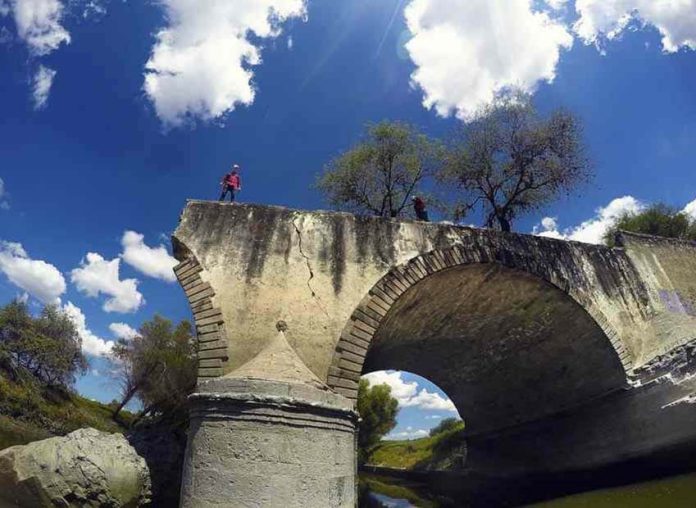
Remains of the old San Rafael Bridge, on San Miguel de Allende's Rio Laja hiking and biking trail.ATV extreme tours
Travel + Leisure magazine calls San Miguel de Allende, Guanajuato, “Mexico’s hidden treasure,” and everyone I’ve spoken to agrees it’s as close to paradise as you’re likely to find on this little old planet.
It is, however, a “town,” and those sanmiguelenses who occasionally get a hankering for “country” may appreciate the advice of local resident Randy Kremlacek, who is one of the leaders of the San Miguel Hiking Group.
“The group has been doing this for at least 20 years,” Kremlacek told me. “In the beginning, hikers showed up at a local gas station at 8 a.m. on Sundays. I joined them because I thought it would be a good way to meet people and to get to know el campo, the countryside. I had zero experience hiking.
“The first time I went with them, we were walking along, and suddenly they started climbing up this mountainside — and I thought: it’s perfectly flat to the left; why are we doing this? So, it took me a while to learn what hiking is all about.”
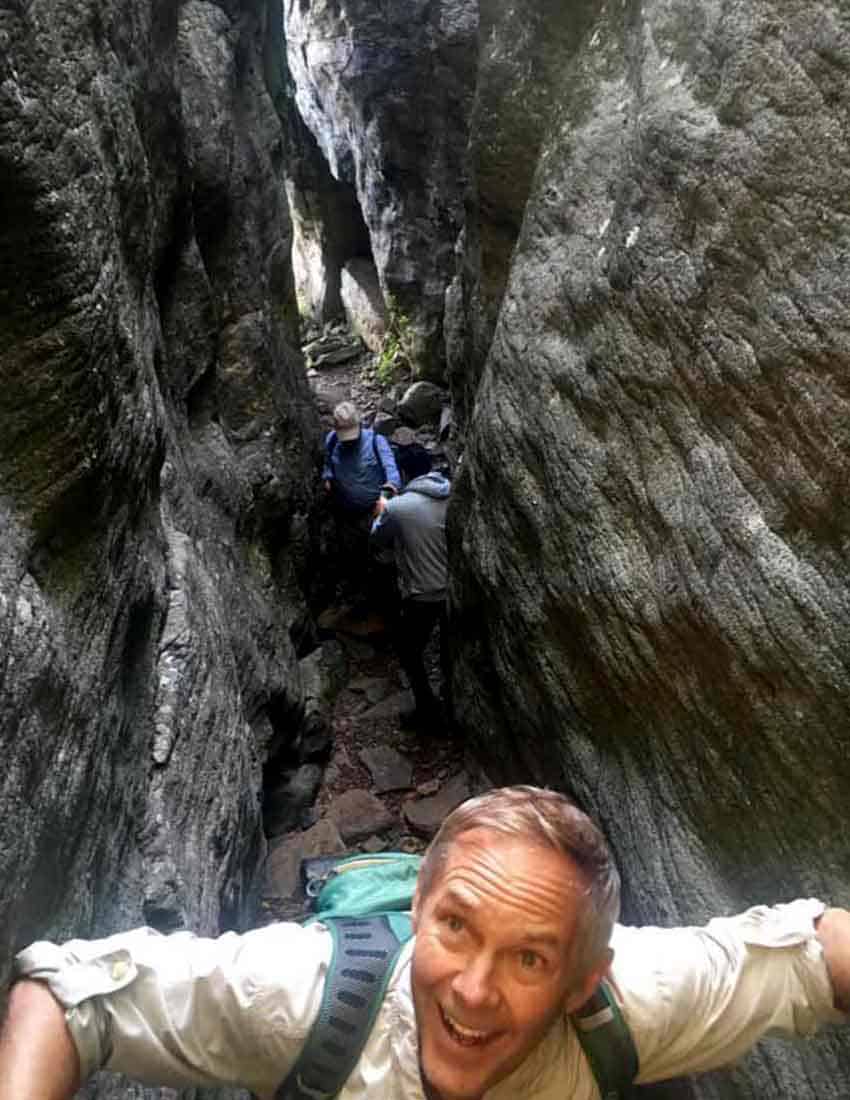
San Miguel de Allende hiker Randy Kremlacek climbing a fissure at Las Cabras, in search of petroglyphs.
Below are descriptions of several hikes listed in San Miguel Hiking Group’s Guide to Walks and Hikesnear San Miguel de Allende. You can download the guide from their English-language website for links to maps, GPS tracks and contacts for local guides.
El Charco del Ingenio
This place is named for a swimming hole near what are claimed to be the ruins of the first mill on the American continent, built in 1561.
“This,” Kremlacek told me, “is a botanical garden located in town, but somehow separate from town because it’s up high and you must cross pasture land to reach it. It’s more of a walk than a hike to me, but it’s a great place for people to get to know the flora and fauna of this area.”
A glimpse of the beauty inside the El Charco del Ingenio, declared a Peace Zone by the Dalai Lama in 2004. LaMorenitaMia
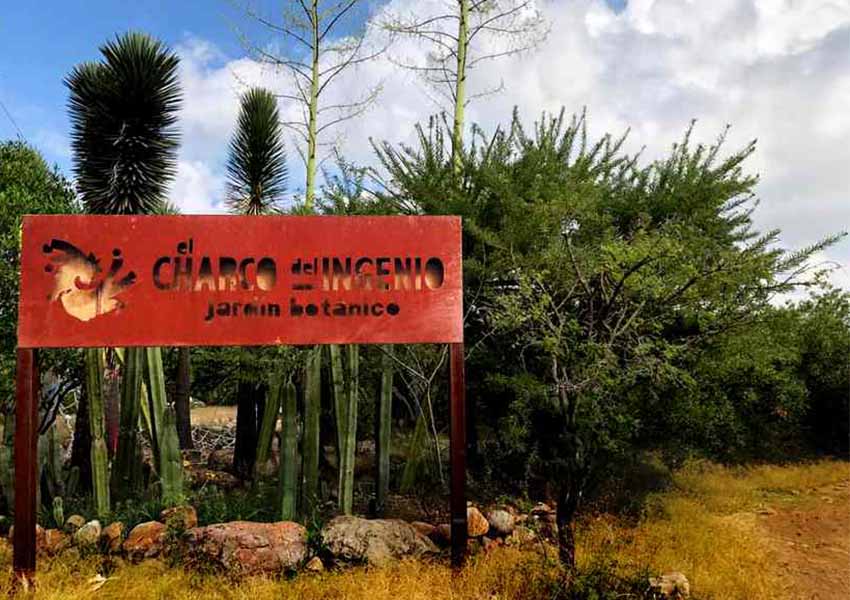
“The botanical garden,” says the unnamed author of an article on the Mexico Desconocido website, “covers 67 hectares and has one of the most complete collections of Mexican cacti and succulents in the world. Many of these have been rescued from little-known areas of Mexico’s deserts and are often rare, threatened or in danger of extinction.”
This collection exists thanks to cactus aficionado Charles Glass, who settled in town in 1993 and then toured the country searching for plants to bring back to El Charco.
In 2004, the Dalai Lama visited the botanical garden and declared it a Peace Zone, a space free of violence and arms.
Parque Landeta
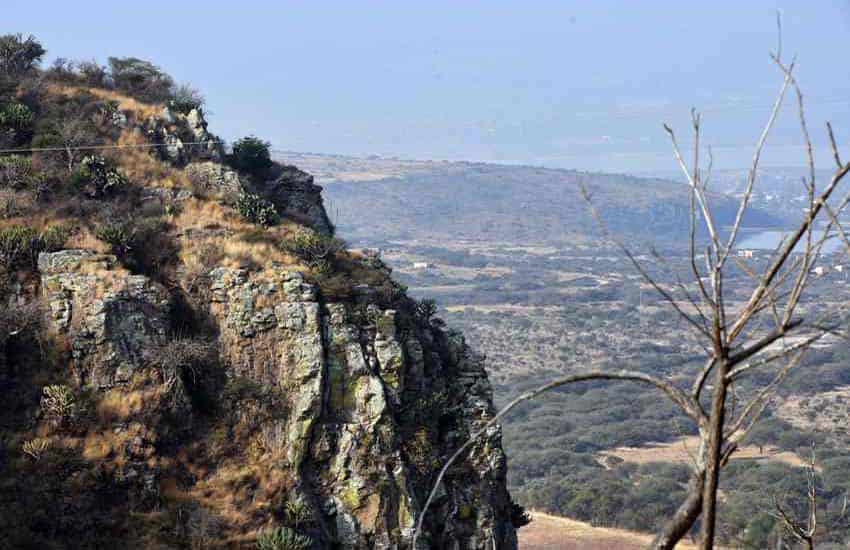
The view from Tres Cruces, a moderate hike of 7 or 8 kilometers. Randy Kremlacek
This is an ungroomed pastoral park, located adjacent to El Charco del Ingenio.
“It makes for a nice loop around the wetlands in the rainy season,” says Kremacek. “In my opinion, it’s more of a dog walk, but it offers a bit of a break from city life because it’s completely wild. It’s nothing spectacular like you’d find outside of town, but you will be getting peace and fresh air. And you almost feel like you are out in the campo (countryside).”
Tres Cruces (Three Crosses)
“This hike,” says Kremlacek, “is also called the Suspension Bridge Hike. When you leave town and head south, there’s a big hill topped by numerous antennas. You have a spectacular view of the city from up there, but if you proceed on to the suspension bridge and zipline area, you cross over that hill, and now you have a view of the presa (the dam) and the Guanajuato mountains in the distance. At first, it’s pretty steep, so it’s a moderate, not an easy, hike — perhaps 7 or 8 kilometers. You’d never know that you are so close to town.”
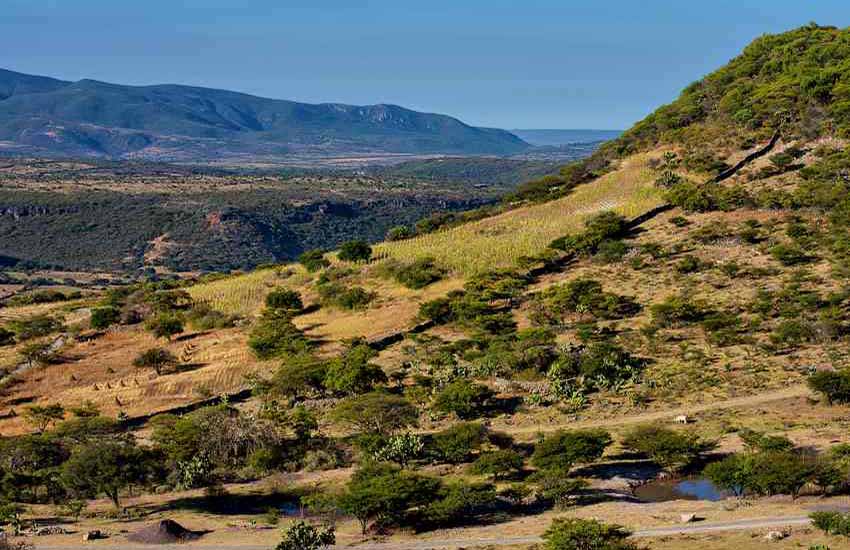
View from the La Joyita campsite, where you can spend the night under the stars. Randy Kremlacek
La Joyita (The Little Jewel)
Kremlacek says this is a beautiful camping area located about 15 kilometers from town. The first 11 kilometers are paved, and the remaining four are what hikers would call “good road,” but what others might consider challenging.
“There’s a family that lives here,” he says, “that has worked with foreigners and has developed a campsite. It’s a great place to spend the night: quiet, little light pollution and there is no music. They have both rough camping and two or three cabins, as well as old Airstream trailers. They also have a rustic full kitchen. Here you have an absolutely stunning view.
“It’s also the only place we hike where you have marked trails. This means you’ll find arrows: red for one trail, blue for the other, nothing fancy. To hike, you just show up and go for it. For camping, it would be a good idea to call and make a reservation: 415 153 7092.”
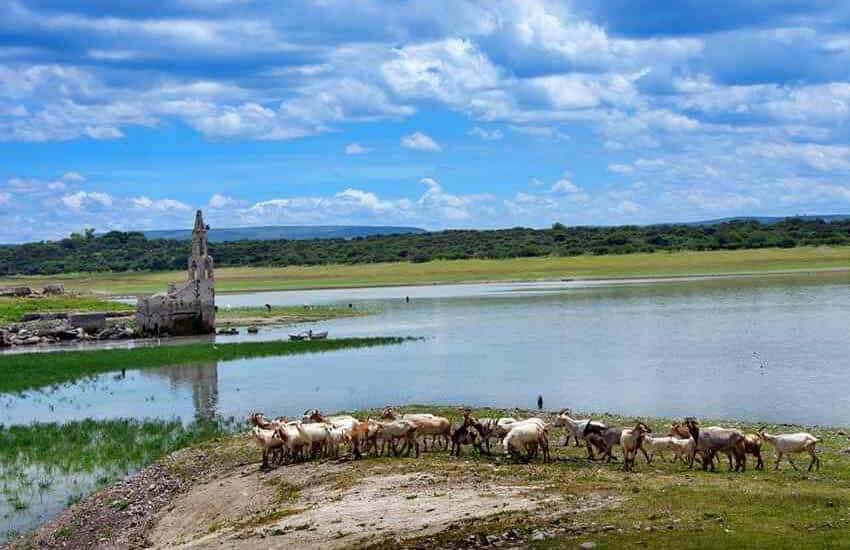
A chapel inside the Allende dam. This is also a great place to see water birds. Randy Kremlacek
Presa Allende (Allende Dam)
The dam was built in 1967 to provide water for irrigation and is fed by the Laja river. A small community of indigenous Otomí was forced to relocate, their houses swallowed up by the artificial lake.
Says Kremlacek: “One thing people go to see is the Capilla, or Sunken Church. Depending on the water level, it’s barely visible to totally accessible. Unfortunately, it’s brown water, polluted by runoff from the agribusinesses, and right now, it’s half covered with water hyacinth.”
It’s possible to walk to the ruins, says Kremlacek, but a beginner hiker would need someone to lead him to the spot. “If they are familiar with programs like Wikiloc or Alltrails, they can do it,” he says, “but otherwise, they’re going to need someone to show them where it’s at.”
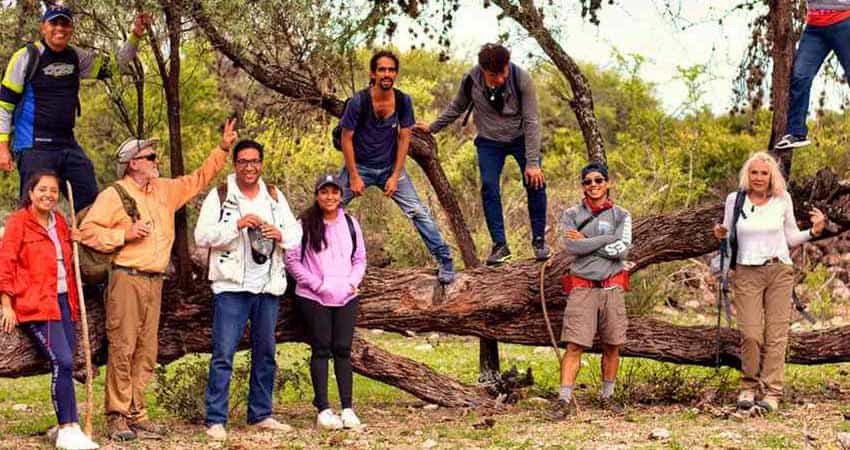
Members of the San Miguel Hiking Group doing what they love to do on Sundays.
The land is perfectly flat, however. “The challenge here is that in the wet season, there’s a lot of growth,” he says, “but it’s beautiful, and there are lots of birds to see. The presa is just full of them, and it’s very green all year long.“
Río Laja (The Laja River)
The Rio Laja Trail is a walking and biking trail that follows the banks of the Laja river from the Allende dam for a distance of 51.9 kilometers. The trail is based upon footpaths that have been established by rural residents over many years.
It’s a great place for getting exercise, enjoying the peace and beauty of nature and viewing birds. It’s such a nice place, in fact, that the Audubon Society has published a Río Laja Trail Guide consisting of 12 printable PDF files with descriptions, waypoints and photos of each stretch of the route.
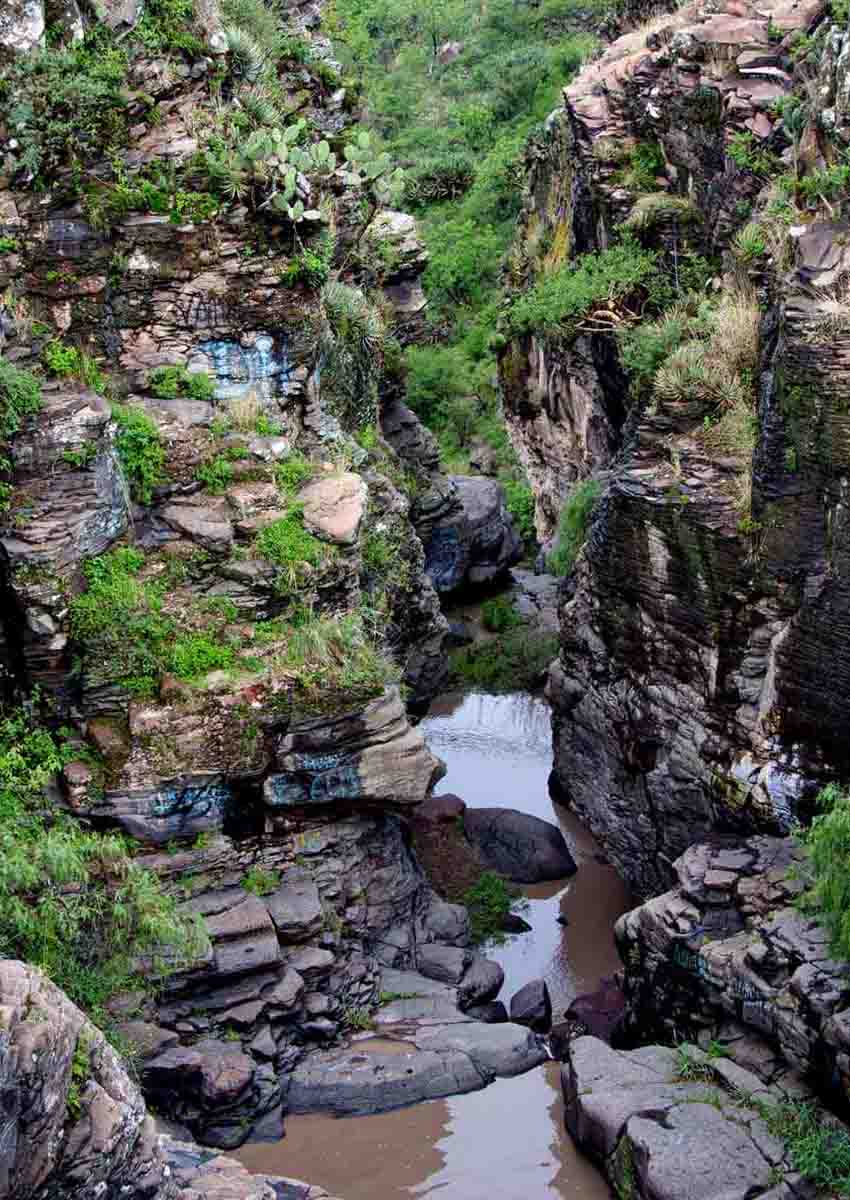
Detail of a picturesque stream at Tres Cruces. Randy Kremlacek
After a long day of hiking, you are bound to work up quite an appetite. Knowing that Randy Kremlacek is co-owner of Venencia Restaurant in San Miguel de Allende, I asked him what from his menu he would recommend to a hungry hiker.
“We are the authentic Oaxacan restaurant in San Miguel,” Kremlacek told me. “After a hard day of hiking, people might enjoy our tlayuda (also called clayuda).”
Here is Kremlacek’s description of a tlayuda “for the ears of a foreigner.”
“Imagine the thinnest pizza crust possible, with only Mexican ingredients on top. So it’s a paper-thin tortilla, griddled until it’s brittle, covered with black-bean paste and then a variety of toppings. It comes to your table in a big flat comal, or griddle pan, and you just snap pieces off. It’s an ideal communal food. Four of you can eat out of the same dish.”
The entrance to the Charco del Ingenio botanical garden, which boasts one of the world’s best collections of Mexican cacti and succulents. Linkogecko
This may be the perfect way to end a day hiking outside the gates of paradise.
What do you think? Have you hiked any of these trails? Any you would you recommend? Let us know in the comments.
The writer has lived near Guadalajara, Jalisco, since 1985. His most recent book is Outdoors in Western Mexico, Volume Three. More of his writing can be found on his blog.
The abuelitas in their limo on the way to the party. Facebook / Hada Madrina Ari Falcon
A group of grandmothers in Reynosa, Tamaulipas, had a dream come true this past week when they celebrated the quinceañera, or 15th birthday party, that they were unable to have when they were younger.
The women, who came from poor backgrounds and whose families were unable to provide them with this traditional celebration when they were teenagers, were able to fulfill the dream of dressing like a princess and dancing the night away thanks to Ariana Falcón.
Falcón, now known as Reynosa’s “fairy godmother,” has been organizing quinceañeras for girls whose families either don’t have the money for a big, fabulous party or are unable to for a different reason. Many of the young girls she has worked with have serious chronic or terminal illnesses.
It started with Falcón’s own quinceañera, which she said was possible only with the collaboration of friends and families who donated food, music, and even make-up and hair services, as her family wasn’t able to afford it on their own. She later loaned her quinceañera dress — known for their elaborateness and fairy princess-like esthetic — to another girl that didn’t have one, then later she gave it away to a different girl.
Falcón has been working the last 10 years to organize parties for girls who wouldn’t get them otherwise and has helped to host over 200 events.
This past week was the opportunity for 14 older women who were never able to fulfill their dream to enjoy the splendor of a 15th birthday party.
¡Sueño hecho realidad! ❤️
14 abuelitas festejaron sus XV años con pastel, mariachi y hasta limusina en Reynosa, #Tamaulipas, gracias a las hadas madrinas que apoyan el proyecto “Cumpliendo un sueño”. pic.twitter.com/j4y0eO7o0s
A television news channel shared footage of the festivities.
“I woke up so excited for something marvelous, it’s truly like a fairy tale movie. I mean at this age, none of us would have imagined having a party like this,” said Oralia González, one of the women celebrating.
The party included food, music, gifts and even a limousine, all donated by members of the community within Falcón’s network of “fairy godmothers.”
“Each one of them has a history of something hard, like diabetes, leukemia, so today is the moment to have fun, I believe each of them deserves to be treated as a queen,” said Falcón.
The automotive manufacturer Tesla has struck a deal with business-friendly Nuevo León to have its own private lane at a Mexico-U.S. border crossing. A bit like a fast track security checkpoint at the airport, the lane is solely for companies that work with Tesla and the automaker’s employees.
Tesla now has six different companies providing parts for its vehicles in Mexico, including EnFlex Corp., Quanta Computer, Faurecia SE, ZF Friedrichshafen AG and APG Mexico. State authorities say the new exclusive lane will make border crossings more efficient and faster, even though there is no similar exclusive lane on the U.S. side of the border.
Neither Tesla nor the state of Nuevo León seem to think a lane for a single company is a problem, with Economy Minister Ivan Rivas adding that in the future “… maybe there will be lanes for other companies …”
Tesla’s private lane is at the Colombia Solidarity International Bridge, a lesser known crossing north of the Laredo, Texas, crossing (which is one of the busier ones). Bloomberg News reports that neither Tesla nor state officials responded to requests for comments so it’s unknown what the manufacturer offered in exchange. But Nuevo León is building its electric vehicle industry, which Rivas says will provide 5-7% of the state’s investments this year.
Despite a heavy presence in Mexico, Tesla founder Elon Musk continues to insist “Teslas are the most made-in-USA vehicles.” The company is No. 1 on the Cars.com 2022 American-Made Index that ranks car companies on how much of their production and manufacturing takes place inside the United States.
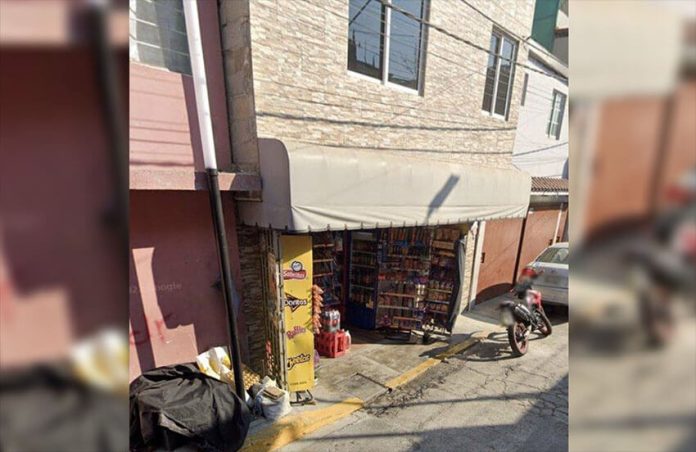
The incident took place at a convenience store in the San José Aculco neighborhood of Iztapalapa. Google Maps via Noticias Iztapalapa
When three teenagers went to a store in Mexico City to collect 2,500 pesos (US $122) in protection money this week, things turned ugly and a 16-year-old boy tending his family’s convenience store ended up getting shot and killed.
The tragic story was reported in the newspaper El Universal and on the digital media site Plumas Atómicas.
Monday evening, according to the reports, the juvenile henchmen arrived by motorcycle at the abarrotes store in the CDMX borough of Iztapalapa, in the San José Aculco neighborhood adjacent to the Central de Abastos market.
At the counter was Daniel, 16, a high school student who often helped out in his spare time; his mother was nearby.
When the young hoodlums demanded he hand over the money and showed a weapon to emphasize their point, a frightened Daniel ran to get away, either toward the backyard or into the house, depending on which report is to be believed. However, the teens chased after him and fired indiscriminately, hitting Daniel, his 65-year-old grandmother and his uncle.
The grandmother, who was hit by a bullet in the leg, and the uncle survived, but Daniel died Tuesday at 4 a.m. in the Moctezuma Pediatric Hospital.
The assailants fled by motorcycle to an awaiting Renault car with license plates from México state. Images captured by security cameras helped the police arrest the alleged perpetrators: Azael, 14; Darwin, 15; and Yosvani, 16. Two of them were said to be residents of Nezahualcóyotl in the state of Mexico, while the oldest reported he lives in Iztapalapa.
According to Plumas Atómicas (Atomic Pens) — which deems itself a community of young writers writing for young readers — none of the arrested youths go to school or have a legitimate job, and all were carrying firearms. El Universal reported that Azael and Darwin were released because they’re too young to be charged, and Yosvani was taken to the prosecutor’s office for juvenile crimes.
Azael allegedly told police that an acquaintance had sent them to collect money from the store. He also allegedly said that his mother has been in prison in the state of Hidalgo for six years for robbing a pharmacy.
The cartel appears to have threatened to kidnap the influencer if they see him in Guadalajara "or anywhere else," in retaliation for blocking traffic in their territory. Instagram @mr.fofomqz
The Jalisco New Generation Cartel (CJNG) has threatened to kidnap a social media influencer who earlier this month boasted about shutting down traffic on a busy Guadalajara bridge.
Rodolfo “Fofo” Márquez and unidentified accomplices blocked all three lanes of the Matute Remus bridge in the Jalisco capital by parking luxury cars across them. “Look, I closed … [the bridge] just for me, showing once again what money and power can do in Mexico,” he said in a TikTok video.
Márquez later apologized for his actions, but his expression of remorse apparently didn’t placate the CJNG. In a social media message that was purportedly written by the cartel but whose authenticity has not been confirmed, the CJNG called Fofo “scum” and condemned his stunt on the Guadalajara bridge.
“It’s an act that we don’t tolerate,” the cartel said, adding that it would never allow an “asshole like this to come [to Jalisco] to do these kinds of things.”
Circula entre la ciudadanía tapatía y distintas redes sociales el siguiente mensaje dirigido a fofo Márquez #guadalajara#CJNG#Zapopan Influncer altanero afectando el tránsito en una vía rápida pic.twitter.com/bL7JWgKnL9
— 🇲🇽De Jalisco Para El Mundo🇲🇽 (@BambynoRs) July 18, 2022
A screenshot shows the threat published by a group supposedly affiliated with the CJNG.
“We’re the ones who are in charge in Jalisco and all of Mexico,” the message said before warning Fofo to be careful.
“We won’t allow you to come to Guadalajara thinking that you can do what you want. Here in Jalisco ‘El Mencho’ is in charge,” the cartel said in reference to its leader Nemesio Oseguera Cervantes.
The CJNG then warned Márquez that it would abduct him if it saw him in Guadalajara or anywhere else, and that his money would be of no use to him. “Not even all the money you have will help you,” the cartel told Márquez, who claims to be the heir to a significant fortune.
The message was posted by a social media account that operates under the name Gente con la gente NG, or People with the NG (New Generation) people.
It's the first strike since the company was privatized by billionaire Carlos Slim.
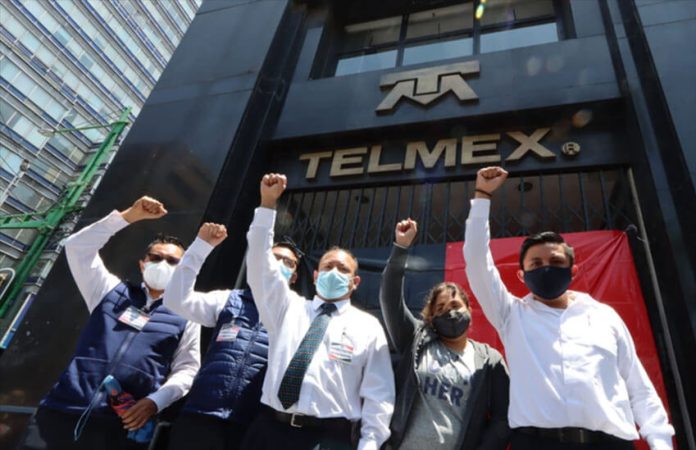
Telmex, one of the largest internet, phone and television providers in Mexico, is guaranteeing that its services will not be affected by a strike of its workers that might head into the weekend.
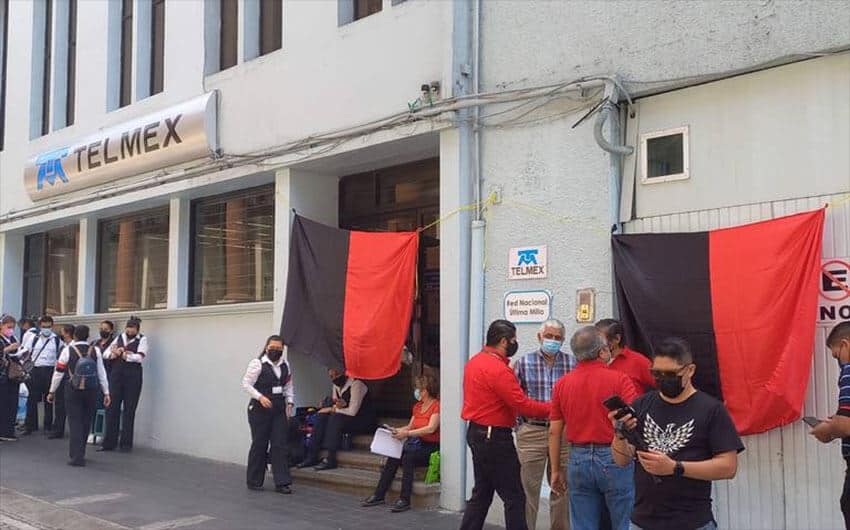
Owned by Carlos Slim and based in Mexico City, the company was hit by a strike at noon Thursday when thousands of members of the Telephone Operators Union of the Mexican Republic (STRM) placed red and black flags in their offices, branches, maintenance sites and service centers.
They are alleging a violation of their collective bargaining agreement with Telmex, which has never had a strike since it was privatized in 1990. The last strike was in 1985 when Teléfonos de México (Telmex) was still a state company.
The main issue, union leaders say, is that the company has failed to fill vacancies created by the retirement of workers, which puts a major strain on current workers trying to fill the void. For three years, the union says, Slim’s company has left up to 2,000 job openings unfilled.
Carlos Slim (center) in 2017, chatting with then-president Enrique Peña Nieto and actor Leonardo DiCaprio.
“We are fighting and we are going to defend our rights,” the union said on Twitter. STRM, which represents some 26,000 active workers and more than 30,0000 retirees, alleged other misdeeds by Telmex, including “coercive measures such as withholding wages, and [retirement] benefits, [and] physical and verbal attacks.”
Telmex is a subsidiary of the América Móvil corporation, which is owned by Slim, the Mexican tycoon whom Forbes says is worth US $81.5 billion. Forbes lists “Carlos Slim Helú and family” at No. 12 on its list of global billionaires.
A potential earlier strike was put on hold after the parties reached an agreement in early June to review the collective bargaining agreement. At that time, Telmex promised to increase the salary of active and retired workers by 4.5%, according to news reports.
But union leadership said a hiring freeze has led to 1,942 vacant jobs, and that Telmex wants to put an administrator in charge of personnel who are about to retire and to modify a clause that outlines retirement benefits.
Telmex workers in offices across the country stopped serving clients midday on Thursday when the strike began. Pictured: a Telmex branch in Xalapa, Veracruz.
For its part, according to the newspaper Reforma, Telmex is claiming that the financial viability of the company is being hurt by older workers and retirees.
Telmex has been shrinking in recent years while Telcel, a cellphone company also owned by Slim, has grown, Reforma reported. Telcel has another union and a different employment contract, so it is not being affected by the strike, Reforma added.
Telmex has 11.1 million landline phone customers and 10.1 million internet subscribers, Reforma reported. It also offers packages with satellite TV and/or video streaming options.
The company, which said it’s willing to continue negotiations, put out a statement about its service: “Telmex guarantees the quality and continuity of all its telecommunications services thanks to its state-of-the-art technology, which allows it to have a network that operates autonomously.”
According to reports, users waiting in Telmex branches at midday on Thursday were no longer served as soon as the red and black flags went up. However, those who were calling in to set up a new phone line and/or internet service were assisted by Telmex operators.
The Labor Ministry quickly stepped into the fray, suggesting a way to get both sides to the bargaining table that would involve Labor Minister Luisa Alcalde acting as mediator. On Thursday, Alcalde posted on Twitter that “progress is being made” and expressed hope that an agreement would be reached on Friday, followed by a union vote that would end the strike.
Reuters reported early Friday that President Lopez Obrador said he expects a deal to get done later Friday or on Saturday. “[Carlos Slim] has told me that [Telmex] has come out ahead of competitors because of its workers. So I think they will reach an agreement,” Lopez Obrador told reporters in his daily news conference.
The president chuckles as he plays the song "¡Uy, qué miedo!" by Chico Che at Wednesday's news conference. Youtube screenshot
United States Ambassador Ken Salazar and the Canadian Chamber of Commerce in Mexico (Cancham) have advised Mexico to take energy policy objections seriously.
Both the United States and Canada have requested consultations under the United States-Mexico-Canada Agreement (USMCA), the free trade pact that took effect in 2020. They believe that policies that favor the Federal Electricity Commission and the state oil company Pemex unfairly discriminate against foreign companies that operate in Mexico’s energy sector.
In announcing the U.S. request for consultations, the Office of the United States Trade Representative complained about “Mexico’s delays, denials, and revocations of U.S. companies’ abilities to operate in Mexico’s energy sector” and asserted that “Mexico’s policy changes threaten to push private sector innovation out of the Mexican energy market.”
President López Obrador on Wednesday displayed flippant disregard for the U.S. request, going so far as to mock it by playing a song at his morning news conference whose title translates to “Oh, How Scary.”
President López Obrador with U.S. Ambassador to Mexico Ken Salazar.
“The consultation mechanism is a fundamental element of USMCA that benefits all three countries by enabling us to quickly resolve disputes,” he wrote. “We must approach this USMCA energy dispute with determination and seriousness for an expeditious resolution.”
For his part, the vice president of Cancham’s energy committee said that “Mexico must attend the consultations request with all seriousness.”
Carlos de María y Campos added that the consequences of not reaching agreement during the consultation phase could be very serious. If there is no resolution, the United States and Canada could seek the establishment of dispute panels to deal with the matter. If they fail to achieve the outcome they seek, the two countries could ultimately impose punitive tariffs on Mexican imports.
“The impact [the dispute] could have on the economy is nothing to laugh about,” said de María y Campos.
López Obrador pledged Thursday that the government would defend its energy sector policies, noting that, despite its close trade relationship with the U.S. and Canada, it has the right to make its own decisions about domestic matters.
Foreign Affairs Minister Marcelo Ebrard said Thursday that the government was already putting together a team to defend Mexico’s policies in the face of the challenge. “We’re going to be prepared and we’re going to defend our arguments,” he said in a video posted to Twitter.
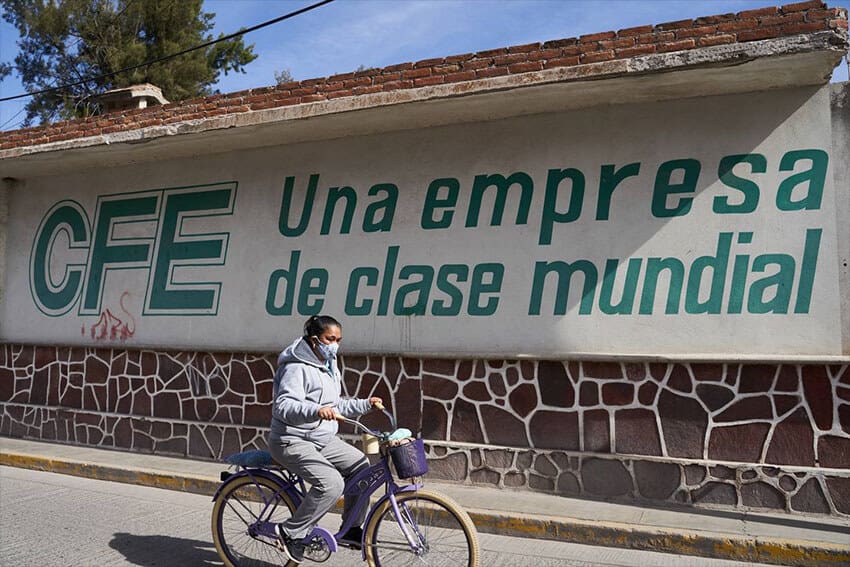
A spokesman for CFE — which is at the center of the dispute as the result of a law that gives the energy it generates priority on the national grid — asserted that Mexico’s policies don’t violate the USMCA. Luis Bravo said that CFE’s position is exactly the same as that of the president. “The agreement isn’t being violated and that’s what will be proven” during the consultations with the United States and Canada, he said.
The question of whether the state-owned Federal Electricity Commission (CFE) has a competitive advantage over foreign companies is at the center of the trade dispute.
Kenneth Smith Ramos, Mexico’s chief USMCA negotiator through 2019, said in an interview with Bloomberg that resolution during the 75-day consultation period was unlikely.
“This looks very difficult to be resolved during the consultation period because the violations are so precise, specific,” he said. “Mexico would need to completely overhaul two pieces of legislation that are essential to AMLO.”
If no resolution is reached and Mexico loses the dispute due to a panel decision, the United States and Canada can impose tariffs equal in value to the losses companies from those countries have incurred, Smith said. Ildefonso Guajardo, a deputy who was economy minister in the 2012-18 government led by Enrique Peña Nieto, said the same in an interview with journalist Carmen Aristegui.
United States officials have spoken of losses of between US $10 billion and $30 billion, meaning that Mexican exports to the U.S. could be subject to tariffs within that range. Canadian tariffs would further hurt Mexican exports. BloombergNEF, a strategic research provider, has calculated that Mexico’s energy policies place at least $22 billion in private investment at risk.
According to Smith, the dispute could potentially be one of the most expensive trade spats since NAFTA, the predecessor to USMCA, took effect in 1994. Guajardo, who as economy minister also had a central role in the negotiation of USMCA, noted that farmers and auto sector manufacturers — both of which are large exporters — could end up paying the price for the discontent generated by Mexico’s energy sector policies.
Luis de la Calle, a former deputy economy minister, said that Mexico’s ability to take advantage of the current global economic conditions could be jeopardized by the trade dispute. He told Bloomberg that the re-routing of supply chains from Asia amid disrupted global shipping networks could boost Mexican exports by billions — over US $35 billion annually, according to the Inter-American Development Bank — but the trade dispute places some of that at risk.
De la Calle said that economic problems in Europe and China have made North America the “most competitive region in the world” right now, and that if there is no resolution to the dispute “the main cost” would be not taking advantage of “the international context that tremendously favors North America.”
Smith described the situation in blunt and evocative terms. “We are watching a potential train crash between the U.S., Mexico and Canada,” he said.
The judge granted an amparo, or protective order, that will allow the marriage to proceed. deposit photos
A polyamorous threesome in Puebla has filed for the right to be married, and the man in the trio, who is the main plaintiff in the case, received a favorable judgement from a local judge.
The attempt to form a “plural family,” or marriage with more than one partner is not legally recognized in Mexico, despite efforts by the LGBTQ+ community to decriminalize this type of living arrangement.
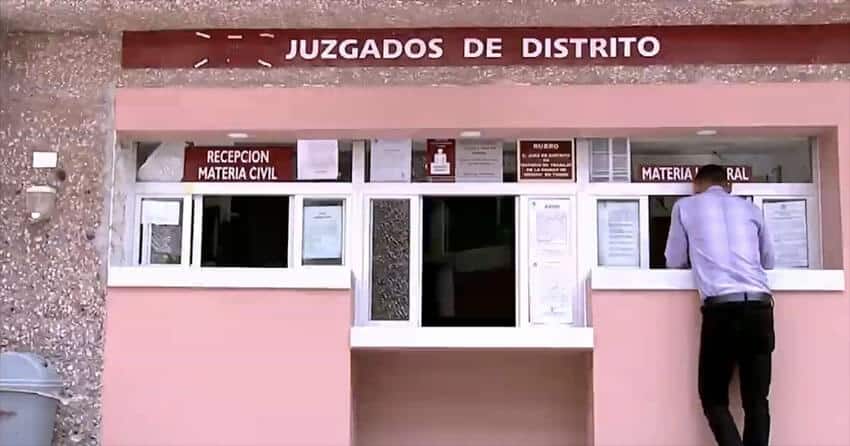
A judge in Puebla’s Eighth District Civil Court ruled in favor of the complainant who filed the suit in protest against articles of Puebla’s civil code, which lay out the state’s legal definitions of marriage and partnership. The plaintiff was awarded an injunction that will allow the marriage to proceed.
The judge ruled that the articles of the civil code were in fact discriminatory because they stated that marriage or partnership could only exist between two people and that they didn’t take into account the possibility of other “sexual orientations like polyamory.”
The case was decided in a Puebla district court. Consejo de la Judicatura Federal
The judge went on to say that authorities have the obligation to promote, respect, protect, and guarantee human rights in accordance with the principles of universality, interdependence, indivisibility and progressiveness.
“In terms of norms, there exists a kind of indirect discrimination,” the judge said, “which happens when the norms and practices appear neutral, but it turns out that their content or application translates into disproportionate effects on people or groups in different situations because of their sexual orientation, like polyamory, without providing an objective and reasonable justification [for those effects].”
The judge said that he could find no constitutional reason why marriage should only be between two partners.
Contesting the law in these kinds of cases has become more common in the past several years, like the case brought by a lesbian couple in Durango last year who petitioned to officially marry the ex-partner of one of the women, who was also the father of their children, in an attempt to raise their children together as a threesome.
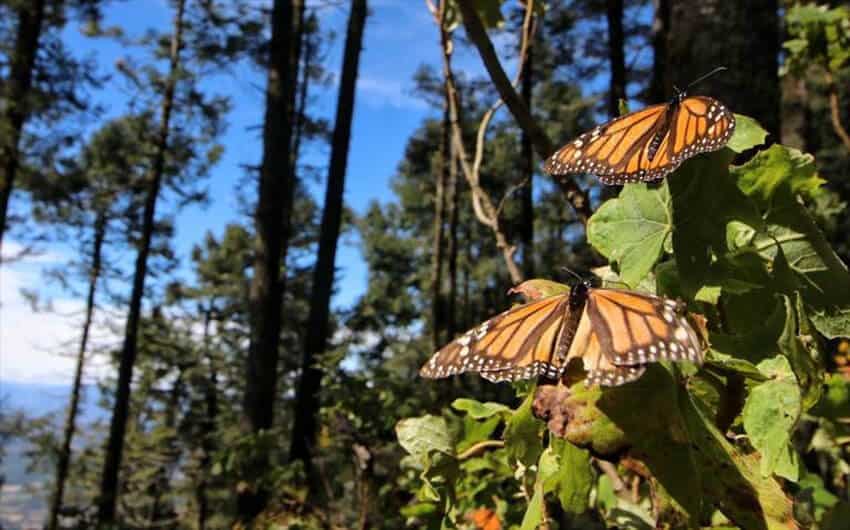
Efforts to plant native milkweed, reduce pesticide use and participate in community science networks provide hope that the species could recover, one expert said. IUCN / Joe Schelling
The migratory monarch butterfly, which overwinters in fir forests in Michoacán and México state, has been classified as endangered by the International Union for Conservation of Nature (IUCN).
It said that the monarch, which travels thousands of kilometers from the United States and Canada to spend winters in the comparatively mild climes of central Mexico, is threatened by habitat destruction and climate change.
IUCN said the population of the now-endangered migratory monarch butterfly – a subspecies of the monarch butterfly (Danaus plexippus) – has declined by between 22% and 72% over the past decade.
Butterflies at El Rosario sanctuary in Michoacán, where conservationists have come up against organized crime, illegal logging and possible corruption.
“Legal and illegal logging and deforestation to make space for agriculture and urban development has already destroyed substantial areas of the butterflies’ winter shelter in Mexico and California, while pesticides and herbicides used in intensive agriculture across the range kill butterflies and milkweed, the host plant that the larvae of the monarch butterfly feed on,” the organization said.
“Climate change has significantly impacted the migratory monarch butterfly and is a fast-growing threat; drought limits the growth of milkweed and increases the frequency of catastrophic wildfires, temperature extremes trigger earlier migrations before milkweed is available, while severe weather has killed millions of butterflies.”
UICN also said that western migratory monarch butterflies, which overwinter in California, are at greater risk of extinction than eastern ones, which migrate to Mexico. The population of the former declined by an estimated 99.9% between the 1980s and 2021, with numbers falling to just 1,914 from as many as 10 million.
The size of the larger eastern population shrank by 84% between 1996 and 2014, UICN said. “Concern remains as to whether enough butterflies survive to maintain the populations and prevent extinction.”
One positive is that the number of monarch butterflies overwintering in Mexico increased 35% last winter, according to the World Wildlife Fund and the National Commission of Natural Protected Areas. However, numbers were still well below those recorded in previous years.
Anna Walker, a member of IUCN’s butterfly and moth specialist group who led the monarch assessment, said that it’s “difficult to watch monarch butterflies and their extraordinary migration teeter on the edge of collapse.”
However, she added that “there are signs of hope” given that “so many people and organizations have come together to try and protect this butterfly and its habitats.”
“From planting native milkweed and reducing pesticide use to supporting the protection of overwintering sites and contributing to community science, we all have a role to play in making sure this iconic insect makes a full recovery,” Walker said.