Home Blog Page 996

Expat artist’s sketching lets her discover the Mexico around her

0
Susan Dorf artist in Patzcuaro
Susan Dorf in Patzcuaro, Michaocán, where she currently lives and sketches. Timothy Scott

“Most people kind of get the basics of learning to draw and see it almost as an addiction,” says Susan Dorf, an urban sketcher and art teacher in Pátzcuaro, Michoacán. “When you’re sketching, you drop into that deeper place which is sort of meditative.”

Dorf has been meditating and sketching in Mexico for the last 10 years, and it has meant a whole new palate and landscape.

“I like to see what’s up close, what’s far away, how can I bring that all together,” she says describing Mexican markets, whose swirling movement and vibrancy inspire her work. “I like to be in the middle of life and what’s happening.”

Dorf has been teaching sketching, drawing and painting for 12 years, and she’s learned that the hardest thing to get over when you start to draw is, basically, yourself.

“The main thing to overcome is judgment and fear,” she says, “So, when I can get people into a place where they can be neutral, so that not only are they not feeling judged or criticized but I’m also not praising them either, there’s a sense of not having to live up to anything.”

cops in Patzcuaro eating ice cream
Dorf’s observations sometimes catch unexpected little moments, like these Mexican police officers taking an ice cream break on the street.

“If it’s perspective or scale, it’s all the same; it’s learning to see — you are basically exercising your eye and your mind and your hand to coordinate. And if you’ve not done that, it’s really awkward, but if you practice, you get more comfortable. You’re learning how to see things in a way that is different from just glancing at it or recording a symbol of it. You’re slowing down to really see it.”

Dorf is a believer in sketching the landscape around her and the people in it: when she lived in San Miguel de Allende, she was a constant fixture, recording life in a city that is both very traditional and yet also changing rapidly due to the near-constant demand for new construction.

She even got a gig doing urban sketching for the local weekly newspaper, Atención San Miguel, a job which continues today even though she no longer lives in the city.

People have always drawn, from cave walls to prestigious arts schools, but the current Urban Sketchers movement that Dorf is part of was started in 2007 by Spanish journalist Gabriel Campanario, who started sharing his drawings online.

In 2009, Campanario formed the Urban Sketchers International nonprofit, a group that unites sketchers all over the world and that offers “chapter” affiliation for groups like the one that exists in San Miguel de Allende.

Dorf’s teaching helped to form the chapter, and many current group members have taken her workshops.

In Dorf’s experience, urban sketching seems to have a particular draw for middle-aged people and retirees; her students are often recent empty nesters or older expats. Urban Sketcher group members meet up to sketch where they live or sometimes travel together and sketch on the road – it’s an easy hobby to take with you wherever you go.
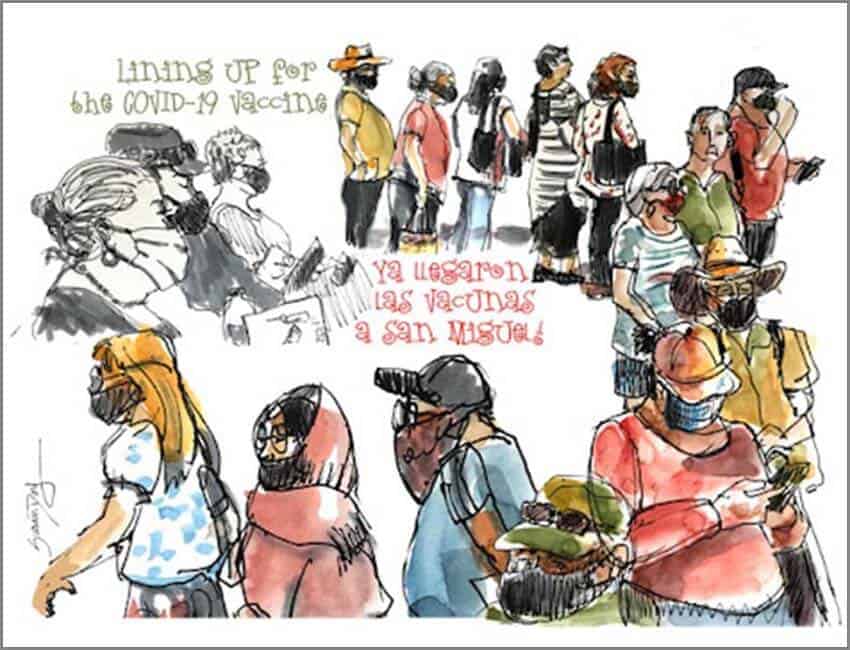
Susan Dorf drawings
Artist Susan Dorf’s take on a mass vaccination day for COVID-19 in San Miguel de Allende, Guanajuato.

“It’s a phenomenon really, it just kind of became that, because it’s so portable. When I go out, I have this little bag and it fits in my purse or my day pack, and when people are traveling, it’s the perfect thing,”

For someone like Dorf, who loves movement and life (she often sketched parades and protests in San Miguel), COVID restrictions completely changed her drawing life.

Fewer people out and about, as well as ubiquitous face mask requirements, meant she turned to sketching architecture and nature and found herself taking long walks alone to sketch the city as it slumbered in quarantine.

These days, you can find Dorf in her new home, Pátzcuaro, Michoacán, and as COVID restrictions ease, she’s teaching sketching once again to visitors and locals there. Her sketches can still be found printed in Atención San Miguel, and she’s recently published a book of her work.

Her newest plans involve sketching local artisans.

“Every village kind of has its own craft, and I’m interested in going to visit them and doing little drawings of them — writing about them and doing these kind of graphic reportage pieces about the people who are here.”

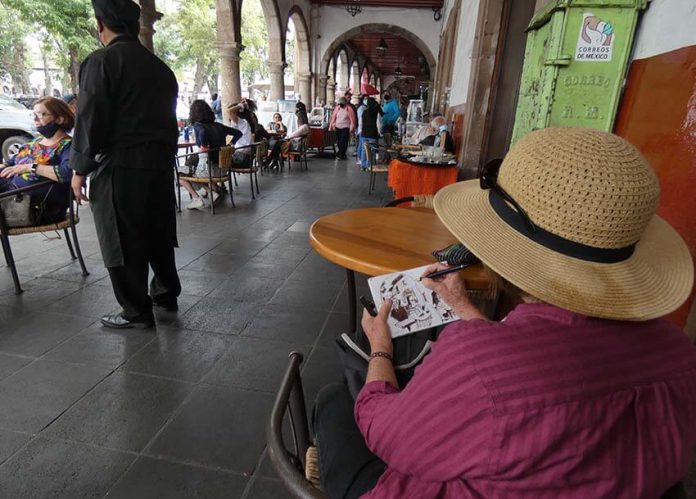
Artist Susan Dorf sketches
Dorf’s latest project is documenting Michoacan’s small towns and the artisans there.

For Dorf, sketching is a way to both be part of the action of a scene and yet keep a kind of journalist’s distance, allowing sketchers to be both participant and archivist. And if you think that after years of teaching and creating, sketching would lose this transformative force, Dorf insists that the experience is always fresh, no matter what the scene.

“As soon as I feel that I’ve got [something] down, then I am going to throw a wrench in the works and make it more difficult,” she adds with a laugh.

To learn more about Susan Dorf and her art, visit her website or her Facebook page.

Lydia Carey is a freelance writer and translator based out of Mexico City. She has been published widely both online and in print, writing about Mexico for over a decade. She lives a double life as a local tour guide and is the author of Mexico City Streets: La Roma. Follow her urban adventures on Instagram and see more of her work at www.mexicocitystreets.com.
Will train travel be a big part of Mexico’s future? Morena lawmaker thinks so

0
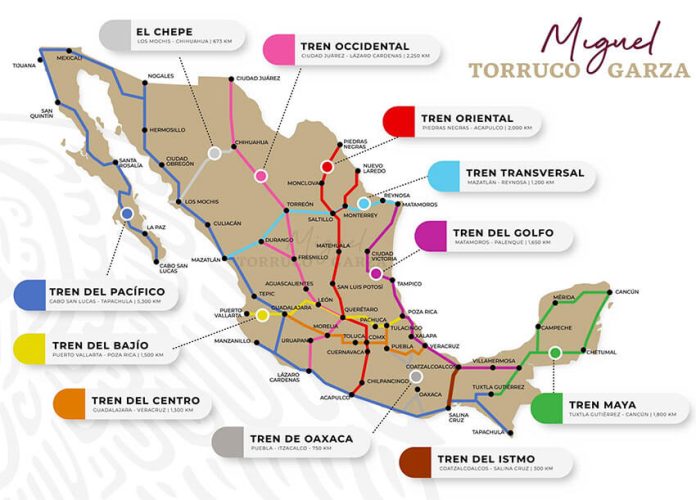
Miguel Torruco's 11 train routes.

There are currently only three passenger train services in Mexico, excluding commuter services such as those that run on the Suburban Train railroad in the greater Mexico City area.

But by 2050 there could be 11 interconnecting services if all the new routes proposed by a ruling party lawmaker are built.

Miguel Torruco Garza, a deputy with the Morena party and son of federal Tourism Minister Miguel Torruco Marqués, published a map to his Twitter account earlier this year that showed existing and possible routes for passenger trains.

“We’re close to making this a reality and returning passenger trains to our Mexico,” Torruco tweeted above his “map of passenger trains in Mexico 2050.”

The lawmaker said Monday that he had presented an initiative in the lower house of Congress that called for the recovery of Mexico’s passenger train system, which fell by the wayside after privatization in the 1990s. He also published a second, slightly different rail map to his Twitter account.

Railroad booster Torruco.

Among the 11 routes on Torruco’s latest map is an existing one and two others that encompass sections of track on which tourist trains currently run.

The three services that currently operate in Mexico are El Chepe, as the Chihuahua-Pacific service between Chihuahua city and Los Mochis, Sinaloa, via the Copper Canyon is known; The Tequila Express, which links Guadalajara to the town of Tequila, Jalisco, the birthplace of Mexico’s most famous tipple; and the Tijuana-Tecate service in Baja California.

According to the map published by Torruco, the Guadalajara-Tequila service would be encompassed within a longer passenger service from Poza Rica on the Gulf coast in Veracruz to Puerto Vallarta on the Pacific coast in Jalisco. The 1,500-kilometer Bajío Train line would run through cities such as Pachuca, Querétaro, León and Guadalajara.

Similarly, the Tijuana-Tecate service would become a small section of the proposed 5,300-kilometer-long Pacific Train line, which would link Cabo San Lucas, Baja California Sur, to Tapachula, Chiapas, via cities including La Paz, Tijuana, Mexicali, Hermosillo, Mazatlán, Tepic, Zihuatanejo, Acapulco and Puerto Escondido.

The other routes featured on Torruco’s map are the Central Train line from Guadalajara to Veracruz city; the Oaxaca Train line from Puebla to the Oaxaca coast via Oaxaca city; the Isthmus (of Tehuantepec) Train line between Coatzacoalcos, Veracruz, and Salina Cruz, Oaxaca; the US $10 billion Maya Train railroad, which is currently under construction and will link cities and towns in five southeastern states; the Gulf Train line from Matamoros, Tamaulipas, to Palenque, Chiapas; the Transversal Train line from Mazatlán, Sinaloa, to Reynosa, Tamaulipas; the Eastern Train line between Piedras Negras, Coahuila, and Acapulco, Guerrero; and the Western Train line between Ciudad Juárez, Chihuahua and Lázaro Cárdenas, Michoacán.

The federal government has outlined plans to run passenger services on sections of the routes proposed by Torruco but not along their entirety.

For example, the Mexico City-Toluca Train line, left incomplete by the previous government, is slated to finally open in 2023, while President López Obrador said earlier this month that 30 billion pesos (almost US $1.5 billion) would be invested in a passenger service between Coatzacoalcos and Palenque via the Dos Bocas refinery, which is currently under construction on the Tabasco coast.

Planning documents obtained by the newspaper El Universal last year indicated that the government was also planning to launch a passenger rail service between Coahuila and Tamaulipas, which would be a branch line of the Eastern railroad proposed by Torruco.

In addition, the government is upgrading existing tracks on the Isthmus of Tehuantepec as part of its trade corridor project, which is touted as a potential rival to the Panama Canal. That railroad could be used by the Isthmus passenger service Torruco advocated.

Another possible project is a high-speed train link between Mexico City and Querétaro city. The previous government suspended the project, but there has been some speculation it could be revived.

With reports from El Heraldo de Chihuahua, Expansión Política and El Financiero 

Jalisco eases rules governing obligatory use of face masks

0
Governor Alfaro
Governor Alfaro says the state is recording 59 new COVID cases per day.

The use of face masks is no longer mandatory in public places in Jalisco with the exception of public transit and health care facilities.

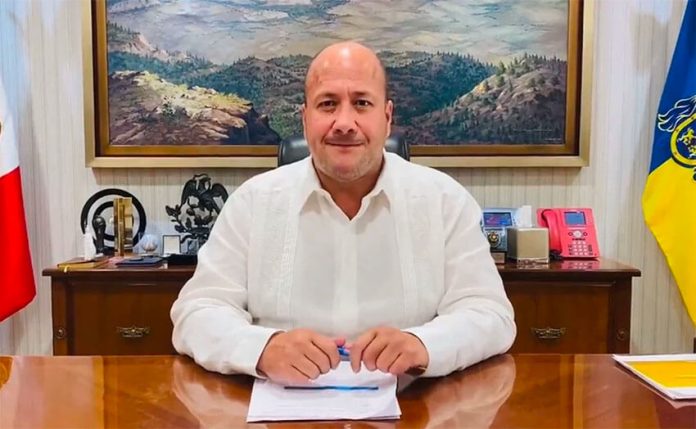
Governor Enrique Alfaro said Monday that the decision to lift the mask mandate was taken after consultation with health experts. He said it was possible because the spread of the coronavirus has been controlled in Jalisco, which includes Guadalajara and tourist destinations such as Puerto Vallarta and the Lake Chapala area.

“The reality is that the numbers tell us we’re doing well, that we’ve made progress and the pandemic in our state has been controlled,” Alfaro said.

The governor said the state is currently recording an average of 59 new cases per day whereas the average over the past two years was 819. He said that just 21 coronavirus patients were hospitalized and there were only 19 COVID-related deaths last month, the lowest monthly total since April 2020.

“These indicators make us think that we can take a step forward with care, with awareness that this hasn’t finished,” Alfaro said.

He advised people with coronavirus-like symptoms to use face masks and noted that there has been a “persistent demand“ in schools for the mask mandate to be lifted.

“Now with the … heat, using a face mask has been an enormous burden for girls and boys,” Alfaro said.

He said his government understands that people are tired of face masks after two years of continuous use but warned citizens not to drop their guard.

Alfaro said he was confident that the decision to end the mask mandate – which officially concluded Tuesday – was the right one and that coronavirus case numbers will remain low.

Several other states have dropped mask mandates – at least for open air spaces – including Baja California Sur, Baja California, Mexico City, Tamaulipas and Nuevo León.

Mexico went through a large omicron-fueled fourth wave of infections that peaked in January with almost 1 million new cases recorded.

The Health Ministry said Tuesday that the pandemic was continuing with “minimal activity,” noting that there was an average of 370 cases per day over the past week.

Mexico has recorded over 5.7 million confirmed cases since the beginning of the pandemic and more than 324,000 COVID-19 deaths. About two-thirds of the population is vaccinated, a figure that should soon increase as the government is now offering vaccines to all children aged 12 and over.

With reports from El Universal 

Like anything in a pipeline, water is fair game—and lucrative—in Ecatepec

0
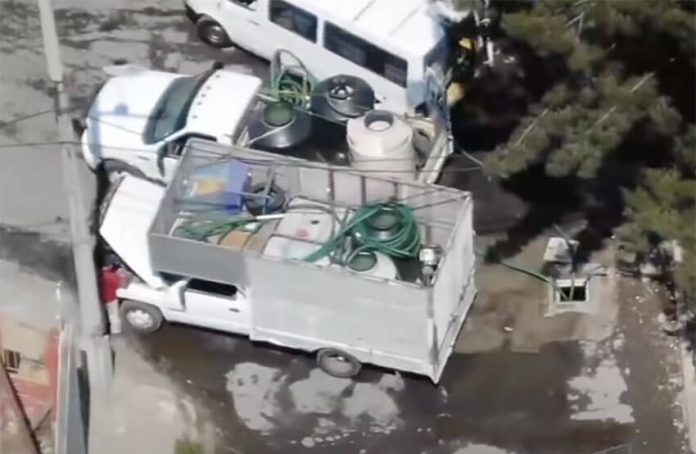
Water thieves fill their tanks from municipal water in Ecatepec.
Water thieves fill their tanks with municipal water in Ecatepec.

Any resource that runs through government-owned pipelines – petroleum, LP gas and even water – is fair game for Mexican thieves.

According to authorities in Ecatepec, México state, 1 million liters of water are being stolen every day in the municipality, which adjoins the northeastern Mexico City borough of Gustavo A. Madero.

The crime generates huge profits for criminal groups that prey on people who are desperate for water, a resource that has become increasingly scarce in Ecatepec and many other parts of the country.

Mario Luna Escanamé, director of the Ecatepec water and sewer utility Sapase, said that an estimated 365 million liters are stolen annually from the local water service.

He said the quantity stolen on a daily basis would fill 100 pipas, or water tankers, each with a capacity for 10,000 liters. “That’s the size of the problem we’re seeing,” Luna said.

The only municipality where more water is stolen is Tijuana, the newspaper El Universal reported.

Sapase has identified numerous points where water has been illegally extracted in recent months, a period in which the incidence of the crime has increased significantly.

Most of the illegal taps were found in a part of Ecatepec known as the Quinta Zona, a densely populated area where water shortages are common.

“The most complicated area is the east of the municipality, where there are neighborhoods adjacent to the México state Outer Loop Road,” Luna said.

“They’re the most critical points because they depend 100% on the Cutzamala [water] system and if there’s a problem there, that area suffers a lot,” he said.

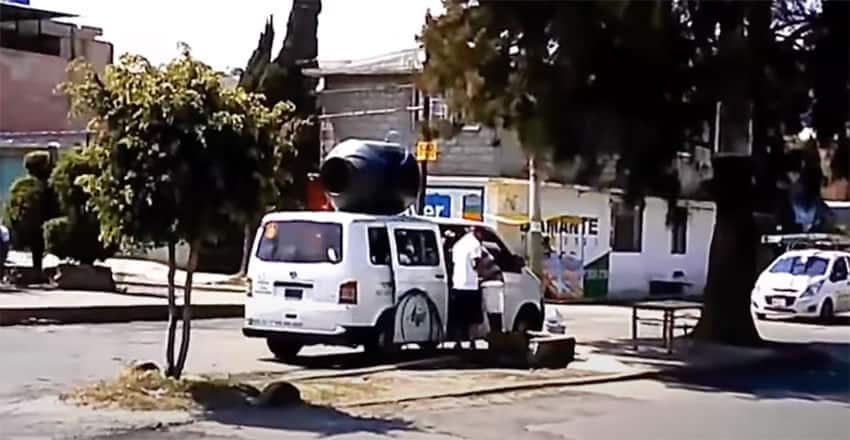
Thieves use pumps and hoses to extract water, according to El Universal, which witnessed the crime being committed in broad daylight. The stolen water is diverted into large containers in vehicles such as pickup trucks or vans, or to tanks in nearby houses and businesses.

Thieves fill their containers.

Lookouts warn thieves if the police or Sapase personnel are approaching. The huachicoleros de agua, as the thieves are colloquially known, later sell the water to families whose homes are not connected to the water system.

El Universal reported that 1,000 liters are sold for 1,000 pesos (US $49) and thieves can make up to 100,000 pesos (US $4,900) per day. Groups specifically dedicated to the crime use sophisticated equipment to steal the water, Luna said.

“It’s clear that it’s now something that is very organized,” he said, adding that the crime is driven by supply and demand for water.

“There is a great need due to the more than 15 billion liters we haven’t received in the past 37 months,” the water utility chief said, referring to a reduction in supply from the México state water commission that has been exacerbated by theft.

One Ecatepec resident told El Universal that many families have no option but to buy water from thieves.

“That happens in several neighborhoods. … As we need water we have to buy it from them. We call them and they come,” said Belén, who lives in the Novela Mexicana neighborhood.

“We’re living in a vicious circle,” said Ricardo Galindo, a resident of the México Prehispánico neighborhood.

“The thieves take advantage of our need because we really need water. … There’s none in the faucet so we have to buy it. … We’re part of the problem but … we’ve lived [without running water] for many years,” he said.

While illicit water entrepreneurs steal large quantities of water, some Ecatepec residents, including business owners, connect hoses to illegal taps just to get enough water to satisfy their own needs.

But those quantities are also very large in some cases: one of the businesses taking free water is a laundromat, El Universal said.

The deputy director of Sapase said water theft affects the utility’s finances because less water reaches the homes of people who pay for the liquid.

Ecatepec authorities have initiated at least 13 investigations in the municipality but there have been no arrests.

Mayor Fernando Vilchis recently reached an agreement with the state government to crack down on the crime, which also occurs in other México state municipalities albeit not to the same extent as in Ecatepec.

State lawmakers with the Morena party have proposed a law that would jail water thieves for three years, but it has not yet been put to a vote in Congress.

With reports from El Universal 

Police arrest man who allegedly robbed 92 Oxxo stores

0
Oxxo store
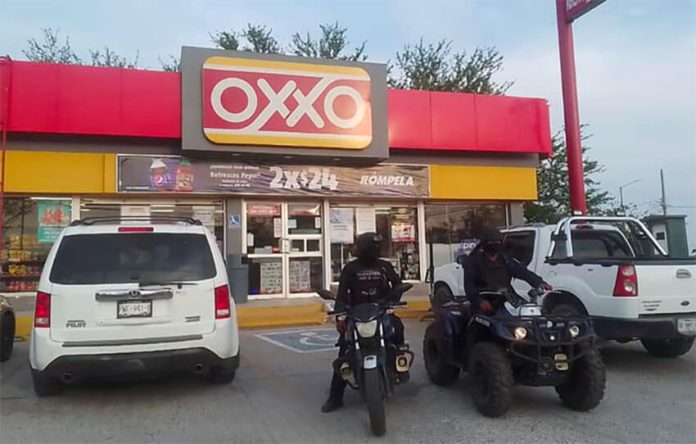
Oxxo stores were the favorite target of a thief in Oaxaca.

A man suspected of robbing 92 Oxxo convenience stores in Oaxaca has been arrested, state security officials said on Saturday.

The man was attempting to rob a store on the Oaxaca-Mexico City highway 10 kilometers north of Oaxaca city, state Security Minister Dalia Baños said.

Workers at the store pressed a panic button which alerted state police, who were already investigating the suspect. The man was arrested by police, who found cards in his possession containing written threats against police which he’d previously left in the stores he robbed.

State Attorney General Arturo Peimbert Calvo said that of the 92 robberies, 55 were committed in Oaxaca city, in the city center and in the neighborhoods of Pueblo Nuevo and San Martín Mexicapam. In 2022, the suspect also carried out robberies in the municipalities of Santa Cruz Xoxocotlán and San Pablo Etla.

The Oxxo robberies began in 2021.

Peimbert added that the arrest represented a major blow to crime in the state.

Amid a rise in robberies of stores, state police in Oaxaca are carrying out patrols in convenience stores and shopping centers, and will install security checkpoints in areas with a high incidence of similar crimes, the newspaper El Sol de México reported.

With reports from Milenio and El Sol de México

25% of airline traffic to be shifted from Mexico City airport to AIFA and Toluca

0
plane landing
Flights will be transferred out of AICM over the next 12 months. shutterstock

A senior transport official said Monday that operations at the Mexico City International Airport (AICM) will be reduced to avoid more dangerous incidents such as that seen last Saturday when a plane had to abort its landing to avoid colliding with another aircraft waiting to take off.

Deputy Transport Minister Rogelio Jiménez Pons said 25% of flights will be transferred to the Felipe Ángeles International Airport (AIFA) and the Toluca International Airport over the next 12 months.

The migration of flights from the saturated AICM will begin in August, he said in a radio interview.

At a meeting with government officials on Monday, representatives of Volaris, Aeroméxico and VivaAerobús expressed their willingness to shift some flights, Jimenez said.

Those three airlines all have a large number of operations at the AICM, he said. “What we’re proposing is an objective … [over] 12 months to achieve a reduction of 25%,” Jiménez said.

“The [Mexico City] airport has been saturated and in terrible conditions for decades,” he added.

The deputy minister said the broader objective is to distribute airline traffic across five airports in central Mexico: the AICM, the AIFA, Toluca, Puebla and Cuernavaca.

Located about 50 kilometers north of downtown Mexico City, the AIFA opened in late March but is currently only handling a very limited number of operations.

With regard to Saturday’s incident involving two Volaris planes, Jiménez confirmed that an air traffic control mistake was to blame. A flight arriving from Mazatlán was cleared to land on a runway where a plane was waiting to take off to Guatemala City.

Jiménez said that a shift change may have contributed to the blunder.

“There is possibly an issue that we’re checking now. … [We have to check] whether there was a shift change,” he said, raising the possibility that different air traffic controllers provided instructions to the two Volaris planes involved in the incident.

Three airlines have agreed to the plan to relieve pressure on AICM.
Three airlines have agreed to the plan to relieve pressure on AICM. shutterstock

“We have to check that, because then there would be two people responsible,” Jiménez said. He described the incident as a “frightening situation” but asserted that people’s safety was not placed at risk.

“The defense of the pilots was put to the test and thank God, these people are prepared,” the deputy minister said.

According to air traffic controllers and aviation experts cited by the newspaper Reforma, the number of aborted landings, or go-arounds, has doubled at the AICM this year due to the redesign of air space to allow that airport and the AIFA to operate simultaneously.

There was an average of three go-arounds for every 1,000 operations at the AICM in the first four months of the year between 2019 and 2021, the sources estimated. That figure increased to six between January and April of 2022, they said. No official data on aborted landings is published.

“The number of go-arounds has increased since August 2021 but they have been more recurrent this year,” an AICM operations commander said.

“We calculate that the rate is five, almost six [go-arounds per 1,000 landings], mainly due to the redesign [of air space] in order to coexist with the AIFA,” he said.

Juan Antonio José, an aviation expert, told Reforma there are up to 10 go-arounds per day at the AICM, where there are some 450 landings every day.

Alfredo Covarrubias, head of the National Air Traffic Controllers Union (Sinacta), confirmed that go-arounds have increased to about six per 1,000 landings. He also said that aircraft incidents have increased 300%.

“Among controllers it was previously a scandal to have an incident. … Now it’s becoming a normality and they prefer not to file a report when things happen because there are reprisals,” Covarrubias told a press conference on Monday.

He said that about 30 serious incidents have been reported in Mexico over the past four months, including 10 at the AICM.

Air traffic controllers cited by Reforma said incidents were kept secret when Víctor Hernández was director of Navigation Services for Mexican Airspace, a government agency. Hernández was dismissed after Saturday’s incident and replaced by Ricardo Torres Muela, who has over 40 years’ experience as an air traffic controller.

According to Sinacta, there is a shortfall of some 300 air traffic controllers across Mexico, meaning that those employed at the nation’s airports have to work long shifts. The union also says that controllers lack training.

The International Federation of Air Line Pilots’ Associations said last week that it appeared that air traffic controllers at the AICM have received little training and support as to how to direct flights operating in the new airspace configuration.

Last May, the United States downgraded Mexico’s aviation safety rating, a move that prevents Mexican airlines from adding new flights to the U.S.

The Federal Aviation Administration (FAA) said it downgraded Mexico from Category 1 to Category 2 after finding that it didn’t meet standards set by the International Civil Aviation Organization (ICAO), a specialized agency of the United Nations.

“The FAA identified several areas of noncompliance with minimum ICAO safety standards,” the aviation authority said in a statement.

“A Category 2 rating means that the countrys laws or regulations lack the necessary requirements to oversee the country’s air carriers in accordance with minimum international safety standards, or the civil aviation authority is lacking in one or more areas such as technical expertise, trained personnel, record keeping, inspection procedures, or resolution of safety concerns.”

With reports from Milenio, Radio Formula and Reforma 

March was a historic month for tourism

0
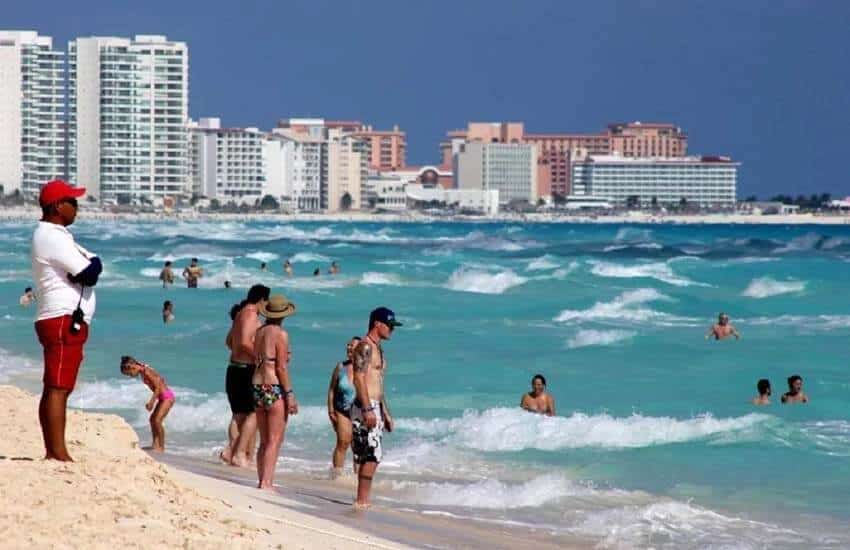
Cancún saw 2.6 million visitors in April, an increase of almost 400,000 compared to the same month of 2019.

A record high of almost two million international tourists flew into Mexico in March, government data shows.

The incoming passenger traffic was the highest ever for a single month and double the number of international tourists who flew into the country in March 2021.

Data published in an Interior Ministry migration statistics report shows that just under 1.99 million foreigners arrived at the nation’s airports in March.

The figure represents a 27% increase compared to February and a 35% jump compared to January. A total of 5.02 million international tourists flew into Mexico in the first three months of the year, an increase of 138.5% compared to the same period of 2021.

Humberto Molina, an economist at the consultancy firm Gemes who specializes in tourism, noted that it was the first time since the beginning of the coronavirus pandemic that a new monthly record for international arrivals was set.

tourists on beach in April 2022
The number of international tourists visiting Mexico has been consistently rising in 2022. March’s numbers were higher than February’s and equaled a 35% jump from January’s.

“It’s due to the extraordinary performance of the United States market,” he said.

United States citizens accounted for 66% of international air arrivals in March, up from 60% in pre-pandemic times. All told, 1.31 million Americans flew into Mexico in March, or over six times more than the number of Canadians, who made up the second largest cohort of international tourists.

While the influx of international visitors is a boon for the tourism sector, Molina described the heavy dependence on the U.S. market as a problem.

“Mexico is now more exposed to the United States, and it’s a problem to depend so much on one single market,” he said.

But as long as U.S. visitors continue streaming into the country, it’s likely that more monthly tourism records will be set.

Molina said it’s probable that a new record for international arrivals was set in April, for which federal data has not yet been published.

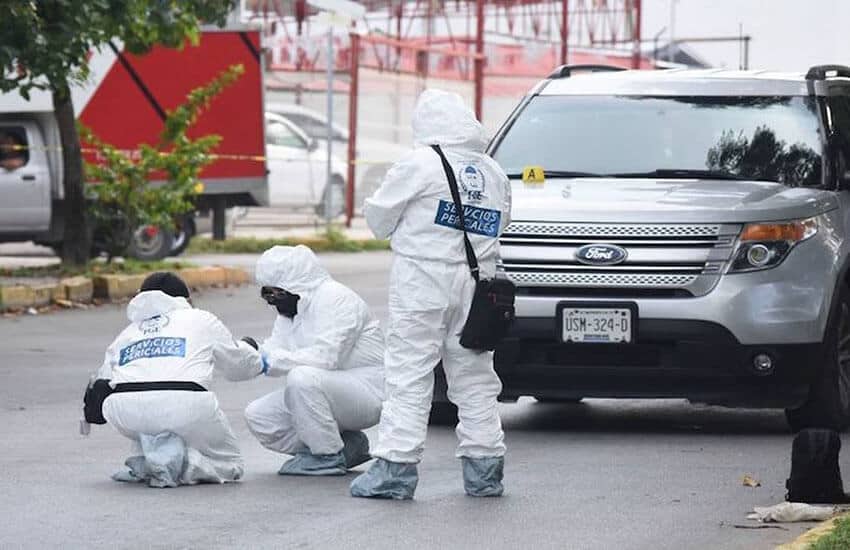
crime scene experts in Quintana Roo
Tourism has been rising in 2022 in Mexico’s most popular vacation destinations despite troubling crime incidents in places like Quintana Roo.

The entirety of Holy Week fell in April this year, driving up visitor numbers. Cancún airport had its busiest April ever last month with 2.6 million arrivals, an increase of almost 400,000 compared to the same month of 2019. That figure includes domestic passengers and Mexicans who arrived from abroad.

April was also a record month for the airports in the Pacific coast resort cities of Los Cabos and Puerto Vallarta.

Francisco Madrid, director of the Center of Research and Tourism Competitiveness at Anáhuac University in Mexico City, said it remains to be seen whether visitor numbers will remain high in the months ahead.

“We’ll have to see whether inflationary pressures and the reopening of other nations [to tourists] allow [us] to maintain … [these levels] in the coming months,” he said.

Molina said that new COVID outbreaks, inflation and higher interest rates – rates rose by 0.5% in the U.S. last week – could all affect the strong recovery of the Mexican tourism sector. However, he said that the biggest risk to the industry is insecurity.

Insecurity has risen in the Caribbean coast state of Quintana Roo, where numerous incidents of violence have occurred in recent months.

Homicide levels in Mexico remain at near-record highs, which hurts the overall perception of the country, but only a small fraction of the victims are resident foreigners or international tourists.

With reports from El Universal 

3 arrested in kidnapping of baby in Sonora

0
Suspects in the murder-kidnapping case in Nogales.

Three women were arrested in Sonora for the kidnapping of a baby, the murder of her mother and an attack on her grandmother.

Forty-five-day-old Alison Guadalupe was kidnapped Saturday by two women in Nogales, a town on the U.S. border, across from Nogales in Arizona. The mother, Adriana, 33, was killed during the kidnapping and the grandmother Gabina, 56, was assaulted.

The Sonora Attorney General’s Office confirmed early on Sunday that Guadalupe had been found in good health at a property 230 kilometers east of Nogales in the border town of Agua Prieta, which neighbors the Arizona town of Douglas.

The perpetrators had given Adriana and Gabina a ride home from hospital and returned to the home later with food and drink. The mother and grandmother consumed it and lost consciousness, the newspaper Milenio reported.

The state Attorney General’s Office later confirmed that forensic tests showed that Adriana and Gabina tested positive for Benzodiazepine, Alprazolam and Diazepam, which can all be used as sedatives.

The newspaper said the two women had been left tied up. Gabina woke up to see that her daughter was motionless and realized that Alison was missing. She managed to break free and contact the authorities.

Alison was returned to her father and Gabina on Sunday. “Thank you for everything. God is going to give me strength to move forward … Thank you for recovering the princess,” Gabina said.

The three women who were arrested are all from the same family. The state Attorney General’s Office said the 31-year-old woman suspected of being the intellectual author wanted to kidnap a baby to validate a fictitious pregnancy in an effort to keep her partner. She was allegedly assisted by her mother, 52, and cousin, 22.

The three women are being held on suspicion of kidnapping, femicide, attempted femicide and robbery.

With reports from Milenio

New regulations call for inspections of light vehicles

0
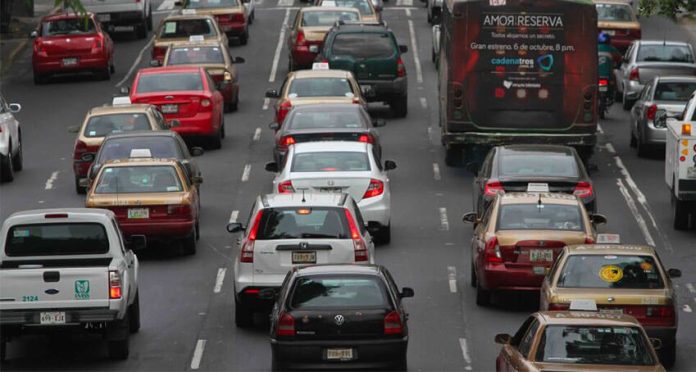
highway traffic
The new inspection requirement takes effect in November.

A new inspection requirement for new vehicles will take effect later this year, the federal government announced.

The Economy Ministry (SE) announced an additional verification requirement for most new vehicles that weigh less than 3,857 kilograms.

Called NOM 236, the requirement will take effect in November, according to an SE publication in the government’s official gazette.

All cars registered in Mexico will have to pass an inspection before they have 1,000 kilometers on their odometers.

Among the things to be checked are cars’ bodywork, seatbelts, lights, brakes, wheel alignment, suspension and engine. Any serious problems will have to repaired in order for vehicles to be deemed roadworthy.

The new inspection requirement is in addition to the emissions verification that vehicles also must pass.

Vehicles will have to pass a second NOM 236 inspection four years after the initial one and additional ones every two years after that until they are 10 years old. Inspections will then become annual. “Intensive use” vehicles will face annual inspections from the get-go.

Among the vehicles exempt from the new requirement are those that weigh less than 400 kilograms and those used exclusively in off-road settings.

With reports from ADN40

Caught in traffic, bride accepts biker’s offer of a ride to her wedding

0
The bride cruises to her wedding on Saturday.

A bride risked arriving at her wedding a little wind-blown on Saturday when she jumped on the back of a motorcycle to get to the church on time after being stuck in traffic.

In a video on social media, the woman is seen in a large white wedding dress and veil getting on the back of a motorcycle amid heavy traffic on the Mexico City-Toluca highway. Two people can be seen helping her onto the motorcycle between lanes of traffic, ensuring her dress is well placed.

In another video, the bride and motorcyclist are seen cruising down the highway at speed.

The motorcyclist is thought to have been a stranger, but saw the bride was in a desperate situation, the newspaper La Razón reported. It’s unclear whether she arrived late to say her vows.

“They’re going to give a ride on a motorcycle to the bride because otherwise she won’t get there,” one of the people filming from another vehicle can be heard saying off camera, as the bride mounts the bike.

“What worried me was that the dress would get stuck in the wheel,” one person wrote on social media.

The traffic was caused by an accident near La Marquesa, 30 kilometers east of Toluca, in the direction of Mexico City, which almost completely stopped traffic.

With reports from La Razón