The WHO estimated that there have been more than 14 million excess deaths during the pandemic.
There were over 600,000 deaths associated with the coronavirus pandemic in Mexico during 2020 and 2021, according to World Health Organization estimates, a figure more than double the number of fatalities officially attributed to COVID-19.
The WHO said Thursday there were approximately 626,000 excess deaths in the two-year period. That figure includes deaths directly caused by COVID and indirectly caused by the pandemic due to its impact on health systems and society.
“Deaths linked indirectly to COVID-19 are attributable to other health conditions for which people were unable to access prevention and treatment because health systems were overburdened by the pandemic,” the WHO said in a press release.
“The estimated number of excess deaths can be influenced also by deaths averted during the pandemic due to lower risks of certain events, like motor-vehicle accidents or occupational injuries.”
The excess death total for Mexico is 109% higher than the official COVID death toll as of December 31, 2021, which was 299,428.
Mexico’s official death toll is now just over 324,000, a figure that hasn’t been updated since late April.
The federal government has acknowledged that the official death toll is an undercount of COVID-related fatalities. Its own excess death estimate is slightly higher than that of the WHO.
Mexico is one of 20 countries that account for over 80% of the estimated global excess deaths for the January 2020 to December 2021 period, the WHO said. It estimated that there were 14.9 million excess deaths around the world in the two-year period, including 4.7 million in India. The global excess mortality figure is more than double the official number of reported COVID deaths, which is currently about 6.25 million.
A panel of experts put together by the WHO calculated the estimates for each country using national data on reported COVID deaths, household surveys and a statistical model that aimed to take into account COVID fatalities that went unreported.
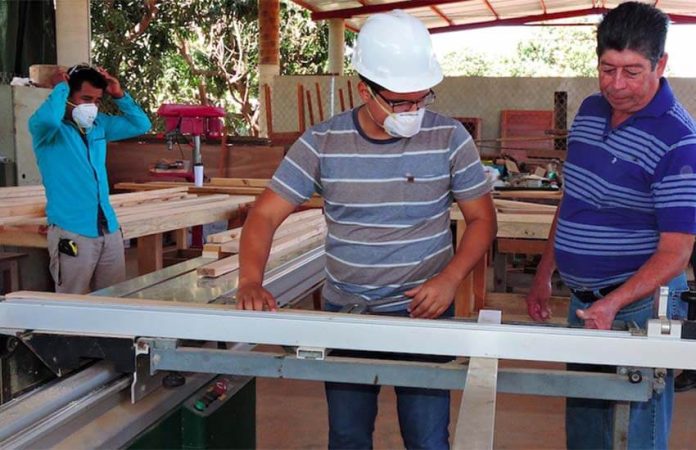
A young man learns carpentry at a training center built by Mar de Jade hotel owner Laura de Valle.
I started out looking for a good hotel on the beach and ended up finding out how to make the world a better place: not bad for a weekend aimed at escaping from work!
The beach I chose was the little Bay of Chacala in the state of Nayarit, located a relatively short three-hour drive from Guadalajara.
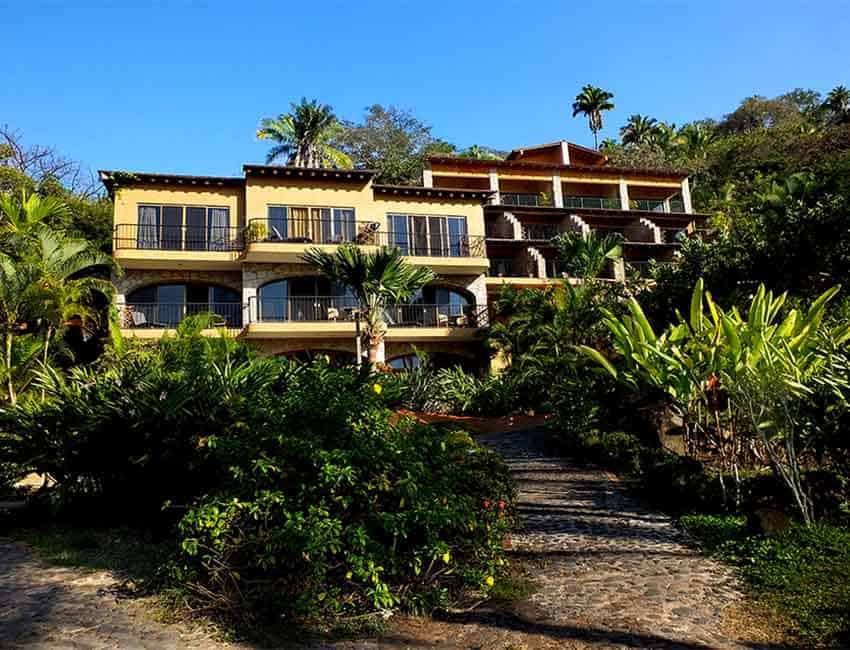
The hotel is called Mar de Jade (Sea of Jade), well-known for its yoga and meditation classes, as well as healthy food.
That’s from the point of view of their clients. The hotel’s neighbors see Mar de Jade in quite a different light: a source of jobs and training that has given great numbers of them a new lease on life.
Among the hotel’s projects are a Waldorf-Montessori school for the Chacala village kids and vocational programs at Tao de Jade, their organic farm and training center.
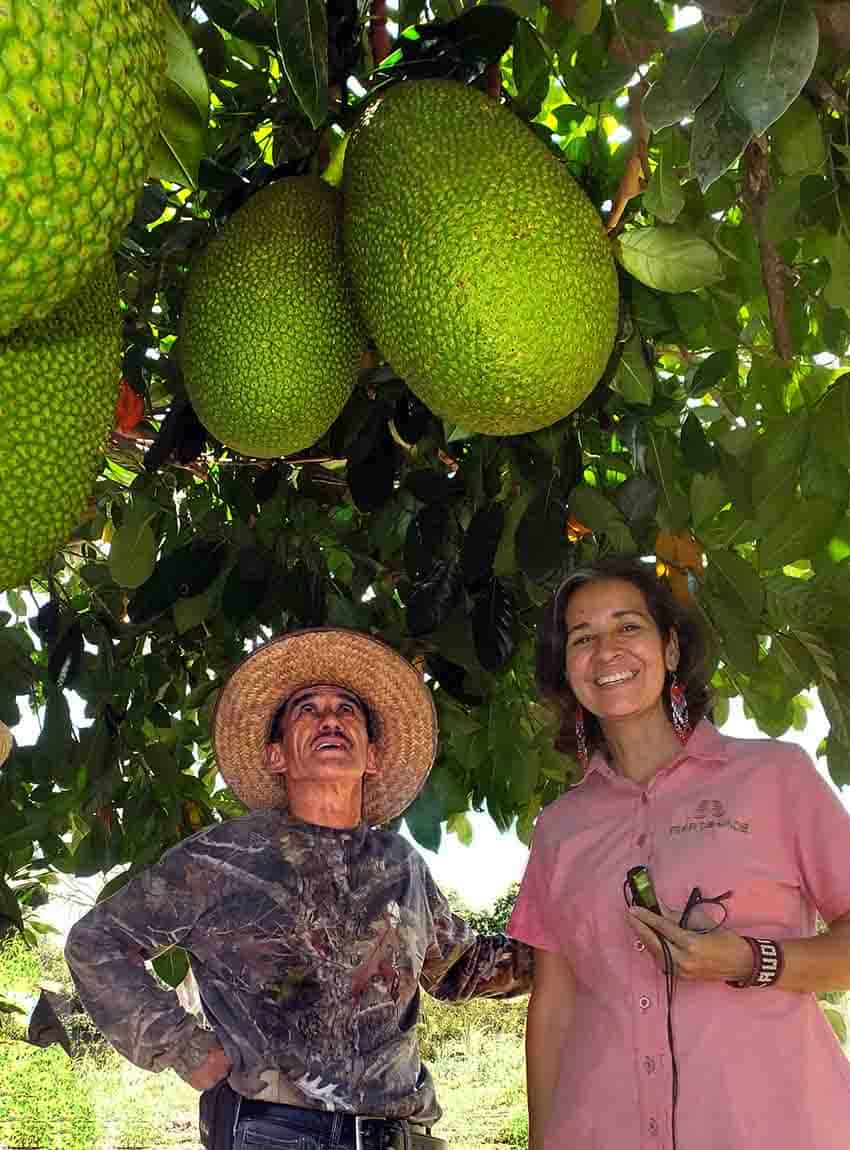
Jackfruits admired by Tao de Jade’s manager Claudia Andalón and agriculturist Don Chuy.
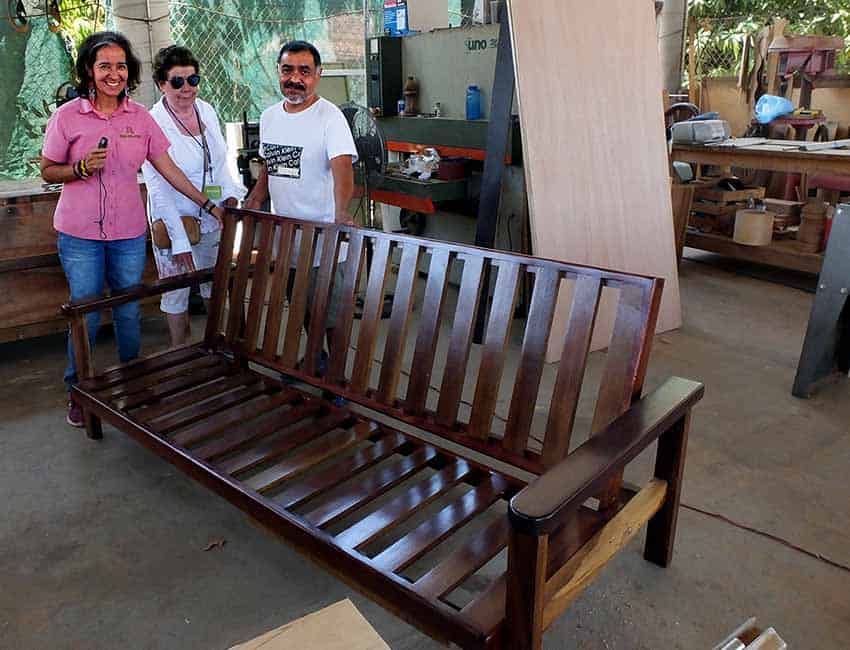
The hotel’s view on sustainability has been to make rather than buy whatever it needs. Its staff teaches youth everything from organic agriculture, maintenance and beekeeping to industrial cooking, sewing and carpentry — where, by the way, local youth produce quality furniture for the hotel as well as its curtains, bedding and all the staff uniforms.
The founder of both Mar de Jade and Tao de Jade is Dr. Laura del Valle, M.D., of Mexico City who now runs both projects with her daughter Angélica.
I asked Laura what brought her from the capital to the tiny pueblito of Chacala on the Pacific Coast.
“I was in my 20s,” she says, “doing theater and commercials, when I stumbled upon the first Japanese Rinzai Zen monk that ever came to Mexico City. I wanted to ask him about traveling in Japan, but he said, ‘Oh, you westerners are too uncouth to travel around Japan. You have to train with my wife.’ And I ended up training for 10 years with him and his wife in Zen meditation and acupuncture … and never went to Japan.
“Now, my Zen monk was a ferocious guy with a great imagination to do the impossible. In our group were a shoe salesman, an artist, an ex-Jesuit priest, a radical leftist, you name it. And he told us, ‘Mexico doesn’t need Zen — it needs protein. The Mexican people are all very much in present time. The majority of people have to be where they are at because there is no future. They’ve only got the present. They’re able to be more present than most people who study Zen. These people live in their body — they work with their hands … but they need protein.”
While the Zen monk taught the group how to plant soybeans and make tofu, del Valle studied acupuncture with the monk’s wife.
A brand-new sofa for the Mar de Jade Hotel.
“I was amazed at what acupuncture could do,” she says, “but I realized I needed to learn anatomy. I didn’t even know what side my liver was on!”
A doctor in her group encouraged her to study medicine. “Do something for your country!” he told her.
“So I did,” says del Valle. “I enrolled at UNAM, and when I began to work with patients in Mexico City’s hospitals, I saw that many of them were country folk with terminal diseases because they had waited too long. As a result, I told myself, ‘When I graduate, I’m going to go off to the countryside to work. I want to be useful where there aren’t enough doctors, where we can deal with the basic diseases before they get too severe.’
“I realized I wouldn’t be able to live off a country doctor’s salary, so I thought I’d start a little Zendo — a Zen retreat house — on some nice beach, where people can sit around and drink carrot juice … and I ended up in Nayarít at Guayabitos beach, which was gorgeous and lush. I said, ‘This is amazing. There are mangoes falling out of the trees!’ Then they told me there was some land for sale on another beach nearby — so I went to have a look.”
In those days, it seems, there was hardly a road to reach Chacala.
“It looked just like Jurassic Park,” says del Valle. When she asked the property owner why he wasn’t developing his land, he replied, “Develop it? No, no, this is Africa! I have property in Puerto Vallarta — Why would I want to put my children into a place like Africa?”
Dr. Laura del Valle is an M.D. specializing in acupuncture.
“So,” says del Valle, “I got together with my friends and my brother, and we bought this little bit of Africa. We lived in huts, we took water from the creek, we had kerosene lamps, we ate iguanas, learned to gut fish and we looked out for alacranes (scorpions) and cascabeles (rattlesnakes).”
Meanwhile, people with medical problems appeared, asking to see la señora de las agujas (the lady with the needles), and del Valle soon realized that a lot of local people simply did not have money for meds.
“What I learned over all those years,” she told me, “is that the public health disease number-one is poverty, and if you don’t address poverty, you’re just not going to change things. People go into a lot of stages of depression and violence. They have too many problems at too many levels. There’s the housing issue; you don’t have money for the school uniforms; you have to borrow money for food; the kid is in jail and you can’t pay a lawyer … I saw so many cases like that, and I said, ‘When I grow up and get old, I’m going to create work.’
“President López Obrador hit it on the nose,” del Valle says, “when he came up with ‘Poverty first — employ the youth.’ That’s what we are doing. We make everything ourselves: curtains, bedspreads, uniforms; we make our own mattresses, furniture, food preserves, you name it.”
“If you want to foster education and employment in any impoverished community,” she says, “you must understand that [young people] already have a family by the time they are 20. They are already supporting one or two kids, or they’re already helping their parents — the mother who is now alone or the father who is bedridden. They reach the age of 16 or 18 with economic responsibilities. They can’t just drop them and go off to school.”
For decades, Del Valle gave local vocational training to the people who were working with her and wanted to extend that opportunity to other youth who were unemployed and out of school.
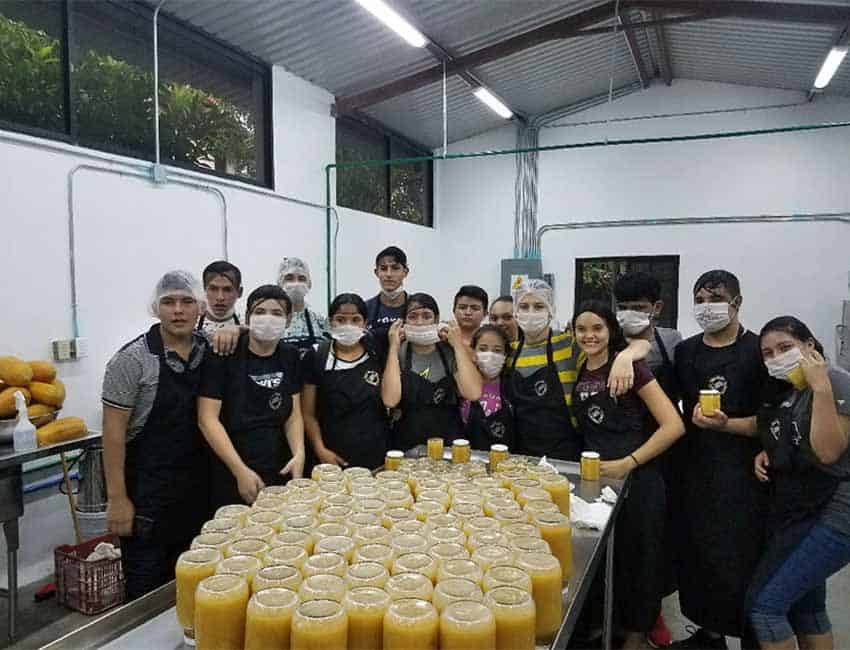
Trainees at Tao de Jade learn to make jam. Mar de Jade
“So I started counting how many salaries that would be, and I said: ‘Oh my God, we’ve got 50 employees at Mar de Jade, and we also have the staff at our nonprofit Waldorf-Montessori school in town,'” she says. “So those are 20 other people to support, and then we’ve got 20 on staff at the farm.”
She wondered how she could afford to add another 40–50 kids to the payroll. “And then AMLO comes along, wins the election and says, ‘Business owner: if you train people for a year, I will pay each of them a salary.’
“But what happens when AMLO leaves and this program gets cut? How will I be able to train?”
With this in mind, del Valle is now working on strengthening the marketing and entrepreneurship of each trade so they can be self-sustaining and serve as a model for graduates of the trades. For instance, she decided to start a sewing club.
“I asked myself: what would sell like crazy on the coast? And I came up with uniforms: there are school uniforms, hotel uniforms, business uniforms and even festivity-day uniforms,” del Valle says. “And there is no one making uniforms in the whole county! So, before we train them to design their own pretty clothes, they learn to make what sells. That’s what we are focusing on first.”
Reflecting on all that has passed since she came to Chacala, del Valle says, “I truly enjoy seeing the youngsters we trained come back, and now they are maintenance people, they can put electricity and plumbing into a house. But before, these kids were just floating around, 20-year-olds lifting boxes of beer onto a truck or mixing cement for 12 hours. Now they’ve got an identity, you know. They’re proud of themselves. That to me is thrilling. It’s good when you are able to say, ‘I can do this. I can do this well.’ That is the happiness that I experience — it’s a great happiness!
The hotel is ideal for people who want to practice yoga or meditation or go on a retreat. Mar de Jade
“I’d like people who come to Mar de Jade to know that it’s not just about business; it’s about humanity, the family of human beings,” she adds.
“We need to be in it, we need to love it, we need to help it. We need to reach out when someone calls.”
The writer has lived near Guadalajara, Jalisco, since 1985. His most recent book is Outdoors in Western Mexico, Volume Three. More of his writing can be found on his blog.
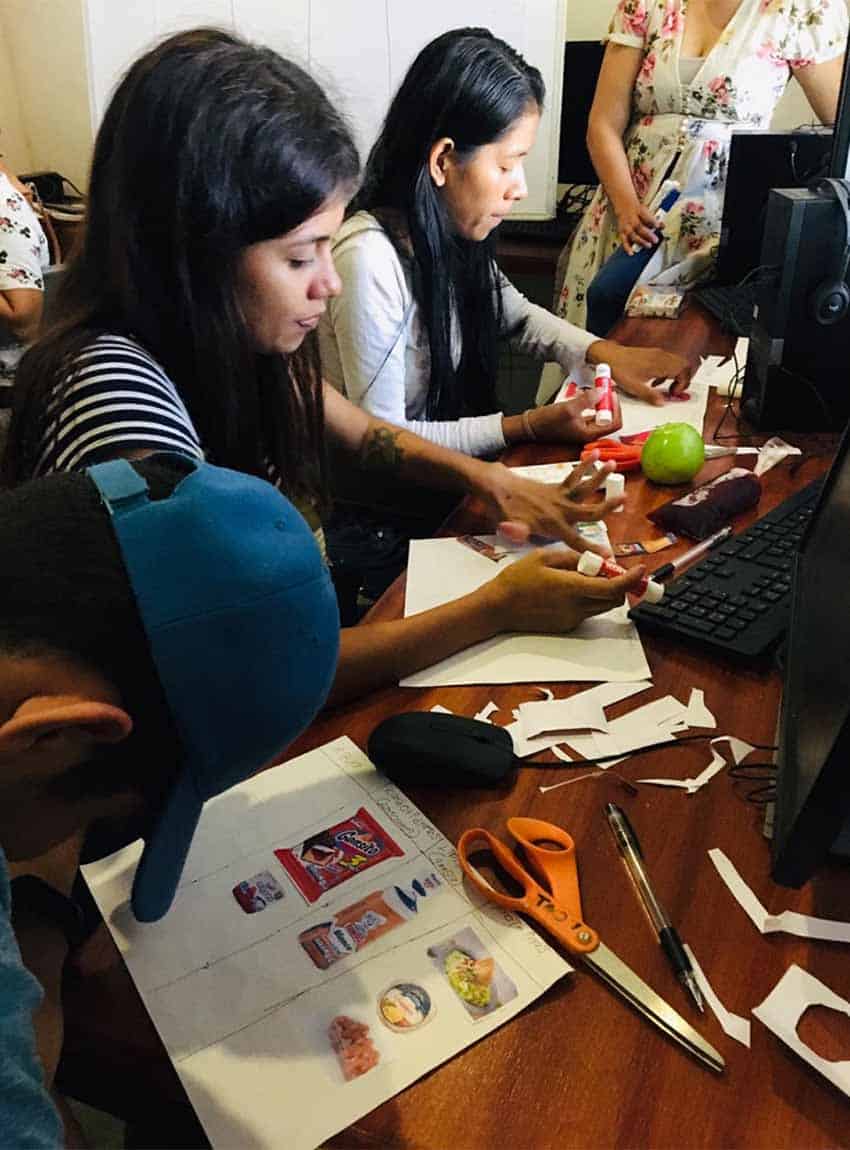
Participants in a workshop on food dehydration.
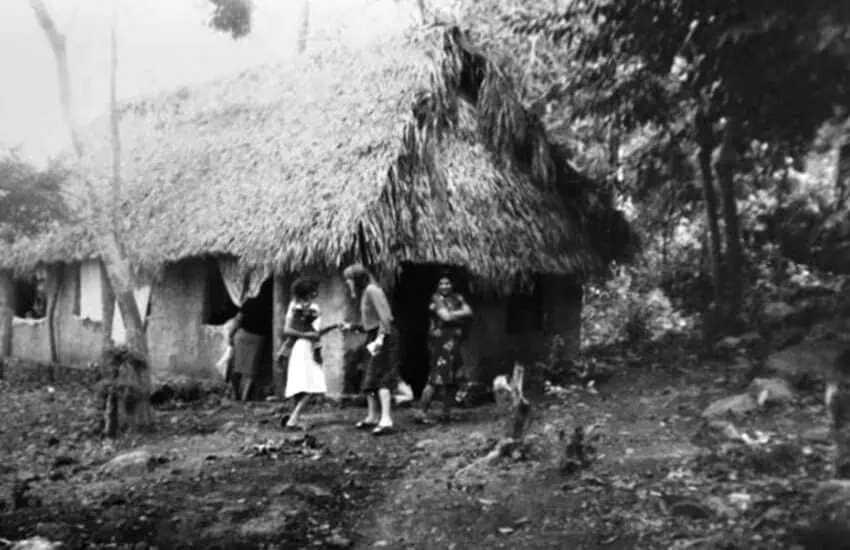
Mar de Jade as it looked in the 1980s. Mar de Jade
The dining hall offers healthy food, buffet style.
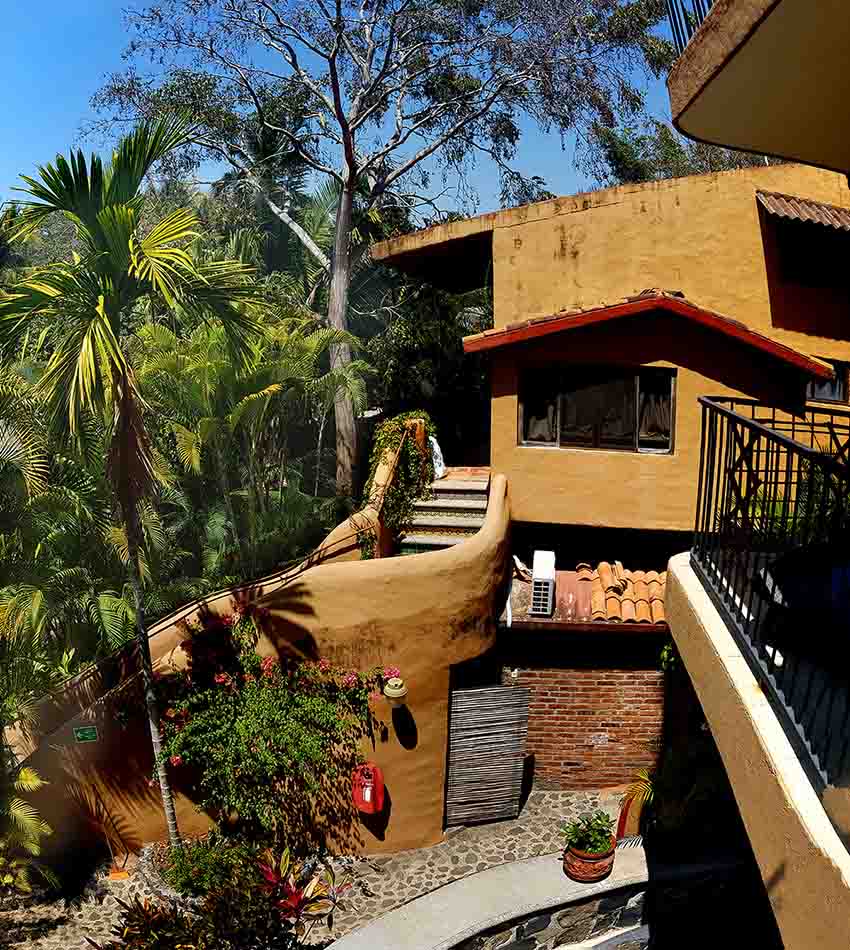
A typical view at Mar de Jade.
The hotel has heated pools and plenty of jungle.
The hotel is located three hours from Guadalajara, four hours from Lake Chapala.
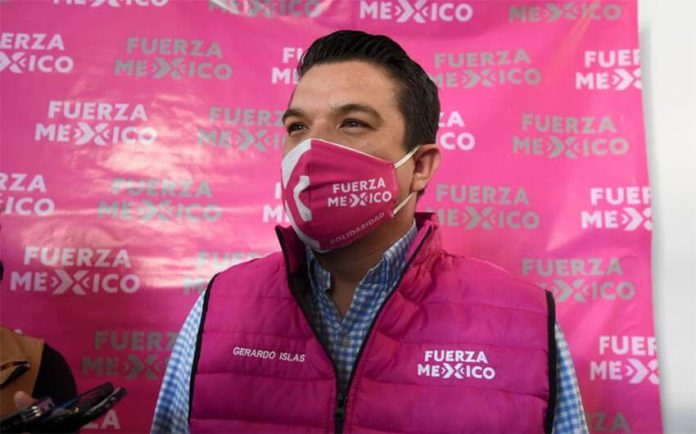
If the money is not paid back this week, the party's national president, Gerardo Islas, and other officials could face charges.
The National Electoral Institute (INE) has detected an apparent embezzlement scheme in which a minor political party diverted almost 34 million pesos in public money to shell companies.
Fuerza por México (FxM), cofounded by union leader and former senator Pedro Haces and former Puebla state deputy Gerardo Islas, received public funding totaling 136.5 million pesos (US $6.8 million) in 2021 to cover ordinary expenses and campaign costs.
FxM was stripped of its registration as a political party after the elections last June because it failed to attract support from 3% of voters.
In a three-month period after the elections, the party transferred 33.9 million pesos (US $1.7 million) to shell companies posing as suppliers, according to the INE’s auditing unit. The companies don’t have premises and are not engaged in any commercial activity, the unit found.
Due to its deregistration, FxM should have sought authorization to make payments using public money during the second half of last year but did not.
FxM was ordered to pay back the money it allegedly transferred to shell companies by this Friday. If it fails to do so legal proceedings will be initiated against the party’s administration secretary, Pablo Enrique Gutiérrez, its general secretary, Alma Lucía Arzaruz, and Islas, the national president.
The party, which considers itself an ally of the ruling Morena party, has not commented publicly on the INE’s findings.
Neither Haces, who represented Morena in the federal Senate, nor Islas, who served as a minister in the Puebla government before becoming a deputy, has addressed the issue, although both remain active on social media. The former is the chief of the Autonomous Confederation of Workers and Employees of Mexico, a union known as CATEM.
The Felipe Ángeles International Airport (AIFA) opened in March of 2022. (Gob MX)
The opening of the Felipe Ángeles International Airport (AIFA) is apparently causing problems for air traffic controllers at the Mexico City International Airport (AICM), leading an international pilots’ federation to raise safety concerns.
The International Federation of Air Line Pilots’ Associations (IFALPA) issued a safety bulletin advising that in the past month it has been made aware of several incidents involving aircraft arriving at the AICM with “low fuel states due to unplanned holding, diversions for excessive delays, and significant GPWS alerts where one crew almost had a controlled flight into terrain.”
A GPWS alert is a ground proximity warning system alert in which pilots are warned they are in imminent danger of flying into the ground or an obstacle.
IFALPA said that with the opening of the AIFA – which began operations on March 21, albeit with a limited number of flights – it would appear that air traffic controllers at the AICM have received “little training and support” as to how to direct flights operating in the new airspace configuration.
AIFA, a mixed civil/military airport built on an Air Force base in México state, is just 40 kilometers north of the AICM.
The International Federation of Air Line Pilots’ safety recommendations for flying into Mexico City.
IFALPA said that crews flying into the latter airport “have received clearances that do not adhere to terrain avoidance restrictions” in accordance with standard terminal arrival route (STAR) procedures.
It also said that proper International Civil Aviation Organization phraseology is not being used by AICM air traffic controllers, “adding to confusion on altitude restrictions.”
The federation recommended that aircraft flying into Mexico City consider carrying additional fuel to allow for prolonged holding and possible diversions. It also advised airline crews to remember that the AICM is a high altitude airport – Mexico City is over 2,200 meters above sea level – and to be prepared to operate in that environment.
“It is also recommended that crews exercise heightened terrain situational awareness and strictly adhere to published altitude restrictions. If you receive a clearance that you find questionable, resolve the clearance to your satisfaction,” IFALPA advised pilots.
Humberto Gual, secretary-general of the Association of Airline Pilots of Mexico (ASPA), agreed that air traffic controllers at the AICM haven’t had sufficient training.
“Issues in the air have increased … [because], from my point of view, the controllers haven’t had [enough] training,” he told the newspaper El País.
ASPA has requested a meeting with aviation authorities, including Navigation Services for Mexican Airspace (Seneam), to deal with the problems occurring in control towers and the airspace above the AICM.
“Our passengers can be confident that ASPA pilots have the highest standards of … training, and under no circumstances would we compromise your safety,” the association said in a statement.
“… We call on Seneam to attend to the reports of Mexican and foreign pilots, seeking the safety of our air operations first of all and the efficiency of our air space.”
Questions have long been raised about the viability of three central Mexico airports – the AICM, the AIFA and the Toluca International Airport – operating in close proximity to each other, especially once flight numbers increase at the AIFA. But the way in which airspace is used was redesigned to enable their simultaneous operation.
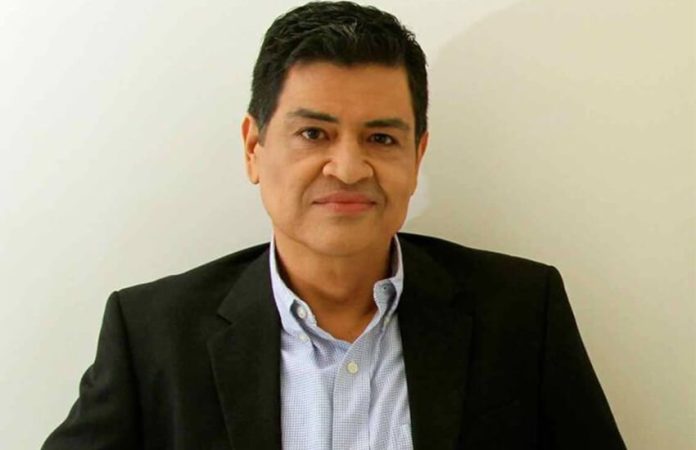
Luis Enrique Ramírez, whose body was found on Thursday in Culiacán, ran the Sinaloa news website Fuentes Fidedignas.
A journalist was found dead in Culiacán, Sinaloa, on Thursday, state authorities said.
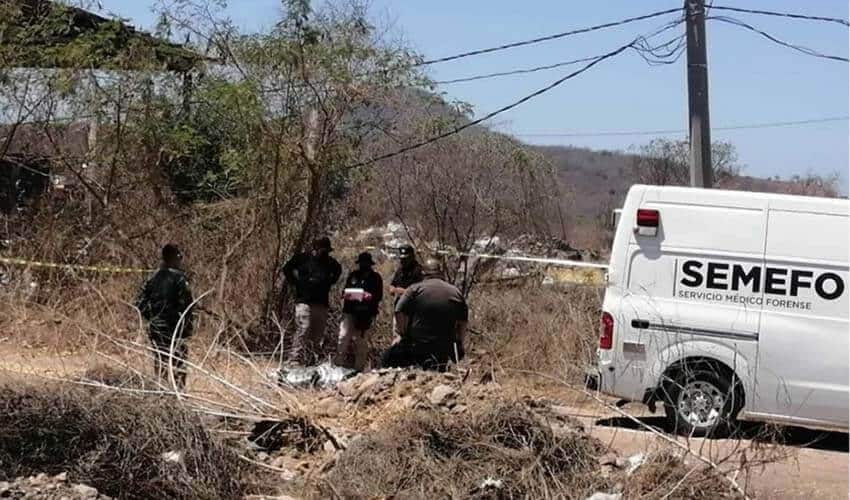
The lifeless body of Luis Enrique Ramírez Ramos, director of the Sinaloa-focused news website Fuentes Fidedignas and a columnist for El Debate, was found on a dirt road on the south side of the state capital.
Sinaloa Attorney General Sara Bruna Quiñónez Estrada told a press conference that the body of the 59-year-old journalist was wrapped in black plastic.
The Attorney General’s Office (FGE) said in a statement that an autopsy determined that Ramírez had suffered a brain injury due to blows to the head. “There were no signs of torture, except for the blows to his head that caused his death,” it said.
The FGE said that Ramírez left his home at approximately 3 a.m. Thursday and members of his family didn’t hear from him after that. Fuentes Fidedignas reported that he was abducted near his Culiacán home.
Ramirez’s dead body was found on a dirt road wrapped in plastic. Authorities said he’d suffered deadly blows to the head.
The FGE said that an investigation into his murder had been opened and that it would consider motives related to his work as a journalist.
Ramírez, an award-winning journalist who contributed to some of Mexico’s leading newspapers during a 40-year career, received threats in 2010 and went into hiding after three of his friends were murdered. He said in a 2015 interview that he and his slain friends were all privy to sensitive information about former Sinaloa governor Mario López Valdez and ex-government secretary Gerardo Vargas Landeros, who is now mayor of Ahome, a coastal municipality in the north of the state.
Ramírez said that the threats he received came from the state government. Quiñónez Estrada noted that he had spoken of being intimidated in media interviews but had not made any complaint to the FGE.
A complaint he filed with the federal Attorney General’s Office got nowhere, the newspaper Reforma reported.
Sinaloa Governor Rubén Rocha, who took office for the Morena party in November, lamented the death of Ramírez, who he described as a friend. He said in a Twitter message that he had spoken to the attorney general and advocated an “immediate, rigorous and exhaustive investigation” into the crime.
Ramírez is the ninth journalist killed in 2022 and the 34th to be murdered since President López Obrador took office in December 2018.
Ozone levels in Mexico City's Benito Juárez borough have reached nearly 100 parts per billion over the safety limit.
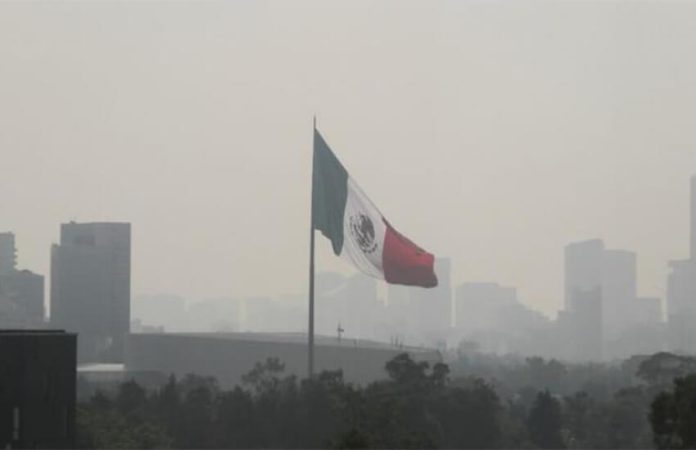
High levels of ozone pollution prompted Mexico City authorities to reactivate a phase 1 environmental alert on Thursday, forcing a large number of cars off the road on Friday.
The Environmental Commission of the Megalopolis (CAMe) reactivated the alert at 4 p.m., just 20 hours after a previous alert was lifted.
It said in a statement that ozone levels had reached 168 parts per billion (ppb) at a monitoring station in the borough of Benito Juárez and 155 ppb at a station in Iztacalco. The city government considers concentrations of ground-level ozone over 70 ppb to be unhealthy.
CAMe said that a high-pressure system over the Valley of Mexico regained strength on Thursday, intensifying atmospheric stability with “variable wind of weak intensity.”
The climatic conditions, including “intense solar radiation,” caused an increase in ozone concentrations, which resulted in “extremely bad” air quality.
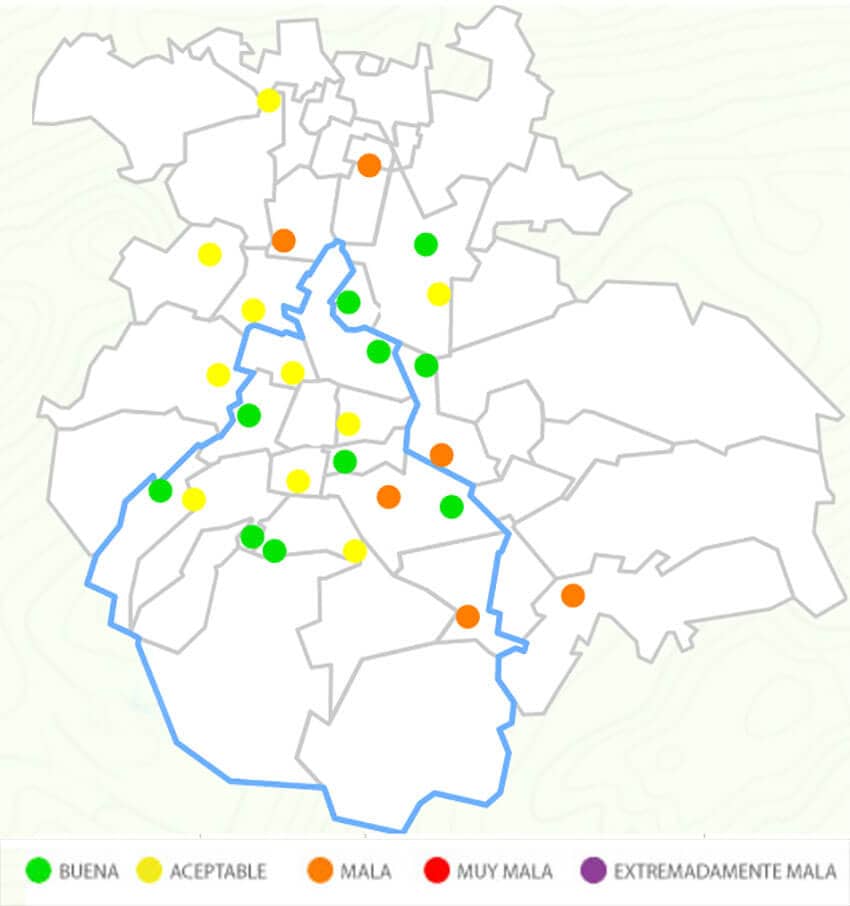
Air quality in the metropolis as of Friday morning at 10 a.m. Índice Aire y Salud ZMVM
Air quality had improved significantly by 8 a.m. Friday, but the environmental alert remained in place. Air quality was “good” or “acceptable” at all monitoring stations in the greater Mexico City area with the exception of that in Chalco, México state, where the classification was “bad.”
Due to the reactivation of the alert, many vehicles are prohibited from using roads in the metropolitan area between 5 a.m. and 10 p.m. Friday. Among the banned vehicles are a large number of those with license plates that end in 1, 3, 5, 7, 9 and 0. Hybrid and electric vehicles are exempt from the restrictions.
Despite the improvement in air quality on Friday morning, authorities are still advising residents of the metropolitan area to avoid outdoor activities including exercise between 1 p.m. and 7 p.m. due to health risks associated with exposure to polluted air.
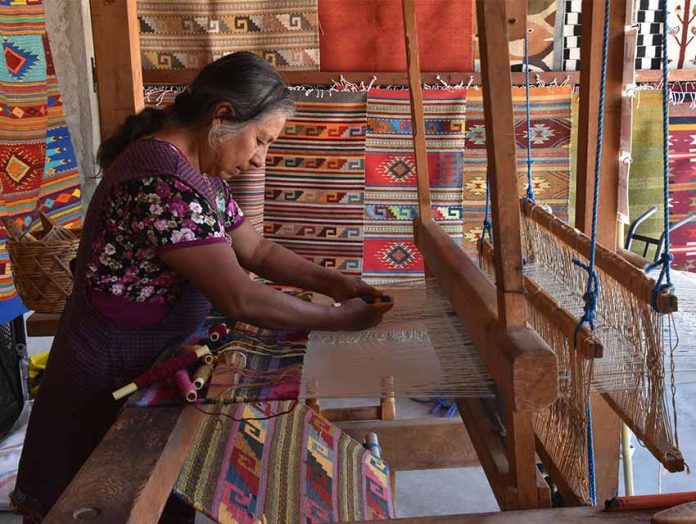
Hermelinda Bautista Bautista makes a colorful rug on a loom passed down through generations. Photos by Joseph Sorrentino
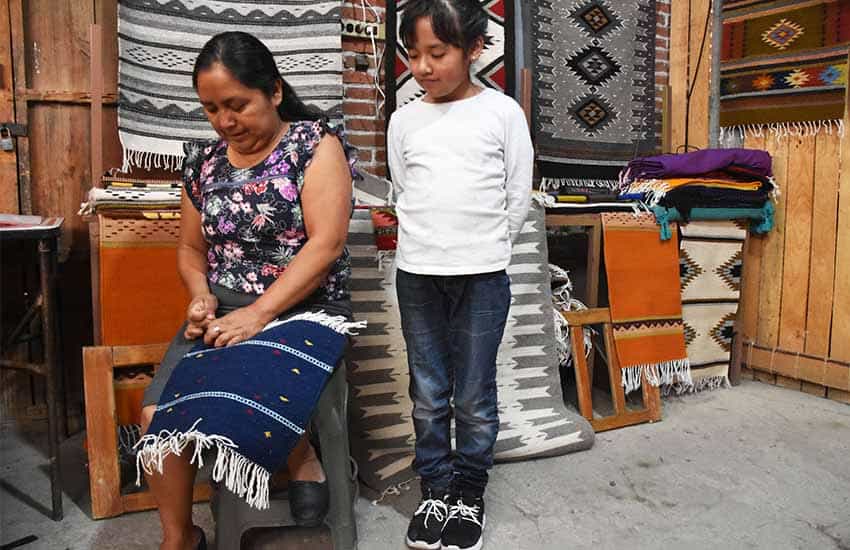
Graciela Contreras Mendoza is a picture of concentration as she leans over her loom, deftly weaving different colored threads into a rug she’s making. “I made my first rug when I was ten,” she said.
She, and about 150 families in Teotitlán del Valle, a pueblo about 20 miles from the city of Oaxaca, are well known for the quality of their textiles, especially their rugs. Weaving in the pueblo dates back hundreds of years. “It is a work that we carry in our blood,” she said.
Teotitlán del Valle is a Zapotecan pueblo, but its current name is actually from Nahuatl and means “land of the gods.” Its original name was Xaquija, Zapotecan for “celestial constellation.”
Children start learning to weave here typically as young as eight or 10 years old.
“First, we learn how to comb the wool,” said Contreras. “Then we learn how to wash the wool and make the string.” Most of the wool that’s used here comes from sheep raised in other states, usually Puebla, Michoacán and Guererro.
It takes about a year to learn how to weave, says Marcela Cruz Lazo.
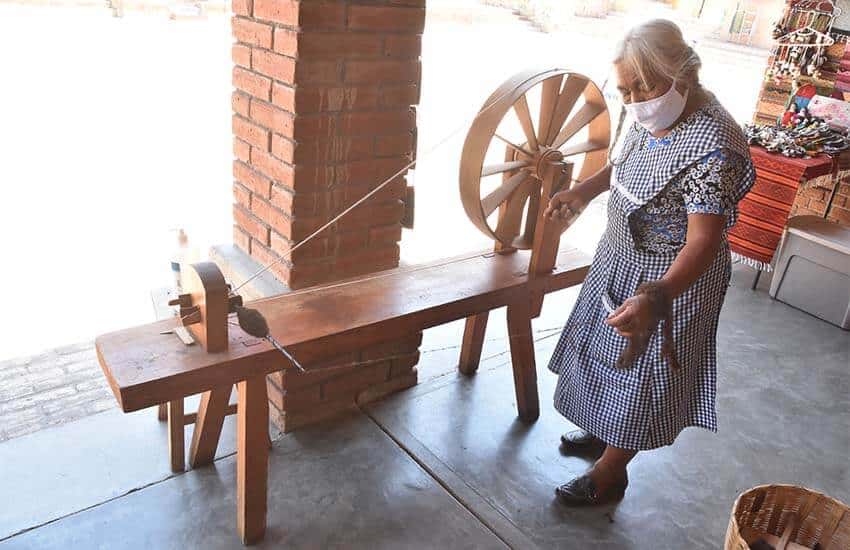
After combing, the wool is gathered into a ball and then made into string, using a spinning wheel. It’s then dyed a wide variety of colors. The dyes are all natural and organic, said Hermelinda Bautista Bautista, who was working with her friend Marcela Cruz Lazo in their small workshop. “We use things like shells from nuts, pomegranates and cochinilla,” Bautista said.
Cochinilla, an insect that lives on nopal, an edible cactus, is collected and ground using a molcajete, a traditional kitchen implement. It yields a deep red color.
Once the various dyes are ground into a fine powder, they’re boiled. The wool is then soaked in the dyes for three days, and then it’s all boiled again, so the wool grabs the color, said Cruz. After those steps are mastered, she said, it takes about a year to learn how to weave. There’s no formal teaching.
“There are no classes,” said Contreras. “We learn by watching. It is informal, more or less. We live with our parents, and we learn from them.”
The first rugs made are simple, just straight lines.
“To make a more complicated piece takes up to two years [of training],” said Rigoberto Martínez, a weaver whose family has a store in Oaxaca, across the street from the Santo Domingo Cathedral. “The large pieces are made by experts with more ability. All one needs is ingenuity — or that is to say — one must be very intelligent to make the designs. Some designs come from books and others from imagination.”
Teotitlán del Valle was one of the first pueblos settled by the Zapotecs, probably around 1465. Ruins of a temple, whose walls are carved with intricate designs, can still be seen here. Those designs are often incorporated into the rugs.
“There are ancient designs that are part of our history,” said Contreras. “We work with Zapotecan designs that are based on the ruins in the pueblo. But we also innovate, using something modern, and these are unique. I like to innovate and create new pieces because it bores me to make always make the same thing. I always prefer change.”
While some weavers will first draw their designs on paper, Contreras doesn’t. “My drawings are in my head,” she explained.
Each family has its unique set of designs and, according to the women interviewed, men make the most complex ones.
“The men make the most complicated designs because they’re dedicated to this work,” said Cruz. “The women do not have the time because they have to take care of their homes. They must clean, cook and care for their children.”
Weaving knowledge and the designs used aren’t the only things handed down through time. “The looms that we use have been passed down from generation to generation,” said Contreras. “We only do maintenance on the ones that require it.”
Children in Teotitlán del Valle learn to weave by watching their parents. Here, Graciela Contreras Mendoza shows her 8-year-old daughter Gracy Esmeralda the ropes.
Although Cruz believes that most of the pueblo’s youth have learned how to weave, she said that some have less interest in it. “The girls now make only a few [rugs] because they go to school,” she said. “Before, the women would weave from when they were little [and] they did not talk about going to school.”
Still, given that there are dozens of stores where rugs can be bought, it doesn’t appear that the craft is in danger of dying out.
The road leading into town from the main highway is lined with a number of stores, but Martínez said they’re not the best place to buy anything.
“At the entrance to Teotitlán, they sell their rugs at a very high price since they work with tourist guides.” He suggested continuing on into the pueblo, where he said rugs are sold for less.
But beautiful textiles aren’t the only attractions here. There’s a community museum, called Balaa Xtee Guech Gulal, Zapotecan for “Shadow of the Old Pueblo” or “House of the Old Pueblo.”
In addition to rooms with the expected exhibits about weaving and photographs of daily life in the pueblo, there’s an impressive collection of pre-Hispanic figures, bowls and intricately carved stones. Some of the pieces on display have Olmec designs and are thought to date to 500 B.C.
A short distance from the museum is the Preciosa Sangre de Cristo church, which was started in 1581 but wasn’t completed until 1758. The church was built on top of a Zapotecan temple, which was destroyed by the Spanish.
Several large stones with Zapotecan designs were incorporated into the exterior walls of the church. Directly behind it, there’s an archeological site where the remains of the indigenous temple can still be seen. The church’s interior contains a large number of lovely polychrome statues of saints.
The majority of residents earn their income from weaving, said Martínez. “It is better to make the textiles because sometimes in the field there is no harvest,” he said. “Textiles are more secure and we can also trade for what we need.” But most people still farm and that’s what helped them get through the pandemic. Like every city and pueblo in Mexico, Teotitlán del Valle was adversely affected by the pandemic. “There was no tourism, and we could not sell our carpets,” said Contreras. “The pueblo survived because we have agriculture.”
Teotitlán del Valle is a very traditional pueblo, one where, said Bautista, “everyone speaks Zapotecan.” In fact, she said, “We did not speak Spanish until we went to school, and we were afraid to learn it.”
Martínez is proud of his pueblo and his heritage.
“The valley of Oaxaca was Zapotecan, and they originated this type of work,” he said. “It is like a gift that our ancestors gave to us. We are lucky to be Zapotecans.”
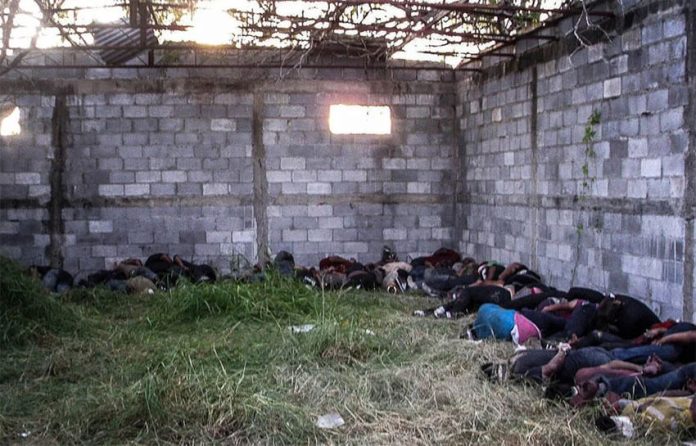
The navy found the bodies of the victims — 58 men and 14 women — on a farm in August 2010.
Eighteen people convicted of the abduction of 72 migrants who were killed by the Zetas drug cartel in Tamaulipas in 2010 have been sentenced to lengthy jail terms.
The federal Attorney General’s Office (FGR) announced Tuesday that a federal judge had sentenced 15 men and three women involved in the crime committed in San Fernando, a municipality south of Matamoros in the northern border state.
In August 2010, the navy found the bodies of 58 men and 14 women – mainly Central American and South Americans – on a farm after engaging in a gunfight with members of the Zetas.
Authorities were alerted to the massacre by a survivor, a migrant from Ecuador. The undocumented migrants were offered work with the Zetas but were killed when they didn’t accept, according to the Ecuadorian, who escaped after pretending he was dead.
The FGR said that the 18 people involved in the abduction of the migrants prior to their murder were all arrested in 2011. They were found guilty on charges including kidnapping, organized crime, possession of firearms and drug trafficking.
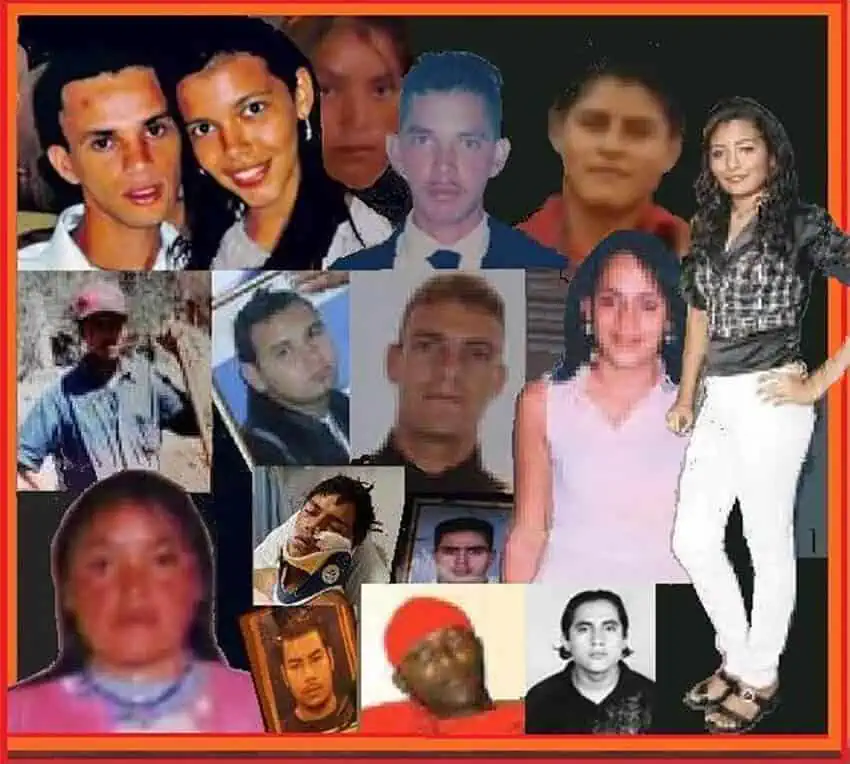
A composite image of some of the victims of the massacre. InSight Crime
However, none was convicted of the murder of the migrants. The guilty parties received prison sentences ranging from 13 years to 58 years.
Documents made public by the Attorney General’s office in 2014 revealed that local police collaborated with organized crime in the murder of the migrants.
The presumed mastermind of the massacre, Martiniano de Jesús Jaramillo Silva, was arrested in Ciudad Victoria, Tamaulipas, in 2017. However, the regional leader of the Los Zetas Vieja Escuela (Old School Zetas) criminal cell in Tamaulipas spent only two days behind bars before he died of kidney failure in a Mexico City hospital.
An additional 193 bodies were found in 47 clandestine graves in San Fernando in 2011. The victims – both men and women – were also killed by the Zetas.
The unprovoked attack was caught by a restaurant security camera.
A man is facing a charge of attempted murder after he attacked a teenager with a large stone in a Mexico City restaurant on Sunday.
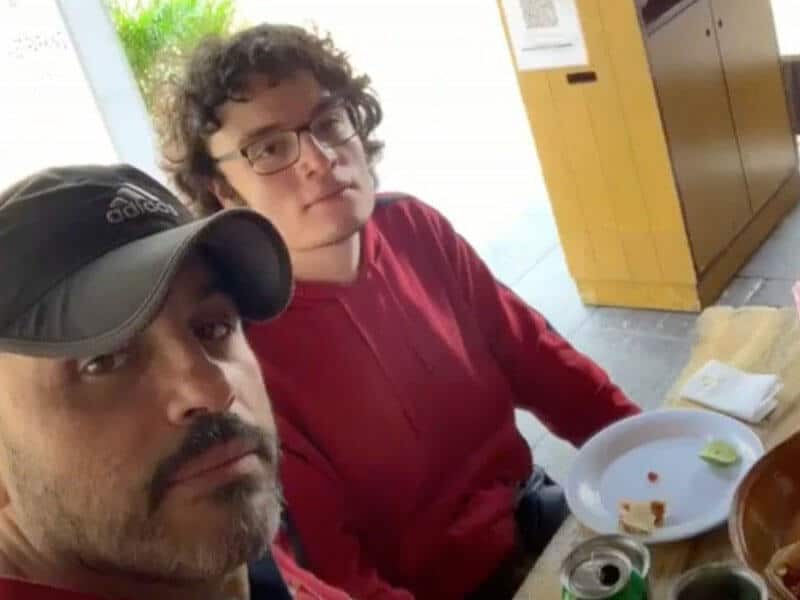
A 39-year-old man identified as Sidartha N. hit 19-year-old Andro Nava in the back of the head with a stone slab in a taco restaurant in the trendy neighborhood of Roma. The restaurant’s security cameras captured footage of the brutal, unprovoked attack.
Nava, who was dining with his father when he was attacked, sustained head injuries and was transported to a nearby hospital for treatment. He was discharged after a short stay but subsequently admitted to the National Institute of Neurology, where he was reported in stable condition on Wednesday.
Sidartha, who reportedly lived on the street in the Roma area, was arrested Monday on drug possession charges and remanded in preventative custody. The Mexico City Attorney General’s Office (FGJ) announced Thursday that he had been ordered to stand trial on a charge of attempted murder.
“A period of two months was set for the completion of the complementary investigation,” the FGJ said.
Andro Nava and his father at the taco restaurant, before the attack.
Nava’s father, Manuel Nava, said in an interview that his son could permanently lose his sense of smell and taste as a result of the attack.
He said that he was discharged from the San Ángel Inn Chapultepec hospital after 30 minutes but on the way home his son realized that he couldn’t taste or smell anything when he was given something to eat. It is unclear whether he will recover those senses.
Manuel Nava said he was convinced that the intention of the aggressor was to kill his son.
“He told police that he did it because he was drugged. He’d been taking drugs for five days straight or something like that but he … [attacked my son] without remorse or anything,” he said.
Nava also said that at least two other people have reported attacks by the same man. One of the victims was a woman who suffered a broken leg.
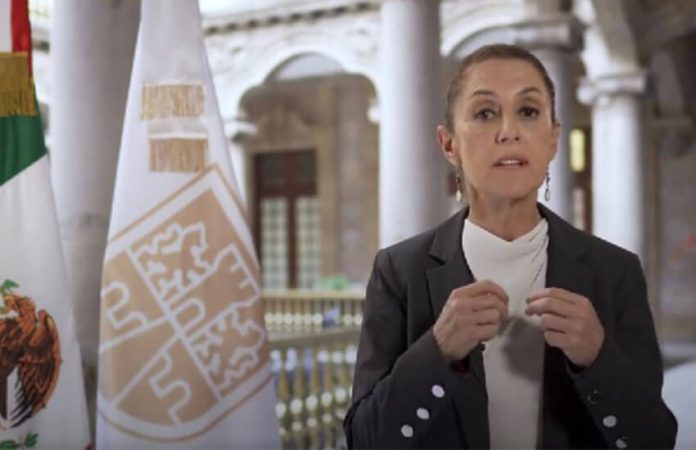
Mexico City Mayor Claudia Sheinbaum, seen in a video she posted on Twitter Tuesday on the 1-year anniversary of the Line 12 crash.
The Mexico City government has rejected the final independent report about the causes of the subway accident that claimed the lives of 26 people last year and filed a civil complaint against the company that conducted the investigation.
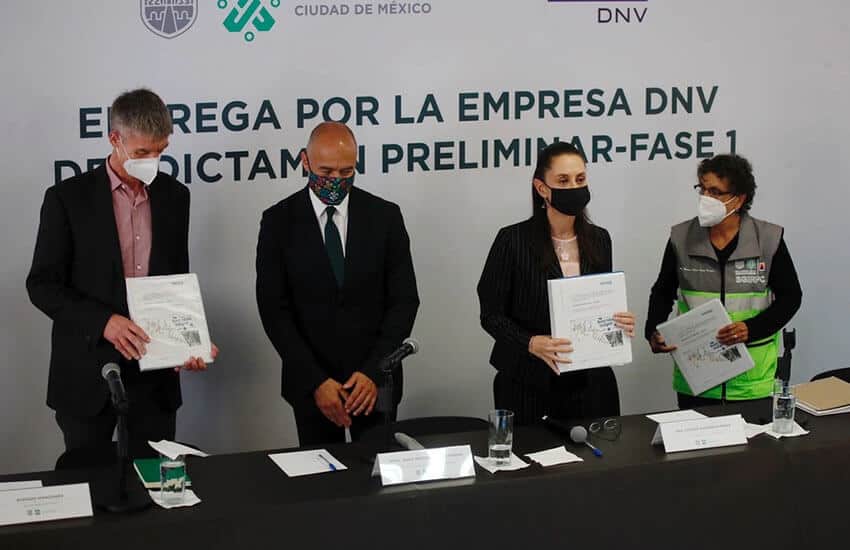
Mayor Claudia Sheinbaum described the report prepared by Norwegian company DNV as “deficient” and “poorly executed.”
It has “technical problems” and is “biased and false,” she told a press conference Wednesday.
According to government sources cited by the newspaper Reforma, DNV’s final report, which hasn’t been made public, says that oversights, anomalies and irregularities in the maintenance of Line 12 of the Mexico City subway system during the governments led by Sheinbaum and former mayor Miguel Ángel Mancera – in addition to design flaws and shoddy construction work – contributed to the collapse of an overpass on the line on May 3, 2021.
Two cars of a train plunged toward a busy road in the southeastern borough of Tláhuac due to the collapse. In addition to 26 fatalities, over 100 people were injured in the disaster, the worst ever on Mexico City’s subway system. Line 12, the newest line, was built during the 2006–2012 Mexico City government led by Marcelo Ebrard, who is now foreign minister.
Its reputation as a world leader in investigating construction defects gave Sheinbaum confidence, she said when the city hired Norwegian company DNV.
Sheinbaum, who had touted DNV as a world leader in the investigation of construction defects, turned against the company earlier this year because it employs a lawyer who prosecuted a 2012 case against President López Obrador, her political mentor.
She claimed that DNV – a risk management and quality assurance company that operates in over 100 countries – was guilty of a conflict of interest as a result of his employment, an accusation the firm has rejected.
The mayor, a leading contender to become the ruling Morena party’s candidate at the 2024 presidential election, said Wednesday that DNV completed an analysis that “doesn’t correspond to what was originally proposed” and has political purposes.
“We’re not going to accept the distortion of reality. … Why choose this lawyer? Why do they completely change their view from the second to the third report?” Sheinbaum said.
She claimed that “there are a lot of interests behind” the report, asserting that DNV has links to the National Action Party (PAN) and Mexicans Against Corruption and Impunity, a nongovernmental organization that has exposed alleged corruption in the federal government.
Sheinbaum previously pledged to disseminate all of DNV’s findings about the Metro disaster but has not yet released the company’s third and final report. However, she said it would be made public in order to show “how it failed to comply with its own methodology.”
The subway overpass collapse in the capital’s Tláhuac borough killed 26 and injured more than 100.
The mayor also said that the firm’s contract with the government was being rescinded and threatened to file a criminal complaint against it.
Some opposition party politicians noted that Sheinbaum’s rejection of DNV was incongruent with her previous praise of it.
“Up to a few days ago, @Claudiashein was praising the Norwegian company DNV, which she contracted for the #Line12 technical studies. Now with the report in hand she changed her opinion and even wants to criminalize them because she didn’t like the results. What is the mayor hiding?” PAN national president Marko Cortés wrote on Twitter.
PAN Deputy Jorge Triana described the mayor’s about-face as “grotesque,” while Democratic Revolution Party national president Jesús Zambrano used the colloquial term “ah caray” to express his surprise about Sheinbaum’s new view about a company she hired due to its “international prestige. ”
One year and two days after it occurred, no one has been held accountable for the accident on the so-called Golden Line, although 10 former Mexico City officials face charges.
The line, which runs between Mixcoac in Mexico City’s southwest and Tláhuac in the southeast and has underground and elevated sections, was built by a consortium of companies that included Carlos Slim’s Carso Infrastructure and Construction, French company Alstom and Mexican firm Ingenieros Civiles Asociados.