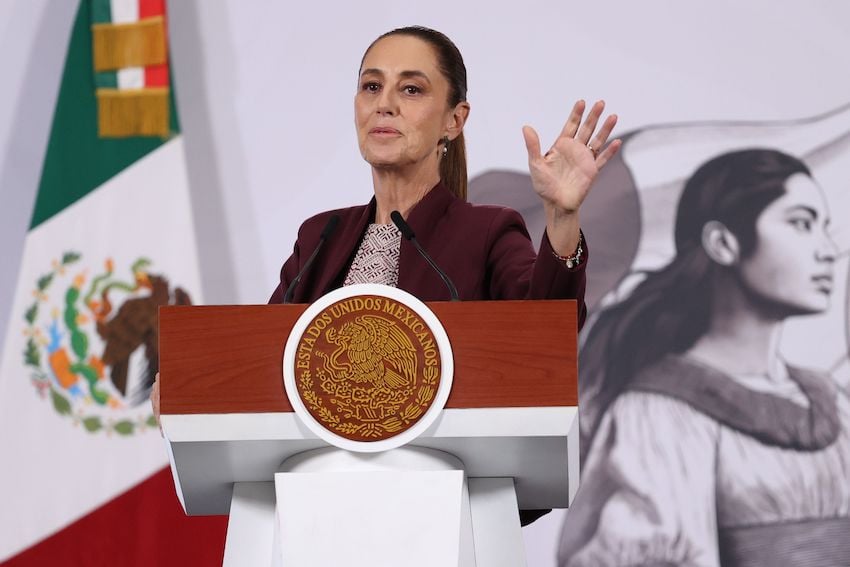
Mexico’s decision to turn down U.S. President Donald Trump’s invitation to join his Board of Peace and the strengthening of the economic relationship with Canada were among the issues President Claudia Sheinbaum spoke about at her Tuesday morning press conference.
Here is a recap of the president’s Feb. 17 mañanera.
Mexico declines Trump’s invitation to join Board of Peace
Sheinbaum told reporters that her government declined the offer from Trump to join his Board of Peace (BoP), an organization he formally established earlier this year.
The White House said in January that the BoP would “play an essential role in fulfilling all 20 points” of Trump’s Gaza peace plan, “providing strategic oversight, mobilizing international resources, and ensuring accountability as Gaza transitions from conflict to peace and development.”
Sheinbaum said that her government had already communicated its decision not to join the board to the United States.
She explained that the decision to turn down the invitation Trump extended in late January was because Mexico recognizes Palestine as a state, but Palestine won’t be represented at a BoP meeting scheduled to take place in Washington, D.C., this Thursday. Israel, in contrast, will be represented at the inaugural BoP meeting as it is a member of the board.
🔴 México no participará de manera directa en la llamada “Junta de Paz” convocada por Donald Trump, informó la presidenta Claudia Sheinbaum.
La decisión se debe a que el proceso no contempla la inclusión de Palestina. No obstante, el país asistirá únicamente en calidad de… pic.twitter.com/rPePeH433C
— Azucena Uresti (@azucenau) February 17, 2026

“The participation of both states, Israel and Palestine, is important. But that is not how it is being set out in the meeting,” Sheinbaum said.
“It’s being proposed that we go [to the meeting] as observers. So, our ambassador to the United Nations will probably go as an observer,” she added.
Among the countries that accepted Trump’s offer to join the BoP are Argentina, Hungary, Indonesia, Pakistan, Saudi Arabia, Turkey and the United Arab Emirates.
Trump said on Truth Social on Sunday that the board has “unlimited potential,” and noted that he will be joined by its members “at the Donald J. Trump Institute of Peace in Washington, D.C” this Thursday.
At the meeting, “we will announce that Member States have pledged more than $5 BILLION DOLLARS toward the Gaza Humanitarian and Reconstruction efforts, and have committed thousands of personnel to the International Stabilization Force and Local Police to maintain Security and Peace for Gazans,” he wrote.
“Very importantly, Hamas must uphold its commitment to Full and Immediate Demilitarization. The Board of Peace will prove to be the most consequential International Body in History, and it is my honor to serve as its Chairman,” Trump said.
Sheinbaum: ‘We’re strengthening our relationship with Canada’
A reporter noted that there has been speculation that the United States could withdraw from the USMCA — which is up for trilateral review this year — and highlighted that a view has emerged that Mexico is seeking a “plan B with Canada.”
“More than a plan B, we’re strengthening our relationship with Canada,” Sheinbaum said.
Mexico, Canada announce joint economic action plan for a post-USMCA future
Indeed, Mexico and Canada are aiming to deepen their economic integration via a joint action plan, an initiative Economy Minister Marcelo Ebrard announced on Monday after meeting with Dominic LeBlanc, Canada’s minister for Canada-U.S. trade, intergovernmental affairs and One Canadian Economy.
Sheinbaum noted that a large contingent of Canadian businesspeople is currently in Mexico exploring investment opportunities.
The “objective” in the relationship with Canada is “to strengthen not just trade but investment as well,” she said.
“There are many Mexican agri-food products that we can export to Canada [and] we can also import products from Canada. We also want more investment from Canadian companies in our country, … and we want Mexican companies to have investments in Canada,” Sheinbaum said.
“So the Mexico-Canada relationship will be strengthened, but that doesn’t mean the agreement won’t exist,” she said, referring to the USMCA.
“As I’ve said several times, the USMCA will remain. There may be some modifications, but it will remain in place because it is beneficial for the three countries,” Sheinbaum said.
Sheinbaum: There is ‘a lot of interest in Mexico’ as an investment destination
Asked what concerns she has heard from foreign businesspeople about investing in Mexico, Sheinbaum initially asserted that “nobody” has spoken about “any problem.”
However, she subsequently conceded that concerns have been raised about the length of time it takes to complete the bureaucratic procedures that are required to get a project of the ground.
Sheinbaum told reporters that the government is working hard to reduce the time it takes for investors to complete those procedures. Indeed, reducing the average time between an investment announcement and the execution of a project from 2.6 years to 1 year is one of the goals of the government’s Plan México economic initiative.
Sheinbaum didn’t mention insecurity or infrastructure bottlenecks as concerns for investors, although they are commonly cited as problems that prevent Mexico from reaching its full potential as an investment destination.
Instead, she stressed that there is “a lot of interest in Mexico” as an investment destination.
Mexico received just over US $40.9 billion in foreign direct investment (FDI) in the first nine months of last year, a record high. The Economy Ministry has not yet reported the FDI total for the entirety of 2025.
By Mexico News Daily chief staff writer Peter Davies (peter.davies@mexiconewsdaily.com)