It was a year of mixed fortunes for the Mexican economy. Economic growth significantly slowed, but foreign direct investment hit a record high. Incoming remittances declined for the first time in over a decade, but export revenue continued to grow.
Meanwhile, the Mexican peso appreciated significantly, a development that has both upsides and downsides for Mexico.
On the business front, three Mexican financial institutions shut down after the U.S. government accused them of laundering money for cartels, while the state of Querétaro solidified its position as Mexico’s data center hub.
As 2025 draws to a close, here’s a look back at 10 of the biggest business and economics stories in Mexico this year. Many of the developments, events and issues outlined below had a significant impact on the economic situation in Mexico this year and, in some cases, will help shape the future the country will face in the years to come.
The Mexican peso gains strength
According to the Bank of Mexico, the USD:MXN exchange rate at the close of trading on Dec. 31, 2024, was 20.88
On Dec. 30, 2025, the USD:MXN closing rate was 17.99. Thus, the peso appreciated just over 16% against the greenback in the first 11 months and 30 days of 2025.

The USD:MXN exchange rate briefly went above 21 in April, the peso becoming collateral damage in an escalating trade war between the United States and China.
But all in all, the peso had a very positive year in 2025, performing far better than many people expected.
The currency’s appreciation was due to a range of factors, including the weakness of the US dollar, the Bank of Mexico’s still-high benchmark interest rate (even though it declined by 300 basis points in 2025) and strong foreign investment inflows.
Why does it matter?
A strong peso has a range of impacts on individuals, companies and government. Let’s take a look at a few examples.
Mexican families that depend on remittances from the United States receive less money in pesos when Mexico’s currency is stronger, reducing their purchasing power.
Similarly, Mexico-based U.S. citizens who rely on income and/or savings in the U.S. to fund their living expenses get less bang for their buck when the peso is stronger, effectively making Mexico a more expensive place for them to live.

In theory, a strong peso should make many imported consumer items — especially those from the U.S. — more affordable for Mexicans, although that depends on importers and retailers passing on the lower costs.
For foreign companies operating in Mexico, a strong peso will increase their in-country costs, including labor costs, when converted to dollars. A strong peso can be a deterrent to foreign investment as it increases the overall costs of doing business in the country.
For the Mexican government, a strong peso increases the capacity to service dollar-denominated debt. According to President Claudia Sheinbaum, the strong peso is a sign that the Mexican economy is doing well, even though growth slowed significantly in 2025.
The government launches Plan México
The unveiling of the Plan México economic initiative in January was a major milestone in the first year of Sheinbaum’s presidency.
Among the goals of the ambitious industrial policy are to make Mexico the 10th largest economy in the world by 2030, reduce reliance on imports from China and other Asian countries, increase domestic production of a range of goods, attract higher levels of private investment and create 1.5 million new jobs.
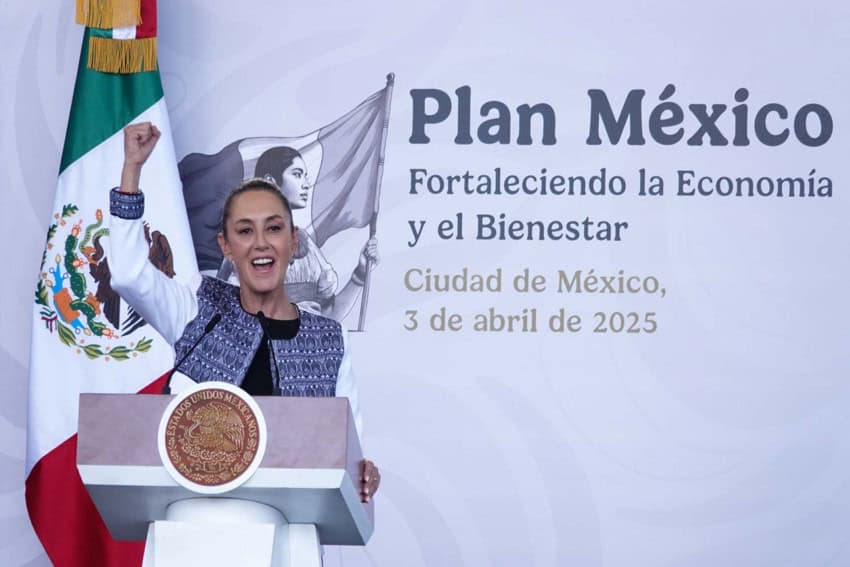
The plan was strengthened in April with the announcement of 18 related “programs and actions,” including commitments to accelerate the construction of public infrastructure projects and homes, and to increase domestic production of a range of goods including vehicles, pharmaceuticals, medical devices and petrochemicals.
Why does it matter?
Plan México is all about setting Mexico up for the future.
If Mexican industry weren’t protected, even by imposing higher tariffs on imports from China (see below), a huge number of Mexican jobs could (or would) be lost and more “Hecho in México” products would disappear from shelves.
If the Mexican government were not proactive in seeking foreign investment, GDP growth rates in the coming years would likely suffer.
FDI hits a new high
In the first nine months of the year, Mexico received a record high US $40.9 billion in foreign direct investment (FDI), an increase of 14.5% compared to the same period of 2024.
The amount exceeds total FDI in the entirety of 2024, which was around $37 billion.
A major positive in the FDI data for the first nine months of 2025 is that the new investment component — as opposed to the reinvestment of profits by companies with an existing presence in Mexico — more than tripled compared to the same period of 2024.
New investment accounted for 16% of total FDI between January and September, up from just 6% in the same period of 2024.
Why does it matter?
A record-high FDI total shows that Mexico is benefiting from the nearshoring trend, despite claims that it had missed the boat. The increase in new investment is particularly encouraging in this respect.
The increase in FDI is also positive because it demonstrates that foreign companies are willing to invest in Mexico at a time when the country’s preferential trading conditions with the United States via the USMCA free trade pact are diminished as a result of Donald Trump’s imposition of tariffs on a range of Mexican products.
The conclusion of the 2026 review of the USMCA will provide greater certainty for investors, and should therefore spur an additional influx of FDI, provided that Mexico can meet foreign companies’ needs, including a reliable electricity supply (bonus points if it is from a renewable source), robust logistics infrastructure, a stable rule of law and security.
The increase in FDI in 2025 allows the federal government to say that Mexico is doing a pretty good job in meeting investors’ needs and that Plan México is already bearing fruit.
US accuses Mexican banks of laundering money for cartels
The news came as a bombshell in late June: The Financial Crimes Enforcement Network (FinCEN) of the U.S. Department of the Treasury accused the Mexican banks CIBanco and Intercam, and the Mexican brokerage firm Vector, of laundering millions of dollars for drug cartels involved in the trafficking of fentanyl and other narcotics to the U.S.
The Mexican government repeatedly pointed out that FinCEN didn’t provide any hard evidence to support its allegations, but the accusations nevertheless turned out to be a fatal blow for the three financial organizations.
CIBanco, Intercam and Vector all ceased to operate in Mexico, not before causing their customers a significant amount of grief.
3 Mexican financial institutions cease operations after US money laundering claims
Why does it matter?
This whole episode is a testament to the long — and muscular — arm of Uncle Sam, and his willingness to use it against those he sees, or believes, are doing harm to U.S. citizens.
In this case, the target was financial institutions accused of being part of a malicious network that poisons Americans with illicit fentanyl.
Ultimately, the U.S. government was effectively able to kill off CIBanco, Intercam and Vector with accusations that weren’t supported by any hard, publicly accessible, evidence.
This is clearly concerning, not least for other Mexican banks.
Querétaro’s data center boom continues
The Bajío region state of Querétaro has, in a relatively short period of time, become Mexico’s data center hub. It is an attractive destination for data center investment for a range of reasons, among which are its central location in Mexico, its proximity to Mexico City and its infrastructure, including high-speed data cables.
After various developments in this space in 2024, including the opening of a Microsoft data center region, the momentum continued in 2025, with President Claudia Sheinbaum confirming a $5 billion “digital region” investment by Amazon Web services, the company ODATA beginning operations at a $3 billion data center campus, and the U.S. tech firm CloudHQ announcing that it will build six data centers and complementary infrastructure on a single site in Querétaro.
Querétaro is thus poised to receive significant investment in the coming years as it leads the country in providing the physical infrastructure for companies at the forefront of the digital revolution, an ongoing transformation that now has the development of artificial intelligence at its center.
Why does it matter?
The data center investment in Querétaro will help Mexico play a pivotal role in the digital revolution in the second quarter of the 21st century.
The investment will create jobs, spur the economy, contribute to even greater economic integration between Mexico and the United States and strengthen the country’s competitiveness in technologies such as cloud computing and artificial intelligence.
The onus is on federal, state and municipal authorities to manage the data center boom in Querétaro effectively and ensure that it doesn’t create major problems, including environmental and water supply ones.
New tariffs target China
In September, President Sheinbaum sent an initiative to Congress that aimed to impose new tariffs on imports from countries with which Mexico doesn’t have a free trade agreement.
The main target of the proposed new tariffs was — and is — clear: China, even though Sheinbaum herself asserts that the duties are not specifically directed at the East Asian economic powerhouse.
The tariffs were approved by Congress this month, albeit after many of the duties proposed by the president were lowered by lawmakers.
Still, Mexico’s protectionism against the world’s second-largest economy and various other countries, including South Korea, India and Thailand will increase to an unprecedented level in January.
China, for one, is not happy, urging Mexico to “correct its wrong practices of unilateralism and protectionism” as soon as possible.
Why does it matter?
Mexico’s willingness to impose additional tariffs on Chinese goods is seen in a positive light by the United States and could thus help it in next year’s USMCA review.
Higher tariffs against cheap Chinese imports will also help to protect Mexican industry, while the Mexican government is projected to collect tens of billions of pesos in additional revenue on an annual basis. It remains to be seen whether the impact on inflation will be more than the projected 0.2 percentage points.
The plan to increase the tariff on cars imported from China to 50% from 20% could lead to a reduction in the sale of such vehicles in Mexico, where BYDs, MGs and Chireys are commonly seen on the streets.
However, Chinese manufacturers are known for their ability to reduce their costs and the purchase price of their products in order to offset the impact of tariffs. Thus, it remains uncertain whether strong sales of Chinese cars in Mexico will come to an end .
Central bank continues to cut interest rates
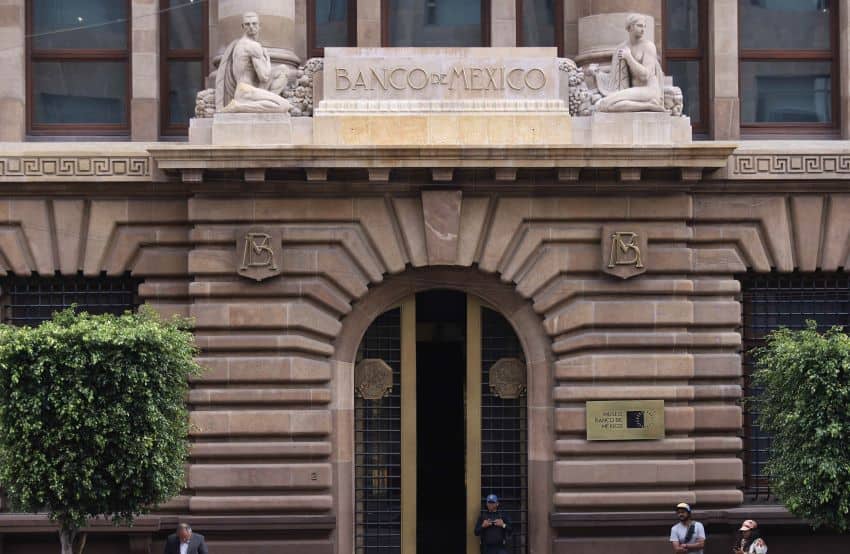
The Bank of Mexico (Banxico) lowered its benchmark interest rate after every one of its board’s eight monetary police meetings in 2025.
Banxico’s key rate thus declined from 10% at the start of the year to 7% after the Dec. 18 monetary policy meeting.
More cuts could come in the first half of 2026, provided inflation trends down, as the central bank forecasts it will.
Why does it matter?
Lower interest rates should help to spur the Mexican economy in 2026 by increasing domestic demand from consumers.
The reduction in interest rates and consequent cheaper access to credit could also help some businesses to invest in themselves and expand, both in a physical sense and in terms of their workforces.
Lower interest rates could also contribute to a weaker Mexican peso in 2026, although the currency appreciated significantly this year despite the 300-basis-point reduction in Banxico’s benchmark rate.
Mexico became the biggest buyer of US goods, as exports continue to grow
As we reported last month, in 2025 Mexico was the largest buyer of U.S. goods in the first eight months of the year, outpacing Canada. It remained in that position at the end of September, according to U.S. data published on Dec. 11.
Mexico’s ascension to the No. 1 position among purchasers of U.S. goods is a significant milestone in the bilateral trade relationship.
Mexico is also the largest exporter of goods to the United States, having dethroned China in 2023.
Mexico’s outlay on imports from the U.S. in the first nine months of 2025 was $253.6 billion, just ahead of Canada’s expenditure of $253.47 billion.
Why does it matter?
Mexico’s rise to the position of the world’s top buyer of U.S. exports further underscores the trade dependency of the two North American neighbors.

Mexico’s expenditure on U.S. goods in the first nine months of the year increased, albeit only slightly, whereas Canada’s outlay on imports from its southern neighbor declined amid a “Buy Canadian” movement that emerged in response to tariffs imposed by U.S. President Donald Trump on a range of Canadian products.
That Mexico can show the United States that it is spending more on U.S. goods should help it in negotiations with the U.S. during the USMCA review.
While the United States could push Mexico to buy even more U.S. goods as it seeks to reduce the trade deficit it has with its southern neighbor — a priority of Trump — the fact that Mexico’s outlay is increasing should be seen in a positive light by U.S. trade negotiators.
The economy slows
Mexico’s economy grew just 0.4% annually in the first nine months of 2025, a significant slowdown compared to the 1.2% expansion in 2024.
A 1.5% contraction of the secondary sector — which includes manufacturing, construction, mining and electricity generation — was the cause of Mexico’s slowdown this year.
The primary sector (+2.9%) and the tertiary sector (+1.2%) both grew in the first nine months of the year.
In the third quarter of the year, the Mexican economy contracted 0.3% compared to the previous three-month period.
BBVA Research said in a note that “the decrease in GDP during the third quarter of the year occurs in a context of prolonged uncertainty regarding U.S. trade policy, slower growth in real wages, and a deterioration in consumer confidence.”
Why does it matter?
This year’s economic slowdown primarily matters because of the negative effect on the lives of ordinary Mexicans.
While unemployment remains low, at 2.6% in October, the rate has risen from the all-time low of 2.2% in March.
That is one sign that the low growth rate is having an impact on the economy of Mexico and its people.
Another is that the percentage of total workers who are employed in the informal economy has increased, reaching a three-year high of 55.4% in the third quarter.
In addition, consumer confidence fell every month between September and November, according to the national statistics agency INEGI.
The economic slowdown is also concerning, considering that foreign direct investment in Mexico reached a record high in the first nine months of the year. FDI can be a key driver of economic expansion, but in 2025, it wasn’t able to spur anything beyond a lackluster rate of growth.
Let’s hope that the projections for higher growth in 2026 are at least met, if not exceeded.
Remittances decline
The inflow of remittances to Mexico declined 5.1% annually in the first 10 months of 2025, making it inevitable that the accumulated value of the international transfers will fall this year for the first time in more than a decade.
Between January and October, Mexico received just over $51.3 billion in remittances, down from $54.08 billion in the same period of 2024.
Analysts have partially attributed the decline in remittances to Mexico this year to fear of going out to work among U.S.-based Mexicans, of whom 4.3 million are “unauthorized” immigrants, according to the bank BBVA.
Why does it matter?
An increase in the value of the peso and the decline in the transfer of remittances to Mexico was a double whammy for the millions of Mexican families that depend on the international transfers to make ends meet.
In 2025, many of those families would have received significantly less in pesos from their loved ones abroad, leaving them with less money to spend at a time when inflation remains a concern, if not the runaway scourge it was earlier in the decade.
The reduction in remittances — which contributed to 3.6% of Mexico’s GDP in 2024 — is also a factor, albeit not a major one, in the economic slowdown this year.
By Mexico News Daily chief staff writer Peter Davies (peter.davies@mexiconewsdaily.com)