
Last week, I wrote about Puerto Vallarta’s municipal payroll as part of my weekly roundup of local stories. It generated quite a bit of interest, and, more importantly, a lot of questions. So, I went looking for the answers.
The good news is that much of the information is sitting right there in the city’s own transparency records. The less good news is that once you start comparing those records with what the City Council actually approved, things get a little more complicated.
At the center of it all is Councilwoman Melissa Madero Plascencia, who says her review of municipal records has uncovered a significant difference between the number of positions the city was authorized to have and the number of people currently appearing on the payroll. Mayor Luis Munguía says the payroll isn’t inflated.
Both sides have made their positions clear, but this is one of those stories where the most useful thing we can do is step away from the political argument for a minute and look at the paperwork.
What was approved? Who’s actually being paid? How much is it costing? And perhaps most importantly, what are residents getting for all that money?
Comparing authorized positions with payroll records
This isn’t really about whether Puerto Vallarta needs a lot of municipal employees. Of course it does. A city of this size needs people collecting garbage, maintaining parks, fixing streetlights, responding to emergencies, processing permits and doing all the other largely invisible work that keeps a city functioning.
It’s about whether the people being paid are where they’re needed, whether the positions are properly authorized, and whether residents are seeing the benefit of the money being spent.

And when public money is involved, those seem like pretty reasonable questions.
What did the city actually approve?
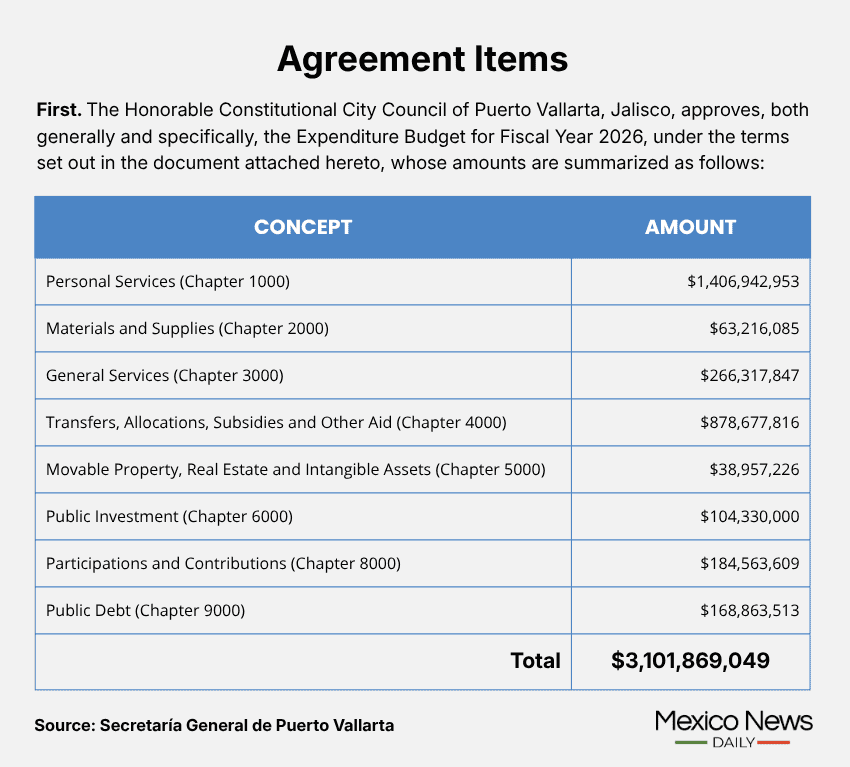
When the city council approved Puerto Vallarta’s 2026 budget in December 2025, it also approved the city’s staffing list; essentially, the number of positions the municipality was authorized to have. That number was 2,707 positions, with an annual cost of about 758.5 million pesos.
Madero says her review of municipal records shows 3,375 active positions on the payroll. That’s 668 more positions than the council approved, representing an estimated additional cost of 151.95 million pesos a year, according to her analysis.
Those are significant figures, but they’re allegations that still need to be independently examined. The existence of additional positions, by itself, doesn’t prove that anything illegal has happened.
Examining the details of city records
What do the city’s own records show?
Puerto Vallarta publishes its payroll online, including employees’ names, positions, departments and pay. The most recent complete payroll currently available is for the second half of July 2026. It runs to 61 pages and provides a remarkably detailed look at who was being paid by the municipality at that point.
The city also publishes its approved 2026 staffing list, making it possible to compare what was authorized with what actually appears on the payroll. That comparison is where some of the questions begin.
For example, the approved staffing list includes 18 positions under the mayor’s office. But the July payroll contains considerably more people across the broader areas associated with the mayor’s office.
Madero’s analysis counts 151 people across the mayor’s office, private secretary’s office, executive office and advisers, at an annual cost of about 52.15 million pesos.
There are differences in how some departments and positions are grouped in the various reports, however, which is why the actual payroll records matter. Before anyone can draw a firm conclusion, the categories need to be compared on an apples-to-apples basis.
Analyzing budget figures and departmental growth
How much is being spent?
Puerto Vallarta’s total 2026 spending budget is about 3.1 billion pesos. Roughly 1.4 billion pesos of that is budgeted for personnel costs, which is about 45% of the city’s total spending budget. That figure includes more than basic salaries, so it shouldn’t be treated as a straight payroll figure.
Madero has also identified 778 positions she says fall outside the approved structure, representing about 179.7 million pesos in annual costs. That number shouldn’t simply be added to the 668 additional positions mentioned earlier, as the categories overlap, meaning doing so could count some positions twice.
She’s also raised concerns about the pace of payroll spending, saying an area of the budget set aside about 100 million pesos for eventual payroll spending could end up closer to 291 million pesos annually if the current rate continues. Those figures will need to be reconciled with the administration’s records.
What does the mayor say?
Munguía has rejected the suggestion that the municipal payroll is inflated. He said he welcomes the observations from council members, and that the city’s budget is dynamic and can be reviewed or redirected as necessary. He specifically pointed to garbage collection trucks, machinery, specialized equipment, pruning and streetlight maintenance as areas where resources could potentially be redirected.
Assessing public service impact and next steps
And that brings us to the question that may matter more to residents than any spreadsheet.
What are residents getting for the money?
Madero says some departments have actually seen staffing reductions while other areas have grown. She points to 179 fewer personnel in citizen security than the authorized staffing level, as well as reductions in parks and gardens and the municipal landfill. She’s also raised concerns about staffing and equipment in areas such as traffic signals and drainage.

Those claims deserve scrutiny too, because ultimately, residents don’t experience a payroll spreadsheet. They experience the city.
Residents know when the garbage isn’t picked up. They know when the park down the street isn’t being maintained; they know when the water goes out, when a streetlight stays broken for weeks, when traffic signals aren’t working or when potholes seem to multiply faster than they can be repaired. If the city needs more employees, then residents should be able to see what those employees are doing and why they’re needed.
What’s being done … and what isn’t
Madero has said she plans to take her evidence to the municipal comptroller and, if necessary, to the state’s anti-corruption prosecutor. As of Sept. 8, I couldn’t find a public announcement that the municipal comptroller has opened a specific investigation into the payroll allegations. That doesn’t mean one isn’t underway; it simply means there’s been no public announcement that I could find.
For now, we have the approved staffing list, the city’s payroll records, Madero’s analysis and the mayor’s response. And perhaps that’s exactly where this story should stay for the moment. With the records, the questions and the people who ultimately pay the bill.
Charlotte Smith is a writer and journalist based in Mexico. Her work focuses on travel, politics and community. You can follow along with her travel stories at www.salsaandserendipity.com.