Tariffs took center stage the second week of December. Mexico approved new tariffs of up to 50% on a variety of products from non-trade partners in a move some speculated was aiming at appeasing the U.S. ahead of next year’s trade pact review. Mexico also faced the prospect of higher tariffs on its own products — a threat U.S. President Trump says will become reality if Mexico doesn’t deliver Rio Grande water it owes the U.S.
President Sheinbaum highlighted the decline in homicides, while the National Public Security Council agreed prioritize fighting extortion in 2026. On the economic front, inflation is trending up as the central bank prepares its last interest rate decision of the year.
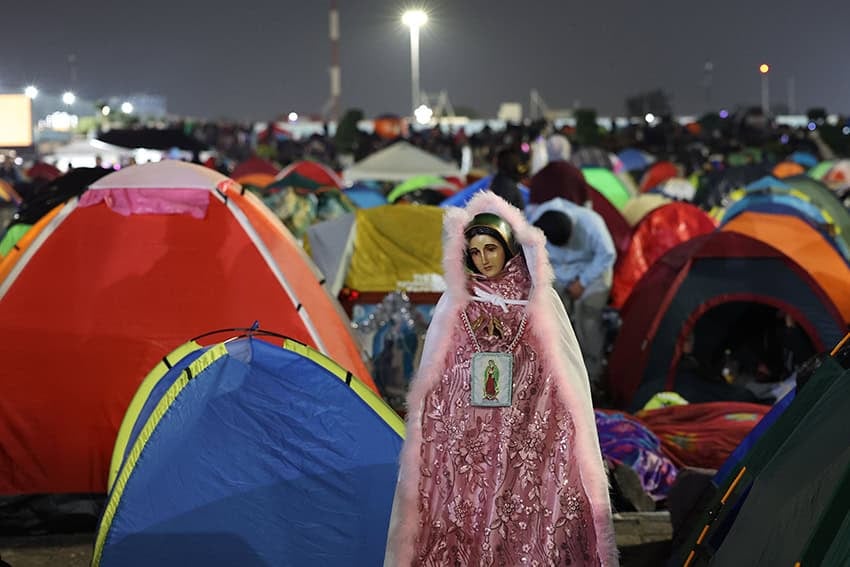
The week wrapped up with a beloved Catholic tradition: Millions of the faithful made the pilgrimage to the Mexico City Basilica to celebrate the Day of the Virgin of Guadalupe at the place where, legend has it, she first appeared in Mexico nearly 500 years ago.
Didn’t have time to read this week’s top stories? Here’s what you missed.
Protectionist trade policies dominate at home and abroad
On Wednesday, Congress approved sweeping new tariffs on imports from China and other non-free trade agreement countries. The legislation, passing the Chamber of Deputies 281-24 with 149 abstentions, proposes tariffs ranging from 5% to 50% across 1,463 product categories.
The Chinese government immediately responded, urging Mexico to reverse the tariffs “as soon as possible.” However, Sheinbaum defended the measures at her Thursday morning press conference, with Economy Minister Marcelo Ebrard emphasizing the tariffs aim to protect Mexican industry from cheap imports rather than serving as a political measure. The legislation targets sectors including auto parts, textiles, furniture, and electronics, with the government estimating it will generate 70 billion pesos ($3.8 billion) in additional revenue annually.
Sheinbaum defends Mexico’s sweeping new tariffs: Thursday’s mañanera recapped

The tariff bill, though somewhat softened from Sheinbaum’s original September proposal, represents a calculated recalibration of Mexico’s trade relationships. It aims to protect domestic manufacturers, and could potentially smooth relations with the U.S. ahead of next year’s USMCA review — though critics warn it could increase consumer prices and create inflationary pressures.
Security progress and setbacks
Mexico’s security landscape presented a study in contrasts this week. A devastating car bomb explosion in Coahuayana, Michoacán, killed six people, including at least three community police officers, on Dec. 7. The powerful blast outside a community police station, initially characterized as terrorism before that designation was quietly removed, underscored the operational capacity criminal groups still maintain despite government initiatives like Plan Michoacán.
Yet government data told a different story. At her Tuesday morning press conference, President Sheinbaum presented figures showing homicides down 29% nationally compared to 2024, with an average of 65.1 murders per day during the first eleven months of 2025. November alone saw a 37% reduction compared to September 2024, equivalent to 32 fewer homicides daily. Officials reported nearly 39,000 arrests for high-impact crimes since October 2024, alongside seizures of 311.7 tonnes of drugs and 20,169 firearms.
Despite these improvements, public perception remains challenging. Sheinbaum’s approval rating declined to 74%, down nine points from its May peak, with younger Mexicans particularly skeptical. Only 35% of poll respondents believe Mexico is improving in terms of security.
Economic resilience despite inflationary headwinds
Despite trade tensions and security concerns, Mexico’s labor market demonstrated remarkable strength. Formal employment reached a record 22.8 million workers as of Nov. 30, the highest figure since records began in 1943. The addition of 48,595 new jobs in November brought cumulative growth for 2025 to 599,389 positions, with women’s formal employment showing particularly strong gains of approximately 98,000 new positions over the past year.
However, inflation continued climbing toward 4%, reaching 3.80% in November, up from 3.57% in October. Core inflation hit 4.43%, the highest since March 2024, driven by service sector pressures, food price increases (serrano peppers up 24.76%, squash climbing 17%), and electricity costs soaring 20.7%. The central bank is expected to reduce interest rates by 25 basis points at its December 18 meeting despite these inflationary pressures.
Es muy posible que en algunos meses de 2026 la inflación general se ubique por encima de 4% en México. pic.twitter.com/BAia27tmhG
— Gabriela Siller Pagaza (@GabySillerP) December 9, 2025
Bilateral relations: Diplomatic whiplash
President Sheinbaum’s week illustrated the volatile nature of U.S.-Mexico relations. Following what she described as a “very friendly” meeting with President Trump at the World Cup draw in Washington, D.C., where Trump showed “a lot of respect toward Mexico,” the diplomatic atmosphere quickly deteriorated. Just days later, Trump threatened a 5% tariff on Mexican goods unless Mexico promptly delivers water owed to Texas farmers under the 1944 Water Treaty, demanding 200,000 acre-feet before December 31.
Sheinbaum responded diplomatically, acknowledging treaty obligations while noting physical limitations including pipeline capacity and Mexico’s own water needs during severe drought. She expressed confidence that an agreement could be reached, emphasizing Mexico’s shortfall is “not a matter of ill will.”
The water dispute emerged alongside other bilateral tensions. Sheinbaum reported that the Trump administration is deporting fewer people to Mexico than the Biden administration did—an average of 472 per day versus 572 under Biden. This data point, presented at Wednesday’s press conference, suggests a more complex reality than Trump’s tough-on-immigration rhetoric might suggest.
Cultural recognition and tourism highlights
President Sheinbaum continued garnering international recognition this week. The New York Times named her among the 67 most stylish people of 2025, highlighting how she uses clothing incorporating Indigenous textile heritage as an extension of her political agenda. At her Wednesday press conference, Sheinbaum graciously deflected the praise to Mexico’s Indigenous artisans, emphasizing her consistent stance against cultural appropriation by major brands. Separately, Forbes again named Sheinbaum one of the world’s five most powerful women, noting her central role in North America’s manufacturing transformation.
Mexico’s tourism sector delivered exceptional news as international visitation surged 13.6% in the first ten months of 2025, with 79.3 million visitors generating $28.2 billion in revenue. October set records with 8.3 million arrivals and visitor spending jumping 50.3% compared to pre-pandemic 2019. Adding to tourism momentum, the BBC named Loreto, Baja California Sur, to its top 20 global destinations list for its community-led conservation efforts.
Other not-to-be missed stories from this week
- Former Chihuahua governor César Duarte arrested for embezzlement
- Automaker Stellantis planning major expansion of its Mexican operations
- Nearly 40% of businesses in Mexico now using AI, says AWS executive
- Mexico City hotel prices spike nearly 1000% ahead of the World Cup
- The Nohoch Mul pyramid, tallest in the northern Yucatán Peninsula, is climbable again
- Inside the binational effort to clean up the Rio Grande
Looking Ahead
As the year winds to a close, Sheinbaum is under increasing pressure over Mexico’s ongoing security challenges. Water issues remain top of mind as Mexico and the U.S. work out how to deal with Mexico’s water delivery shortfall along the two countries’ shared border.
Economically, record formal employment and continued foreign investment signal underlying strength, but inflation trending toward 4% threatens purchasing power and could force difficult monetary policy decisions. The central bank is expected to further cut interest rates next week, which could push inflation even higher.
Meanwhile, the tempestuous relationship with the United States—oscillating between friendly World Cup meetings and water-driven tariff threats within days—underscores the delicate diplomatic tightrope Sheinbaum must walk. As 2026 approaches with its crucial USMCA review, Mexico’s challenge will be maintaining sovereignty over domestic policy while managing an increasingly transactional and unpredictable northern neighbor. The coming months will test whether Sheinbaum’s blend of pragmatism, cultural nationalism, and strategic assertiveness can navigate these crosscurrents successfully.
Mexico News Daily
This story contains summaries of original Mexico News Daily articles. The summaries were generated by Claude, then revised and fact-checked by a Mexico News Daily staff editor.