How much sovereignty does Mexico really have? That question hung over the week of Jan. 26-30 as the United States exercised increasing authority within Mexico and weaponized tariffs to reshape Mexican foreign policy beyond its borders.
The week began with President Claudia Sheinbaum insisting alleged drug trafficker Ryan Wedding had simply turned himself in at the U.S. Embassy last week — contradicted by a Wall Street Journal bombshell revealing FBI agents handcuffed the suspect in what one official called a “zero-margin, high-risk operation” on Mexican territory. By week’s end, Trump issued an executive order threatening tariffs on any country supplying oil to Cuba, putting Mexico’s solidarity with the island in direct conflict with its need to maintain trade relations with its northern neighbor.
Between these episodes of American pressure, Sheinbaum grappled with a debilitated security narrative and the news of lackluster GDP growth in 2025.
Didn’t have time to follow this week’s top stories? Here’s what you missed.
Ryan Wedding arrest controversy deepens
The circumstances surrounding the Jan. 22 arrest of alleged drug trafficker Ryan Wedding dominated headlines throughout the week. Wedding, a 44-year-old former Olympic snowboarder wanted on U.S. drug trafficking and murder charges, was apprehended under circumstances that remain murky.
President Sheinbaum has consistently maintained that Wedding turned himself in at the U.S. Embassy in Mexico City, even as Wedding’s lawyer disputed the surrender narrative, telling reporters on Monday that “any spin that the government of Mexico is putting on this that he surrendered is inaccurate.” On Wednesday, a Wall Street Journal exclusive published Wednesday painted a different picture, citing U.S. and Mexican officials who described FBI Hostage Rescue Team involvement in an operation that Mexican law explicitly forbids.
FBI Director Kash Patel, who was in Mexico City during the arrest, called it a “zero-margin, high-risk operation” executed by FBI teams “alongside our Mexican partners.” The Journal reported the FBI’s involvement was intended to remain secret, as Mexican law prohibits foreign agents from participating in law enforcement operations on Mexican soil.

At her Thursday press conference, Sheinbaum insisted the WSJ report supported her version of events, even though the article clearly suggests U.S. intervention in Wedding’s arrest.
WSJ: FBI involved in Canadian trafficker’s arrest in Mexico despite ban on foreign agents
The controversy raises broader questions about U.S.-Mexico cooperation on security matters at a time when the Trump administration has threatened unilateral strikes against cartels in Mexico. On multiple occasions throughout the week, the president reiterated that Mexico will never “accept joint operations with the United States, or with federal, state or municipal forces of the United States, in our territory.”
However, according to the WSJ, the FBI is now mapping out more targets across Mexico for potential joint operations, suggesting this may be the first of many such incidents.
Is security in Mexico improving?
While the Sheinbaum administration has touted a 30% decline in homicides in 2025 as evidence of improved security, a comprehensive analysis of crime statistics this week revealed a troubling picture that calls the government’s claims into question.
The report examined evidence that state authorities may be systematically misclassifying murders as lesser crimes. The number of intentional homicide victims allegedly declined 11% over six years, while victims of culpable homicide and “other crimes against life and integrity” increased 11% and 103%, respectively.
More concerning, disappearances surged 16% during Sheinbaum’s first year compared to López Obrador’s final year. A total of 14,765 people who disappeared between October 2024 and September 2025 remained unaccounted for. When homicides and disappearances are combined, the total declined only 5% compared to the AMLO administration’s average — far less impressive than the promoted 30% homicide reduction.
Security experts suggested that disappearing people allows organized crime to “create terror” and “hide lethal violence” because without a body there’s no crime — a situation that is “politically profitable” for all involved.
The week brought fresh evidence of Mexico’s security challenges. In Salamanca, Guanajuato, gunmen massacred 11 people at a soccer field, while in Sinaloa, two state legislators were hospitalized after an assassination attempt in Culiacán. Most troubling was news from Concordia, Sinaloa, where Canadian mining company Vizsla Silver confirmed a mass kidnapping of employees, with victims still missing and work suspended indefinitely.
Despite government claims of improved security, a new report showed that feelings of insecurity among Mexicans have risen even as official crime statistics have fallen — suggesting a disconnect between lived reality and government narratives.
Pemex pauses scheduled oil shipment to Cuba
Cuba was a second front from which Mexico’s position between principle and pragmatism came into sharp relief this week.
On Jan. 23, Reuters reported the Sheinbaum administration was reviewing whether to continue shipments to the island amid mounting U.S. pressure, citing three senior government sources who expressed “growing fear that the United States could take unilateral action on our territory.”
Monday brought news that Pemex had canceled a scheduled January shipment. At her Tuesday press conference, Sheinbaum didn’t deny the cancellation but emphasized oil shipments are a “sovereign decision” made by Mexico and Pemex. When pressed on whether shipments would resume, she simply said: “In any case, we will inform you.”
The pressure escalated throughout the week. Trump declared on social media that “THERE WILL BE NO MORE OIL OR MONEY GOING TO CUBA – ZERO!” while Politico reported the administration was weighing a total blockade. Mexican officials observed at least three U.S. Navy drones conducting flights over the Bay of Campeche since December, following routes taken by tankers carrying Mexican fuel to Cuba — the same surveillance aircraft spotted off Venezuela’s coast before U.S. military intervention there.
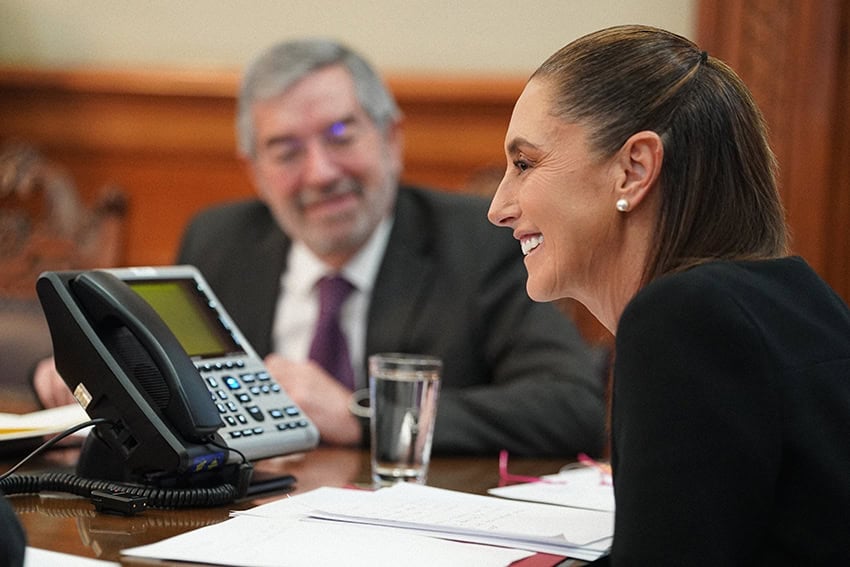
When Sheinbaum spoke with Trump by phone Thursday, she indicated Cuba wasn’t discussed during the 40-minute conversation focused on border security, drug trafficking and trade.
But the next day, Trump issued an executive order declaring a “national emergency” over Cuba and establishing a tariff system under which additional duties may be imposed on imports from countries that provide oil to Cuba. The order, as the Associated Press noted, “would primarily put pressure on Mexico.”
At her Friday press conference in Tijuana, Sheinbaum delivered a prepared four-point response: reaffirming Mexico’s commitment to sovereignty, warning tariffs could trigger a humanitarian crisis affecting Cuban hospitals and food supply, instructing the foreign minister to contact the State Department for clarification and pledging Mexico “will seek different options to help, in a humanitarian way, the people of Cuba.”
She stressed her government needs to understand “the reach” of Trump’s order because “we don’t want to put our country at risk in terms of tariffs.” She noted there are “other ways to support” Cuba beyond oil, and even suggested the United States itself could send oil to the island. “Our interest is that there is not a serious situation for the Cuban people,” she said, while acknowledging Mexico’s need to avoid additional tariffs.
Mexico finishes 2025 with 0.7% GDP growth
Amid controversies and geopolitical tensions, Mexico’s economy delivered the welcome news of record export performance that prevented a recession after the economy shrunk 0.3% in third quarter.
Mexico’s exports surged to $664.8 billion in 2025, a 7.6% increase representing the strongest growth since 2022. More importantly, the strong finish created Mexico’s first trade surplus since 2020 — a modest $771 million that nonetheless contrasts sharply with 2024’s $18.5 billion deficit.
The December surge was particularly impressive, with exports climbing 17.2% compared to the previous year. This performance helped push GDP growth to 0.7% for the year, keeping Mexico out of recession despite what a Bank of America chief economist called “an environment of uncertainty and new tariffs.”
Carlos Capistrán Carmona, chief economist for Mexico and Canada at Bank of America (BofA), told Forbes magazine that exports will once again be Mexico’s economic engine in 2026, forecasting growth above 5%.
Light news and cultural highlights
Not all the news in Mexico this week was dominated by controversy.
- At the 2026 Sundance Film Festival, Guillermo del Toro delivered a mariachi concert and even took over tortilla prep in the kitchen.
- More Mexicans are visiting Japan, inspired by a growing interest in Japanese culture.
- Grupo Modelo plans to flood Mexico with beer during the 2026 World Cup to make Mexico the tournament’s best host.
- A pair of jaguar cubs and a black bear were spotted in San Luis Potosí, suggesting population growth.
- Panchito the elephant seal made his annual visit to Mexico’s Pacific coast.
- President Sheinbaum wrote a letter to Korea’s prime minister requesting more BTS concert dates after ticket sales for the group’s tour in Mexico descended into chaos.
Looking ahead
The week’s events highlighted complex challenges facing the Sheinbaum administration. The Ryan Wedding controversy exposed tensions over U.S.-Mexico security cooperation ahead of USMCA review negotiations. Questions about crime statistics threaten the president’s security narrative, while export success provides economic leverage but may not offset broader growth challenges.
The message from Washington was unmistakable: Mexico’s decisions — on law enforcement, on trade partners, on foreign policy — are subject to American approval.
The Cuba decision will test Mexico’s ability to maintain foreign policy independence while managing an aggressive U.S. administration that has threatened military strikes. Sheinbaum faces a delicate balancing act between principle and pragmatism.
Looking for last week’s round-up?
Mexico News Daily
This story contains summaries of original Mexico News Daily articles. The summaries were generated by Claude, then revised and fact-checked by a Mexico News Daily staff editor.