
President Claudia Sheinbaum kicked off the week by giving Bad Bunny’s Super Bowl halftime show her official seal of approval, while senators were busy hammering out the details of historic labor reform to reduce the workweek to 40 hours.
Across the border, Monday was San Francisco’s first-ever “Tigres del Norte Day” in honor of the legendary norteño band. And in El Paso, a bizarre incident involving what U.S. officials claimed was a cartel drone sparked diplomatic confusion and raised more questions than it answered. Behind these headlines, a darker story unfolded in Sinaloa and Mexico found itself playing high-stakes diplomatic chess with both Washington and Beijing.
Didn’t have time to catch the top stories of the week? Here’s what you missed.
Tragedy in Sinaloa: Bodies of kidnapped miners found in mass grave
On Monday, authorities confirmed the bodies of three employees of Canadian mining firm Vizsla Silver Corp were found in a mass grave in Sinaloa. The victims — engineers José Ángel Hernández Velez and Ignacio Aurelio Salazar Flores from Zacatecas, and geologist José Manuel Castañeda Hernández from Guerrero — were among 10 workers kidnapped on Jan. 23 from employee housing near La Concordia, located about 250 kilometers southeast of Culiacán.
The remains were discovered in an advanced state of decomposition in El Verde, a small community north of La Concordia, with mothers searching for their missing loved ones from neighboring Sonora reporting that at least 20 bodies were found at the site. President Sheinbaum announced that federal authorities had made several arrests in connection with the case, with those in custody providing information to prosecutors.
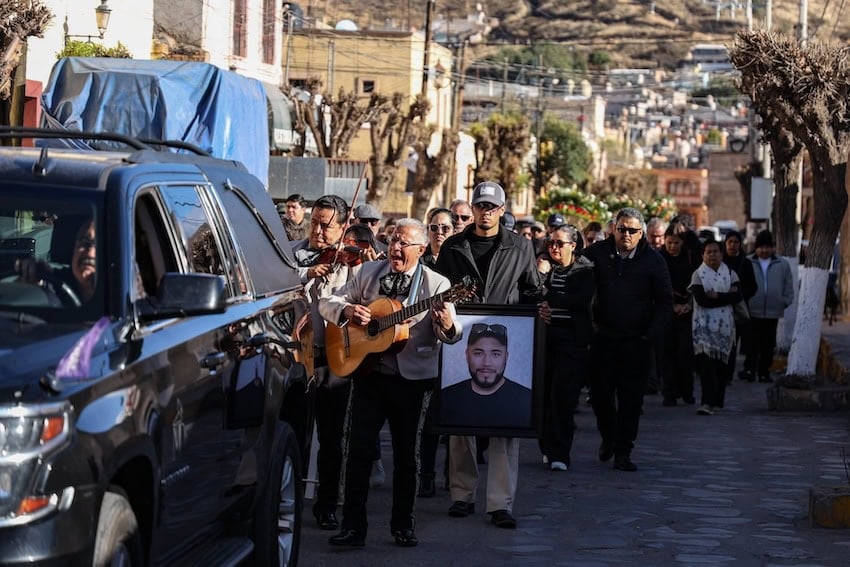
(Adolfo Vladimir/Cuartoscuro)
Security Minister Omar García Harfuch said on Tuesday that the miners may have been mistaken for members of a rival cartel faction, though Sheinbaum herself cast doubt on this “mistaken identity” theory, promising that investigators hadn’t ruled out the possibility of an extortion attempt gone wrong.
With five victims confirmed dead and five still missing, the tragedy underscored the dangers that continue to plague Mexico’s northern states despite government claims of reduced violence.

What really happened over El Paso?
A bizarre incident at the U.S.-Mexico border sparked confusion and raised diplomatic tensions when airspace over El Paso, Texas, was abruptly closed late Tuesday, Feb. 10. U.S. Transportation Secretary Sean Duffy initially claimed a “cartel drone incursion” had forced the Federal Aviation Administration to close the airspace, asserting on social media that the threat had been “neutralized.”
However, multiple reports citing people familiar with the situation told a different story. According to The New York Times and the Associated Press, the closure was actually precipitated when U.S. Customs and Border Protection officials deployed a military anti-drone laser on loan from the Department of Defense without giving aviation officials enough time to assess risks to commercial aircraft. The Times reported that CBP officials thought they were firing on a cartel drone but it turned out to be a party balloon.
At her Wednesday morning press conference, Sheinbaum demanded an official explanation from the U.S. government, asserting there was no evidence of drones having entered the U.S. from Mexico. “You can be absolutely certain of that,” she reiterated on Thursday, noting that the U.S. statements referenced “cartels” but never mentioned “Mexico” directly.
CBP anti-drone laser reportedly triggered El Paso airspace closure
U.S. Senator Tammy Duckworth called the incident a result of “lack of coordination that’s endemic in this Trump administration,” while security expert Carlos Pérez Ricart noted that while drone incursions from Mexico are common, “there’s no evidence that the cartels would attack the U.S. with drones, it doesn’t make sense for them.”
Mexico rushes aid to Cuba as shortages worsen
As Cuba continues to face severe fuel and food shortages and frequent blackouts, Mexico stepped up its humanitarian response.
Two Mexican Navy vessels carrying more than 800 tonnes of aid arrived in Havana on Thursday, prompting Cuban President Miguel Díaz-Canel to post a video thanking Mexico and President Sheinbaum personally.
At her Friday press conference, Sheinbaum went further, revealing that Mexico could establish an air bridge to Cuba if the island nation requests it. “If Cuba requests it, then those conditions would exist, of course,” she said, noting that planes can refuel in Mexico even though jet fuel shortages have grounded many flights in Cuba itself.
The humanitarian gesture comes as Mexico has suspended oil shipments to Cuba due to U.S. President Donald Trump’s threat to impose tariffs on countries that supply the island with petroleum. Sheinbaum pledged to send more aid, with the humanitarian supplies representing “solidarity, friendship and the exemplary history of sovereignty and respect for the rights of others that distinguish Mexico,” according to Díaz-Canel.
China reenters the frame: Trade talks and manufacturing ambitions
As the U.S., Mexico and Canada began their formal review of the USMCA trade agreement, China moved to strengthen its position in Mexico through both diplomatic and business channels. Deputy Economy Minister Vidal Llerenas traveled to Beijing for the first face-to-face trade talks since Mexico imposed tariffs of up to 50% on many Chinese imports in December, meeting with China’s chief trade negotiator Li Chenggang.
Chinese Ambassador Chen Daojiang expressed confidence that the two countries could deepen cooperation, calling China’s 2026-2030 five-year plan “a golden opportunity” to strengthen ties in manufacturing, innovation, the digital economy, energy and the green economy. Foreign Affairs Ministry undersecretary María Teresa Mercado also met with Chinese officials to discuss technological innovation, public health and smart water management.
Meanwhile, Chinese automakers made a bold move to establish a manufacturing presence in Mexico.
BYD and Geely emerged as two of three finalists bidding to purchase a shuttered car plant in Aguascalientes originally built as a joint venture between Daimler and the Renault-Nissan Alliance. The facility, which comes with skilled workers, transportation infrastructure and 230,000-unit annual capacity, would give China a coveted manufacturing foothold in North America.
However, Economy Ministry officials are reportedly pressuring Aguascalientes authorities to delay any decision until after USMCA trade talks are completed, wary that Chinese production in Mexico could inflame Washington.
World Cup woes
With just four months until the 2026 World Cup kicks off, Mexico’s iconic Estadio Azteca faces a crisis. Renovations at the stadium are running behind schedule, raising concerns that FIFA could strip it of hosting duties for the tournament’s opening match on June 11.

A quarterly financial report submitted to the Mexico Stock Exchange by Grupo Ollamani, which owns the stadium, listed as a genuine risk the “failure to meet deadlines for the remodeling works and unforeseen costs,” including a “possible disqualification or relocation of key matches by FIFA.”
Owner Emilio Azcárraga visited the facility — now officially renamed Estadio Banorte after the bank provided a 2.1 billion peso loan to fund renovations — and admitted the work is behind schedule. He announced the project would be divided into three stages, with the first concluding at the end of March for a friendly against Portugal, the second phase focused on meeting minimum requirements for the June 11 inauguration when Mexico faces South Africa, and a third phase to complete remaining work after the tournament ends.
Poised to become the first stadium to host three separate World Cup inaugural matches, Estadio Azteca was closed in June 2024 with promises of complete renovation. However, Azcárraga explained that difficulties arose from the need for constant maintenance that had been lacking for years. FIFA will take full possession of all host stadiums in early May, and if conditions at Estadio Azteca seriously compromise the opening match, relocation remains a possibility.
Separately, robot dogs will patrol Monterrey’s World Cup stadium to provide an early-warning security system for fans attending matches in Mexico’s northern industrial capital.
Olympic pride: Mexican athletes make their mark in Milan Cortina
As the Milan Cortina Winter Olympics unfolded, Mexican athletes gave the nation reason to celebrate. Figure skater Donovan Carrillo made history by becoming the first Mexican to reach the Olympic final twice, qualifying for Friday’s men’s final with a score of 75.56 points in Tuesday’s short program. The 26-year-old from Jalisco, competing in a sport rarely practiced professionally in Mexico, finished 23rd out of 39 competitors, with the top 24 advancing.
View this post on Instagram
“This is for all of Mexico!” Carrillo shouted after his performance. “Dreams do come true!” President Sheinbaum called him “a great source of pride for Mexico.” Carrillo trains in shopping mall ice rinks in Guadalajara, dealing with distractions and lower-quality ice compared to international facilities, but receives support through Olympic Solidarity Grants and a monthly stipend from Mexico’s National Sports Commission.
Meanwhile, U.S.-based Olympic skier Regina Martínez represented Mexico in alpine skiing for the first time, carrying forward the country’s growing presence in winter sports despite its lack of ski infrastructure.
Looking forward
The Cuba situation is becoming a new diplomatic tightrope for Mexico’s Sheinbaum. The president has tried to frame the relationship around humanitarian aid. But as Cuba’s crisis deepens with prolonged blackouts and food shortages, Washington has made clear that cutting off energy supplies is part of its broader strategy to force regime change, extending its reach through bilateral pressure on Mexico. The country must navigate between historical solidarity with Cuba and economic realities with its largest trading partner, all while trade negotiations loom.
Public health officials are racing to contain a measles outbreak that threatens Mexico’s disease-free status just months before the World Cup. With over 9,000 confirmed cases since early 2025, a Pan American Health Organization panel will meet April 13 to decide whether to revoke Mexico’s three-decade measles-free status — less than two months before an estimated 5 million World Cup visitors arrive.
The World Cup preparations themselves have sparked controversy. In Mexico City, construction along Calzada de Tlalpan has cut earnings for sex workers by more than half, while street vendors are being pushed out of underground passages near Estadio Azteca. The pattern echoes what advocacy groups call “social cleansing” ahead of major sporting events, reminiscent of Paris and Brazil’s actions before previous Olympics and World Cups.
How Sheinbaum navigates these intersecting crises — trade negotiations with an unpredictable U.S. administration, Cuba’s humanitarian crisis, a measles outbreak, World Cup displacement of vulnerable workers, and Chinese investment amid American scrutiny — will determine Mexico’s place in a rapidly shifting geopolitical landscape.
Mexico News Daily
This story contains summaries of original Mexico News Daily articles. The summaries were generated by Claude, then revised and fact-checked by a Mexico News Daily staff editor.