The week of July 27th in Mexico ended with a major security win as agents captured the alleged intellectual author of Uruapan Mayor Carlos Manzo’s assassination, a case that rattled Michoacán, a state burdened by organized crime, in late 2025.
President Claudia Sheinbaum, meanwhile, spent much of the week swatting away rhetorical grenades lobbed from abroad: she rejected Argentine President Javier Milei’s claim that Mexico was funding an “anti-Argentina campaign,” and brushed off White House adviser Stephen Miller’s assertion that cartels control Mexico’s political system, telling reporters the United States “must look at itself” on drug consumption. Closer to home, a cheating scandal consumed Mexico’s largest and most prestigious university, which confronted suspicions that AI and old-fashioned cheat sheets had corrupted its admissions exam. In a lighter moment, chefs in the capital’s Venustiano Carranza borough assembled a 100-meter, 1.5-tonne torta at the International Torta Fair, a Guinness-certified spectacle that drew hundreds of thousands of visitors.
Didn’t have time to catch this week’s top stories? Here’s what you missed.
Mastermind of Manzo murder captured in Jalisco
Federal authorities on Thursday arrested Ramón Ángel “R1” Álvarez Ayala, the alleged mastermind behind the November 2025 assassination of Uruapan Mayor Carlos Manzo.
Security Minister Omar García Harfuch said Álvarez Ayala, leader of a CJNG-linked cell known as “Los R’s,” was apprehended in Atotonilco, Jalisco, in an operation involving a high-speed chase and a shootout that left one of his bodyguards dead. García Harfuch later detailed R1’s criminal history, noting he was first jailed in 2012 for orchestrating a wave of violence in Guadalajara, was released in 2022, and resumed criminal activity soon after — allegedly ordering several killings, including that of influencer Valeria Márquez. His capture marks the 31st arrest connected to Manzo’s murder, a killing that shocked Mexico’s political and business classes and turned the independent mayor into a national symbol of local officials’ vulnerability to organized crime.
‘R1’ ordered Manzo’s murder for defying cartel, says security minister: Friday’s mañanera recapped

Mexicans now view China more favorably than the US, Pew finds
A new Pew Research Center survey found that Mexicans view China more favorably than the United States for the first time in nearly two decades of polling. Some 59% of Mexican respondents said they had a favorable opinion of China, compared to 40% for the U.S., and Mexicans were roughly three times more likely to express confidence in Chinese President Xi Jinping than in Donald Trump. Canada showed a similar reversal, and Pew noted the trend held across most of the 36 countries it surveyed. Analysts attribute the shift largely to worsening views of Washington rather than improving perceptions of Beijing, with younger Mexican adults especially likely to favor China over the U.S.
Chemical spill near Arizona border triggers emergency response
Two separate freight train derailments prompted emergency responses over the weekend. In Ciudad Madero, Tamaulipas, authorities declared a Code Red and evacuated more than 200 residents after a Pemex-owned tank car carrying 70,000 liters of gasoline tipped over in a rail yard.
Farther north, a Ferromex freight train derailed in Naco, Sonora, spilling roughly 59,000 liters of sodium hydrosulfide, a corrosive chemical used in copper mining, just south of the U.S. border. Heavy rain then hampered cleanup efforts in Sonora, forcing families near the Cuauhtémoc ejido to temporarily leave their homes due to fumes. Sonora’s Civil Protection Agency said emergency measures were deployed immediately, while the National Water Commission is testing water and soil to determine whether the chemical reached waterways near Cananea. The Federal Attorney General’s Office has opened an investigation into the derailment, which occurred on a Grupo México-linked rail line and raised fresh concerns about industrial safety in a state that is already home to some of Mexico’s largest copper mining operations.
Del Toro caps historic Tour de France
Cyclist Isaac del Toro delivered Mexico’s best-ever Tour de France result, finishing third overall and taking the white jersey as the race’s best young rider — a result celebrated by President Sheinbaum. The 22-year-old from Ensenada, Baja California, made history early in the three-week race too, winning Stage 2 in Barcelona after teammate and four-time champion Tadej Pogačar eased up in the final meters to let the young rider take the victory, a gesture that left Del Toro visibly stunned. It was the first Tour stage win by a Mexican rider in 36 years, since Raúl Alcalá’s back-to-back victories in 1989 and 1990. Del Toro’s final-week performance in the Alps, where Pogačar again worked to protect his young teammate’s position, sealed a podium finish that surpassed Alcalá’s previous best of eighth place, cementing Del Toro’s status as Mexico’s greatest cyclist and a genuine contender for future Grand Tours.
Acapulco hydroelectric dam project scrapped
Sheinbaum canceled the long-controversial La Parota dam project near Acapulco, citing unresolved land expropriation issues and a lack of community agreements. In its place, the government will build radial wells along the Papagayo River, rehabilitate aqueducts and replace drinking water lines serving the city’s upper neighborhoods.
Foreign investment keeps flowing
Several new investment announcements underscored continued foreign interest in Mexico.
Houston-based Talos Energy agreed to acquire a 50% stake in Repsol’s offshore Block 29 in the Gulf of Mexico, home to the Polok and Chinwol oil discoveries.
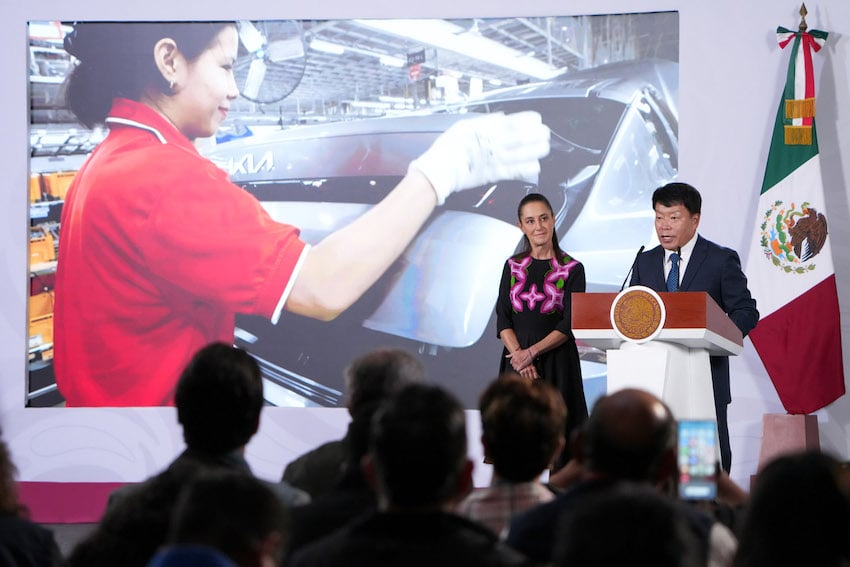
South Korean automaker Kia announced a US $649 million investment to begin producing its EV3 electric SUV at its Pesquería, Nuevo León plant starting Aug. 4 — the model’s first production site outside South Korea, expected to create 500 jobs this year and 1,500 more by 2030.
On the consumer side, U.S. cookie chain Crumbl opened its first Mexico store in Roma Norte, CDMX, to 800-person lines, while gourmet hot dog chain Dog Haus debuted in Mérida, part of a broader wave of American food brands expanding south.
Mexican economy shows signs of life
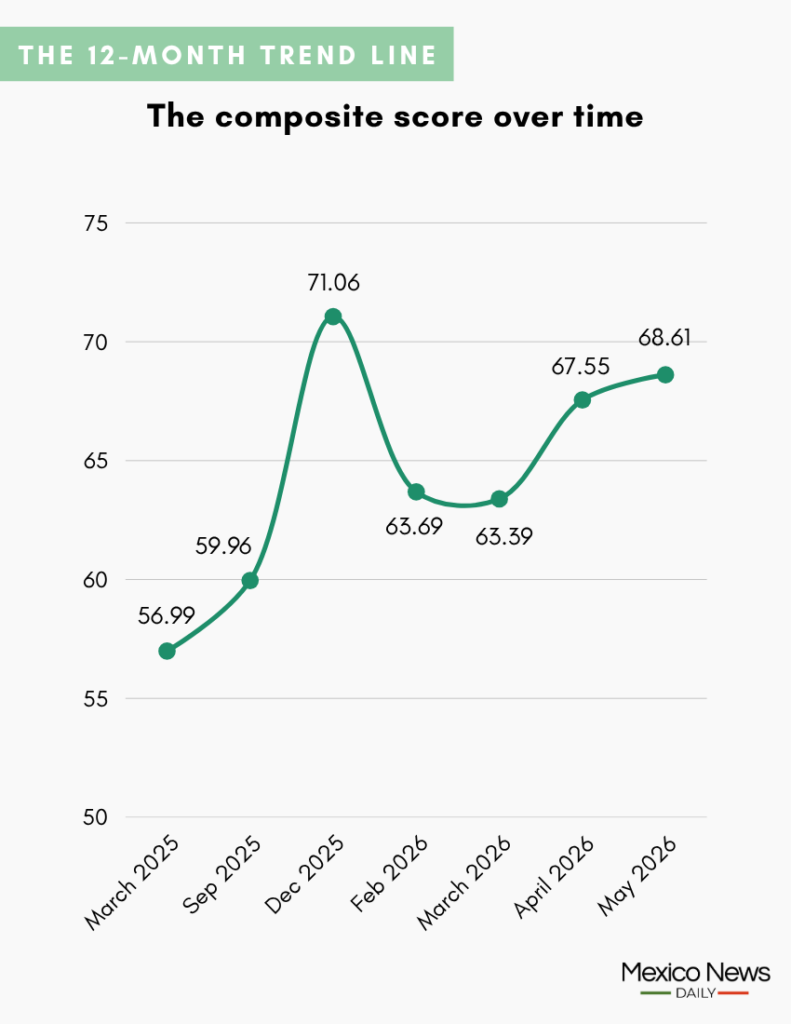
The MND Economy Index™, a 10-pillar composite gauge of Mexico’s economic health, rose to 68.61 in its latest edition — its highest reading yet, driven by improving inflation and monetary policy scores even as economic growth remains the weakest-performing pillar. The improving picture was reinforced by other data this week:
- Mexico’s export revenue hit a record US $389.72 billion in the first half of 2026, a 24.6% annual increase driven by a surge in non-automotive manufacturing exports.
- The economy grew 1.5% quarter-over-quarter in Q2, Mexico’s best result since late 2020, aided by World Cup-related tourism spending.
Economy Minister Marcelo Ebrard also weighed in on the trade relationship with Washington, downplaying Trump’s latest remark that he “doesn’t care” about the USMCA. “Obviously there are warnings every week, there are a lot of things,” Ebrard told reporters, adding that “as of today we’re doing well.” Sheinbaum echoed the sentiment, noting the two countries’ economies remain deeply integrated after decades of free trade.
Navy presents US $115M sargassum plan
With Quintana Roo facing its worst sargassum season on record, the Mexican Navy announced a 2-billion-peso plan to combat the seaweed influx choking Caribbean coast beaches. The strategy includes roughly 50 kilometers of new anti-sargassum sea barriers near Playa del Carmen, Cancún, Tulum, Puerto Morelos and Mahahual, along with new collection vessels aimed at eventually processing 4,000 tonnes of sargassum per day. Quintana Roo has already collected more than 92,000 tonnes of the macroalgae this year, with officials projecting the total could exceed 119,000 tonnes before year’s end.
World Bank aligns support with Plan México
World Bank Group President Ajay Banga made his first visit to Mexico in five years, meeting with Sheinbaum to align a new five-year Country Partnership Framework with the government’s Plan México industrial strategy. The framework will prioritize infrastructure, energy, water management and human capital development.
Banga also toured Grupo Naturasol, a family-owned agribusiness in México state that previously received International Finance Corporation financing, calling it a model for how smaller firms can plug into North American supply chains.
Mexico News Daily
This story contains summaries of original Mexico News Daily articles. The summaries were generated by Claude, then revised and fact-checked by a Mexico News Daily staff editor.