Home Blog Page 1084

COVID cases keep rising as death toll approaches 300,000

0
A transmission electron microscope image shows SARS-CoV-2, the virus that causes COVID-19, isolated from a patient in the U.S. Virus particles are shown emerging from the surface of cells. The spikes on the outer edge of the virus particles give coronaviruses their name, which means crown-like.
A transmission electron microscope image shows SARS-CoV-2, the virus that causes COVID-19, isolated from a patient in the U.S. Virus particles are shown emerging from the surface of cells. The spikes on the outer edge of the virus particles give coronaviruses their name, which means crown-like. Rocky Mountain Laboratories/NIAID

Mexico recorded its highest single-day tally of new coronavirus cases since late August on Wednesday, while the official COVID-19 death toll approached 300,000.

The Health Ministry reported 20,626 new cases, elevating the accumulated tally to just under 4.03 million. An additional 94 COVID-related fatalities lifted the death toll to 299,805.

Only four countries – the United States, Brazil, India and Russia – have recorded more pandemic deaths than Mexico.

Mexico’s fatality rate is 7.4 per 100 confirmed cases, the highest among the 20 countries currently most affected by COVID, according to data compiled by John Hopkins University. Its mortality rate is 235 per 100,000 people, the 25th highest in the world. Peru ranks first with 624 COVID deaths per 100,000 people followed by Bulgaria (449) and Bosnia and Herzegovina (410).

Mexico’s estimated active case tally rose to 80,510 on Wednesday, a 31% increase compared to Tuesday. Baja California Sur remains the country’s COVID epicenter with almost 700 active cases per 100,000 people. That’s more than triple the per capita rate in Mexico City, which ranks second for current infections with just over 200 per 100,000 residents.

Quintana Roo ranks third with about 200 active cases per 100,000 people. No other state has more than 100.

In other COVID-19 news:

• Baja California has become the first state to make presenting a vaccination certificate compulsory for customers who wish to enter establishments such as bars, restaurants and nightclubs. The new rule, which will be policed by the State Commission for Protection against Health Risks, took effect Wednesday.

The same rule entered into force in the municipality of Culiacán, Sinaloa, on Tuesday.

• Despite the national increase in case numbers as the highly contagious omicron strain continues to spread, residents of Acapulco, Guerrero, have fewer rather than more options when it comes to getting tested. Two public testing stations where people were formerly able to get tested free of charge are no longer in operation after being dismantled last month, the newspaper Reforma reported.

It is unclear whether they will be set up again. Acapulco currently has 192 active cases, according to the Guerrero government, more than any other municipality in the state.

The Mazatlán International Carnival will not go ahead in late February and early March if coronavirus case numbers are high at that time, said Sinaloa Health Minister Héctor Cuén.

He told a press conference that the Sinaloa General Health Council has the authority to cancel the annual event – a week of nonstop festivities – if it deems it to be a public health risk. “We put the health of sinaloenses first,” Cuén said.

• Gaining access to a COVID-19 test in the public health system is becoming more difficult as demand increases, but another option for people who want or need to get tested is private labs. Visitors to Mexico who require a negative test result to return home can get tested at such labs, while testing services are also available at the country’s major airports.

Aeroméxico has an alliance with certain laboratories with exclusive benefits for people with bookings on that airline and Delta Air. More details about the alliance, and private lab testing locations in Mexico City, Guadalajara, Monterrey and Cancún, are available on the Aeroméxico website.

Some states include positive test results from private lab tests in their coronavirus case data but the federal government – to Mexico News Daily’s best knowledge – does not, meaning that infections are significantly underreported.

With reports from La Voz de la Frontera, Reforma and Noroeste 
10 bodies abandoned in car beneath Christmas tree in Zacatecas city center

0
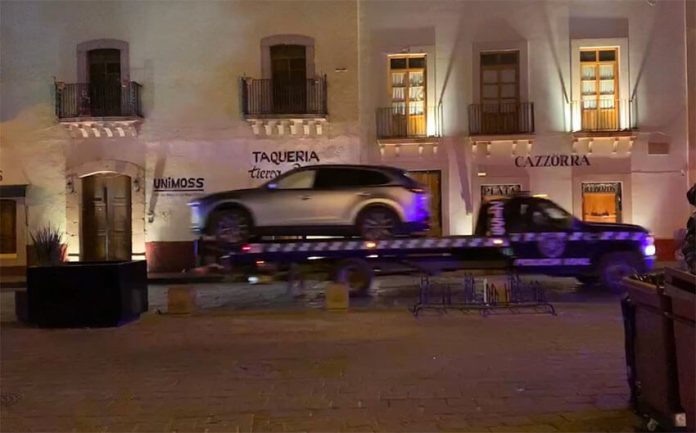
The vehicle in which the bodies were found
The vehicle in which the bodies were found is loaded aboard a truck for removal.

The Zacatecas governor got an unwanted present for Kings Day: a vehicle with 10 dead bodies abandoned beneath the giant Christmas tree in front of the state government palace in the early hours of the morning.

Governor David Monreal Ávila appeared in a Facebook Live video around 7 a.m. to inform the public of the incident. He said the silver Mazda SUV entered the Plaza de Armas around 5:15 a.m. and was abandoned minutes later. The driver took off running and escaped behind the Basilica Cathedral of Zacatecas, he said.

Authorities initially believed it to be a car accident, before finding the pile of bodies inside the vehicle. The Attorney General’s Office arranged for the vehicle to be towed, and the army and National Guard cordoned off the area for about an hour. Within two hours of the incident, the vehicle had been cleared and authorities vacated the area.

Monreal announced in a video Thursday afternoon that those responsible for the incident had been arrested, but didn’t specify how many people had been detained or any further details.

Initial reports indicated that there were six bodies in the vehicle, but the Security and Citizen Protection Ministry (SSPC) later clarified that there were, in fact, 10 cadavers.

The incident, presumably orchestrated by organized crime, comes after the federal government’s November announcement of the deployment of additional troops to the area as part of a new security plan. The state faces high levels of violence and has been the site of a turf war between the Sinaloa Cartel and the Jalisco New Generation Cartel (CJNG) since mid-2020.

A number of bodies have been left hanging from bridges and highway overpasses in recent months, a highly visible message that organized crime groups are active in the state.

With reports from Milenio

COVID no barrier to fiesta time in Guerrero capital

0
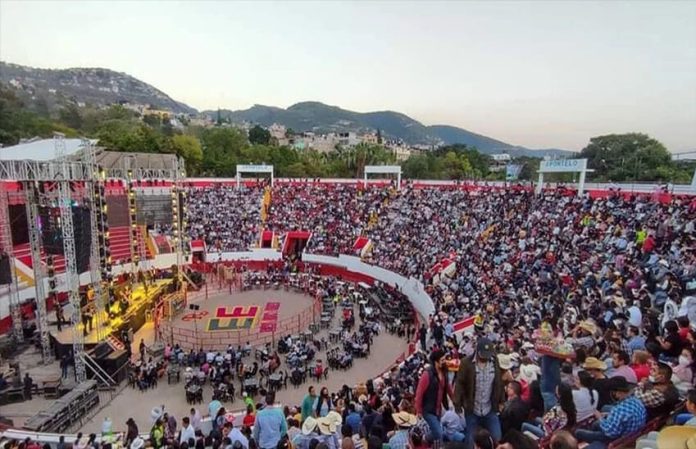
Banda El Recodo performed at a rodeo in the Belisario Arteaga bullring in Chilpancingo.

The coronavirus has had no shortage of recent opportunities to spread in Chilpancingo, Guerrero.

The annual San Mateo Fair started in mid-December, meaning that there have been a plethora of public events in the state capital.

After more than two weeks of concerts, dance processions and other events, Chilpancingo played host to a rodeo at the Belisario Arteaga bullring on Tuesday.

Some 13,000 people filled the arena, where mask wearing was lackadaisical and social distancing impossible. The band El Recodo added to the festive, carefree mood, playing for almost four hours while bull riders tried to stay on their bucking animals.

The San Mateo Fair, which concludes this weekend, was given the green light to go ahead on the proviso that virus mitigation measures would be enforced and attendees would show their COVID-19 vaccination certificates or otherwise agree to a rapid test prior to entry to the various events.

But attendees at the Tuesday night rodeo didn’t have to comply with any of those requirements, the newspaper El Universal reported.

Despite the partying in Chilpancingo, and the recent increase in national coronavirus case numbers, COVID has not (yet) become a major problem in Guerrero, at least according to official data. The state, which also includes tourism hotspots Acapulco and Zihuatanejo/Ixtapa, currently has 440 active cases, the Guerrero Health Ministry reported Wednesday.

Only 63 of those are in Chilpancingo, while 192 – 44% of the total – are in Acapulco. According to federal data, Guerrero has the sixth least number of cases on a per capita basis among the 32 states. Only Chiapas, Veracruz, Michoacán, Tlaxcala and Oaxaca have fewer cases per 100,000 people.

With reports from El Universal 

For Kings Day, a Oaxaca boy gives away a table full of toys

0
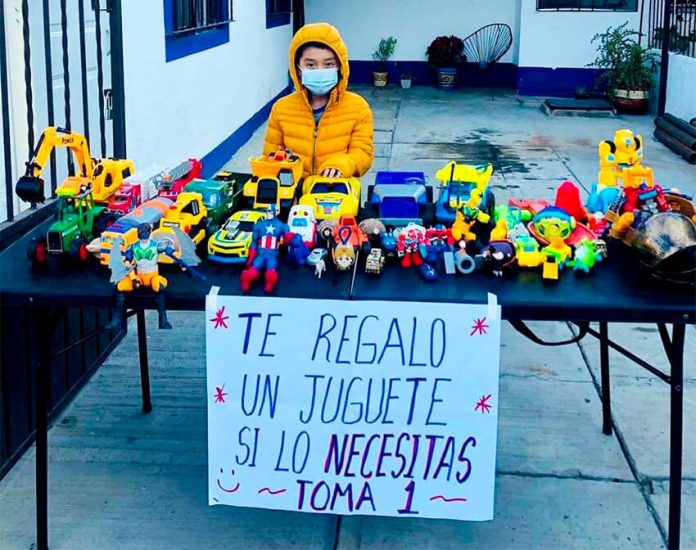
Alessandro and his Kings Day gifts
Alessandro and his Kings Day gifts for children who might want a toy.

Kings Day is the traditional day for giving gifts in Mexico and many children look forward to receiving them. But an 8-year-old Oaxaca boy took the spirit of giving to a whole new level on Thursday.

Alessandro Vendrell of Oaxaca city set up a table full of toys outside his home and posted a sign: “I’ll give you a toy if you need it. Take one.”

More than three dozen toys, from cars and tractors to superheroes and — well, even more cars covered the table.

The photo appeared in a post on the Facebook page of the Oaxaca newspaper Central Q Noticias and generated more than 100 complimentary comments and 500 shares in just a few hours.

“My respects,” said one commenter. “This indeed is the true future of Mexico.”

Mexico News Daily

Last year saw record-breaking increase in creation of formal jobs

0
Formal jobs registered with the IMSS increased 4.3% in 2021.
Formal jobs registered with IMSS increased 4.3% in 2021.

The total number of formal sector jobs in Mexico rose by 846,416 in 2021, the biggest increase on record, the Mexican Social Security Institute (IMSS) reported Wednesday.

There were 20.62 million formal jobs at the end of December, a 4.3% annual increase. The figure is slightly higher than the number of formal jobs before the beginning of the pandemic, IMSS said in a statement.

About 1.2 million formal jobs were lost between March and July 2020 due to the pandemic and associated restrictions, but there was a net gain of about 270,000 positions in the final five months of that year.

The institute said the sectors with the biggest increases in terms of the number of people they employ were transport and communications, up 11%; mining, up 8.1%; and construction, up 7%.

The number of people in formal positions increased by more than 12% in each of Tabasco, Quintana Roo and Baja California Sur, making those states the national leaders for job creation.

IMSS also reported that the average base salary in the formal sector rose 7.5% annually to 438.6 pesos (US $21) per day at the end of last year. It was the second highest end-of-year increase in the past decade, it said.

The number of employers registered with IMSS increased 5.3% last year to 1.05 million, meaning that they employ about 20 people each on average. Tens of millions of Mexicans work in the country’s vast informal economy, which was also hit hard by the pandemic.

While it doesn’t give a complete picture of the employment situation in Mexico, the IMSS data does provide additional evidence that the economy recovered strongly last year after recording its biggest contraction in 90 years in 2020.

GDP increased 6.4% in the first nine months of last year compared to the same period a year earlier. Data on the economy’s performance in the last quarter of 2021 has not yet been published.

Mexico News Daily 

Behind lucha libre’s comedy and theatrics lies generations of dedication

0
lucha libre
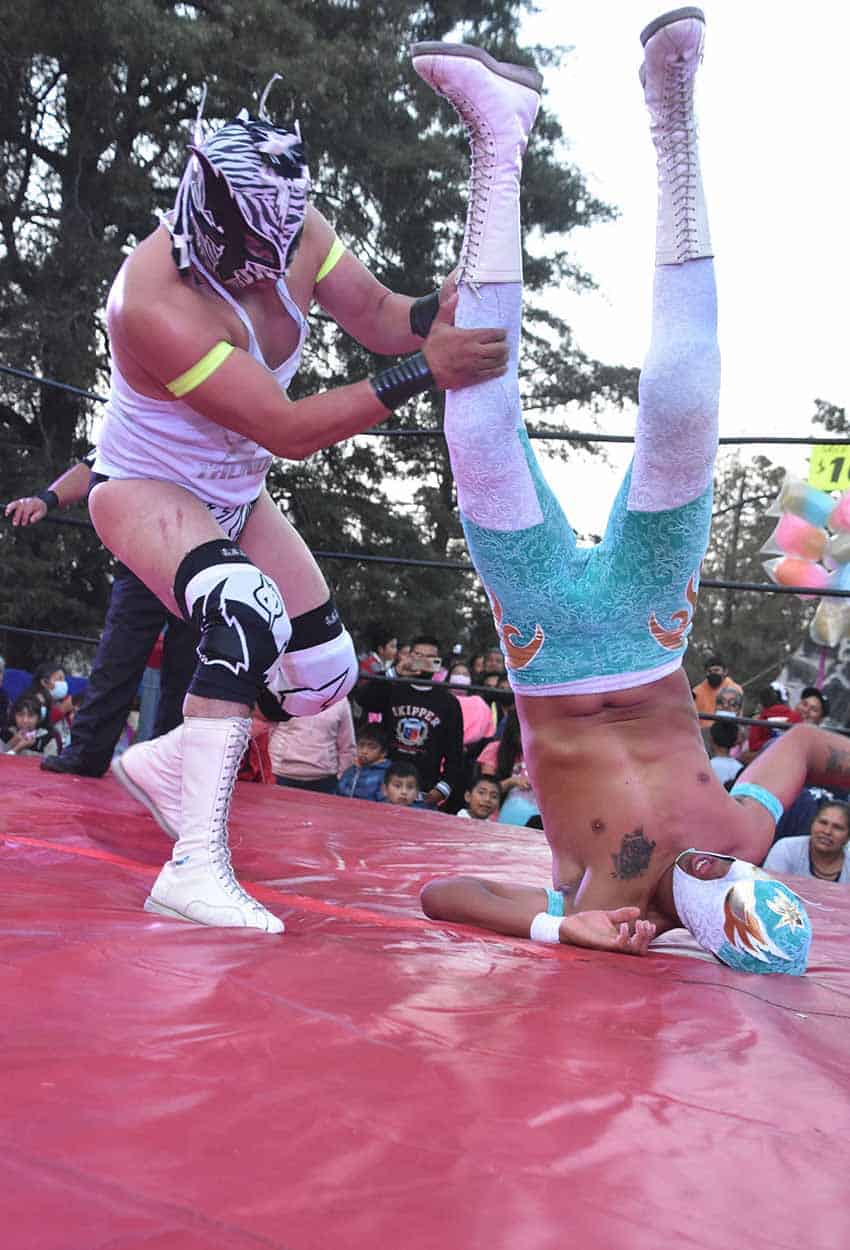
"Some of them are real," said young spectator Marlen Popoca Fernández of the punches thrown in the ring. Photos by Joseph Sorrentino

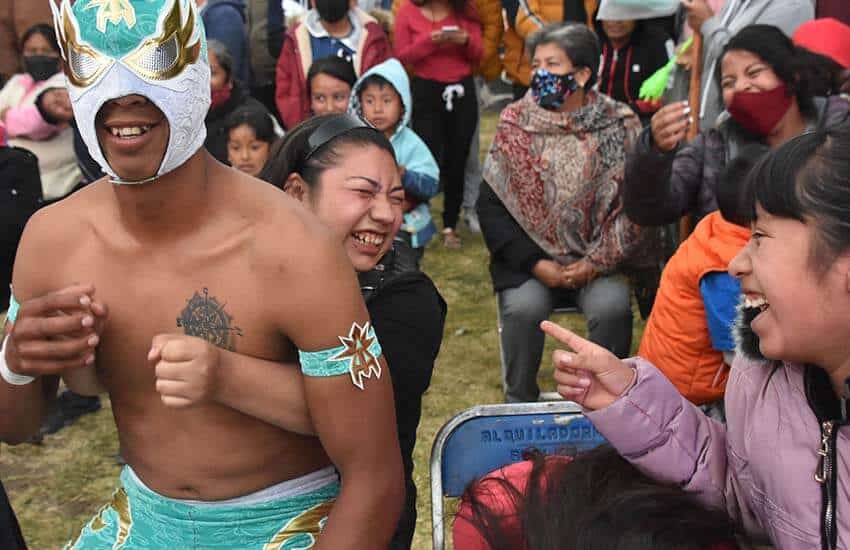
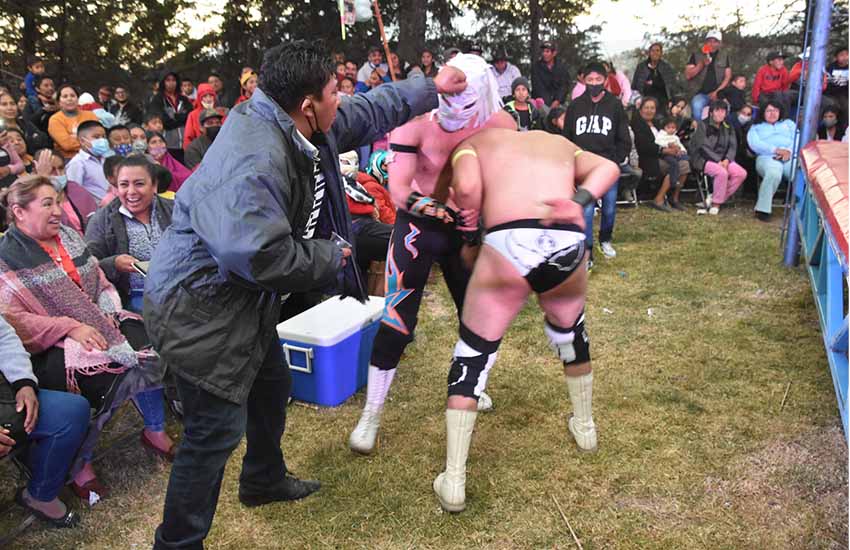
As the sun set in the late afternoon, people started filing into the churchyard in San Pedro Yancuitlalpan, Puebla, sitting on folding chairs that had been placed around a small platform. But they weren’t there to attend a Mass. They were there to attend one of Mexico’s more spectacular sporting events: lucha libre.

Lucha libre literally means “free fight” but is typically translated as “freestyle wrestling” and has been around since 1863. Enrique Ugartechea is credited with inventing it in that year, basing it on Greco-Roman wrestling.

Although popular from its very beginning, it was mainly a regional event until 1933 when the Empresa Mexicana de Lucha Libre (The Mexican Lucha Libre Enterprise) was formed and the sport began gaining national attention. Then, in 1942, a luchador (wrestler) known only as El Santo (The Saint) donned what has become the most recognizable symbol of lucha libre: a mask, giving the participants an air of mystery that continues to this day.

In his wake, almost all luchadores now wear masks, and some never appear in public without theirs.

“Lucha libre is about tradition and family,” explained Rob Sheen, the event’s announcer. “It is an amazing show.” Sheen has worked as an announcer for eight years. “I am the third generation in my family dedicated to lucha libre,” he continued.

lucha libre
Even in the ring, fighters mug for photos and take moments to engage with the audience.

His father and grandfather were both luchadores. “I like it first for tradition, second for conviction and third for its passion,” he said. “It is a contact sport — totally.”

Although passionate about the sport, he’s never been a luchador.  “I am dedicated to announcing,” he said. “It is safer.”

But his 14-year-old daughter, Estefanía Nobali Meléndez Rojos, who was sitting nearby, plans on following in her grandfather’s footsteps.

“I love lucha libre,” she said. “My grandfather taught me the moves.” She said she’ll start training when she’s 15.

Her grandfather also influenced Sheen’s older daughter, who has been training for seven years to become a luchadora. When Meléndez was told that this seemed like a long time, she replied, “You never stop training when you are in the life of the lucha.”

Shortly before the match began, eight luchadores arrived with small bags and backpacks, changing into their costumes and masks inside a small trailer. Then, as Sheen announced the beginning of the first match, four luchadores filed out.

lucha libre
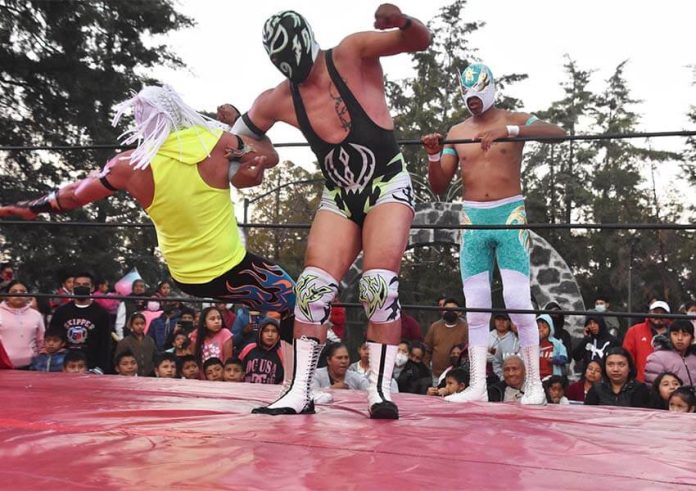
One of lucha libre’s signature wrestling moves: the helicóptero.

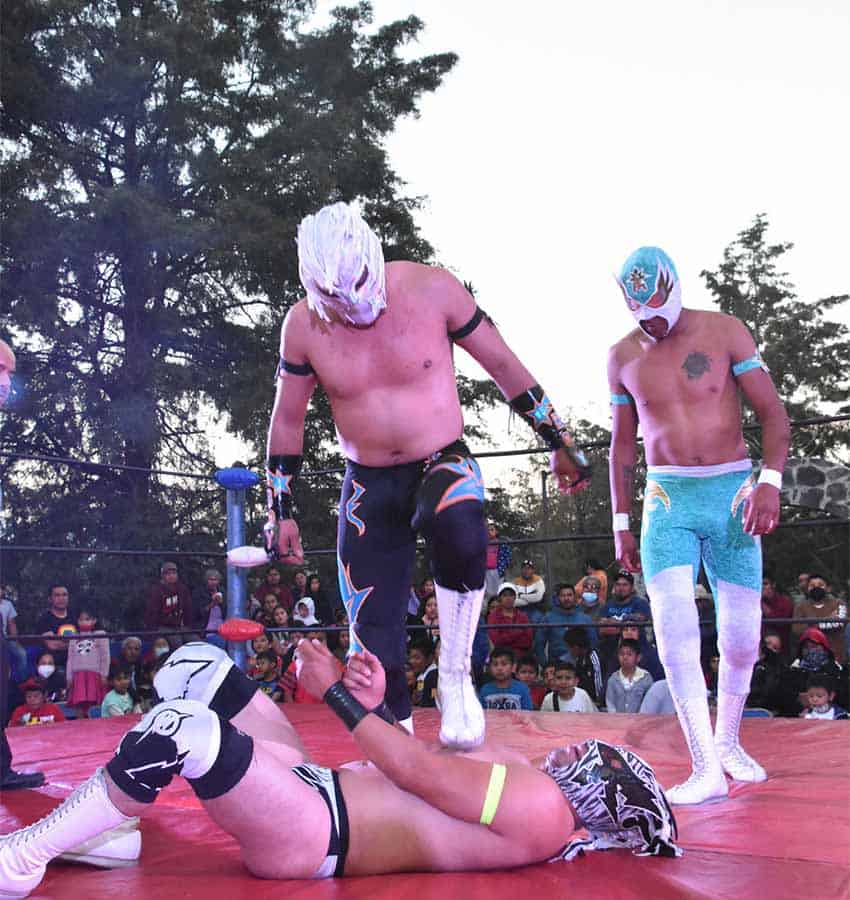
The matches featured teams with two luchadores each, one team serving as the técnicos, the other as the rudos. The individual fighters or teams of fighters generally play one of the two roles: the técnicos are the good guys, the rudos, the bad guys.

A match is won when a luchador is pinned to the mat and the referee counts to three or when a competitor is knocked out of the ring for a count of 20, although the referee’s counting speed varied considerably at this event. Until the very end of a match, the luchador always got back into the fight just before the count ended.

As Sheen said, lucha libre is a contact sport — totally.

There are moves with names like plancha (where a luchador jumps from the top rope onto an opponent who’s lying on his back), the centón (a plancha variant in which the luchador lands on his back atop his opponent) and the helicóptero (which involves, as its name suggests, spinning an opponent).

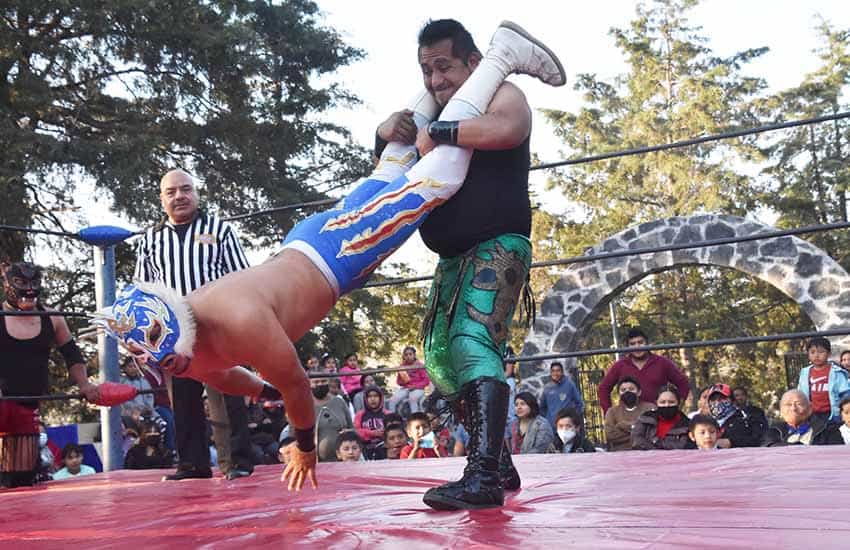
Although the piledriver, where a luchador is slammed head-first onto the ground, is supposed to be illegal because of the risk of serious injury, it’s still used in matches and was used in this event.

Whatever the move, almost all of them ended with a luchador landing — forcefully — on the thin mats that covered wooden slats, something that had to hurt. There were also punches and kicks and heads being slammed into poles or stepped on. But, in fact, virtually all of those attacks were fake.

lucha libre
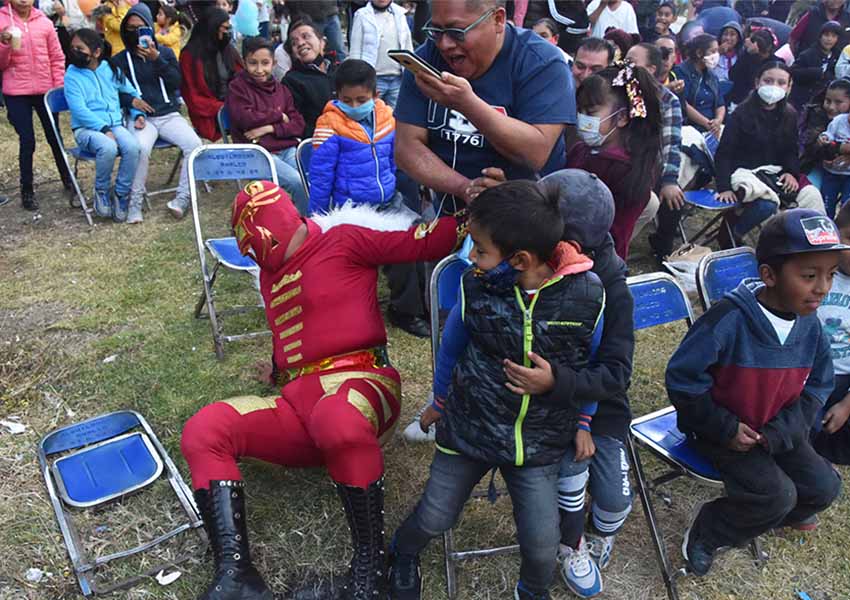
A luchador takes a seat on an available lap.

No one in the audience seemed to mind.

The crowd, which was somewhat sparse and quiet at first, grew in size and rowdiness as the matches wore on. There were derisive shouts of “¡Cuidado! ¡Cuidado!” (be careful!) when someone was tossed out of the ring; ¡Otra! ¡Otra!” they shouted when an opponent was hit.

There was also lots of (mostly) good-natured trash-talking between luchadores and spectators.

But, as the bottles of tequila being passed around the crowd emptied, the taunting grew in volume. One seriously inebriated man ill-advisedly grabbed a luchador for a moment or two. Fortunately, the luchador reacted calmly — at first.

When the man continued to yell and curse, though, the luchador crooked his finger and said, “Ven” (come).

The challenger wisely beat a hasty retreat.

lucha libre
The agony of defeat.

Luchadores are incredibly dedicated to their sport. Tiger Boy, a member of Fabuloso Técnicos, who has been a luchador for seven years, trained for 10 years before his first match.

“It is a passion for me. It is to be with people,” he said. “I train every day for two to three hours. It is very hard, but I like it.”

Although Tiger Boy is the first member of his family to participate in lucha libre, Cometa Boy Junior, another member of the Fabuloso Técnicos, is one of five family members who are luchadores. “It is the ultimate thing I wanted to be,” he said.

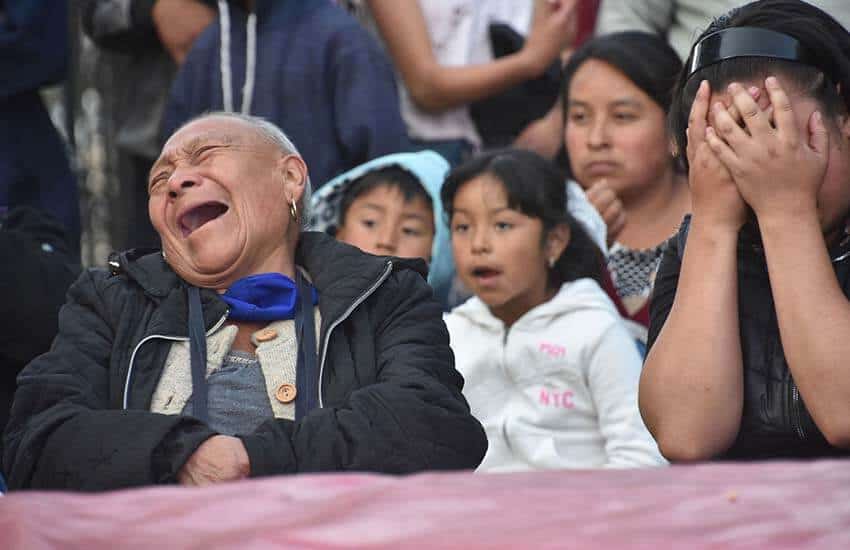
People clearly enjoyed the match and, along with the trash talk, there was lots of laughter. Should you go to a match, don’t sit in the front row. Luchadores tossed out of the ring sometimes land on people sitting there. Other times, they’ll just walk over and sit on an available lap.

Because of the pandemic, precautions have been taken at lucha libre events. “Some luchadores have masks that have been fitted with cubrebocas (medical masks),” Sheen said. “They all use sanitizing gel and all have to be vaccinated. It is a rule.”

The sport is extremely popular in Mexico, and some of the kids at this event said they dreamed of being a luchador. But not everyone thought that was such a great idea.

lucha libre
A child gets an up-close look at a fighter who was tossed out of the ring and landed on a chair.

“It is fun to see how they hit,” admitted Marlen Popoca Fernández, “but I do not want to be a luchadora because there are many punches, and some of them are real. I do not want to be punched.”

Joseph Sorrentino, a writer, photographer and author of the book San Gregorio Atlapulco: Cosmvisiones and of Stinky Island Tales: Some Stories from an Italian-American Childhood, is a regular contributor to Mexico News Daily. More examples of his photographs and links to other articles may be found at www.sorrentinophotography.com  He currently lives in Chipilo, Puebla.


lucha libre
Posing, flexing and trash talking — with both opponents and the audience — is part of lucha libre’s showmanship.


lucha libre
Even stepping on your opponent is an acceptable move.


lucha libre
The infamous and supposedly prohibited piledriver.


lucha libre
A spectator grabs at one of the fighters, ready to issue a challenge.

Canadian ‘influencers’ stranded in Cancún after party flight from Montreal

0
The December 30 party aboard a charter to Cancún.

A group of Canadian social media influencers and reality TV personalities had their return flight canceled after videos of their party flight from Montreal to Cancún went viral.

In the videos, the influencers can be seen drinking, smoking, dancing and even crowd-surfing, all without face masks, in their December 30 charter flight.

The videos were originally posted by the plane party’s participants, then later deleted. In the posts, the party-goers could be seen passing bottles of alcohol and dancing in the aisles. In response, the charter company, Sunwing, canceled the group’s return flight. Other Canadian airlines have followed suit, refusing to accommodate the group on a return flight.

Sunwing has reported the revelers to Canadian officials, who have opened an investigation. Passengers found to have violated COVID-19 safety regulations could be fined up to CA $5,000 (US $3,900).

Even Canadian Prime Minister Justin Trudeau has weighed in on the scandal, saying he was “very frustrated” with the influencers’ behavior, as Canada faces a fifth wave of the deadly virus.

MONTREAL'S WILD FLIGHT PARTY TO CANCUN FULL LENGTH VIDEO WITH AUDIO 2022

“It’s a slap in the face to see people putting themselves, putting their fellow citizens, putting airline workers at risk by being completely irresponsible,” Trudeau told reporters on Wednesday.

But the owner of 111 Private Club, the business that chartered the flight, said the group “respected all instructions given by Sunwing” and seemed surprised by the controversy.

“A simple party on a plane did all this buzz … Give me a moment to understand the situation better,” owner James William Awad wrote on Twitter.

He also released a statement on Thursday saying that all passengers were tested for COVID before flying and thus “the whole group was safe.”

Awad added that Sunwing had offered to fly the group back if they had agreed to a number of rules, including providing negative PCR tests, staying in their seats, and not being sold alcohol or food during the five-hour flight. But he objected to the lack of in-flight meals, and the parties were thus unable to reach an agreement.

Montreal, where the influencers hope to return home, is currently an epicenter of the pandemic in Canada. Canadian authorities announced more than 39,000 new cases in the country on Wednesday, but said the number is an undercount because testing centers have been overwhelmed by demand. Officials have asked people with symptoms not to line up to get tested and Montreal implemented a number of restrictions, including a city-wide curfew.

With reports from El Universal

Family accuses National Guard of kidnapping 2 youths in Michoacán

0
National Guard members are accused of kidnapping two men from Michoacán in early December.

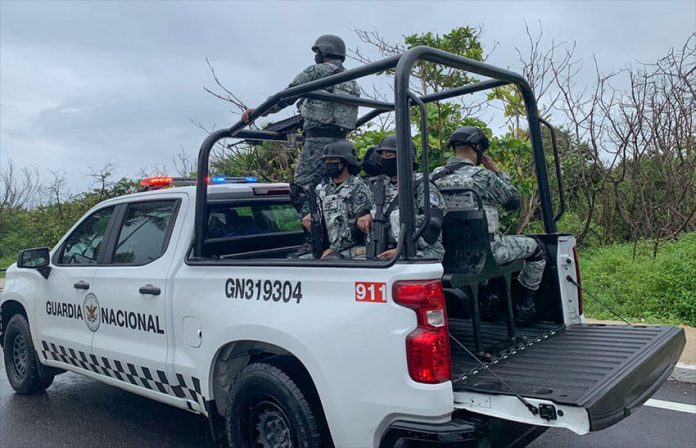
Two young men remain missing almost a month after they were allegedly abducted by the National Guard (GN) in Michoacán, but the federal government denies that the security force committed a crime.

Footage filmed by a resident of Los Reyes, a municipality that borders Jalisco, shows guardsmen searching three young men whose pickup truck they allegedly stopped on December 8.

The video shows that the young men were subsequently taken away in their vehicle, with one guardsman driving and another traveling in the back of the pickup. One of the men was released hours later, but only after he was tortured, the newspaper El Universal reported.

The whereabouts of the other two men is unknown. The federal government on Wednesday denied that the men had been abducted by the GN, describing reports that asserted otherwise as fake news.

“According to the disseminated version [of events], the National Guard was implicated in a supposed case of the disappearance of two young men in Michoacán. That information turned out to be false,” fake news debunker Ana García Vilchis told President López Obrador’s regular news conference.

She said guardsmen found an abandoned pickup in Los Reyes with weapons, ammunition and tactical equipment in it. The vehicle and its contents were turned over to the federal Attorney General’s Office, García said, adding that no arrests were made.

Eunice Ceja Escalera, sister of one of the missing men, told El Universal in an interview that García’s remarks amount to “a complete lie.”

“You can clearly see in the videos that it was GN members who took them. … What is happening is that they don’t want to take responsibility,” she said.

Ceja confirmed that neither her brother, Gabriel Escalera, nor the other missing man have been found.

“It’s now going on a month [since they disappeared]. The GN first released a statement saying they were going to investigate, that they wouldn’t allow [such conduct] but now they’re saying that they didn’t take them,” she said.

Ceja accused the National Guard and federal government of “playing” with the families of the missing men, adding that their denial that a crime occurred amounted to “a lack of respect toward us.”

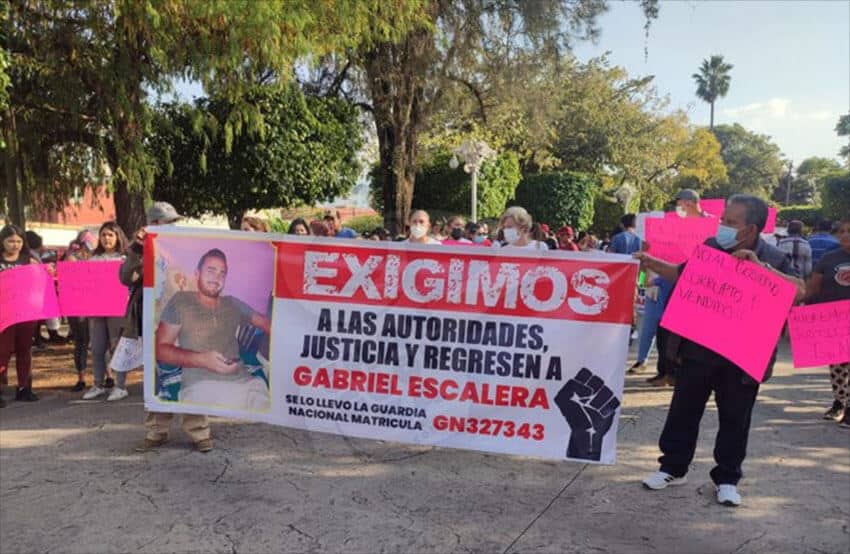
Protesters with a sign demanding justice and the return of Gabriel Escalera, who was recorded being taken away by a National Guard vehicle.

Ceja told El Universal that her family had struggled to cope with the disappearance of Gabriel. “We don’t know where he is, we don’t know if he’s still alive. Not knowing is infuriating… and then the government does nothing,” she said.

“They should tell us where my brother is, they should return him to us. … [We want] the government to take responsibility for its actions,” Ceja said. “… It’s not fair that they kidnap people and now they act as if nothing happened,” she said.

Ceja said that she and her family are prepared to do whatever is required to ensure that the National Guard members who abducted her brother are held to account and Gabriel is returned to them.

The two missing men are among more than 95,000 desaparecidos in Mexico. Official security forces – including police and members of the armed forces – were involved or allegedly involved in some of the disappearances, including the kidnapping and presumed murder of 43 students in Guerrero in 2014  and dozens of abductions in Tamaulipas in 2018.

Two members of the National Guard were taken into custody on kidnapping charges in Oaxaca last year, while a third guardsmen implicated in the crime was shot by state investigative police and subsequently died in hospital.

With reports from El Universal 

Telmex says fiber optic lines cut intentionally, affecting internet across Mexico

0
telmex

Vandalized fiber optic cables caused internet service interruptions for Telmex customers throughout the country on Wednesday.

Internet users had problems accessing foreign-hosted websites due to breaks in two fiber optic cables, one in the United States and one in Mexico. The company said that service was re-established within two hours.

The first break occurred in Texas, 18 kilometers from the Mexico-U.S. border. The second was in Sinaloa, between Mazatlán and Culiacán.

The line in Sinaloa was repaired within two hours after the company received numerous complaints. Telmex plans to report the vandalism as an attack on telecommunication channels.

“Telmex activated its contigency plan to immediately attend to the fiber optic cut in Mexico, directing traffic through alternative routes to give users additional options, which re-opened access to international content,” the company said.

The vandalism affected users in Zacatecas, Aguascalientes, Nayarit, Jalisco, Guanajuato, Colima, Michoacán, Querétaro, México state, Puebla, Oaxaca, Veracruz, Tabasco, Chiapas and Mexico City.

With reports from Milenio

Mother turned investigator put her daughter’s brutal killers behind bars

0
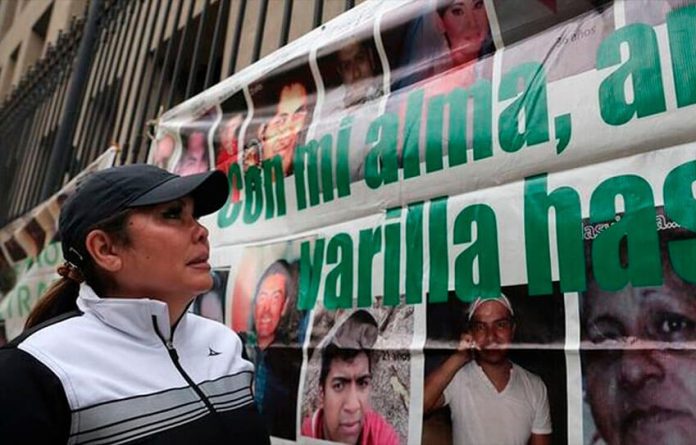
Margarita López, the founder of Buscando Cuerpos, in front of a banner commemorating disappeared people.
Margarita López, the founder of Buscando Cuerpos, in front of a banner commemorating people who have disappeared.

A woman whose daughter was kidnapped and murdered in Oaxaca decided to take on the search for the victim herself. She met the killers in the process, and brought them to justice.

One of them, a former leader of the Zetas cartel in Oaxaca, was sentenced this week to 91 years in jail.

Yahaira Guadalupe Bahena López disappeared on April 13, 2011 in Tlacolula, Oaxaca. Her mother, Margarita López abandoned her business in Michoacán to dedicate herself to finding her daughter and founded Buscando Cuerpos (Searching for Bodies) in the process.

Fear was no obstruction for López. “What are we going to be afraid of if our children have already been taken from us?” she said in an interview in March 2021. 

Bahena married a soldier in the army’s special forces when she was 17, and moved from Michoacán to Tlacolula

Yahaira Guadalupe Bahena disappeared in 2011
Yahaira Guadalupe Bahena disappeared in 2011. Her mother found her remains after a two-year search.

Once there, a state police commander started harassing her. The commander had an argument with Bahena’s husband and then told members of Los Zetas that the young bride was connected to a cartel in Michoacán, and that she planned to bring their recruits to Oaxaca.  

Shortly after, Bahena was kidnapped. Her mother requested help from soldiers but they suggested she should investigate the case alone.

In her new life as an investigator, López paid people for information, disguised herself as an official, wore a concealed camera while visiting brothels with child prostitutes and paid to enter a forensic laboratory to search for her daughter’s remains.

After a long search, she tracked the 30 men who kidnapped Bahena, including Oaxaca officials who provided protection to the Zetas. 

She found the former head of the Zetas in Oaxaca, Marco Carmona Hernández, also known by the moniker “El Cabrito,” in Perote prison in Veracruz. He admitted to torturing Bahena and said he was sent the order to kill her, despite knowing that she was innocent.

Bahena was held captive for 10 days without food and was raped daily.

On the day of her murder, Carmona said she would be released. Shortly after, two gang members — one named Encarnación Martínez Colorado — decapitated her. 

But López said that wasn’t enough to satisfy the murderers. “They started playing with the head, they gave it kisses on the mouth and they threw it between one another …. I wanted to cry, I wanted to do a thousand things, to take out the eyes of the man who had confessed everything to me, but I had to stay calm,” she said. 

Both Carmona and Martínez will spend years in jail but López said there has been no victory.

“Wherever you turn, wherever you go, there are local, state and federal authorities involved with organized crime and the disappearance of people,” she said. “Just in my daughter’s case there is an anti-kidnapping commander and a commander of the ministerial police among those arrested and there are still arrest orders to be completed against federal officials. They supported us with absolutely nothing.”

López found her daughter’s remains after two years, four months and 19 days, but continues to help others search for their disappeared loved ones by looking for clandestine graves.

With reports from La Crónica de Hoy