Citizens Movement Senator Verónica Delgadillo asked fellow senators why such a natural act should target women for 'discimination and humiliation.'
The Senate unanimously approved a reform Tuesday which classifies restrictions on breastfeeding in public as discriminatory.
Breastfeeding in public spaces, according to the motion, has been stigmatized throughout history to the detriment of women, violating the right of infants to sufficient nutrition, the newspaper Reforma reported.
The reform will add a new modification to article 9 of the Federal Law to Prevent and Eliminate Discrimination.
Citizens Movement Senator Verónica Delgadillo stated the case for the law: “Why is an act as generous and as natural as breastfeeding a baby an act subject … to discrimination and humiliation?” she asked.
“At some point we have all witnessed a woman deciding to breastfeed her baby in public and the act becoming an object of criticism, shouting and humiliation,” she added.
The practice is considered a human right by the United Nations (UN), for both mothers and infants, due to its health benefits and positive effect on children’s physical development.
The president of the Senate Human Rights Commission, National Action Party Senator Kenia López Rabadán, said the state is obliged to promote and protect breastfeeding as a right.
She argued that it isn’t common enough in Mexico: only 28.6% of children under six months old are nourished exclusively through breastfeeding, she said, while the UN’s goal is for that to be the case for 50% of children.
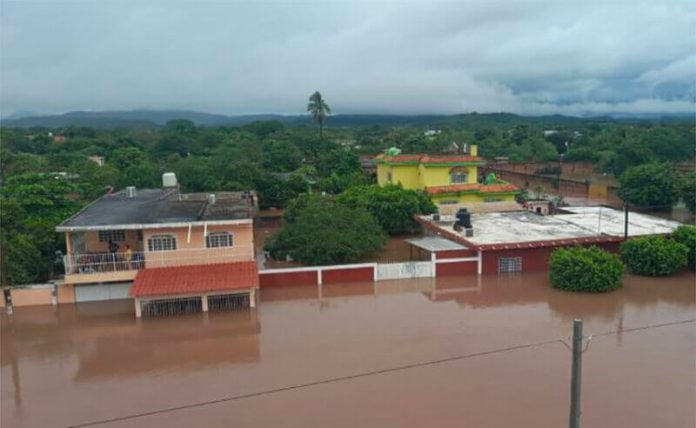
Flooding Wednesday near Escuinapa, Sinaloa, where a river overflowed its banks.
Hurricane Pamela made landfall in Sinaloa as a Category 1 hurricane early Wednesday, bringing strong wind and torrential rain to that state and Durango.
Pamela reached land at approximately 6:00 a.m. near Estación Dimas, a town in the municipality of San Ignacio, which borders Mazatlán to the north. There have been no reports of injuries or loss of life, and damage to property was mainly limited to flooding.
The storm, which has since been degraded to a tropical depression, was about 415 kilometers northeast of Mazatlán at 4:00 p.m. CDT, according to the United States National Hurricane Center (NHC).
“The depression is moving toward the northeast near 28 mph (44 kph) and this motion is expected to continue through tonight. On the forecast track, the center of Pamela will continue to move over central Mexico until dissipation,” the NHC said.
“… Pamela is expected to produce an additional 1 to 3 inches [2.5-7.5 cm] of rain across the Mexican states of Durango and Nayarit through tonight.”
The storm brought sustained winds of 120 kph with gusts of up to 150 as it crossed Sinaloa and moved into Durango. Large swells were also reported on the coast of Sinaloa and Nayarit.
Heavy rain caused rivers and creeks to overflow in parts of the former state, including in Escuinapa, Sinaloa’s southernmost municipality on its border with Nayarit. Flooding affected the communities of La Campana and La Concha, where water inundated people’s homes and forced some families to evacuate to higher ground.
The rain also caused landslides that forced the closure of the Mazatlán-Durango tollway and the libre, or free highway, between the same two cities.
The Federal Electricity Commission reported that more than 120,000 customers lost power in Sinaloa and Nayarit in the wake of Pamela’s passing, the vast majority of whom live in the former state. Power was restored to most residents of Nayarit by the early afternoon but many in Sinaloa were still waiting for service to resume.
Authorities in Mazatlán reported only minor damage, among which was the inundation of homes caused by flash flooding in some neighborhoods.
Pamela was the 16th named storm in the eastern Pacific this year and the sixth hurricane. The Pacific hurricane season still has seven weeks to run before it officially ends on November 30.
Justice Laynez said he wasn't given the opportunity to prove his sobriety.
A Supreme Court (SCJN) justice was detained in Coahuila on Saturday for driving under the influence of alcohol, but the judge denies he was intoxicated.
Justice Javier Laynez Potisek was stopped by municipal police and arrested in the center of Torreón in the early hours of Saturday morning and was held in police custody until later the same day.
In a statement issued by the SCJN on Tuesday, Laynez said he never accepted nor will he accept that he was driving in a state of inebriation. He also said he didn’t have the opportunity to prove his sobriety, and wasn’t told why he had been detained.
The justice said his arrest didn’t occur at a sobriety checkpoint and asserted that it wasn’t until the next day – although in fact he was referring to the same day – that he learned that the police justified his arrest because he changed lanes at an “inopportune” time.
But “that never occurred,” Laynez said. “Despite my respectful and repeated requests throughout this whole event I was never able to see or speak to a doctor, an authority, a judge, a prosecutor’s office … or a human rights representative,” he said.
“The next day [Saturday], following the instructions they were given, my family members made the payment of of 6,500 pesos (‘only in cash’). And despite their express request, they were denied a receipt or proof of payment,” the justice said.
“I want to make it clear that I completely agree with … anti-alcohol operations. No one has the right to drive in a state of intoxication and this conduct must be severely sanctioned. However, these operations must be subjected to strict standards that avoid corruption and respect citizens’ human rights,” Laynez said.
Some details in the justice’s statement are incongruent with local media reports, which indicated that the justice was aware of the reason for his arrest and was required to pay a fine of 44,000 pesos (US $2,140) to secure his release.
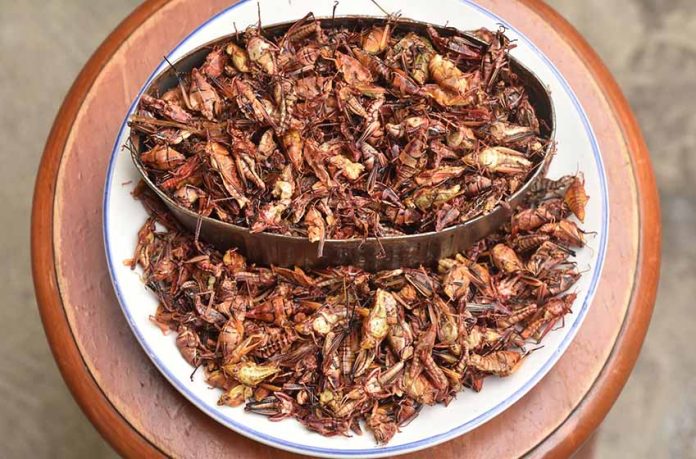
A variety of insects and larvae are eaten in Mexico. Perhaps the most popular is chapulines, or grasshoppers. photos by Joseph Sorrentino
Americans appear to be finally catching onto something that people in Mexico — and many other countries — have known for probably tens of thousands of years: bugs are a great source of protein.
Approximately two billion people in 130 countries are already eating insects — and apparently finding them quite tasty. In Mexico, people eat gusanos (worms), chicatanas (winged ants) and escamoles (ant larvae), among several other insects, but the most popular choice is probably chapulines, or grasshoppers.
The chapulín, derived from chapolin, a Náhuatl word that means “an insect that jumps like a rubber ball,” is an excellent alternative to meat. They contain between 60% and 70% protein (different articles claim different numbers) — more than beef — and all of the essential amino acids.
In addition, they’re high in Vitamins A, B and C; fiber; and several minerals.
Hargol FoodTech, an Israeli-based company, is the first that’s been able to grow chapulines on an industrial scale, and it’s recently begun distributing its products through companies in the United States. Right now, its main product is chapulín powder, but it has plans to sell whole insects. The company has succeeded in growing chapulines in captivity by using fairly high-tech techniques and equipment.
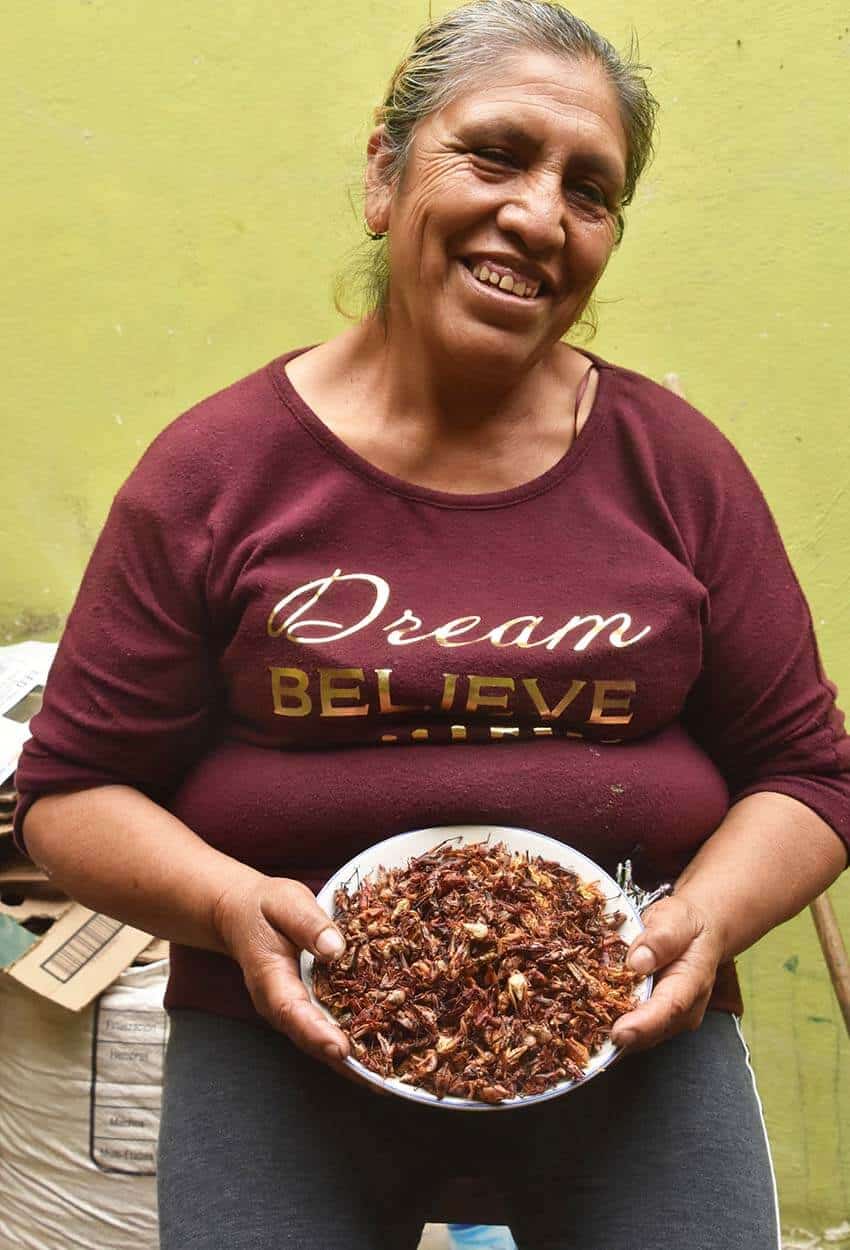
Chapulines vendor Concepción Fernández of San Pedro Yancuitlalpan, Puebla, with a bowl of freshly-cooked grasshoppers.
But in pueblos like San Pedro Yancuitlalpan, Puebla, where Concepción Fernández has a small food stand, things are decidedly low-tech. The chapulines she uses are all local and wild. “I buy them from workers who catch them using nets,” she said.
In a small room adjacent to her kitchen, Fernández lights a pile of charcoal with a piece of ocote, wood from a species of pine tree. Although she has a gas stove in her kitchen, she cooks most of her food using charcoal. “Carbón (charcoal) gives a different flavor to all types of food,” she said.
Once the coals are ready, she heats oil in a large pot and adds a significant amount of garlic (like virtually all traditional cooks, she measures nothing). It’s fried to a deep brown, and then she adds enough chapulines to fill half the pot.
As I watched, Fernández stirred these constantly for three or four minutes before adding a small handful of chile. “This is chile de árbol,” she said. “It is a spicier chile.”
She fried the insects for around five more minutes until they were golden brown and then poured them into a large strainer. To a second batch, with slightly larger chapulines, she added a chile called chiltepín, one that was less spicy than the chile de árbol. She’ll sometimes use other chiles, including chilepasilla.
“Here, chapulines are available all year,” she said. They’re prepared one of two ways: fried or natural. The latter method involves boiling them and adding lime. “I prefer fried for the flavor,” said Fernández, “but the majority of people eat natural because it doesn’t have fat.”
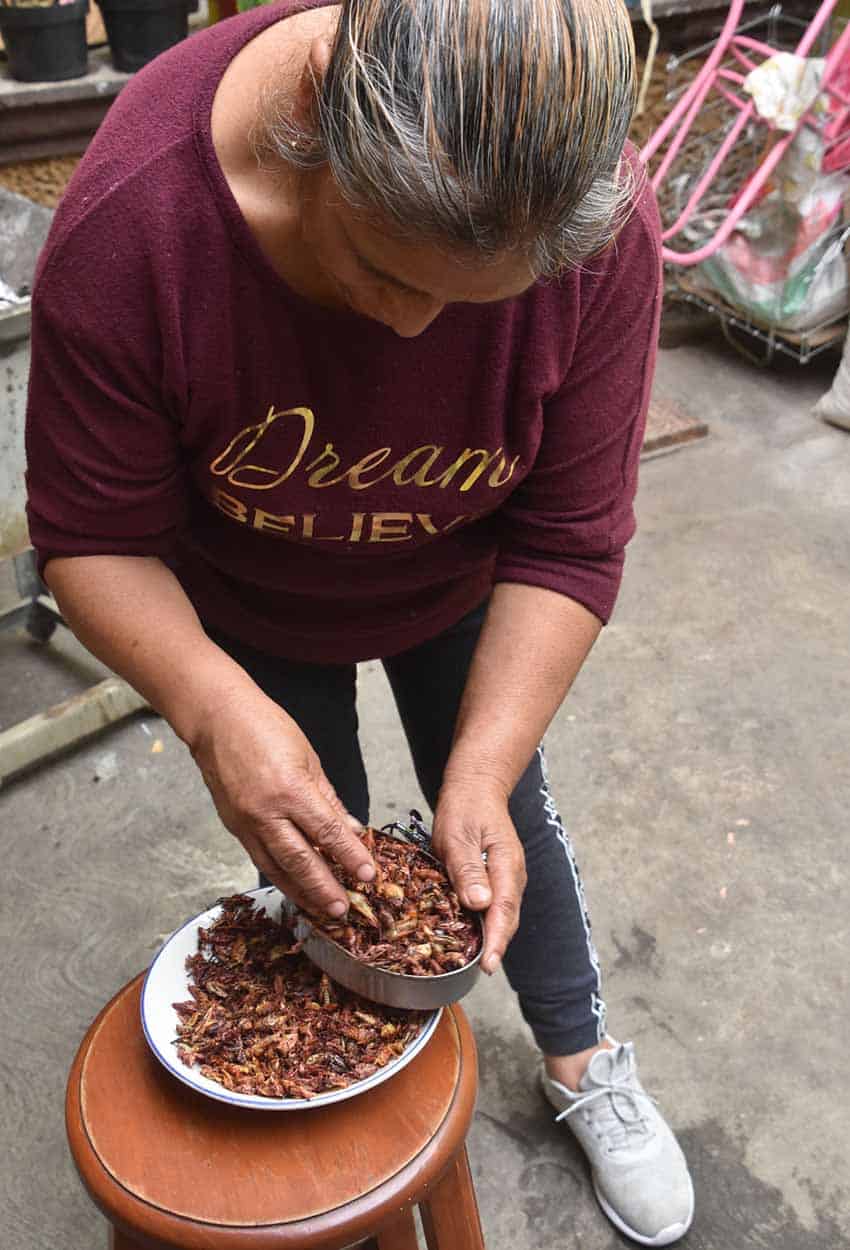
Packing grasshoppers into a tin for sale.
Chapulines are usually eaten as a snack, sold in small plastic bags or sometimes wrapped in paper cones. In many traditional pueblos, foods like beans, rice and chapulines aren’t purchased by weight but by latas — cans or tins. Fernández fills a large sardine tin with them and charges 40 or 50 pesos.
Chapulines can also be added to foods like chile navideño or stuffed inside enchiladas. When asked about the flavor, Fernández said they taste like fish. She also sells a worm, the cuetla, which is dark gray or black and about the length and width of an index finger.
Several restaurants in the United States have started offering dishes made with grasshoppers and other insects, some for their flavor and some because it’s becoming increasingly apparent that bugs pack lots of protein and that factory farming simply isn’t sustainable.
Farming chapulines releases far fewer greenhouse gases, uses a minimal amount of water and requires far less land than growing animals like cows and pigs. The grasshoppers also produce much less excrement.
Corporations are also beginning to take notice of the increased interest in insects as a food source. In 2019, an article in Business Insider reported, “The insect protein market could be worth US $8 billion by 2030, up from less than $1 billion in 2019.”
Business Insider cited an analysis by Barclays stating that as the world’s population continues to grow, more people will be eating insects as a major protein source. They believe this may lead to grocery chains and food corporations selling them.
Fast-food companies have already caught on to the trend toward a meatless future: Burger King and McDonald’s sell veggie burgers, and KFC offers a vegan substitute for their fried chicken. It’s not a stretch to think that they’ll have insect-based foods on their menus in the near future.
Fernández sells her chapulines and other foods in the Atlixco market, at her small stand on the outskirts of San Pedro Yancuitlalpan and from her home. In the market, she’s noticed a decided increase in sales and a new group of people interested in them.
“Many people are now buying them and taking them to the U.S. They like the quality and the fact that they are high in protein,” she said, adding, “One lata of chapulines has the same amount of protein as a kilogram of meat.”
She enjoys eating them and extols their benefits. “I do not eat them every day,” she said, “but probably two or three times a week. They are pure protein.”
But she also gave some important advice about eating them:
“It is best to remove the legs first. They can get caught in one’s throat.”
Youths are frequently recruited by organized crime in communities where violence has become normal.
Eduardo was a cartel lookout at 13, selling drugs at 15 and trained to become a hitman a short time later. Unfortunately, his story is far from unique: approximately 30,000 minors work for organized crime gangs, according to the Network for Children’s Rights in Mexico (REDIM).
The testimonies of 67 of them are compiled in a new report by Reinserta, a civil society organization that helps ex-prisoners reintegrate into society.
Presented by the organization on Wednesday, Boys, girls and adolescents recruited by organized crime details how criminal organizations recruit young people and outlines reasons why some youths are susceptible to recruitment.
Based on studies conducted in Coahuila, Nuevo León and Tamaulipas (the northern zone); México state and Guerrero (the central zone); and Oaxaca and Quintana Roo (the southern zone), the report states that adolescents are recruited either voluntarily or forcibly.
In the former case, a young person might be invited by a friend to join a gang to which he or she already belongs. Alternatively, youths might take it upon themselves to approach a criminal organization and ask to join its ranks.
Reinserta presents its study of the recruitment of youths by organized crime on Wednesday morning in Mexico City.
In the latter case, teenagers are forced into a life of crime. Reinserta said voluntary recruitment is more common than forced recruitment in all three zones it studied.
The organization’s study identified four factors that can make minors more susceptible to recruitment: their family and psychological situation, their level of education, their socio-economic situation and their cultural background.
Young people whose family life is unstable, for example, or who have been abandoned or neglected by their family are more likely to join a criminal gang. Minors disinterested in their studies or who have already left school are also more likely to accept an offer to become a member of a criminal organization.
Boys, girls and adolescents are frequently recruited in urban and rural communities where violence is so common it is normalized, the report said. Cartels in the northern zone pay their underage members up to 35,000 pesos (US $1,700) a month, making a life of crime particularly attractive to young people who may lack life’s most basic necessities.
In the case of Eduardo (a pseudonym used by Reinserta to protect his identity), members of the Northeast Cartel recruited him at the age of 13 to work as a halcón (hawk), as a lookout is colloquially known. Two years later he was selling drugs on the streets and was in charge of other lookouts as the cartel’s chief hawk in the area he worked. Two months after becoming the jefe de halcones, Eduardo sought another promotion to become a sicario, or cartel hitman, Reinserta said.
Known as the Tropa del Infierno (Hell’s Army), the cartel unit to which he belonged provided weapons and combat training to young recruits – a heady experience for budding capos not long out of primary school.
Eduardo’s cartel experience came to an end after he was arrested on drug trafficking charges and sentenced to two years in a juvenile detention center in Coahuila. The youth, who spoke to Reinserta after serving nine months, said he wants to start a new life when he is released but is fearful of what might happen to him and his family if he doesn’t rejoin the Northeast Cartel.
“… I’m afraid that the cartel will look for me and if they find me I don’t know what I’ll do. … If they find you you can’t tell them, ‘I don’t want to do it anymore,’ you have to join because [if you don’t] they’ll beat the shit out of you, at the very least. It’s more likely they’ll put a bullet in your head,” Eduardo said.
Presenting the report, Reinserta co-founder Saskia Niño de Rivera cited REDIM data that showed that 20,000 minors have been murdered and 7,000 have disappeared over the past 20 years. Many of those killed likely had links to or were members of criminal gangs.
President López Obrador asserts that his government’s social programs, especially the “Youths Building the Future” apprenticeship scheme, help steer young people away from a life of crime, but Reinserta believes there is a lack of public policies to combat organized crime’s recruitment of boys, girls and teenagers. The consequences of the policy vacuum, the organization said, include the abduction and even murder of minors.
Those who are arrested before they meet one of those fates face the possibility of being tortured while detained, Reinserta said, noting that the practice was detected in juvenile detention centers in all three zones where it conducted its study. Consequently, it is not just criminal groups that violate minor’s human rights but also the authorities, the organization said.
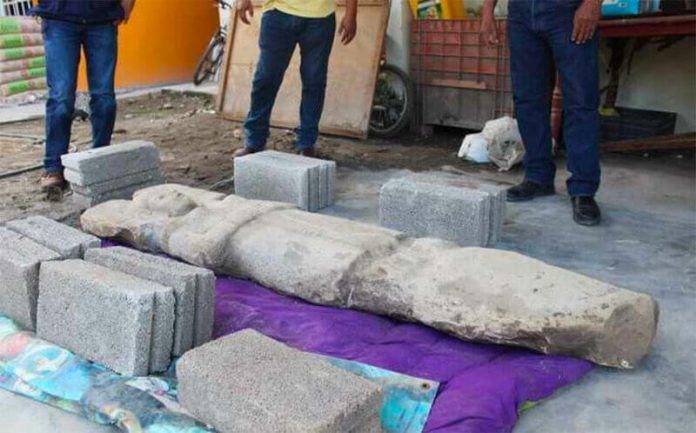
The pre-Hispanic sculpture that will be the model for Columbus' replacement.
A Mexico City statue of Christopher Columbus will be replaced with a replica of a pre-Hispanic sculpture of an unknown indigenous woman that was discovered in a Veracruz field in January.
The Columbus statue was removed from its plinth on Mexico City’s Reforma Avenue in October 2020, purportedly for cleaning, amid threats it would be knocked down. It was later announced it would be relocated to a new home in Parque América, a park in the affluent Polanco district.
The new effigy, a replica of “The Young Woman of Amajac,” named after the village where she was found buried in the Huasteca region of Veracruz, will be as much as three times the size of the two-meter original, which is being displayed in Mexico City’s Museum of Anthropology.
The statue dates from the late postclassical period, between 1450 and 1521. Its presence will differ markedly in style to neo-classical statues of indigenous people which have previously featured on Reforma Avenue, the Associated Press reported. “The Young Woman of Amajac” will stand on Columbus’ original base, which is of that neo-classical European style.
Speaking about the mystery of who the the young woman of Amajac represented, a field inspection officer at the National Institute of History and Anthropology (INAH) said she was more likely to have been a political figure than an ancient goddess of fertility, as was earlier speculated.
“Contrary to what one might think, it does not represent a goddess but a ruler …” said María Eugenia Maldonado. “We know these characters were representing ruling people or people of the hierarchy with political rank including women. So, in that sense, I think it’s the representation of a young woman of high-ranking character.”
Mexico City Mayor Claudia Sheinbaum announced in September that a statue of an Olmec woman would replace the Columbus sculpture. The sculptor chosen to create the effigy, Pedro Reyes, had already named his would-be design Tlalli, meaning Earth, world or land in Náhuatl. It is unclear if Reyes is still involved in the process, or if Tlalli will come to be.
The decision to replace the Columbus statue has caused controversy. A petition on change.org to return the explorer’s likeness to his plinth has gained over 33,000 signatures.
However, INAH director Diego Prieto Hernández said its relocation was an attempt to protect the effigy. “This was based, not on any ideological judgement of the (Columbus) character … if it had been left in place, it would have been the target of threats and protests,” he said.
After a 19-month closure, the United States is set to reopen its land borders for nonessential travel from Mexico and Canada to fully vaccinated travelers in early November.
Vehicle, rail and ferry travel between the U.S. and Canada and Mexico has been largely restricted to essential travel since March 2020 in reaction to the COVID-19 pandemic. Those restrictions have remained in place ever since, renewed on a monthly basis, despite growing pressure from the Mexican and Canadian governments.
The move to facilitate cross border travel aligns with a September 20 announcement that air travel from 33 countries will open up in November for the fully vaccinated. In contrast to air travel, no testing will be required to enter the U.S. by land or sea, provided travelers meet the vaccination requirement. By mid-January, even essential travelers seeking to enter the U.S. by land or sea, such as truck drivers, will need to be fully vaccinated.
The U.S. will accept travelers who have been vaccinated with any of the vaccines approved for emergency use by the World Health Organization, according to officials, meaning Pfizer, Moderna, Johnson & Johnson, AstraZeneca, Sinopharm and Sinovac would all be recognized, while Sputnik and CanSino would not. However, the newspaper Reforma reported that the U.S. Centers for Disease Control and Prevention still hasn’t made a final decision on the matter.
If the Russian Sputnik and Chinese CanSino vaccines remain unrecognized some 4 million Mexicans would be unable to enter the U.S. Mexico has received 8.4 million doses of the former (a two-dose vaccine) and 100,000 of the latter (one-dose).
The move toward restoring travel comes as COVID-19 cases in the U.S. have dropped to about 85,000 per day, the lowest level since July, following a spike from the more transmissible delta variant of the virus. Per capita case rates in Canada and Mexico have been been lower in the two countries than the U.S. throughout the pandemic, which heightened frustrations about the U.S. restrictions on travel.
“These new vaccination requirements deploy the best tool we have in our arsenal to keep people safe and prevent the spread of COVID-19 and will create a consistent, stringent protocol for all foreign nationals traveling into the United States whether by land or air,” a senior U.S. administration official said.
U.S. Democrat Chuck Schumer said the move would bring relief to communities on the country’s borders. “Since the beginning of the pandemic, members of our shared cross-border community have felt the pain and economic hardship of the land border closures. That pain is about to end,” he said.
However, despite the liberalization of U.S. border policy, officials cautioned that illegal entrants would still be expelled under so-called Title 42 authority first invoked by former President Donald Trump. Title 42 has been used to expel migrants on the grounds of a public health emergency before they can apply for asylum.
One U.S official said it was continuing the policy because cramped conditions in border patrol facilities pose a COVID-19 threat. It is not clear if proof of vaccination against COVID-19 will be accepted as evidence in migrants’ favor, given their lower risk of transmission.
Striking workers at the Dos Bocas refinery on Tuesday.
Laborers at the construction site of the new Pemex refinery on the Tabasco coast were among workers in at least five states who walked off the job on Tuesday.
Some 5,000 workers employed by the construction company ICA Fluor downed tools at the Dos Bocas refinery site to protest pay and working conditions.
There was a confrontation Wednesday morning when workers attempted to enter the refinery site for their shift. They claim that one of their number was shot and killed but there has been no official report on the incident, said the newspaper Reforma, which published a video showing police firing tear gas at the workers.
Tuesday’s protest was over an extension of their working hours without additional remuneration. They also claim they have faced threats of dismissal if they don’t pay moches – cuts or kickbacks – to a union leader installed by ICA.
Reforma reported that the workers abandoned the construction site at 9:00 a.m. Tuesday after making their dissatisfaction known by yelling and throwing stones at machinery. Marines and police subsequently secured the area where the ICA laborers were working.
The refinery, currently under construction in the municipality of Paraíso, is one of the signature infrastructure projects of the federal government. The US $8 billion project, which President López Obrador says will help Mexico achieve self-sufficiency for gasoline, is slated for completion in 2023.
Gas distributors are also on strike in Mexico City, where they continue to block roads to protest the federal government’s refusal to meet their demand to raise gas prices by 1 peso per kilo. The disgruntled distributors, who caused traffic chaos in the capital during the past two days, said they would stop working indefinitely if the government doesn’t change its position.
Some of their tankers were removed by tow-trucks, an action justified by Mexico City Mayor Claudia Sheinbaum, who said the capital can’t be held hostage by private interest groups.
In Guerrero, public health workers, police officers and state bureaucrats were among a group of people who protested in Chilpancingo on Tuesday to demand the payment of bonuses and other benefits, while Michoacán teachers took to the streets of Morelia to pressure the government to pay wages they say they are owed. Members of the CNTE teachers union also continue to block railroads in Michoacán.
Street vendors in Oaxaca city also protested on Tuesday to demand they be allowed to sell their wares in “tourist corridors” such as pedestrian streets, parks and squares. They directed their ire at the state government, holding their protest outside the Oaxaca Government Palace.
The Acapulco building that will house the Ministry of Health.
The federal Health Ministry is relocating from Mexico City to Acapulco but the viability of the move is uncertain as only 20% of surveyed employees indicated they are prepared to move to the Pacific coast resort city.
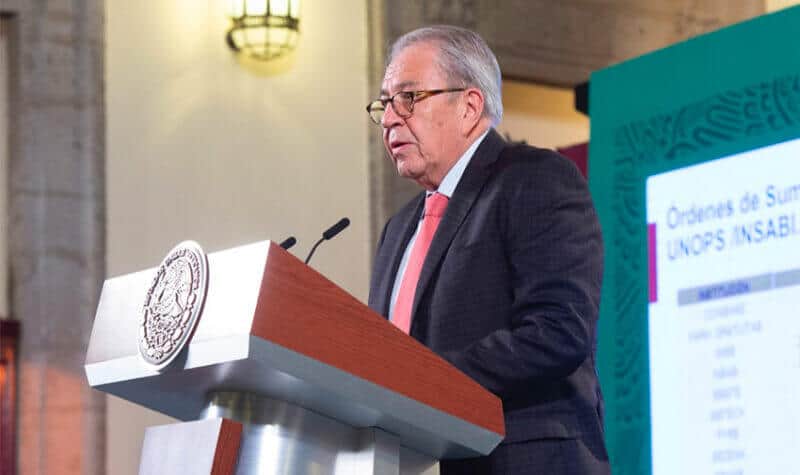
Health Minister Jorge Alcocer said Tuesday that the ministry began the process of moving into new headquarters on Acapulco’s seafront boulevard, Avenida Costera, earlier this month.
He told President López Obrador’s regular news conference that high-ranking officials from several Health Ministry departments, including Prevention and Health Promotion and the National Institute of Health for Well-Being, or Insabi, have already made the move to the Guerrero coast.
“The relocation of personnel from other areas will be voluntary and progressive,” Alcocer said.
“… In this initial stage, [department] heads, general directors, area directors, trusted people of middle and senior managers and core staff who requested to voluntarily join this stage were transferred,” he said.
Health Minister Alcocer report on the Acapulco move at the president’s press conference on Tuesday.
All told, 100 people have made the move to Acapulco, Alcocer said, adding that 320 more, including employees of the health regulator Cofepris, will transfer to the city by January.
“By the end of the second half of 2022 about 1,200 workers will have been transferred,” he said, adding that they will receive assistance from the government to find housing, access health care and enroll children in schools.
“According to the voluntary survey we conducted, … 944 of 4,600 participants, 20.5% in other words, responded in the affirmative to the change of residence. Workers who don’t want to or can’t move … will have the opportunity to request a change of assignment,” Alcocer said.
He said that some workers may opt for voluntary redundancy or early retirement rather than make the move. The minister also said the Health Ministry is working on a plan with the Culture Ministry to convert its Mexico City headquarters, located in the inner city neighborhood of Juárez, into a health museum.
The newspaper Reforma reported that some Health Ministry workers declined the offer to move to Acapulco because they have mortgages in Mexico City or are applying for home loans in the capital. One employee said the majority of unionized workers wouldn’t be transferring.
“They can’t dismiss us,” said another employee, who explained that workers who don’t want to go to Acapulco expect to be transferred to a hospital or Health Ministry offices in another location.
“We know that we have to enter a different area in a few months. They tell us that the building [the ministry’s Mexico City headquarters] has to be vacated in December because it’s going to become … a museum,” the worker said.
“There are people who are paying off houses [in Mexico City],” the employee said, explaining why a shift to the coast was not an attractive option for some workers. “Your life and family are here, everything happened suddenly.”
Before he took office in late 2018, López Obrador announced a plan to decentralize the federal government by moving numerous departments to different cities across the country. However, the plan has faced opposition from both employees and the business sector, and little progress has been made.
The Health Ministry is just the second ministry to relocate after the Energy Ministry, which is now based in Villahermosa, Tabasco.
Among the other ministries the government intends to relocate are Wellbeing to Oaxaca, Culture to Tlaxcala, Education to Puebla, Economy to Monterrey and Public Administration to Querétaro.
Alma Sánchez Barragán takes office in Moreléon, Guanajuato. Her mother, a Citizens Movement candidate for the post, was killed by gunmen in May.
The mayor of Moroleón, Guanajuato, took office this week, when she spoke earnestly about replacing her mother, a Citizens’ Movement candidate killed during the campaign for the June 6 elections.
Alma Rosa Barragán Santiago was murdered on May 25 during a campaign event in that municipality, located in the south of the state on the border with Michoacán.
According to witnesses, armed men arrived at the event and opened fire at the candidate. Two other people were wounded, the newspaper Milenio reported.
Alma Denisse Sánchez Barragán, her daughter, assumed the candidacy and won the contest. She said she felt conflicting emotions at her swearing-in ceremony.
“For me, being here today is something beautiful but at the same time it is very painful … Today I tell you with all my heart, today this is no longer just a town … today we are all Moroleón, a family,” she said.
“We can address pain in a good way, in a strong way, by uniting to keep moving forward,” she added.
The electoral season leading up to municipal, state and federal elections on June 6 was the most violent on record, according to a report by risk analysis firm Etellekt, which tracks election campaign violence. It showed that politicians and candidates were murdered in more than 20 states in the lead-up to the elections.
Guanajuato is never far from the discussion of violence. It tops the list as the worst state for homicides in terms of raw numbers.
President López Obrador has previously placed the blame squarely on state authorities, particularly state Attorney General Carlos Zamarripa.
“I urge the governor to do something … we don’t have support,” he said on August 30. “The attorney general has been there a long time, and there are no results.”