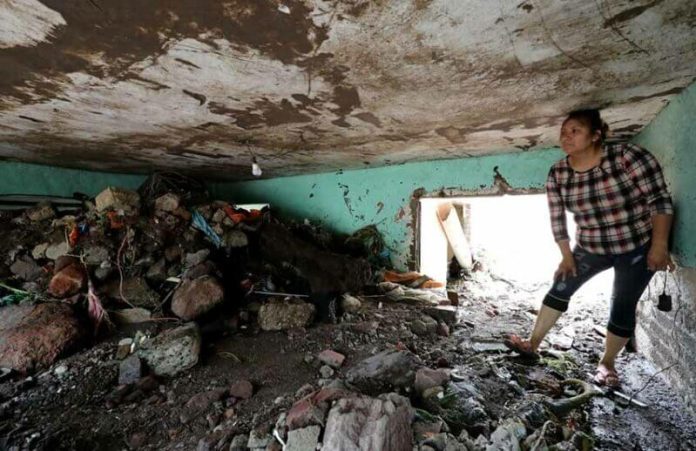
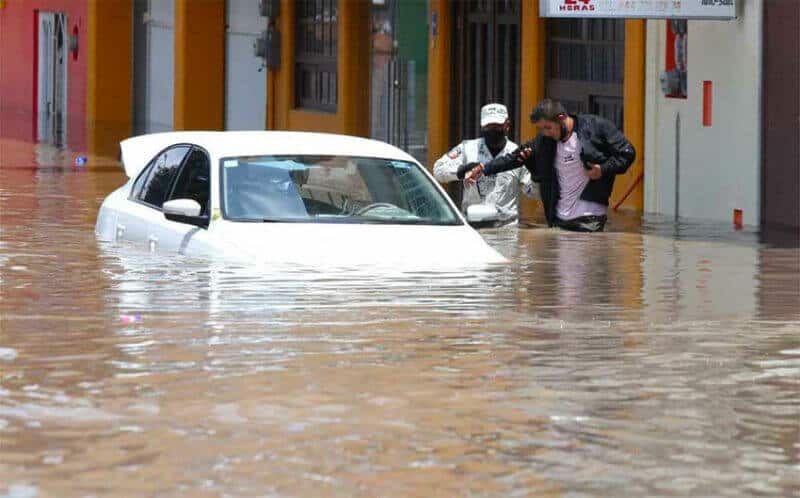
This woman's home was flooded after the San Andrés River overflowed.
Victims of flooding in Ecatepec, México state, protested on Wednesday to demand government help to remove water and mud from their homes.
More than 20 Ecatepec neighborhoods, including San Pedro Xalostoc, Jardines de Santa Clara, México Colonial II, Ciudad Azteca, Hank González and San Andrés de la Cañada, were flooded on Monday after torrential rains – 2.4 centimeters in 90 minutes – struck the municipality, part of the greater Mexico City metropolitan area.
Some 800 homes were damaged, according to the México state government, two people died and at least 120,000 Ecatepec residents were affected by the floodwaters, which cut off some roads in the densely populated municipality.
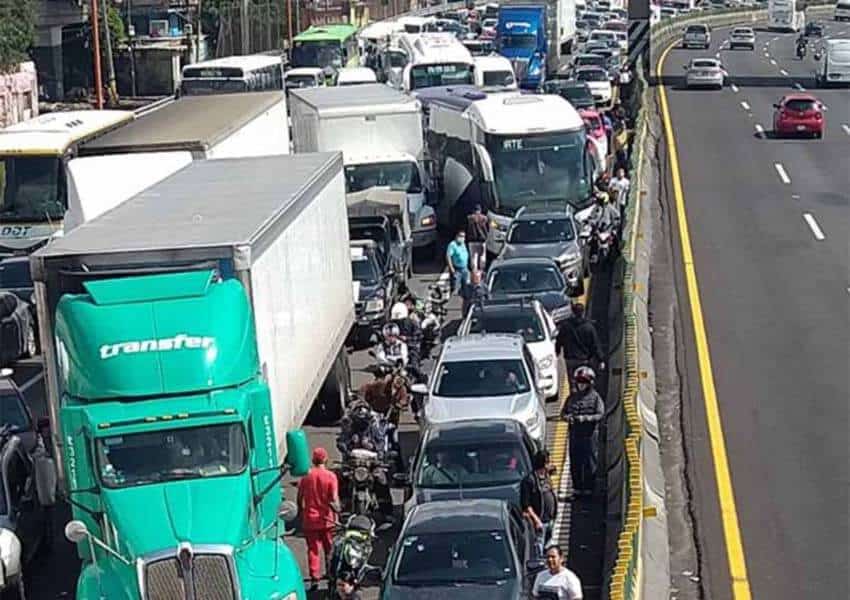
Flood victims who say they haven’t received any help from authorities protested on the Mexico City-Pachuca highway for more than two hours on Wednesday, blocking traffic bound for the national capital.
“We’ve been without state support for 72 hours. There are no solutions to our requests,” said one placard, even though only 48 hours had elapsed since the flooding occurred.
Traffic at a standstill on the Mexico-Pachuca highway.
“Governor Alfredo del Mazo is not listening to us or helping us,” Víctor Ramírez, a San Pedro Xalostoc resident, told the newspaper El Universal. “The flood was on Monday afternoon. It’s Wednesday now, and he hasn’t come to tour the [affected] neighborhoods and see what we’re facing. What insensitivity!”
Flood victims also protested and blocked traffic at other locations in Ecatepec, including a busy avenue in Ciudad Azteca.
“We need help to remove water from our homes, we’re still flooded here. We’ve lost our possessions, … there are a lot of [flooded] homes and the water level isn’t going down. We don’t have electricity, we can’t cook and we haven’t eaten. We need help from the authorities,” said Javier Conde, a resident of México Colonial II.
“We’ve now been flooded twice,” Margarita Galán Vázquez, a resident of Hank González, told the newspaper La Jornada.
“They haven’t brought machinery or anything here to help us. … We lost all our possessions — clothes, living room furniture and our car. The San Andrés River overflowed here and flooded our home.“
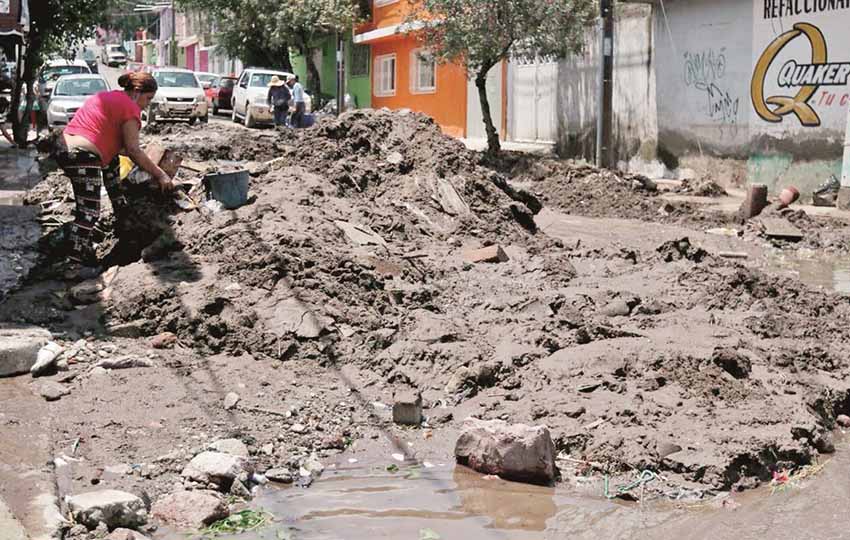
Residents say they are dealing with overwhelming amounts of floodwaters and mud and need government assistance.
Although hundreds of residents complained about the absence of assistance from authorities, the Ecatepec municipal government said Wednesday that cleanup work was underway in 23 affected neighborhoods.
Mayor Fernando Vilchis said the worst affected areas were Polígonos II, Alborada de Aragón, La Esperanza, Santa María Tulpetlac and San Andrés de la Cañada and that his government was working in conjunction with state and federal authorities.
Soldiers and National Guard troops were due to begin delivering food packages donated by the state government to affected residents on Wednesday. But some cleanup and aid efforts have been hampered by further rain.
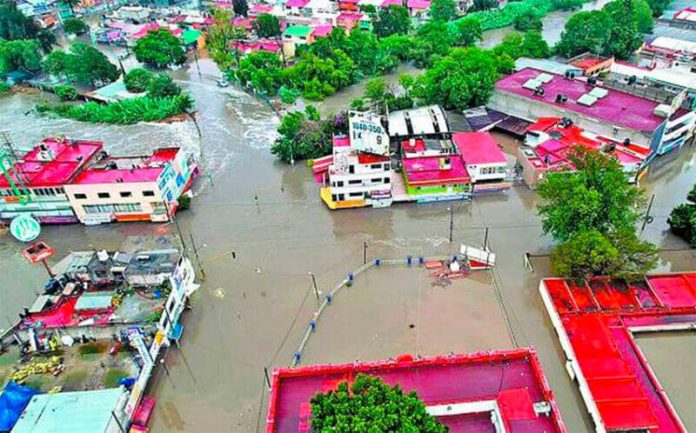
Rivers broke their banks in Tula, Ixmiquilpan, Chilcuautla, Mixquiahuala de Juárez, Tepeji del Río, Tezontepec de Aldama, Tlahuelilpan and Tlaxcoapan, the newspaper Reforma reported.
A flooded street in Hidalgo.
Authorities in the first two municipalities ordered people who live near rivers or other bodies of water to evacuate due to the worsening flooding.
Hidalgo Governor Omar Fayad also ordered the evacuation of the center of Tula and other locations in the Mezquital Valley.
Soldiers and National Guard troops were deployed to assist evacuations in both residential and commercial areas. Three military helicopters and four boats assisted the efforts.
At least 1,000 people left their homes in Ixmiquilpan and took refuge in shelters, while hundreds of Tlahuelilpan residents also evacuated. The Salado River overflowed in the latter municipality, which was declared a disaster zone. At least 5,000 people in Tezontepec were at risk because they live near the same river, and 3,000 homes had been affected in Tula.
At least 30,000 homes had been affected by floodwaters as of Thursday morning, according to the federal Civil Protection agency.
Governor Fayad said 11 schools, three hospitals and numerous bridges had also sustained damage.
The governor warned on Wednesday that the flooding could continue to worsen as rain continued to fall in neighboring México state and Mexico City. Floodwaters as high as two meters were possible within the vicinity of the Tula River, he said.
Fayad also said that the entire region of Hidalgo that is currently affected by floods will be declared a disaster zone, which will trigger government funding to aid clean-up and repair efforts.
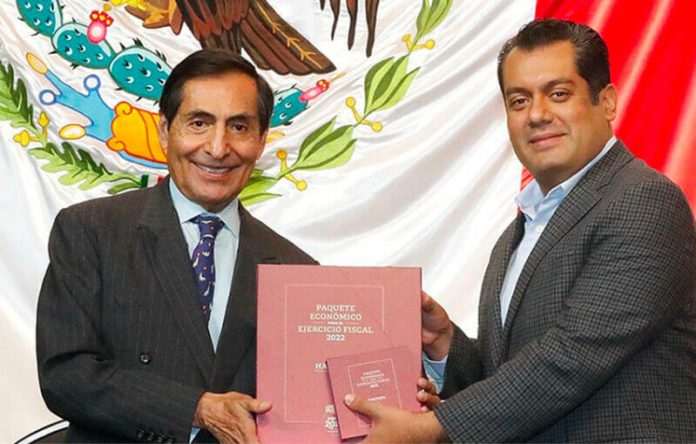
Finance Minister Ramírez presents the 2022 economic package to Chamber of Deputies president Sergio Gutiérrez Luna.
The health sector, seniors and the state oil company are among the winners in the federal government’s proposed 7-trillion-peso (US $351.8 billion) 2022 budget.
Delivered to the lower house of Congress on Wednesday, the draft economic package details spending of some 800 billion pesos on health in 2022, a 15.1% increase compared to this year.
Funding for the federal Health Ministry will increase 27.6% to 192.3 billion pesos under the government’s plan, which outlines total spending that is 8.6% higher than that in the 2021 budget.
“The resources to continue confronting the pandemic are fully guaranteed in this budget,” Finance Minister Rogelio Ramírez de la O told federal lawmakers.
“… Eight hundred billion pesos is being allocated to this task, which includes the purchase of vaccines and medications, free health services … and an increase to the health workforce to attend to the pandemic,” he said.
The budget calls for a 70% increase in pension spending.
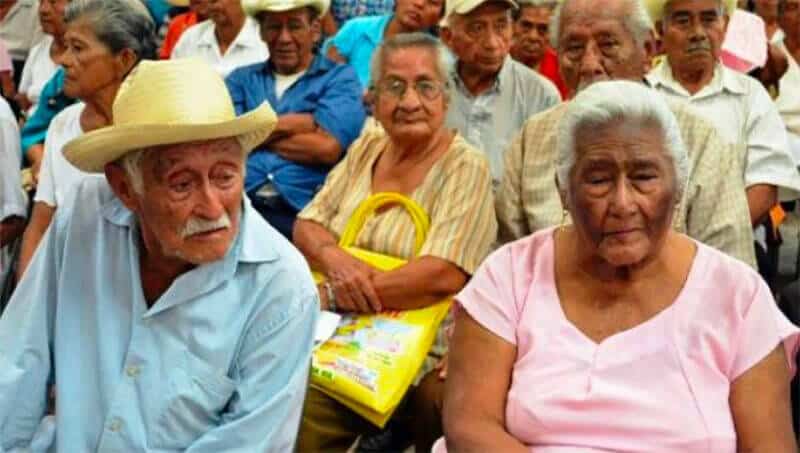
Another government priority is the delivery of pensions to seniors, with spending set to increase 69.9% to just over 238 billion pesos.
Pemex, the world’s most indebted oil company, has been allocated just under 636.3 billion pesos, a 16.8% increase compared to 2021, while the Federal Electricity Commission (CFE) is slated to get just under 450 billion pesos, a 7.7% jump. Pemex is also set to get further tax relief.
President López Obrador has made the rejuvenation of both Pemex and the CFE a priority, and his administration has sought to increase the state-owned utilities’ participation in the oil and electricity markets, which were opened up to foreign and private companies by the previous federal government.
The government is also pursuing a wide-ranging infrastructure construction program and to that end allocated almost 1 trillion pesos, or almost 15% of the total funds in the 7.05-trillion-peso budget. About 45 billion pesos is slated to go to the new refinery project on the Tabasco coast, while the Santa Lucía airport project is set to get an additional 63.2 billion pesos in 2022.
Those two projects, along with the Maya Train railroad – which will receive the lion’s share of the tourism budget – and the Isthmus of Tehuantepec trade corridor, are set to get a combined 12% funding boost in 2022.
In his third annual report to the nation last week, López Obrador noted that the government is building numerous infrastructure projects including highways, dams, hospitals, state-owned banks, universities, schools, water treatment plants, bridges, railroads, airports, military barracks, libraries and stadiums.
State and municipal governments are also budget winners with their federal funding set to increase 4.9% to over 2 trillion pesos in 2022, the highest annual allocation during the current government.
One of the budget losers is the military, which the president has depended on heavily for tasks such as public security, infrastructure construction and the COVID-19 vaccine rollout. The armed forces have been allocated funding of just under 141.9 billion pesos, a 7.5% cut compared to 2021.
However, the National Guard, the two-year-old quasi-militarized security force that is playing a central role in public security and stopping the movement of migrants, is set to get almost 70% more resources next year.
Ramírez de la O, who succeeded Arturo Herrera as finance minister earlier this year, said the 2022 budget is built on three pillars.
“The first is support for the wellbeing of the most vulnerable population. The second is stability and strength of public finances, maintaining fiscal prudence. The third is support for regional investment projects that trigger social development and which have positive direct and indirect impacts on wellbeing and employment,” he said.
The finance minister told lawmakers that 2022 will be a year of consolidation of the economic recovery in the wake of the sharp pandemic-induced downturn of 2020. The Finance Ministry upgraded its 2022 growth forecast in the budget papers, predicting an economic expansion of 4.2%, up from 3.6% in April. GDP is expected to increase by about 6% in 2021.
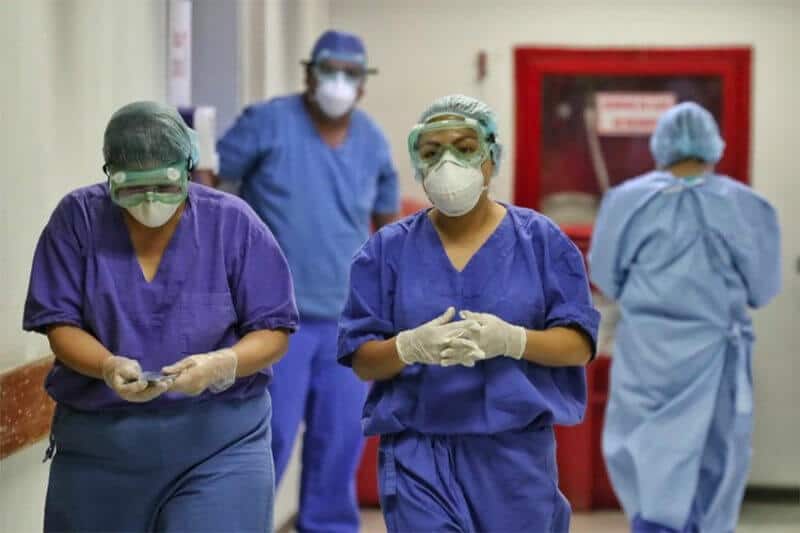
Total spending on healthcare is up nearly 28% in the proposed budget.
Ramírez de la O said the ongoing progress in the delivery of COVID-19 vaccines – more than two-thirds of Mexican adults are now vaccinated with at least one shot – will continue to aid Mexico’s economic recovery. He also said that addressing social and economic inequalities that were made worse by the pandemic is a priority of the 2022 budget.
Women will get some limited economic relief due to the removal of taxes on feminine hygiene products such as tampons and pads.
Among the assumptions in the 2022 budget papers are annual inflation of 3.4%, interest rates of 5% (the central bank’s benchmark rate is currently 4.25%), an average exchange rate of 20.3 pesos to the US dollar, an average per barrel Mexican oil price of US $55, daily oil production of 1.83 million barrels (a 2.2% decline compared to 2021) and total government debt equivalent to 51% of GDP.
The government anticipates income of just under 6.2 trillion pesos in 2022, an increase of 7.5% compared to this year. It didn’t announce any tax increases but expects to receive greater tax revenue due to the ongoing recovery of the economy, higher oil prices and the closure of tax loopholes for large companies, among other factors.
Ramírez de la O asserted that Mexico will start 2022 with macroeconomic stability and in a better position than many other countries with similar levels of development.
Despite the slated 8.6% increase in overall expenditure, the 2022 economic package was devised in accordance with principles of austerity, he declared, adding that there is “rationality and efficiency” in the spending it proposes.
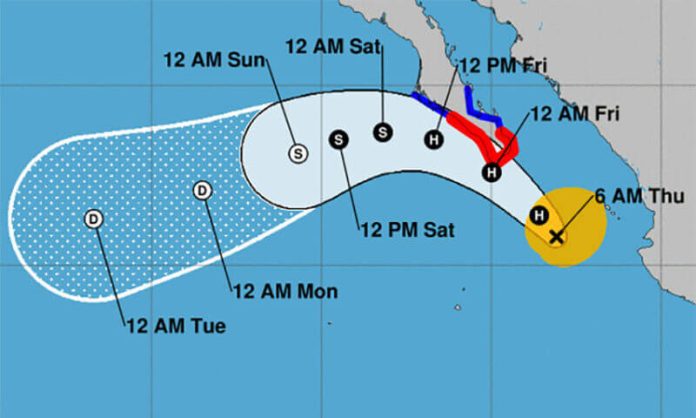
Hurricane warning areas are in red and tropical storm warning areas in blue. us national hurricane center
A tropical storm that is approaching Baja California Sur is expected to become a hurricane Thursday.
The U.S. National Hurricane Center (NHC) reported that Tropical Storm Olaf will move near or over the southern part of the Baja Peninsula Thursday night and Friday before moving westward away from land on Friday night and Saturday.
There is a hurricane warning in effect from Los Barriles to Santa Fe and a tropical storm warning for north of Santa Fe to Cabo San Lázaro and north of Los Barriles to San Evaristo.
The NHC said at 7:00 a.m. CDT today that the storm was located 300 kilometers southeast of Cabo San Lucas and moving north-northwest at 9 kmh. Maximum sustained winds were 110 kmh.
Hurricane conditions are expected to reach the coast within the hurricane warning area by Thursday night and tropical storm strength winds in the afternoon or evening. Preparations to protect life and property should be rushed to completion, the NHC said.
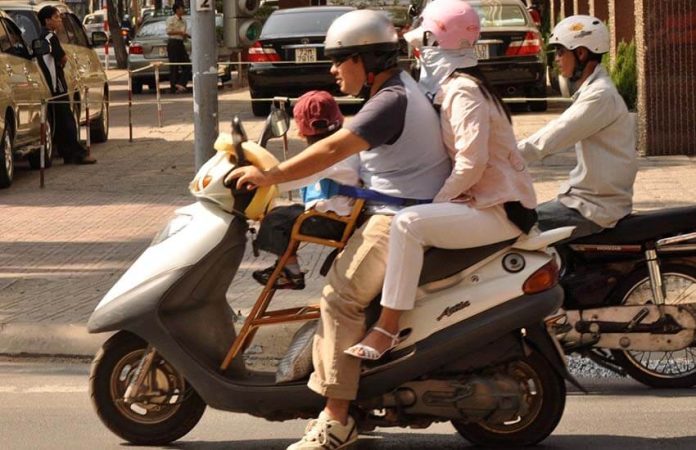
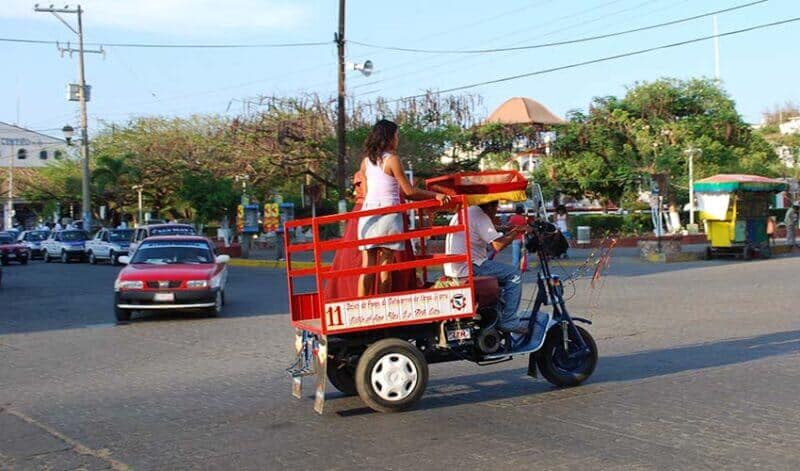
A Mexican family riding a motoneta (scooter). The use of helmets is still fairly uncommon nationwide.
I was surprised to see hardly any motorcycles when I first came to central Mexico in 2003. After all, the temperate weather in most parts makes them far more practical than in places like New York. But it is only in the last few years that I have noticed a significant number of motorcycles on the streets of Mexico City.
I’m not the only one, and it is not just in Mexico City that this has happened.
Scooters (motonetas in Mexican Spanish) and small-engine motorcycles are becoming a significant part of Mexico’s major urban areas. They can be seen in smaller cities and even more rural areas.
Mexico’s statistics agency Inegi says there are about five million motorcycles registered in Mexico, with numbers increasing by between 10% and 20% each year. Growth began as early as 2003 but has really taken off since 2013, in large part due to the rise of delivery services. In fact, small motorcycles are sometimes classified as “deliveries” (using the English word).
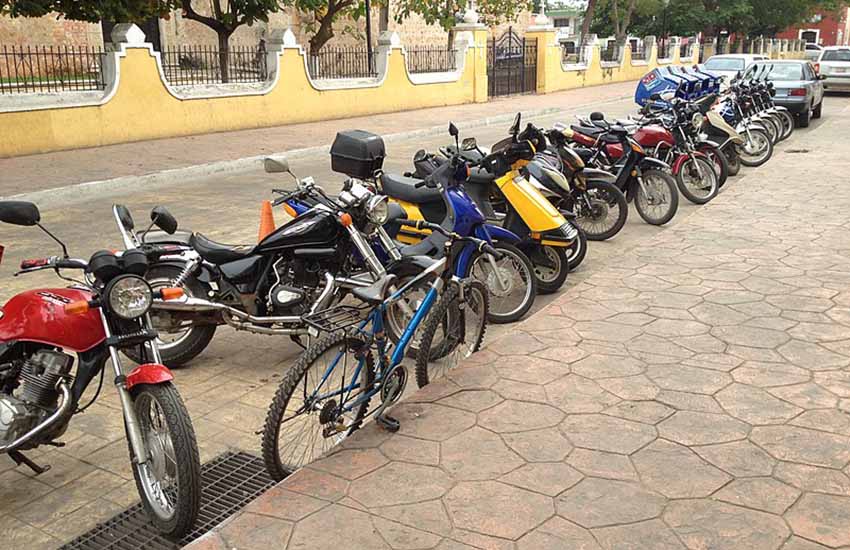
With numbers doubling and tripling, most motorcycles are found in Mexico City, Guadalajara and Monterrey. But coming in fourth is the Yucatán Peninsula with a fairly long history of using these small bikes for everyday transportation.
Parked motorcycles in Valladolid, Yucatán, attesting to the vehicles’ popularity in this region. Wikimedia Commons
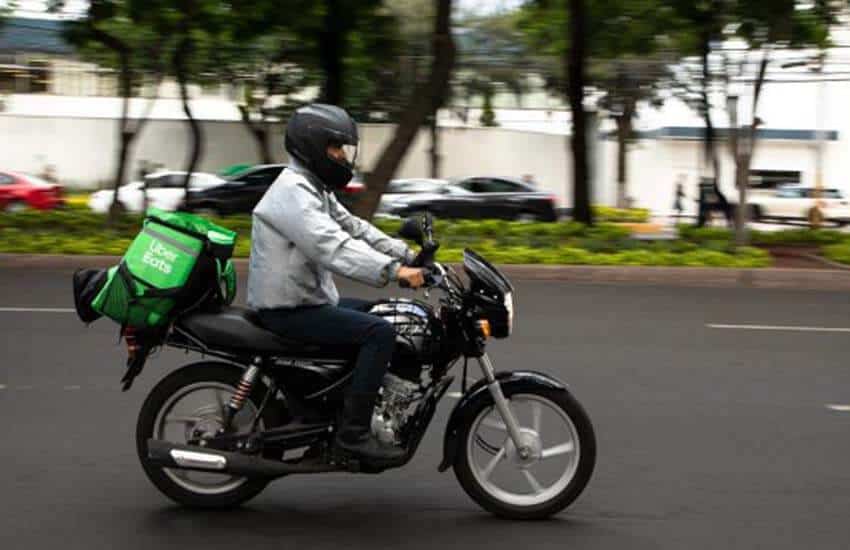
The impact of food delivery services such as Rappi and Uber Eats is best seen in central and northern Mexico, which did not have a culture of urban motorcycle riding. But only 15% of small motorcycles are used primarily for this work. Many are used now as general transportation.
They are far less expensive than cars, take up less space, are agile in heavy traffic and fare far better on gas mileage — no small thing, given fuel prices these days. In Mexico City, small motorcycles face fewer hoy no circula driving restrictions, which aim to combat the city’s notorious smog, and none if the vehicle is electric.
Mexico’s “discovery” of motorized two-wheeled transportation has caught the attention of foreign makers. They have become a bigger share of companies such as Yamaha and BMW, who have sold these and larger bikes for years, but new players are looking to take advantage of the lower-end market.
These include Chinese maker Tayo Motorcycle Technology and Indian maker Bajaj. CEO Olaf Sarabia González says Bajaj México’s interest comes because the country has a much higher population than Chile and much more room to grow than in Colombia, two Latin American countries where the brand has had success.
By far, the major Mexican brand of small motorcycles is Italika. Their motonetas and deliveries can be found all over the country, even for sale in supermarkets and department stores. At its Toluca, México state, plant the company produces over 650,000 units annually, mostly vehicles with 125cc and 150cc motors.
Specialty motorcycles have been around for some time in Mexico, often working as mini-taxis and small delivery trucks. Ecatepec, México state-based Muevetec specializes in these vehicles, and their business has increased significantly because of the pandemic.
An Uber Eats delivery person on a motorcycle. The arrival of food delivery services in Mexico has helped spawn growth in use of motorized two-wheeled transport.
Their most popular vehicles are three-wheeled moto-trucks. These are built-to-order, almost always for small businesses such as food trucks and mobile pet grooming and used for hauling everything from drinking water to dry cleaning.
The custom-made concept is important, says cofounder Roberto Sánchez, because they can tailor the vehicle to customers’ needs and the idiosyncrasies of Mexican roads.
But the rise of economical motorcycling isn’t without its problems. The main one is the high rate of accidents, tripling countrywide as the number of motorcycles have increased similarly.
The main issue is that there is a lack of a motorcycle culture here. The lack of helmet use is the main factor in motorcycle deaths, along with speeding, faulty lights, and little or no training in how to ride.
Motorcycle riders complain that cars do not take them into consideration, but car drivers and pedestrians complain about small motorcycle riders ignoring basic traffic laws. In some areas, up to 98% of motorcycle riders do not have insurance.
Some makers offer riding classes to help with this, and new laws have been passed and proposed to the same end. These include helmet laws, forbidding minors on motorcycles and even special licenses for delivery drivers.
Woman riding a mototaxi in Tehuantepec, Oaxaca. Alejandro Linares García
In major cities, crimes using motorcycles have been a problem. They are used in robberies, assaults and even murders. Perpetrators use them because motorcycles make it easier to escape in traffic and their small license plates are harder to read. Mexico City tried to mandate identifying information on riders’ helmets, but this turned out to be impractical.
Economics favor the increase of urban motorcycling, and time will tell if a (semi) orderly motorcycle culture will emerge in the nation. If you look at films of car traffic from the early 20th century, you know that the adoption of the car was a chaotic process as well.
With a growing number of riders, they are becoming less of an anomaly, making cars and pedestrians more conscious of their possible presence. Let’s hope they reciprocate by thinking of themselves equally as motorists.
Leigh Thelmadatter arrived in Mexico 18 years ago and fell in love with the land and the culture in particular its handcrafts and art. She is the author of Mexican Cartonería: Paper, Paste and Fiesta (Schiffer 2019). Her culture column appears regularly on Mexico News Daily.
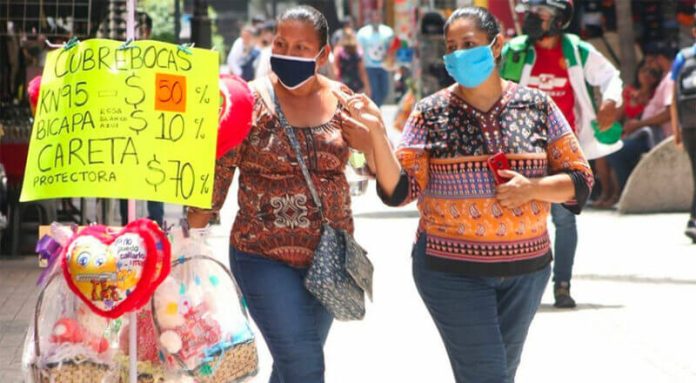
Women in Tabasco walk past a display of face masks.
Mexico recorded 15,876 new coronavirus cases on Wednesday and 879 additional COVID-19 deaths, the federal Health Ministry reported.
The accumulated case tally is now 3.46 million while the official death toll is 265,420. There are 97,611 estimated active cases across Mexico’s 32 states, a 1.6% increase compared to Tuesday.
On a per capita basis, Tabasco has the highest number of active cases with more than 250 per 100,000 people. Colima ranks second with just under 250 per 100,000 while Mexico City ranks third with just over 200. Quintana Roo and Yucatán round out the top five with just over 100 cases per 100,000 people in each state.
Federal data also shows that there are currently 11,369 hospitalized COVID-19 patients across Mexico.
Puebla has the highest occupancy rate in the country for general care COVID-19 hospital beds with just over 65% taken. Durango ranks second with a rate of just under 65% followed by Hidalgo (62%) and Veracruz (61%).
There are 199 hospitals with general care bed occupancy rates of 70% or higher.
At 61%, Colima has the highest occupancy rate for beds with ventilators followed by Veracruz, Tabasco and Jalisco, where more than 53% of such beds are in use. There are 109 hospitals with occupancy rates of 70% or higher for such beds.
Deputy Health Minister Hugo López-Gatell reported on Twitter that just under 88.6 million vaccines have been administered in Mexico after almost 843,000 shots were given on Tuesday. Just over two-thirds of Mexico’s adult population has received at least one shot.
Mexico has received a total of just under 104.5 million vaccine doses. More than 28.2 million CanSino and AstraZeneca doses were bottled here by two laboratories – Drugmex and Liomont, while the remainder arrived in pre-filled vials.
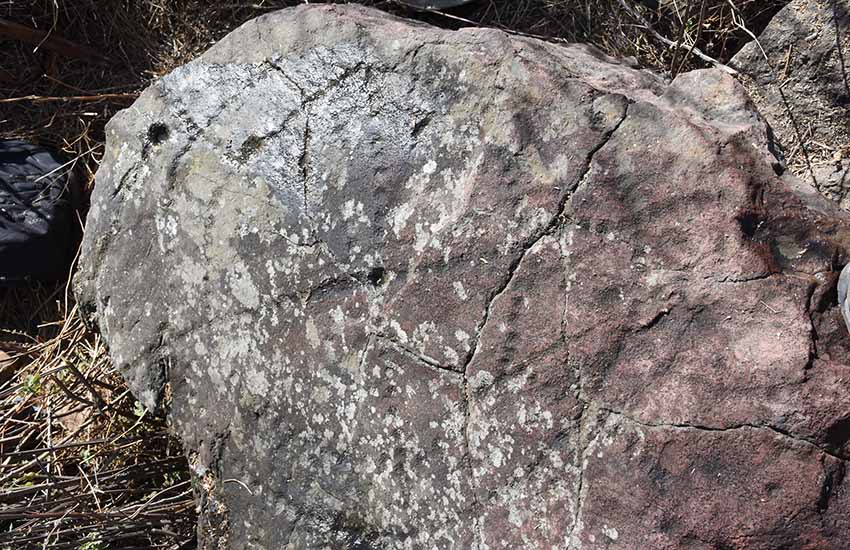
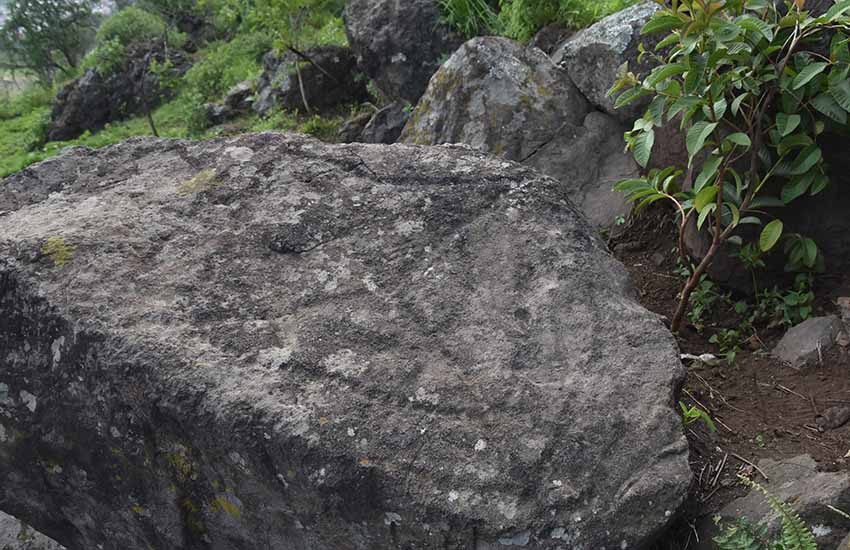
Stones with mysterious 'pecked crosses' have been found in sites from northern Mexico down to Guatemala. Photos by Joseph Sorrentino
Javier Márquez Juárez and I have walked the unexcavated ruins above San Gregorio Atlapulco dozens of times. We’ve walked for as long as four hours, always coming across more ruins — remains of buildings, temazcales (akin to sweat lodges), altars. Márquez has worked alongside several archaeologists, researched and written about the ruins and has become something of an expert on them.
According to Eric Saloma García, one of the archaeologists who has studied and written about these ruins, the site was occupied by different indigenous groups over a couple of millennia. He believes the oldest ruins to be 2,000 years old, and the most recent approximately 600 years.
Other, earlier groups almost certainly lived there but, as far as we can tell, left no trace.
At one entrance to the ruins stand two huge boulders with carvings. One depicts either a priest of Xipe Totec, the Aztec god of agriculture and sacrifice, or Xipe Totec himself. The other is a carving of Cihuateteo, the Aztec fertility goddess.
The presence of these two carvings and the large number of temazcales has led Márquez and others to posit that the ruins are probably the remains of a sacred city.
Researcher Javier Márquez Juárez stumbled across his first discovery of a stone with a “pecked cross” in the San Gregorio ruins after a minor fall forced him to take a rest.
During our explorations, Márquez and I have also come across a multitude of stones carved with what could have been maps, showing water sources, figures of gods, spirals and crosses. Sometimes it seems like every stone we pass has a story to tell.
Among the most interesting are three large stones, each carved with what’s called a cruz punteada, also known as a pecked cross.
“At the end of the 1970s, archaeologists studying Teotihuacán found in floors and rocks geometric patterns formed by a series of [holes] drawn as two concentric circles and divided into four parts by a cross,” he said. The ancient city of Teotihuacán is located about 25 miles from Mexico City.
The circles and the interior cross were formed by drilling, or “pecking” holes into rocks. These cruces punteadas have been found on sites from northern Mexico down to Guatemala. Although the most common of them are those Márquez described, there are a number of variations.
Some crosses have been found that have three circles instead of two, one that’s been found is shaped like a Maltese Cross and some feature rectangles instead of circles. One common element in all of the crosses is their division into four quadrants, something that represents indigenous cosmological beliefs.
Despite being studied for decades, the exact meaning of the crosses still remains something of a mystery.
The majority of archaeologists agree that some must have been used as astronomical devices, although those found carved into floors inside buildings or on rocks in caves can’t have been used as such. Other possible uses include calendars, urban planning devices or a tool that priests employed in some way to make predictions.
They may have been used in different ways by different cultures.
Márquez was alone when he found the first cruz punteada we’ve documented. Finding it took some luck — first bad and then good. He was wandering among the ruins when he came upon an area filled with large rocks. “When I jumped from one to another, I slipped and fell,” he related. He injured his left leg. “The pain was intense, and I crawled to another large stone and sat.”
He laid the bag he was carrying and his machete on the stone and checked to see the damage to his leg; fortunately, he didn’t break anything. When the pain subsided, he turned to pick up his bag and machete.
“I saw that this stone had many small holes. I ran my hands over the stone and realized … they made two circles and a cross. I realized it was a Teotihuacanan cruz punteada.”
Márquez and I have returned to that cruz punteada many times, and he’s sometimes returned on his own, trying to tease out its significance. This specimen has the double circle and a central cross whose arms extend beyond the outer circle.
Despite being studied for decades, the exact meaning of these crosses still remains something of a mystery.
“With this particular cruz punteada, we can see that it aligns with important hills in the Valley of México,” he remarked.
There are 265 holes in this cross, and three of them are larger than the rest. One is on the left and outside the double circles, one is in the center of the cross and the third is on the extreme right, outside the double circles.
“If we align the [hole] on the left with the central [hole], we directly observe the hill called Xochitepec,” Márquez said. “In this hill is a ceremonial center where on December 21, the winter solstice, the sun can be observed rising directly above the crater of Popocatépetl [a volcano located in the states of México, Puebla and Morelos].”
Drawing a line through the other two holes points to Pico del Águila, a hill revered by pre-Hispanic groups. Márquez has also postulated that these crosses may be connected in some way with Venus, an important planet in Mesoamerican cosmology.
A second cruz punteada found here by archaeologist Roberto Palacio has the two concentric circles and a central cross like the one described above but is carved into a smaller rock. Like the other example, it appears that the arms of the cross extend beyond the outer circle.
A third cruz punteada was found only recently and is markedly different from the other two. That one has a central cross with a small inner circle that’s surrounded by two squares. The significance of these differences is unknown, and both require further study to determine if they align with other important pre-Hispanic ceremonial sites or hills.
Most archaeologists view the presence of a cruz punteada as proof of Teotihuacán’s influence throughout Mesoamerica. But Márquez has come to believe that, for the ruins in San Gregorio, there was more than just influence and that before Teotihuacán was a sacred city built by the Mexicas (Aztecs), Teotihuacanos may have settled in the hills around San Gregorio.
He points to the fact that, in addition to three cruces punteadas, there’s a small pyramid that was constructed in the San Gregorio ruins, using techniques found in Teotihuacán. Some vessels similar to those found in Teotihuacán have also been discovered.
“These are indications that in the territory that is now San Gregorio there was a Teotihuacano settlement. This was between 100 and 800 years after Christ,” said Márquez. “I think there was an astronomical center … a Teotihucano astronomical observatory … here before the Xochimilcas or Mexicas (two indigenous groups) arrived,” he said.
Márquez continues to regularly visit the ruins, searching for further proof of a Teotihuacano settlement.
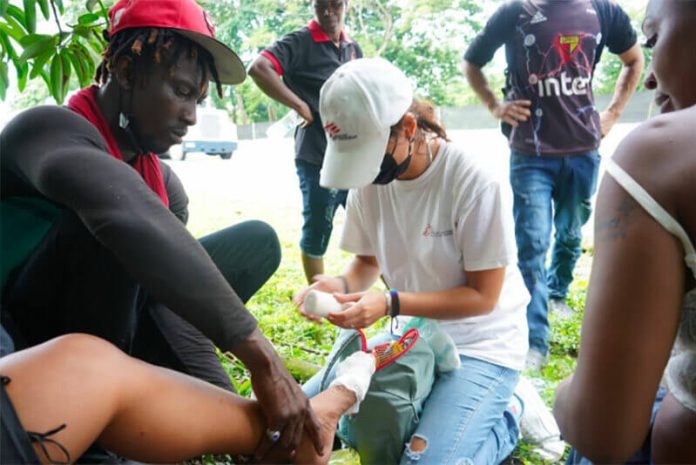
A Doctors Without Borders volunteer treats migrants in Chiapas. Yesika Ocampo / MSF
The situation migrants face in Mexico is unsustainable and policies that criminalize them are unacceptable, according to the Mexican division of Doctors Without Borders (MSF).
The organization said in a statement that it has launched an emergency intervention in Tapachula, Chiapas, “where some 40,000 people are trapped due to the failure of the asylum system.”
Frustrated by long processing times for asylum claims, migrants in four large caravans recently departed the city only to be confronted by National Guard troops and immigration agents intent on halting their advance, even through the use of force.
MSF also denounced the “exclusion and abandonment” of 2,000 migrants in a large camp in Reynosa, Tamaulipas, that the United States has urged Mexico to clear due to concerns that such camps pose a security risk and attract criminal gangs that prey on vulnerable migrants.
Doctors Without Borders said that tens of thousands of migrants in Mexico face a situation of “extreme vulnerability” due to continuous deportations from the United States and the failure of asylum policies.
The medical and humanitarian organization denounced crowded conditions and a lack of access to medical and social services in both southern and northern Mexico.
In Tapachula, an emergency MSF team has provided medical treatment to migrants who returned to that city after being stopped by authorities as they attempted to travel north.
Christoph Jankhöfer, head of MSF’s migrants program in Mexico, said that some migrants were living on the streets of Tapachula because shelters are full. All migrants in the city are at risk of being infected with COVID-19, he said.
Jankhöfer also said that MSF is concerned about symptoms of anxiety, depression and despair among migrants stranded in the southern city.
“Coming from countries such as Honduras, Guatemala, El Salvador, Venezuela, Haiti and Cuba, the migrants in Tapachula, a significant number of whom are women and children, have been in limbo for months waiting for the resolution of their migratory status,” MSF said.
“A lot of these people recently crossed the border with Guatemala, while others were deported by the United Sates to the northern border of Mexico and later transferred to the south of the country by Mexican authorities,” it said.
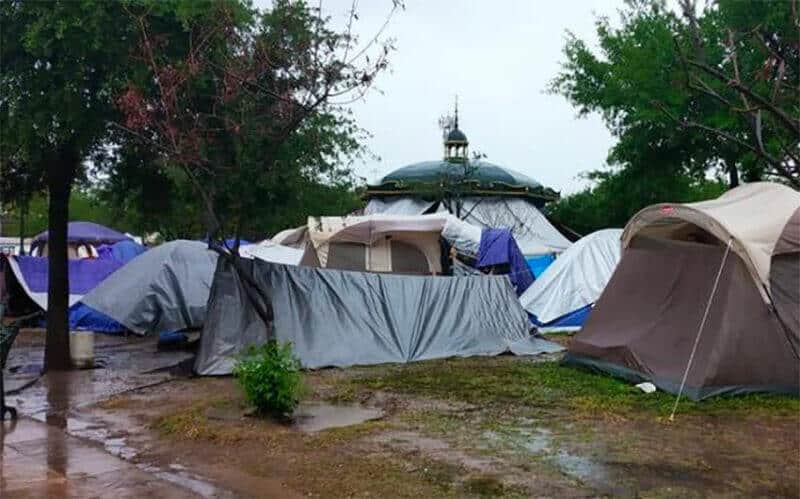
Migrants’ tents in Reynosa, Tamaulipas.
The organization also said that migrants in Reynosa are in an uncertain situation. More than 2,000 are living in tents in a makeshift camp near an international bridge that connects the city to Hidalgo, Texas, MSF said, adding that they are exposed to “harsh heat,” lack access to basic services and face serious security risks.
“As they have fled from their countries of origin, the only option they’ve had is to try to seek asylum [in the United States] from here and wait indefinitely for it to be approved while they survive in deplorable conditions,” said Anayeli Flores, MSF’s humanitarian affairs chief in Reynosa.
“Neither the Mexican nor the United States government provides support despite the fact that their restrictive policies are what keep these people in conditions of vulnerability, violating the international right to request asylum,” she said.
MSF said it is providing primary and mental healthcare services to migrants in Reynosa, and supporting the supply of drinking water. It said it offered 902 consultations between March and August and that the most common ailments were respiratory, digestive and skin problems, all of which were related to “serious overcrowding and lack of hygiene.”
Many patients also showed signs of anxiety, stress and psychological disorders caused by traumatic experiences in their home countries and/or while traveling to the Mexico-U.S. border, the living conditions they currently face, uncertainty about the future and separation from family members, MSF said.
“The majority of migrants in Reynosa, among whom are women on their own, pregnant women, boys and girls, older adults, members of the LGBTQI population, indigenous people and non-Spanish speakers, have been expelled from the United States through Title 42, a policy that constitutes a flagrant violation of international law and which uses the COVID-19 pandemic as an excuse to quickly block people who seek protection in that country and return them directly to border cities in Mexico, with the consent of the Mexican government,” it said.
“The situation of migrants in Mexico is unsustainable,” said Gemma Domínguez, MSF’s general coordinator in Mexico.
“The migratory policies that criminalize migration, the lack of an adequate humanitarian response and repeated violence and persecution against migrants are unacceptable and place the lives of thousands of men, women and children in danger,” she said.
MSF called on the Mexican and United States governments to urgently “take actions that resolve the grave humanitarian situation that migrant populations live throughout the country, particularly in border regions.”
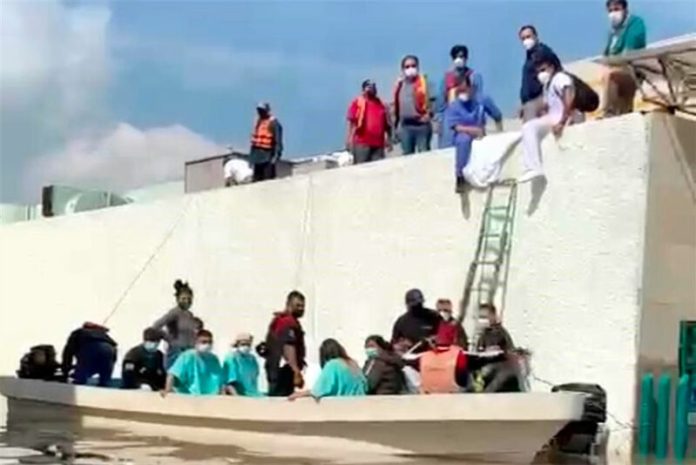
People are evacuated by boat Tuesday from the Tula General Hospital.
A woman whose husband died in an IMSS hospital in Tula, Hidalgo, on Tuesday has questioned why authorities didn’t do more to prevent the tragedy.
Severe flooding cut electricity to General Hospital No. 5 and caused a system supplying oxygen to COVID-19 patients to stop functioning.
IMSS director Zoé Robledo said Wednesday that 14 patients died as a result of the inundation and that two others died just before water from the Tula River flooded the facility.
After receiving a call from her hospitalized husband, Catalina García left her home in Tepeji del Río at 2:00 a.m. on Tuesday and obtained an oxygen concentrator before traveling to the flooded area surrounding the hospital, according to a report by the newspaper Reforma.
She then boarded a boat and an hour later managed to enter the hospital where her husband, 30-year-old José Manuel Hernández Gante, had been receiving treatment for COVID-19.
But her husband had already died. Even if she had arrived before his passing, the oxygen machine she took to the hospital could not have saved his life because there was no functioning electricity source to connect it to.
(Water entering the hospital not only flooded patients’ wards but damaged a generator which would have provided an alternative power supply for the oxygen machines on which patients were dependent.)
“If I got there, why couldn’t anyone else? Nobody took any notice of the oxygen they were all asking for, that’s why they died,” García, a mother of three, told Reforma outside a Hidalgo funeral home.
“They didn’t want to help them, they let them die there, nobody did anything,” she said.
“… If they knew that water was coming in why didn’t they do anything? Why didn’t they move [the patients]? … Why didn’t they take precautions?” García asked.
“[I want] justice to be served, … it was negligence because they didn’t do anything,” she said, adding that she spoke with patients at the hospital.
“They told me that they took them out … when the water was already up to their necks, that when [the hospital] started to flood they did nothing, only said Lift your feet up, nothing will happen, it doesn’t flood here,’” García said.
In a video message posted to social media on Wednesday, Robledo said that neither the hospital’s management nor IMSS officials in Hidalgo received a warning that the facility could be flooded.
“The torrential rain in Hidalgo, México state and Mexico City caused a sudden rise … of the Tula River that caused it to overflow at a point near the hospital,” the IMSS chief said.
“Unfortunately, the [hospital] personnel wasn’t warned officially or informally of the phenomenon and its potential. It was a sudden disaster; in a matter of minutes it put the whole city under water, including our hospital,” Robledo said.
He said that 46 IMSS hospitals have been evacuated over the past three years due to imminent risks but that wasn’t possible on Tuesday morning.
“This case was different, there was no time for anticipation,” Robledo said, adding that he had spoken with hospital personnel and they all talked about the suddenness with which the flooding occurred.
“From 10:00 p.m. [Monday], when it started to rain, until the electricity was cut at about midnight, when the hospital’s emergency generator began working, personnel were taking patients up to the top floor,” he said.
“They said that at 3 in the morning, in a period of approximately 20 minutes, the level of water increased suddenly and paralyzed the hospital’s emergency generator,” Robledo said.
He said that a total of 54 patients were in the hospital when the flooding occurred, including 22 COVID patients, 14 of whom died due to a lack of oxygen.
Five patients were subsequently discharged while the remainder were transferred to other health care facilities in Hidalgo.
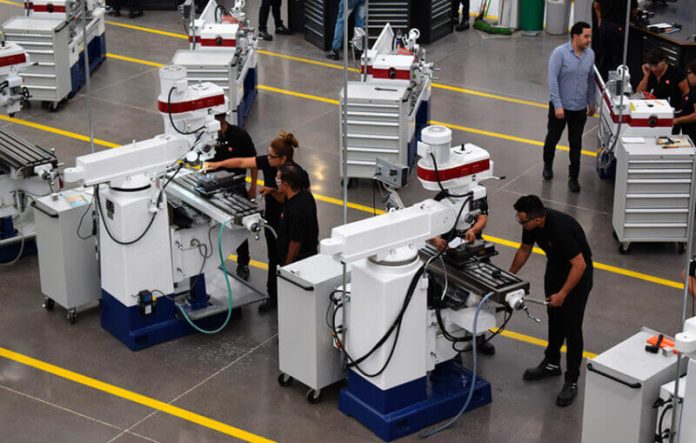
Le Bélier manufactures parts for the automotive and aerospace industries.
A French automotive manufacturer has confirmed that it will invest US $100 million in a new plant in San Miguel de Allende, Guanajuato.
Le Bélier plans to produce aluminum parts such as engine mounts, braking systems and chassis components in the 35,000-square-meter plant, said the state government this week. The company’s client portfolio includes BMW, Mitsubishi, Daimler, Continental and Hitachi.
Governor Diego Sinhue Rodríguez Vallejo, who was in France to visit the company, said the investment spoke of the region’s international reputation. “The old continent has showed its confidence in us through companies with a high level of automation and Industry 4.0 such as Le Bélier, whose project in San Miguel de Allende will be the only one nationwide that brings together all the techniques of aluminum casting through state-of-the-art systems,” he said.
He added that the investment, first announced in June, would create 500 jobs, and that the company’s social outlook aligned with that of his government. “We ensure that the companies that arrive have a high social commitment and care for natural resources. That is the case of Le Bélier, which has an SBT [Science Based Target] certification for the good of our planet,” he said.
David Guffroy, CEO of Le Bélier, said investment in Guanajuato was attractive due to the region’s connectivity, highly competitive workforce and local supply ecosystem, Rodríguez reported.
Le Bélier has a workforce of 3,200 people, presence on three continents and 12 production units across France, Hungary, Serbia, China and Mexico. The company entered Mexico in 2000 with a plant in Querétaro. It forecasts sales of more than 290 million euros (about US $343 million) for 2021.