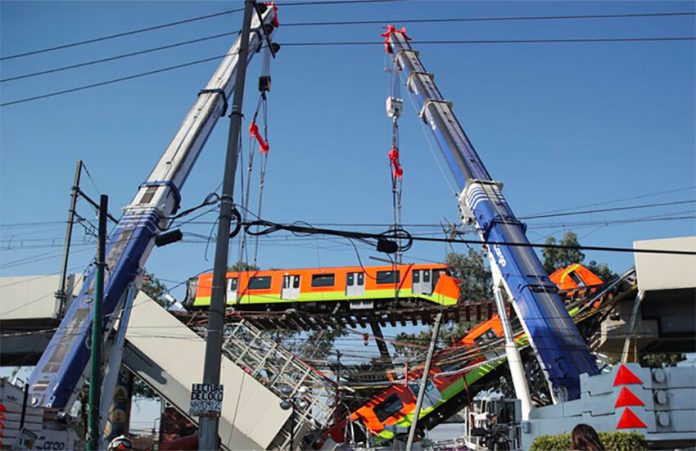
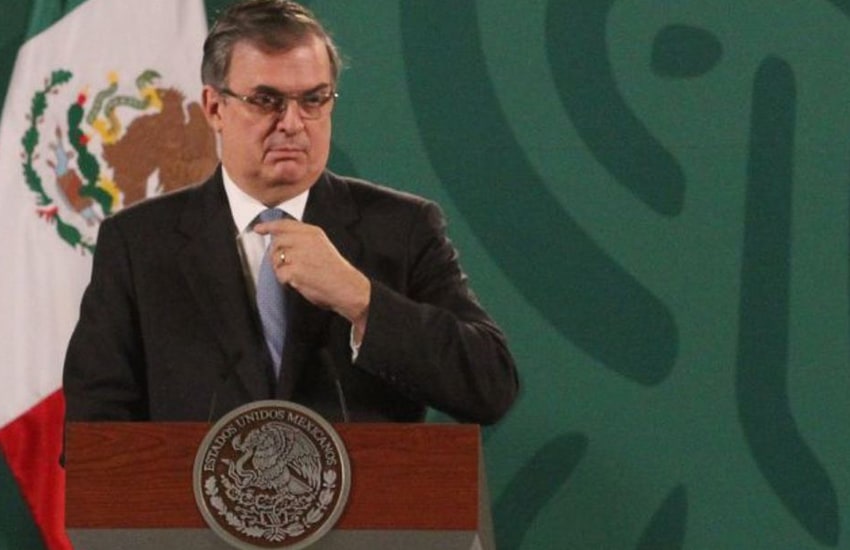
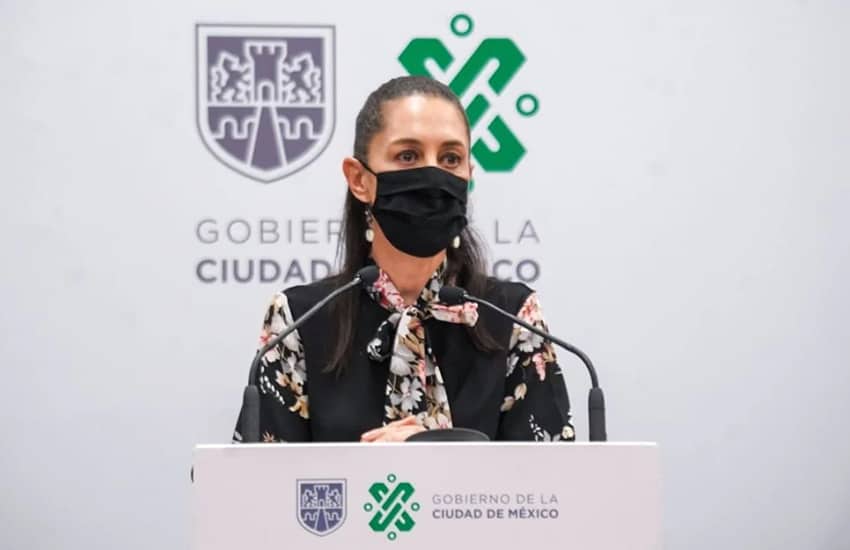
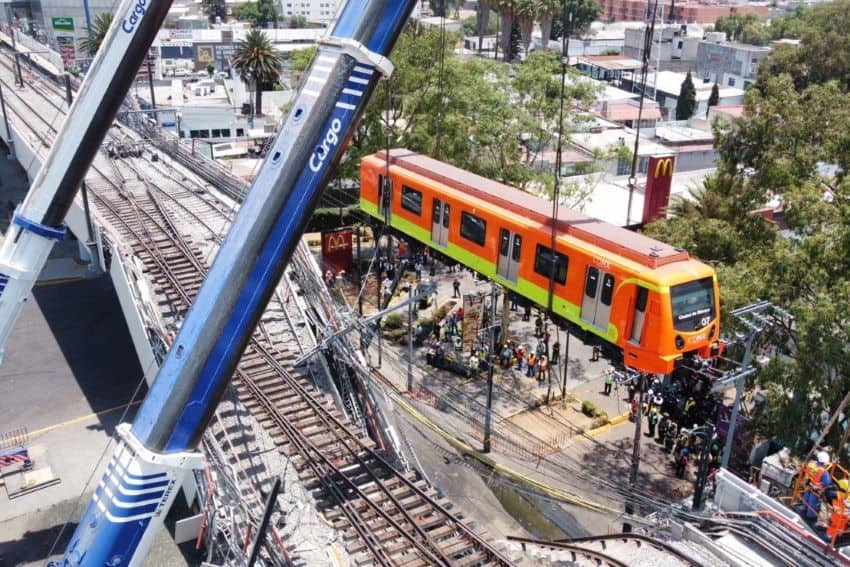
Cranes pick up a Metro carriage after Monday's accident. A poll found that more people blamed former Mexico City mayor Marcelo Ebrard for the crash than current Mayor Claudia Sheinbaum.
Foreign Minister Marcelo Ebrard and Mexico City Mayor Claudia Sheinbaum are both deeply embroiled in Monday’s Metro system train crash that claimed the lives of 25 people in the capital’s southeast.
Will the crash, caused by the collapse of a beam that supported an elevated section of Line 12 of the Metro, hurt their chances of becoming Mexico’s next president?
The answer, as yet, is unclear — and neither the mayor nor the foreign minister has declared their intention to pursue the presidency — but a poll suggests that voters more readily apportion blame to Ebrard, who built the newest line of Mexico City’s large Metro system while mayor between 2006 and 2012.
A poll of 401 Mexico City residents conducted by the firm GCE found that 22.2% believe that the main responsibility for the tragedy lies with Ebrard. Only 4.5% opted for Sheinbaum who, as the current mayor, is ultimately responsible for the Metro system.
When Line 12 opened, critics blamed then Mexico City mayor Marcelo Ebrard of rushing to complete construction to add to his political legacy.
About 8% blamed Metro director Florencia Serranía. Another 6.6% attributed responsibility to the Mexico City government, while 3.3% pointed their fingers at the federal government. About 2% condemned the company in charge of maintenance.
Only the consortium of companies that built the new line incurred more wrath than Ebrard, with 25.7% of respondents saying that it was to blame for the disaster, the deadliest ever for the city’s subway system.
Fernando Belaunzaran, a Mexico City lawmaker with the Democratic Revolution Party — to which both Ebrard and Sheinbaum formerly belonged — put the question as to who is to blame in simple terms.
“If the problem was structural, it hits Marcelo. If the problem was maintenance, it hits Sheinbaum,” he said. “The struggle over succession will be about trying to demarcate the responsibility.”
When asked on Tuesday whether he was concerned that he would be blamed for the crash, Ebrard said that Line 12 of the Metro, also known as the Golden Line, wasn’t “definitively delivered” until July 2013 — more than six months after his term as mayor ended — even though it opened in October 2012. He also said that that he had nothing to hide or fear, although critics accused him of rushing to complete construction of the line while he remained mayor in order to add to his political legacy.
Ramon Pedraza, a 53-year-old who lives near the location of Monday’s accident, criticized Ebrard in an interview with the news agency Reuters, accusing him of cutting corners to complete the project more quickly.
Mayor Claudia Sheinbaum said it would be “mean” to victims and their families to talk about the political costs of the tragedy so soon.
In an apparent attempt to deflect blame, Sheinbaum on Tuesday alluded to problems with Line 12 long before she became mayor, noting that the Golden Line has a “history.”
She also said she was committed to finding out who is to blame for the disaster. Both the Mexico City Attorney General’s Office and its federal counterpart will carry out investigations, as will a private Norwegian company.
The mayor on Wednesday said that it would be “mean” to the victims and their families to talk about the political costs of the tragedy so soon after it occurred.
“It’s up to us to attend to citizens and at this time give priority attention to people who unfortunately have a family member who lost his or her life and [to] people who are hospitalized,” Sheinbaum said.
The Vizcaíno Biosphere Reserve in Baja California Sur has four active mining projects.
There are 73 mining projects within natural protected areas in Mexico, one in a Unesco heritage site, but they are allowed to operate due to a law which defines mineral extraction as a public good.
That would change, however, if the the Senate ratifies the General Law of Ecological Balance which would prohibit mining in natural protected areas.
It is unclear whether the new law would revoke previously granted mining concessions.
The Ministry of Environment has identified 11 highly contaminated places in natural protected areas caused by mining, while many other extraction projects threaten wildlife.
The Unesco protected Monarch Butterfly Biosphere Reserve, on the border between Michoacán and the state of México, is the site of one mining project operated by Grupo México, the country’s biggest mining company.
The Vizcaíno Biosphere Reserve, home to the peninsular pronghorn and the mating and birth site of the gray whale, has four mining projects. The Colorado River Delta, habitat of the endangered vaquita marina, is another site of extraction.
Two areas seeking Unesco classification have outstanding mining concessions: Valle de los Cirios Protected Area in Baja California and the indigenous Wirikuta area in San Luis Potosí.
Manuel Llano, director of investigative the NGO Cartocrítica, detailed the scale of the issue. “There is an area of 2.4 million hectares overlapping between mining concessions and natural protected areas … There are at least 400 concessionary mining titles … inside natural protected areas. The main one is Grupo México which has 84 mining concessions,” he said.
“There is water hoarding, destruction of habitats, accidents, carelessness, negligence and there is corruption …” he added.
Edmundo del Pozo from Fundar, another NGO, called on the Mining Law to be amended. “One would not imagine that in natural reserves they would allow mining activities and mega-mining or hydrocarbon projects, but it is the reality … There must be a substantive modification of the Mining Law to repeal the preference for public good, which violates human rights,” he said.
“Behind the mining activity has come criminalization, violence, the collusion of mining companies with organized crime, … and a series of attacks against communities and land defenders,” he added.
Fundar has documented more than 800 socio-environmental conflicts and 440 attacks on land defenders in relation to mining and extraction projects.
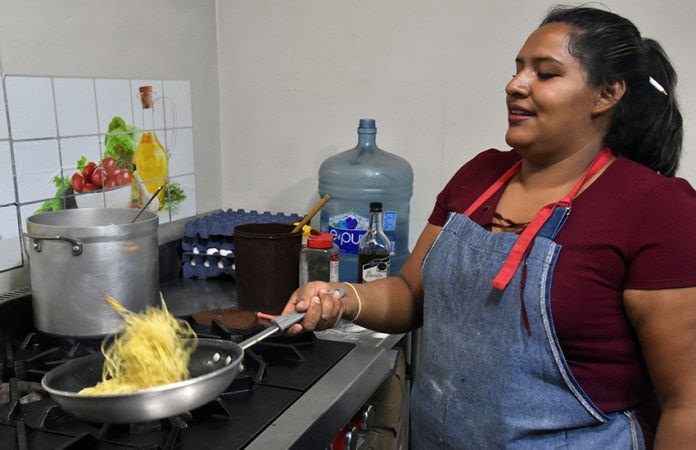
Dulce María Tecuapetla, chef at Il Canton de Italiano restaurant, cooks up some pasta. all photos by Joseph Sorrentino
When 38 families from the Veneto region in northern Italy arrived in Mexico in October 1882, eventually settling in Chipilo, Puebla, they brought with them their language, traditions and, of course, their recipes.
While chipileños, as they’re called, have held tightly to their language and traditions, many of their recipes have changed, incorporating foods and spices found in Mexico. In some cases, chefs have invented completely new dishes that mix the two cuisines.
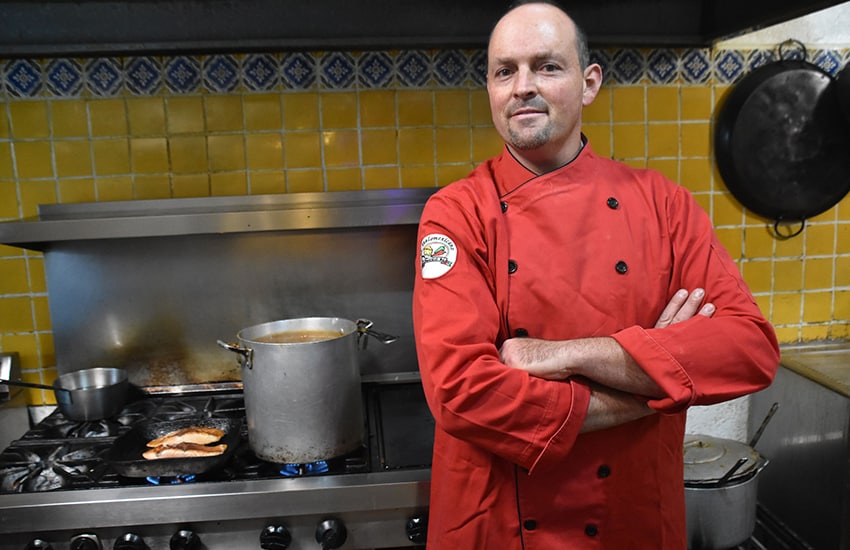
Leonardo Stefanoni Mazzocco studied at Maria Reyna Gastronomía, a culinary school in Puebla, and opened Restaurante El ItaloMexicano in May 2002 on the highway that skirts Chipilo.
“Mexican and Italian foods mix well together,” he said.
Although spicy foods are well accepted in Chipilo, he’s had to make some changes.
Salvador Gutiérrez, owner of Bella Pizza.
“We use garlic, but less because Mexicans aren’t accustomed to it.”
There are a lot of options on his menu that show his ability to meld the two cuisines. There’s a dish called Conejo Chipileño (Chipileño Rabbit) that has jalapeños, a variety of herbs and, he said, “an excess of pepper, which is an Italian touch. It mixes well with the chiles.”
As expected of an Italian restaurant, there are plenty of pasta dishes on the menu. And while some are solely Italian in flavor, there are a number that combine the two cuisines. For example, there’s fettuccini with mole poblano and a pasta enojada, which is penne pasta in a tomato sauce that’s made with chiles, giving it a serious kick.
An interesting option is Plato ItaloMexicano: a generous plate of three pastas that honors the Mexican and Italian flags with their identical colors: penne with salsa enojada (red); gnocchi in a cream sauce (white) and spaghetti with pesto (green).
His salads are a mix of Italian lettuces — like radicchio and arugula — and Mexican ones like romaine. “It is a mix of the sweet with the bitter,” he said, “so that the salad is not so strong.”
There’s also a salad made from darichi (dandelion) that’s popular in northern Italy. “We modify it by adding bacon,” Mazzocco explained, “because Mexicans aren’t used to it.”
El ItaloMexicano Restaurant’s pasta dish pays tribute to the three colors in both the Mexican and Italian flags: red, green and white.
Stefanoni’s is not the only restaurant featuring a melding of the two countries’ cuisines. Chipilo’s main street is lined with restaurants that showcase their own take on Italian-Mexican cooking.
There’s Il Canton de Italiano, owned by Paolo Solimón, who moved to Chipilo from Vicenza, Italy, in 2002. He missed Italian food, so although he had no formal training, he opened the restaurant in 2008.
“I learned how to cook from my grandparents, from my nonna,” he said. “They are the best to learn from.”
His Pizza Mexicano is a local twist on the traditional, featuring jalapeño, beans, avocado and crema, akin to sour cream. Solimón suggested Pasta Ajo as the best example of a pasta that mixes Mexican and Italian flavors. It’s a pasta dish that Dulce María Tecuapetla, who’s been the restaurant’s cook for 10 years, makes by frying up a generous helping of garlic and red chile. Eat a plate of that and you won’t worry about vampires for a few days.
Although he uses Mexican herbs in many of his dishes, Solimón draws the line at cilantro and epazote. “They do not mix well with Italian food,” he said.
Just up the street from Solimón’s restaurant is Bella Pizza, which has been managed by Salvador Gutiérrez for 10 years. He learned how to make pizza in Los Angeles and brought his skills to Chipilo, where he makes a pizza that has satisfied my desire for a real New York-style slice: thin crust, lots of cheese and a delicate layer of oil floating on top of it all.
Leonardo Stefanoni Mazzocco, owner of El ItaloMexicano Restaurant.
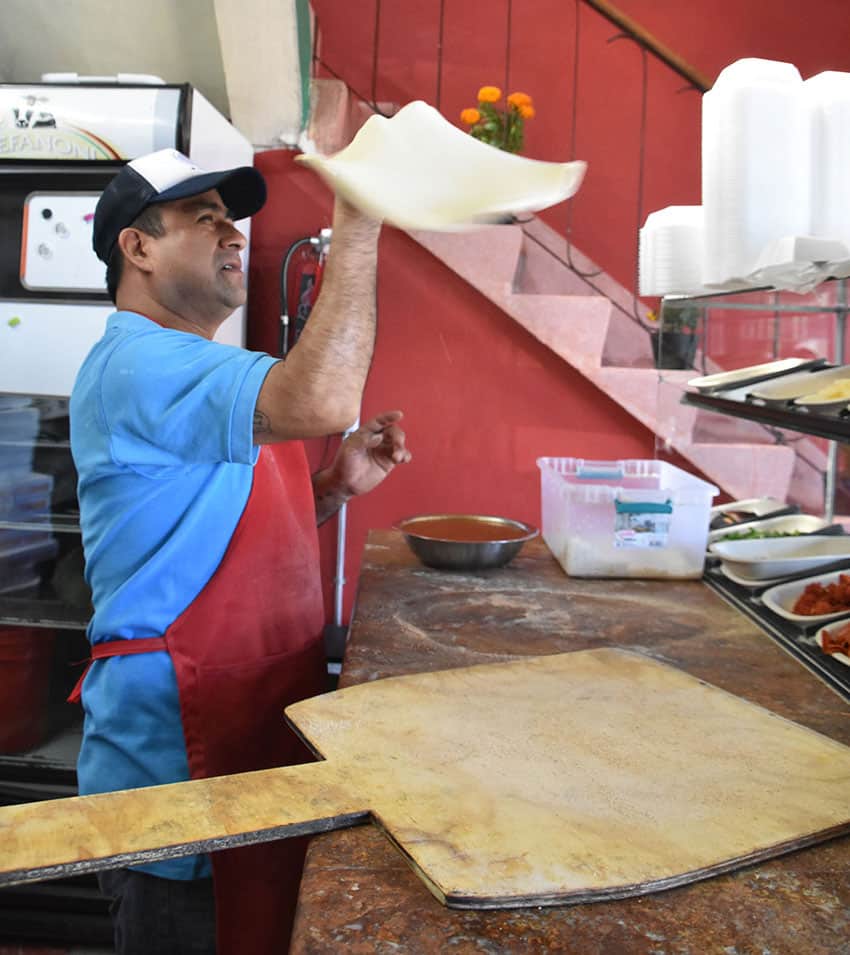
He starts his pizza by first stretching the dough on the counter and then tossing it in the air several times. “I do this for two reasons,” he explained. “First, it is an exhibition. Children really like it. Second, the dough is hard to stretch, and tossing it makes it easier.”
“It’s traditional pizza made in a wood oven,” he said. “We always use wood because it gives the pizza a better flavor; it cooks more consistently. We make it with local cheeses — all Chipileño cheeses — and Italian sauce. But we add jalapeños … habaneros, squash and chorizo, so now it’s a Mexican pizza.”
He doesn’t use avocados, which are a staple on many traditional Mexican pizzas, saying that they can turn black. Like Solimón, he avoids cilantro and epazote. On Tuesdays and Thursdays, the pizza’s twice as good because, amazingly, it’s two pizzas for the price of one.
A favorite stop for breakfast is Buon Giorno, owned and operated by Karina Stefanoni for eight years. “The recipes are from my family,” she said. “My influences are my mother and grandmother, who came from Italy.”
Surprisingly, despite their influence, she doesn’t use basil in any of her dishes, simply saying, “It does not go well.” But, unlike Gutiérrez and Solimón, she does use cilantro and epazote, especially in her salsas, which she said are spicy. “The food is picante, which Italians normally do not use,” she continued.
Her Huevos a la Italiana mixes Italian prosciutto and arugula with Mexican salsa and crema. It all sits atop a slice of bread. “The bread is a recipe from my grandmother and great-grandmother,” she said.
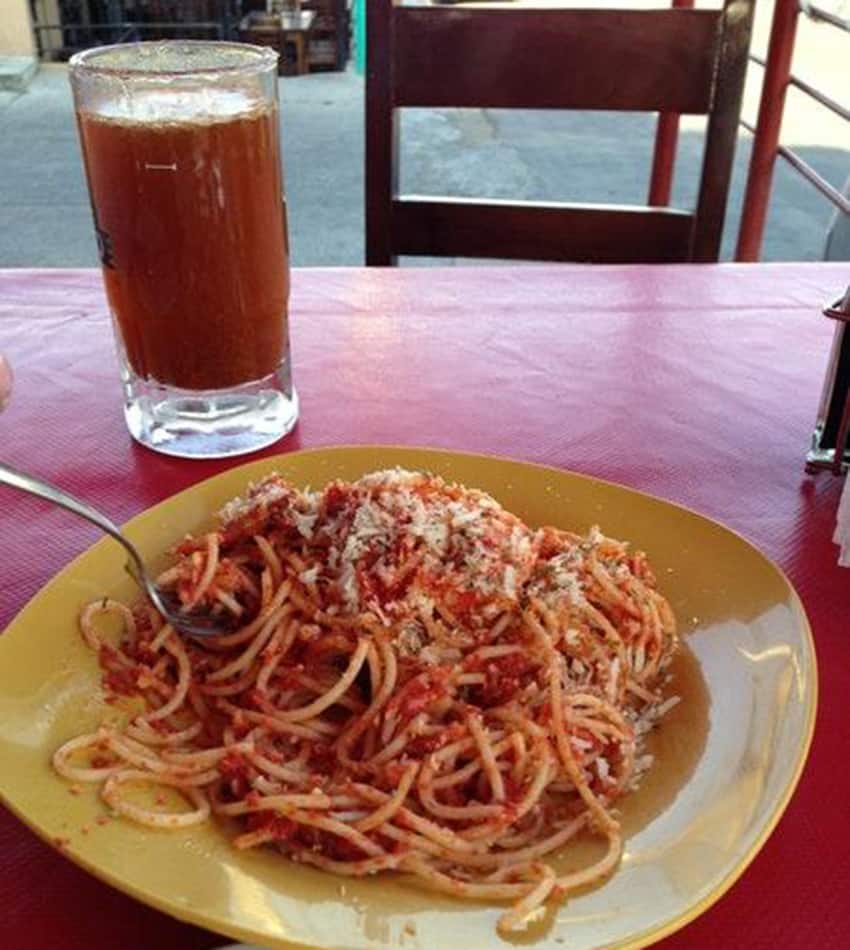
At Il Canton de Italiano, you can get a traditional Italian pasta accompanied by a cold Mexican beer.
The menu is also filled with traditional Mexican offerings. “Chilaquiles are one of the specialties asked for a lot,” she said.
Her chilaquiles are baked (or stale) tortilla strips smothered with salsa and crema and topped with avocado. “We have used the same recipe for eight years, one from my mother, who learned it from her mother, who is Italian.”
The salsa is a little milder than typically found in Mexican restaurants, probably due to her grandmother’s influence.
One particularly interesting item is Huarache Nopalero. It’s a nopal pad on top of refried beans and covered with salsa, panela cheese and crema. “It is a recipe my nonna used,” Stefanoni said. “They started making it when they came to Chipilo.”
Chipilo has many restaurants and pizzerias to choose from. Most are located along its main street, but there also are several on the highway that runs alongside the pueblo. The small restaurants, called fondas, are strictly Mexican, but the larger ones are all Italian Mexican.
Some are more Mexican, others more Italian. Trying them all to find the one with the right balance for your own palate is part of the fun.
President López Obrador has repeatedly pledged to eliminate government corruption, but his administration has dragged its feet in investigating extortion allegations against a high-ranking official.
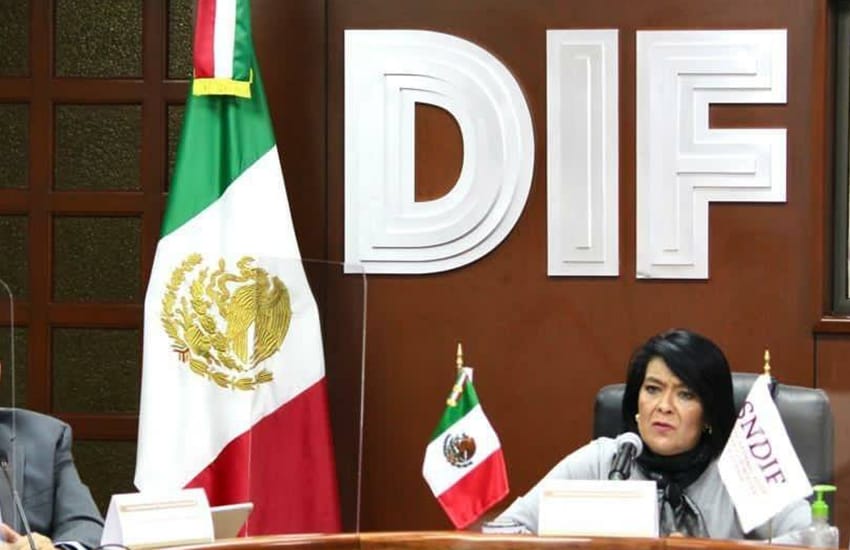
The national director of the DIF family services agency, an ally of the president, is accused of leading an elaborate extortion scheme at the department she heads.
María del Rocío García Pérez and two other high-ranking DIF officials forced more than 1,000 employees to give them 2–4% of their monthly salaries, according to a report by the news website Animal Político, which obtained complaints filed by employees and collected testimonies from six past and present workers.
García allegedly told the employees that making the payments, which ranged from 500 to 2,500 pesos (US $25-$125) per month, was a condition for maintaining their jobs at the agency. She and the other officials who allegedly participated in the extortion scheme could have received as much as 658,400 pesos (US $32,500) a month from 1,002 employees, Animal Político said.
The news website reported that the Ministry of Public Administration (SFP) — which serves as the government’s internal corruption watchdog — only opened an investigation into the allegations on April 23, even though it first received complaints against García last July.
García, center, at a 2019 DIF event with the president’s wife, Beatriz Gutiérrez Mueller. From Twitter
The SFP was asked why it took so long to open an investigation but only responded that it couldn’t comment on an ongoing investigation.
Animal Político said the origins of the extortion scheme can be traced back to a meeting that took place less than four months into López Obrador’s six-year term, which began in December 2018. Senior DIF officials were invited to meet with García, who was in a federal government position for the first time, having been appointed by the president, for whom she worked when he was mayor of Mexico City between 2000 and 2005.
The senior officials, who were asked not to take their phones to the meeting, were allegedly told by García that DIF had expenses that were not covered by its budget and therefore they and other employees would have to reach into their own pockets and make cash contributions.
The money, they were told, would go to the Programa Ahijado, or Godson Program, of which there is no official record. García allegedly told the senior officials that they would have to collect and pass on cash payments from their inferiors.
The officials were allegedly given a printout of the rates DIF employees were required to pay depending on their position at the agency. Animal Político said three DIF employees included the printout in their testimonies.
In one complaint submitted to the SFP, a DIF employee said the money contributed to the Godson Program was deposited to debit cards that can be purchased at convenience stores or to accounts belonging to García’s children or other relatives. DIF employees don’t know how the money was used, Animal Político said, although on one occasion they were told their contributions would go to victims of Hurricane Eta.
According to María del Rocío García Pérez, neither the federal government nor the Ministry of Public Administration has asked her to tell her side of the story.
All of the testimonies collected state that García used her apparent longstanding friendship with López Obrador and his wife to intimidate employees.
“… Rocío García reiterates at every opportunity her close friendship with President Andrés Manuel Lopez Obrador and his wife, Beatriz Gutiérrez Müller, [from when] he was mayor,” Animal Político said.
According to employees’ testimonies, she used that apparent closeness to claim that she was “untouchable” — that is, she could act as she wished without consequence. García allegedly claimed that all her decisions and proposals were endorsed by Gutiérrez and that “nobody wants problems with the wife of the president.”
García, a sociology graduate who earns about 144,000 pesos (US $7,100) a month in wages and benefits, has never previously headed up a company or government department, and none of her work experience has been related to children and adolescents, with whom DIF routinely deals.
Animal Político requested an interview with the DIF chief about the accusations she faces but was denied that opportunity. García did, however, send a statement to the website saying that she was not aware of any investigation against her, suggesting that neither the SFP nor any other federal government department has summoned her to give an account of her side of the story.
The highly modern designs for the new Mexico City airport, which was canceled in 2018 after construction had already begun. FR-EE AND FOSTER + PARTNERS
In the “before-times” I frequently flew home to Texas for visits with my family and friends there. Though the Veracruz airport is closer to me, it’s much smaller, and I usually found better deals out of the Mexico City airport.
So, I would simply take a bus to the capital and fly out. It’s about a 4 1/2-hour ride, but the buses are nice (with bathrooms!), and my distracted brain was pretty much made for staring out the window and listening to music for hours on end.
I’ve probably flown in and out of the Mexico City airport at least 100 times and you’d think I’d have a handle on the layout by now.
But no! I pretty much get lost or at least turned around every time.
Part of the issue is a lack of signs. Some signs are clear and logical, as they should be, while others are simply absent. Also, if there’s an arrow pointing up, does that mean I go straight or that I go up the escalators right by me?
I usually walk up and down the ground floor of Terminal 1 several times before I figure out where I’m supposed to go for ticketing. Every time I’ve picked someone up, I’m invariably at the wrong gate.
Knowing whether I’m leaving from Terminal 1 or the relatively new Terminal 2 is also usually a mystery that I have to go to great length to figure out. Many airlines have check-in desks at both terminals, and while most international flights leave Terminal 2, they don’t always.
It’s an adventure before the real adventure gets started, and I make a point of getting there early so that I can be ready for whatever new obstacle is thrown at me. Usually, it’s simply a matter of having to take the fun speedy train thing to the other terminal (which you can only do if you have your ticket in hand; what happens if you’ve gone to pick someone up and you’re at the wrong terminal, I wonder).
Other times, it’s the challenge of finding the tiny Autobuses de Oriente (ADO) ticketing agent tucked away in some far-off corner that is kilometers from where you actually board the bus and then finding the actual terminal from which the buses leave. The long skywalk to the terminal is mysteriously without any signage at all, and there are two skywalks not too far away from each other whose entrances are identical.
When I arrive, I usually ask myself how the other people there managed to find it. I suppose they just asked someone like I always have to do.
Buses don’t leave from there to Xalapa very often, however, so about 50% of the time, I walk the approximately half mile back to Gate 5 (or was it 6? … 7, maybe?) to buy a card for the Metro Bus, which is very nice and very cheap but also very hard to figure out. Without knowing exactly how much it will cost — why put a list of prices to common destinations? — I put about 100 pesos on the card, which up to now has always been enough.
Then I go outside and stand in line, waiting for said Metro Bus (it’s like a fancy trolley — it gets its own lane!). Several come; it’s not always clear which one I need to be on, though, so I ask each driver.
It’s all a very complicated process, especially with heavy luggage and sometimes a child in tow. Rather than feeling frustrated, however, I feel proud of my ability to have once again navigated that labyrinth.
I wonder, though: what do people who need to move around like this do, especially if they don’t speak Spanish? And even if you do speak Spanish, there are just so many little things you need to know … like what the Metro Bus even is, for example.
But all that being said, the Metro Bus is great — a big, clean, trolley that goes around certain key parts of Mexico City speedily. It was instituted by President López Obrador when he was the mayor of Mexico City.
During the last presidential race, I’d often bring up the Metro Bus as a fantastic example of what good, logical government can do. In addition to it being fast, clean and inexpensive, it has cameras on each unit as well as a security officer who will usually help you with your bags if you have many. The stops themselves are also beautiful and orderly.
I never would have guessed that that same person responsible for that wonder of posh infrastructure would later be responsible for canceling the beautiful new airport I’d been so looking forward to using.
As you might have read, the never-to-be airport just won an international architectural prize (the organizers apparently hadn’t realized that the project had been canceled). Our president, however, made a show of how unimpressed he was by the award and called the cancellation “the best public business we’ve done.”
This puzzles me because I don’t quite understand what his definition of “to do business” is. Is the cancellation of something not literally the opposite of “doing business”?
Much of his argument was that the new airport was over budget. Fair enough. But was there truly not a way to simply audit the expenses and look for ways to safely reduce additional costs? Was tossing the whole project really necessary?
Still on the table, of course, and pushing forward despite several distinct objections from various environmental and local groups, is the Maya Train project. I’ll say one thing for the president: he really sticks to his decisions once they’re made.
In the meantime, I guess we’ll all just keep wandering laps around the Mexico City airport, hoping to get to our flights on time.
It’s no sparkling, award-winning architectural marvel, but at least it’s got coffee shops everywhere.
Sarah DeVries is a writer and translator based in Xalapa, Veracruz. She can be reached through her website, sdevrieswritingandtranslating.com.
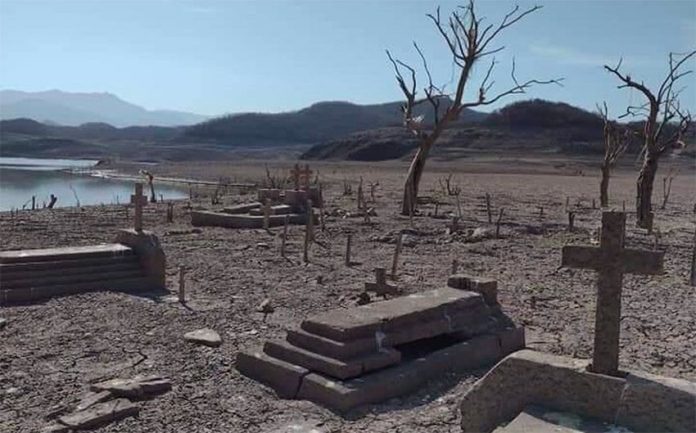
The cemetery was submerged by the Bacurato reservoir.
A cemetery that was submerged by the construction of a dam has reappeared from the depths of a reservoir in Sinaloa due to severe drought.
The graves at the Terahuito cemetery were submerged when the Bacurato reservoir, known officially as Gustavo Díaz Ordaz reservoir, was built in the 1980s.
One of the largest in the state, the reservoir is at only 11.2% of its capacity, according to a report by released Monday by the National Water Commission.
Fisherman and tour guide Félix Pérez Castro shared photographs and a video on social media which quickly garnered attention.
The images show a desolate landscape with dispersed tombs and crosses where past generations of the town were buried.
The mayor of nearby Sinaloa de Leyva, María Beatriz León Rubio, visited the reservoir to see the effect of the drought. “It is sad news. Look how the the water level in the reservoir is going down, being pulled down by the drought that we are seeing in the whole municipality,” she said.
“Faith is the bigger than any other thing, and we hope to God that the rains will arrive very soon and that we can once again see the richness of the Bacurato reservoir which a lot of families benefit from,” she added.
Terahuito’s community was was relocated to the municipality of Guasave when the reservoir was built.
Bacurato is used for sport fishing sea bass and the the commercial fishing of tilapia.
The family of 12-year-old Brandon Giovanny Hernández, who died in the crash, comfort each other outside forensic offices in Iztapalapa.
The newest line of the Mexico City subway system, the scene of a shocking train crash on Monday night that claimed the lives of at least 25 people and injured about 80 others, has been plagued by problems since it opened in 2012.
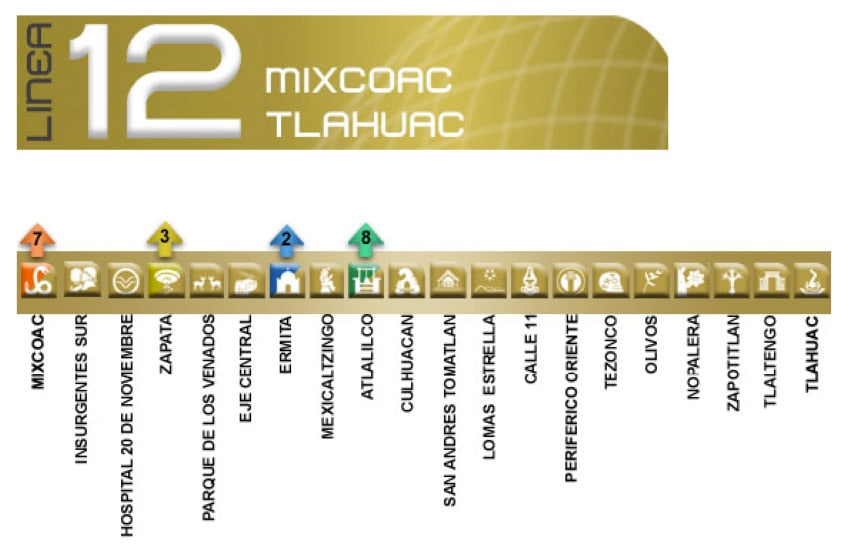
An elevated section of the Metro’s Line 12, also known as the Golden Line, collapsed at 10.22 p.m. Monday, causing two train carriages to plunge onto a busy road in the capital’s southeast. Firefighters and other rescue workers labored for hours to free trapped passengers, more than 20 of whom died at the scene.
The death toll from the crash, the worst ever on the 52-year-old transportation system, rose to 25 late on Tuesday. The victims, 21 males and four females, range in age from 12 to 76.
Monday night’s tragedy was caused by the collapse of a girder on the elevated section of the Metro near the Olivos station, according to Mayor Claudia Sheinbaum. She told a news conference Tuesday that the collapse appeared to indicate a structural failure.
Sheinbaum also said that the entire Golden Line, built when Foreign Minister Marcelo Ebrard was mayor between 2006 and 2012, had been inspected last year with no major problems detected. She also said there is daily maintenance on the line.
Authorities remove the final car of the derailed Line 12 train on Tuesday afternoon, a process that began at 5 a.m.
Public Works Minister Jesús Antonio Esteva said that the structural collapse was not the result of a defect that had worsened over time. The Metro system and the government “never had information” about “growing damage,” he said.
A Norwegian company will conduct an independent investigation into the crash and the state of the entire line, which runs between Mixcoac in Mexico City’s southwest and Tláhuac in the southeast. The federal Attorney General’s Office and its Mexico City counterpart will also conduct probes into the incident.
“The promise that I am making to the Metro users, to the citizens, is to get to the bottom of this terrible incident,” Sheinbaum said.
The 26-billion-peso (about US $2 billion at the 2012 exchange rate) Golden Line, used by about 220,000 passengers per day, opened amid fanfare in late 2012 with officials touting that it would drastically reduce travel time for residents of outlying neighborhoods of the capital. But problems quickly emerged.
According to media reports, there were 60 mechanical failures on trains or tracks during the line’s first month of operation. Engineers warned of the potential for derailments, and trains were consequently required to reduce their speed on the elevated section of the line.
In an interview with the newspaper El Universal, Fernando Espino Arévalo, the head of the Metro workers union, said a range of problems, including vibrating support columns on elevated sections of the track, have been reported to authorities since 2012. However, the union’s concerns were ignored, he said.
In a radio interview, Espino apportioned blame for Monday’s disaster to the French company TCO, which he said was responsible for maintaining the line.
“We are constantly insisting that maintenance be our responsibility,” he told Imagen Radio. “But, unfortunately, the authorities don’t listen to us and don’t let us help. They get rid of the best technicians that we have because [the technicians] don’t agree with what the administration demands.”
In 2014, several of the Line 12 stations were closed for structural repairs, leaving about half the line — the elevated section — out of service for months. Government data shows that at least one support column was damaged in the powerful September 2017 earthquake that killed hundreds of people in Mexico City.
The column, located not far from where Monday’s crash occurred, was repaired. But people who live near the scene of the accident questioned the quality of the reconstruction, according to The New York Times.
Four residents told the news agency Reuters that they witnessed columns supporting elevated sections of the line shaking when trains passed over them.
“Every time I saw the train, I saw the columns and beams shake,” said Víctor Lara, who used Line 12 on a daily basis. “They’re not well-made.”
The accident occurred over Mexico City’s Tláhuac Avenue near Olivos station.
Some of the locals who spoke with Reuters recalled that there were warnings about soil in the area being unsuitable for major construction.
Built by a consortium of companies that included billionaire businessman Carlos Slim’s CCICSA, Mexican firm ICA and the Mexican division of France’s Alstom, the Golden Line — like many infrastructure projects in Mexico — has also been the subject of corruption allegations.
In 2018, federal senators with the Institutional Revolutionary Party (PRI) called on the Mexico City government to report to Congress about alleged irregularities in the funding to construct Line 12. The PRI lawmakers said in an official party document that the Golden Line was a “symbol of corruption and the misuse of public resources that prevailed during” Ebrard’s administration.
Jesús Urban, secretary-general of the Metro workers union, said Tuesday that structural damage at the point where Monday’s crash occurred was reported six months ago but authorities didn’t listen. He told the newspaper Milenio that work was subsequently carried out on the beam that collapsed but the maintenance done was not what was needed.
Urban said the Mexico City government, including the mayor’s office, was aware that maintenance was a problem. It spent 780 million pesos on Line 12 in the past five years and 1.1 billion pesos on repairs in 2014, according to the newspaper Reforma, but was ultimately unable to ensure its safety. In addition, the Metro system was without a director of infrastructure maintenance for a year before Mayor Sheinbaum filled the position last week.
Héctor Homero Zavala, another representative of the Metro union, said Monday’s tragedy could have been averted if the government had heeded the warnings it received.
“If us workers were really listened to by this administration, a lot of problems would be avoided,” he said.
“… The Mexico City government must understand that the entire [Metro] system is at risk at the moment, mainly Lines B, 5 and 9, where an even greater tragedy could occur,” Zavala said.
Many of the Golden Line problems, concentrated on its elevated section, could perhaps have been avoided if the entire line had been built underground, as was originally planned. In a 2015 report, a Mexico City Congress committee lamented the decision to make part of the line elevated rather than subterranean, an apparent cost-cutting measure.
“The modification of the basic engineering of the project resulted in a chain of problems,” the report said.
President López Obrador, who declared three days of national mourning for the victims of the disaster, said Tuesday the investigation into the crash should be completed quickly and that nothing should be hidden. He pledged at his regular news conference that there will be “no impunity for anyone.”
Ebrard said he will cooperate fully with the investigation and that he had nothing to hide or fear, although critics accused him of rushing to complete construction of the Golden Line while he remained mayor in order to add the project to his political legacy.
Marcelo Ebrard, left, opening Line 12 in 2012 with then-president Felipe Calderón, right, and one of Line 12’s builders, Carlos Slim, back left, when Ebrard was mayor.
“Like anyone else, I am subject to whatever the authorities determine, but even more so as a high-level official, as someone who promoted the construction of the line,” he said.
The foreign minister’s office released a statement saying that Line 12 is the “most audited” infrastructure project in the history of the country. No reports on inspections of the line mentioned problems with beams or the structural integrity of the elevated section, the statement said.
Metro director-general Florencia Serranía, appointed to the position in 2018, said Tuesday that she would not resign as a result of the latest — and deadliest — incident.
“I will continue working and cooperate however I can to determine the structural damage,” she said.
Mayor Sheinbaum expressed her support for the Metro chief and declared, “We are not covering for anyone — the question here is, who is responsible?”
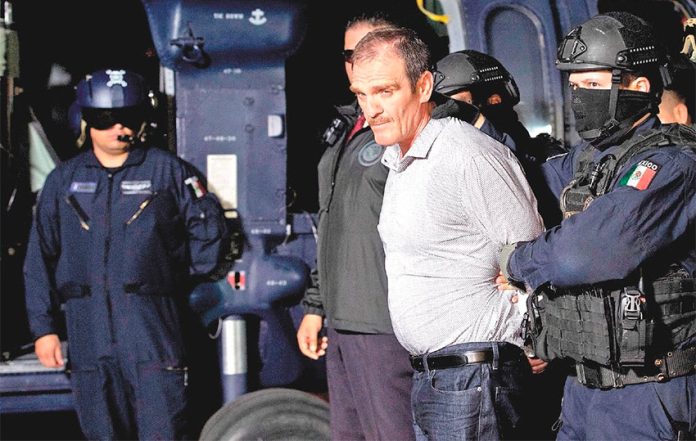
Héctor Luis Palma, seen during his deportation to Mexico in 2016, was an early contemporary of El Chapo Guzmán.
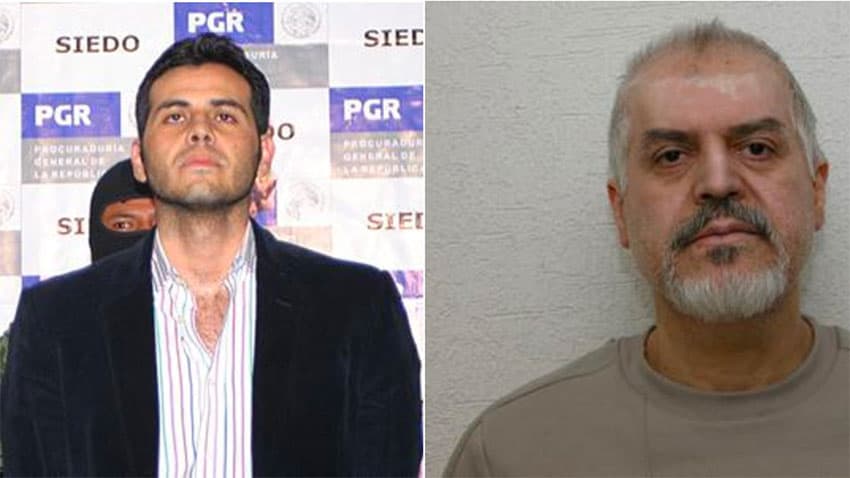
Three high-profile drug traffickers are in the process of being released from jail in the United States and Mexico, which analysts fear could inflame territorial disputes and trigger more violence.
Vicente Zambada Niebla, 46, and Eduardo Arellano Félix, 64, are being released from U.S. penitentiaries while Héctor Luis Palma Salazar, 80, was acquitted of his only standing charge last weekend as Mexico’s Attorney General’s Office could not prove he still had links to drug trafficking. The government has requested 48 hours to search for any pending charges.
Security experts said the release of the front-line drug traffickers could lead to acts of retribution, unsettling territorial borders and organizational hierarchies.
Manelich Castilla, a security consultant and former chief of the now-disbanded federal police, predicts internal struggles. “Rearrangements could be coming, disputes over territories and businesses that they claim as their own,” he said.
He warned that the violence between the Jalisco New Generation Cartel and the Sinaloa Cartel could intensify.
Vicente Zambada of the Sinaloa Cartel, left, and Eduardo Arellano of the Tijuana Cartel.
Francisco Rivas, director of the National Citizens’ Observatory (ONC), said the government should deploy more federal forces in the areas with the largest cartel operations.
“Problems between criminal groups become exacerbated and retaliation is carried out … The attacks are starting … [the government] should pay attention and move federal forces to areas that we know are under the operation and control of these groups,” he said.
Héctor Luis Palma Salazar, an early leader of the Sinaloa Cartel, was imprisoned in Jalisco 1995 and extradited to the United States in 2007 on drug trafficking charges. He was convicted and and jailed until 2016 when he was released and returned to Mexico where he was charged with the 1995 double homicide of two police officers.
Palma spent the next five years awaiting trial. After his acquittal last weekend he was released from prison this week only to be rearrested while justice officials search for outstanding charges. Salazar claims he is being illegally deprived of his liberty.
Vicente Zambada Niebla, also of the Sinaloa Cartel, was released by U.S. authorities as a collaborating witness to testify against other drug traffickers. In February 2020, his uncle Jesús “El Rey” Zambada was also freed to act as a witness against Joaquín “El Chapo” Guzmán.
Eduardo Arellano Félix, of the Arellano Félix family cartel (CAF), also known as the Tijuana Cartel, was released having served an almost full term, convicted on a lesser charge of money laundering. There are concerns that the Tijuana based CAF will attempt to reclaim territory lost to the Sinaloa Cartel in his absence.
Despite Covid-19, worshippers of the outlaw saint Jesús Malverde flocked to his chapel in Culiacán, Sinaloa, to pay their respects.
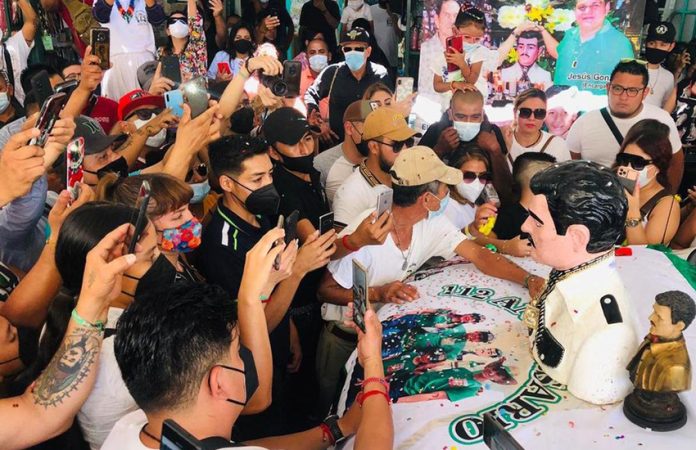
Thousands of devotees of Jesús Malverde – “the narco-saint” – flocked to his chapel in Culiacán, Sinaloa, on Monday to pay their respects on the 112th anniversary of his death.
Banda sinaloense musicians played as people filed into the chapel one by one to leave candles, flower bouquets, alcoholic beverages and other offerings to Malverde, a Robin Hood-type figure who is believed to have lived between 1870 and 1909, although his existence is not historically verified.
Whether he existed or not, Malverde — also known as “the generous bandit” — has countless followers not only in Sinaloa, a state notorious for its drug traffickers such as Joaquín “El Chapo” Guzmán and Rafael Caro Quintero, but also in many other parts of Mexico and beyond.
Jesús Manuel González Sánchez, son of the founder of the chapel and the current administrator, told the news website Debate that people began arriving early Monday morning even though it had been announced that there would be no celebrations due to the coronavirus pandemic.
However, the chapel management relented, bringing out a bust of Malverde for the admiring masses and allowing eight bands to liven up festivities at the chapel, located just outside Culiacán’s downtown area.
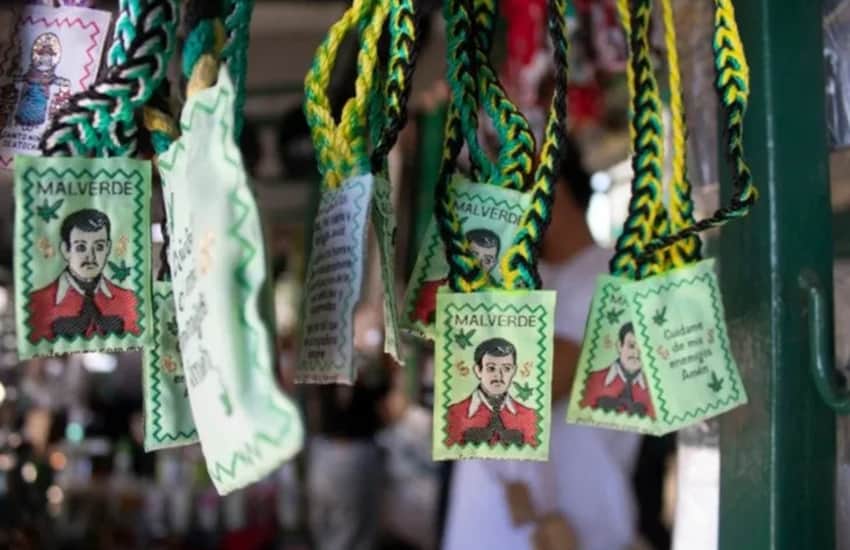
Malverde amulets on sale at his Culiacán chapel.
Compared to previous years, fewer people arrived to pay their respects to the “the narco-saint,” but devotees nevertheless numbered more than 3,000.
“The truth is that because of Covid-19, we thought that not so many people would come, but they have a lot of faith. … They come to thank [Jesús Malverde] and leave their candles,” González said.
Many people arrived to thank Malverde for what they believe are miracles granted by “the angel of the poor,” another nickname for the saint.
One man, Juan Ignacio, has been going to the chapel for 25 years to thank Jesús Malverde for helping his son to walk again after he was paralyzed as the result of a seizure. He said that he and his family prayed to the saint and, “thanks to Malverde, he now walks.”
María Luisa Alvarado Valdés, a long-term Valverde adherent whose son was unable to walk for seven months after being hit by a car, related a similar story. She claimed that Malverde not only helped her son to walk again but also blessed him with a family of his own.
Karla Celeste Robledo traveled from Orlando, Florida, to pay her respects. She said she has written a corrido, or ballad, about “the narco-saint” called la Reyna de Sinaloa (The Queen of Sinaloa).
“… I left Sinaloa when I was very young. I just bought my first statue [of Malverde]. … It’s not something bad [to be a devotee of him],” she told the newspaper Milenio.
According to the mythology of Malverde’s biography, the man who would go on to become a much-loved folk saint suffered poverty and many other injustices in his childhood. Consequently, as an outlaw in his adult life, he robbed landowners and wealthy families and used the proceeds of his crimes to help the poor.
His status as “a criminal with a heart” has won him legions of devotees, at least some of whom are involved, or have been involved, in illegal activities such as drug trafficking.
The new North American free trade agreement is supposed to guarantee workers’ right to choose the union they want to represent them.
But some workers at an auto sector factory in Matamoros, Tamaulipas, have found that freeing themselves of the shackles of their current union is no easy feat.
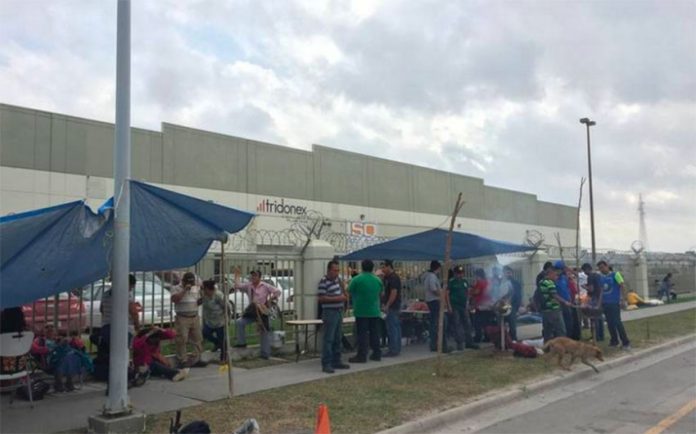
After their union, SITPME, didn’t support their fight for higher wages in 2019, a significant number of workers at the Tridonex auto-parts plant decided that they wanted to be represented by a new organization led by Susana Prieto, an activist and attorney.
According to the news agency Reuters, about 400 Tridonex reporters protested outside a labor court in Matamoros last year to be allowed to change unions. The United States-Mexico-Canada Agreement (USMCA), which took effect last July, enshrines workers’ rights to choose which union manages their collective contract.
But the Tridonex workers who no longer want to be represented by SITPME haven’t managed to switch to Prieto’s union, although their employer earlier this year consented to their decision to stop paying dues to the former.
“Dismantling the power of Mexico’s entrenched unions is proving a tough challenge,” Reuters said, quoting labor activists.
“… Amid resistance from SITPME, the Tridonex workers’ request to be represented by Prieto’s union has still not been put to a vote,” the news agency said.
It added that legal challenges by Prieto to replace the unions at 45 other factories in the Matamoros area have “stalled.”
According to Prieto, many Tridonex workers who wanted to leave SITPME are no longer employed at the Matamoros factory, where second-hand car parts are refitted for sale in the United States and Canada. She told Reuters that 600 of her supporters were dismissed between April and October of 2020.
The news agency said it could not independently verify the claim, although it did confirm that more than 700 Tridomex workers were fired in that period last year.
It noted that Cardone Industries, the Philadelphia-based parent company of Tridonex, didn’t respond to a question about whether the termination of the workers was retaliation for their opposition to SITPME. However, Cardone did say that there were layoffs due to decreased demand associated with pandemic lockdowns.
SITPME’s longtime leader Jesús Mendoza said that workers’ claims that they were dismissed as retaliation were “lies.”
Reuters reported that some of the Matamoros workers who were unable to switch to Prieto’s union are now looking to the United States for support.
There is speculation that U.S. President Joe Biden will pressure Mexico to ensure that workers’s rights as set out in the USMCA are respected. The three-way pact, which replaced NAFTA, stipulates that companies that don’t allow workers to freely choose their union representation can be punished with tariffs or other penalties.
United States Trade Representative Katherine Tai said last week that she was not afraid to use USMCA enforcement provisions but didn’t specify which issues could be reviewed by the office she heads.
In the meantime, Mexican workers in Matamoros and elsewhere who push to be represented by the union of their choice will likely continue to face the prospect of dismissal, as has occurred with many employees who have tried to stand up for their labor rights.
“They fire them; they suppress them. They stop giving extra hours. They don’t give bonuses. They change them to night shift,” said Federal Center of Conciliation and Labor Registration chief Alfredo Dominguez, referring to punishments routinely dished out to agitators by Mexican companies.
SITPME, meanwhile, told Reuters that it had won back the support of at least 3,000 people who had wanted to join Prieto’s breakaway union. Mendoza defended the union’s record, saying it has delivered benefits for its members while maintaining good relations with the companies that employ them.
The union leader also said that his modus operandi is to seek dialogue with company executives to resolve labor issues rather than call for strikes.
“What we do well is guarantee labor peace and efficiency in the workforce,” Mendoza said.