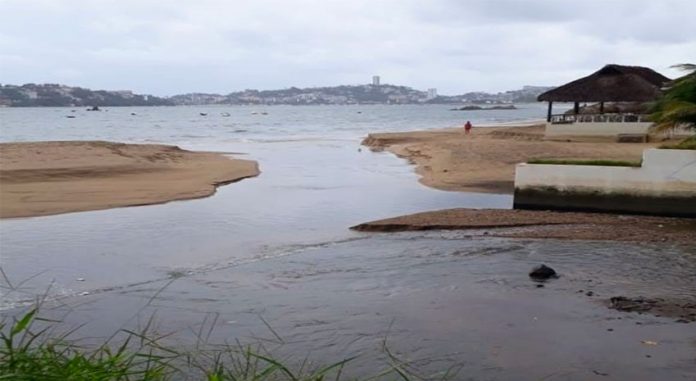
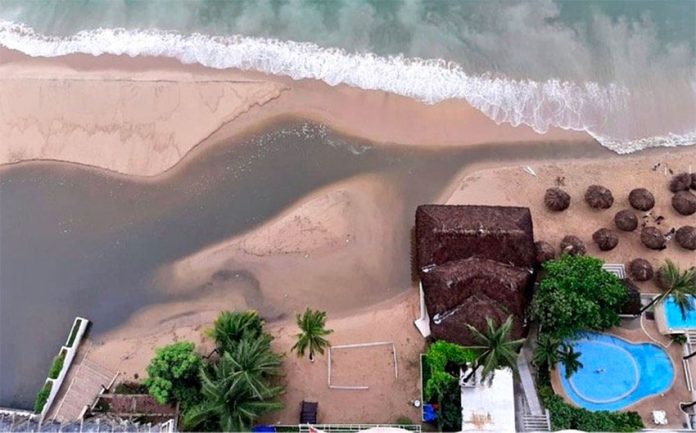
Despite photos uploaded to social media earlier this week showing a large black plume of water entering Acapulco’s Santa Lucia Bay, the National Water Commission (Conagua) declared there was no discharge of sewage.
The discolored torrent, photographed pouring into the sea alongside the Krystal Beach Hotel, was instead overflow caused by stagnant water backing up in the city’s storm drains due to recent heavy rains, Conagua found.
“It is presumed that the stagnant water was the result of a remnant generated by extraordinary runoff that occurred during the previous night in the area, and that when mixed with stagnant water inside the Magallanes drainage canal, it generated runoff,” Conagua said in a statement.
A widely publicized sewage leak in June resulted in a criminal complaint against the city’s water utility, Capama, for environmental damage. The leak also caused Icaco beach to lose its coveted Blue Flag designation for cleanliness, and the mayor demanded the resignation of five Capama directors and the city’s head of ecology due to the breach.
This week’s reported leak “did not present the same characteristics that were shown in images disseminated by different media. Additionally, no characteristic odors or colors of wastewater were perceived,” local Conagua representative Norma Arroyo Domínguez reported. No violation of the national water law was found.
Meanwhile, Acapulco Director of Ecology Juventino Herrera Juárez says his office is investigating 70 businesses that are suspected of clandestinely discharging their sewage into the sea. If evidence shows they are, there will be sanctions, Herrera said.
In the last month, 22 different sewage leaks due to failing infrastructure have been identified and repaired, and 15 sanctions have been levied for illegal sewage discharges in the past 10 months.
The city has long battled contamination of its beaches by illegally dumped wastewater, a reputation it is trying to shake as it courts tourism dollars in a struggling economy.
Capama says it is performing maintenance on its water system, including removing silt and other debris from clogged storm drains and rebuilding aging sewer pipes that have collapsed.
Last year, the Federal Commission for Protection Against Health Risks (Cofepris) briefly declared Manzanillo, Carabalí, Suave, Hornos and Caletilla beaches in Acapulco unfit for human use due to excess amounts of enterococci bacteria that is found in fecal matter.
Researchers at the Autonomous University of Hidalgo (UAEH) have developed various models of face masks with filters strengthened with extracts of the hibiscus flower.
The use of hibiscus, known as jamaica, as well as the mineral zeolite in one mask filter they developed allows it to stop up to 98% of particulate matter, said Javier Castro Rosas, a researcher at the UAEH Institute of Basic Sciences and Engineering.
He told the newspaper Milenio that the hibiscus/zeolite filter is superior to that in N95 surgical masks.
Castro said that researchers at UAEH have been working with hibiscus for 15 years and explained that it has a “significant antimicrobial effect.”
He added that they have been granted nine patents for disinfectants made with the flower. “With all that experience, we wanted to include hibiscus in face masks,” Castro said.
The researcher explained that hibiscus has at least six different substances with the capacity to destroy pathogenic bacteria.
“One is an acid called hibiscus acid that gives hibiscus its characteristic aroma, … this compound has been reported since the ’70s … but it wasn’t known that it has an effect against bacteria; we discovered it a couple of years ago and patented its use,” Castro said.
He and fellow researchers Esmeralda Rangel and Edgar Chávez used hibiscus in the filters designed for two everyday face masks. One is a disposable mask that will cost 20 to 25 pesos and the other is a washable cloth mask that will cost 50 pesos.
The hibiscus filters, which can be used for a week, will cost 10 pesos each but the price could go down if they are produced in higher quantities, Castro said.
“We’re not just putting jamaica [in the filters], it’s a mixture with other compounds such as vinegar. We’re taking advantage of the physicochemical properties of the material we’re using as a filter – it’s made of cellulose, … mixing this material with our formulation it becomes more rigid but it’s resistant and it causes particles to be stopped,” he said.
Up to 92% of particulates can be stopped by the hibiscus masks, the researchers found. They made another filter for medical-grade masks that uses both hibiscus and zeolite. It is even more effective at stopping potentially harmful pathogens.
“We’ve found that it has a greater [particulate] retention than N95 masks, … up to 98%,” Castro said.
“We haven’t worked with viruses but there are researchers in other parts of the world that have found that hibiscus has an antiviral effect. They’ve tried it against … hepatitis A, the measles virus, different types of human herpes viruses. A group of researchers even found recently … that it has an effect agains the influenza A H1N1 virus,” he said.
“Being there in the filter, the hibiscus has an effect against bacteria. Now we need to prove that it has an effect against the coronavirus.”
Many businesses have reopened but their incomes remain low.
Several well-known actors and entertainers have added their voices to calls for the government to provide a temporary basic income to people who have lost their jobs and livelihoods due to the coronavirus pandemic.
Actor Daniel Giménez Cacho, actress and soprano singer Susana Zabaleta and actress and comedian Mara Escalante are among the entertainers who appear in a video urging the government to pay an ingreso vital, or living income, to people struggling to survive.
Under the initiative, which is promoted by a group made up of more than 60 civil society groups called Citizens Action Against Poverty (ACFP) and supported by the Citizens Movement party, people who lost their jobs or income as a result of economic restrictions would be paid a minimum wage of about 3,700 pesos (US $167) per month for three months.
“We ask the government to adopt the decision now to create a basic emergency transfer and direct it without conditions to those who have been left without work,” Zabaleta says in the video.
Unemployed people who don’t already receive financial support from the government would be eligible.
Proponents of the ingreso vital say it will help to prevent millions of people from falling into poverty and allow more citizens to stay at home to slow the spread of the coronavirus.
According to the national statistics institute Inegi, more than 12.5 million Mexicans lost their jobs or saw their income dry up in the first half of the year.
Citizens Action Against Poverty last week presented the results of a survey that found that at least one in every three households across Mexico has seen their income drop by up to 50% as a result of the pandemic.
Just over 27% of those polled said that they and/or a member of their family had lost their jobs or source of income.
Although the economic situation improved for many in June when the economy began to reopen after a two-month-long national social distancing initiative, some 4.4 million people are still estimated to be jobless. As a result, millions of families continue to suffer from food insecurity.
The ACFP survey also found that more than 30% of respondents were suffering from severe depression and/or anxiety related to the pandemic even after restrictions began to be eased in the so-called “new normal” period. People of limited economic means suffered from the conditions at even higher rates, the poll found.
“People who don’t have sufficient income are forced to go out to work; that reduces unemployment but increases anxiety,” said Mauricio Merino, head of the organization Nosotrxs, one of the ACFP members.
He said the information gleaned from the survey shows that action is needed to reduce inequality. One of the ways to do that in the short term is to provide a basic living income to those who need it, he said.
Meanwhile, six months after the coronavirus was first detected here, Mexico continues to record thousands of new cases every day.
The Health Ministry reported 5,267 new cases on Wednesday, increasing Mexico’s accumulated tally to 573,888.
The last time fewer than 1,000 cases were reported on a single day was April 27 and the last time fewer than 2,000 were registered was May 13.
The Health Ministry also reported 626 additional Covid-19 fatalities on Wednesday, lifting the official death toll to 62,076.
More than 10,000 students are expected to apply for a free tablet.
In a single day, more than 5,000 students from low-income families in Hidalgo del Parral, Chihuahua, applied to receive free tablets provided by the municipal government in order to facilitate federally mandated distance learning due to the coronavirus pandemic.
The school year, which started on August 24, has been relegated to online or televised lessons, which makes getting an education complicated for thousands of students across Mexico who can’t afford the necessary equipment to keep up with their studies.
Many rural areas across the country don’t even have access to electricity, let alone an internet connection. Approximately 30% of Parral residents, some 35,000 people, live in extreme poverty, according to the Ministry of Social Development.
“We will not rest until our daughters and sons, who are our pride, have everything they need so that their education is guaranteed,” Mayor Alfredo Lozoya said. “We must make a great effort so that our children do not fall behind in their education. We parralenses will not fight at a disadvantage.”
The day after the municipal government opened the registration process on August 20, 5,483 students had applied, the mayor announced. The application process will close on September 4.
“These are very good quality electronic tablets with a powerful processor so that they can do their homework and follow their classes remotely,” Lozoya said.
The mayor hopes the program will help keep kids in school and has promised to deliver the tablets within 10 days. He also hopes to increase internet capacity in the area as bandwidth is likely to become saturated due to the surge in students accessing course material online.
According to projections, more than 10,000 students are expected to apply for the equipment in the coming days.
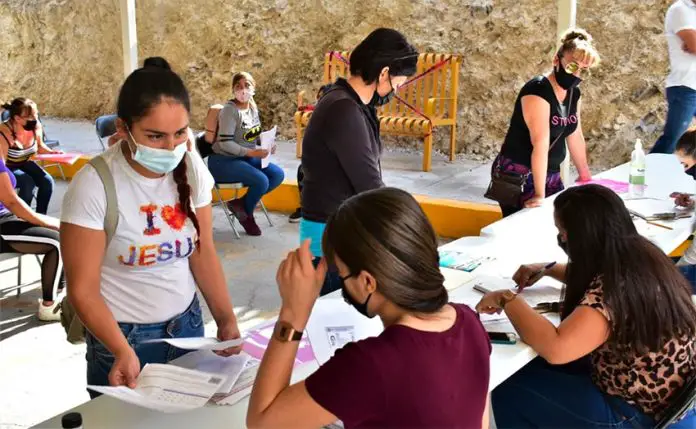
Applicants must fill out a registration form via WhatsApp or in person and are evaluated based on economic need.
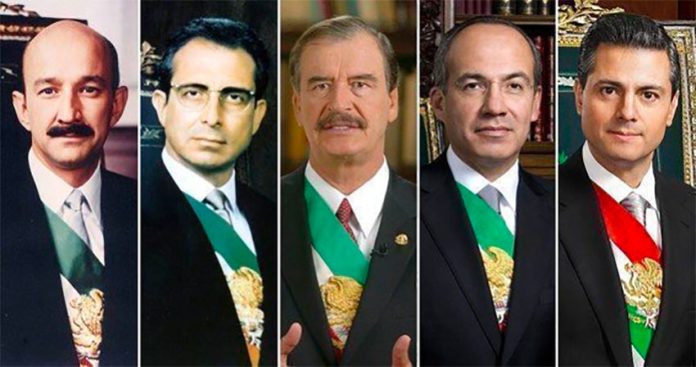
Ex-presidents Salinas, Zedillo, Fox, Calderón and Peña Nieto should face justice, say poll respondents.
An overwhelming majority of Mexicans believe that former presidents and other ex-officials who committed crimes while in office should face justice, according to a new opinion poll.
A telephone survey conducted by the newspaper El Universal this month found that 95.6% of respondents would like to see former presidents and officials brought to justice for crimes they allegedly committed.
Almost nine in 10 respondents – 89.4% – said that Enrique Peña Nieto, whose 2012-18 administration was plagued by corruption scandals, should face trial for alleged wrongdoings.
Former Pemex CEO Emilio Lozoya, currently awaiting trial on corruption charges, has told federal authorities that Peña Nieto and his finance minister, Luis Videgaray, led a bribery scheme that paid off opposition party lawmakers in exchange for support of the previous government’s structural reforms.
Lozoya has also accused former presidents Felipe Calderón and Carlos Salinas of involvement in corruption related to the payment of bribes by the Brazilian construction conglomerate Odebrecht.
The El Universal poll found that 88.5% of respondents think that Salinas, widely considered one of Mexico’s most corrupt presidents, should face trial while 82.1% said the same about Calderón.
President López Obrador claimed earlier this month that Mexico was a narco-state during Calderón’s 2006-12 administration given evidence that has emerged against his security minister Genaro García Luna, who is awaiting trial in the United States on charges he colluded with organized crime.
The poll also found that more than 70% of respondents believe that former presidents Vicente Fox and Ernesto Zedillo should face justice for alleged crimes.
Despite the strong support for the ex-presidents accused by Lozoya to be brought to justice, 53.9% of respondents said that the ex-Pemex chief is not telling the truth.
Almost 87% of those polled believe that he should serve prison time for the crimes he is accused of committing – accepting bribes from Odebrecht and benefiting from the state oil company’s 2015 purchase of a run-down fertilizer plan at an inflated price.
Only 7% of respondents said that he should be spared a prison sentence as a result of his agreement to cooperate with authorities.
The president has been accused of using the consultation proposal to win votes in the midterm elections.
Three-quarters of respondents said that the ruling Morena party, founded by Andrés Manuel López Obrador in 2014, should be sanctioned if it is proven that the payments constituted illegal funding of the party.
The president said last week he didn’t know whether the money, apparently used for Morena’s campaign at 2015 elections in Chiapas, was registered with authorities.
Speaking at a press conference in Torreón, Coahuila, on Wednesday, López Obrador reiterated his intention to hold a public consultation to decide whether former presidents should be put on trial for alleged corruption and other wrongdoings.
The president said that it will be up to the Supreme Court to decide whether such a consultation is permitted by the Mexican Constitution. But he claimed that it is.
“A consultation is provided for in the Constitution, it’s part of participatory democracy,” López Obrador said, adding that real democracy is not just about voting and then leaving everything up to politicians for the next three or six years.
“Fortunately, progress is being made in participatory democracy so that we can rule by obeying the people; it should always be the people who decide. … So in important matters, such as prosecuting an ex-president or not, all of us should participate,” he said.
The president said that if the Supreme Court rules that holding a consultation on the issue is constitutional, the National Electoral Institute will be in charge of arranging it.
López Obrador said that he would personally vote against prosecuting his predecessors because he favors looking to the future rather than the past.
“I don’t want people to think that I’m an executioner, revenge is not my strong point,” he explained.
Some lawmakers spoke out against the planned consultation, charging that one is not needed in order to prosecute past presidents. Indeed, the federal Attorney General’s Office has the power to investigate and prosecute past presidents if they receive complaints against them that they are able to substantiate.
Juan Carlos Romero Hicks, leader of the National Action Party in the lower house of Congress, said the purpose of the law is to be “applied,” not subjected to consultation. He described the president’s promotion of a public vote as a “smokescreen” to divert attention from his poor management of the coronavirus pandemic.
Manuel Añorve, a senator with the Institutional Revolutionary Party, agreed that the prosecution of former presidents does not require validation from a consultation.
Ex-presidents can be brought to justice using existing laws, he said, adding that it’s “obvious” that López Obrador’s consultation plan is an electoral strategy designed to win votes at the 2021 midterm elections.
Citizens Movement party Senator Juan Zepeda said much the same. “The president wants to have an issue that will pay off politically at the 2021 election in order to retain his majority in Congress,” he said.
According to the Constitution, consultations of national or regional importance can only be held on the first Sunday of August, meaning that a referendum asking citizens whether past presidents should be prosecuted could be held just two months after the midterm elections in early June 2021.
Criminal lawyer Juan Luis Gómez Jardón agreed with the lawmakers that a consultation is not necessary. Former presidents are regular citizens who can be prosecuted for crimes they committed just like any other person, he said.
“They don’t have immunity anymore. … There is no need to consult the people in order to comply with the law,” Gómez said.
“I don’t know what they intend to accuse the most recent ex-presidents of. Above all, who will file the complaint [if a consultation finds majority support to prosecute them]? The auditor’s office? [The tax agency] SAT?”
The president insinuated that Díaz, right, approved loan to Pemex.
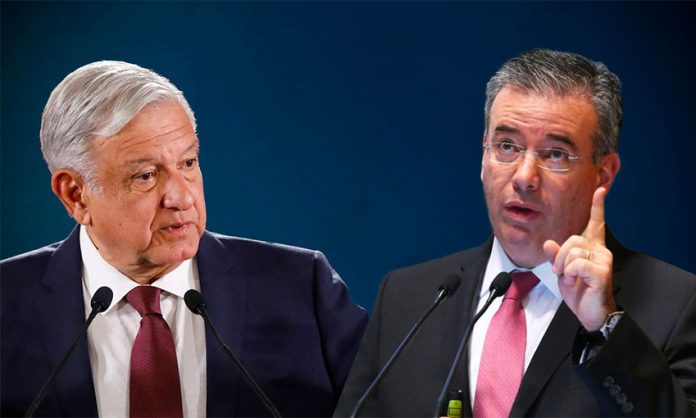
The governor of the central bank has rejected an insinuation by President López Obrador that he approved a suspicious, potentially corrupt loan while head of the state-owned development bank Bancomext.
López Obrador on Wednesday called for an investigation into loans that Bancomext and the development bank Nacional Financiera provided to Pemex during the previous government.
The president said the loans partly financed the state oil company’s US $635-million purchase in 2015 of a fertilizer plant in Lázaro Cárdenas, Michoacán. The Federal Auditor’s Office concluded last year that the price Pemex paid to the plant’s owner, Grupo Fertinal, was excessive.
López Obrador said the purchase was made when Bank of México (Banxico) Governor Alejandro Díaz de León was the director of Bancomext.
But Díaz said at a press conference on Wednesday that he wasn’t director of the development bank when the loan was approved in October 2015, pointing out that he joined Bancomext a month later.
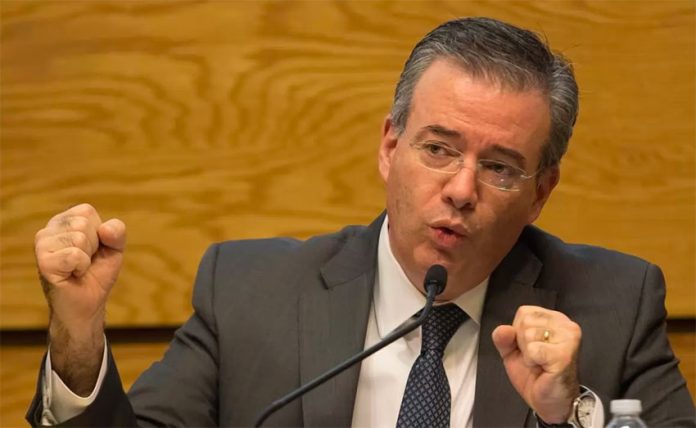
“Those are things that were approved by the Bancomext governing body prior to my arrival at that institution,” he said while presenting the central bank’s latest quarterly report.
Díaz told a Bloomberg reporter that he appreciated the question about López Obrador’s remarks “because it allows me to clarify this.”
Several leading financial figures also defended the Banxico chief, including Gerardo Esquivel, a member of the central bank board, who described Díaz’s explanation as a “very important clarification.”
Gerardo Rodríguez, a BlackRock portfolio manager and former deputy finance minister, wrote on Twitter, “In all of Mexico, you won’t find a more honorable official than the current governor of Banxico.”
Díaz’s predecessor at Bancomext was Enrique de la Madrid, who left the bank in August 2015 to take up the role of federal tourism minister.
López Obrador also mentioned his name when calling for an investigation into the Bancomext and Nacional Financiera loans.
The president rebuked former Pemex CEO Emilio Lozoya, currently awaiting trial on corruption charges, for not providing information about the purchase of the Fertinal plant in a document he submitted to the federal Attorney General’s Office (FGR) earlier this month.
Lozoya, extradited from Spain last month, has agreed to cooperate with authorities and has been afforded protected witness status.
In an August 11 submission to the FGR, he accused three ex-presidents as well as former government ministers and federal lawmakers of corruption, much of which was allegedly linked to the payment of bribes by Brazilian construction conglomerate Odebrecht.
López Obrador said Wednesday that it was “inexplicable” that Lozoya remained silent on the Fertinal plant purchase given the excessive price that was paid.
“They [Pemex] paid about 9 billion pesos. … Do you know who gave them the loans? The Nacional Financiera and the Exterior Commerce Bank [Bancomext],” he said.
López Obrador charged that the purchase of the fertilizer plant is a worse example of corruption than Pemex’s acquisition of another fertilizer plant in Veracruz, for which it also allegedly paid an inflated price.
The FGR needs to get to the bottom of the matter, he said.
Acapulco’s wastewater system appears to have failed again, causing a discharge of sewage in Santa Lucía Bay, the second major occurrence in the past two months.
Photos uploaded to social media show a massive black stain of water flowing into the sea next to the Krystal Beach Hotel.
Recent heavy rains appear to have overloaded the city’s sewer system, water and sewer official José Ramón Aysa Neme said.
Aysa was put in charge of the city’s water utility, Capama, last month when Mayor Adela Román Ocampo demanded the resignation of five of its directors and the city’s head of ecology in the aftermath of a highly publicized, previous sewage leak at Icacos beach in June.
Footage of that leak showed a plume of black water emptying into the sea over the course of 25 minutes. “It was very stinky and made me nauseous,” a witness told Reuters. The leak was blamed on a broken pipe after heavy rains soaked the resort city.
That discharge also provoked a criminal complaint against Capama from the National Water Commission (Conagua), alleging environmental damage. It also resulted in the beach losing its prestigious Blue Flag distinction for cleanliness.
Since Aysa was appointed to his post, he says, investigators have uncovered 22 different sewage leaks due to failing infrastructure. The leaks have been fixed and are being monitored, he said.
Locals have complained about leaky sewer pipes that spew untreated water into the bay for years, a situation that has repelled some tourists in the past.
Last year Capama workers repaired the sewage pipes of three restaurants in Papagayo Park that were emptying into the bay.
On August 20 Mayor Román reported that since October last year 15 sanctions have been levied for illegal sewage discharges.
Román has also pledged to clean clogged storm drains and rebuild aging pipes that have collapsed over time.
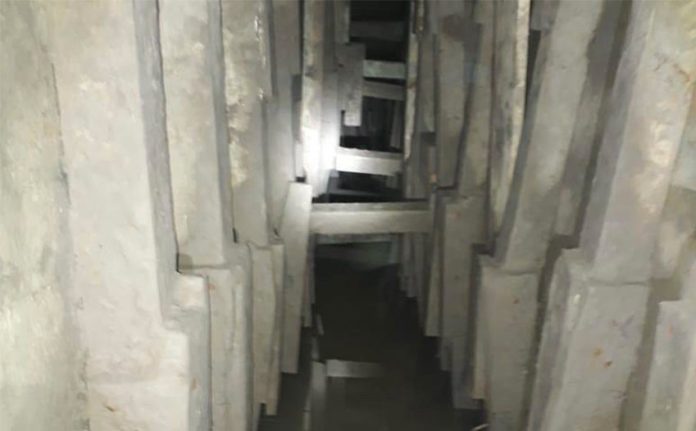
Mexican authorities have discovered a tunnel under the Rio Grande connecting the cities of Matamoros, Tamaulipas, and Brownsville, Texas, U.S. Customs and Border Protection (CBP) reports.
Mexico’s National Defense Ministry (Sedena) has taken charge of the investigation into the tunnel, discovered during a patrol near the bank of the river by the army.
Located about 50 meters from the river, the tunnel was equipped with a generator, water pump and hoses. The subterranean passage measure 1.5 meters high and 80 centimeters wide, but had partially collapsed due to rains in the area, which could explain the related equipment which may have been used in the tunnel’s repair. Three clips of ammunition of different calibers were also found nearby.
The length of the tunnel has not been reported, nor its terminus on the U.S. side, although social media reports indicated it led to the Brownsville neighborhood of Southmost.
Matamoros is under the control of the Gulf Cartel and it is likely that the tunnel was dug to run drugs, weapons or people from one country to the other.
Tamaulipas public security spokesman Luis Alberto Rodríguez said that investigations into the tunnel are being coordinated with seven federal agencies of the United States in order to strengthen cross-border collaboration, including the Federal Bureau of Investigation and the Texas Department of Public Safety. A working meeting on the topic was held Wednesday.
“Priority criminal targets that operate on the border were reviewed, as well as effective communication mechanisms to strengthen bilateral cooperation,” Rodríguez said, as both countries work together toward capturing criminals in the border region.
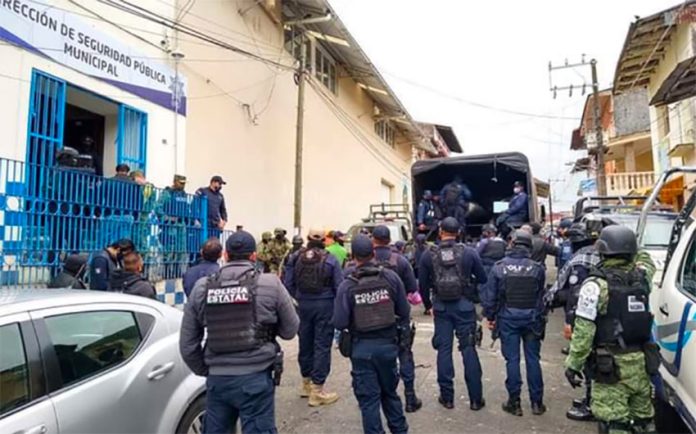
The National Guard and state police have taken control of public safety in the municipality of Altotonga, Veracruz, relieving the 43-member local police force of duty.
Members of the municipal police squad were ordered to undergo training and competency testing in the state capital of Xalapa after a family was gunned down over the weekend.
The change took place on Wednesday morning when national and state authorities also examined the municipal force’s weapons and disarmed them, the state’s Ministry of Public Security reported.
The measure, ordered by Governor Cuitláhuac García Jiménez, was enacted after a couple and their 8-year-old daughter were gunned down on Sunday morning.
The family, who sold chickens for a living, were seated in their delivery truck around 7 a.m. when gunmen on a motorcycle fired at least 15 bullets into the cab of the vehicle, prompting neighbors to appeal to the governor via social media for help in maintaining order in the town where residents say crime has run rampant in recent months.
[wpgmza id=”251″]
Sources say the family had recently been victims of an extortion attempt and were targets of loan sharks belonging to a criminal oragnization.
Gangs will typically offer high-interest loans, and when a party can’t pay, threats and violence often follow.
The move by the governor took place a day after García held a public safety meeting in Altotonga in which he pledged to reinforce security in the area from Altotonga to Tlapacoyan, notably in Jalacingo, Atzalan, Martínez de la Torre and Misantla. After taking office, García vowed in July 2018 that his administration would abolish crime in Veracruz within two years. Thus far in 2020, at least five families in the state have been murdered.
“We will not allow criminal gangs or groups to return to Veracruz,” García said Monday. “Unlike other administrations, we are not going to allow impunity.”
Central bank Governor Díaz: three forecasts developed due to coronavirus uncertainty.
The economy could contract by 12.8% in 2020 in a worse-case scenario, the central bank said on Wednesday after the publication of revised data confirming that GDP declined almost 20% in the second quarter as Mexico hunkered down amid the coronavirus pandemic.
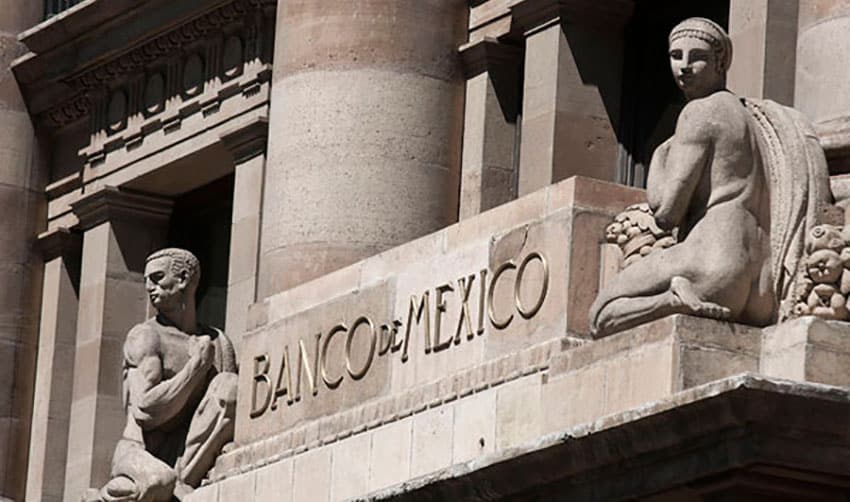
Presenting the bank’s quarterly report for the April-June period, Bank of México Governor Alejandro Díaz de León said that three different forecasts have been developed due to the uncertainty about how the pandemic will evolve in coming months.
In the best-case scenario, the economy recovers quickly from the second-quarter slump and damage is limited to an 8.8% decline in GDP this year.
GDP falls 11.3% in 2020 in an intermediate scenario while in the worst case the economy suffers a deep U-shaped recession entailing the 12.8% slump.
The bank’s most pessimistic outlook for 2020 is 4% worse than its previous worst-case scenario forecast of an 8.8% contraction in 2020.
In all three updated scenarios, the Mexican economy contracts this year by its largest amount since 1932 when GDP plummeted more than 14% amid the Great Depression.
In an interview with the newspaper El Financiero after the national statistics agency Inegi published revised data showing an 18.7% contraction in the second quarter compared to the same period last year – 0.2% better than the preliminary data result, Díaz noted that the economy began to show signs of recovery in June, the month in which nationwide coronavirus restrictions were replaced by state-by-state rules.
Economic activity increased 8.9% that month compared to May but was still 13.2% lower than in June 2019.
Díaz said that if the economy continues to grow in a similar vein throughout the second half of 2020, “a more vigorous recovery” can be expected in 2021.
However, the central bank governor said that “it is clear that the economic recovery next year won’t be enough to return to the levels [of economic activity] we had at the end of 2019.”
The economy will grow by 5.6% in 2021 in the best-case scenario, the Bank of México said in its report, while in the worst-case scenario GDP will only rebound 1.3%.
Díaz said it is unclear how long it will take for the economy to get back to pre-pandemic levels but many analysts predict that it will take several years.
Alonso Cervera, chief Latin America economist for Credit Suisse, and Ernesto O’Farrill, president of the brokerage firm Bursamétrica, both predicted that it will be 2025 before economic activity returns to pre-pandemic levels.
Joel Virgin, chief Mexico economist for French bank BNP Paribas, was slightly more optimistic, forecasting that GDP will recover to pre-coronavirus levels by 2024.
The Bank of México also provided updated forecasts on Wednesday for employment, inflation and the nation’s current account.
It predicted that a total of between 1.1 million and 1.75 million jobs will be lost this year, an improvement compared to its previous forecast in which it anticipated the loss of 1.4 million to 1.8 million positions. The central bank predicted that 100,000 to 450,000 new jobs will be created in 2021.
The bank increased its end-of-year inflation forecast to 3.7% from 3.5% and predicted a current account deficit in 2020 of US $5 billion to $6 billion. It previously forecast a current account deficit of between $3.1 billion and $15.1 billion.
Asked about private sector surveys that found that Mexico is likely to lose its investment grade sovereign credit rating in the next one to three years, the Bank of México chief told El Financiero:
“I believe that it continues to be a possibility: it’s not a certain scenario and it should be avoided to the extent that is possible through the adoption of policies that can provide greater stability, certainty and solidity to the macroeconomic framework and in particular public finances.”