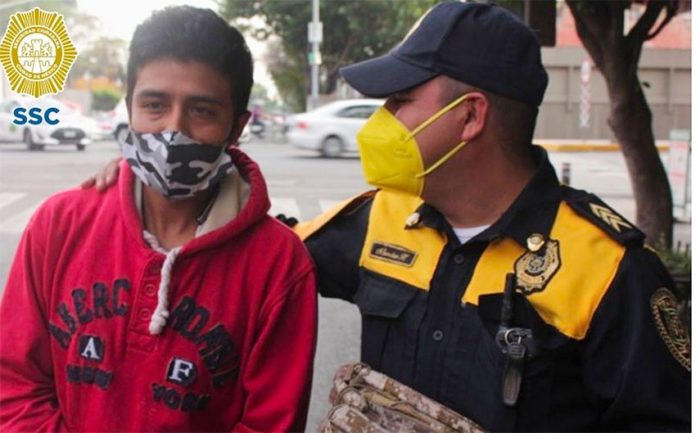
Officer Sánchez and the thankful owner of the lost cash.
A sharp-eyed Mexico City police officer saved the day for a distraught man who had left a fanny pack containing 30,000 pesos in a city washroom stall.
Officer Norberto Sánchez Hernández also may have indirectly helped save a life.
The owner of the pack told Sánchez he’d been carrying the large sum of money because he had been on his way to buy a badly needed oxygen tank for his wife, and he had been dreading going home empty-handed and without the money he had lost.
“He told me, ‘Officer, you won’t believe it, but you just saved my wife’s life because she needs that tank very much.”
Sánchez found the pack next to a toilet in a public restroom at a market in the Doctores neighborhood. After waiting a while with it at the market’s entrance, thinking someone would approach him about it, he got curious and opened the pack. What he saw concerned him.
Inside were boxes of medication, ID cards, a bank card and a bus card, 60 bills in 500-peso denominations. He also saw a tube he recognized immediately as part of an oxygen tank, something he was well familiar with.
“I personally had Covid-19,” he explained. “With treatment and isolation, I was able to recover. Currently, I’m on medication. At times I feel myself suffocating or I get tired, and my breathing fails me, but I have recovered.”
He approached a patrol car, asking to use its radio to call his precinct. Another officer arrived some minutes later, and the pair inspected the bag more carefully, finding a list of phone numbers.
They eventually reached the owner’s wife, who Sánchez says was coughing and having trouble breathing while she talked to him. After he explained his discovery, the woman confirmed that her husband had gone to Mexico City to buy an oxygen tank he had seen on the internet.
Once his wife called him, the owner — identified only as “Andrés”— came running to claim the pack. Sánchez returned it once he confirmed that the man could identify the pack’s contents.
Sánchez was recognized for his good deed on Police Chief Omar García Harfuch’s social media accounts, where he congratulated the officer. According to Sánchez, he will be receiving a promotion.
It is not the first time Sánchez has been recognized for his good work. He has been named Officer of the Month twice in his career, once in October 2019, when he stopped the attempted hijacking of a truck that contained 1.2 million pesos’ worth of cell phones — which also resulted in him receiving a promotion — and again in November of last year for chasing down a person he noticed assaulting two drivers stuck in a traffic jam.
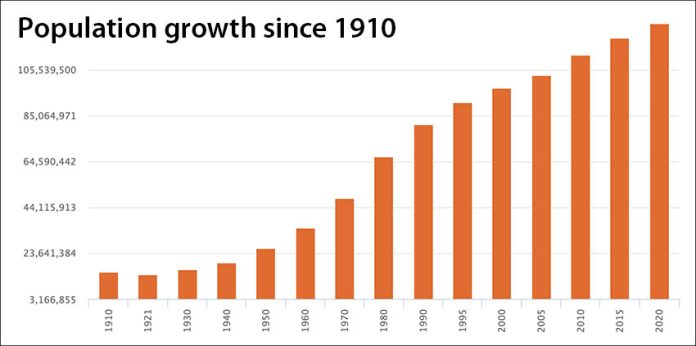
Annual growth has slowed to 1.2% during the last decade.
Annual population growth in Mexico slowed to just 1.2% during the past 10 years as young people increasingly prioritize work over starting a family and consequently have fewer children on average than their parents and grandparents.
Mexico’s population was just over 126 million last year, according to 2020 census results published Monday by the national statistics agency Inegi. The figure represents an increase of 12.2% compared to 2010 when the population was 112.3 million.
The annual growth rate of 1.2% over the 10-year period is the lowest since the start of the 20th century. In the 1950s, ’60s and ’70s, annual population growth was above 3% before falling to 2% in the ’80s, 1.9% in the ’90s and 1.4% in the first decade of the 21st century.
Baruch Sangines, a demographer and geographer, told the newspaper Milenio that Mexico could reach 0% annual population growth in a period of three to four decades if the trend continues. That would place Mexico in a similar situation to European countries in the 1990s, he said.
Sangines said that a major factor behind the decrease in population growth is that more people are focusing on their careers rather than getting married and having kids at a young age.
“Our grandparents, the baby boomer generation, had up to eight or nine kids at a very young age. There was a lower death rate [than in the previous wartime period] and a higher birth rate, which produced a population explosion,” he said.
“[Among] the new generations, especially in large cities, everyone wants to work and a lot [of young people] don’t want to get married. If they do decide to get married, [many couples] only have one child,” Sangines said.
The census found that women now have an average of 2.1 children compared to 2.6 in the year 2000. Unlike some other countries, Mexico depends very heavily on the birth rate for population growth because immigration levels are low.
Sangines said that migration helped to boost the population of European countries after the growth rate declined in the ’90s but noted that Mexico is not the final destination for many migrants.
“They [only] cross [Mexico] to go to the United States,” the demographer said, adding that questions need to be asked about what Mexico will do to boost population growth in the coming decades.
The Inegi census also found that 1.21 million residents of Mexico – about 1% of the total population – were born overseas, almost 800,000 of them in the United States.
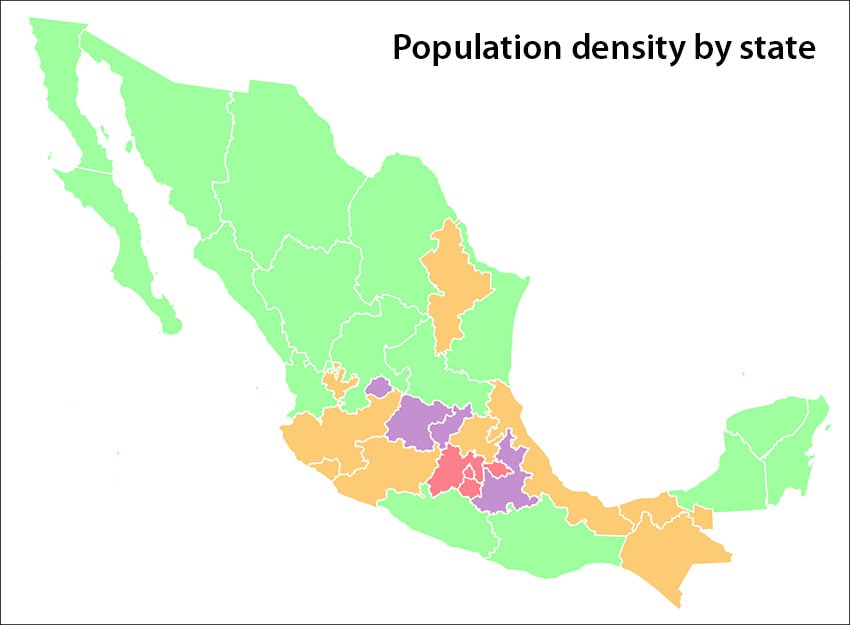
Inhabitants per square kilometer: green indicates 11 to 59, brown 59 to 148, purple 148 to 254 and red 254 to 6,163.
In addition, the census found that the average age of Mexicans is 29, an increase of three years compared to the 2010 census and seven years compared to 2000. According to the National Population Council, the average age of Mexicans in 2050 will be 38 and Mexico will no longer have a “demographic bonus” – more working age people than non-working age (children and seniors.)
“Mexico will be an aged country in 2050, … [a lot of] old people with few young people,” Sangines said, acknowledging that the size of the nation’s workforce is on track to decrease as a percentage of the overall population.
“It’s something that worries demographers, the dependency ratio [the number of people not in the workforce depending on those who are] is going to be a lot higher.”
Sangines said the health system and pension system will need to be overhauled in order to meet the needs of a country with a large, older population and relatively few young people.
Some of the other findings of the 2020 census:
Females account for 51.2% of the population while males account for 48.8%.
México state, which includes many municipalities in the greater Mexico City metropolitan area, is the country’s most populous state with almost 17 million people. The small Pacific coast state of Colima, with a population of 732,000, is the least populous.
Quintana Roo recorded the highest annual population growth among Mexico’s 32 states over the past decade. The growth rate in the Caribbean coast state was 3.2%. Querétaro ranked second (2.6% annual growth) followed by Baja California Sur (2.3%), Nuevo León (2.2%) and Aguascalientes (1.9%).
The illiteracy rate declined to 4.7% from 6.9% in 2010.
Mexicans have completed 9.7 years of education on average, up from 8.6 years in 2010 and 7.5 years in 2000.
Among Mexicans aged 12 or older, about three-quarters of males and 49% of females are employed.
Internet connectivity rose to 52% of households from 21% in 2010.
Almost 7.4 million Mexicans speak an indigenous language, up from 6.9 million in 2010. However, the percentage of the overall population that speak an indigenous language declined from 6.6% to 6.1%.
Almost 21 million Mexicans have some kind of disability or physical limitation.
Some 2.6 million people identify as Afro-Mexican or of African descent.
Almost three-quarters of the population have some kind of health insurance.
An average of 3.6 people live in each home.
About 1.2 million homes don’t have access to running water.
Nine of 10 homes have a TV, 88% at least have one cell phone, 38% have a computer and 47% have a car.
New IKEA stores will share space with French sports retailer Decathlon as part of a dual marketing campaign. (Photo: Archive)
Although it has yet to open a physical store in Mexico, a second Ikea store will open in the city of Puebla sometime in the first six months of 2022.
“We are very excited because little by little, our dream of reaching more homes is becoming a reality,” Ikea México announced on its Twitter account, “and today we can say, ‘Hej!’ [the Swedish word for “hello”] … because as of the first semester of 2022, Puebla will be the home of our second store.”
The store, which will open in Puebla’s Vía San Ángel shopping center, will cover 10,382 square meters and feature an Ikea restaurant, said the company in a press release.
The Mexico City store was originally scheduled to open last fall but was delayed by Covid-19.
The Mexico City store is scheduled to open in the Encuentro Oceania mall in the first quarter of this year.
Currently, the only way to purchase Ikea México products is via its e-commerce website, which was launched in October. However, the website is currently only able to deliver to customers in Mexico City and some municipalities in México state. The website has also struggled since its opening with logistics, having experienced much higher than expected demand from the moment it opened. The site currently warns customers that deliveries could take longer than expected.
“On par, we will continue working to better the service of our online store. The pandemic has caused logistical problems to many businesses all over the world, and we have seen ourselves affected on the local level and worldwide,” the company said in a press release.
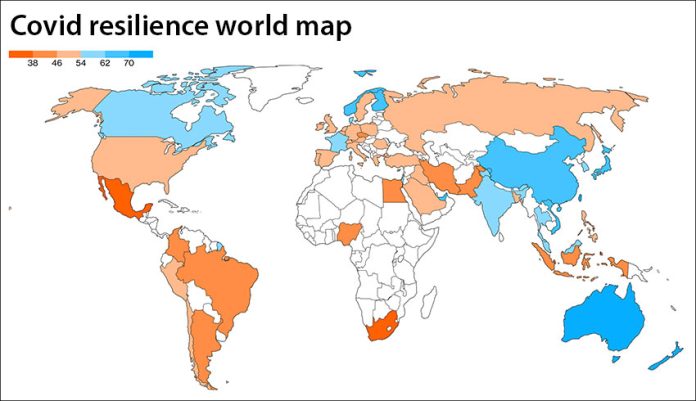
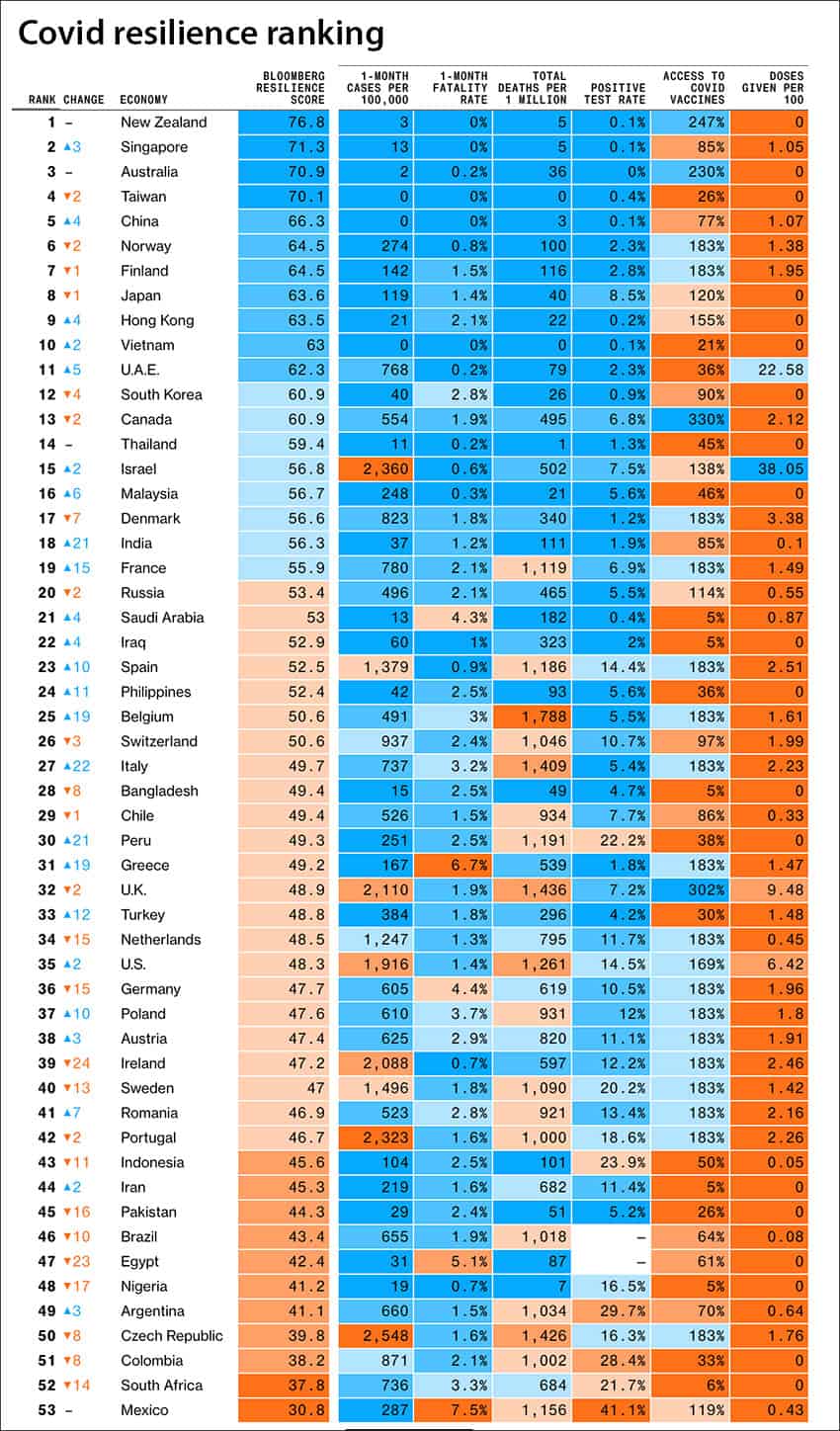
On the covid resilience map, blue is best and orange is worst. bloomberg
Mexico remains the worst country to be in during the coronavirus pandemic, according to an updated analysis by the Bloomberg news agency.
On a monthly basis since November, Bloomberg has graded 53 countries with economies larger than US $200 billion to determine where the virus has been handled most effectively with the least amount of disruption to business and society.
It uses 10 different indicators to assess the coronavirus situation in individual countries, including growth in virus cases, the overall mortality rate, testing capabilities, the capacity of the local health system, the impact of virus-related restrictions on the economy and freedom of movement.
For its latest analysis – which was published on Monday – Bloomberg introduced an 11th indicator to evaluate each country’s progress in administering Covid-19 vaccines.
The news agency uses the various indicators to calculate a “Covid resilience” score for each country.
Mexico ranked 53rd in both the November and December analyses and maintained that unenviable position in the January assessment. Not only that, its score declined.
The Covid resilience score was just 30.8 out of 100, a decline of 6.8 points compared to November. The second worst ranked country – South Africa – achieved a score seven points above that of Mexico.
Mexico has the highest case fatality rate among the 53 countries with a rate of 7.5 deaths per 100 confirmed cases over the past month. (Mexico’s overall case fatality rate is 8.5, the highest among the 20 countries currently most affected by Covid-19, according to Johns Hopkins University.)
It also has the highest positivity rate, with 41.1% of Covid-19 tests coming back positive.
“A high rate of positive tests indicates a government is only testing the sickest patients and there’s high levels of undetected infection in the community,” Bloomberg said.
New Zealand tops the list of countries on the resilience ranking. bloomberg
Other indicators that contributed to Mexico’s score included 287 cases per 100,000 inhabitants over the past month; 1,156 Covid-19 deaths per 1 million inhabitants; 0.43 vaccine doses administered per 100 people; and a 2021 GDP growth forecast of 3.5%.
Bloomberg said that Mexico has vaccine agreements to cover 119% of Mexico’s population (just over 126 million, according to recently-released census results), but supply is currently extremely limited.
By comparison, Canada and the United Kingdom have vaccine agreements to cover more than 300% of their populations, while New Zealand and Australia have deals to cover more than twice the number of residents.
New Zealand, which has been extremely successful in controlling the coronavirus, was rated by Bloomberg as the best place to be during the pandemic with a Covid resilience score of 76.8. Singapore ranked second followed by Australia, Taiwan, China, Norway, Finland, Japan, Hong Kong and Vietnam.
Mexico’s North American trade partners, Canada and the United States, ranked 13th and 35th, respectively.
The 10 worst ranked countries were, in order, Mexico, South Africa, Colombia, Czech Republic, Argentina, Nigeria, Egypt, Brazil, Pakistan and Iran.
Bloomberg acknowledged that some countries have started inoculating citizens against Covid-19 but said “the biggest global vaccination campaign in living memory has yet to reach a point where it’s causing meaningful shifts in … [the] Covid resilience ranking.”
“How quickly vaccinations can bring down fatalities and how effective they’ll be against new, fast-spreading variants will be the key focus into February, when we’ll update the Covid resilience ranking again,” the news agency said.
Noting the poor performance of the United States, Brazil and Mexico in combating the pandemic, Bloomberg said that former U.S. president Donald Trump, Jair Bolsonaro of Brazil and President López Obrador – who announced Sunday that he had tested positive for Covid-19 – all “repeatedly downplayed the coronavirus threat.”
Cynthia Arnson, Latin American program director at Washington D.C. think tank the Wilson Center, said the “cavalier” leadership approach in some Latin American countries, in addition to a lack of social safety nets and strong public health systems, has worsened the coronavirus crisis in the region.
Bloomberg noted that Latin America is the most urbanized region in the world and that social distancing is difficult for many people because they live in crowded conditions.
“The high proportion of people who rely on informal work and daily wages means that few are willing to stay home,” it added.
The news agency also said that International Monetary Fund data shows that most countries in Latin America won’t return to pre-pandemic growth levels until 2023 and per-capita income won’t recover until 2025, which is “later than anywhere else.”
On an annual basis, Mexico’s economy slumped almost 20% in the second quarter of 2020 and 8.6% in the third quarter.
Coronavirus restrictions continue to act as a handbrake on the economy across Mexico, especially in the 10 states currently painted maximum risk red on the federal government stoplight map. Mexico City, an economic powerhouse, is among the entities facing red light restrictions.
An easing of restrictions in the capital and several other states appears unlikely in the short term as Mexico faces its worst month of the pandemic in terms of both new cases and Covid-19 deaths. More than 88% of general care hospital beds in Mexico City are currently occupied by coronavirus patients.
The national death toll passed 150,000 on Monday with 659 additional fatalities reported and now stands at 150,273, the fourth highest total in the world.
The accumulated case tally rose to 1.77 million on Monday with 8,521 new cases registered. Mexico ranks 13th in the world for case numbers despite the low testing rate here.
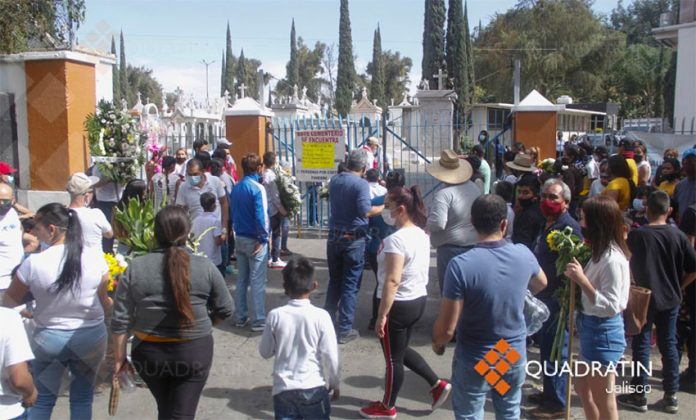
Cemeteries in Jalisco are so busy there are lineups to enter.
A range of high-profile figures in Jalisco have called on citizens to redouble efforts to stop the spread of the coronavirus.
Jalisco is currently one of 10 states painted maximum risk red on the federal government coronavirus stoplight map. The western Mexico state has recorded more than 181,000 confirmed coronavirus cases and 7,807 Covid-19 deaths (including more than 1,600 this month), according to state government data. The federal Health Ministry estimates that there are more than 4,600 active cases in Jalisco.
In light of the situation, University of Guadalajara rector Ricardo Villanueva Lomelí called on all Jalisco citizens to do their part to help stop the virus.
“The measures that each of us takes are more important than the decisions of the authorities,” he told the newspaper Informador.
Other influential figures who spoke with the Guadalajara-based newspaper offered similar advice.
Luis Arriaga Valenzuela, head of Guadalajara’s ITESO university, said that citizens need to empathize with families who have lost ones due to the pandemic as well as health workers when thinking about what they can do to prevent the spread of the virus.
Guadalajara Archbishop Francisco Robles Ortega said that all citizens have to “face up to this moment with a lot of responsibility.”
He said it is worrying that some people are stockpiling essential medical supplies such as oxygen and criticized those who have sought to politicize the application of limited Covid-19 vaccines.
Guadalajara Mayor Ismael del Toro called on citizens to be aware of their individual responsibility in the fight against Covid-19, asserting that “the only way” the virus will be defeated is if people “understand the risk of not respecting the [health] measures.”
Yannick Nordín Servín, the Jalisco health system’s director of emergencies, called on citizens to be aware that hospitals will be overwhelmed if they don’t follow the restrictions in place.
Only 52% of general care beds and 49% of those with ventilators are currently occupied in Jalisco, according to federal data, but Villanueva, the University of Guadalajara rector, said that some hospitals have reached capacity.
A weekend wedding in Veracruz attracted 200 guests.
He also said that if case numbers and hospitalizations continue to rise at the rate seen at the end of December and in the first weeks of January, the health system will reach its limit in February.
While there are beds available for new coronavirus patients now, the hospital situation could quickly become critical if case numbers continue to rise, Nordín warned.
“Nothing will separate us from what the Italians, Spanish and New Yorkers experienced,” the health official said. “Please follow the recommendations – wash your hands, use masks and don’t go out more than what is essential.”
“It’s clear that the best demonstration of love right now is [social] distancing,” Villanueva said. “We all have to take steps [to stop the spread of the virus.”
In other Covid news:
• Eight hotels in Jalisco are currently for sale because they are unable to pay their debts as a result of the downturn in travel due to the coronavirus pandemic, the newspaper El Universal reported. Two of the hotels are in Guadalajara, five are in Puerto Vallarta and one is in Barra de Navidad, a small coastal town just north of the border with Colima.
• Scores of businesses have been forced to close permanently in Guanajuato, where red light restrictions are currently in place. Among the businesses that have recently had to shut for good are five-star hotels, fine-dining restaurants, stores that sold well-known fashion brands and numerous small shops, El Universal reported. León, Celaya, Salamanca and Irapuato are among the cities where businesses have been shuttered due to the pandemic-induced economic downturn.
• Another victim of the pandemic is a well-known cafe/restaurant in Mérida, Yucatán. The owners of Moncho, an establishment frequented by politicians, local officials, journalists and other citizens for almost 45 years, decided to close their two branches due to financial reasons related to the coronavirus crisis. The president of the Yucatán branch of the national restaurant association Canirac said that 2,700 eateries in the state have closed for reasons related to the pandemic.
• The annual nudist festival in Zipolite, Oaxaca, has been canceled on orders from state health authorities. The Zipolite beach will remain open during the dates the festival was to be staged – January 29 to February 1 – but no official events will be held, the organizers said in a statement. The announcement comes two weeks after organizers said the festival, which attracted some 8,000 nudists last year, would go ahead despite Covid-19.
• Authorities in San Pedro Mixtepec, a municipality in Oaxaca where the resort town of Puerto Escondido is located, have extended for 90 days an ordinance that makes the use of face masks mandatory. Anyone caught not wearing a mask in a public place is subject to a 150-peso (US $7.50) fine, an order to complete community work or even imprisonment, a fate that befell a foreign visitor to Puerto Escondido last October.
• Family members of coronavirus patients receiving treatment at the Acapulco General Hospital have accused health workers of reselling medicines they bought for their sick loved ones. They also say that they receive scant information about the condition of their ill family members, some of whom have been in the hospital for almost a month.
• The newspaper Milenio reported that a wedding with more than 600 guests, a large 15th birthday party and cock fights were held in different parts of the state of Veracruz over the weekend in defiance of coronavirus restrictions. Veracruz is currently orange light high risk on the stoplight map. The Gulf coast state has recorded almost 49,000 confirmed coronavirus cases and more than 6,800 deaths, according to state government data.
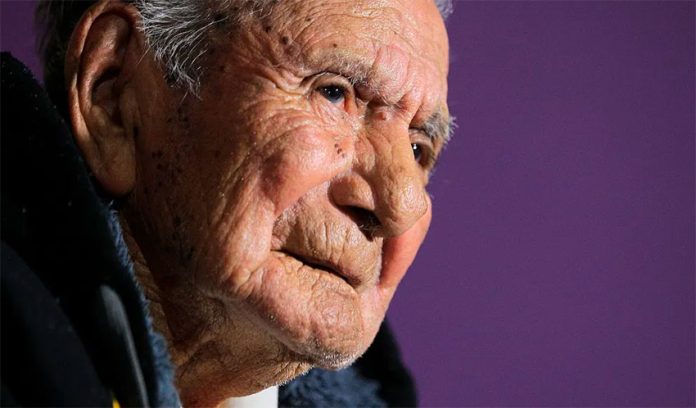
He’s had 17 children, lived through two world wars and even through the Mexican Revolution in 1910.
At 124 years old, Manuel García Hernández may be the oldest man in the world, and he has the paperwork to prove it: a birth certificate showing his birthdate as December 24, 1896 in the small Veracruz city of Tlapacoyan, where he lived nearly all of his life as a farmer.
“I miss the fields very much,” he told the digital newspaper Sin Embargo this week. “I miss working.”
García now lives with his daughter Tomasa García in Ciudad Juárez, where he moved after his wife died. While he’s looked after by Tomasa and his grandchildren, his family members say his mind is still quick, even if his body is not.
Don Manuel’s advice for living a long life is to work hard and avoid vices.
“Don’t lose yourself to vices, drink, work and eat well and don’t wait to take care of yourself when you’re sick,” he said.
García may be the world’s oldest living man: according to Guinness World Records, as of last October there was no one documented as the world’s oldest man, and the last man to hold the title was a mere 116 years old when he died. The oldest living person ever, male or female, was Jeanne Louise Calment, who died at 122.
However, García’s title is likely never to be confirmed because he and his family have no interest in seeking the validation.
He did get unsolicited recognition, however, from his country’s president last week. President López Obrador noted García’s advanced age on his Twitter account on January 18, a fact which apparently impressed García.
“No president does this, to say hello to the poor,” he told the EFE news agencySaturday from his modest home in Juárez.
The greeting didn’t make him Mexico’s best president ever in García’s eyes, however. That honor goes to Plutarco Elias Calles, who was president from 1924–1928.
“He helped the farmers,” García said. “A request was made, and he attended to people’s needs.”
García farmed until age 100, starting at age 9. He raised animals and crops, waking before dawn to feed the animals and till his fields. He waited to marry until his 40s but made up for lost time with 17 children, who have given him 40 grandchildren. He’s outlived all but four of his kids.
He also outlived his wife Rosa Medino, whom he married when she was 13. She died back in Veracruz 10 years ago, and that was when García moved to Ciudad Juárez, at the urging of his daughter, Tomasa García, 57.
Tomasa herself is an early riser, waking up at 4 a.m. to make her father breakfast before she goes off to work at a factory, despite her father’s objections.
“He tells me not to leave, that on any day I could come back home and not find him anymore,” she said, adding that his grandchildren come by to check on him when she’s at work.
Having a year-round supply of inexpensive, delicious avocados is one of the many perks of living in Mexico, don’t you think?
I eat them all the time and have certain, set ways I use them: guacamole, eaten with tortilla chips; on fish tacos or papas locas (think smothered potatoes); mashed on toast or cubed and added to a green salad or to a smoothie. Of course, they are also great eaten right out of the shell with a squeeze of lime and sprinkled with salt. But rarely do I do anything different or look for new ways to eat them.
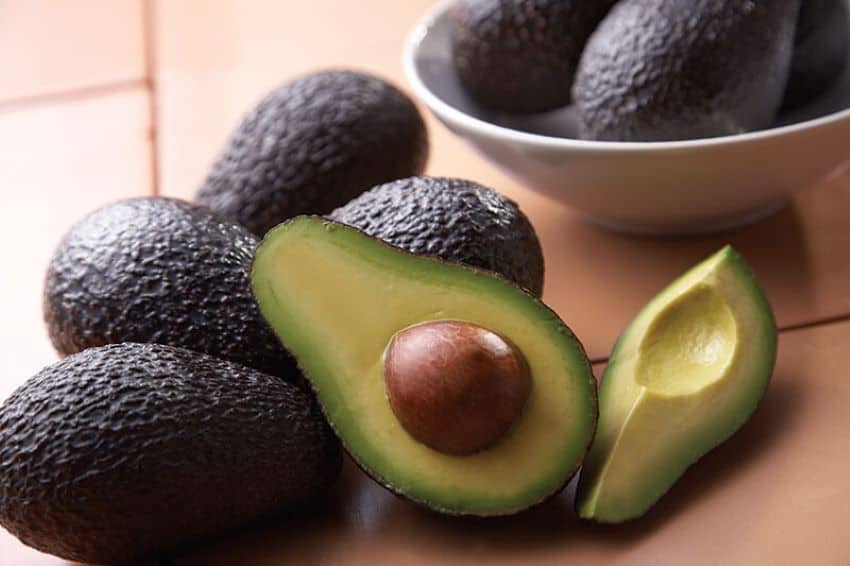
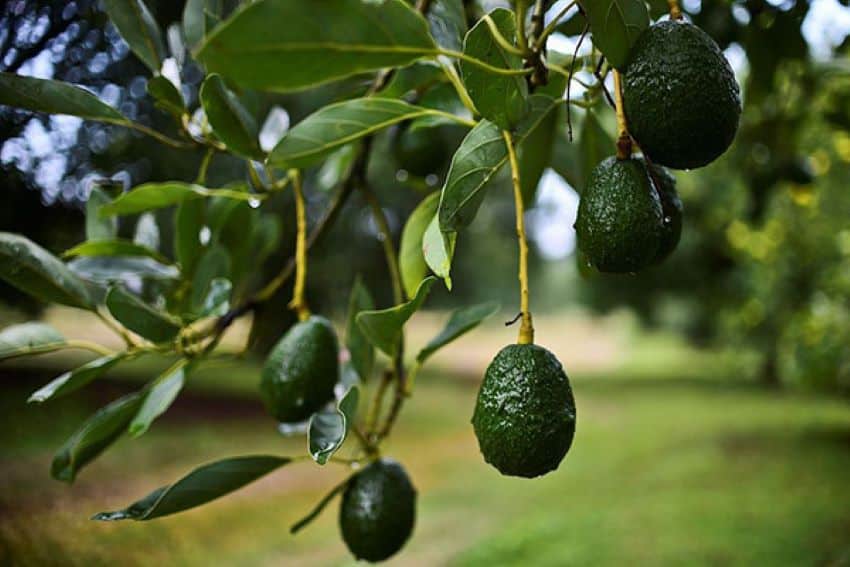
Avocados ripen after being picked, and botanically speaking are classified as a berry with a large seed. While there are many varieties, the most common are the blackish, pebbly skinned Haas, the smooth-skinned green Bacon avocados and the small, smooth-skinned criollo, commonly found in the states of Oaxaca and Chiapas. They’re considered to have originated in Puebla, where pits have been excavated and found to be 10,000 years old! Avocados were mentioned in European botanical literature in the 1600s. They didn’t reach the United States until the late 1800s.
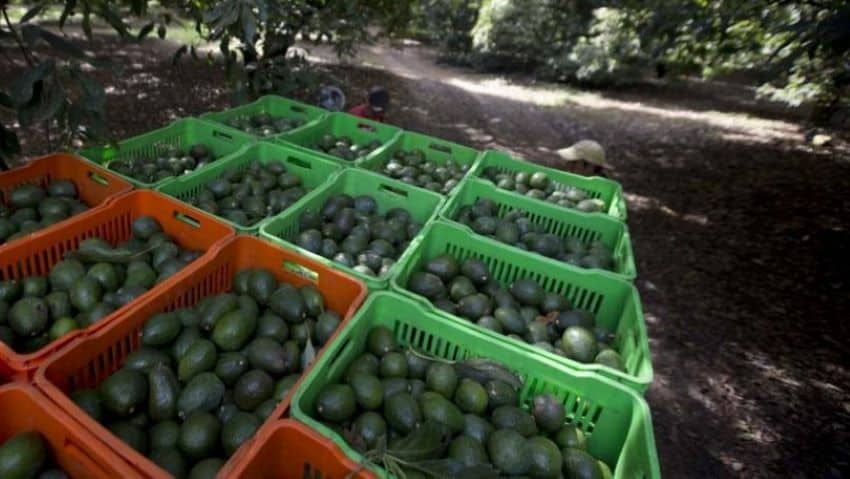
I’m not going to get into the unfortunate politics of avocado production, especially in Michoacán; that’s for another page, in another section. Instead let’s revel in our good fortune that avocados — good avocados, that aren’t brown inside or that never ripen — can be found basically everywhere in Mexico.
A couple of years ago I noticed an unfortunate trend in restaurants and some taco carts in Mazatlán of using packaged or frozen guacamole instead of the real thing. I suppose it has to do with cost, but still … how to tell if you’re dealing with the frozen stuff?
A ripe avocado is great eaten right out of the shell.
An almost surreal bright green color is the first tip-off. The flavor is bland and blah, and the texture is like pancake batter. Now in Mazatlán, however, many places make their guacamole in a blender, so it’s very runny and smooth — don’t jump to any conclusions. The packaged kind is mostly corn syrup and vegetable oil, so it tastes very different from the real thing.
You may know that the word aguacate (avocado) comes from the Náhuatl word for testicle, āhuacatl, because of the shape. But where did “avocado” come from? Apparently, it derived from a mispronunciation of aguacate as avogato — which sounded like the words in French, Dutch and Old German for lawyer or advocate (avocat). The Spanish word for lawyer, abogado, is a close relative. In the U.S., “avocado” was adopted and promoted in 1915 by the California Avocado Association, and the rest is, as they say, history.
Melt chocolate chips in microwave. Add espresso powder, if using, and stir until smooth. Add avocado, maple syrup, coconut milk, cocoa, vanilla, salt and melted chocolate to a food processor.
Purée until smooth and silky. Season to taste with salt. Spoon into four small bowls. Chill for two hours. Serve topped with whipped cream and shaved chocolate.
Maple syrup and chocolate chips make this mousse sweet.
Grilled Avocados with Ceviche
4 ripe but firm avocados
Olive oil, for drizzling
2 Tbsp. fresh lime or lemon juice
About 1½ cups purchased or homemade ceviche
Salt
Heat grill to medium-high heat. Slice avocados in half, remove pits, and drizzle each with olive oil, lime juice and salt. Grill avocado halves cut side down 3-4 minutes or until char marks form. Remove from grill, place on platter and fill each half with ceviche.
Avocado Cashew Cream
½ cup raw, unsalted cashews
½ cup water
Juice of 1 lime
1 small avocado
2 tsp. minced pickled jalapeño
Salt
In a blender, combine cashews, water, lime juice, avocado, jalapeño and salt. Blend until smooth. Taste, adjust seasoning. Chill 15-20 minutes. Serve as a dip with steamed veggies, baked potatoes or other creative pairings you can think of.
Avocados are considered a fruit, fitting the criteria of a berry.
Kale Watermelon Salad with Avocado
1 small bunch curly kale
1 Tbsp. olive oil
1 tsp. fresh lime or lemon juice
1 tsp. white wine vinegar
1 small cucumber, peeled, thinly sliced
3 radishes, sliced
2 scallions, chopped
½ avocado, pitted, cubed
¼ cup crumbled feta or cotija cheese
4 cups cubed watermelon, seeds removed
Salt & pepper
Optional: 1 small fennel bulb, sliced
Remove coarse stems of kale. Tear leaves into small pieces. Place in large bowl and drizzle with olive oil, salt, pepper, lime/lemon juice and vinegar. Mix well. Add fennel (if using), cucumber, radishes, scallions, avocado, feta and toss. Add watermelon, toss again. Taste and adjust seasonings.
Process 2 cartons raspberries, avocado, yogurt, salt and simple syrup in blender until smooth. Fold in 1 cup chopped raspberries. Pour into an 8-serving pops mold. Freeze overnight or at least 6 hours. Drizzle with the melted white chocolate.
Preheat oven to 400 F. In a bowl, toss sweet potatoes with olive oil, chile powder, salt and pepper. Spread on baking sheet. Roast 20 minutes or until golden brown.
In blender or food processor, mix yogurt/crema, avocado, garlic, lime juice, salt and pepper. Pulse until smooth. Taste, adjust seasonings. Chill until ready to use. To assemble tacos, spread a layer of sauce, then sweet potatoes, black beans, toppings and a squeeze of fresh lime juice.
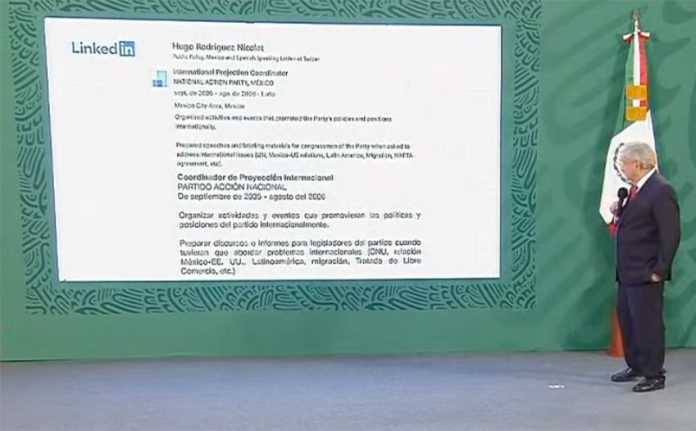
The president reads from a LinkedIn resume of a senior Twitter executive during last Wednesday's press conference.
Several claims made about a senior Mexican Twitter executive who was maligned by President López Obrador last week are false, the Associated Press has determined.
López Obrador asserted last Wednesday that Hugo Rodríguez Nicolat, director of public policy at Twitter México and Twitter Latin America, has close links to the National Action Party (PAN) and was an advisor to a PAN senator.
It is important to know who works at companies such as Twitter because “neutrality is very difficult,” López Obrador said.
“The director of Twitter in Mexico was a campaigner or sympathizer very close to the PAN, the one who currently runs Twitter,” the president said, referring incorrectly to Rodríguez’s role.
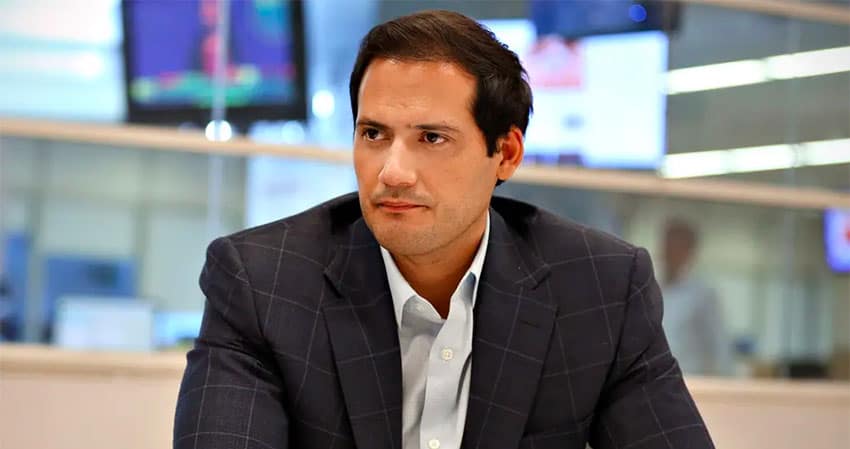
Hugo Rodríguez of Twitter México.
“[He] was even an advisor to a very famous PAN senator. …We just hope he does his job professionally, and doesn’t create bot farms,” the president said, referring to automated accounts he alleges are responsible for online criticism of him and his government.
After his remarks, there were claims on social media – where the president has many ardent supporters – that Rodríguez worked at the (formerly pro-government) broadcaster Televisa for 10 years and was involved in electoral fraud that allowed former PAN president Felipe Calderón to defeat López Obrador at the 2006 presidential election.
The Associated Press said it had contacted Rodríguez and that he confirmed that he was a member of the PAN between 2006 and 2008. However, he rejected the social media claims that appear to have been incited by López Obrador’s remarks.
“I don’t personally know former president Fox; I doubt that ex-president Calderón can place me so the accusation of ‘closeness’ is false,” Rodríguez said in an email to AP.
He said he has never worked at the National Electoral Institute and wasn’t part of Calderón’s campaign team for the 2006 election at which the former PAN president narrowly defeated López Obrador.
“So I don’t know how it can be asserted that I participated in the 2006 ‘electoral fraud.’ I haven’t worked at Televisa at any time,” Rodríguez wrote.
The Associated Press said it had obtained four different versions of Rodríguez’s CV and consulted his profiles with LinkedIn and the Mexican Council on Foreign Relations. The news agency determined that his work history was not consistent with López Obrador’s claims and the accusation made on social media.
Rodríguez worked for an Institutional Revolutionary Party senator between 2003 and 2005 and for the PAN international division between 2005 and 2006. Between September and November 2006 – a period after that year’s presidential election, which was held in July – he worked for Calderón’s transition team, AP said.
Rodríguez subsequently worked at the National Immigration Institute for a period of nine months before working in a range of positions overseas. Before taking up his position at Twitter, the executive worked at ride-hailing company Uber for three years, AP found.
The Associated Press reviewed public documents and media reports about the Odebrecht corruption case and found no mention of the Twitter executive. Rodríguez denied any involvement in the case in his email to AP.
Twitter México described López Obrador’s singling out of the executive and his suggestion that it might be biased as a result of his employment as “regrettable.”
“No person at Twitter is responsible, by themselves, for our policies or compliance actions, and it is regrettable to see comments directed at our employees as if they were solely responsible for the company’s rules or decisions,” Twitter México said.
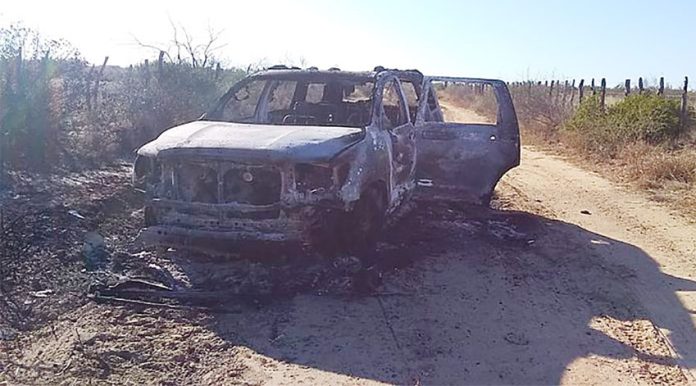
One of two trucks in which 19 murder victims were found in Tamaulipas.
While Tamaulipas authorities have not confirmed the identities of 19 charred bodies found in two burned vehicles in the municipality of Camargo near the U.S. border, a third-division soccer team in Guatemala is claiming one of the victims as its own.
The victims, who all had gunshot wounds, were found by state authorities on a dirt road in the municipality of Camargo, along with rifles. A Camargo official, who requested anonymity due to security concerns, told CBS News that the killings occurred Friday but that people had been afraid to report them. State authorities announced the discovery Saturday.
Tamaulipas authorities did not confirm assertions made by area residents to local media that the victims were Guatemalans seeking passage to the United States. However, the area where the bodies were found — near the border with Nuevo León — is often known as “the little border” and is a major smuggling transit point for both drugs and people.
On social media, officials with the Guatemalan team Juventud Comiteca condemned the killing of the 19 victims, claiming them to be Guatemalans and that one of them was a young player on their team, Marvin “El Zurdo” Tomás, 22.
“The board of directors, the coaches, players, and the fans of Juventud Comiteca repudiate the vile killing of our compatriots, and especially of our young player, Marvin Alberto Tomás,” the club said Sunday on its official Facebook page. “El Zurdo, thank you for being part of our dream. Thank you for your passion. Thank you for giving us the opportunity to know you … For everything, thank you, champion.”
The Foreign Affairs Ministry said in a statement that Guatemala’s embassy in Mexico and its consulate in Monterrey were communicating with Tamaulipas and federal authorities to determine if any of the victims were Guatemalan.
None of the trucks displayed gunshot holes, nor did authorities find any shells at the scene, suggesting that the victims had been shot elsewhere. One of the vehicles bore registration documents for Nuevo León.
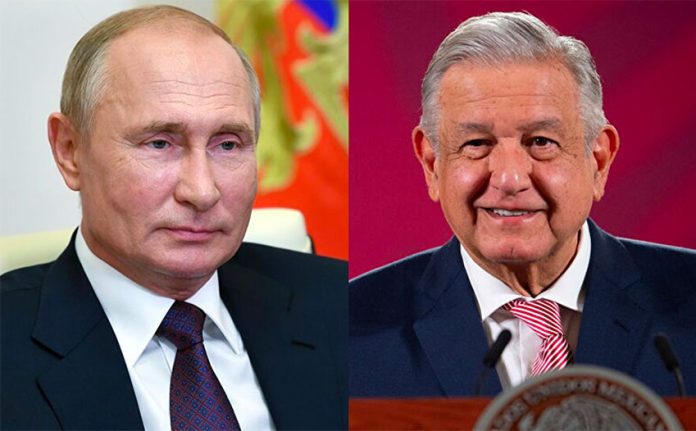
A phone call between Vladimir Putin and President López Obrador was described as friendly and successful.
After announcing Sunday that he had tested positive for Covid-19, President López Obrador said Monday that he had spoken to Russian President Vladimir Putin and thanked him for agreeing to supply 24 million doses of Russia’s Sputnik V vaccine.
“We spoke with the president of the Russian Federation, Vladimir Putin, and he was genuinely affectionate. I invited him to visit Mexico and thanked him for the decision to send us 24 million doses of the Sputnik V [Covid-19] vaccine over the coming months,” he said in a social media message.
Foreign Affairs Minister Marcelo Ebrard said on Twitter that the call between the two leaders was friendly and successful.
“As a result, [Deputy Health Minister] Hugo López-Gatell will be able to move forward with the support of the Russian government to ensure the arrival of the Sputnik V vaccine shortly,” he wrote.
Ebrard said last Tuesday that 400,000 doses of the two-shot Sputnik vaccine would arrive in Mexico this week. It was unclear whether that remained the case.
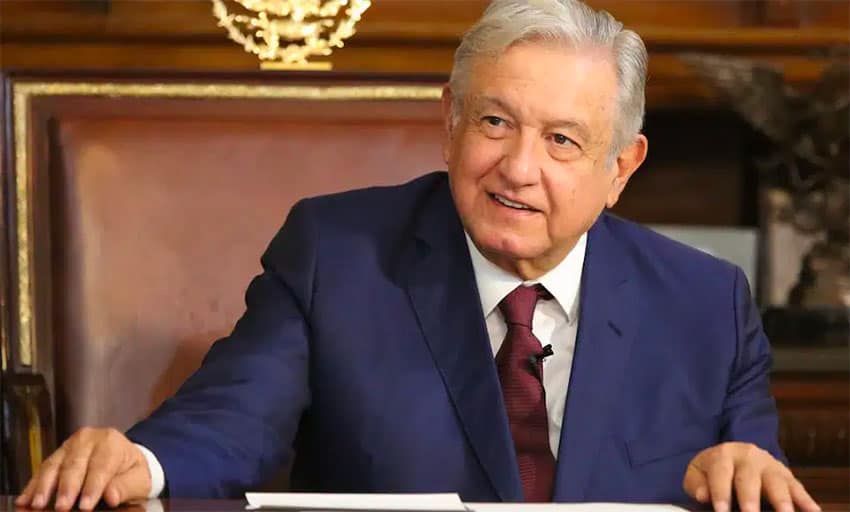
The president during Monday morning’s call with Putin.
For its part, the Kremlin said in a statement that Putin and López Obrador “noted the constructive and mutually beneficial bilateral relations that are successfully developing in various areas.”
“The leaders discussed in detail the tasks of countering the spread of the coronavirus and ensuring epidemiological safety. They reviewed issues of organizing the distribution of the Russian Sputnik V vaccine in Mexico and training Mexican medical specialists in Russia,” the statement said.
“Vladimir Putin wished an early and complete recovery to the president …”
The Sputnik V vaccine, the first Covid-19 vaccine to be registered anywhere in the world, was created by the Gamaleya Research Institute, which is part of Russia’s Ministry of Health. It has an efficacy rate of 91.4%, according to a December announcement based on phase 3 trials with almost 23,000 participants.
“The vaccine demonstrated 100% efficacy against severe coronavirus cases. There were 20 severe cases of coronavirus infection among confirmed cases in the placebo group and no severe cases in the vaccine group,” the Russian government said.
“… No unexpected adverse events were identified as part of the research. Some of those vaccinated had short-term minor adverse events such as pain at the injection point and flu-like symptoms including fever, weakness, fatigue, and headache.”
Gamaleya Institute director Alexander Gintsburg said that the phase 3 trials “support our confidence in its high efficacy and complete safety for health.”
The vaccine has not yet been approved by Mexico’s health regulator, Cofepris, but López Obrador said last week that authorization is imminent.
Only the Pfizer/BioNTech and AstraZeneca/Oxford University Covid-19 vaccines have so far been approved for use in Mexico but none of the latter has arrived. As of Sunday night, just under 630,000 doses of the Pfizer vaccine had been administered to health workers but only 25,185 of such workers had received both required doses.
Ebrard said last week that millions of doses of the AstraZeneca/Oxford University, Sputnik V and CanSino Biologics vaccines, as well as further shipments of those made by Pfizer, would arrive in the coming weeks. The government expects to inoculate just over 14 million Mexicans by the end of March, he said.