Home Blog Page 1740

Nostalgia at Pemex: company looks to 1950s for gas station rebranding

0
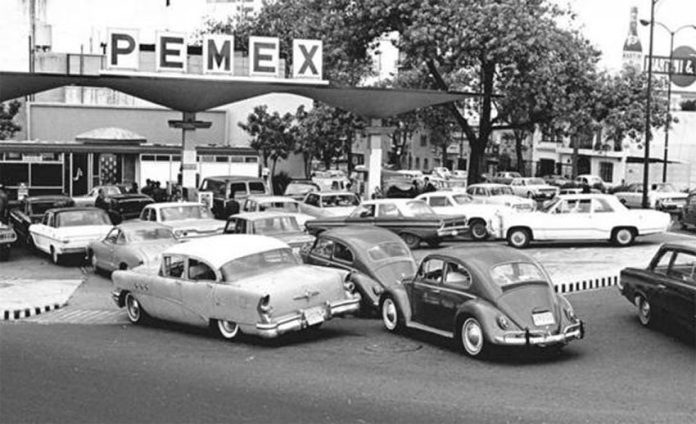
early pemex station
Coming (back) soon?

Pemex has looked to the past for inspiration for a new network of gas stations.

The state oil company will build 500 stations based on the architecture and design of its gasolineras in the 1940s and ‘50s.

The retro model “will seek to exploit nostalgia and sentimentalism” of Mexico’s golden age, Pemex says in a document directed at potential franchisees to which the newspaper El Universal had access.

The new gas stations, the first of which are expected to open in 2020, will be built in parts of the country where a sense of nostalgia already exists, such as Pueblos Mágicos, or Magical Towns.

The use of one of the company’s past logos at the new stations is currently under consideration.

early pemex gas pumps
A yearning for yesteryear.

Pemex tells would-be investors that there is a yearning for yesteryear among today’s consumers and that the retro gas stations have the potential to become icons of the areas in which they will be located.

However, the company concedes that building gas stations that hark back to the past will be costly and time-consuming.

But Pemex is determined to win back at least some of the market share it has lost since private gas stations entered the retail fuel market following the implementation of the previous government’s energy reform.

Motorists who fill up at the retro stations will enjoy a unique experience and be guaranteed high levels of “quality, honesty, innovation and service,” according to the company.

The first of the new stations is to be built in La Condesa, a trendy Mexico City neighborhood known for its bars, restaurants, parks, leafy streets and attractive art deco architecture.

One person unlikely to be seen filling up at a retro Pemex gasolinera is former president Vicente Fox.

After the state company’s plan came to light, Fox took to Twitter to claim that it was the brainchild of President López Obrador, of whom he is a frequent critic.

“It’s obvious that this outdated and nostalgic crap comes from the throne of his Serene Highness,” he wrote.

“Pemex is going back 50 years. López [Obrador] is taking us back 100 years . . .”

Source: El Universal (sp) 

Lower house approves labels giving risk warnings for processed foods

0
food labels
When the word alto appears a few times, beware.

Prominent health risk warnings may soon appear on prepackaged food and non-alcoholic beverages whose consumption can have adverse health effects.

The lower house of Congress on Tuesday passed modifications to the General Health Law that stipulate that the labels on food and drinks must warn consumers if they contain high levels of calories, sugar, salt or saturated fat.

An octagonal-shaped symbol will appear on the front of products that exceed Health Secretariat guidelines.

Within the symbol, which will have a black background, white text in capital letters will warn consumers that the product is alto en (high in) one or more harmful ingredients.

Labels must also state whether a product contains ingredients that are genetically modified and include its nutritional value, including energy content and total sugar amounts, in a “direct, simple, visible and easy-to-understand way,” according to the reform approved by lawmakers.

In addition, the labels of products high in sugar must warn consumers that excessive consumption increases the risk of serious illnesses such as diabetes, obesity, cancer, cardiovascular diseases and poor oral health.

The Secretariat of Health has the right to include graphic images on products considered especially harmful to human health such as those seen on cigarette packages.

The lower house of Congress also voted in favor of outlawing the use of images of children on products that are considered harmful. Images that “cause confusion or false expectations among consumers,” such as a picture of a person exercising while consuming a product that is high in saturated fat, are also banned.

The modifications to the health law will now go to the Senate for its consideration.

Deputies’ approval of the General Health Law modifications came a day after President López Obrador acknowledged that taxes on unhealthy food and cigarettes have not been successful in discouraging their consumption.

“It can’t only be about paying more taxes,” he told reporters on Monday. “There needs to be more information for the people.”

Source: El Financiero (sp) 

Mexican women are not without defenders of reproductive rights

0
A faceoff between abortion supporters and opponents.

After reading last week about Oaxaca’s vote on legislation to legalize abortion, I wrote about my thoughts on punishing the women who had allegedly had abortions.

Happily, abortion during the first 12 weeks of pregnancy was indeed legalized, making Oaxaca the second state in the country to do so. This of course has been faced with immediate and predictable challenges from the usual suspects, but at least for now Oaxaca seems poised to move “complications from illegal abortions” down quite a few rungs on the ladder from its current place at No. 3 among causes of death.

I celebrate with and for the women of Oaxaca, and hope that other states will soon follow suit. No woman deserves to be jailed for exerting control over her own body. The myth of flippant, slutty women running off to the clinic for endless abortions after irresponsible and thoughtless sex is pervasive. The fact that so many women, however, are willing to risk their lives and freedom to procure an abortion tells a very different story.

For this second article in my two-part piece, I’d like to discuss the contours of the pro-life and pro-choice movements in Mexico, and the surprisingly strong influence that United States-style movements exert here in Mexico.

Let’s start with the positive: though they’re not the majority, the women of Mexico are not without defenders and promoters of their reproductive rights. One such organization is GIRE (Grupo de Información en Reproducción Elegida), which works to educate women and girls, support reproductive health and decriminalize abortion.

Another, Las Libres is based in Guanajuato, one of the most conservative states when it comes to abortion, and works to promote women’s human rights and ensure that the laws already on the books are effectively implemented.

Unlike some of the various large pro-life organizations active in Mexico, most reproductive rights organizations seem to be homegrown.

Close observers might notice that the pro-life movement here closely resembles the pro-life movement in the U.S., and this is no accident. Conservative thought-leaders promote the idea of “exporting abortion” as a form of U.S. imperialism, a ludicrous and tired argument that’s easily disproved. We actually are, however, exporting our strategies for shaming women into not having abortions even when they legally have the choice to do so.

At clinics where abortions are legally performed in Mexico City, for example, “crisis pregnancy centers” set up tables outside, often with similar uniforms, and do “intake” for those heading into the clinic. These booths, vans or sites that women are sometimes later driven to are made to look like family planning clinics; billboards promote their existence and mislead women about the kinds of places they really are.

“Documentaries” of women traumatized and remorseful about their abortions are shown. And who can forget the requisite “miracle of life” videos followed by scenes of graphic, bloody abortions?

Sounds familiar, right? One activist organization that sent women in regularly (who were not pregnant) said they were always told they were pregnant and shown “ultrasounds” of highly-developed fetuses that could not possibly be at the gestational age they supposedly were. (For an excellent read on how the U.S. pro-life movement influences their Mexican counterpart, check out the excellent article from The Nation, “Mexico’s Abortion Wars, American-Style”).

While the pro-life movement likes to label the other side as “pro-abortion,” the reality is that no one is gleefully jumping for joy at the thought of women ending their pregnancies. No matter what side of the argument you fall on, it’s in all our interests to prevent unwanted pregnancies in the first place.

The oft-recommended advice to “close your legs” is not a reasonable or effective solution. Can we just agree that women are humans that also have sex drives? Also, as a clever meme recently put it, one could spend a lifetime with her legs spread without getting pregnant . . . it’s almost as if some other element were needed, right?

All joking aside, it’s important for us to remember that as promiscuous and “immoral” as a woman could possibly be perceived to be, pregnancy is only possible, on average, once a year. A man, on the other hand, could theoretically impregnate a different woman every day, and possibly even more often. Could it be that we’re worrying too much about the wrong side of the equation here?

Women, of course, are the ones who inevitably suffer the consequences of a pregnancy. There’s the risk to one’s life as a result of pregnancy and childbirth, of course, and then the supporting of another human being as they grown into an adult — no short order.

At least compared to the U.S. I feel Mexico does a fairly good job at making birth control available. But we need to do better, especially in smaller communities, and especially with teenage girls and boys.

Pairing free health services with robust sexual education in the curriculum would help us promote sexual health and responsibility as a social good, and might even give the culture of sexual machismo a few needed dents.

In the meantime, we need to keep working for the right of women to exercise full control over their bodies, publicly and privately. Sanctity of life? A mí no me engañan (They don’t fool me).

If you love the potential for life inside a stranger’s womb but feel nothing but disdain and contempt for the stranger herself, there’s more to it than selflessly caring about a developing life in the womb.

Sarah DeVries writes from her home in Xalapa, Veracruz.

Shell begins importing fuel for its gas stations

0
Shell gasoline is now being shipped to Mexico by train.

Shell Mexico has begun importing fuel from the United States for sale in its gas stations in Mexico.

The company announced the arrival of a freight train carrying gasoline to a storage terminal in San José Iturbide, Guanajuato.

“Initially, the importation will be by land and later by sea,” the company said in a press release.

With this strategy, Shell will immediately supply 25% of the gasoline at its own gas stations in the Bajío region, and in the coming years will supply all of its 1,200 stations.

The company’s expansion plans call for a 1 billion-peso (US $50.5-million) investment over the next 10 years.

“The importation of our own fuel is a fundamental part of our value proposition and represents an essential factor for supporting our growth plans in Mexico over the next 10 years,” said Murray Fonseca, downstream director of Shell Mexico.

Shell now joins companies like Marathon, Exxon and BP as an importer of gasoline and diesel to the Mexican market.

The energy reform introduced by the previous government of president Enrique Peña Nieto allowed private-sector participation in the energy market. Since then, the new players have come to make up 30% of the retail gasoline market, which was previously exclusive to Pemex. However, Pemex still supplies 95% of the country’s gasoline.

Source: Forbes (sp)

Roma actress Aparicio to be named UNESCO Goodwill Ambassador

0
Goodwill Ambassador Aparicio.

Actress Yalitza Aparicio will be named a Goodwill Ambassador of the United Nations Educational, Scientific and Cultural Organization (UNESCO), the organization said in a statement.

Aparicio will be formally appointed ambassador at a ceremony on Friday at UNESCO headquarters in Paris.

The Oaxaca-born, indigenous actress will work on behalf of the empowerment of indigenous peoples during her two-year mandate.

“This is made possible by Yalitza’s commitment to gender equality and the rights of indigenous peoples, and the ideals and goals of the organization,” said UNESCO.

Goodwill Ambassadors are celebrities who promote the work of the organization.

Aparicio has been a vocal advocate for women and indigenous people since being nominated for an Oscar for her performance in Alfonso Cuarón’s film Roma. In September, she participated in the “Nueva Gente” conference held by the Anáhuac Mayab University in Mérida, Yucatán, while in March she participated in an event to observe International Women’s Day.

Source: El Financiero (sp), Diario de Yucatán (sp)

Tropical storm leaves 46,000 incommunicado in Oaxaca

0
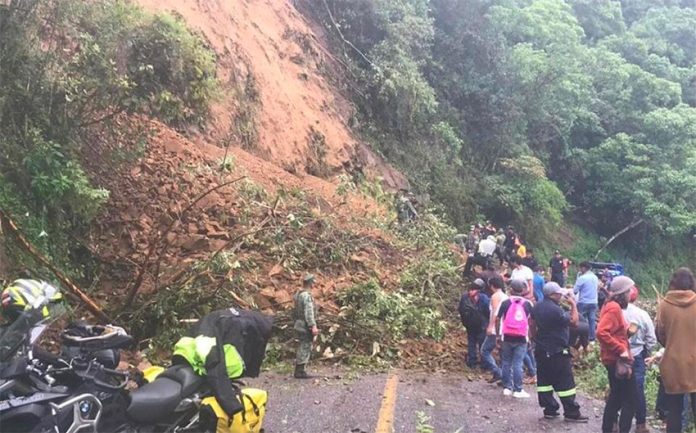
One of many slides that have blocked highways in Oaxaca.

As emergency personnel in Oaxaca worked on Tuesday to repair the damage left by Tropical Storm Narda over the weekend, at least 46,000 people in 46 communities remained isolated from the rest of the state because of damage to roads.

The isolated towns are located in the municipalities of Santiago Xanica, San Andrés Cabecera Nueva, Santa María Ozolotepec and Santa Cruz Zenzontepec in the Sierra Sur region, and Constancia del Rosario in the Mixteca region.

Narda, which hit Oaxaca on Saturday, caused landslides and floods that damaged roads and highways across the state. The Sierra Sur, Mixteca and Costa regions saw the most damage.

According to Oaxaca Highways and Airports director David Mayren, state and federal emergency workers have been able to reopen all federal highways but work continues to remove debris from state highways.

Mayren said the Río Grande-Juquila highway, in the municipality of Santa Catarina Juquila, has been partially reopened.

Source: Milenio (sp), Diario Marca (sp)

Father of 6 arrested after dousing kids with gas, setting house on fire

0
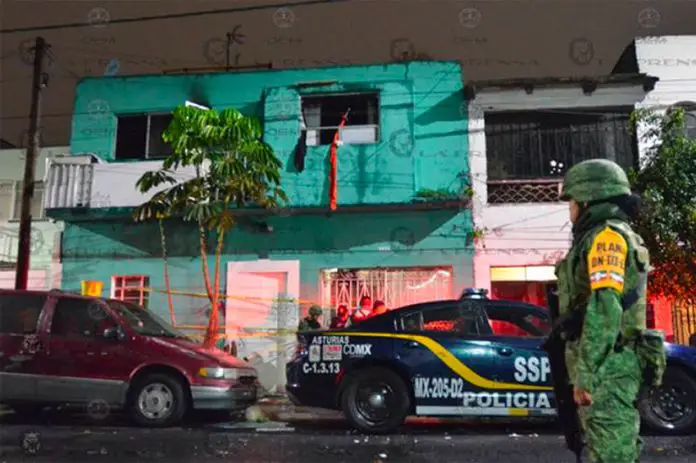
The home where six children were rescued by emergency personnel.
The Mexico City home where six children were rescued by emergency personnel.

A father of six was arrested in Mexico City on Tuesday after stabbing his children, dousing them with gasoline and setting them and his house on fire.

The attack occurred at about 9:00pm last night in Ampliación Asturias, a neighborhood in the central borough of Cuauhtémoc.

Neighbors who heard children screaming called police who gained access to the locked home with the help of firefighters.

Six minors aged between 7 and 12, all of whom were suffering from stab wounds and burns, were removed and transferred to hospital. A 12-year-old girl died this morning while the other five remain hospitalized in serious condition.

While police were at the Cuauhtémoc house, the children’s 33-year-old father appeared on its roof, where he cut himself with a knife before flinging himself to the ground in an apparent suicide attempt.

Officers arrested the man, who identified himself as Jorge Villegas Fuentes Elizalde, and transferred him to hospital, where he is in police custody.

A report in the newspaper Reforma said that Fuentes told police that his wife had recently left him and that her departure triggered the attack on his children.

The fire at his home, where furniture and the floor were doused with gas, was extinguished by firefighters but the kitchen and two bedrooms sustained extensive damage.

The Mexico City Attorney General’s Office has initiated an investigation into intentional homicide, malicious injury and arson.

Source: Reforma (sp), Noticieros Televisa (sp) 

UNAM student will lead simulated NASA Mars mission

0
Telecommunications engineering student Bazaldua.

A student of the National Autonomous University of Mexico (UNAM) will lead a simulated NASA mission to Mars conducted by the University of North Dakota (UND).

Telecommunications engineering student Danton Iván Bazaldua Morquecho was chosen to lead the venture due to his experience at the head of other simulations, such as a 2107 Poland Mars mission.

The mission’s objective is to test technology made for actual missions to the red planet, such as space suits. The results will also yield information useful for the colonization of Mars.

The mission will take place on October 2-16 in NASA facilities as part of a program designed to stimulate competitive research.

“My role as commander is to examine and experiment with ideas developed by myself, the University of North Dakota and NASA, as well as some of the crew’s projects,” said Bazaldua in a UNAM press release.

“We all have experience in simulations, but unlike others, this one is completely scientific, with complex and extremely rigorous objectives, experiments and schedules.”

Bazaldua said it will be the first entirely Latin American crew to participate in a project at the U.S. university. That is thanks to Pablo Gabriel de León, an Argentinian aerospace engineer who works with NASA to make space suits for the next missions to Mars and the moon, and who will also work on the project.

For Bazaldua, getting to Mars is important because it produces strategic advantages, and shouldn’t be seen as mere human achievement. He says that nations invest resources in space missions because they generate economic, political, social and national security benefits.

Balzaldua believes that the Earth will look to space for resources that become scarce, and work like his will be seen as a necessity.

Source: Milenio (sp)

Big tourism boost expected with Real del Monte-Huasca highway

0
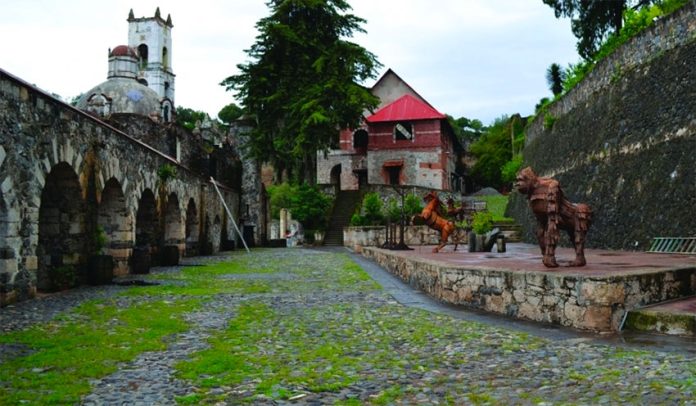
The Magical Town of Huasca will get a new highway link to Real del Monte.

Hidalgo Governor Omar Fayyad has announced the construction of a new highway between Real del Monte and Huasca, predicting that it will significantly boost tourism in the region.

State Tourism Secretary Eduardo Baños Gómez said the 15-kilometer highway will improve access to the two Magical Towns, or Pueblos Mágicos.

“This will be an iconic project for our administration . . . and it will help tourism immensely.”

He noted that the highway could increase tourism in the state by as much as 40%.

“I hope that we can start the bidding process before the end of the year, in two or three months,” he said. “This will be a great project, a beautiful highway that will not only help tourism but also various other sectors of the state’s economy.”

The highway will traverse bridges and tunnels through the Pachuca mountains and will reduce travel time between the two towns.

Secretary Baños added that he hopes the federal government will resume funding for the Magical Towns program, which was suspended earlier this year.

Pachuca, the state capital, will host the national Magic Towns fair this month, bringing together representatives from the 121 municipalities across Mexico that have been awarded the distinction.

The country of England will be a special guest at the fair, which is expected to bring 200,000 people to Pachuca, of which 50,000 are expected to visit Real del Monte as well.

The fair takes place October 25-27.

Source: Milenio (sp)

President calls on Tlatelolco massacre marchers for a peaceful event

0
Armed forces attacked civilians during a 1968 protest against the Mexico City Olympics.

Mexico City has been gearing up this week for the annual march to commemorate the 1968 Tlatelolco massacre amid worries that violence seen at recent demonstrations will be repeated on Wednesday.

During his morning press conference today, President López Obrador sent a message to people planning to attend the marches scheduled for later on Wednesday, urging them to refrain from covering their faces and committing violent acts or vandalism.

“I’m telling you that’s not the way — no masks. People who fight for justice don’t have to cover their faces, they should identify themselves, and they shouldn’t carry weapons, whether that means rocks, fireworks, metal bars, anything like that,” he said.

The president also suggested that protesters’ families would not be supportive if they knew. “I’m sure that grandparents, parents, mothers and fathers [of these people] do not agree with their acts, or my name is not Andrés Manuel.”

The president’s statement comes after two recent Mexico City protest marches were marked by vandalism. On September 26, during a march to commemorate the anniversary of the disappearance of 43 students in Iguala, Guerrero, masked protesters smashed windows at businesses on Avenida Juárez, causing an estimated 100 million pesos (US $5 million) in damage. On September 28, protesters demanding the legalization of abortion set fire to the door of a chamber of commerce on Avenida Reforma.

The October 2nd march, which commemorates the 51st anniversary of a massacre of at least 300 students in 1968, will start at the Three Cultures Plaza in Tlatelolco at 4:00pm and end at Mexico City’s zócalo.

March organizers joined AMLO in asking participants not to wear masks and to avoid vandalism.

Mayor Claudia Sheinbaum said the city made an agreement with march organizers that police presence at the march will be minimal in order to avoid provocations. In lieu of sending a contingent of riot police to prevent vandalism, the city government set up barriers in front of buildings on the march route and will deploy a 12,000-person “peace barrier” of civilian government employees to maintain order.

“There will be no repression, but we can’t allow any kind of aggressive acts,” she said.

Sheinbaum disbanded Mexico City’s riot police as a distinct agency in one of her first acts as mayor, fulfilling a central demand of the 1968 student movement.

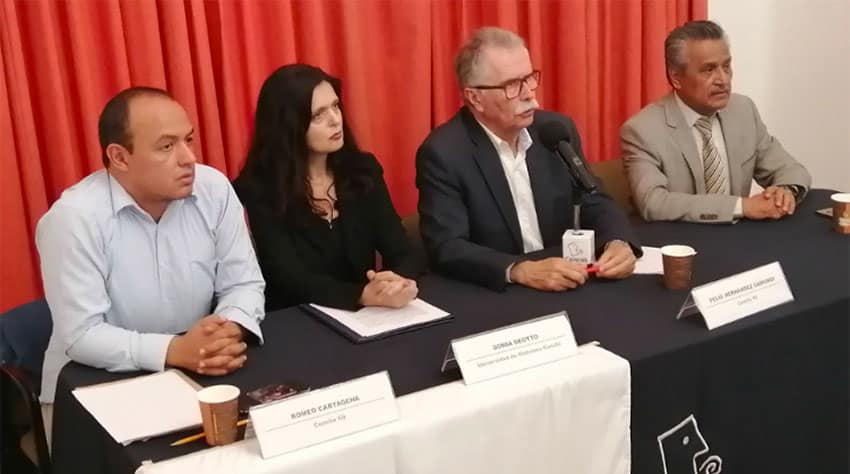
In a press conference on Tuesday, march organizers echoed the calls by the president and the mayor to eschew face coverings and acts of vandalism.

“We will be marching with our faces uncovered, and we ask anyone who wants to join us to do so without hoods, with their faces visible,” said Félix Hernandez Gamundi, a leader in the 1968 student movement and a survivor of the Tlatelolco massacre.

“This is a peaceful protest, like all of our actions have been for the last five decades.”

Source: El Financiero (sp), Proceso (sp), 24-Horas (sp)