Home Blog Page 1741

Morena leader proposes state-owned company to control marijuana sales

0
marijuana
A Pemex for pot?

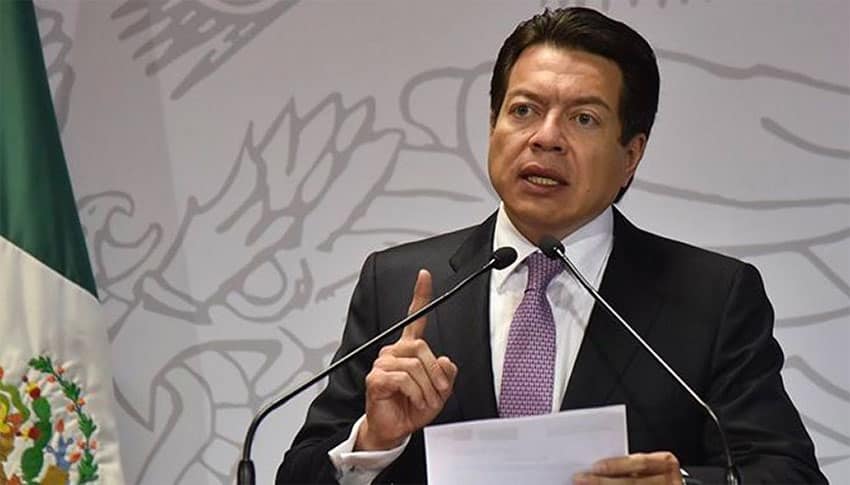
The leader of the ruling Morena party in the lower house of Congress presented a bill on Tuesday that proposes the creation of a state-owned company to control marijuana sales in a regulated market.

The draft General Law for the Control of Cannabis presented by Mario Delgado also proposes the legalization of the cultivation of marijuana for personal use.

Under Delgado’s bill, a state company called Cannsalud (a portmanteau of cannabis and health) would have the exclusive authority to purchase marijuana from legal producers and sell it to both authorized franchisees – who would supply the recreational retail market – and pharmaceutical companies.

“This way the cannabis market wouldn’t be left to the autonomous regulation by individuals but would involve the state as a permanent supervisor and controller of activity involving this substance within a legal framework that would guarantee benefits for all,” the bill says.

The proposal seeks to prevent large companies from dominating a potentially lucrative legal marijuana market.

Deputy Delgado introduces marijuana bill.

A state-owned company would be able to “contain the risks inherent in the establishment of a new market,” the bill states, whereas large companies would “seek to maximize their profits” without regard for the protection of people’s health.

The proposed law also states that adult citizens would be able to grow up to six cannabis plants “without the need for a license or permission as long as they are destined for personal use . . . in the home.”

Morena leads a majority in both houses of Congress, meaning that approval of Delgado’s bill would appear likely but the news agency Bloomberg noted that it is unclear whether President López Obrador would support a state company controlling the legal marijuana trade.

However, the president does generally support greater government presence in the economy.

Congress’s move towards the legalization and regulation of marijuana for recreational purposes follows the publication by the Supreme Court in February of eight precedents on its recreational use, which determined that prohibition of the drug is unconstitutional.

Source: El Financiero (sp), Milenio (sp) 

Puebla street vendors scare off restaurant investment

0
puebla street vendors
No restaurants here.

Street vendors in the historic center of Puebla city are scaring off investment in the restaurant industry.

Ten new restaurant projects worth a combined 150 million pesos (US $7.6 million) were slated to start in the heart of Puebla in the final months of 2019 but according to the local president of the national restaurant association Canirac, the investment is now in doubt.

“Investors are worried about the lack of action to remove the street vendors, who have been taking over space since the change of municipal government in the middle of October last year,” said Olga Méndez Juárez.

She claimed that local authorities allow the vendors, known in Mexico as ambulantes, to operate with impunity, adding that the problem is even worse on weekends. Méndez also said that the invasion of street sellers presents a poor image of the city to tourists.

The Canirac president said the heavy presence of the ambulantes is also having a negative impact on existing restaurants in Puebla’s downtown, explaining that patron numbers were down 30% in the first nine months of the year.

Méndez questioned the logic of authorities’ failure to crack down on unregulated commerce in the city’s streets, plazas and parks given that, unlike formal businesses, street vendors don’t pay tax or generate large numbers of jobs.

“If just 10 projects are going to bring 150 million pesos . . . and dozens of jobs, why not . . . do something to remove the informal sector workers?” she asked.

“. . . We’re worried that the city council isn’t looking at this issue with concern,” Méndez said before calling on Morena party Mayor Claudia Rivera Vivanco to do something.

Removing “unfair competition” from the streets of Puebla would send a positive message to both the 150 existing restaurants in the historic center and entrepreneurs planning to open new establishments, she said.

Source: El Economista (sp) 

In Oaxaca, 400 territorial disputes have cost 78 lives in 3 years

0
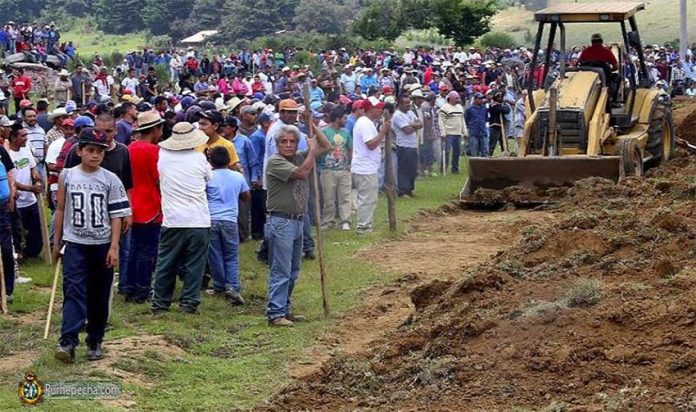
A dispute between Santiago Juxtlahuaca and San Martín Peras in the Mixteca region has been going on for years.

Territorial disputes in Oaxaca have cost the lives of at least 78 people since 2017, according to the state government.

Another 68 people have suffered injuries during heated conflicts over land ownership, while the disappearance of 12 people is believed to be connected to the same issue.

The Secretariat General of the Oaxaca government says there are currently more than 400 unresolved territorial disputes in the state, mainly in the Central Valleys, Mixteca and Sierra Sur regions.

The main reason for the high number is that 81.3% of all land in Oaxaca belongs to ejidos, or agrarian communities, and is therefore owned communally. Complicating the issue further is that half of the 394,000 registered ejidatarios, or community landowners, in the state, are deceased.

Efraín Solano Alinarez, head of the organization Unidad, Identidad y Raices de Oaxaca (Unity, Identity and Roots of Oaxaca, or Unir), told the newspaper El Universal that the figures explain why there is a state of permanent conflict in Oaxaca.

He said the first step in resolving the disputes, particularly in indigenous communities, is to fix the flaws in the collective land ownership system.

Solano said that it is often unclear who owns a parcel of land, explaining that the disorderly growth of towns has in some cases made historical boundaries difficult to identify.

The most serious conflicts occur when private property owners clash with ejidatarios, he added.

To solve the conflicts, the Unir chief said, the records of state and federal authorities need to be consulted to determine the rightful owners of disputed land.

Solano also said that more resources need to be allocated to mediating disputes. To oversee that process, he recommended the establishment of a dedicated government group.

The Unir chief also said that the presence of foreign companies in parts of Oaxaca, especially the Isthmus of Tehuantepec where several wind farms have been developed, has also raised the ire of landowners and led to conflicts.

Solano added that the federal government’s isthmus trade corridor project, which includes the modernization of the railway between Salina Cruz, Oaxaca and Coatzacoalcos, Veracruz, and new mining developments could make existing land conflicts worse or create new ones.

President López Obrador says the trade corridor and other projects such as the Maya Train will bring significant economic and social benefits to the south and southeast.

But Solano warned that “in Oaxaca, the triumph or failure of the president’s social goals will depend on the response he provides to agrarian conflicts.”

Source: El Universal (sp) 

Entrepreneurs in Querétaro looking at China for suppliers

0
The Canton Fair complex, where Querétaro entrepreneurs will be looking for new Chinese partners.

A group of Querétaro businesses is planning a tour of China to look for new partnership opportunities in that country.

Lorena Jiménez Salcedo, Querétaro president of the Mexican Employers’ Federation (Coparmex), said the tour will seek to find new suppliers for Querétaro businesses, as well as other partnerships.

“In China, specifically, we’re mostly looking at suppliers, but we don’t have a specific focus on one area,” she said. “We’re going to look at different contacts that could work as suppliers both for medium and large businesses, or suppliers who can provide specific parts that are necessary for the production chain.”

The delegation will attend the China Import and Export Fair, also known as the Canton Fair, which will take place from October 15 to November 4, and will be attended by around 20,000 businesses.

Jiménez said it is important for Querétaro business to look for alternative partners outside North America. The organization is also looking to build commercial relationships in Brazil.

Coparmex Querétero is also working with Querétaro’s World Trade Center on planning trade missions to other countries. The first will be a visit to Washington between October 1 and 4 to meet with personnel from the World Bank, the Inter-American Development Bank and the Mexican Embassy.

The announcement comes at a time when Chinese businesses are showing more interest in investing in Querétaro because of the trade war between China and the United States, according to Querétaro Sustainable Development Secretary Antonio del Prete Tercero.

Source: El Economista (sp)

Firm plans 7-billion-peso industrial park in Querétaro

0
Artist's rendering of new industrial park in Querétaro.
Artist's rendering of new industrial park in Colón.

The Mexican construction firm Construye Industrial announced that it will build a 7-billion-peso (US $354-million) industrial park in Querétaro, its third in the state.

To be located in the municipality of Colón, just 4.5 kilometers from the Querétaro Intercontinental Airport, the Kaizen industrial park will house both industrial and commercial facilities, as well as services such as a gas station and a 150-room hotel.

The investment includes 3 billion pesos for industrial logistics and manufacturing facilities and build-to-suit lots. Another 2.5 billion will go to data and call center offices, general offices and the hotel. And 2 billion pesos will be dedicated to commercial investments.

The Kaizen project will be LEED-certified, making it a green facility through the use of a sustainable transportation network, 100% renewable energy and the inclusion of green spaces.

The gas station will be the first in Mexico to offer not only gasoline and diesel but natural gas and electrical charges.

Construye Industrial says the project will generate around 1,500 jobs both directly and indirectly through the establishment of 150 businesses. It said it hopes to establish better salaries in the area due to the growth and development of different types of commercial services available to local residents.

Source: El Financiero (sp)

Youths’ made-in-Mexico nanosatellite launches in December

0
The satellite will be launched aboard a SpaceX Falcon-9 rocket.

The first nanosatellite to be completely designed and made in Mexico will be launched from Cape Canaveral in December on a mission operated by Elon Musk’s SpaceX.

Approved by NASA last year, the AztecSat-1 was designed by students at the Popular Autonomous University of Puebla (UPAEP), together with the National Council of Science and Technology (Conacyt) and the private space initiative MX Space.

“It is now ready to be launched into space,” said Andrés Martínez, director of special programs in NASA’s Advanced Systems Division. “It will be a historic day.”

The launch will take place on December 4 on Mission SpaceX-19, the Mexican Space Agency (AEM) reported.

“Our youth are making history,” said AEM director Javier Mendieta Jiménez. “It will be the first satellite to be launched during the administration of President Andrés Manuel López Obrador. It represents an achievement of young Mexican talent in the Fourth Transformation.”

The nanosatellite will be put into orbit by SpaceX’s Falcon-9 rocket, on which the Mexican development team worked.

“Their performance is now comparable to many NASA engineers,” said Mendieta.

Once in orbit, the AztecSat-1 will be allowed to interconnect and transmit data to the Globalstar satellite constellation.

AEM’s head of the AztecSat-1 project, Carlos Duarte Muñoz, praised the young people’s achievement.

“This launch will demonstrate that the talent of our young people can make history and is literally infinite,” Duarte said.

Source: El Financiero (sp)

Taxes no deterrent to junk food consumption: AMLO

0
junk food
Taxes haven't stopped consumers from choosing less than healthy options.

President López Obrador acknowledged that taxes on unhealthy food and cigarettes have not been successful in discouraging their consumption, but the government plans on raising them anyway.

“It can’t only be about paying more taxes, there needs to be more information for the people,” he told his morning press conference on Monday.

The president also announced that his government will launch an awareness campaign to promote healthy diets.

“We’re going to carry out a media campaign,” he said. “It will be about how to eat well, eat healthy, and not be influenced by advertising that pushes you to eat junk food that not only affects your health, but also your wallet.”

He added that he hopes to promote traditional Mexican beverages as alternatives to soda, like pinole, pozol and chilate.

The government’s 2020 budget includes a new increase on cigarettes and junk food, which is expected to bring in an additional 62 billion pesos (US $3.12 billion).

Source: El Universal (sp)

7 days of Narda leaves a trail of damage on Pacific coast, killing at least 2

0
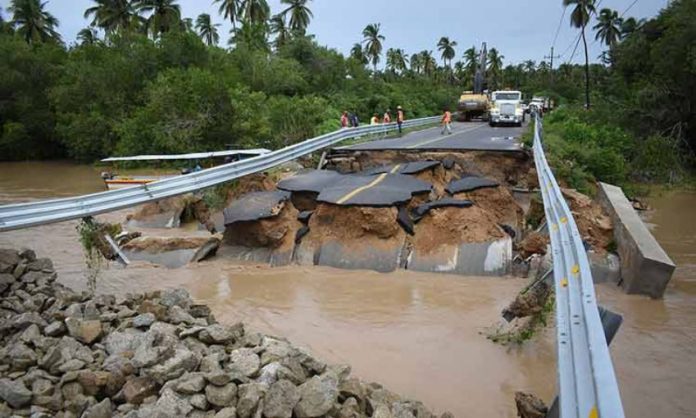
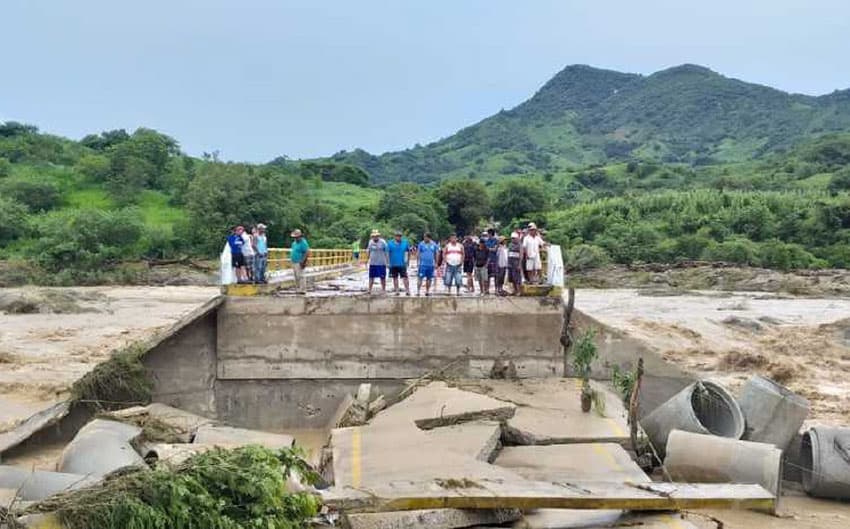
Washed-out bridges and mudslides cut off many communities in Guerrero.

Tropical storm Narda left a trail of damage along Mexico’s Pacific coast as it moved northward during the past seven days, hitting the states of Oaxaca and Guerrero particularly hard.

The storm claimed the lives of two people in Oaxaca: a 23-year-old man and a 17-year-old boy who were swept away by floodwaters while trying to cross rivers in the municipalities of San Pedro Mixtepec and San Jerónimo Coatlán respectively.

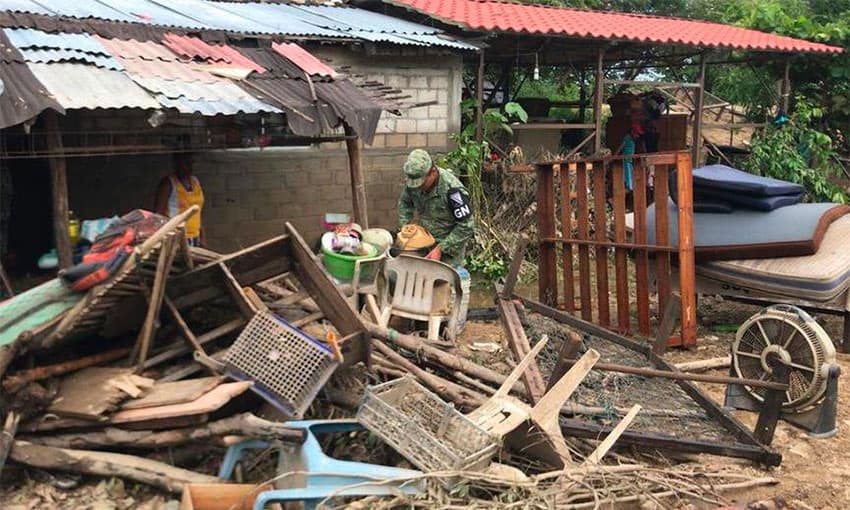
About 300 homes and at least 11 schools were damaged in the southern state as was the hospital in Tutupec, a municipality halfway between Puerto Escondido and Pinotepa Nacional.

At least nine rivers broke their banks, scores of trees fell, access to 47 Oaxaca municipalities was cut off and more than 800 people took refuge in shelters.

Federal transportation official Jaime López Carillo said that sections of three federal highways in Oaxaca collapsed due to heavy rain brought by Narda.

A National Guardsmen provides aid to flood victims.

Federal Highway 200 was closed on Monday from the Guerrero border to Puerto Escondido due to landslides and flooding, while sections of the Oaxaca-Miahuatlán-Puerto Ángel highway and the road between Pinotepa Nacional and Putla de Guerrero were also impassable.

Oaxaca transportation official David Mayrén Carrasco said that 23 rural roads in the state had also closed.

In Guerrero, Narda caused the collapse of sections of several roads and highways, triggered landslides, damaged schools, felled hundreds of trees, cut power in parts of the state and flooded about 800 homes.

Acapulco Mayor Adela Román Ocampo said the city’s three water supply systems sustained rain damage and that residents could be without running water for two to three weeks.

The newspaper Milenio reported that at least eight towns in the municipalities of Juan R. Escudero and Tecoanapa remained cut off on Monday after the Omitlán river broke its banks and caused a 100-meter-long section of road leading to a bridge to collapse.

In Tixtla, a municipality just east of the state capital Chilpancingo, the entire drainage system collapsed after Narda dumped torrential rain. One person was reported missing in the area.

Damaged bridge leaves Guerrero residents stranded.

Guerrero Governor Héctor Astudillo asked federal authorities on Monday to declare a state of emergency in 28 municipalities in order to access funds to purchase food, water and other essential supplies.

Narda also caused damage in Michoacán, Jalisco, Colima and Nayarit.

The Colima-Manzanillo and Manzanillo-Barra de Navidad highways closed on Monday due to landslides, while at least 120 homes were damaged in Jalisco. Three people were rescued from a flooded creek in Nayarit while activities in the port of Mazatlán, Sinaloa, were temporarily suspended.

National Civil Protection authorities said that rain brought by Narda forced the closure on Monday of schools in 138 municipalities in six states: Guerrero, Oaxaca, Michoacán, Jalisco, Colima and Sinaloa.

The United States National Hurricane Center (NHC) said the remnants of Narda were located 210 kilometers northwest of Los Mochis, Sinaloa, at 10:00am on Tuesday.

Maximum sustained winds had decreased to about 45 kilometers per hour and no coastal watches or warnings were in effect but rainfall is still likely across portions of northwestern Mexico, the NHC said.

Source: Expansión Política (sp), El Universal (sp), El Imparcial (sp), Informador (sp), Milenio (sp) 

AMLO favors university admission without entrance exams

0
Students line up for a university entrance exam in Guadalajara.

President López Obrador said Tuesday he would support ending admission exams for public universities.

“I don’t support admissions tests,” he told reporters at his morning press conference. “I think everyone should have the chance to study. If they are behind there should be a catch-up period so that they can study, but we shouldn’t reject people.”

He noted that 60% of students at the National Autonomous University (UNAM) are from poor families because UNAM automatically admits students who come from UNAM high schools, while only 35% of students at other public universities come from poor families.

“In the neoliberal period, they used the excuse that young people hadn’t passed the test to reject them,” he said. “But it was a lie. It’s not that they didn’t pass the test, it’s that there were no spaces, because there was no budget for the universities; it was a pretext to privatize education.”

The president added that a central part of his political project is improving access to higher education, and that his government is working on opening 100 public universities around the country.

“Everyone needs to have the opportunity to study,” he said. “I don’t believe in the policy of rejection, it’s a thousand times better for a young person to study than to have them on the street.”

Source: El Financiero (sp), Forbes México (sp)

Over-exploitation of water is drying up Chihuahua oasis of Cuatro Ciénegas

0
In Cuatro Ciénegas, there is far less water than there used to be.

Over-exploitation of water has dried up more than 90% of the Cuatro Ciénagas marshland in Coahuila’s Chihuahua Desert.

One hundred years ago, natural springs and waterways covered 2,500 hectares of land in the Cuatro Ciénagas reserve, a unique biosphere located about 80 kilometers east of Monclova.

Today, water extends over an area of less than 250 hectares, mainly due to the diversion of the natural resource for use in alfalfa farming during the past 20 years.

To begin to remedy the situation, federal authorities and the Coahuila government intend to lobby President López Obrador to support a restoration plan for the wetlands.

They also plan to hold a series of public meetings so that local residents, alfalfa farmers, researchers and government representatives have the opportunity to analyze and discuss how to restore Cuatro Ciénagas to its former glory.

Diversion of water for irrigation is blamed for the depletion of the marshlands.

“The Cuatro Ciénagas valley is in a situation of extreme stress because its [water] area has been reduced by more than 90%,” said National Water Commission (Conagua) chief Blanca Jiménez Cisneros.

“It’s an issue of concern because it’s on the verge of disappearing, the problem is very complex. It’s not just [a matter of] Conagua holding back the water . . . biological recovery has to be achieved in a comprehensive way [with the participation of several] government departments, we can’t do it on our own,” she said.

Valeria Souza, a researcher at the Institute of Ecology at the National Autonomous University who has studied the drying of Cuatro Ciénagas for the past 20 years, told the newspaper Milenio that canals that carry water away from the natural pools and waterways for agricultural purposes are to blame. She called for the immediate closure of all irrigation canals that deplete the area of its water.

One canal, known as Saca Salada, which was built in 1900 and diverts up to 2,000 liters of water per second, is one of the main culprits.

Souza said that due to the poor planning of the uncovered canal and evaporation, only 10% of the water it carries reaches its final destination: agricultural lands 80 kilometers away in the municipality of Frontera.

“It’s pure stupidity, [the canal] was thought up a hundred years ago when they started to establish agricultural lands and the wetlands were in a good state . . . This is the bleeding of Cuatro Ciénegas,” she said.

Cuatro Ciénegas biosphere reserve in Coahuila.

Since the 1960s, increasingly greater quantities of water have been diverted for agricultural purposes and in the 1980s, the Cañón river, which for years was the main source of drinking water in the area, ran dry.

In 2000, a project that diverted water to the south of the municipality of Valle del Hundido began placing even greater pressure on Cuatro Ciénegas’ water resources and eventually caused both the Nuevo Atayala spring and the Churince lagoon to dry up, the latter in 2016.

Patricia Olmedo, head of the genetic engineering department at the Center for Research and Advanced Studies in Irapuato, Guanajuato, said that the damage to the lagoon is “irreversible,” explaining that fish and endemic turtles were victims of the project.

“If we close the sluices, it will take us five years to restore the site. It’s possible to recover it but we have to do everything very quickly. What we can’t allow is for the spring to dry out because then there would be nothing we could do,” she said.

Over time, environmental authorities hope to convince local farmers to transition away from the cultivation of alfalfa to crops that don’t require such large amounts of water, such as the nopal, or prickly pear cactus.

To begin to restore the area in the short term, Conagua and the Natural Protected Areas Commission have designed a project that diverts water from one irrigation canal back to dried-up marshland.

However, Coahuila Environment Secretary Eglantina Canales acknowledged that it will only restore a very small area of the bacteria-rich Cuatro Ciénegas reserve and that a lot more needs to be done.

“Of course, it’s not enough . . . We hope . . . to do a longer-term project that allow us to flood a much larger area and which avoids unnecessary losses [of water] . . .” she said.

Source: Milenio (sp)