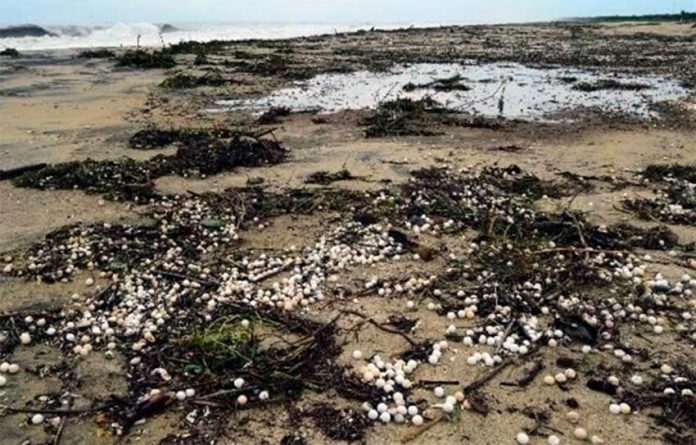
Environmental authorities have estimated that Tropical Storm Narda destroyed more than eight million turtle eggs in nests on beaches in Oaxaca.
The local delegation of the Natural Protected Areas Commission (Conanp) said that torrential rain, strong wind and large swells brought by Narda, which made landfall in the southern state last Saturday, damaged 44,000 nests at the Playa Escobilla turtle sanctuary, causing the loss of approximately 4.4 million eggs.
South of Escobilla, near the oil refinery city of Salina Cruz, just under four million eggs in almost 40,000 nests were destroyed at the Morro Ayuta sanctuary, Conanp said, bringing the total number of lost eggs to 8.39 million.
The figures, which assume an average of 100 eggs per nest, were calculated following censuses carried out at the two sanctuaries on September 30.
Conanp said the storm damaged 9.5% of all nests in which eggs were laid during the third mass arrival of turtles this nesting season, which began on August 21.
Millions of turtle eggs were lost on Oaxaca beaches.
It also said that a wide range of debris, trash and vegetation washed up on both beaches after the passing of Narda, which caused widespread damage in Oaxaca and cut off access to 46 communities for days.
“After the battering . . . it will not be an easy task [to restore the beaches]. It will require the joint effort of the public, authorities of the three levels of government and non-governmental institutions and organizations,” Conanp said.
Clean-up efforts assisted by local youth and environmental authorities began on Tuesday.
In the immediate aftermath of the storm, the head of the turtle protection group Tortuga Verde criticized authorities for not implementing measures to protect the Escobilla sanctuary.
Rubén Sánchez said that neither the environmental protection agency Profepa nor the federal Secretariat of the Environment did anything to stop or limit the destruction of the nests.
Six of the world’s seven sea turtle species come ashore in Oaxaca to lay their eggs, most notably the olive ridley sea turtle. The Escobilla and Morro Ayuta beaches are among the world’s most important turtle nesting sites.
Turtle eggs have been destroyed during past weather events including tropical storms and hurricanes, and they are also sold in Juchitán de Zaragoza, Oaxaca, despite a federal ban on their consumption.
Would-be turtle hatchlings were not the only wildlife affected by Narda in Oaxaca: heavy rain flooded crocodile habitats in some parts of the state, causing the reptiles to flee their usual habitat for populated areas, including the towns of Pinotepa Nacional and Huazolotitlan.
A rescue worker pulls a man out of floodwaters in Jalisco.
It only took eight minutes of rain from Tropical Storm Narda to turn the coastal paradise of Yelapa, Jalisco, into a flooded nightmare and leave extensive damage in its wake.
Losses have been estimated at 20 million pesos (US $1 million) in Cabo Corrientes, the municipality in which Yelapa is located, where 300 households have been affected and at least 30 have lost everything.
Located just south of Puerto Vallarta, the town has about 1,500 Mexican and foreign residents, of whom about 80% remained to wait out the storm. Locals said that they have never seen flooding like that which surged through town on Sunday.
Espiridión Joya Ramos has lived for decades in Yelapa, where he and his grandson ran a small restaurant on the shore of the river next to a waterfall. The flood swept everything away.
“The water arrived just before it got dark, around 7:30 or 8:00pm. I’ve lived here 49 years, and from what I can remember, there has never been flooding like this. The river burst its banks, taking with it houses and everything in its path,” Joya said.
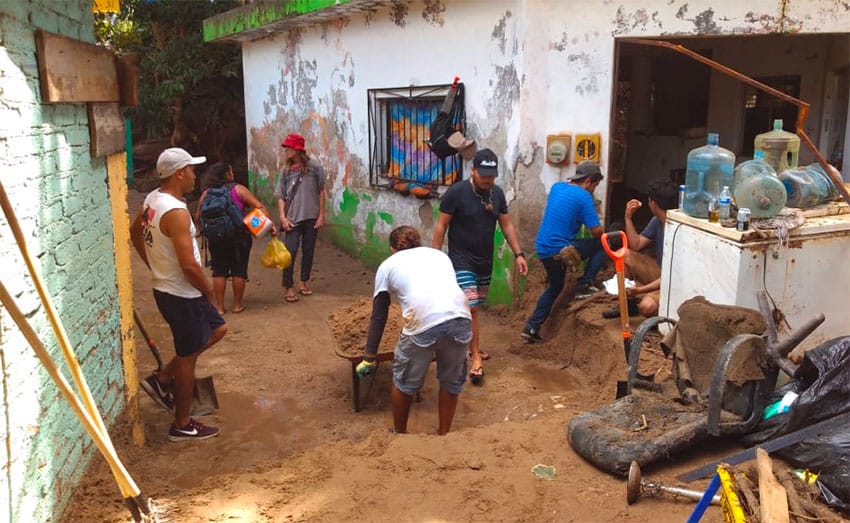
Cleaning up in Yelapa after Tropical Storm Narda.
Another victim, Rufino Córdova, barely escaped the rushing waters.
“The river got really full and it was taking all the rocks with it . . . here where I live, I would have drowned, but I’ve got a couple of large rocks there that protected me,” he said.
On Tuesday morning, families were trying to recover their belongings.
“It happened in the blink of an eye,” said María Magdalena Lorenzo, who fled to the second floor of her house when the ground floor flooded. “In less than five minutes we were already flooded. We didn’t have time to grab anything.”
Personnel from the navy, National Guard and Civil Protection agency surveyed the damage on Monday morning, but left immediately thereafter.
“The navy came, but they only checked for injured and dead,” said Román Lorenzo, one of hundreds of residents who were cleaning up. “We haven’t received any help on the part of the government to clean up.”
Since the day of the storm, Yelapa residents have been without electricity, drinking water, telephone and other services. Those who have generators have been able to use them to charge their phones to call Puerto Vallarta, from which supplies are being sent.
So far three tonnes of food, water and other supplies have arrived, but the town is still in need of more.
Students march in protest against violence in Celaya.
An auxiliary police officer in Celaya, Guanajuato, has been relieved of his duties after suggesting a repeat of the Tlatelolco massacre to deal with students who have been protesting in the city this week.
Celaya security officials announced the dismissal of the officer and distanced itself from the comments he made on his Facebook page.
“Hopefully they’ll do a Tlatelolco version 2.3,” the officer’s post read, accompanied by photos of the protesters.
October 2 was the 51st anniversary of the student massacre at Tlatelolco, in which 300-400 students were killed by government forces. Invoking the atrocity sparked outrage and calls for the officer’s removal on social media.
The municipal government said it would not tolerate any expression against the safety of citizens.
“The municipal government, via the Secretariat of Public Security, reports that officer Miguel Alejandro ‘N.’ was immediately dismissed from his post this Tuesday for making comments that are not in accord with the vision and values that represent this administration,” said Celaya police in a press release.
Students at the Celaya Campus of the National Technical Institute of Mexico (TNM) have been protesting since Monday against insecurity faced by the student body and the death of Gabriel Luna Ibarra, who was murdered after leaving school on Saturday.
Over 10,000 students from nine universities gathered in downtown Celaya on Tuesday to repudiate the violence in the city and to demand justice for the three students murdered this year.
President López Obrador denied on Thursday that Pemex is seeking to take over a Gulf of México oilfield where a United States company discovered a significant reserve in 2017.
A report published on September 30 by the news agency Reuters said the state oil company wants to seize control of Zama, a shallow water field containing almost a billion barrels of oil that is operated by a consortium led by Texas-based Talos Energy.
According to an unpublished draft report by the consultancy Wood Mackenzie, about a third of the reserve likely extends into an adjacent Pemex field although that hasn’t been confirmed because the state-run company hasn’t yet drilled there.
Asked at his regular news conference whether Pemex was seeking operational control of Zama, López Obrador responded:
“No, it’s a reserve that is shared with Pemex and there is no problem.”
The president asserted that his administration is not reviewing any exploration or drilling contracts awarded by the past government following the 2014 energy reform.
“We don’t commit any arbitrary acts,” López Obrador said.
The president also responded to a report published today by the newspaper Reforma which quoted a U.S. Department of State official as describing the possibility of Pemex taking over control of Talos’ project as a “disturbing development.”
Kurt Donnelly, deputy assistant secretary for energy diplomacy, also said that the United States government would defend U.S. interests in Mexico and has communicated as much to the López Obrador administration.
“Mexico was seemingly on the right path. This might indicate that they are deviating,” he told Reforma.
López Obrador said the official was misinformed and questioned why he hadn’t discussed the issue with the Secretariat of Foreign Affairs.
“. . . With all respect, why is the Department of State intervening [in this way]. They should do it through Foreign Affairs, ask us for information . . . They have to act with respect to our sovereignty,” he said.
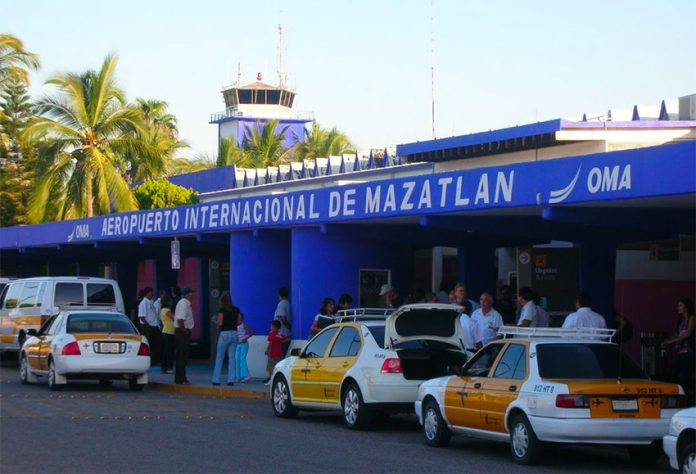
More international connections sought for Mazatlán.
Sinaloa is working to open up more international and domestic air routes to its airports in Mazatlán, Culiacán and Los Mochis.
International routes linking Mazatlán to Seattle, San Francisco and Denver were on the table when Tourism Secretary Óscar Pérez Barros met with the state’s hotel association and the general manager of airport operator Grupo OMA to discuss strategies for bringing more airline travelers to the state.
The same strategies will be applied to the domestic market in order to focus on opening routes to Ciudad Juárez, Puebla and the Bajío region, and on increasing frequency to Monterrey and Mexico City. The strategies are expected to spark an increase in visitors to Sinaloa.
Pérez also had a meeting with the general manager of airline Magnicharters in which they initiated talks to confirm a route from Mazatlán to Ciudad Juárez-El Paso by winter, and one from Mazatlán to Chihuahua by next summer.
The secretary reiterated that the vision Governor Quirino Ordaz Coppel’s expressed at the 2019 Tianguis Turístico conference has piqued the interest of large hotel chains like Grupo Presidente, AM Resorts, Habita, Hyatt, Hilton, Radisson and Fiesta Americana Grand.
Courtyard by Marriott, One, Fiesta, City Express Plus and Avid have already confirmed plans to build more hotels in Sinaloa.
As for other sources of tourism, Mazatlán will begin to welcome 5,000-passenger Norwegian and Carnival cruise ships this season. These big-ticket cruise lines will bring high-profile passengers who are expected to spend a lot of money during their stays. Celebrity and Royal Caribbean have also confirmed that their 4,000-passenger liners will begin visiting Mazatlán in 2021.
The environmental protection agency Profepa has begun evaluating possible environmental damage from a fire on a tuna boat on Tuesday in Manzanillo, Colima.
The fire started around noon on the María Verónica, which was about to leave from the Fondeport pier.
Shortly before the boat caught fire, workers were doing maintenance welding on the boat, but the cause of fire is still not known. The María Verónica was carrying 680 liters of diesel fuel, which created a column of black smoke when it was consumed by the fire.
The port’s emergency response team, which includes navy firefighters, arrived at the scene to fight the fire and contain leaks of harmful materials. More than 1,200 people were evacuated from around the port, which was shut down for several hours.
After around 24 hours, firefighters were able to extinguish the blaze. There were no casualties.
The boat is owned by the company Grupo Mar, which produces the Tuny brand of canned tuna.
Profepa inspector Javier Martínez said the agency has been monitoring air and water quality near the port to see if it has been affected by the fire, and that it will carry out a more thorough investigation.
He added that flame retardant used in the firefighting effort did not have any negative effects on water quality.
Quintana Roo police have arrested a man they say is the leader of the Pelones crime gang that operates in Playa del Carmen.
Jonathan “N,” also known as “El Pantera,” was arrested in Cancún after an investigation by state and federal police. He was carrying drugs and guns when he was captured.
The suspect is wanted for several murders and attempted murders.
Quintana Roo Attorney General Óscar Montes de Oca said he is likely responsible for the murder of Daniela Patiño, a Colombian woman whose body was found in Quintana Roo in September.
Patiño arrived in Playa del Carmen in August when she escaped from a human trafficking network that was holding her against her will in Guatemala. She disappeared on September 10, and her body was found seven days later.
“We believe [Jonathan “N”] participated in the femicide of a young woman from Colombia,” said Montes de Oca. “Before being killed, she received extortion messages which, according to witnesses, came from the suspect’s telephone.”
Montes de Oca added that Jonathan “N” is highly dangerous and responsible for many violent incidents in the northern part of the state, especially the municipality of Solidaridad, in which Playa del Carmen is located.
The mostly peaceful march on Wednesday in Mexico City.
More than 10,000 people marched in Mexico City on Wednesday to commemorate the 51st anniversary of the 1968 Tlatelolco massacre, during which at least 300 students were killed by government forces.
Members of more than 15 social organizations and public university students made up the bulk of the marchers who gathered yesterday afternoon at the Three Cultures Plaza, the scene of the slaying that occurred at a rally held amid social and political unrest 10 days before the opening of the Mexico City Summer Olympics.
The march left the plaza at 4:00pm bound for the zócalo, the capital’s central square.
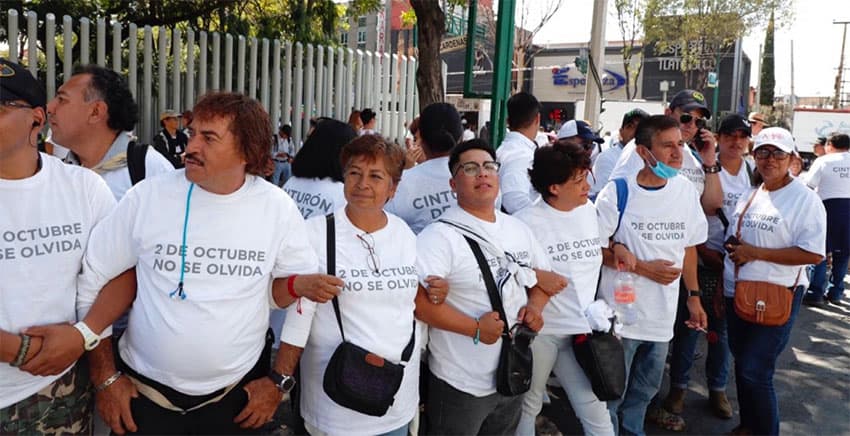
About 12,000 Mexico City government workers lined the route to form a so-called cinturón de paz (peace belt), a strategy intended to prevent acts of violence and vandalism such as those that occurred during last week’s march for the 43 students who disappeared in Guerrero in 2014.
Almost all businesses that lined the route closed on Wednesday afternoon and some erected barriers to prevent the possibility of being targeted by radical protesters. Monuments, museums and most government buildings were also boarded up for protection and a plywood fence surrounded the Palace of Fine Arts.
Protester spray paints ‘peace belt’ participants.
The cinturón de paz, however, was unable to prevent a group of masked men and women from carrying out a vandalism spree whose commencement was marked by the explosion of a rocket on Eje Central, a major thoroughfare that runs through the historic center.
Self-styled anarchists proceeded to throw rocks at the Bank of México building located on the corner of Eje Central and Avenida 5 de Mayo and deface its façade with graffiti that denounced government involvement in past atrocities.
The masked individuals committed more acts of vandalism on the latter street, smashing glass at newspaper kiosks and street advertising as well as spray-painting anti-government slogans on storefronts or the barriers that protected them.
A small number of Molotov cocktails were also thrown in the direction of police officers, who didn’t patrol the march route but were present in large numbers on adjacent streets.
Shortly after, a rally commenced in the zócalo at which Felix Hernández Gamundi, a leader of the 1968 student movement, called for an end to impunity, demanding justice for the victims of the Tlatelolco massacre and other allegedly state-sponsored acts of violence.
Arms linked, Cinturón de Paz keeps the peace.
“. . . We have to break with the state of impunity that the intellectual and material culprits of the 1968 massacre have enjoyed,” he said.
“. . . We don’t want another Ayotzinapa,” Hernández added, referring to the disappearance of the 43 students.
“. . . These incidents have kept repeating because the country hasn’t been capable of enforcing the law or justice in order to break impunity.”
At 6:10pm, the exact time that the 1968 massacre began, the names of all the victims were read out after which a minute of silence was held in their memory. A large contingent of police observed the rally while guarding the National Palace, which was damaged last week and has been targeted at previous Tlatelolco marches.
While the rally was taking place, masked radicals, most of whom were dressed completely in black, clashed with police in surrounding streets.
Police were verbally abused and attacked with stones and fireworks on one street before the instigators were repelled only to engage in another clash in a nearby street minutes later.
Some marchers were less than peaceful.
Three encapuchados (hooded persons) were detained by police but almost immediately released, the newspaper Milenio reported.
In a statement issued last night, the Mexico City government said “the objective of these groups was to provoke a scene of repression” in which police officers would use force against protesters, “which didn’t occur.”
Fourteen people were hurt during the clashes, most of whom were police officers who suffered only minor injuries, the statement said. However, three police were transferred to hospital for treatment.
Despite the acts of vandalism and aggression, the government described the deployment of the officials who formed the cinturón de paz as successful, asserting that they “contained the violence.”
Mayor Claudia Sheinbaum recorded a voice message that was disseminated among the officials in which she thanked them “infinitely” for their work.
“It’s very important civic work, we managed to contain the violence. I know that there were tense moments but you really are heroes . . .” she said.
Some of the officials, who work in either the Mexico City government or those of the capital’s 16 boroughs, complained to reporters that they were forced to attend the march and carry out security duties for which they are not trained.
Having been supplied with identical white t-shirts announcing they were part of the cinturón de paz, they were an easily-identifiable target for the radical protesters, some of whom used their spray paint on the shirts. El Universal reported today that the city government spent 960,000 pesos (US $49,000) to buy them.
The federal government has issued a new call for National Guard recruits, offering a monthly salary of 19,000 pesos (US $960) and a range of benefits.
An advertisement published by the Secretariat of Security and Citizens Protection (SSPC) says that members of the new security force will receive annual bonuses, 20 days of paid vacations, mortgage credit, meals, life insurance and pension payments and other benefits.
New recruits who are willing to relocate to join the National Guard will be offered moving services free of charge.
The salary on offer is about 4,000 pesos higher than that earned by new recruits of the Federal Police, which the government plans to disband.
The SSPC is looking for both male and female recruits aged between 18 and 30. Applicants must be Mexican by birth, unmarried and not living with a partner.
Minimum height restrictions of 1.63m for men and 1.55m for women apply and both sexes must have a body mass index of between 18.5 and 27.9. People who have previously belonged to one of the armed forces or a police force are ineligible.
The government is aiming to recruit 21,170 new recruits by the end of the year for the new force, which was officially inaugurated at the end of June after which its members were deployed to 150 regions across the country.
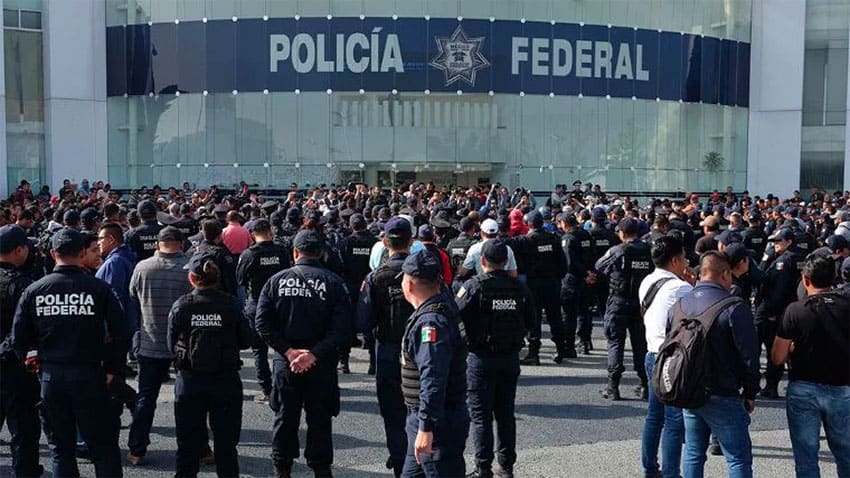
Meanwhile, more than 15,000 Federal Police officers who refuse to be transferred into the National Guard are continuing to demand compensation from the government.
Iván Chávez, a lawyer for the disgruntled officers who blocked access to the Mexico City airport during a September 13 protest, said that each officer is seeking about “half a million pesos” (US $25,200) in compensation for the government’s decision to dissolve their employer.
A further 1,500 officers have indicated that they will settle for severance pay of 350,000 pesos, he said.
At least 15,000 federal cops don’t want to transfer to the new force.
The newspaper El Economista reported that meeting the officers’ demand would cost the government around 8 billion pesos (US $403.9 million).
Federal Security Secretary Alfonso Durazo said in July that the Federal Police would be disbanded within 18 months and that intention was formalized on Monday via an announcement published in the government’s official gazette.
The same day, officers who belong to a group called Ciudadanos Uniformados (Uniformed Citizens) delivered a letter to the SSPC that reiterated that they do not want to join the National Guard.
Chávez, the police lawyer, said that disbanding the Federal Police is a mistake although he acknowledged that officers who do agree to join the National Guard will be better off financially.
One officer willing to make the shift is Higinio Amezcua, a 49-year-old with 18 years of experience in the Federal Police.
“It’s not a good idea for me to be going around looking [for a new job]. God willing, I’ll just finish another 12 years and then I’ll leave,” he told El Economista.
While acknowledging the benefits of joining the National Guard, which will recognize his years of service in the Federal Police, Amezcua said that becoming a member of the new security force won’t be easy, especially initially, because it is currently going through inevitable teething problems.
“To me it seems that the Guard is in diapers,” he joked.
Federal Police officers who decide not to join the Guard, or don’t meet its entry requirements, will have the opportunity to take up positions in one of several other government agencies managed by the SSPC.
They include Civil Protection services, the National Anti-Kidnapping Commission and the department that manages Mexico’s federal prisons.
Officers who have not yet made up their mind whether they want to join the National Guard or not need to act fast.
Four competing drug cartels are extorting avocado producers in Michoacán, Mexico, showing how the fruit is becoming an increasingly important source of illicit profits in the context of shifting criminal dynamics in the state.
The Jalisco Cartel New Generation (CJNG), the Nueva Familia Michoacana, the Tepalcatepec Cartel and the Zicuirán Cartel are all involved in this growing criminal economy, according to Michoacán’s attorney general.
Michoacán produces over 80% of Mexico’s avocados, with an annual export value of around US $2.4 billion, earning the fruit the nickname “green gold.”
The cartels charge a monthly protection payment from avocado producers, calculated per hectare cultivated or kilogram exported. Those who fail to make the payments may be kidnapped or killed. One distributor’s daughter was assassinated at the door of his business, El País reported.
In addition, avocado theft is rampant. At least four truckloads of the fruit are stolen every day in the state, according to the Guardian.
Competition for these criminal profits has fed into the wave of violence currently engulfing Michoacán. In August 2019, 19 people were massacred in Uruapan, the center of Michoacán’s avocado industry. Their bodies were displayed in three locations around the town.
Authorities linked the atrocity to a territorial war between the CJNG and the Viagras, the armed wing of the Nueva Familia Michoacana, for control of the town’s criminal economies.
InSight Crime analysis
The extortion of Michoacán’s avocado growers is not new, but is now resurging as the industry’s profitability has boomed as criminal economies in the state have withered.
Michoacán and neighboring Guerrero have long been prized by criminal groups as the center of Mexico’s heroin production. However, the rise of synthetic opioids has caused the price of opium to plummet to under a third of its 2017 value, leaving drug cartels scrambling for alternative income streams.
The value of Mexico’s avocado industry has quadrupled over the last decade due to the fruit’s growing popularity in the United States and Europe. The country’s avocado exports to the U.S. market alone rose by 16% between 2018 and 2019.
Several of the state’s criminal players are experienced at shaking down the avocado industry. The CJNG has reportedly used the tactic to fund their expansion since the 1990s, while the Familia Michoacana entered the business around 2009. They and their splinter groups were thus well-placed to supplement declining opium profits by tightening the screws on local avocado growers.
The resurgence of this criminal economy also reflects the weakening of Michoacán’s self-defense groups. These emerged in 2014 partly in response to such extortion practices and achieved a temporary respite for producers in some regions.
In subsequent years, however, many of these groups have themselves been infiltrated by criminals, leaving local businesses vulnerable once again.
Reprinted from InSight Crime, a foundation dedicated to the study of organized crime.