Home Blog Page 1776

Mexico City airport is sinking as much as 30 centimeters a year

0
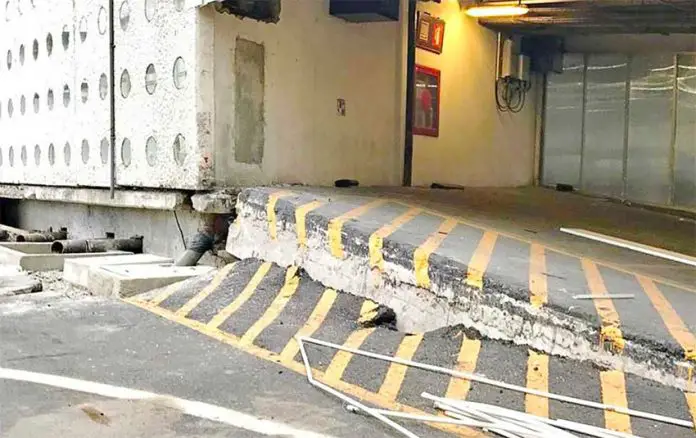
In some parts of the airport the ground has sunk as much as 1.3 meters.

Mexico City’s Benito Juárez International Airport is sinking at a rate of up to 30 centimeters a year, according to a report released by the airport administration.

The airport is also in need of an updated assessment of the structural damages that resulted from the earthquakes of September 2017, the report said.

Even though remedial and reinforcement work has been carried out in order to maintain adequate operational conditions and attend to damages done by the earthquakes, there is evidence that various airport installations have sunk “between 21 and 30 centimeters a year.”

The airport’s study of structural damages to Terminals 1 and 2, carried out in April, attributed the sinking to the extraction of water from the aquifer below the structure, which contributes to widespread sinking in other areas of Mexico City.

“This situation has been ongoing for the past 30 years,” stated the report, “and there are no signs that it will change in the foreseeable future.”

The Center for Research in Geography and Geomatics (Centrogeo) determined that some areas of Mexico City have sunk as much as 25 centimeters, 10 times the monthly average, since the 7.1-magnitude earthquake of September 19, 2017.

Since 2017, structural damages have been found in the airport’s two terminals, both of which have seen significant increases in traffic in recent years.

The number of travelers passing through Terminal 2 has more than doubled in the past 10 years. Terminal 1 saw a 63% increase in visitors in the same period.

The most prominent structural damages found were uneven floors, sunken and cracked foundations and weakened girder joints. After the quakes in 2017, beams supporting rooftop advertisements were removed after being found to be too weak to be safe.

Despite the findings, the airport administration declared that both terminals are currently in adequate condition in terms of security and operability. However, it reported that “if these issues are not dealt with, it could generate structural security problems in the future.”

Source: El Universal (sp)
Mexico City’s Mercado Portales celebrates 62 years with birthday bash

0
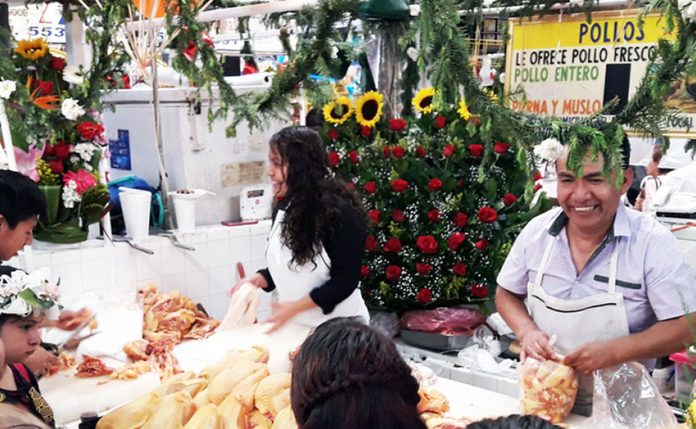
Pollo Ismael, a family business at the Mercado Portales.

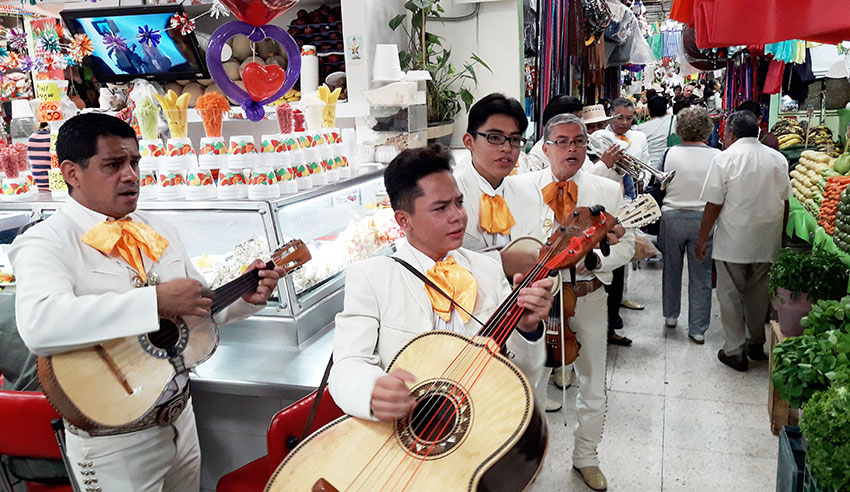
Mercado Portales celebrated its 62nd anniversary on August 10 with live music, festive decorations and gifts for customers.

Every year on the anniversary of the market’s opening, owners and operators of the 600 individual puestos throw a public party to commemorate the history of the market and to show appreciation to their clientele. This year, in addition to mariachis playing up and down the narrow passageways, they included a stage with traditional Mexican performers.

Many vendors give away small items to commemorate the anniversary. Gifts ranged from calendars and Tupperware to traditional Mexican food and tequila.

“Lots of people come for their gifts, so we always sell more on the anniversary,” said Ismael Flores Valdez, proprietor of Pollo Ismael.

This year Flores gave away tostadas de tinga de pollo, a traditional dish prepared from chicken, tomatoes, onions, and chipotle and served on fried tortillas. Like many workers in the market, Flores puts in seven days a week. He inherited the puesto from his family and has been working there for over 20 years.

Araceli Chavira has worked at Fruta Ara for 28 years.

Araceli Chavira, owner and operator of Fruta Ara, says she does not see much of an increase in sales during the anniversary. “The same people who come to me all year to buy fruit will come today, but the rest are just here for the party.”

Chavira has worked in Mercado Portales with her sister for 28 years. They inherited the business from their mother, the original owner when the market opened in 1957. It will pass to a third generation, her children, when she decides to retire.

Chavira has seen the growth in the size and popularity of the market first-hand. “The market expands every year. They put up more and more puestos outside and now it goes for blocks. To see it from the outside, it’s not the same market.”

She also works seven days a week. “When you sell fruit, if you take a day off, your fruit starts to spoil. Then you must sell it at a lower price than you bought it for. The only way to make money is to come here every day.” Chavira says she rests “when necessary.”

In Viveros Portales, Guadalupe Zenón offered free plates of three traditional Mexican dishes — mole verde, pipián, and tinga de res — to thank her regular customers.

“This year the anniversary falls on a Saturday, so we have far more customers today. When it falls on a weekday, it’s never as big.”

A mariachi band plays for the market's anniversary.
A mariachi band plays for the market’s anniversary.

Zenón is the third generation in her family to run the only puesto for plants in the market. “My grandmother sold flowers here, but around 45 years ago we started selling live plants.”

Zenón’s only workers are other family members. She does not have children, but when she retires her niece and nephew will inherit the business and continue the tradition for a fourth generation. Her nephew is finishing a university degree in biology, which Zenón says he chose because of the nature of the family business.

At Mercado Portales, the Mexican tradition of working hard for your family business is alive and well. Those who choose to shop here instead of big-box stores owned by multinationals are deciding — consciously or unconsciously — to support this proud tradition.

A large sign in Spanish hangs in the back of the market. It reads: “In light of the recent statements Donald Trump has made against our country, we invite the public to consume 100% Mexican products to support Mexican farmers. Get your basic needs at high quality.”

• Mercado Portales is located on the corner of Santa Cruz and Alhambra, Benito Juárez. It’s open seven days a week, 11-6 weekdays; 9-7 Saturday and Sunday.

The writer lives and works in Mexico City.

Mayor apologizes to protesters, pardons vandalism that followed marches

0
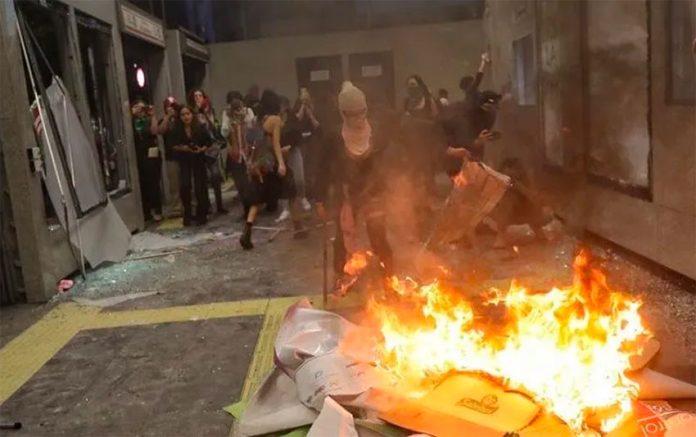
Protesters light a fire Friday at the Insurgentes Metrobús station.

Mexico City Mayor Claudia Sheinbaum has apologized for describing last week’s protests against gender violence as acts of “provocation” and pledged that authorities will not seek to prosecute women who vandalized buildings and public places.

Dana Corres, an activist and human rights defender, said the mayor made the apology and promise at a closed-door meeting yesterday with 40 women from a range of collectives that participated in the August 12 and 16 protests.

Thousands of women took to the streets last Monday and Friday to demand the prosecution of police officers accused of raping a teenage woman and a 17-year-old girl, and to urge the government to do more to prevent gender violence.

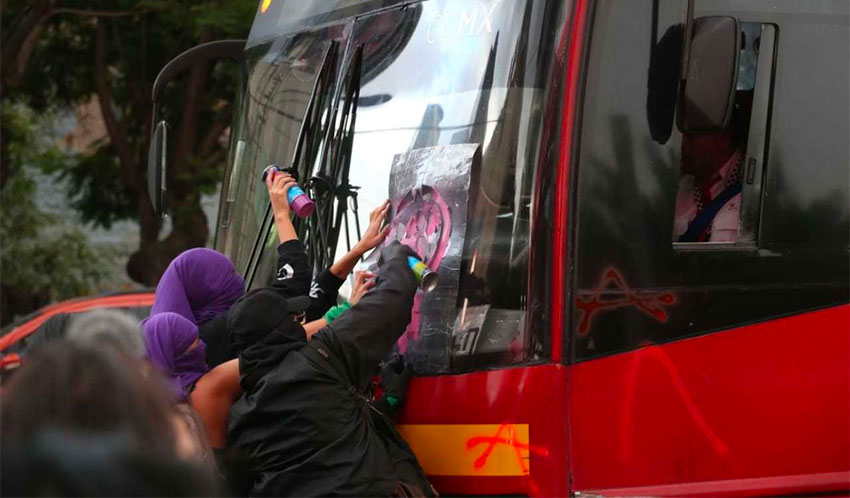
The glass doors of the Mexico City Attorney General’s Office were smashed during the former protest while at the conclusion of the latter, the Insurgentes Metrobús station was trashed, a fire was set inside a police station and the base of the Angel of Independence monument was defaced with graffiti.

After both protests, the government said that it wouldn’t fall into the “provocation” of using force against the protesters, which it charged is “what they are seeking.”

Women criticized the use of the word “provocation,” noting that it is sometimes used to blame victims for sexual assaults committed against them.

At the meeting with Sheinbaum, activists denounced the government’s “mistaken narrative” about the protests and its criminalization of the women who participated in them, Corres said.

The government’s characterization of the protests gave rise to threats on social media against the women who took part, the activists told the mayor.

According to Corres, Sheinbaum accepted that describing the protests as “provocation” was wrong.

The mayor said she will make a statement this week calling for the threats and aggression against women to stop and “also committed to sitting down with other groups of affected women as well as family members of victims [of gender-based violence],” Corres said.

She explained that the mayor gave her word that the Mexico City Attorney General’s Office has not opened and will not open any investigations into the acts of vandalism committed last week even though the government said in a statement Friday that it had already done so.

Participants in Friday’s march spray-paint a bus in Mexico City.

However, the Sheinbaum administration remains committed to prosecuting those who attacked journalists covering Friday’s protest.

In an interview with the newspaper Milenio, the mayor said her government will not criminalize social protests and pledged that she is committed to taking “effective action” aimed at the eradication of violence against women.

Sheinbaum conceded that public policy in the area is insufficient and called on civil society to collaborate with the government to develop strategies that will contribute to making the capital a safe city for women.

“The door to the government is open to citizens for dialogue and always will be . . . The demand [for the eradication of gender violence] has to be addressed and public policy is needed for that,” she said.

President López Obrador expressed support for the mayor’s actions, telling his morning press conference she “acted well although the conservatives will say the situation requires a firm hand because that’s how they are — with all respect — very hypocritical. But it is not necessary to use force.”

According to Human Rights Watch, Mexican laws “do not adequately protect women and girls against domestic and sexual violence.”

In a report published this year, the organization said that provisions in Mexican law, such as those that make the severity of punishment for sexual assaults contingent on the supposed chastity of the victim, “contradict international standards.”

Source: Milenio (sp) 

New US ambassador arrives with ‘extended hand’

0
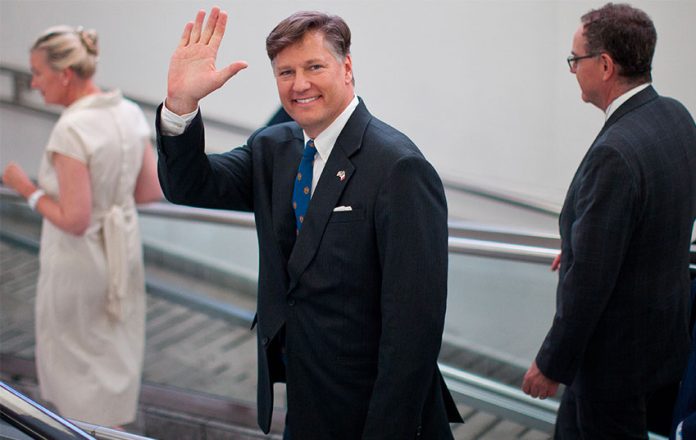
Ambassador Landau at Mexico City airport on Friday.

United States Ambassador Christopher Landau sent a friendly message to Mexico upon his arrival at the Mexico City airport on Friday.

In a three-minute statement to reporters, Landau said that he has come to Mexico with an “extended hand” and a commitment to resolve differences between the two countries.

“Of course, there are challenges in the bilateral relationship, but they are the kind of challenges you can expect to see in any relationship this close,” he said. “There is a huge amount of synergy that exists in our countries, on every level: economic, cultural, familiar. In my country, you can’t walk for two blocks without seeing a Mexican restaurant like La Michoacana or Cielito Lindo.”

Landau said he plans to visit all parts of Mexico during his posting, and promised to be able to speak Spanish without an accent by the time his service ends.

“I want to learn more about the culture and history of this magnificent country,” he said. “Listen closely to my accent, because I promise that I am going to change it. My ambition is that the day I leave, and I hope that’s a long time from now, that you’ll say, ‘He learned to speak like us.’”

Landau was sworn in as ambassador on August 12, several months after he was appointed by President Donald Trump. Before he took office, Mexico had gone 15 months without a U.S. ambassador since the resignation of Roberta Jacobson in May 2018.

After his statement, Landau said he did not have time to take questions from the press, but promised to speak to reporters after handing in his credentials.

“My message is very simple: my hand is extended, the United States wins when Mexico is prosperous and stable, and Mexico wins when the United States is prosperous and stable,” he said.

Source: Milenio (sp)

Retail drug trade fuels inter-gang warfare in León, Guanajuato

0
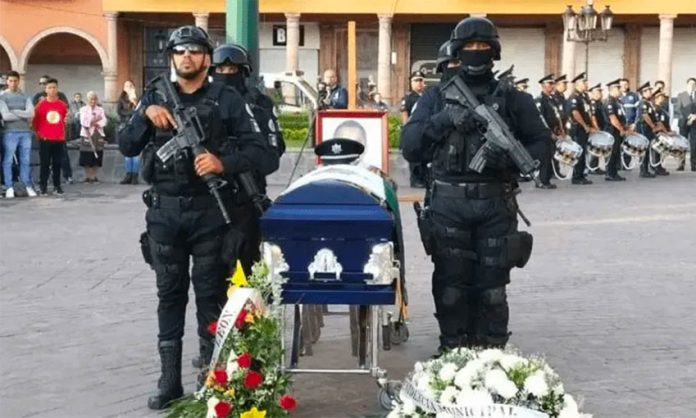
The funeral for a León police officer killed by a man who had been jailed 47 times.

Inter-gang warfare over the drug trade is causing an increase in violence in the city of León, Guanajuato, where 28 people were killed in the first two weeks of August.

According to León Public Security Secretary Mario Bravo Arrona, several bodies have been found accompanied by messages from criminal gangs.

“It’s a problem related to drug addiction and the cartels who are trying to take control of the plaza.”

Bravo did not say how many gangs are involved in the conflict.

He added that most of the victims have criminal records, and many had been released from jail because of lax policies.

“. . . many of them are arrested one day and released the next day, and it’s all because of drugs,” he said.

A man arrested last week in the murder of a León police officer had been jailed and freed at least 47 times prior to his most recent arrest.

León councilor Christian Cruz Villegas said the municipal government is taking measures to reduce violence and improve security.

“I can say that we are demanding better patrols, better diligence, and fast results,” he said. “And . . . we’re working on improving coordination with state and federal agencies.”

Cruz noted that León is an attractive territory for criminal groups, but authorities will fight to prevent gangs from taking over the city.

“We understand that they are fighting for territories in León, which they see as a fertile city for their illegal businesses,” he said. “But we’re fighting them, and these unfortunate incidents will make us double down on our efforts.”

Source: Milenio (sp)

First of Volkswagen’s Final Edition Beetles sold and delivered by Amazon

0
Amazon delivers a Beetle to a Mexico City collector.

A happy customer has taken delivery of the first of 65 final edition Volkswagen Beetles that are on sale in Mexico exclusively on the e-commerce platform Amazon.

Joaquín Jasso’s new car arrived at his México state home on the back of an Amazon truck inside a box custom made by the German automaker.

The Beetle, or Vocho as the car is affectionately known in Mexico, was made at the Volkswagen factory in Cuautlancingo, Puebla.

The plant produced 1.7 million New Beetles between 1997 and July 10 this year when the last one rolled out the doors to head to its final resting place, the Volkswagen Museum in Puebla city.

Jasso told the news website Expansión that purchasing his new car on Amazon was easy.

“It was very simple. The truth is if you have an Amazon account . . . it’s all very simple, it took me barely three minutes to buy,” he said.

The 44-year-old, who owns around 40 VW vehicles, said he was extremely happy with his latest purchase.

“I’ve always looked for special editions . . . and cars that are in impeccable condition . . . In my entire collection, each car has fewer than 100,000 kilometers [on the odometer] . . . most of them don’t have license plates and I’m not thinking about putting plates on this either . . .” Jasso said.

Volkswagen México wrote on Twitter that “Joaquín is part of the legend,” explaining that he is one of a select group who will have the privilege of receiving their new Beetle inside a box at their home.

Seeing the Volkswagen box on the back of the truck parked in front of his home, Jasso said it was like receiving “a big toy.”

“[Getting] a new car is always a really cool feeling and what’s better with this car is the way in which I bought it . . .” he said.

The final edition Beetle sells on Amazon for just over 410,000 pesos (US $21,000).

Source: Forbes (sp), Expansión (sp) 

Youths’ disappearance turns Oaxaca magic town into tragic town

0
Families of missing youths display a banner bearing their photos.

The disappearance of seven young men has turned Huautla, Oaxaca, from a magic town to a tragic town in the last eight months.

The first to disappear from this Magical Town in Oaxaca’s Sierra Mazateca was Fausto Ríos, who was taking surveys for the government when he last seen on December 5, 2018. The most recent cases are those of Iván and Efrén Martínez, two brothers who disappeared on July 31.

Ríos’ mother, María Mendoza, told the newspaper Reforma that her son left her a voicemail on the day he disappeared, saying that he was fine, but he could not talk to her at the time.

“A lot of young people have been taken away, there is a lot of crime here, it’s not a magical town, because people are taking our children away and we don’t know why,” she said. “We want them back, alive.”

Residents of Huautla, many of whom depend on offering services to visitors, are living in fear because of the recent wave of crime.

“This started when the current mayor, Óscar Peralta Allende, took office, and he’s not helping us at all,” said Mendoza. “When we ask him for help, he says he doesn’t have a magic wand to say ‘here’s your son.’ A mayor shouldn’t say a thing like that, he should talk to those of us who are in pain because our sons have disappeared.”

Susana Cerqueda, whose brother Juan Cerqueda went missing on June 15, said family members have not been asked for ransom payments. They also take place in broad daylight.

“. . . the disappearances have happened in the center of Huautla, out in the open,” she said. “When we made the report, coincidentally, the municipality’s security cameras weren’t working that day . . . people here in Huautla are afraid to talk because they’ve been threatened and we, family members, have been threatened by municipal officials who are close to the mayor.”

The municipality is known for being the birthplace of indigenous healer María Sabina.

Source: Reforma (sp)

Santa Lucía airport will put Mexico at a disadvantage in tourism market

0
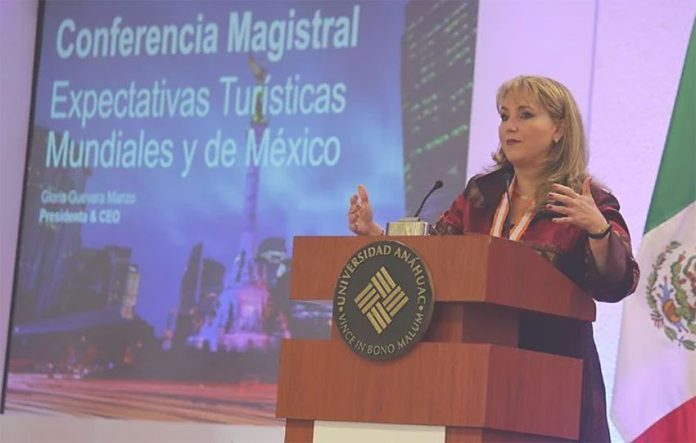
Guevara said airport facilities will be insufficient to meet growing demand.

The decision to build the Santa Lucía airport instead of continuing with the airport at Texcoco will put Mexico at a competitive disadvantage in the global tourism market, claims the president of the World Trade and Tourism Council (WTTC).

Speaking at a tourism conference in Mexico City, Gloria Guevara said the effects of the decision will be seen in five or seven years.

The government’s plan to build the Santa Lucía airport – currently mired due to legal opposition – and upgrade the existing airports in Mexico City and Toluca will be insufficient to meet growing demand for air travel, she charged.

“It’s essential that we have an airport of the size [worthy] of a tourism power such as this country is – a world class one and with the technology it requires,” Guevara said.

President López Obrador canceled the previous government’s US $13-billion airport project at Texcoco, México state, on the grounds that it was corrupt, too expensive, not needed and being built on land that was sinking.

The WTTC president, who served as tourism secretary in the government of former president Felipe Calderón, said she understands “perfectly” and supports President López Obrador’s commitment to stamp out corruption but contended that his alternative airport plan won’t provide Mexico with the level of airport infrastructure it needs.

Asked about the government’s decision to disband the Tourism Promotion Council, Guevara said she was willing to collaborate with authorities to discuss alternative marketing strategies, adding that she was interested in meeting with Foreign Secretary Marcelo Ebrard.

Ebrard announced in April that marketing the nation as a tourism destination would become a responsibility of Mexico’s embassies and consulates.

Before Guevara spoke, Tourism Secretary Miguel Torruco officially opened the fourth edition of the International Congress of the Women’s Association of Executives of Tourism Companies.

He acknowledged that there has been a “rethink” of tourism policy since the new government took office that has included measures that haven’t pleased everyone.

However, he highlighted that the number of tourists who visited Mexico in the first half of the year increased 7% compared to the same period last year.

Citing figures from statistics agency Inegi, Torruco said that around 22.1 million visitors came to the country between January and June, and spent US $11.9 billion while they were here, a 13.9% increase compared to the first half of 2018.

He said that tourism revenue declined 0.8% in the first quarter of 2019 but explained that the Easter vacation period this year fell in April whereas in 2018 it was in March.

Source: El Economista (sp), EFE (en) 

Driver flees, abandons Lamborghini after accident

0
The Lamborghini after Saturday morning's accident.

The driver of a Lamborghini abandoned the car after colliding with a sidewalk planter in the Mexico City neighborhood of Roma Sur early Saturday morning.

The accident occurred around 5:00am, at the intersection of Zacatecas and Yucatán streets, where it struck a sidewalk garden.

The front of the car was badly damaged, and left with a missing wheel, but there was now sign of the driver.

Police found a permit to drive without license plates in the name of José Jiménez Villalobos. But the permit did not correspond to the Lamborghini.

The accident was captured by a C5 security camera, and police are examining the video.

The Lamborghini was valued at between 4 million and 5 million pesos (US $203,000-$254,000).

Source: El Heraldo de México (sp), Milenio (sp)

Longtime Baja ecotourism operator and conservationist dies at 75

0
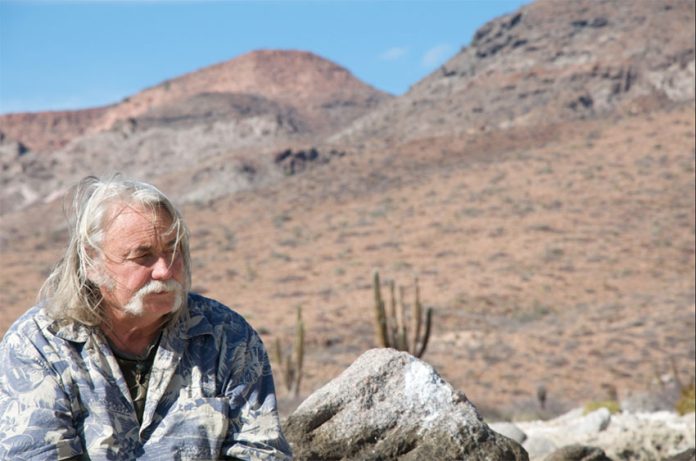
Tim Means, Baja conservationist for five decades.

A pioneer ecotourism operator and conservationist in the Gulf of California and on the Baja peninsula died August 13 in San Diego due to complications with diabetes.

Timothy Irwin Means Heineman, 75, was born in Pennsylvania and raised in Arizona, where he fell in love with the Sonoran desert at an early age.

He turned his childhood fascination with the wild deserts into a lifetime of commitment to conservation and eco-adventures for more than five decades, sharing his vision and inviting people to connect with the natural world.

Friends say that “gravity brought Tim Means to Baja California” – metaphorically following the rapids of the Colorado River in the Grand Canyon, where he was a raft guide in his early career.

That gravity took him down to the waters of the Gulf of California where he founded Baja Expeditions in 1974 in La Paz, then a quiet port and home to fishing families and today the bustling city where he lived for the rest of his life.

A Mexican citizen since 1993, Means and Baja Expeditions welcomed thousands of visitors from around the globe and supported research and education dedicated to marine and wildlands conservation. He devoted his life to the preservation of the deserts of Baja California and the Gulf of California.

Means worked with fishermen, scientists and politicians to draw attention to the depletion of sea life and loss of wildlands posed by overfishing and rampant development.

He was a catalyst for the federal designation of Isla Espíritu Santo as a national protected area in 1994.

Just before the island’s official protection, development pressure was intense and a developer wanted to build a resort casino on the island.

Means bought land in the middle of the developer’s property, forcing him into negotiations, then enlisted the support of donors to purchase the property and donate it to the federal government.

With the threat of the casino gone, he and a coalition of conservationists put together another deal to purchase and permanently protect the entire island and provide public access. The successful campaign resulted in a thriving ecotourism sector and sustainable artisanal fishery in La Paz.

As a result of Means’ work, Isla Espíritu Santo and 244 other islands were named a UNESCO World Heritage Site in 2005.

Concerned over the threat of rapid coastal development in Baja, Tim and others founded the Sociedad de Historia Natural Niparajá in 1990 to preserve the coastal wildlands of the Baja peninsula and promote sustainable fishing.

Means and several partners also bought an old ranch on the coast of the Sierra La Giganta as a reserve for bighorn sheep and other species.

Means believed that conservation starts with education, and supported and led countless expeditions and programs for students, scientists, filmmakers, politicians and citizen scientists to invite people to enjoy a connection with the natural world and emphasize the need to preserve wildlands for healthy ecosystems.

Timoteo, as he was affectionately called, was a colorful and influential figure in the community who helped support and inspire a whole generation of young explorers, collectors of La Paz’s solid waste recycling and conservationists.

A public celebration of his life will take place on September 13 in La Paz.

Mexico News Daily