Morena deputies announce their decriminalization plans.
The abortion debate is shifting from the state to the federal level with the announcement by lawmakers with the ruling Morena party that they will seek to decriminalize the practice in the first 12 weeks of pregnancy.
Female deputies told a press conference at the lower house of Congress on Monday that if the modifications to the federal criminal code are approved, they will ask state legislatures to change their laws to make them consistent with federal legislation.
But the states have the last word on the issue.
Paola González Castañeda said Morena will propose changes to four articles of the criminal code.
One change would stipulate that the termination of a pregnancy is only considered an abortion if it occurs more than 12 weeks after a woman conceives, she said.
The deputy explained that another article would be modified to establish a penalty of between three and six months’ imprisonment or 100 to 300 days of community work for women who have an abortion after the first 12 weeks.
González also said that Morena is seeking to modify the General Health Law so that access to the legal termination of a pregnancy is a sexual and reproductive right.
She said Morena’s proposal recognizes the right of medical personnel to refuse to perform an abortion on moral or religious grounds but also establishes the obligation for healthcare providers to have staff who are willing to carry out the procedure to ensure that women can access the service.
Wendy Briceño, a Sonora deputy and president of the gender equality commission, said that guaranteeing access to safe abortion services is a federal government responsibility.
“The main focus [of the proposal] is the guarantee that the Mexican state has to provide,” she said, adding that lawmakers from Morena, which leads a coalition with majorities in both houses of Congress, are committed to ensuring that the decriminalization of abortion becomes a reality.
“There are no taboo issues and we believe that [the decriminalization of abortion] would be real substantive representation [of women] . . .” Briceño added.
If Morena succeeds in changing the federal criminal code but a state doesn’t change its laws to reflect the modifications, women could still access legal abortion services in the first 12 weeks of pregnancy at IMSS and ISSSTE hospitals, which are run by the federal government.
Oaxaca became the second state to decriminalize abortion for any reason after Mexico City. Some other states allow abortion in cases of rape or to protect the life of the mother.
An amnesty law proposal sent to Congress by President López Obrador last month would exonerate women imprisoned for having an abortion as well as medical personnel convicted of illegally carrying out the procedure.
Pemex wants to take over a lucrative private company oil project in the Gulf of Mexico, according to a report by the news agency Reuters.
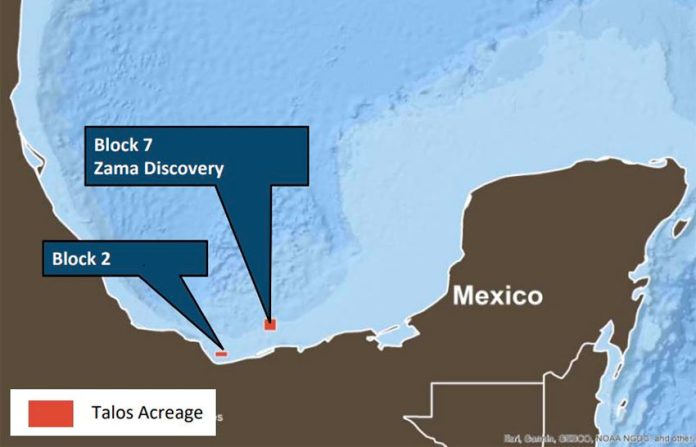
Two company executives with knowledge of discussions at the state oil company and two former federal energy officials told Reuters that Pemex has its eyes on an oil field where the United States oil firm Talos Energy found a reserve of almost a billion barrels two years ago.
Talos – which has a 35% stake in the field – was the first private company to find oil after the government of former president Enrique Peña Nieto opened up the sector to private and foreign companies after an almost 80-year state monopoly.
However, the new government has indefinitely suspended further auctions of oil blocks in favor of offering restrictive partnerships to private oilfield services firms that allow Pemex to have greater control.
Reuters’ sources said that taking over Talos’ shallow water field, named Zama after the Mayan word for dawn, would be a symbolic blow to the previous government’s energy reform. They also said that it could act as a further deterrent for investment from the world’s largest oil companies.
However, Pemex does have a potential claim to Zama because it holds the drilling rights for an adjacent field.
An unpublished draft report by the consultancy firm Wood Mackenzie seen by Reuters said that about a third of the reserve discovered by Talos likely extends into Pemex’s field although that hasn’t been confirmed because the state-run company hasn’t yet drilled there.
The two companies began talks last year about carrying out a joint project and agreed to discuss later how revenue would be divided and who would ultimately have operational control. The Secretariat of Energy would settle disputes and designate which company would take control if the talks break down.
Energy Secretary Rocío Nahle, who is also the chair of the Pemex board, hinted in August that control of the project could go to Pemex.
“We definitely have to talk to Pemex, to Talos — another company that’s there — to see who will be in charge of the operations, because Pemex has a big part of it,” she said.
If Pemex takes control, Talos would retain its stake but have to rely on Pemex to drill efficiently and profitably. There is no certainty that would occur considering that Pemex is the world’s most indebted oil company and has seen a decline in oil production for 15 consecutive years.
“If Pemex does end up operating it, that would not send a good signal to private investors,” the executive of a major oil company that has several projects in Mexico told Reuters.
In the latter years of Peña Nieto’s presidency, oil executives said that investing in oil projects in Mexico was as attractive as drilling off Brazil’s coast or in the shale fields of Texas.
But with President López Obrador determined to wrest back at least some of the control ceded to private companies, Mexico is not nearly as attractive as it was.
George Baker, a Houston-based energy analyst and publisher of the newsletter Mexico Energy Intelligence, said “the door is closed on newcomers in Mexico right now while it’s wide open in places like Brazil and Guyana.”
Some firms that entered the market during Peña Nieto’s presidency have now decided to get out. One such company is Sierra Oil & Gas, which sold its 40% stake in Zama and all of its other Mexico assets to Wintershall DEA. Premier Oil said last month that its 25% stake in Zama was for sale although it plans to continue with three other energy projects in Mexico.
Talos CEO Tim Duncan declined to comment directly on a Pemex takeover of Zama but asserted that his company was the best qualified to manage the project.
“We’re fully prepared to go execute this project, finish it, wrap it up and get it into production,” he said.
Even though the federal government would get almost 70% of net profits from Zama under the terms of Talos’ contract, one of Reuters’ industry sources said that Pemex is resolute in its desire to seize control, claiming “for them, there is no other scenario.”
Chinese motorcycle manufacturer Zontes has opened the first of 25 dealerships in Mexico.
One of the four brands of Chinese motorcycle giant Guangdong Tayo Motorcycle Technology, Zontes says its goal is to offer a high-quality, affordable bike to middle-class consumers.
Zontes México sales director Juan Ballester said that talks about bringing the company to Mexico began in 2018. He would not say who the Mexican partners were, but said they saw the product’s performance in China and worked to foster a joint venture between Zontes and a group of Mexican investors.
The four models that will be sold in Mexico are manufactured in Guangdong, China, one of that country’s three principal motorcycle manufacturing cities. Highly automated and dedicated to proprietary products, the Guangdong plant has already produced 256 appearance patents, 121 utility model patents and 36 invention patents.
Such numbers have produced high levels of confidence among those who have brought the brand to Mexico.
The bikes even come with the seal of approval of Mexican motorcyclist Dubanok, who said the stigma of Chinese products being low-quality is now a thing of the past.
“There were those who categorized Zontes as the ‘Huawei of motorcycles,’ but Huawei is a company that has been a watershed with respect to the idea of a bad product or bad Chinese quality. In the case of Zontes, we like the epithet,” he said.
The firm expects to thrive in two sectors in the Mexican market: riders of bikes with smaller engines who want to be introduced to the world of touring bikes, and with those who already have bikes with large engines and are looking for a second motorcycle for city riding.
Zontes will be competing with other well-established Asian brands like Honda and Suzuki.
The company’s first dealership opened in Mexico City, and it also opened a logistics center in Toluca, in which it invested 10 million pesos (US $506,000). It plans to open 24 more dealerships across the country by the end of 2020.
Zontes already has a presence in other Latin American countries, such as Argentina, Chile, Peru, the Dominican Republic, Bolivia, and Ecuador, but the joint venture that brought the company to Mexico aims to operate exclusively within the country.
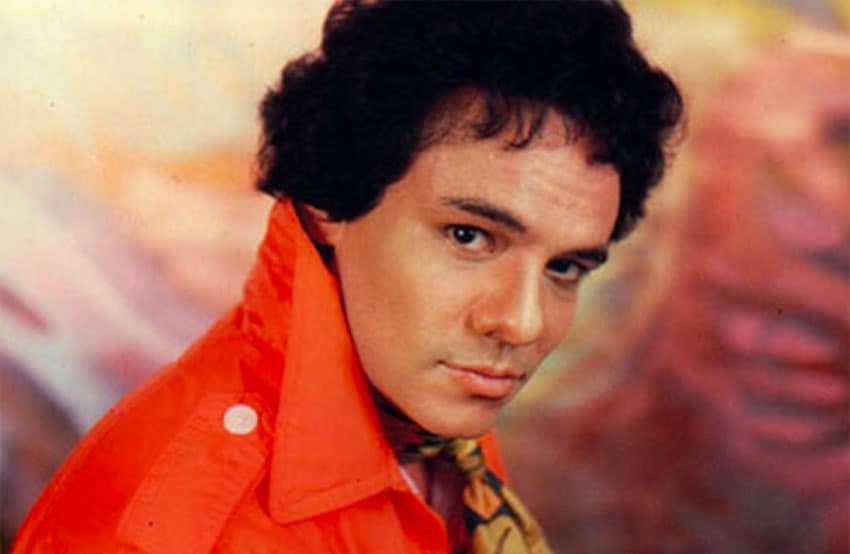
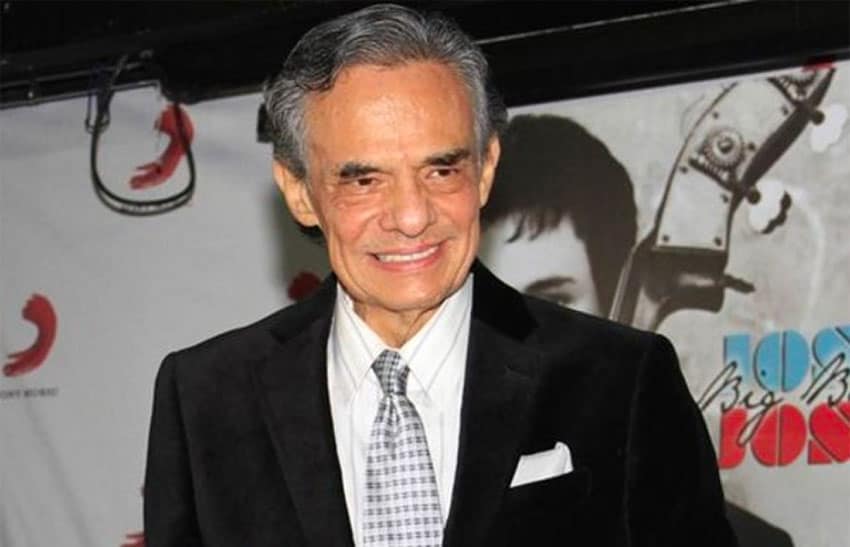
José José, an acclaimed and widely-loved Mexican crooner who shot to fame almost 50 years ago died on Saturday in Miami, Florida.
The Secretariat of Culture announced the death of the singer, whose real name was José Rómulo Sosa Ortiz, describing him as “one of Mexico’s most loved voices.” He was 71.
José José, also known as the “Prince of Song,” was born into a family of musicians in Mexico City in 1948: his father, José Sosa Esquivel, was a tenor in the National Opera of Mexico; his mother, Margarita Ortiz Pensado, a concert pianist.
As a child, José José sang in his school’s choir and at the age of 15 formed a musical trio. As a young singer and musician, he would go on to perform in nightclubs and played double bass in a jazz and bossa nova group he formed.
The singer released his first solo album in 1969 under the stage name of José José, which he said was inspired by his father, who succumbed to a battle with alcoholism in 1968.
José José sold more than 250 million albums and was nominated for nine Grammy awards.
However, it was the singer’s rendition of El Triste (The Sad One) at the 1970 Latin Song Festival in Mexico City that made him a household name in the Spanish-speaking world.
The memorable performance also had a less desirable effect: like his father, José José became a heavy drinker soon after and battled alcoholism throughout much of his career.
But it didn’t stop him from achieving phenomenal success. José José sold more than 250 million albums and was nominated for nine Grammy awards, although he never took one home.
During the 1980s, the most successful decade of his career, José José sold two million copies of his hit album Secretos in the space of just a few weeks and he also starred in several films including the autobiographical Gavilán o Paloma (Sparrowhawk or Dove).
He achieved fame and acclaim beyond the Spanish-speaking world in countries such as Japan and Russia and in 2004, the “Prince of Song” won the Musical Excellence Prize at the Latin Grammy Awards.
His musical talent also caught the eye – and ear – of legendary American singer Frank Sinatra.
Complications from treatment for pancreatic cancer spelled the end for the beloved singer.
In an interview with Roberto Cantoral Zucchi, the son of the composer of El Triste, José José said that Sinatra told him he had seen his performance at the 1970 Latin Song Festival and thought he should have won (he placed third).
Three years after his introduction to the man who would become the “Prince of Song,” Ol’ Blue Eyes, as Sinatra was known, was at his office at his record label Reprise Records in Los Angeles, California, when he heard a José José song playing faintly on the building’s stereo system.
Sinatra demanded to be put into contract with the Mexican singer and soon after he proposed that the two record and release an album of duets.
José José accepted immediately but his record label, RCA Víctor, with whom he had an exclusive contract, refused to allow the collaboration with Sinatra to go ahead.
In his autobiography Esta Es Mi Vida (This Is My Life), José José said he became deeply depressed as a result of the situation and drank heavily for weeks while listening to Sinatra songs.
In the 2008 book, he opened up about his battles with the bottle, describing the troubles it brought him with his second wife Anel Noreña, the financial problems it created and the effects that heavy drinking had on his health.
In the early days he played string bass in a jazz and bossa nova group he formed.
José José separated from Noreña in 1993, with whom he had two children, and remarried in 1995 to Sarita Salazar, a Cuban he met while in an alcohol rehabilitation center in the United States. The pair had a daughter, Sara who was born in 1995.
Even though his health was deteriorating, José José continued performing throughout the ‘90s and into the 21st century.
Even several unsuccessful operations to repair his damaged vocal cords and a facial paralysis in 2007 didn’t put an end to his career, although it did make it very difficult for him to sing.
Greek composer and pianist Yanni said it took José José seven days to get ready “just to attempt to sing” before the pair performed at a concert together in 2008.
In a video posted to Twitter, Yanni said “that was an act of bravery on his part,” adding “he fought hard for every word, for every sound.”
In the end, it was complications from treatment for pancreatic cancer that finally spelled the end for the beloved singer, whose melancholic love ballads have been the soundtracks to countless people’s lives for the past half a century.
Fans of José José paid homage on the weekend by flocking to a park in the Mexico City borough of Azcapotzalco, where a statue in his likeness stands.
President López Obrador told reporters that he was saddened by the death and described José José as “an extraordinary singer from an era that, with his songs and his romanticism, made a lot of people from my generation cry and be happy.”
The balloon festival in León, Guanajuato, is one of several big events scheduled during the remaining months of 2019.
There are only three months left in 2019, but the calendar still has plenty of festivals and fairs to enjoy. From film and dance presentations to book releases and DJ sets, entertainment and cultural enrichment opportunities abound.
Here are five big ones coming up in what remains of the year.
2019 Christmas Ornament Fair
Now in its 20th year, this artisans’ festival is held in the Pueblo Mágico, or Magical Town, of Tlalpujahua, Michoacán. Highlighting the work of over 300 glass blowers, the event is sure to dazzle spectators and shoppers as they begin to feel the holiday spirit. All pieces are handmade and hand-painted, making for lots of unique ways to decorate the Christmas tree. There are also workshops for visitors to learn the process themselves.
The fair opened on Sunday and runs through December 15. Admission is free.
Entijuanarte 2019
One of the biggest festivals of northwestern Mexico, the 15th anniversary of Entijuanarte invites visitors to immerse themselves in contemporary Mexican culture in Tijuana’s Centro Cultural. This year’s festival brings together over 100 wide-ranging projects, including theater, dance, film, concerts and visual arts expositions, all tinged with the essence of Tijuana’s vibrant energy.
Aguascalientes is this year’s guest of honor, and other invited states include Coahuila, Guanajuato, Jalisco, Morelos, Zacatecas, Oaxaca, México state and Mexico City. Admission is free.
Festival Internacional Cervantino
Now in its 47th year, Guanajuato’s El Cervantino, as it’s popularly called, is one of Latin America’s most important cultural events. Celebrating the life and work of Spanish writer Miguel de Cervantes, it hosts plays, dances, concerts, film screenings, workshops, readings, book releases and much, much more. The festival has become so important to the commemoration of the Don Quixote author’s work that in 2005 UNESCO dubbed Guanajuato the “Capital Cervantino” of the Americas.
This year’s event takes place on October 9-27, and hosts Guerrero and Canada as honored state and country. Tickets to the events can be bought through Ticketmaster.
Morelia International Film Festival
The 17th iteration of this small but respected film festival in Morelia, Michoacán, is dedicated to the people who came to Mexico after fleeing Spain during its Civil War in the 1930s. One such exile was Spanish film director Luis Buñuel, who himself wrote much of his work in Michoacán and ended up becoming a nationalized Mexican citizen. A total of 94 films from states across Mexico will be featured. Check the Cinépolis website for tickets.
2019 International Hot Air Balloon Festival of León
The fun begins at 6:30pm on November 15 when over 200 hot air balloons from 16 countries take off from León, Guanajuato. There will be workshops, camping, concerts, a magical night glow and, of course, hot air balloon rides. The featured concerts include musicians like María José, Yahir and world-renowned DJ Martin Garrix.
It all takes place in León’s Metropolitan Ecological Park, ending on November 18. The entrance fee is 143 pesos (US $7).
Academics and public servants alike admit that emigration has turned at least 20 municipalities in Zacatecas into all but ghost towns.
The representative of the National Immigration Institute (INM) in Zacatecas, Ignacio Fraire Zúñiga, says the state has the third highest levels of emigration in the country, surpassed only by Michoacán and Oaxaca.
“This exodus shouldn’t fill us with pride. People don’t emigrate to another country for pleasure, but rather out of necessity, and it’s not something we desire. [Mobility] should be something optional for people and not an obligation in order to have a better quality of life,” he said.
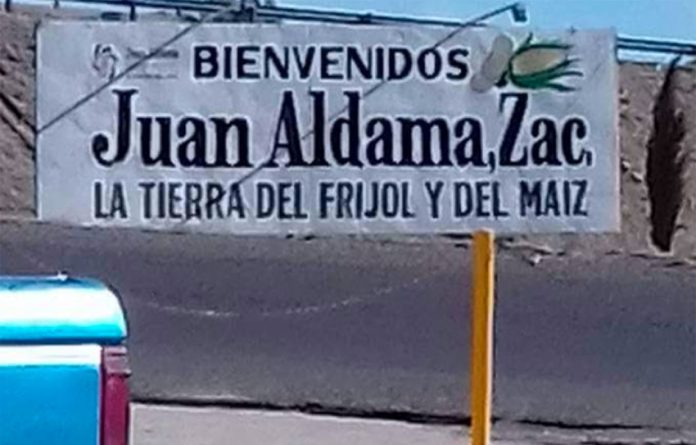
He said emigration rates are the highest in the state’s canyon country, in towns like Jerez, Tlaltenango, Juchipila, Jalpa, Fresnillo, Nochistlán, Río Grande, Sombrerete, Miguel Auza and Juan Aldama.
And although emigration has been a problem in Zacatecas for years, Fraire says it has also brought economic benefits to the state through remittances sent from the United States.
“The amount of money that comes as remittances is almost equal to what the federal government invests in the state,” Fraire said. “The money that people from Zacatecas send home is the second most important source of revenue, providing a subsidy for our economy.”
This importance is also recognized by Javier Mendoza Villalpando, a state delegate of the Secretariat of Foreign Relations (SRE).
“The total budget for the state is around 26 million pesos [US $1.3 million] and we’re talking about almost 18 million pesos of that coming from remittances,” Mendoza said. “That’s how important our compatriots in the United States are.”
A professor and researcher at the Autonomous University of Zacatecas (UAZ) says that Mexican authorities have not been able to provide the education or work opportunities necessary for its citizens so they are not forced to leave the country.
“For at least 40 years, bilateral emigration to the United States from Mexico has become an escape valve for problems like poverty, marginalization and lack of growth and development, which are the consequences of the neoliberal economic model,” Rodolfo García Zamora said, using the catch phrase preferred by President López Obrador to describe Mexican governments of the last few decades.
Contrary to Fraire and Mendoza, García claims that the remittances have not been a benefit to Zacatecas, but rather a palliative for the state’s social, economic and labor deficiencies.
“In Zacatecas we have a 100-year history of international emigration, and the billions of dollars that come in annually haven’t been able to rectify the marginalization and lack of employment,” he said.
African migrants attempt to stop UN officials from leaving new registration center.
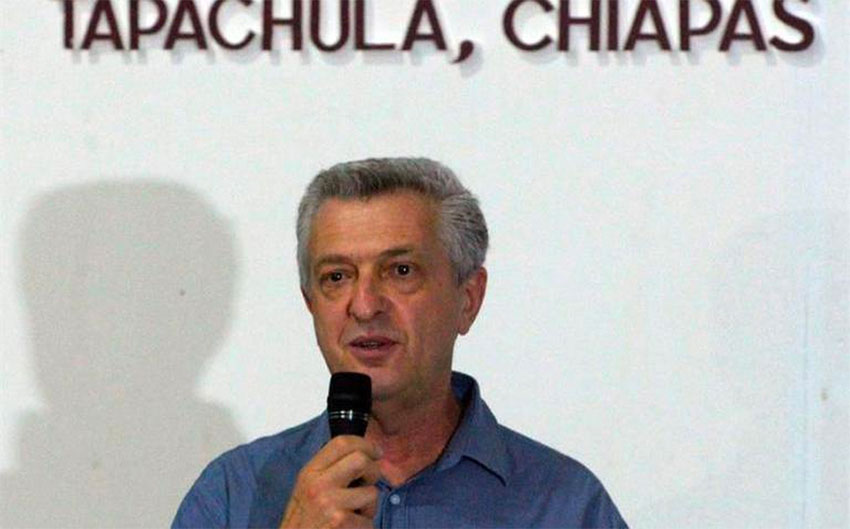
As United Nations High Commissioner for Refugees Filippo Grandi opened a new registration center for asylum seekers in Tapachula, Chiapas, on Saturday, African migrants renewed their protest to demand transit visas that would allow them to travel to the northern border.
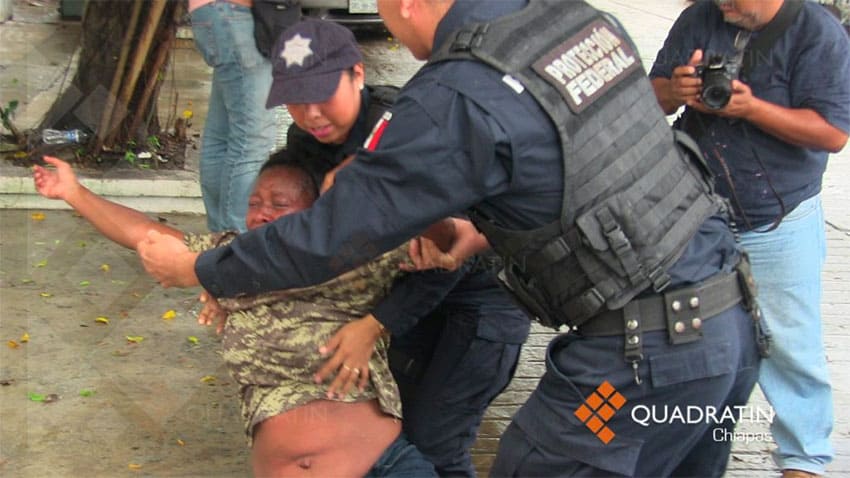
The migrants also tried to storm the new facility but were prevented from entering by Federal Police, the newspaper Milenio reported.
When Grandi and other UN Refugee Agency officials left the building, the protesters — with children placed in front — surrounded their vehicles and tried to prevent their departure. A Congolese woman even grabbed onto the front tire of one of the vehicles in a desperate attempt to be given the opportunity to plead her case to the UN officials.
But Grandi boarded the vehicle without speaking with the protesters.
The migrants, many of whom have been stranded in Tapachula for months, are demanding transit visas in order to travel legally to the northern border to seek asylum in the United States.
Police wrestle with a Congolese woman who wished to plead her case before UN officials.
Luis García Villagrán, head of a local human rights center, said that Mexican law stipulates that migrants have the right to travel through and leave the country.
However, the National Immigration Institute (INM) has insisted that their departure be via the southern rather than the northern border and in recent months it has only issued visas that allow the migrants to stay in Chiapas.
Citizens of countries including Ethiopia, Mali, Cameroon, Somalia, Congo, Mauritania, Guinea and Haiti have protested in Tapachula on several occasions and in early September they damaged a service module that had been set up to review their cases.
At Saturday’s inauguration of the registration center, Grandi acknowledged that there is room for improvement in responding to migrants’ claims for asylum and transit visas.
“Chiapas receives the highest number of asylum applications of any state in Mexico. We have to work together to respond [to them] efficiently, quickly and fairly, respecting the rights of those who have to flee,” he said.
Commissioner Grandi speaks at Tapachula registration center.
The high commissioner said the new center – a converted coffee warehouse located in south Tapachula that will be managed by the Mexican Commission for Refugee Assistance (Comar) – will play an important role in ensuring that happens, stating that it will enable asylum applications to be dealt with “promptly and fairly.”
“Comar needs more resources and room to work because the challenge is increasing,” he said. “There has been an important increase [in migrant arrivals] but this does not equate with the resources that Comar has . . .”
Meanwhile, federal authorities said on Saturday that they had arrested two suspected leaders of a human smuggling ring that earned up to US $40,000 a week by bringing migrants into the country illegally via the Mexico City and Cancún airports.
“According to intelligence information, the alleged culprits led a criminal group that received on average 25 foreigners per week, mainly Ecuadorians and Peruvians as well as undocumented persons of Indian origin,” the Secretariat of Security and Citizens Protection (SSPC) said in a statement.
The SSPC said the migrants were transferred to properties in Mexico City and México state where they stayed for one or two days before being put on buses to Mexicali, Baja California.
The arrests of the two suspected ringleaders followed a tip-off from a citizen, the secretariat said, adding that each foreigner brought into the country illegally paid between US $1,500 and $2,500 for the criminal organization’s services.
When director John Huston came to film The Night of the Iguana in 1963, Puerto Vallarta was just a sleepy little fishing village. A little Hollywood glamour, provided by the famous cast and scandalous and media-drenched affair between Elizabeth Taylor and Richard Burton, and this little pueblo suddenly became an international beach hideaway for starlets and regular folks alike.
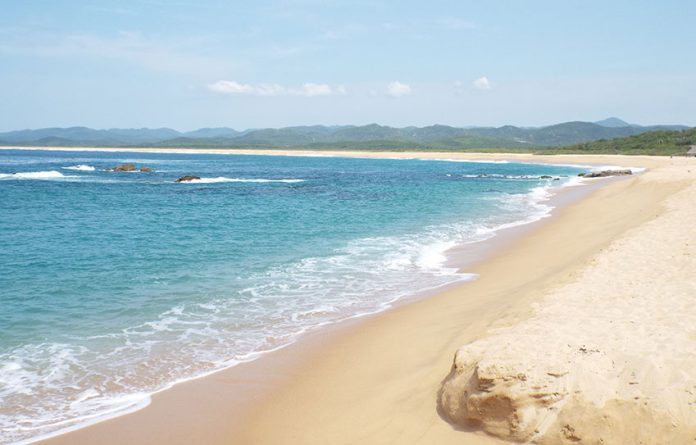
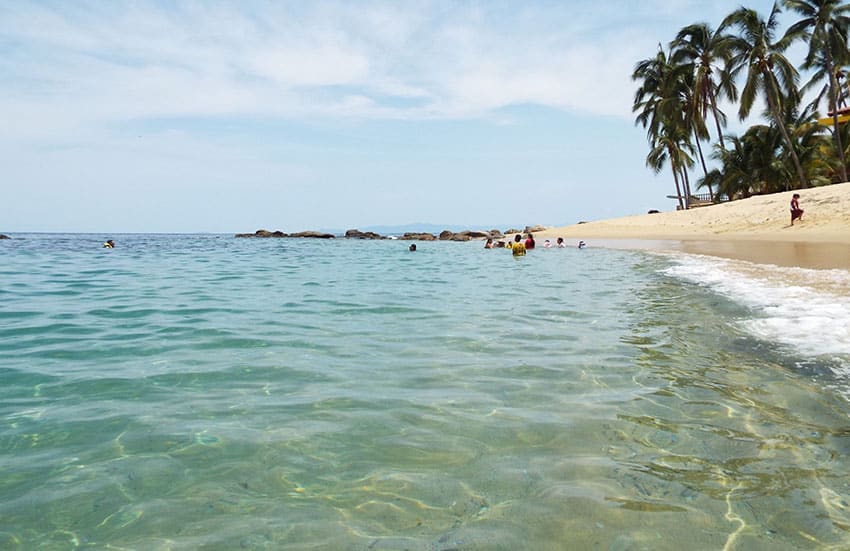
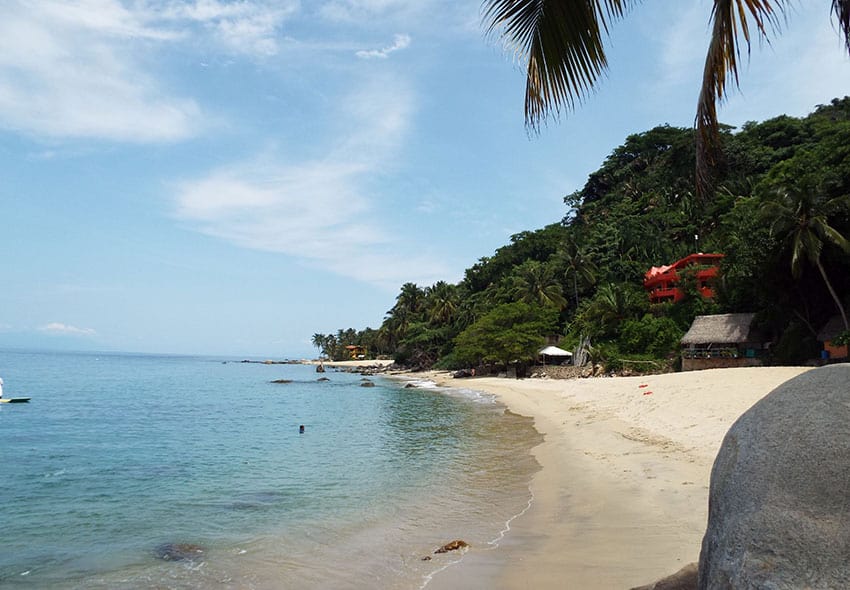
Palm-lined beaches, turquoise waters, brown sugar sand and a sultry year-round climate — there’s a lot to love in Puerto Vallarta.
Unbeknownst to a lot of travelers that beach-hop north – to the beaches of Punta Mita, Sayulita and San Francisco – Puerto Vallarta’s southern shores are dotted with delicious little inlets and a handful of quaint towns that boast some of the coast’s most beautiful beaches. It takes a little effort to get to these off-the-beaten track expanses of sand, but I think you’ll find it worth it once you arrive.
From Boca de Tomatlán to Yelapa
The road south out of central Puerto Vallarta is a jungle-lined trek past luxury hotels, public beach accesses and a half-dozen, half-built dream houses. Despite the constant construction, a dense fog of humidity and heat permeates everything, slowing even the most ambitious projects and most energetic tourists.
Along this road you’ll pass the now-closed Night of the Iguana hotel, and several exclusive housing developments in pre-sale before you reach the highway entrance to Boca de Tomatlán, a small village about 30 minutes down the coast. Whether you go by bus or by cab, it’s easy to find the town’s boat dock as you enter Boca’s small handful of streets. This is one of the bigger towns along this stretch of coast and the take-off point for the boat that takes you down the shoreline.
You’ll see handfuls of locals and Mexican tourists waiting for the next water taxi to set out. Boats to Yelapa leave every hour on the hour starting at 8:00am with an additional final boat at 6:30pm. Sounds prompt, but everything here is variable, so arrive with sunscreen and patience. The Yelapa taxi will drop you off at any of the beaches between Boca and Yelapa (about a 40-minute ride) but you have to ask the boat’s captain in advance.
Alternatively you can ask around to see which boats are going to the specific beach you want and you can often find someone leaving sooner and getting you there faster. There is a single walking path that will take you overland to both Animas beach and Quixmo beach but it is a long and hot walk. The boats are infinitely faster and more enjoyable. In the case of the water taxi you pay when you get off; a private boat ride requires you to set a price in advance.
I suggest riding the entire way to Yelapa to take a look at the beaches as you decide what suits your fancy. There is a first tiny, rocky-edged beach called Madagascar as you pass a palapa “house” on the edge of a cliff heading out from Boca. There is nothing here as far as amenities and not much shade, but it is an isolated pinpoint of a beach to drop anchor and swim for a bit.
A little farther down and you will see a short, palm-lined strip of beach that is absolutely lovely called El Caballo. This has little human presence to speak of although there are a few hotels on either end tucked up into the mountainside. Just past the rocky outcrop at the end of Caballo is Animas beach. Animas has a decent strip of beach and a long dock in the center.
This a popular beach for tourists because there are a couple of dozen restaurants that sit between the sand and the jungle backdrop. The water is nice but not as crystal clear and gorgeous blue as some of the others.
Morning in Yelapa.
The next big beach is Quimixto, which you will recognize by the terracotta-roofed house that sits to one edge, almost in the water. This is a splendid beach for an afternoon, and many locals told me it was their favorite. There are a handful of restaurants and hotels but much fewer than at Animas.
Next is Caletas, which is the home to the Ritmo de Noches show put on by Vallarta Adventures at night. This was also the once home of director John Huston and the beach is absolutely adorable, even though there are just a few hotels and no restaurants open to the public. Majahuitas beach (the next down) is similar in that there are a few hotels but not much with open arms to the public. Still the beach is delicious and small.
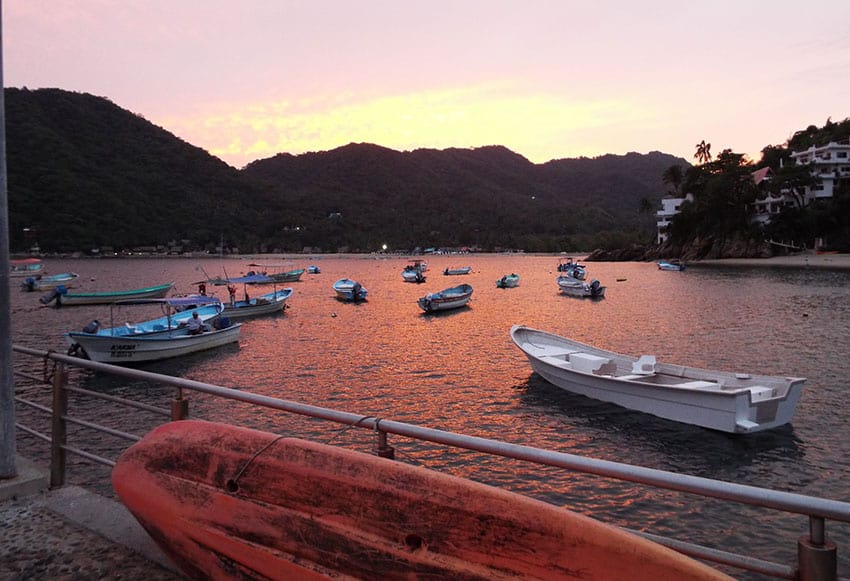
Yelapa is next up, with an ample beach to one side of the town, home to about 1,500 people. Several restaurants, including the most famous, Fanny’s, sit center-stage on the beach and boats bob in the water near the town dock as many of the locals you see working in this area either live here or in Boca. Yelapa is a nice town to make your base if you’re comfortable depending on water taxis for transportation or paying exorbitant rates for private boats (someone quoted me US $70 an hour for a private ride).
The town has some nice hotels including Hotel Lagunita, Casa Pericos and others that sit along the edges of Yelapa’s tiny bay. The rock outcropping to the south end of the bay down the little coast to Playa Isabella has nice snorkeling.
Yelapa to Chimo
Twice daily from Yelapa runs a taxi that heads farther south down the coast to Chimo beach, about 30 minutes away. Again, beware of trusting timetables too much and always be early and prepare to wait. Catch the morning taxi to head to La Manzanilla, a minuscule beach that glitters like a jewel just 10 minutes down the coast by boat. There’s nothing there to distract from the beauty of the crystal-clear water but a shady palapa for picnics.
Manzanilla glitters like a jewel.
From Manzanilla you can walk south over the rocks (watch out for iguanas!) to the next beach ingeniously called Playa del Medio, or beach in the middle. This is another gorgeous little gem, and quiet, unless there is a rowdy yacht parked just off the coast like the day I was there.
From Playa del Medio you can walk along a cement path to Pizota, a small fishing village at the farthest end of this strip of beaches. Pizota has that same lovely water, but the beach is scattered with locals’ kayaks and canoes and the water with taxis and fishing boats. Most days you will have a little audience if you want to swim there as the local boat operators hang out in the shade near the edge of the beach, gabbing and drinking beers.
Pizota is a regular stop on the Chimo taxi’s route, but be sure to ask the taxi captain and not the locals what time they will be coming through – answers varied wildly and I ended up missing it altogether. There is a small convenience store on the edge of beach with some surly women running it – a fine place if you need to get a beer or water or snacks.
Inland and then out again
Too far to go by water (unless you have your own boat) there are a handful of places farther south, what is commonly called Costa Alegre, that I think you should know about.
Mayto beach is absolutely divine. The water makes a deep drop just past the sand-dune style coast, but while it looked rough, the day I went the waves were a joy. A single hotel sits on the beach, the Mayto Hotel (what else?), and they serve cheap beer and delicious food in an exclusive setting. This beach is starting to be on people’s lips, but it’s still so far out there (about an hour from the closest town of Tuito) that it’s yet to be overrun with tourists.
Playa del Medio is another gorgeous gem.
The day I went (albeit during the low season) there were only about six other people (and most of those eating at the hotel). The beach stretches lazily around a 12-kilometer bay that the staff of the Mayto says can have rougher waves in the winter season. There is no shade here so bring that umbrella or prepare to fry. There is a small tortoise refuge that releases turtles in the evening if you stick around. You can camp at the tortoise refuge for about $8 a person a night.
Once you make it out to Mayto you can hop down the coast for a few other hidden beaches. The Playa del Amor (love beach) is just a five-minute drive and another five minutes will take you to Tehuamixtle a small fishing village famed for their oysters and ancient lighthouse. Talk to Juan Pablo at Restaurante La Galleta, he speaks perfect English after living in Los Angeles most of his life and can give you all kinds of tips on where to hike and which beaches he loves.
His suggestion, which I didn’t have time to follow, was Playa Corrales, about an hour north, where he said the bay is so small and intimate it’s like floating in a Jacuzzi. Sitting at Juan Pablo’s place you can see the beaches of Villa del Mar across the bay. Supposedly the waves are rough because of their location but you should definitely decide for yourself.
For a stop on the way back to Puerto Vallarta, the tiny town of El Tuito is growing in popularity. It is famed for its dairy products so make sure to order the jocoque or queso fresco from a local restaurant. Another lovely side trip? The Vallarta Botanical Gardens on that same road, a breathtaking collection of local flora in the midst of the dry, tropical forest.
While travel times and complications can sometimes feel overwhelming, I promise you any of these hidden beach that you make the effort to visit will reward you with a delicious swim and an equally delicious day.
Lydia Carey is a freelance writer based in Mexico City and a frequent contributor to Mexico News Daily.
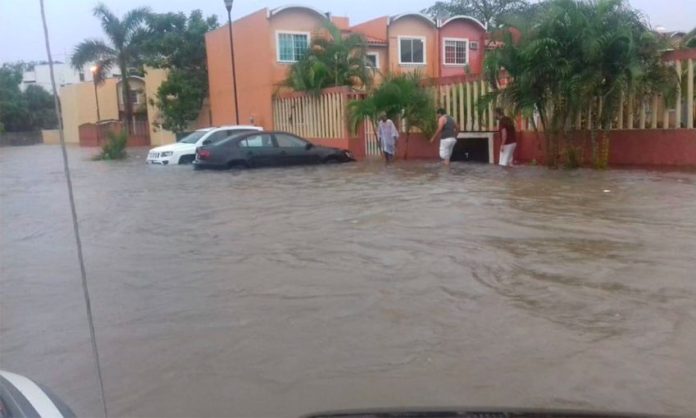
Flooding caused by Narda on the weekend in Guerrero.
Tropical Storm Narda is moving north along Mexico’s Pacific coast, leaving a trail of extensive damage to infrastructure and at least one death.
Narda made landfall in Oaxaca on Saturday before being temporarily downgraded to a tropical depression. But after delivering destructive rain and wind to states along the coast over the weekend, the storm gained strength and was upgraded back to a tropical storm on Monday.
According to Oaxaca Civil Protection Secretary Heliodoro Díaz Escárraga, a 26-year-old man disappeared on Saturday in the municipality of San Pedro Mixtepec, and was found dead the next day. Díaz said he was probably carried away by the strong current of a river he was attempting to cross.
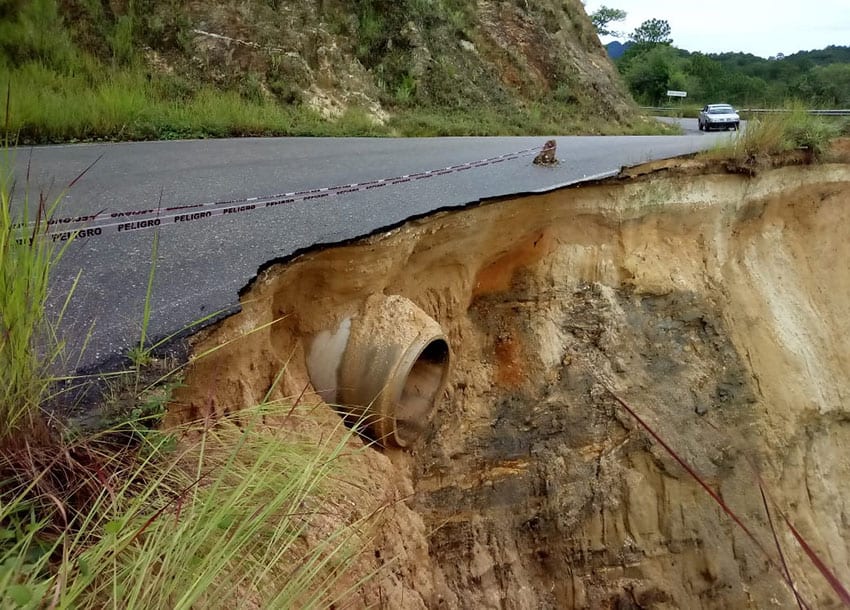
The rains also caused a landslide in Santa Catarina Juquila which buried a butcher shop and a clothing store, although no one was injured. Thirteen Oaxaca municipalities suffered serious damage, especially in the Costa and Mixteca regions.
In Acapulco, Guerrero, floodwaters dragged three vehicles off the roads, and flooding damaged a public hospital.
Road damage in Oaxaca.
In Jalisco, Civil Protection evacuated 450 people from coastal regions before the storm hit early Monday morning. When it did, it brought wind gusts at speeds higher than 60 kilometers per hour and heavy rain, causing landslides, overflowing rivers and damage to 248 houses.
A search was under way for someone who authorities fear may have died in the town of Yelapa, Cabo Corrientes, after the Yelapa river broke its banks. Yelapa has been isolated by the flooding and can only be reached by air or sea.
At 11:00am CDT, on Monday, Narda was located 80 kilometers south of Mazatlán, Sinaloa, and 75 kilometers west of El Roblito, Nayarit, according to the National Meteorological System (SMN). It forecast that Narda will reach northern Sinaloa by Tuesday morning, and the state of Sonora on Wednesday, after which it will once again be downgraded to a tropical depression.
A tropical storm warning is in effect for San Blas, Nayarit, to Guaymas, Sonora, and for Islas Marías.
The SMN said Narda will cause intense rains in seven states, and very heavy rains in another 17, including Mexico City.
Schools have suspended classes across Guerrero, Nayarit and Colima, and in some municipalities in Jalisco, Sinaloa and Oaxaca.
The roller coast where Saturday's accident occurred.
Mexico City prosecutors are investigating an accident on a roller coaster in the Feria de Chapultepec amusement park that killed two people on Saturday.
The borough of Miguel Hidalgo, where the park is located, said the company that operates the park follows a security program with the borough, and that investigators should focus their efforts on the program’s records, which include a maintenance and operations calendar.
“Prosecutors should focus investigations on the records, especially for the Quimera ride, because someone didn’t do their job,” the borough said in a statement.
Mexico City Mayor Claudia Sheinbaum said the city could ask for international help in investigating the accident.
“We need to find out if the protocols we have in the city are the same as in other parts of the world,” she said. “The Civil Defense Secretariat will look over it and will call different international organizations, which we will announce later, because the most important thing is to ensure the security of people who go to amusement parks.”
She added that if anyone is found to be criminally responsible, they will be punished.
The accident happened on Saturday around 1:30pm when the last car on the ride derailed and fell about 10 meters to the ground. Two young men were killed in the fall and two women were seriously injured. The operator said the park will remain closed for one or two weeks.
Park vendors who spoke with the newspaper El Universal said that technical problems with the ride had existed for about three years, but had been ignored by the park’s management.