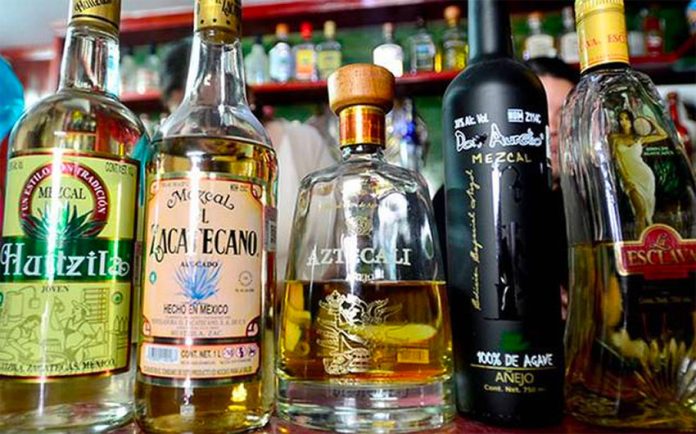
Zacatecas will attempt to win the Guinness World Record for the largest mezcal tasting on Thursday.
The event will be held in the city of Zacatecas’ Plaza de Armas, where more than 2,000 people are expected to show up to sample the state’s mezcals.
Rural Affairs Secretary Adolfo Bonilla Gómez confirmed that Guinness representatives will attend the event to witness the achievement of the record.
Bonilla explained that the tasting is part of the Zacatecas 2019 Food Show, which hopes to introduce 21 Zacatecan food products to national and international markets.
He hopes the event will “open a new window to the world” for locally produced mezcal.
Mezcal produced in Zacatecas shares denomination of origin status with the states of Guanajuato, Tamaulipas, Oaxaca, Guerrero, Durango, San Luis Potosí, Michoacán and Puebla.
It is also protected by the Regulatory Council of Mezcal, an entity that reviews standards related to production, bottling, labeling and commercialization of the beverage.
The Zacatecan mezcal industry is comprised of approximately 1,000 agave producers and 22 mezcal distilleries, which together produce 60 distinct brands.
Zacatecas is home to five species of agave used to distill mezcal: Cenizo, Salmiana, Tequilana Weber, Maparrillo, and Guadalajara.
The state was the country’s eighth largest producer of agave in 2018, with 100,221 hectares of farmland dedicated to cultivating the succulent. Those fields yielded 21,731 tons of agave that year.
There are two main agave producing regions — Cañones de Tlaltenango y Juchipila, located in the south of the state, and the Pinos region, a semi-desert area in the southeast.
Bonilla emphasized the food show’s focus on creating direct commercial deals between producer and buyer in hopes of cutting out the middleman.
In order to make the state’s agricultural sector more organized and competitive, the event will host Italy as its guest country. Sinaloa was invited to be the event’s guest state.
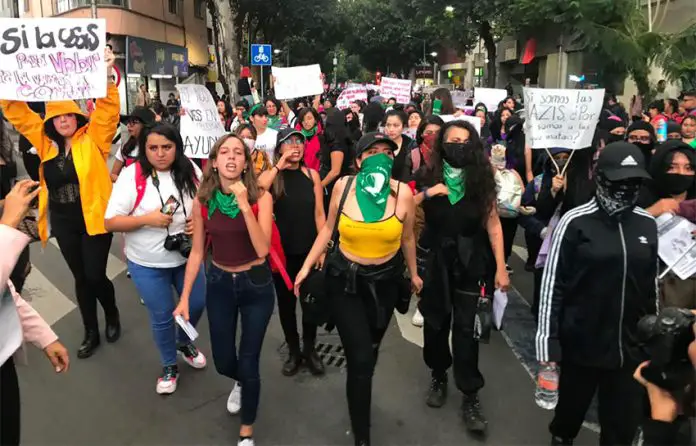
Women march against gender violence in Mexico City.
Some people are natural rebels — revolutionaries, even — but not me. I’m a natural rule-follower, a lover of order. I like established parameters I can respect and expect others to do the same.
Spontaneity, frankly, makes me anxious. Even concerts and parades overwhelmed me for fear the sheer mass of people could lead to chaos. If there’s not a plan for all possibilities that could result from a given course of action, count me out.
Growing up in any kind of family other than the liberal, activist one in which I did, I could have easily turned out to be a Mike Pence conservative. I often feel my personality doesn’t match the mostly anti-establishment views with which my ideology lines up.
I want change, but I am allergic to and terrified of — if we’re being honest — conflict. For example, I crave the structure of good government, but want only the parts that don’t tear common people down. Meanwhile, I’m probably hiding in the back room sending encouraging dispatches to the real fighters.
What I really want, I suppose, is for the world to be Denmark or one of those other northern European countries where everything just seems to work and solutions to societal problems are logically and matter-of-factly found and implemented.
I’ve been reading with interest about the recent women’s protest in Mexico City in response to the alleged rape of a teenage girl by police officers. The group went to the Attorney General’s Office to demand that the accusations be taken seriously.
The event garnered a lot of attention — windows were shattered, furniture was destroyed, angry words were shouted and glitter was thrown. The predictable cries of “That’s not the way you should protest; your hooligan strategies are self-defeating!” and counter-cries of “Your privilege and wrongly-placed priorities are showing, you hypocrites, and it’s not a good look!” have been echoing around the internet since then.
I’ve read accounts of what happened and seen the pictures and videos. The rule-loving, people-pleasing part of me — what I consider the less-evolved part of my brain — winces at the specter of chaos and raw emotion. But my higher self — the part of me able to think deeply about the intricacies of what justice really means — thinks: “Well, really, what things don’t women have to be angry about?”
When it comes to fighting for fairness, women often can’t win. The social expectations that designate us “the fairer sex” aren’t much use when it comes to fighting for our rights. For many, there’s nothing more contemptible than women acting as if they have just as much right to demand respect as men do.
This was one good reason among a multitude to protest, and I’m glad they did. The more attention crimes — particularly those aimed at women — receive, the more likely they will be taken seriously by both the justice system and by society at large. We’re not likely to eradicate the patriarchy, sexism, sexual abuse and violence in our lifetimes, but it’s certainly worth trying.
I know plenty of people will keep going back to the “but-that’s-not-the-way-to-protest” argument and, as someone who instinctively falls in line, I can sympathize. But that said, how much attention might have they received if it had been a simple march? Does the old adage, “any press is good press,” apply here?
As a woman, I often feel frustrated about how little violence against half the population is taken seriously by the public at large and, specifically, by the powers that be.
An alleged rape by police is the tip of the iceberg in Mexico. Other major problems include the all-too-common murders of women by current or former partners and the “disappearances” of women into the modern-day slave trade, shallow graves, or both. Then there are more “minor” problems such as job and wage discrimination, forced sterilizations, and run-of-the-mill sexual harassment that millions of women suffer every day.
These things can really grate on a girl’s nerves, you know?
All that said, I think the authorities responded fairly well to this situation under the circumstances. Any specialist in conflict resolution will tell you that if you really want a successful outcome through dialogue, both parties must remain calm and avoid accusations, criticisms and blaming.
While this is not an example of two organizations with equal power, I think the fact that the Mexican authorities and Police Chief Jesús Orta Martínez at least tried to talk to protesters demonstrated goodwill.
While his “running away from glitter” made excellent fodder for memes, it’s hard to imagine anyone trying seriously to discuss something when there’s so much passion and anger on the other side. The No. 1 rule of conflict resolution is that when people lose their cool, a break must be taken before resuming.
As of this writing, Mayor Claudia Sheinbaum has officially apologized for the government’s perceived exaggerated response to the protest and reiterated her commitment to the safety of women in Mexico, which is exactly what she should have done. The Attorney General’s Office will not be pressing charges against those who committed acts of vandalism, which is also exactly the right move.
They listened to concerned citizens, put their egos on the back-burner, and gave priority to people’s concerns about grave human rights violations over a few broken windows and fistfuls of glitter, which is what the authorities must do.
Bravo to the brave women who marched to shine light when it needed to be shone. Bravo to the authorities for — eventually — getting the response right. I think we’re finally getting somewhere, y’all.
Sarah DeVries writes from her home in Xalapa, Veracruz.
The Mexican multinational baking company Grupo Bimbo will begin using a completely compostable bag for its bread in October.
The bags can be mixed in with organic waste, and will decompose over a period of 180 days, the company says.
The new bags put Bimbo at the vanguard of innovation in terms of reducing its environmental impact, general manager Daniel Servitje said during a forum on innovation in waste management.
“This is the first step that our company is taking at a global level in the area of compostable bags, through innovations led by our technical teams,” he said.
Servitje said that Mexico will be a pioneer in the development and use of compostable bags.
“Currently, 100% of our products could have completely biodegradable bags, which means that they can be integrated back into the environment without leaving residue,” he said. “That covers all of our product categories, including bread, sweetbread, pastries, cookies, snacks and candies.”
He added that Bimbo was the first Mexican company to use biodegradable plastic bags, which it began doing in 2008.
“I am convinced, personally and professionally, that we can create a Mexico and a world without plastic pollution,” he said.
Mexico City Mayor Claudia Sheinbaum, who also spoke at the forum, said Bimbo will be an important ally for the city government in its efforts to improve waste recycling.
“They are showing their commitment with this investment, not only to technological development but also to reducing the environmental impact of waste, in our city and around the world,” she said.
Peace is drawing near in the tomato war between Mexico and the United States.
Tomato producers said they reached an agreement late Tuesday with the United States Department of Commerce that will remove tariffs on Mexican exports.
A committee of Mexican tomato producers and officials from the commerce department negotiated the deal in Washington D.C. over four days.
The United States imposed 17.5% tariffs on Mexican tomatoes in May after the two countries failed to renew an agreement that suspended a U.S. anti-dumping investigation that first opened 23 years ago.
However, the director of the Confederation of Agricultural Associations of Sinaloa, Mario Robles, said in a statement that a new deal was struck at midnight that “suspends the ongoing dumping investigation.”
Once the agreement takes effect, Mexican tomatoes will enter the United States tariff-free and all duties paid since May 7 will be returned to producers.
The Department of Commerce said the draft deal will be reviewed over a period of 30 days and signed on September 19 if both countries agree.
But one aspect of the agreement that is less pleasing to Mexican growers is that 92% of Mexican tomato trucks will be subject to quality control inspections.
The Department of Commerce said the inspection mechanism will prevent imports of “poor-condition” tomatoes that have “price suppressive effects” for the broader market.
Tomato producers said in July that the inspection requirement would create “a logistical tangle” at the border, given that 120,000 trucks a year would have to be inspected, a process estimated to take an hour and a half for each truck.
The new deal also sets reference prices for tomatoes and stipulates that organic tomatoes must be priced 40% higher than varieties that aren’t. The agreement is scheduled to be reviewed in September 2024.
If a deal had not been reached, tariffs could have increased to 25%, which would have had a significant impact on the Mexican tomato industry.
Mexico sends about US $2 billion worth of tomatoes to the United States annually, making it one of the country’s biggest fruit and vegetable exports along with avocados. About one million people work in the Mexican tomato industry.
Mexico overtook the Netherlands last year to become the world’s biggest exporter of the crop, of which 99.7% is shipped to the U.S.
Tomato growers in Florida have said that Mexican producers unfairly undercut U.S. farmers on price but Mexico denies the charge.
President López Obrador, who had warned that permanent tariffs on tomatoes could fuel migration to the United States, said today that he welcomed news of the deal.
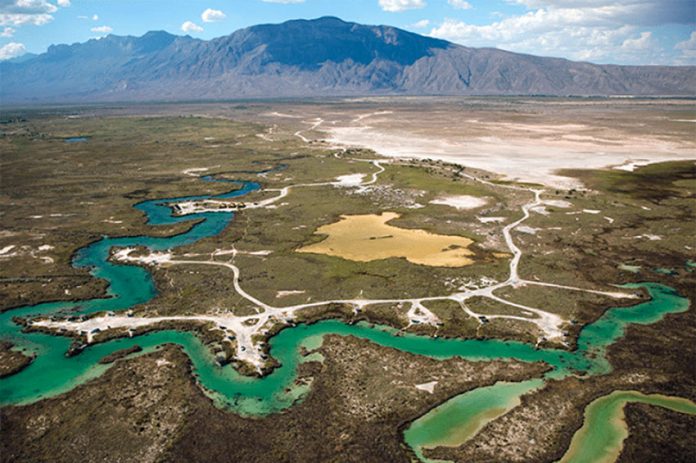
Aerial view of Cuatro Ciénegas in Coahuila. David Jaramillo
The pools of Cuatro Ciénegas (four marshes) in Coahuila’s Chihuahua Desert conceal a very old secret: the origins of life on Earth.
They are inhabited by colonies of bacteria-formed stromatolites, organisms considered the inventors of photosynthesis. They are formed by bacteria that use water, carbon dioxide and sunlight to create food, expelling oxygen as a by-product. The real significance of stromatolites is that they are the earliest fossil evidence of how life began.
Cuatro Ciénegas is a unique biosphere — literally an oasis in the desert at an altitude of 740 meters. Located northwest of Monclova, the area owes its name to abundant springs that form extensive marshes and pools in the middle of the desert.
The city is formally known as Cuatro Ciénegas de Carranza, in honor of its most famous son, Venustiano Carranza, president of Mexico from 1915 to 1920, who was born there in 1859.
The intriguing landscape is the result of a sea that, millions of years ago, emerged at the same time as the Sierra Madre Oriental. Its folded and fractured marine rocks formed most of its mountain ranges and hills.
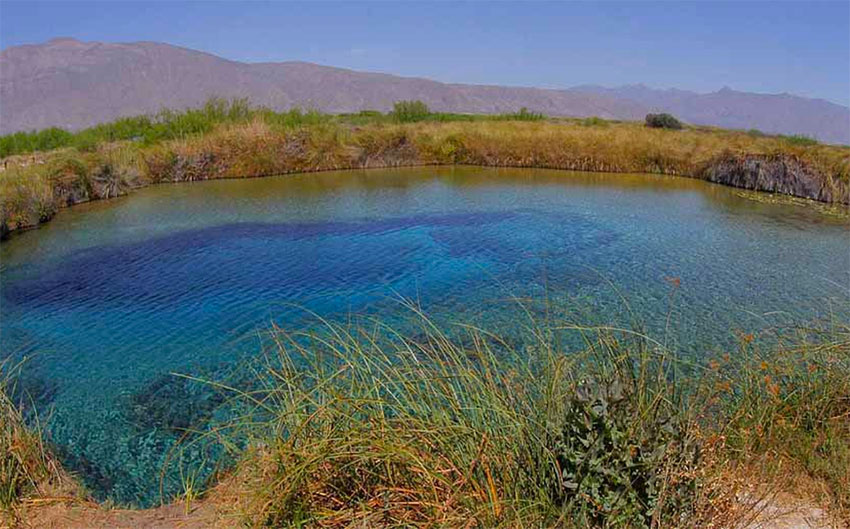
Poza Azul at Cuatro Ciénegas, Coahuila.
Two things immediately strike you about Cuatro Ciénegas: tomb-like silence and the surreal shroud that encases it. Some say they feel currents of occult energy flowing like fog, ebbing in town, peaking at the bright-white dunes. It flows steadily through the transparent azure wells.
According to some, the energy is peaceful except by the old mines where it is sad. Listen to Cuatro Ciénegas yourself and, they say, you may hear your soul coming out to mingle with the soul of creation.
Some writers claim you need four-wheel drive to visit all sites of interest. Balderdash, I say. Except for one inaccessible well, the attractions are on paved roads.
Pozo Azul and Las Dunas de Yeso are the two most photographed, iconic spots. Next are Poza la Becerra and Río Mezquites, where you can swim, legally. Kayaks are available. Sunscreen or lotions are prohibited. Other attractions include the Bodegas Ferriño Winery and a spectacular canyon in the nearby mountains.
The gypsum dunes rise to 12 meters and resemble those of White Sands, New Mexico, where I grew up. Gypsum is used in cement, drywall and agriculture. From 1979 to 1996 it was mined — scooped up — on an industrial scale at Cuatro Ciénegas. Though officially banned in 1996, residents say it still goes on.
Scientists believe there are clues to life on ancient Earth in the landscape — microbes, bacteria, fossils and fish. There are live stromatolites in the pools and fossils on the edges. These cauliflower-like sponges are relics of the earliest microbes on earth.
Las Dunas de Yeso a popular attraction among photographers.
The area has been designated a biological reserve. But farmers still extract water and miners and bucket loaders still shovel gypsum. It’s a Pueblo Mágico, or Magical Town and, since 2006, a United Nations-recognized biosphere reserve. In 2007 president Felipe Calderón took a few baby steps to limit water extraction on the Chihuahua Desert.
Two things menace the springs — huge alfalfa farms that suck water from the aquifer and Arundo Donax, an invasive giant reed that threatens native species and the water supply. Much of the water is covered by this reed.
Compared to my first trip three decades ago, my guess is that 30% of the pools are gone or covered.
Meanwhile a debate rages about which herbicide will be safe enough to kill the invaders, but not the native flora and fauna.
There are reputed to be more than 500 springs feeding the pools. Water temperatures vary by season and pool. Averages are 20 C in Poza Azul (winter) to a balmy 32 C in Poza Escobedo (summer). Some pools are transparent, like Yucatecan cenotes. Others are turquoise, aquamarine, cerulean or teal, depending on sky conditions.
Swimming and camping are allowed only at Poza Becerra. But we saw swimmers elsewhere who missed the memo.
Poza la Becerra, where swimming and camping are allowed.
Everybody in Cuatro is, knows or is related to a guide. If you don’t need a college-level lecture on the ecosystem, they do just fine. On many paths there are signs describing the flora and fauna as well as in a remarkably good on-site museum.
As a local guide, the folks at the Plaza Hotel recommended Raúl, a man in his 30s who spoke English and had a friendly, intelligent demeanor. He took us where we needed to go; told us what we needed to know.
You don’t need a guide, but I like to help the local economy. A local will always know more than I do. Raúl went one step farther. The photographer wanted to do some astrophotography at the dunes.
The access road was blocked by a locked iron gate at night but Raúl had a key. So, late that night, we went to the dunes and he shot to his heart’s content.
Downtown is always a trip. Owners of the few restaurants came out and greeted us like family. People stopped what they were doing, smiled and said “Hello.”
In all my years of traveling Mexico, I can’t remember a friendlier town. We also visited President Carranza’s museum.
[wpgmza id=”230″]
You can camp at Poza la Becerra or there are four good hotels. I stay at The Plaza (1,255 pesos). There’s Hacienda del Caballo (1,200 pesos), Hostel Doña Carlota (1,050), San Pablo (840) and the luxury Hacienda (1,800). There are several friendly, inexpensive restaurants on the town square and at most hotels.
Cuatro Ciénegas is in northeastern Coahuila, 73 kilometers west of Monclova. From Piedras Negras it’s 306 kilometers.
In summer, the devil has a condo there. My last trip was in the fall, which has perfect, dry temperatures in the day and a little cooler at night. October-November highs average 24-28 C with lows of 9-15 C.
Visiting the stromatolites at Cuatro Ciénegas is like going back four billion years to view the beginning of life.
“Mexico Mike” Nelson was a prolific author of books and articles about Mexico travel and culture in the 1980s and 1990s. Rumors of his demise are only partially true. He says he’s just been resting on his laurels. More of his work can be found at https://www.mexicomike.com.
Four navy vessels that will gather sargassum from the waters off Quintana Roo are under construction in the port of Coatzacoalcos, Veracruz.
The first is expected to be ready in October.
The navy is building the 15-meter boats, which were designed by navy engineers, for 7.5 million pesos each.
A ramp at the front of each vessel will scoop up the sargassum, which will then be carried up by a conveyor belt and deposited for draining and bagging in 600-kilogram sacks.
Each boat will have a five-tonne crane for off-loading the sacks.
The navy has been leading the effort to combat sargassum on the beaches of the Mexican Caribbean since May.
The new sargassum-collecting vessels will be more efficient because they are specially designed to remove the macroalgae, Admiral Jorge Daniel Zamora Vuelvas said.
Most beaches in Quintana Roo are currently rated as moderate or low in terms of sargassum levels, a considerable decrease from just a few weeks ago.
A retired army general and former secretary of security in Nuevo León was sworn in yesterday as the chief of the new metropolitan police force in Guadalajara, Jalisco.
Arturo González García will be responsible for a 7,500-strong force that will operate across the metropolitan area of the Jalisco capital.
Eight of nine mayors in the greater Guadalajara area as well as the Jalisco government voted in favor of giving the Metropolitan Security Agency direct responsibility for combating crime rather than only generating public security policy.
González was given a period of 30 days to prepare an operational plan for the force.
“It will be designed through the identification of the strengths, weaknesses, opportunities and internal and external threats in security matters in the metropolitan area,” the new police commissioner said.
The 64-year-old explained that his plan will be based on the National Police Model that was designed by the National Public Security System and approved by the National Security Council last month.
Federal Security Secretary Alfonso Durazo expressed confidence that the new metropolitan police force will help to guarantee peace in a city where there has “historically” been a strong organized crime presence.
“We’re going to close this cycle of violence that the state [of Jalisco] has lived” throughout the administrations of successive federal governments, he said.
“We won’t allow any criminal group to claim for itself the name of a federal entity such as Jalisco,” Durazo added, referring to the Jalisco New Generation Cartel, Mexico’s most power and dangerous criminal organization.
“Without apportioning blame or shirking responsibilities, federal, state and municipal authorities must join forces . . . We have the obligation to yield results.”
The security secretary predicted that the results in Guadalajara could be similar to those achieved by the single-command police force in the Comarca Lagunera region, which takes in parts of both Coahuila and Durango.
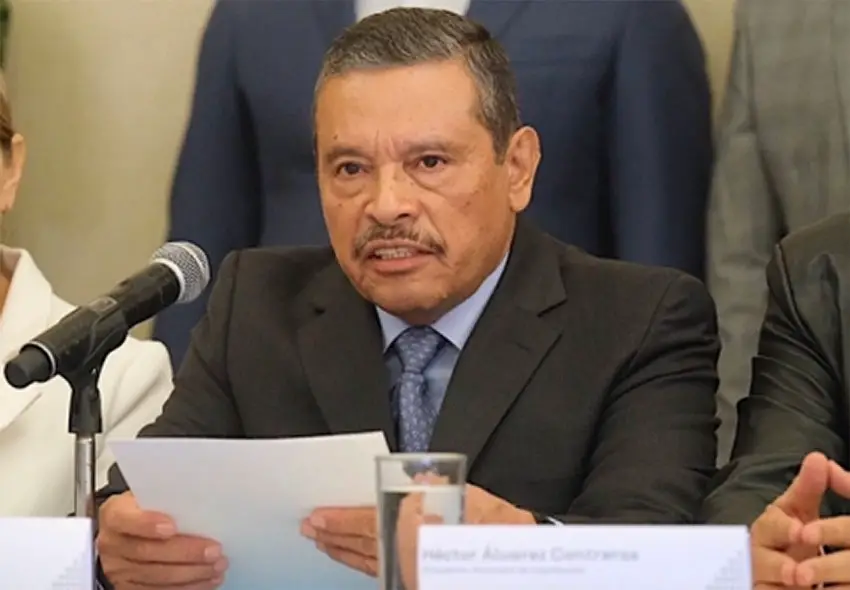
Guadalajara’s new metropolitan police chief.
“That area doesn’t even appear in [crime] statistics now,” Durazo said. “If there’s no coordination or single operational command, the possibility of effectively pursuing criminals is practically zero.”
Jalisco Governor Enrique Alfaro also expressed confidence that the new metropolitan police will help to reduce crime, adding that the capacity of municipal forces to combat organized crime has been exceeded.
Guadalajara Mayor Ismael del Toro pointed out that before the new policing model can be implemented, it must be ratified by municipal councils.
One municipality where local lawmakers have expressed doubt about the new police force is Tlaquepaque.
Morena party councilors yesterday called for more discussion, analysis and debate before a ratification vote is held.
Alberto Mercado Chavarín, Morena coordinator in Tlaquepaque, said the party will support any attempt to improve security in Guadalajara but asserted that it is not yet clear how the coordinated policing model will work.
“How is this Frankenstein going to work? Who came up with [the idea]? Where are the qualified voices that suggested this model? Yes to metropolitan coordination but let’s first see how [it will work], it has to be an applicable model,” he said.
Ranks of the new force, which replaces the Fuerza Única, will be drawn from the municipal police forces in greater Guadalajara.
The two inmates who have waited a long time in jail.
Two México state men who have been held in prison for 17 years while awaiting trial will soon be released, a judge ruled on Monday.
Judge Felipe Landero Herrero ruled that Daniel García Rodríguez and Reyes Alpízar Ortiz, who were arrested for a murder in 2001 but never went to trial, will be released while the legal process continues. They will be required to wear electronic geolocation bracelets and check in with authorities every 15 days.
The organization Pena Sin Culpa celebrated the ruling and the new legal interpretation made by Judge Landero, calling it “transcendental and historic.”
“The release of Daniel and Reyes is a step forward for the achievement of justice and the fulfillment of human rights recommendations from international bodies,” the organization said in a press release.
García and Rodríguez have been held in preventative custody longer than anyone else in Mexico and the western hemisphere. If they are convicted, they face a maximum sentence of 15 years and eight months, shorter than the time they have already spent behind bars.
In a phone interview with the newspaper Reforma, García called it an “atrocity.”
“The use of preventative prison is an atrocity, it’s prehistoric, it shouldn’t happen in the modern world,” he said. “The ministers of the court have contributed to the continued use of the practice. No one should be punished without having been convicted of a crime.”
However, the criminal case against the two men is not over. García promised that he will cooperate with the process and the conditions of his release.
“If they demonstrate that we are guilty, and we need to go back to prison, that’s how it will be,” he said. “But if not, at the moment we are found innocent we will demand the reparation of the harm done to us, and an apology from the Mexican state.”
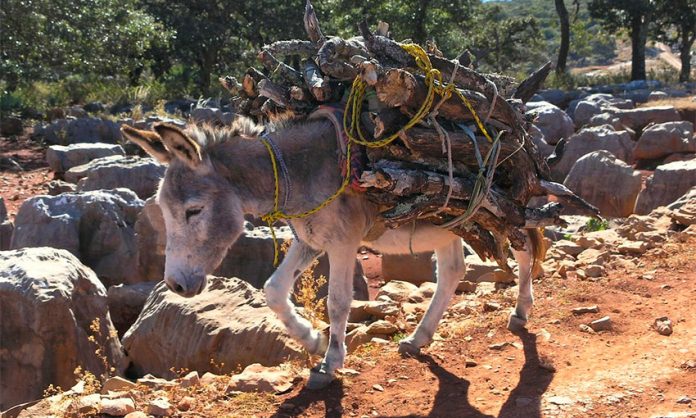
Carrying firewood is a donkey's role in Río Dulce and other Oaxaca communities.
A donkey has been freed from jail in San Sebastián Río Dulce, Oaxaca, after 72 hours behind bars through the efforts of an animal rights organizations.
Pascual Cruz and Alejandra Mejía, both in their 80s, did not have the means to pay the taxes, which other residents have denounced as abusively high.
After hearing that the couple had been refused the right to tkae the donkey food and water during its detention, animal rights activists in the state united to file an animal cruelty case with the state Attorney General’s Office.
Public pressure and the legal approach prompted the municipality of Zimatlán de Álvarez, in which Río Dulce is located, to demand the animal’s return to its owners without their having to pay the taxes.
Oaxaca animal rights group president Hilda Toledo said that activists had planned on going to Río Dulce to protest but the town is considered dangerous and outsiders must solicit authorization to enter, so they chose the legal route.
In Oaxaca, the mistreatment of animals can carry a punishment of three months to two years in prison, as well as fines up to 100,000 pesos (US $5,000).
Authorities in Río Dulce have been criticized for imposing inordinately high taxes for many community services, such as fees as high as 30,000 pesos for burials in the local cemetery.
In May 2017, municipal agent Carmelo López denied a family the right to bury an elderly relative for five days until they paid a fee of 20,000 pesos.
Toledo said she and other activists will keep an eye on the situation in the coming days.
His nickname means “The Nuisance,” and for good reason. At just 18 years old, Juan Isaac “El Calilla” V. E., has been arrested 43 times, mostly for assault and robbery.
He was arrested again on Monday in Cuauhtémoc, Chihuahua.
Police were searching for him in connection with a violent robbery as well as a number of other offenses.
In 2017, members of La Línea, an armed wing of the Juárez Cartel, cut off Juan Isaac’s right hand to teach him a gruesome lesson and warn other house burglars in the area.
This did not deter “El Calilla,” who continued to steal and rack up a lengthy criminal record.
He was located in the Emiliano Zapata neighborhood of Cuauhtémoc where he tried unsuccessfully to flee.