The abandoned airport at Texcoco must be left untouched.
The federal government’s airport plan has hit yet another
legal hurdle.
A federal judge has ordered that construction of the Santa
Lucía airport (AISL) must be suspended and that the abandoned airport project
at Texcoco be left intact.
The ruling was made in response to an injunction request
filed by the #NoMásDerroches (No More
Waste) Collective, a group made up of civil society organizations,
law firms and more than 100 citizens.
The group said in a statement that it has already obtained six definitive suspension orders against the AISL that stipulated that construction could not begin until environmental, safety and aeronautical viability permits, among others, had been obtained.
“In other words, once all the permits and studies in those matters have been obtained, which for the most part depend on the federal administration itself, the government would have the legal opportunity to start construction of the airport even if the injunction proceedings haven’t yet concluded,” #NoMásDerroches said.
“With this new injunctive relief obtained by #NoMásDerroches, construction of the AISL will
have to wait until the injunction proceedings are definitively resolved,” it
explained.
The collective has filed 147 separate injunction requests that could hold up or threaten construction of the new airport.
According to Rogelio Rodríguez, an attorney who specializes
in aviation law, resolving all of them could take up to a year.
President López Obrador once again described the legal action against the US $4.8-billion airport as “legal sabotage.”
“. . . It’s incredible, more than 80 injunctions. How many injunctions were presented when they [the former government] wanted to do the juicy business of building the Texcoco lake airport?” he asked at today’s presidential press conference.
Answering his own question, López Obrador said that there were none before claiming that now that he is in office, “filing injunctions against all the projects we’re doing is like a national sport.”
“I hope that this is resolved soon. We’re asking the judicial power, in accordance with the law, to resolve this because they’re stalling tactics . . . so that the project isn’t built or is delayed . . .” he said.
The president declined to offer a prediction about how long the project might be delayed.
The Secretariat of National Defense, which is building the airport, said last month the airport will open in January 2022, six months later than originally anticipated.
According to the master plan, its construction will take 30 months.
A federal agency has identified eight Tamaulipas doctors who offer cosmetic surgery without having the necessary qualification.
The head of the state office of the Federal Commission for Protection Against Sanitary Risk (Cofepris) said that doctors — and even veterinarians — sometimes claim to be specialists in certain areas such as plastic surgery.
“So far, we’ve identified eight in Tampico, Reynosa and Matamoros,” Óscar Villa Garza said. “Usually, they claim to be plastic surgery specialists, when they really aren’t.”
Villa said that to address the problem, Cofepris will create an online platform that will allow people to verify doctors’ specializations.
“Soon, we will put information about specialists on the Cofepris webpage,” he said. “Right now, we are cleaning out and updating the information of every specialist, in every municipality, so that people will know who is treating them.”
Villa asked citizens to report unlicensed surgeons so that irregularities and malpractice will no longer go unpunished.
According to Tamaulipas plastic surgeon Sonia Estela González Macay, there are more than 15 general practitioners who illegally perform plastic surgery in the state, and many more people who offer plastic surgery without having medical degrees.
“There are people who aren’t even doctors, and they are doing cosmetic surgery,” she said. “This problem is getting worse and worse, and now there are even some hairdressers that offer plastic surgeries. Some of them are doctors, but don’t have the certification or the training. It’s especially odontologists, ENT specialists, dermatologists, general practitioners and ophthalmologists who do cosmetic surgery without having the proper certification.”
González, who has been practicing plastic surgery for 35 years and is the only woman plastic surgeon in Tamaulipas, said that people looking for cosmetic surgery should only go to surgeons who are certified by the Mexican Plastic Surgery Council, and should avoid hiring “charlatans” for procedures that could be potentially dangerous.
“They inject substances in the mouth, the chest and the buttocks, substances that aren’t even medical products, like baby oil, or mineral oils, or even automotive or kitchen oil,” she said. “They use fillings that haven’t been well evaluated, and that aren’t trustworthy, but are cheap. They offer surgery for 3,000 pesos (US $153), when a real surgery with local anesthesia is never cheaper than 20,000 pesos.”
Smart hikers wear long sleeves and pants on Mexican trails.
In many parts of Mexico, the rainy season reaches its peak in August, creating a rich, verdant landscape. Exuberant foliage spreads over the hills and valleys, while wildflowers and mushrooms sprout underfoot.
It’s the perfect time to go hiking in the great outdoors. But beware! August may also bring irritating bugs like moscos (mosquitoes), jejenes (gnats) and ácaros (mites). These little creatures could transform your idyllic walk into pure misery but you can greatly reduce the chances of that happening by taking a few simple precautions.
First, wear long sleeves and long pants even though it’s summer. This simple ploy will not only reduce the impact of the bugs just mentioned but will also help protect your arms and legs from thorns or irritating plants like cacti, uña de gato (cat’s claw) and mala mujer (nettles).
Just before hiking, apply bug repellent to your shoes, socks, calves, waist, neck and ears, but never to your forehead where sweat will carry it right into your eyes. The ecologically-sound repellents I’ve tried don’t last long, so I reluctantly recommend Off or something else containing DEET.
Just as soon as possible after the hike, take a shower and vigorously scrub yourself — twice! Then throw all your hiking clothes into the wash.
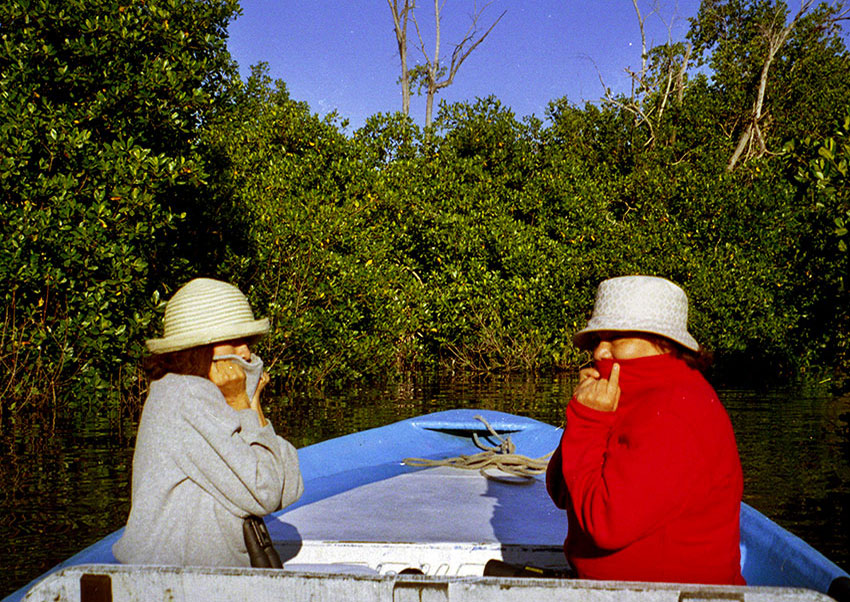
On a panga at San Blás. Are they cold or fighting off gnats?
These procedures will greatly reduce your chances of finding yourself covered with itchy red spots — caused by chiggers — a day or two after your hike. Note the words of biologist Nina Bicknese: “There is no creature alive that can cause more torment for its size than the chigger.”
This nearly invisible creature is the trombiculid mite, known in Mexico as ácaro de la cosecha, ácaro rojo, tlazahuate, nigua or güina, and it could easily continue to plague you for weeks if you give in to temptation and scratch it.
During your hike, a nearly microscopic attack force of chiggers probably dropped on to your shoes from the tips of overhanging plants. Sitting on the ground is another way to pick them up. I know one experienced hiker who carries a super-light folding chair in her backpack. That chair is the only thing upon which she will place her posterior when hiking or camping.
The mites that boarded your body did not, by the way, consist of seasoned fighters, but, quite literally, “babes in the woods.” They are larvae that, once grown, turn into vegetarians representing no danger to human beings.
Bicknese says:
“A chigger usually goes unnoticed for one to three hours after it starts feeding . . . quietly inject(ing) its digestive saliva. After a few hours your skin reacts by hardening the cells on all sides of the saliva path, eventually forming a hard, tube-like structure called a stylostome. The stylostome . . . (that) functions like a feeding tube for the hungry chigger that sits with its mouthparts attached . . . and, like a person drinking a milk shake through a straw, sucks up your liquefied tissue.”
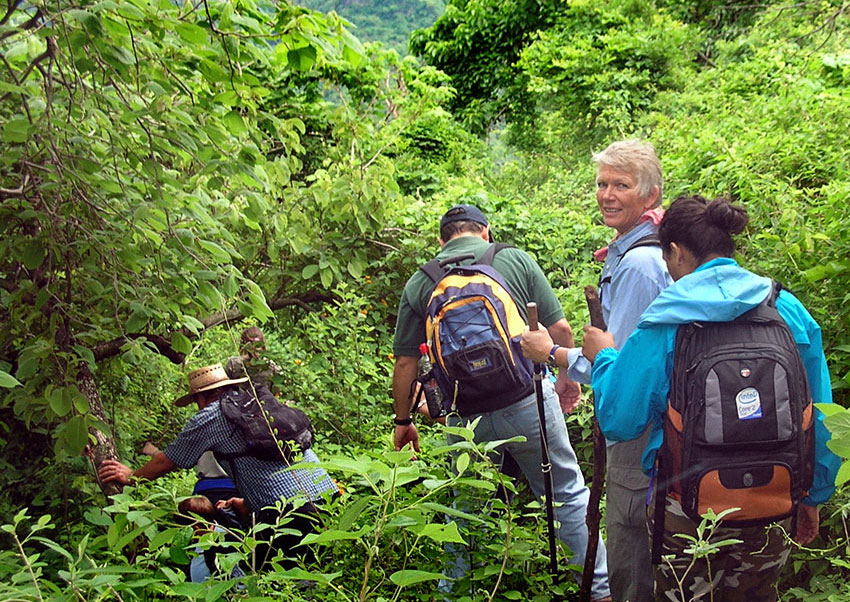
Río Verde canyon, Jalisco. In semi-tropical areas be ready for chiggers or scabies mites.
You won’t feel anything during this gruesome-sounding process because the little chigger cleverly administers an anesthetic right from the start. Only when your body reacts to the presence of the stylostome do you feel the urge to scratch.
Don’t do it! Scratching will almost certainly lead to infection and to several extra weeks of misery. One good thing about chiggers is that, unlike certain other kinds of mites, they don’t carry diseases of any kind.
Although they are so small, chiggers run very fast on long legs and take only about 15 minutes to climb from your shoes to your belt line — a distance equivalent to a human’s climb to the top of a tall mountain. At the belt line they may encounter a tight elastic band, so that’s where they often stop and start eating. The waist and the softer parts of the body is where you’ll usually find the red welts.
If, unfortunately, you forgot your repellent and now find yourself covered with itchy red splotches:
Don’t scratch them, not even a little bit.
Apply Calamine lotion — Caladryl is a popular brand name in Mexico — liberally and renew it as often as possible. To be sure you don’t scratch while sleeping, you may want to apply Andantol to stop the itching. After a week, you should be fine.
A less common, but equally itchy problem, is infestation with scabies mites, sometimes called aradores (plowers). These are females that tunnel under your skin, laying eggs as they go. The results are small red bumps or mini-blisters in a straight or S-shaped line. They itch like crazy.
Be on the alert for leaves with tiny, irritating hairs.
These mites won’t wash off in the shower like chiggers, but they can be killed overnight with a potent cream called Scabisan, easily found in Mexico.
Next on our list are jejénes, a word that covers biting midges, sand flies or no-see-ums. They are, without a doubt, the most unforgettable bloodsucking superstars of the famed port of San Blás in Nayarit.
Elsewhere, they tend to cause problems principally during the rainy season. If you want to live with them, you need to lather DEET-based repellent onto every exposed skin surface except your eyes and forehead. That may hold you for a few hours. Be prepared to repeat the slathering twice more in the course of a day.
That should do the trick, but you may still find yourself performing what Douglas Brown calls “The San Blás Salute,” waving a handkerchief in front of your eyes whenever you’re trying to talk to someone.
Another bloodsucker is triatoma, the Mexican bed bug or kissing bug (chinche hocicona). They like to sneak up while you’re sleeping under the stars and insert a needle in your neck or lip. Because they sometimes transmit Chagas Disease (which killed Darwin), I suggest you sleep in a tent.
As for scorpions, arachnid expert Rodrigo Orozco says Mexico is the world champion, with 120 species. The most dangerous are the Centruroides, typically found on the Pacific coast. They are also known as bark scorpions in North America. If you get stung, head for a hospital and try to bring along the creature that stung you.
[soliloquy id="86948"]
If you discover ticks on your body, use alcohol to clean the area around the tick and tweezers to grab it as close as possible to the head. Pull it out and clean the bite area again with alcohol or soap and water.
Finally, let me mention Africanized bees, about which there is much to say — and I have said it in How to Survive a Bee Attack.
But all these dire warnings should not put you off. It’s likely you will not encounter even one of these pests on your next hike. But if you do — and you are wearing long sleeves, long pants and a splash of repellent — you should still be smiling on the following day.
Happy hiking!
The writer has lived near Guadalajara, Jalisco, for more than 30 years and is the author of A Guide to West Mexico’s Guachimontones and Surrounding Area and co-author of Outdoors in Western Mexico. More of his writing can be found on his website.
The legal team of former cabinet secretary Rosario Robles has accused the judge who ordered their client to stand trial on corruption charges and remanded her in preventative custody of making rulings based on “political and personal reasons.”
The federal Attorney General’s Office alleges that Robles allowed over 5 billion pesos (US $258 million) to be misappropriated from the federal budget while she was leading two secretariats.
During court hearings, Delgadillo made pejorative, sexist and offensive comments, Robles’ lawyers said in a statement. They also said the judge’s rulings were “clearly out of legal context.”
“We will soon present a complaint before the Federal Judiciary Council since his conduct is contrary to our constitution, international treaties and the Organic Judicial Power Law,” the lawyers said.
“Our client and her team of lawyers feel offended by the
partiality with which the judge acted,” they said, adding that the crime of
which Robles is accused doesn’t warrant preventative prison.
“. . . The control Judge Felipe de Jesús Delgadillo Padierna
flagrantly violated the concepts and principles related to precautionary
measures,” the lawyers said.
Legal experts who spoke to the newspaper El Financiero agreed with their assessment.
Ricardo Sánchez Reyes Retana, a lawyer who is currently acting for former Veracruz governor Javier Duarte, said the law provides judges with the option of imposing 14 different precautionary measures apart from preventative custody in cases where the accused is considered a flight risk.
They include confiscation of a person’s passport and the imposition of an ankle bracelet monitoring device, he said.
Sánchez also said that Robles’ decision to return from
overseas to attend court was clear evidence that she has no intention to
attempt to evade justice.
Therefore, the judge’s decision to impose preventative prison
was “excessive,” he said.
Former president Felipe Calderón said it appeared that the decision to imprison Robles was motivated by revenge.
“. . . It’s clear to me that there are significant irregularities that have to be punished but . . . I think that the way in which she was put in prison . . . has an arbitrary part to it and it doesn’t have to be this way, it seems [to be] personal revenge against her,” he said.
“I don’t excuse her, I don’t exonerate her, I believe that there were very serious things in the Master Fraud but everything has to be done in accordance with the rule of law” Calderón said.
Former Supreme Court judge José Ramón Cossío said in a radio
interview that the imprisonment of Robles “sends a bad very sign for the
justice model that we’re trying to build,” adding “it’s not a good precedent.”
However, he said the former secretary does have legal recourse, explaining that she can appeal the decision and seek an injunction against the imposition of preventative prison.
Robles’ legal team expressed confidence that the decision to jail Robles before her trial would be overturned and said that the process to win her release is already underway.
The lawyers concluded their statement by saying that they are
convinced of their client’s innocence and will prove it in court.
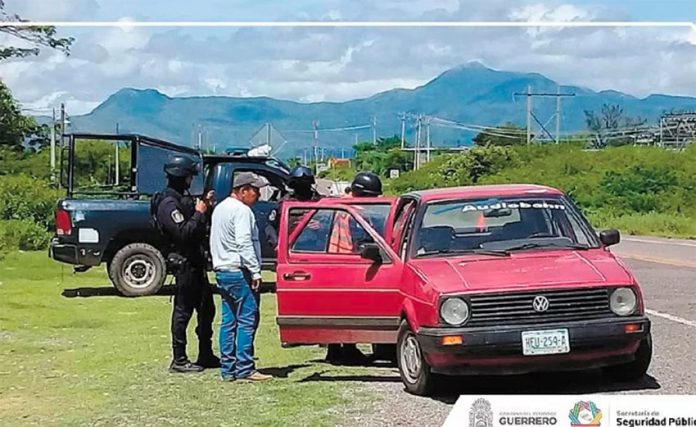
Police check a vehicle in Guerrero, where security has been stepped up in response to an incursion by the Jalisco cartel.
The government of Guerrero is stepping up security in the Tierra Caliente region of the state after a video circulated on social media showing a convoy of armed civilians entering the municipality of Pungarabato.
In the video, which was uploaded to social media on Wednesday afternoon, a convoy of 11 pickup trucks can be seen driving in what appears to be Ciudad Altamirano, the municipal seat of Pungarabato.
Anonymous sources told the newspaper El Universal that the occupants of the trucks were members of the Jalisco New Generation Cartel (CJNG), which is believed to be making an incursion into Guerrero.
State security spokesman Roberto Álvarez Heredia said the government is monitoring the situation, but has not been able to confirm whether drivers of the trucks were members of the CJNG, or whether they were in Ciudad Altamirano. But he also said that neither of those possibilities could be ruled out.
As a precautionary measure, the presence of the army and state police will be ramped up in the region.
Pungarabato lies on Guerrero’s border with Michoacán in the Tierra Caliente region, which includes parts of inland Guerrero and Michoacán. According to state police, the nine Tierra Caliente municipalities in Guerrero are dominated by organized crime groups from Michoacán such as the Familia Michoacana and the Caballeros Templarios, and are considered some of the most violent municipalities in the state.
According to government sources who spoke to the news magazine Proceso, organized crime groups in Pungarabato and five other nearby municipalities have been imposing a curfew and limiting freedom of movement for several days.
Armed civilians have set up checkpoints on the highway between Arcelia and Ciudad Altamirano, they said.
The sources said that leaders of the Familia Michoacana and Caballeros Templarios cartels in Guerrero have made a temporary alliance, and are preparing to fend off an attempt by the CJNG to take over.
Residents of the municipalities told Proceso that for the past several days they have been hearing messages played on loudspeakers urging people to stay in their homes because of the violence.
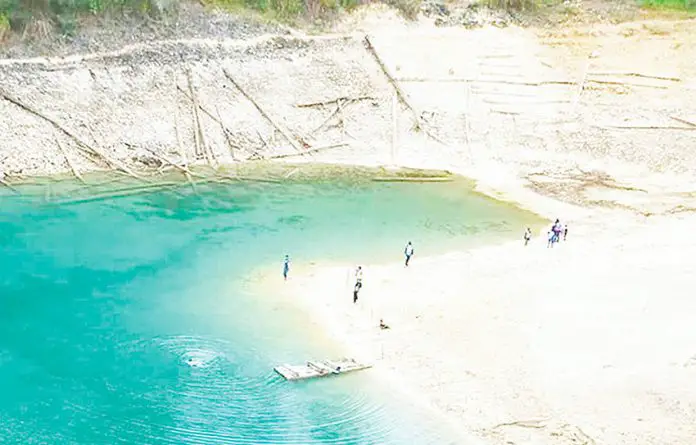
Lake levels are down in Lagunas de Montebello park.
Low rainfall due to the weather phenomenon El Niño has been blamed for lake levels that are as much as six meters below normal in the Lagos de Montebello National Park in Chiapas.
The 6,000-hectare park, a UNESCO biosphere reserve near the Guatemala border, is a popular tourist attraction, with 59 colorful lakes that run the gamut from blue to turquoise to green, even to crystalline shades of red, brown, and gray.
This year, rocks and white sand that were under water in February can now be seen on the rims of the group of lakes called Cinco Lagos (Five Lakes).
In much of the park, water levels are one or two meters lower than usual, but the Cinco Lagos lakes have sunk as low as six meters below normal.
Tour guide Isaías García Sántiz said he has witnessed this drop since February. He hopes the rains will come soon to bring the lakes back to normal.
[wpgmza id=”228″]
Park director Odetha Cervantes asserted that the decrease in water levels was due to meteorological factors, and not deforestation, as has happened in the past.
A forest fire in 1998 caused water levels at Lake Tziscao, on the border with Guatemala, to experience similar reductions.
“The Lagos de Montebello National Park has now recovered 100% of forest density, 50% of which was lost in the wildfire in 1998,” she said in order to clarify that the problem was El Niño, and not deforestation.
The park usually receives eight to nine months of rain a year, but precipitation has been scarce since February.
“This is one of the worst years I’ve seen,” said Amado, a resident of Cinco Lagos who offers boat tours to tourists. “There has been very little rain this season, and water levels are decreasing. This hasn’t happened to us before.”
Portal advised the president that the matter was 'extremely serious.'
Former president Enrique Peña Nieto was advised about the so-called “Master Fraud” embezzlement scheme in which government departments allegedly misappropriated billions of pesos but did nothing, according to the former chief auditor.
In an interview with the newspaper El Universal, Juan Manuel Portal said that he spoke to Peña Nieto at a 2017 meeting about the involvement of the secretariats of Social Development (Sedesol) and Agrarian Development and Urban Planning (Sedatu) in the scheme.
The former head of the Federal Auditor’s Office (ASF) said he told the ex-president that the matter was “extremely serious” and needed to be cleaned up.
Portal also said he told Peña Nieto that ASF reports about the embezzlement scheme had been sent to the president’s office.
“Analyze them . . . Look at them with the Secretariat of Public Administration . . .” he recalled telling the president.
Asked whether Peña Nieto took any action, Portal responded: “No, there was the intention, but he didn’t do anything.”
In response, Peña Nieto “took note to find out what it was about,” Portal said.
The “Master Fraud” scheme, in which billions of pesos were misappropriated through allegedly phony contracts with universities and shell companies, is back in the spotlight after a judge this week ordered former cabinet secretary Rosario Robles to stand trial on charges related to the case.
The Attorney General’s Office alleges that through omission, Robles allowed over 5 billion pesos (US $258 million) to be misappropriated from the federal budget while she was at the helm of Sedesol and later Sedatu.
However, the head of the federal Financial Intelligence Unit, Santiago Nieto, said today that Meade is not under investigation.
Robles’ legal team said at a hearing this week that their client told both Meade and Peña Nieto about the financial irregularities at the departments she headed.
Asked whether Peña Nieto should be investigated for omission, Portal said that must be determined by a judge before reiterating that the former president was “aware” of the corrupt practices occurring within his administration.
Likewise, the former ASF boss said that it wasn’t up to him to determine whether Meade should be investigated but added that “he was there [and] he should have known the [content of] the reports.”
Portal told El Universal that in meetings with Robles, the former secretary rejected that public funds had been misappropriated via public universities.
He said that Robles told him that she had personally verified the proper use of funds that had allegedly been embezzled.
“. . . The area in which she has a misunderstanding is that it is the Auditor’s Office that audits, not her,” Portal said.
Before one meeting, the former ASF chief said a truck arrived with more than 60 boxes of documents which Robles asked him to review.
However, a revision of the documents showed that they were “pure rubbish: copies, photocopies of photographs of events that had no date, no place, no nothing,” Portal said.
Asked how similar thefts of public money can be avoided, Portal said the law needs to be changed to ensure that the heads of government secretariats and other agencies such as Pemex are required to sign off on the expenditure of large amounts of funds.
Without that change, officials will continue to say “‘I didn’t sign anything,’” he said.
“We also need to strengthen confidence controls, train people [and] have more honest people [in government],” Portal said.
“However, the example comes from the president or the secretary. Each . . . must set an example . . . If everyone knows that a secretary is doing it [embezzling money] or if the president is diverting resources, who below them will respect [the law]? That’s why [setting] an example is very important . . . [as are] penalties.”
The compensation agreement has been approved by the Inter-American Human Rights Commission.
A compensation agreement reached between the government and a man who was illegally arrested and tortured by federal agents in 2001 has been approved by the Inter-American Commission on Human Rights (IACHR).
Mexico has agreed to pay financial compensation to medical doctor José Antonio Bolaños Juárez and publicly acknowledge the violations of his human rights.
In evidence Bolaños presented to the commission, he said 40 masked agents of the Attorney General’s Office (PGR) broke into his clinic in 2001 and destroyed his property. Ten days later, he was arrested and taken to a parking garage under a government building where police tortured him, threatening to kill him if he did not confess to being a kidnapper.
After one officer inserted a stick into Bolaños’ rectum, causing internal bleeding, he was rushed to a hospital for surgery. He was later charged with and convicted of kidnapping, and in 2003 he was sentenced to 60 years in prison.
He spent more than a decade in jail before his conviction was overturned, and was released in 2013.
Bolaños presented a petition to the IACHR in 2004, while he was still in prison, claiming the violation of his human rights by the Mexican state.
According to his petition, the PGR framed him for kidnapping because it was under pressure to produce results in anti-kidnapping efforts.
“The PGR fabricated these crimes in order to offer something to media and family members of people who had been kidnapped by the Los Colmeneros gang,” reads the petition.
In 2016, Bolaños and the Mexican state agreed to seek an amicable agreement, which the parties signed in 2018.
Under the agreement, the Mexican government took responsibility for the human rights violations and the payment of damages to Bolaños for the violation of his rights.
The government has also agreed to compensate him for loss of earnings, although the amount has not been determined and provide him with free healthcare, to expunge his criminal record, and improve training for police officers.
The Bank of México (Banxico) cut interest rates yesterday for the first time in five years, citing slowing economic growth and lower inflation.
The Banxico board voted four to one in favor of cutting the bank’s key lending rate to 8% from 8.25%, which was a 10-year high.
It is the first time since June 2014 that the central bank has reduced borrowing costs. Since December 2015, rates had risen 5.25%.
“Slack conditions in the economy have continued to loosen, even more than expected, widening the negative output gap. In an environment of significant uncertainty, the balance of risks for growth remains tilted to the downside,” Banxico said in a statement.
The Mexican economy narrowly avoided entering into a technical recession after recording growth of just 0.1% in the second quarter of 2019. The economy contracted 0.2% in the first quarter.
In addition to maintaining prudent monetary policy, it is important to “promote the adoption of measures that foster an environment of confidence and certainty for investment,” Banxico said.
Central bank Governor Alejandro Díaz de León said in a radio interview that inflation has gone down “a little faster” than expected. The current rate of 3.8% is the lowest in 2 1/2 years.
Díaz de León said that stagnating economic activity over several quarters “has given the bank space to believe” that inflation will converge towards the 3% target.
However, the central bank said that any move by the United States to impose new tariffs on Mexican exports could pose a threat to lower inflation.
In yesterday’s statement, Banxico cited downgrades to the sovereign credit rating and that of the state oil company as well as uncertainty in the relationship between Mexico and the United States as risk factors for the economy.
“It is necessary to attend to the deterioration in the sovereign credit rating and that of Pemex as well as meet fiscal goals for 2019,” the bank said.
President López Obrador was happy about the rate cut.
It said that it is important for the government to present a 2020 budget that generates confidence, adding that it is “essential” that it also strengthen the rule of law and combat corruption and insecurity.
The rate cut follows a July 31 decision by the Federal Reserve in the United States to reduce borrowing costs in that country for the first time since 2008. Central banks in New Zealand, Thailand and the Phillipines also recently cut rates as the global economy shows more signs of slowing.
The peso weakened slightly on news of the cut but quickly recovered. It is currently trading at about 19.5 to the U.S. dollar.
Banxico’s decision is welcome news for President López Obrador, who told Bloomberg News late last month that he believed that Mexico’s interest rate was too high for a decelerating economy.
After reiterating his respect for the central bank’s autonomy, López Obrador said that he would like Banxico not only to contain inflation but also think about how it can help to stimulate growth.
“At the Bank of México, they’re paying more attention to inflation, which isn’t bad . . . but it is important to lower rates to encourage growth,” he said on July 29.
López Obrador said today that the rate cut would “stimulate growth” and make the productive sector more profitable.
“The economy is good, there is a favorable environment,” he said.
Many analysts said that they expect Banxico to cut rates again before the end of the year.
“With inflation set to fall further and growth to stay weak, we expect another 50 basis points of rate cuts to 7.50% by year-end,” Edward Glossop, Latin America economist at Capital Economics, said in a note to clients.
Charles Seville, a Latin America analyst at the ratings agency Fitch, said that “depending on the trajectory of Fed rates, the door may be open to further rate cuts.”
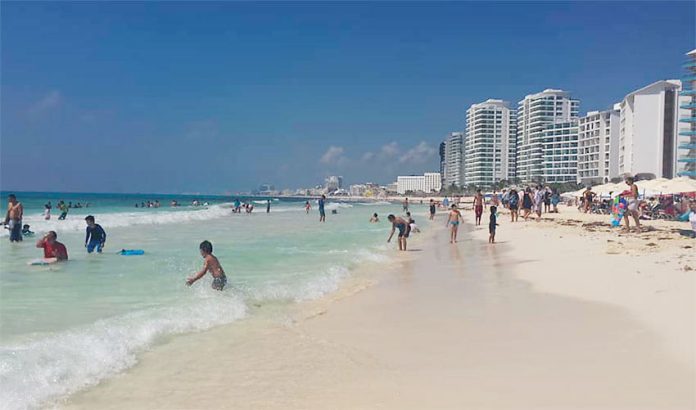
The beaches at Cancún and elsewhere on the Caribbean coast are clean and free of sargassum, according to Quintana Roo Governor Carlos Joaquín González.
Joaquín said there hasn’t been a significant resurgence of the smelly and unsightly algae in recent weeks.
He explained that the infrastructure installed with the support of the federal government has worked well.
“We’re waiting for more infrastructure, more boats, more barriers that will work in coordination with the navy, which has yielded good results up to now,” he said.
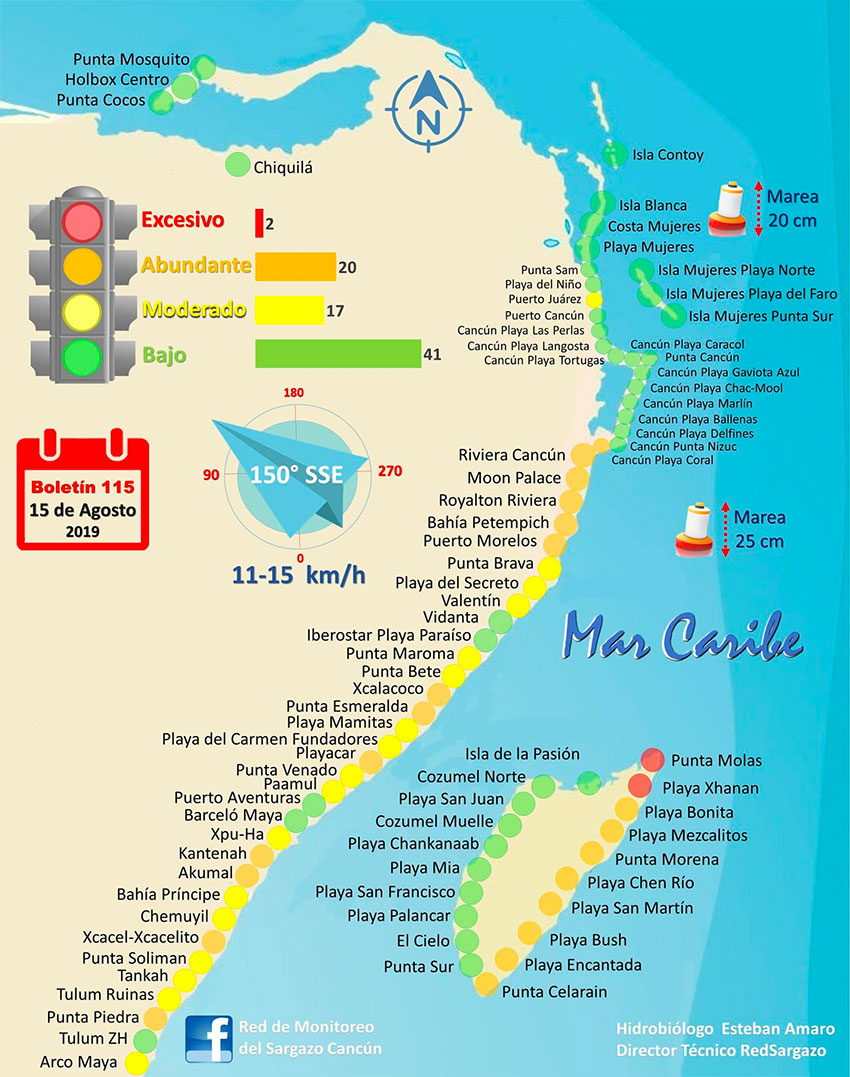
Sargassum conditions Thursday morning according to the Cancún sargassum monitoring network.
Meanwhile, a man described in news reports as a construction industry expert says sargassum is not a problem but an opportunity.
Ricardo Lambretón López-Ostolaza says the seaweed can be used to make bricks for low-cost housing.
“Advances in the industry have given us the opportunity to build houses and other structures ecologically and affordably,” he said.
“We should take advantage of problems like this, putting the resources to good use, rather than wasting them.”
He highlighted the low cost and durability of bricks made of sargassum, claiming that they have been shown to have a lifetime of up to 120 years.
He plans to build houses with 40 square meters of floor space using 20 tonnes of sargassum, for which the approximate cost would be 150,000 pesos (US $7,700).
“It’s incredible how such an opportunity has arisen from this problem, which is now seen to have a great social impact for nearby areas of extreme poverty,” he said.
Lambretón is not the first to see an opportunity for construction. A Puerto Morelos businessman has built at least one house using sargassum and adobe and was planning to build a hotel in Tulum with the same materials.