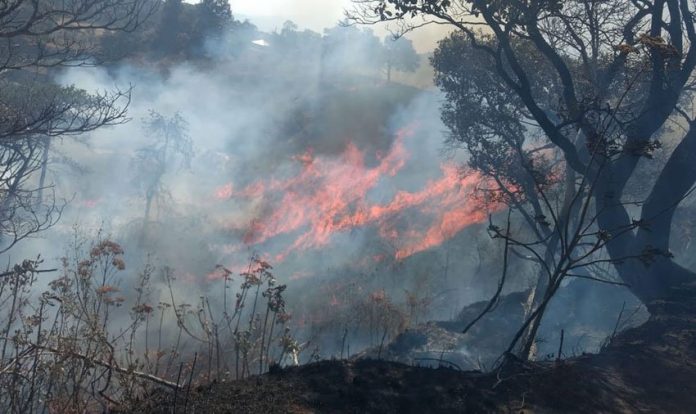
There were more fires in the Primavera Forest in Jalisco yesterday and after one threatened an inhabited areas, authorities evacuated 600 people.
The state government said a fire broke out in the Mesa de los Caballos region of the forest yesterday at 3:40pm, but was later controlled.
At 6:10pm, another fire broke out in Paredones de la Venta, prompting the evacuation of 600 people from the Pinar de la Venta neighborhood in Zapopan.
[wpgmza id=”109″]
The governor said on Twitter that although no injuries or loss of real estate had been reported, an undetermined number of vehicles had been destroyed in the blaze.
Footage shot by residents of Pinar de la Venta showed people using hoses and buckets in an attempt to control the fire as it crept closer to their properties and consumed power lines.
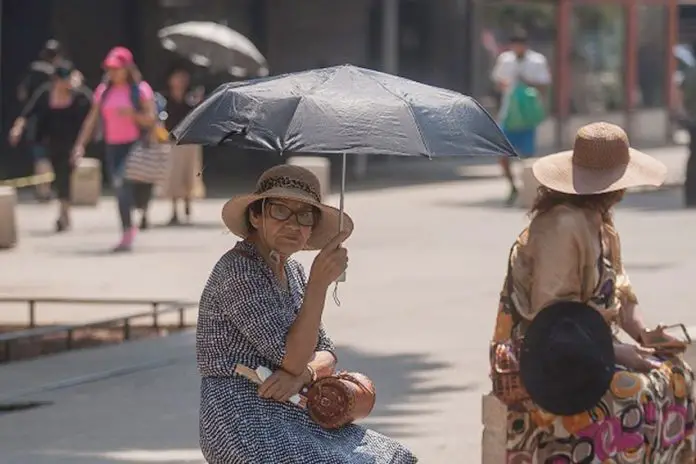
A woman shades herself from the sun in Mexico City, where more hot weather is in the forecast.
High ozone levels worsened already severe contamination in Mexico City yesterday, leading authorities to declare another emergency alert and impose restrictions on the circulation of vehicles.
Air quality in the capital on Tuesday was the worst in five years, according to a report in the newspaper El Universal.
Smoke from fires burning in and around Mexico City and in central and southern states is the primary cause of the contamination but hot and dry conditions with little wind have exacerbated the situation.
The Environmental Commission of the Megalopolis (Came) issued an Extraordinary Environmental Contingency yesterday morning for the Mexico City metropolitan area after measuring extremely high levels of fine particulate matter known as PM2.5.
Later yesterday, Came activated an additional Environmental Contingency due to high levels of ozone in the atmosphere.
“Today, at three in the afternoon, two contaminants combined, contaminants of particles 2.5 and ozone,” Mayor Claudia Sheinbaum said in a video on social media.
“This can cause greater harm to health. So we made the decision to increase the measures of environmental contingency for tomorrow [Wednesday].”
Electric and hybrid cars as well as vehicles that have passed emissions tests and are identified with “0” and “00” holographic stickers are free to use roads in the Mexico City metropolitan area today.
But higher-emission vehicles and private cars with license plates from a different state or a foreign country are not permitted to circulate today between 5:00am and 10:00pm.
Authorities in México state have imposed restrictions on the circulation of vehicles in 16 municipalities of the Valley of Toluca, where an Environmental Contingency has also been declared.
In addition to the vehicular restrictions, Sheinbaum said that roadwork has been suspended and a professional soccer match scheduled for Mexico City today has been postponed.
The mayor explained that restrictions were not imposed on cars as a result of the initial emergency alert because current contingency plans are not activated by high levels of fine particulate matter.
However, federal environmental official Sergio Sánchez told a press conference yesterday that a PM2.5 contingency program will now be established.
While fewer cars on the roads in the capital today will help to prevent a further deterioration of air quality, the Environmental Commission of the Megalopolis said in a statement this morning that there are “unfavorable [climatic] conditions for the dispersion of contaminants.”
At 10:00am today, Came said that air quality in most of the metropolitan area of the capital is still “bad” due to the high presence of fine particulate matter and that wind speeds were just 7 kilometers per hour.
Ciudad Nezahualcóyotl, a municipality just east of the capital in México state, continues to be the most polluted area of the Valley of Mexico, according to the Imeca index.
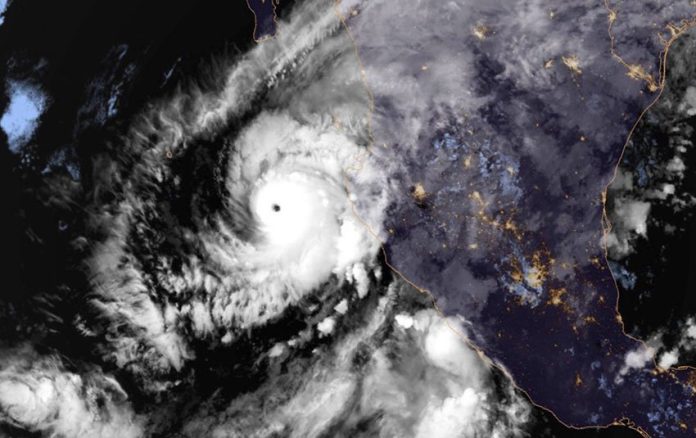
Hurricane Willa struck the coast of Sinaloa in October last year.
Forecasters are predicting more intense hurricane activity in the eastern Pacific Ocean this year and slightly-below average activity in the Atlantic.
Christian Domínguez, a hurricane expert and researcher at the Center of Atmospheric Sciences of the National Autonomous University (UNAM), told the newspaper Reforma that between 14 and 16 tropical cyclones can be expected in the Pacific during the hurricane season, which officially begins today.
“The tropical cyclone activity . . . in the Pacific will be more active because of El Niño, in other words, [there will be] very high [water] temperatures that favor the formation of tropical cyclones,” he said.
Domínguez predicted that the Pacific Ocean cyclones will be stronger than last year, and reach categories as high as the maximum of 5 on the Saffir-Simpson scale.
In the Atlantic Ocean, Domínguez predicted that there will be 12 tropical cyclones this season, while researchers at the Colorado State University (CSU) are predicting 13.
The CSU researchers forecast that the “2019 Atlantic basin hurricane season will have slightly below normal activity,” citing the relatively high probability of a weak El Niño as a primary factor for its prediction.
The university predicted that 2019 hurricane activity will be about 75% of an average season whereas 2018 activity was about 120%.
The CSU report said the tropical Atlantic is currently slightly cooler than normal, and that colder than normal sea surface temperatures provide less fuel for tropical cyclone formation and intensification.
Of the 13 named storms it is predicting, the CSU Tropical Meteorology Project team expects five to become hurricanes and two to reach major hurricane strength, meaning they would be Category 3, 4 or 5 on the Saffir-Simpson scale with sustained winds of 178 kilometers per hour or higher.
The Atlantic hurricane season starts on June 1 and like the Pacific season will conclude on November 30.
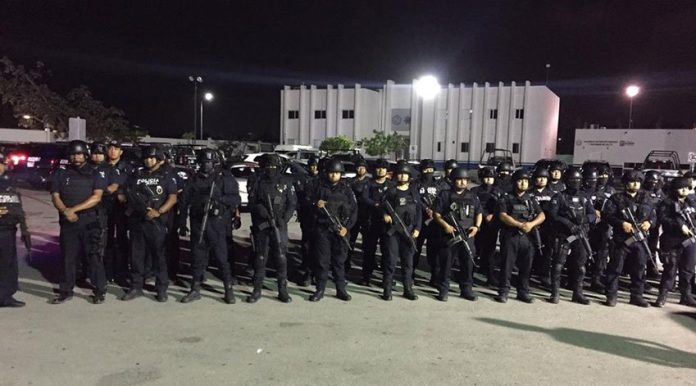
A show of force in Playa del Carmen by state police, who arrived last night in a convoy of 30 patrol vehicles.
The government of Quintana Roo has taken over policing in Playa del Carmen but the mayor calls it “a coup d’etat.”
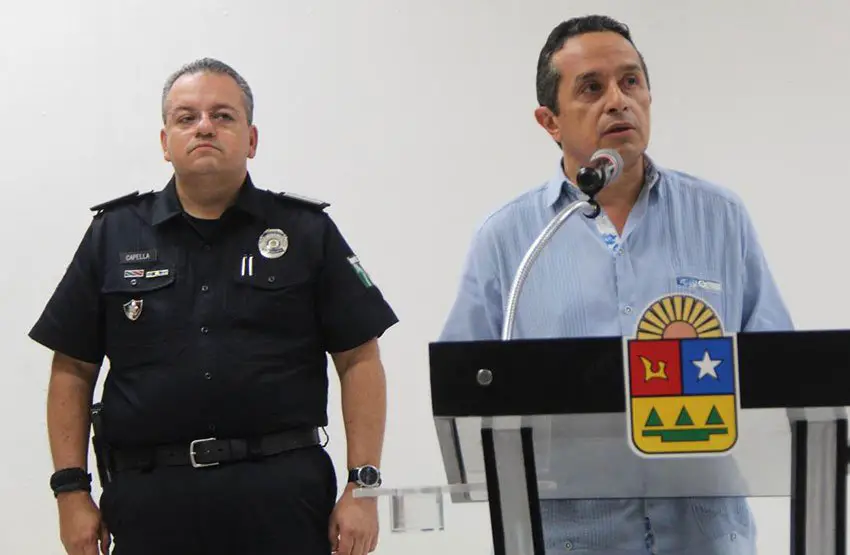
Governor Carlos Joaquín González announced that a single-command state police force would assume responsibility for security in the municipality of Solidaridad, effective yesterday.
The announcement came after one person was killed and 11 were wounded in a gunfight at a Playa del Carmen bar on Sunday night.
Joaquín said he was acting in accordance with the state constitution and responding to the “emergency situation” in Solidaridad.
He also noted that the single-command model has obtained positive results in other municipalities where it has been implemented, “significantly reduced the levels of corruption and collusion of authorities with criminal groups.”
State security chief Capella, left, and Governor Joaquín.
In Solidaridad, the governor charged, local authorities have been unable to work as a team.
Public Security Secretary Jesús Alberto Capella Ibarra is now in command of Solidaridad’s municipal police. He said late yesterday there have been 92 homicides in the municipality so far this year, up from 31 last year.
Although the local chief of police said he was prepared to work with state authorities under the single-command system his former boss, the mayor, was not supportive of the state’s action.
Laura Beristain Navarrete declared that the move was “a coup d’etat against the autonomy of Solidaridad and an unconstitutional act” and would take legal action against it.
She claimed Joaquin’s decision was based on “mean-spirited interests” and was an attempt to usurp her authority.
Authorities have frozen the bank accounts of a federal judge suspected of corruption after releasing members of the Jalisco New Generation Cartel (CJNG) from preventative custody.
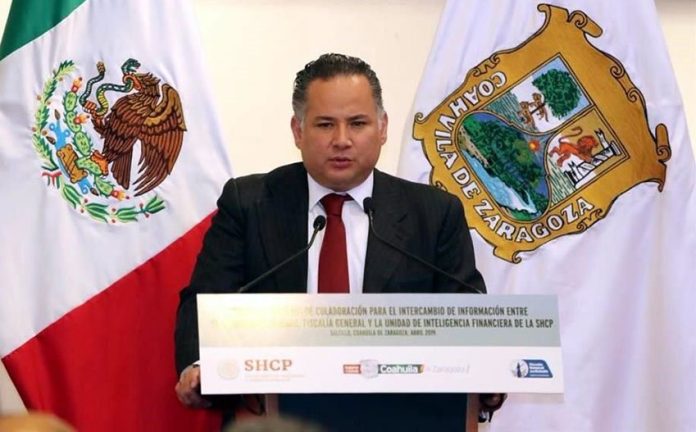
The Financial Intelligence Unit said yesterday that a Jalisco-based judge – reported by the Reforma newspaper to be Isidro Avelar Gutiérrez – had lost access to accounts containing 50 million pesos (US $2.6 million).
“We’ve frozen his accounts and filed a complaint with the federal Attorney General’s Office . . .” UIF chief Santiago Nieto said.
The UIF initiated its investigation into Avelar after senators from the ruling Morena party disclosed that he had spent 18.7 million pesos on properties between 2010 and 2016.
The judge has been under investigation by the Attorney General’s Office since the six-year term of the previous government.
On July 17 last year, Avelar ordered the release of Juan Francisco Aguilar Santana, a CJNG operative known as “Juan Pistolas” who is believed to be close to cartel leader Nemesio “El Mencho” Oseguera Cervantes.
Aguilar was arrested at an address in Tlajomulco de Zúñiga, Jalisco, in June 2018 with more than 30 firearms, including two grenade launchers, and illegal drugs.
He was remanded in preventative custody until Avelar ordered his release on the grounds that the authorities had obtained a search warrant for the address without following proper processes.
In 2015, the judge also freed the son of El Mencho, Rubén Oseguera González, and his brother-in-law after ruling that their arrest was illegal.
In that case, Avelar said that Federal Police had entered a home illegally to arrest the two men, contradicting federal authorities’ version of events that the arrests were made when the suspects were riding in a truck.
The judge identified three other factors as well: there was a delay of nine hours between their arrest and their presentation before a prosecutor, they were not given immediate access to a defense lawyer and there was insufficient evidence linking the men with the CJNG.
According to a report today in the newspaper Reforma, federal authorities are also investigating other Jalisco judges who are believed to have colluded with Avelar.
Some judges allegedly passed on CJNG cases to him under the pretext that their excessive workloads precluded them from hearing them.
In addition to freeing cartel suspects, the federal judge also granted an injunction in 2011 to former Federal Electricity Commission (CFE) operations director Néstor Moreno, ruling that there was no evidence of illicit enrichment to justify the issuing of an arrest warrant against him.
In 2017, the CFE official was found guilty of the crime and sentenced to eight years in prison.
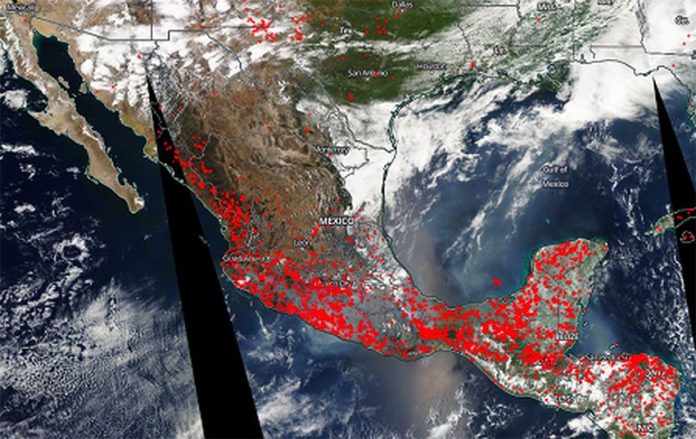
NASA satellite image indicating active wildfires in Mexico.
More than 100 wildfires are burning across the country, creating dangerous and smoky conditions especially in southern and central states where the blazes are concentrated.
According to a count by the newspaper El Universal, there were at least 108 active wildfires in 17 states yesterday. Federal Civil Protection chief David León placed the figure at a slightly more modest 106.
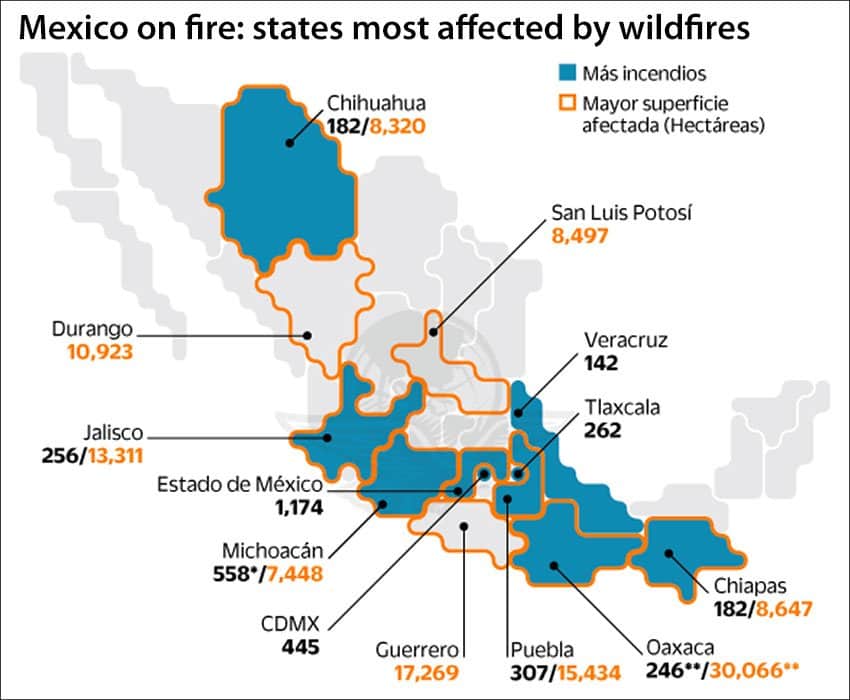
El Universal said there were 14 fires in Guerrero, 13 in Oaxaca, 12 in México state, 11 in Veracruz, 10 in Michoacán, nine in both Puebla and Chiapas, six each in Jalisco and Chihuahua, four in Mexico City and San Luis Potosí, two in Tamaulipas, Hidalgo, Guanajuato and Yucatán, and one apiece in Aguascalientes and Querétaro.
A satellite map published by NASA showed much of Mexico replete with red dots, each one representing an active wildfire.
León said that 7,500 firefighters are working across the country to control and extinguish the blazes and called on the public to be alert to warnings and instructions from authorities.
He said that Puebla was the worst affected state in terms of the area of land affected by wildfires.
In Guerrero, Governor Héctor Astudillo Flores yesterday called on federal Civil Protection to declare a state of emergency in the state due to the high number of fires and the extent of land affected.
The aim of the request, he said, was to “have the greatest human capital and tools to reduce the impact” of the fires.
In México state, 11 municipalities were affected by fires yesterday including the popular tourist destination of Valle de Bravo.
Fires also burned in Cuatitlán Izcalli, Tultitlán, Atizapán de Zaragoza, Naucalpan and Huixquilucan, all of which are located in the Mexico City metropolitan area.
In Huixquilucan, where fires were ablaze for a fifth consecutive day, Mayor Enrique Vargas del Villar said the situation was “like nothing we’ve had before.”
States with largest number of fires are shown in blue; those with the largest area affected are highlighted in orange. Number of fires is indicated in black and hectares affected in orange.
In Mexico City – where an Extraordinary Environmental Contingency was issued today due to extremely high levels of fine particle matter in the air – four fires continued to burn last night but firefighters yesterday fought a total of 23 blazes in 11 boroughs of the capital. Sixteen were wildfires, El Universal said.
In Oaxaca, where almost 30 fires have been burning in different regions of the state for as long as 30 days, the Interior Secretariat declared a state of emergency last Saturday for 11 municipalities.
Aaron Juárez, chief of the State Forest Commission, said that more than 20,000 hectares of forestland were lost in the blaze but added that a reforestation plan is already being drawn up.
Across Mexico, there have been more than 4,400 wildfires in 30 states this year, according to the National Forestry Commission. More than 150,000 hectares of land has been affected, 94% of which was covered with grass or brush. The other 6% was forest.
Almost half of all the fires have occurred in just four states: México, Mexico City, Puebla and Tlaxcala.
Civil Protection chief León told El Universal that the number of fires recorded is not atypical, pointing out that between January 1 and May 9 last year there were 697 more blazes than this year.
Nine of every 10 fires are the result of “people’s carelessness or irresponsibility,” he said, explaining that 41% of blazes are caused by burns that get out of control, while 10% start from discarded cigarette butts.
León explained that climate factors including high temperatures, wind and low humidity also contribute to the commencement and spread of fires.
Six firefighters have been killed fighting fires this year, he said.
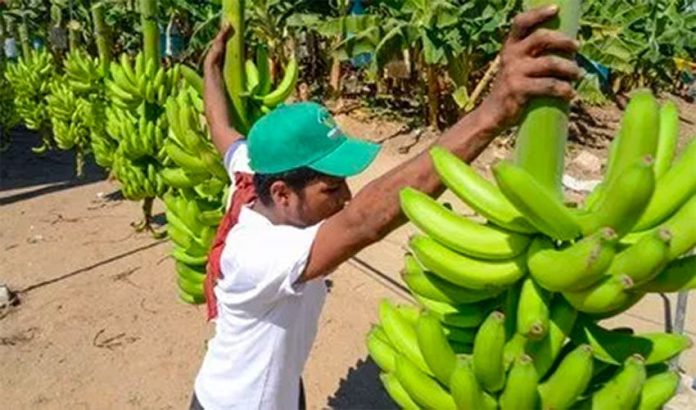
Bananas from southeastern Mexico will soon be on their way to Chinese consumers after the signing of a bilateral agreement.
A process that began with the previous federal government concluded with the signing of a phytosanitary protocol by Agriculture and Rural Development Secretary Víctor Villalobos Arámbula and Chinese official Zhang Jiwen.
Speaking in Beijing, Villalobos explained that the new deal will benefit producers in the states of Chiapas, Tabasco and Veracruz, where 30%, 27% and 10% of the country’s bananas are harvested respectively.
In order to benefit from the new export opportunity, producers must sign up as exporters and comply with China’s phytosanitary requirements.
The first certificates allowing Mexican banana producers to export their produce to China could be issued before the end of the year, Villalobos explained.
Official figures show that bananas are harvested in 16 states where they are grown on more than 80,000 hectares. The annual yield is just under 2.2 million tonnes and worth close to 7 billion pesos (US $365.6 million).
Mexico was the world’s 12th largest banana producer in 2017, contributing 2% of the global total.
The truck that left a trail of injured bystanders and damaged vehicles in Tijuana.
A man driving a pickup truck struck four people and 17 vehicles at a border crossing in Tijuana, Baja California, yesterday as he attempted to flee from police.
A man identified as Frank E. was arrested by municipal police at the San Ysidro port of entry to the United States after his high-speed dash for the border.
Four street vendors were struck and taken to hospital. Two are reported to have serious injuries.
According to the newspaper El Imparcial, the incident occurred at around 2:00pm yesterday after police received a report of an altercation between the driver of the vehicle and a pedestrian in the Zona Río district of the northern border city.
Tijuana police said last night that the U.S. man had threatened a person with a knife on Manuel Márquez de León avenue.
When officers arrived at the scene, the Utah-licensed Chevrolet Silverado in which a female passenger was also traveling made a beeline for the border crossing between Tijuana and San Diego, California, precipitating a police chase. One police officer was struck as the vehicle made its escape.
At the port of entry, the pickup truck hit 14 vendors’ stalls in addition to the vehicles and hawkers. One vendor said it appeared that the man had struck everything in his path “on purpose.”
A motorist who was waiting in his car to cross into the United States described his experience to El Imparcial.
“We were here in line and out of the blue we started hearing screams [then] a pickup truck hit us from behind. It was a gringo with a young woman, the woman’s face was covered with blood,” Alejandro Contreras said.
Just meters short of the border security booths, the pickup came to a halt. The front of the vehicle was badly damaged and its tires were flat, reportedly because they had been punctured by vendors, 20 of whom allegedly removed the driver from the truck, beat him and held him until police arrived.
Tijuana police chief Mario Martínez said late yesterday that only the driver was taken into custody. The identity of his female companion, who is also reportedly a U.S. citizen, is unknown.
No significant delays at the border crossing were reported as a result of the incident.
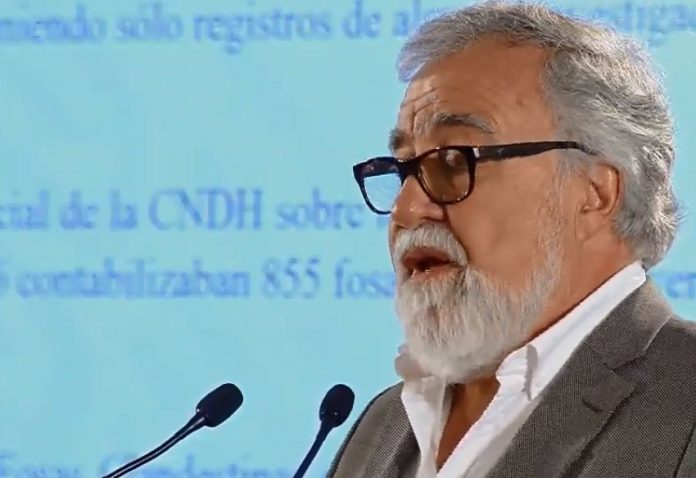
Encinas presents his report on hidden graves this morning.
Eighty-one locations, 222 hidden graves and 337 bodies: that’s the official count so far since December 1, when the new government took office.
Human rights undersecretary Alejandro Encinas revealed the numbers today at the president’s morning press conference, noting they were current as of Monday. He also said it was the first official government effort to gather and compile such data.
Of the states in which hidden graves have been discovered, Encinas said, Veracruz led the way with 76, Sonora followed with 35 and Sinaloa was third with 23.
Encinas described the hidden graves as “a phenomenon that has existed for many years, but the data was always hidden or minimized. There aren’t antecedents [for this report]. Data on forced disappearances was mixed and hidden away with statistics on common homicides, even though in many of the cases [where hidden graves were discovered] the remains were discovered many years after the victims were killed.”
The data will be continually updated and the numbers will be presented every 15 days to the federal government’s security cabinet.
In previous years, families and friends of missing persons headed up efforts to search for hidden graves, relying on tips from witnesses about where to dig.
The graves themselves have been described as a mechanism used by criminal gangs to instill terror among citizens, and demonstrate their power and impunity and the limited capacity of the state to fight them.
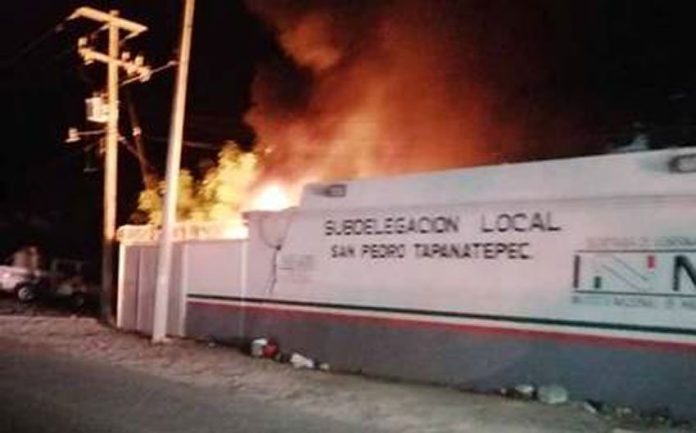
The Attorney General’s Office (FGR) is investigating a fire at a Oaxaca immigration center, allegedly set by migrants early Sunday.
The investigation has revealed that 107 migrants from Guatemala and El Salvador were waiting to obtain temporary permits to remain in Mexico but National Immigration Institute (INM) agents had not issued them.
Just after midnight on Sunday, the migrants began to riot in protest, and set the building on fire.
Eight people were subsequently arrested at the immigration center, located in San Pedro Tapanatepec in the Isthmus of Tehuatepec, but several escaped.
The rest were moved to another center in Acayucan, Veracruz. There were no casualties among either the migrants or the agents guarding them.
The incident and another escape by Cuban migrants from a center in Chiapas on the weekend indicate that the immigration institute continues to be overwhelmed by the migrant numbers.
About 100 Cuban citizens escaped from the immigration center in Tapachula between Saturday and Sunday. Ninety fled the same center last week.
The facility was shut down for 50 days in March after a brawl that was triggered by Cubans demanding faster processing times and protesting corruption among immigrant agents who were allegedly charging up to US $900 to process immigration documents.