Heineken plans to open 10 additional SIX stores in the next 24 months, which will employ at least 130 people. (Tecate/Lepub)
Heineken Mexico has launched an innovative hiring campaign aimed at Mexicans repatriated from the United States, in an effort to support their economic and social reintegration in the country.
The program is driven by Heineken through the Tecate brand and Heineken’s chain of convenience stores in Mexico — SIX stores — in collaboration with Fundes, an NGO focused on economic and social inclusion.
“What made us reflect on this issue was a number that is really more than just a number,” head of the Tecate brand Esteban Velasco said. “More than 160,000 people have been repatriated to Mexico in 2025. This is a large number, but beyond the number, there are many stories,” he added.
The initiative integrates technical training, continuous support and access to job opportunities within the SIX and Heineken Mexico network, and will operate across three phases.
The first phase began in early 2026 with the opening of five SIX stores in the border cities of Tijuana and Ciudad Juárez. It created 15 jobs.
The program is now moving into a second phase, which aims to employ at least 130 people and open 10 additional SIX stores in the next 24 months.
Inti Pérez, Director of Corporate Sustainability at Heineken Mexico said that these new stores will be located mainly in northern Mexico, as this region is home to a high number of repatriated people.
“We firmly believe that companies must be active agents in building solutions that generate real opportunities in the long term and in a sustainable way,” Pérez said, while adding that this initiative is a scalable model with the potential to be replicated in other regions of the country.
Creatively, the campaign focuses on the idea that returning is not a failure, but a new beginning, as it celebrates the character, accumulated work experience and resilience of those who return.
Marta García, Marketing VP at Heineken Mexico, said that the “Welcome Back, Paisano” campaign is an initiative that “reflects the character and courage of Tecate: being present when most needed and supporting Mexicans with concrete actions.”
Nikola Jokic will lead the Denver Nuggets into Arena CDMX on Nov. 7 to take on the Indiana Pacers in the annual NBA regular-season game in Mexico. (NBA)
The game during the 2026-27 season will be the league’s 35th in Mexico since 1992 and the 16th regular-season contest.
The Nuggets’ only Mexico experience was a 2006 preseason game in Monterrey before the Jokic era. The Pacers are making their first appearance in Mexico. (NBA Mexico)
Occurring within a week of Day of the Dead, the game will have a backdrop including holiday-themed elements such as court design, uniforms and decorations featuring marigolds, bright colors, skeletons and catrinas.
The NBA has played games in France, the United Kingdom, Japan and elsewhere as part of its Global Games series, but Mexico has had more NBA games than anywhere outside of the U.S. and Canada.
“Hosting the 35th game in the country reflects the depth of the NBA’s relationship with Mexico and the role this event plays in bringing the global game closer to fans locally, throughout Latin America and the world,” said Raúl Zárraga, senior vice president of NBA Latin America.
Denver, the NBA champion three years ago, will make its second appearance in Mexico and first in the regular season. The Nuggets previously played a 2006 preseason game in Monterrey against the Golden State Warriors that drew 12,265 fans.
This time, they are expected to be led by 6-foot-11 Serbian superstar Nikola Jokic, a three-time league MVP and nine-time all-star. After finishing in third place in the Western Conference this season, Denver is currently involved in the first round of the NBA playoffs against Minnesota.
The Pacers, meanwhile, missed the 2025-26 playoffs by suffering through two double-digit losing streaks and finishing 19-63, second worst in the NBA. Injuries and roster moves decimated a team that just one season earlier went 50-32 and made the NBA Finals, losing in seven games to Oklahoma City.
The Nuggets-Pacers contest — set to be broadcast on ESPN in Mexico — will mark the Pacers’ first game in Mexico, making them the 23rd franchise to play there.
Arena CDMX is also the home of the Mexico City Capitanes of the NBA G League. The minor-league squad averages about 6,500 fans per game, including several crowds over 8,000 this season and an 11,236 figure for a playoff game earlier this month.
For the Nov. 7 NBA game, fans can register for tickets at NBAMexicoCityGame.mx. The league has not announced a tipoff time, but Mexico City games have typically started around 8 or 8:30 p.m. local time.
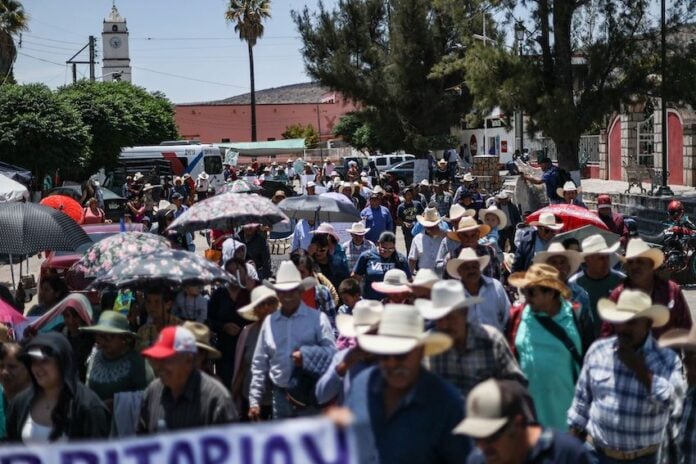
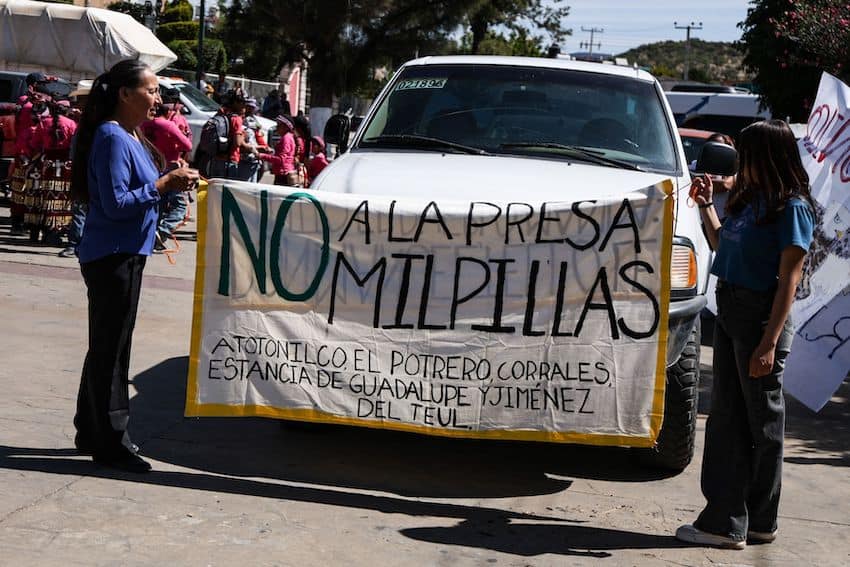
Residents and ejido members in and near the Zacatecas town of Jiménez del Teul gathered on Friday to express their opposition to a proposed dam on the Atenco River. (Adolfo Vladimir/Cuartoscuro)
An assembly of local residents and ejido members on Friday voted to reject a dam project in the state of Zacatecas, even as the government staged an “official” consultation that supported the proposal.
While the “informal” assembly — convened by the Movement in Defense of the Territory and the Atenco River — took place in Jiménez del Teul near the site of the proposed dam, state and federal officials held their meeting in Sombrerete, 85 miles to the north. No officials attended the local assembly.
The opponents say that inundating their communities by constructing a dam would not solve the drinking water shortage in the major state cities of Fresnillo and Zacatecas but rather serve the needs of planned new mines, the Modelo Brewery and other manufacturing plants in the state. (Adolfo Vladimir/Cuartsocuro)
The proposal consists of a dam and a 167-kilometer aqueduct to carry potable water to the urban corridor comprising Fresnillo and the state capital in central Zacatecas.
Jiménez del Teul has 4,465 inhabitants, dispersed in nearly 50 rural localities in a territory of 1,541 square kilometers.
The Movement refuses to recognize the decisions and agreements reached in Sombrerete, calling the official consultation an “act of discrimination” and “institutional simulation,” saying it violated their right to effective and meaningful participation.
The official argument that Atenco River water is “wasted” as it flows to the sea is “a lie,” the Movement insists.
“For years, the Atenco River has irrigated our cornfields, beans, squash, guava trees and orange trees,” the statement said. “It has provided water for deer, wild boar and woodpeckers.”
The local residents insist the project would not address the acknowledged drinking water crisis in central Zacatecas, but would instead be primarily allocated to “industrial and productive activities.”
In March, Environment Minister Alicia Bárcena confirmed her agency conducted an environmental impact study (MIA in Spanish) while also reviewing three adjacent mining projects. It confirms that the 90-meter-high dam would flood 300 hectares of communal land, eradicating the communities of Atotonilco, El Potrero and La Lagunita.
Opponents of the project say the mining proposals — whose projected investments exceed 20 billion pesos (US $1.15 billion) and whose operations would require significant amounts of water — would be the ultimate beneficiaries.
Additionally, the Modelo Brewery located just south of Fresnillo would benefit from the dam.
Furthermore, the MIA indicates the dam would divert 92% of the Atenco River, shifting the water crisis from the Zacatecas city municipal area to one of the poorest municipalities in the state.
Originally proposed 10 years ago, only to stall under three state administrations, the mega-project was taken up by the federal government in January, featured as a strategic macro-project in the National Water Plan.
The cost of the project is another stumbling block. The initial budget of 3.5 billion pesos has ballooned to 9.7 billion pesos.
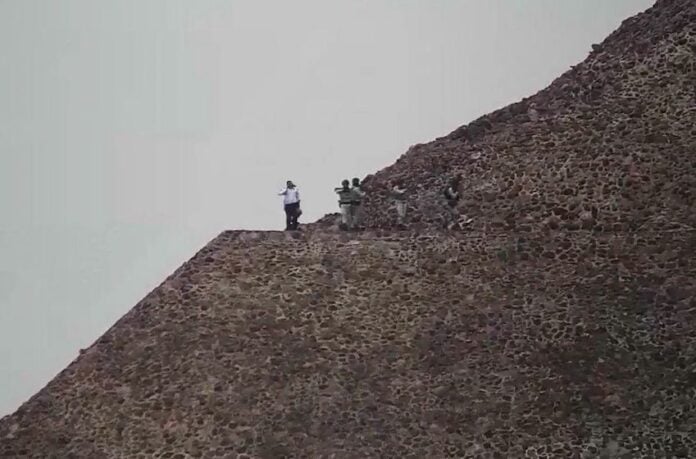
The gunman allegedly shot from approximately halfway up the Pyramid of the Moon. (Cuartoscuro)
A gunman killed a Canadian woman at the Teotihuacán archaeological site near Mexico City on Monday, authorities said.
The shooter — who opened fire from the Pyramid of the Moon at the pre-Columbian city — wounded several other people before turning the gun on himself. It appeared to be a random shooting — a crime that is rare in Mexico. No motive for the crime was immediately reported.
“According to preliminary information, a man fired shots … and subsequently took his own life. Unfortunately, a woman of Canadian nationality lost her life and, to date, we have information about several people who were injured,” the Security Cabinet said.
The government of México state — where Teotihuacán is located — said in a statement that the National Guard and state police responded to the shooting. It said that they found two deceased people at the site, including “the probable aggressor.”
The México state government said that at least six people were injured, four of whom sustained firearm wounds and two of whom suffered “falls.” The injured were taken to a local hospital for treatment.
The IMSS Bienestar health service said on social media that medical personnel were providing care to seven people, including a minor, after the incident at Teotihuacán. It said the patients were receiving treatment at the Axapusco General Hospital in México state.
“Of the total number of patients being treated, four have gunshot wounds, one has a fracture, another is being treated for a sprain, and one more for an anxiety attack,” IMSS Bienestar said.
Video footage shows the alleged gunmen on a platform approximately halfway up the Pyramid of the Moon. “Call the police,” someone shouts before a gunshot rings out.
A witness told the broadcaster N+ that the gunman was holding people “like hostages” on the pyramid, a version of events that is supported by video footage.
“I saw that he let a person go down, a girl,” said Laura Torres.
“I thought he was going to shoot her in the back, but he didn’t, thank God he let her go,” she said.
Torres also said that the aggressor allowed “a boy” to descend the pyramid. “But [other] hostages remained there,” she said.
President Claudia Sheinbaum said on social media that “what happened today at Teotihuacán deeply pains us.”
“I express my most sincere solidarity with the affected people and their families,” she wrote.
“We’re in contact with the Canadian Embassy. I have instructed the Security Cabinet to thoroughly investigate these events and provide all [necessary] support,” Sheinbaum said.
Located about 50 kilometers northeast of downtown Mexico City, Teotihuacán is one of Mexico’s most-visited archaeological sites. It is popular with both Mexican and foreign tourists, and generally considered safe to visit, although violence has occurred in nearby areas.
Monday’s shooting occurred just over seven weeks before Mexico City will host the first match of the 2026 FIFA men’s World Cup.
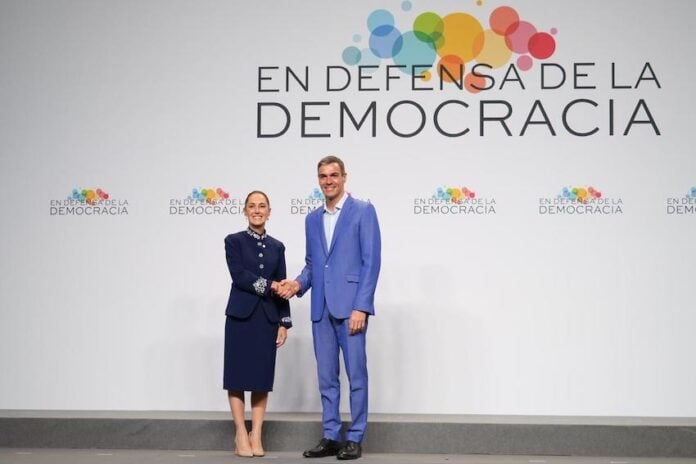
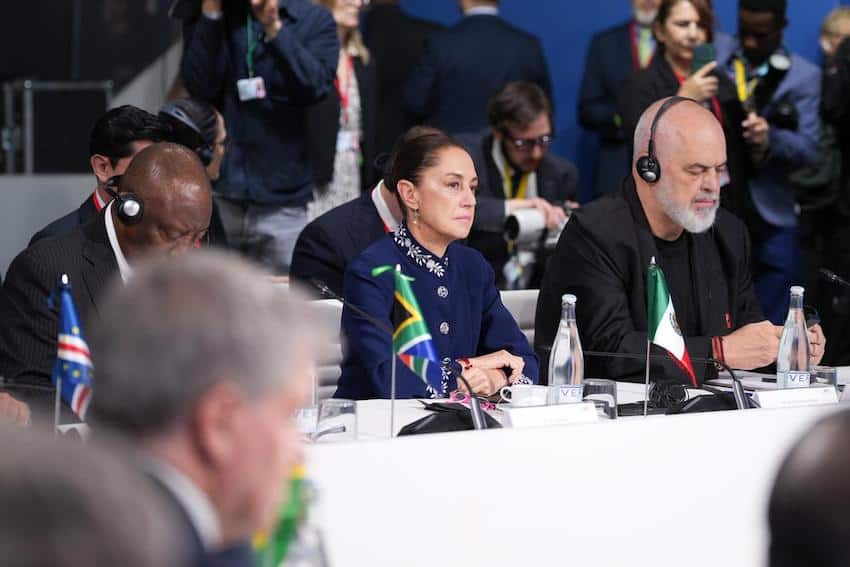
Sheinbaum, the first Mexican president to visit Spain in eight years, met one-on-one with Spanish Prime Minister Pedro Sánchez during the "In Defense of Democracy" summit. (Házel Cardenas/Presidencia)
President Claudia Sheinbaum used her address at a gathering of progressive leaders in Barcelona to propose that 10% of global spending on armaments be redirected to a reforestation program, speak out against any possible military intervention in Cuba and promote Mexico’s foreign policy principles.
In her speech at the In Defense of Democracy summit in Barcelona, Spain, on Saturday, President Sheinbaum invoked Mexico’s rich cultural heritage as well as its most beloved president, Benito Juárez, quoting him, “With the people, everything [can be achieved]; without the people, nothing.” (Házel Cardenas/Presidencia)During her address, the president proposed that “10% of global spending on armaments” be redirected to a “global program” that would allow “millions of people” to reforest “millions of hectares” of land per year. She is seemingly advocating a global initiative similar to the “Sowing Life” scheme introduced in Mexico during the 2018-24 presidency of Andrés Manuel López Obrador.
In Barcelona on Saturday, she declared: “Instead of sowing war, let’s sow peace, let’s sow life.”
In a message clearly directed to the United States, Sheinbaum also proposed “a declaration against military intervention in Cuba,” a country currently experiencing a humanitarian crisis that has been exacerbated by a virtual U.S. blockade on oil shipments to the Caribbean island nation.
“Let dialogue and peace prevail,” the president said.
The governments of Brazil, Spain and Mexico subsequently issued a statement addressing what they called “the dire situation facing the Cuban people.”
In the statement, the three governments expressed their “deep concern over the serious humanitarian crisis facing the Cuban people” and called for “the adoption of the measures necessary to alleviate this situation.”
They also reiterated “the need to respect international law at all times,” including “the principles of territorial integrity, sovereign equality and peaceful settlement of disputes,” and reaffirmed their “unwavering commitment to human rights, democratic value, and multilateralism.”
“… The goal must be to find a lasting solution to the current situation and to ensure that the Cuban people themselves decide their future in full freedom,” the three governments said.
In her address, Sheinbaum — a leading defender of Cuba — also promoted Mexico’s constitutionally-enshrined foreign policy principles, including respect for people’s right to self-determination, advocacy of the peaceful resolution of conflicts and “rejection” of the use of force.
‘I am a woman of peace and I represent a nation that loves freedom’
Sheinbaum told her fellow leaders and other officials that she was attending the In Defense of Democracy summit on behalf of the “hardworking, creative, brave” and “deeply generous” people of Mexico.
“I come from a people who recognize their origins in the great Indigenous cultures — those that were silenced, enslaved, and plundered, but never defeated,” she said, making a particularly poignant point in the country that, in the 16th century, conquered the land now known as Mexico.
“… I come from the Pyramid of the Sun, from Tláloc, Huitzilopochtli and Coatlicue,” Sheinbaum said, mentioning three Mexica deities.
— Claudia Sheinbaum Pardo (@Claudiashein) April 18, 2026
In her address, the president also cited the legacy of various heroes of Mexico’s rich history, and even declared that she had come to the summit “recognizing the bravery of Frida Kahlo.”
“… I am a woman of peace,” Sheinbaum said in her closing remarks. “And I represent a nation that loves freedom, justice and fraternity, and understands democracy as the great Benito Juárez would say: ‘With the people, everything [can be achieved]; without the people, nothing.'”
Sheinbaum offered to host another In Defense of Democracy summit in Mexico next year.
“We can speak about the well-being-focused economy and about democracy that responds to the true needs of people,” she said.
Reuters described Saturday’s summit as “a gathering of global leftist leaders to mobilize advocates of these movements against the far right.”
Sheinbaum meets Sánchez, declares there is no ‘diplomatic crisis’ with Spain
In 2019, AMLO called for the king of Spain to apologize for the conquest of Mexico, but the Spanish government “vigorously” rejected the request. As president, he also railed against Spanish energy companies such as Iberdrola and Repsol, accusing them of abusive business practices in Mexico.
Sheinbaum met with a group of Mexicans living in Spain following the summit on Saturday. (Házel Cardenas/Presidencia)
“There are things that, when we study them, in our judgment, with our current values, obviously cannot make us proud,” King Felipe said. He was the first Spanish monarch to make such a statement.
At a press conference on Saturday, Sheinbaum was asked whether her visit to Spain meant that “the diplomatic crisis” between Mexico and the European nation was over.
“There is no diplomatic crisis, there never has been,” she responded.
“What is very important is that we recognize the strength of the Indigenous peoples for our homeland,” Sheinbaum added.
According to Reuters, Spain’s economy minister, Carlos Cuerpo, told reporters at Saturday’s summit in Barcelona that “Sheinbaum’s presence here is a very important and positive sign of a rapprochement between the two countries.”
— Claudia Sheinbaum Pardo (@Claudiashein) April 18, 2026
Sheinbaum also posted a video of her flight and encounters with Mexicans in Barcelona, a photo in which she appears with the presidents of Brazil, Colombia and Uruguay, and footage of her meeting with Mexican residents of Spain at the Mexican Consulate in the Catalan capital.
“I visited the National Supercomputing Center in Barcelona, with whom we’re collaborating for the Coatlicue project, the Mexican supercomputer,” she wrote in the post.
"We're normal people," Sheinbaum said on Monday, referring to herself and other officials. (Gabriel Monroy/Presidencia)
Sheinbaum’s mañanera in 60 seconds
🚨 Chihuahua security row: Sheinbaum said her government had no knowledge of a joint operation between Chihuahua state and U.S. authorities that left two U.S. Embassy staffers and two senior Chihuahua officials dead in a car accident Sunday. She stressed that security cooperation is a federal matter and that states cannot independently enter into agreements with the U.S. Sheinbaum said her administration is reviewing whether national security law was broken.
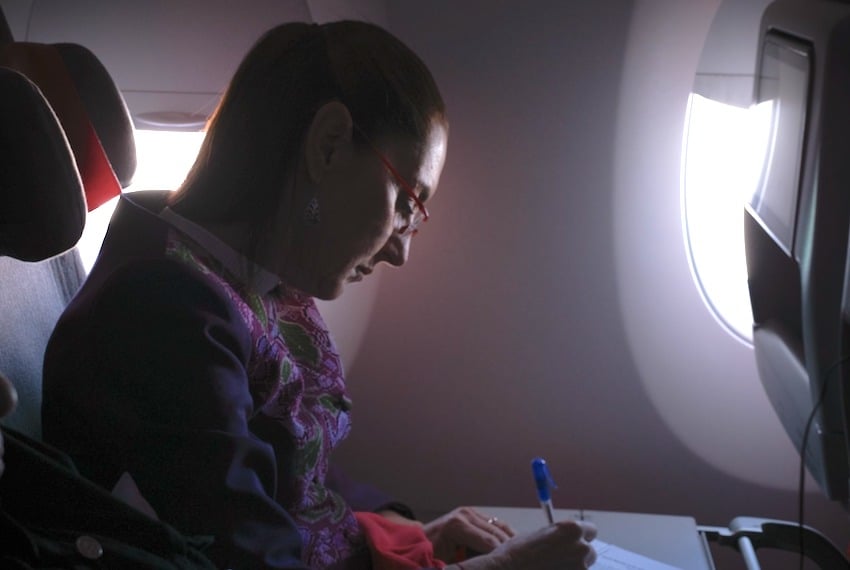
✈️ Sheinbaum says she is a “normal person.” Asked about flying economy to Barcelona for a summit with the leaders of various countries, Sheinbaum said holding the presidency doesn’t entitle her to special privileges, adding that she doesn’t share the outlook of past presidents who failed to “connect with the people.”
🇪🇺 EU trade deal imminent: Sheinbaum said that Foreign Affairs Minister Roberto Velasco is in Brussels arranging a May visit by European officials to Mexico City to formally sign the modernized Mexico-EU trade agreement.
Why today’s mañanera matters
The most significant revelation at President Sheinbaum’s Monday morning press conference was that the federal government wasn’t aware that the Chihuahua government was collaborating with U.S. officials on security matters on the ground in the northern border state.
Given Sheinbaum’s steadfast opposition to U.S. involvement in security operations in Mexican territory, it is embarrassing for her to have to concede that Chihuahua and U.S. authorities were working together without her knowledge. If the accident that claimed the lives of two Chihuahua officials and two U.S. officials on Sunday hadn’t occurred, the federal government could have conceivably remained in the dark about the collaboration.
Also of note at Monday’s mañanera was Sheinbaum’s defense of her decision to fly economy class to and from Spain in recent days.
After fatal accident, Sheinbaum says federal government was unaware of security collaboration between US and Chihuahua
Sheinbaum told reporters that her administration was unaware that the government of the northern state of Chihuahua had been collaborating with U.S. authorities on security tasks.
Her remarks came after two U.S. Embassy personnel and two high-ranking security officials in the Chihuahua government were killed in a car accident in Chihuahua early Sunday. The Mexican and U.S. officials were returning from an operation in which clandestine drug labs were shut down, according to the Chihuahua attorney general.
Sheinbaum said that the decision to involve U.S. personnel in the operation was made by the government of Chihuahua.
“We’re asking for more information from the government of Chihuahua,” she added.
After expressing sorrow over the deaths of the officials, Sheinbaum said that her administration is also seeking information from the U.S. government about the security collaboration in Chihuahua.
“[We’re] reviewing whether there was any violation of the National Security law,” she added.
“No estábamos enterados”. Sheinbaum exige a Chihuahua información sobre qué hacían en México los dos funcionarios de la embajada estadounidense que murieron en un supuesto accidente tras operativo antidrogas.https://t.co/8j5XP9noKApic.twitter.com/A3AKuU1YBS
Sheinbaum subsequently reiterated that her government cooperates with U.S. authorities on security issues, but stressed that “there are no joint operations” in Mexico — at least not ones that have been authorized by the Mexican government.
She emphasized that the state of Chihuahua — which is governed by the opposition National Action Party — cannot legally enter into its own security agreements with the United States.
“The [security] relationship [with the U.S.] is federal, not state level,” Sheinbaum said.
Mexico’s states “have to have authorization from the federal government for this [kind of] collaboration,” she said, adding that “the constitution establishes that.”
Sheinbaum describes herself as a ‘normal person’ after flying coach to Spain
A reporter noted that Sheinbaum flew to Spain on a commercial airline to attend a meeting in Barcelona with the leaders of countries including Spain, Brazil, Colombia and Uruguay. The president also returned to Mexico in economy class.
“I was on the same flight,” the reporter said before asking Sheinbaum about her experience taking photos and engaging with other passengers on a commercial aircraft.
Sheinbaum responded by describing herself as a “normal person.”
On Friday, President Sheinbaum once again traveled internationally in an economy seat, this time to Barcelona, Spain. (Claudia Sheinbaum/Facebook)
“Even though I’m president, that doesn’t mean I stop being a common human being,” she said.
“I have a responsibility, I was elected by the people and I assume my responsibility, but that doesn’t mean [I should have] special privileges,” Sheinbaum said.
She went on to say that she takes appropriate “security measures” when traveling, but asserted that she doesn’t share “the vision” of past presidents of Mexico who didn’t “connect with the people.”
Sheinbaum highlighted that she earns a good salary compared to most Mexicans, and asserted that her wage is “sufficient recognition” for her work as president — i.e., she doesn’t need or deserve privileges such as traveling on private planes, or in first or business class.
“We’re normal people,” she said, referring to herself and other officials.
Sheinbaum acknowledged that she has used military planes when traveling in Mexico so that she can visit various parts of the country in a single day.
“But in general, we try to go on commercial flights or in vehicles,” she said.
EU representatives to come to Mexico in May to sign new trade agreement
Sheinbaum told reporters that Foreign Affairs Minister Roberto Velasco is in Brussels to “organize the visit of the European Union in May.”
European officials are coming to Mexico to sign the updated trade agreement between Mexico and the European Union, she said.
“It greatly benefits Mexico in terms of exporting products to Europe, both agricultural and manufactured goods. So it’s very beneficial for Mexico,” she said Oct. 17.
By Mexico News Daily chief staff writer Peter Davies (peter.davies@mexiconewsdaily.com)
Rahm, 31, had finished in fourth place in last year's tournament. (@livgolfleague/Instagram)
Spaniard Jon Rahm triumphed at the LIV Golf Mexico City event, shooting a 7-under par 64 on Sunday to secure a 6-shot victory — and a US $4 million payday — in the 72-hole, four-day tournament.
The 31-year-old two-time major winner wasn’t the only Spaniard to conquer the 7,443-yard Club de Golf Chapultepec course: David Puig, a 24-year-old Barcelona native, finished second on the leaderboard, while 22-year-old Valencian Josele Ballester took third place.
With rounds of 65,67,67 and 64, Rahm, a Basque Country native, finished the sixth event of the 2026 LIV season at 21 under par, six shots ahead of Puig and seven ahead of Ballester.
Zimbabwean Scott Vincent finished in fourth place at -12, while five golfers tied for fifth at -11.
In a press conference after his victory, Rahm said he was “very happy to finally win here at [Club de Golf] Chapultepec,” which over the past four days hosted a LIV event for a second consecutive year. He finished in fourth place in last year’s tournament in the Mexican capital.
The team Rahm captains, Legion XIII, won the teams event, earning the Spaniard and his three teammates — Tyrell Hatton, Tom McKibbin and Caleb Surrat — $750,000 each.
Ortiz and Ancer finish strong
Two Mexicans played the LIV Mexico City event — and both had solid final rounds to finish in the top 25 in the 57-man field.
Guadalajara-born Carlos Ortiz shot a three under par 68 on Sunday to tie for 17th place at -7. He provided one of the highlights of the day on Sunday when he chipped in for birdie on the par 3 18th.
Abraham Ancer, a Texas-born Mexican national, tied for 22nd after shooting a two under par 69 on Sunday.
Another Mexican, Luis Carrera, got the chance to play a single round at the LIV event, replacing Bryson DeChambeau in the field on Sunday after the California native and two-time major winner withdrew due to a wrist injury. Carrera, a 25-year-old native of Naucalpan — the Mexico City suburb where Club de Golf Chapultepec is located — shot a one over par 72.
LIV says it will return to CDMX in 2027
The 2026 Mexico City LIV event began shortly after various media outlets, including The New York Times and Financial Times, reported that Saudi Arabia’s sovereign wealth fund would cease to fund the LIV golf tour after the current season. LIV CEO Scott O’Neil subsequently confirmed that the tour is only funded through 2026, but pledged to “work like crazy” to keep it going.
Despite the uncertainty, LIV Golf announced on Sunday that it will “return to Club de Golf Chapultepec for LIV Golf Mexico City 2027.”
“… LIV Golf Mexico City 2027 will mark the fifth straight year the League has played in Mexico and the third in a row at the historic venue, which has welcomed tens of thousands of fans this week for world-class competition, music, food and culture,” LIV said in a statement.
LIV also said that this week’s event was “more than just a golf tournament.”
It was “a four-day festival of music, gastronomy, art and entertainment inspired by Mexican culture,” LIV said, noting that legendary Mexican musical group Los Ángeles Azules performed and there were “live cooking and mixology demonstrations” within the grounds of the jacaranda-tree adorned course.
The weather is picking up, and that means San Miguel's world famous community is coming back out to play. Here's some of April's most notable happenings. (Ria Talken)
Spring brings purple jacaranda blossoms and occasional evening showers to San Miguel, and community activities start to pick up, too.
A volunteer group is planning a special fundraiser to benefit projects for kids, a major mural project is in the works and a long-time San Antonio restaurant is closing. Read on for the details.
Making sure local orphans and school kids aren’t forgotten
Nechelle and Tony Vanias (left) with a group of children from the “Wrapped in Love” gift drive. (Miritha Montoya)
A group of San Miguel volunteers organized by Nechelle and Tony Vanias wanted to make sure children in local schools and orphanages receive gifts on their birthdays and for Christmas. Project Remembered was the result.
Alongside other volunteers, they have spent the past few years raising funds, buying what the children request and delivering gifts for their “Cakes and Candles” monthly birthday events and their “Wrapped in Love” holiday celebrations, Nechelle Vanias said.
“This is our third holiday in San Miguel,” she told Mexico News Daily. “We did Casa Hogar for 32 girls ages 4-18, we added Mexiquito and Santa Julia, which are run by the Don Bosco nuns, and, in 2025, we added La Palmita Escuela Primaria, a public elementary school with 60 children, for a total of 110 kids in 2025.”
For Christmas, Wrapped in Love volunteers give the children new sneakers, toys, clothing, a pillow and blanket and chocolate, Vanias said. For the birthday celebrations, Cakes and Candles volunteers bring cakes, gifts, decorations and piñatas for children having their special day.
Additional volunteers are welcome to donate time and/or money to these two projects, Vanias said.
“There are so many people in need, and it’s a great thing to be able to do for others,” she said, adding, “These kids are so grateful for what we give them. The schools have received donations before, but they told us that nobody has ever given them new stuff.”
A fundraiser for Project Remembered will be held on May 14, 5-8 p.m., at the Ilo Rojo Boutique Hotel, Salida Real a Querétaro 136-A. More information is available here and here.
Murals are coming to the Las Cachinches Arroyo
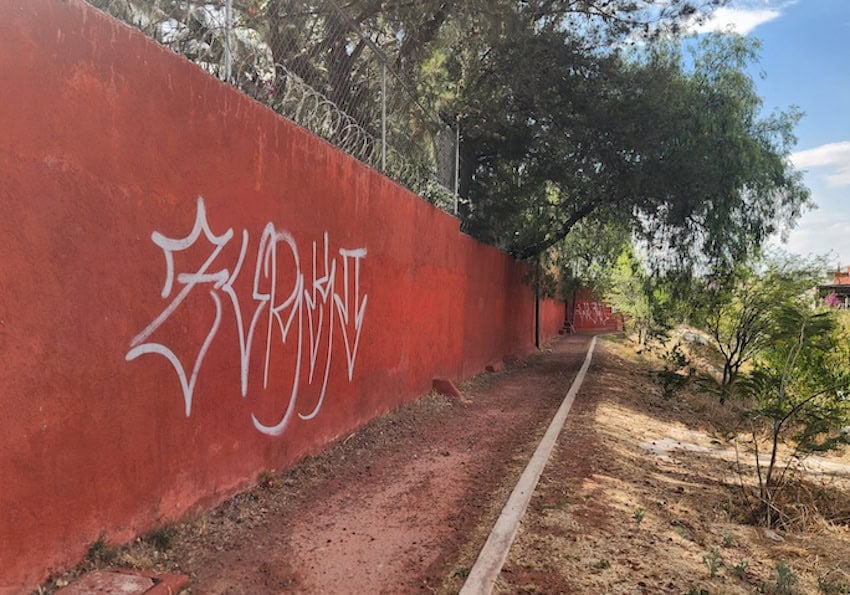
The project hopes to improve the area around the Las Cachinches arroyo. (April Gaydos)
Artists will soon be painting 12 large-scale murals along 90 meters of the Puente Viejo Residential wall next to Las Cachinches Creek and just west of Calzada de la Aurora. The goal is to transform the previously neglected area into an open-air gallery celebrating the arroyo’s history, ecology and enduring presence, according to Audubon de México, manager of the project.
“A lot of people don’t even know it’s there,” said April Gaydos, president of the organization. “It will be a lovely green place for people to walk. It’s important to mention that it’s an area that’s been repeatedly tagged, and murals are a deterrent for tagging. There have been studies done on this. It’s educational as much as creating a place people want to visit.”
The murals will be painted between June 12-14, and people can come and see the artists in action during that time, she said. An inauguration of the murals is planned for June 17.
The completed project will feature an illustrated map showing the arroyo’s journey from Parque Landeta through the city to the Presa, as well as a mural painted by local schoolchildren. The other 10 murals will focus on water, birds, insects, mammals, reptiles and amphibians, plants, trees, moments of wonder, hands for the Earth and cycles of life.
Legacy sponsors include Engel & Völkers, Fundación 11:59:59 and Namuh. Mural sponsors are 100x; Jose Pascual Higueros; Panio; Quince Rooftop; Stephanie and R. Alan Rudy; Cheri Schwarcz, Amy Rothlin and Tiffany Paige of The Agency; and Charlie Volmer. Gaydos said Rosewood San Miguel donated print materials and Comex, a major sponsor, donated acrylic paint for the murals.
San Antonio restaurant to close its doors next month
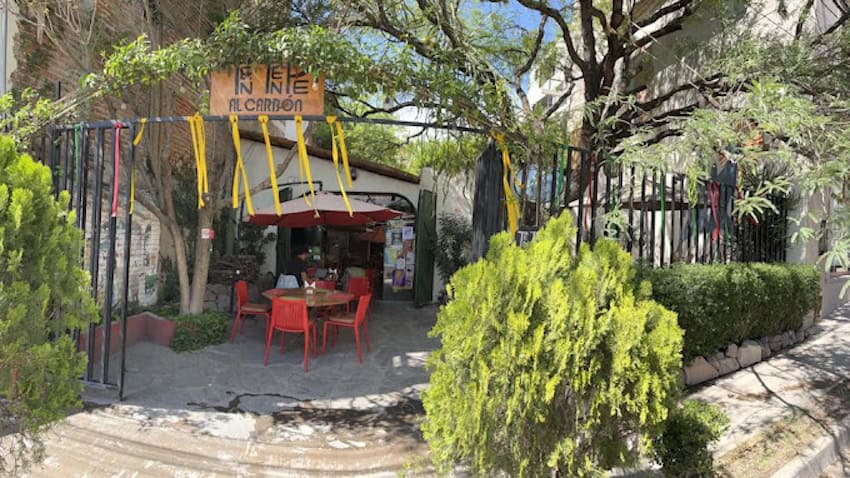
San Miguel institution Ten Ten Pie al Carbón is set to close its doors in May, after more than three decades of service to the community. (Ten Ten Pie/Facebook)
The Ten Ten Pie al Carbón restaurant at Stirling Dickinson 5 in the San Antonio neighborhood will close up shop next month after 18 years in that location and 33 years in San Miguel.
Juan Villaseñor launched the restaurant as El Ten Ten Pie at Cuna de Allende 21 back in 1993 and moved to the current location in 2008. The restaurant is known for grilled meats, stews, hamburgers, shrimp tacos, salsas and its own Ginger Bell beverage.
A three-day celebration last weekend provided a festive send-off with an elegant dinner to honor the founder; a second night of music, food and drink; and a Family Sunday with games, music and dance, pozole and beer.
Stirling Dickinson has attracted several new eateries lately, plus Restaurant Row is just around the corner on the Ancha de San Antonio. Ten Ten Pie has long been a fixture in that neighborhood and will no doubt be missed by its many fans.
Cathy Siegner is an independent journalist based in San Miguel and Montana. She has journalism degrees from the University of Oregon and Northwestern University.
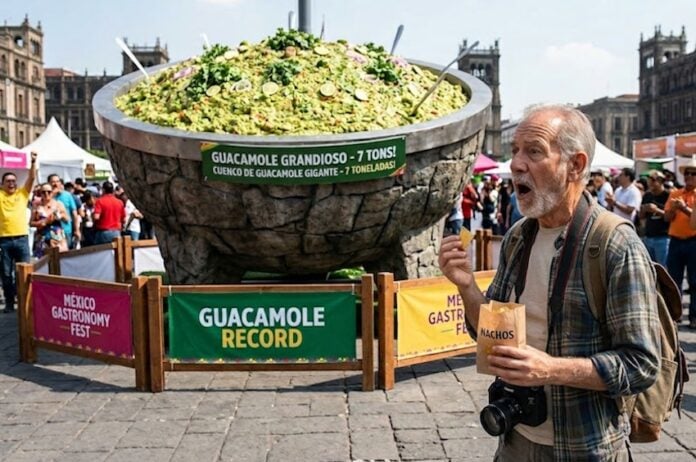
PERIBÁN, MICHOACÁN — Expressing what he called a “fundamental betrayal of the dip-chip social contract,” American tourist Brad Kowalski, 43, confirmed Tuesday that he had flown to the Mexican state of Michoacán specifically to witness 800 people make nearly seven metric tonnes of guacamole, only to discover that no tortilla chips would be provided.
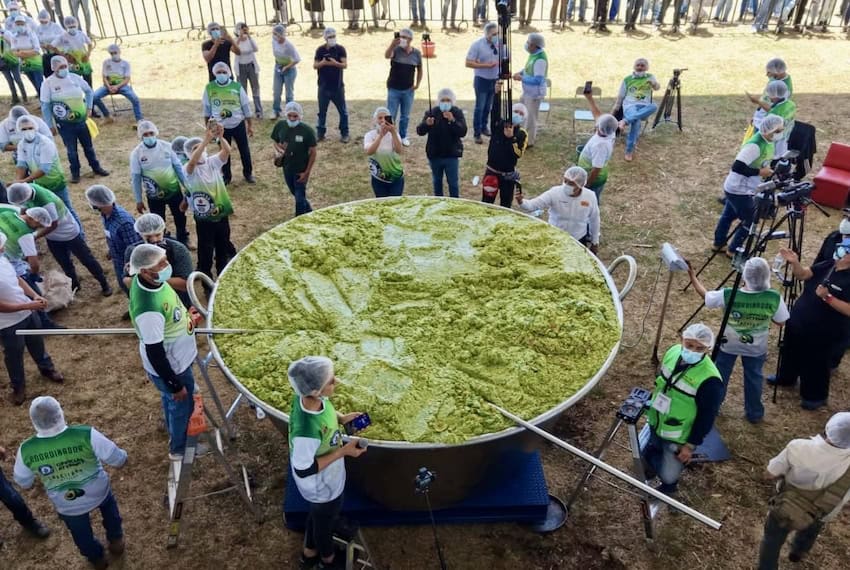
“I just assumed,” said Kowalski, staring blankly at approximately 6,800 kilograms of the world’s largest certified serving of guacamole, certified by Guinness World Records on November 20, 2022. “Like, logically. You make guacamole, you serve chips. That’s not a cultural thing. That’s physics.”
The guacamole weighed over 7 tonnes. The (Michoacán Tourism Ministry)
Kowalski, who had booked a connecting flight through Mexico City after reading about Peribán’s inaugural Avocado Expo, said he was “fully supportive” of the endeavor in principle, calling the three-and-a-half-hour production effort by local residents “genuinely impressive, the guacamole objectively exceptional and the overall experience delicious.”
He ate four portions. He ate them off a tostada. He did not make eye contact with anyone while doing so.
Locals were unfazed by the critcism. “This is avocado country,” explained one vendor, with the calm of a man who has never once considered a Tostito.
“I’m not saying they did anything wrong,” he said carefully, boarding his return shuttle with the thousand-yard stare of a man rethinking several life choices. “I’m saying there was a communication gap. Between me and reality. About chips.”
Kowalski has since posted a four-star review of the event. He took one star off for the chips.
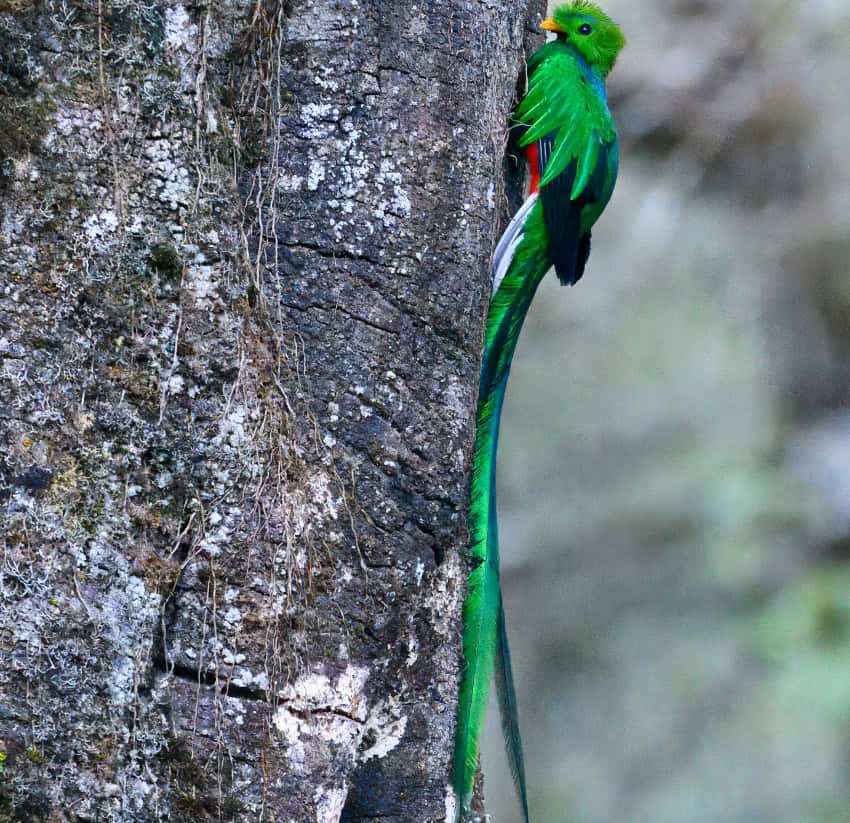
The resplendent quetzal has a long history in Mexico and can still be found in the forests of Chiapas. (American Bird Conservancy)
Quetzals, the godlike birds of pre-Columbian lore, are lovely small, colorful forest dwellers that “twitchers” — as bird spotters like to call themselves — will travel a long way to see. There are five recognized species, plus the eared quetzal, a slightly more distant relation, despite the name.
While their range stretches from the Amazon to Central America, only one species — the resplendent quetzal (Pharomachrus mocinno) — is found as far north as Mexico. This bird has interacted with humans for many centuries. Pre-Hispanic civilizations associated the bird with Quetzalcóatl, the feathered-serpent god of life, light, knowledge and the winds.
The Maya and Mexica coveted the quetzal’s long green tail feathers. (lwolfartist/Wikimedia Commons)
A majestic bird of Mayan legend
One Mayan legend tells how the resplendent quetzal is said to have gained its color: It had been an all-green bird until one accompanied the Maya K’iche prince Tecún Umán into battle against the Spanish conquistador Pedro de Alvarado. When the faithful bird landed on the body of the injured Tecún, the legend says, the prince’s blood gave the resplendent quetzal its characteristic red chest feathers.
The elite societies of both the Mexica and the Maya coveted the bird’s long green tail feathers. Amy A. Peterson and A. Townsend Peterson of the Center for Latin American Studies at Tulane University concluded in a 1992 study that at the height of the Mexica Empire, between 6,20 and 31,000 resplendent quetzals were harvested every year.
The fact that the birds survived such losses suggests that they were far more abundant in pre-Hispanic times than they are today. These estimates are clouded by the question of whether the long tail feathers might have been plucked and the birds then released. We have no idea what the fatality rate from such treatment might have been.
Centuries later, science finally names it ‘resplendent’
Although long familiar to locals, the bird was not officially recognized by science until 1832, with the work of distinguished naturalist Pablo de la Llave, who had been involved in the first study of Michoacán’s orchids.
In 1831, he was appointed director of Mexico’s National Museum of Natural History. De la Llave used this role to publish a small journal in which he described and named several birds, including the resplendent quetzal, as well as the equally colorful rufous-tailed hummingbird.
Where to see the resplendent quetzal
The best spot to see the birds in Mexico is the El Triunfo Biosphere Reserve, located in the central portion of the Chiapas Sierra Madre and known as the “Galapagos of the Cloud Forests.” Designated a state park in 1990 and a UNESCO international biosphere reserve in 1993, the park’s amazing biodiversity includes 997 different plants, 112 mammals and nearly 100 amphibian and reptile species.
The bird count hovers around 147 species, of which 79 are year-round residents. In addition to the resplendent quetzal, the star attractions here are the highland guan, spotted nightingale-thrushes, the wine-throated hummingbird, the green-throated mountain-gem, the rufous sabrewing and the sparkling-tailed hummingbird.
If you are a “twitcher,” then you are now in rapture from reading that list and already planning your first visit to this forest biosphere. If you are not a bird-watcher, let me just say that El Triunfo is one of the greatest places in the world to see rare and beautiful birds.
El Triunfo is considered safe to visit, but finding the rarer animals requires both considerable effort and local knowledge, and usually requires joining a tour. A typical trip might include a two-night stay in a mountain cabin, or perhaps a farm around the park’s edge. The resplendent quetzal tends to stay within a set range but, within its home, migrates up and down the slopes. The best time to see this bird is when it’s most active, during the March–April breeding season. At this point, they gather at higher altitudes.
The bird that eats an avocado whole
The relatively easy access to the forest — both here in Mexico and across the bird’s central American range — has led to several studies over the years, giving us a good understanding of the bird’s life cycle. Its diet consists mainly of fruits, but it might prey on insects, lizards, frogs and snails. It is not a fussy eater and has been seen dining on over 40 different plant species.
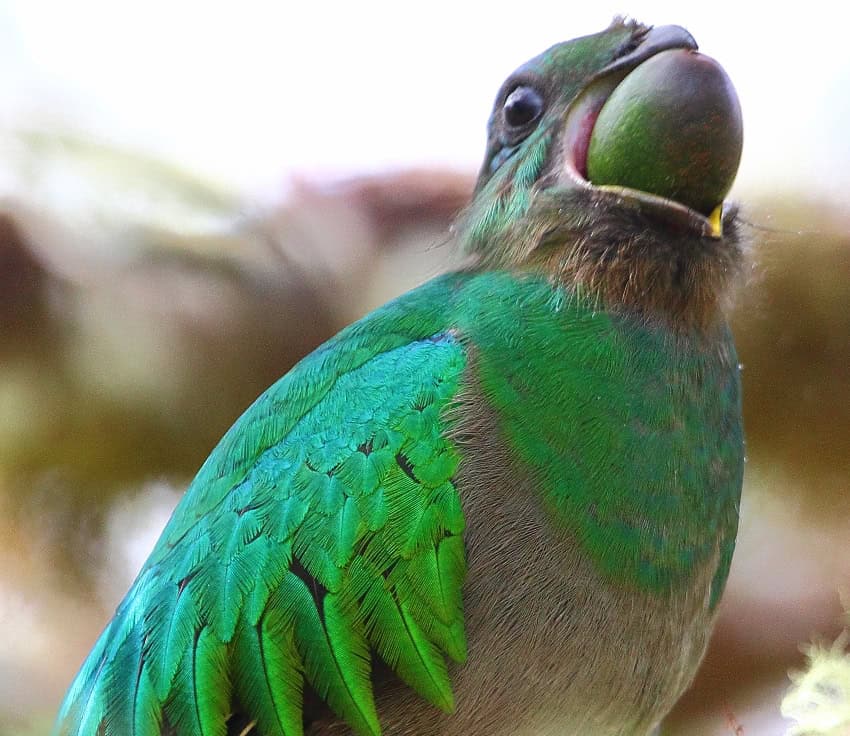
Most dramatically, it has a taste for wild avocados, helping wild avocado trees disperse through the forests. The birds swallow the avocados whole, often to the horror of tourists, convinced that the bird must choke on its giant meal! But having consumed the avocado flesh, the bird will regurgitate the pits.
The birds like to build their nests in the holes of decaying hollow trees, as far off the ground as possible. The female usually lays one to three eggs, and they are good parents, sharing the task of caring for eggs and young. It is while feeding their chicks that the birds are most likely to add insects and other small animals to their diet.
Yes, quetzals can eat an entire avocado whole. (ryanacandee/Wikimedia Commons)
While the birds have been studied, there have not been regular counts, so any population quote has an element of estimation. The most commonly given figure is between 20,000 and 50,000 birds worldwide, with some estimates more optimistic, but numbers are generally presumed to be declining, although in some well-protected areas, populations might be holding steady.
The main concern is ongoing deforestation. This not only destroys the bird’s habitat but leaves populations increasingly fragmented. Three hundred birds in one forest is a very different prospect for survival than 300 birds spread over six small and isolated populations.
There are also concerns that climate change might have an impact, perhaps allowing birds such as the keel-billed toucans (Ramphastos sulfuratus) to migrate further up the mountain slopes, where they might compete with the resplendent quetzal for nest holes.
Mexico-Texas program offers hope for breeding in captivity
There is a need for regular bird counts, which would help direct conservation projects. We need to confirm, for example, if the birds are still being hunted, which would highlight the need for local education programs. Or perhaps a greater concern should be to establish safe migration corridors between the higher and lower forests, through which the birds pass during the year.
One interesting challenge has been to get the birds to breed in captivity, something that until quite recently was thought impossible.
For birdwatchers, it’s worth traveling to the El Triunfo Biosphere Reserve in Chiapas, Mexico, to see the resplendent quetzal in flight. (American Bird Conservancy)
ZooMAT, in Chiapas, with help from the Dallas World Aquarium, has started to solve this problem. By removing the eggs and placing them in an incubator, they have been able to raise a small number of birds in captivity.
Future captive-bred birds might be released into the wild, increasing numbers and mixing up the DNA and with that hopefully improving the health, adaptability and robustness of the population. For now, however, there is still hope that the wild populations can be protected and will slowly increase in number.
Bob Patemanlived in Mexico for six years. He is a librarian and teacher with a Master’s Degree in History.