Home Blog Page 61

New poll suggests 54% approve of Sheinbaum — her lowest rating yet

12
Sheinbaum walking among people
The highest approval ratings the Atlas Intel's LatAm Pulse poll has yielded for the current president since she was sworn in on Oct. 1, 2024, was 66.7% in October 2024 and 66.3% in April 2025. (Presidencia/Cuartoscuro)

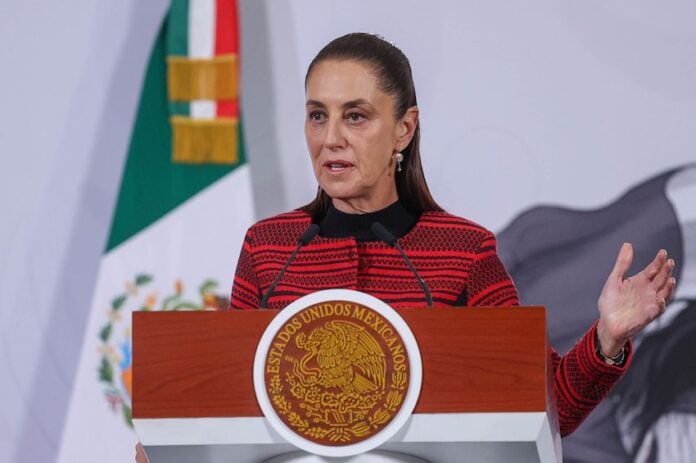
Amid heightened corruption and crime concerns, President Claudia Sheinbaum’s approval rating has sunk to its lowest level since she took office 18 months ago, according to the results of a poll conducted for Bloomberg News.

Conducted by Brazilian company AtlasIntel between March 20 and 24, the LatAm Pulse México survey yielded a 53.9% approval rating for Sheinbaum, down from 56% in February and 62.8% in January.
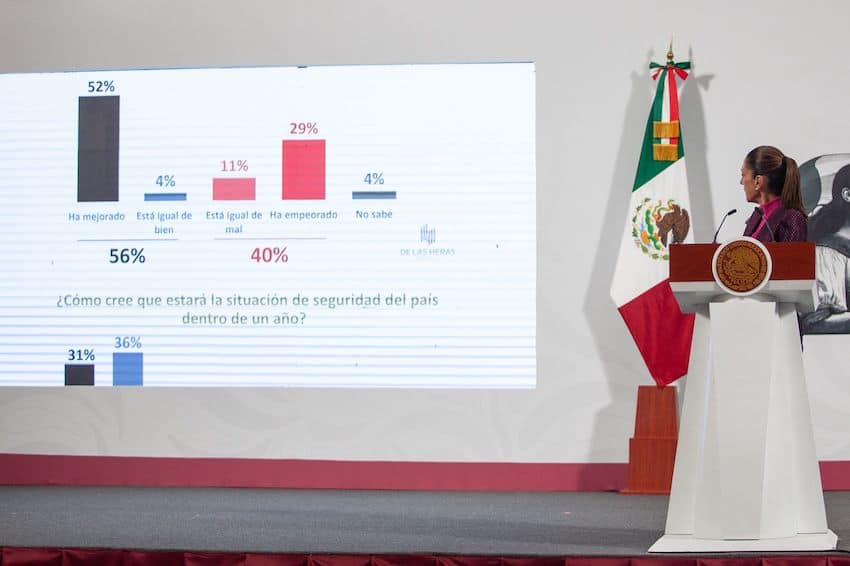
Sheinbaum presented a poll on Tuesday in which 56% of respondents said that the security situation has improved (52%) since she took office or remains "just as good" (4%) as before.
Sheinbaum sometimes takes the opportunity to present polls favorable to her government’s performance. Security is one area that can weigh heavily on the president’s approval. (Andrea Murcia/Cuartoscuro)

Until February, Sheinbaum’s approval rating had remained above 60%, according to LatAm Pulse results. The highest approval ratings the poll has yielded for the current president since she was sworn in on Oct. 1, 2024, was 66.7% in October 2024 and 66.3% in April 2025.

The latest LatAm Pulse poll surveyed 3,263 people in Mexico using an online polling method called “random digital recruitment.” The sample size is larger than many other telephone and in-person polls that have consistently yielded an approval rating of around 70% or higher for Sheinbaum.

The president’s disapproval rating rose to 40.9% in March, according to LatAm Pulse, up from 36.1% in February and 30.5% in January.

What are Mexico’s most significant problems? 

Asked to identify Mexico’s most significant current problems, 55% of survey respondents nominated corruption, an increase of nine points compared to the previous LatAm Pulse poll.

Insecurity, crime and drug trafficking were the second most commonly cited problems, nominated by 49% of those polled. That percentage rose 10 points compared to February.

The next three most commonly cited problems were:

In its report on the poll results, Bloomberg noted that the 10-point increase in the percentage of respondents who identified insecurity and crime as a major problem came despite the killing of Jalisco New Generation Cartel (CJNG) leader Nemesio Rubén “El Mencho” Oseguera in a military operation in Jalisco on Feb. 22. The operation targeting the notorious cartel boss triggered a very violent and widespread response from the CJNG, a factor that fed into the security concerns of poll respondents. The death of “El Mencho” could possibly lead to an increase in violence in Jalisco and other parts of the country in the coming months.

The increase in the percentage of respondents who identified corruption as a significant concern in Mexico came a month after Transparency International published its latest Corruption Perceptions Index, which showed that Mexico had slid down the rankings to 141st out of 182 countries and territories.

Bloomberg reported that corruption concerns “have lingered at a time when members of Sheinbaum’s ruling Morena party have been involved in a series of scandals.”

They include the arrest in February of the mayor of Tequila, Jalisco, and other municipal officials on extortion charges, and allegations that members of the Mexican Navy and others were involved in a fuel smuggling/tax evasion scheme known as huachicol fiscal.

Bloomberg wrote that Morena officials have “denied wrongdoing and Sheinbaum has moved to aggressively combat the practice” of huachicol fiscal.

Mexico News Daily identified the huachicol fiscal scandal as one of Mexico’s 10 biggest news and politics stories of 2025.

10 other poll results 

Below is a summary of 10 other results from the latest LatAm Pulse México survey.

  • Around four in 10 respondents (39.5%) believe that the Sheinbaum administration is doing an “excellent” or “good” job. Almost one-third of those polled (31.7%) said the government is doing a “bad” or “very bad” job, while 28.8% rated the federal administration’s performance as “fair.”
  • Almost half of those polled (47%) said that Mexico’s current economic situation is “bad,” while 26% said it is “good” and 26% said it is “normal.”
  • Almost eight in 10 respondents (78.1%) said they were in favor of the military operation that resulted in the death of “El Mencho.”
  • More than six in 10 respondents said they were either “concerned” (37.1%) or “extremely concerned” (25.3%) about “the violence unleashed in Mexico since the death of ‘El Mencho.'”
  • Just over four in 10 respondents (42.4%) said that military operations that result in the death of cartel leaders constitute the “most effective policy” to combat drug cartels. One-third of those polled said that such operations are effective only when implemented with other policies.
  • Forty-five per cent of respondents said that Security Minister Omar García Harfuch is doing an “excellent” or “good” job dealing with violence in Mexico. Only 38% said the same about Sheinbaum, even as homicide numbers trend down.
  • More than six in 10 respondents (62.4%) said that the United States’ provision of intelligence for the operation against “El Mencho” was a positive thing, compared to just 8.5% who had a negative view.
  • More than four in ten respondents (43.4%) said that Sheinbaum is doing an “excellent” or “good” job managing the relationship with U.S. President Donald Trump. Three in ten of those polled said she is doing a “fair” job managing the relationship, while 22.7% said she is doing a “bad” or “very bad” job.
  • Just over five in 10 respondents (51.5%) said they wouldn’t support U.S. military action against cartels in Mexico “under any circumstance.” Just over a quarter of those polled (27.5%) said they would only support U.S. action in operations that are coordinated with Mexico. One in six respondents (16.7%) said they would support U.S. action against Mexican cartels, including a “prolonged deployment of troops” in Mexico. Sheinbaum is vehemently opposed to U.S. military action in Mexico.
  • Around four in ten respondents (42%) believe that it is “very probable” that there will be “revelations about large frauds or corruption schemes” in Mexico in the next six months. Similar percentages believe it’s “very probable” that robberies and muggings will increase in the next six months (40%), and that “attacks or murders related to criminal factions” will increase (39%). More than one in five respondents (21%) said that a coup is “very probable” in Mexico in the next six months, although 51% said that such an eventuality is not at all likely.

With reports from Bloomberg 
1 of 4 trapped miners pulled to safety in Sinaloa

0
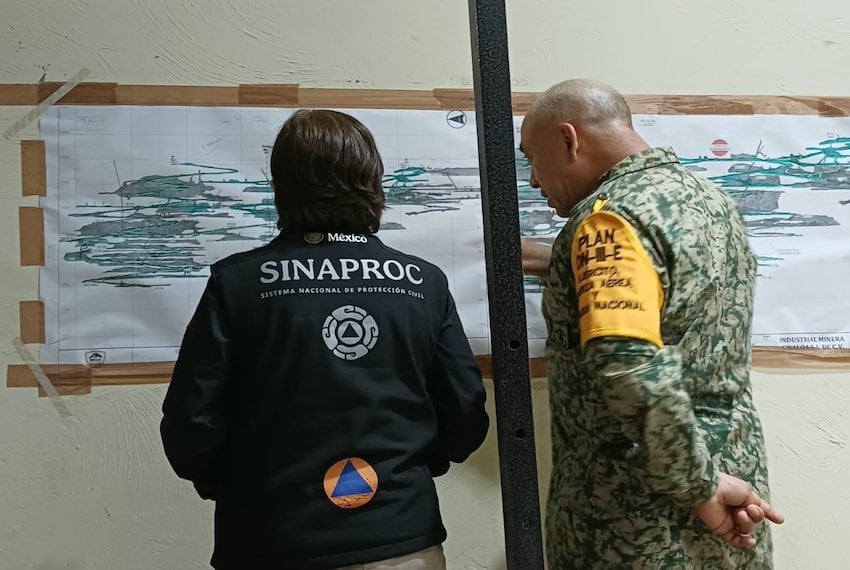
rescue workers at mine site
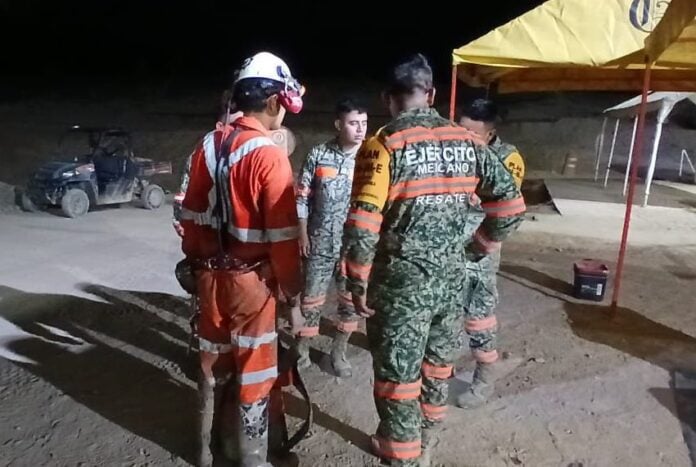
The three remaining miners have been trapped 250 feet below the surface since Wednesday. (SSPC)

One of four miners trapped in a Sinaloa mine since Wednesday was pulled to safety just after midnight Sunday. 

With more than 300 rescuers on site in the municipality of El Rosario, the authorities are hopeful the other three miners can be rescued. 

rescue workers at ine site
After 100 hours of uninterrupted work by emergency crews, José Alejandro Cáustulo, 44, was pulled from the mine at 12:25 a.m. local time. (SSPC)

Shortly after a tailings dam collapsed, rescuers had located the four miners and were delivering water, food and oxygen to the men. At the time, officials said one of the miners was 100 meters below the surface, while the other three were about 250 meters farther inside the mine.

After 100 hours of uninterrupted work by emergency crews, José Alejandro Cáustulo, 44, was pulled from the mine at 12:25 a.m. local time. He was transported by helicopter to Mazatlán General Hospital for treatment. 

Twenty-five mine workers were excavating inside the mine on Wednesday when the collapse occurred at 2 p.m. The accident was reported to National Civil Protection (CNPC) authorities around noon Thursday after initial rescue efforts were unsuccessful. 

A unified command post immediately established a structural reinforcement plan aimed at ensuring the safety of the rescuers and the trapped miners.

“The efforts of more than 300 personnel and 42 units are working around the clock, organized in operational rotation periods,” the CNPC said in a statement, adding that rescue teams are operating with controlled ventilation and temperatures close to 25 degrees Celsius. “An alarm system remains active … to issue timely warnings of any risk and carry out immediate evacuations if the situation requires it.”

As the rescuers work to clear a path along 1.5 kilometers of ramps and tunnels to reach the deepest point of the mine, the internal structure will be reinforced with cement mixtures and expansive resins to guarantee the integrity of the escape route.

A mine official said tunnels deep inside the mine did not collapse, but escape was made difficult by muddy materials that made the ramps slick, trapping the men below the collapsed areas.

The Santa Fe gold mine is operated by Industrial Minera Sinaloa, located in the town of Chele, Sinaloa.

With reports from La Jornada, El Universal, El Financiero, Expansión and El País

25 tonnes of counterfeit World Cup-related products seized in CDMX

0
counterfeit goods seizure
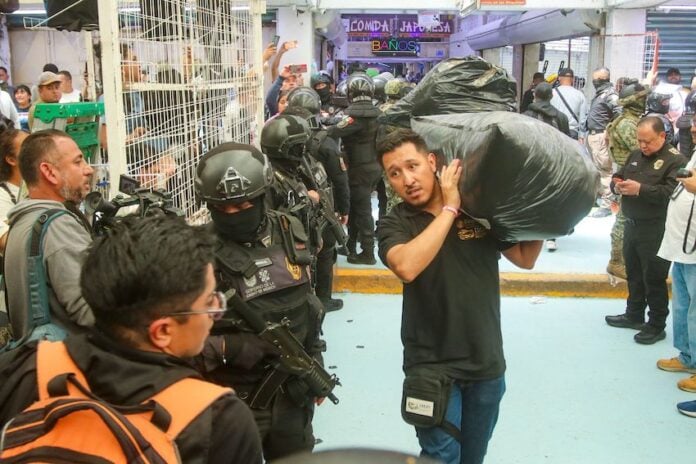
Personnel from the Mexican Institute of Intellectual Property, the Security Ministry, and the city Attorney General's Office haul off 25 tonnes of counterfeit merchandise, mostly bogus athletic clothing with fake famous brand logos, worth an estimated US $850,000. (Axel Sánchez/Cuatrocuro.com)

Authorities seized in Mexico City’s Tepito neighborhood Thursday at least 25 tonnes of counterfeit products related to the 2026 FIFA World Cup, valued at an estimated 15.3 million pesos (US $850,000). 

The action by the Mexican Institute of Industrial Property (IMPI), known as “Operation Cleanup,” forms part of the government’s crackdown on piracy, illicit trade and product smuggling. 

counterfeit clothing seized
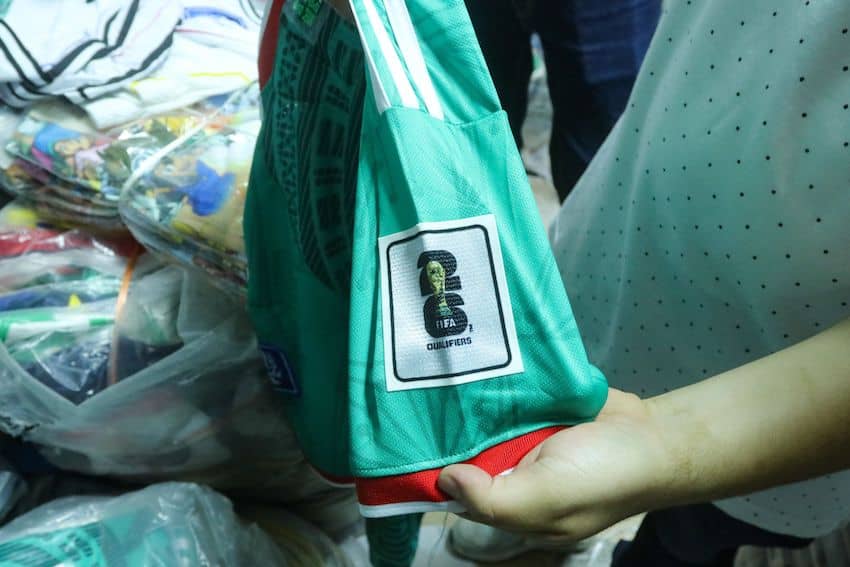
Most of the confiscated property was sports-related, as the perpetrators clearly intended to cash in on the World Cup. (Axel Sánchez/Cuartoscuro)

On Thursday, 80 IMPI inspectors led the operation, seizing 80,973 counterfeit products of Asian origin branded with logos of such well-known brands as Adidas, Nike, Puma and Reebok, among others, from several warehouses on Aztecas Street in Tepito. 

“With a global event like the 2026 FIFA World Cup approaching, we reiterate that IMPI, in coordination with the federal government and state authorities, will combat the sale of pirated or counterfeit goods head-on in order to protect intellectual property, safeguard consumers and guarantee fair competition for creative industries,” said IMPI’s head, Santiago Nieto Castillo, in an official statement. 

Operation Cleanup was launched by the government in 2024, led by the Economy Ministry, to combat piracy and the massive smuggling of illicit goods, including textiles, toys and electronics, primarily of Asian origin. 

The operation has resulted in historically high seizures of illicit goods, with the confiscation of merchandise valued at 935 million pesos ($52 million) in the 20 operations across 11 states that took place before the Tepito operation.

While some of the confiscated goods have been destroyed, roughly 96.8% of the products remain in IMPI warehouses for safekeeping while they are processed. 

IMPI is preparing additional measures for tackling the sale of counterfeit items ahead of the World Cup, including inspections, greater surveillance, crackdown operations and the seizure of illicit merchandise around participating stadiums and at Fanfests, to deliver a message of zero tolerance of the sale of illegal goods.

“This operation today in Tepito represents the beginning of a series of coordinated actions that the Mexican government will carry out within the framework of the FIFA World Cup,” said Nieto. 

“These actions will consist of permanent operations around the stadiums and at Fanfests to protect intellectual property rights, preserve the integrity of the event, and guarantee a safe and authentic experience for fans.”

With reports from Infobae and Puente Libre

AZ gun store owner accused of arming 2 Mexican cartels

6
Laurence Gray, 75, has been accused of selling weapons to the Jalisco New Generation Cartel (CJNG) and the Sinaloa Cartel. (Unsplash)

The U.S. Attorney’s Office for the District of Arizona has indicted a former holder of a federal firearms license (FFL) on charges relating to selling weapons to Mexican drug cartels.  

The accused is Laurence Gray, 75, owner of the shop Grips By Larry, which had a license to sell all types of weaponry.  

Gray has been accused of selling weapons to the Jalisco New Generation Cartel (CJNG) and the Sinaloa Cartel, criminal groups that U.S. President Trump’s government designated as foreign terrorist organizations last year. For the crime of aiding a terrorist organization, Gray could face a maximum penalty of 20 years in prison and a fine of up to US $250,000.

The prosecution explained that in May 2025, Gray attempted to provide weapons to the CJNG and the Sinaloa Cartel, with full knowledge of who the buyers were. 

“The indictment alleges that Gray knowingly attempted to provide firearms to CJNG in May of 2025, and knowingly conspired to provide firearms to both CJNG and CDS (Sinaloa Cartel) that same year,” the U.S. Attorney’s Office for the District of Arizona said in a statement 

It also said that Gray was previously indicted for firearms trafficking offenses in 2025, alongside his accomplice Barrett Weinberger, 73, of Tucson, Arizona. 

According to the federal indictment, Gray stands accused of facilitating the sale of three semi-automatic rifles, a machine gun and two pistols. 

The Tucson Sentinel reported that during two purchases, Gray, Weinberger and a third individual named David Prince allegedly sold two .38-caliber pistols, a .50-caliber rifle, two M249S belt-fed rifles and an Ohio Ordnance M2 SLR .50-caliber belt-fed rifle, weapons typically associated with organized crime violence in Mexico.

Reportedly, the CJNG recently used a .50-caliber rifle to knock down a Mexican military helicopter in 2015 during a cover escape of former cartel leader Ruben “El Mencho” Oseguera González, who ultimately died last month following a military operation that ended in the drug lord’s death.     

For years, the Mexican government has pressured its northern neighbor to halt the smuggling of weapons into the country, arguing that the violence in the country is fueled by the illegal trafficking of weapons from the U.S. 

A 2025 report by the Bureau of Alcohol, Tobacco, Firearms, and Explosives (ATF) found that the U.S. is the largest supplier of firearms to criminals in Mexico, with an estimated 200,000 weapons illegally crossing the northern border every year. 

With reports from El País and La Jornada

Sheinbaum’s security strategy has led to an 11% increase in Mexico’s prison population

0
escorted prisoner
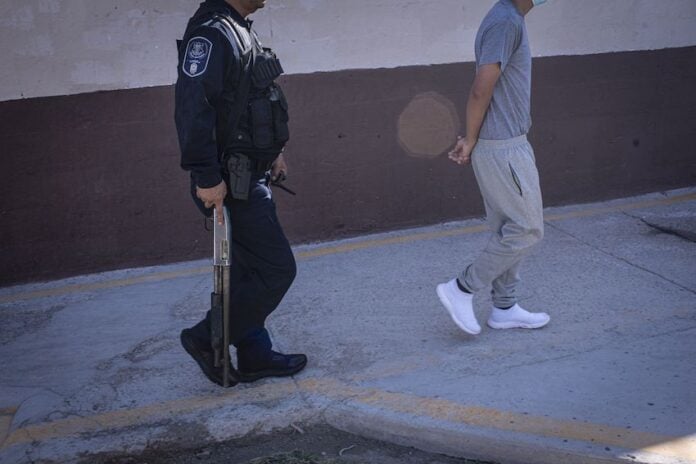
Though President Sheinbaum continues to support — in theory — her predecessor's strategy of offering potential cartel members alternative life options, her main approach has been to make more arrests, resulting in an 11% increase in the prison population since she took office in October 2024. (Pedro Anza/Cuartoscuro)

The number of people in prison in Mexico has reached a historic high, with official records showing that as of Feb. 28 there were more than 260,000 people incarcerated in the 276 local and federal prisons across the nation.

In another historic record, Mexico’s prison population grew by 20,000 inmates in a single calendar year in 2025.

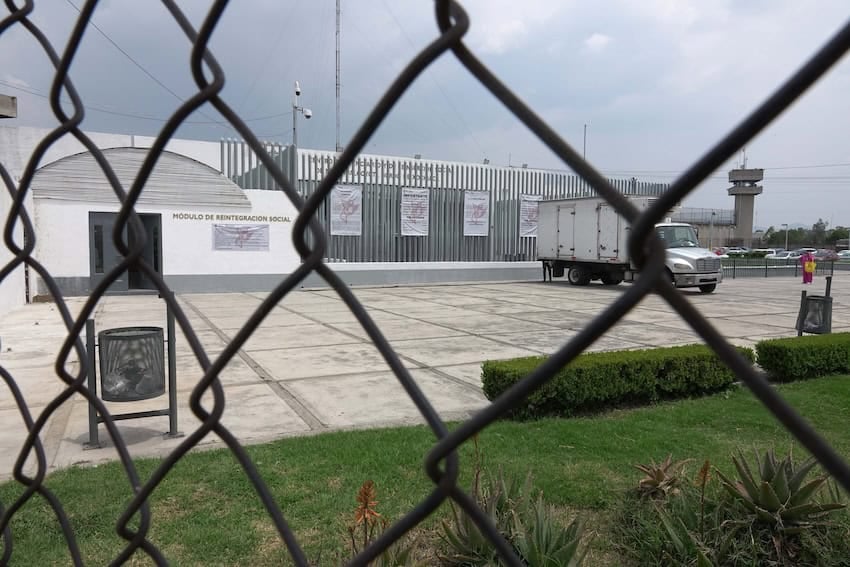
prison thru chain-link fence
President Sheinbaum’s more aggressive approach toward organized crime has increased the country’s prison population by 11%. (Rogelio Morales/Cuartoscuro)

While the data reflects the new security strategy adopted by President Claudia Sheinbaum after abandoning the “hugs, not bullets” policy embraced by her predecessor, the increase in arrests has resulted in prison overcrowding issues.

Thanks to Sheinbaum’s more aggressive approach toward organized crime, the country’s prison population has grown by 11%. When Sheinbaum was inaugurated as president on Oct. 1, 2024, there were 235,461 people incarcerated. By the end of February 2026, the figure had risen to 261,388.

During the first 17 months of her administration, 46,405 people were arrested. At the same time, however, a significant number of people were released from Mexican prisons, either because they had served their sentences or were allowed to continue legal proceedings while free or due to insufficient evidence. Thus, the prison population increase stands at 25,927 inmates.

The data also reveals the number of inmates by gender.

In October 2024, there were 221,620 men and 13,841 women in prison; by February 2026, the figures had risen to 245,022 men (up 10.5%) and 16,366 women (up 18.2%).

The success of the new strategy is causing problems for state prisons, however.

State-run facilities are currently housing 37,634 inmates more than they were built to hold. Federal prisons are also running out of space as there are only 7,816 bunks available in these penitentiaries.

According to the Security Ministry, 140 of the nation’s 276 prisons are overcrowded. 

The newspaper El Sol de México reported that the state prisons with the most alarming levels of overcrowding are in Chiapas, Morelos and México state. The most extreme example is Social Reintegration Center No. 7 Huixtla, in Chiapas, with 510% overpopulation: 244 prisoners housed in a space designed for 40. 

The overcrowding is attributed to the excessive reliance on pretrial detention (nearly 111,000 inmates, 42%, are awaiting trial), a situation that could be alleviated in April if the Supreme Court determines that this measure is unconstitutional.

With reports from El Financiero, Milenio and El Sol de México

MND Local: ‘No Kings’ comes to Puerto Vallarta, and 10,000 oysters come to Bucerías

3
Aerial view of a part of the coastline of Puerto Vallarta, featuring beachfront homes in bright orange and white and pools of various shapes.
The Bay of Banderas has quite a lot going on lately, from its own No Kings rally last week to preparations for a major oyster festival in Bucerías coming in the beginning of April. (Alessandro Aviles/Pexels)

Recent events in the Bay of Banderas news have seen a rally in Parque Hidalgo protesting U.S. governance, Bucerías welcoming its annual oyster festival, upgraded security for the Semana Santa safety holidays and Puerto Vallarta expanding public internet access for schools, parks, and civic centers. 

No Kings rally

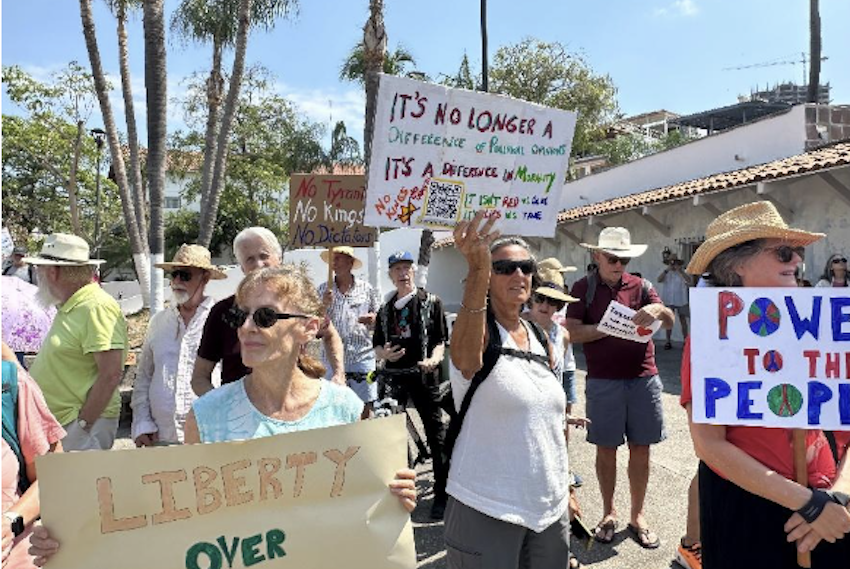
No Kings Rally Puerto Vallarta
Around 250 people turned out for a “No Kings” rally in Puerto Vallarta, to protest the U.S. President. (Charlotte Smith)

A permitted peaceful demonstration by U.S. citizens living in Puerto Vallarta took place at Parque Hidalgo on Saturday, March 28, organized by Indivisible Abroad Vallarta with participation from the Costa Banderas Chapter of Democrats Abroad Mexico, under an approved permit and in compliance with local regulations.

The “No Kings” rally saw over 250 participants stand in solidarity with Americans opposing what they described as authoritarian tendencies tied to Donald Trump. 

Speakers addressed perceived failures to check unlawful behavior. The remarks mixed policy critique with personal testimony from U.S. citizens who said they felt compelled to speak out from abroad.

Organizers stressed the demonstration’s nonviolent, single-issue focus and coordinated closely with municipal staff to ensure a smooth, orderly assembly. 

Rally leaders linked the March 28 action to a broader wave of global solidarity protests connected to the “No Kings” movement in the United States, which grew from mass demonstrations beginning in 2025.

Bucerías Oyster Festival 

According to organizers, the Bucerías Oyster Festival served 10,000 oysters and 500 kilograms of ceviche to attendees in 2025.

On April 4 and 5,  Bucerías will host its annual Feria de Ostiones, a celebration honoring the town’s oyster-diving heritage with music, cultural events, and seafood along the coast. The festival, organized by the Municipal Government of the Bay of Banderas with community partners, aims to welcome Semana Santa visitors while spotlighting local traditions and the coastal economy.

Known locally as the “Place of the Divers,” Bucerías traces much of its identity and livelihood to oyster harvesting. This year’s program blends family-focused entertainment, live music, artisanal markets and abundant fresh oysters prepared by neighborhood chefs and vendors. Organizers highlight the festival’s role in sustaining seasonal income for fishers and small businesses and in reinforcing Bucerías’ reputation as a culinary destination on the Vallarta–Nayarit shore.

Visitors are encouraged to arrive early, support local businesses and respect the town’s artisan fishing zones. Municipal officials extended an open invitation to residents and tourists to join the celebrations over the holiday weekend.

Semana Santa safety

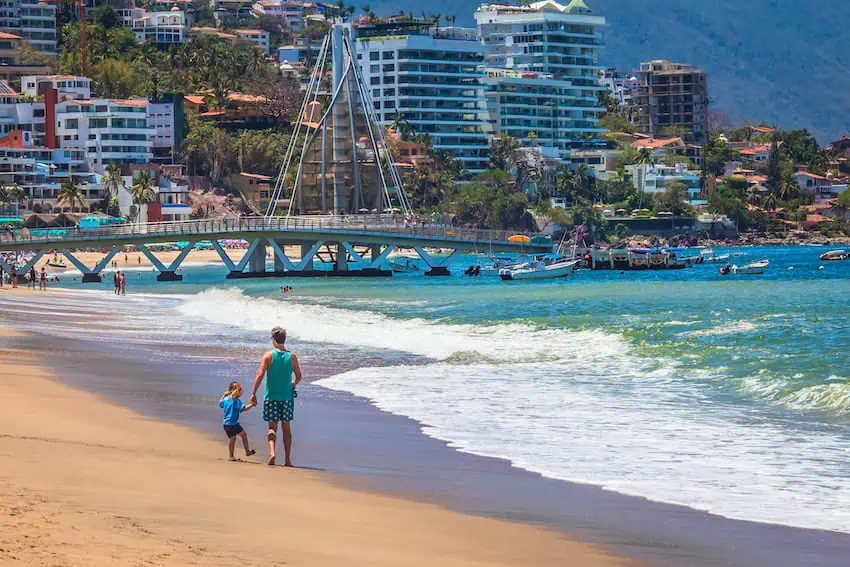
A father walking on a PV beach with buildings in the background
Beachgoers in Puerto Vallarta can make the most of the sunshine, as the municipal government has invested in increase security measures. (Shutterstock)

The Bay of Banderas has stepped up a coordinated municipal effort to ensure safe, welcoming conditions for residents and holiday visitors. Public works, police, port authorities and emergency medical and fire services have expanded patrols, finalized joint emergency plans and conducted readiness drills to handle peak-season demand.

Cleaning and repair crews focused on beaches, boardwalks and high-traffic corridors, and public-safety units have increased visible patrols and reinforced coordination between municipal police, port authorities and volunteer rescue squads. Fire and medical teams from neighboring municipalities ran surge-capacity exercises and reaffirmed mutual-aid agreements to ensure rapid support for larger incidents. 

A central element of the safety push was national recertification of Puerto Vallarta’s lifeguard teams by the Mexican Federation of Aquatic Rescue and Lifesaving. Lifeguards underwent rigorous open-water and pool evaluations to test endurance, rescue technique and operational readiness. Officials say the recertification reinforces confidence in the lifeguard service’s on-the-water response capabilities.

The overall objective is to protect public safety and natural resources while ensuring a positive holiday atmosphere. With enhanced maintenance, tighter emergency coordination and a recertified rescue force, municipal leaders say they are prepared for the seasonal surge. They urge visitors to follow local guidance and report hazards promptly.

Puerto Vallarta expands public internet access 

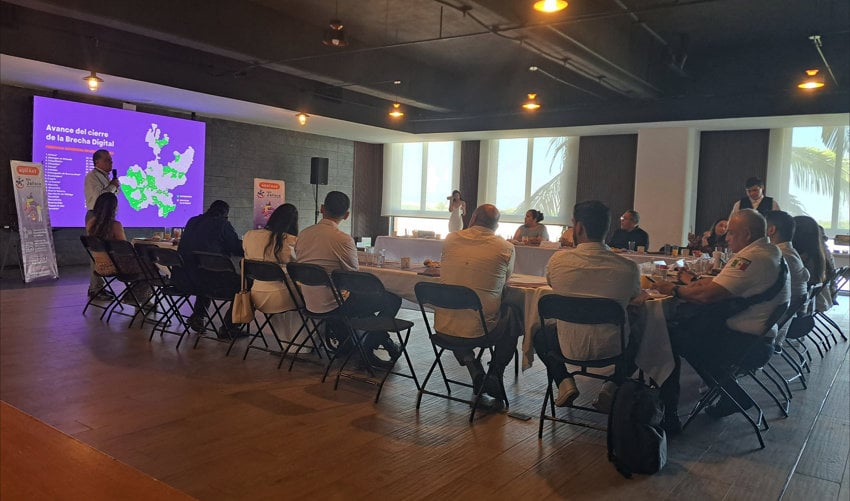
An official presentation regarding digital connectivity in Jalisco, Mexico. A man stands before a purple screen displaying a map of Jalisco and the text "Avance del cierre de la Brecha Digital" (Progress in closing the Digital Divide). He is addressing a group of professionals seated at a long, white-clothed table in a modern, well-lit conference room with large windows.
Puerto Vallarta’s increase in free, public internet connectivity is the result of a state initiative called Red Jalisco (the Jalisco Network), which has a goal to close the state’s digital connectivity gaps. (Government of Puerto Vallarta)

Puerto Vallarta has accelerated efforts to widen public internet access as part of Jalisco’s state initiative to close connectivity gaps, expanding free hotspots in parks, civic centers and schools. The state-managed Red Jalisco now reports more than 2 million users across all 125 municipalities, and Puerto Vallarta says that network has brought concrete gains for residents, students, and visitors.

City officials report over 300 active public connectivity points, including hotspot coverage in major parks and public gathering places, plus internet service now installed in 184 local schools to support teachers and online learning. Municipal managers framed reliable internet as an essential public service that enables schooling, telehealth, job searches, and access to digital government services rather than a luxury.

Beyond coverage numbers, the municipality emphasized usability and impact, including faster links to municipal services, improved WiFi at tourist sites, and initiatives to help community centers and libraries offer digital-literacy support. The expansion aligns with broader state policy to reduce the digital divide and promote inclusive access to online resources across Jalisco.

Charlotte Smith is a writer and journalist based in Mexico. Her work focuses on travel, politics, and community. You can follow along with her travel stories at www.salsaandserendipity.com.

Sheinbaum makes monetary donation to Cuba: Monday’s mañanera recapped

1
Mexican President Claudia Sheinbaum said on Monday that her donation of more than 1,000 dollars in aid to Cuba had "nothing to do" with her role as president.
Mexican President Claudia Sheinbaum said on Monday that her donation of more than 1,000 dollars in aid to Cuba had "nothing to do" with her role as president. (Moisés Pablo/Cuartoscuro)

Sheinbaum’s mañanera in 60 seconds

  • 🇪🇸 World Cup diplomacy with Spain? Sheinbaum wouldn’t confirm whether she’d meet King Felipe VI during his possible visit to Mexico, but the stakes are real. The president has been pushing Spain to formally apologize for the conquest, and Felipe recently acknowledged “significant abuses” during colonization, the strongest royal statement on the matter yet.

  • 🇨🇺 Personal donation to Cuba. The president revealed she donated 20,000 pesos (US $1,100) out of her own pocket to a humanitarian fund for Cuba, stressing the move had nothing to do with her role in government.

  • 🕊️ Another Mexican dies in ICE custody. José Guadalupe Ramos Solano passed away at California’s Adelanto Processing Center on March 25 — at least the 14th such death in ICE custody this year. Sheinbaum promised stronger protest measures, including a formal complaint to the Inter-American Commission on Human Rights.


Why today’s mañanera matters

At her Monday morning press conference, President Claudia Sheinbaum took the opportunity to comment on a range of international issues, including the death of another Mexican in the custody of U.S. Customs and Immigration Enforcement.

In her 18 months in office, Sheinbaum has shown herself to be a more outward looking president than her predecessor, Andrés Manuel López Obrador, who famously quipped that the “best foreign policy is domestic policy.”

Still, the current president — after disclosing the size of a personal donation she made to buy humanitarian aid for the people of Cuba — stressed on Monday that her top priority is to “protect” Mexico and the Mexican people.

“That is my obligation and my responsibility,” she said.

Today’s mañanera was important as it served as further testament of the international issues the Sheinbaum administration is dealing with at a time when it also faces major challenges at home, including ongoing security concerns, weak economic growth, rising inflation and legislative setbacks.

Could Sheinbaum meet with the King of Spain during the World Cup?

A reporter asked the president whether the government had received any confirmations from leaders and heads of state who were invited to come to Mexico to attend the opening ceremony and opening match of the FIFA men’s World Cup in Mexico City on June 11.

Sheinbaum responded that government officials, including World Cup coordinator Gabriela Cuevas, will look this week at which leaders and heads of state have confirmed they will attend the opening ceremony, which will take place at the Estadio Banorte (Estadio Azteca) before the opening match between Mexico and South Africa.

The reporter asked the president whether she would meet with the King of Spain, Felipe VI, if he came to Mexico, and whether such a meeting could mark a “complete reset” of bilateral relations with Spain.

“Let’s wait and see who’s coming,” Sheinbaum responded before noting that her government could hold an event a day before the World Cup opening ceremony to welcome officials from other countries.

Earlier this month, King Felipe IV acknowledged that during the Spanish conquest and colonization of America, “there were significant abuses” and “moral and ethical controversies,” marking an unprecedented statement on the matter for a king of Spain.

Sheinbaum has called on Spain to apologize for abuses committed during the conquest and the fall of Tenochtitlán.

Sheinbaum reveals she donated 20,000 pesos to Cuba 

Sheinbaum told reporters that she had made a donation of 20,000 pesos (US $1,100) to a fund created to purchase humanitarian aid for the people of Cuba.

“There were problems with the deposit,” she added, without providing further details.

Sheinbaum apparently made her donation to a bank account of a recently created non-governmental organization called Humanidad con América Latina (Humanity with Latin America).

Earlier this month, former president Andrés Manuel López Obrador called on Mexicans to make monetary donations to the account.

Former president AMLO calls on Mexicans to donate money for Cuba in rare public message

Sheinbaum stressed that her 20,000-peso donation was “personal.”

“It’s my personal decision as Claudia Sheinbaum Pardo to donate to an account that a series of organizations opened in order to take aid to Cuba,” she said.

“… It has nothing to do with my role as president,” Sheinbaum added.

The people of Cuba are facing a situation of extreme hardship due to factors including a recent U.S. blockade of oil shipments. However, the U.S. is allowing a Russian tanker to take oil to the communist-run island.

Sheinbaum on Monday said that Mexico has “every right” to send fuel to Cuba, although it hasn’t done so recently following a threat from U.S. President Donald Trump to impose tariffs on goods from countries that supply oil to the island nation.

Sheinbaum acknowledges death of Mexican in ICE custody

Sheinbaum acknowledged that another Mexican had died in the custody of U.S. Immigration and Customs Enforcement (ICE).

She said that her government would take “more measures” than it has previously taken to express its discontent with the death of another Mexican in the custody of ICE.

In light of the latest death, Sheinbaum said that her government would take “various actions of protest,” including the submission of a complaint to the Inter-American Commission on Human Rights.

ICE said in a statement on Monday that José Guadalupe Ramos Solano, “a criminal illegal alien from Mexico previously convicted of possession of a controlled substance and theft, passed away on March 25, 2026, at 9:29 p.m.”

“Ramos was being held at the Adelanto ICE Processing Center [in California] when security staff discovered him unconscious and unresponsive. Staff immediately initiated life-saving procedures, and he was taken to Victor Valley Global Medical Center in Victorville, California, where he was pronounced deceased,” ICE said.

ICE said that Ramos had “received constant medical care” for “several medical issues,” including diabetes and hypertension. However, Mexico’s Ministry of Foreign Affairs said in a statement that it was demanding “an immediate review of the Adelanto center due to serious oversights and evident deficiencies in the provision of medical care to people under its custody.”

The death of Ramos came after a 19-year-old Mexican man died in ICE custody in Florida earlier this month. There have been at least 14 deaths in ICE custody so far this year.

By Mexico News Daily chief staff writer Peter Davies (peter.davies@mexiconewsdaily.com)

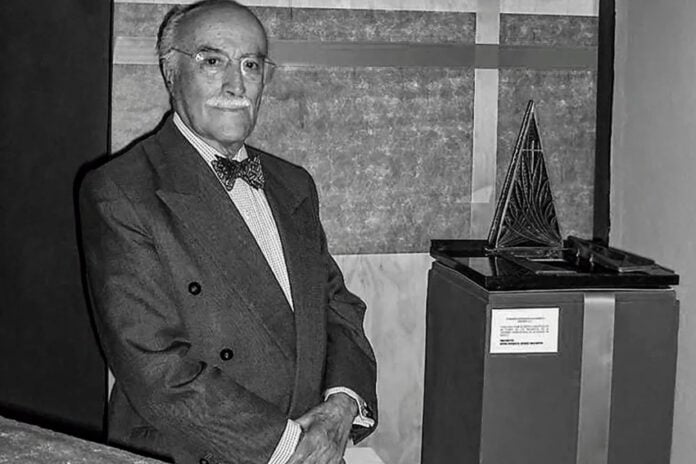
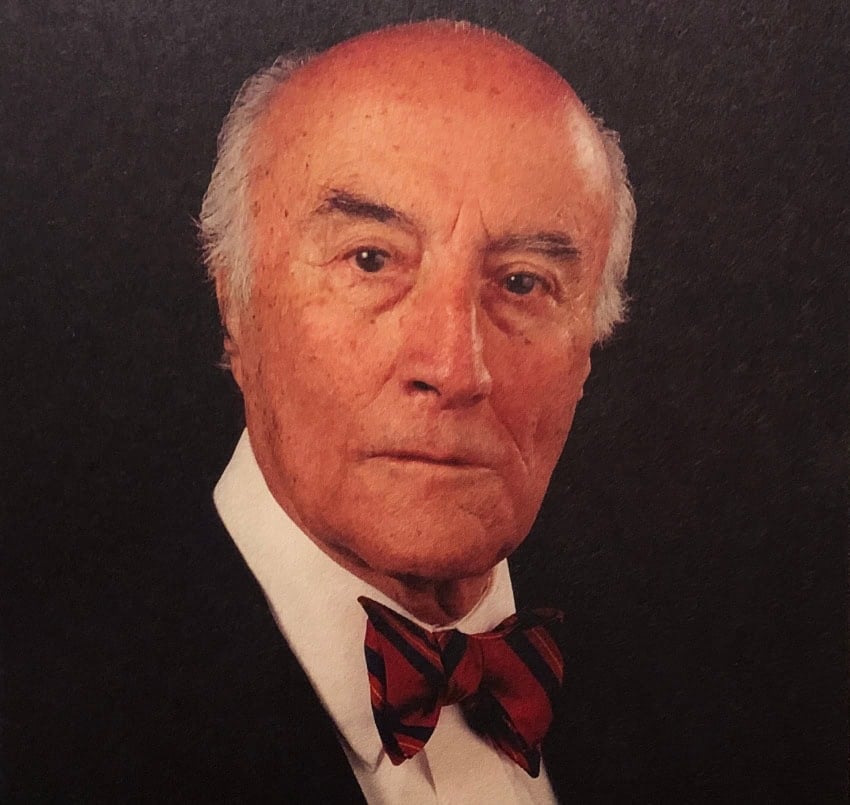
Ernesto Gómez Gallardo: The architect who redefined Mexican furniture

0
Ernesto Gómez Gallardo Argüelles
Ernesto Gómez Gallardo Argüelles was one of Mexico's most esteemed architects, and also an iconic designer of furniture. (Acervo de Arquitectura Mexicana)

Though you might not know it now, there was a time — particularly during the first half of the 20th century — when architects also engaged in furniture design. Numerous notable examples exist worldwide, including the French architect Le Corbusier, who designed the iconic LC2 and LC4 chairs; the German architect Ludwig Mies van der Rohe, known for the legendary Barcelona chair; and the Finnish-American architect Eero Saarinen, renowned for the Tulip table. Mexico also contributed to this creative wave.

During this period, prominent Mexican architects like Ernesto Gómez Gallardo Argüelles and Pedro Ramírez Vázquez — who created the National Museum of Anthropology and History — and the Mexican-Cuban architect Clara Porset, who designed iconic furniture for figures such as Luis Barragán and Mario Pani, crafted remarkable pieces that significantly impacted the history of design in Mexico. Ernesto Gómez Gallardo Argüelles, in particular, stands out.

silla paleta
Designed in the 1950s, the iconic paleta chair of Ernesto Gómez Gallardo Argüelleshas remained a standard in Mexico. (Gaceta UNAM)

Furthermore, in Mexico during the 1970s, there was a convergence of design, industry and government, facilitating the integrated proposal and implementation of various projects. During this time, Ernesto Gómez Gallardo Argüelles emerged as a key figure and was part of the original team of architects who designed and built the National Autonomous of Mexico’s University City, now designated as a UNESCO World Heritage Site.

Ernesto Gómez Gallardo Argüelles and his iconic mobiliary

In the late 1950s, the Mexican government sought proposals for the Federal School Construction Program Management Committee, specifically targeting rural schools and appointing Gallardo as the lead. The project aimed to combine industrialized architecture with self-construction, resulting in a prefabricated school model for rural areas. This initiative was part of an 11-year campaign by the Ministry of Public Education to expand educational coverage in regions lacking suitable facilities for children. Gómez’s goal was to design desks entirely of wood, allowing for easy repairs by both teachers and students. Remarkably, his furniture for rural schools is still in use today.

One of his most notable achievements in furniture design is the paleta chair for UNAM. This chair was used in classrooms across the newly constructed university and earned him the Silver Medal at the Milan Design Triennial in 1960. It remained in use at the institution for decades.

Later, in the 1980s, he explored the use of wrought iron in designing street furniture for parks and plazas, creating structures with bent slats that formed seating. Due to its durability, ease of maintenance and ease of production, this type of furniture became integral to the city’s public spaces.

Other highlights of his career

In addition to being one of the architects behind some of UNAM’s most significant buildings, Gallardo designed the high altar of the Metropolitan Cathedral in Mexico City, as well as airports in Zacatecas, Palenque and Tuxtla Gutiérrez in Chiapas.

In terms of architecture, one of his most remarkable works is his own Casa Möbius, characterized by its unique triangular concrete roof, which reflects the architect’s fascination with mathematics. The roof serves as a simplified representation of the Möbius strip, a geometric shape discovered by the German mathematician August Ferdinand Möbius in 1858, resembling an infinite loop.

Ernesto Gómez Gallardo Argüelles
An experimenter in many disciplines of design, Ernesto Gómez Gallardo Argüelles has left a rich legacy in Mexico. (Andrés GGM/Wikimedia Commons)

Furthermore, in academia, Gómez Gallardo served as the Dean of the School of Architecture at the Monterrey Institute of Technology and Higher Education. Like many of his generation, he experimented with creations across various disciplines before hyperspecialization began to impose limitations and opportunities on both the sciences and the arts.

Ana Paula de la Torre is a Mexican journalist and collaborator for various outlets, including Milenio, Animal Político, Vice, Newsweek en Español, Televisa and Mexico News Daily.

El Jalapeño: Mexico confirms World Cup visitors will be greeted by construction site, taxi war and National Guard before reaching baggage claim

2
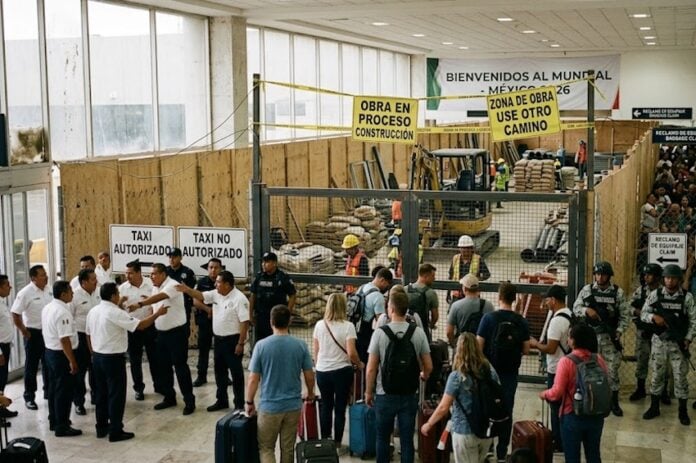
The magic of Mexico is on full display at Mexico City Airport (This image created using AI tools)

All stories in El Jalapeño are satire and not real news. Check out the original article here.

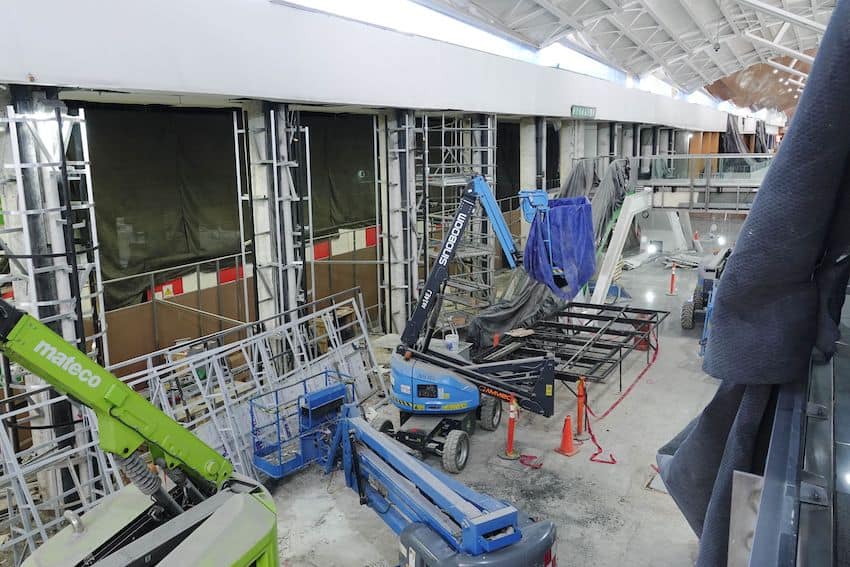
MEXICO CITY — Officials at Mexico City International Airport confirmed this week that the $416-million renovation of the facility will not be completed before the World Cup begins on June 11, assuring the estimated millions of international visitors that the experience of arriving into a half-finished building actively disputed by rival transport factions and supervised by armed federal agents will nonetheless represent “a significant improvement” on what was there before.

Airport Director General Juan José Padilla said Phase One of the renovations — defined, after some reflection, as whatever gets finished — will be 100% complete by the tournament’s opening match. Phase Two, which includes baggage carousels, elevators, drainage, staircases, and parking, will not. Padilla described this as “the original schedule,” in the same tone a man uses when he has just decided something was always the plan.

renovations at Mexico City international airport
The original schedule allowed for 10-20% of the remodel to be completed after the World Cup concludes. But with under three months left before the World Cup kicks off on June 11, more than one-third of the renovations remain. (Camila Ayala Benabib/Cuartoscuro)

Visitors navigating the terminal in the meantime can expect blocked sidewalks, narrowed corridors, out-of-service staircases, reduced waiting areas, and the ambient soundtrack of heavy machinery, which officials said would give the airport “an atmosphere of momentum and progress” that reflects Mexico’s energy as a host nation.

Upon successfully exiting the construction zone, arrivals will then enter the airport’s ground transportation area, currently the site of an ongoing jurisdictional conflict between traditional taxi operators and ride-hailing apps including Uber, the resolution of which involves the National Guard and several pending court orders.

It is unclear whether Uber will be permitted to collect passengers with the same freedom it currently enjoys, a question that FIFA delegations, team coaches, and 48 national football federations are advised to consider before landing.

To stress-test the facility ahead of June, officials confirmed the airport will use the Easter holiday rush — approximately 4 million domestic tourists — as a dress rehearsal. The actual performance follows six weeks later, before a global audience, with less margin for error.

Padilla said he was confident. He said this on the radio, from somewhere that was not the airport.

Check out our Jalapeño archive here.

Got an idea for a Jalapeño article? Email us with your suggestions!

The unexpected power of a Fire Horse journey in San Miguel de Allende

2
Year of the Fire Horse
2026 is the Year of the Fire Horse in the Chinese zodiac, a very rare sign that happens once every 60 years. (Fire Horse Saloon)

It’s hard to stand still when a 1,000-pound horse is galloping straight toward you —snorting, pounding her hoofs, white mane flying.

“I should get out of the way,” I remember thinking. But which way? If I stepped right and the horse veered in that direction, I might get trampled. Same thing if I stepped left. I barely had time to think or breathe.

Rancho Baile de la Luna
There were scary moments, as well as transformative ones, at a recent Rancho Baile de la Luna’s Spirit Horse Journey. (Rancho Baile de la Luna)

I looked at the white mare as she came closer, our eyes met, and I sensed a message: “Be still.”

The Fire Horse journey

Morita missed me by inches, narrowly avoiding another woman before galloping to the far side of the arena. I exhaled in relief.

Earlier that afternoon, on a hot, sunny Tuesday in February, 12 women convened at Rancho Baile de la Luna near San Miguel de Allende, joining Chris, the ranch owner and avid horsewoman, and Amy, instructor and horse whisperer, to celebrate the rare Chinese zodiac year of the Fire Horse. We ranged in age from our 20s to our 70s and shared a passion for horses.

Each of us had unique reasons for joining this celebration. I looked forward to hanging around the ranch with women friends. Loftier motives prompted many of the other women: releasing old habits and making a fresh start in the new lunar year.

Dressed in cowgirl attire and yoga clothes (yes, there would be yoga), we introduced ourselves, sharing a word summarizing our current mindset.

Greeting the lunar new year

“Grateful,” “joyful,” “safe” and “peaceful” were among the words we offered one by one. “Escape,” someone said, and we chuckled because, in a way, we were all escaping our daily routines to share rituals and fun here at the ranch — and perhaps more.

Rancho Baile de la Luna in San Miguel de Allende
Spirit Horse Journeys will be held throughout this year at Rancho Baile de la Luna, located just outside San Miguel de Allende. (Facebook)

Before meeting, a few participants had posted affirmations in our WhatsApp group, inviting us to choose courage, act with integrity and welcome abundance during the year of the Fire Horse.

To me, the messages sounded a little woo-woo. Personally, I tend to be more practical, keeping my boots on the ground. That said, I’ve always admired women who are in touch with their inner wisdom. I’m still looking for mine.

I was here more out of curiosity than anything else. I knew there would be horses, yoga, snacks, a bonfire, some laughs and plenty of camaraderie. Maybe I’d pick up some wisdom too, if I was lucky.

An actual fire

After our introductions, we settled onto our yoga mats near the arena. I closed my eyes, letting myself luxuriate in the poses, and tried to relax, given the extenuating circumstances. Coincidentally (or not), an actual fire was raging in the desert-dry countryside not far from Chris’s ranch. Loud crackles and pops were competing with Amy’s yoga instructions.

“Sounds like really loud bacon frying,” someone said as black smoke billowed and bright-orange flames taller than the trees licked the sky.

One gal climbed on the cement wall separating the ranch from the fire to watch its progress. The rest of us tried not to think about it (“Snap, pop, crackle”) as we focused on our yoga practice and the ensuing meditation Chris read while we lay in shavasana. It’s safe to say we weren’t very relaxed, knowing this fire was heading our way.

San Miguel de Allende
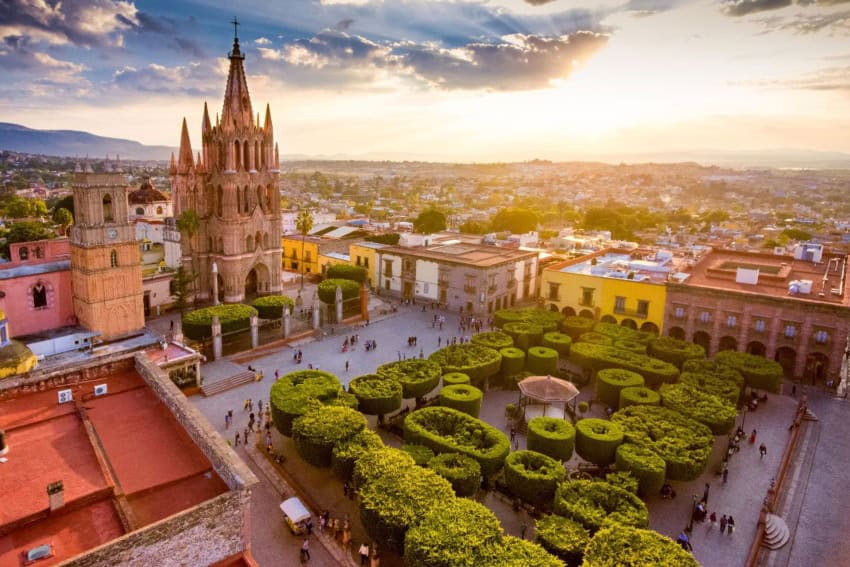
Rancho Baile de la Luna is one of many attractions in and around San Miguel de Allende. (Luxury Rental Management)

We weren’t the only ones.

As we paused for snacks and refreshing hibiscus water après yoga, someone saw flashing lights. Hurray! The fire brigade arrived to ensure the fire didn’t spread to Chris’s ranch, as well as nearby homes and farms. Soon, the flames began to diminish as the fire reached a dry riverbed and could advance no further. Peace and quiet ensued.

Emotions intensify

The timing of the fire on this fortuitous first day of the year of the Fire Horse wasn’t lost on any of us, of course. As we walked up the hill to the arena, we laughed about this strange
coincidence, most of us still carrying an extra dose of energy and anxiety — our own fire within.

For the next part of the celebration, we would commune with six or seven of Chris’ horses, who were roaming freely inside the arena. (“Be honest,” Chris said, “and the horses will respond with curiosity and peacefulness.”) As we passed through the gate, each of us chose an affirmation card and then formed a large circle with four or five feet separating us.

Next, we read our cards aloud. They contained empowering statements — sort of like you’d find in fortune cookies, I thought. Mine was “Obstacles are detours in the right direction.” I considered a few of the obstacles I’d encountered lately, wondering whether the detours they’d precipitated led to better outcomes.

As we read our cards, Amy walked around the circle with a bundle of sage and “smudged” us individually with the smoke, clearing stagnant energy and making room for the energy of the Fire Horse.

An uncomfortable moment

Spending time with a horse in San Miguel de Allende
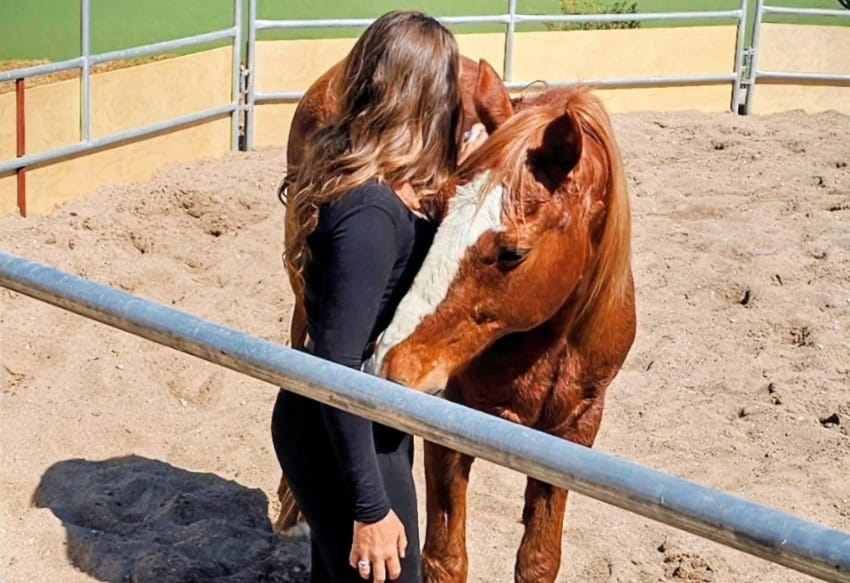
Quality equine time is part of the allure of Spirit Horse Journeys at Rancho Baile de la Luna. (Rancho Baile de la Luna)

Speaking of horses, a few began to walk in and out of the circle, sometimes pausing for a second or two. A couple of them trotted around the arena, and occasionally a small scuffle broke out among moody mares. Chris was a little concerned about the more active horses and asked if anyone felt uncomfortable.

That’s when Morita (aka the “Fire Horse”) came galloping straight toward our circle.

Once Chris realized everyone was safe, she caught Morita and decided to tie her up at the top of the driveway outside the arena. Clearly, the wildfire had made the horses nervous. As Chris led Morita up the driveway, the remaining horses became very active. Communing with our four-legged friends would not be possible, we realized — too much fire energy in them and now in all of us.

Jeff, Chris’s husband, suggested we head over to the fire pit at one end of the arena while Chris tied up Morita and Amy helped her secure the remaining horses.

A strange and disturbing episode

As we gathered around the fire pit, sitting on old wooden chairs and hay bales draped with colorful Mexican blankets, Jeff shared something he’d learned at a recent clinic about dealing with emotions when working with horses.

“Give your emotion a number from one to 10,” he said, “and then visualize that number going down as you breathe and relax and decompress.”

Rancho Baile de la Luna
Spirit Horse Journeys can be emotional, particularly where the year of the Fire Horse is concerned. (Rancho Baile de la Luna)

Suddenly, a mare named Amiga began squealing. When I looked across the arena, I saw the front half of the horse atop a concrete wall as she scrambled to pull the rest of her body up and onto the driveway in a desperate attempt to join her friend, Morita.

We watched helplessly as Amiga squealed in pain before managing to pull herself up with her forelegs, leaving behind tufts of hair on the concrete wall. Chris took Amiga to the barn to tend to her wounds, mostly superficial, thankfully. Amy and Jeff continued fetching horses and tying them up before another one got a crazy notion to jump out of the arena or randomly gallop toward us humans.

The carefully curated agenda Chris and Amy had crafted for this ceremony, celebrating the year of the Fire Horse, was apparently never meant to be. Obstacles had appeared unexpectedly throughout the afternoon. We sat around the firepit trying to process a range of emotions — fear, turmoil, anxiety, and concern for Amiga’s well-being — as the sun sank, warming us with late-afternoon rays.

A woo-woo moment

Then something unexpected happened — you could even call it woo-woo. As we sat around the firepit with Chris, while Amy and Jeff tended to the horses, the spirit of the Fire Horse moved us to pick up where Jeff had left off and to talk about our emotions. We shared how we were feeling, even giving numbers to our emotional states, which, due to the turbulent events of the afternoon, were in a state of flux.

Somehow, the raw emotions we were feeling, the fires that were burning just below the surface in all of us, allowed us to peel back layers and share our feelings openly. It was as if the fire had burned away our reticence and allowed us to scramble onto a higher level, much like Amiga had pulled herself onto her feet, finally, instead of staying stuck, half in and half out of where she had been.

Morita, the Fire Horse, showed us how to blaze a new trail into the new year, not with baby steps but instead galloping, thundering, raging like a fire into the next place we need to be.

Rancho Baile de la Luna
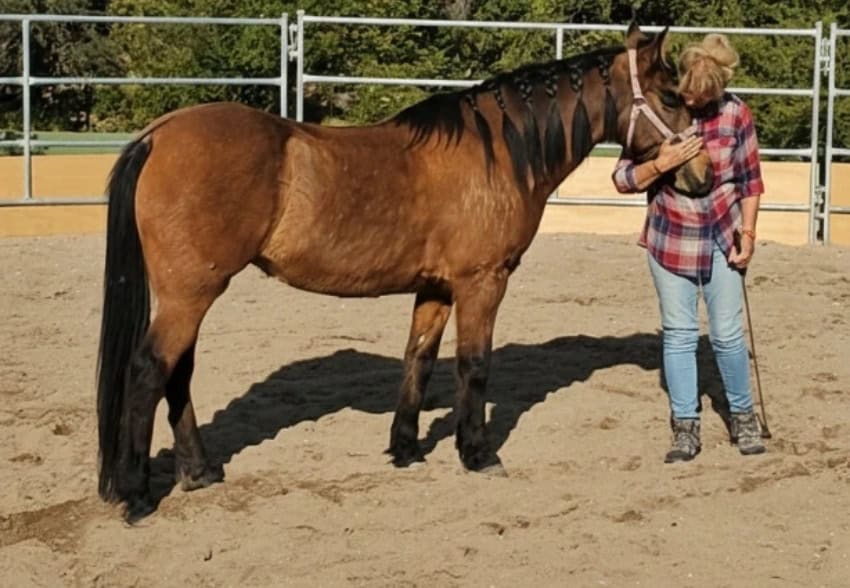
Not all horses at Rancho Baile de la Luna are as unpredictable as Morita, the Fire Horse. (Rancho Baile de la Luna)

The obstacles that presented themselves to us that day became part of the journey, leading us in the direction we were meant to go.

To be still

I thought back to the moment when Morita was running straight toward me, when I sensed the message to be still. I knew that moment was testing my courage and also reminding me that slowing down and being present helps us discover some of life’s most powerful lessons, including those brought on the back of a Fire Horse.

As I hugged these wonderful women before we went our separate ways, I could feel the energy of the Fire Horse still racing through my veins. Was it woo-woo? Inner wisdom? All I know is that the smiles and warmth and honesty we shared that day brought us all to a place of courage, integrity and abundance. I’m looking forward to what the new year brings.

For more information: The Spirit Horse Journey is an ongoing series of immersive equine wisdom experiences held throughout the year at Rancho Baile de La Luna near San Miguel de Allende. Each journey stands on its own while also weaving into the larger arc of the Year of the Fire Horse — a time of movement, courage, balance and inner truth. Reserve early — spaces are intentionally limited.

Peggy Sijswerda is a freelance writer who divides her time between San Miguel de Allende and the Netherlands. She writes about travel, food, culture and wellness, and is the author of “Still Life with Sierra,” a travel memoir. Find her on Substack at @peggysijswerda.