Mexico entered the week of May 4 already reeling from a bombshell: a U.S. federal indictment unsealed the previous week had charged 10 members of the ruling Morena party — including former Sinaloa Governor Rubén Rocha Moya — with drug trafficking and collusion with the Sinaloa Cartel.
By Monday, several officials — Rocha among them — had stepped down and President Sheinbaum was in damage-control mode. Also making headlines were a 5.6-magnitude earthquake in Oaxaca, and NASA-backed news that Mexico City is sinking at up to 10 inches per year due to the over-extraction of groundwater beneath its ancient lakebed. Adding insult to injury, the mayor of Madrid arrived for a tour of Mexico during which she took the opportunity to defend the Spanish Conquistador Hernán Cortés.
Didn’t have time to catch this week’s top stories? Here’s what happened in Mexico between May 4 and May 8.
Sinaloa crisis deepens: A new governor and more US pressure
The fallout from the U.S. indictment of 10 Mexican officials continued to dominate the political landscape this week. After Governor Rubén Rocha Moya took a voluntary leave of absence, the Sinaloa legislature appointed Yeraldine Bonilla Valverde as interim governor on May 2. Bonilla Valverde, a Rocha ally who had served as the state’s Secretary of Government, was sworn in amid ongoing questions about the depth of alleged cartel ties within Sinaloa’s political establishment. The mayor of Culiacán, also named in the same indictment, likewise stepped aside.
Sheinbaum addressed the case repeatedly throughout the week. At Monday’s mañanera, she reiterated that the superseding indictment is nearly devoid of hard evidence — characterizing a handwritten list purporting to show bribe payments as “a sheet of paper” — and reaffirmed that it is Mexico’s attorney general, not Washington, who will determine whether grounds for arrest exist. She denied having asked Rocha to step aside, saying the decision was his own. Mexico’s Foreign Affairs Ministry sent a diplomatic note to the U.S. Department of Justice requesting substantive proof to support the allegations.
Madrid mayor cuts visit short after reigniting Conquest debate
What was billed as a trade-promotion tour by Madrid Mayor Isabel Díaz Ayuso became one of the week’s defining political dramas. Díaz Ayuso arrived in Mexico on a planned 10-day trip promoting Madrid as “a unique platform” for Mexican trade with Spain — but it was her public defense of the Conquest that ignited a firestorm. The ultra-conservative Díaz Ayuso and President Claudia Sheinbaum are fiercely at odds: Díaz Ayuso has referred to Sheinbaum as “a far-left dictator,” while the Mexican president has called the Madrid leader someone “clinging to visions of empire.” The Sheinbaum administration appeared to ignore her visit altogether.
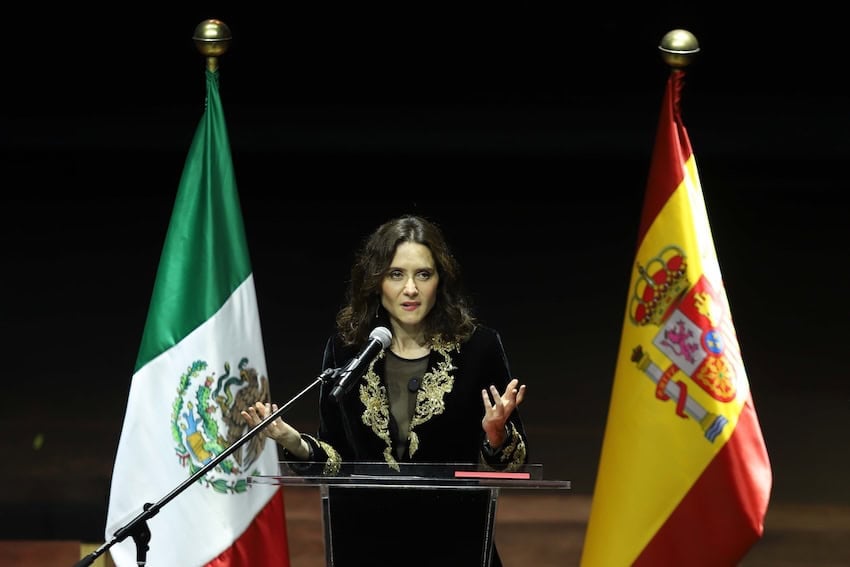
A tribute to Hernán Cortés was originally planned at Mexico City’s Metropolitan Cathedral, but the Archdiocese withdrew permission, going to great lengths to distance itself from any association with the event. It moved instead to Frontón México, the jai-alai venue where the conservative PAN party was founded in 1939. There, Díaz Ayuso praised the mestizaje that resulted from the Conquest. “Mestizaje is a message of hope and joy,” she said.

“Faced with hate speech that divides us, those of us who see life through these alliances must find ways to speak freely.” Indigenous groups organized protests throughout the week. According to the Spanish newspaper El País, Díaz Ayuso’s visit aimed to boost the conservative opposition in Mexico while consolidating political forces aligned with U.S. President Donald Trump. Her agenda included meetings with executives from Cemex and Alsea and reunions with all four PAN governors — a visit that was particularly sensitive given that the Sheinbaum administration was simultaneously managing U.S. accusations of drug trafficking against Morena officials, which Díaz Ayuso used to reinforce her claim that Mexico is “a narco-state.”
At Wednesday’s mañanera, Sheinbaum called Díaz Ayuso “one of the representatives of the far-right in Spain” and criticized Mexican opposition politicians for hosting her, naming the governor of Aguascalientes and the mayor of Mexico City’s Cuauhtémoc borough as examples. “What does that mean? That they think like her,” Sheinbaum said, attributing to Díaz Ayuso the view that welfare programs are wrong, that Cortés deserves recognition and that “the poor are poor because they don’t work.” The president said the Madrid mayor has the right to visit, “but it’s important to know what she says, who she meets with and who brought her.”
Díaz Ayuso cut her trip short on Friday, with her government accusing the Sheinbaum administration of orchestrating a “boycott” — claiming that Mexican federal authorities had threatened to close the hotel in Quintana Roo where the Platino Awards gala was to be held if Díaz Ayuso attended. The Sheinbaum government denied any such threats. Madrid’s opposition parties used her early return to attack her in Spain’s parliament, calling the trip “sectarian and fanatical,” while her People’s Party (PP) allies argued the objective had been to attract foreign investment.
More charges against Mexican politicians on the way, US AG warns
Acting U.S. Attorney General Todd Blanche gave an interview to NewsNation on Wednesday, saying more charges against Mexican politicians are coming, noting that cooperation from cartel figures already in U.S. custody — many transferred from Mexico over the past year — could yield additional allegations.
“We’ve already indicted multiple government officials out of Mexico — a judge recently as well. And so that’s something that will continue,” he said. He added, however, that the U.S. currently has “a very good relationship with the Mexican government.” Sheinbaum pushed back on the broader framing, demanding reciprocity from Washington on arms trafficking and extradition requests Mexico has filed.
Sheinbaum brushes off Trump’s cartel threats: Thursday’s mañanera recapped
Are US consulates encouraging migration? Mexico says no
A new front opened Friday when the Trump administration announced it is conducting a review of all 53 Mexican consulates in the United States, a move a State Department official said could lead to closures, without providing reasons. U.S. officials have privately suggested that some consular offices may be facilitating irregular migration — a charge Sheinbaum flatly denied at Friday’s press conference, saying Mexico’s consular network exists to protect the rights of Mexican nationals abroad, not to steer migration.
Mexico operates the most extensive consular network in the United States of any foreign government, and the review was widely seen as the latest instrument of pressure from Washington in an increasingly strained bilateral relationship.
Morena names new party president
Amid the turbulence in Sinaloa, Mexico’s ruling party Morena moved quickly to project internal unity. Former Welfare Minister Ariadna Montiel Reyes was elected as its new national president at an extraordinary congress in Mexico City on Sunday, May 3, with more than 1,800 delegates in attendance.
Montiel replaced Luisa María Alcalde, who stepped down to become the president’s top legal adviser. In her first speech, Montiel struck a zero-tolerance line on corruption, pledging that no candidate with proven wrongdoing would receive the party’s backing even if they won internal primaries — a pointed signal in the wake of the Sinaloa indictments. The congress was widely read as a bid to stabilize Morena’s image ahead of the 2027 midterm elections.
Education Ministry cuts school year short — then Sheinbaum backtracks
One of the week’s more surprising stories came from the Education Ministry.
Minister Mario Delgado announced Thursday that the national school calendar would end on June 5 rather than July 15 — a 40-day reduction — citing a nationwide heat wave and Mexico’s co-hosting of the 2026 FIFA World Cup. Some 32.6 million students would be affected.
Mexico’s National Union of Parent Associations called the decision “unacceptable,” arguing that education cannot be “sacrificed for a sporting event that will take place in only three of the country’s 2,500 municipalities.” By Friday, Sheinbaum appeared to distance herself from the announcement, telling reporters the proposal “was not yet final” and that children’s school days also had to be taken into account. The episode left parents and schools in limbo as the World Cup countdown continued.
Announced investments top US $20B
Despite the political noise, capital continued to flow toward Mexico this week on several fronts:
- Mexico Infrastructure Partners (MIP Real Assets) unveiled plans to invest more than $12 billion over five years across renewable energy, highways, digital infrastructure and midstream oil and gas projects, with Bloomberg reporting around $8 billion earmarked for clean energy alone.
- The government announced an $8.1 billion plan to build 12 new natural gas pipelines by 2030, with state utility CFE constructing nine and pipeline operator Cenagas building three, partly to fuel 13 new gas-fired power plants currently under construction.
- British neobank Revolut disclosed it has now invested $167 million in Mexico — all within less than half a year of launching full banking operations. The company reported 290,000 customers after just nine weeks of public availability, with total assets up 275% in Q1.
MND Peso Index™ makes its debut
Mexico News Daily launched a new data product this week: the MND Peso Index™, a monthly economic indicator that measures whether the Mexican peso is overvalued or undervalued against the U.S. dollar by comparing the prices of 20 goods and services in Mexico’s biggest cities and Dallas, Texas.
The MND Peso Index™: Is the Mexican peso over or undervalued against the US dollar?
The inaugural April 2026 edition found that the peso was modestly overvalued by roughly 3%, with a mean implied exchange rate of 17.85 pesos per dollar against the Banxico spot rate of 17.36 on the same date. Of the 20 items in the basket, half were cheaper in Mexico and half were more expensive — but the items that cost more in Mexico were expensive enough to tip the index into overvaluation territory. The index joins MND’s growing suite of proprietary data products and will be published monthly.
Good news roundup
🌊 President Sheinbaum and Quintana Roo Governor Mara Lezama inaugurated a new bridge in Cancún designed to ease traffic flow in one of the country’s most-visited tourist destinations.
🚗 Car sales in Mexico topped 500,000 units in the January-April period for the first time ever, a 4.8% increase over 2025, with April alone posting the best monthly result since 2013.
📉 Inflation eased to 4.45% in April, and Banxico cut its benchmark interest rate from 6.75% to 6.50% in a 3-2 vote, its second cut of 2026. Sheinbaum said the move “activates investment.”
🐢 Tamaulipas beaches recorded a significant Kemp’s ridley sea turtle nesting season, offering hope for one of the world’s rarest marine species, whose primary nesting grounds are on Mexico’s northwestern Gulf Coast.
🌳 Mexico signed a new pact aimed at restoring natural protected areas through 300 million tree plantings, part of a broader push to recover degraded ecosystems across the country.
Looking ahead
The school calendar saga is far from over. Education Minister Mario Delgado spent Friday insisting the June 5 end date was confirmed — even as Sheinbaum told reporters that nothing was final. By evening, he had announced a follow-up meeting with all 32 state education ministers for Monday, May 11, to produce a “definitive proposal.” The PRI has demanded his removal, Citizens’ Movement (MC) is pursuing legal injunctions and some private schools say they will not follow the shortened calendar regardless of what the federal government decides.
On the economic front, Mexico Infrastructure Partners’ $12 billion commitment was welcome news on the heels of the government’s Plan México investment-streamlining initiative, and more announcements are expected as the administration pushes its nearshoring agenda. The diplomatic picture is cloudier: with Todd Blanche warning of further indictments of Mexican officials, the U.S. consulate review still unresolved and trade negotiations ongoing, Sheinbaum faces a busy few weeks managing the bilateral relationship while keeping the domestic political house in order.
Mexico News Daily
This story contains summaries of original Mexico News Daily articles. The summaries were generated by Claude, then revised and fact-checked by a Mexico News Daily staff editor.