Home Blog Page 1153

Despite promise of transparency, prosecutors hide soldiers’ Ayotzinapa testimony

0
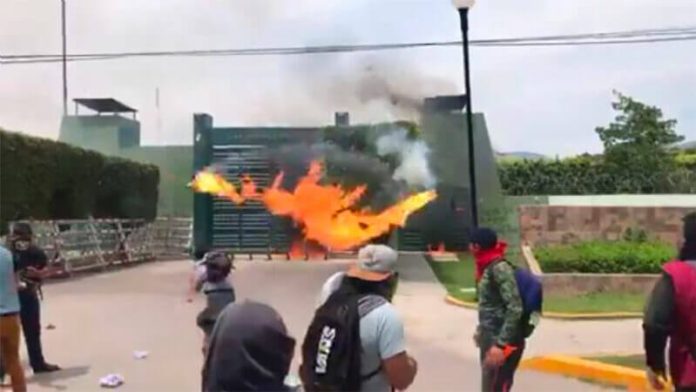
Ayotzinapa protesters attack a military barracks in Iguala, Guerrero, three years ago.

Despite a federal government pledge that there would be complete transparency in the new investigation into the 2014 disappearance of 43 students in Guerrero, the federal Attorney General’s Office (FGR) has heavily redacted a 239-page document containing testimony from soldiers.

The FGR was forced to release the document in order to comply with the federal transparency law but the version it disclosed is so heavily expurgated that it is illegible, according to the newspaper El Universal.

The document censors statements from soldiers who may have information about the whereabouts of the 43 students who disappeared in Iguala on September 26, 2014, or who may have even participated in the young men’s abduction and presumed murder.

The army has long been suspected of involvement in the students’ disappearance, and leaked (non-military) testimony obtained by the newspaper Reforma earlier this year supported that theory. According to a protected witness identified only as Juan, one group of students was taken to a military base in Guerrero and some of them were killed there.

El Universal, which has examined the redacted document, said that some pages contain only two words that haven’t been blacked out.

A page of soldiers' testimony in the Ayotzinapa case
A page of soldiers’ testimony in the Ayotzinapa case is well redacted.

“… On other pages complete paragraphs can be seen [but] they don’t contain substantive information that helps to know the facts of September 26 and 27, 2014,” the newspaper said.

When he took office in late 2018, President López Obrador committed to finding out what happened to the 43 students without protecting anyone. Forty-four soldiers were consequently summoned by a special unit of the FGR that was tasked with conducting a new investigation into the case. Thirty have provided testimony so far, but what they told prosecutors is a mystery due to the FGR’s redaction of their statements.

The FGR’s position contrasts with that of its predecessor, known as the PGR, which did provide public access to its files without redacting them first after being ordered to do so by the National Transparency Institute.

However, the previous government’s official version of events – the so-called “historical” truth – has been rejected by the López Obrador administration. It was concocted by federal officials and corroborated by suspects who were tortured, according to the FGR’s Special Investigation and Litigation Unit for the Ayotzinapa case.

El Universal said it was the first media outlet to gain access to the previous government’s declassified documents, which helped to identify flaws in the historical truth proffered by the 2012-18 government led by former president Enrique Peña Nieto.

“Unlike then, the current FGR is not prepared to reveal the declarations of the soldiers who might have participated in the disappearance of the 43 Ayotzinapa students,” the newspaper said.
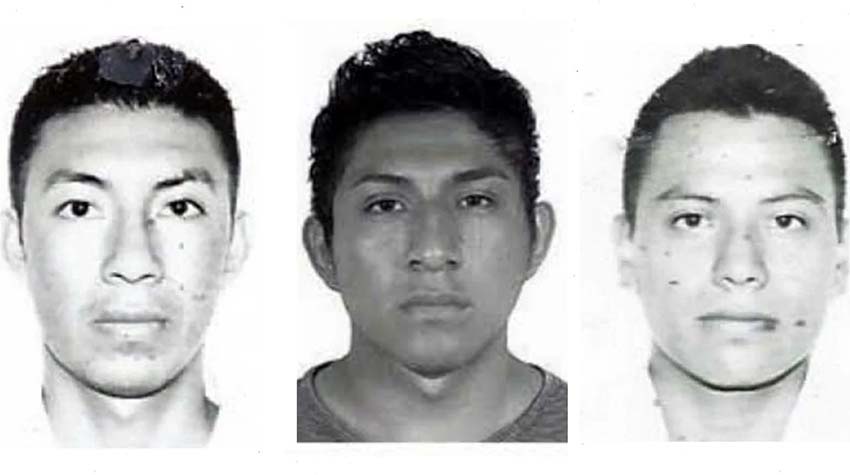
The only three of the missing 43 students whose remains have been identified
The only three of the missing 43 students whose remains have been identified are, from left, Jhosivani Guerrero, Alexander Mora and Christian Rodríguez.

Estafanía Medina, co-director of anti-impunity organization Tojil, said the FGR is seeking to avoid having its work subjected to the scrutiny of citizens.

“There’s no interest in revealing these [evidence-collecting] processes,” she told El Universal.

Medina described the FGR’s decision as a backward step in Mexico’s system of transparency and access to justice.

Santiago Aguirre, director of the Prodh human rights center, said that whether the FGR has an obligation to provide public versions of documents related to ongoing investigations that haven’t been redacted is debatable. However, in a case in which there have been grave violations of human rights authorities should avoid blacking out text to such an extent that witness declarations become unintelligible, he said.

Aguirre said the FGR is failing to fulfill its commitment to shed light on what happened on September 26 and 27, 2014. A new investigation was launched shortly after López Obrador took office but almost three years later the government has not divulged its own definitive version of events.

“The progress has been very poor,” said Aguirre, whose organization has provided assistance to the students’ families over the past seven years.

He also said that the army – which López Obrador has depended on for a wide range of tasks during his government – has not shown that it is truly willing to cooperate in the investigation into what happened to the 43 students, the remains of whom just three have been found.

With reports from El Universal 

Amazon distribution center in Tijuana sits in sharp contrast to its surroundings

0
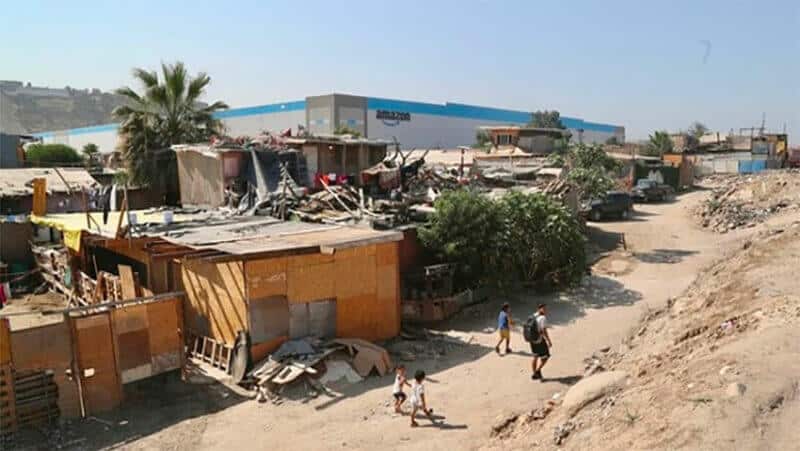
Amazon's new fulfillment center in Tijuana.

Next to a Tijuana shantytown surrounded by a creek where human remains have been known to float by, e-commerce behemoth Amazon has opened a new distribution center.

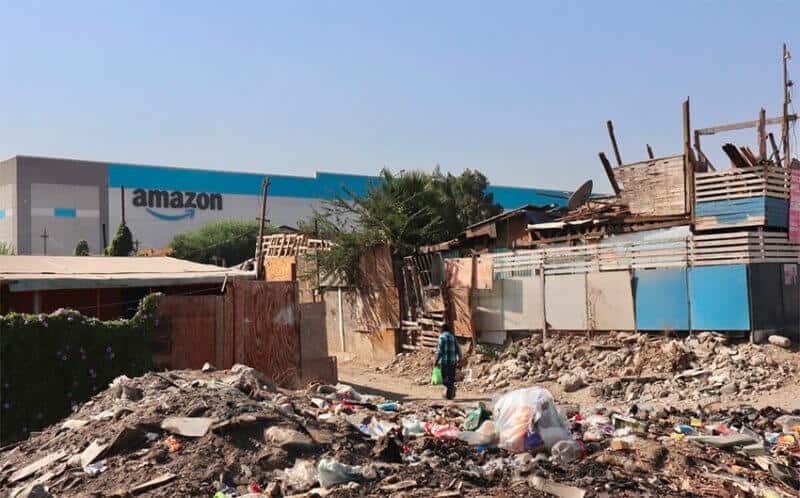
The 32,000-square-meter facility is adjacent to Nueva Esperanza, a neighborhood in Tijuana’s east side where most homes are built with cardboard, wood scraps, sheet metal and tarps. Inhabited mostly by migrants who moved to Tijuana from other parts of Mexico, the informal settlement is a 20-minute drive from the border with the United States.

Photos of Amazon’s new fulfillment center, which will employ 250 people, went viral earlier this month due to the stark contrast between the gleaming facility and the poverty-stricken, trash-strewn neighborhood that is plagued by high levels of crime.

“Pure and hard inequality,” one Twitter user wrote in response to a photograph posted to the social media site by photographer Omar Martínez.

“What is striking is the contrast of realities that can be seen in the photos, but this is nothing new,” said Melina Amao, a doctor in cultural studies and professor at the Autonomous University of Baja California.

The Tijuana shantytown and the new Amazon facility.

Pedro Aranda, a longtime resident of Nueva Esperanza who keeps pigs in a pen that abuts the Amazon facility’s perimeter wall, told the newspaper Milenio that construction workers worked around the clock for a year to prepare the site and build the new center.

He and other residents are concerned they could be evicted from their homes due to the arrival of the United States-based multinational, although no authority has indicated that is about to occur.

“We are here because we need a place to live,” María Mendoza, another long-term resident, told The San Diego Union-Tribune. “We just don’t want this to work against us,” she added.

Gabriel Camarena, secretary of economic development in the Tijuana municipal government, predicted that residents’ living conditions will improve as a result of the construction and opening of the Amazon warehouse.

“Either there is complete transformation, or they will be offered other and more dignified living options,” he said.

It is unclear whether Amazon, owned by the world’s richest person – Jeff Bezos, will provide any resources for the improvement of Nueva Esperanza, whose name translates into English as New Hope.

Nueva Esperanza is the colonia adjacent to Amazon's center
Nueva Esperanza is the colonia adjacent to Amazon’s center. In English it means “new hope.”

Álvaro Gómez, a Chiapas native who lives in a gloomy windowless dwelling with his wife, called on Tijuana authorities to regularize the neighborhood.

“We want water and electricity, but we’d be more grateful … if they helped us with crime. … The police never come here,” he said. “We’re aware that we live in an irregular settlement but half of us pay property tax,” Gómez said.

While residents are concerned about their future, authorities and business groups have welcomed Amazon’s investment in Tijuana. About US $21 million was invested to build the new distribution center, according to city officials.

“The arrival of Amazon in Tijuana contributes to the ongoing economic recovery in various productive sectors, achieving stability in employment,” the municipal government said in a press release.

“It is always positive that first-world companies continue to set up in our city,” said Francisco Rubio, president of the Tijuana chapter of the Business Coordinating Council, an umbrella organization that represents 12 business groups.

Diego Mendez, general director of operations at Amazon México, said in a June press release that “at Amazon México, we feel great responsibility towards the communities where we operate, and we are pleased to be able to offer hundreds of job opportunities in Tijuana.”

However, whether any Nueva Esperanza residents – some of whom had no idea what Amazon was before its arrival on their doorstep – are able to find work at the facility remains to be seen.

Arlene Herrera, spokeswoman for Amazon México, said the new distribution center will only serve the Mexican market, offering same-day deliveries in Tijuana and next-day deliveries to other cities in Baja California such as Mexicali and Tecate.

Several other companies have large facilities in the area officially called the Real Estate Management and Services Industrial Park but Amazon’s new distribution center is the only one that directly adjoins Nueva Esperanza.

With reports from Milenio and The San Diego Union-Tribune 

Capitalinos celebrate 200 years of Mexico’s independence

0
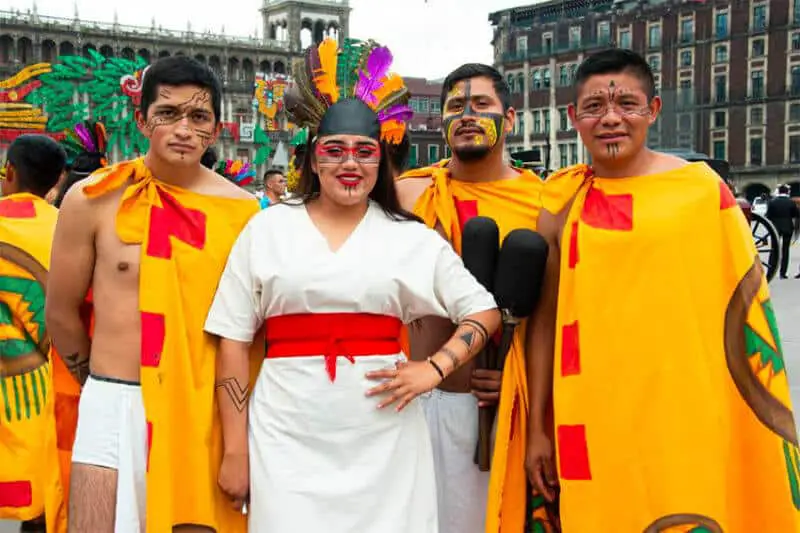
Images are projected on to the walls of the National Palace
Images are projected on to the walls of the National Palace Monday evening.

Fireworks, theater, the pope and U.S. President Joe Biden all formed parts of celebration of 200 years of independence in Mexico City Monday.

The capital’s central square was taken over for the ceremonies, the same location where the rebel army had marched two centuries earlier before declaring independence the following day. In fact, the best known date for Mexico’s liberation from Spain is September 15, day of “El Grito,” which marks the beginning of the struggle 11 years earlier, but the ceremony to mark the 200th anniversary was larger in scale this year.

Pope Francis sent a message marking the occasion, urging the importance “to recognize the very painful errors committed in the past.” President López Obrador had sent a letter to the pope and the Spanish royal family in 2019 asking for an apology for the wrongs of the conquest. The pope’s contrite message partially responds to the president’s appeal, which was rejected outright by Spain.

The president called Pope Francis a “true Christian, a defender of the poor … who with profound humility recognizes the errors of the past.”

A message from U.S. President Joe Biden was projected after he declined an invitation to attend the event. He said the United States had “no closer friend than Mexico.”

The independence movement was depicted in seven stages, from the pre-Hispanic to the signing of the Independence Act.

“From the earliest days of our nations, the people of Mexico and the United States have shared a strong bond, united by our shared values, and our shared aspirations … throughout our history, we’ve learned that we’re stronger when we come together as neighbors, partners and friends,” he added.

The evening culminated in a more than hour long large scale theatrical piece involving many dozens of soldiers, dancers and actors, telling the story of the independence movement in seven stages.

The first stage depicted the pre-Hispanic period until Spain established political control. The second showed “El Grito” when Miguel Hidalgo, a priest from Guanajuato, inspired a revolt. The third stage portrayed José María Morelos writing his essay “Sentiments of the Nation.”

The fourth represented the Plan of Iguala, a proclamation for Mexico to become a constitutional monarchy with Catholicism as the sole religion. The fifth showed the Treaty of Córdoba in which Spain effectively accepted independence, followed by the entrance of the rebel army into the zócalo. The final scene was the signing of the Independence Act on September 28, 1821.

The celebration concluded with a fireworks display.

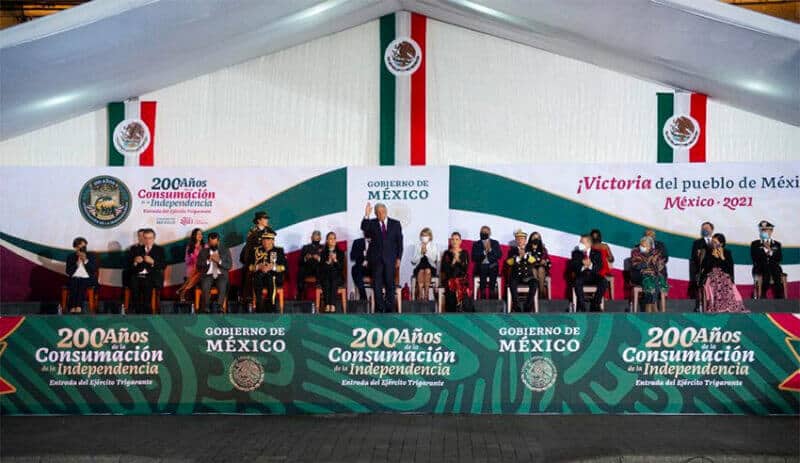
President López Obrador presides over Monday's event in the zócalo.
President López Obrador presides over Monday’s event in the zócalo.

With reports from Reforma, AP News and Milenio

Clinical trials show promise for chikungunya vaccine

0
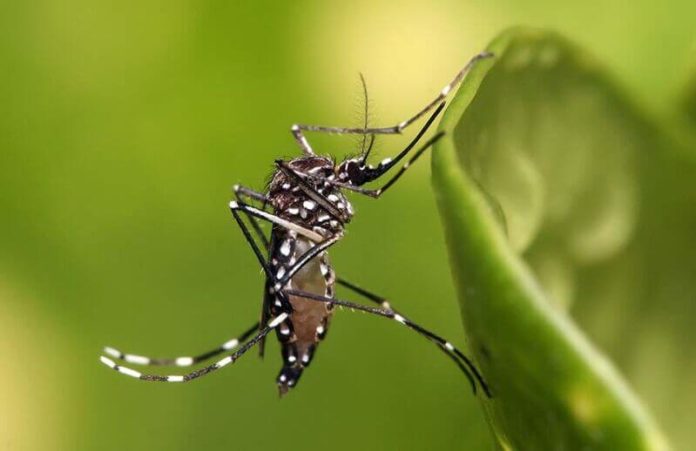
Aedes egypti
Aedes aegypti, one of the mosquitoes that can carry the chikungunya virus. Wikimedia Commons

A vaccine to combat chikungunya fever, a viral infection transmitted by mosquitoes, has been successfully trialed on humans.

The ChAdOx1 Chik vaccine, developed by the National Polytechnic Institute (IPN) in collaboration with Oxford University and the University of Texas, is only the fourth potential defense to be tested on humans since the fever was first isolated and identified almost 70 years ago. Previous attempts to create a vaccine were unsuccessful.

Chikungunya fever, like zika and dengue, is a disease transmitted by mosquitoes and circulates widely in hot and humid areas of Mexico and Central and South America, and in other parts of the developing world. It carries a risk of death of about 0.1% but can leave people with permanent arthritis.

The vaccine injection was given to 24 healthy volunteers between the ages of 18 and 50, a common range for phase I clinical trials. The results indicated that 100% of the volunteers who received the vaccine developed antibodies against chikungunya regardless of the dose, which means that even very low doses could afford high levels of protection. Broadly neutralizing antibodies against four lineages of the virus were found in all participants and as early as two weeks after vaccination, according to the scientists’ report of their findings in the journal Nature.

The volunteers’ defense against the virus remained high for the whole six-month duration of the trial.

Dr. Arturo Reyes Sandoval
Dr. Arturo Reyes Sandoval of the National Polytechnic Institute.

Dr. Arturo Reyes Sandoval of the IPN said the vaccine was developed on a similar foundation as the Oxford-AstraZeneca vaccine for COVID-19, using the same respiratory virus as its base.

He added that researchers applied genetic engineering to the respiratory virus so that it can express five proteins — rather than one — and thus generate immune responses against much of the virus that causes chikungunya fever.

Chikungunya was first described in 1955, following an outbreak in 1952 in east Africa. The name comes from the Tanzanian Kimakonde language and means “to become contorted.”

Mexico News Daily

Blamed for ‘invasion of violence’ in Chiapas community, migrants told they’re not welcome

0
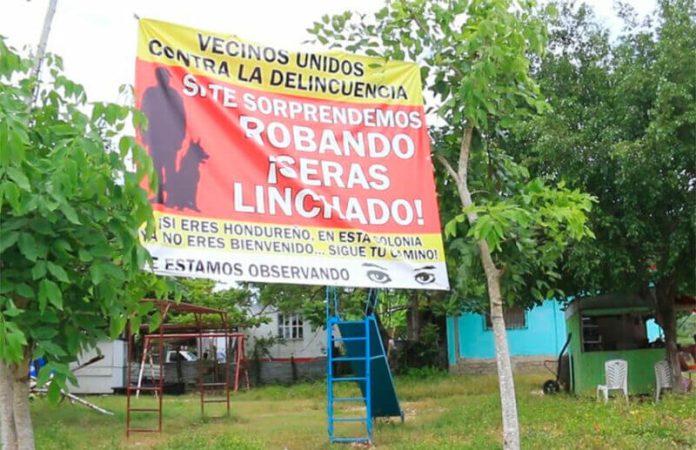
'If we catch you stealing you will be lynched!' warns a sign
'If we catch you stealing you will be lynched!' warns a sign in Pakalna, Chiapas.

Residents of a small town in Chiapas are sending a clear and hostile message to Honduran migrants, whom they accuse of crimes such as rape, robbery and drug trafficking.

“If we catch you stealing you will be lynched! If you’re Honduran you’re no longer welcome in this neighborhood … continue on your way! We’re watching you,” read banners hung by a citizens’ group at various points in Pakalna, a community about five kilometers from Palenque.

According to a local government official people are fed up because Pakalna has been “invaded by violence.”

Leopoldo Contreras told the newspaper Milenio that federal authorities are aware of residents’ concern about the situation in Pakalna but have refused to relocate a shelter that attracts migrants to the town.

However, due to the residents’ threats toward migrants and its own personnel, the Jtactic Samuel Ruiz García shelter recently decided to close its doors. Contreras said residents want the closure to be permanent.

“… We don’t despise [migrants]; on the contrary we’ve helped them with work and food [but] we want [the shelter] to be closed and [the migrants] removed,” he said.

It’s not the first time that residents of Pakalna have shown hostility toward migrants. In March 2020, residents attacked and expelled some 130 Central Americans who had been staying in a local auditorium. They too were accused of committing crimes in the town, including robberies and assaults on women.

With the town’s shelter currently closed, exhausted migrants – who likely entered Mexico via the border with Guatemala in Tabasco – are sleeping on the streets, Milenio said. “Many commit crimes due to hunger and a lack of work,” the newspaper said.

However, one Honduran migrant who said he walked through jungle for four days to reach Pakalna said he just wanted to rest.

“One comes with the hope of resting for at least one day or a few days but we arrived to see the migrants’ shelter closed,” said Javier, who was forced to bunk down outside.“It was a critical situation for us last night because it rained,” he said.

Barefooted and wearing wet clothes after sleeping on a park bench, another Honduran said it was a shame that the shelter is closed. Luis said that a small number of migrants who have committed crimes in the town have given all migrants a bad name.

[wpgmza id=”349″]

“In the vineyard of the Lord …  there are good people and bad people. Unfortunately those who come with the intention of doing damage ruin the path for those of us who come in peace and with the hope of finding a better course for our lives,” he said.

The director of the Jtactic shelter claimed that “some political leaders,” whom he didn’t name, are behind the threats toward migrants.

“There was a very belligerent group that ordered … people to go to the shelter with sticks and machetes as if we were criminals. I just want to say that [the threats and aggression] are documented before the National Human Rights Commission [CNDH] and also in a preliminary [criminal] investigation,” said Alberto Gómez, who is also a priest.

Fearful of more threats and the possibility that the shelter could be attacked, the Chiapas bishops’ association called on the federal government to provide a security guarantee so that the casa del caminante (wayfarer’s house), as the shelter is officially called, can reopen.

“We’re convinced that joining forces to attend to migrants as best we can with clear and concrete policies and actions that respect their dignity is urgent,” the association said in a missive directed to the federal government and the CNDH.

It said it has evidence of “campaigns of hate and xenophobic intolerance” that were carried out in Pakalna and forced the shelter’s closure.

Gómez rejected Contreras’ call for the shelter to shut permanently, asserting that not only should it reopen but a second facility should be built.

“We need a second shelter because [the Jtactic shelter] is unable to welcome a lot of people. Migration flows will keep growing and it’s not true that the flow will end with the removal of the shelter,” he said.

Record numbers of migrants have arrived in Mexico this year, including large numbers of Hondurans and Haitians. Many have been detained in the country’s south but thousands have reached northern border cities such as Tijuana, Reynosa and Ciudad Acuña.

With reports from Milenio

AMLO orders creation of special team to recover stolen archaeological pieces

0
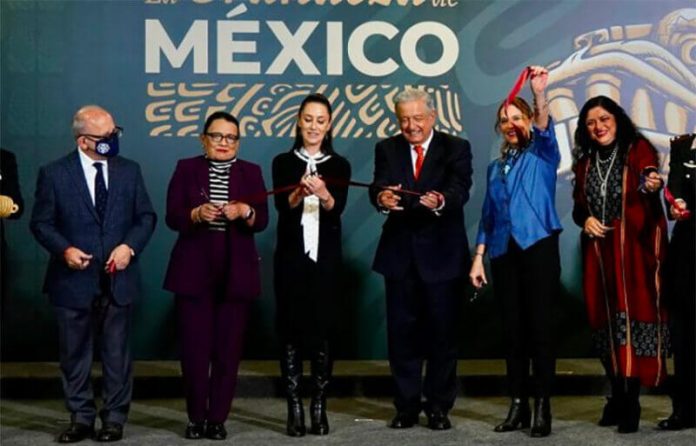
Grandeur of Mexico exhibition
The president and other officials inaugurate the Grandeur of Mexico exhibition on Monday.

President López Obrador announced the creation of a special team dedicated to recovering stolen archaeological artifacts and historic documents at his morning news conference Monday. He said the order had been made to the National Guard, the security body he established in 2019.

López Obrador said inspiration for the idea had come from Italy, which had recovered and sent artifacts to Mexico for the Grandeur of Mexico exhibition. “What an example: Italy has a special body of carabinieri to recover stolen archaeological pieces. Imagine if all countries had the same organization dedicated to the recovery of stolen pieces that belong to the cultural and artistic heritage of the different countries of the world … We are going to follow the example of Italy, I have given the instruction for the National Guard to constitute a special team for the purpose,” he said.

Later in the conference, the head of the Italian carabinieri department which recovers artifacts, Brigadier General Roberto Riccardi, was decorated with the Mexican Order of the Aztec Eagle, the highest order that can be awarded to a foreigner.

Foreign Minister Marcelo Ebrard explained the recognition. “Brigadier General Roberto Riccardi has exercised a very active leadership in support of the safeguarding and return of heritage pieces illicitly stolen from our nation. An example of this is the recent recovery of 17 archaeological pieces that were intended to be auctioned in Italy …. and the restitution of 74 archaeological pieces … since 2013,” he said.

Riccardi took the opportunity to argue for the cultural value of historic artifacts. “We believe in what we do, deeply. Every time we recover an artifact of historical or artistic value, it is a piece of identity, of collective memory … I wish Mexico a brighter future, if possible, than its glorious past,” he said.

The president also showed his appreciation to the governments of the United States, France and the Vatican for lending and returning artifacts to Mexico. “The French government was the government that lent us the most pieces for the exhibition. A special thanks to the Vatican, to Pope Francis, who gave us documents and works, which had never happened in history,” he said.

The governments of Netherlands, Germany and Sweden were also accredited by the president.

The Grandeur of Mexico exhibition will display 1,525 pieces for five months in Mexico City at the National Museum of Anthropology and at the Education Ministry’s headquarters.

In the National Museum of Anthropology the pieces are displayed by theme, and divided into territory, spirituality, the person, symbolism and the paths to freedom. The SEP exhibition presents pieces along geographical lines: the southeast and the Mayan region, the highlands region and northern Mexico.

With reports from Milenio

Mexico’s ‘Bat Man’ adds PBS documentary to his list of achievements

0
Rodrigo Medellin
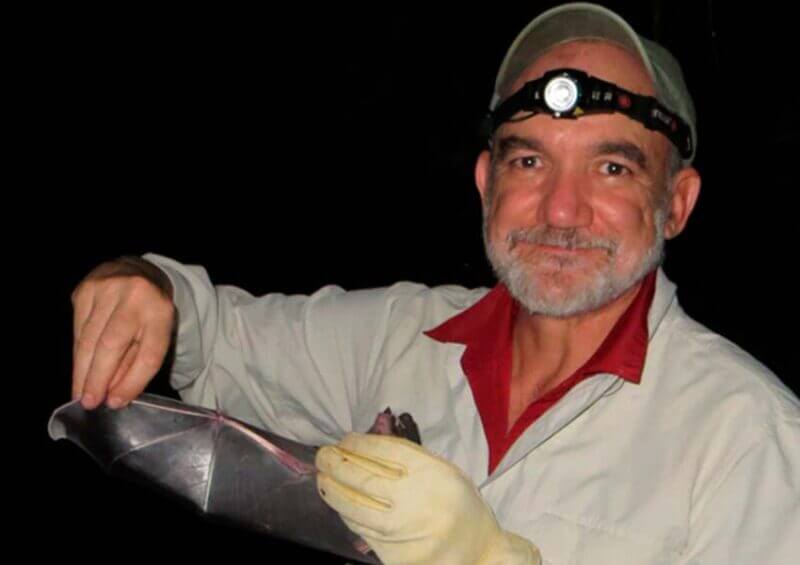
UNAM researcher Rodrigo Medellín, a world-renowned expert on bats, is the subject of a PBS Nature documentary about him, "The Bat Man of Mexico."

Although it weighs less than an ounce, the lesser long-nosed bat has a big impact in Mexico: it pollinates the agave plant that humans use to make tequila, earning it the nickname of the “tequila bat.”

For decades, UNAM ecologist Rodrigo Medellín has been working to preserve this tiny but vital species. Now his efforts are being recognized in an episode of the PBS series Nature.

“The Bat Man of Mexico” is narrated by celebrated British natural historian Sir David Attenborough and produced by the British Broadcasting Corporation. It follows Medellín’s determined campaign to save the lesser long-nosed bat, in part by raising awareness of its importance to the tequila industry.

“The lesser long-nosed bat and the agave have an intimate connection,” Medellín said in a phone interview. “One depends on the other for their survival and sexual reproduction.”

As he explains, an agave plant reproduces just once in its life, via a flower created by sugar that has accumulated in the plant. Bats feed on nectar from the flower. In doing so, they help agave plants exchange genes with each other.

lesser long-nosed bat
“The lesser long-nosed bat and the agave have an intimate connection,” says Medellín. “One depends on the other for their survival and sexual reproduction.”

However, all of this was jeopardized toward the end of the 20th century by declining bat populations. In the 1990s, the bat was placed on the endangered species list in both Mexico and the United States and was at risk of going extinct.

“Since then,” Medellín said, “I started working on a recovery plan — what needed to happen for the species to recover.”

Over the past two decades, in the 13 largest-known colonies of the bats in Mexico, “all of the roosts have become stable or are growing,” Medellín said. “There’s evidence of growing new colonies we had not known about.”

In the documentary, he tracks the bats’ numbers by following their three-million-strong migration across Mexico, from the caves of Calakmul in the south to the Sonoran Desert to the north. Along the way, he braves a hurricane, snakes and swarming cockroaches. The documentary shows the bats on the move — in what it calls “a living tornado” that is meant to discourage predators — as well as groundbreaking footage of a live birth.

“These bats are the sweetest bats you could possibly think of,” Medellín said. However, he noted, “Like any wild animal that you hunt, a lizard or a snake or a rat … they will try to bite you if they want to defend [themselves] or perceive you as a predator.”

A fascination with bats dates back to his childhood. As shown in the documentary, the young Medellín began an up-close study of a species known for its bite, the vampire bat. Since becoming a scientist, he’s done conservation work with many other animals, including jaguars, bears and bighorn sheep.

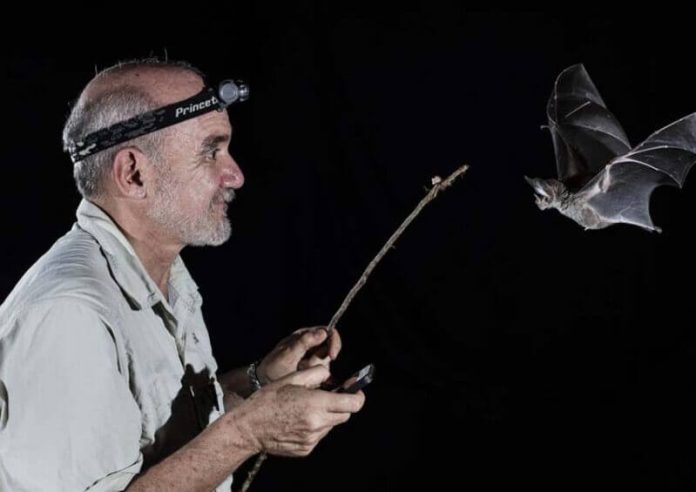
Rodrigo Medellin
Medellín doing what he loves.

His efforts with the lesser long-nosed bat earned worldwide recognition with the Whitley Gold Award in 2012. The award is presented annually by the British-based Whitley Fund for Nature. Medellín remembers the ceremony, when he received the prize from England’s Princess Anne and got to meet Attenborough, who did narrations for videos about the honorees.

“It was one-on-one, David Attenborough and myself,” recalled Medellín, who compared himself to a Justin Bieber fan upon meeting his longtime hero and role model. “We talked about everything — about life, bats, Mexico, everything.”

Medellín’s enthusiasm for the bats resonated with Attenborough, who not only pledged to do whatever he could to make a documentary about Medellín but made good on his promise a day later: five members of the BBC approached Medellín at a reception at the House of Lords to say that a documentary filmmaking crew had been assigned to him.

In 2013, the crew came to Mexico for three to four months of filming.

“I have nothing more than praise for the work of the BBC,” Medellín said. “They were extremely respectful of the bats, myself and the environment.”

Attenborough gave the species its memorable nickname of the “tequila bat.” The crew filmed it inside the caves of Calakmul, using infrared light so the bats would not see any light around.

Rodrigo Medellin and David Attenborough
Rodrigo Medellin, left, meeting David Attenborough at the Whitley Fund for Nature’s award ceremony, at which Medellin won the Whitley Gold Award.

The use of light came into play in a different way when Medellín was having a hard time tracking the bats. He came up with an unorthodox solution. Upon catching some bats, he would sprinkle them with UV dust. They would lick it and ingest it, and it would make their glowing guano easy to spot. According to the program, the dust is harmless to the bats.

A moving moment in the documentary shows the successful realization of Medellín’s goal: the lesser long-nosed bat was taken off the endangered species list in Mexico in 2013, then delisted in the U.S. four years later.

As Medellín has tracked the bats across Mexico, he has sought to raise awareness about their importance. In the past, he said, people wrongly associated them with vampire bats and attacked the caves where they reproduced.

“Out of fun, they would throw rocks at bats, dynamite them, gas them, trying to get rid of vampire bats,” he said.

He does advocacy work with local communities — including landowners near the 13 principal caves where the bats breed, as well as elementary schoolchildren in these areas. Medellín praises the role of women in the community as well for imparting his message to their families and neighbors: “It’s an incredible opportunity for me to understand socially how information travels within a society,” he said.

He’s also urging the tequila industry to counter a trend of what he describes as cloning agave shoots to maximize alcohol production, instead of relying on bats for pollination. He questions whether cloned plants would “adapt to the conditions of climate change, agricultural pests, any other situation.”

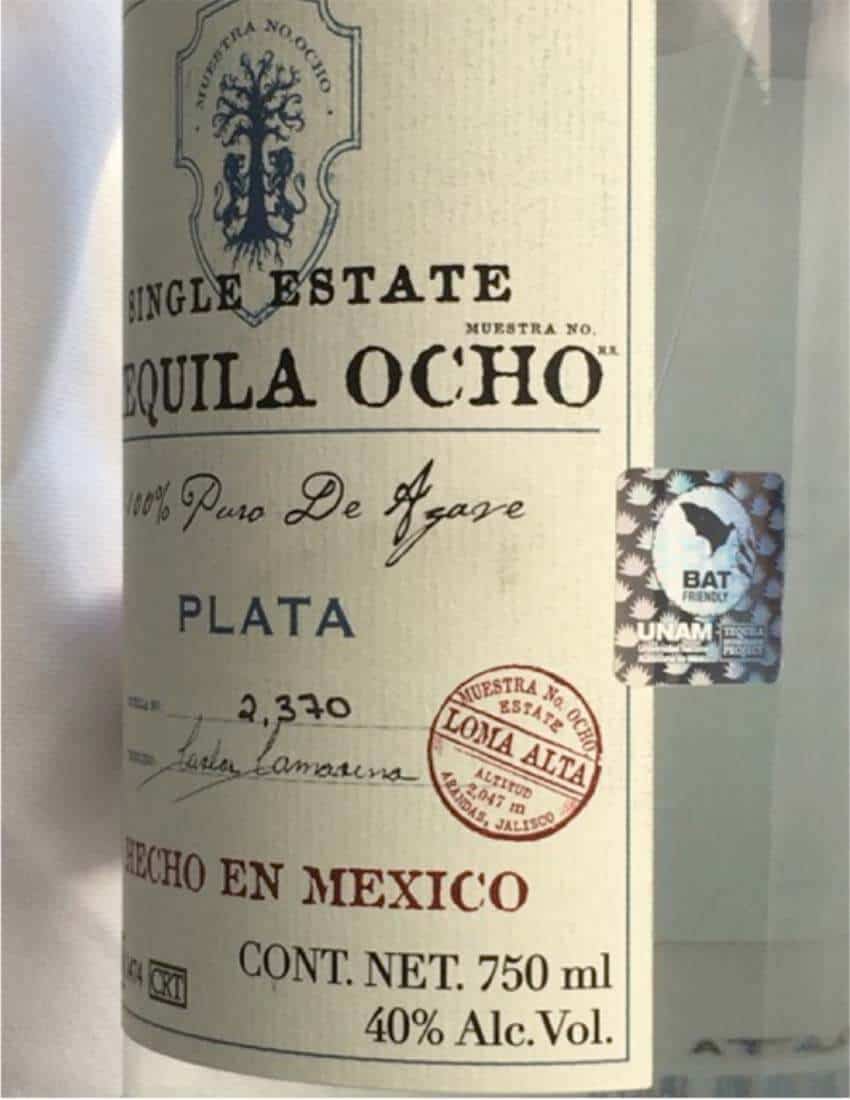
Tequila Ocho brand tequila with bat friendly label
in 2013, Medellín convinced some of Mexico’s most prominent tequila makers to allow 5% of their agave plants to flower. In return, the resulting tequila was allowed to bear a UNAM ‘bat friendly” label.

In 2013, Medellín joined forces with some of the most prominent members of the tequila industry [to] “basically convince [them] that they should allow 5% of their plants to flower,” with the resulting tequila being labeled as bat-friendly, he said.

In Mexico, he said, bats have avoided a more recent threat — stigmatization due to the COVID-19 pandemic.

“When this news [of COVID-19] started to come out in February and March of 2020, in many countries in the world there was a war on bats,” Medellin said. “It didn’t happen in Mexico. There was not a single instance of people killing bats because of fear of the coronavirus … People in Mexico already know bats are our friends.”

According to Medellín, there is “no evidence whatsoever that bats gave us COVID.”

And in general, he said, bats “do nothing — nothing — to deserve the bad reputation they have.”

The documentary shows him doing all he can to defend the reputation of the lesser long-nosed bat.

Rodrigo Medellin
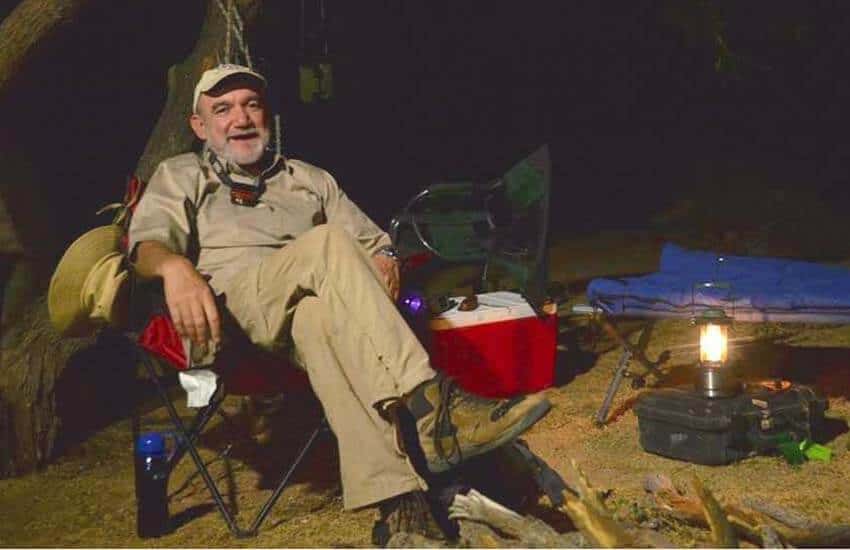
Medellín on the Pinacate Biosphere Reserve in the Sonoran Desert during filming.

“The people [living] behind all the caves nearby, the community living nearby, they never knew that [for] pulque, agave, tequila, these [bats] are the heroes,” he said. “I would give them pictures, evidence, proof. They immediately became bat allies.”

• “The Bat Man of Mexico” episode of Nature is available to view on the PBS website

Rich Tenorio is a frequent contributor to Mexico News Daily.

Active COVID-19 cases decline 13% to 58,000

0
covid-19

The federal Health Ministry reported 3,007 new cases and 226 additional COVID-19 deaths on Monday, lifting Mexico’s accumulated tallies to 3.63 million and 275,676, respectively.

There are 58,311 estimated active cases, a 13% decline compared to Friday. On a per capita basis, Tabasco has the highest number of active cases with just over 160 per 100,000 people. Colima ranks second with a rate just over 140 followed by Mexico City, where there are about 120 active cases per 100,000 people. No other state has a rate above 100.

The pandemic has been on the wane in Mexico for several weeks after a large delta-driven third wave peaked in August.

Almost 99.2 million vaccine doses have been administered in Mexico, according to the most recent data. The Health Ministry said Sunday that 71% of the adult population has had at least one shot.

Nine in 10 adults in Mexico City and Querétaro have been vaccinated while 18 states have vaccination rates above the national average.

The 12 states with rates below the 71% average are Campeche, Chiapas, Guanajuato, Guerrero, Jalisco, México state, Michoacán, Oaxaca, Puebla, Tabasco, Tlaxcala and Veracruz.

There are currently 7,630 hospitalized COVID-19 patients, according to federal data, and 114 hospitals have capacity levels of 70% or higher in their general care COVID wards.

At 52%, Puebla has the highest occupancy rate for general care hospital beds followed by Nuevo León and Michoacán with rates of 49% and 47%, respectively. Morelos ranks first for beds with ventilators with 48% taken followed by Aguascalientes and Tabasco with rates of 44% and 41%, respectively.

Deputy Health Minister Hugo López-Gatell said recently that more than 95% of hospitalized COVID patients haven’t been vaccinated.

Mexico News Daily 

2-billion-peso aqueduct will deliver arsenic-free water to Yaqui communities

0
The president meets with Yaqui representatives last August in Sonora.

The federal government will build a 2.16-billion-peso (US $107.7 million) aqueduct to supply uncontaminated water to 50 Yaqui communities in Sonora.

According to a National Water Commission (Conagua) planning document seen by the newspaper Milenio, the government will commence construction in January 2022 and complete the project two years later.

Almost 812 million pesos will be spent on construction of the aqueduct itself, while the remainder of the money will go to the construction of two pumping stations, a water-treatment plant and other complementary infrastructure.

The objective is to deliver water that is free of arsenic, lead, magnesium, sodium and other contaminants to approximately 40,000 residents of Yaqui communities in the municipalities of Guaymas, Empalme, Cajeme, Bácum and San Ignacio Río Muerto.

During a visit to Guaymas just over a year ago, President López Obrador pledged to deliver reliable water services to Yaqui communities whose residents have protested to demand that the government compensate them for ceding land for a range of infrastructure projects and fulfill social development commitments. Milenio suggested that he will formally announce the aqueduct project during another visit to Yaqui communities on Tuesday.

Studies show that water currently supplied to Yaqui towns is contaminated by high levels of arsenic, which is believed to cause diabetes and increases the risk of developing certain types of cancer. Diabetes is the most common chronic disease across the 50 Yaqui communities the aqueduct will serve, according to the University of Sonora.

Just over 18% of residents suffer from diabetes, one study shows, whereas the prevalence is below 1% in nearby Tepehuán communities.

The Conagua planning document says the main benefit of the aqueduct project will be the reduction of illnesses among residents. It also notes that access to clean water in sufficient quantities is a human right.

More than 6,000 residents across 24 Yaqui communities in Sonora currently don’t have access to piped water, according to Conagua, a situation that forces them to obtain it from alternative sources.

With reports from Milenio

After a perilous journey north, Haitian migrants face uncertain future

0
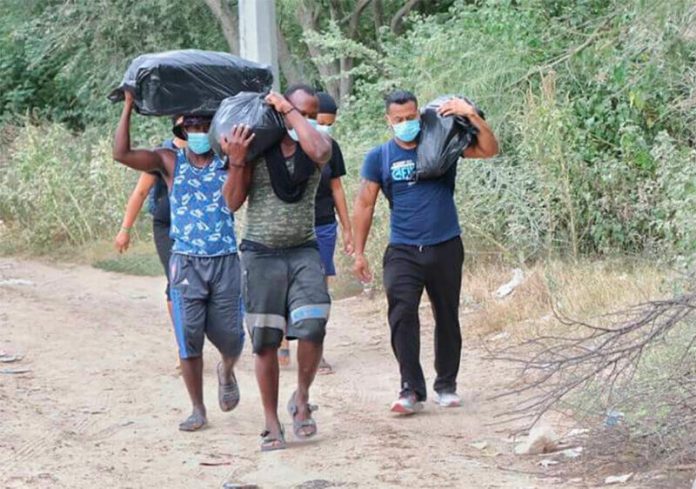
Haitian migrants on the road.

Thousands of Haitian migrants have endured hellish journeys from South America to reach Mexico and the U.S., only to face possible deportation, lack of access to visas and an uncertain future.

More than 14,000 migrants, many from Haiti, ended up the camp at Del Rio, Texas, regularly crossing back into Mexico to buy food. Pictures of U.S. border patrol agents on horseback confronting migrants prompted outrage, including U.S. President Joe Biden, who called them “horrible” and “beyond embarrassing.”

The sudden focus on a long-simmering crisis has turned into a political crisis for the Biden administration, which has come under fire both from Democrats, who have denounced harsh treatment of the migrants, and Republicans who say White House policies have encouraged people to make the difficult journey.

A debate within the administration over how to address the crisis spilled out into the open last week, as Daniel Foote, the U.S. special envoy to Haiti, resigned over what he described as “inhumane” treatment of Haitians. That drew a public rebuke from the state department, which said Foote had mischaracterized the circumstances of his resignation.

As more migrants turn up at the southern U.S. border, activists say it has become harder to claim asylum. Rules introduced during the pandemic allow agents to immediately return those who cross the border. The U.S. government said on Friday that all the migrants had been cleared from the camp, with 2,000 deported to Haiti.

Dana Graber Ladek, head of the UN’s International Organization for Migration mission in Mexico, said the expulsion of Haitians was particularly concerning, since many had left their home country years ago. They may have no family ties left and face political instability, insecurity and a lack of opportunity, she said.

“We need to understand the nature of this migration,” she told the Financial Times. “These are individuals who are simply seeking a better life for themselves and for their children.”

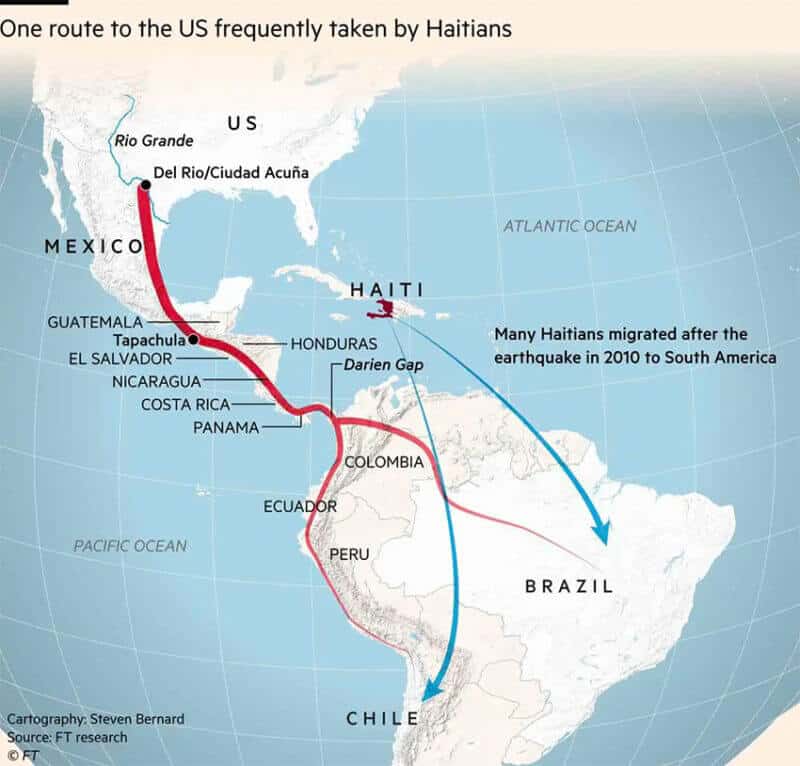
In the years after a devastating 2010 earthquake in Haiti that killed more than 200,000 people, tens of thousands of people left the country and scattered across South America, often in Chile and Brazil.

After work opportunities dried up, many headed for Mexico in recent months, making a perilous trip across borders. The migrants travel first up to northern Colombia, where there are some 19,000 Haitians awaiting a boat crossing that would leave them close to Panama.

The presidents of Costa Rica, Panama and Dominican Republic expressed deep concern over the crisis in Haiti and its impact on the region in a letter on Wednesday, asking the U.S., UN and EU for help finding structural solutions.

As more migrants began arriving in August, the Colombian and Panamanian foreign ministries agreed that just 500 migrants would be allowed to cross each day, using two local boat services. The beach at Necoclí, Colombia, which has become a bottleneck for the migrants, is packed with tents.

haitian migrants' route

“We’re worried that we’re going to have a health crisis on our hands, and we won’t have the capacity to respond,” said Necoclí Mayor Jorge Tobón.

From there, migrants take on the most perilous part of the trip: a multi-day trek across Panama’s Darién Gap, a jungle that is home to gangs, treacherous rivers and poisonous snakes and without roads or mobile phone reception.

“It was tragic,” said Joseph, who left Haiti in 2015 and recently traveled north from Chile, of the Darién. “There are things that one doesn’t want to see twice … seeing dead people, sleeping in unsafe places.”

Even if migrants cross Central America, they face immigration crackdowns in Mexico, which has stepped up deportations and deployed the National Guard to try to contain migrants.

Three times more Haitians have requested refugee status in Mexico this year than in 2019 or 2020. Fewer than one-third of those whose cases have been resolved this year obtained refugee status, according to Comar, the Mexican state agency for helping refugees.

One Haitian migrant, Jean-Louis, tried to get a residency permit through Comar when he reached Tapachula, Chiapas, after a journey that took him across nine countries, where he saw fellow migrants drown and was robbed by gangs. It was denied, and he said he was appealing.

Despite that, he has no intention of returning to Haiti, having left in 2017. “The country is in a very complicated state, like Afghanistan,” the 42-year-old said of his home country. “I want to stay in Mexico … I don’t have any family in Haiti,” he said from Tapachula.

Yuriria Salvador, structural change co-ordinator at the Fray Matías de Córdova Human Rights Center in the same city, said the organization had seen a big increase in the number of Haitians seeking help. In Mexico, they experienced racism and lived in cramped housing with limited access to water, she said.

Despite expectations of a softer approach to migration, both the Mexican government of President López Obrador and Biden’s administration have maintained many of the same practices of their predecessors.

“There were a lot of expectations that there might be a much more humanistic vision,” Salvador said of Mexico’s government. “There wasn’t a change in policies either here or in the U.S.”

In his morning news conference Friday, López Obrador said he did not want Mexico to become a migrant camp. He said the U.S. should support development in Latin America and that the UN should intervene to help Haiti.

Joseph has been waiting six weeks for his interview in Tapachula for a residency permit from Comar. When he gets it, he doesn’t mind where he lives in Mexico, but he wishes it would go faster.

“The money we had to be able to eat is running out,” he said.

© 2021 The Financial Times Ltd. All rights reserved. Please do not copy and paste FT articles and redistribute by email or post to the web.