Home Blog Page 1154

‘They have nothing to eat:’ Mexicans step up with aid for Haitian migrants

0
feeding Haitian migrants in Ciudad Acuña
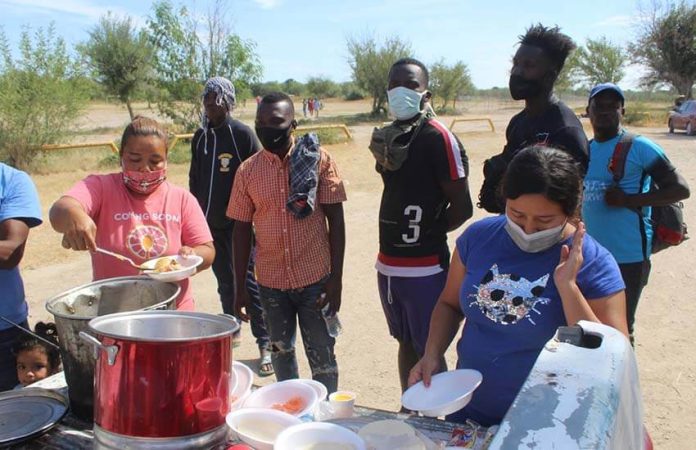
Ciudad Acuña resident Victoria Palomares and her family hand out cooked meals to Haitian migrants in the Braulio Fernández Ecological Park.

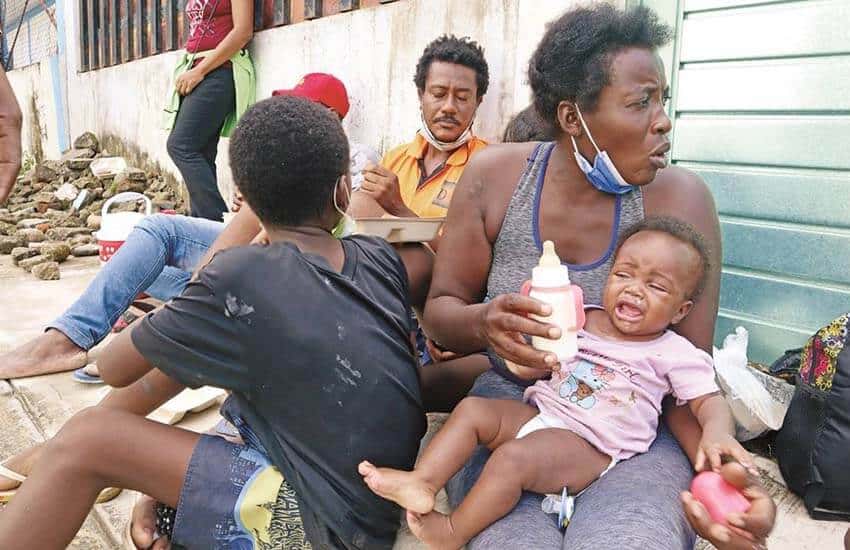
Haitian migrants who returned to Mexico after giving up on their quest to find asylum in the United States have received a helping hand from some residents of Ciudad Acuña, Coahuila.

More than 14,000 mainly Haitian migrants recently crossed the Rio Grande and gathered in a makeshift camp below the international bridge that connects Ciudad Acuña to Del Rio, Texas.

Some 2,000 were returned to Haiti on repatriation flights from the United States last week while many others remain in U.S. immigration facilities.

Some decided to return to Mexico to avoid likely deportation to Haiti, a country plagued by poverty, political turmoil and frequent natural disasters, including a devastating earthquake last month.

Hundreds of Haitians set up camp in a Ciudad Acuña park late last week after the camp on the U.S. side of the Rio Grande was cleared, while some found refuge in the homes of generous locals.
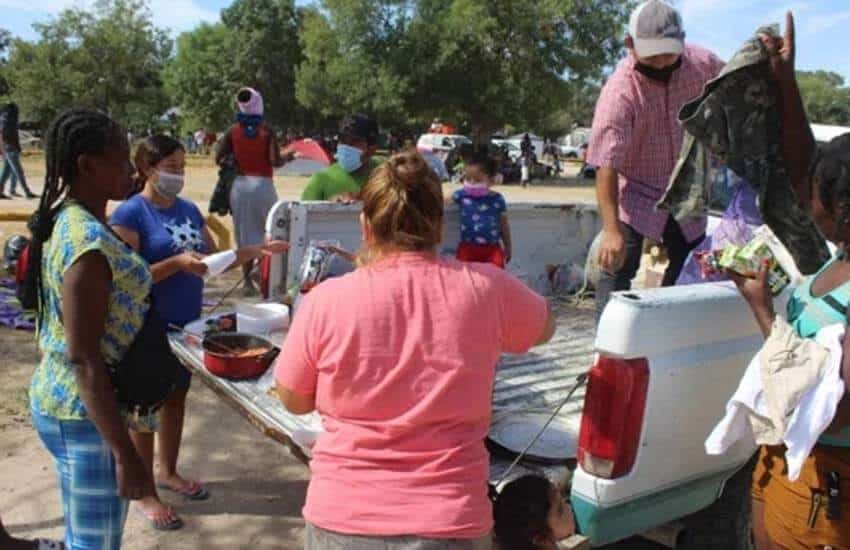
feeding Haitian migrants in Ciudad Acuña
‘We want to give them things, not sell to them,’ Palomares said. She and her family set up a makeshift soup kitchen with their pickup truck.

Those in the Braulio Fernández Ecological Park, located on the southern banks of the river, received free food, water and clothes from altruistic acuñenses, as locals of the border city are called. One such person is Mayra Lorena Arredondo, who along with her six children and son-in-law prepared chicken sandwiches and rice for the Haitians and gave them apples, juice and bottles of water.

“We were motivated by the necessity they have now; it’s very sad that they’re coming in search of a new future but they’re closing the doors on many of them,” Arredondo told the newspaper El Universal.

“They have nothing to eat,” she said. “While we can help them with something, we’ll be here supporting them.”

The 42-year-old mother said she wanted to instill the importance of charity and solidarity in her children and noted that they could someday find themselves in a situation in which they, too, required assistance.

“They [the migrants] need help. … If God allows me and blesses me, I will continue to come,” Arredondo said.

Victoria Alejandra Palomares and her family also took food to the Haitians camping out in the park.

Mensah Montant
Mensah Montant, a Togolese man who migrated to Mexico nine years ago, with his daughter, Rachel. He has been delivering food and medicine to Haitian families.

“I was moved by seeing the migrant children,” she said. “I wanted to come and give them something to eat. … We want to give them things, not sell to them. … We didn’t bring much.” Palomares then rattled off a long list that included rice, chicken, soup, Coca-Cola, bananas, popsicles, shoes and clothes.

“Poor things; it makes me sad seeing them like this. My husband works on farms, but we left everything to come here today.”

Virginia Salazar and her husband Mensah Montant, a Togolese man who arrived in Mexico as a migrant nine years ago, also came to the Haitians’ assistance.

The Associated Press reported that Salazar and Montant have delivered rice to one home where Haitians were staying, took medicine to another and were looking for a mattress for one family. All told, they have provided personal assistance to about a dozen Haitians.

Salazar, a cleaner, told AP that she came from a family of migrants, so she is aware of the challenges they face. “There’s my husband, and I have one sister who has documents and another who is illegal [in the United States],” she said. “ [Helping] comes naturally to me.”

Andrea García, a 24-year-old hairstylist, and her family have gone above and beyond in helping Haitians in Ciudad Acuña, providing accommodation in six houses they own. “They arrived at my house alone, with their babies … they said there was no place they could go,” García said, referring to one family she helped.
Haitian migrants in Tapachula outside shelter
Migrants in Tapachula line up outside a shelter hoping for an available spot.

“Yes, I am worried, afraid because Mexican immigration agents are going into people’s houses and are not giving them a chance at the process” to apply for residency, she said. “But it is more sad than scary to see how they pray when they see an immigration van.”

Mexican immigration agents have told Haitians in Ciudad Acuña that they must return to Tapachula, Chiapas, to apply for asylum in Mexico. Some have been bused to the city, located more than 2,300 kilometers south.

However, most Haitians are reluctant to return to Tapachula because having already passed through the city, they know what to expect: a lack of work opportunities, overwhelmed migrant services and long wait times at the Mexican Commission for Refugee Assistance, which is responsible for processing asylum claims.

Many of the Haitians — a large number of whom previously spent time in South American countries such as Chile and Brazil — left Tapachula without Mexican papers because they had been stranded in the city for weeks or months and were unsure whether they would ever be issued documents that allowed them to travel legally through the country.

Hundreds were recently detained by immigration agents and the National Guard as they made their way through Chiapas on foot.

AP reported last week that Haitians in Mexico will soon be deported on repatriation flights from Tapachula and Monterrey, Nuevo León, while the National Immigration Institute said in a statement on Sunday that flights to Haiti from Tapachula and Villahermosa, Tabasco, would be offered starting next week to “those who voluntarily wish to return to their country.”

Haitian migrants in Reynosa
Migrants living in tents at an overflowing Reynosa refugee shelter.

In addition to Ciudad Acuña and Tapachula, another city overwhelmed with migrants is Reynosa, Tamaulipas. One shelter alone is currently hosting almost 1,200 Central American and Haitian migrants — a figure triple its capacity — with many sleeping in more than 200 tents set up on its grounds.

Amid the high demand for its services, the Casa Senda de Vida (Path of Life House) ran out of food and other provisions, prompting its management to appeal for help from citizens, social organizations and all three levels of government.

“We have 27 volunteer cooks who can do nothing because we have nothing to prepare,” director Héctor Silva told El Universal. “About 10 boxes of chicken are used here for a meal. We [also] use sacks of potatoes, vegetables, eggs, milk and cereal for the kids, but we don’t have any of that.”

A short time later, the shelter received a donation of cleaning supplies, hygiene products and medications, as well as chicken, rice, potatoes and broccoli, which were quickly cooked and served to the migrants. But with 1,200 hungry mouths to feed, plenty more supplies are required.

“We want to help … because there is a lot of necessity,” said Miguel Ortiz, a Reynosa resident who collected funds to put toward the purchase of food for the shelter.

“There are a lot of children here who are not to blame for the fact that their governments or countries can’t provide them with a good environment to live in.”

With reports from El Universal and AP 

Mexico’s Julio Urías leads MLB pitchers with 19 wins this season

0
The star pitcher from Sinaloa, Julio Urías
The star pitcher from Sinaloa, Julio Urías. mlb

Los Angles Dodgers pitcher and Sinaloa native Julio Urías is close to being crowned the most successful Major League Baseball (MLB) pitcher of 2021, now on 19 wins after his team defeated the Arizona Diamondbacks on Sunday. “El Culichi,” as he is known by fans, would be the first Mexican to hold that record.

Urías, 25, has a three-win lead over Gerrit Cole of the New York Yankees and Adam Wainwright of the St. Louis Cardinals, both of whom are tied for second.

The southpaw was born in Culiacán, Sinaloa, and moved to the United States in his youth after being scouted and signed by the Dodgers on his 16th birthday.

He has only lost three games so far this season, making him one of the most effective pitchers in MLB. He is also one of the best pitchers in MLB when it comes to hitting.

Urías said that given the choice, he would opt for honors in the pitching department despite his fondness for batting. “Obviously I like hitting. I’ve always talked about how much I like hitting,” he said.

“We have a competition among ourselves and it’s something that’s very important to me. I was able to contribute, which is really great … reaching 20 wins [as a pitcher] would be a dream come true and something I’m really striving for,” he added.

The pitcher has one more series to hit the 20 mark when the Dodgers face the Milwaukee Brewers on October 2. Then the Dodgers will face the San Francisco Giants in the playoffs.

Another Mexican pitcher won more games in a season than Urías’ 19, but fell short of being the best pitcher that year. In 1986, Fernando Valenzuela from Etchohuaquila, Sonora, racked up 21 wins with the Dodgers, but was edged out by Roger Clemens of the Boston Red Sox, who ended the season with 24 wins.

Urías was one of two Mexican pitchers who helped the Dodgers win last year’s World Series. He and Víctor González pitched in the Dodgers’ 3-1 win over the Tampa Bay Rays in the final game of the series in Arlington, Texas.

With reports from Infobae

Michoacán student refused to sit by and do nothing in face of attacks

0
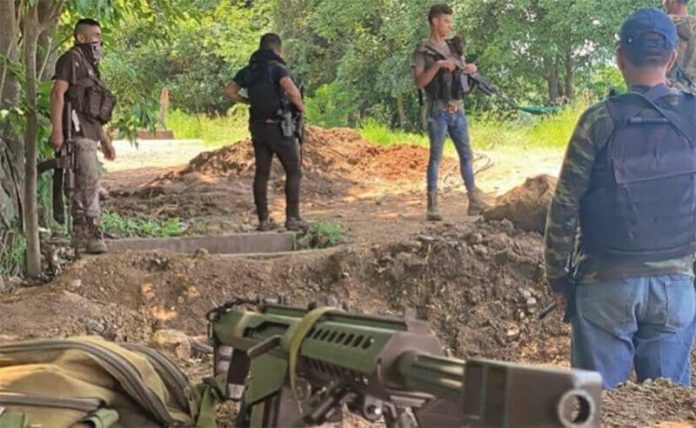
Community guards on patrol in the Tierra Caliente.

An 18-year-old man presumed killed by Jalisco New Generation Cartel (CJNG) gunmen in Tepalcatepec, Michoacán, earlier this month took up arms to defend his family, according to his devastated mother.

Men believed to be CJNG sicarios carried out a lengthy offensive in the Tierra Caliente municipality in the middle of September, killing seven people and wounding three others.

Five men manning a checkpoint designed to keep criminals out of the community of La Estanzuela were murdered and decapitated before two other men also working as community guards were shot dead in the locality of Plaza Vieja.

One of the victims of the latter attack was Juan José López Cervantes, who recently graduated from middle school and planned to continue his studies at a technical school.

His body and that of the other victim have not been recovered because they are in an area controlled by the CJNG, the newspaper El Universal reported.

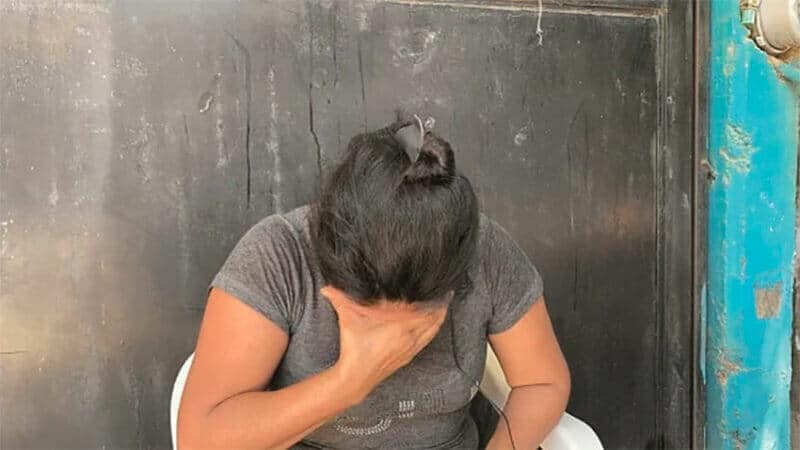
The mother of murdered young man
The mother of murdered young man said he wished to defend his family.

López’s mother told El Universal that her son had dreams of becoming a soldier or a nurse but was unable to commence his high school studies due to the pandemic. Not wanting to sit idle as Tepalcatepec came under attack, he decided to join the community resistance to the CJNG and swapped his textbooks for a gun, said Genoveva Cervantes Cortés.

Chelito, as López was affectionately known, didn’t want to see his family murdered, Cervantes said.

According to a community guard working alongside the young man, López, described by his friends as “very brave,” was first shot in the leg and later in the head as they came under attack by CJNG gunmen. Running for their own lives, the other comunitarios were unable to remove the bodies of their slain colleagues.

Cervantes said that armed attacks have become a daily occurrence in Tepalcatepec, one of several Tierra Caliente municipalities plagued by violence perpetrated by the CJNG and its local rival, the Cárteles Unidos.

“[There is] a lot of violence. You’re at home waiting for a bullet or bomb to fall on you. You can’t sleep because you don’t know what’s going to happen to you or if they’re going to kill your child,” she said before urging authorities to recover the body of her son.

With reports from El Universal 

US Border Patrol detains 14 Mexican soldiers who crossed into US

0
The soldiers sit at the roadside, under guard by border patrol agents.

Fourteen Mexican soldiers were detained by U.S. officials for several hours early on Saturday after they entered U.S. territory at El Paso, Texas, across the border from Ciudad Juárez, Chihuahua.

The soldiers, who crossed the bridge between the cities in two military vehicles, said they didn’t realize they had entered the United States.

The newspaper El Heraldo Chihuahua reported they were from southern Mexico and had only recently arrived at the northern border.

Border agents secured weapons and equipment for “safety and processing,” said U.S. Customs and Border Patrol (CBP), adding that Mexican military leadership was contacted and arrived shortly after.

Thirteen of the soldiers were processed without incident, but one was given a civil penalty after CBP officers discovered a small quantity of marijuana in his possession.

The soldiers appeared to have been handcuffed according to Reuters. Their vehicles and weapons were returned to them when they were released.

The border crossing was closed for about two hours due to the incident, a witness said.

One witness, who asked not to be named, described the tense moments when border officials stopped the soldiers. “The CBP yelled at the soldiers to put their hands up and drop their weapons immediately.”

Involuntary border crossings by Mexican military forces have occurred in the past, the newspaper El Universal reported, but usually in areas where the border is not clearly marked, rather than on international bridges.

With reports from Reuters, El Heraldo Chihuahua and El Universal

México state celebrates successes of its 109 crimefighting drones

0
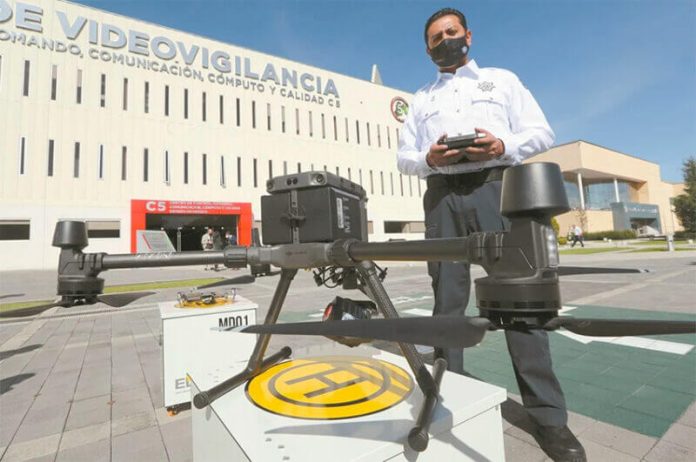
One of the drones used for crimefighting in México state.

The use of drones to combat crime is proving to be a success in México state, where 109 of the devices are in operation.

The unmanned aerial vehicles have helped authorities detain thieves who target public transit users and pedestrians, locate missing people and track stolen vehicles, according to the deputy director of video surveillance at the C5 security center in Toluca.

Drones and other crimefighting technology such as security cameras have allowed authorities to identify and follow criminals as they escape from the places where they perpetrated their offenses, José Luis Amado Mauro told the newspaper El Universal. 

“[The drones] have been very useful,” he said, explaining that they have carried out 8,736 flights of which at least 400 made a successful contribution to the fight against crime.

Amado said the drones are often used in hard-to-reach places such as gullies and ravines, adding that they have also been deployed in high-crime areas where carrying our patrols is risky for police.

The official said that México state authorities have used two different types of drones since early last year. One is the so-called “drone in a box” in which the aerial vehicle deploys from and returns to a self-contained landing box.

Amado said that 65% of the box drones are situated in high-crime areas that are part of the greater metropolitan area of Mexico City. There are three in Ecatepec, a municipality notorious for crime, and two in each of Naucalpan and Tlalnepantla. There are also two box drones in Toluca, the state capital.

Amado said the box drones were placed in areas where there are few security cameras. They are operated from the C5 security center, he explained.

The security official said that México state is one of the states with the highest number of crimefighting drones. He described the state, Mexico’s most populous, as a pioneer in their use.

Amado said authorities also used drones to assess a recent landslide at Cerro de Chiquihuite, a populous hill on the boundary between Tlalnepantla and Gustavo A. Madero, a Mexico City borough.

As a result of the use of drones, authorities were able to inform rescue workers about the conditions they faced, allowing them to work with greater precision and without risking their lives, he said.

With reports from El Universal 

Highway robbery reached annual high in August

0
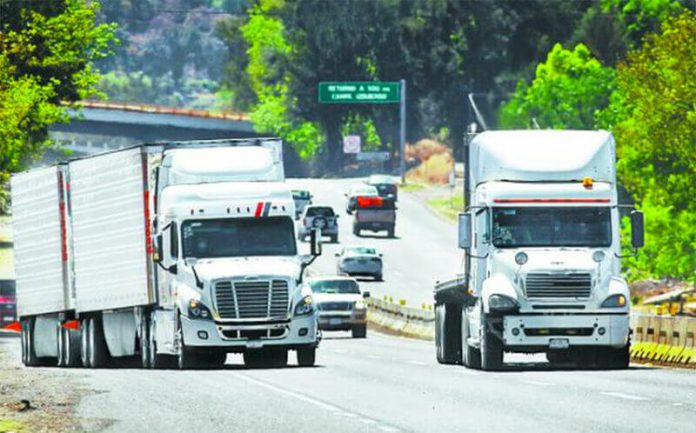
transport trucks
More robberies are expected during the coming months due to increased economic activity.

Highway robberies of transport trucks hit their highest level for the year in August when 778 incidents were reported, almost half of which were in México state, according to data from the National Public Security System (SNSP).

The state is by far the worst state for the crime: 377 robberies were recorded in August, bringing the total for the year to 3,029. The second worst state, Michoacán, saw a comparatively modest 91 incidents in August, taking its annual total to 695.

Six of every seven robberies involved violence, the SNSP said.

This year’s numbers are slightly better than last year, when 815 incidents were recorded during the month.

Summer appears to be a profitable season for highway thieves: August usurped June, when 746 such robberies were recorded; May, which saw 719 incidents, and July when there were 711 robberies.

Luis Rangel of logistics company WebFleet Solutions said robberies were likely to continue in the coming months due to an increase in trade for the holiday season. “This is not going to go down, on the contrary, an increase is coming because we are approaching December, where there is much more movement of motor transport. Logically there are more goods, and unfortunately and statistically speaking, there is more crime,” he said.

With reports from Milenio

New 20-peso bill commemorates Mexico’s independence

0
new banknote
The new banknote went into circulation on Friday.

The Bank of México has released a new 20-peso bill (about US $1) to honor the 200th anniversary of independence, recalling the moment exactly two centuries ago when the rebel army entered Mexico City. On the following day, September 28 1821, Mexico was declared independent.

The reverse side of the note pays tribute to the country’s natural wealth with an image of the Sian Ka’an Biosphere Reserve in Quintana Roo, a UNESCO Natural World Heritage Site. It features a crocodile and a garza chocolatera, a type of crane also known as roseate spoonbill.

The celebrated former president Benito Juárez has dropped off the 20-peso note, which went into circulation on Friday.

The primarily green and red bill depicts a painting which hangs in Chapultepec Castle called “The Solemn and peaceful entry of the Army of the Three Guarantees into Mexico City on September 27 from the memorable year of 1821” by an anonymous artist. It glorifies the moment the army arrived at Mexico City’s central square, led by Agustín de Iturbide.

The image displays the flag of the army and the Mexican flag side-by-side, and local people celebrating the military arrival.

Reverse side of the new bill.

Another of the Bank of México’s eye-catching designs was internationally applauded earlier this year: a 100-peso bill (about $5) depicting the self-educated nun and intellectual Sor Juana Inés de la Cruz was named banknote of the year 2020 by the International Bank Note Society (IBNS).

A series of events are planned for 2021 to recall two centuries since independence, 500 years since the fall of the Aztec capital Tenochtitlán, and — rather more dubiously — 700 years since the ancient city’s foundation.

In addition to the Sian Ka’an Biosphere Reserve, there are five UNESCO Natural World Heritage Sites in Mexico. Those are: the El Vizcaino Whale Sanctuary in Baja California and Baja California Sur; the Monarch Butterfly Biosphere Reserve, Michoacán; the Revillagigedo Archipelago in the Pacific Ocean; The El Pinacate and Gran Desierto de Altar Biosphere Reserve, Sonora; and the Islands and Protected Areas of the Gulf of California spanning Baja California, Baja California Sur, Sonora, Sinaloa, and Nayarit.

With reports from El País

7 years later: families of the 43 see only minimal advances in Ayotzinapa probe

0
About 3,500 people attended Sunday's march
About 3,500 people attended Sunday's march in Mexico City.

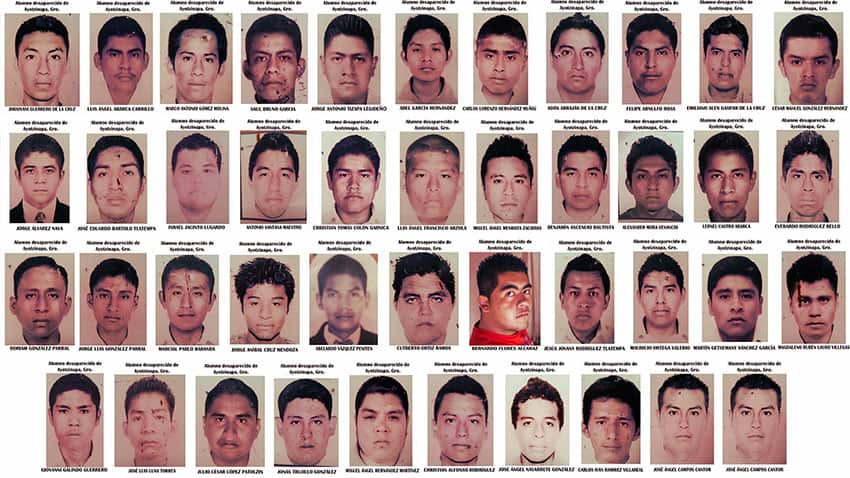
Seven years after 43 students were abducted and presumably killed in Guerrero, the students’ families, anti-violence activists and everyday citizens are still clamoring for justice.

At a protest march and rally in Mexico City on Sunday to mark the seventh anniversary of the students’ disappearance, parents expressed frustration with the government’s investigation.

“With this government it seemed that the path to the truth was clearer but with the passage of time it has become steeper and full of thorns and stones that prevent us from reaching our objective, which is to know the whereabouts of our sons,” said Hilda Hernández at a rally at the zócalo, Mexico City’s central square.

The mother of César Manuel González Hernández said parents will keep up their fight amid adversity due to the COVID-19 pandemic and despite “the maze of a lethargic justice system.”

The government rejected its predecessor’s “historical truth” about what happened to the students after their disappearance in Iguala on September 26, 2014 and launched a new probe. But almost three years later it has not divulged its own definitive version of events.

The 43 students who disappeared September 14, 2014 in Guerrero.

No one has been convicted of the crime, scores of suspects have been released from prison – many because they were subjected to torture, and the remains of just three of the 43 students have been found.

A key aspect of the previous government’s version of events was that the students’ bodies were burned in a dump near Iguala after they were killed by members of a local crime gang in cahoots with municipal police. But experts concluded there wasn’t a blaze of significant intensity at the dump to incinerate 43 corpses.

The army has long been suspected of involvement in the students’ disappearance, and leaked testimony obtained by the newspaper Reforma earlier this year supported that theory.

“We’re asking President López Obrador to investigate the army thoroughly,” said Cristina Bautista, another mother of one of the missing students. “… They had knowledge [of what happened].”

Hilda Legideño, whose son Jorge Antonio Tizapa Legideño was among the victims, accused the previous federal government of fabricating evidence to support its version of events, an opinion shared by the special division of the federal Attorney General’s Office that is conducting the new investigation.

The current government has shown political will to get to the bottom of what happened but it hasn’t delivered results, she said.

'7 years without justice,' reads a giant banner in the zócalo on Sunday.
‘7 years without justice,’ reads a giant banner in the zócalo on Sunday.

“We’ve been waiting for three years but we don’t know the whereabouts of our sons,” Legideño said.

Another mother who was cited by the newspaper Milenio but not identified by name rebuked the federal government for failing to secure the extradition of Tomás Zerón from Israel. The head of the now-defunct Criminal Investigation Agency is accused of torture and tampering with evidence.

Along with former attorney general Jesús Murillo Karam, Zerón is considered a key architect of the so-called historical truth.

“Officials who endorsed the historical truth continue to hold high-ranking positions in the Attorney General’s Office,” the unnamed mother told Milenio.

According to the Mexico City government, approximately 3,500 people participated in Sunday’s march, which departed the Angel of Independence monument on Reforma Avenue at 4:00 p.m. and reached the zócalo in the late afternoon. The facades of some buildings along the route were graffitied with messages such as “We’re missing 43” and “We’ll neither forgive nor forget” but there were no reports of violence.

There was also a protest march on Sunday in Chilpancingo, the capital of Guerrero, where some 300 students and activists took to the streets to demand justice in the seven-year-old case.

With reports from Reforma and Milenio 

A reverse snowbird enjoys a life of Baja heat and Canadian ice

0
Jessica Collins
Jessica Collins in Baja and up north.

When I think of Canadians traveling seasonally to Mexico, I think of well-off people looking for comfortable temperatures year-round, but Jessica Collins turns this stereotype on its head.

And the nomadic side of my personality is envious.

Collins spends about half a year in Mulegé, Baja California Sur, tending an unusual Airbnb business and the other half working waaaaay up north as a cook for miners and ice truckers.

Essentially, she admits, she is an “overgrown adventurous college student,” one who has led this kind of life for about 20 years.

I initially interviewed Collins because I was interested in her business of creating and renting reworked old trailers as hotel space.

Trailercito Caracol
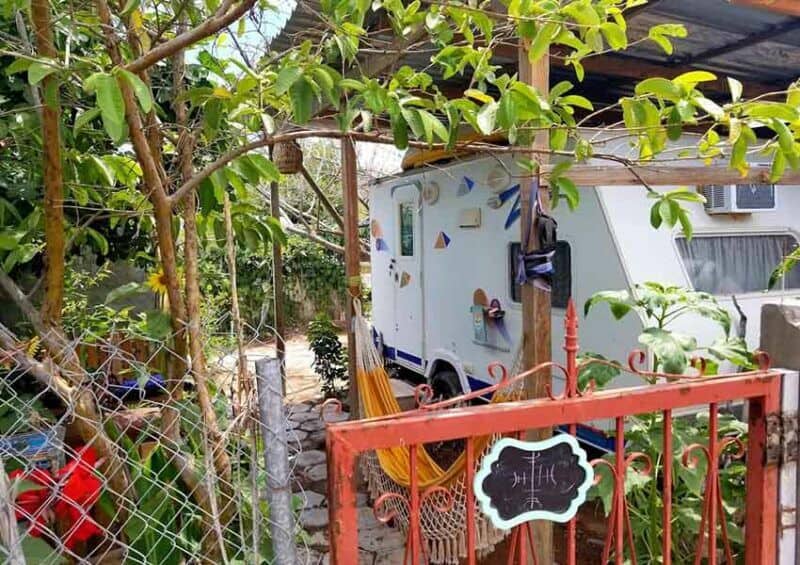
One of the trailers that the Collins family rents via Airbnb.

About three years or so ago she, a sister and her Mexican brother-in-law realized that they could buy broken-down trailers and RVs for only a few hundred dollars, as their owners don’t want to haul them back north. They are fixed up and rented through AirBnB under the name Trailercito Caracol.

The Collins sisters’ connection with Baja came from traveling the area for many years in their teens and 20s. Her sister met and married a Mexican man from Mulegé, and his family’s land became the Collins family’s base in Mexico.

The trailer idea has only been active for a few years, but they have two that are rentable with a third in progress. Making them habitable usually includes replacing floors, painting and thorough cleaning and fumigation to make sure to be rid of the area’s infamous scorpions and other critters.

Although an important part of their lifestyle and a unique way to experience Baja, the hotel income doesn’t yet support the family. For economic and personal reasons, Jessica still travels north each year to work, but not necessarily in the summer when the weather is better in Canada.

Instead, her migrations depend on gigs she gets during the year, which include cooking in mining camps and for ice truckers. The latter, in particular, means working near the Arctic Circle during the coldest months of the year.

At the time of the interview, Collins was working at a mining exploration camp near the Alaskan border. Like a good Canadian, she was dressed in a flannel shirt and heavy boots. Even though it is summer, it was only 4 C and rainy there.

Jessica Collins
Getting ready to board a plane to a camp in the middle of nowhere in Canada.

The money she makes, and that her sister makes working in Canadian summer resorts, goes toward developing the land in Mulegé and their general living expenses in Mexico. For Collins, that can mean that her Baja months are not when normal snowbirds are “in season” but rather the hot summer months. Her yearly migrations can put her in temperatures anywhere between -40 C and 40C, but she wouldn’t have it any other way.

COVID-19 has put a strain on their trailer rental business, although not in the sense of people wanting to rent. In fact, the isolation of the trailers and natural beauty are a draw for those looking to get away from the insanity.

But providing proper shower and bathroom facilities means a separate outdoor structure that is shared among the trailers, and that sharing is currently disallowed by municipal authorities. Currently, they can rent only one trailer, but they hope this will change soon. Collins says “… there is nothing like showering at night under a million stars.”

Outdoor bathrooms and cooking areas are common in Mulegé. It is very often too hot to cook indoors and never too cold to bathe outdoors. Also, sewer systems in the area have a tendency to back up, and this setup keeps the smell out of the house.

The use of old trailers, including one they’ve refurbished from the 1960s, is a brilliant idea not only because it appeals to the same adventure-minded people that come to off-the-beaten-track Mulegé but because it reuses something that would otherwise sit in a junkyard.

The time that the two sisters spend up north is more than just money to supplement their life in Baja. They take advantage of that time to promote Baja and understand exactly what their target market is and wants. One aspect is understanding how important the internet is even to such a small operation, even though access for them there can be sketchy.

Jessica Collins
View of Collins’ life in Baja and in Canada.

Although tourism in Mulegé began to grow starting with the 1976 construction of Mexican Highway 1, making it 12 hours from the nearest border with the United States, it has not developed like Los Cabos or even Loreto has.

Nevertheless, Collins is very optimistic about the trailer idea going forward. She believes that in the post-COVID world, “people are going to want the experience over the flash of resorts.”

And when they are ready, so will the Collins family be.

Leigh Thelmadatter arrived in Mexico 18 years ago and fell in love with the land and the culture in particular its handcrafts and art. She is the author of Mexican Cartonería: Paper, Paste and Fiesta (Schiffer 2019). Her culture column appears regularly on Mexico News Daily.

Huitlacoche: don’t judge a book by its cover

0
huitlacoche growing on corn
Kind of like a mushroom, huitlacoche is a naturally occurring parasitic fungus that grows on untreated organic corn.

We all have our food fears.

I’ve shared some of mine in this column: mussels, liver, lengua (tongue), sesos (brains). Here’s another one: huitlacoche (whee-tla-KO-cheh). Corn “smut.” Mexican truffles. Kind of like a mushroom, it’s a naturally occurring parasitic fungus that grows randomly on untreated organic corn.

Why hadn’t I eaten it? To begin with, huitlacoche is quite ugly and looks just like what it is: a grey, blobby parasite, an invader of pearly-yellow corn kernels. Gray is not a color food should be, and it just doesn’t look appetizing to me.

That’s why the package of fresh huitlacoche I bought sits abandoned on a shelf in my fridge. But my column deadline was upon me and I could procrastinate no longer. Well-meaning friends had suggested I try it at a restaurant the first time, so I set out this morning, determined to (ulp) overcome my aversion and fear of this ugly but harmless foodstuff.

“You won’t even know it’s in there,” said a friend — and she was right. The deep-fried quesadillas I ordered, with shrimp, huitlacoche and Oaxaca cheese, were delicious, the huitlacoche a smoky, earthy, soft complement to the other ingredients. Cooked, the unpalatable grey turns to a deep-black brown which, while unusual, doesn’t have the same repellant effect as elephant-skin grey. Consider me a new fan!

huitlacoche gordito
Huitlacoche is used as a filling or topping in many classic Mexican dishes, including this gordito.

Huitlacoche can be used anywhere you’d use mushrooms and is most commonly sautéed with onions, chiles and garlic and used in quesadillas, tortas, tamales, stews and soups. It pairs well with eggs and is a flavorful addition to scrambled eggs, frittata or omelets. When cooked, huitlacoche releases an inky black liquid, almost like a gravy. Cooking it longer will cause some of this to evaporate, depending on the texture you’re looking for.

While you can find huitlacoche year-round in most parts of Mexico, now — the end of summer — is when it’s most abundant, as it develops on corn after the rainy season. It’s most commonly sold already removed from the corn, wrapped and packaged on a little Styrofoam plate.

If you’re lucky, you might find a farmer or vendor selling whole ears of corn with huitlacoche “attached.” If you do, remove the husks and any hair. Use a sharp knife to carefully cut off the huitlacoche, rinse gently, pat dry and proceed with your recipe.

It’s also available canned, but, of course, fresh is best.

And that package of huitlacoche in my fridge? Eating it is one thing — cooking it another. We shall see!

Classic Huitlacoche Quesadillas

Epazote is a common Mexican herb that adds a rich, aromatic flavor to certain dishes. Find it fresh or dried at your local mercado or in some grocery stores.

  • 2 Tbsp. butter
  • ½ onion, chopped
  • 1 garlic clove, minced
  • 1 jalapeño, seeded and chopped
  • 5 fresh epazote leaves
  • 1 lb. fresh huitlacoche
  • Salt to taste
  • 10 (6-inch) corn tortillas
  • 1 lb. Oaxaca cheese, separated into strings
  • Vegetable oil as needed

Melt butter in skillet over medium heat; add onion, garlic, jalapeño and epazote. Cook until soft, about 5 minutes. Add huitlacoche and cook, stirring, until liquid evaporates, about 10 minutes. Season with salt; cover and keep warm.

Heat a comal or skillet over medium heat until hot. Moisten both sides of two tortillas with water and place them, stacked together, onto the hot griddle; cook until the bottom tortilla is crisp, about 2 minutes.

Flip the stacked tortillas and cook the other tortilla until crisp. Separate the two cooked tortillas; place them separately, uncooked side down, onto the hot griddle. (You may need to add a spray or drizzle of oil or butter to the comal or skillet at this point.) Cover the crisp side of one tortilla with one-fifth of the Oaxaca cheese; place one-fifth of the huitlacoche mixture over the cheese, then lay the crisp side of the second tortilla on top to cover.

Cook, turning once, until both tortillas are crisp and cheese is melted. Repeat with remaining ingredients. Cut each quesadilla into four wedges to serve.

huitlacoche enchiladas
Huitlacoche can be substituted just about anywhere you’d use mushrooms and is typically sauteed with onions, chiles and garlic.

Huitlacoche Soup

  • 1 Tbsp. olive oil
  • 1 onion, finely chopped
  • 1 garlic clove, minced
  • 1 cup fresh corn kernels
  • 2 cups huitlacoche
  • 1 large epazote leaf
  • 3 large plum tomatoes
  • 1½ liters chicken or vegetable broth
  • 2 poblano peppers, roasted, cut into thin strips
  • 8 squash flowers, cleaned and minced
  • Salt to taste
  • 1 small round of queso fresco

Heat oil in a large saucepan over medium heat. Add onion and garlic; sauté until transparent. Add corn kernels, huitlacoche and epazote leaf. Sauté for 10 minutes, stirring.

In a blender, process tomatoes with 1 cup of broth. Strain into the pan with the huitlacoche mixture. Add remaining broth and season with salt. Bring soup to a boil, reduce heat to low and simmer for 10 minutes.

Add poblano strips and squash flowers; cook 5 minutes. Serve garnished with crumbled queso fresco.

Janet Blaser is the author of the best-selling book, Why We Left: An Anthology of American Women Expatsfeatured on CNBC and MarketWatch. She has lived in Mexico since 2006. You can find her on Instagram at @thejanetblaser.