The third wave of the coronavirus pandemic has been receding for eight weeks, Deputy Health Minister Hugo López-Gatell said Tuesday.
But data from the Reuters COVID-19 tracker paints a slightly different picture, although it also shows that the delta-driven wave is on the wane.
The Reuters data shows that the average number of new infections reported each day has fallen by more than 7,500 over the past three weeks to 8,143. The latter figure represents just 43% of the rolling seven-day peak recorded on August 17, but that was just five weeks ago, suggesting that the pandemic might not have been declining for as long as López-Gatell claims.
However, the government has long stressed that the case numbers reported on a daily basis are not necessarily indicative of infections detected that day. Some may have been detected weeks or even months earlier, health officials have said.
Speaking at President López Obrador’s regular news conference, the government’s pandemic chief also said that the number of hospitalized COVID-19 patients is declining.
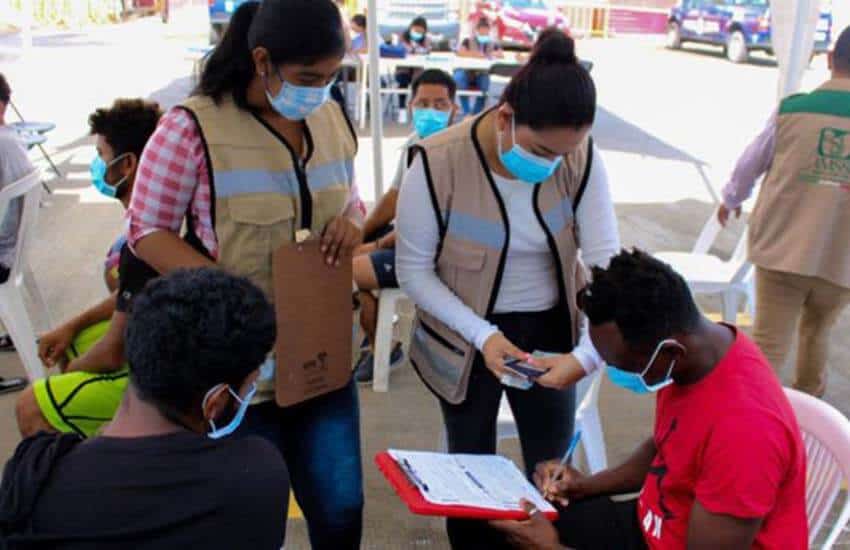
Migrants are vaccinated by health officials in Tapachula, Chiapas.
“We’re continuing to see this trend of the vacation of [beds in] COVID hospitals,” López-Gatell said. “… This is a maintained trend in the entire national territory.”
Federal data shows that there are just under 9,000 hospitalized COVID patients across the country. Durango has the highest occupancy rate for general care hospital beds – currently just under 58% – while 51% of beds with ventilators are taken in Tabasco, more than in any other state.
Meanwhile, Mexico’s accumulated case tally rose to 3.58 million on Tuesday with 12,521 new infections reported.
The official COVID-19 death toll increased by 815 to 272,580, and there are 64,175 estimated active cases across the country, a 6% increase compared to Monday.
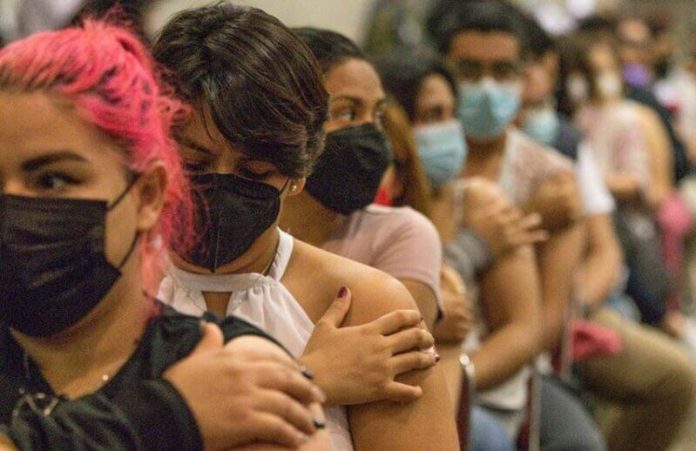
Almost 96.1 million vaccine doses have been administered in Mexico, according to the latest official data, after just over 442,000 were given Monday.
“The epidemic is declining and vaccination is not stopping,” López-Gatell wrote on Twitter.
About 70% of Mexican adults have received at least one shot, while the population wide vaccination rate is 49%, according to The New York Times vaccinations tracker. About one-third of Mexico’s 126 million citizens are fully vaccinated.
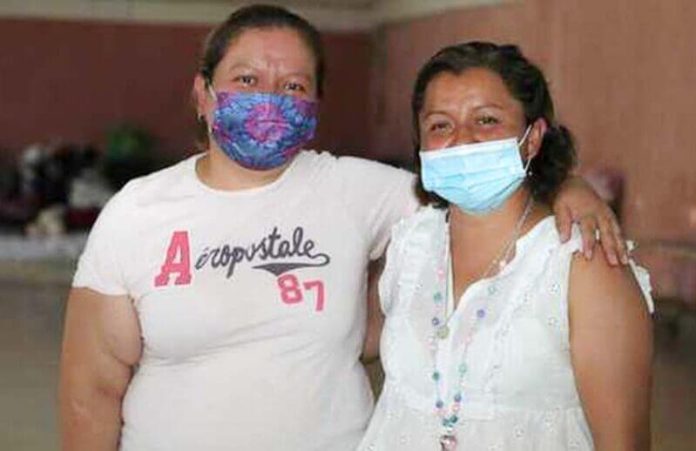
Angélica Maturano, left, with her sister Cristina Maturano opened their events hall as a public shelter after floods in Tula left neighbors without a place to sleep.
A Hidalgo businesswoman has become a community hero after opening a shelter for victims of flooding in the central state.
When severe flooding affected the municipality of Tula earlier this month, Angélica Maturano was approached by a neighbor looking for a dry and safe place where he and his family could sleep because their own home had been inundated with water.
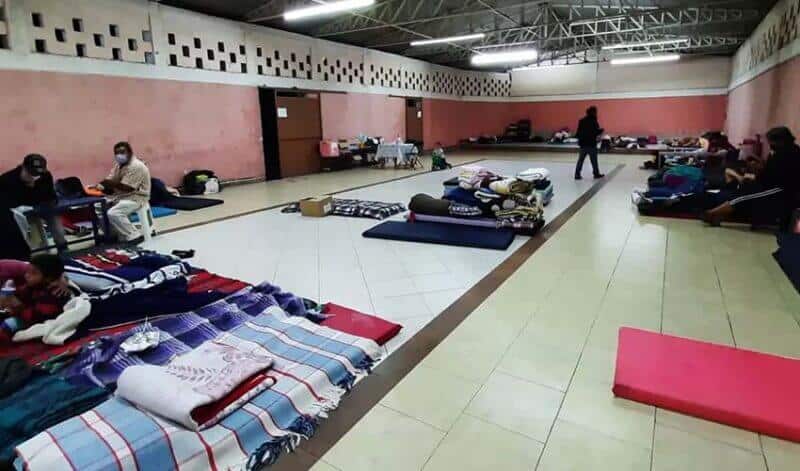
Despite some initial reluctance, she decided to let them stay at a warehouse-cum-events hall she owns. Other flood victims soon arrived at the makeshift shelter, and Maturano let them in too, seeing the number of occupants swell quickly to a peak of 90 before declining over the past two weeks to the current level of 54.
“This [shelter] was opened by chance; on Monday [September 6] ‘Fili,’ a neighbor, arrived … to ask me for help,” Maturano told the newspaper Milenio.
“The truth is I didn’t want to [open the warehouse] but seeing the anguish on his face won my heart over in the end – I put myself in his shoes and opened the doors,” she said.
Maturano expected to open her hall up to neighbors for a few days, but cleanup from the floods has been slow.
“There were about 90 people here the first day [and] those 90 people were given food. My sister Cristina and I took the decision to help … because we saw they didn’t have anywhere to sleep. … I thought that … the water would go down, we’d clean up like on other occasions and we’d all return to our normal lives [but] that hasn’t happened. We’ve been here 15 days,” said Maturano, who has provided mattresses and blankets to the shelter occupants.
She and her sister have also passed on donated food and medications to Tula residents whose homes weren’t as badly affected by the floods but nevertheless lacked the essential items they needed to survive.
Maturano said the homes of some of those taking refuge in the shelter sustained flooding damage that is so severe that they will never be habitable again. She also said that residents are living in fear due to the risk of more flooding.
“We’re living in fear, in desperation because a lot of people were left without a home and without work, and because there’s been four flooding alerts in 15 days,” Maturano said.
“I’ve gone to the [flooded] homes and schools and I come back crying because … I see the devastation and I say ‘that’s not the Tula where I grew up,’” she said.
“I call on the federal government to support those people who have lost everything. … their homes, their businesses.”
Supplies the sisters have collected to distribute to Tula’s flood victims.
A dole of 109 turtles was born Sunday in Los Cabos, Baja California Sur, but two of the newborns particularly stood out.
They were albinos, and will be easy to recognize among their 108 siblings. “They are a rarity among their sisters,” wrote Carlos Villalobos, the head of the Network to Protect Sea Turtles in Los Cabos.
Graciela Tiburcio, from the same animal conservation group, said the two albinos were healthy and were released into the ocean together with the other baby turtles.
Tiburcio said the two albinos are not as miraculous as they might appear. “Albinism is not uncommon in the animal kingdom. In the case of sea turtles, some cases of albinism can be observed during the season during nest cleanings. What makes this case unique and exceptional is that the turtles appear to be in perfect health,” she added.
In recent years, work has increased among conservationists to protect sea turtles, by protecting their nests from human disturbance. Once born, the turtles are released into the sea with the purpose of promoting their reproduction since some species are in danger of extinction.
Los Cabos is one area where conservationists work to protect turtles. One of their methods sees locals and tourists invited to release the newborn turtles into the sea.
From left to right, Conagua's listing of states that could be seeing some rain. Some areas could also experience thunderstorms or hail.
Mexico’s national weather service (Conagua) announced that Mexico’s first cold front of the year has arrived, bringing forecasts of falling temperatures as well as heavy rains, strong winds and even hail in some states, mainly in the north and northeast.
The fronts usually have a duration of between five and seven days.
Cold front season runs from September 15–May 15, generally affecting northern, eastern and southeastern states, and later reaching the center and west of the country. It is most intense in mid-winter from December to February.
Snow recently fell for the first time this year last week on the continent’s northernmost city, Utqiagvik (previously known as Barrow), Alaska, and the spread of arctic ice is in a greater amount than it has been for more than a decade, both signs that wintry conditions have arrived and are heading south.
The cold front, which is interacting with a low-pressure system, according to Conagua, arrived in Chihuahua and Coahuila Tuesday morning and will reach Nuevo León and Tamaulipas Wednesday and northern Veracruz Wednesday night. It is likely to reach the south of the state Thursday.
The front’s movement will bring heavy rains, some hailstorms and winds of 50 kilometers per hour to affected areas. In the north and east, Sonora, Coahuila, Nuevo León and Tamaulipas could see as much as 75 millimeters of rain, according to Conagua, as could Nayarit and Jalisco in the west.
Temperatures are predicted to be lower in the afternoon in the north, northeast, east and center of the country at 20–30 C. Sunrise is likely to record temperatures of 10–19 C, while higher areas of the Altiplano might not exceed 10 C. The first norte, a local wind phenomenon, will arrive for a prolonged spell on the coasts of Tamaulipas, Veracruz and the Isthmus of Tehuantepec with gusts of 60–85 kph.
An Olympic medalist was grateful for the 50,000 peso check (about US $2,500) she received for her performance at the Tokyo Games — until she tried to cash it at the bank.
Aremi Fuentes won bronze in women’s weightlifting at the Tokyo 2020 Olympic Games. She said she was later given a check by the Baja California Governor Jaime Bonilla but the bank said there were no funds to cover it.
“We were given a prize of 50,000 pesos in recognition of what we did in the Olympic Games. We even had an official photo taken … it’s not just that the check doesn’t have funds, I’ve been told that the check doesn’t exist,” she said.
“Other Olympic medalists who went to Tokyo 2020 were given 150,000 pesos for winning medals, plus a salary of 20,000 per month, while I earn 3,000 monthly plus 3,500 for food. I have been representing the state since 2014; it seems like a mockery what they have done, to give me a check in front of the media and it doesn’t exist; it doesn’t have funds,” she added.
The weightlifter posted on social media to explain that she feared she wouldn’t receive the money. “I don’t know if they will retaliate, it is possible that they will delay with speeches and promises until November when the government changes and for that reason it is now or never.”
Fuentes is also waiting for a prize that will be delivered by the federal government from money raised through the presidential raffle on September 15.
The weightlifter won her medal by lifting 245 kilos. Ecuador’s Neisi Patricia Dajomes Barrera won gold after lifting 263 kilos.
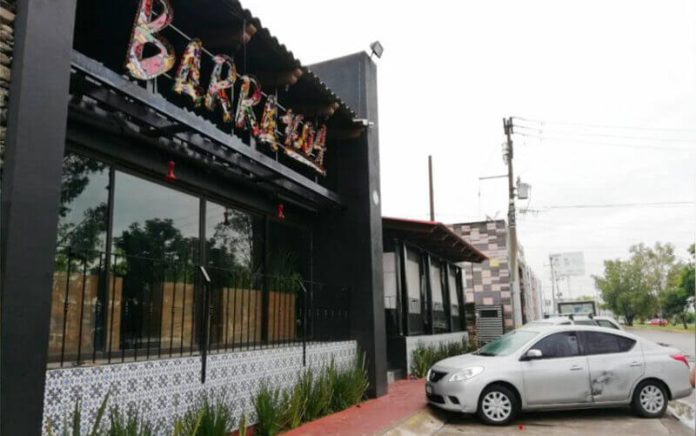
The Salamanca restaurant where a bomb was delivered Sunday.
Two men were killed and five other people were injured Sunday when a bomb disguised as a birthday present exploded in Salamanca, Guanajuato.
A courier on a motorcycle delivered a package with balloons attached to it to a restaurant/bar in the El Deportivo neighborhood on Sunday evening.
Owner Mauricio Salvador Romero and manager Mario Alberto Hernández took delivery of the package and were killed when it exploded seconds later.
Authorities are investigating what kind of explosive device was used in the attack.
Guanajuato Governor Diego Sinhué described the incident as “a terrorist attack unprecedented in the state.”
According to a report by the newspaper Milenio, Romero’s business – Barra – had been subjected to extortion demands for seven months prior to Sunday’s bomb attack. People who identified themselves as members of the Jalisco New Generation Cartel (CJNG) were demanding payments of 50,000 pesos (about US $2,500) per week.
Family members of Romero also told Milenio that complaints about the extortion were filed with the Guanajuato Attorney General’s Office but it took no action.
Romero’s brother claimed that the attack was designed to intimidate residents of Salamanca, a city of almost 300,000 people where violence and extortion are common.
“My brother and Mario were the victims but the message wasn’t just for them,” Eddie Romero said.
“… This was a message to say that they [the CJNG] are here, … that they’re not leaving. It’s a message to cause terror, to force us to lock ourselves away in our homes,” he said.
However, the head of the Guanajuato public security system said in an interview that “this event doesn’t coincide with the intimidatory characteristics” traditionally used by criminal groups in Guanajuato, where the CJNG and the Santa Rosa de Lima Cartel are engaged in a violent turf war.
Sophía Huett told Radio Fórmula that one line of investigation is that the explosive device was sent to Barra to settle a personal matter – the non-payment of the weekly 50,000 peso derecho de piso fee.
But she stressed that non-compliance with extortion demands was not the only possible motive under investigation.
In a separate interview, Eddie Romero urged authorities to not just deliver justice in the case but also guarantee peace in Salamanca, located in Mexico’s most violent state.
“My family and I are completely devastated, it’s difficult,” he said. “… Beyond justice we want peace for those of us who are still here, for those who live in Salamanca.”
Sunday’s bomb attack wasn’t the first time explosives have been deployed in the city. Explosive devices were found in vehicles near the Pemex refinery in 2019 and 2020. The Santa Rosa de Lima Cartel, which is reportedly backed by the Sinaloa Cartel, allegedly planted the bombs but none exploded.
“In the state of Guanajuato, more than in other places, for some time now they have begun using explosives to commit crimes, and to try to spread fear and terror,” President López Obrador said Monday. “This is a delicate situation.”
The writer and his daughter walking on Hualahuises' Hanging Bridge. Visiting here is about enjoying natural areas and the town's unhurried pace of life.
Whenever we tire of the dusty bustle of Linares, Nuevo León, my adopted city, my family packs some towels in a bag, slips into flip-flops and escapes to the neighboring town of Hualahuises.
To get there, you take the Old Road to Hualahuises (el viejo camino a Hualahuises). It is a glorious 13-kilometer drive through ejidos (communally owned land), farms and large ranches and past cornfields and acres of orange and grapefruit groves laden with fruit, the blue intensity of the Sierra Madre mountains shimmering before you like a mirage.
I am averse to religion, but as you enter the town, you become aware of an almost transcendental sense of peace and tranquility. With its long, straight, nearly traffic-less streets, Huala (as the locals call it) brings to mind Comala, the ghost town in the classic Mexican novel Pedro Páramo.
Half the population of Hualahuises either lives in the United States or works there seasonally as fruit pickers, mainly in Washington state — hence its nickname “HualaWashington.” Remittances provide a vital stimulus for the local construction industry, and returning families on vacation inject much-needed dollars into the economy.
Lying 118 kilometers southwest of Monterrey, the state capital, this rural town of 7,000 straddling the Hualahuises river was founded by the Spanish colonist Martín de Zavala in 1646 and first populated by small bands of indigenous Borrados and Gualagüises) as well as transplanted Tlaxcalans.
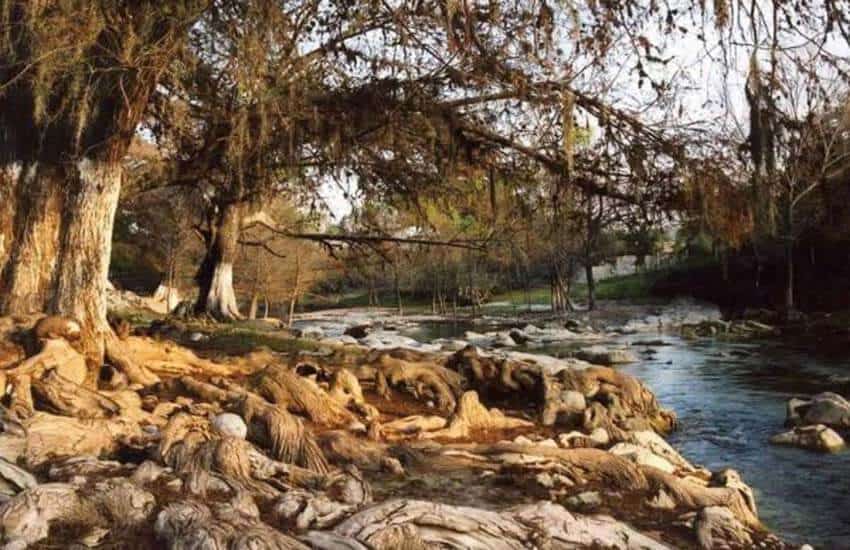
Enormous gnarled tree roots on the Hualahuises River.
Napoleón Nevarez Pequeño, the town’s official historian, or cronista (chronicler), dubbed the town “the Vatican of Nuevo León” not only because of its particular Catholic character but also because it’s the only municipality in the state surrounded on all sides by another municipality, i.e. Linares.
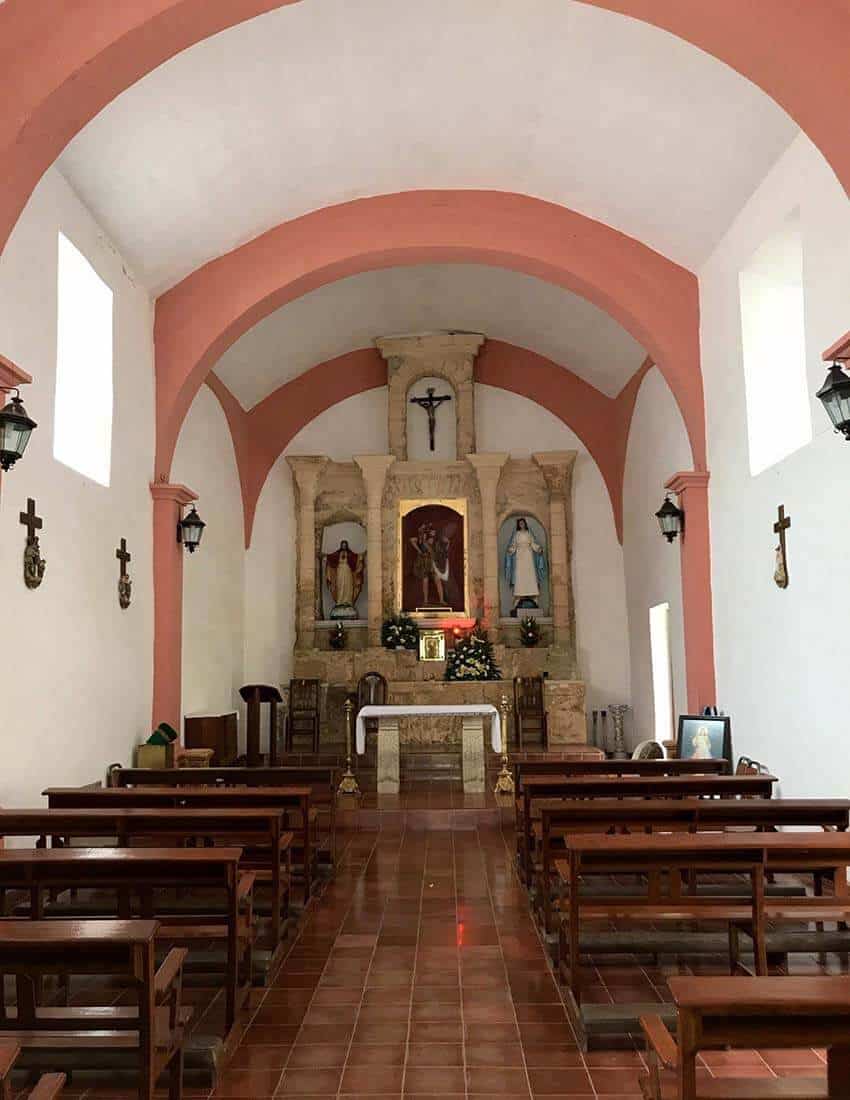
At the settlement’s founding, the Franciscans brought with them a carved wooden image of St. Christopher, one of three of its kind in Mexico. The locals adopted him as their patron saint.
Believed to be miraculous, the statue is housed in the Temple of St. Christopher downtown and is only removed from the church during religious feast days and processions.
Once, the story goes, when strangers attempted to make off with the statue, it grew so heavy that the astonished interlopers were forced to abandon it in the road. But when some passing farmers came upon it, they lifted it with ease and returned it to its rightful place.
I first visited Huala in December 2001. I was 28 and had just begun dating a young teacher from the school where we both worked.
On weekends, Verónica would drive us there in her big old red Chrysler junker, a cassette tape of Huapango music or the Beatles wafting through the open windows. I felt an immediate sense of inner calm and well-being and a reduction in stress and anxiety. I also loved how green everything was, with sabino, oak and fruit trees growing freely.
The Temple of St. Christopher, where an image of the town’s patron saint still sits since Franciscan monks brought it with the settlement of Hualahuises in 1646.
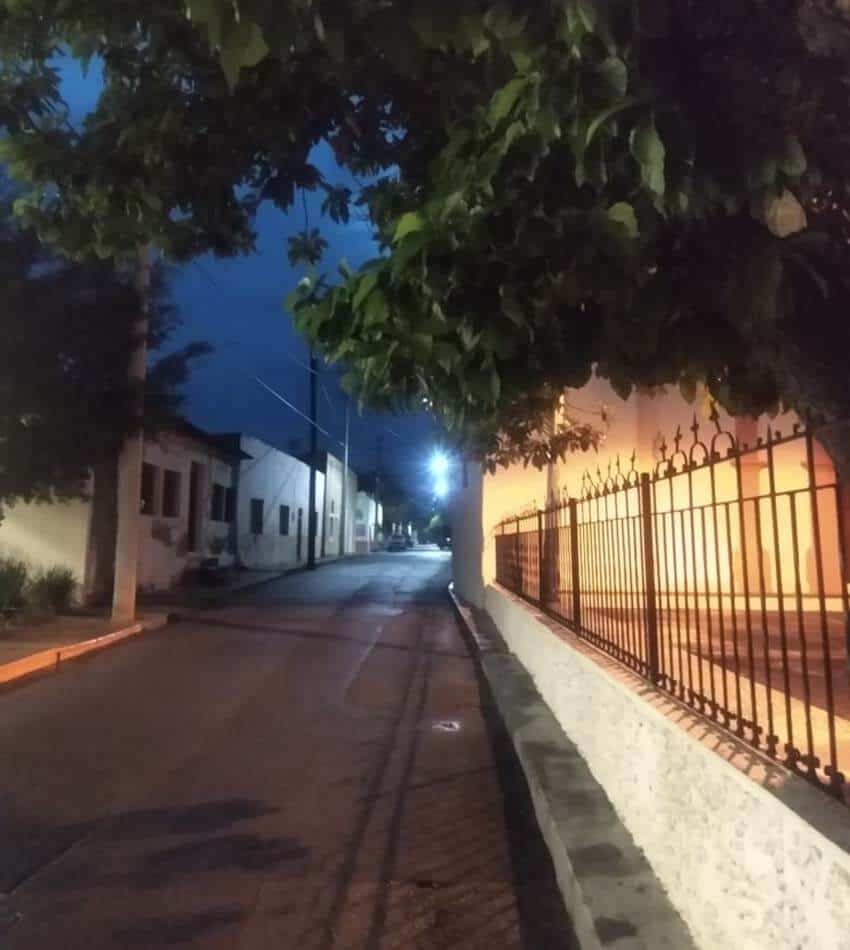
Twilight here is a rare delight. As evening’s shadows slowly lengthen, people sit outside their homes and sip a furtive Tecate while they talk over the day’s events and gossip with friends and neighbors.
Driving slowly along the silent, dimly illuminated streets, the sizzle of frying chicken or carne asada in back yards mixes with the sounds of conversation and light laughter.
A day-tripper might be tempted to dismiss the place as a sleepy backwater — “a hotbed of rest,” as the late Irish poet and travel writer Kildare Dobbs once sardonically described 1950s Ottawa — but this palpable peace cannot be put down solely to the absence of people. The inhabitants themselves exude an air of inner reserve and calm.
In almost 20 years of visiting Huala, I have never seen anyone here angry or aggressive — or even raising their voice. The people comport themselves with quiet dignity, and when they observe you, it is in a discreet manner, never in a way that causes visitors discomfort.
With my red hair, freckles and pasty white skin, the dogs in the street know I’m an outsider, but no one has once directed at me that coldest of Spanish words: extranjero.
The only commotion I ever witnessed there was when I, my brother and a mutual friend were chased by a red bull while exploring a secluded part of the river. A local woman was shocked to see three gringos, one of them a 6-foot-4 Newfoundlander, running toward her house in a state of barely suppressed panic.
Half the population of Hualahuises either lives in the United States or works in Washington state seasonally as fruit pickers, making for quiet streets much of the year.
In 2014, the dean of a local university, Ángel Alameda Pedraza, asked me to organize an international literary event with an emphasis on education. El Congreso de Lengua y Literatura (The Congress of Language and Literature) attracted writers from Mexico and around the world. Whenever I could, I would load up the car with authors and sneak them away to Hualahuises for a few hours.
I can still see Canadian poet Bruce Meyer sitting on a rock in his white Stetson safari hat, writing in his journal with a ballpoint pen while a white horse cropped grass on the opposite bank of the river. Bruce would write 29 poems about his experiences in Mexico, which I published in a bilingual edition called “A Linares” (To Linares).
Despite the book’s title, a number of the poems were set in Hualahuises. The white horse — which put Bruce in mind of the one running through the center of the city in Costa-Gavras’ political thriller film Z — features in his poem “Nadar at Río Hualahuises:” (Swimming at the Hualahuises River).
It is common for people from Linares, and even Monterrey, to drive here to sample the town’s excellent cuisine. Tacos Ibarra is famous throughout the region, while Restaurant El Puente is known for its traditional local specialties, including menudo (a thick broth), asado de puerco (pork stew) and guisado de res (beef stew).
My personal favorite is La Parrilla de Gil, a family-run eatery serving delicious tacos (carne asada, trompo, mixtos), hamburgers, tacos piratas and gorditas.
Over the years, our trips to Huala have become more frequent. From the moment I showed Kathleen and Emma how to swim in the clear, cold, shallow waters of the Hualahuises River, they always plead to come back.
A tranquil park in Hualahuises.
That river is part of us now; it runs through our veins.
Upriver from the famous Hanging Bridge (El Puente Colgante), there is a pool (charco, or “puddle,” in the local idiom) beneath the shade of an old sabino festooned with streamers of grey-green moss, where we like to bathe with frogs, darting sprats, and squirrels while entranced by the intermittent “hoo” of a hidden owl or the long ratcheting whine of cicadas on reverb.
[wpgmza id=”348″]
Having been raised in Lanesboro, a small rural Irish town on the banks of the majestic River Shannon, I am at home here among these big shady trees, the hearty fare, the charming country people and the laid-back pace of life.
Maybe that’s part of the spell of Hualahuises — maybe I have found my emotional correlative to Lanesboro here? Certainly, watching my daughters splash around and hearing their shrieks of laughter calls to mind my own early days, as to have children is to relive one’s own childhood.
Colin Carberry is a Canadian-born and Irish-raised writer who lives in Los Linares, Nuevo León, with his wife and two daughters. He has published four poetry collections and his work has appeared in publications in North America, Europe and Asia.
Deputy Arturo Lemus, right, with his son Mario, who was killed Sunday in Zapopan, Jalisco. File photo
The murdered son of a state lawmaker in Jalisco was a singer and composer of narcocorridos, a genre that glorifies and pays tribute to narcos.
Some of the songs by Mario Alberto Lemus Romero, which were uploaded to YouTube, were dedicated to the alleged leader of the Jalisco New Generation Cartel (CJNG), Nemesio “El Mencho” Oseguera Cervantes.
Lemus, 18, son of Morena Deputy Arturo Lemus Herrera, was killed Sunday by four men in a cemetery in Zapopan, Jalisco, 15 kilometers from the center of Guadalajara. He was declared dead at the scene by emergency personnel.
His brother, who witnessed the attack, suffered a nervous breakdown.
The song El Imperio del Árabe 7-7, or The Arab’s Empire 7-7, on which Lemus is a featured vocalist with the band Banda Puro Grullo, was uploaded to YouTube on September 5 and has had more than 16,000 views. A photo of Oseguera appears as a backdrop to the video, and references are made to him within the song.
The song title and the name of Lemus’ former band, Mario Lemus y Su Código 7, also make oblique references to José Luis Gutiérrez Valencia, a CJNG operative who was known by the alias 7-7.
In the song El Grande or The Great, Lemus pays tribute to Gutiérrez, who died in a shootout in 2017, singing, “With respect … there will never be another one like you.”
In the wake of the murder, Jalisco Governor Enrique Alfaro Ramírez extended his condolences to the Morena deputy.
“I want to express my condolences to Deputy Arturo Lemus Herrera for the cowardly murder of his son Mario. I know there are no words for these moments of pain. I have instructed the prosecutor’s office not to pause the investigations until the facts are clarified and those responsible are found,” he said in a tweet.
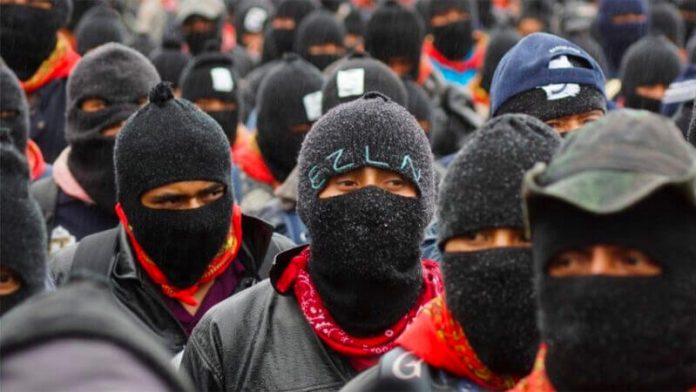
The Zapatistas issued a rambling communique this week.
The Zapatista Army of National Liberation (EZLN) – an organization best known for staging an armed uprising in southern Mexico in January 1994 – has released a statement warning that Chiapas is on the verge of civil war.
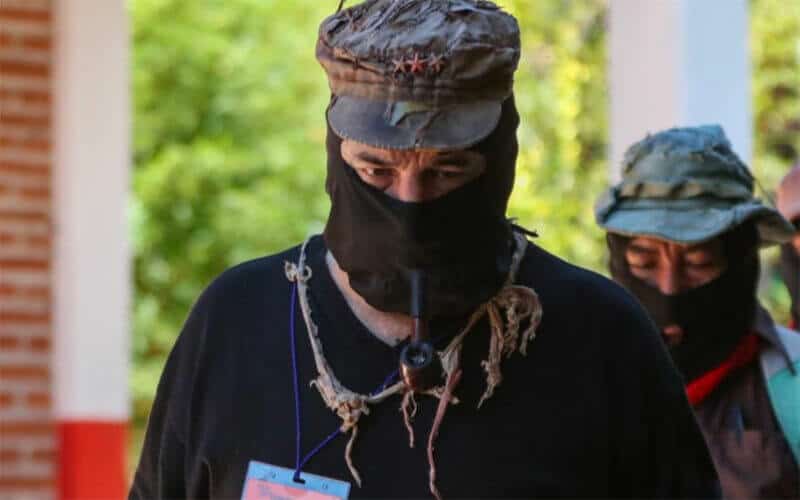
Endorsed by Zapatistas’ leader Subcomandante Galeano, the communique denounced the abduction of two EZLN members by a paramilitary organization at the service of the Chiapas government led by Morena party Governor Rutilio Escandón.
“On September 11, 2021, in the early morning, while the Zapatista air delegation was in Mexico City, members of ORCAO [the Regional Organization of Ocosingo Coffee Growers] – a paramilitary organization serving the Chiapas state government – kidnapped the compañeros Sebastián Nuñez Pérez and José Antonio Sánchez Juárez … from the Good Government Council of Patria Nueva [New Homeland], Chiapas,” the statement said.
The Zapatistas, who control a significant amount of territory in the state, asserted that ORCAO is “a political-military organization with paramilitary characteristics: they have uniforms, equipment, weapons, and ammunition purchased with money they receive from [government-sponsored] ‘social programs.’”
“… They fire on the Zapatista community of Moisés y Gandhi every night with these weapons,” the communique said.
EZLN leader Subcomandante Galeano.
The kidnapping victims were released on Sunday eight days after they were abducted “thanks to the parish priests of San Cristóbal de las Casas and Oxchuc, of the San Cristóbal diocese,” the EZLN said after claiming that the Chiapas government had attempted to sabotage their rescue.
“The compañeros were robbed of a walkie-talkie and 6,000 pesos in cash belonging to the Good Government Council,” the statement said.
“… The only reason the conflict did not escalate into a tragedy was due to the intervention of the parishes mentioned above, human rights organizations, and the mobilizations and denunciations carried out in Mexico and, above all, Europe. The misgovernment of Rutilio Escandón is doing everything possible to destabilize … Chiapas.”
The EZLN accused the state of a laundry list of abuses, asserting that it violently represses student teachers, sabotages agreements between teachers and the federal government, protects drug gangs and finances paramilitary groups.
“Its vaccination campaign is purposefully slow and disorganized, creating unrest in rural communities that it will no doubt exploit. Meanwhile, the rising COVID deaths in these communities are ignored,” it added.
“Its officials are stealing everything they can from the state treasury, perhaps preparing for a federal government collapse or betting on a new party coming into power. And now they want to sabotage the departure of the Zapatista delegation participating in the European chapter of the Journey for Life,” the statement said, referring to a group of Zapatistas – the so-called “air delegation” that departed for Europe by plane on September 13.
“They ordered their ORCAO paramilitaries to kidnap our compañeros, leaving the crime unpunished, and trying to provoke a reaction from the EZLN, all in a state where governability hangs by a thread.”
The Zapatistas also claimed that the Ecological Green Party is really in power in Chiapas but currently “badly disguised” as Morena, the party founded by President López Obrador.
In addition to accusing Escandón of abuses, the EZLN took aim at state government secretary Victoria Cecilia Flores Pérez.
“If what they [Escandón and Flores] want is to topple the federal government, or to cause problems in retaliation for the current federal criminal investigations against them, or to support one of the factions competing for power in 2024, then they should use the available legal channels and stop playing with the life, liberty, and property of the people of Chiapas. They should call for a vote to revoke the presidential mandate and stop playing with fire because they’re going to get burned,” said the rambling and somewhat deranged communique entitled Chiapas on the Verge of Civil War.
The EZLN called for foreigners and Mexicans to protest on Friday in front of Mexican embassies and consulates and at the government offices of the state of Chiapas to demand “an end to their provocations and renunciation of their death cult.”
“Given the actions and omissions of the state and federal governments regarding these crimes and previous ones, we will take the necessary measures to bring justice to the criminals in the ORCAO and the government officials who sponsor them. That is all. Next time there won’t be a communique. That is, there won’t be words, only actions,” concluded the statement issued from the mountains of southeastern Mexico.
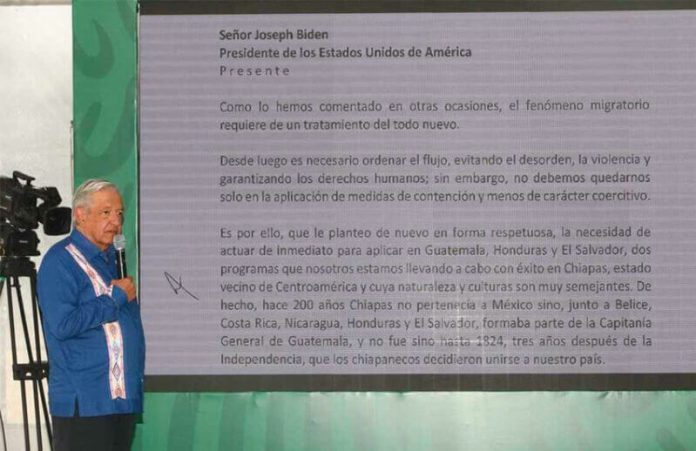
López Obrador reads his letter to reporters on Monday.
President López Obrador has disclosed a letter he sent to United States President Joe Biden to seek his government’s financial support for the implementation of two employment programs in Guatemala, Honduras and El Salvador.
López Obrador presented his letter – which also asks Biden to consider offering temporary work visas to participants in the programs – at his morning press conference on Monday.
“As we have mentioned on other occasions, the migratory phenomenon requires a completely new treatment,” opens the letter, dated September 7.
“Of course ordering the [migratory] flow, avoiding disorder and violence and guaranteeing human rights is necessary. However, we mustn’t limit ourselves to the application of contention measures, especially ones of a coercive nature,” López Obrador wrote, perhaps referring to Mexican authorities’ recent use of force to detain migrants in the south of the country.
In that context, the president proposed once again the extension of his government’s tree-planting employment program Sembrando Vida (Sowing Life) and the apprenticeship scheme Youths Building the Future to the northern triangle Central American countries.
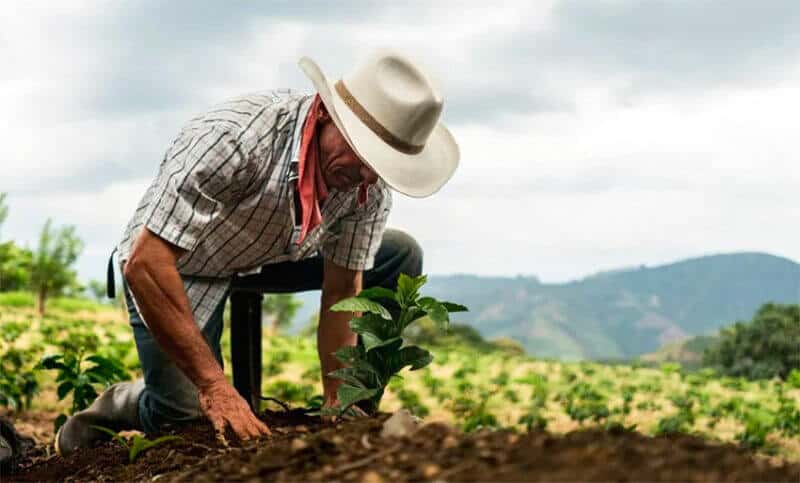
A farmer plants a tree under Mexico’s Sembrando Vida.
He suggested that the size of the programs in each of Guatemala, Honduras and El Salvador be the same as those already underway in Chiapas.
“Today we’re planting 200,000 hectares of fruit and timber-yielding trees in Chiapas, and that program provides work to 80,000 planters who receive a salary to cultivate their land. This same procedure can be immediately applied in the three Central American countries of greatest migration (Guatemala, Honduras and El Salvador), through which the area of sowing would expand by 600,000 hectares and employment would be provided to 240,000 farmers,” said the letter, dated two days before the federal government announced that the United States had agreed to collaborate with Mexico on employment programs in the south of the country and Central America.
“Another of our relevant social programs that is being applied in Chiapas consists of providing work as apprentices to 30,000 young people who receive a minimum wage in order to undertake training in workshops, companies and in other productive and social activities. If this action was immediately applied in Guatemala, Honduras and El Salvador, 90,000 people among those who emigrate due to a lack of work could be kept in their countries of origin,” López Obrador said.
The president noted that a total of 330,000 Central Americans could be supported by the programs, which he estimated could commence within six months. If the U.S. government agrees to support the programs financially, the Mexican government will be “fully willing” to collaborate, López Obrador said, pledging that it would provide advice, experience and labor.
“Mr. President Biden, to the measures signaled, I add another that we believe is very effective: signing agreements with those registered in these programs to offer them in the medium term – in an orderly way and in accordance with demand – temporary work visas for the United States,” he wrote.
“Nobody would be harmed by that because it’s known that the great nation you preside over needs an additional workforce to boost economic growth, strengthen production and reduce imports from Asia,” the letter said, adding that the United States will need a “great army of workers” to construct a range of infrastructure projects the Biden administration intends to build.
“… I believe that the combination of these circumstances opens up a perfect opportunity to plan, put order to and humanize migration flows.”
The United States hasn’t publicly indicated any support for the president’s temporary work visa proposal.
“The government I represent respectfully calls on the United States government to lift the blockade against Cuba,” he said at an Independence Day event last Thursday. “Because no state has the right to subjugate another people, another country.”
The president appears to be trying to distance Mexico from the United States while paradoxically and simultaneously seeking a more collaborative relationship.
Perhaps wary that his government is perceived as being subservient to the United States by deploying security forces to halt the advance of migrants to the northern border, López Obrador seems keen to highlight that Mexico is also prepared to take positions that are very different from those of its powerful neighbor.