Home Blog Page 1163

Refugee agency pleads for more money amid flood of Haitians into Mexico

0
migrants in chiapas
Agency says it needs nearly double the amount allocated to deal with refugee claims.

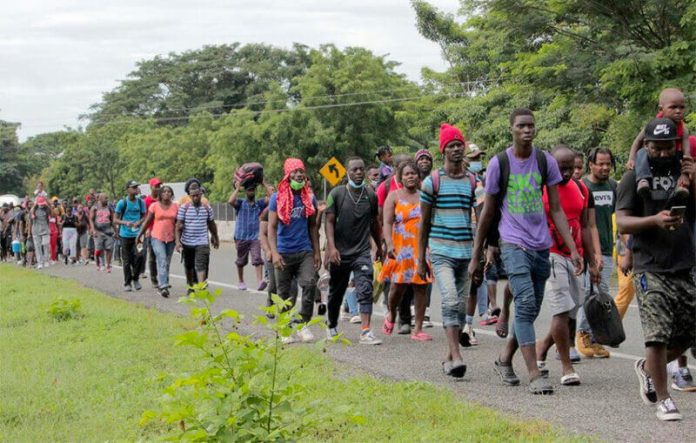
As record numbers of migrants stream into the country, a government agency at the forefront of responding to the influx is facing a budget cut, prompting its chief to appeal to Congress for more money.

Almost 80,000 migrants, including large numbers of Haitians, have applied for asylum after crossing into the country via the southern border this year.

More than 110,000 claims are expected to have been filed by the end of the year, a figure more than 40% higher than the existing annual record.

The agency responsible for processing the claims is the Mexican Commission for Refugee Assistance (Comar), but despite the immense pressure it currently faces, the Finance Ministry last week proposed cutting its 2022 budget by more than 2% to 45.67 million pesos (US $2.3 million).

In an interview with media outlet Grupo Imagen, Comar chief Andrés Ramírez Silva said the agency needs at least 42 million additional pesos to meet the high demand for its services. That amount would allow Comar to hire an additional 148 workers to process asylum claims, he said.
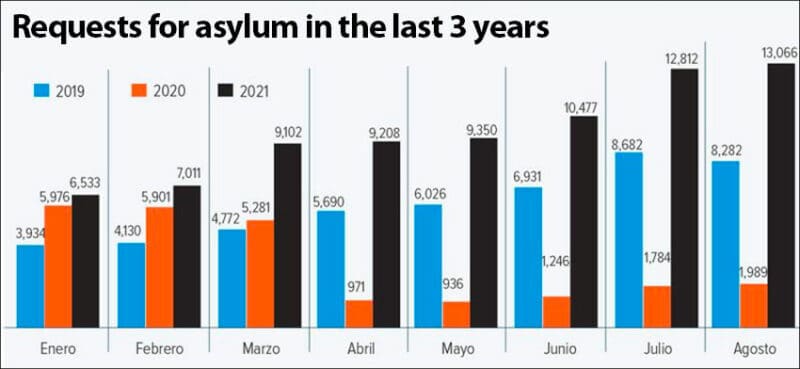
Asylum requests in the first eight months of each year since 2019.
Asylum requests in the first eight months of each year since 2019. excélsior

In a separate interview with the newspaper El Universal, Ramírez said the agency faces a difficult situation and called on Congress, which must approve the Finance Ministry’s budget for it to take effect, to be “receptive” to Comar’s plea for additional funding.

He claimed that the resources allocated to the agency are insufficient and that the government’s proposed funding fails to acknowledge the situation it faces.

“… To determine the budget, the [current] operational capacity [of Comar] has to be taken into account because it’s [the agency] that attends to refugees,” Ramírez said before calling on the Congress to be “conscious” of its predicament.

Asked whether he expects the Congress to be understanding and increase Comar’s budget, he responded:

“I always hope [that it will be] but I know that it’s not that easy – it’s complex, but every year we’re always hoping for a better budget.”

Ramírez said funding from the United Nations refugee agency has been significant in recent years and could help Comar mitigate its shortfall but that depends on the number of migrants who arrive on the southern border with Guatemala.

He described the current situation in the southern border region – where several migrant caravans have been confronted recently by authorities after leaving Tapachula, Chiapas, before their asylum claims were processed – as unprecedented.

“The number of people arriving is really unusual. We’ve never had anything like it in the history of Mexico,” Ramírez told El Universal.

“[Arrivals in 2021] far exceed what we had in 2019, when we reached 70,400. That figure was surpassed by 10% at the end of August,” he said.

The arrival of 77,559 migrants in the first eight months of the year has placed Comar in “a really overwhelming situation,” Ramírez said, adding that the agency’s office in Tapachula – located just north of the border with Guatemala – is on the brink of collapse.

He attributed the situation to the “enormous pressure” placed on Comar by “a very large avalanche of Haitians,” who have fled the Caribbean country due to poverty and crime exacerbated by natural disasters and political unrest.

Ramírez noted that Haitians have arrived in Mexico after passing through countries such as Brazil and Chile, and claimed that they are not genuine refugees because they didn’t seek asylum in those nations.
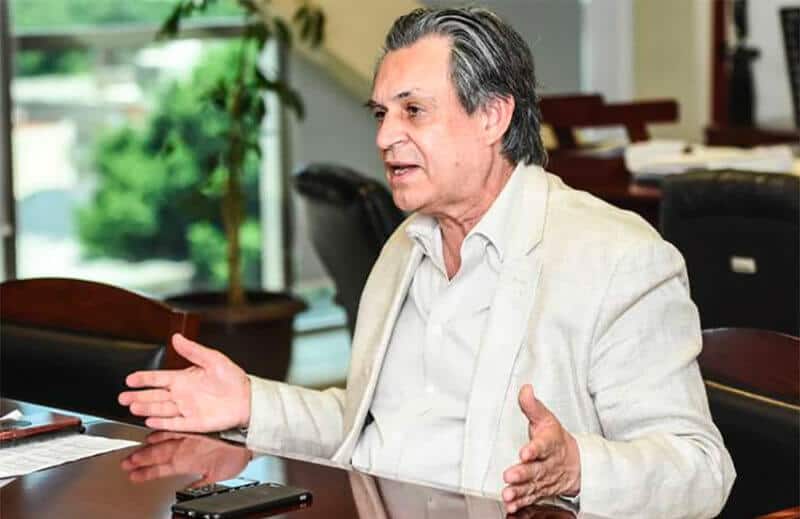
Refugee agency chief Ramírez.
Refugee agency chief Ramírez: ‘We’ve never had anything like it in the history of Mexico.’

“… They’re people who are not refugees because they don’t fit within the … [definition] of a refugee to the extent that they are coming from countries where there is not a concrete situation of persecution or violation of their rights,” he said, even though international law doesn’t explicitly require refugees to claim asylum in the first “safe” country they reach.

Although he claimed Haitians in Mexico are not genuine refugees, Ramírez said it’s “absolutely clear to everyone” that they can’t be deported to Haiti because the country’s political system is in ruins, its president was assassinated in July and it suffered a devastating earthquake in August.

“The situation is extremely complicated and what they’re seeking are migratory alternatives [to claiming asylum in the first country they reach]. … Nevertheless, we have to attend to them, that’s what the law establishes. We are attending to them, but people of many other nationalities are also arriving,” Ramírez said, referring to migrants from Honduras, El Salvador, Guatemala, Venezuela and Cuba.

He said the number of Haitians who have arrived in Mexico this year is already triple the number that arrived in 2020.

“Due to the pandemic there was a significant decrease in migrant numbers [in 2020] for practically all nationalities but one of the important exceptions was Haiti. There was a record of 5,957 [Haitian] asylum seekers in 2020 but … in the first eight months [of 2021] … we had triple that number with 18,883,” Ramírez said.

“The issue is the bottleneck that Tapachula represents, because that’s there where the vast majority of people enter [the country], 70% [of migrants] are concentrated in Tapachula. … We’ve increased our personnel, we’ve had a lot of support from the Office of the United Nations High Commissioner for Refugees,” he said, explaining that the agency has provided resources to employ more Comar staff and train them.

However, more personnel are needed, Ramírez added, highlighting that staff members with Haitian Creole language skills are in particularly short supply.

“The lack of translators is an additional complication … that we don’t have with the majority of other asylum seekers who speak Spanish. … The Haitians speak Creole [but] we don’t have many people who speak Creole. We have four interpreters but that doesn’t allow us to keep up. We’re going to have more interpreters, who will arrive in the coming days. We’re going to have a total of seven,” he said.

“… [The lack of interpreters] slows down the [asylum seeking] process. … It’s a very delicate matter, we’re talking about people’s lives. However, the Mexican authorities clearly understand that we can’t deport … these people to their country of origin.”

That leaves Mexico in a difficult position because it is also facing pressure from the United States to stem the flow of migrants to its southern border.

One option is to deport Haitians to another country, as Mexico did on the weekend by sending some 150 back to Guatemala, according to migrant advocacy group Pueblos Sin Fronteras. But those migrants will in all likelihood enter Mexico again.

Another option is to resettle Haitians in Mexico in cities such as Mexico City and Tijuana, where there is already a community of Haitian migrants. But that alternative would not necessarily stop Haitians from seeking asylum in the United States, and if they do so in large numbers, Mexico runs the risk of once again upsetting its powerful northern neighbor (as occurred in 2019), even with a more migrant-friendly president in the White House.

With reports from El UniversalExcélsior, La Jornada and El Economista 
A week on, homeless earthquake victims in Guerrero protest lack of aid

0
An estimated 15,000 people were affected by the 7.1-magnitude quake.

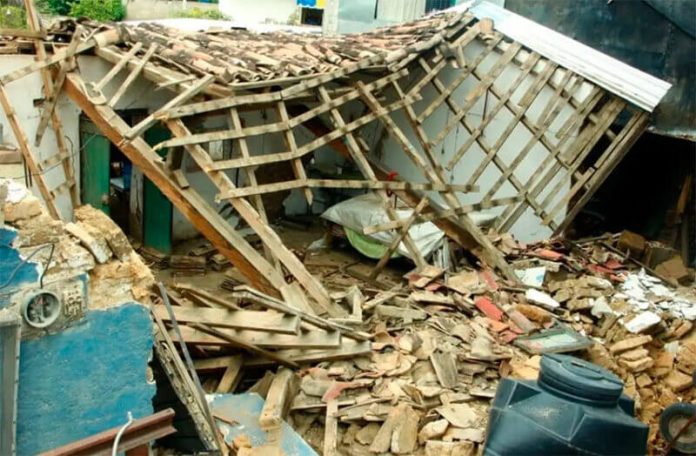
No major damage was initially reported but it has come to light that last Tuesday’s powerful earthquake damaged almost 8,000 homes in Guerrero.

Governor Héctor Astudillo said Sunday there were reports of 7,800 damaged homes and 15,000 people affected by the 7.1-magnitude quake.

“Without a doubt, it must be said, the earthquake has revealed its reach to us. Up until today, the damage is very different” than we initially thought, he said.

The governor said that 694 of the damaged homes are in Acapulco, located just 14 kilometers from the quake’s epicenter.

Homes, schools, hospitals, hotels, churches and other buildings were also damaged in municipalities such as Chilpancingo, Coyuca de Benítez, Atoyac de Álvarez and Chilapa de Álvarez.

Casas y comunidades abandonadas: los daños que dejó el sismo en Guerrero

Astudillo called on the federal government to help repair the damage and provide assistance to victims.

His remarks came after families from Xaltianguis, a town 40 kilometers inland from Acapulco, blocked the Chilpancingo-Acapulco highway for more than three hours on Saturday to protest the lack of government assistance after their homes were damaged in the earthquake.

The residents only agreed to lift their blockade after Astudillo arrived and pledged to send sleeping mats to the town as well as Civil Protection personnel to inspect the 450 severely damaged homes, among which were 150 that collapsed.

In Chilpancingo, 60 families who live in a government-built residential development were forced to abandon their homes after last week’s quake, the newspaper Reforma reported.

“We’re definitely not going back because the houses have cracks and with another slight quake they’ll come down,” said one resident.

Edith Díaz Gómez said that some families have gone to shelters but most are bunking down with relatives.

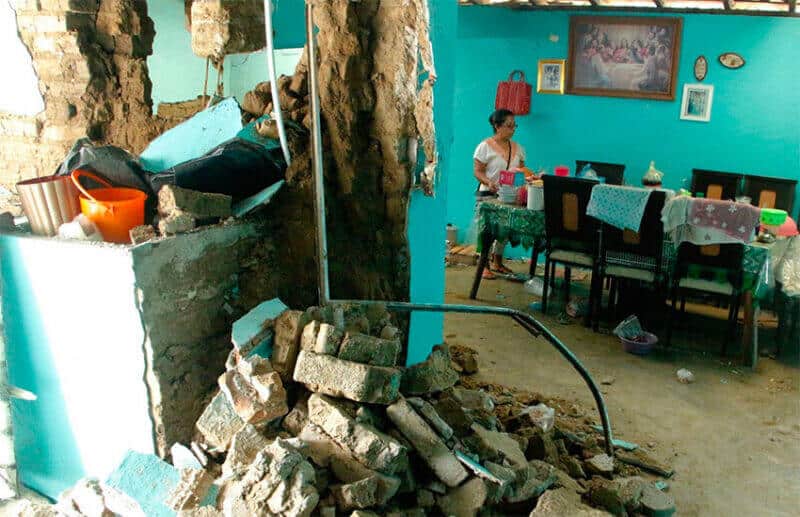
Life goes on in a Guerrero home
Life goes on in a Guerrero home where a wall collapsed.

“We’re going to ask the government to pay the monthly rent for a house because it’s impossible for us to continue living with our relatives,” she said.

In some other Guerrero communities, families have been sleeping outside due to fear their homes could collapse in another quake or aftershock, of which there have been hundreds since the strong temblor struck just before 9:00 p.m. last Tuesday.

Astudillo said the victims’ plight was worsened by rain and stressed the importance of “solidarity” during the trying times.

Some Guerrero residents were also left without power for days after the earthquake but the governor said Sunday that service had been restored across the state with the exception of just a few communities.

Felt in at least 13 states, the quake caused three deaths, including that of a 14-year-old boy in a rural area of the municipality of Acapulco. He and one other person were crushed by walls that fell amid violent shaking while a third person was killed by a lamppost that toppled during the temblor.

With reports from Reforma, Milenio, Televisa and Animal Político 

Government warns another 120 homes in danger due to risk of second slide

0
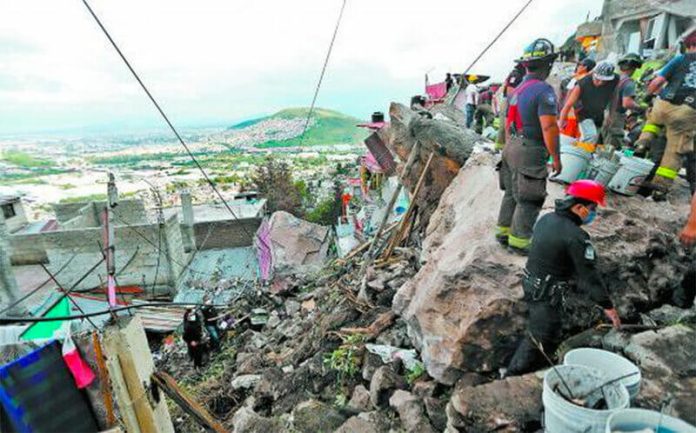
Rescue workers in Tlalnepantla after Friday's slide.
Rescue workers in Tlalnepantla after Friday's landslide.

A high probability of another landslide on the Cerro de Chiquihuite (Chiquihuite Hill) on the boundary of Tlalnepantla and the Mexico City borough of Gustavo A. Madero means that 126 homes must be evacuated, government officials said.

One person was killed when 200 tonnes of rock and earth swept through at least 10 homes in a landslide on Friday. A mother and her two children are still missing, according to a report by the newspaper La Jornada. There were originally thought to be 10 people missing, one of whom was rescued with severe injuries, the newspaper Milenio reported. México state Governor Alfredo del Mazo said it was likely that heavy rains and the 7.1-magnitude earthquake last Tuesday had caused the landslide.

Authorities have increased the call for evacuation from 80 homes to 126. Four temporary shelters have been opened to receive evacuees, but so far only around 50%, or 76 people, have responded to the request. The newspaper El Universal reported Sunday that almost 200 people in 92 homes were yet to leave.

More than a thousand sandbags have been laid to create a retaining wall to stabilize the dislodged boulders. Search operations involving rescue dogs to find the three missing people continue.

State official Ricardo de la Cruz Musalem explained at a press conference that topological transformations on the hill made it unsafe. “There are rocks that ended up underneath one another and under some houses. That’s why I reiterate the call for people to evacuate,” he said, and added that a high concentration of water on the hill increased the danger.

Cerca de 200 personas se oponen a evacuar zona de riesgo del Cerro del Chiquihuite

He added that evacuating was the best way to avoid tragedy. “It is very difficult to leave the heritage they have built for a generation or even several, but it is much worse to be searching for a loved one,” he said.

Tlalnepantla Mayor Raciel Pérez said illegal housing, facilitated by corruption, had increased the risk. “In this area there is urban growth based on corruption, a black market for land use. Overnight there were changes in land use, despite the dangers in the area,” he said.

At least one resident of Chiquihuite Hill noticed six waterfalls had formed on the hill during heavy rains prior to the landslide.

Leonel Carrasco, another resident, confirmed that local people had seen warning signs, and alerted authorities beforehand. “Since the rains began we felt a lack of stability in the earth. There have been other landslides, but this one was deadly. We asked the local government for geological studies to determine the stability of some land, but there was no response,” he said.

With reports from Jornada, Milenio and El Universal

Theft continues to create big losses for electricity commission

0
Some suspicious-looking connections on utility poles in Mexico City.

The federal government has failed to reach its targets to reduce electricity theft, a practice that costs the state-owned Federal Electricity Commission (CFE) approximately 50 billion pesos (US $2.5 billion) per year.

The government’s ultimate aim is to reduce theft to a figure equivalent to 7.8% of total CFE sales.

That target, which the López Obrador administration hopes to hit in 2024 – the final year of its six-year term, is just below the 8% international reference, according to a report by the newspaper El Universal.

But judging on past performance, achieving the goal appears unlikely.

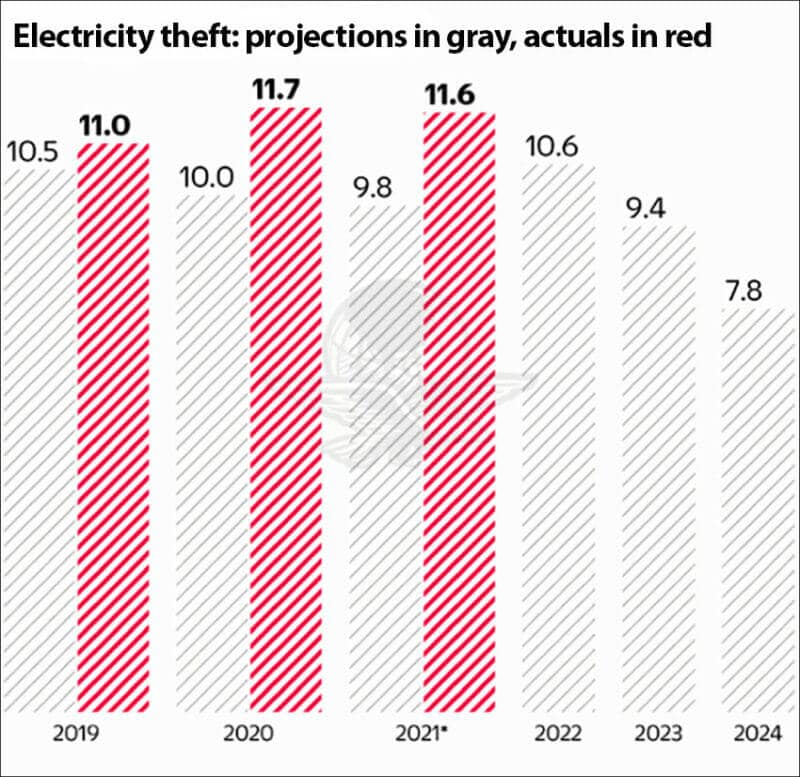
Losses due to theft were equivalent to 11% of sales in 2019, 0.5% higher than the target set by the federal Energy Ministry (Sener).

Unmet targets for controlling electricity theft.
Unmet targets for controlling electricity theft. Figures for 2021 are for the first half of the year.

They rose to 11.7% of sales last year, 1.7% above the goal, and based on figures for the first half of 2021, losses this year will amount to 11.6% of revenue.

That’s despite an investment of more than 8.8 billion pesos (US $443 million) in 2021 to reduce theft and stem the losses.

Illegal hook-ups, known colloquially as diablitos, and meter tampering are the most common ways in which electricity theft occurs. Street stall proprietors, market vendors and homeowners are among the culprits.

According to the Program for the Development of the National Electricity System, a multi-year plan published by Sener in June, the crime is common in “irregular” low socioeconomic neighborhoods, or shanty towns.

There are almost 41,000 electricity users in such settlements who don’t have CFE contracts, Sener said, adding that it is aiming to sign them up as customers as part of efforts to control power theft losses.

Sener also said there are almost 5.8 million meters that must be replaced in the next five years because they have reached the end of their useful life or are regularly tampered with by customers seeking to reduce their electricity bills.

With reports from El Universal 

Mexico’s War of Independence 101: a quick overview for newbie expats

0
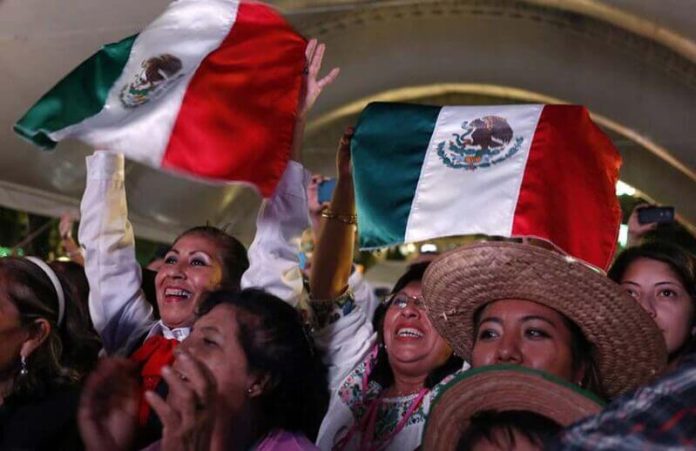
Mexicans celebrate the Cry of Dolores in Puebla
Mexicans celebrate the Cry of Dolores in Puebla.

So Mexican Independence Day is coming up, and if you’re not Mexican you probably wonder: why do the festivities start the night before?

Well, Mexicans’ love of partying may be part of the reason but not the main one. It has to do with how independence from Spain was achieved.

Mexico’s struggle came at a time when much of the New World was itching to throw off European rule and Spain was weak because of Napoleonic invasion and internal instability. The War of Independence wasn’t one campaign led by the same set of actors from beginning to end. It was a series of insurrections for over a decade in danger of collapsing on more than one occasion.

The first of these insurrections was led by Miguel Hidalgo, the name most strongly associated with the Independence story. He has a street named after him in the center of just about every town or city.

Hidalgo is considered to be the father of his country, but he was also a “father” in the sense that he was a priest — and despite this, because he sired five children that he acknowledged. (¡Viva México!) It is because of him that Independence Day celebrations begin late on September 15 even though the official holiday is the 16th.

Miguel Hidalgo portrait from Museum of Independence
Portrait of Miguel Hidalgo that hangs in the Independence Museum in Dolores Hidalgo, Guanajuato.

At 11 p.m. on September 15, 1810, Hidalgo climbed the bell tower of the church in Dolores (now Dolores Hidalgo), Guanajuato, to call the parishioners and exhort them to overthrow the colonial government. He had been planning a rebellion with others in Querétaro, but the plot had been discovered, so his choices were to start immediately or get arrested.

Little did he know how quickly the small crowd that night would swell as it marched toward Mexico City.

With mayhem along the way, the mob/army made its way to the outskirts of the Valley of México. There they defeated the royal army at Monte de las Cruces, but in a decision that still causes debate, Hidalgo decided not to descend into the capital but rather retreat to Guadalajara.

Eventually, this decision cost Hidalgo his head, literally, as it was hung from the Alhondiga building in Guanajuato after his execution in Durango.

Hidalgo’s insurgency lasted less than 10 months, but it is the best remembered. After his death, the fighting waned in central Mexico but resurfaced elsewhere, especially in Morelos, Guerrero and Oaxaca. Several important leaders emerged, including Mariano Matamoros, Vicente Guerrero, Guadalupe Victoria and Ignacio López Rayón.

The movement, however, coalesced around José María Morelos. His importance is such that he appears alongside Miguel Hidalgo on the new 200-peso bill. He understood military tactics better than Hidalgo and brought guerilla strategies into the struggle.

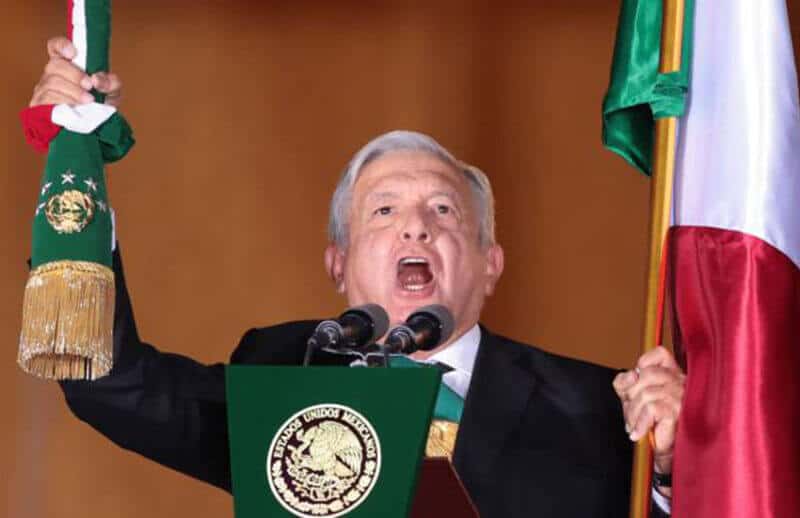
AMLO reenacts the Grito de Dolores in National Palace
President López Obrador reenacts the Grito de Dolores at the center balcony of the National Palace in Mexico City. Leaders at all three levels of government do this ritual.

Morelos and the other rebels mentioned above also had political skills. They formulated documents called “plans” to articulate their goals and rationales. This concept would be central in the chaotic century that followed Mexico’s separation from Spain.

I should mention that many current history books list Morelos as a mestizo — someone whose ancestry was a mix of Spanish and indigenous. However, at the time of his birth, he was classified as “Spanish” (likely criollo, i.e., a child who had been born in the New World whose parents had been born in Spain), even though he did have some indigenous ancestors on one side of his family.

This may reflect the attitudes of both time periods since he was a descendant of the conquistador Hernán Cortés, but today’s politics favor historical figures of indigenous or mixed heritage in a number of ways.

Morelos’s primacy lasted from 1811 to 1815. His success in the south of the country forced the Spanish viceroy to reorganize his army. But Morelos was captured, interrogated, tried and executed by firing squad. With his death, the insurgents abandoned any form of conventional warfare.

The next major phase came under the leadership of Vicente Guerrero, a mestizo with African heritage. With the death of Morelos, the viceroy thought the rebellion was all but over and even offered amnesty to insurgents. Many accepted, only to take up arms again when the opportunity arose.

This phase of the war, from 1816 to 1820, was a kind of stalemate between insurgents and royal forces. Insurgents attacked roads and convoys but launched few major attacks.

Agustín de Iturbide entering Mexico City in 1821
Agustín de Iturbide entering Mexico City in 1821. His name is relatively unknown although he was Mexico’s first head of state.

But Spain itself was embroiled in internal struggles after Napoleon was ousted in 1813. Support for royal troops in Mexico was lacking. A number of royal officers, Agustin de Iturbide among them, saw the writing on the wall, especially when a December 1820 offensive failed to decisively destroy the insurgents.

However, the insurgents were not in a great position either. Despite the fact that mestizo rebels had done most of the heavy lifting for a decade, it seemed rather likely that the criollo class would take over an independent Mexico (and indeed, that is what happened). Guerrero decided that his best bet was to join forces with Agustín de Iturbide’s faction and force the viceroy to accept an independent Mexico.

This viceroy, Juan O’Donojú, was indeed the last to rule New Spain in the king’s name.  He signed the Treaty of Córdoba acknowledging Mexico’s independence on September 27, 1821, 11 years after Hidalgo rang the church bell in Guanajuato.

Spain did not immediately recognize this treaty, and it would take several more years before Mexican troops would expel the last of the Spanish army from the port of Veracruz, the same place where Cortés had invaded Mexico 300 years before.

Mexico’s Independence Day begins the night before with a reenactment of Hidalgo’s Grito de Dolores (Cry of Dolores). This reenactment is done at exactly 11 p.m., one of the few things that must be done on time here. When I attended my first Grito reenactment at Mexico City’s zócalo in 2005, President Fox arrived late, and the crowd responded by calling him an obscene term.

Everywhere across the country, after the leader of the country and those of the states and municipalities repeat Hidalgo’s words (more or less) and ring the bell, fireworks — and, yes, lots of drinking — commence until the early morning hours.

Grito de Independencia 209 Aniversario. Presidente AMLO

Leigh Thelmadatter arrived in Mexico 18 years ago and fell in love with the land and the culture in particular its handcrafts and art. She is the author of Mexican Cartonería: Paper, Paste and Fiesta (Schiffer 2019). Her culture column appears regularly on Mexico News Daily.

Is inclusive language here to stay? Either way, a little respect never hurts

0
Replacing the gendered "o" or "a" in Spanish words with an "e" is one proposed (and often mocked) way of making language more inclusive.

Last week, as soon as I saw it, I clicked on Peter Davies’ piece on the use of inclusive language in Mexico. It’s a topic I’ve wanted to write about for years now but haven’t dared.

It’s highly emotional for some, and when high emotional loads are in the mix on any subject, no amount of nuance and thoughtfulness, especially from someone like me who is trying to understand and be sympathetic but mostly doesn’t have a clue, is generally appreciated.

But now that the box has been opened, I’d like to weigh in, since language and its relationship to culture are both of deep importance and of interest to me. And since the bulk of my income these days actually comes from translating, it’s not simply an issue of armchair philosophy; it has real implications for my work.

As anyone who speaks even rudimentary Spanish knows, the plural of articles (those words like el/la, un/una, etc.), as well as those of nouns and adjectives default to the masculine when you are talking about a group with both genders. So, for example, the most likely translation for los niños ruidosos is “the loud children,” a group that probably includes both boys and girls.

However, it could also refer to loud boys and not include girls at all. But, it definitely could not mean “the loud girls” — at least not exclusively. Even if there were a group of nine girls and one boy, in Spanish, the male gender is still the default when you pluralize.

I was in college and very new to the Spanish language when then-president Vicente Fox began referring to children as niños y niñas rather than simply niños. While some linguistic purists thought it was a ridiculous gesture, I appreciated it. It did make me feel that girls were being as specifically included and given as much importance as boys, rather than simply assumed to have been (perhaps) mixed in with them.

Making decisions about how to talk about human beings is fairly straightforward: do you want to make sure everyone knows they’re being included or don’t you? Niños y niñas, señores y señoras, and even los y las maestros — these pairings have become commonplace and widely accepted.

But for some people, this seems to be their limit: I’ve seen and heard plenty of people get very worked up about the “ridiculousness” of specifically including women instead of simply letting the masculine plurals do the work for them — rather than letting women be (like Schrödinger’s cat) simply assumed to either be or not be present.

Notably, I’ve never seen or heard a woman get upset about being specifically included.

So most people say niños y niñas nowadays. Great! But there will be no resting on our laurels. Language is a living organism that changes with us, and more change is always upon us.

I’m thinking specifically of ways to recognize and respect linguistically people who consider themselves to be nonbinary, neither male nor female. Because while it’s something I don’t feel I understand at all, I’d still recommend, just as a human, always erring on the side of assuming people aren’t joking or being overly dramatic when they say something about their identity is deeply important to them.

Yet, it is a concept that has made me feel pretty old. When did this come about, and how did I not notice? In western culture, it feels brand new, though it’s not new among humankind: in the Zapotec cultures in Oaxaca, the muxe occupy a sort of third gender space, and there are numerous other examples throughout the Americas of indigenous cultures that made room for gender expression beyond the male/female dichotomy.

And I’m not that old. But when I was studying gender and sexuality from a sociological perspective in college 20 years ago, the term “nonbinary” in reference to people who wished to neither designate themselves as female nor male did not exist. I knew straight people, gay people, transexual people and people who liked to dress up as someone of the opposite sex occasionally. While they may not have preferred the pronoun that matched their biological gender, it wasn’t until much later that I came upon anyone who wished to be referred to as neither he nor she.

Thus, the gender-neutral pronouns “they/them” in English: it’s been a bit tricky to learn and remember, but if someone has explicitly expressed their desire to be referred to as such, I do my best.

I haven’t the faintest idea of what it might feel like to identify as neither male nor female, nor how it might feel to perceive that a person is misgendering me (or would it simply be “gendering” in the case of a nonbinary person?) by insisting on referring to me as one or the other. But since it’s something capable of upsetting people very much, I want to do my best to make sure others feel seen and respected.

All things considered, a slight change in pronoun is a pretty simple way to do that.

And while it can be confusing (“Wait, you have more than one person staying with you?” a friend asked me last summer when I referred to my nonbinary houseguest as “them”), the fact that in English, gender only exists in our pronouns (and that there are easy fixes for nouns — “policeman” can become “police officer,” for example) makes the changes required relatively easy to make.

But in Spanish, gender is all over the place, so the task of working gender neutrality into baked-in gendered language is a bit stickier. Writing “@” or “x” is simple enough to do, but how are we to pronounce it?

Using “e” (as in, “les amigues”) has been suggested and used by some but currently seems to provoke ridicule and eye rolls from most people — or in the case of second-language speakers like me, assumptions about my lack of knowledge about the Spanish language.

Will it eventually become the norm? Time will tell.

I feel for the student who sobbed “¡Soy tu compañere!” at her university classmate (read Peter’s article above for more details) and found herself having gone viral, not least of all because this is a country in which jokes are made of literally everything. He (or she? No, “the person”) who gets upset, loses.

But the reaction of this student also makes it clear that it’s an incredibly painful issue for them, which I think is something that should make anyone who cares about being respectful sit up and pay attention.

I appreciate being specifically included, and I bet everyone else would appreciate that too. Language matters, and whether these new linguistic suggestions take off or fall flat, it would behoove us to remember that being named is a big part of what makes us human.

Sarah DeVries is a writer and translator based in Xalapa, Veracruz. She can be reached through her website, sdevrieswritingandtranslating.com and her Patreon page.

The specter of high inflation returns to haunt Latin America

0
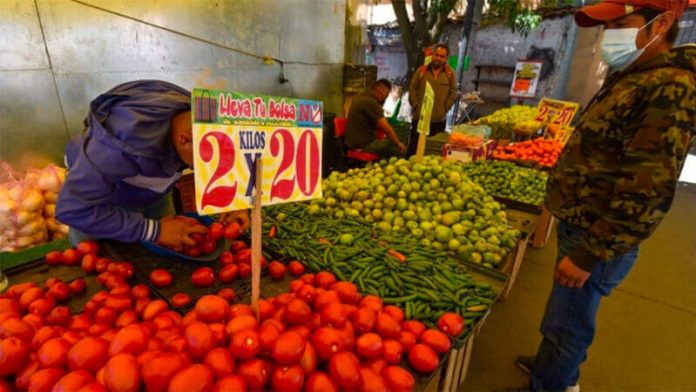
fruits and vegetables
Citibank expects inflation of 6.1% in Mexico this year.

While policymakers at the U.S. Federal Reserve conduct a drawn-out discussion over the pros and cons of starting to withdraw their multitrillion dollar pandemic stimulus, south of the border the debate is already over.

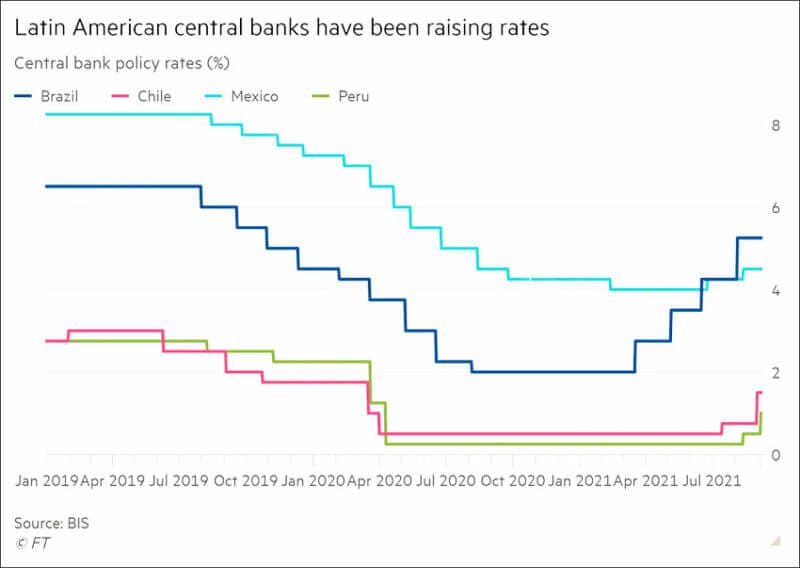
Inflation is back with a vengeance and Latin American central banks are raising rates, some aggressively.

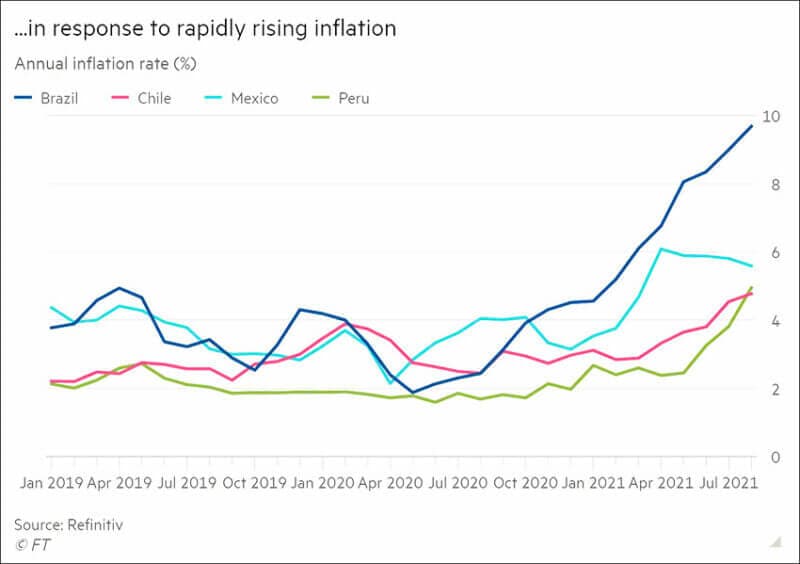
Leading the pack is Brazil, where the newly independent central bank is struggling to prevent inflation from hitting double digits. “Brazil really had a very big inflation shock,” central bank Governor Roberto Campos Neto admitted on September 1. Days later figures were published showing annual headline inflation at a five-year high of 9.7% in August.

Brazil has already raised its reference interest rate four times since March to 5.25% and investors expect another increase of at least 1 percentage point this month, with more to follow.

Inflation causes particular alarm in Latin America because of the region’s long history of price instability, particularly in the 1970s and 1980s. Newly empowered central banks brought prices under control in most of the major economies over the past two decades but the region has never completely exorcised its inflationary demons.

interest rates

Venezuela had the world’s worst inflation of 5,500% in 2020 and prices in Argentina are rising more than 50% a year as the central bank prints money merrily to fund a deficit — another bad old Latin American habit.

In Mexico, core prices rose last month at their highest rate since 1999 and Citibank expects inflation for 2021 of 6.1%. Although the central bank never cut rates as aggressively during the pandemic as its peers, it has tightened policy twice this year and Citi expects two more rises before the year end, taking the policy rate to 5%.

The same story is repeated along the Andes. Annual inflation in Chile hit 4.8% in August, almost double February’s level. The central bank published a hawkish inflation report, signaling further tightening after doubling rates last month. In neighbouring Peru, inflation reached 4.95% in August and the central bank has started tightening while in Colombia prices rose 4.4% a year in August.

“The picture is getting uglier by the day with the inflationary pressures rapidly disseminating, , said Alberto Ramos, head of Latin America economics at Goldman Sachs. “It will likely take a significant amount of policy tightening to put the inflation genie back in the lamp.”

Latin America was hit harder by the combined health and economic impact of coronavirus than any other region. Rapidly rising interest rates now threaten to choke off a recovery which was already losing steam as government stimulus programs wound down and prices for commodity exports levelled off. JPMorgan expects that growth of 6.4% in the region this year will slow to just 2.4% next year.

“Central banks in the region don’t have a choice,” said Ernesto Revilla, head of Latin America economics at Citibank. “They have to tighten monetary policy despite a weak economy because they can’t allow inflation expectations to drift off. It’s the curse of emerging market central banks.”

inflation

Latin American policymakers are casting envious glances at the U.S., where the Fed has so far been able to continue its multi-trillion-dollar economic stimulus despite inflation hitting a 13-year high in July.

“The Fed can keep saying that inflation is transitory and there is no need to overreact,” said Claudio Irigoyen, head of Latin America economics at Bank of America. “Eventually it will pay a price but the reality is that the world pays in dollars … Latin American central banks don’t have the luxury of saying ‘this is a temporary change in inflation.’”

The rising threat of inflation comes ahead of an election cycle that will see new presidents elected in Chile, Colombia and Brazil over the next 13 months, while Peru and Ecuador chose new leaders earlier this year. Voters are venting their anger over pandemic missteps on incumbents and favouring radical outsiders, a dynamic which bodes ill for central banks.

The Bank of México’s rate rises have already triggered a political row with populist President López Obrador. “Although the Bank of México should be paying attention to inflation and growth … for a long time they have only been concerned with inflation,” he said at his morning news conference last month.

Irigoyen said he saw “a decent chance” of more radicalization in the upcoming election. “This will create a lot of pressure on currencies and a demand for high spending, which will put pressure on central banks,” he added. “In the U.S. there are more and more people claiming that the Fed should accommodate fiscal deficits. People in Latin America will say ‘if they can do it, why can’t we?’”

© 2021 The Financial Times Ltd. All rights reserved. Please do not copy and paste FT articles and redistribute by email or post to the web.

Statues, high water and unfirm ground: the week at AMLO’s press conferences

0
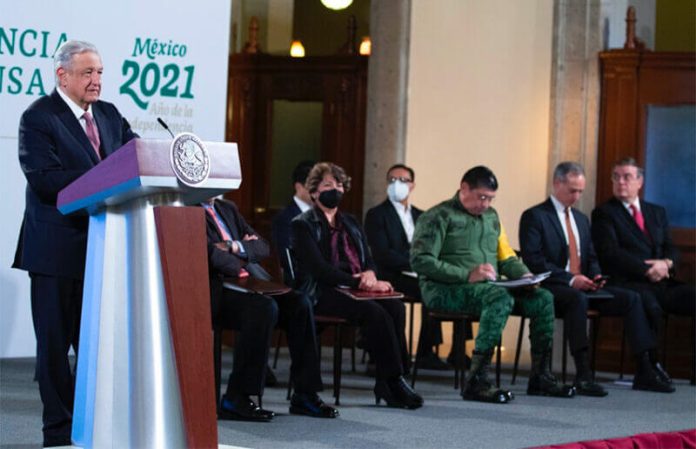
Tuesday's mañanera brings out a full house of cabinet ministers.

President López Obrador had spent the weekend checking up on his flagship project, the Maya Train. The 1,525-kilometer railway is set to traverse the Yucatán Peninsula, an economically deprived region historically.

The massive infrastructural project could change the face of the southeast of the country, connecting far-flung ruins, indigenous towns and tourist hotspots. AMLO has said trains will be running before he leaves office in 2024.

On Monday, the man from Tabasco was back at the morning news conferences bright and early as ever.

Monday

It was a morbid start to Monday. A journalist asked AMLO how he would like to be remembered alongside the great presidents now lying in the political cemetery of history. The leader from Tepetitán said that wasn’t for him to answer: “I can’t talk about that, history will tell. I want to finish well, to continue serving the people of Mexico and when time goes by the people will judge us,” he said.

Ideological battles came to the fore later in the conference. Right wing Spanish politicians had been in town the previous week, and AMLO pointed to other foreign agents —in the time of Mussolini — who had brought propaganda to Mexico to smear the name of communism. “Mexicans, this is made in Italy, if we do not destroy communism, it will destroy our family, our moral ideas, our civilization, our longings for freedom, our homeland,” read one poster.

But the president made clear that the c-word wasn’t a term he’d shy away from. “What is communism? If to be a humanist is to be a communist, let them put me on the list,” he said.

Tuesday

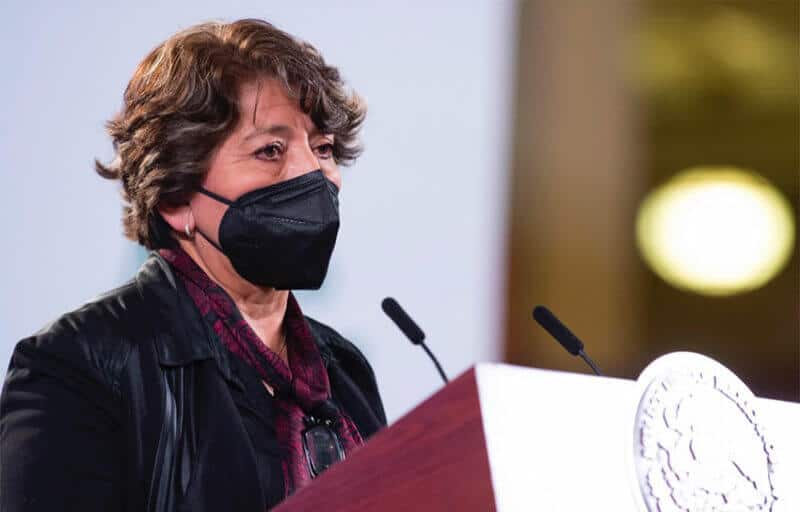
“It’s raining a lot; yesterday we had floods in many states in the country,” opened the president. In better news, COVID point man Hugo López-Gatell confirmed a fourth week of reduction in cases and two thirds of adults vaccinated with a first shot. However, on the education front it was a mixed bag. Education Minister Delfina Gómez Álvarez skimmed through some unflattering figures: only just over 50% of students had returned to classes.

Another presidential raffle was set for September 15, the day of the El Grito independence celebration. AMLO brought on lottery official David Roberto Jacinto Rodríguez to detail the 22 prizes on offer, which include former narco properties and a box at the Azteca stadium.

Foreign Affairs Minister Marcelo Ebrard stepped up. He was off to the United States on Thursday, and expressed the urgency of a solution to the migrant crisis. Seven hundred and fifty migrants, many of them minors, had been rescued by authorities in three recent events, he said.

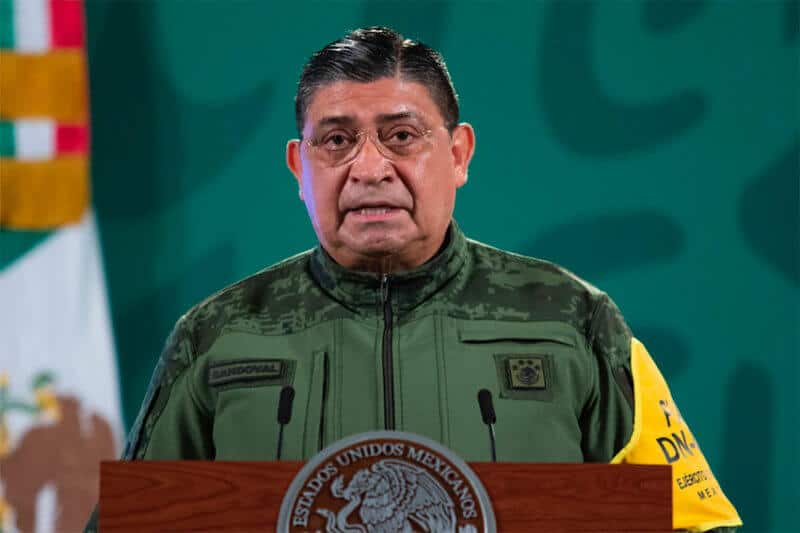
Defense Minister Sandoval reports on construction at Mexico City's new airport.
Defense Minister Sandoval reports on construction at Mexico City’s new airport.

Later in the conference, the president demonstrated his dexterity. A journalist posed the topic of the Supreme Court’s decision on abortion, which threatened the legal autonomy of Sinaloa and Coahuila. AMLO, the journalist said, had previously taken a pro life stance.

“These are very controversial, contentious issues and we do not want to encourage any confrontation … if it is already in the Supreme Court, then let it be resolved there … I’m not taking sides,” the president declared.

Wednesday

Tula was at the top of the agenda. The president extended his condolences to the 16 patients killed in a Hidalgo hospital after the building flooded, and then addressed the big movements the previous evening: a powerful earthquake had hit Acapulco, Guerrero, and shaken Mexico City hard.

Ana Elizabeth García Vilchis lined up the fake news. The Christopher Columbus statue — removed from its plinth on Reforma Avenue in October — had not been destroyed; hospitals had indeed received cash prizes from the last presidential raffle; hospital ventilators were all fully functional.

AMLO revived Columbus, and celebrated his fall: Mexico City Mayor Claudia Sheinbaum “has made the decision to put a sculpture of an indigenous woman on Reforma Avenue [in place of Columbus.] It seems very good … I celebrate it because it is a recognition of the deep cultural greatness Mexico, of pre-Hispanic Mexico,” he said, and added that Mexico’s heritage goes deeper than recent European developments: “In Teotihuacán there’s a huge pyramid … from the year A.D. 600, we’re talking about 900 years before the Spaniards arrived …”

Later in the conference, AMLO found himself in a mischievous mood. Visits from right-wing Spanish politicians were no problem, he said, and managed to mispronounce the name of their political party: “So, welcome to those from Fox — Vox.” The cynical observer might see a feigned reference to a former right-wing president of Mexico.

Thursday

The now defunct disaster relief fund Fonden was a “bag of money” for corrupt officials, AMLO said. Chiefs of Civil Protection, the Well Being Ministty, the navy, the defense ministry and transportation all took to the podium to detail how natural disasters were now being better tackled, including support for 35,000 people in Tula, Hidalgo.

Migration arrived at the conference: another 648 migrants had been rescued in Nuevo León to add to the 750 announced by Marcelo Ebrard on Tuesday.

“That’s what’s being discussed today in Washington. The United States has to take the decision to help poor countries, the Central American countries, and attend the causes of the migration phenomenon,” AMLO said. “Now it’s a new era … there hadn’t been any attention to the population which has to emigrate. There hadn’t been anything in years … it’s all coercive,” he added.

What of police abuse against migrants, posed a journalist. “We don’t have information about that,” AMLO replied.

Education Minister Gómez reported that schools are only at half capacity.

The cause of the Tula hospital disaster was revealed. Dams had overflowed causing the roads to turn to rivers and the hospital could not be contacted, said Civil Protection chief Laura Velázquez.

A Spanish journalist returned to the conference. In his last appearance, he had said that apologies for historic wrongs were inappropriate, and that Mexico should be appreciative of what the European conquerors had brought. Now, polarization was on the menu. Words like fifí, to refer to wealthy snobs, and chairo, to describe idealistic young protesters, were having a negative impact, he said.

“Brotherhood,” the president replied, reigns in Mexico.

Friday

The Felipe Ángeles Airport, being built to serve Mexico City, was first on the Friday menu. The president had been irked by an article in the newspaper El Universal which claimed construction workers were being poorly treated. Engineers and the military top brass spoke to give their enthusiastic support to the project, which is more than two thirds complete.

Back to statues. A plinth stood empty at the President’s Causeway, located at Los Pinos, the official presidential residence where AMLO had chosen not to live. Would his effigy take its rightful place there after his term?

“I don’t want my name to be used to name any street, I don’t want statues, I don’t want my name to be used to name a school, a hospital. Absolutely nothing,” the president insisted.

On Thursday’s economic talks in Washington, one journalist reported U.S. Vice President Kamala Harris said there will be investment in Central America. The president called for a Panamerican future: “The union of our America or North America, Central America, South America, all of America, we have to unite,” he said.

A busy weekend was ahead for AMLO with travel to Sonora, Sinaloa, and Nayarit.

Mexico News Daily

Just peachy! End-of-summer harvest means easy, delicious desserts

0
peaches
With peach season at its height in Mexico, now's the perfect time to whip up an easy fruit-filled dessert!

Yesterday I breezed into the grocery store intent on getting in and out quickly. I only needed a few things to try a recipe for what I thought was going to be this week’s column.

I headed for the produce section just to see what was available (you know how that is, right?) and suddenly my olfactory sensors registered something very, very wonderful. Something that shouldn’t have been there, that never is. The deliciously sweet aroma took me back to summer in New York and Pennsylvania, California and Oregon, when stone fruits fill farmers’ markets and grocery stores, and one somehow grows tired of eating them.

I let my nose lead me to the left, and there they were: peaches. Piles of them. An employee was dumping boxes and boxes of the fuzzy round fruits unceremoniously onto a display table. The smell was mouthwatering.

I asked where they were from, and he pointed out the two varieties, a more yellow, smoother and bigger peach from Chihuahua and a classic fuzzy, reddish-orange peach from California.

I was skeptical, remembering the countless times I’d fallen prey to the sweet smell of plums, peaches or nectarines in Mexico and finding them mealy, dry and flavorless. Dare I risk it once again?

Peach galette
A galette makes the perfect showcase for in-season peaches!

I did. And boy, am I glad!

Late August and early September are the height of peach season in Northern Mexico and California, which produces the most peaches of any American state. (Yes, more than Georgia!) Here in Mazatlán, the Mexican peaches were from Sonora, but they’re grown in Chihuahua, Zacatecas, Puebla and Veracruz too.

I’d actually wondered why peaches were included in the traditional chiles en nogada recipes, not realizing that the harvest came in at the end of summer. If you’re living in Mexico, now is the time to look for and buy them! Wanting the peaches of my past, I bought the California ones.

Native to China, peaches are in the rose family — hence the strong, sweet aroma. Cherries, apricots, plums and almonds, too, are all in the genus Prunus. Nectarines are actually fuzz-less, smooth-skinned peaches but are marketed separately as a completely different fruit. Peaches came to Mexico with the Spaniards, who brought pits and planted them.

After two days of ripening on the counter, my peaches were slightly soft to the touch and made my kitchen smell like summer memories. They were sweet and juicy, tender and delicious, and I went back to buy more. Yes, I’m grateful to have a year-round abundance of mangos, coconuts, papayas and pineapple in my Mexican life — but there’s just something really wonderful about a perfectly delicious peach.

Usually, I include an assortment of recipes for both sweet and savory dishes. This time, I want to encourage and enable you to enjoy these delicious fruits as the desserts they deserve to be.

Peach Galette

Don’t be intimidated — galette is just a fancy name for a free-form pie. Use the same method with other fruits, like apples, berries or mangos. For step-by-step photos of the process, go here. 

  • Pie dough for 1-crust pie
  • 4 large ripe peaches
  • ¼ cup tapioca or corn starch
  • ½ cup sugar
  • Pinch kosher salt
  • 1 large egg
  • 1 large egg yolk
  • 1 Tbsp. heavy cream or milk
  • ⅛ tsp. salt

Roll dough into a 14-inch round. Transfer to parchment-lined baking sheet, cover with plastic and refrigerate to chill dough, at least 2 hours or up to 24.

Wash peaches. (No need to peel). Cut into ½-inch slices. (Thicker slices cook slower without turning mushy.) In a medium bowl, measure out 3 cups of fruit. (Don’t use more.) Sprinkle starch over peaches; toss until well combined.

Preheat oven to 400 F. Adjust oven rack to lower-middle position. Arrange peaches in a ring in the center of chilled dough, tiling slices like dominoes and leaving about a 2-inch border of dough all around. Sprinkle sugar on top of peaches; finish with a pinch of salt.

peach galette dough
With a single ready-made pie crust, this is a snap to whip up.

With a sharp knife, cut a series of slits into the border of dough, each slit running from fruit to edge of the dough, spacing them about 5 inches apart.

Fold each segment of dough over peaches, tugging gently so the edge of each segment tightly overlaps the one that came before. Alternately, fold border of dough up over peaches, crimping like a big pie, leaving the fruit exposed in the center.

Whisk egg, egg yolk, cream or milk and salt in a small bowl. Brush over dough in a thin, even layer (including under each flap) to give crust a golden sheen and help bind pieces together.

Bake until pie is juicy, golden brown around the edges and bubbling in the center, 25–35 minutes.

Let cool 5 minutes, then slice into wedges and serve warm, garnished with whipped cream or vanilla ice cream.

Peach Upside-Down Cake   

  • ¼ pound unsalted butter, softened, plus more for greasing the pan
  • 3 large, ripe peaches
  • 1¼ cups sugar
  • 1 cup flour
  • ¾ tsp. baking powder
  • ¼ tsp. ground nutmeg
  • 3 eggs

Heat oven to 350 F. Grease a 9-inch cake pan. Line bottom of pan with parchment paper and butter that too. Pit peaches; cut into slices ½-inch thick. Arrange slices in a pattern on the bottom of the pan.

Combine ½ cup of sugar with ¼ cup of water in a saucepan. Cook over medium-high heat until mixture turns amber, 10–12 minutes.

Remove from heat immediately and pour evenly over the peaches.

In a medium bowl, sift flour, baking powder and nutmeg. Set aside.

In another bowl, beat together butter and remaining ¾ cup sugar. Beat in eggs one at a time, then stir in flour mixture. Spread batter evenly over the peaches and caramel.

peach upside down cake
This decadent upside-down cake uses fresh peaches and just six other basic ingredients.

Bake 30–35 minutes, until top is golden brown and cake is set. Remove from oven. Run a knife around the sides, then place a platter or plate on top and invert the cake onto the platter. Serve warm or cooled to room temperature.

Janet Blaser is the author of the best-selling book, Why We Left: An Anthology of American Women Expatsfeatured on CNBC and MarketWatch. She has lived in Mexico since 2006. You can find her on Instagram at @thejanetblaser.

COVID roundup: accumulated case numbers approaching 3.5 million

0
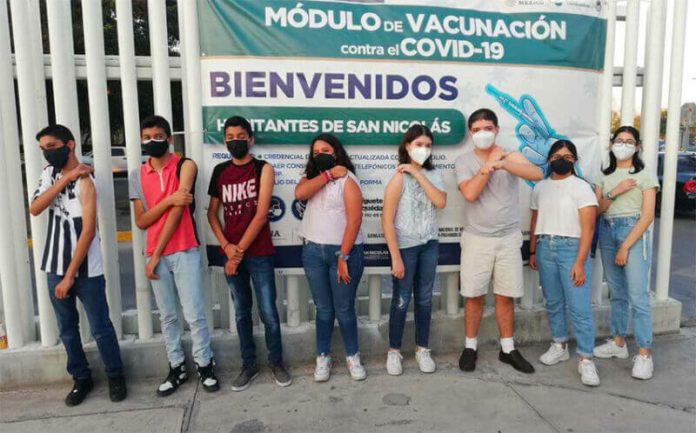
These eight youths were the first to be vaccinated — by court order — in Nuevo León.

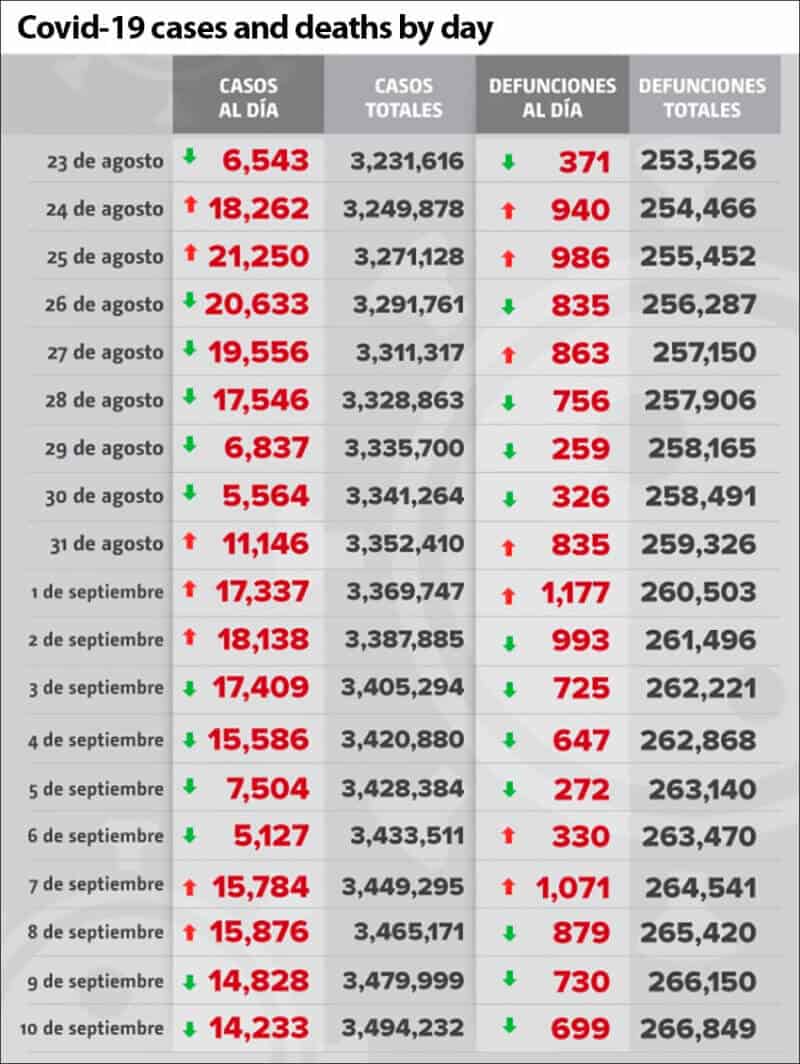
Mexico’s known tally of coronavirus cases approached 3.5 million on Friday with 14,233 new cases reported, while the official COVID-19 death toll rose by 699 to 266,849.

The accumulated tally now stands at just over 3.49 million, the 15th highest total in the world.

Mexico’s death toll, which like the case tally is considered a significant undercount, is the fourth highest in the world after those of the United States, Brazil and India.

On a per capita basis, Mexico has the 19th highest COVID death rate with 208 fatalities per 100,000 people, according to data compiled by Johns Hopkins University.

There are currently 100,643 estimated active cases in Mexico, a 1% increase compared to Thursday.

Tabasco continues to lead the country for active cases with more than 250 per 100,000 people, while Colima ranks second with exactly 250.

With more than 18,000 active cases, Mexico City easily has the largest current outbreak in the country but ranks third on a per capita basis with about 200 infections per 100,000 people.

In other COVID-19 news:

• Two hundred and fifty-nine days, or about 8 1/2 months, after the first shot was given on December 24, the total number of vaccine doses administered in Mexico passed 90 million on Thursday.

More than 90.3 million jabs have now been administered, according to the most recent Health Ministry data, after 865,661 shots were given Thursday.

More than 37.5 million Mexican adults are fully vaccinated while another 22.4 million have had their first dose of a two-shot vaccine.

Coronavirus cases and deaths in Mexico as reported by day.
Coronavirus cases and deaths in Mexico as reported by day. milenio

• There are 3,159 COVID-19 patients in hospitals in the metropolitan area of Mexico City, city official Eduardo Clark said Friday. The figure is 645, or 17%, lower than a week ago.

Mexico City will remain medium risk yellow on the federal stoplight map next week. Mayor Claudia Sheinbaum said the return to in-person classes in the capital and the further reopening of the economy hasn’t caused an increase in new cases.

She also said the government is in talks with the organizers of the Corona Capital music festival and Formula 1 Grand Prix with a view to those events going ahead with spectators. Both are scheduled to take place later this year.

• At the municipal level, the Mexico City borough of Álvaro Obregón had the highest number of active cases in the country as of Thursday with 3,486. Iztapalapa, another Mexico City borough, ranked second with 3,140 followed by Centro (Villahermosa), Tabasco, with 3,107; Gustavo A. Madero, Mexico City, 1,897; and Puebla city, 1,765.

Ranking sixth to 10th with more than 1,200 active cases each were Mérida, Yucatán; Tlalpan, Mexico City; Querétaro city; Monterrey, Nuevo León; and Guadalajara, Jalisco.

• More than 700 people who work in the lower house of federal Congress have tested positive for COVID-19 since the start of the pandemic and 39 have died. The newspaper El Universal reported that 115 deputies and 594 employees had been infected up until August 31.

The official COVID-19 death toll for the Chamber of Deputies is 39, a figure that includes four deputies who succumbed to the disease.

The “Chamber clusters” have occurred despite the investment of millions of pesos on initiatives designed to mitigate the spread of the virus in Mexico’s halls of power.

• Eight children were vaccinated in Nuevo León on Thursday after their parents obtained injunctions that ordered they be given shots. The jabs were given in San Nicolás de los Garza, a municipality in the metropolitan area of Monterrey.

State Health Minister Manuel de la O Cazavos said that all children aged over 12 who have obtained court orders will be vaccinated whether they suffer from an underlying health condition or not.

• At least seven people were injured on Friday when three buses that were part of a convoy taking Nuevo León residents to be vaccinated in the United States were involved in an accident on the Monterrey-Nuevo Laredo highway. Three people were reportedly taken to hospital.

Intended for the employees of manufacturing businesses that export products to the U.S., the cross-border vaccination initiative, which began last month, is the brainchild of Nuevo León governor-elect Samuel García.

With reports from El Universal, El Economista, Milenio, Aristegui Noticias and La Jornada