Home Blog Page 1191

Freeing the damned and trying the mighty: the week at the mañaneras

0
AMLO
AMLO praised the Mexican army and denigrated a journalist for asking if his weekend trip to Sinaloa was connected to the family of jailed drug lord Joaquín “El Chapo” Guzmán.

On Sunday, the country will return to the polls. The referendum will ask whether five past presidents should be investigated for corruption; those leaders were only stripped of their immunity to prosecution in 2019.

The exercise has split opinion: what President López Obrador (or AMLO) has promoted as participatory democracy, sections of the international press have labeled a “sham trial.”

Whether enough voters turn out is looking touch and go: 40% participation is the minimum needed to make the result binding.

Sixty-seven years young and as eager as ever, the president discussed the following topics at his morning press conferences this week.

Monday

Becoming well accustomed to the sea breeze, the president was at the port of Veracruz for Monday’s conference. Governor Cuitláhuac García gave thanks for the 60-billion-peso (US $3 billion) federal contribution in 2020, which was equal to half the state’s budget.
Meanwhile, crime in the state, said Navy Minister José Rafael Ojeda Durán, had dropped 59% since 2019.

Questioned on violence, the president added up the weekend’s homicide numbers from state to state — over 200 — and announced 50 billion pesos ($2.5 billion) for the National Guard over the next two years. Fuel theft, he said, had been reduced from 80,000 barrels per day in November 2018 to 5,000, worth over 158 billion pesos (about US $7.89 billion).

A journalist reminded AMLO of his weekend comments: at a conference for foreign dignitaries at Chapultepec Castle he’d called for a “truly autonomous” supranational organization that would “not [be] anybody’s lackey,” as opposed to the Washington D.C.-headquartered Organization of American States (OAS).

“I believe that we must seek a new relationship between all the countries of America … with respect for the sovereignty of each country,” the president said, before reiterating his call for an end to the U.S. embargo on Cuba.

Tuesday

Olympians got the nod on Tuesday. The mixed archery pair and women’s synchronized swimmers had all taken bronze. But there were consolations for the women’s softball team, a sport close to the president’s heart, who missed out on a medal after a tight contest with Canada. “We send them all a hug,” AMLO said.
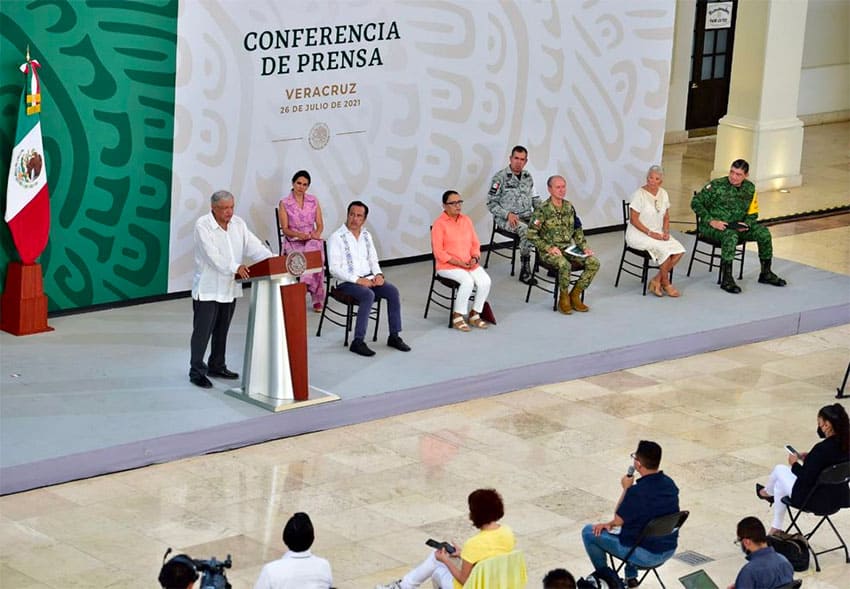
Monday's conference was held in Veracruz.
Monday’s conference was held in Veracruz.

Deputy Health Minister Hugo López-Gatell assured reporters that the third wave of the pandemic was distinct from the previous two. Mortality, he said, was 77% lower than in the first wave and 87% lower than in the second. All people over 18 would have a first dose by the end of October, the president stated; he later confirmed that his son Jesús Ernesto had contracted Covid-19 but was well.

The subject turned to Sunday’s referendum on whether Mexico’s ex-presidents should be investigated for corruption.

“Predictions are that it won’t reach the voting percentage,” posited a journalist, referring to the 40% turnout needed to legitimize the results.

“We trust in the people; we have to have faith in the people … the people are very aware … this is one of the most aware countries in the world,” the president replied.

Cuba returned to the table. Two ships were set to sail from Veracruz to the Caribbean island nation, carrying medical equipment. Could the aid lead to U.S. sanctions against Mexico, asked a journalist.

“No, because we are an independent country, free, sovereign, and we will behave as such,” AMLO affirmed.

Wednesday

Blood pressures rose for the fake news patrol on Wednesday. To set the scene, the government’s fake news czarina, Ana Elizabeth García Vilchis, offered some reassuring pronouncements: “Here, neither opinions nor criticisms are questioned. Here, freedom of expression is respected,” she said.

The first disavowed claim related to the Felipe Ángeles airport: an article had stated that the construction budget had been cut by 90%. “This information is false,” García said.

The Economist was next in her path: the English newspaper’s July 15 headline called Sunday’s referendum “a show trial of his [AMLO’s] predecessors.”

“It mocks the president and in a deceitful way makes it look like the referendum and the question … are decisions of the president,” she said.

Enter Julio Hernández López, author of an article that was given a dressing down precisely a week before. His story alleged that property speculation was threatening an area’s classification as a Natural Protected Area in San Luis Potosí.
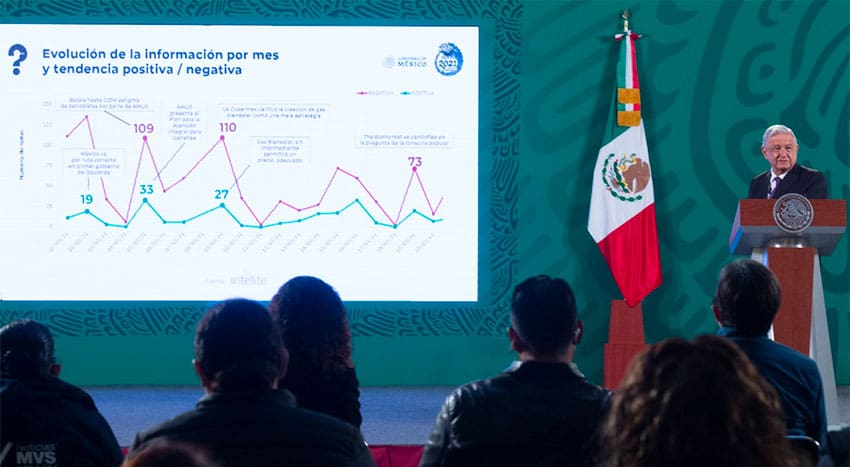
negative mentions in the media.
A graph indicates the administration’s positive (in green) vs. negative mentions in the media.

Hernández questioned García’s credentials: “Last week I was accused of lying on three occasions … and without journalistic authority … I call on Elizabeth García Vilchis — as real journalists do when they make mistakes — to … apologize.”

In response, AMLO questioned the journalist’s credentials as an environmentalist.

It was to be another busy weekend ahead for the president, and he mapped it all out for the press.

“We’re going to have the conference in Culiacán [Sinaloa] on Friday … I’m going to supervise the roads [being built] … I’m going this weekend to Sinaloa, Durango, Nayarit. And on Monday, the security meeting will take place in Puerto Vallarta, Jalisco.”

Thursday

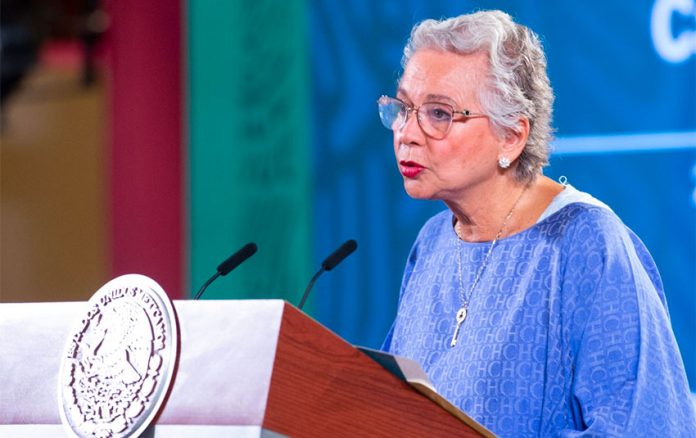
First on Thursday, Interior Minister Olga Sánchez announced a planned reform for prisoners awaiting trial, who she said made up 43% of the prison population.

Any federal prisoner that has been tortured, for any crime, will be eligible for release, she explained. Additionally, any federal prisoners awaiting trial that are over 75, or are over 65 and with severe health problems, will be able to leave prison and live under house arrest.

The president confirmed that the prisoners in question would be released by September 15. However, he conceded that the reform only scratched the surface: “Look,” he said, “under state jurisdiction without sentence: 82,189 [prisoners]; under federal jurisdiction: 12,358.”

A journalist from W Radio dropped in to ask the president if his weekend trip to Sinaloa was connected to the family of jailed drug lord Joaquín “El Chapo” Guzmán. AMLO linked the question to a recent headline by the Spanish newspaper El País and offered his disdain. “A prejudicial way of doing journalism … that’s conjecture,” he said.

Before the conference ended, a recording of a prisoner was played by a journalist: “My name is Pablo Green Salamanca,” it announced. “… I am a victim of the political system … I have committed no crime … I trust you that you have the will to do justice and that innocent people like me will not remain in prison while innocent.”

Friday

The conference was broadcast from Culiacán, Sinaloa, on Friday where Governor Quirino Ordaz Coppel of the Institutional Revolutionary Party (PRI) offered kind words to the president. The defense minister gave a security report, which signaled an increase in femicides in the state, making it the third worst in the country.

Later in the conference, AMLO expressed his admiration for the army.

“Let us not forget the origin of our army …  from a revolutionary movement … It is the fruit of our people … The rank generals are the sons of peasants; they are the sons of workers, they are the sons of merchants, they are the sons of soldiers,” he said.

He also stood by the decision to release the son of “El Chapo” after he was detained in Culiacán in October 2019. “I have a clear conscience because, when I asked for a report … more than 200 innocent people were going to lose their lives, according to the estimate … and I said: ‘No.'”

Shortly thereafter, the conference came to a close. However, there was little time for the president to catch his breath: the weekend would take him to three states in as many days.

Mexico News Daily
A new survey shines light on the fight to save Mexico’s native languages

0
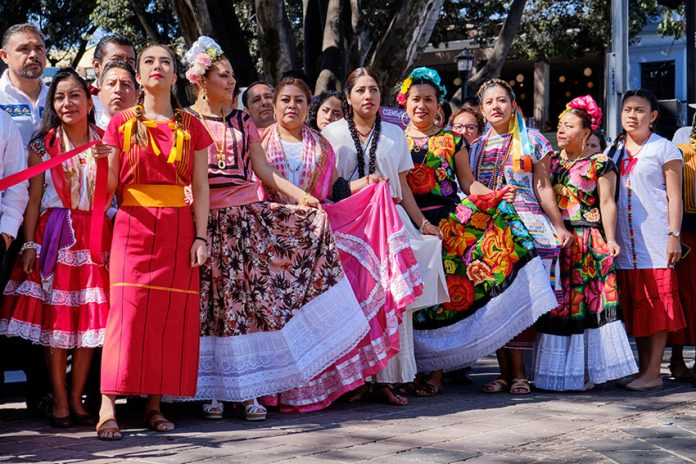
Oaxaca women in traditional dress at the 2020 International Day of Indigenous Languages
Oaxaca women in traditional dress at the 2020 International Day of Indigenous Languages.

With more than 60 indigenous languages spoken in Mexico, and English and Spanish taking economic precedence over indigenous languages, many of these languages have become endangered. Practices such as Castilianization, which aim to convert speakers of an indigenous language to Spanish speakers, continue to exist in the state of Chiapas and exacerbate this problem.

Preserving indigenous languages can be a challenging task with limited time in school, limited resources and limited training for language teachers. English-language study materials, on the other hand, are widely available for free online, and qualified teachers are easier to find. Yet, Mexico has also faced difficulties in implementing coherent policies even to promote English programs in schools. For instance, a 2005 program by the Mexican government promoted learning English digitally, but was based on the idea that the material included within the program alone would be sufficient for students to reach English proficiency, and that teachers without prior knowledge of English would be able to learn the language alongside their students. During the 2012-2013 academic year, Mexico’s English programs only reached 25% of the students it intended to reach.

Currently, national standards regarding English education mandate that students across all grade levels learn English. Students begin learning English early in their education, but content in English classes is often limited to simple phrases and vocabulary. One reason for this due to a lack of teachers who are communicatively proficient in English. Conversely, another issue is that native English speakers, regardless of their experience or background in teaching English, are often preferred to teachers who have learned English as a second language.

To what extent has the Mexican public even supported language efforts, especially in the context of preserving indigenous culture? We commissioned a national public opinion web survey June 24-26 via Qualtrics, surveying 625 Mexicans via quota sampling. Besides demographic and political attitude questions, we included two questions relating to issues of indigenous groups in Mexico.

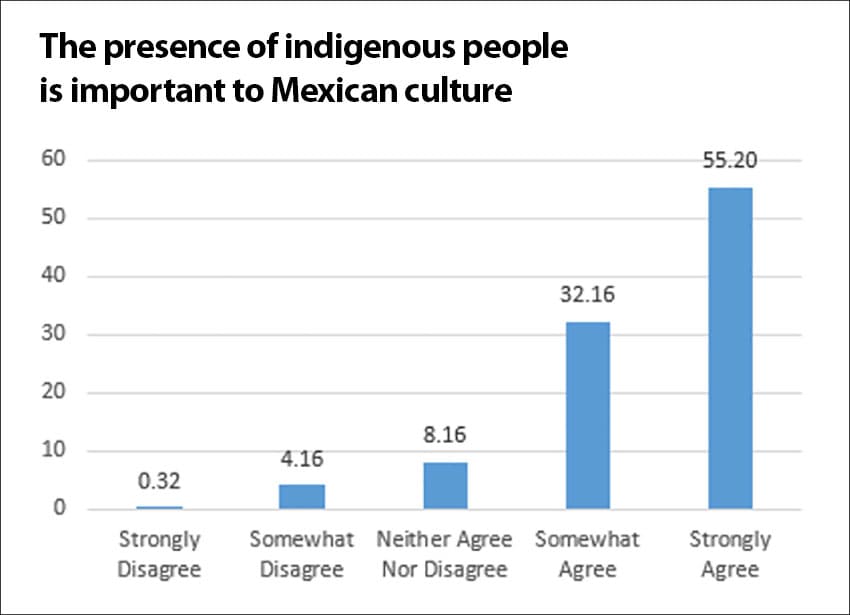
We first asked respondents to evaluate the statement “The presence of indigenous people is important to Mexican culture” on a five-point scale of strongly agree to strongly disagree.

The majority of Mexicans surveyed agreed that the presence of indigenous people is important to Mexican culture.

The vast majority of respondents (87%) indicated that they agreed with this statement. Further analysis shows little difference across age, gender, education, or income, although respondents self-reporting as mestizo statistically were more likely than those identifying as blanco to agree.

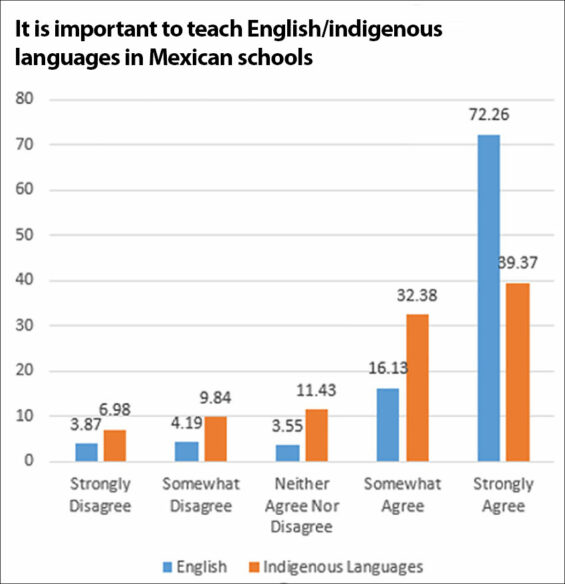
The next question took the issue of indigenous culture from more abstract to more concrete. Respondents received one of two versions of the following prompt to evaluate on a five-point scale (strongly disagree to strongly agree):

V1: It is important to teach English in Mexican schools

V2: It is important to teach indigenous languages in Mexican schools

Though both versions found that a majority of respondents were in support of language education, English surpassed indigenous languages by over 16%, suggestive of the broader incentives behind learning English. Further analysis shows that demographic factors including self-identified ethnicity did not appear to change preference, although those more likely to agree with the previous indigenous question will be more likely to support both language versions.

English is often perceived as a language of business or a useful means to improve one’s income. Due to this image of practicality, support for English education can sometimes outstrip support for education in a country’s local or indigenous languages, even though English may not have any significant cultural ties in that place.

More people supported English education than supported the teaching of indigenous languages.

As indigenous languages gradually disappear from more developed areas of Latin America, the loss of indigenous languages entails a loss of a significant aspect of indigenous cultures. Moreover, lack of education among the general public regarding indigenous languages has placed those who speak these languages at a disadvantage socioeconomically. For instance, studies on Mexican, Guatemalan, Peruvian, and Bolivian indigenous languages demonstrate that the ability to speak an indigenous language is often correlated with limited access to healthcare and education, especially among indigenous women.

The Mexican government has recently begun promoting the preservation of indigenous languages through a branch of the Ministry of Culture called Inali, the National Institute of Indigenous Languages. Inali took advantage of the new virtual formats used during the pandemic to expose hundreds of thousands of people to indigenous languages through comics, books, and other resources throughout 2020. Mexico’s Minister of Culture, Alejandra Frausto Guerrero, said, “Mexico’s greatest strength is found in her diversity of culture,” and emphasized the importance of indigenous languages in that culture. However these efforts, much like with English policies, may poorly transfer to the classroom, limiting proficiency.

For those fighting to preserve Mexico’s indigenous heritage, it is clear that they are still supported — at least in theory — by the majority of Mexicans. However, when it comes to meaningful action, particularly those that could take funds away from other important causes, support may falter.

This piece was coauthored by the following:

Carolyn Brueggemann is an honors undergraduate researcher majoring in international affairs, Chinese, and Spanish at Western Kentucky University.

Isabel Eliassen is a 2021 honors graduate of Western Kentucky University. She triple majored in international affairs, Chinese, and linguistics.

Aurora Speltz is an honors undergraduate researcher at Western Kentucky University, majoring in Arabic, international affairs, and Spanish.

Timothy S. Rich is an associate professor of political science at Western Kentucky University and director of the International Public Opinion Lab (IPOL).

A nutritional powerhouse, oats take their rightful place in sweet and savory recipes

0
rolled oats
Although most people associate oats with carbs, did you know that half a cup of oats contains 13 grams of protein?

I’m finding myself in the kitchen more and more as Covid surges again in Mexico; instead of eating out, I’m cooking at home. One of the things I see myself drawn to is oats, perhaps because they’re such a comforting food and that’s what I’m in need of now.

While oatmeal is a classic breakfast full of nutritional benefits, oats also figure highly in cookies, muffins and breads, and as an ingredient in some entrées. The whole oat grain, or groat, has a hard shell and takes a long time to cook; rolled or crushed oats cook faster and are what’s usually used.

Quick or instant oats are crushed thinner so that they cook more quickly but will have a mushier texture when done; steel-cut oats (available from Amazon México!) are the whole oat groat cut into tiny pieces and have a nuttier flavor and more firm texture.

I’d always “heard” how healthy oats are but never really paid attention to the details. Turns out they’re one of the most nutrient-rich foods around! Half a cup of oats contains 13 grams of protein, eight grams of fiber and notable amounts of iron, magnesium, zinc and B-vitamins.

They’re also loaded with antioxidants, specifically avenanthramides, which have been proven to lower blood pressure levels, assist in better blood flow by helping the vessels dilate and reduce both LDL and total cholesterol levels. They can also aid in lowering blood sugar levels.

Mango overnight oats
No-cook mango overnight oats are an easy and sweet start to the morning.

Interestingly, avena, the Spanish word for oats, derives directly from its Latin name, Avena sativa. (Also interesting is that oats are the only cereal grain always referred to in the plural.)

Oats have been eaten for centuries, most commonly as porridge, cooked in milk or water. They also pop up in some beers (think oatmeal stout) and steeped in honey-sweetened whiskey in Atholl brose, a traditional Scottish drink.

In Mexico and other parts of Latin America, raw whole oats are ground in the blender with milk, cinnamon, sugar and often banana, then heated and served as a hot drink in the winter months.

Great Granola

  • 3 cups whole oats
  • ½ cup brown sugar, grated piloncillo or regular sugar
  • ⅓ cup honey
  • ¼ cup coconut or vegetable oil or a combination
  • 1 ½ tsp. cinnamon
  • 2 tsp. vanilla
  • ¼ cup water
  • Optional: ¼ cup wheat germ, ½ cup dried fruit, 1 cup unsweetened dried coconut, 3 Tbsp. cocoa

Combine dry ingredients; mix well. Add vanilla, oil, honey and water; stir to combine. Bake on lightly greased cookie sheet for 20–30 minutes, stirring occasionally. Remove from oven; granola should be crisp. Let cool, then stir in optional ingredients.

Oatmeal Pancakes

  • 1¼ cups flour
  • ½ cup quick or whole oats, uncooked
  • 2 tsp. baking powder
  • ¼ tsp. salt
  • 1¼ cups milk
  • 1 egg, lightly beaten
  • 1 Tbsp. vegetable or coconut oil

Optional Stir-ins:

  • 1 cup fresh or frozen, unthawed blueberries;
  • 1 ripe banana, mashed + pinch ground nutmeg;
  • ¾ cup finely chopped apple + ¼ cup chopped pecans + ½ tsp. cinnamon;
  • ½ cup chocolate chips

In large bowl, mix flour, oats, baking powder and salt. In separate medium bowl, combine milk, egg and oil; blend well. Add liquid ingredients to dry ingredients all at once; stir just until dry ingredients are moistened (do not overmix). If desired, add stir-in options now.

Heat lightly greased skillet over medium-high heat. For each pancake, pour ¼ cup batter onto hot skillet. Turn when tops are covered with bubbles and edges look cooked. Turn only once.

oat pancakes
Stir in some blueberries, banana or pecans to make these oat pancakes truly shine.

Banana-Oatmeal Energy Bites

  • 2½ cups Quaker® Oats (quick or old fashioned, uncooked)
  • 2 Tbsp. honey
  • ¼ cup creamy or chunky peanut butter
  • 1 cup ripe mashed banana (about 2 large bananas)
  • 1 tsp. ground cinnamon

In large bowl, mix oats and cinnamon. Stir in mashed banana, peanut butter and honey until well blended. Shape into 24 (about 1-inch diameter) balls. Cover and chill in refrigerator. Store in sealed container in fridge.

Mango Overnight Oats

  • ½ cup oats
  • ¼ cup milk
  • ⅓ cup yogurt
  • ½ cup diced mango
  • 1 tsp. honey
  • ⅛ tsp. vanilla or almond extract
  • 1 tsp. chia seeds

Mix oats, milk, yogurt and extract in Mason jar or other container. Add layer of mango, drizzle with honey and sprinkle chia seeds on top. Chill in refrigerator at least 8 hours.

Spinach-Stuffed Chicken/Turkey Meatloaf

  • ¾ cup quick or whole oats, uncooked
  • 1 cup chopped mushrooms
  • ¼ cup chopped onion
  • 10-oz. package frozen chopped spinach, thawed and drained OR equivalent fresh spinach
  • ½ cup shredded Chihuahua or mozzarella cheese, divided
  • ¼ cup grated Parmesan cheese
  • 1 pound ground turkey or chicken
  • ½ cup milk
  • 1 egg white, lightly beaten
  • 1 tsp. dried oregano
  • Salt and pepper

Heat oven to 375 F. Lightly spray medium skillet with cooking spray. Cook mushrooms and onion in skillet over medium heat about 4 minutes; remove from heat. Add spinach, ¼ cup cheese and all the Parmesan; mix well. Set aside.

In large bowl, mix turkey/chicken, oats, milk, egg white, oregano, salt and pepper. Spoon 2/3 of meat mixture lengthwise down center of 11 x 7-inch glass baking dish in a long, thick “stripe.” Make a deep indentation down middle of this mixture; fill with spinach/cheese mixture.

Top with remaining turkey, sealing edges to completely enclose spinach filling, forming a loaf.

Bake 30–35 minutes or until juices show no pink color.

Remove from oven; sprinkle with remaining cheese. Return to oven 1–2 minutes until cheese melts. Let stand 5 minutes before slicing.

oat-turkey stuffed meatloaf
Oats fill out this healthy alternative to traditional meatloaf.

Salted Oatmeal Cookies

  • 1½ cups flour
  • ½ tsp. baking soda
  • ¼ tsp. salt
  • 16 Tbsp. (two sticks) unsalted butter, at room temperature
  • 1 cup sugar
  • 1 tsp. vanilla extract
  • 1 egg
  • 3¼ cups whole oats
  • ⅔ cup raisins (golden if available)
  • Fine sea salt if available or regular salt

In large bowl, beat butter until smooth. Add sugar, beat till fluffy. Beat in egg, then vanilla.

In large bowl, mix flour, baking soda and salt. Add oats and raisins. Form dough into a log and wrap with plastic wrap. Chill in refrigerator at least two hours till firm.

Line two baking sheets with parchment paper. Pour salt in a flat bowl or plate. Slice dough in ¼-inch pieces, roll into balls and then dip tops of balls into salt. Place on cookie sheet with salted side up. Bake cookies at 375 F until edges are golden, about 12 minutes.

Janet Blaser is the author of the best-selling book, Why We Left: An Anthology of American Women Expats, featured on CNBC and MarketWatch. She has lived in Mexico since 2006. You can find her on Instagram at @thejanetblaser.

US demand feeds second-quarter economic growth of 1.5%

0
People walk by a building under construction in Mexico City
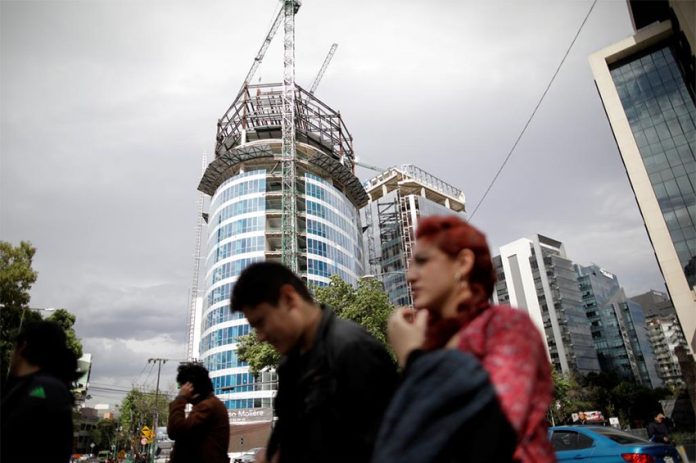
People walk by a building under construction in Mexico City.

Buoyed by services and exports to the United States, the Mexican economy grew 1.5% in the second quarter of 2021 compared to the first quarter and 19.7% compared to the April-June period of 2020, preliminary data from the national statistics agency Inegi showed on Friday.

It was the fourth consecutive quarter of growth but the 1.5% seasonally adjusted expansion was 0.2% below the average forecast of 14 analysts surveyed by the news agency Reuters.

The near 20% annual expansion, the first year-on-year quarterly growth since the start of the pandemic, is the largest on record.

Much of the Mexican economy was shut down for most of the second quarter of last year as the result of a government-mandated suspension of nonessential activities due to the burgeoning coronavirus outbreak. GDP slumped 8.5% in 2020, the worst economic contraction since the Great Depression, as Covid-19 ravaged the economy.

Inegi data showed that secondary sector activities, including manufacturing, were up 28.2% in the April-June quarter compared to the same period of last year. Demand for Mexican-made cars and electronics in the United States drove the strong result.

Data also showed that tertiary activities, including trade and financial services, were up 17% annually in the second quarter, while primary activities, including agriculture and fishing, were up a more modest 6.8%. Domestic consumption was buoyed by record remittances sent home by Mexicans working abroad.

Quarter-on-quarter growth was 2.1% in the tertiary sector, 0.6% in the primary sector and 0.4% in the secondary sector, Inegi said.

Despite the second-quarter growth, GDP was still 3.6% below the level it achieved in the July-September quarter of 2019, said Gabriel Casillas, an economist at the bank Banorte. The economy was already contracting when the coronavirus hit Mexico in early 2020.

After last year’s steep recession there is plenty of scope for growth, although the third wave of the pandemic will likely dampen the recovery in the third and fourth quarters.

“We expect real GDP growth to reach 6% in 2021, but the recent deterioration of the Covid backdrop, high inflation and rising rates could slow down the envisaged recovery,” Goldman Sachs economist Alberto Ramos said in a note to clients.

He also said that growth in the second quarter was hampered by supply chain disruptions and a shortage of parts, including computer chips, for key industries.

Growth in the first quarter of 2021 was 0.8% compared to the previous three-month period but GDP declined 2.8% compared to the January-March period of 2020. Mexico announced its first confirmed Covid-19 case on February 28, 2020. The accumulated tally now stands at more than 2.8 million while the official Covid-19 death toll reached almost 240,000 on Thursday.

With reports from El Economista and Reuters 

In US, Iguala case closed after gang leaders negotiate deal with prosecutors

0
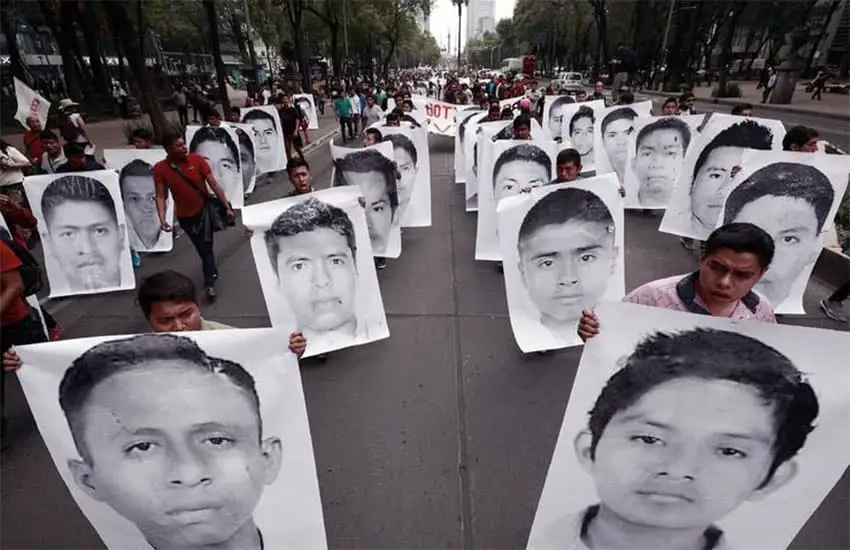
A protest against the 2014 disappearance of 43 students from Iguala, Guerrero
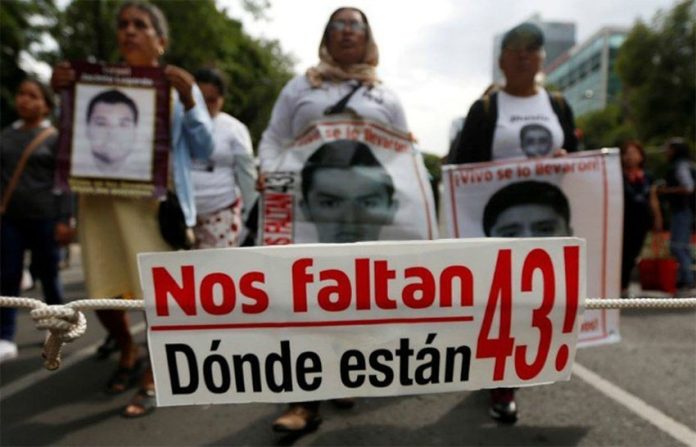
A protest against the 2014 disappearance of 43 students in Iguala, Guerrero.

The United States is set to close its investigation into crimes allegedly related to the disappearance of 43 students in Iguala, Guerrero, in 2014.

A leader of the Guerreros Unidos crime gang – which allegedly killed the Ayotzinapa rural teacher’s college students – has confessed to transporting drugs from Iguala to Chicago and reached an agreement with the United States government to provide information to the U.S. about the illegal smuggling.

Pablo Vega, who has been in prison in the United States for the past seven years, pleaded guilty in April to transporting drugs to the U.S. in passenger buses, according to the newspaper Milenio, which reviewed official U.S. documents. The details of the agreement he reached with U.S. authorities is classified but it appears likely he will be released from prison as a result of his agreement to collaborate.

José Rodríguez, an associate of Vega who was also a member of the Guerreros Unidos, is currently in negotiations with U.S. authorities and pending an agreement will officially plead guilty to trafficking charges on September 1, Milenio said.

Once that occurs the Ayotzinapa-Iguala case will be officially closed in the United States.

The United States Drug Enforcement Administration (DEA) determined several years ago that the Guerreros Unidos had transported heroin to the United States on passenger buses. The gang transported the heroin in hidden panels on the buses that ran from its territory in Iguala to Aurora, a suburb of Chicago, the DEA established.

By intercepting dozens of messages Vega received on his Blackberry phone, the DEA also concluded that Guerreros Unidos members in the United States were aware of the abduction of the 43 students on September 26, 2014.

The students were on a bus they had commandeered to travel to a protest in Mexico City when they were intercepted and came under attack by Iguala municipal police. Independent experts who investigated the students’ disappearance said that one hypothesis is that the bus on which they were traveling was carrying drugs and would have left for the United States had it not been commandeered. It was allegedly one of five buses carrying drugs that was scheduled to depart for the U.S. on the day the students disappeared.

According to the previous federal government’s official version of events, the students were intercepted by corrupt municipal police who handed them over to the Guerreros Unidos. Gang members then killed the students, burned their bodies in a dump in the municipality of Cocula and disposed of their remains in a nearby river, according to the so-called “historical truth” presented in January 2015.

But the “historical truth” was rejected by the current government, which established a truth commission and launched a new investigation. It hasn’t yet presented its own definitive version of events but is expected to do so soon. The remains of just three of the 43 students have been formally identified. The remains of two of those showed no evidence of fire damage, leading Omar Gómez Trejo, the special prosecutor in charge of the reexamination of the case, to declare that the “historical truth is over.”

In order to disprove the previous theory the current government has been relying heavily on the declarations of a protected witness known only as Juan, Milenio reported this week. The man – a suspected leader of the Guerreros Unidos who says he didn’t participate in the events of September 26 – provided testimony to the federal Attorney General’s Office (FGR) in early 2020 (which was subsequently leaked) that asserted that the army and state police were directly involved in the disappearance of the 43 students.

Protesters carry signs showing the faces of the disappeared Ayotzinapa students

In a court appearance in May, Juan presented information that added to and clarified his earlier testimony.

He said that the army, Federal Police, Guerrero police and Iguala municipal police all collaborated with the Guerreros Unidos on the night of the students’ disappearance. Juan also said that Jesús Pérez Lagunas, a Guerreros Unidos leader known as “El Güero Mugres” (The Filthy Blondie), issued an order for all the students to be killed.

Milenio noted that authorities had not previously linked Pérez to the disappearance of the students. El Güero Mugres was murdered in 2018.

Juan previously said that three groups of students and suspected hitmen from a rival gang were detained on September 26. One group was taken away by the Guerreros Unidos, another was placed in the custody of state police and the third group was transported to an army base in Guerrero, he said.

Juan said the group taken to the army base was interrogated before being handed over to a cell of the Guerreros Unidos. Some of the students and suspected gang members were already dead at that time, he said.

The witness said the Guerreros Unidos killed those who were still alive and dissolved the bodies of the deceased in acid and caustic soda. Liquid remains were then poured down the drain, he said. Other students and suspected gangsters were allegedly butchered with machetes and axes at a cartel hideout in Iguala before some of their remains were cremated at a funeral home on the outskirts of Iguala.

Ashes were allegedly scattered in various locations, including in the municipality of Cocula, which borders Iguala. All told, 70 or 80 people including the 43 students were killed on September 26 and 27, 2014, Juan told the FGR.

In his new testimony, he asserted that state and federal security officials including former Guerrero security minister Leonardo Octavio Vázquez Pérez, ex-attorney general Iñaki Blanco and an army captain were on the Guerreros Unidos’ payroll and in cahoots with El Güero Mugres. He previously accused Omar Harfuch, Mexico City’s police chief, who was previously a Federal Police coordinator in Guerrero, of being on the gang’s payroll but didn’t mention him in his most recent testimony.

Juan received the information he presented to authorities via radio and text messages and at a meeting on September 30, 2014, with Guerreros Unidos members involved in the crimes, Milenio said.

Although 43 students disappeared, the Guerreros Unidos didn’t think that the case would become such big news, Juan told the court during his appearance at the hearing in May. The case triggered mass protests against the federal government less than two years after former president Enrique Peña Nieto took office, and there was some belief – and a lot of hope – at the time that he could be ousted.

Fue el estado,” or “It was the state” was a constant refrain at those protests and many, if not most, Mexicans remain convinced that federal security forces were involved in the students’ disappearance.

With reports from Milenio 

Why I only speak to my Mexican daughter in English

0
Bilingual child
Making sure your child growing up in Mexico learns both Spanish and your native language isn't hard, but it does require some forethought and consistency.Marta Ortiz/Shutterstock

It wasn’t until my daughter reached kindergarten that she realized that the ability to speak English was something other people thought was cool.

“Bye, Mommy! Have a good day, Mommy! I’ll see you in the afternoon, Mommy!” she’d shout for all to hear as she walked toward her classroom. She seemed to relish the head turns from the parents and the open-mouthed stares of her classmates. I mean, it’s not every day that being different makes you cooler (as opposed to simply weirder).

At home, it has always been natural for her to use one language with me and another language with her father and anyone else who happened to be around. Her “mother tongue” has mostly been exactly that: the language she speaks with her mother. The rest of her world, except when we travel to the United States or have visitors from there, is in Spanish.

Today, we’re going to take some time away from all the sad news of the day and the types of articles that earn me angry comments on Facebook and focus instead on a question I get quite a lot: how did you teach your kid English?

I, of course, haven’t sat down to “teach” her as I would kids in a classroom; that’s not how native language acquisition works.

But before I came to Mexico, I’d always figured that being a foreigner in a foreign country and having kids there would pretty much do it; not so, I’ve found! However, it’s not as complicated as it seems if you just follow a few simple rules:

Only speak to your child in your native language — especially if you’re the foreigner.

This is by far the most important item on the list. In fact, you could do only this and you and your kids would probably be golden.

This seems simple, but I’ve observed many native English-speaking parents in Mexico — mostly fathers, for some reason — speak to their children primarily in (not very good) Spanish. I have some theories on why men especially do this, but that could be an entirely different article. For now, we’ll just stick with the do this, not this instructions.

Anyway! Insisting on this point (and you must insist for this to work) means that if they want to talk to you, they’ll have to do it in your language. All the time. Or at least … 99% of the time?

It’s possible, even likely, that you’ll meet some resistance from your child at some point. After all, speaking in one language with everybody instead of two with different sets of people is easier.

In my daughter’s case, she tried to insist for about two days when she was two years old that I speak in Spanish, since she obviously knew I spoke it. She’d ask me for things in Spanish and get mad when I responded, “You have to speak to Mommy in English, sweetie.”

She eventually did, and all has been well since then. In fact, on the off occasion that I say something in Spanish to her, she looks at me strangely and says, “Why are you speaking Spanish?”

One last note here: don’t feel guilty about insisting your kids speak to you in your language. Being a permanent foreigner and second-language speaker in nearly every aspect of your life is hard. You deserve to have at least one person in your immediate family with whom you can speak in your own language.

Watch movies, listen to music, and read books in the foreign language on a regular basis.

As many a foreign-language course client will tell you, media won’t do the entire job for you. However, just like in one’s native language, hearing different dialects and accents of a language in different formats is enriching and entertaining and can help with grammar, vocabulary, idiomatic expressions, collocations, pronunciation — all those things that people spend years in English-language classes to learn.

When my little one was younger, I would simply turn on shows and movies for her in English and choose books in English to read to her. Now that she’s older, she prefers a mix, and I mostly oblige since it’s simply a matter of preference: Hercules is better in Spanish (apparently), and Sing is best in English.

Most of the children’s books we have are in English, but if she wants one in Spanish, I’ll read it to her and let her marvel at her mother’s foreign accent in a language in which her own pronunciation is flawless.

Visit your native country with your child whenever you can so that they are forced to use the language with people besides you. 

My daughter was 1 1/2 the first time we visited the United States. For the first day, she was very shy about speaking English with anyone but me; after all, she’d never really done it before!

In the end, she was motivated by pie; my mom had made one, and my daughter wanted a piece of it. When I refused to ask for some on her behalf, she finally got up the nerve to do it herself. The rest is history!

What if you can’t travel back frequently to your native country with your child — say, if there’s a global pandemic, for instance? The next best thing is having other native speakers of the foreign language speak with your child as much as possible — I mean, if you like them and want to spend time with them, of course.

Don’t be alarmed if your child takes longer than others to start speaking.

When babies realize there is more than one language being spoken by the important people around them, they pay close attention. And in most bilingual households, they pay close attention for a considerably longer time than kids in monolingual homes do.

In my case, my daughter surprised me and started speaking in phrases and sentences in both languages at about the same rate as her Spanish-speaking peers did. I was not expecting it, and aside from the belief, as all parents have, that my child is obviously a genius, I figured that she just really, really, wanted to start communicating.

Is my daughter’s English as good as that of a 7-year-old child who has grown up in the United States? Honestly, I don’t know; I don’t know any other gringo kids, here or at home, to compare her to. Those of you out there with experience raising bilingual kids, what have you noticed? I’d be curious to hear other people’s stories.

She doesn’t have an accent in either language, though, and when she says something in English that’s adorably wrong and that has very obviously been translated from either Spanish grammar or slang vocabulary, I say, “Oh, in English you say [insert English translation here]. Can you say that for me?”

She repeats the phrase, and then it’s learned.

Really, that’s all it takes.

Sarah DeVries is a writer and translator based in Xalapa, Veracruz. She can be reached through her website, sdevrieswritingandtranslating.com and her Patreon page.

Removing sargassum from beaches proves costly for hotels, says industry group

0
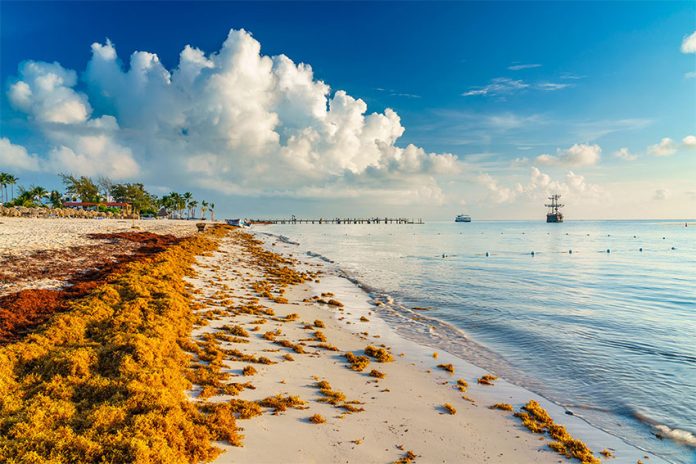
Beaches in Quintana Roo have been inundated by massive amounts of sargassum seaweed.
Beaches in Quintana Roo have been inundated by large amounts of sargassum.

Beachfront hotels in Quintana Roo are spending US $70,000 to $90,000 each per month on containing sargassum and removing the seaweed from the beach, according to the head of an industry group.

Antonio Chávez, president of the Riviera Maya Hotel Association, said the outlay is as high as it is because hotels have installed their own sargassum barriers in the sea and have to maintain them on a daily basis.

The use of machinery to clear the smelly, unsightly seaweed from beaches and the hiring of workers to manually remove it adds to hotels’ costs.

During the sargassum season, which is expected to last eight months this year, hotels in destinations such as Cancún and Playa del Carmen will spend more than $500,000 each on contention and removal efforts, Chávez said.

He said the navy’s removal of sargassum from the ocean is welcome but pointed out that the quantities it extracts are dwarfed by the amounts that reach Quintana Roo’s famous white sand beaches.

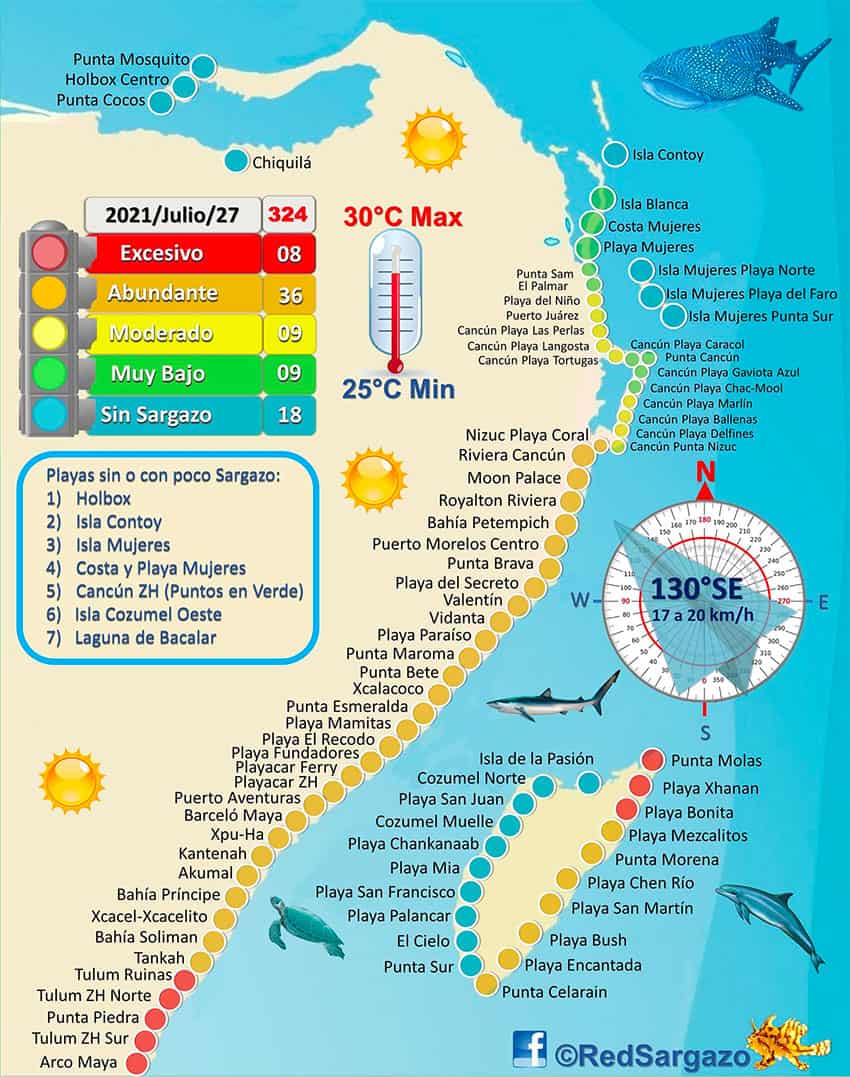
The sargassum situation in Quintana Roo
The sargassum situation in Quintana Roo as of Tuesday afternoon. sargassum monitoring network

While the navy has reported removing about 500 tonnes of sargassum from offshore, hotels have cleared more than 5,000 tonnes from beaches, Chávez said. That’s proof that the navy isn’t deploying enough sargassum-gathering vessels, he said.

Chávez also said that navy vessels have nowhere to dock in northern Quintana Roo to offload sargassum they have collected. Instead they get as close to the coast as they can and release the sargassum back into the water where small boats recollect it and take it to shore for disposal. The exercise slows the whole sargassum-gathering process down, Chávez said, adding that taxes municipalities collect from foreign tourists should go to the construction of a wharf where navy vessels can dock.

The most recent map published by the Quintana Roo Sargassum Monitoring Network shows that there are abundant quantities of the seaweed on most of the state’s north coast with excessive amounts on beaches in the Tulum area.

However, the navy said this week that sargassum arrivals are expected to decline in August and September due to changing ocean currents. The first reductions should be seen within the next two weeks, said Lieutenant Reynaldo Varga of the navy’s Gulf and Caribbean Oceanography Institute.

With reports from El Economista and Periódico Viaje 

Author Tony Burton seeks out Jalisco’s forgotten histories and mysteries

0
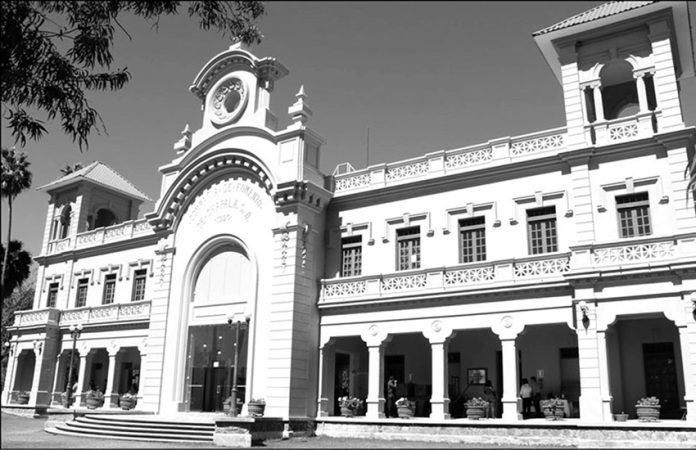
former Chapala, Jalisco, train station
The Chapala train station, designed in 1917, is now the González Gallo Cultural Center. Burton connects the birth of the railroad in Mexico with the beginning of tourism in places like Chapala.Turismo Jalisco

Whenever I’m looking for the story behind some curious Mexican custom or the history of a venerable old hacienda that I’ve stumbled upon in my travels, I find myself reaching for one of several books written by Tony Burton.

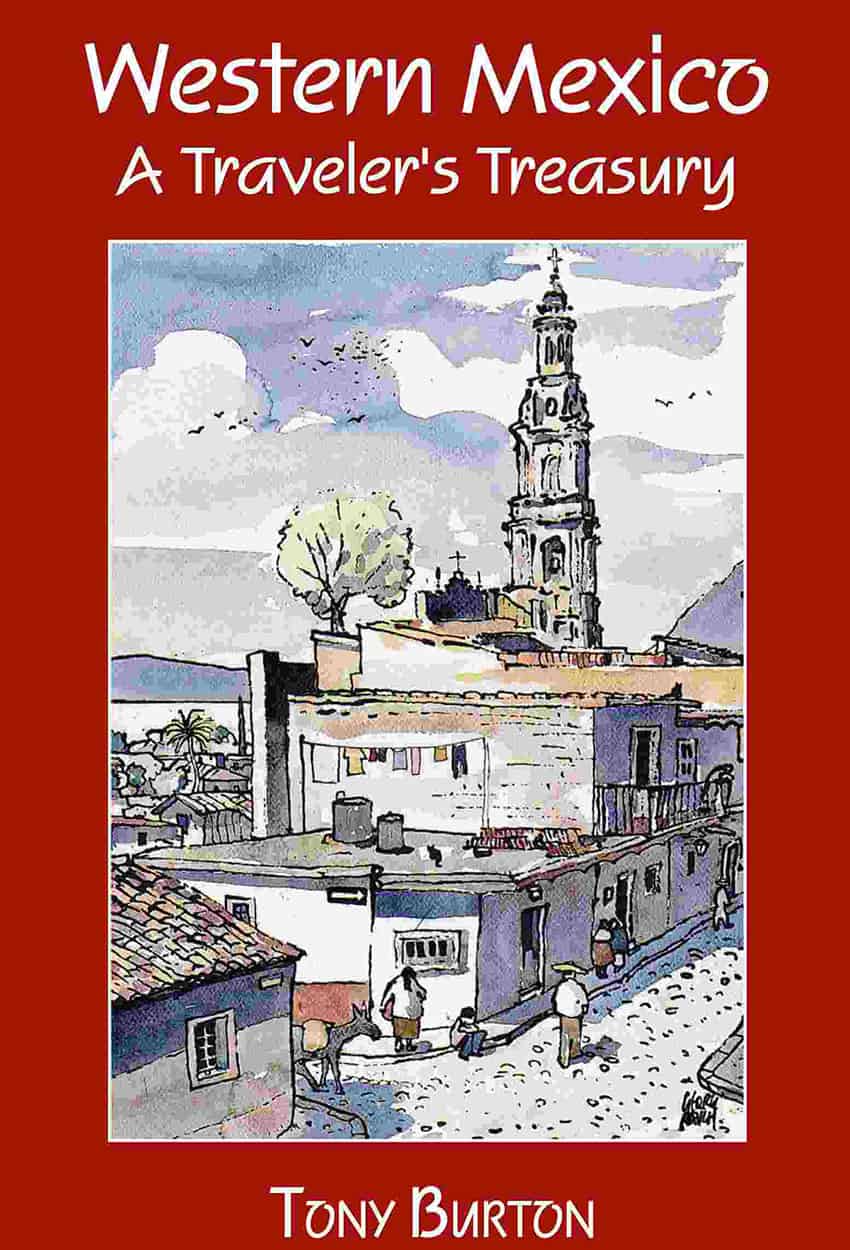
Have you ever heard of the Pastry War, which occurred between Mexico and France in the 1800s? Tony Burton tells the story in the book Western Mexico — A Traveler’s Treasury:

The Pastry War began when Mexico refused to pay compensation for damages to a pastry shop owned by a Frenchman in Mexico City. The shop had allegedly been looted during riots in 1828.

Ten years later, the French government used this pretext — and other losses that had occurred at the same time to other French property — to demand US $600,000 in damages from the Mexican government of [Mexican president Antonio] Bustamante. The French also sought a preferential trading agreement with Mexico.

Bustamante considered the claim for looted pastries to be preposterous and refused to pay or to consider the trade agreement. Outraged, the French brought up a fleet from the Caribbean island of Martinique and blockaded Veracruz.

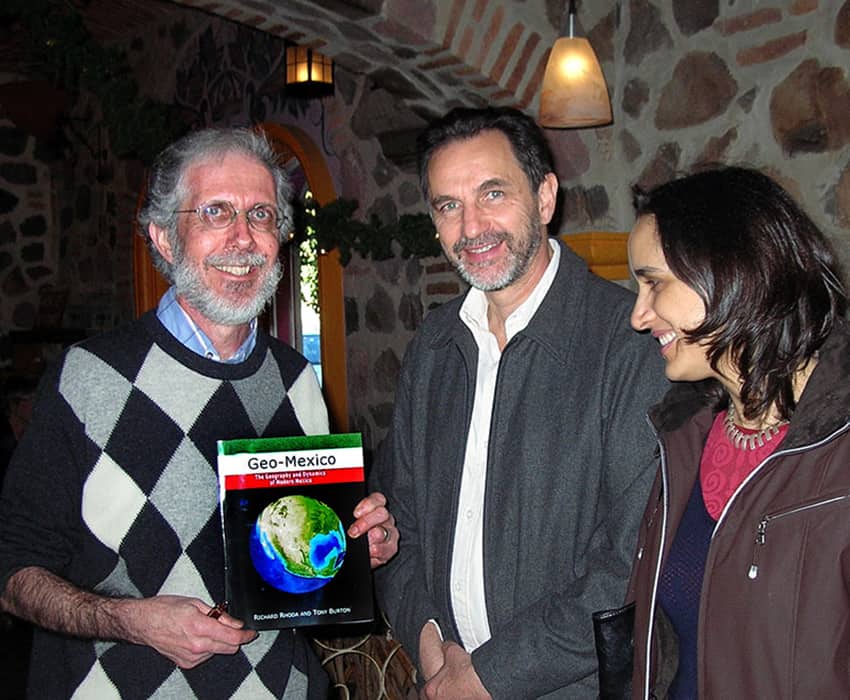
Tony Burton at book launch of Geo-Mexico in Ajijic, Jalisco
British-born geographer and writer Tony Burton, left, at the book launching of Geo-Mexico in Ajijic, Jalisco.

Seven months later, the French added US $200,000 to their demand to cover the costs of the blockade. Bustamante finally gave in and paid in full, whereupon the French fleet sailed off.

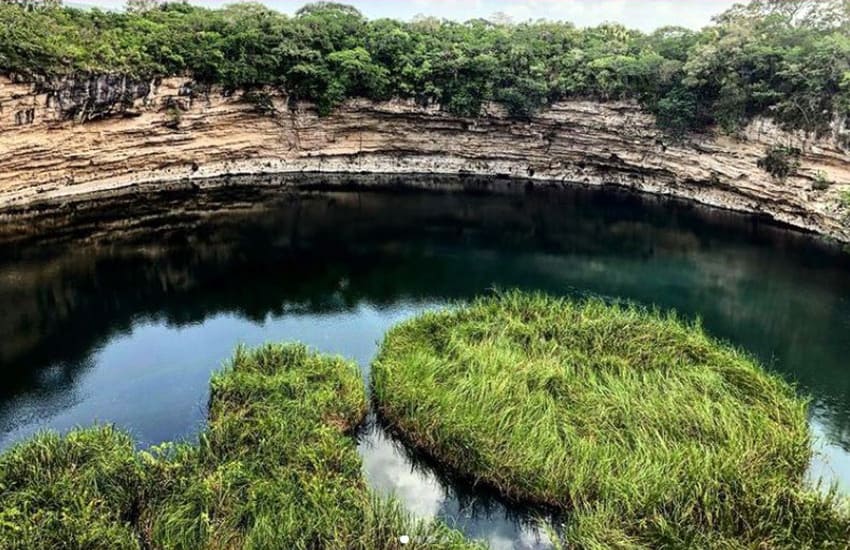
Even if you know all about the Pastry War, you may have no idea where to find the world’s deepest water-filled sinkhole. Well, you don’t have far to look if you live south of the United States border.

The book Geo-Mexico, by Richard Rhoda and Tony Burton, tells us that the El Zacatón Cenote on Rancho Azufrosa near Aldama, Tamaulipas, “is the deepest water-filled sinkhole anywhere on the planet. A 2007 NASA-funded study proved that it is a staggering 335 meters (1099 ft) deep.”

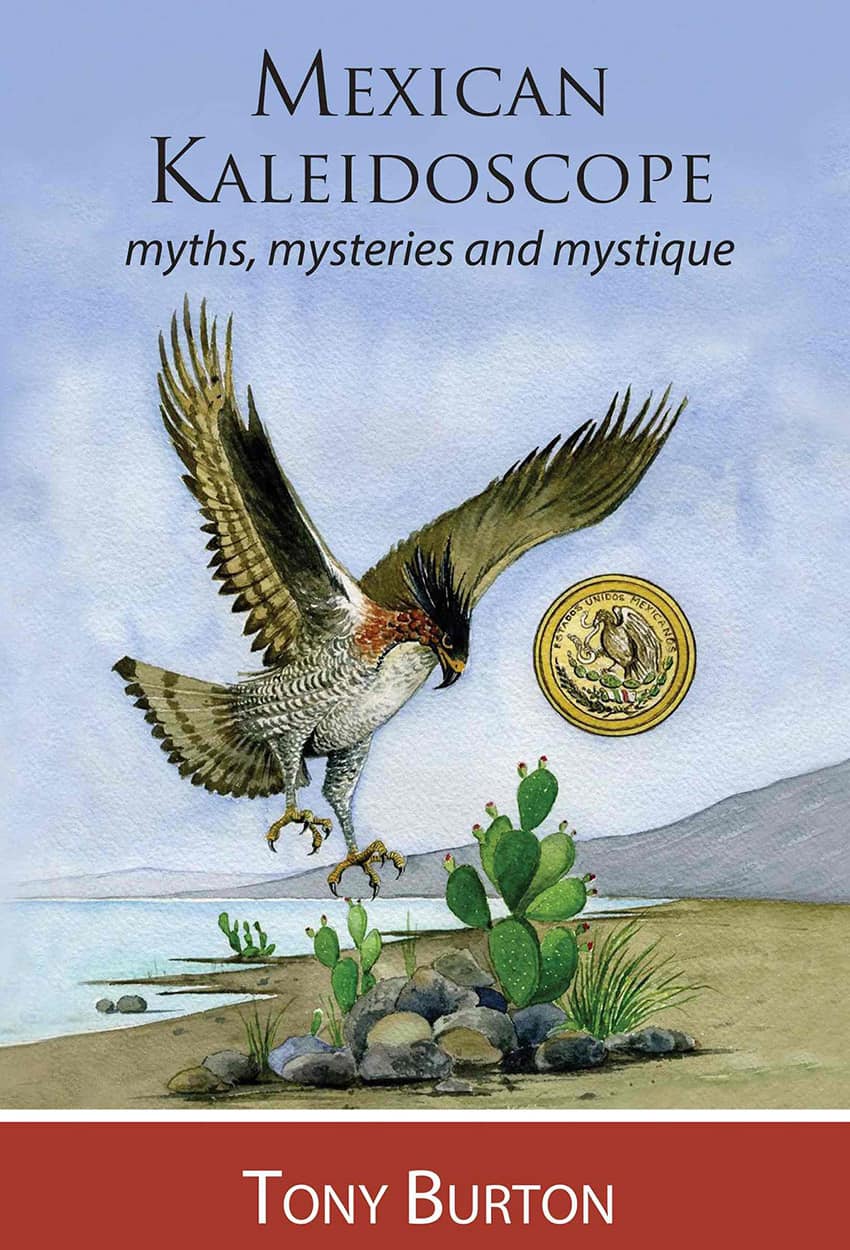
Tony Burton is also the author of Mexican Kaleidoscope: Myths, Mysteries and Mystique, as well as If Walls Could Talk: Chapala’s Historic Buildings and Their Former Occupants. I decided it was time to present Burton and his books to readers of Mexico News Daily, though many of you, no doubt, are already among his fans:

John Pint: Tony Burton, you are a British geographer. How did you become interested in Mexico?

Tony Burton: I first visited Mexico in 1977 when I backpacked solo all across southern Mexico for a summer. When I was offered the opportunity two years later to work in Mexico City [to teach at Greengates School], I jumped at the chance. One thing led to another, and within a few years, I had visited every state in the country (most of them several times), my collection of books related to Mexico was growing and my “must-see” list was becoming quite small!

Zacatón
Zacatón, the world’s deepest cenote. Pioneer cave diver Sheck Exley died here in 1994 trying to reach its bottom. Alex_sc

JP: Can you tell me something about your latest book, If Walls Could Talk?

TB: When researching the history of tourism in Mexico for Geo-Mexico, I realized that most previous accounts began with Acapulco, which first became popular in the 1920s. But where did tourists visit before that? In many ways, the growth of tourism in Mexico began with the railroads. As the nation’s railroad network expanded at the end of the 19th century, it not only made major provincial cities more accessible, it also led to the development of the lakeside town of Chapala as Mexico’s earliest purpose-built resort destination.

Almost overnight, a small fishing village became a resort with several hotels, dozens of fine villas and chalets and a yacht club. It attracted many foreign writers and artists, whose books and paintings helped popularize it. The 1910 revolution put a temporary brake on tourism, but many of these historic buildings still stand. Even today, it is quite easy to walk around Chapala and recognize the many fine examples of early vacation-oriented architecture. The mix of old and new, and the many extraordinary people who have lived there over the years, are what make Chapala such a fascinating town. Hence my book about Chapala’s historic buildings and their former occupants.

JP: Can you give me an example of one of these houses with a curious history?

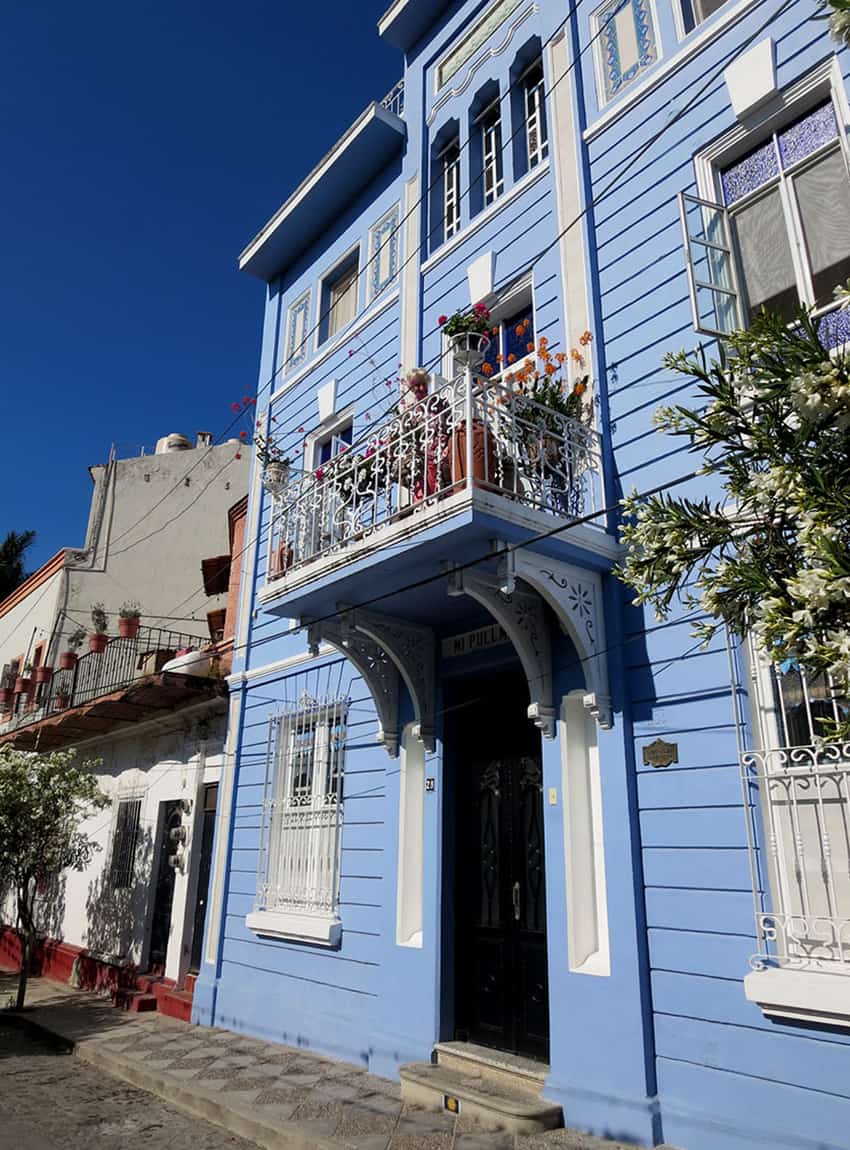
TB: If I’m limited to only a single example, I’ll have to go with Mi Pullman, an unusually tall and skinny house just back from the lakefront, designed by local architect Guillermo de Alba as his family home. The proportions of this small building, completed in 1906, resemble a Pullman rail car, hence the name.

De Alba designed numerous private homes and hotels in both Chapala and in Guadalajara and was commissioned in 1917 — by Norwegian entrepreneur Christian Schjetnan, a near neighbor — to design the beautiful Chapala Railroad Station [now the González Gallo Cultural Center]. As for Mi Pullman, by the 1990s, it had fallen into a terrible state of repair, though its ground-floor rooms were still being used for the local tourism office.

Mi Pullman House
Mi Pullman as it looked in 2019. The house was designed by architect Guillermo de Alba and built in 1906. Tony Burton

Fortuitously, in 2004, a visiting Englishwoman, Rosalind Chenery, fell in love with the dilapidated building. She spent several years persuading the owners to sell and then restored this gorgeous art nouveau townhouse to its former glory, inside and out. Chenery tells the full story in Mi Pullman: Remodeling a Mexican Art Nouveau Townhouse.

JP: How about your book Mexican Kaleidoscope? Can you share one of those mysteries with us?

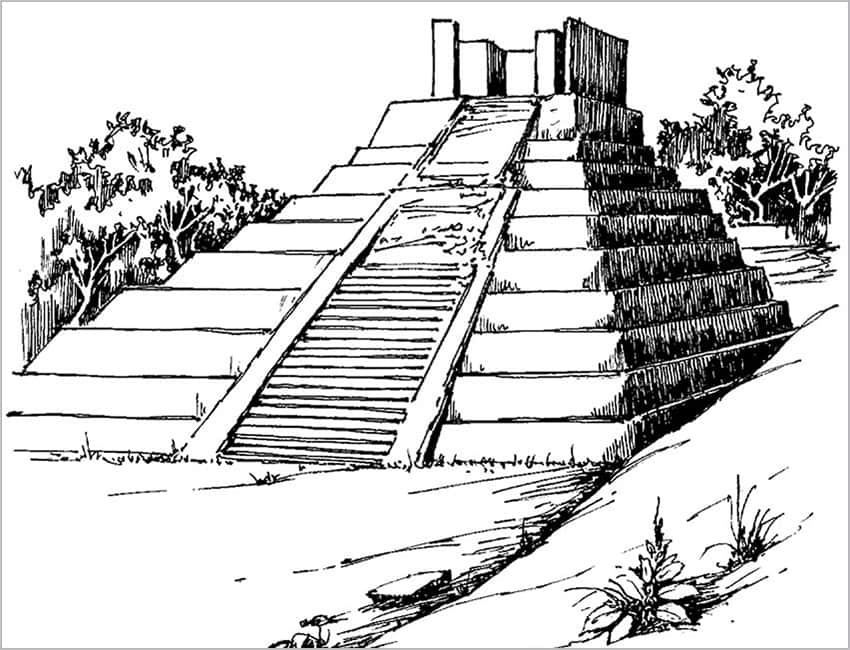
TB: Seriously? Only one? Well, rather than the story of why rubber balls bounce (and don’t simply shatter) or the reasons why ancient astronomers held a conference in Xochicalco in the eighth century to reboot their calendar, I’m opting for the mystery related to the pyramids of Comalcalco in Tabasco.

The pyramids were built by the Chontal Maya, using thousands of flat, rectangular bricks held in place by a mortar made mainly from oyster shells. The workmanship is impressive, but the bricks hide a secret: during restoration, archaeologists realized that many of the bricks bore mysterious symbols or inscriptions, and sometimes even the brickmakers’ fingerprints.

Most of the symbols are thought to be brickmasons’ signs. But the really curious thing is that these marks are virtually identical to the masons’ marks used by the Romans, half a world away in Europe. In Mexican Kaleidoscope, I examine the evidence for the claim that the Romans may have been in the Americas a thousand years before Columbus, or that their influence was introduced to Comalcalco via India.

• If this all-too-brief introduction to the works of Tony Burton has whetted your appetite, you’ll find all of his books listed on his Amazon page.

The writer has lived near Guadalajara, Jalisco, for 31 years and is the author of A Guide to West Mexico’s Guachimontones and Surrounding Area and co-author of Outdoors in Western Mexico. More of his writing can be found on his website.

drawing of ruins of Comalcalco in Tabasco
The ruins of Comalcalco in Tabasco, the only major Maya city built with bricks instead of limestone. Enrique Velázquez


Masons' marks on Roman bricks, left compared with marks at Comalcalco, right
A sampling of the masons’ marks on Roman bricks, left, compared with Maya markings at Comalcalco, right. After Fell and Barry, 1990


Cover of If Walls Could Talk by Tony Burton
Cover of If Walls Could Talk by Tony Burton. The art is from a photo by Winfield Scott, published as a postcard in 1905.


Western Mexico, A Traveler's Treasury book
Western Mexico, A Traveler’s Treasury, first published in 1993, is the indispensable guide to Jalisco and its surrounding states.


Stagecoach in Chapala around 1905
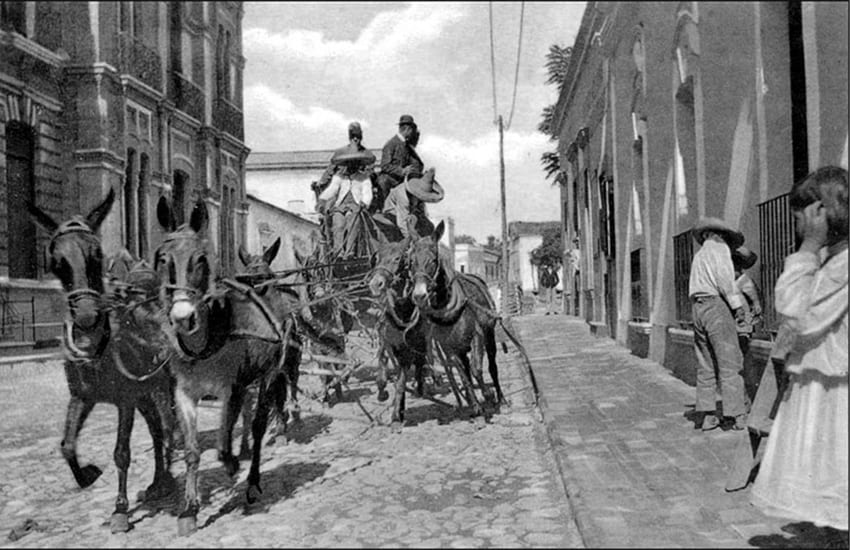
Stagecoach in Chapala around 1905.


sangritas
Where is the birthplace of sangritas and the Cholula brand hot sauce? The Widow’s Bar in Chapala: see Chapter 5 of If Walls Could Talk. Rimma Bondarenko.


Mexican Kaleidoscope book by Tony Burton
Mexican Kaleidoscope is a collection of little-known but well-documented facts that leave a reader with an urge to explore Mexico.

Morena takes aim at electoral authority amid doubts over turnout for referendum

0
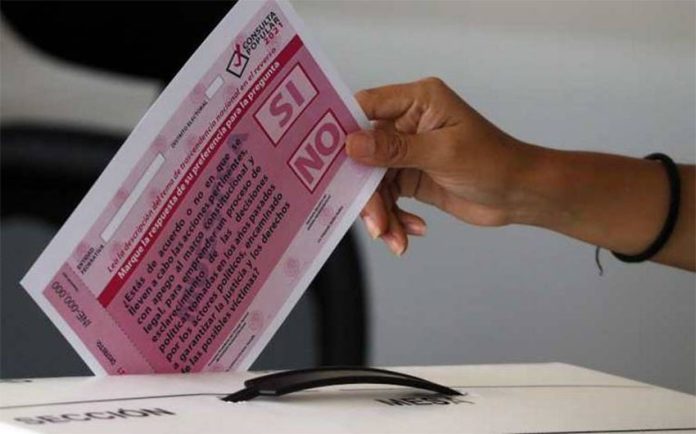
The referendum on whether ex-officials should be investigated for possible crimes is scheduled for this Sunday, August 1.
The referendum on whether ex-officials should be investigated for possible crimes is scheduled for Sunday.

The ruling Morena party has accused the National Electoral Institute (INE) of sabotaging this Sunday’s referendum at which citizens will be asked whether past presidents and other ex-officials should be investigated for crimes they might have committed while in office.

The party’s secretary general said the INE and opposition parties will be to blame if the 40% voter turnout – approximately 37 million Mexicans – required to make the vote binding is not achieved.

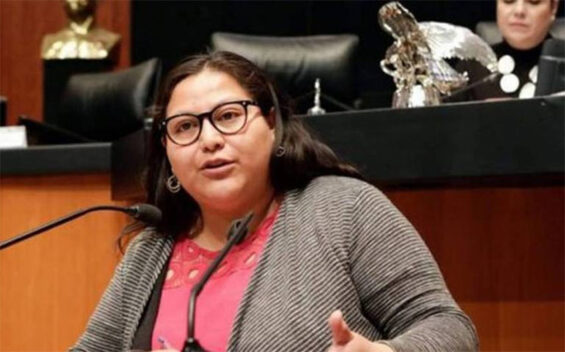
“If the consultation doesn’t achieve its objective in terms of participation to be binding, without a doubt the main reason … will be the INE,” Citlalli Hernández said in an interview with the newspaper Milenio.

While many citizens have promoted the referendum, the INE “has placed obstacles” in the way of participation because it has barely publicized it, expressed opinions against it and will only set up one-third the number of voting points it set up at last month’s elections, she said.

“… The job of the electoral authority is to use all its institutional strength to promote citizens’ participation, but we see a systematic process that allows us to affirm that the INE is sabotaging this cons,ultation,” Hernández said.

She claimed that some INE officials have become political activists who are opposed to President López Obrador (who proposed the referendum) Morena, and all the initiatives they put forward.

“… The consultation is legitimate, legal and constitutional and the job of the INE is to guarantee citizens’ participation … but they [INE officials] have discredited it publicly and they’re increasingly driven … by their [political] affinities and phobias,” Hernández said.

“In addition to discouraging [participation], I believe that the electoral authority has shown scant seriousness in attending to such an important process as this referendum is.”

Hernández also took aim at opposition parties, saying that their call for citizens to boycott the vote – in which the Institutional Revolutionary Party and National Action Party presidents are referred to indirectly in the referendum question – is an attack on democracy.

“Any persons who call themselves democrats must promote it [democracy] regardless of the content of the consultation,” she said.

Citlalli Hernández, general secretary of the Morena ruling party
Citlalli Hernández, general secretary of the Morena party.

Morena national president Mario Delgado also accused the INE of sabotage, asserting on Twitter that thousands of Mexicans have been unable to locate their nearest voting station when using the INE website tool designed for that purpose.

“The sabotage of the INE before the referendum is unbelievable, its system doesn’t work; we have thousands of reports of people unable to locate their [voting] table,” he wrote. “… We demand seriousness and respect for the will of the people.”

Delgado also said that Morena will seek to hold past presidents to account even if voter turnout is below 40% and a majority doesn’t vote in favor of investigating Carlos Salinas, Ernesto Zedillo, Vicente Fox, Felipe Calderón and Enrique Peña Nieto for alleged wrongdoings.

“Regardless of the result of the referendum, in Morena we’re going to seek a way for a truth commission to be created and for the ex-presidents to pay for the crimes they committed. We’re not going to rest until justice is served,” he said.

However, ex-presidents and other former officials don’t have immunity from prosecution so there is no reason why they can’t be prosecuted – without the need for a referendum – if there is evidence they committed a crime.

Delgado said the vote is not just about the past but also the future.

“If we never again want to have homicidal and criminal presidents we have to go out and participate. We have to break through the inaction of the electoral authority that is discouraging people’s participation – due to a lack of money, they say, but they haven’t wanted to reduce their exorbitant salaries,” he said.

INE president Lorenzo Córdova defended the electoral body’s management of the referendum and declared that it will be a success no matter how many people turn out to vote.

“Hopefully it will be [all of] the 93.5 million [enrolled voters] who participate but whatever the percentage of participation is, this [referendum] is already a success. This is the first serious referendum at a federal level and the number [of participants] will be unprecedented with respect to those there have been in the past. It will be historic,” he said Thursday.

Córdova said that the question on the referendum will be exactly as the Supreme Court stipulated and rejected Morena’s claim that voters are being asked whether former presidents should face trial.

A flyer encouraging participation in the national referendum
A flyer encouraging participation in the national referendum.

He indicated that he was unconcerned about the criticism the INE will likely face if turnout is below the 40% threshold, asserting that the institute will only be strengthened by the referendum process.

The vote, which will cost approximately 520 million pesos (US $26.2 million), will take place between 8:00 a.m. and 6:00 p.m. this Sunday, with the INE to set up almost 57,000 voting “tables.”

The question, described by the newspaper The Economist as Cantinflan, or convoluted, is as follows:

“Are you in agreement or not that appropriate actions in accordance with the constitutional and legal framework be carried out in order to undertake actions of clarification of political decisions taken in the past by political actors, aimed at guaranteeing justice and the rights of the possible victims?”

With reports from Milenio

AMLO to issue decree freeing thousands of prison inmates

0
Interior Minister Sánchez
Interior Minister Sánchez: more than 90,000 people who have never been sentenced are being held in the country's prisons.

A presidential decree is set to release thousands of prisoners from Mexican jails including those aged 75 and over who didn’t commit a serious crime and victims of torture.

President López Obrador said Thursday he would sign the decree next week ordering the release of federal prisoners who fall into four categories.

They are prisoners accused of non-serious crimes who have been incarcerated for more than 10 years without a sentence; prisoners who were victims of torture regardless of the crime of which they are accused; inmates aged 65 and over with chronic illnesses who didn’t commit a serious crime such as murder; and prisoners aged 75 and over who didn’t commit a serious crime.

The decree to free such prisoners will be drawn up by the Interior Ministry and take effect by September 15, López Obrador told his regular news conference.

Interior Minister Olga Sánchez said there are more than 94,000 people in prison who haven’t received a sentence. Of that number, more than 12,000 are incarcerated in federal prisons.

López Obrador said he hoped state authorities would consider releasing prisoners in the same categories from penitentiaries they operate.

He said the Ministry of Health will carry out assessments of prisoners aged over 65 to determine if they are suffering from a chronic disease.

Prisoners’ claims of torture will be assessed in accordance with the United Nations Istanbul Protocol on the effective investigation and documentation of torture.

The UN said in 2018 that many of the suspects accused of involvement in the disappearance of 43 students in Guerrero in 2014 were tortured. Human rights organizations have denounced Mexico for using torture as a means to obtain confessions from criminal suspects.

The federal Congress passed an amnesty law early last year that allowed the release of some prisoners. Although impunity rates are very high in Mexico, some of its prisons are severely overcrowded, a problem that could be alleviated somewhat by the upcoming mass release.

With reports from Reuters and Milenio