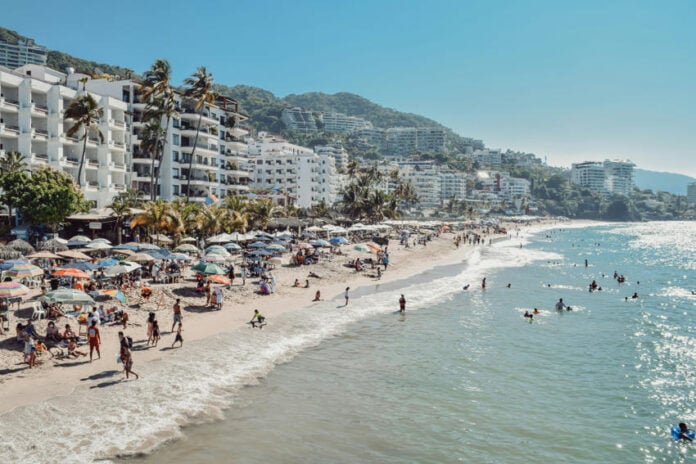
Photos from early December show the last stages of construction at the east end of the Nichupté Bridge, where it connects to Cancún's hotel zone. (Elizabeth Ruiz / Cuartoscuro.com)
Mexico’s Infrastructure, Communications and Transportation Ministry (SICT) has committed to reinforcing Cancún’s Nichupté Bridge after videos and photos circulating on social media revealed visible cracks in the concrete joints of the yet-to-be-inaugurated infrastructure project.
Following the circulation of images showing fissures in the unions between concrete blocks that make up the bridge, SICT announced it will strengthen the structure and conduct dynamic and static resistance tests before the bridge enters operation, according to El Economista.
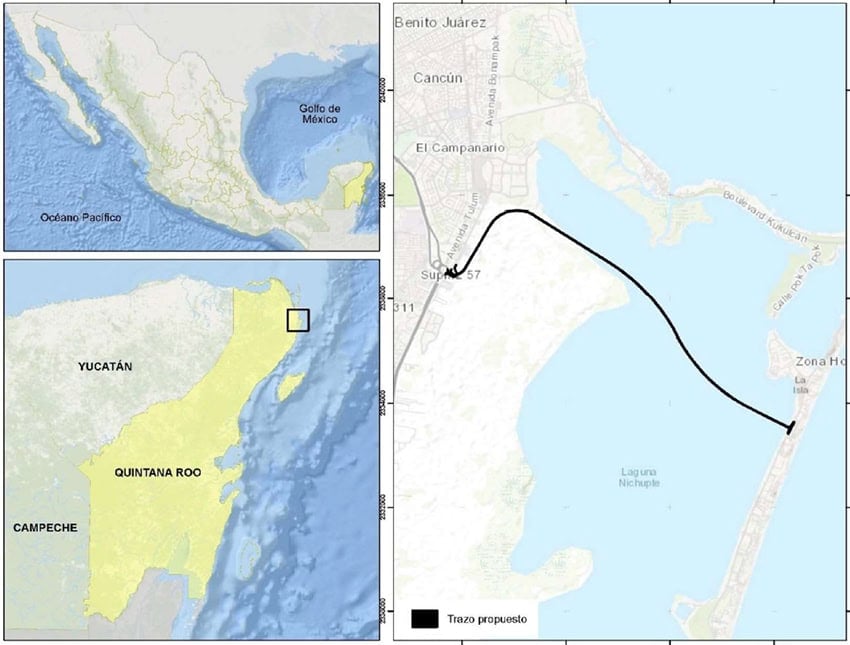
The bridge cuts across the Nichupté lagoon, granting quicker access to Cancún’s hotel zone. (Gobierno de México)
Guido Mendiburu Solís, SICT delegate in Quintana Roo, said the bridge structure poses no risk to users. Nonetheless, he said four additional support pillars and a metal beam will be constructed at at least three support points throughout the concrete structure as reinforcement measures.
Some parts of the structure have settled, Mendiburu said, because the bridge was built in an area with high karsticity, a geological feature of limestone areas prone to sinkholes.
“It is not structural damage, but before it is inaugurated we will conduct load tests, both with moving and static vehicles, to verify that the work fulfills the objective for which it was designed,” the official explained.
The images shared by social media users this month show pronounced cracks and irregularities in concrete joints, particularly in sections of the traffic distributor connecting Bonampak Avenue and Luis Donaldo Colosio Boulevard, according to local news outlet Expediente Quintana Roo. The photos also reveal fissures on lower and lateral surfaces of the structure, as well as areas with cracked concrete and chipped edges, generating concern among drivers and local residents about the structural safety of the megaproject.
El Puente Nichupté, en Cancún, Quintana Roo, será uno de los puentes más largos de América Latina sobre una laguna. Su construcción beneficiará a más de 1.3 millones de habitantes y a 20 millones de turistas que visitan la zona anualmente. 🏖️ pic.twitter.com/nHGqFwbkSl
The 11.2-kilometer Nichupté Bridge, which officials had previously announced would open this month, has been plagued by delays since construction began in 2022. Originally proposed in 2006 as part of Cancún’s 2030 Strategic Plan for Sustainable Development, the project languished for 16 years before work finally commenced.
With the bridge scheduled to be inaugurated by the end of this month, builders are coming down to the wire, with Mendiburu reporting that construction is 93% complete.
The bridge will feature three lanes in each direction on its main section with one reversible lane, a bike path and pedestrian walkway. It is designed to reduce transit times between the city center and hotel zone by up to 45 minutes by crossing a portion of the Nichupté lagoon and avoiding the most congested traffic areas. Officials say it will benefit an average of 1.3 million residents and more than 20 million tourists annually, and have promised that there will be no tolls.
Online expat groups are often an important resource for foreign newcomers to Mexico, but members can easily fall into gatekeeping behavior and online arguments. (Nicole Herrero/Unsplash)
Anyone who’s spent time in online expat groups knows the pattern: What often begins as a practical space for advice about visas, neighborhoods or where to find a decent loaf of bread can quickly spiral into something else entirely.
Minor misunderstandings flare into full-blown arguments. Longtime residents clash with newcomers. Local pride rubs up against foreign expectations. And before long, the original purpose of connection is buried beneath sarcasm, gatekeeping and thinly veiled frustration. Which is why, when something genuinely different comes along, people notice.
Melanie Henderson’s Puerto Vallarta online expat group has nearly 94,000 followers.
It’s helpful without being patronizing and positive without being naive. It’s a place where newcomers feel welcome, and longtime residents don’t feel worn down by answering the same questions for the hundredth time.
In a digital landscape where tension often feels inevitable, this page has somehow sidestepped it. And in doing so, it’s become a firm Vallarta favorite.
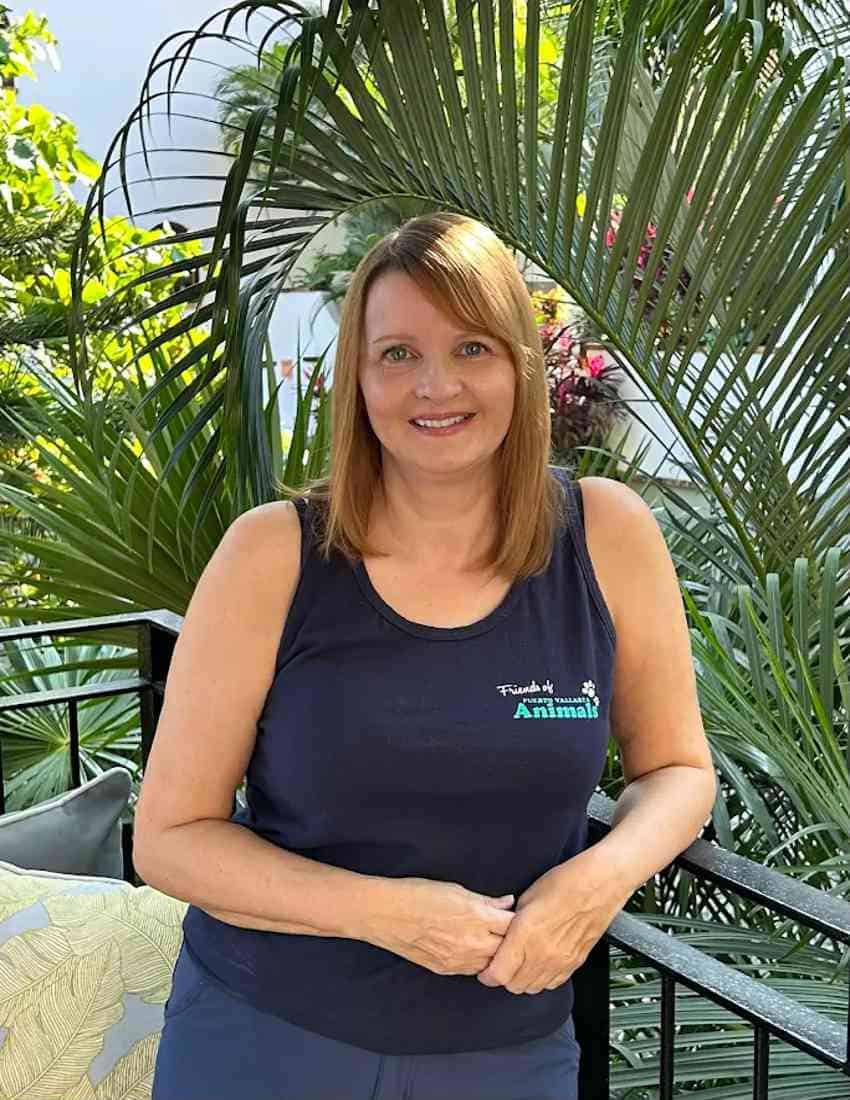
Page founder and Canadian expat Melanie Henderson started the group as a simple way of sharing her and her husband Travis’s experiences.
“My family, friends and the many customers I had where I used to work all wanted to know what we were into when we retired,” she said. “I began the page as a way of keeping them informed, and the next thing I knew, it unexpectedly grew. There was no moment when I thought it was needed; I just started it for fun and [as] a way to communicate with people.”
Puerto Vallarta Experience Share has managed to be a group where newcomers get gentle community and kind, helpful answers to questions about PV, not thin skins or arguments. (Courtesy of Melanie Henderson)
What’s striking is that the page — which has just shy of 94,000 followers — doesn’t position itself as an authority. There’s no sense of “we know better because we’ve been here longer.” Instead, it feels like a conversation happening at eye level.
If someone asks a question about buses, they get three thoughtful answers instead of a lecture. Someone shares a small joy — a sunset, a meal, a chance encounter — and it’s met with warmth rather than one-upmanship.
At its heart, Puerto Vallarta Experience Share seems less interested in being right and more interested in being useful.
“This is a group to share, discover and celebrate everything about Puerto Vallarta,” Henderson said. “Whether it’s photos, experiences, restaurant reviews, hotel tips, events or travel questions, our community is here to help each other enjoy the best the area has to offer. I want people to experience the culture [and] the beautiful people and make meaningful memories. In a nutshell, I want the group to add happiness to everyone who’s on it. Knowing it was doing that would make me very happy.”
That sense of positive emotional aftertaste, how people feel when they log off, is perhaps the page’s quiet superpower. And that doesn’t happen by accident.
Maintaining a positive tone in an expat group isn’t simply about deleting negativity. It’s about modelling behavior. It’s in the way questions are answered, disagreements are softened rather than sharpened, and humor is used to defuse rather than divide.
Puerto Vallarta Experience Share’s About Page on Facebook. (Screen capture)
“We aim to post or make comments with kindness, respect, and positivity, so that others will follow suit,” Henderson said. “Our group has so many role models that inspire me, and they’ve helped me see the joy in everything. The group is very important to all of us, so we try to treat each other like family.”
There’s also a noticeable respect in the group for Puerto Vallarta itself. Not just as a backdrop for expat life, but as a living, breathing place with its own rhythms, people and history.
Posts regularly highlight local businesses, traditions and everyday moments that remind members they’re guests here, not just consumers of sunshine and scenery, and that respect feels genuine rather than performative. It’s woven quietly into the tone of the group, shaping how people speak about the city and, just as importantly, about one another.
There’s an understanding that loving a place means listening to it, learning from it, and allowing oneself to be changed by it. That affection for Vallarta, and for the people who make it what it is, shines through in almost every interaction.
“I love the sense of community. There’s such a noticeable feeling of togetherness here,” Henderson said. “I’m grateful every day that my husband and I have been welcomed, and I want everyone to experience the joy we have in Vallarta.”
For many members, Puerto Vallarta Experience Share becomes something more than a practical resource. It’s a touchstone, a reminder of why they chose Vallarta in the first place, or why they’re considering it now. For those newly arrived, still finding their footing, it offers reassurance that uncertainty is all part of the process of being a migrant to a new country and that questions are welcome.
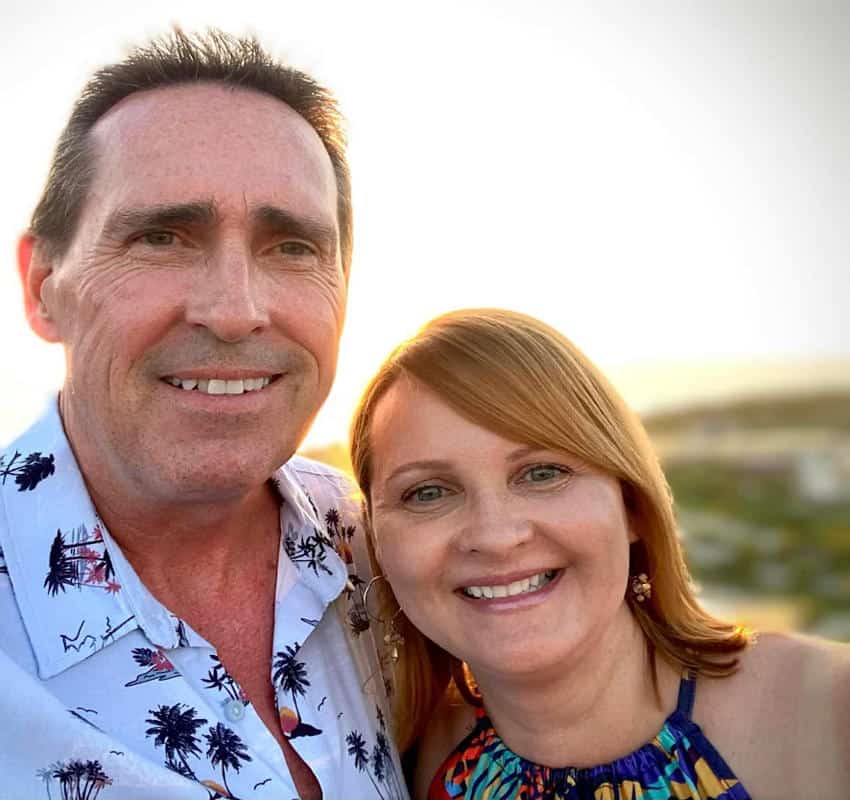
Melanie Henderson with her husband, Travis. (Courtesy of Melanie Henderson)
For those who’ve been here longer, it gently rekindles a sense of appreciation that can sometimes fade with familiarity.
In that way, Puerto Vallarta Experience Share bridges a quiet but important gap: It allows different stages of expat life to coexist without competing. There’s room for the excitement of discovery alongside the steadiness of experience. There’s room for curiosity without judgment. And, above all, there’s room for kindness.
Looking ahead, the future of the page feels less about expansion and more about intention.
“As the group grows, I’m hoping it’ll continue to be a space we can all enjoy and share together,” Henderson said. “Each time someone reaches out to someone with a post or comment, it connects us. I think the dream is that those connections remain meaningful.”
In a digital world that often rewards outrage and scorn, Puerto Vallarta Experience Share has chosen a different path, valuing curiosity over righteousness, generosity over ego and connection over noise.
That may not sound revolutionary, but in practice it is. Not because the group promises perfection but because it offers something far more sustaining: a reminder that community, when nurtured with care, can still be a source of comfort, joy and belonging.
In a city shaped by arrivals and departures, reinvention and return, Puerto Vallarta Experience Share reflects the best of what expat life can be: open, respectful and grounded in gratitude. A place where sharing experiences doesn’t mean competing for them and where being part of something never requires being someone you’re not.
In the end, that quiet sense of welcome may be its greatest success of all.
Charlotte Smith is a writer and journalist based in Mexico. Her work focuses on travel, politics and community.
In the face of renewed criticism from the Trump administration, President Claudia Sheinbaum defended Mexico's progress on security issues on Friday. She also urged to the U.S. to do its part combating addiction and reducing demand for fentanyl. (Presidencia/Cuartoscuro.com)
Responding to another sharp U.S. criticism of Mexico’s progress on security issues, President Claudia Sheinbaum on Friday defended her country’s record and reiterated her rejection of repeated U.S. offers of military intervention.
The U.S. government had issued a terse statement on Thursday after Mexican Foreign Minister Juan Ramón de la Fuente and U.S. Secretary of State Marco Rubio discussed strategies to confront shared security threats this week.
Acknowledging that progress on bilateral security matters is being made, De la Fuente and Rubio — who also spoke on Sunday — agreed that significant challenges remain.
In a joint statement on security cooperation released on Thursday, the State Department said that the two diplomats “reaffirmed the importance of the U.S.-Mexico partnership, grounded in mutual respect for sovereignty, while acknowledging that more must be done to confront shared threats.”
“The United States made clear that incremental progress in facing border security challenges is unacceptable.”
It added that Mexico is being asked to provide “concrete, verifiable outcomes to dismantle narcoterrorist networks and deliver a real reduction in fentanyl trafficking.”
Thursday’s diplomatic exchange came three days after Sheinbaum personally told U.S. President Donald Trump that U.S. intervention against Mexican cartels is unnecessary. Sheinbaum had requested the dialogue after Trump said he was prepared to confront drug cartels on the ground while again claiming that cartels run Mexico.
In her Friday morning response to the U.S. demand for increasingly stringent security measures and greater results, Sheinbaum asserted that Mexico has achieved significant progress.
“Fentanyl seizures at the U.S.-Mexico border have declined by 50 percent, according to official U.S. data,” she said, adding that the reduction means larger shipments are being seized on the Mexican side of the border.
The United States made clear that incremental progress in facing border security challenges is unacceptable. Upcoming bilateral engagements with Mexico will require concrete, verifiable outcomes to dismantle narcoterrorist networks and deliver a real reduction in fentanyl…
— Bureau of Western Hemisphere Affairs (@WHAAsstSecty) January 16, 2026
What Sheinbaum thinks the US should do
While insisting that bilateral cooperation is based on mutual respect and shared responsibility, Sheinbaum told reporters at her Friday morning press conference that it is incumbent upon the U.S. to more aggressively address the illicit flow of weapons into Mexico and to conduct an intensive campaign among young people to prevent drug addiction.
“It ought not be assumed that the issue of drug trafficking can be solved on this side of the border,” she said. “The consumption crisis they have there must be addressed from a public health perspective, with prevention campaigns and education. Because the consumption is there.”
With regards to arms trafficking, Sheinbaum noted that according to data from the U.S. Department of Justice, 75% of the weapons entering Mexico originate in the United States.
She added that just this week Mexico’s Defense Ministry seized a shipment of 21 rifles and 30 handguns being smuggled across the border into Tijuana.
Sheinbaum also said that Mexico has requested the support of technological surveillance equipment to reinforce operations carried out exclusively by Mexican agencies.
Thursday’s joint statement revealed that the bilateral Security Implementation Group — established last year to coordinate actions against drug/arms trafficking, financial crimes and fuel theft, and first convened in September 2025 — will meet next on Jan. 23. It has been tasked with “delivering tangible actions to strengthen security cooperation and meaningful outcomes to counter cartels.”
At next week’s meeting, the Group will “follow up on bilateral initiatives to promote information-sharing” and will reassess already established cross-border security initiatives.
The North American neighbors will also hold a Security Ministerial in Washington, D.C., in February, which “will provide an opportunity to assess progress, identify gaps and set clear expectations for further collaboration.”
One Mexican researcher is reducing the size of the microchips that power AI, and it's won him a prestigious scholarship at Google. (Tec de Monterrey)
When Luis Eduardo Garza Elizondo was a kid, he couldn’t resist prying open his toys. It wasn’t about breaking them — it was about seeing how they worked. “I wanted to understand what was inside,” he recalls. That childhood obsession never really stopped. It just got a lot more sophisticated.
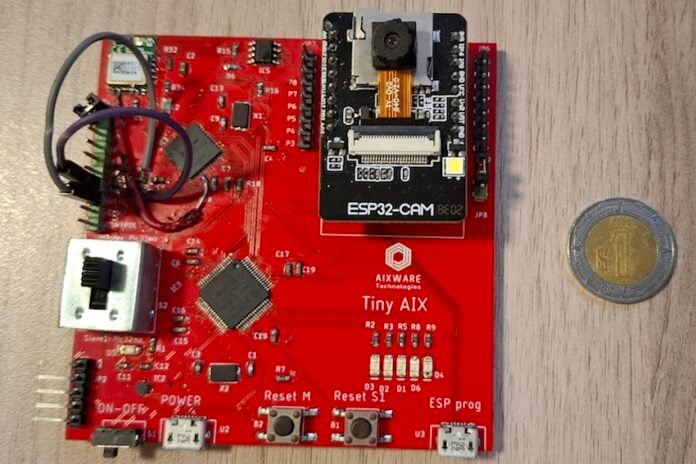
Now, as a PhD candidate at Tecnológico de Monterrey, Garza is pushing artificial intelligence to an entirely new frontier: the micro-world of chips, sensors, and embedded devices. Forget massive server clusters or data centers sucking up megawatts of power. His vision is of an AI that can think locally — and he is creating miniature, energy-efficient systems that learn and adapt on the fly without ever calling home to the cloud.
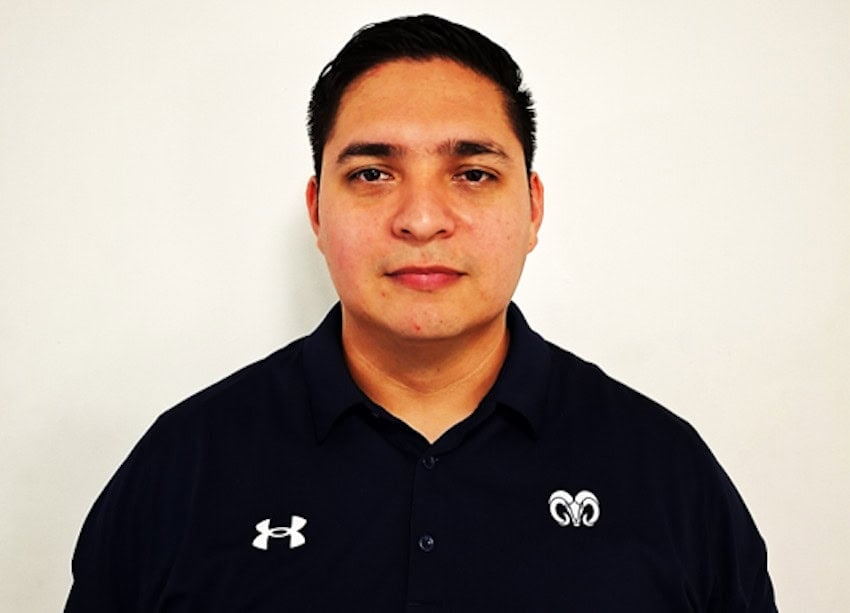
Luis Eduardo Garza Elizondo, the inventor of TinyRL. (Tec de Monterrey)
That bold idea has earned him a Google PhD Fellowship for 2025, a prestigious award reserved for the most promising young scientists redefining how computing will look in the next decade.
When Big AI gets too big
Most of today’s AI depends on immense computational infrastructure. This is like brainpower outsourced to enormous digital “cathedrals” — endless racks of GPUs chewing through terabytes of data. It’s powerful but also unsustainable.
“Today’s large AI models have an enormous environmental footprint,” Garza says. “We want to show that intelligence doesn’t have to mean excess — that it’s possible to build systems that are just as capable, but far more sustainable and accessible.”
Enter Tiny Reinforcement Learning, or TinyRL — Garza’s minimalist twist on machine learning. In essence, he’s teaching microsystems to be smart. TinyRL combines reinforcement learning (where machines learn by trial and error) with math inspired by the Kolmogorov-Arnold theorem, letting embedded devices optimize themselves in real time. The most incredible part of this process is that no supercomputers are required, unlike the large-scale machine learning systems that are currently popular.
A robot that learns by failing
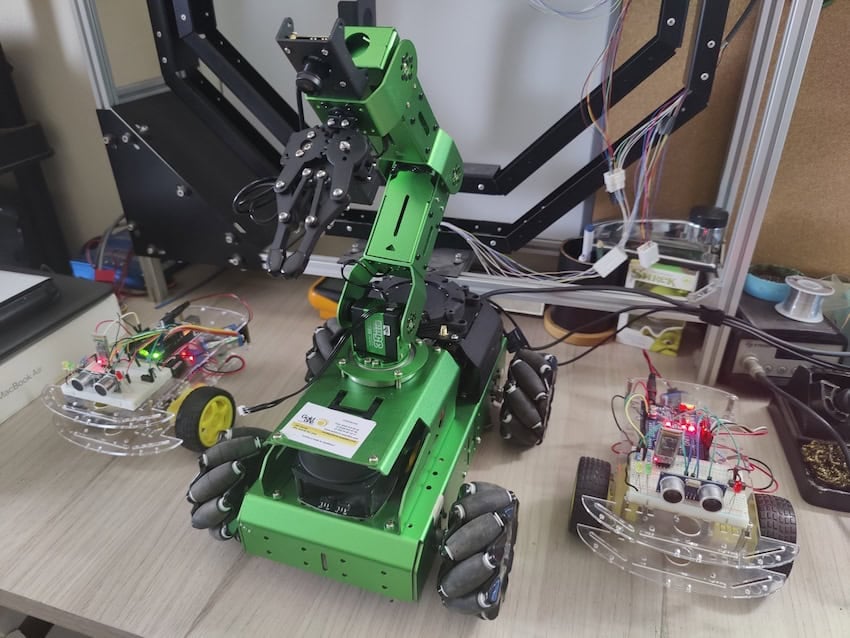
In the university’s robotics lab, Garza and his team are testing a small ground robot that starts out totally clueless. It doesn’t know where it is, how its wheels move, or what its sensors are for. But through thousands of tiny experiments — bumping into walls, pivoting, adjusting — it begins to figure it out.
After a few hours of digital trial and error, that chaos turns into coordination. “You can literally see intelligence emerging from scratch,” Garza explains. The robot goes from jittery improvisation to purposeful navigation, all without any pre-programmed instructions or cloud-based training.
This proof-of-concept robot uses miniature AI chips to learn how to operate. (Tec de Monterrey)
Soon, these algorithms will evolve to run on multi-microcontroller architectures, where multiple miniature agents learn together and share discoveries, creating a sort of ecosystem of networked intelligences.
The human-centered future of Industry 5.0
The work anchors Tec de Monterrey’s “Research Group for Industry 5.0,” a collaborative effort to design technology that’s smaller, smarter, and friendlier to both people and the planet.
Garza imagines factories where robots learn new tasks on the job, homes where assistive devices adapt to their users, and wearable health monitors that predict problems before they surface. “Imagine a smartwatch that doesn’t just track your pulse,” he says. “It anticipates changes in your health and warns you before something happens.”
For Google, his selection as a 2025 fellow places him among 255 doctoral candidates worldwide tackling pressing computing challenges. The program provides mentorship, funding, and a global research network. For Garza Elizondo, it’s an affirmation that big thinking doesn’t have to live in big machines.
“When people think about AI, they imagine huge systems behind screens,” he says. “But what excites me is the idea that intelligence can live anywhere — even in the tiniest corner of a chip.”
This story was written by a Mexico News Daily staff editor with the assistance of Perplexity, then revised and fact-checked before publication.
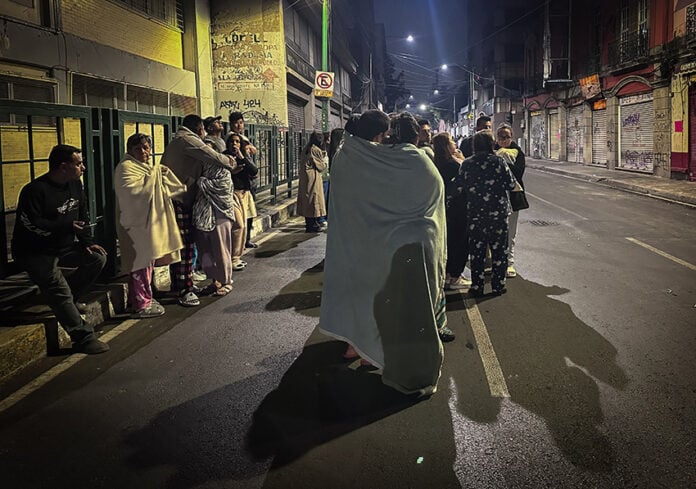
Mexico City residents found themselves huddling in the cold after a Seismic Alert System warning sent them into the street shortly after midnight Friday.
(Andrea Murcia/Cuartoscuro.com)
Residents of Mexico City were again rousted from their beds just after midnight Friday after an earthquake triggered the Seismic Alert System, but authorities quickly reported that no damage had occurred.
The 5.0 magnitude temblor was barely perceptible in most of the capital, but did produce some minor shaking closer to the epicenter in the Pacific coast state of Guerrero.
.@SismologicoMX: Hasta las 08:00 horas del 16/enero/2026 se han registrado 4,700 réplicas del sismo de M 6.5 ocurrido en San Marcos, Guerrero el 2/enero/2026, la más grande de magnitud M 5.0 pic.twitter.com/XS0IZzhhgn
In a social media post shortly after the incident, President Claudia Sheinbaum said no damage had been reported, adding that “the National Civil Protection Coordination is initiating the review protocol” in Mexico City and in areas around the epicenter.
Hours later, federal and local authorities said no injuries had been reported and confirmed that no significant damage to infrastructure had been identified.
Mexico’s National Seismological Service (SSN) described the tremor as an aftershock related to the Jan. 2 earthquake that rang in the New Year.
“Through 8 a.m. on Jan. 16, 2026, we have registered 4,700 aftershocks related to the 6.5 magnitude earthquake that occurred in San Marcos, Guerrero, on Jan. 2, 2026, the largest being magnitude 5.0,” the SSN said on its website.
Forty-eight more aftershocks occurred in the seven hours immediately after the Friday morning temblor, the largest reaching just 4.1, the SSN reported.
Newspaper reports indicated the epicenter of the 5.0 magnitude tremor was 17 kilometers (10 miles) southwest of San Marcos, and about 70 kilometers (44 miles) south of Acapulco.
The distance from San Marcos to Mexico City is roughly 365 kilometers (225 miles).
The SSN explained that the recent seismic activity in San Marcos, also near the epicenter of the Jan. 2 quake, is due to “the readjustment of the Earth’s crust after a major rupture.” Additionally, it said, “Guerrero sits at the confluence of the Cocos and North American tectonic plates, and the movements arise when the former slides under the latter, in a phenomenon known as subduction.”
Scientists have dismissed speculation that a so-called San Marcos Fault has formed, explaining that San Marcos is located very close to the Guerrero Gap, which extends approximately 150 kilometers (93 miles) from Acapulco to Papanoa-Petatlán, and is part of the Cocos-North America boundary.
Movement along the Guerrero Gap occasionally produces large earthquakes, but frequent, slow-slip events that release strain, known as silent earthquakes, are more characteristic.
Economy Minister Ebrard shared updates on the USMCA review and private investment in Mexico at Thursday's presser, while President Sheinbaum discussed the national development plan known as Plan Mexico and infrastructure. (Mario Jasso/Cuartoscuro.com)
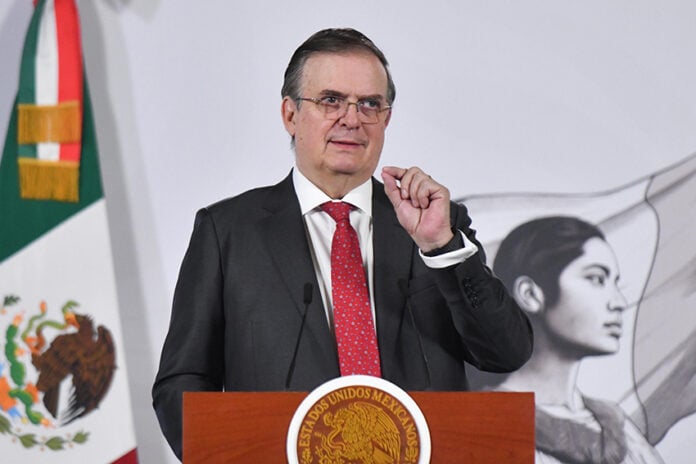
Economy Minister Marcelo Ebrard attended President Claudia Sheinbaum’s Thursday morning press conference and responded to questions on a range of topics including investment in Mexico and the USMCA review.
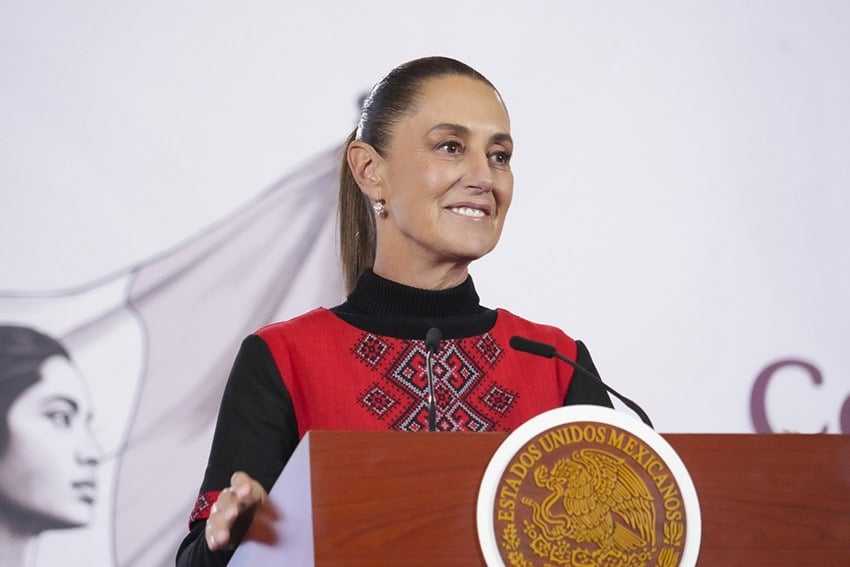
Sheinbaum also spoke about public and private investment in Mexico within the context of Plan México, the government’s ambitious economic initiative that was launched a year ago this week.
Ebrard: US $293 billion in Mexico’s investment ‘portfolio’
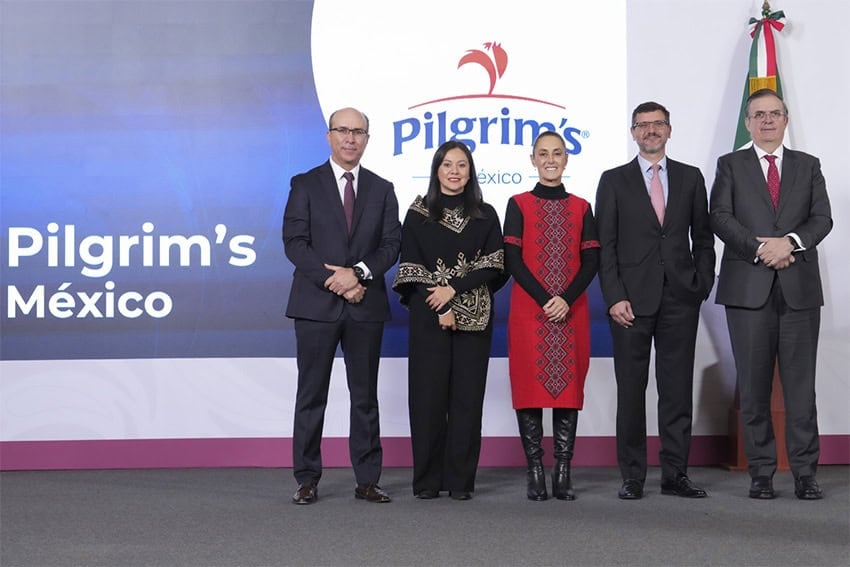
After executives from chicken producer Pilgrim’s Pride announced an investment of US $1.3 billion in Mexico over the next five years, Ebrard said that the nation now has an “investment portfolio” of $293 billion.
“So this week we only have $2.3 billion [in investment announcements],” Ebrard said, apparently speaking tongue in cheek.
“At the national level, in the portfolio we have $293 billion,” he reiterated.
A planned investment of US $1.3 billion by chicken producer Pilgrim’s Pride was the latest addition to Mexico’s nearly US $300 billion “investment portfolio,” according to Economy Minister Ebrard. (Presidencia)
The economy minister was presumably referring to investment commitments from both Mexican and foreign companies as well as projects that are currently in progress. There is no guarantee that all of the announced investments will come to fruition.
Automakers Tesla and BYD are among the companies that haven’t followed through on investment plans they announced.
Ebrard: USMCA negotiations are going well
Asked about negotiations related to the review of the USMCA free trade pact, Ebrard said he believed that good progress has been made “on all the points that concern each of the parties,” namely Mexico, the United States and Canada.
“And we also have a clear idea already of the points that will have, let’s say, the greatest focus for each country, the greatest importance, the highest priority [in the formal review]” he said.
Ebrard said that Mexico’s “first strategic objective” is to maintain the USMCA, which wouldn’t expire until 2036 even if the three parties failed to reach an agreement to renew it.
In late September, U.S. Trade Representative Jamieson Greer accused Mexico of failing to comply with the USMCA, and declared that it didn’t “make a lot of sense to talk about extending” the agreement as things stood.
NEW: Trump’s point man on trade floats separate deals with Canada and Mexico.
Jamieson Greer laid out the case for bilateral agreements, a move that would end more than 30 years of a unified free-trade deal in North America. #CUSMA#USMCAhttps://t.co/XNjUJCMxGe
“There are areas where they’re supposed to be complying with the USMCA, where they’re not. This could be energy, telecommunications services, agricultural, all kinds of things,” Greer said without going into specifics.
Government to present 1-year review of Plan México soon
Sheinbaum told reporters that her government will present an evaluation of Plan México in 2025 in around two weeks. She said that officials will also speak about the execution of the plan in 2026.
“We’ll probably do an event, either at the Museum of Anthropology or some other space, to which we’ll invite the business sector, workers and various [other] sectors of Mexican society,” Sheinbaum said.
An analysis by the think tank México ¿cómo vamos? of the progress made toward achieving six of the 13 Plan México goals over the past year indicated that the execution of the plan is not going as well as might have been hoped.
Sheinbaum: ‘I’m very excited because there will be more investment in infrastructure’
Later in her mañanera, Sheinbaum spoke in broad terms about new infrastructure projects that will be carried out in Mexico.
“I’m very excited because there will be more investment in infrastructure, in energy, in oil, in natural gas, in electricity,” she said.
President Sheinbaum promised continued federal investment in infrastructure, with an emphasis on energy infrastructure. (Hazel Cárdenas / Presidencia)
She said that the new infrastructure projects will be undertaken with public investment, with private investment and in public-private partnerships in some cases.
“There are a lot of investments that we are certain are coming to Mexico starting this year. That is the case with Pilgrim’s and other investments in the portfolio held by the Economy Ministry,” Sheinbaum said.
“… So, it’s a good year for Mexico. And Plan Mexico will continue to strengthen,” she said.
By Mexico News Daily chief staff writer Peter Davies (peter.davies@mexiconewsdaily.com)
The peso closed at 17.65 to the dollar on Thursday, marking the lowest exchange rate since July 2024. (Shutterstock)
The Mexican peso appreciated against the US dollar for a fifth consecutive trading day on Thursday, closing at 17.65 to the greenback, according to the Bank of Mexico.
The peso is currently at its strongest level since July 12, 2024, when it closed at 17.62 to the dollar.
On Thursday, the peso appreciated 0.92% after closing at 17.81 to the dollar on Wednesday.
On Thursday morning, Banco Base’s director of economic analysis Gabriela Siller wrote on X that the peso was appreciating due to “1) the weakness of the dollar, 2) carry trade operations (due to the interest rate differential between Mexico and the US and between Mexico and Japan), and 3) the rise in the price of silver.”
In a separate post, Siller wrote that President Sheinbaum’s remarks about the National Electoral Institute maintaining its autonomy “generated optimism about Mexico.”
The federal government is planning a wide-ranging electoral reform that will likely be submitted to Congress next month.
The peso has appreciated this week even though U.S. President Donald Trump cast some doubt over the future of the USMCA by asserting on Tuesday that the free trade pact provides “no real advantage” to the United States and is “irrelevant” to him.
Paula Chaves, a financial markets analyst with the firm HF Markets, said that when the USMCA is “questioned” the interpretation of the market is that the risk is greater for the United States than for Mexico.
“The predominant reaction is a reduction in exposure to the dollar,” she said.
Chaves also said that the “market recognizes that the USMCA” — which will undergo a formal review process this year — is “strategic for Mexico and the United States.”
“Weakening it would imply significant costs, particularly in terms of competitiveness and productive efficiency,” she said.
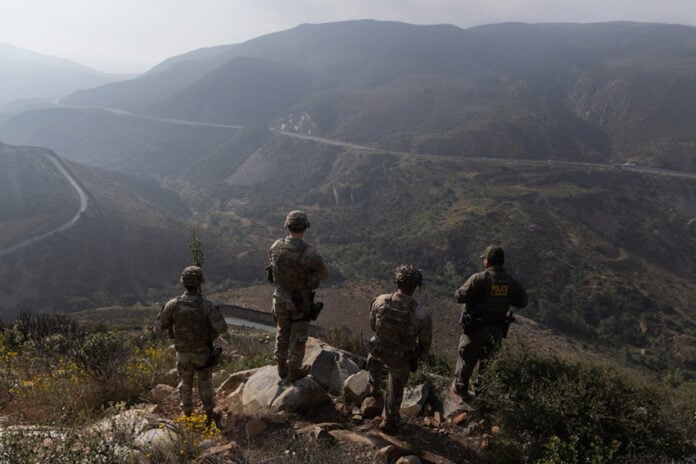
U.S. soldiers and Customs and Border Protection (CBP) agents patrol the border with Mexico near Chula Vista, California. (Elijah Ingram/U.S. Army)
On the very first day of his second term as U.S. president, Donald Trump was asked whether he would consider “ordering U.S. special forces into Mexico” to “take out” drug cartels.
“Could happen. Stranger things have happened,” Trump responded.
Now, The New York Times is reporting that the United States is “intensifying pressure” on Mexico “to allow U.S. military forces to conduct joint operations to dismantle fentanyl labs inside the country.”
Published on Thursday, the Times’ report quotes U.S. officials who spoke with the newspaper “on condition of anonymity to discuss sensitive diplomatic issues and military planning.”
The U.S. attack on Venezuela and President Trump’s subsequent threats of military intervention in Mexico have reawakened worries that the U.S. president’s talk could turn into action. (Gage Skidmore CC BY 2.0)
The Mexican president subsequently said that Trump told her that the United States could provide additional assistance to combat cartels if Mexico requested such help. Sheinbaum — a staunch defender of Mexican sovereignty and an ardent opponent of any kind of U.S. intervention in Mexico — told her counterpart that U.S. “boots on the ground” help wouldn’t be necessary.
The president — whose government has significantly ramped up the fight against organized crime over the past 15 months — also said on Monday that a U.S. military action in Mexico could be ruled out.
NYT: US officials want American forces to take part in Mexican Army raids
Citing its sources, the Times reported that “U.S. officials want American forces — either Special Operation troops or C.I.A. officers — to accompany Mexican soldiers on raids on suspected fentanyl labs” in Mexico.
Under the U.S. proposal, Mexican troops would lead the raids and make “key decisions,” while U.S. forces would support them, providing intelligence and advice, according to the Times’ reporting.
The newspaper noted that “such joint operations would be a significant expansion of the United States’ role in Mexico, and one that the Mexican government has so far adamantly opposed.”
The Times, again citing its U.S. government sources, wrote that the United States’ joint operations proposal “was first raised early last year and then largely dropped.”
The U.S. has asked that its forces be allowed to participate in Mexican military action against cartels, a request that has so far been denied. (José Betanzos Zarate/Cuartoscuro.com)
Given Sheinbaum’s staunch defense of Mexican sovereignty and her repeated assertions that U.S. forces won’t be allowed to come into Mexico to combat the country’s notorious drug cartels, it would appear extremely unlikely that she would consent to the Trump administration’s request, no matter how intense the pressure becomes.
In addition to the president’s personal opposition, the United States’ “proposal for joint operations also runs up against recent Mexican laws that restrict foreign troops on Mexican soil, including a constitutional amendment passed last year,” the Times wrote.
Sheinbaum frequently stresses that her administration is willing to collaborate and cooperate with the U.S. government on security issues, but will not accept subordination or any violation of Mexican sovereignty. Indeed security cooperation between Mexico and the United States is premised on “the principles of reciprocity, respect for sovereignty and territorial integrity, shared and differentiated responsibility, as well as mutual trust,” according to a joint statement issued in September.
Security Minister Omar García Harfuch told the Times last month that Mexico has “highly trained army units and special forces,” and in light of that dismissed the need for U.S. forces in Mexican territory.
“What we need is information,” he said.
Security Minister García Harfuch dismissed the idea that Mexico needs U.S. firepower, underlining the need for more intelligence sharing. (Victoria Valtierra/Cuartoscuro)
NYT: US advisers are already in military command posts in Mexico
While the Mexican government has not consented to joint operations in Mexico, Mexican officials this month “offered counter proposals,” including “increased information sharing and for the United States to play a greater role inside command centers,” the Times reported, citing “a person familiar with the matter.”
The newspaper wrote that “U.S. advisers are already in Mexican military command posts, according to American officials, sharing intelligence to help Mexican forces in their antidrug operations.”
The Times added that “Mexican officials are under pressure to reach an agreement, as some American officials would like to see the U.S. military or C.I.A. conduct drone strikes against suspected drug labs.”
“… But fentanyl labs are notoriously difficult to find and destroy,” the newspaper wrote, citing U.S. officials.
US Democrats introduce bill aimed at stopping unauthorized US military force in Mexico
On Wednesday, three Democratic Party lawmakers, Congressman Joaquin Castro, Congresswoman Sara Jacobs and Congressman Greg Stanton, introduced the “No Unauthorized War in Mexico Act” to the U.S. House of Representatives.
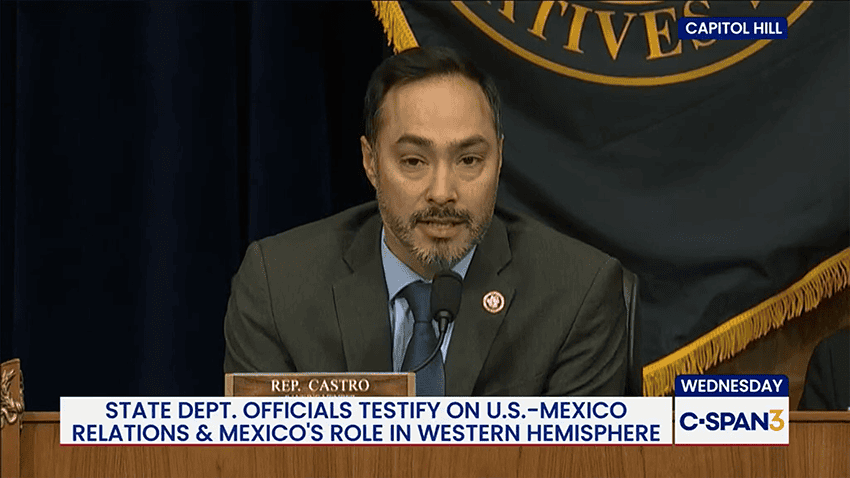
U.S. Congressman Joaquin Castro, seen here at a December congressional hearing regarding relations with Mexico, was one of the legislators behind the proposal to prohibit a U.S. military incursion in Mexico. (CSPAN)
The legislation advocates a “prohibition on use of force in or against Mexico” unless the U.S. Congress has “declared war on Mexico” or “enacted specific statutory authorization for such use of military force after the date of the enactment of this Act.”
If enacted, the legislation would “prohibit taxpayer funds from being used for an unauthorized war in Mexico,” according to a statement issued by Castro.
“Launching the United States into another unnecessary — and unauthorized — war in Latin America is a destabilizing move that will come back to haunt the nation,” Castro said.
“My constituents in San Antonio don’t want the U.S. to spend billions in another war that risks destabilizing the region, mass migration, and human rights abuses. My legislation, the No Unauthorized War in Mexico Act, would protect our relationship with a close ally and prevent wasting taxpayer dollars on military force in Mexico,” he said.
While its extremely unlikely that the bill will be approved by the Republican-dominated lower house of Congress, it serves as a warning to, and rebuke of, the Trump administration, and adds to the public debate over its intentions in Mexico.
The introduction of the bill came five days after Castro, Stanton and 70 other House Democrats wrote to U.S. Secretary of State Marco Rubio to express their opposition to “the unauthorized use of military force in Venezuela and threats from the President and administration officials alluding to U.S. military action inside Mexico without Mexico’s consent and without congressional authorization.”
“… Unilateral military action against Mexico would be disastrous,” they wrote before pointing out that “Mexico is America’s number one trading partner and critically important security partner with whom we share longstanding familial and border connections.”
“Under President Claudia Sheinbaum, Mexico has dramatically increased its cooperation with the United States. Any unilateral military action would violate Mexico’s sovereignty, and tarnish the new era of cooperation that … Sheinbaum has ushered in.”
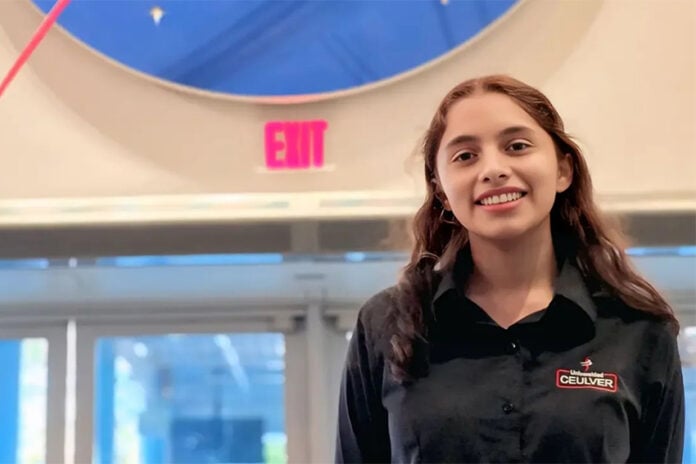
Only one student receives the medal each year out of a worldwide pool of candidates. Valeria Palacios is the first Mexican to be so honored, for which she has received congratulations from President Sheinbaum. (Valeria Palacios/Facebook)
Valeria Palacios Cruz, a 19-year-old student from Veracruz, has been selected as the winner of a 2025 World Education Medal.
She has been honored in the student category for using artificial intelligence to address environmental and social challenges in her community.
Palacios said the medal “reflects my belief that AI should be applied where it can create a real difference for people and the planet.” (Valeria Palacios/Facebook)
The international award, presented by technology giant HP and announced Tuesday in London, honors only three people each year — one global leader, one educator and one student — for using technology to achieve social impact and advance education.
Palacios, a student at Ceulver/TecNM University in Veracruz, is the first Mexican to win in any category. The formal ceremony will be held next Tuesday at the Education Leaders Forum in London.
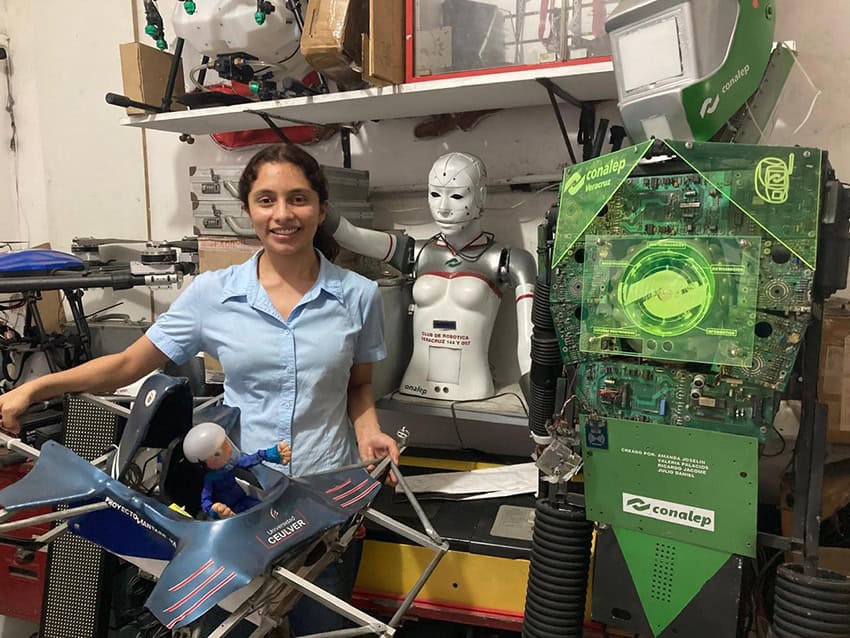
Palacios develops projects that merge AI, robotics and drones to solve local environmental problems.
Her initiatives include Clean Water Drone, which removes floating waste; Drones for Reforestation, which plants seeds in damaged areas; and Project Manta Ray, a rescue drone used in emergency response.
She also created CONIA, a service robot designed to help older adults live independently by recognizing medications, reading printed materials and detecting medical emergencies.
“This [award] reflects my belief that AI should be applied where it can create a real difference for people and the planet,” Palacios said. “Thank you, HP, for recognizing the potential of young innovators in using AI for a positive social and environmental impact.”
President Claudia Sheinbaum congratulated Palacios at one of her morning press conferences this week, adding that she plans to meet her soon.
HP Global Director of Education Business and Strategy Mayank Dhingra said Palacios’ work “highlights how leveraging the latest technologies can pave the way for a brighter future in education, offering hope and progress to society.”
The other winners were Rebecca Winthrop, director of the Brookings Institution’s Center for Universal Education in Washington, D.C., in the leaders category, and Vineeta Garg, head of IT at SRDAV Public School in New Delhi, India, in the educators category. Approximately 130 countries participated in the competition.
Palacios’ award is the latest in a string of global honors for Mexicans in the world of education.
In August, three Chihuahua teens won first place at 2025 World Robot Contest in China; in September, Mexican student Alejandro Aguilar won the 2025 James Dyson National Award for creating an app that uses AI to detect retinal diseases in under 30 seconds; and in December, Nelsy Saray Valenzuela Flores of Sinaloa was nominated for the GEMS Global Teacher Prize, one of the world’s most prestigious education awards.
In addition, high school students from Veracruz won the Zayed Prize for their marine conservation project, and an elementary school in Mexico City became the first Mexican institution to win the World’s Best School Prize for Community Collaboration, an international award from London-based T4 Education.
Chinese-made cars in Mexico include brands like BYD, Changan and MG as well as cars manufactured in China by Ford and General Motors. (Michael Fortsch/Unsplash)
Around one in five cars sold in Mexico in 2025 was made in China, according to data from the national statistics agency INEGI and industry groups.
Citing data from INEGI, the Electro Mobility Association and the Nuevo León Automotive Cluster (CLAUT), the Reforma newspaper reported on Thursday that 306,351 “Made in China” light vehicles were sold in Mexico last year, representing 19% of total sales.
The figure includes sales of vehicles made by Chinese automakers such as BYD, Changan, MG and GWM as well as sales of cars made in China by foreign companies such as General Motors and Ford.
Around 244,000 of the “Made in China” light vehicles sold in Mexico last year were Chinese-branded cars, according to the Mexican Association of Automotive Distributors (AMDA). That figure represents around 15% of total sales in 2025, which numbered over 1.6 million units according to AMDA.
Five years ago, sales of Chinese-branded vehicles accounted for less than 1% of total sales in Mexico, the El Economista newspaper reported. Mexico is now the world’s top importer of vehicles made in China.
The rapid increase in sales of Chinese cars, and the resultant impact on the Mexican auto industry, was a key reason why the federal government took the decision to increase tariffs on vehicles made in China. As of Jan. 1, such vehicles are subject to a 50% duty when entering Mexico, up from 20% in 2025.
‘Cars built in China don’t have a single part made in Mexico’
CLAUT director Manuel Montoya told Reforma that the significant market share of “Made in China” cars in Mexico is largely due to their attractive prices, which are possible thanks to low production costs in the East Asian economic powerhouse.
“The traditional brands [such as Ford and GM] that manufacture here and also in China have the option of bringing a quota of vehicles from there [to Mexico] at [Chinese] prices,” he said.
“… That’s why you have an SUV such as the Ford Territory with a super price [in Mexico] and that encourages people to buy,” Montoya said.
BYD electric vehicles have become popular in Mexico because of their affordability compared to other EVs. Around 85,000 BYDs were sold in Mexico last year, representing about one-third of all sales of Chinese-branded vehicles.
Montoya said that “Made in China” vehicles are selling “because they have very attractive prices and, in addition, they’re very well made.”
While many Mexican consumers are happy about having access to Chinese cars, the rise of the Chinese auto industry represents a threat to its Mexican counterpart.
GM started to export made-in-China cars to Mexico in 2020 with its Chinese JV partner SAIC. This helped pave the way for SAIC and other Chinese automakers to grow quickly in the Mexico market.
“Cars built in China don’t have a single part made in Mexico,” noted Montoya.
“It affects us because the Mexican industry lives off production of vehicles made in North America. It really affects us, the United States and Canada,” he said.
Will higher tariffs impact sales of Chinese cars?
AMDA president Guillermo Rosales told El Economista that it is difficult to predict what impact the higher tariffs will have on sales of Chinese cars in Mexico.
Although the 50% duty took effect on Jan. 1, Rosales said he didn’t anticipate “significant changes” in sales of Chinese-made cars in the first half of the year.
“The year already started and we’re not seeing upward price changes,” he said.
Higher prices for Chinese vehicles could become apparent later in the year as dealerships take delivery of cars that entered the country after Jan. 1. However, Chinese automakers are known for having the capacity to absorb and offset tariff increases.
Still, the 50% tariff on vehicles from China and other countries with which Mexico doesn’t have a free trade agreement (such as India and South Korea) “is a measure and a public policy that balances the market,” according to Rogelio Garza, president of the Mexican Automotive Industry Association.
“… As the Economy Minister [Marcelo Ebrard] has said himself, [it creates a] level playing field in order to be able to compete in Mexico,” Garza said.