Mexican-American singer-songwriter Lila Downs’ new album is dedicated to the chile, is conformed mostly of cumbia beats and and doesn’t shy away from a hot issue in Mexico and the United States — immigration.
Downs said during an interview in New York that immigration is an “uncomfortable” issue for some people, but she could not abstain from addressing it in her new release, called Al Chile.
Al chile is a Mexican expression that means speaking with honesty, being “straight up” or “keeping it real.”
“It’s our personality. We Mexicans are sweet, but also spicy,” Downs said about her album’s title.”We are like that verse from La Llorona: ‘I am like the green chile, Llorona, hot but delicious,'” she sang with a smile.
Downs covers Manu Chau’s iconic song Clandestino, a hymn to immigrants everywhere. She gave the song her own cumbia and ranchera-inspired touch, and modified some of the lyrics to make it more up to date with the times, making it a protest against the immigrant detention and family separation policies in the United States.
“If we don’t fight for the children, what will become of us?” she asks.
Downs said she sings the song from the perspective of a migrant woman because her mother was one.
“My mother was a migrant. She married a gringo, she went to the United States. She came here and suffered. She migrated from her indigenous town to the city, she lived those two periods of her life, which were difficult, and perhaps that is why my perspective is that of the woman,” said Downs.
In Al Chile, Downs offers a diverse selection of music, through collaboration with various Mexican bands playing traditional Mexican music, to a song with jazz artist Norah Jones.
Two of the album’s 11 songs were co-written by Downs and her husband, Paul Cohen.
Nacif, Marín and Karam: arrest warrants outstanding.
One of four people sought for the torture of a journalist in 2005 has been arrested and remanded for trial.
Juan Sánchez Moreno, a former official in the Puebla Attorney General’s Office, was arrested last week for the torture of celebrated investigative journalist Lydia Cacho.
Sánchez is one of four people for whom warrants were issued last month. The others are former Puebla governor Mario Marín, businessman Kamel Nacif and another former senior police official in Puebla, Hugo Adolfo Karam Beltrán.
Cacho was detained by Puebla police in Cancún in 2005 on defamation charges following the release of her book, The Demons of Eden, which exposed a pedophilia ring in Cancún allegedly run by businessman Jean Succar Kuri (who has been tried and convicted) with the participation of Kamel Nacif, the Puebla-based businessman known “the “denim king” for his large textile empire.
While held in custody, Cacho was tortured and threatened with rape in a case that became a national sandal when a tape was leaked of a conversation between Nacif and then-Puebla governor Marín plotting to prosecute Cacho as punishment for her book.
Cacho accused federal authorities last week of allowing Marín, Nacif and their accomplices time to escape by neglecting to issue a red alert through Interpol. She wrote on Twitter that the alert should have been issued on April 13, just after the arrests warrants were issued.
As of Sunday, there was no record of an Interpol alert for either ex-governor Marín or Nacif.
In August, the United Nations denounced the lack of justice for Cacho and demanded that the Mexican government apprehend those responsible for human rights abuses during her imprisonment.
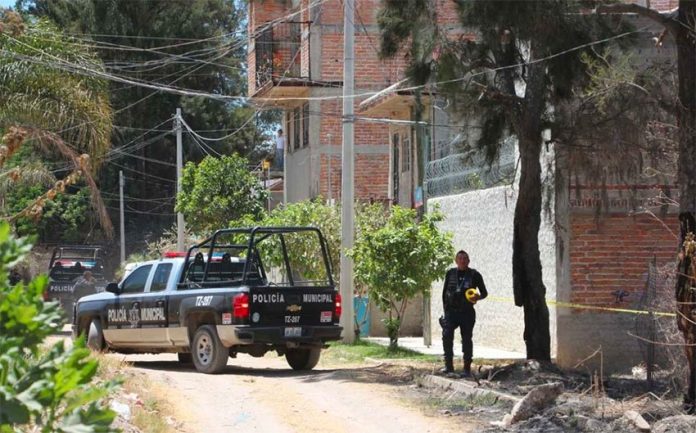
Police at the house in Tlajomulco where kidnapping victims were found.
Authorities in Jalisco freed 17 kidnapping victims yesterday after some escaped from their captors.
One group of victims was located in the Del Periodista neighborhood of Guadalajara after two were seen running along the street naked with their hands tied early yesterday morning.
The two men, who showed signs of having been tortured, told police that seven people remained in the safe house where they were being kept.
A search of the property led to the discovery of the remaining victims, all of whom had been injured with a sharp object. One was missing three toes. Police said soil in the back yard had been disturbed recently, indicating the possibility that bodies had been buried there.
Later in the day, there was a similar report in San Sebastián del Grande, Tlajomulco, where several men showed signs of having been tortured and tied up.
The men led authorities to a property where they found three women and five men being held captive, along with four bodies.
The state Attorney General’s Office said most of the kidnapping victims had a criminal record, are related to local small-scale drug-dealing and are suspected to be members of a criminal gang.
A man identified by the authorities as one of two perpetrators of the Minatitlán massacre in which 13 people were killed was arrested yesterday in Coatzacoalcos, Veracruz, leading to a fatal shootout a few hours later.
Adrián N. “El Pelón,” 25, is a suspected member of the Jalisco New Generation Cartel (CJNG) and a resident of Cosoleacaque, a municipality located near the scene of the April 19 killings.
Aauthorities suspect that Adrián N. was accompanied by Tomás N. “El Lagarto,” the cartel’s presumed plaza leader in Minatitlán.
Federal government sources said the former was an employee of the state oil company Pemex and worked at the Pajaritos industrial complex.
Federal agents apprehended him as he was leaving the Pajaritos plant after finishing a shift.
Hours after the arrest, police clashed with armed civilians on the streets of Minatitlán.
At least two officers were killed in the shootout, and three people were wounded, including two police.
Interjet has announced it will phase out four Mexico-United States routes and four within Mexico, while at the same time opening five new routes between Mexico and South America as part of a restructuring plan.
The airline said that route changes will begin on May 11 with the discontinuation of the company’s Mexico City-Aguascalientes flight.
Service between Los Angeles, California, and Puerto Vallarta, San José del Cabo and El Bajío will end on June 5, as will the Mexico City-Ciudad Obregón route. Cancún-New York flights will be discontinued on June 17.
At the same time, the airline is turning toward South America for further growth. The first of the new routes, from Mexico City to Medellín, Colombia, will begin operating on June 5, followed by Cancún-Medellín on June 6, Cancún-Lima, Peru, and Mexico City-Guayaquil, Ecuador, on June 17 and Cancún-Guayaquil on June 21.
Interjet also said it will increase the number of seats available on eight domestic routes as of June 1. They are Mexico City flights to El Bajío, Ciudad del Carmen, Campeche, Mazatlán, Palenque, Puerto Escondido, Torreón and Varadero.
The changes come just three days after Interjet and American Airlines signed a bilateral alliance that will allow the two airlines to jointly offer all of their routes and connecting flights as partners.
Interjet said that sales for both airlines have tripled in the last two years. In the first quarter of this year Interjet’s sales were up 52% over last year.
The airline described the American Airlines pact as mutually beneficial, saying it will allow both companies to increase and profit from increased travel between Mexico and the United States.
The airline also expected the agreement to “strengthen competitivity in the various markets it competes in, offer better connections and flight options to customers as well as . . . attract leisure and business travelers to domestic destinations.”
Guerrero teachers burn documents while vandalizing government buildings.
Members of the Guerrero-based CETEG teachers’ union vandalized several areas of the Guerrero state Congress building, destroying equipment, documents and furniture after rejecting lawmakers’ offers of dialogue.
The teachers arrived at the government buildings at about midday yesterday accompanied by teacher trainees from Ayotzinapa teachers’ college and members of the SUSPEG public servants’ union.
After the protesters broke through the metal barriers surrounding the buildings they rejected an offer to establish talks and entered the legislature.
While the group’s leaders accused lawmakers of betrayal for supporting President López Obrador’s new educational reform, the rest of the group, wearing masks and armed with chains, pipes and sticks, proceeded to destroy computers and audio equipment valued at 7 million pesos (US $370,000).
The teachers also broke into the Siervo de la Nación library, destroying computers, windows and doors, and removing documents that they burned in front of the building. Riot police arrived on the scene and attempted to contain the situation but were repelled by the teachers.
Before departing, the teachers threatened to return on May 15 in conjunction with the beginning of a 72-hour strike.
State lawmaker Cesáreo Guzmán decried the attack, saying that Guerrero would not be held hostage by violence. He urged teachers and union members to reestablish peaceful talks with state lawmakers and to also take their complaints and observations before the Secretariat of Education and federal authorities for consideration.
Workers erect the stage for the two-day festival Domination México.
More than 60,000 people are expected attend a concert that begins today in Mexico City, bringing 53 international bands including Kiss, Alice Cooper, Slash and Apocalyptica.
Domination México will offer heavy-metal fans two days of performances on five stages at what organizers bill as a “world-class event.”
“This is the first edition, and we are betting on everything coming out wonderfully because we have given our best to have the best team, the best lineup and the best atmosphere,” said organizer Guillermo Parra.
Also part of the festival is a cinema that will show four movies each day, including cult classics like The Evil Dead and The Warriors.
Those looking for a more fast-paced form of entertainment can visit an arcade with 32 video games straight out of the 80s. The event also features a heavy-metal vinyl record store, another where collectible Funko pop culture figures can be purchased, a barber shop, a tattoo parlor “and even a church where you can marry, Vegas-style,” said Parra.
Domination México starts today at the Hermanos Rodríguez race track in Iztacalco, Mexico City.
Jalisco Governor Alfaro will head up judicial corruption fight.
President López Obrador has threatened to go after judges who regularly free suspected criminals who go on to commit new crimes.
It would be a strategy similar to the one the president has adopted with respect to gas stations — identifying at his Monday press conference those that sell the most expensive fuel.
“We’re going to be respectful of the judicial branch, but we will also be vigilant; if there are judges that are arbitrarily freeing crime suspects . . . that’s over now. There will now be a who’s who of the justice system.”
Reminding his audience that one of the central aims of his administration is to stifle corruption, he said judges will now have to act within the bounds of the law.
As an example of what can go wrong, the president recounted the case of a suspected criminal who was freed and then proceeded to murder the police officer who had arrested him.
“. . . The executive branch must intervene. This cannot be allowed to keep happening.”
On Tuesday, the president and the National Conference of Governors agreed to conduct an offensive against corruption in the judicial branch.
Jalisco Governor Enrique Alfaro will head up an initiative to develop a methodology to review cases of judicial corruption that can then be applied in every state.
He said his state is emblematic of the problem, claiming that for years the judicial branch has been hijacked by branches of government and individuals.
The judicial branch has been controlled, it has had its masters and there has been ongoing manipulation of decisions, Alfaro said, “and that history has come to an end.”
Meanwhile, in an interview with the newspaper Milenio, constitutional lawyer Alberto Woolrich suggested that the president’s threat to identify suspect judges should not be seen as a threat against the judicial branch, but as a response to the public’s demand to purge institutions of corruption.
“People are fed up with so much corruption. I don’t see this as a threat. Instead, it’s a measure to curb corruption among judges.”
The lawyer highlighted the case of Raúl Salinas de Gortari, brother of former president Carlos Salinas de Gortari, who was arrested for money laundering but later freed by the Supreme Court.
“How can you put faith in the Supreme Court, in these robed lawyers that supposedly respect the constitution . . .”
The lawyer added that corrupt judges directly undermine Mexico’s sovereignty, saying that though he did not fully agree agree with the president’s ideals, the situation requires immediate action. People throughout the country are fed up with situation, he said.
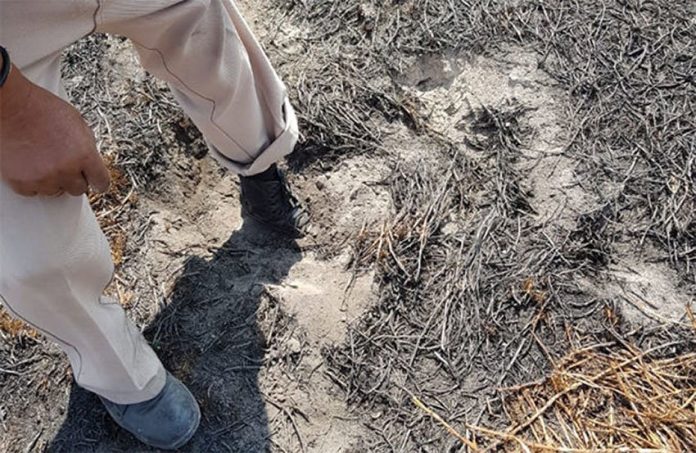
Evidence of heat coming from the ground in Chalco.
On what used to be an ancient lakebed in the state of México, just one misstep could send your feet plunging through the surface and suffering nasty burns.
Two weeks ago, residents of Santa Catarina Ayotzingo and San Juan Tezompa, once waterfront villages on a now dried-up part of Lake Chalco, noticed smoke coming from land where residents grow food on the San Miguel Ranch in Chalco, México state.
Upon closer inspection, residents discovered gas was being emitted from the ground and the temperature — reported to be as high as 370 C — was hot enough to melt plastic bags and bottles and burn grass. Rumors of volcanic activity quickly spread among residents of the region.
After all, the Popocatépetl volcano is just 50 kilometers away.
But it was not a new phenomenon and it wasn’t a volcano forming.
San Juan Tezompa resident Leonel Ramírez remembers that it was his father who first told him that the ground sometimes spontaneously ignited on the dried bed of the ancient lake, which he later confirmed.
“When you walk [in that area] you can feel the discomfort in your feet. If you scratch a little at the earth, you feel it even more.”
Local official Pedro Camacho remembered another occasion on which a woman reported she had been walking on the ranch with her young son when suddenly his foot broke though the surface of the ground. The heat burned the boy’s foot.
Geologist Ramón Espinar at the National Center for Disaster Prevention (Cenapred) was called in to inspect the groundsby federal authorities in response to requests from local officials. Chalco Civil Protection head José Antonio Aguilar said the geologist’s investigations led him to conclude that the phenomenon was not caused by volcanic activity.
“People were alarmed because they thought that it was the birth of a volcano, but that theory was discarded. Cenapred explained to us that it is actually peat, an underground fire. This was once a lake, but when it dried up many organic materials and fossils remained and decomposed over time, causing high temperature that set underground fires.”
Aguilar said that local authorities will cordon off the area because of the danger presented by the high temperatures.
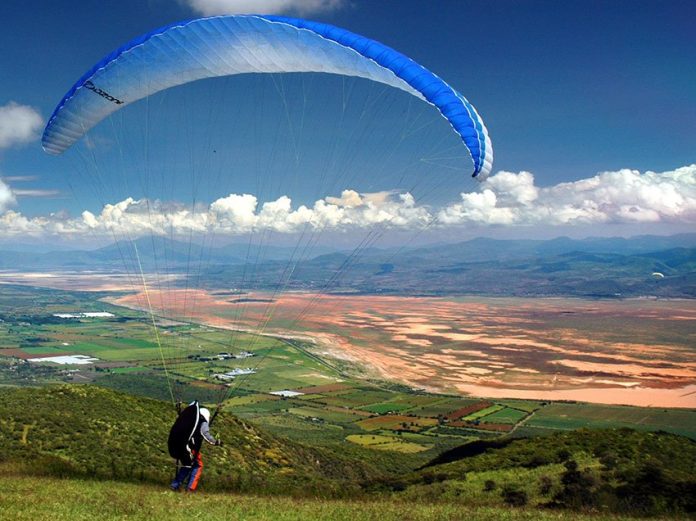
Located in the Sierra Tapalpa, La Ceja is a popular place for paragliders to take off.
The mountain town of Tapalpa is a favorite weekend destination for the population of Guadalajara during the months of April and May. After strolling the picturesque cobblestone streets of this Pueblo Mágico, tourists might visit Las Piedrotas — the Great Big Rocks — just outside of town, or even hike to the spectacular 102-meter-high Salto del Nogal (Walnut Cascade).
There are, of course, many other sites to see and things to do in the surrounding Sierrra de Tapalpa. I began to discover some of them years ago when I heard rumors there was a hermit living in these hills, a man who had quit his job at the Autonomous University of Guadalajara in order to dedicate himself full time to self-knowledge and the appreciation of nature.
Finding the solitary cabin of Alfredo Leal was no easy task but we were rewarded with an opportunity to assist at a sort of “seminar under the pines” with the hermit and visitors who had joined him that day discussing — of all things — the nature of time.
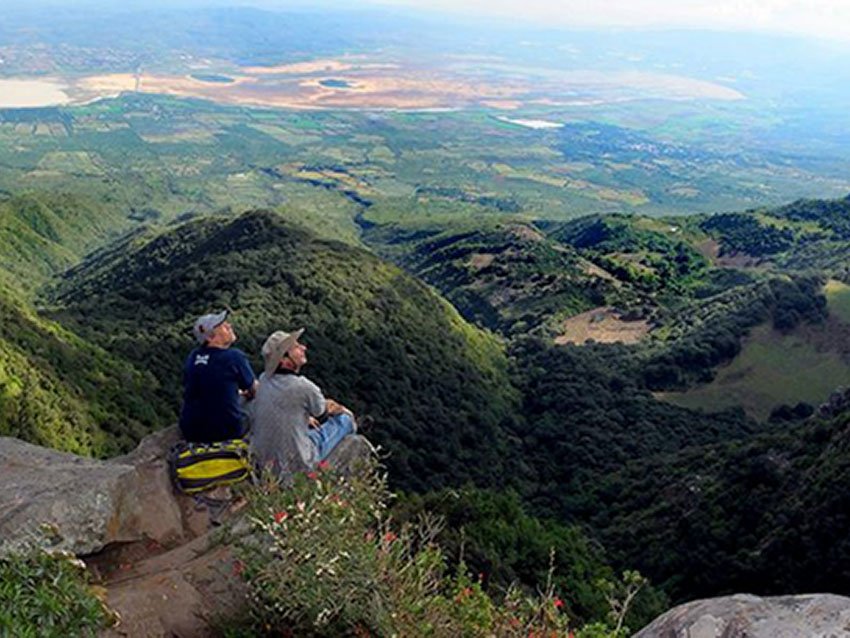
The day after that, we heard about an impressive divisadero or lookout point offering a magnificent view of the great salt flats of Sayula a thousand meters straight down.
Today this spot is known as the Cruz del Hermitaño, the Cross of the Hermit, in honor of Alfredo Leal, who passed away in 2017, hopefully after gaining insights into what makes this universe tick.
The panoramic view from the Hermit’s Cross.
The Hermit’s Cross Lookout is easy to reach from Highway 437, the scenic route through the Sierra Tapalpa. This road passes through the mountain town of Atemajac de Brizuela and takes you west to the pueblito of Juanacatlán which, by the way, means “the place of onions” in Nahuatl.
If you park near the plaza of Juanacatlán you can take a delightful hike through the nearby hills to visit La Piedra Balanceada, Balanced Rock. This picturesque trail is simply gorgeous during the rainy season when you will see no end of wildflowers and strange, beautiful mushrooms while you hike beneath the tall, straight pine trees.
The hike starts at the northeast end of the plaza on Calle Pascual Morones. The trail is 4.7 kilometers long, with a vertical difference of 336 meters and the walk may take two hours (one way) with lots of stops for snapping pictures. This turned out to be one of the most beautiful paths I’ve been on in the Tapalpa area, which is noted for its great outdoor beauty.
The trees were incredibly tall here and we passed a bubbling brook whose waters looked so clean that one of my friends drank from the stream, suffering no ill effects. This trail, by the way, is listed on Wikiloc.
When you stand atop the Balanced Rock, you are at 2,817 meters above sea level (nearly two miles), just about as high as you can get in the Sierra Tapalpa. While this rock is rather ordinary looking, it is big, easy to climb, and it does wiggle a little if enough people get on top of it and run back and forth.
The monolith, by the way, is close to a dirt road, so a friend who didn’t go on the hike could drive around and pick you up there. If you do that, you will pass by a huge slate quarry at the edge of town. I believe this would be a fascinating place to visit on a weekday when you could watch workers removing huge, thin sheets of smooth slate several meters across.
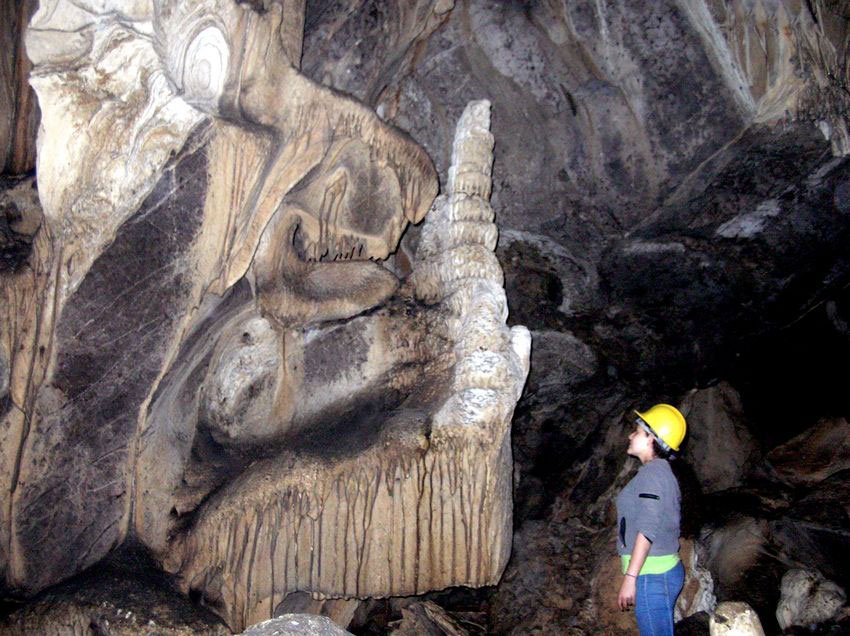
Curious cave formation inside La Cueva de la Palma, near Atemajac.
Curiously, I learned that Mexican schools never used slate for blackboards. “Our pizarrones were made of painted wood instead of pizarra (slate), although there’s plenty of slate around this area and it’s dirt cheap,” my friend Jorge Monroy told me.
If it is late in the day and you need a place to stay before continuing on your way to Tapalpa, check out Cabañas Tapalpa, Sierra del Tecuán. The entrance is on the highway, just north of Juanacatlán. Here you’ll find a delightful little lake surrounded by delightful little cabins.
This is also the home of a truly curious place previously known as Amor Corazón Restaurant.
Everything you see here at Cabañas Tapalpa — including the lake — was created and designed by a lawyer named Carlos Sánchez. Most interesting of all, in my opinion, are his artistic creations inside Amor Corazón: psychedelic art which incorporates bottles, sometimes lit up by sunlight from outside, very much in the style of Antonio Gaudí of Barcelona.
When I asked Sánchez to comment on what it all means (to him), he said:
“Well, although I am a lawyer by profession, I’ve always liked painting and art, and I should mention that all the artwork around you, even the colors themselves, are symbolic. Now the main theme is love, a force that radiates, that buds and springs forth. So there are many symbols of the male and female forces here, for example, the bas-relief snake climbing this column has two heads, representing these forces, a motif you see all around you.”
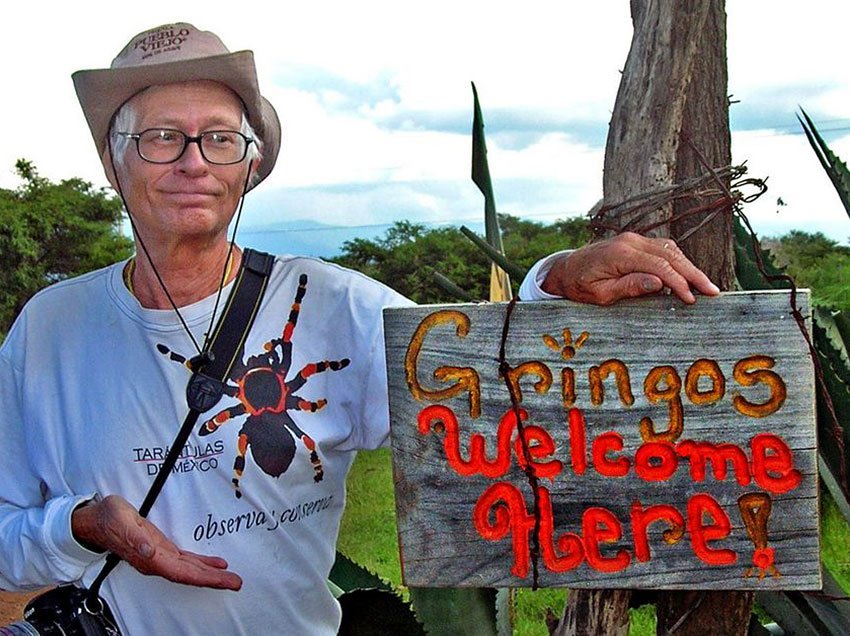
‘Gringos welcome here,’ says the sign at La Ceja.
Indeed, we could see a male jaguar and a female panther at the near end of a long mural running the length of the restaurant, as well as a pair of giant lizards gamboling above us. Carlos went on to explain the meaning of the two fairy-like thrones we could see. One is shaped like a mushroom with a flower decorating its stem.
“The flower is love,” says Carlos,” and its roots are anchored in the earth. But along its length are false roots floating in the air and these show how human beings can be deceived by illusion and lose their way. And the other throne is called the Kundalini of Human Health, representing man’s soul and the path to spiritual well-being.”
If the bizarre, beautiful and mystic art makes your head spin, you can come back to earth by hiking along a wide, smooth trail which circumnavigates the 60 hectares of Cabañas Tapalpa property and, of course, at night you can enjoy the perennial attraction of these hills: sipping locally made ponche in front of a roaring fireplace with occasional excursions outside the cabin to check out the constellations sparkling in the cold mountain air.
Amor Corazón no longer operates as a restaurant, but you can wander about inside the building even if you are just passing by.
Fortunately, you are now only 20 kilometers away from an operating restaurant — and a very fine one, I might add — called La Ceja, which is located right on the edge of another impressive lookout which is also a paraglider takeoff point.
La Ceja means The Eyebrow which is exactly what a paraglider looks like when seen from a distance. So here is a place where you can enjoy a delicious ham-and-mango pizza while watching people leaping over the edge of a precipice and blissfully hovering in the air.
[soliloquy id="77729"]
Checking out their website will give you an idea how beautiful this place is and they actually have an English version. Here you could rent an “ecological cabin” or book a paraglider flight for total beginners, in which you fly together with an expert.
Finally, I should mention that the first thing you see when you arrive at this place is a big sign at the gate saying, “Gringos are welcome!”
The writer has lived near Guadalajara, Jalisco, for more than 30 years and is the author of A Guide to West Mexico’s Guachimontones and Surrounding Area and co-author of Outdoors in Western Mexico. More of his writing can be found on his website.