Mexico City lawmakers wrestled with the fact that smart phones can be a tool for learning, and also a distraction from learning. (Unsplash)
Cell phone use will soon be strictly regulated in Mexico City’s primary and secondary schools after the local Congress unanimously approved on Thursday an amendment to the capital’s Education Law requiring the development of guidelines for imposing restrictions.
Legislators insist the reform does not contemplate a total ban on cell phones in school, but rather seeks the elimination of distractions during school hours. Nor are they seeking to hinder technological innovation, but rather aim to promote a balance between digital learning and the well-being of students.
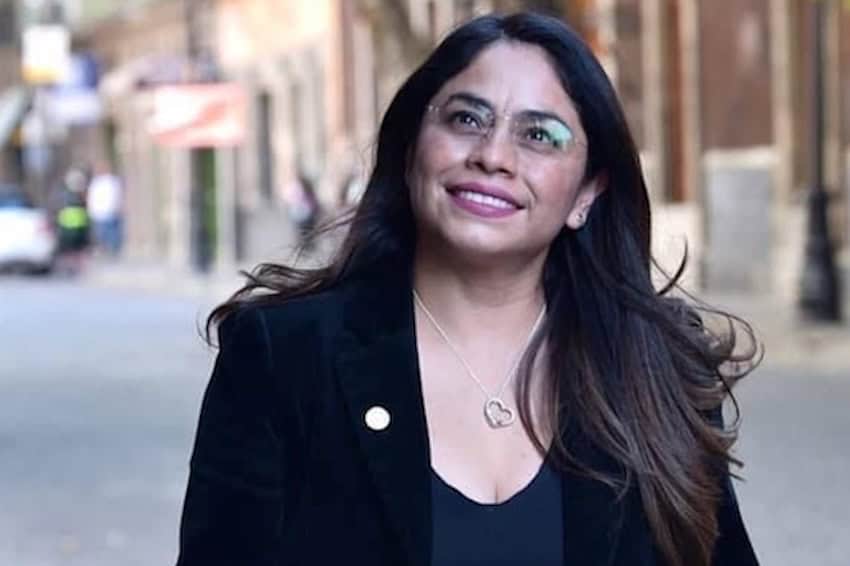
Mexico City Congresswoman Claudia Montes de Oca stresses that an outright ban was never considered: “It wouldn’t solve the underlying problem.” (Facebook)
On-campus cell phone use, therefore, will be permitted for expressly authorized educational activities. The new legislation also incorporates the principle of “responsible digital learning,” with the intention of promoting critical and informed use of information technologies among students.
During floor debate, lawmakers voiced concern that the excessive and uncontrolled use of cell phones and screens within schools affects the learning, coexistence and mental health of adolescents.
“We understand that simply prohibiting the use of devices does not solve the underlying problem,” said Claudia Montes de Oca, a member of the Committee on Education, Science, Technology, Innovation, and Artificial Intelligence. “An absolute restriction could contradict the constitutional mandate to incorporate technology and innovation into educational processes.”
Speaking on behalf of the bill she co-sponsored, National Action Party Deputy Laura Alejandra Álvarez said 75% of teachers believe that students are constantly distracted by their cell phones in class, adding that more than 3 million teenagers have been victims of cyberbullying or online sexual exploitation in Mexico.
The reform has been sent to Mayor Clara Brugada, who has up to 30 business days to enact it and order its publication in the capital’s Official Gazette.
The reform will take effect the day after its publication, after which educational authorities will have a yet-to-be specified period of time to define the protocols and oversight mechanisms for implementing the restriction in classrooms.
With this reform, Mexico City joins several other states, including Querétaro, Guanajuato, Morelos, Aguascalientes and México state that have already implemented similar restrictions in basic education.
The new law applies to both public and private schools. It does not call for sanctioning students for an episode of guideline violation.
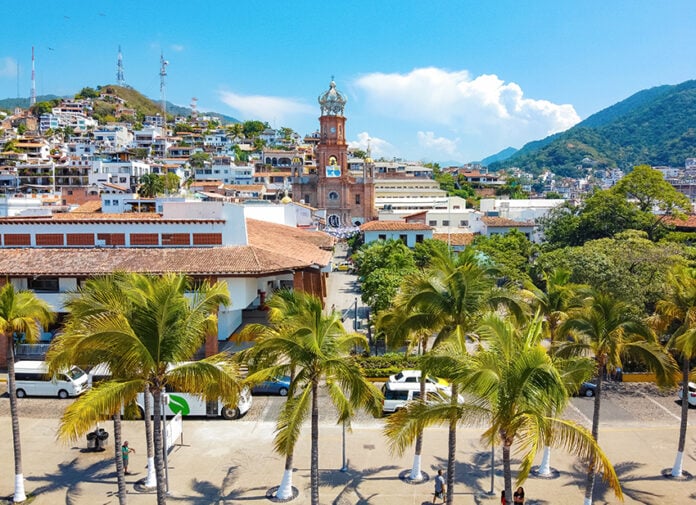
Three women were found dead in similar circumstances in Puerto Vallarta in less than two weeks, prompting a police investigation into whether the deaths could be linked. (Shutterstock)
Authorities in Puerto Vallarta are investigating whether a possible serial offender could be linked to the deaths of three women whose bodies have been discovered in separate areas of the city in recent weeks.
The latest case emerged Thursday morning after a woman’s body was found on a dirt road near the Parque Las Palmas neighborhood, off Camino Viejo a Mojoneras. The discovery has prompted investigators to compare the circumstances surrounding her death with two similar cases already under investigation.
The first victim was reportedly discovered near Rancho El Pirulí in the Chimborazo area on May 10. Days later, another woman’s body was found at a roadside stop along the highway to Mismaloya.
According to preliminary information, all three victims were women believed to be between 30 and 35 years old. Investigators say the bodies were found in isolated or lightly traveled areas of Puerto Vallarta, and until now none of the women had been officially identified.
Authorities also noted that each victim had multiple tattoos and was discovered in a similar state of partial undress.
The details have led investigators to examine whether the killings may follow a pattern.
Detectives and forensic teams are now reviewing evidence from each scene in an effort to determine if a single suspect could be responsible or if the similarities are coincidental.
In the latest case, authorities revealed the woman found Thursday had several distinctive tattoos that investigators hoped could help identify her. Among them were an image of a horned woman with a hand covering her mouth, a skull tattoo, and a woman’s name tattooed on her right forearm. Officials said additional identifying marks were located on her neck, hand, and arm.
On Friday morning, unofficial reports emerged suggesting the victim could possibly be a 22-year-old woman from the State of México who was reported missing in late April. Information released by the State of Mexico’s Missing Persons Search Commission described a missing woman with tattoos matching some of those found on the victim.
Authorities in Jalisco have not officially confirmed the identity, but reports do indicate that relatives of the missing woman may travel to Puerto Vallarta on Friday to determine whether the victim is their family member.
The woman found Thursday reportedly showed signs of violence, prompting ministerial authorities to open an investigation under the corresponding homicide and femicide protocols.
Despite the discovery of the bodies over a period of time, no relatives or acquaintances had initially come forward to identify or claim any of the women. Investigators are also exploring the possibility that the victims may have been transported from another location before being abandoned in Puerto Vallarta.
The cases have generated growing concern among locals, residents and tourists, as rumors of a possible serial killer continue circulating on social media. Officials, however, caution that the investigation remains in its early stages and stress that no formal conclusion has been reached.
Investigators from the state prosecutor’s office and local police departments are coordinating efforts, reviewing forensic evidence, surveillance footage, and police reports connected to each case. Authorities say every line of investigation remains open as they work to determine whether the deaths are linked.
While officials have not publicly labeled the case as serial homicide, the similarities between the victims and the crime scenes have intensified scrutiny and increased pressure on investigators to identify those responsible.
For now, authorities continue searching for evidence that could reveal whether Puerto Vallarta is dealing with a single repeat offender or a series of unrelated crimes.
Charlotte Smith is a writer and journalist based in Mexico. Her work focuses on travel, politics and community. You can follow along with her travel stories at www.salsaandserendipity.com.
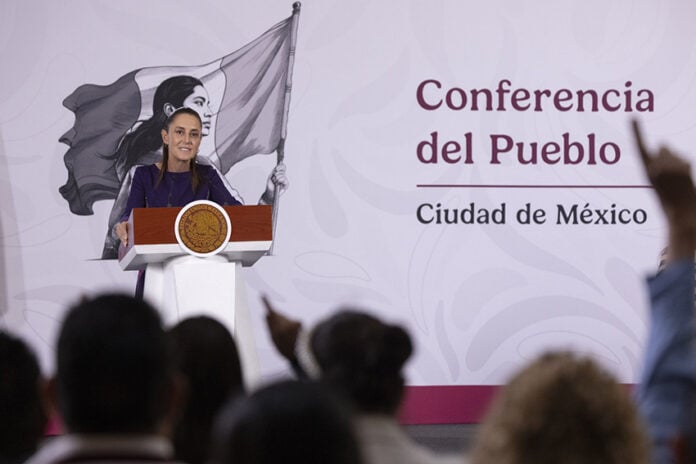
President Sheinbaum answered questions about her meeting with U.S. Homeland Security chief Mullin and the U.S. indictment of Raúl Castro at her Friday morning presser. (Carlos Ramos Mamahua / Presidencia)
Sheinbaum’s mañanera in 60 seconds
🇺🇸Sheinbaum outlines limits of U.S. security cooperation to Mullin: In a Thursday meeting with U.S. Homeland Security Secretary Markwayne Mullin, Sheinbaum said she explained that Mexican law and the Constitution prohibit joint security operations on Mexican soil — a direct reference to last month’s unauthorized CIA participation in a Chihuahua drug lab raid. She described the bilateral relationship as one of “collaboration,” not “subordination,” and proposed more frequent security meetings to avoid future misunderstandings.
🇨🇺President questions U.S. indictment of Raúl Castro: Sheinbaum pushed back on the U.S. Justice Department’s unsealing of a murder indictment against former Cuban President Raúl Castro, 94, over the 1996 shoot-down of two U.S.-based aircraft, asking why charges would be brought 30 years after the incident. A strong backer of Cuba, she has long been critical of U.S. policy toward the island.
At her final press conference of the week, President Claudia Sheinbaum spoke about her meeting on Thursday with U.S. Homeland Security Secretary Markwayne Mullin. She revealed that she had told Mullin that Mexico’s legal framework prohibits U.S. involvement in security operations on Mexican soil.
The U.S. government is no doubt well-versed in what it can and can’t do in Mexico, but officers with the U.S. Central Intelligence Agency nevertheless participated in a drug lab raid with state forces in Chihuahua last month — without the knowledge or authorization of the Mexican government.
Recibimos en Palacio Nacional al Secretario del Departamento de Seguridad Interior de los Estados Unidos, Markwayne Mullin. Acordamos seguir colaborando conjuntamente en el marco de respeto de nuestros países. pic.twitter.com/qmqWGGTGCa
— Claudia Sheinbaum Pardo (@Claudiashein) May 21, 2026
Sheinbaum’s disclosure that she had explained the limits of bilateral security collaboration to Mullin came after she revealed late last month that Security Minister Omar García Harfuch had essentially read the riot act to Chihuahua Governor Maru Campos over the CIA’s participation in the security operation in the northern state. Campos asserts she didn’t authorize or have knowledge of the presence of the CIA in Chihuahua before last month’s operation took place.
Also of note at today’s mañanera was Sheinbaum’s questioning of the motivation of the U.S. indictment against Raúl Castro, which was unsealed this week.
Reuters reported that the indictment — which accuses Castro and Cuban military pilots of murder — “marks a new low in relations between the longtime Cold War rivals and comes as U.S. President Donald Trump is pushing for regime change in Cuba, where Castro’s communists have been in charge since his late brother Fidel Castro led a revolution in 1959.”
Sheinbaum says she explained Mexico’s laws to Mullin
Asked about her meeting on Thursday with Mullin, Sheinbaum said she made it clear that the security relationship between Mexico and the United States is one of “collaboration” and “coordination,” not “subordination.”
She said that Mullin recognized the work Mexico is doing to combat insecurity, and noted that she proposed that bilateral security meetings be held more frequently “so that there aren’t misunderstandings” and so that there is greater “monitoring” of the collaboration between the two countries.
Sheinbaum said that the next Mexico-U.S. security meeting will take place in June.
At the meeting on Thursday, she said that the Mexican government presented its “security results” and spoke about the ways in which Mexico and the U.S. are collaborating on security issues.
“And I also told [Mullin], with complete transparency, what our laws are and what our constitution is,” Sheinbaum said, adding that she explained that security cooperation between Mexico and the United has to take place within a “certain framework.”
She said she specifically told Mullin that Mexican laws and the Mexican Constitution don’t allow joint operations to take place on Mexican soil, as occurred in Chihuahua last month.
Sheinbaum said that the meeting with the Homeland Security secretary was “good,” telling reporters that Mexico and the United States “agreed to continue working [and] collaborating” within “the framework of respect.”
She said that Mullin didn’t make any specific requests beyond what is set out “in the agreement we reached in September, the understanding from September.”
Mexico and the United States announced the establishment of a high-level bilateral security group in September, and, at the same time, reaffirmed their commitment to cooperate on shared security challenges.
Sheinbaum questions US indictment against Raúl Castro
A reporter asked the president about the U.S. indictment against Raúl Castro, president of Cuba between 2008 and 2018.
The newly released coins include bimetallic 20-pesos coins that entered circulation this week, as well as more valuable gold and silver collectibles. (Banxico)
The Bank of Mexico (Banxico) has released 12 commemorative coins to mark the FIFA World Cup 2026, blending soccer imagery with some of Mexico’s most iconic landmarks — and some are already in circulation.
The collection, released by the Mexican Mint, includes four bimetallic coins for everyday use and eight struck in precious metals — four gold and four silver. Nine of the 12 coins are dedicated to Mexico’s three host cities — Mexico City, Guadalajara and Monterrey — while three more celebrate the country’s natural, historical and cultural heritage.
Monedas conmemorativas de la Copa Mundial de la FIFA 2026™, organizada por México-EE. UU.-Canadá
The release honors a special occasion: Mexico will become the first country to host three World Cups, and Azteca Stadium — temporarily rebranded as Mexico City Stadium — will once again host an opening match. Mexico’s 1986 coin collection is today highly prized by collectors, a fact that appears to be driving fierce collector interest in this new series.
Designs rooted in Mexican identity
The dodecagonal bimetallic coins carry a face value of 20 pesos and feature host-city landmarks: Mexico City’s Column of Independence, Guadalajara’s Minerva statue and a coin depicting a jaguar surrounded by monarch butterflies, agaves and nopal cacti. The gold and silver collector coins depict the Templo Mayor, the Palacio de Bellas Artes, the Monument to the Revolution and Chichén Itzá’s Pyramid of Kukulkán, as well as La Calavera Garbancera — the José Guadalupe Posada illustration behind the beloved Catrina figure.
Specs and where to find them
Gold coins carry a face value of 25 pesos and contain a quarter troy ounce of 0.999 gold; silver coins have a face value of 10 pesos and contain one troy ounce of 0.999 silver. Real-world prices will far exceed face value — silver coins are expected to fetch upward of 1,000 pesos, with gold pieces reaching considerably more. The bimetallic coins entered circulation on May 18 through regular bank channels, while gold and silver pieces will be sold through authorized distributors including the Mexican Mint and Mexico City’s Interactive Museum of the Economy (MIDE).
If you're an expat living in Mexico and flying with Volaris, you're now subject to paying the DNR fee. (Tomás Del Coro/Wikimedia Commons)
In recent months, many travelers flying with Volaris have reported confusion and frustration over changes involving Mexico’s Derecho de No Residente (DNR), commonly called the non-resident tax. The DNR is a fee charged to foreign visitors entering Mexico, and airlines generally collect it as part of an international ticket.
Historically, temporary and permanent residents of Mexico were exempt from paying the tax if they could show valid residency documentation. However, the new procedures implemented by Volaris have significantly changed how the exemption is handled.
Volaris’ controversial new policy and what it means
If you live in Mexico but use a U.S. passport, you will be charged a DNR fee by Volaris. Only those with Mexican passports are now exempt. (Volaris)
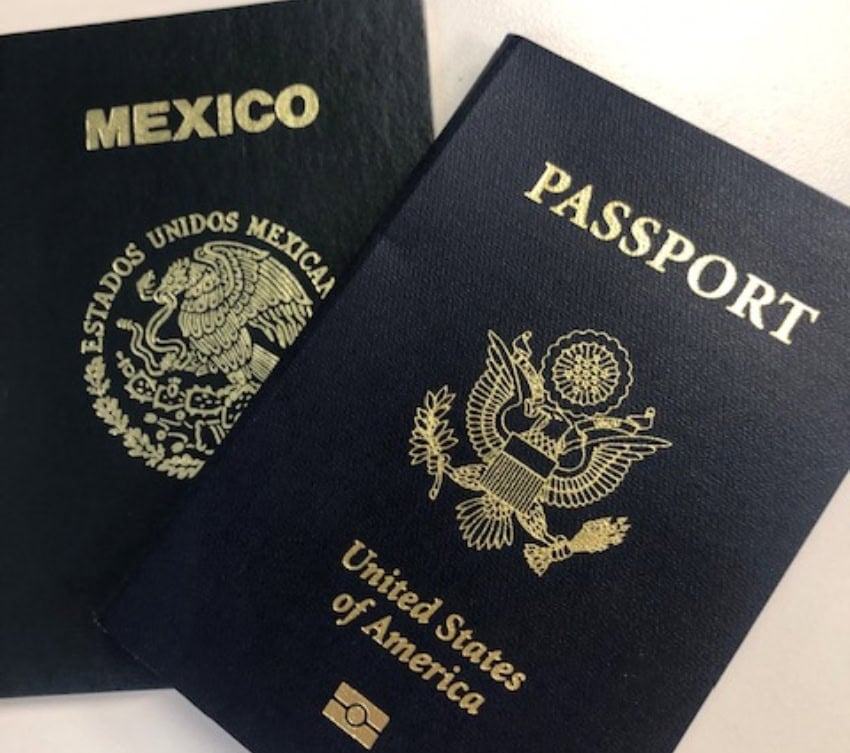
Under the new policy, Volaris only recognizes a valid Mexican passport as automatic proof for exemption from the DNR during online check-in and ticket processing. According to Volaris travel documentation, “other residency documents will no longer be considered valid” for this purpose.
This means that many legal, temporary and permanent residents who are foreign nationals but live in Mexico have suddenly found themselves charged the DNR despite previously being exempt.
The change has generated widespread complaints among expatriates and foreign residents in Mexico. Travelers posting on online forums describe situations where the airline’s mobile app rejected residency cards, airport agents insisted the fee had to be paid before boarding passes could be issued, and customer service representatives blamed either the airline system or instructions from Mexican immigration authorities.
Some passengers report being charged between US $50 and $60 in additional fees. Others stated that they spent hours arguing with staff but were ultimately forced to pay to avoid missing flights.
Part of the confusion stems from the fact that Mexican immigration law itself doesn’t appear to have changed in a way that removes DNR exemptions for legal residents. Instead, many travelers believe Volaris altered its internal verification system to simplify compliance and reduce disputes during check-in.
If it’s not really an immigration issue, why is Volaris charging the fee?
Volaris has stated in customer communications that the change took effect in early February 2026 and was tied to National Immigration Institute (INM) procedures. However, many passengers who contacted INM claim officials told them the exemption for residents still exists and that the issue is primarily an airline policy matter rather than a new federal law.
Volaris claims that its new policy is in keeping with INM procedures in Mexico. INM, meanwhile, says its policies haven’t changed regarding exemptions. (Volaris)
The airline’s motivation likely comes down to administrative efficiency and regulatory risk. Airlines operating international flights to Mexico are responsible for correctly collecting immigration-related fees from passengers. If an airline fails to collect required taxes from travelers later deemed non-exempt, the carrier can face penalties or reimbursement issues.
By limiting exemptions to Mexican passport holders, Volaris reduces the chance of incorrectly waiving the fee. A Mexican passport is easy to verify digitally, while residency cards may involve manual checks, expired formats or system compatibility.
A Volaris app update in late 2025 seems to have removed, or in some cases weakened, the ability to scan residency cards successfully.
The financial reasons for the decision
The broader financial climate in Mexico may also help explain why airlines are tightening enforcement around government fees. Mexico has increasingly emphasized the collection of the DNR and related travel charges as part of tourism and infrastructure funding.
News reports over the last year have highlighted government efforts to expand and standardize DNR collection, including new charges on cruise ship passengers who were previously exempt. Authorities argued that foreign visitors benefiting from Mexico’s tourism infrastructure should contribute through the tax system.
For travelers hoping to avoid paying the DNR unnecessarily and who are determined to use Volaris as their only option, there are still a few strategies that may help.
Volaris is one of the largest airline carriers in Mexico, but its new policy may cause foreign residents to make other flight plans. (Volaris/X)
Mexican citizens entering the country with a valid Mexican passport remain exempt from the fee. Dual nationals should therefore always book and travel using their Mexican passport when entering Mexico. Volaris explicitly states that Mexican citizens residing abroad are exempt when presenting a valid Mexican passport.
Foreign temporary and permanent residents face a more complicated situation. Some travelers report partial success by checking in at the airport rather than online and presenting original residency cards directly to airline staff. Others advise carrying printed copies of Mexican immigration regulations showing resident exemptions. But many recent reports on social media suggest airport staff are still requiring payment even after residency documentation is shown.
Another possible remedy is requesting reimbursement after travel.
Will complaints cause Volaris to change its new policy?
Several passengers have filed complaints with Mexico’s consumer protection agency, Profeco, while others have disputed the charge with credit card companies or filed complaints with the U.S. Department of Transportation for flights originating in the United States. Both are processes that can be lengthy and inconsistent.
For now, many foreign residents in Mexico are watching closely to see whether Volaris eventually adjusts its policy or whether other airlines follow the same path. While some travelers may decide it’s easier to book with another carrier to avoid the hassle and uncertainty surrounding DNR charges, the long-term impact remains unclear. If complaints continue to grow and more residents push back through consumer agencies or social media, the airline could face pressure to clarify or soften its procedures.
Until then, time will tell whether this becomes an industry-wide standard or a policy that ultimately drives travelers toward competing airlines.
Charlotte Smith is a writer and journalist based in Mexico. Her work focuses on travel, politics and community. You can follow along with her travel stories at www.salsaandserendipity.com.
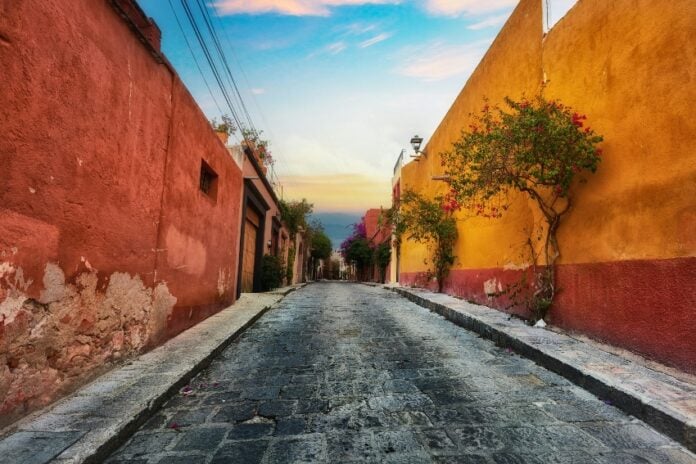
The latest San Miguel de Allende community roundup covers what's happening in the city and surrounding areas. (Jezael Melgoza/Unsplash)
In this edition of the San Miguel de Allende community roundup, two local Non-Governmental Organizations (NGOs) are helping to shelter and sterilize animals, a new bilingual high school has just been inaugurated in Querétaro, El Charco is providing youth conservation training and a big international book fair is coming to El Centro.
Lucky dogs get new shelter at converted bullring
Staff and volunteers of the nonprofit Lucky Dogs Club House are busy retrofitting a former bullring just outside San Miguel on the road to Querétaro as its no-kill shelter for dogs. The group moved operations there in November from its former space in Los Frailes, said Doug Meier, Mexico vice-president and U.S. president of Lucky Dogs.
Volunteers from Lucky Dogs Club House regularly show adoptable dogs at the two Petco stores in San Miguel. (Lucky Dogs Club House)
The facility is one of two in San Miguel that rescues, shelters and facilitates adoptions for dogs, he said. Lucky Dogs is also the only shelter allowed to hold adoption events at the two Petco stores in town — one at City Market on Saturday afternoons and one at the Luciérnaga mall every other Sunday afternoon.
“There was a long vetting process, and we were the only ones approved,” Meier said.
Lucky Dogs did about 300 adoptions last year, he noted, and the organization has staff members on hand 24 hours a day, 365 days a year.
Rescues of dogs and cats
There are always between 80 and 100 dogs at Lucky Dogs, but typically only a few cats, Meier said, noting that there are no cats at the shelter now.
“There are other cat organizations in town, and it’s hard to do both,” he said. “You’re either one or the other, and to be set for both is challenging. Having said that, we do take cats, but we don’t go out of our way to do it.”
The group acquires animals in two ways, Meier explained. The first is through direct rescue, where Lucky Dogs representatives go out and pick up abandoned or abused dogs and bring them back to the shelter. The second is through people who rescue dogs themselves but ultimately can’t keep them.
Volunteers taking dogs out for a walk at the Lucky Dogs Club House shelter. (Lucky Dogs Club House)
“We always try to get that person to keep the dog and foster them, and we will help adopt them,” he said, adding that, on “Good Samaritan Tuesday,” Lucky Dogs posts photos on Facebook of dogs for whom they’re trying to find homes.
How to volunteer or donate
Volunteers are welcome at Lucky Dogs, especially to come out and walk dogs on Tuesday and Friday mornings before it gets too hot, Meier said. However, the main need right now is donations to cover the shelter’s open areas with roofing material so the dogs are protected from the sun and rain.
“It’s this massive bullring, which is great because the dogs can run around and play, so we want to divide it up into four play areas,” he said. “We are raising funds for roofing over two additional sections of the shelter that don’t have a roof. The cost will be about US $3,000.”
At some point, Lucky Dogs will be holding an open house at the shelter on a Sunday afternoon so people can come and adopt animals, but Meier said the group wants to get some more projects done beforehand.
Meanwhile, Facebook Messenger is the best way to contact Lucky Dogs, and donations can be made via PayPal, bank transfer or here.
Amigos de Animales: 25 years of free pet sterilization clinics
A San Miguel volunteer organization that has arranged to have thousands of dogs and cats spayed or neutered for free will celebrate its 25th year in operation in September.
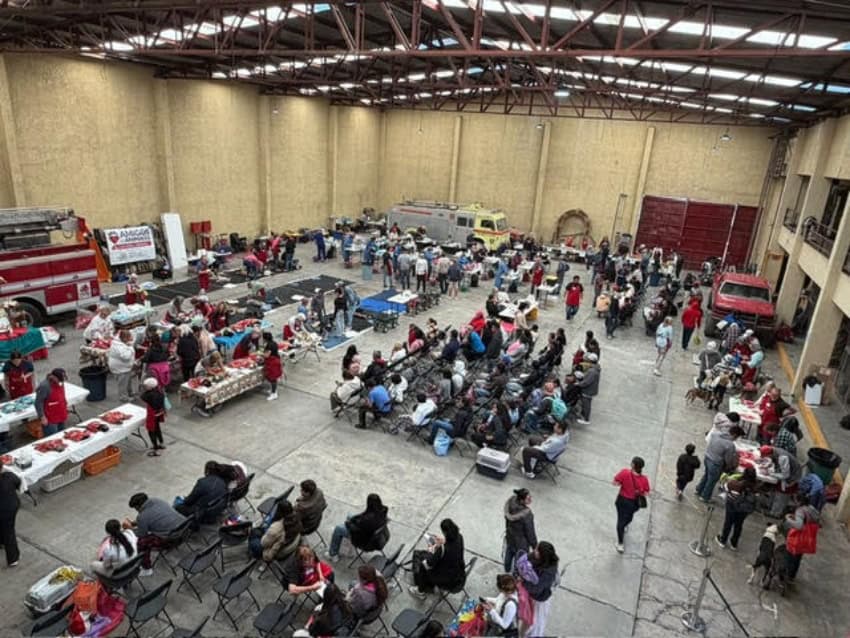
Mass dog and cat sterilization clinics are held every few months at the Bomberos fire station in San Miguel. (Amigos de Animales)
Amigos de Animales SMA will hold its next sterilization clinic Aug. 8 at the Bomberos fire station across the Salida Real a Querétaro from the Luciérnaga mall. Surgeries by 22 volunteer veterinarians will start at 9 a.m. and should finish by about 3 p.m., said Michael Friedman, a group officer who helps to organize the sterilization clinics.
“We plan to sterilize 350 cats and dogs — the same as we did in our last mass clinic in March,” he said. “We do not take appointments, and generally, people begin to line up very early in the morning to ensure a spot. In some of our past clinics, the first person in line would get there at 4 a.m. or 5 a.m. But in general, if a person is in line by 7 a.m., they will get in for a free sterilization.”
Friedman said the group also conducts weekly free clinics in rural communities surrounding San Miguel and, in 2025, started a monthly clinic just for independent rescuers in the area.
“Together with our educational programs in local primary schools, we try to approach the problem of cat and dog overpopulation in a holistic way,” he said.
How to volunteer or donate
Those interested in volunteering to help Amigos de Animales can email the group at volunteers@amigos-sma.org. Donations are also welcome since Friedman said each mass clinic costs about US $7,000. Contributions to Amigo de Animales can be made here, and the group can be contacted here.
Friedman said Amigos de Animales believes it succeeds through a singular focus on the core problem of cat and dog overpopulation in the community.
“Our mission is clear, and thus our commitment is to reduce the suffering of cats and dogs due to their overpopulation through free sterilizations,” he said, adding, “We need the community to continue to support our work by donating and by spreading the word about our programs.”
JFK American School of Querétaro constructs new high school
The new JFK American School of Querétaro high school was inaugurated on May 19. (Emergent Design Studios)
A brand-new high school was inaugurated on May 19 on the campus of the John F. Kennedy School, The American School of Querétaro.
Designed by London-based Emergent Design Studios, which won the international design competition, the new facility covers about 26,000 square meters with an academic building, external sports facilities and landscaped areas.
Founded in 1964, the private, non-profit institution offers bilingual classes and has a diverse group of approximately 1,400 students from pre-kindergarten through 12th grade representing 35 nationalities.
The demographic breakdown of the total student body consists of 76.7% Mexicans, 7.76% U.S. and Canadian nationals, and 15.53% from other countries. More information about the school can be found here.
El Charco hosts science, conservation scholarship recipients
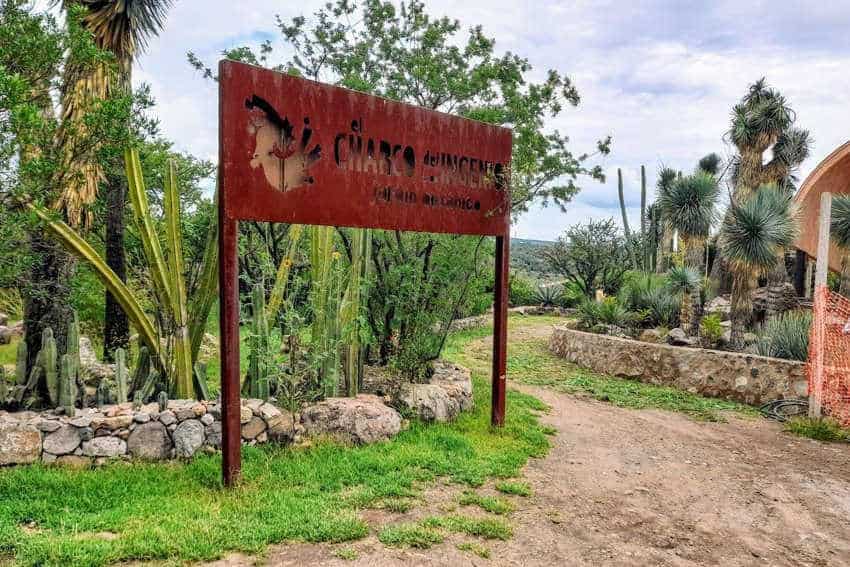
The El Charco del Ingenio Botanical Garden on the northeastern edge of San Miguel currently has two scholarship recipients from the Jóvenes Construyendo el Futuro (Youth Building the Future) federal government program working in scientific and conservation areas.
El Charco del Ingenio has two young people with a federal government program helping out with conservation work. (El Charco del Ingenio)
The botanical garden’s management said the young people are participating in cultural and herbarium activities such as mounting and adding specimens and collaborating on work at the seed bank by transplanting, seed cleaning and doing scheduled irrigation.
This experience “contributes to the formation of new generations committed to science, the land, and the conservation of natural heritage,” El Charco said.
Young people between the ages of 18-29 who don’t study or work can register here to train at a workplace for up to one year, and workplaces, companies and social organizations can also register to provide the training.
Free international book fair to focus on Korean culture
San Miguel will hold its third annual international book fair from May 29 to June 7 on two stages in the Jardín Principal and also at Centro Cultural Ignacio Ramírez “El Nigromante” (also known as Bellas Artes), Hernández Macías 75 and Casa de la Cultura, Mesones 71. Admission is free, and hours each day will be 11 a.m. until 9 p.m.
This year’s international book fair will feature readings, signings, presentations, workshops and live musical and dance concerts. The day-by-day schedule can be found here.
Cathy Siegner is an independent journalist based in San Miguel and Montana. She has journalism degrees from the University of Oregon and Northwestern University.
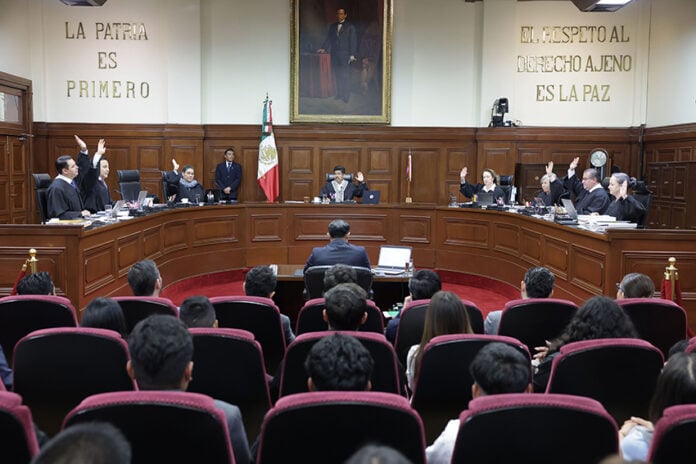
Chief Justice Hugo Aguilar presides over an April 27 session of the Mexican Supreme Court (SJCN). (SJCN via Cuartoscuro)
President Claudia Sheinbaum on Wednesday submitted a proposal to Congress that seeks to postpone Mexico’s next judicial elections to 2028 and make other changes to the judicial reform that took effect in 2024.
The president’s reform bill effectively recognizes that there were a range of deficiencies in the 2025 judicial elections and seeks to address them.
Presidential Legal Counsel Luisa María Alcalde, one of the architects of the new judicial reform proposal, shared some details of the plan at Monday’s morning press conference. (Juan Carlos Ramos Mamahua /Presidencia)
Mexico held its first ever judicial elections in 2025 and citizens were scheduled to go to the polls to elect more judges in 2027.
However, Sheinbaum said on Monday that she would submit a proposal to Congress to postpone Mexico’s second judicial elections to 2028 in order to avoid a clash with municipal, state and federal elections that will take place in June 2027. The president cited logistical difficulties related to holding judicial elections and other elections on the same day as the main reason why she was proposing the postponement of the former. She is now proposing that the second judicial elections be held on June 4, 2028, a date on which a presidential recall election could also be held.
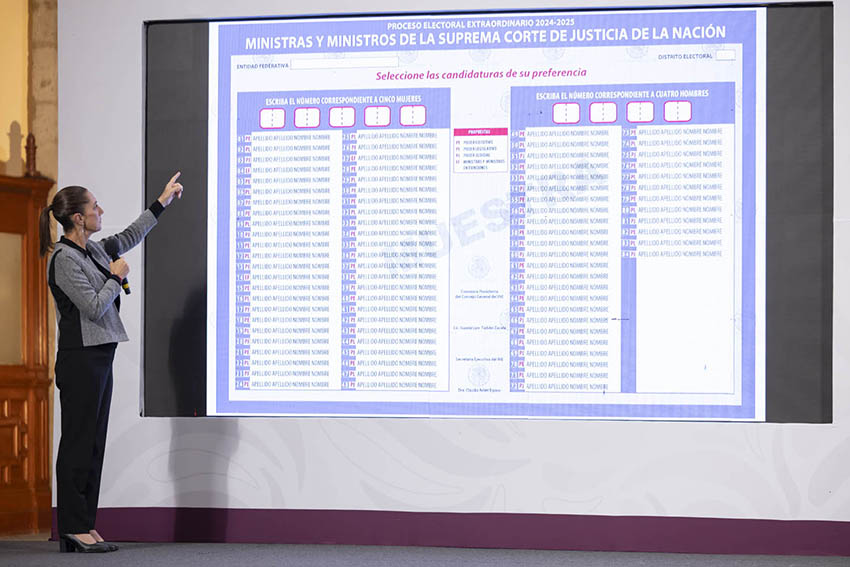
The proposal to amend the 2024 reform comes after just 13% of eligible voters participated in the 2025 judicial elections. Those who participated faced the gargantuan task of electing almost 2,700 judges, including nearly 900 federal ones. Complicated ballots with large numbers of candidates led many voters to make use of cheat sheets, some of which were handed out by people affiliated with the ruling Morena party.
Despite the low turnout, Sheinbaum declared the elections a success, although she conceded that the process could be “perfected.”
Still, Sheinbaum has maintained that judicial elections were — and are — necessary to rid Mexico’s judiciary of corruption, nepotism and other ills. She has rejected claims that the motivation for holding judicial elections was to seize control of the judiciary. That said, many judges who were elected last year, including Supreme Court justices, have links to the government and/or Morena.
What does Sheinbaum want to change?
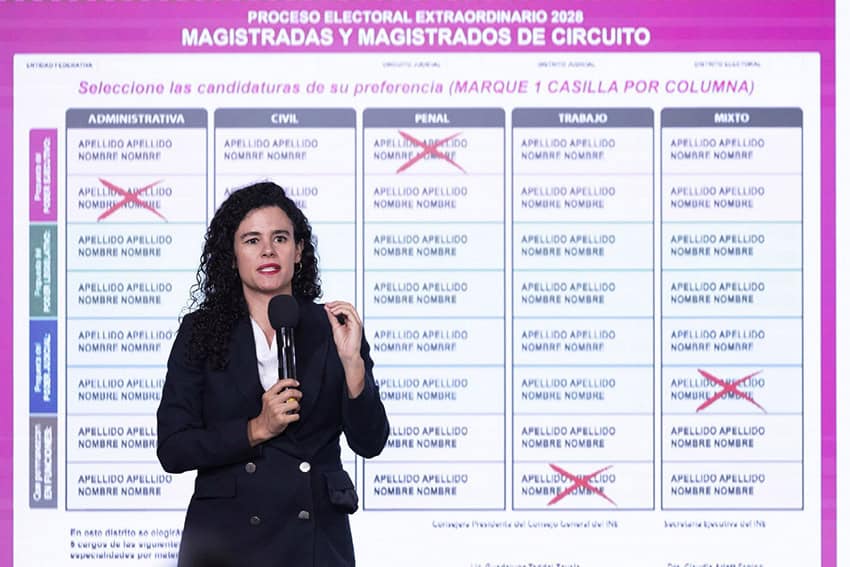
The federal government is now proposing that each individual judgeship race be limited to two candidates. Selection committees would choose the four best-qualified would-be candidates from a list of aspirants and that number would be reduced to two via sortition. The number of candidates allowed to vie for positions in courts that need to find people to occupy numerous judgeships would also be reduced, although they would still number in the dozens in various cases.
The El País newspaper reported that “the government’s bet is to transform a saturated and unreadable ballot into a more manageable” one. Sheinbaum is also seeking to ensure an equal number of male and female candidates on ballots.
Among the government’s other proposed changes to the 2024 judicial reform is one aimed at ensuring that judicial election campaigns and the voting process itself take place “without the intervention of political party representatives.” The National Electoral Institute would be tasked with ensuring that interference by political parties is avoided.
Drawn up by officials including presidential legal adviser Luisa María Alcalde, Sheinbaum’s reform bill also seeks to ensure that judicial election candidates are well-qualified to become judges. In 2025, requirements for candidates included having a “good reputation,” holding a law degree and presenting five letters of recommendation from neighbors and colleagues. If Sheinbaum’s proposal passes Congress — as is expected given Morena’s congressional strength — candidates would be required to have the “necessary technical knowledge” to serve as a judge and possess qualities such as “honesty,” which isn’t currently specified as an essential trait.
Sitting judges who want to contest judicial elections with the aim of winning a different judgeship would be required to resign from their current position. In accordance with the proposed changes to the judicial reform, which could be approved as soon as next week, appraisal and oversight of judges would be more stringent than is currently the case, with judges to be subject to performance reviews from their first year in the job.
In addition, Sheinbaum’s reform bill proposes that the Supreme Court return to what would essentially be a dual-chamber system of the kind that existed prior to the 2024 judicial reform.
El País reported that the proposed modification “represents a significant change to the redesign promoted by López Obrador, whose bet had been to centralize all [Supreme Court] decisions in a single plenary as part of his narrative of austerity and institutional simplification.”
Judges’ association: Postponement of judicial elections is a sign of the ‘inviability of the original design’
In a statement issued on Monday, the National Association of Federal Circuit Magistrates and District Judges (JUFED) said that postponing the next judicial elections to 2028 is “the clearest confession” from the federal government “about the inviability of the original design” of the elections.
Released two days before Sheinbaum submitted her reform proposal to Congress, the statement also said that delaying the elections by one year is equivalent to “postponing a systemic mistake without addressing the underlying causes.”
The reduction of candidates and the “simplification” of ballots are “insufficient measures,” JUFED argued.
A sample judicial ballot presented by President Sheinbaum in May 2025, ahead of the country’s first judicial elections. (Gabriel Monroy/Presidencia)
“These changes do not address ballot fatigue or the risk that the judicial election will become entangled in the dynamics of political parties,” the association said.
“… Furthermore, the creation of a ‘Coordinating Commission’ to standardize evaluation criteria confirms that the 2025 Evaluation Committees lacked the technical methodology necessary to ensure profiles of excellence” among judicial election candidates, JUFED said.
Before last year’s judicial elections were held, civil society organizations filed complaints against some candidates, alleging that they had links to organized crime or the Guadalajara-headquartered La Luz del Mundo religious sect, whose leader is a convicted sex offender.
In its statement, JUFED also said that if judicial elections have to be held, their purpose should be limited to filling “real vacancies” created by “natural causes (resignation, retirement or death).”
JUFED expressed its opposition to other aspects of Sheinbaum’s reform bill, and asserted that the staging of more judicial elections “without specific criteria regarding functionality” will cause Mexico’s justice system to “collapse.”
Bloomberg News reported in February that just over five months after the judges elected last year were sworn in, Mexico’s court system was “in disarray,” and that companies operating in the country were “increasingly steering clear” of it.
In a separate statement on Wednesday, JUFED referred to what it called “the dismantling of the professional justice system in Mexico” — i.e. the replacement of long-serving judges with people with limited or no experience in the judiciary.
It also said that hundreds of judges who lost their jobs after last year’s elections are still owed “extraordinary payments.”
“It is imperative that the public see an undeniable reality: The current authorities are not even complying with what they themselves designed to their liking. The 2024 judicial reform was promoted under the banner of ‘justice,’ but today, in practice, it has become an instrument for persecution and dispossession,” JUFED said.
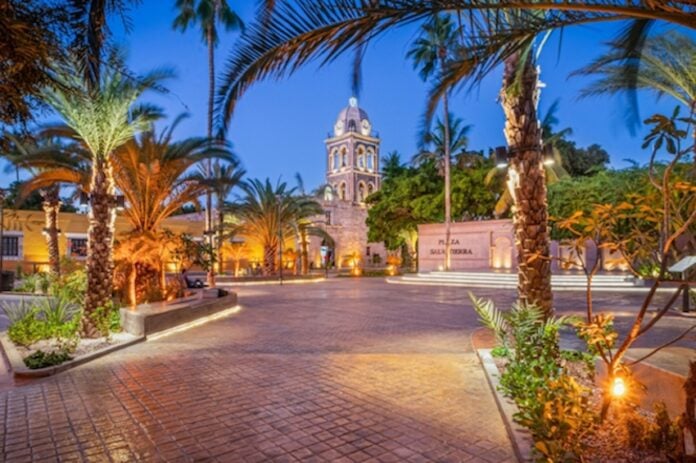
As a Magical Town, Loreto is committed to low impact development. It is also the gateway to Loreto Bay National Park, a protected natural area and UNESCO World Heritage Site. (Loreto, BCS)
Following a month of protests and demonstrations, Baja California Sur Governor Víctor Manuel Castro on Wednesday agreed to formally request President Claudia Sheinbaum to repeal a decree that had opened the port of Loreto to large-scale maritime traffic.
By amending the Federal Public Administration Law and the Ports Law, Sheinbaum’s decree converted Loreto into a deep-sea cabotage port, thereby authorizing the entry of international vessels — including cruise ships — and allowing for expanded foreign trade activities, such as the transit of national ships for the transport of goods, fuel and passengers.
The coalition “Whales or Gas?” — comprising more than 40 civil society and environmental protection organizations — led the protests demanding immediate revocation of the decree, which “gravely endangers the habitat of the blue whale and the local economies that depend on the arrival and presence of the world’s largest animal and other equally important species.”
After weeks of rallies and marches, the governor agreed to meet with the protesters along with representatives of the federal, state and local governments.
The Navy Ministry sought to negotiate modifications to the decree as an alternative to its cancellation, but the community flatly refused to budge from its demand of a full repeal. Castro accepted the legitimacy of the community’s mobilization efforts, saying that he and Loreto Mayor Paz Ochoa will sign the petition and send it to the president.
“By decision of the community assembly in defense of the Loreto Bay National Park, I hereby express my commitment to preserve the Natural Protected Area and support the request for the repeal of the decree.”
It concludes by saying that “the municipal and state authorities trust that our proposal will be duly and respectfully acknowledged.”
The petition points out that Loreto was designated a Pueblo Mágico (Magical Town), fostering the development of an economic model based on low-impact, community-oriented tourism. The port also serves as a gateway to Loreto Bay National Park, declared a protected natural area three decades ago and recognized as a UNESCO World Heritage Site for over 20 years.
Environmentalists also point out that the decree contradicts the conservation vocation of the area by going against the principles established in the Loreto Bay National Park Management Program, published in 2019, while also describing the operation and transit of cruise ships and mega-cruise ships as a direct threat to the survival and habitat of the blue whale.
In addition to the blue whale, Loreto is home to several other protected species, including some types of dolphins, sea turtles, birds and sharks.
While the protesters celebrated the agreement with the governor as a community victory, they insist they will remain vigilant until the cancellation of the decree is officially published.
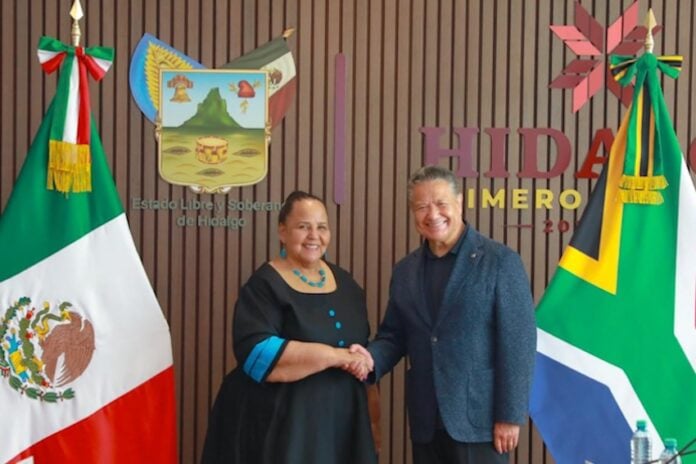
Shown here with Hidalgo Gov. Julio Menchaca is Beryl Rose Sisulu, ambassador to Mexico from South Africa, one of the few nations whose World Cup teams are staying in Mexico rather than the United States. Ambassador Sisulu said Pachuca, Hidalgo was chosen for the team´s camp because "here the air is as clean as the state is safe.” (Julio Menchaca)
Mexico will host just six of the 48 national teams during the 2026 FIFA World Cup, with the overwhelming majority opting to set up their base camps in the United States — a lopsided distribution that leaves half of Mexico’s prepared training sites unused.
According to announcements this week, only Mexico, South Africa, Uruguay, South Korea, Tunisia and Colombia selected base camps in Mexico.
Colombia will be seting up camp at the academy in the greater Guadalajara area belonging to Atlas FC of the Liga MX. (Atlas FC)
By contrast, 40 teams chose U.S. locations, while just two — Canada and Panama — will be based in Canada.
Co-hosted for the first time ever by three countries, the 39-day men’s soccer extravaganza will begin June 11 with two games: Mexico vs. South Africa at 1 p.m. local time at Mexico City’s Estadio Azteca, and South Korea vs. Czechia at 8 p.m. at Estadio Akron in Zapopan, a city of about 1.3 million adjacent to Guadalajara.
As for team practices, South Korea and Colombia will set up camp at the training academies of metro Guadalajara’s two Liga MX teams, CD Guadalajara (aka Chivas) and Atlas FC, respectively.
South Africa will train in Pachuca, Hidalgo, and Tunisia in the Monterrey metro area — both at Liga MX team facilities — while Uruguay will be just outside of Playa del Carmen, Quintana Roo, at a field and training complex next to the Mayakoba Fairmont resort.
Meanwhile, six of Mexico’s 12 proposed base camp sites will sit empty: facilities in Querétaro, Puebla, Tijuana, Toluca and Torreón, as well as a specially built training complex at the Moon Palace all-inclusive near Cancún.
Teams that have at least one scheduled game in Mexico but opted to stay in the U.S. are Uzbekistan, Czechia, DR Congo, Spain, Sweden and Japan.
National team officials cited logistics, infrastructure and travel considerations as key factors in choosing their locations.
South Africa’s decision to base in Pachuca stood out, driven in part by security considerations.
“The perception regarding crime and other very important reasons are what led us to choose Hidalgo,” said South Africa’s ambassador to Mexico, Beryl Rose Sisulu. “The people who made the decision visited Cancún, they visited Puebla [and] Hidalgo as well, and besides the altitude and other things that Hidalgo has, I realize that here the air is as clean as the state is safe.”
Sisulu also pushed back on perceptions of insecurity in Mexico, saying, “there’s crime in Mexico and all over the world.”
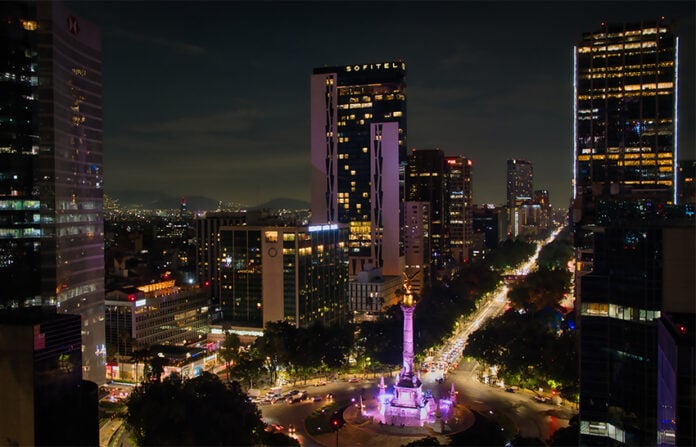
Moody's is the third major credit-rating firm to assign Mexico a low grade recently, although it did nudge the country's outlook up to stable from negative. Pictured: Paseo de la Reforma in Mexico City. (Shutterstock)
Credit rating agency Moody’s cut Mexico’s credit score to Baa3, its lowest level of investment grade and just one notch above junk status.
On the positive side, it revised Mexico’s outlook from negative to stable.
In announcing the reduction, Moody’s said Mexico’s weak economic growth reduces the government’s ability to generate revenue, while also dealing with an increasingly rigid budget, which notably includes financial support for the state-owned oil company Petróleos Mexicanos (Pemex).
Moody’s, like S&P and Fitch earlier, minced no words in placing a good share of the blame for Mexico’s sinking credit-rating on the drain on the public treasury caused by government support of Pemex, the state-owned oil company. (Camila Ayala Benabib / Cuartoscuro.com)
In its statement, Moody’s said the lower sovereign rating “will be partially offset by Mexico’s macroeconomic stability, policy responsiveness, and underlying economic strength, adding that “Mexico does not face macroeconomic imbalances that amplify fiscal risks.”
However, Moody’s warned that “continued support for Pemex will continue to limit fiscal consolidation.”
S&P also cited Pemex as a reason for its action, saying that “expected continued substantial fiscal support for Pemex and the Federal Electricity Commission would continue to aggravate Mexico’s fiscal rigidities.”
The Moody’s rating is now in line with Fitch Ratings, which reduced Mexico to “BBB-” in April 2020 (reaffirmed this year), and is one notch below S&P’s BBB rating.
Fitch, Moody’s, and S&P are the three largest global credit rating agencies, and all three now rate Mexico near the line between investment grade and speculative (aka “junk”). But while Moody’s has now joined Fitch in giving Mexico a Stable outlook, S&P recently dropped it to negative.
After Moody’s issued its latest decision, the Finance Ministry responded by outlining recent measures it has taken to keep public finances healthy, including a push for fiscal consolidation and a plan to lure more investments.
“Mexico maintains its investment-grade rating from all eight agencies that assess its sovereign debt, reflecting its commitment to responsible economic policy and the sustainability of public finances,” it said.
Last week after the S&P cutback, President Claudia Sheinbaum said Mexico would demonstrate that there are clear signs the economy is doing well.
Mexico’s economy contracted 0.8% in the first quarter this year, the worst result for the Mexican economy in any first quarter since 2020.