Fyre Festival 2 changed its location to Playa del Carmen shortly after Isla Mujeres officials stated that they had not received any information about the event from the organizers. (Fyre)
Fyre Festival 2, which was scheduled to take place from May 30 to June 2 in Playa del Carmen, Mexico, has been postponed indefinitely, according to its organizers.
In an email to ticket holders, organizers said that “the event has been postponed and a new date will be announced.” They also said that a refund had been issued.
Tickets for Fyre Festival 2 range between US $1,400 and $1.1 million.According to its creator, Billy McFarland, there are 1,800 tickets for sale.
Fyre Festival 2 is the sequel to the ill-fated event in 2017, for which McFarland faced criminal charges of fraud in the United States. After spending three years in prison, McFarland announced earlier this year that there would be a second edition of the festival in Mexico.
This week’s announcement is the second time in three months that organizers have changed the festival’s venue. In February, they announced it would take place on Isla Mujeres in the Riviera Maya. Later, in March, they said the festival would move to Playa del Carmen.
However, early in April, McFarland claimed that they had been working directly with the government of Playa del Carmen and their officials since March 5, 2025, to ensure a safe and successful event.
In a post on Instagram, he published 14 screenshots of emails, social media posts and official documents from the municipal government of Playa del Carmen and payment slips, arguing that his team had followed the proper processes and obtained all relevant permits for the event.
“All media reports suggesting our team has not been working with the government of Playa del Carmen are simply inaccurate and based on misinformation,” McFarland wrote in the post.
Despite the controversy, organizers said in the Wednesday email update verified by The New York Times that the event is still happening — just in a different location. Details about the musical lineup also remain nebulous.
“We are vetting new locations and will announce our host destination soon,” the email said. “Our priorities remain unchanged: delivering an unforgettable, safe and transparent experience.”
Organizers advised ticket holders that they will be able to repurchase tickets once the new date is announced, “if it works for your schedule.”
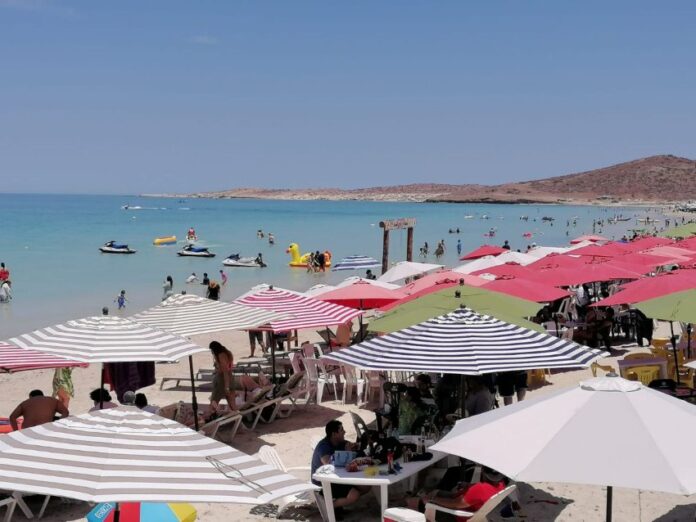
Mexicans flock to the beaches of Baja California Sur on Holy Week, mainly due to a confluence of schools, government offices and private businesses shutting down for most or all of the week, making many families free to vacation. (Omar Martínez/Cuartoscuro)
The two biggest weeks of the year in terms of tourism in Baja California Sur are associated with holidays: Christmas and Semana Santa, the latter being Holy Week, which leads up to Easter Sunday.
Semana Santa is particularly notable for the high visitor numbers and elevated hotel occupancy figures but also because so many more Mexican tourists typically plan beach holidays during this period.
For Semana Santa, Baja California Sur’s government has drafted assistance from a wide swath of resources, including the Mexican military, nonprofit organizations, local government and more to assist vacationing visitors this week. (State of Baja California Sur government)
“During Holy Week, we see an increase in domestic tourism — although it doesn’t surpass international tourism. But we’ll be managing, for example, a 60-40 ratio: 60% international tourism, 40% domestic tourism,” Lilzi Orcí, Executive President of the Los Cabos Hotel Association, told Meganoticias.
“We have a lot of regional tourists, that is, from BCS, during this season. They also come from Mexico City, Monterrey, Guadalajara — and some from the Bajío.”
How many people visit during Semana Santa?
In 2025, about 94,000 tourists were expected to check into statewide hotels during Holy Week, while many times that number were projected to enjoy regional beaches (113,000 in Los Cabos alone, according to official estimates). Naturally, having so many people visit during any given week puts additional pressure on regional authorities to ensure the beaches and water are clean and welcoming and that other signature attractions around the state are ready to handle more traffic than usual.
With that in mind, here’s a look at some of the planning and preparations this year and the expectations regarding visitation, hotel occupancy, and economic impact during one of, if not the, biggest week of the year (since final numbers have not yet been announced).
Safety and security measures
In Los Cabos, and in other vacation spots throughout the state, the government has placed aid stations at beaches for rapid response to visitor needs and emergencies. (Government of Baja California Sur)
In Los Cabos, more than 1,700 personnel and 250 units were tasked with being part of Semana Santa Segura 2025, an initiative to ensure the safety of all those visiting during Holy Week. If that seems like a lot, consider the ground they had to cover: 65 beaches across 190 kilometers of coastline.
“There will be seven surveillance, security and first aid stations on highways; eight surveillance and first aid stations on beaches; and 36 agencies from the three levels of government, institutions and organizations from the public, private and social sectors, who will carry out coordinated work,” confirmed Francisco Cota Márquez, Municipal Director of Civil Protection of Los Cabos, per Tribuna de Mexico.
Making sure beaches and water were of optimal quality
Federal officials have asked the public this year for help keeping regional beaches clean, an ongoing issue due to the enormous quantities of trash often left behind. Last year, Los Cabos cleaned up more than 70 tons of trash left on area beaches during Semana Santa.
To ensure optimal sanitary conditions at local beaches for the influx of visitors this year, the Federal Commission for Protection against Health Risks (COEPRIS) tested the water at 39 regional beaches — those expecting the highest turnouts, naturally — for any bacterial contamination.
Fortunately, all those tested got a clean bill of health. The World Health Organization has established acceptable levels of enterococci, a bacteria whose relative presence is used to gauge overall water quality. Samples of sandy stretches from BCS beaches were also tested at regional laboratories and came back 20 times cleaner than was necessary to receive the “optimal” designation.
Playa Balandra will keep the same hours during Semana Santa
Of all the regional beaches in BCS, none is as beautiful or difficult to visit as Playa Balandra in La Paz. That’s because it’s now a protected area, and access is limited to 450 visitors during two daily periods (8 am to noon or 1 pm to 5 pm). Locals get in free, but visitors must purchase an electronic bracelet for 120 pesos.
Those hours and rules remained the same during Semana Santa, but as always, all the other beautiful beaches in the La Paz municipality were free and offered unlimited access.
How hotel occupancy spikes during Semana Santa
The occupancy level at the state’s 499 hotels will vary this year. In Los Cabos, for example, it was expected to hit 90%, with robust rates too.
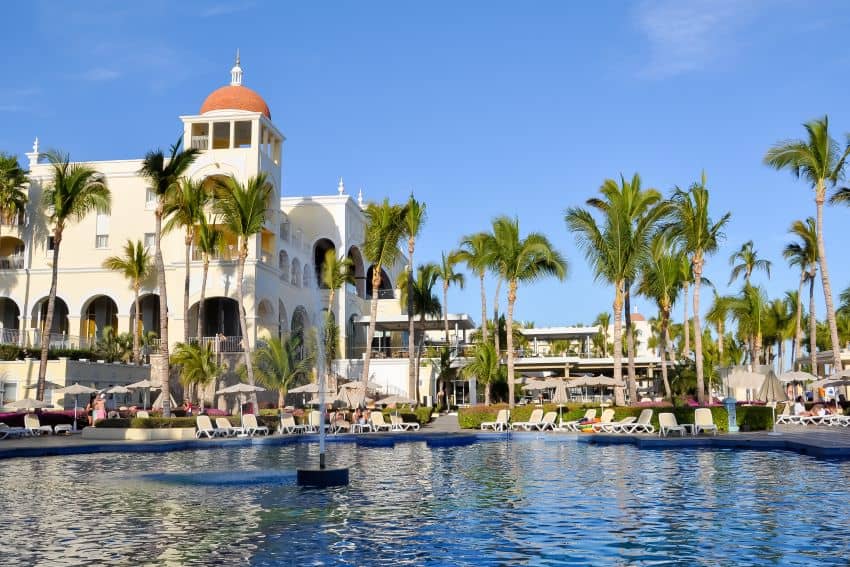
Los Cabos’ hoteliers are expecting their resorts to have been 90% filled this week. (Lester Balajadia/Shutterstock)
“We are expecting a rate of US $515, which provides an excellent economic impact during this season,” Orcí said the week before Semana Santa. “The total number of rooms we have as a Hotel Association is 19,500, and our tourist density per room is 2.4, which still gives us a projection of how many tourists we will receive per day during this holiday period. The rate we are managing is $20 higher than last year.”
But as good as 90% sounds, it’s not as good as the 95% occupancy expected in Mulegé. Other regional destinations were anticipating numbers that weren’t quite that robust but expected them to be above, often well above, the average hotel occupancy in Mexico (60%). Comondu, for instance, was booked this year at 84% of hotel capacity, Loreto at 75% and La Paz at 65%.
The statewide number is likely closer to the Los Cabos figure since the southernmost municipality hosts easily the most hotel rooms: 19,500 of 28,651 in BCS, or 68%.
Celebrating a memorable moment in regional history
The Western Flyer was the ship used by Nobel Prize-winning author John Steinbeck and his friend Ed Ricketts to explore the Gulf of California in 1940. (Western Flyer Foundation)
The “Log from the Sea of Cortez” by John Steinbeck is perhaps the best-known book ever written about the Baja California Peninsula, even though it’s only an abridged version of an earlier work: “Sea of Cortez: A Leisurely Journal of Travel and Research.”
“The Log” keeps Steinbeck’s narrative observations but jettisons most of the notes on specimen collecting and marine biology that were the prime motivators of the six-week expedition undertaken by Steinbeck and his friend Ed Ricketts — the inspiration for the character Doc in Cannery Row — aboard the Western Flyer in 1940.
Steinbeck and Ricketts have long since passed away, but amazingly, the Western Flyer, a 77-foot purse seiner, is still around. She arrived in La Paz on Sunday, April 13, the start of Semana Santa, and was displayed to the public at the Muelle Fiscal as part of festivities celebrating the 85th anniversary of the legendary voyage.
Chris Sands is the Cabo San Lucas local expert for the USA Today travel website 10 Best, writer of Fodor’s Los Cabos travel guidebook and a contributor to numerous websites and publications, including Tasting Table, Marriott Bonvoy Traveler, Forbes Travel Guide, Porthole Cruise, Cabo Living and Mexico News Daily. His specialty is travel-related content and lifestyle features focused on food, wine and golf.
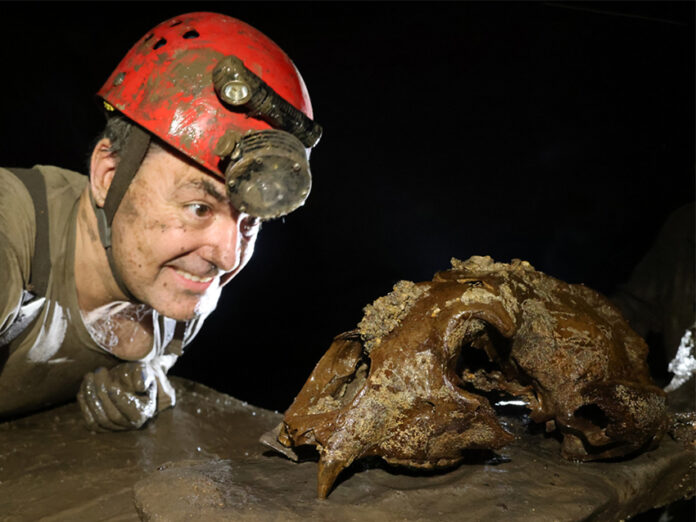
Dr. Luis Espinasa went into the Calera cave system looking for cavefish but found an world of ancient megafauna, like this cave bear. (All photos courtesy of Luis Espinasa)
Mammoths, saber-toothed tigers, camels, bison, glyptodons and gigantic five-ton sloths: all of them once roamed what today is called Mexico. The offbeat account of how the remains of these Ice-Age giants were discovered in a little-known and diabolically difficult cave is told in an award-winning, light-hearted documentary called “Crypt of the Megafauna.”
The story began in March of 2019, when cave biologist Luis Espinasa of New York’s Marist University, went to study cavefish in an underground stream passing through a little-known cave in the Sierra del Abra, in San Luis Potosí.
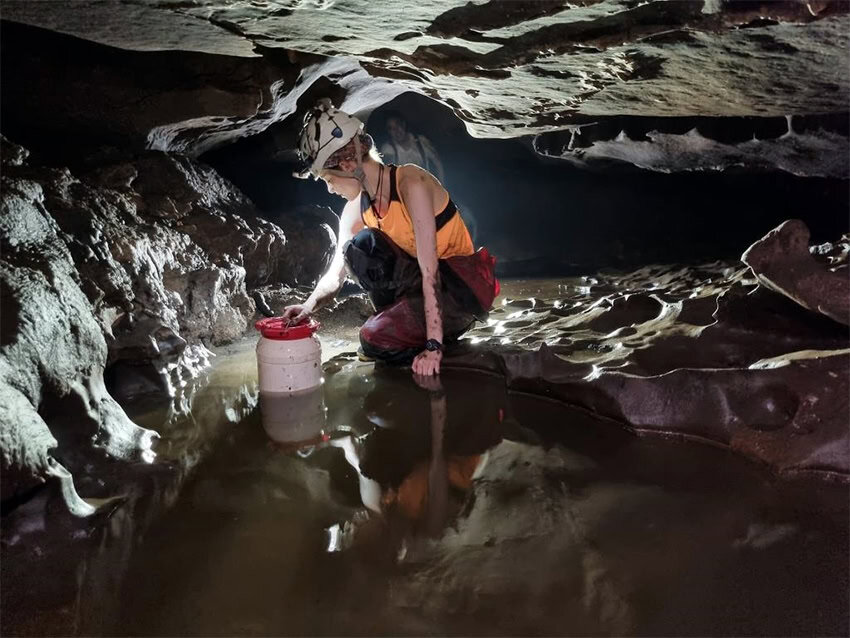
Sofia Espinasa, Dr. Espinasa’s niece, collecting cavefish.
Blind cavefish
“I knew that both eyeless and eyed versions of the same fish, Astyanax — popularly known as the cave tetra — had been spotted in a small cave near Ciudad Valles,” Espinasa says. “It was a tiny cave, nothing more than a sinkhole leading to a pool where both morphs lived together. It looked like this cave would be an ideal place to study their behaviors and to witness the effects of natural selection.”
While exploring the Calera cave system, they discovered an entrance that led to virgin passage. Espinasa and his colleagues went in for a first look around.
The nightmare crawl
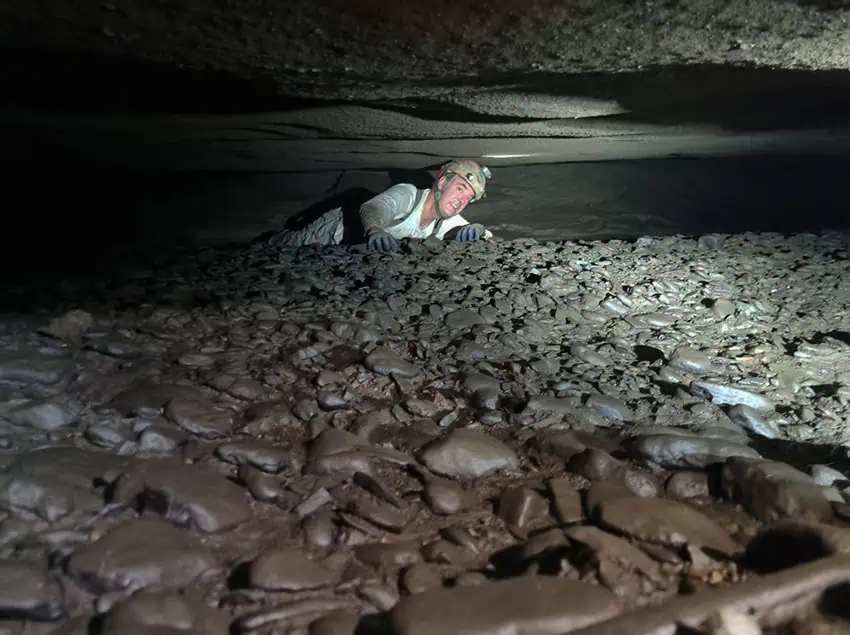
“After descending a vertical pit,” says Espinasa, “the passage was about a meter in height with a sandy floor and we crawled in on our hands and knees. Unfortunately, this soon transformed into a miserable belly crawl, with a ceiling height of only 40 centimeters (16 inches).”
A typical crawl through the Calera cave system.
“But the low ceiling wasn’t the main problem. Instead of the comfortable sandy floor, the ground beneath was a nightmare of rough, spiky rocks, each movement sending sharp jolts of pain through your body. These rocks seem to have a malicious intent, digging into our skin with relentless determination. They offered no respite, no mercy, only an unyielding challenge to our endurance… and, unfortunately, for this first visit we had not bothered to bring along knee pads.”
The most important event of this first visit occurred in the entrance pool, but at the time, Espinasa paid it no attention.
A velvety black jawbone
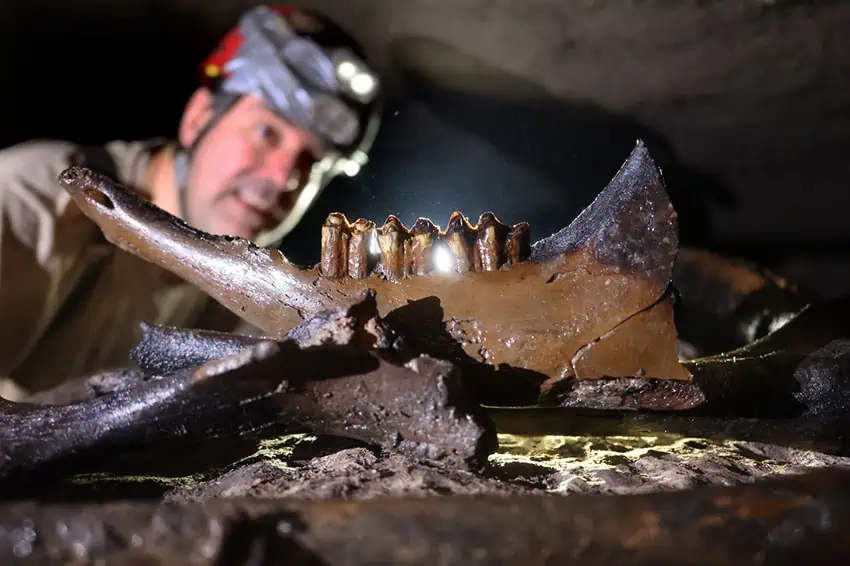
“As I was swimming in the pool,” the biologist says, “I saw a massive jawbone half-buried in the silt of the cave floor. Its surface, once composed solely of bone, had undergone a remarkable process of fossilization, with minerals seeping into its very essence, encasing it in a delicate embrace of stone. The rich hues of manganese oxide cast the jawbone in an otherworldly sheen of velvety black.”
A bison mandible like the one found by Dr. Espinasa.
“In reality, I had in my hands a fossilized jaw of an ancient and extinct bison. But there are no bison in Mexico. So what did I do? I said to my fellow explorers, ‘A horse jaw… cool!’ and tossed it back nonchalantly into the pool.”
Espinasa found several unexplored passages, many of them littered with more of the velvety, black, fossilized bones. To survey what was turning into a complex system, he called in his brother, sister-in-law and niece, all expert cavers and proficient in cave mapping.
The mysterious molar
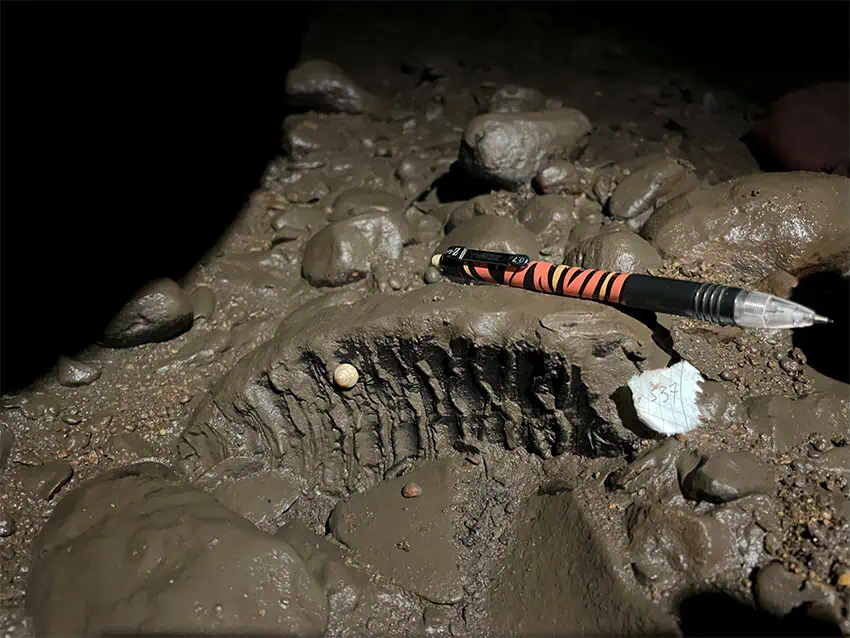
One day, deep inside the cave, Espinasa’s niece Sofía found a large rock with semi-circular, parallel ridges. Thinking it could be an ammonite, she took off her caving coverall, wrapped the rock in it, put it in her knapsack, and headed for the exit. Moving through the tight passages required lifting the heavy bag over and over, each time placing it an arm’s length ahead of her.
In the dark of a cave and covered in mud, an elephant molar can easily be mistaken for a rock.
“She showed it to me,” comments Espinasa, “and I said, ‘Hmm, something about it does not look right to be a mollusk.’ Then, all of a sudden my brain clicked and I realized what it was. It had to be the molar of an elephant.”
But there are no elephants in Mexico and never have been. So what was an elephant molar doing in San Luis Potosí? It was at that moment that Espinasa realized that the molar had to belong to a mammoth and that the bones the team had noticed throughout the cave were not modern at all but actually fossils from Ice Age megafauna.
It was clear that what the team was now calling the Crypt of the Megafauna needed to be protected, but to convince the landowners and the local community — and, indeed, the whole world of its importance — they needed to collect and catalog more of its fossils.
Robo-Teddy to the rescue
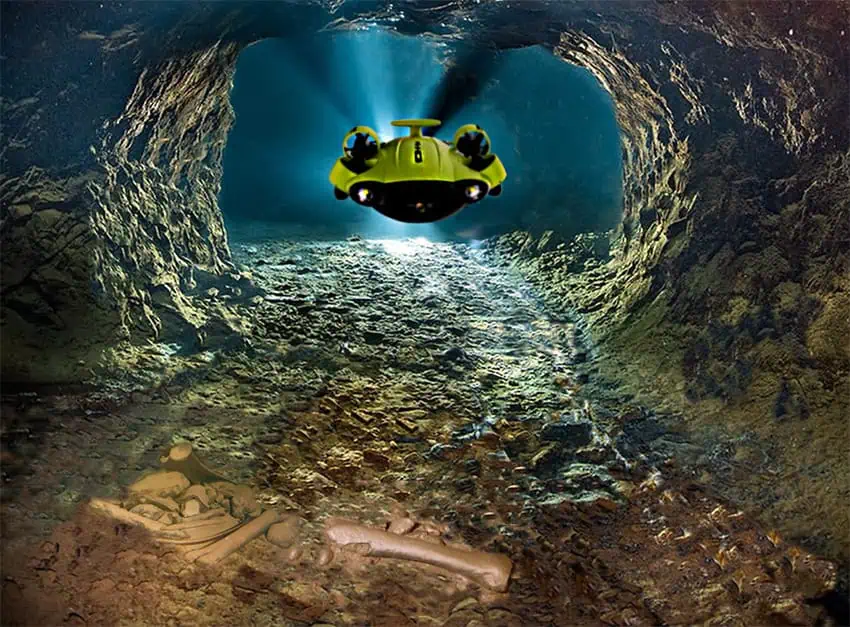
The remotely operated underwater vehicle (ROUV) that helped extract the bones in the cave.
The problem was the cave. Some of the best-looking bones, for example, lay in a passage the team called El Arrastre Lodoso — the Muddy Crawl. This was 40 centimeters high. The floor was covered with sharp rocks as usual, but in this passage, all those rocks were coated with a thick layer of mud. Other promising galleries were filled with water. It was more than a human could handle.
This being the case, the team decided to bring in a small underwater drone with a claw capable of grasping and carrying a bone. They named it Robo-Teddy.
Thanks to Robo-Teddy and to a hair-raising scuba-diving endeavor, the explorers were able to catalog 775 specimens. These included parts of a saber-toothed tiger, a dire wolf, a glyptodon and a giant sloth that once weighed five tons and stood six meters high.
At one point, they found three vertebrae of an Ice Age bison. When they discovered that the three pieces fit together perfectly, they realized that the cave may have contained the complete cadavers of megafauna. An inevitable question arose: were human beings involved in the deaths of these creatures?
John Pint has lived near Guadalajara, Jalisco, for more than 30 years and is the author of “A Guide to West Mexico’s Guachimontones and Surrounding Area” and co-author of “Outdoors in Western Mexico.” More of his writing can be found on his website.
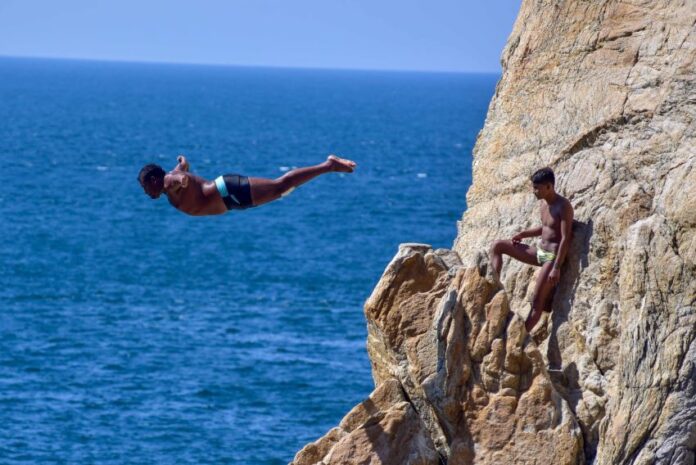
The Guinness award recognizes Acapulco's long-standing tradition of cliff diving. (Carlos Alberto Carbajal/Cuartoscuro)
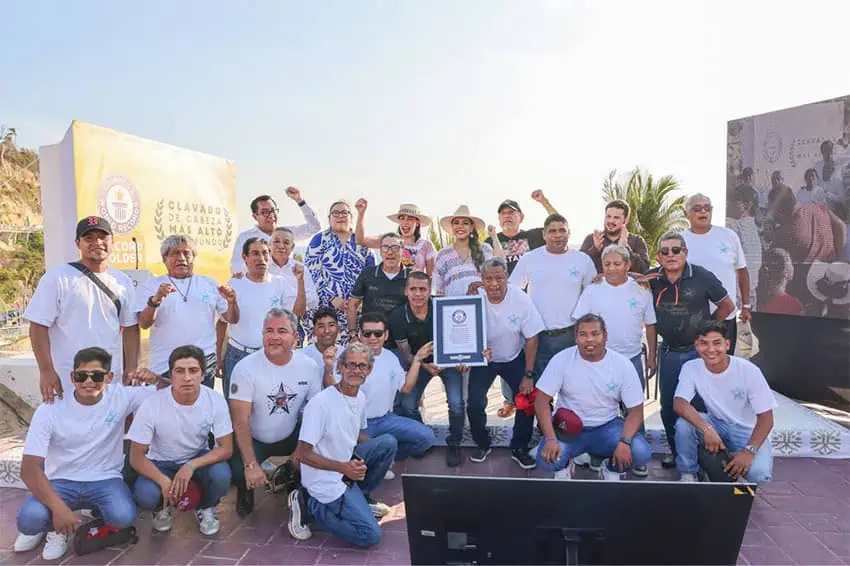
The famed Acapulco cliff divers were awarded a Guinness World Record this week for completing 5 million headfirst dives from La Quebrada, the steep, rocky cliff that towers above the Pacific Ocean.
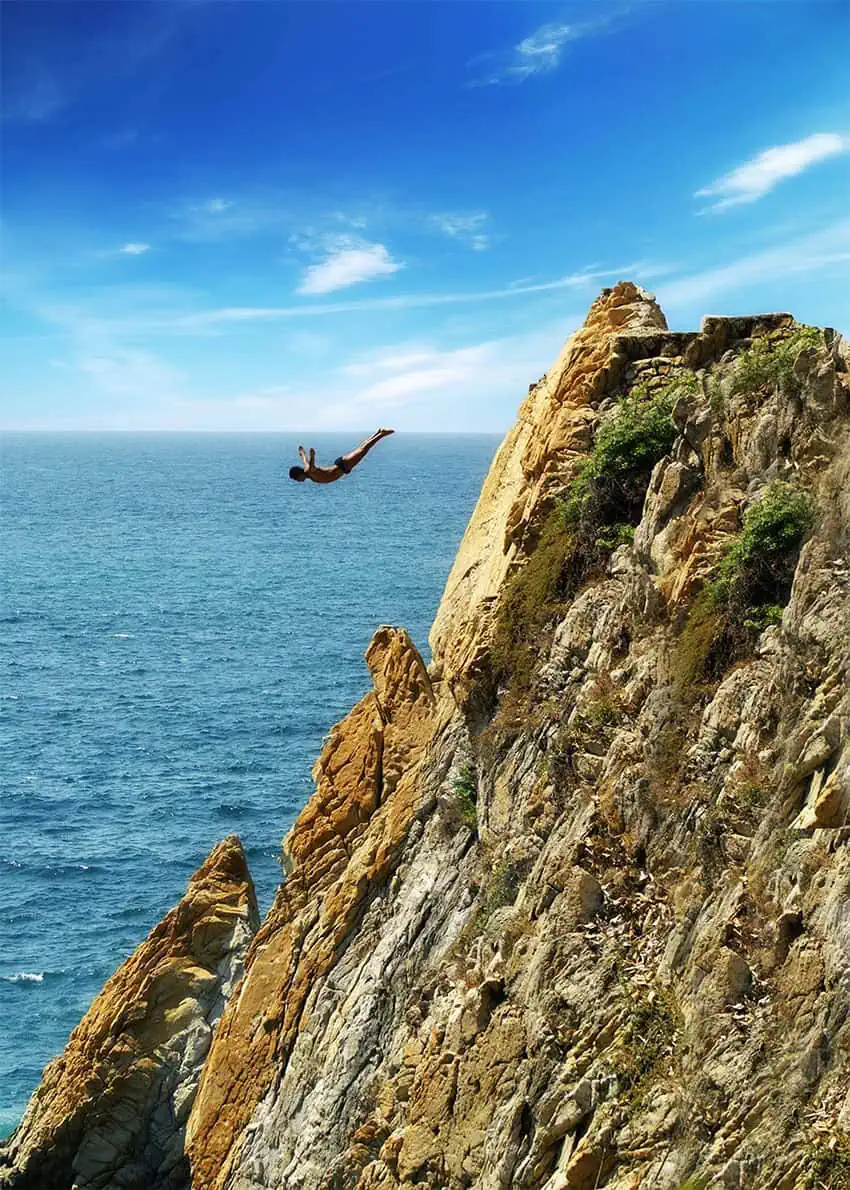
Since 1934, La Quebrada’s divers have drawn global attention for their perilous 35-meter (115-foot) dives into a watery inlet just 7 meters (23 feet) wide and 4 meters (13 feet) deep.
Record Guinness Clavadistas Acapulco!
The Guinness award cements their legacy as one of Mexico’s most enduring cultural and athletic traditions.
Gustavo Gatica Gorostieta, president of the Professional Divers Association of La Quebrada, emphasized the nine decades of sacrifice behind the milestone.
“This record is the result of tears, sweat, pain and fear,” he said. “We do it with love and dedication to promote La Quebrada, Acapulco and Guerrero.”
Acapulco is the largest city in the state of Guerrero, with a population of 658,000.
Situated a short walk or taxi ride from downtown, the cliffs of La Quebrada are just northwest of Acapulco’s main square — not adjacent to any beach, but rising 35 to 45 meters (115 to 148 feet) above the ocean below. The Hotel El Mirador overlooks the cliffs, with panoramic views of the diving shows.
The historic 5 millionth dive was executed by Amadeo Alcocer, who began practicing the sport at age 12 and is now a professional diver at 18. Wearing a ceremonial cape emblazoned with the Guinness logo, Alcocer described the moment as nerve-wracking yet exhilarating.
“It makes me feel very happy, very proud to be part of the group and to be from Acapulco,” he said, mentioning that he said a prayer to the Virgin of Guadalupe (Virgin Mary) moments before the plunge.
Divers can reach speeds of 90 km/h (56 mph) during their 4-second descent.
Divers and government officials celebrated the record at a ceremony on Tuesday. (Evelyn Salgado Pineda/Facebook)
Hurricane Otis forced a six-week halt to performances in late 2023, with divers later scaling back shows due to reduced tourism. Moreover, the accumulation of debris along the coast after both hurricanes also made the waters unsafe for boaters and divers alike.
Federal Tourism Secretary Josefina Rodríguez Zamora praised the divers as “the best in the world” and highlighted the Guinness record as publicity that can help revive Acapulco’s tourism sector.
Guinness representative Ingrid Rodríguez Borja noted the unique nature and difficulty of the dives, which are performed at triple the height of Olympic platforms into shallower depths. Divers also must wait for the right tide before taking their plunge, and strong winds are often part of the equation.
The ceremony featured 12 dives, including one by a woman and two by minors.
Over the past 91 years, since fishermen began challenging one another to jump from the crags into the water below, La Quebrada’s cliffs have hosted many celebrities and been a site in many Hollywood films, including Elvis Presley making a dramatic dive in 1963’s “Fun in Acapulco.”
But nowadays, Salgado said, the focus is mainly on preserving Acapulco’s identity. “This isn’t just sport,” Salgado said. “It’s a story of overcoming, of a people who rise again.”
By the mid-1930s, cliff diving had become a popular pastime among young thrill-seekers in Acapulco. (Comisión Mexicana de Filmaciones/CC BY-SA 2.0)
One of them is Raúl Arturo García Bravo, a high-dive pioneer and big promoter of La Quebrada diving in the 1930s who, legend as it, was the stunt man for Elvis’ big dive in “Fun in Acapulco.” He also jumped from the Golden Gate Bridge in San Francisco and appeared in at least 10 other Hollywood films; his record of more than 35,000 high dives included his last from La Quebrada at age 71 in 1998.
The other is Iris Selene Álvarez Alonso, who was 14 when she achieved a Guinness record in 2007 by jumping into the ocean below from a cliff 18 meters (59 feet) high, making her the youngest female to accomplish such a feat. A shoulder injury forced her to terminate her diving career.
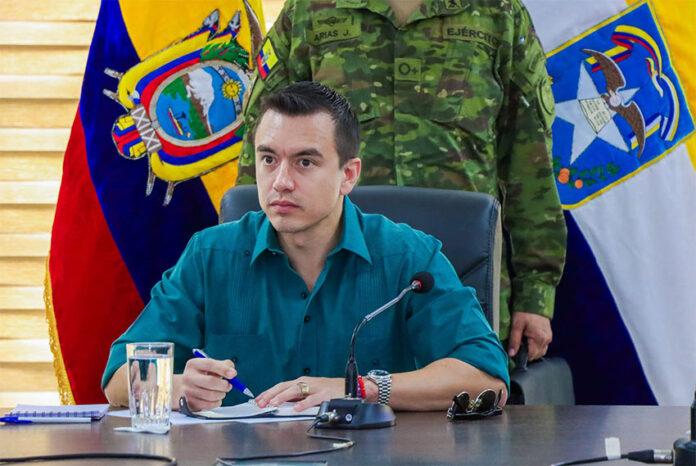
Sheinbaum described Ecuadorian President Daniel Noboa's recent election win as "highly irregular." (Gobierno de Ecuador)
President Claudia Sheinbaum on Wednesday said Mexico has no plans to restore diplomatic relations with Ecuador after President Daniel Noboa won re-election over the weekend.
During her Wednesday morning press conference, Sheinbaum cast doubt on Noboa’s election victory, calling it “highly irregular,” while rejecting the Ecuadorian president’s expressed desire to renew relations with Mexico.
President Sheinbaum answered reporters’ questions about Mexico-Ecuador relations at her Wednesday press conference. (Presidencia)
“We do not currently have relations with Ecuador and we will not restore relations as long as Noboa is in power,” Sheinbaum said.
Sheinbaum’s predecessor, Andrés Manuel López Obrador, broke off relations with the South American nation after Ecuadorian police raided the Mexican Embassy in Quito on April 5, 2024. Noboa ordered the highly controversial raid to detain a former vice president of the South American nation who was seeking asylum in Mexico.
Then-Foreign Minister Alicia Bárcena announced the cancellation of diplomatic relations the following day.
“In consultation with [President López Obrador], and in view of the flagrant and serious violation of the Vienna Convention on Diplomatic Relations, [especially] the principle of inviolability of Mexico’s diplomatic premises and personnel, and the basic rules of international coexistence, Mexico announces that it is immediately breaking diplomatic relations with Ecuador,” she said.
Surveillance footage of the embassy raid showed Ecuadorian police grappling with Roberto Canseco, Mexico’s deputy chief of mission, as they arrested Jorge Glas, Ecuador’s former vice president.
Glas, twice convicted for corruption, had sought protection from embezzlement charges by requesting asylum in Mexico. In December 2023 — a little over a month after Noboa first assumed power — López Obrador granted Glas permission to live at Mexico’s embassy.
Noboa, who will serve a four-year term, has been in office since November 2023 after winning a snap election following the resignation of President Guillermo Lasso six months earlier.
Noboa defended his decision to raid Mexico’s embassy by saying the security crisis in Ecuador called for “exceptional decisions,” and that he could not allow a convicted criminal to escape justice.
Felipe Ángeles International Airport is the hub for Viva Airlines’ U.S. routes. (Mario Jasso/Cuartoscuro)
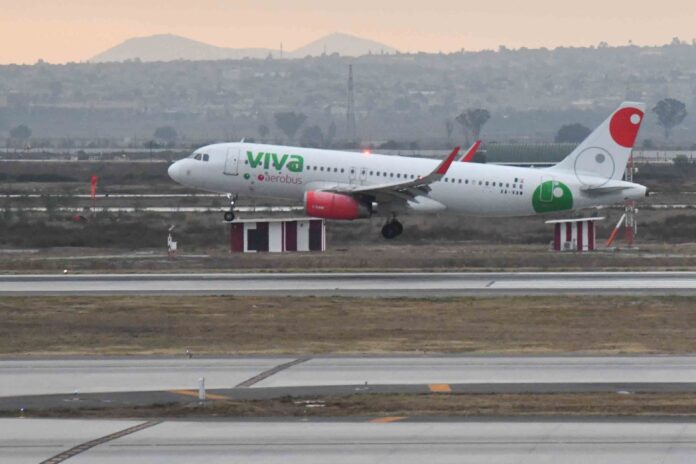
Viva Airlines has announced seven new direct flights from the Felipe Ángeles International Airport (AIFA) to U.S. destinations beginning in October. The airline is also adding flights to two domestic destinations.
On Wednesday, Viva CEO Juan Carlos Zuazua said in a LinkedIn post that the new flights reaffirm the airline’s “commitment to a more accessible, modern … aviation at the best prices for all.”
AIFA welcomed Viva Airlines’ expanded offerings, which could boost usage of Mexico City’s new airport. (Mario Jasso/Cuartoscuro)
Viva will add flights from AIFA to seven U.S. cities: Chicago, Dallas-Fort Worth, Denver, Houston, Los Angeles, Miami and Orlando. The airline will also add domestic service to La Paz, the capital of Baja California Sur, and Tepic, the capital of the Pacific Coast state of Nayarit.
In a press release, Viva said the new routes solidify its position as “the leading carrier for international travel between the Mexico City metropolitan area and the United States.”
“We went from 29 to 38 direct flights from AIFA, marking a growth of 31% (at AIFA),” Zuazua wrote. He added that the expansion is important because “the U.S. is [Viva’s] main international market and a strategic partner for tourism, investment and trade in Mexico.”
The new flights could help establish AIFA as an international hub; so far, Viva has flown 5 million passengers out of AIFA, Zuazua said — almost half of all passengers who have passed through the México state airport.
The new airport has struggled to meet expectations in terms of passenger numbers, according to industry experts cited by Mexico Business News.
The government’s original projections had AIFA handling 20 million passengers annually within its first three years. However, since opening on March 21, 2022, the airport — located 45 kilometers north of downtown Mexico City in neighboring México state — had served only 10.47 million passengers through Jan. 31, 2025, an average of just over 3.5 million passengers per year.
The lack of ground transportation has been a significant hurdle for passengers flying into and out of AIFA, even though ticket prices are lower than at the original international airport in eastern Mexico City, Benito Juárez. A new passenger rail line connecting AIFA to the old Mexico City train terminal, just 3 kilometers northwest of the capital’s Historic Center, is set to open in July.
Performing under scrutiny: Narcocorridos are in hot water as states crack down on the genre. (Graciela López/Cuartoscuro)
Restrictions on narcocorridos — a Mexican regional music subgenre that tells stories associated with drug trafficking and organized crime — are on the rise in Mexico as more states and cities ban live performances of drug ballads.
Nayarit was the first state to issue a ban this year. More states have followed suit as pressure against the controversial genre has mounted, both in Mexico and abroad. Now, Querétaro, Jalisco, Aguascalientes, Michoacán and Mexico City have all announced restrictions on public performances of the music promoting violence or crime — prohibitions that in some cases extend to private events.
Why are Mexican states banning narcocorridos?
Prohibitions over narcocorridos, also known as corridos tumbados, are not new. In 2023, Tijuana, Baja California, banned narcocorridos, forbidding musical groups from singing them at public events and commercial establishments from playing them. That same year, the municipality of Benito Juárez (Cancún) denied granting permits to concerts that promote organized crime, and the city of Chihuahua, Chihuahua, banned corridos tumbados and music that promotes violence or misogyny. Artists such as Natanael Cano and Peso Pluma have faced sanctions for violating this rule.
By late March, the debate intensified after the musical group Los Alegres del Barranco performed a narcocorrido during a concert at the University of Guadalajara (UdeG), praising the leader of the Jalisco New Generation Cartel (CJNG), Nemesio Oseguera Cervantes, also known as El Mencho, while projecting his image on screen.
The United States later announced it would revoke the visas of the group’s members.
Weeks later, the Texcoco Feria del Caballo in the state of México became the center of the debate, after singer Luis R. Conriquez refused to perform some of his most famous corridos that reference — and sometimes glorify — real-life figures in the drug world. The musician, who self-censored after the state government threatened to criminally prosecute narcocorrido singers, left the stage as the rowdy fans began to riot.
Artists like Conriquez are reconsidering their set lists as more states prohibit music referencing violence. (Ocesa)
The incident in Texcoco prompted President Claudia Sheinbaum to state that narcocorridos are not forbidden by the federal government. “It would be absurd to ban a musical genre,” she said. Instead, Sheinbaum said her administration proposes “that the lyrics stop condoning drugs, violence, violence against women, or viewing women as sexual objects.” In November, Sheinbaum announced a national contest seeking to change the lyrical content of narcocorridos.
Which states or cities have issued bans so far this year?
Nayarit
In February, Governor Miguel Ángel Navarro Quintero issued an official decree banning narcocorridos and corridos tumbados at fairs, stadiums, public squares, and other public spaces.
Querétaro
Last week on April 10, the Querétaro government and the state’s 18 municipalities signed a joint agreement to forbid public and private events that glorify crime.
Jalisco
On April 11, Governor Pablo Lemus ordered a ban on any public presentations or musical groups that glorify crime at events organized by the state government.
Mexico City
On Wednesday, Mayor of Mexico City Mayor Carla Brugada announced that her government will issue a directive to limit music with violent messages at government events and public spaces.
Aguascalientes
On Thursday, the local Congress approved an initiative to ban narcocorridos at public eventsjust days before the San Marcos Fair begins on April 19. The crime will be classified in the local penal code as “Provocation to commit a crime or apology for crime,” and will carry a prison sentence of six months to one year.
Michoacán
Starting Thursday, a decree signed by Governor Alfredo Ramírez Bedolla took effect prohibiting authorities from granting permits for public events hosting musical groups that advocate crime.
Mexico maintains its investment-grade rating thanks to "prudent macroeconomic policy framework, robust external finances, and its large and diversified economy," Fitch reported. (Gideon Benari/Flickr)
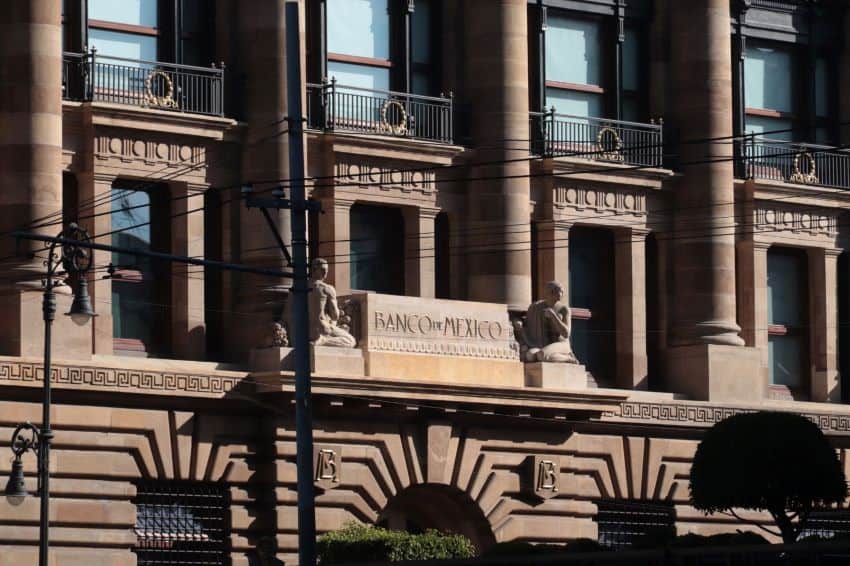
Fitch Ratings has affirmed Mexico’s sovereign credit rating at the lowest investment-grade level while forecasting that the Mexican economy will fall into recession this year.
“FitchRatings has affirmed Mexico’s Long-Term Foreign Currency Issuer Default Rating (IDR) at ‘BBB-‘ with a Stable Outlook,” the New York-based credit rating agency said in a statement on Wednesday.
Mexico maintained its investment-grade credit rating despite the likelihood of an economic downturn. (María Ruiz)
Fitch also said that it expects the Mexican economy to contract 0.4% this year.
Among the countries that currently have an AAA rating with Fitch — denoting the lowest expectation of default risk — are Switzerland, Germany and Australia. The United States’ rating is AA+, the second highest level.
With a BBB- rating, Mexico’s default risk is on par with that of India and Greece, among other countries.
Fitch said on Wednesday that “Mexico’s rating is supported by a prudent macroeconomic policy framework, robust external finances, and its large and diversified economy.”
It said that Mexico’s rating is “constrained by muted long-term growth, weak governance indicators, fiscal challenges related to a low revenue base and budgetary rigidities, and contingent liabilities from Pemex,” the state oil company.
In a statement issued on Wednesday, Mexico’s Finance Ministry highlighted that Mexico has an investment-grade rating “with the eight rating agencies that evaluate its debt.”
That situation, the ministry added, “guarantees favorable access to international financial markets.”
Fitch predicts a recession on the horizon
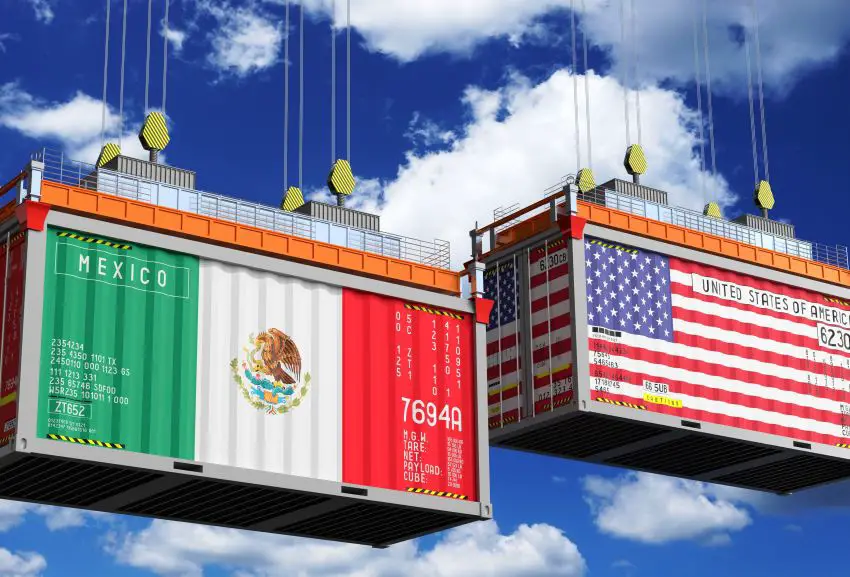
Fitch said that Mexico is “especially vulnerable to U.S. trade protectionism, as decades of integration have made exports to its northern neighbor a mainstay of the economy (27% of GDP in 2024).”
Mexico’s auto sector is especially vulnerable to disruption from tariffs, Fitch reported. (Volkswagen de México)
Fitch said that the ultimate “fate” of the Mexico-U.S. trading relationship “is likely to remain unclear at least until a review of the USMCA agreement scheduled for mid-2026.”
“Even if U.S. tariff policy preserves a preferential treatment for Mexico relative to competitors, we see dimmer prospects for ‘nearshoring‘ so long as this uncertainty persists,” it said.
In that context, Fitch is forecasting that the Mexican economy will contract 0.4% in 2025 “as tariffs, tariff-induced uncertainty, fiscal adjustments, and a slowdown in the U.S. weigh on activity.”
If the Mexican economy were to contract, it would be the first recession since 2020, when Mexico’s GDP plunged 8.5% due to the COVID pandemic and associated restrictions. The economy grew 1.5% in 2024, but contracted on a sequential basis in the last quarter of the year.
Fitch acknowledged that the current economic outlook is “uncertain and will hinge on the new trade relationship with the U.S. that emerges.”
“For now, we expect a modest 0.8% recovery in 2026 as the economy continues to digest tariffs and U.S. growth remains soft,” it said.
What happens with Mexico economy in 2025 depends in part on the results of current tariff negotiations. (Shutterstock)
Fitch’s forecast for the Mexican economy in 2025 contrasts sharply with those of the International Monetary Fund and the World Bank, which are predicting growth of 1.4% and 1.5%, respectively. However, both those forecasts were made in January, before United States President Donald Trump imposed tariffs on imports from Mexico.
In the Mexico report it issued on Wednesday, Fitch Ratings also commented on the federal government’s Plan México economic initiative, tax collection and other issues.
Plan México
Fitch said that Plan México “seeks to enhance growth prospects, via a state-led model with participation by the private sector given limited fiscal resources.”
“New energy-sector legislation, for example, bolsters the primacy of public companies but introduces new modalities for partnership with the private sector,” it said.
Fitch said that “increased social outlays, public mega-projects” — such as the Maya Train railroad — “higher interest costs, and Pemex’s operational losses have worsened … [Mexico’s] fiscal position, lifting the ‘public sector borrowing requirements’ … to a record-high 5.7% of GDP in 2024.”
It added that the Mexican government is aiming to reduce public borrowing requirements to 3.9% of GDP this year, “via large cuts” to capital expenditure “following completion of mega-projects and austerity in operating expenditures even in priority areas (health, education, security).”
Tax collection
Fitch said it believes the Mexico government “can achieve this year’s fiscal goal despite the adverse backdrop” created by U.S. tariffs and tariff threats.
It highlighted that tax collection rose 10% annually in the first two months of 2025 “despite stagnating economic activity.”
Fitch said the higher tax revenue reflects “resilience and possible gains from some measures (e.g., taxes on e-commerce), while spending cuts remain on track.”
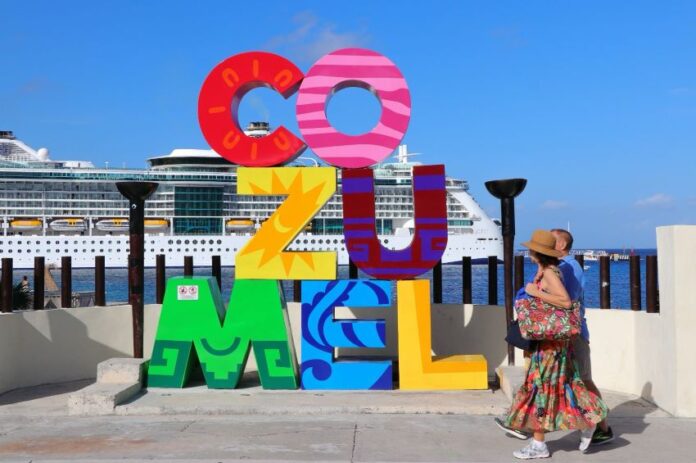
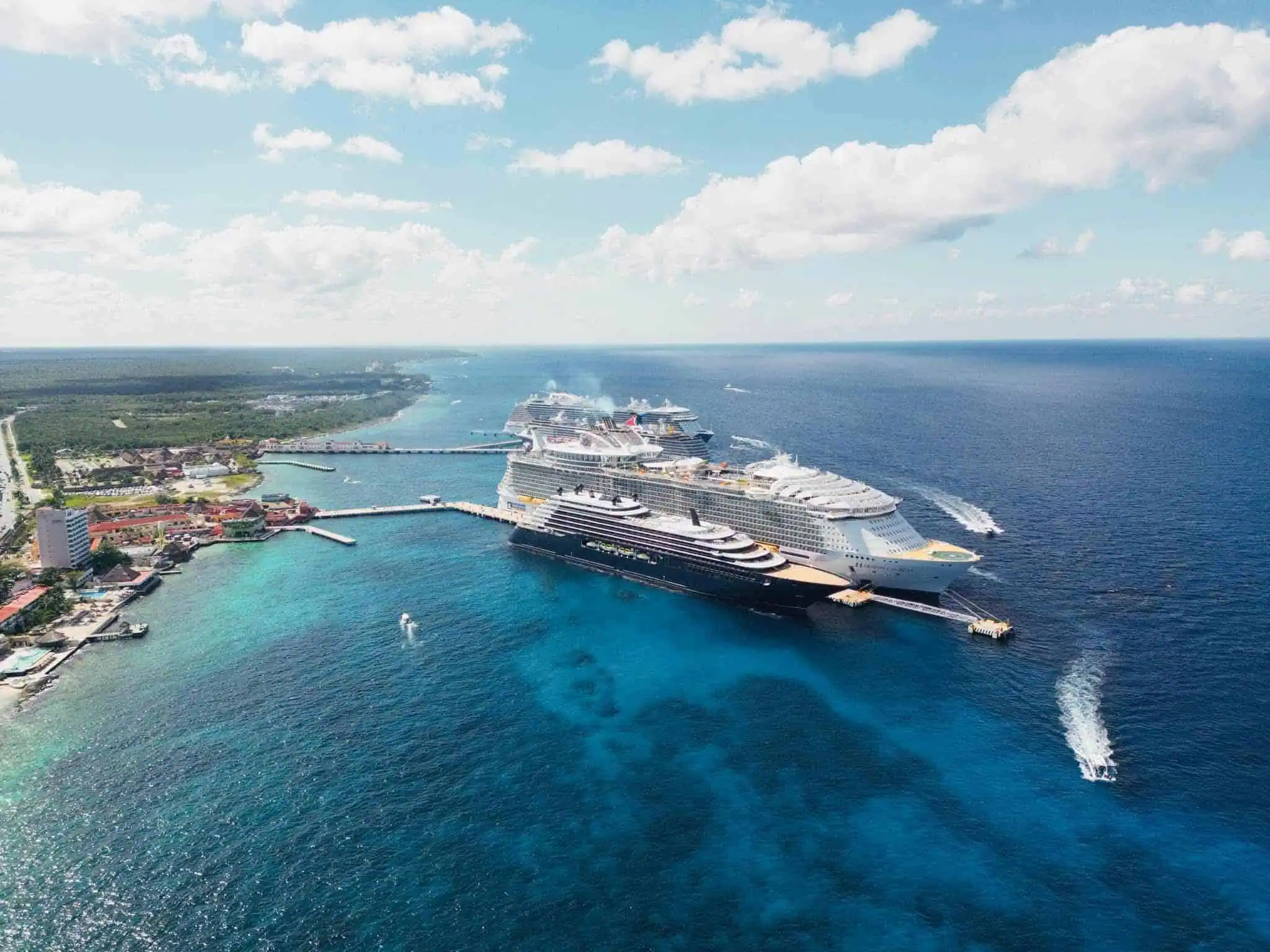
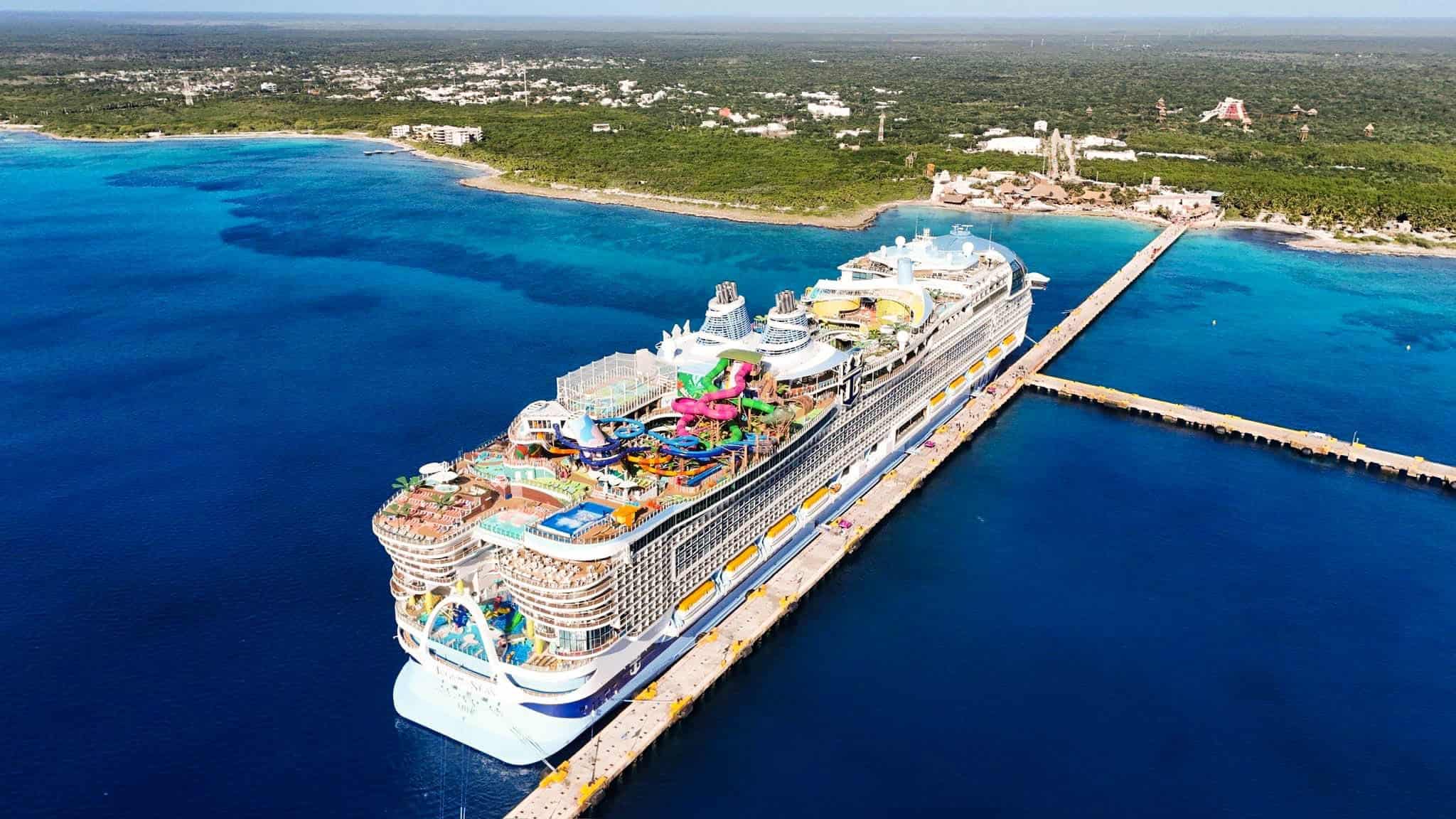
Spring break is bringing a surge in cruise tourism to Cozumel. (Mara Lezama/X)
Cozumel, Quintana Roo, is expecting tens of thousands of cruise ship passengers during the first week of spring break, according to a statement from the state government.
The Quintana Roo Comprehensive Port Authority (Apiqroo) reported that 21 cruise ships carrying some 80,459 tourists would be arriving at the island this week through Sunday, April 20.
High season in Cozumel: cruise ships and turquoise waters. (Especial/Cuartoscuro)
Officials expected nearly 14,000 tourists on Wednesday and over 18,000 on Thursday, which is expected to be the busiest day of the season. Estimates suggest that over 16,000 travelers will arrive on Friday, followed by roughly 6,000 a day on Saturday and Sunday.
While final figures have not been released, authorities estimated that a total of 19,765 cruise passengers were going to stop in Cozumel on Monday and Tuesday.
Cozumel Mayor José Luis Chacón Méndez, said these statistics reflect a trend that will likely lead the island to end the year with at least 5 million visitors, marking a record figure for the sunny destination.
“Last year, Cozumel welcomed 4,623,000 tourists; the goal is to reach 5 million,” Chacón said in a press conference, adding that cruising companies have expressed their confidence in Cozumel, as a leading destination “with a huge range of natural beauty.”
Gov. Lezama has said that beyond numbers and records, Quintana Roo’s government wants to leverage its tourism leadership to improve health, education, housing, and working conditions for tourism industry workers.
Some of her recent actions to boost tourism include a working trip to Miami, where Lezama met with executives from the Florida-Caribbean Cruise Association (FCCA) and CEOs of major shipping companies. She also participated in Seatrade Cruise Global, a leading trade fair for the cruise industry worldwide, intending to continue to position Cozumel and Mahahual as top cruise tourism destinations in Latin America.
Cruise ships bring plenty of life to Mahahual’s tranquil shores. (Elizabeth Ruíz/Cuartoscuro)
According to her administration, these companies confirmed that they see Quintana Roo as a strategic location for growth and investment, citing its expanding infrastructure and reliability, and expressing strong interest in showcasing the region’s potential and attractions to a global audience.
Born in Xalapa in 1920, Chedraui is Mexico's largest locally-owned supermarket chain. (Larry D. Moore / CC BY 4.0)
For being such a compact and lightly visited city, Xalapa — the quaint capital of Veracruz — has provided the rest of Mexico with some of its most important amenities. Aside from being one of the country’s main coffee producing regions and the namesake and origin of jalapeños en escabeche, Xalapa is where Chedraui began. The nation’s most profitable Mexican-owned supermarket, Chedraui currently accounts for 19.3% of national grocery market sales.
Its blue, white and orange letters and logo of a young family strollering a baby forward announce themselves all over Mexico. Today, the supermarket can be found in 25 of Mexico’s 31 states under a variety of iterations: the more affordably-priced Super Chedraui, grocery and department store Tienda Chedraui, small and often self-service Chedraui Supercito and Chedraui Selecto, which carries high-end imports. Since 1997, Chedraui has even existed in parts of the United States, outgrowing its first U.S. outlet in South Gate, California, and present across the U.S. Southwest under the monikers El Super and Fiesta Mart.
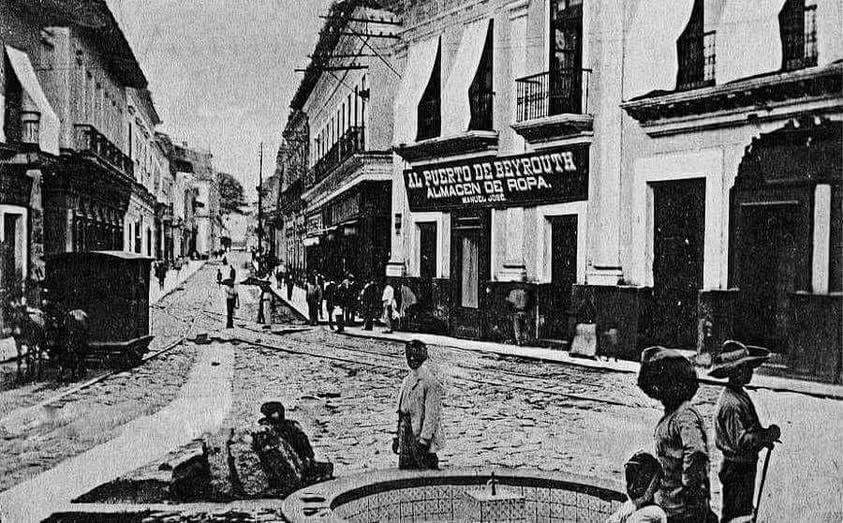
Al Puerto de Beirut, sometime between 1920 and 1927. (Facebook)
A Lebanese-Jalapeño success story
Of course, Chedraui wasn’t always the standard for grocery shopping in Mexico. In fact, the store started out much like the first jalapeños en escabeche makers did: as an ad hoc operation in Xalapa in the first decades of the 20th century. Lázaro Chedraui, a Lebanese immigrant, and his wife Ana Caram officially opened Al Puerto de Beirut in Xalapa in 1920. Initially a men’s clothing store, they could be found on what is now the corner of Xalapeños Ilustres and Carrillo Puerto, a central artery of the city to this day. In 1927, the couple decided to rename their business into something more similar to what we know it as today: Casa Chedraui. Unfortunately, the original location of that Chedraui no longer exists, as the triangular, Flatiron-esque building is now occupied by a variety of small clothing stores and food businesses.
Despite their ubiquitous boom since then, Chedraui’s first expansion didn’t occur until 1961. 34 years after his parents’ store first opened, Lázaro and Ana’s son Antonio Chedraui Caram assisted in shepherding the business into the future by launching a supermarket known as Almacenes Chedraui, also in Xalapa’s downtown, on Calle Dr. Lucio.
Chedraui branches out
Nine years later, in 1970, the family’s first department-style mega store opened under the auspicious title of Super Chedraui. That branch remains and continues to serve a large clientele in downtown Xalapa, just around the corner from Chedraui’s original flagship. The store later added more departments and increased their total workforce to 180 employees — massive for the time. According to Xalapa Antiguo, a Facebook group dedicated to preserving local history, the Chedraui on Calle Dr. Lucio was one of the first buildings to use escalators in Veracruz’s capital.
The Calle Dr. Lucio store was designed by Enrique Murillo, perhaps Xalapa’s most prolific architect, with noteworthy buildings in locations including the port of Veracruz, Mexico City and Acapulco. During that time, Chedraui offered everything from groceries and clothing to auto service and vehicle maintenance. That same decade also brought the arrival of Chedraui outside of Xalapa, beginning in the port of Veracruz in 1976 and going as far as the neighboring state of Tabasco in 1983. Back then, the Chedraui chain hadn’t fully established itself, consolidating under Grupo Chedraui Comercial in 1985. Prior to that, each outlet operated independently. Grupo Chedraui slowly jettisoned former parts of its business plan over the years: the auto services and large department store offerings, for example, were sold to Liverpool, a recognizable chain store throughout Mexico in its own right, in 1997.
The Chedraui on Mexico City’s Paseo de la Reforma anchors the Lagunilla antiques market. (Thayne Tuason/CC-BY-SA 4.0)
Chedraui went from being a regional chain to a national outlet in 2005, when they attempted their entry into Mexico City. It was Soriana, a similarly-sized grocery market from northern Mexico, that went on to gain a majority of Mexico City’s clientele. Generally, though, Chedraui has been a mainstay throughout the nation as a go-to shopping option for families.
For most of my life visiting my extended relatives in Xalapa, I’ve always assumed that Chedraui — both as a brand and as a family — were as integrated everywhere in Mexico as they are here. Of course, as a kid, I didn’t realize that their presence and familiarity was extra apparent in Xalapa, where I now live, because it’s where they first started out. Every year for Christmas, the large home that the Chedraui family still owns in the city is converted into a nativity scene. It’s customary to drive through the upscale neighborhood of Las Animas to see what the Chedrauis have set up, and to enjoy the ostentatious architecture and lake views in the neighborhood. My aunt claims that the family’s Christmas decorations keep expanding and taking up more lawn space year by year; this past year, they even incorporated a small portion of the neighborhood’s lake.
In 2017, 72% of Mexicans reported spending up to two hours at the supermarket per trip. That tends to mean strong associations with these stores. For Mexicans across the country, Chedraui tends to mean convenience. For Jalapeños, it means hometown pride.