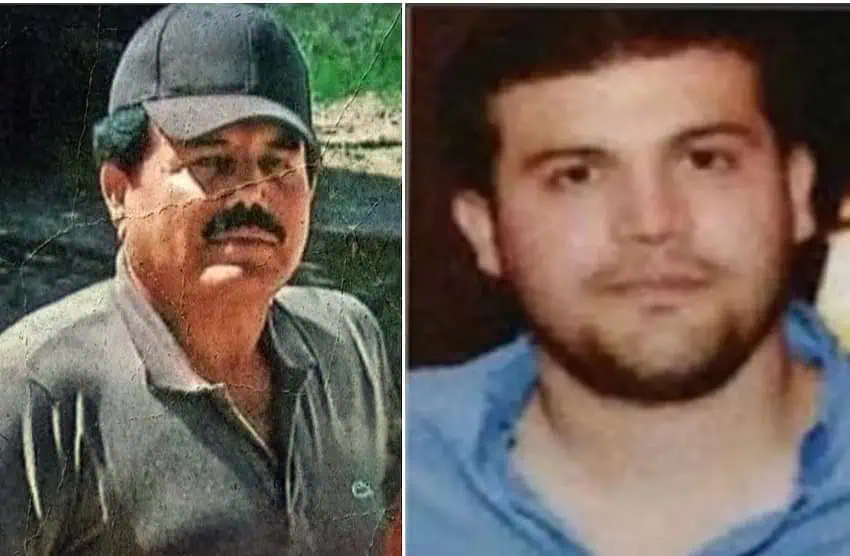
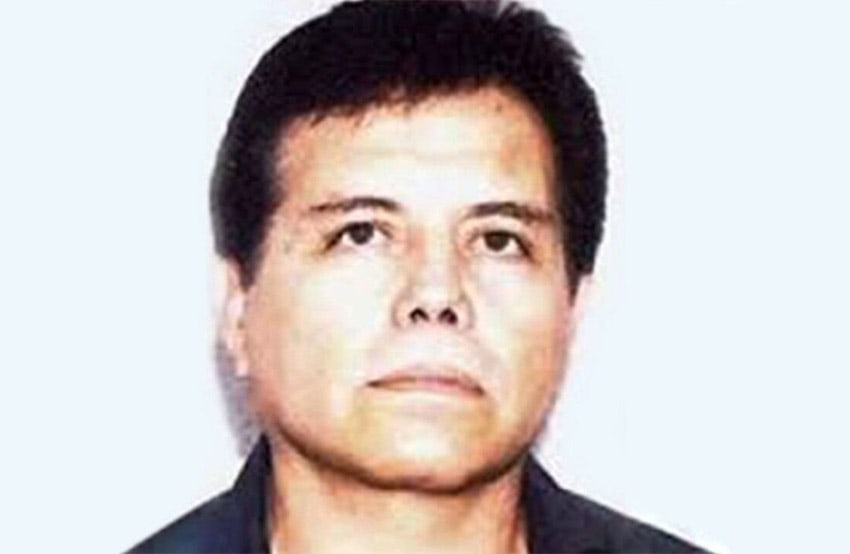
El Piyi was arrested on Thursday then quickly transferred to Mexico City. (via Ríodoce)
Federal forces on Thursday arrested “El Piyi,” an alleged security chief for the “Los Chapitos” faction of the Sinaloa Cartel. His capture deals a significant blow to the criminal group as it engages in a fierce battle with the “Los Mayos” faction of the same cartel.
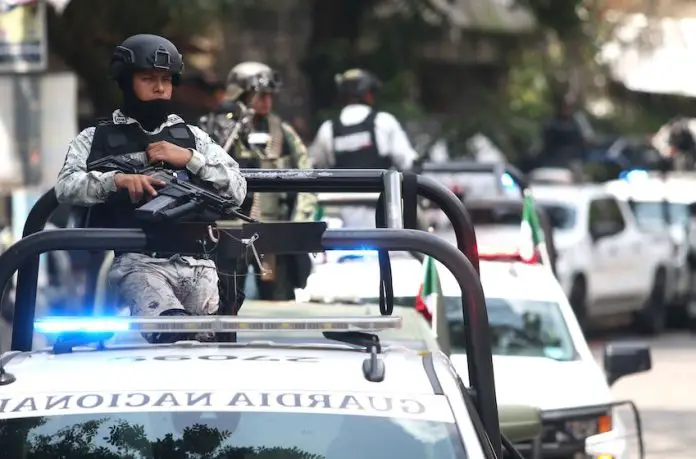
Mario Alexander Gámez Cuevas, known as “El Piyi,” was detained in Culiacán, Sinaloa, during an operation carried out by the army and National Guard. He was subsequently transferred to Mexico City.
At least five other alleged Sinaloa Cartel gunmen who were traveling with Gámez in a convoy of vehicles in the north of Culiacán were also detained, according to reports.
El Piyi is allegedly a close collaborator of Iván Archivaldo Guzmán Salazar, one of the sons of convicted drug trafficker Joaquín “El Chapo” Guzmán.
Guzmán Salazar is a leader of the “Los Chapitos” faction of the Sinaloa Cartel along with his brother Jesús Alfredo Guzmán Salazar.
His two half-brothers, Joaquín Guzmán López and Ovidio Guzmán López, are in custody in the United States.
El Piyi was known for constantly using a balaclava to hide his identity. (Luis Chaparro/X)
Before his arrest, he reportedly worked closely with Jorge Humberto Figueroa, another alleged security chief for “Los Chapitos.”
El Piyi is believed to have been playing a key role in the conflict between “Los Chapitos” and “Los Mayos” that has intensified in recent weeks as the latter faction seeks revenge for the arrest of alleged Sinaloa Cartel leader Ismael “El Mayo” Zambada García. Zambada alleges he was kidnapped by Joaquín Guzmán López and forced onto a private plane that delivered him to U.S. law enforcement authorities in late July.
Dozens of people have been killed in what has been described as a “war” between the rival cartel factions. More murders occurred in Culiacán on Thursday.
El Piyi shared photos of luxury cars, watches and plane flights on his Instagram, but never posted images of himself. (@el.piyi/Instagram)
Gámez reportedly kept a low profile in an attempt to avoid identification and arrest. His face was rarely seen, the Milenio newspaper reported, because he always used a balaclava.
However, El Piyi became known through songs recorded by Peso Pluma and other artists who make music that fits into the corridos tumbados subgenre of regional Mexican music.
Through such songs, “the identity and personality” of Gámez was revealed “little by little,” federal sources told Milenio.
The songs mention his “different exploits” and “confrontations against the government and opposing groups,” the sources said.
According to Milenio, Gámez also “won notoriety” because he took part in the two so-called culiacanzos — the violent cartel responses to the capture of Ovidio Guzmán in 2019 and again in 2023.
The alleged cartel security chief reportedly kept three lion clubs as pets and recently traveled to the United Arab Emirates, where he drove buggies in the desert and posed for a photo with a falcon on his head.
Father Baxin of Santa Ana church in Soconusco, Veracruz, stood in the back of a pick-up truck sprinkling holy water along federal Highway 180. (Parroquia Santa Ana Soconusco/Facebook)
One month after two separate single-car accidents on a Veracruz highway claimed the lives of six people and left two children severely injured, a local priest blessed a stretch of that highway with holy water.
Father Ramiro Baxin Ixtepan, the parish priest at the church of Santa Ana in Soconusco, conducted the unorthodox ceremony in the company of a handful of parishioners and Alma Leticia Borquez de Baruch, president of the local DIF social assistance program.
The priest prayed that all those who travel on the highway “may overcome life’s difficulties, realize their dreams and arrive happily at their destination.” (Parroquia Santa Ana Soconusco/Facebook)
The priest began the rite by saying a prayer at the arch that marks the entrance to Soconusco from federal Highway 180, praying for fewer accidents.
Municipal police controlled traffic on the trans-isthmus highway between the southern Veracruz cities of Acayucan and Jáltipan while Father Baxin stood in the back of a pick-up truck sprinkling holy water along the road.
The priest then got out of the vehicle at the site of the two accidents and, after dipping the rosemary sprigs in the bucket of holy water, blessed the road while leading the congregants in prayer.
According to the Facebook post published by the church, Father Baxin said the following: “With this sacramental blessing, we ask almighty God the Father that through his grace he guides all those who traverse this highway such that with his protection they may overcome life’s difficulties, realize their dreams and arrive happily at their destination.”
Father Baxin blessed the stretch of highway between the southern Veracruz cities of Acayucan and Jáltipan. (Parroquia Santa Ana Soconusco/Facebook)
Responses to the Facebook post demonstrated support for the blessing ceremony, with several users suggesting other highways that could be blessed as well. Others suggested that in addition to the blessing, it would be helpful if the highway was repaved.
The radio station W Radio reported on its website that many attendees were hopeful that the blessing would provide greater protection to those traveling on this stretch of the highway.
The municipal authorities of Soconusco also issued an advisory to the public, calling on motorists to obey the posted speed limit.
According to the Catholic Church, holy water can be used to bless people, places and things that are used by humans in their goal of glorifying God with their lives. The practice is meant to visibly represent God’s sanctifying work in all parts of people’s lives.
Sheinbaum said the National Guard would have a greater presence in areas of Veracruz at risk for political violence during the elections. (Margarito Pérez Retana/Cuartoscuro)
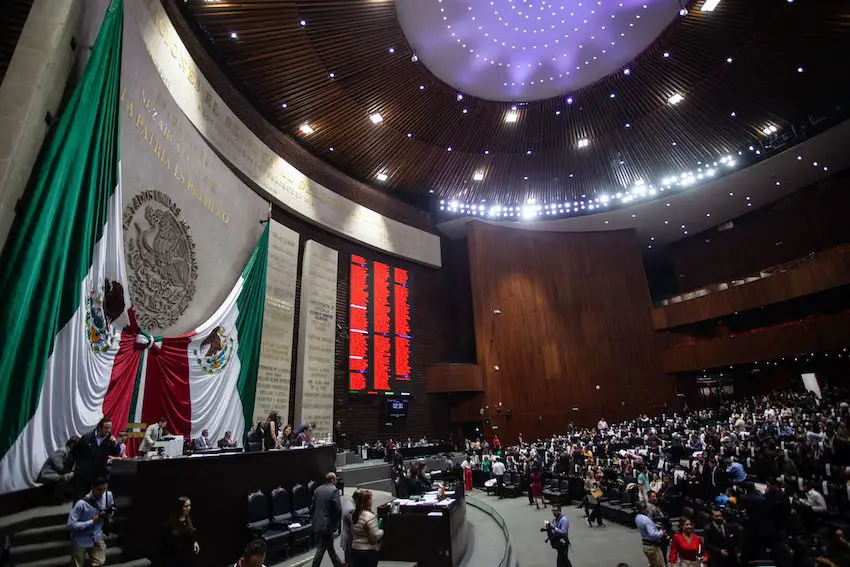
Lawmakers in Mexico’s lower house of Congress approved on Thursday a constitutional reform bill that seeks to place the National Guard (GN) under military control.
The bill will now be considered by the Senate, where the ruling Morena party and its allies are in a strong position to pass the reform proposal.
Mexico’s lower house of Congress approved on Thursday a constitutional reform bill that seeks to place the National Guard (GN) under military control. (Andrea Murcía/Cuartoscuro)
After a debate that lasted 16 hours, 362 deputies voted in favor of the GN reform proposal while 133 opposed it.
The two-thirds majority required to approve constitutional bills (334 votes) was easily reached.
A supermajority of deputies also approved the bill en lo particular — i.e. after the consideration of its individual articles.
The most controversial aspect of the bill is the provision to place the GN under the control of the National Defense Ministry (Sedena).
However, the bill seeks to modify a total of 12 articles of the Mexican Constitution. Among its aims are to define the GN as a professional public security force that is part of the military but whose members have police training, and to empower it to conduct investigations under the direction of the Federal Attorney General’s Office.
The GN was created by the current federal government as a civilian security force. It effectively replaced the Federal Police, which was disbanded in 2019.
In late 2022, the Congress approved a bill backed by President Andrés Manuel López Obrador that modified four secondary laws and paved the way for the GN to be placed under the control of the army.
However, the Supreme Court ruled in April 2023 that the transfer of control over the National Guard from the civilian Security Ministry to Sedena was unconstitutional, a decision that angered the president.
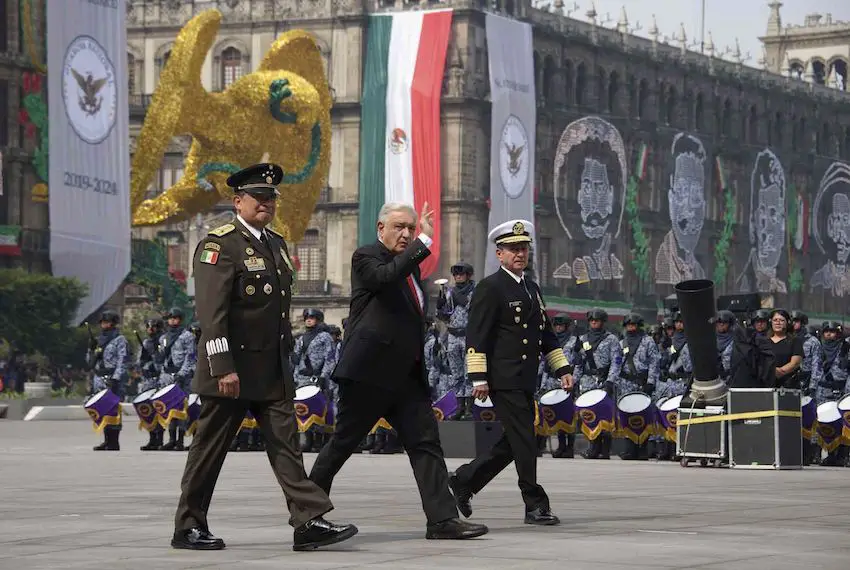
President López Obrador has relied heavily on the military, using it for public security, infrastructure construction and a wide range of other tasks. (Presidencia/Cuartoscuro)
López Obrador, who argues that the National Guard needs to be under the control of the military to prevent corruption and guarantee the force’s professionalism, subsequently prepared a constitutional bill to once again give Sedena responsibility for the security force his administration created.
Opposition parties, government critics and some human rights organizations pointed to the transfer of control over the National Guard to the army in 2022 as another example of the militarization of Mexico that they say has occurred during the current government. Human Rights Watch has warned that the government’s militarized security policy risks facilitating abuses by security forces while failing to reduce violent crime.
Morena, the Labor Party (PT) and the Ecological Green Party of Mexico (PVEM) have a two-thirds majority in the Chamber of Deputies, allowing them to pass constitutional bills without the support of opposition lawmakers.
The allied parties are just one vote short of a supermajority in the Senate, but it appears likely that they will be able to reach the required threshold to pass the GN reform, as was the case last week with the controversial judicial reform proposal, which is now law.
Deputy Leonel Godoy, Morena’s deputy leader in the Chamber of Deputies, said that the constitutional bill makes it clear that the National Guard will have “military discipline” but a “police function.”
He stressed that any military personnel who become members of the GN “have the obligation” to first undergo police training.
Morena Deputy Dolores Padierna Luna asserted that the reform proposal will lead to the “rebirth of the National Guard as an institution of military origin,” while PT Deputy Pedro Vázquez said that the bill will enable the security force to pacify the country.
Opposition lawmakers are concerned that the transfer of the National Guard to the military will only result in more violence. (Andrea Murcía/Cuartoscuro)
Opposition lawmakers argued that the transfer of responsibility for the GN to Sedena would only increase the militarization of Mexico.
National Action Party (PAN) Deputy Germán Martínez Cázares railed against President López Obrador, who has relied heavily on the military, using it for public security, infrastructure construction and a wide range of other tasks.
“No to militarization,” he said, adding that López Obrador has failed to bring peace to Mexico “as he promised.”
Martínez pointed out that there have been more murders during the current six-year term of government than during the presidencies of Enrique Peña Nieto (2012-18) and Felipe Calderón (2006-12).
López Obrador’s presidency has been “a six-year period of death, a six-year period of blood and a six-year period of militarization,” he said.
PAN Deputies Agustín Rodríguez and Miguel Ángel Monraz, and other opposition deputies, questioned why Morena lawmakers supported the militarization of public security now when they previously opposed it.
Before becoming president, López Obrador himself was opposed to the use of the armed forces for public security tasks.
“What a short memory [they have]” said Monraz.
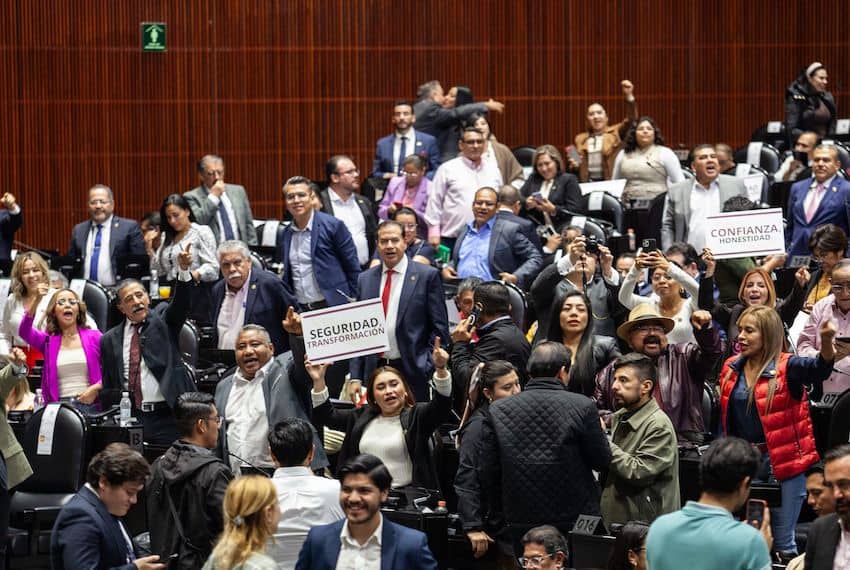
Citizens Movement (MC) party deputies unfurled a giant banner in the Chamber of Deputies that read: “Mexico with justice and peace. No to militarization.”
They also placed signs on their seats that read: “We want peace, not militarization.”
Valeria Moy, an economist, columnist and director of the think tank Mexican Institute for Competitiveness. Follow Moy on X at @ValeriaMoy. (IMCO)
Mexico is the country that never misses the chance to miss an opportunity, an analyst recently said when discussing nearshoring and the blow that the judicial reform would represent to the economy.
Looking at it from the outside, he continued, it’s hard to understand why Mexico insists on making decisions that hinder its growth.
The judicial reform will have harmful impacts on the country, not just from an economic perspective of course.
I think it’s naive to argue that it will “democratize” access to justice and eliminate corruption. Those who promoted and voted for it know that it will lead to setbacks, making the country less democratic and more authoritarian.
Before the reform, the GDP growth expectations for Mexico’s economy were around 1.7% this year, even below the mediocre 2% that had been so criticized. If Mexico grows at that rate during a period of nearshoring and in an election year with rampant spending, what can be expected in a year without these economic drivers?
Growth forecasts will be adjusted following the publication of the reform. Some banks have already done so, estimating that Mexico will grow 1.2% this year and 1% next year.
Beyond the exchange rate — which responds to much more than just internal policies — the real problem will be what we don’t see: the investment that won’t happen, the foreign investment announcements that won’t materialize, the jobs that won’t be created, the growth and development that won’t arrive.
That will be the real crisis: the stagnation of an economy that could have grown but chose not to.
In terms of magnitude, the judicial reform is the most harmful so far, but the ones on the horizon will not be harmless, and the relationship with our trading partners will only get more strained.
The elimination of the figure of state-owned productive enterprises could violate Chapter 14 of the USMCA by restricting investment in the electricity sector. The reform limiting the trade of genetically modified corn would violate Chapter 3 by restricting access to a market not excluded from the agreement. Additionally, the elimination of autonomous bodies would contradict other articles, such as Article 18 on telecommunications and Article 21 on economic competition.
In the specific case of the judicial reform, there is concern that administrative acts may not be impartial, which would violate Chapter 29 of the USMCA. Intellectual property protection could also be compromised, contrary to what is established in Chapter 20.
These issues could arise from a judiciary that, due to a lack of independence and skill, fails to fulfill its duty to maintain fair conditions for all economic actors. The 2026 review could turn into a renegotiation.
Just as today we don’t know what would have happened if the banking sector hadn’t been nationalized in 1982, or if Mexico hadn’t opened up to international trade, or if the 1994 crisis hadn’t occurred, or so many other things — the list is long — we won’t be able to fully grasp the impact of missed opportunities or the gradual regression these reforms represent.
They say that “what if” doesn’t exist. That may be true. But it could also be that we are simply unable to see it.
Valeria Moy has been the director of the Mexican think tank IMCO (Mexican Institute for Competitiveness) since 2020. She is an economist with degrees from the Autonomous Technological Institute of Mexico (ITAM) and the London School of Economics. She is a regular columnist for El Universal and El País newspapers and was named one of the 100 most powerful women in Mexico by Forbes.
Conjugating verbs is the hardest part of learning a language, so sit back and let MND's private tutor help you to go native! (Keren Fedida/Unsplash)
Hi there! I know Spanish can be hard when it comes to verb conjugation as English is much easier with respect to this topic. I understand it can be a challenge to deal with to think of a different form for each person, depending on who you are talking to, and for each tense.
When my Italian boyfriend started learning Spanish I noticed that he started by learning some easy verb combinations that were the simplest way to start and make progress without racking his brain. So, this is the reason why I want to share them with you. In these combinations you will only have to remember the pattern and then add the verb you intend to actually do. Let’s see some examples.
Voy a learn Spanish better thanks to Paulina. (Vitaly Gariev/Unsplash)
These are some examples of verb combinations that can help you start speaking faster. My recommendation would be to learn one or two of them and start practising whenever you have the chance. It is all about finding the pattern, getting used to it and start using it as soon as you can!
Paulina Gerez is a translator-interpreter, content creator, and founder of Crack The Code, a series of online courses focused on languages. Through her social media, she helps people see learning a language from another perspective through her fun experiences. Instagram: paulinagerezm / Tiktok: paugerez3 / YT: paulina gerez
Guangdong Vessel will build modular “houses of the future” in several new development parks throughout Nuevo León. (Vessel)
The Nuevo León government is teaming up with the Chinese Boda International Holding Group to build “houses of the future” in the northern industrial state.
Nuevo León Governor Samuel García released a video on social media on Thursday in which he announced that Boda has plans to invest US $850 million to build smart homes as part of a comprehensive community development program.
Amanecimos con una excelente noticia, porque anoche Grupo Boda nos confirmó que llegan al nuevo Nuevo León con una inversión de 850 MILLONES DE DÓLARES que generará 3 mil empleos para construir CASAS DEL FUTURO en Nuevo León junto con Vessel.
García made the announcement after meeting with Niu Shuha, president of Boda’s board of directors, and Simón Levy, Boda’s vice president.
This announcement follows hard on the heels of the news that Chinese technology company Intretech broke ground on a US $60 million “smart” manufacturing plant in Apodaca, a suburb of the state capital of Monterrey.
Boda is finalizing details with the Nuevo León government in hopes of launching the project by the end of this year. García said the ambitious project would generate 3,000 jobs and would provide environmentally friendly and economic housing options for the people of his state. The governor did not specify where the homes will be located.
Boda announced it would team up with Guangdong Vessel, a prefab house manufacturer and the self-styled pioneer of space-capsule houses, to build the developments, which will feature energy-efficient homes and state-of-the-art solid waste treatment facilities.
VESSEL-V9 - GEN6 English_Full Review - The Original space capsule house
On its website, Vessel says “we specialize in providing high-quality, environmentally friendly, and sustainable mobile housing solutions for cultural tourism resorts, boutique residences, public infrastructure and commercial projects.”
The modular homes will feature atmospheric water generators and solar panels, and each development would be built in broad parklands of at least 350 hectares (865 acres). The developments are adaptable, reported the newspaper Excelsior, so they could eventually be converted into hotels.
A bulletin released by the state government revealed that Boda intends to pursue infrastructure opportunities and has already established a relationship with several Nuevo León universities.
The long-term goal is to establish a first-ever “world housing university” to create and develop advanced regenerative water treatment plants that rely on AI, and install a photovoltaic solar farm.
Boda also wants to set up a project to export agricultural goods from Nuevo León to China. The Chinese holding company also aims to integrate the state’s small and medium-sized businesses into the production chain, according to Excelsior.
Vessel, the prefab house manufacturer, specializes in tourist-oriented cabins that strive to “reconstruct the habitat in harmony with nature by challenging traditional architecture.” However, the company has expressed an interest in building a tech center in order to contribute to the economic and cultural growth of Nuevo León.
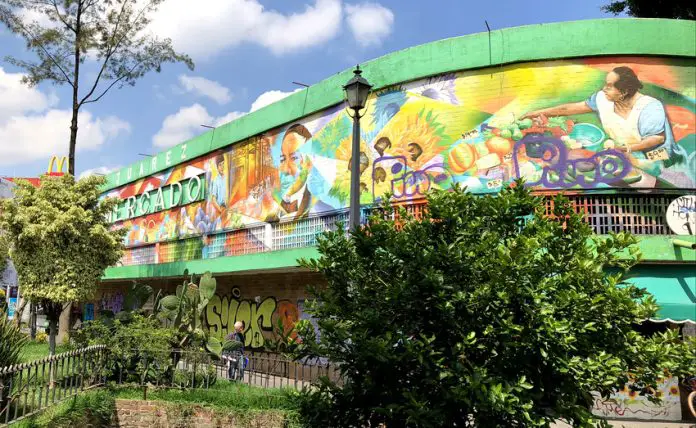
A cultural, commercial and administrative powerhouse, La Juárez is one of the most important neighborhoods in Mexico City's most important borough. (Gobierno de la Ciudad de México)
Borough: Cuauhtémoc Established: 1906 Location: 850 m east of the Angel de la Independencia Pre-Columbian inhabitants: Mexica
Who lives here
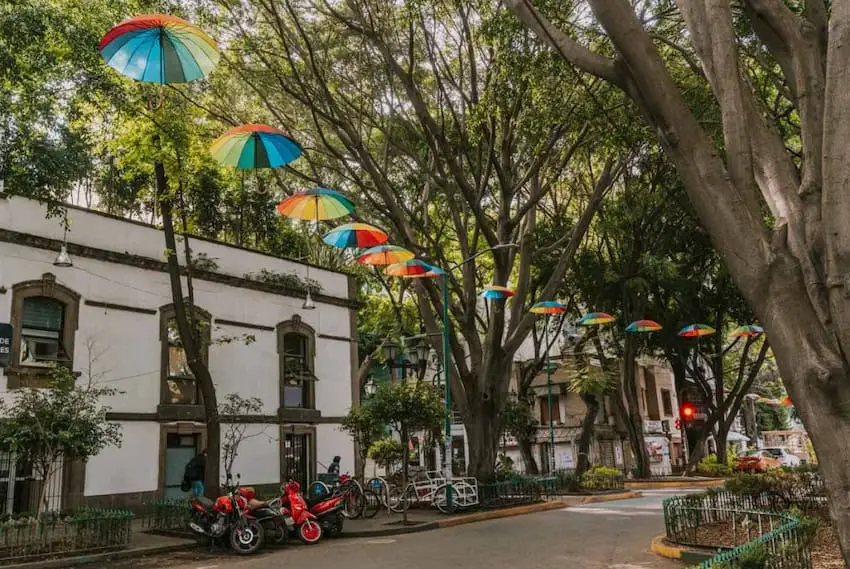
La Juárez has come a long way since its inception in the early 1900s, when only the wealthy graced its streets. Today, you can find a mix of young professionals, artists and families largely between the ages of 25 and 45.
Mexico City’s Zona Rosa is a hub for LGBTQ+ nightlife and alternative thrill seeking, but it still retains a distinctly Mexican charm. (Your Friend the Nomad)
The unique blend of urban living, historical charm and modern amenities draws locals and, as of late, expats. La Juárez’s proximity to La Roma and the Historic Center is an added bonus, as is its generally laid-back atmosphere.
A brief history of La Juárez
At the turn of the 19th century, Mexico City’s Historic Center was losing its residential luster. As the Zócalo and surrounding streets became busier, louder and more crowded, wealthy families looked around for calmer alternatives. Colonia Juárez, officially inaugurated as such in honor of the 19th-century Mexican president in 1906, was an attractive option. It was verdant, quiet and ripe for construction.
Almost overnight, one could find new Art Nouveau mansions popping up on streets named after European cities. Embassies and businesses moved in and La Juárez quickly became one of the capital’s most affluent areas — but not for long. In 1910, the Mexican Revolution swept the city and the Porfirian elite abandoned their new community in search of safer pastures.
For years, La Juárez fell into dereliction. It wasn’t until the 1940s that it resurged. Shops, cafes, restaurants and bookstores replaced the ground floors of once-residential buildings. Antiques stores and jewelers occupied the section above Avenida Insurgentes, now known as Zona Rosa. It was a place to see and be seen, with visitors coming from nearby cities to buy collectibles or peruse local art. The arrival of Korean immigrants in the 1970s and ‘80s added another layer to an increasingly eclectic society.
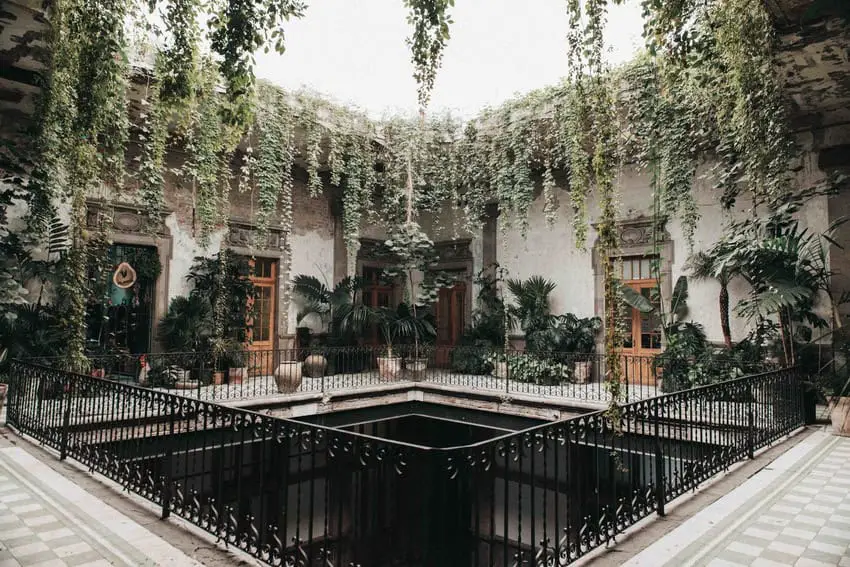
Proyecto Público Prim, an event space in a Porfiriato-era mansion, encapsulates the many lives of La Juárez. (Proyectos Públicos)
The vibrant commercial district was severely damaged in the 1985 earthquake. Its soul, however, remained, and by the early 1990s La Juárez was thriving again — this time with a new look.
A guide to La Juárez today
On a map, La Juárez is shaped like a triangle, enclosed by Paseo de la Reforma, Avenida Chapultepec and Avenida Bucareli. It’s divided by Avenida Insurgentes into what might feel like two sharply contrasting personalities: to the west is Zona Rosa, a predominantly-nocturnal haven for the LGBTQ+ community. Sandwiched between its Korean restaurants are thumping rooftop bars and dance clubs. East of Insurgentes is a boutique shopper’s paradise complemented by a sizable list of trendy restaurants, art galleries and architecture reminiscent of the Parisian suburbs.
If what you’re looking for is entertainment, you’re sure to find it here. From small theaters to jazz clubs to vintage bookstores, there’s plenty to keep your attention at full occupancy. For the stylish crowd, the oh-so-chic Soho House hides in plain sight on Calle Versalles and Hanky Panky Cocktail Bar hides out of sight on Calle Turin. Surprisingly, the neighborhood remains largely local, though you’re sure to run into a fair share of expats on Calle Havre and Calle Dinamarca.
La Juárez is great if you love: Europe. Beyond the architecture and street names like Londres and Hamburgo, there is an undeniable Italy-meets-Istanbul-meets-Mexico feel going on here, and it’s rather charming.
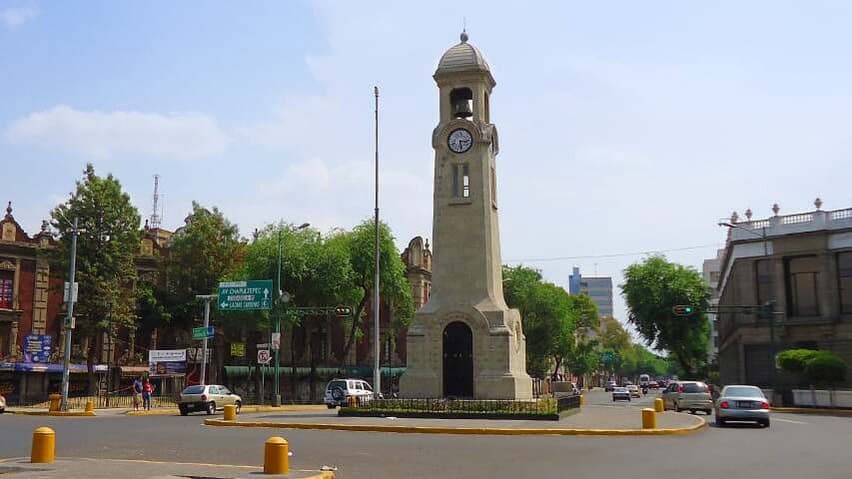
The Chinese Clock, a gift from China’s last imperial government for the centennial of Mexican independence, marks the boundary between La Juárez and the Historic Center. (México Desconocido)
What to do in La Juárez
Postales de Cafe:The Condesa favorite recently opened its third and — in my opinion — dreamiest outpost on the bright corner of Calle Napolés and Calle Marsella. Come for strong coffee and excellent people-watching.
Librería Jorge Cuesta: Warning! This captivating vintage bookstore will give you surreal flashbacks of your hoarding grandmother’s living room – assuming it was stuffed to the gills with antiques, trinkets and the occasional cat.
Utilitario Mexicano: A go-to for gifts, this little Mexican-made shop has every cool kitchen utensil you might want, as well as a selection of paper products and bathing essentials.
Querencia: This well-priced, quality plant shop that also sells things you never knew you needed, like handmade soy candles and faux-gold jewelry.
Fusion Design Market: Where local artisans and designers showcase handmade goods, including clothing, accessories and home decor, all with sustainability in mind.
Hotel Geneve: If you don’t stay here, you should at least pop into the lobby of this historic hotel, a favorite among travelers since its opening in 1907.
Teatro Varsovia: Catch local talent in this intimate theater, which hosts various performances including plays, concerts and cultural events.
Parker and Lenox: Stylish and sexy, this NYC-esque jazz club is a great spot for a date with your cute Spanish teacher or as a group outing with your music-loving friends.
Xaman Bar: Almost undiscoverable as a speakeasy should be, you’ll be greatly rewarded by the basement bar’s marvelous cocktail menu and seductive vibe.
Museo de Cera: To be clear, this is a wax museum. If that’s not your thing, who am I to judge? It’s not mine either. A walk by the magnificent mansion it’s housed in, though, is worth your while.
Fábrica Social: You might experience sticker shock upon first glance. But these incredible, colorful textiles are sustainable, durable and handmade by artisans all over Mexico.
The Edificio Mascota, inaugurated in 1913, was Mexico City’s first purpose-built apartment building (Gobierno de la Ciudad de México).
Where to eat in La Juárez
Pazzesca Pizzeria: This place is a jewel for anyone who appreciates authentic Italian food. I’m talking pasta al dente, pizza made in the estilo di Napoli, focaccia baked in front of your eyes and the opportunity to eavesdrop on your neighbor’s conversation… in Italian.
Taller Xilotl: My fingers tremble as I type this. Do I want to share my very favorite restaurant in all the land with hundreds of thousands of readers? When it only has about six tables and a tiny, open-air kitchen? Yes, I do, because I believe it’s that good. Find me a better fish taco in Mexico City. I dare you.
La Barrita Comida del Mar: If you’re craving fresh, coastal dishes in a casual environment, this is your spot. The clientele spills onto the sidewalk in the most inviting of ways, making you feel like you’re at a laid-back house party, without the chit-chat.
Sushi Kyo: It’s one of the most highly-rated sushi spots in a city that boasts a plethora of highly-rated sushi spots. Edo Kobayashi rarely disappoints, and this 13-seater escape to Japan is no different.
Café Nin: Don’t go on a weekend, as there will be a wait. Elena Reygadas, the brainchild and chef behind Roma favorite Rosetta, knows ambience and she knows it well. Add to that some of the best pan dulce in CDMX and you’ve got yourself a lovely breakfast nook.
Havre 77: Escargot, anyone? When you’re feeling French, chef Eduardo García’s latest masterpiece has you covered. Both the food and the space are works of art and will effectively whisk you away to La Marais, one bite at a time.
Taverna: The Mediterranean-inspired menu and extensive wine list is best enjoyed within its dynamic, artsy atmosphere. The bar scene is exceptionally vibey, but go early, as it fills up quickly.
Bagels Lepu: They claim to be the closest thing to New York bagels in Mexico, which might be why the place is always packed. Their menu is straightforward: classic bagels and toppings like lox, whitefish, cream cheese and eggs. There’s also a bakery but… bagels.
One hidden gem
I stumbled on Tannin Artbar by sheer chance and was wowed by the concept. An art gallery, wine bar, tasting house and garden oasis, all in one? Sold. To boot, there’s a generous selection of Mediterranean dishes, perfect for indulging in under the not-so-starry Mexico City sky.
Bethany Platanella is a travel planner and lifestyle writer based in Mexico City. She lives for the dopamine hit that comes directly after booking a plane ticket, exploring local markets, practicing yoga and munching on fresh tortillas. Sign up to receive her Sunday Love Letters to your inbox, peruse her blog, or follow her on Instagram.
The president said the U.S. was "jointly responsible" for the current wave of violence in Sinaloa, which was triggered by the kidnapping and subsequent arrest of cartel leader Mayo Zambada in the U.S. (Mario Jasso/Cuartoscuro)
President Andrés Manuel López Obrador claimed on Thursday that the United States government is partly to blame for the wave of cartel violence that has claimed more than 40 lives in Sinaloa in the past two weeks.
By “operation” he apparently meant a negotiation with another alleged Sinaloa Cartel leader, Joaquín Guzmán López, that he believes resulted in the delivery of Zambada to U.S. law enforcement authorities at an airport near El Paso, Texas.
While Los Mayos and Los Chapitos have been fighting each other for years, the main cause of their current conflict is the alleged kidnapping of El Mayo.
Since El Mayo’s capture, shootings and other incidents of violence have increasingly disrupted everyday life both in rural areas of Sinaloa and in the state capital of Culiacán — and AMLO says the U.S. government is partly to blame. (José Betanzos/Cuartoscuro)
Nevertheless, López Obrador declared that the United States government needs to “internalize” that it “can’t act like that, without taking the government of Mexico into account.”
“In other words, there can’t be a relationship of cooperation when unilateral measures are taken. That can’t be accepted,” he said.
The president charged that there was an agreement between Guzmán López and U.S. authorities, and “due to that agreement … the confrontation that is occurring was caused.”
AMLO alleged that the U.S. government made a deal with Los Chapitos leader Joaquín Guzmán López, right, that led him to kidnap fellow drug trafficker Mayo Zambada and turn him into U.S. authorities. (Archive)
He said that Mexican authorities still didn’t know the details of the alleged agreement, despite their calls for transparency from their U.S. counterparts.
Jeffrey Lichtman, Guzmán López’s lawyer, said in late July that his client didn’t have any deal with U.S. authorities.
However, López Obrador said that “according to the Federal Attorney General’s Office [FGR], the [U.S.] Department of Justice conducted talks with one of the crime groups in Sinaloa and they had agreements.”
“They even released or gave a different status to one of the prisoners in the United States at the same time that another person was taken [to the U.S.],” he said.
Publicly available records of the U.S. Federal Bureau of Prisons showed that Ovidio was released from prison on July 23 — two days before the arrest of his brother and Zambada — but United States Ambassador to Mexico Ken Salazar has said on repeated occasions that Ovidio remains in U.S. custody.
Unconfirmed reports have indicated that Ovidio Guzmán, aka “El Ratón,” is in U.S. witness protection — something the U.S. government has denied. (Cuartoscuro)
“That requires an explanation because we’re now facing a situation of instability, of confrontation in Sinaloa,” he said.
“It’s due to them taking that decision,” López Obrador said.
“We don’t agree … because we have the problem here. Of course we’re facing up to it, we’re solving it, but in Sinaloa there wasn’t the violence there is now,” he said.
“Nor is it … [as bad as] they think, it’s [not] completely out of control, no,” López Obrador said.
“… But we’ve had to take special measures and move members of the armed forces [to Sinaloa]. And we’ve also lost soldiers who have been murdered because of this special, extraordinary situation.”
AMLO: US ‘operation’ to capture Zambada was ‘completely illegal’
Later in his press conference, López Obrador was asked whether the United States was “right” to carry out an operation (or negotiation) to arrest Zambada.
“It can’t be right because they murdered people. It was completely illegal,” he said, apparently referencing El Mayo’s claim that former Culiacán mayor Héctor Cuen was killed at the same place he was abducted.
“And agents of the [U.S.] Department of Justice were waiting for el señor Mayo,” López Obrador said, seeking to provide further evidence of a prior agreement with Joaquín Guzmán López.
U.S. agents reportedly scrambled to get to an airport near El Paso after receiving word that El Mayo was en route. He was received by DEA and FBI agents when his plane landed. (DEA via SDP Noticias)
He also said that it was “completely irregular” that a person was “kidnapped via an agreement and taken to the United States.”
During lengthy remarks about the case, López Obrador also questioned whether the United States “really” negotiated the arrest of Zambada out of its desire to stem drug trafficking, especially the entry of the deadly synthetic opioid fentanyl to the United States.
“Let’s see if it was that or if it was a decision that was taken, as always, to [just] show that they’re attending to the fentanyl use problem — just for propaganda,” he said.
“The relationship has to be good for geopolitical reasons, because of the border — 3,180 kilometers long,” he said.
“Forty million Mexicans live and work honorably in the United States. … So we have to maintain a relationship of respect and good neighborliness with the United States,” López Obrador said.
“The only thing they have to understand is that we’re an independent country.”
German tennis player Alexander Zverev, currently ranked No. 2 in the world, will be among the top players at the 2025 Mexican Tennis Open, to be held in Feb. 24–March 1 in Acapulco's GNP Seguros Arena. (Alberto Carbajal/Cuartoscuro)
Acapulco is ready to host the 32nd edition of the Mexican Tennis Open next year, according to the Mexican Tennis Association (AMT) and the state’s Tourism Ministry (Sectur).
The tournament is set to take place from Feb. 24 to March 1 at the Arena GNP Seguros. According to organizers, 60% of the tournament’s tickets have already been sold.
Many iconic hotels and other sites in Acapulco suffered major devastation from 2023’s Hurricane Otis, but the resort city managed to recover enough to host the 2024 edition of the tournament. (Cuartoscuro)
During a press conference, AMT head of operations Geoffrey Fernández recalled that the Category 5 hurricane caused structural damage to the Arena GNP Seguros event complex. However, the arena was ready by the time the tournament returned for the 2024 edition in February.
For that reason, Fernández said, “the 2024 edition was a magical and unique year.”
Fernández said he expects the tournament’s upcoming edition to bring in 500 to 550 million pesos (US $25 to $28 million), exceeding by 200 million pesos (US $10 million) the revenues of the previous edition.
So far, players expected to compete include the No. 2 world-ranked German player, Alexander Zverev, who won the championship in 2021; Norway’s Casper Ruud, who lost in the 2024 finals to Australia’s Alex de Minaur; the United States’s Tommy Paul and Ben Shelton; Denmark’s Holger Rune; and Italy’s Lorenzo Musetti.
The full list of players attending the event, Fernández said, will be released in the coming weeks.
Fernández also announced the launch of digital tickets this year for the event, to prevent ticket resales.
Casper Ruud, left, and Alex de Miñaur at the 2024 Mexican Tennis Open finals. Ruud will play in the 2025 edition of the tournament. (Carlos Alberto Carbajal/Cuartoscruo.com)
Acapulco’s reconstruction continues
According to Welfare Ministry head Ariadna Montiel, the reconstruction of Acapulco and Coyuca de Benítez after Otis has cost 35 billion pesos (US $1.82 billion).
Simon Quiñones Orozco, head of Guerrero’s state Tourism Ministry, said that 1,000 rooms per month have been renovated in 236 hotels since Otis and that he expects 16,000 rooms to be available in the Diamante and Dorada hotel zones by next February.
People are gaining confidence in Acapulco, he said, and the city’s schedule of events is only bolstering that confidence.
Quiñones expressed gratitude for the Mexican Tennis Open’s sponsors and organizers, saying that thanks to the tournament, Acapulco’s reconstruction process was “accelerated,” making it possible for both Sectur’s annual Tourist Tianguis tourism industry conference, the Tourist Tianguis, and the National Banking Convention to take place in the city earlier this year.
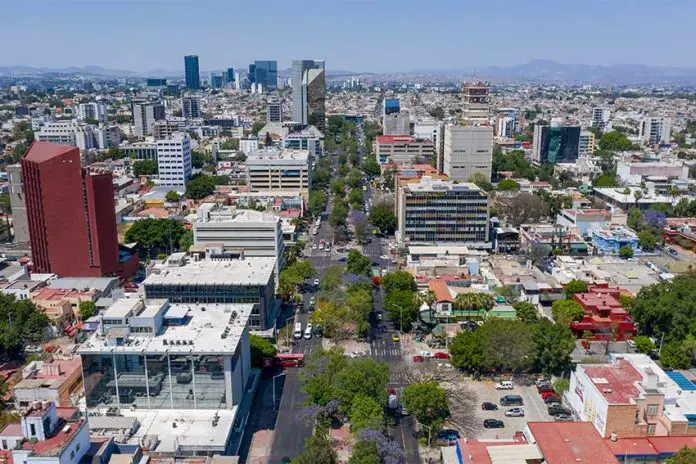
Guadalajara's Colonia Americana neighborhood was designated as a Barrio Mágico, or Magical Neighborhood by Mexico's Tourism Ministry. The designation comes with federal neighborhood improvement and tourism promotion funds. (Ricardo Pacheco/Shutterstock)
Guadalajara’s Colonia Americana neighborhood — recently ranked as the world’s coolest neighborhood by Time Out magazine, is now also a Barrio Mágico, or Magical Neighborhood — a tourism designation granted to remarkable neighborhoods in Mexico’s cities.
Mexico’s Tourism Ministry (Sectur) created the program in 2022 to promote tourism in Mexico’s major population centers. It’s similar to Sectur’s Pueblos Mágicos (Magical Towns) program, which highlights towns across Mexico with historical and cultural value. As large cities are ineligible for the Pueblos Mágico titles, the Magical Neighborhoods program seeks to highlight certain locations or areas with tourism appeal within Mexico’s cities.
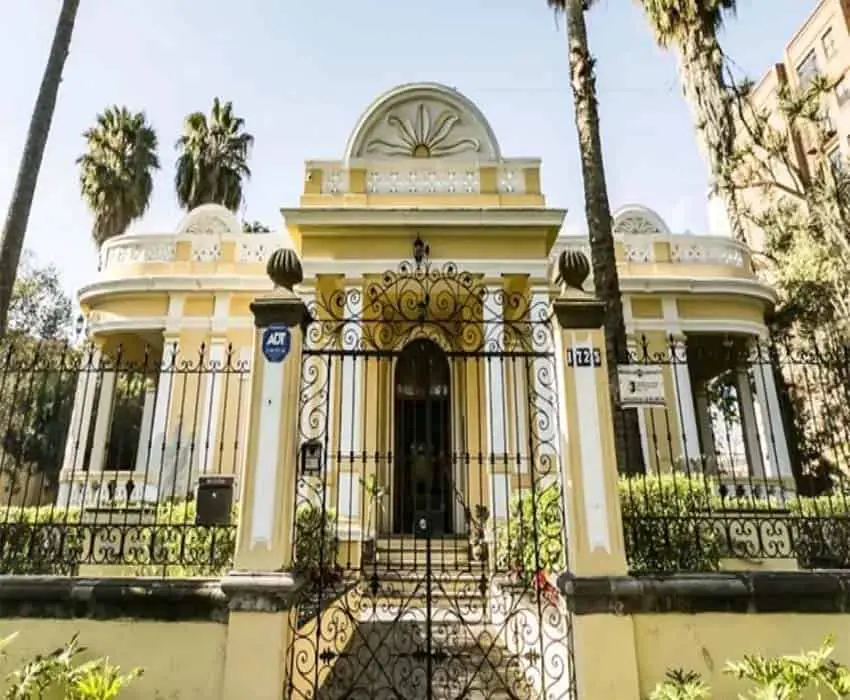
Built in the late 1800s and designed by Ernesto Fuchs, a German living in Guadalajara, Colonia Americana is a historic neighborhood full of European influences. (X)
Jalisco’s Tourism Minister Vanessa Pérez Lamas said that those who have had the chance to explore Colonia Americana “can verify that it is indeed a very cool neighborhood; it is indeed a Magical Neighborhood, and this designation is extremely deserved.”
Colonia Americana’s designation as a Barrio Mágico was awarded by Mexico’s Tourism Minister Miguel Torruco Marqués, though not in Guadalajara, but in Puerto Vallarta. In the same ceremony, Torruco also updated the designation of Magical Towns in Jalisco: Tapalpa, Tequila, Mazamitla, Tlaquepaque, Mascota, Talpa de Allende, San Sebastián del Oeste, Lagos de Moreno and Ajijic.
To date, Sectur has designated 177 towns in Mexico as Magical Towns and named 34 Magical Neighborhoods across the country. Just like the other towns and neighborhoods in the two programs, Colonia Americana will receive federal funding to renovate buildings and promote its tourism industry.
Adjoining Guadalajara’s downtown, Colonia Americana is one of Guadalajara’s oldest neighborhoods. Built in 1898, it was designed by German engineer and architect Ernesto Fuchs, who added European features to the neighborhood’s streets and avenues. Some of the neighborhood’s main landmarks include the Expiatory Temple of the Blessed Sacrament, Revolución Park and the Museum of Arts of the University of Guadalajara (MUSA). The neighborhood is also home to many restaurants and bars.
Time Out has described the neighborhood as “an edgy blend of art deco and neoclassical mansions with artists’ squats and warehouses containing some of the city’s best music venues.”
However, the neighborhood’s popularity has led to gentrification, real estate speculation and insecurity, forcing many locals to exit the neighborhood or close their businesses due to the increase in rental prices.