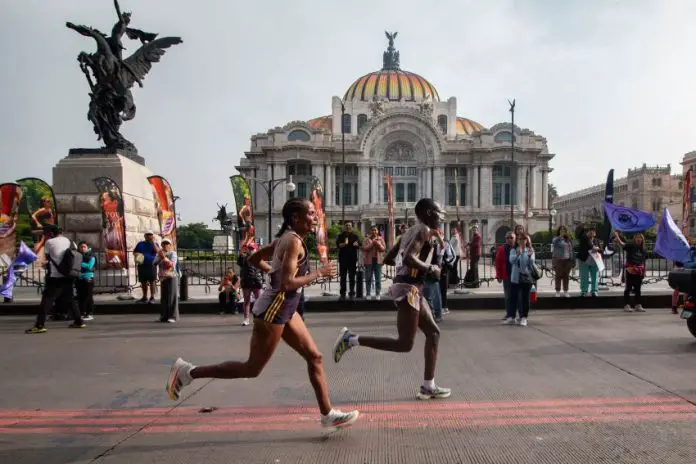
Long-distance runners from around the world participated in the Mexico City marathon on Sunday. (Mexico City Government)
The 41st Mexico City marathon attracted more than 30,000 long-distance runners on Sunday, with Kenyans taking five of the six podium spots.
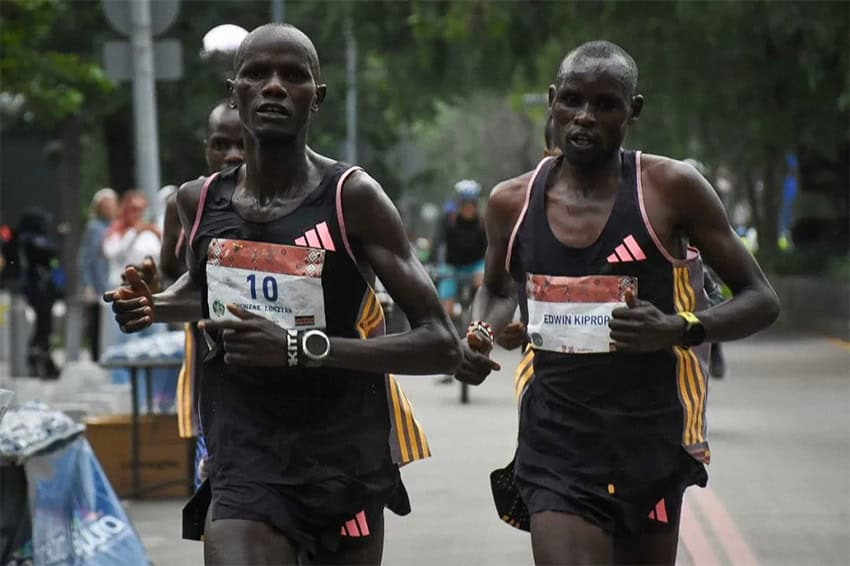
The African runners finished 1-2-3 in the men’s competition, with Edwin Kiprop Kiptoo outracing countrymen Leonard Langat and Francis Cheruiyot.
Kenyan runner Edwin Kiprop Kiptoo (right) took first place in the men’s marathon. (Maratón CDMX/X)
On the women’s side, Kenyan Fancy Chemutai claimed first place ahead of Bahrain’s Shitaye Eshete and Janet Ruguru, also of Kenya.
The 42.2-kilometer race began at the southern end of the capital in Ciudad Universitaria adjacent to the university’s Olympic Stadium, ending in the heart of the Centro Histórico with the finish line in the Zócalo in front of the National Palace.
The runners traversed several of Mexico City’s most iconic boulevards, including Insurgentes Avenue, Ejército Nacional, Presidente Masaryk, Paseo de la Reforma, Avenida Juárez and Avenida Madero, while also crossing Chapultepec Park and running alongside the Alameda Park.
Kiptoo, the 2022 Mexico City Marathon winner, completed his run in 2 hours, 10 minutes and 36 seconds, a personal best. The 31-year-old returned to the winner’s circle after finishing third last year. The 2023 winner — Bolivia’s Héctor Garibay — will hold onto his record (2:08:23) at least another year.
The race for second place was a close one, with Langat finishing in 2:11:30 and Cheruiyot following 5 seconds later.
An embarrassing mix-up for marathon organizers
Chemutai earned first place on the women’s side by holding off Eshete down the stretch, though the exciting finish was marred by race organizers who thought Chemutai, who was wearing her hair short, was a man.
As the 29-year-old Kenyan approached the finish line, race organizers tried to redirect her away from the women’s finish line where the victory tape was stretched across the path. Chemutai ignored the instructions but as she crossed the line, the organizers lifted up the banner so she did not get the thrill of breaking the tape in triumph, Chemutai did raise her arms, however, managing to pull the banner out of the hands of the misguided attendants.
Chemutai finished in 2:29:19 with Eshete close behind at 2:29:22. Ruguru clocked in at 2:30:58 to earn third place.
Women’s winner Fancy Chemutai managed to snag the finish line banner despite an error by marathon staff. (Maratón CDMX/X)
Ethiopia’s Amare Berise set the women’s Mexico City Marathon record in 2022, posting an impressive time of 2:25:04.
The winners Kiptoo and Chemutai earned 550,000 pesos and a Garmin watch while the second-place finishers took home 245,000 pesos and a Garmin watch. Third-place finishers also received a Garmin watch, along with 180,000 pesos.
Runners finishing fourth through eighth also received monetary prizes.
Mexicans finished 1-2-3 in both the men’s and women’s wheelchair categories. In the men’s race, Fernando Sánchez (1:34:14) was first; Gonzalo Valdovinos (1:35:39) came second; and Marco Antonio Caballero (1:36:08) was third. On the women’s side,: first place went to Yeni Aide Hernández (1:59:14); second place to Ivonne Reyes (2:01:50); and Leticia Sánchez (2:38:45) came in third.
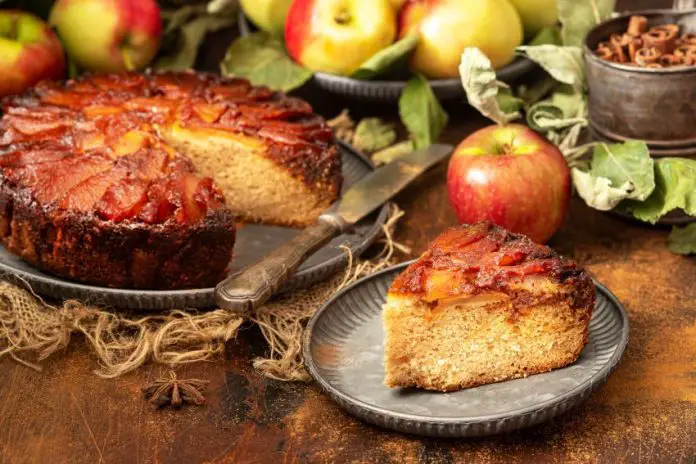
A splash of Yucatán magic takes this upside-down cake to the next level. Serve with whipped cream and wash down with a melipona honey cocktail to really make the most of Mexico's greatest natural miracle. (Shutterstock)
A great way to enjoy dessert in Mexico is by combining two contrasting flavors: the sweet, tart freshness of apples and the indulgent, ambrosia-like taste of pure, natural Mexican Melipona honey! Put them together in this recipe and you’ve got one luscious apple melipona honeyupside-down cake!
Mexico may not be known for a fruit that one associates with Fall, but apples grow in abundance in the higher elevations of Central Mexico, originally brought here by the Spaniards in the Colonial Period (1521-1821). Ever wonder why they’re so red and so appealing? It’s because they’re a member of the rose family as are pears, plums, peaches, cherries and blackberries, all grown in Mexico.
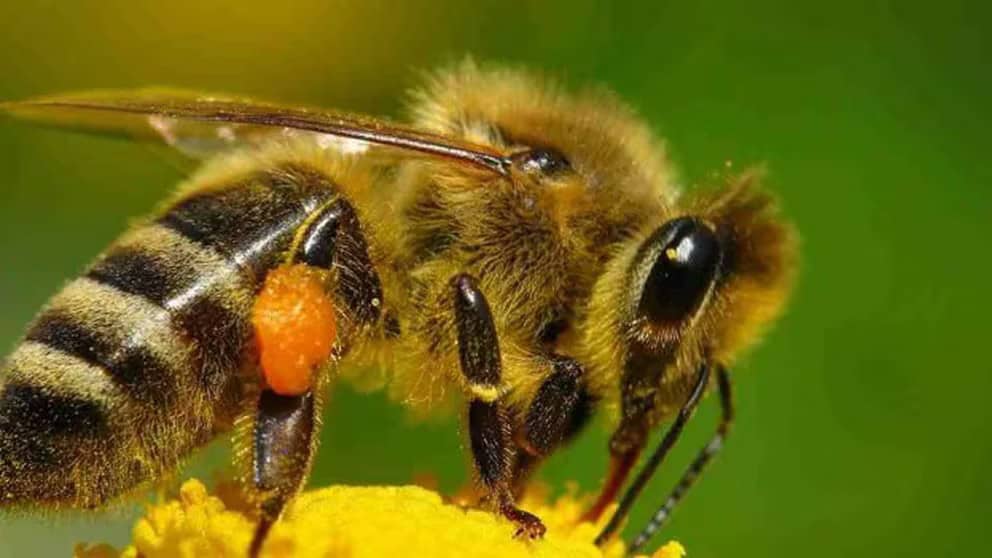
The stingless melipona bee, which creates delicious – and very special – honey. (Government of Mexico)
When it comes to baking, Golden Supreme and Gala are considered tops and both are grown here, coming to market about mid-August. You might want to combine them in this cake for added flavor and texture. Watch for them.
NOTE: In the U.S. it is estimated that 50%-70% of all honey is fake or adulterated, diluted with sugars or syrups, or by feeding corn syrup to bees rather than letting them pollinate. To ensure that your honey is pure (no matter what its origin), fill a glass with water and add a spoonful of honey. If the honey dissolves or the water becomes cloudy, it’s likely fake. Real honey will settle at the bottom of the glass, in a lump or sink to the bottom, maintaining its thickness
Melipona honey is different because it contains more fructose than glucose, which gives it its unique flavor that is a little acidic, as if one added lime. And these bees don’t make honeycombs, but rather store it in sack-like structures they create in their nests. This honey is also very high in antioxidants and is still managed by bee-makers who follow Mayan tradition, and it is rare. It is prized by international chefs who value its distinctiveness on all levels. It also makes for a great cocktail (recipe included).
The apple honeyupside-down cake that’s featured is a traditional Jewish holiday favorite for the Jewish New Year, Rosh Hashanah, but that doesn’t mean you can’t enjoy it anytime, especially with the succulent goodness of Mexican apples and the exceptional quality of its honey! And why not enjoy a Honey-Bee Cocktail to go along?
Apple honey upside-down cake (with tequila whipped cream):
Recipe adapted from Cinnamonschtick. (Cinnamonschtick)
Equipment:
9-inch springform pan (Be sure to place foil-lined baking tray on oven rack beneath pan to catch drippings.)
Ingredients:
Apple Topping (for bottom of pan):
4 Tbs. (55 grams) refined coconut oil; vegan butter; or butter (aceite de coco refinado (Use only refined to avoid coconut flavor.); mantequilla vegana; o mantequilla)
½ cup (110 grams) light brown sugar (azúcar moreno)
1 tsp. vanilla extract (extracto de vanilla)
⅕ tsp. salt (sal)
2 apples (manzanas), cored and cut into ¼-inch wedges. Do NOT cut thinner, or they will float in the batter.
2 cups (240 grams) all-purpose flour. All-purpose flour is not found in Mexico. Buy at amazon.com.mx
½ tsp. salt (sal)
2 tsp. baking powder (polvo para hornear)
½ teaspoon baking soda (bicarbonato)
¾ tsp. cinnamon (canela)
¾ teaspoon allspice. Allspice is not available in Mexico, so make your own:
4 tsp. ground cinnamon (canela)
2 tsp. ground nutmeg (nuez moscada)
2 tsp. ground cloves (clavo)
Mix together and store in an air-tight container.
2 large eggs (huevos)
¼ cup (50 grams) sugar (azúcar)
1 cup plus 2½ Tbs. (396 grams) Melipona honey (miel Melipona)
½ cup 110 neutral vegetable oil**: coconut oil (aceite de coco); avocado oil (aceite de aguacate). You can substitute butter for oil in baking using a 1:1 ratio. Melt butter and cool before adding it to recipe.
2/3 cup (156 grams) strong coffee (café), at room temperature
1 tsp. vanilla extract (extracto de vainilla)
Optional: Sliced, toasted pecans (nueces pecanas)
Instructions:
Preheat oven to 350° F (177 C).
Spray a 9-inch springform pan with non-stick spray. Line the bottom with parchment paper.
In a small bowl, whisk together coconut oil, brown sugar, salt and vanilla. Spread evenly in prepared pan.
Place apples in circular, decorative fashion over the brown sugar mixture. Press them into the brown-sugar mixture.
In a small bowl, whisk together the flour, salt, baking powder, baking soda, cinnamon and allspice. Set aside.
In a large mixing bowl, using the same whisk, whisk together the eggs and the sugar until fully combined. Next, whisk in the honey, oil, coffee, and vanilla.
Whisk dry ingredients into the wet ingredients just until fully combined. Do not overmix.
Slowly pour batter over apples. (Pouring the batter too quickly may cause apples to float.) Bake for 55-60 minutes, until a toothpick pressed in the center comes out clean and the sides of the cake start to pull away from the pan.
Cool on a wire rack for 20 minutes. Use a metal spatula or knife to release the cake from the sides of the pan. Then remove the outer portion of the springform pan. Holding a serving dish over the cake, carefully invert the cake onto the serving dish. Remove the bottom of the pan and the parchment paper. (Add some sliced, toasted pecans, if you’d like.) Allow to cool completely before slicing and if you’d like, top with the tequila whipped cream that we made for our delicious strawberry pie!
Disfruta, along with a Honey-Bee Cocktail!
Honey-Bee Cocktail:
Recipe adapted from ceimaya.com (Home Bar Menu)
Ingredients:
60 ml (4 Tbs.) of tequila
30 ml (2 Tbs.) of Melipona honey
10 ml (2 tsp.) of mezcal
2 dashes Angostura bitters
22 ml (1 1/5 Tbs.) freshly squeezed lime juice
Ice
Lemon peel
Steps:
Make Honey syrup:
Heat water and Melipona honey in a saucepan over medium high heat and bring to a boil. Reduce heat to low and boil for 2 minutes. Remove from heat and allow to cool completely. Store in a glass jar.
In a cocktail or martini glass, pour mezcal into the glass and tilt the glass to ensure the mezcal covers the entire surface. Fill the glass with crushed ice and reserve. Next, fill a cocktail shaker with several ice cubes and add tequila, lime juice and honey syrup. Close the shaker and shake vigorously to mix all the ingredients well (about 30 seconds, give or take). Discard crushed ice from glass. Using a strainer over the shaker, pour the cocktail into the glass. Add two dashes of Angostura bitters. Garnish with lemon peel.
Deborah McCoy is the one-time author of mainstream bridal reference books who has turned her attention to food, particularly sweets, desserts and fruits. She is the founder of CakeChatter on Facebook and X (Twitter), and the author of four baking books for “Dough Punchers” (available at Amazon). She is also the president of The American Academy of Wedding Professionals.
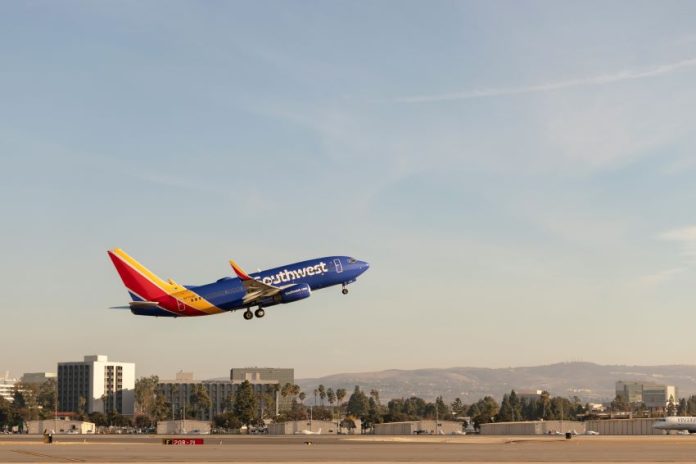
Travelers can book their spring break flights from March 8 through April 7, 2025. (Unsplash)
Southwest Airlines is adding new destinations in Mexico and expanding its flight schedule for the upcoming spring season, in a move to meet the growing demands of its customers.
Starting March 8, 2025, Southwest will commence weekly Saturday service from Nashville, Tennessee to the popular spring break destination of San José del Cabo (Los Cabos), Mexico.
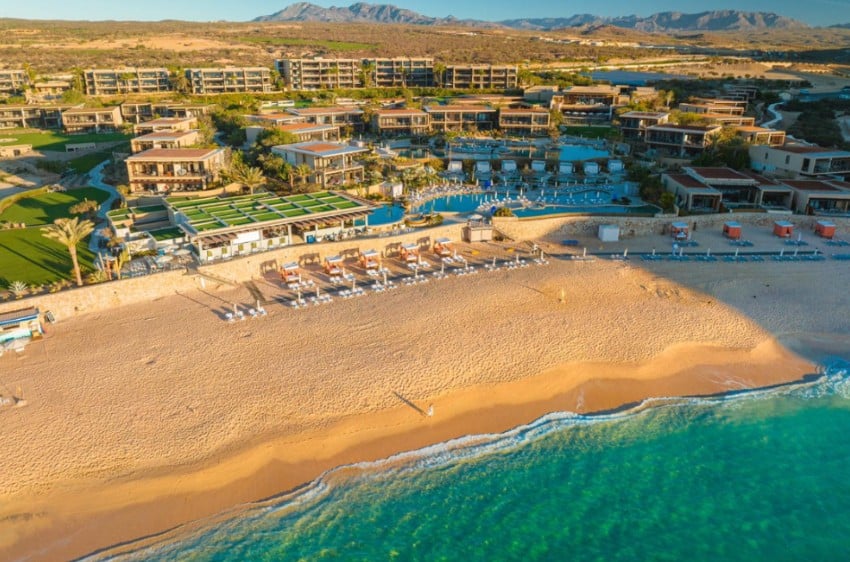
Southwest unveiled two Pacific spring break flights beginning in 2025: Los Cabos and Puerto Vallarta. (Montage Los Cabos)
The new route will add to Southwest’s existing non-stop route connecting Nashville and Cancún.
The airline, based in Dallas, will also begin Saturday flight service between Sacramento, California, and Puerto Vallarta, Mexico, on March 8, 2025.
“Thanks to our world-renowned flexibility, two free checked bags and a schedule that flexes with travelers’ demands, customers can book their flights today and secure their spring getaway,” Southwest Airlines’ Vice President of Marketing Jennifer Bridie said in a statement.
Besides the free checked bags, the low-cost carrier offers no change fees. This flexibility allows travelers to adjust their plans without incurring additional costs, a rarity in the airline industry.
The expansion of the airline’s flight schedule allows travelers to book their spring break flights through April 7, 2025.
According to Allianz Partners, which analyzed more than 3.4 million flight itineraries for spring break trips between five and eight days in length, Mexico was the most popular international destination for U.S. spring breakers in 2024, with three cities on the list. Coming in first was Cancún, followed by San José del Cabo (Los Cabos) in No. 2 and Puerto Vallarta in No. 4.
With over 100 weekly flights each, American Airlines and United Airlines operate the largest number of weekly flights from the U.S. to Cancún, followed by Southwest.
With 34,332 seats per month, Dallas is the U.S. city with the most seats to Cancún. This route also has the highest number of operations with 186.
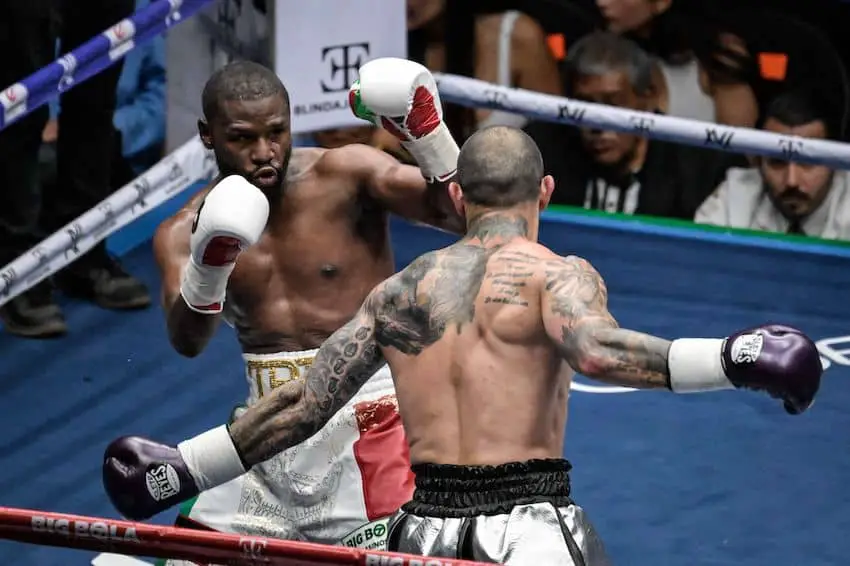
Mayweather, who retired from boxing in 2017 with a 50-0 record, rained blows on the indifferent Gotti. (Pedro Anza/Cuartoscuro)
Boxing legend Floyd Mayweather Jr. pummeled John Gotti III in an exhibition bout on Saturday that left the Mexico City crowd disenchanted.
“Mayweather, 47, dominated Gotti from start to finish,” reported the news agency Al Jazeera, leaving the 22,000 people in attendance at the Arena Ciudad de México “unimpressed.”
USA Today reported that “[t]he crowd voiced its displeasure after the eight-round exhibition,” booing both fighters loudly. Al Jazeera added that a round-ending bell did not sound and that the referee left the ring mid-fight.
There was no official winner since this was an exhibition bout — meaning two-minute rounds with two minutes in between each round — and there were no judges.
Saturday’s fight was a rematch of the farcical June 2023 exhibition match that ended in the sixth round when a mass brawl erupted inside the ring.
The rematch teetered on the edge of parody when Panamanian referee Hector Afu left the ring in the second round, replaced by Mexican official Alfredo Uruzquieta.
Mayweather got angry when Afu warned him about throwing rabbit punches, which, to be fair, were actually wide hooks. It is not clear if Mayweather demanded the referee be replaced or if Afu simply had enough of the boxer’s threats and Gotti’s complaints.
The first round began with Mayweather throwing punches at Gotti’s head while the grandson of infamous crime boss John Gotti tried to limit the damage. Gotti’s corner then raised a ruckus when the bell failed to sound at the end of the round.
Mayweather had his way with Gotti, who showed little inclination to fight back until the fourth round. (Pedro Anza/Cuartoscuro)
Other than the momentary delay in the second round, the fight continued with little mayhem, much to the crowd’s dismay. Mayweather had his way with Gotti, who showed little inclination to fight back until the fourth round.
Mayweather, who retired from boxing in 2017 with a 50-0 record, rained blows on the indifferent Gotti in the sixth and seventh rounds. Gotti managed to hold on in the eighth after Mayweather cornered him and the two embraced when the final bell rang out.
Mayweather managed to get the crowd back on his side after the bout, praising Mexican boxing legend Julio César Chávez Sr., who was there as part of the broadcast team, before saying “Mexico City, I love you guys. Thanks for coming out.’’
He also had praise for his opponent. “Gotti is tough as nails,” he said.
Gotti returned the respect, saying Mayweather hit him hard. “He’s still got it,” Gotti said.
Mayweather’s pre-fight flamboyance
Mayweather sparked controversy leading up to the fight as he was spotted traveling around Mexico City in a “sleek, armored SUV.”
Floyd Mayweather in Mexico with max security and a bulletproof tank
Ahead of the rematch with John Gotti III. 🔥💰 pic.twitter.com/J5GWdD9NOq
Though some speculated about his need for heightened security, others took to social media to make light of the situation, describing him as an “attention seeking grandpa,” the sports site Marca reported.
Following the construction of its second Mexicali plant, Gulfstream will employ over 5,000 people in Baja California. (Gulfstream)
Gulfstream Aerospace Corporation has announced a US $370 million investment to build a new plant in the northern city of Mexicali, Baja California, as reported by Governor Marina del Pilar Ávila Olmeda.
The 540,000-square-foot plant will be the company’s second manufacturing facility in the state and will create 1,500 specialized jobs, bringing the company to more than 5,000 employees in Baja California.
Baja California Governor Marina del Pilar Ávila Olmeda with representatives of Gulfstream. (Marina del Pilar/Gulfstream/X)
The announcement was made during a meeting attended by John Ortega, vice president of Gulfstream; Mark Bennet, global director of institutional relations at Gulfstream; and Kurt Honold Morales, economy and innovation minister for Baja California.
“Gulfstream’s expansion in Mexicali marks a significant milestone for our operations in the region. We are excited about the new opportunities this investment will create and are eager to further contribute to the local economy,” Ortega said at the meeting.
Gulfstream opened its Mexicali plant, currently the company’s only plant in Mexico, 30 years ago. The manufacturing site makes electrical wire harnesses, sheet metal components, sub-assemblies and machined parts.
“This new facility will enhance our production capabilities and reinforce our commitment to Mexicali and the broader Baja California region,” added Mark Bennet.
No further details have been given about the new site’s construction or its production outlook.
The aviation and aerospace industry in Mexico is one of the three largest manufacturing industries in Mexico today.
Its market size is estimated at US $2.58 billion in 2024 and is expected to reach US $2.96 billion by 2029. The state with the largest aerospace industry in the country is Baja California, also considered the birthplace of the aerospace industry in Mexico.
The first foreign aerospace company to invest in Mexico was Hughes Aircraft, which opened over 40 years ago in Mexicali. Since then, 28 aerospace companies have been established in Baja California including United Technologies Aerospace Systems, Honeywell, Safran, Collins Aerospace and others.
According to the Economy Ministry (SE), in the first six months of 2024, Mexico received US $161 million in foreign direct investment (FDI) in the aerospace manufacturing industry.
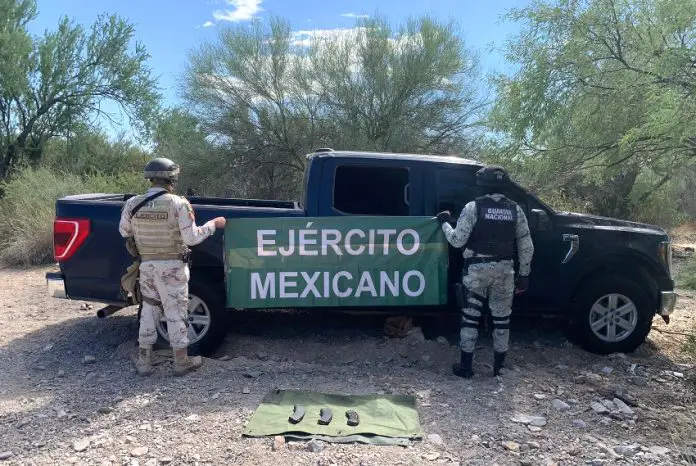
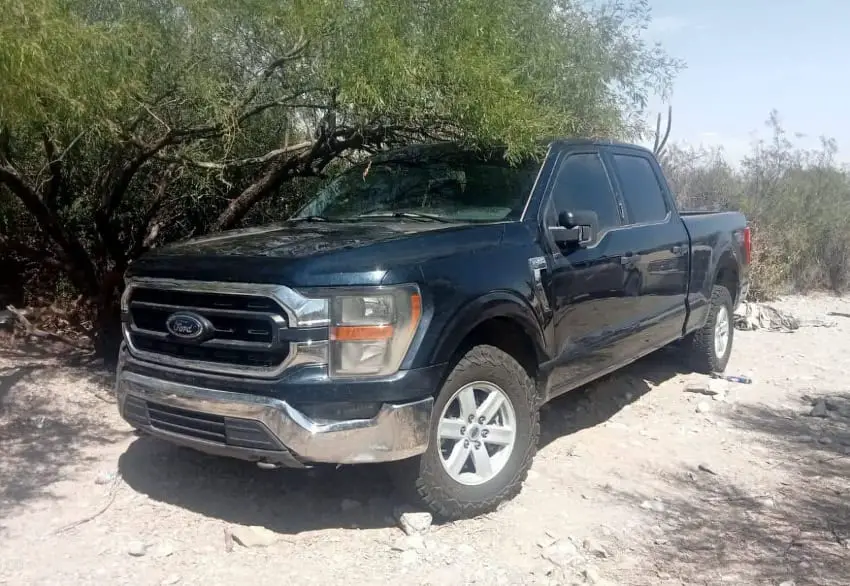
The authorities found a stolen pick-up truck with guns and ammunition that they believe was used by the gunmen in the Sonoyta-Caborca highway attack on Friday. (FGE Sonora/X)
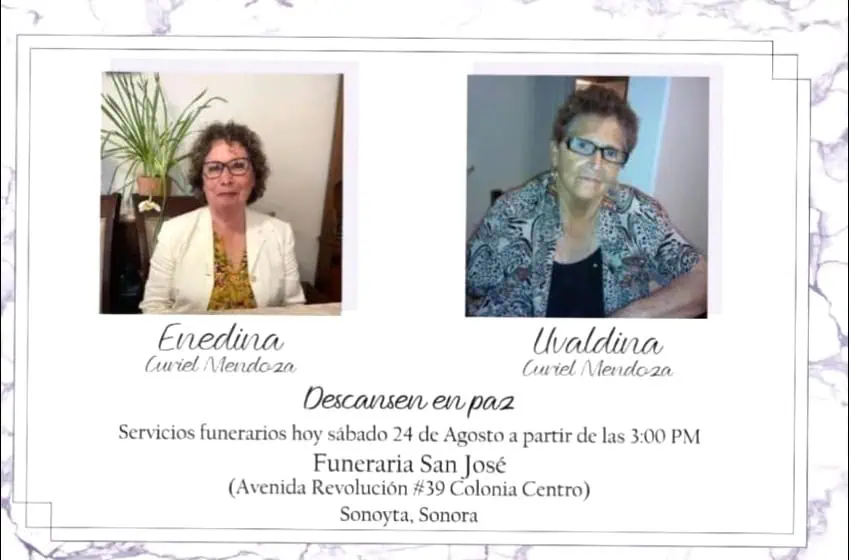
Two women from Arizona were killed on Friday when gunmen opened fire on their vehicle on the Sonoyta-Caborca highway in the northern state of Sonora, authorities said.
The two sisters were killed on Friday afternoon when gunmen shot at their SUV on the Sonoyta-Caborca highway. (Facebook)
The women were originally from Caborca, a city around 150 kilometers south of the Mexico-U.S. border between Lukeville, Arizona, and Sonoyta, Sonora.
They were on their way to Caborca when they were attacked. The driver reportedly lost control of the vehicle when the gunmen started shooting.
The husband of one of the victims lamented the death of his wife and sister-in-law in a post to Facebook.
“Today is the most terrible day in the existence of my family because [gunmen] wanting to rob my wife and sister-in-law killed them on the Sonoyta-Caborca stretch [of highway],” wrote José Ortiz Reyes, a former professor at the University of Sonora.
According to his Facebook page, he lives in Phoenix, Arizona.
A U.S. State Department spokesperson told CBS News that one of the women was a U.S. citizen while the other was a lawful permanent resident (LPR) of the United States.
The FGJE said in a statement that its investigation into the armed highway attack was advancing, but it didn’t reveal a motive. Media reports said the gunmen wanted to steal the women’s vehicle.
The news website La Silla Rota reported that stealing vehicles from both Mexican and foreign travelers has become a common “practice” in northern Sonora. Gunmen reportedly target pick-ups and SUVs.
The authorities said they located a stolen pick-up truck near the Arizona border that was used in the Sonoyta-Caborca highway attack. (FGE Sonora/X)
The Federal Bureau of Investigation told CBS News that it was assisting Mexican authorities with their investigation into the murders of the two women.
The FGJE said that municipal, state and federal security forces participated in an operation to locate the perpetrators of the attack, but no arrests were reported.
Federal security forces did, however, find a vehicle and weapons allegedly used by the aggressors.
According to the FGJE statement, soldiers and National Guard personnel located a Ford pick-up truck near the town of Quitovac in the municipality of General Plutarco Elías Calles, which borders Arizona. The vehicle had been reported as stolen.
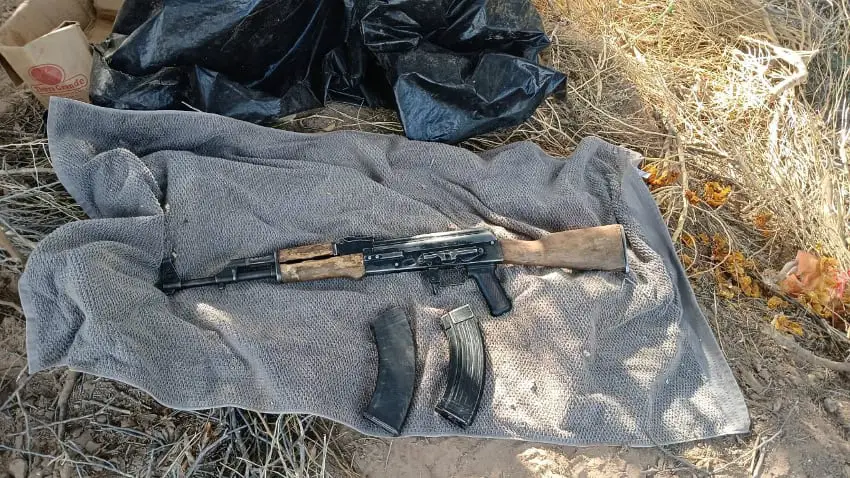
The federal security forces also found and seized ammunition, 25 cartridge holders, three bulletproof vests and four AK-47 assault rifles.
The state attorney general’s office of Sonora published photos of weapons and ammunition found in the abandoned pick-up truck near the Sonora-Arizona border. (FGE Sonora/X)
“Sonora is a key location used by the international drug trade and human trafficking networks. Violent crime is widespread. U.S. citizens and LPRs have been victims of kidnapping,” the Department says.
“Travelers should maintain a heightened level of awareness of their surroundings in all their travels in Sonora. Security incidents may occur in any area of Sonora.”
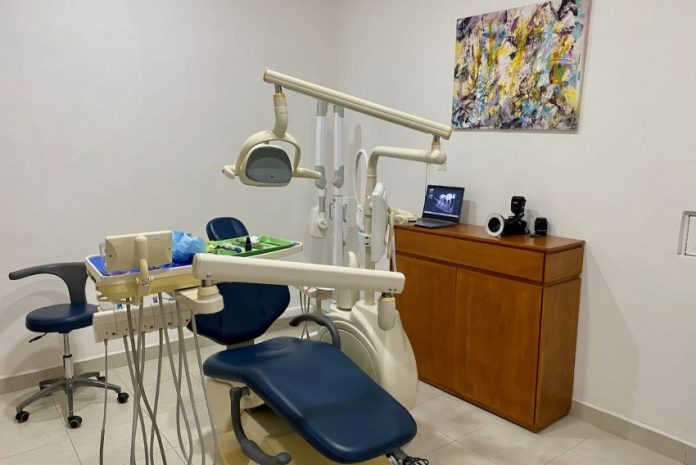
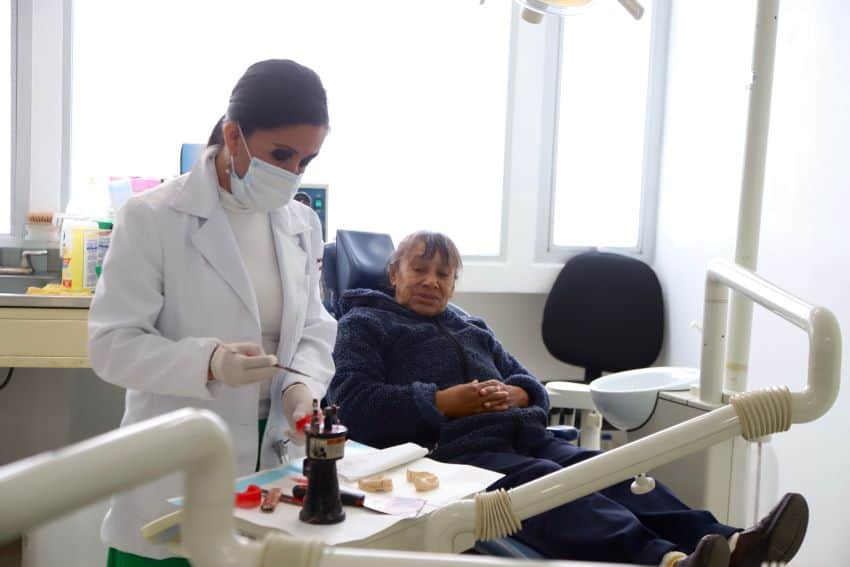
Dentists in Mexico are modern, clean, efficient and friendly. With the high standards of professional care and ease of access, even difficult procedures are a breeze for patients. (Bel Woodhouse)
I realize it’s not just me: most people hate going to the dentist. And when people think Mexico plus healthcare, they ask the question: Is a Mexican dentist safe? Well, I can safely say that my experiences have been safe, caring, and relaxing. My dentist genuinely cares. He is warm, well educated, very professional, easy to get an appointment with, and I never have to wait.
One of life’s ickiest experiences isn’t scary anymore! In Mexico, I don’t dread it. My dental emergencies, both times, have been outstanding experiences. Now I understand why dental travel is a thing.
Dr. Poot was a consummate professional who made me feel immediately at ease. (Bel Woodhouse)
How much does dental work cost in Mexico?
Mexican dentists are very affordable and well-priced. Ask yourself this: How much does an annual checkup with your dentist cost where you live? To give you an idea of the affordability, I’ll give you an example. My emergency visit to the dentist a couple of months ago was US $26.
With a huge and painful swelling in my jaw, I knew I couldn’t put off a dentist visit any longer. I had to get an appointment— right away. I got one that afternoon. But that’s not the astonishing part. The astonishing part is that the visit was only 500 pesos (US $26). Yes, that’s total. 500 pesos for everything.
This included the consultation and dental x-rays, plus a second consultation with a specialist and a procedure that had to be done on the spot. I’ll spare you the details.
Suffice it to say it wasn’t a little thing we were dealing with. I was looking at two weeks of two types of antibiotics plus three antibiotic shots. Those were cheap too: a nurse at the pharmacy gave me the injection for 20 pesos, or about a dollar (fluctuating exchange rates be damned). After antibiotics, an extraction of the infected molar would have to happen.
Professional and caring
Even follow-up treatment is extremely affordable, with antibiotics and additional appointments simple and cheap to schedule. (Edgar Negrete/Cuartoscuro)
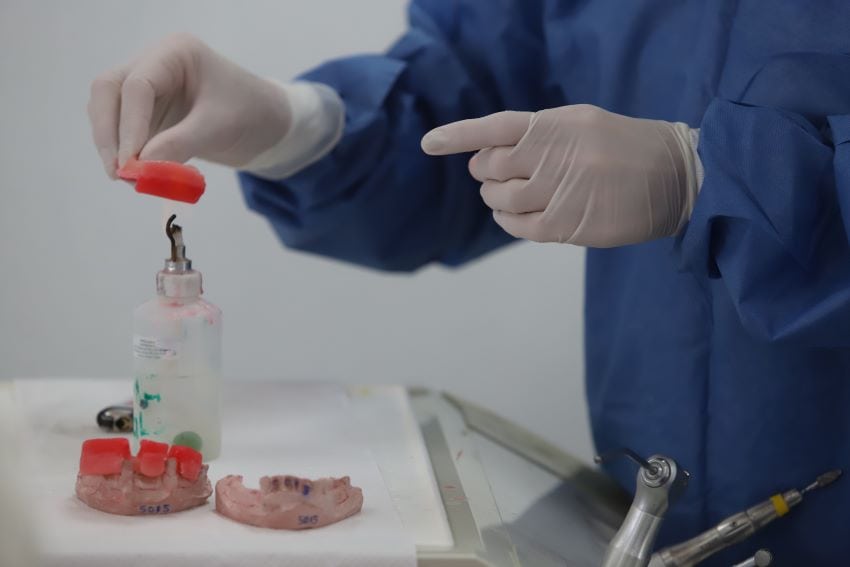
Like all of Mexican healthcare, the warmth of dental professionals is amazing. As is the state-of-the-art equipment. Sparkling-clean implements were laid out. But my favorite was the comfy reclining chair. I’m not joking, I almost had a nap while waiting for the local anesthesia to take effect.
My lovely dentist, Dr Poot (pronounced Pot), kept asking if I was okay. He put on soft music to help my nerves as I find that the dentist can be a bit of a stress trigger. Plus, I don’t mind sharing that when it comes to a big ouchie like this, I get a little scared. Both about the pain and the cost. Like most people who know they’re in for major dental work, I guess.
The whole visit was smooth sailing and stress-free. Afterward, at the pharmacy, it was the same thing. The nurse giving me an antibiotic injection at the pharmacy was very sweet, calling me “cariño,” and I didn’t feel a thing. It was the best injection I’ve ever had.
Major dental work wasn’t stressful
If you’re curious about the price for my molar extraction, it was 2000 pesos, $116 US. Now I know back home in Australia it would have been more like $1,000 dollars. Molars are the most expensive teeth to have taken out. But here in Mexico, this 2,000 pesos included everything. X-rays to see that the infection had gone down sufficiently. Along with the anesthetic and the extraction procedure.
The professionalism of the Mexican dental team really dispelled many of the negative stereotypes around Mexican dental care. (Edgar Negrete/Cuartoscuro)
As it turns out, it wasn’t easy. Fun fact: Human molars normally have two roots. My molar had three roots. So this extraction was not only going to take longer, but he had to work really hard to get it out. It was not a fun experience.
Even so, the whole thing took less than an hour, and I didn’t feel a thing. That in itself amazed me. While I lay back listening to soothing Spanish guitar, Dr Poot kept asking if I was alright. As if that was the most important thing. I must say, he’s the kindest dentist I’ve ever had.
Do I recommend a Mexican dentist?
Yes. I highly recommend Mexican dentists. If you’re worried about a Mexican dentist being safe, don’t be. They are caring, warm, professional, and genuinely care about your well-being. Reflecting on this whole experience, I can see why dental travel is on the rise. It’s a win-win. With the money you save, you can have a holiday while recovering. Even with a holiday, it is still probably cheaper than getting major dental work done in the US.
The warmth of the Mexican people makes them excellent healthcare professionals. They genuinely care. About you as a person and your comfort while being treated. This goes for specialists, doctors, dentists, and surgeons. I’ve lived in Mexico for eight years. During that time, I’ve had two trips to the dentist. Each time, the visits have been fantastic. So much so, that now I’m not scared to go to the dentist anymore. In fact, I love going to the dentist, in Mexico. I think I’d still be anxious back home, but here in Mexico, it’s great.
Mexico Correspondent for International Living, Bel is an experienced writer, author, photographer and videographer with 500+ articles published both in print and across digital platforms. Living in the Mexican Caribbean for over 7 years now she’s in love with Mexico and has no plans to go anywhere anytime soon.
How did a stereotypical family from the 1960s become an emblem of life in modern Mexico - and what does that say about the country? (Facebook)
I’ve seen her around Mexico, and you probably have too.
She’s a dark-haired six-year-old with a round face and expressive eyes. Though she’s typically spotted in a signature red dress and matching bow, she’s been known to change it up now and again. She’s almost a scribble in her visual simplicity. She has an aversion to soup and strong opinions on important world issues. A voice for the younger generations, she’s witty and insightful, with critical perspectives on adult society. She’s especially known for her rebellious spirit and fierce rejection of societal norms and expectations.
I’m referring to Mafalda, the comic book-turned-cartoon character beloved by generations of Mexicans, Latin American populations, and numerous others worldwide.
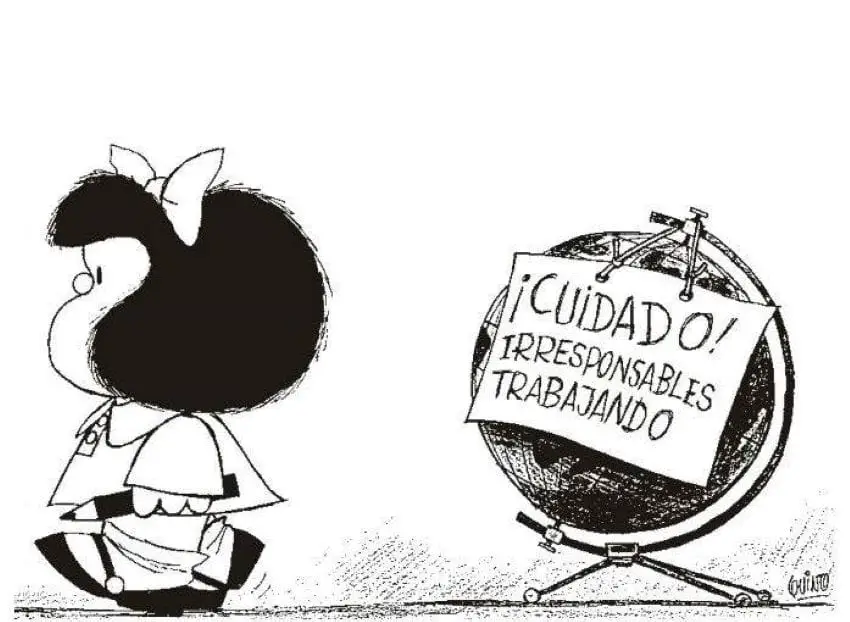
“Watch out! Irresponsible at work” is definitely a theme we can all get behind. (Facebook)
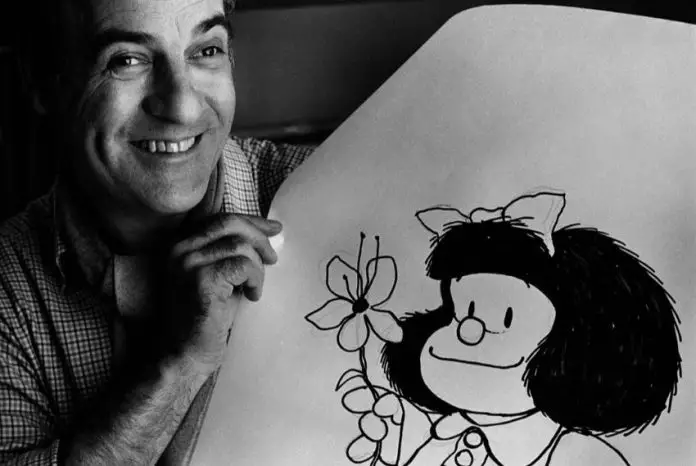
Created in 1964 by Argentine cartoonist Joaquín Salvador Lavado Tejón (better known as Quino), Mafalda began life as an advertising mascot for the appliance company Siam Di Tella. But she quickly outgrew her commercial roots, evolving into a cultural phenomenon that continues to resonate with audiences today. In Mexico, her popularity is comparable to that of Charlie Brown or Garfield, cementing her status as one of the Spanish-speaking world’s most iconic characters.
The birth of a pint-sized icon
At first glance, Mafalda appears to be a typical six-year-old girl from a middle-class Argentine family of the 1960s. Her father works a mundane office job and her mother tends to the home. At the same time, her relationship with her younger brother Guille reflects the typical mix of sibling rivalry and affection. The family dynamic embodies societal norms of the time, but beneath this veneer of normalcy lies Mafalda’s sharp wit and a deeply inquisitive mind that constantly challenges the status quo.
While Mafalda engages in typical childhood activities — school and playing with friends — her innocently presented perspectives often have a philosophical bent. Throughout her daily life, Mafalda reflects on various social issues, expressing her thoughts through musings and humorous observations. An avid reader, she stays informed about current events, which fuels her desire for justice and change.
Contrasting opinions: Mafalda’s social circle
Mafalda’s world is populated by a colorful cast of characters who serve as contrasts for her progressive ideals. There’s Susanita, the materialistic girl who dreams of landing a wealthy husband and having lots of babies. Mafalda’s interactions with her friend frequently involve her challenging Susanita’s views on marriage, beauty standards, and the role of women in society. When Susanita expresses her desire to marry a wealthy man, Mafalda questions her motivations and encourages her to pursue her own goals. “Para qué ser mamá? No es la única meta en la vida.” (“Why be a mom? It’s not the only goal in life.”)
Themes of exploitation, masculinity and religion remain as topical as ever, keeping Mafalda ever relevant. (Facebook)
Manolito, the son of a shopkeeper, is obsessed with money and business. Mafalda’s and Manolito’s debates about capitalism, consumerism, and social inequality are recurring themes. In one exchange, Mafalda argues that Manolito’s family’s wealth is not earned through hard work alone but rather through the exploitation of the working class. “No se puede ser rico sin hacerle daño a otros.” (“You can’t be rich without harming others.”)
Felipe, the romantic daydreamer and the most introspective of Mafalda’s friends, provides a foil to Mafalda’s pragmatism. He often serves as a sounding board for her philosophical musings. Their conversations delve into existential questions about life, death, and the nature of humanity. In one strip, Mafalda asks Felipe if he believes in God, leading to a thoughtful discussion about faith and the meaning of life. “Crees que hay vida en otros planetas? Yo creo que sí, pero también creo que no hay vida en este.”(“Do you think there is life on other planets? I believe there is, but I also believe there is no life here.”)
Mafalda’s group of friends, their stories, personalities and perspectives represent the differing societal perspectives of the time. Through their discussions, Mafalda creator Quino addresses themes such as capitalism, gender roles, societal expectations, immigration, and political ideologies. The characters’ differing viewpoints allow readers to explore complex topics through the lens of childhood innocence and humor, while also provoking thought and reflection on many of the issues still relevant today.
Enduring wisdom in Mexico & beyond
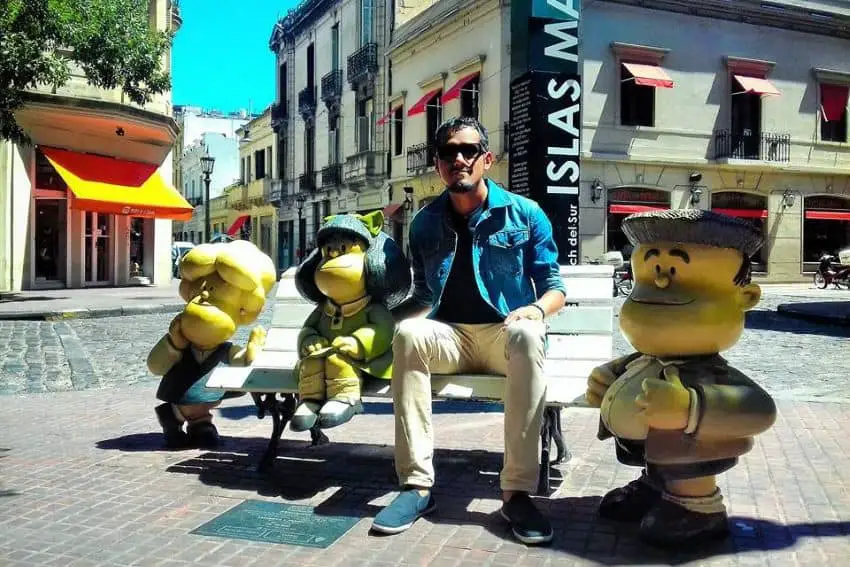
In Mexico and across Latin America, Mafalda has become a symbol of resistance and social commentary. Her image can be found on everything from T-shirts to protest signs, with her witty observations shared widely on social media. In Buenos Aires, statues of Mafalda and her friends draw fans eager to snap selfies with this pint-sized revolutionary.
Even today, statues to Mafalda can be found across her adoptive nation of Mexico. (Alan Concepción Cuenca/Facebook)
What makes Mafalda’s popularity in Mexico particularly fascinating is how her perspectives align with Mexican culture, even today. Though born in Argentina, her concerns about social justice, equality, and humanity’s future strike a universal chord. In a country struggling with complex social and political issues, Mafalda’s views are particularly relevant.
“The problem is that there are more people interested than interesting people,” Mafalda quips in one strip, addressing modern society’s self-absorption. Such observations feel as fitting in 2024 Mexico City as they did in 1960s Buenos Aires.
Mafalda’s challenges to gender norms resonate strongly in contemporary Mexico. As the country wrestles with machismo and women’s equality, Mafalda’s rejection of traditional female roles feels particularly relevant. Mafalda also advocates for work-life balance, often asking why life must revolve around work.
Her concern for peace and social justice strikes a chord in a nation familiar with violence and inequality. “Everywhere they bake beans, but nobody dares to strangle the maitre’d,” Mafalda observes, highlighting the gap between acknowledging problems and taking action. It’s a sentiment many Mexicans, frustrated with known corruption and systemic issues, relate to. She adds, “I like people that say what they think. But above all, I like people who do what they say.”
Mafalda has even found her way into Mexican schools. (Facebook)
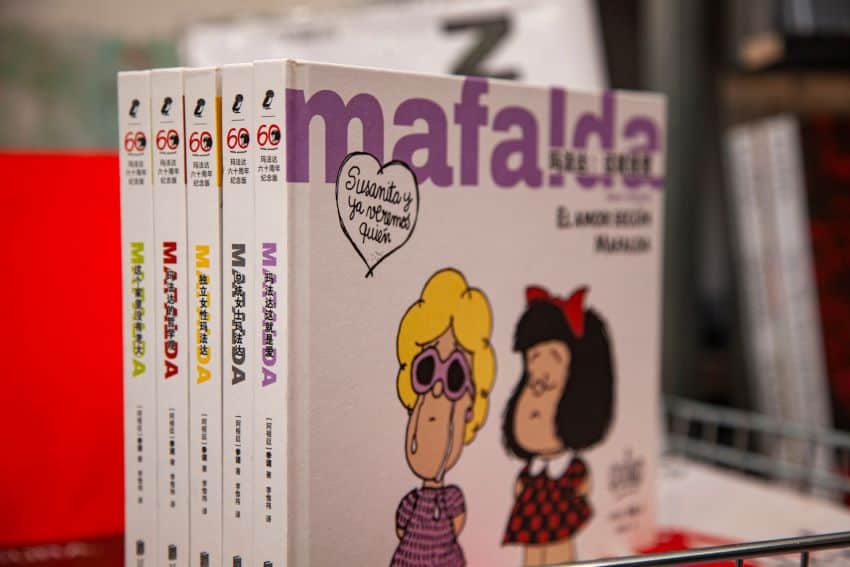
Beyond social commentary, Mafalda has become an educational tool in Mexico, her comics are used in schools to teach critical thinking and social awareness. Her sophisticated vocabulary and complex ideas, presented accessibly, introduce young readers to important concepts.
Mafalda Today
Mafalda’s comic strip run ended in 1973, though she may be poised for a resurgence.Netflix recently announced plans to develop new content based on the character, introducing her to a whole new generation of viewers.
As Mexico and the world grapple with issues of inequality, climate change, and political upheaval, Mafalda’s blend of optimism and pragmatism offers a voice of reason in a complex world.
“Wouldn’t it be more progressive to ask where we are going to go, instead of where we are going to stop?” Mafalda asks in one strip. It’s a question that could apply to any contemporary issues, from technological advancement to social change. By encouraging her readers to think critically, and empathetically and dream big, Mafalda continues to inspire generations of Mexicans to imagine a better world.
So next time when you encounter Mafalda, perhaps she’ll remind you to keep questioning, keep dreaming, and never stop working towards a better tomorrow. Just don’t try to make her eat any soup.
Monica Belot is a writer, researcher, strategist and adjunct professor at Parsons School of Design in New York City, where she teaches in the Strategic Design & Management Program. Splitting her time between NYC and Mexico City, where she resides with her naughty silver labrador puppy Atlas, Monica writes about topics spanning everything from the human experience to travel and design research. Follow her varied scribbles on Medium at https://medium.com/@monicabelot.
Colonial history and a high-tech future collide in today's three cities, as we take a look at where to live in the Bajío region. (Shutterstock)
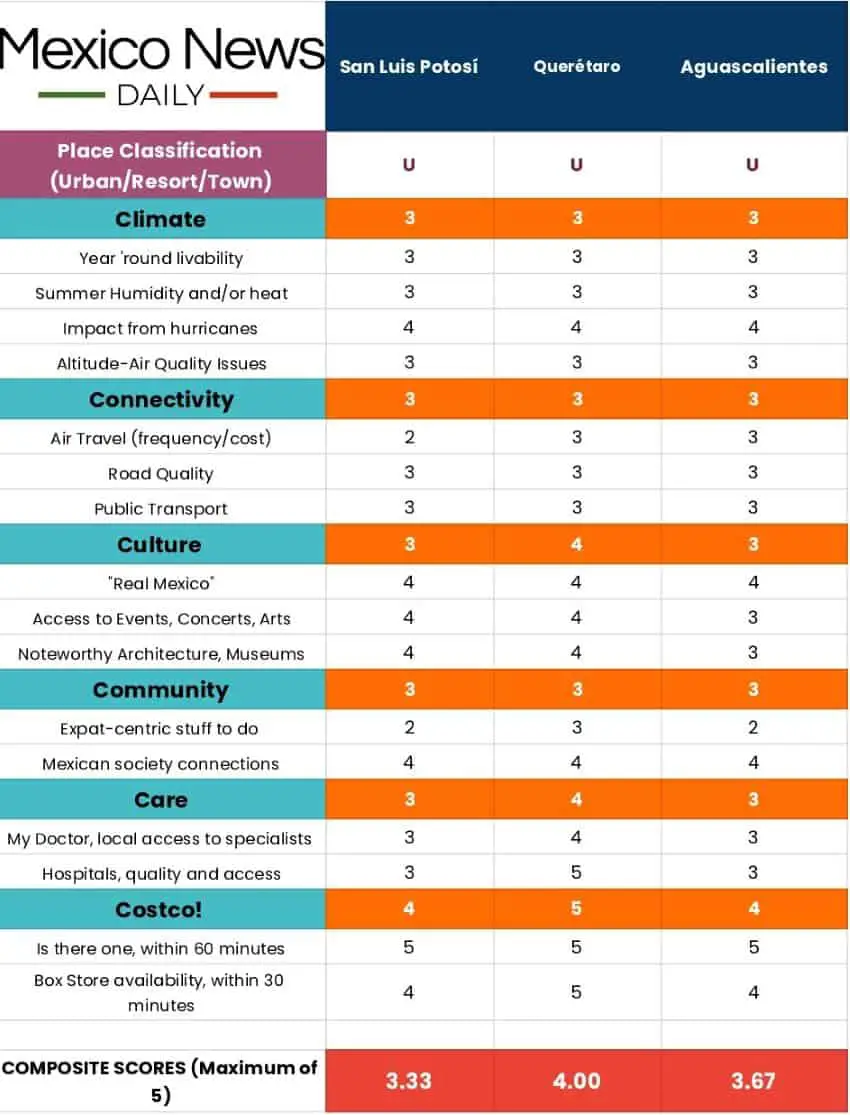
This week in the MND Where to Live in Mexico 2024 Guide: Bajío Trio, we are moving inland to explore three central Mexican locations that don’t get a lot of coverage in the “where to live” online ecosystem.
San Luis Potosí, Querétaro, and Aguascalientes might be the three largest cities you’ve never heard of. These eponymous cities are by no means “unknown,” having a combined population exceeding 6.5 million inhabitants. Two cities are UNESCO World Heritage Sites, and the three states combined have 17 Pueblos Mágicos. Each has traits particular to their central role in Mexico’s Spanish colonial legacy and 21st century economy. San Luis Potosí and Querétaro share a border, while Aguascalientes is a landlocked island of sorts, as well as one of Mexico’s smallest states by population and landmass. Another similarity is a seasonally moderate high plateau climate (temperate, semi-arid; more arid in northerly San Luis Potosí). The temperature may spike higher in May-June and lower in December, but stable, low-humidity highland living is the norm.
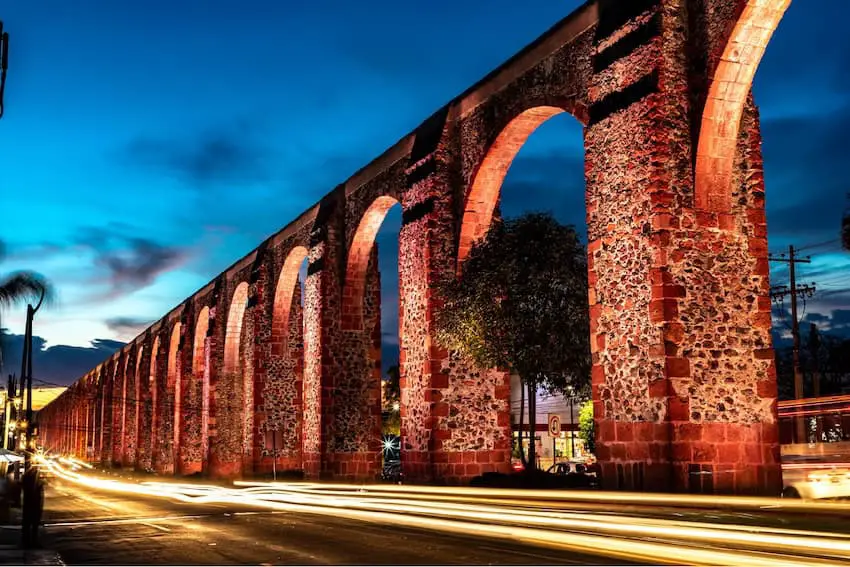
Colonial charms abound in the area -and none are more iconic than Querétaro’s aqueduct. (Turismo del estado de Querétaro)
Querétaro also leads this trio when it comes to a booming economy. While Aguascalientes is an automobile manufacturing town (Nissan) and San Luis Potosí carries its BMW pedigree, Querétaro’s economy is mega-diverse. Central to this success is the “Triple Helix Model,” a framework of close cooperation between government, industry, and academia. Automobiles, aerospace and appliances dominate. Querétaro also leads in medical care. One 2021 ranking gives Querétaro six of Mexico’s top 10 hospitals. It’s also a great location for box-store shopping, should such things matter to you.
Aguascalientes
Though it be but little, Aguascalientes puts up a fierce claim for Mexico’s most underrated city. (Expedia)
Capital of the state bearing the same name, Aguascalientes (altitude 6,200 feet) is today a burgeoning commercial and industrial center in the heart of a state known for its brave bullfighters, fine wines (a four hundred year tradition), gentle climate and relaxed provincial character. It is Mexico’s second smallest state in terms of area; however, it enjoys an important commercial position thanks to the factories that ring the city that produce a good portion of Mexico’s high-tech manufacturing output.
City attractions include thermal springs (Ojocaliente, Balneario Valladolid), museums, green spaces, pedestrian-friendly streets, and the state’s annual fair. The Feria de San Marcos, dating back to 1604, is held each April-May and is one of the world’s ten largest agricultural fairs. There are dozens of distinct “barrios” surrounding the urban core – too many to include here. Other than the city’s foreigner, managerial manufacturing workforce, you won’t find many foreign-born retirees or remote workers in Aguascalientes. This can feel either refreshing (with very affordable home rental costs to boot) or isolating, depending on your desire for an authentically Mexican experience.
San Luis Potosí
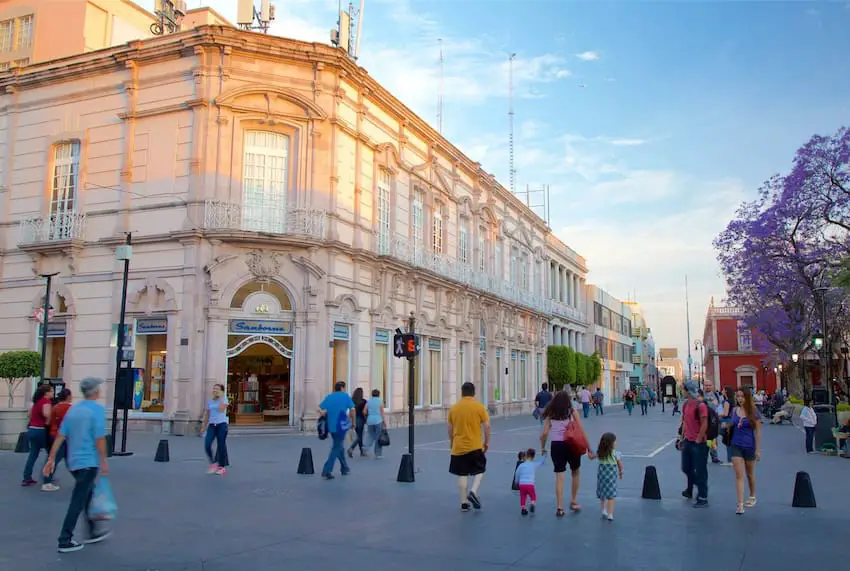
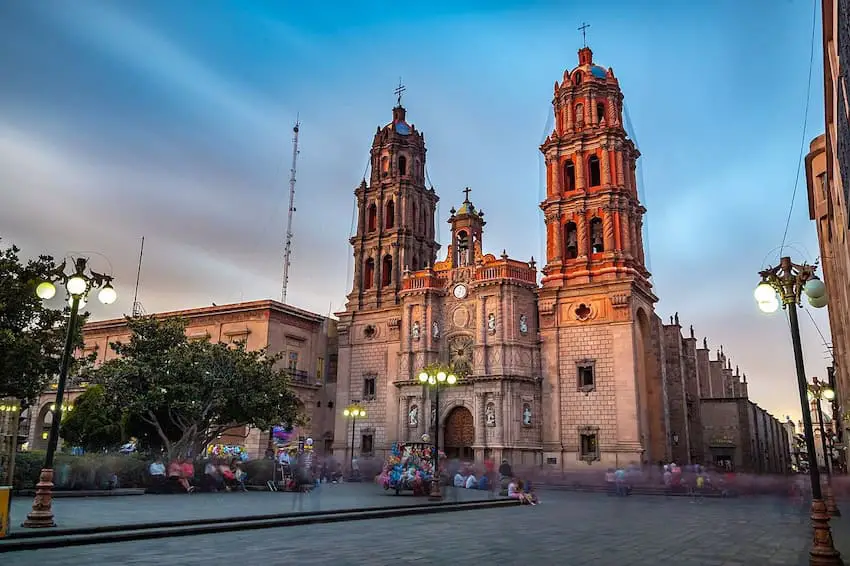
Historic San Luis Potosí was once the seat of a sprawling northern empire. The glory is still on show for all to see. (MyGuide Mexico)
Continuing due east is the city-state of San Luis Potosí (170 km). This vast state stretches across the windswept, sunbaked plains of north central Mexico, refreshingly cooler in its Veracruz-facing Sierra Huasteca tropical highlands. Its importance in Mexican history spans four centuries of influence, making its capital city of the same name (a UNESCO World Heritage Site) a city of renown.
Mexico has too many “best kept secret” places to explore, but the state capital is certainly one of them. A mining boom in the late 16th century was followed by an era when San Luis Potosí assumed the role of Mexico’s most important northern city, whose domain once stretched from Louisiana to New Mexico. For much of the colonial era, its mining and ranching wealth bestowed on the city many elaborate neoclassic and baroque public buildings, mansions and churches. It has one of Latin America’s longest pedestrian thoroughfares (Calzada de Guadalupe, stretching some 3 kilometers) and Mexico’s second largest urban park.
The historic center, beautifully illuminated at night, features tiered esplanades, several handsome plazas, flower-filled parks, and an active cultural scene. Three fine museums (Federico Silva, Leonora Carrington, Museo Nacional de la Mascara), concerts, film, and theaters (Museo Francisco Cossío, Teatro de la Ciudad, Teatro de la Paz) keep locals and a smattering of foreigners engaged socially. The dining and nightlife here are more varied than in many colonial cities.
The surrounding state’s topography is similarly diverse, due to the Sierra Madre Oriental range that runs through the eastern part of the state. Also running north-south is the Sierra Gorda range (part of Querétaro state), creating a myriad of valleys and plains. Much of the state’s pre-Hispanic and colonial influence can still be seen today in the towns and villages of this region (there are six Pueblos Magicos, including two of Mexico’s most bizarre — abandoned mining town of Real de Catorce and whimsical jungle sculpture garden at Xilitla).
Querétaro
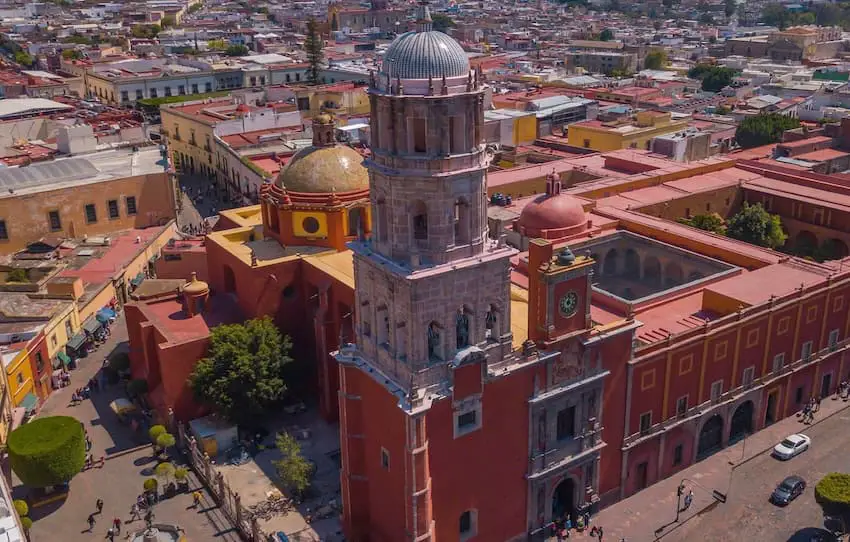
No city quite sums up modern Mexico like Querétaro. (Fiesta Americana)
When it comes to Mexico living, Querétaro State might just be the hardest to pronounce (“que-REH-tah-roh”) and easiest to embrace. It earns a very solid “4” on our 1-5 scale. Growth has diminished, in some ways, the city’s provincial town character but also bestowed the city with one of Mexico’s highest living standards and best-educated populations.
A commercial center of nearly one million inhabitants, Querétaro lies at the junction of two major interstate highways, routes 57 and 45 (construction delays are endemic of late). Located only 220 kilometres from Mexico City, Querétaro has become a satellite of sorts for the Capital. Several large manufacturing plants have relocated to the city’s outskirts, and thousands of businessmen commute between the two cities.
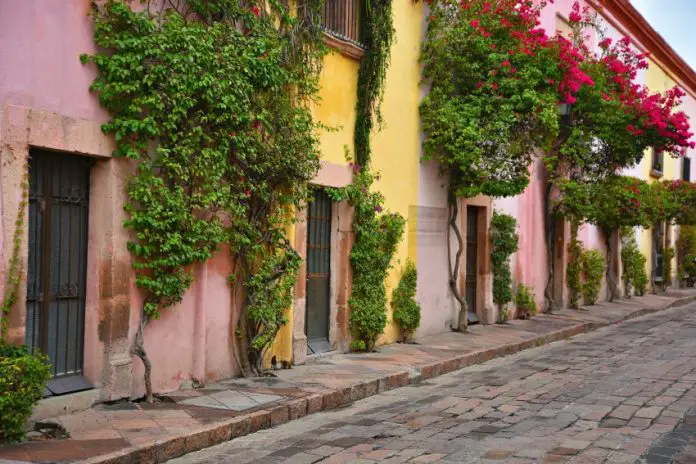
The city has preserved its historic downtown and has taken steps to beautify many areas. The Historic Monuments Zone of Querétaro was named a UNESCO World Heritage site in 1996, as an exceptional example of a colonial town whose layout symbolizes its multi-ethnic population. It is also endowed with a wealth of outstanding buildings, notably from the 17th and 18th centuries. Querétaro holds several treasures, and a friendly sense of civic pride prevails. The historic city center is filled with lovely colonial mansions, immaculate pedestrian walkways and quaint plazas little changed since colonial days. Its 18th century Acueducto of 74 towering arches (some standing 100 feet tall) are dramatically lit at night, stretching for miles across a broad valley on the City’s eastern edge.
Living here means finding an outlying, suburban neighborhoods of El Refugio, Jurica, Juriquilla and El Pueblito are all excellent options. If that doesn’t appeal, then try a surrounding hillside suburb or a spot in the historic city centre — which is refreshingly quiet for a city this size. More central living can be found in the Jardines de las Haciendas, Carretas, Alamos, and Campanario areas. There’s housing variety and general affordability, along with some choice assisted-living options (Spanish chain Ballesol is one of Mexico’s best options). Expats are scattered across this landscape or living in “compound-like” gated communities, so it will take some effort to connect with other English speakers, though the opportunities are there for those who seek them.
One blogger describes living here (compared to, say Guadalajara) this way: “Querétaro is a button-down corporate town, where people work for others and have the more conservative lifestyle that (sic) dictates. I think this tamps down the exuberance I’ve grown to love elsewhere in Mexico. Locals are friendly and educated, but readily admit to being more reserved than their fellow countrymen.”
Author Greg Custer lives in Mexico. He’s worked for over 40 years in international tourism, educating travel advisors around the world about Mexico and other Latin American destinations. He helps folks explore Mexico for living at www.mexicoforliving.com.
With visitors numbers climbing ever higher, Chris Sands take a dive into the real figures behind Los Cabos' tourism data. (Los Cabos Tourism Board)
For the past three years, tourism in Los Cabos has been like an arrow shooting straight up. That trend has applied to costs, with the asking prices for everything from hotel rooms to restaurant entrées rising inexorably. It has also applied to the number of vacationers visiting Baja California Sur’s southernmost municipality.
Thus, the big question has been: how long can this continue? Eventually, one presumes, some tourists will balk at the higher prices, preventing record-setting visitation numbers at the end of each calendar year.
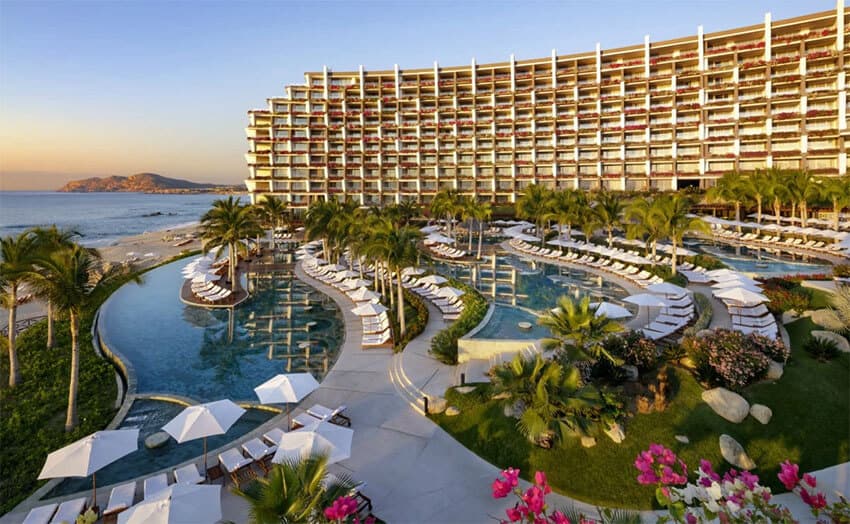
Los Cabos’ luxury hotels continue to pull in visitors from all over the world. (Grand Velas)
With the release of data for the first six months of 2024 by the Los Cabos Tourism Board (Fiturca), it’s possible to take a more nuanced look at the tourism statistics. Yes, hotel rates are higher than a year ago, and people are still visiting in droves, but not everything is at an all-time high. Decreases can be seen in some areas for the first time since the pandemic years of 2020 and 2021.
Higher room rates haven’t deterred tourists from Los Cabos
The number of visitors flying into Los Cabos has risen each year, from 2.8 million in 2021 to 3.3 million in 2022 and a record 3.86 million in 2023. Simultaneously, the average daily rate of the region’s hotel rooms has climbed as well, reaching US $417 in 2022, $452 by 2023 and climbing even higher to $517 in 2024.
The correlation between these two statistics suggests visitors are unfazed by room rate price hikes. The numbers in 2024 confirm it. Occupancy percentages for Los Cabos hotels are at 76% this year, slightly better than the 70% achieved in 2022 and 2023.
Looking for budget-friendly travel? Choose your Los Cabos resort location carefully
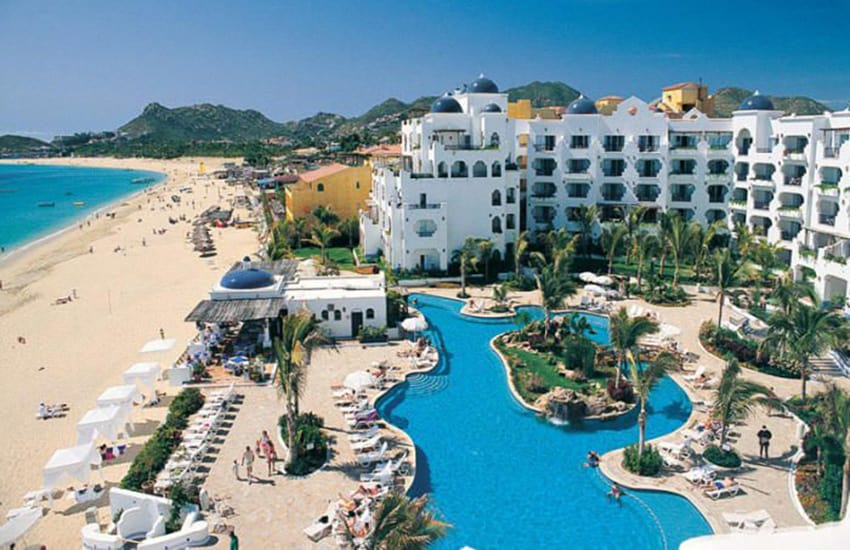
Interestingly, average daily room rates fluctuate significantly depending on where the accommodations are located – at least based on Firtuca’s latest figures for that statistic . Resorts in the Tourist Corridor connecting cape cities Cabo San Lucas and San José del Cabo commanded an average room rate of US $626 in 2023, while rooms in San José del Cabo proper averaged $383, and those in Cabo San Lucas “only” $316.
Hotels located in the popular Tourist Corridor command higher prices than those on the edge of the town. (Los Cabos guide)
Why are Tourist Corridor-based hotel rooms so much more expensive on average? This 20-mile coastal corridor is home to many of the most luxurious properties in the Los Cabos municipality, including exclusive properties like One&Only Palmilla, Las Ventanas al Paraíso, Montage Los Cabos, Esperanza, and Chileno Bay Resort & Residences. Cabo San Lucas, meanwhile, is the site of many of the region’s best budget-friendly hotels.
Fewer domestic travelers are visiting Los Cabos
The total number of passengers who flew into the area through May this year was 1.64 million, a figure down slightly from a year ago. But the reason wasn’t a drop in international visitors. Their numbers have been up, albeit by a fraction of a percent. Rather, domestic travelers accounted for the slight decrease in arrivals.
A little over 544,000 people visited Los Cabos from within Mexico through May, 7.1% less than did so during the same time frame last year. This could suggest a distaste by some Mexicans for the higher hotel rates – Los Cabos, famously, is the most expensive destination in the country. On the other hand, this could be an entirely predictable slide after massive visitation numbers by domestic travelers in 2023. Last year, for example, domestic passenger numbers were up 34.8% in January, 30.1% in February, 27.6% in March, 21.4% in April and 14% in May. Those incredible numbers simply weren’t sustainable.
Despite more international flights, most tourists hail from U.S. or Mexico
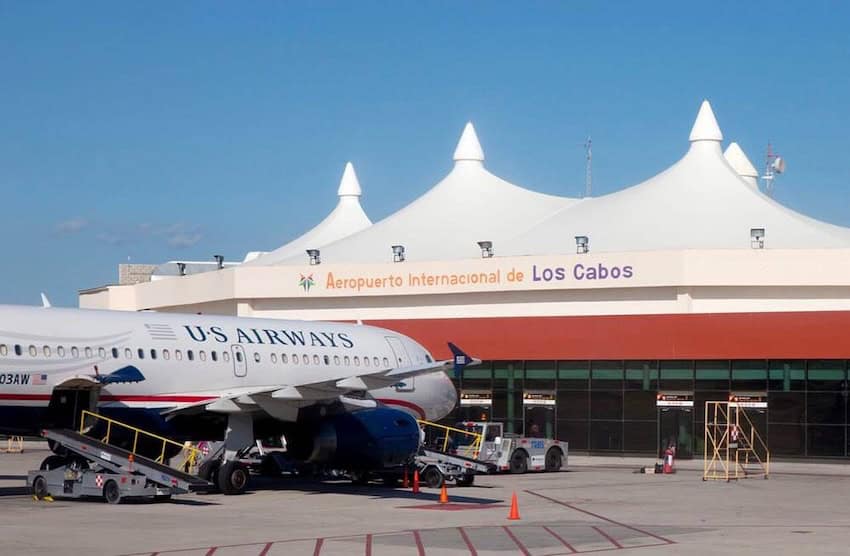
Los Cabos is easier to reach than ever, with flights now available from 30 cities in the U.S., 16 in Mexico, 11 in Canada and two in Europe. The European markets — Frankfurt and Madrid — are an important addition in terms of connectivity but don’t be deceived: the overwhelming majority of tourists coming to Los Cabos in 2024 fly from North American destinations, with nearly 56% of flights originating in the U.S. and 38% from Mexico.
Los Cabos International Airport now sees more international routes than ever – but is anyone actually traveling from Europe? (Trip Support)
These numbers are even more remarkable given that a few select destinations provide most of the traffic. Nearly half of all U.S. visitors fly from airports in California or Texas, with Mexico City the most common debarkation point for domestic travelers.
Cruise ship visits and passenger numbers are down this year
The last two years have been banner ones for the Cabo San Lucas cruise ship economy, as the Land’s End city welcomed 226 ships bringing 540,773 visitors in 2022 and 236 ships carrying a staggering 735,686 passengers in 2023. This year to date has not been nearly as good, with 50 fewer ships visiting through the first four months relative to the same period in 2023.
However, these numbers are not indicative of a long-term trend, at least according to a well-placed source, who credited last year’s robust numbers in part to the slow recovery of other cruise destinations from the COVID-19 pandemic earlier in the decade. Thus, ships not normally dedicated to Mexican Riviera or Cabo San Lucas cruises were rerouted in 2023, benefitting the local market. The good news for Cabo San Lucas is that despite the decline so far in 2024, over 257,000 cruise ship passengers have already visited, and 2025 is expected to be even better.
Visitor projections for the remainder of 2024 and what they mean
Projecting forward, visitor numbers should be close to, if not slightly better than in 2023. Fiturca expects more than a million more visitors from the U.S. to arrive by air before the end of 2024, with nearly 900,000 scheduled from within Mexico. Add that 1.98 million expected airline passengers to the 1.64 that arrived through April and the 302,000 in May and you get 3.93 million total, a number slightly above the 3.86 million who flew in last year.
There’s still plenty of time to buy tickets, too, so the recent streak of record-setting annual totals in Los Cabos looks poised to continue.
Chris Sands is the Cabo San Lucas local expert for the USA Today travel website 10 Best, writer of Fodor’s Los Cabos travel guidebook, and a contributor to numerous websites and publications, including Tasting Table, Marriott Bonvoy Traveler, Forbes Travel Guide, Porthole Cruise, Cabo Living and Mexico News Daily. His specialty is travel-related content and lifestyle features focused on food, wine and golf.