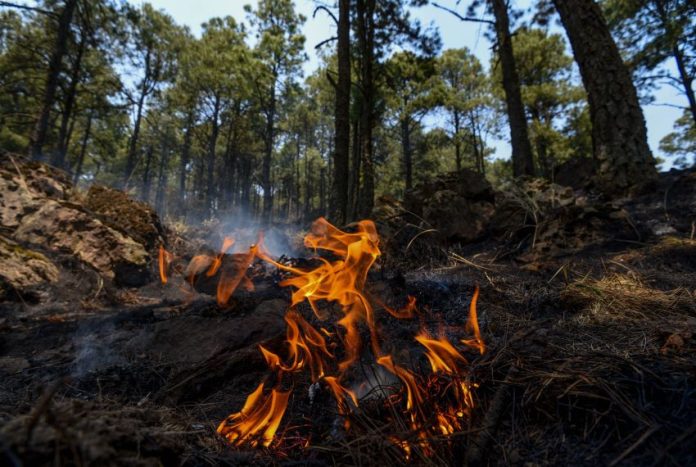
A forest fire in Tenango del Valle was just one of many burning in México state and across the country over the weekend. (Crisanta Espinosa Aguilar/Cuartoscuro)
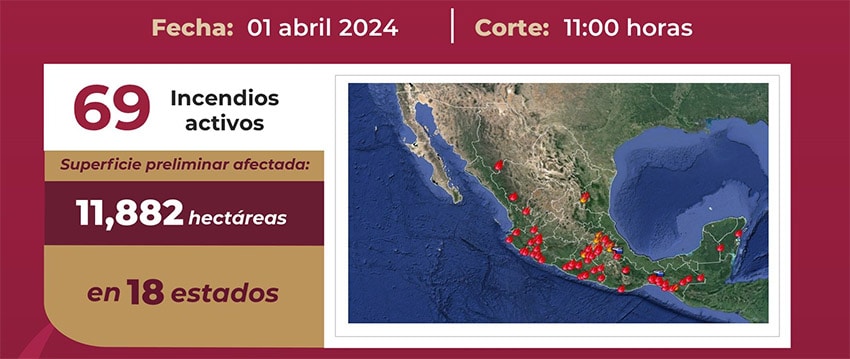
Mexico’s National Forestry Commission (Conafor) reported that 39 forest fires around the country had been extinguished but that 69 were still active as of Monday morning.
A forestry commission graphic shows the location of wildfires still active on Monday. (Conafor)
Earlier Monday, President Andrés Manuel López Obrador addressed the wildfires during his press conference at the National Palace. At that time, his data showed 84 fires were still active.
The nation’s silver-haired leader also took time during his mañanera to deny that Mexico’s more than 100 fires this year have been caused by real-estate developers wanting to build on that land, something he hinted at last week.
“Real estate interests are also always there,” he said on Wednesday. “I don’t rule it out.”
AMLO clarified his statements on Monday by saying, “From what we have investigated, the number of fires has to do with the drought [and] very high temperatures.”
Firefighters try to get ahead of a forest fire in Acapulco’s El Veladero National Park earlier this month. (Carlos Carbajal/Cuartoscuro)
He said it cannot be established that there are “bad intentions of developers who want to burn a forest to establish housing,” adding, “More than anything, it is due to accidents” or “the burning of grasslands for livestock and agriculture.”
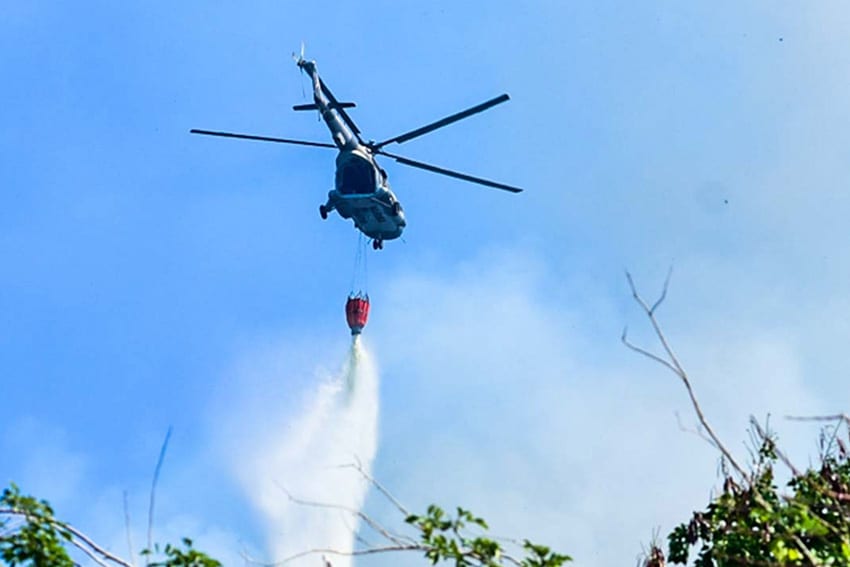
As of last Wednesday, there were a record 120 wildfires burning in 19 states, according to Mexico’s National Forestry Commission (Conafor). The agency noted that 6,195 firefighters and seven helicopter teams were fighting the blazes that had ravaged 7,137 hectares.
On Monday, Conafor posted updated numbers through 11 a.m. that included 69 active fires in 19 states, covering 11,882 hectares and including 12 fires in natural protected areas.
The president noted that the state of México had the most fires with 11, followed by Guerrero with 10.
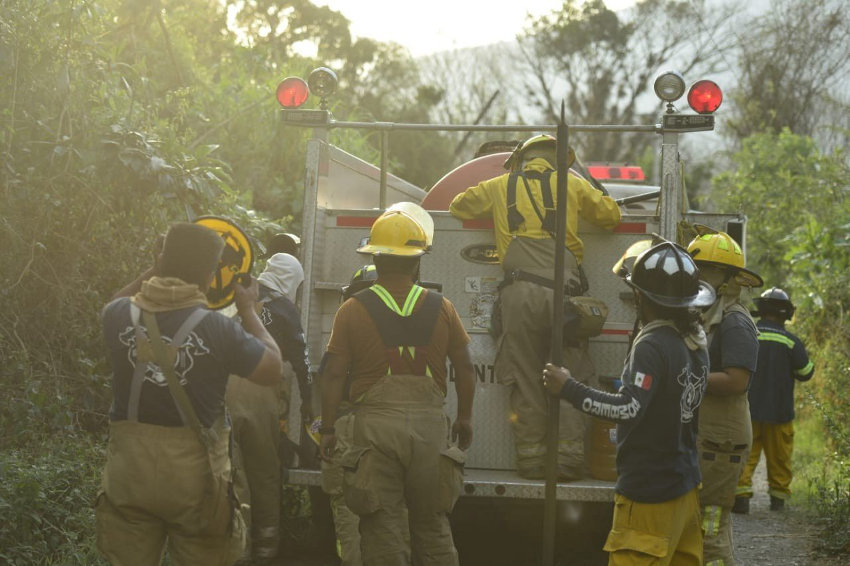
According to his data at the time, 3,845 people were fighting the fires: 723 from the forestry commission (Conafor), 1,045 from the Ministry of Defense (Sedena), 338 from the National Guard, 666 from state governments and 1,073 from other agencies.
Overall, from Jan. 1 to March 21, Conafar said 667 forest fires had been recorded in 23 states, in an area of 22,247 hectares. Last week, there were 20 new fires, mostly in the states of Tlaxcala, Veracruz, Chiapas, Durango and Morelos.
Federal officials say they have ramped up coordination between different government agencies and entities. The synergy has reportedly allowed a rapid response to fire reports, with an average response time of less than 2 hours, even in remote and difficult-to-access areas, according to officials.
As of last Wednesday, there are 1,000 firefighters working to extinguish wildfires in Veracruz. (Cuartoscuro)
In terms of area, the state most affected by the fires is Oaxaca, where 6,633 hectares have burned. México state, Veracruz and Guanajuato have each suffered more than 2,000 hectares of damage.
The natural areas affected include the Nevado de Toluca in central Mexico, the Sierra Gorda in northern Querétaro and neighboring states, the La Sepultura Biosphere Reserve in Chiapas and the El Tepozteco archaeological site in Morelos.
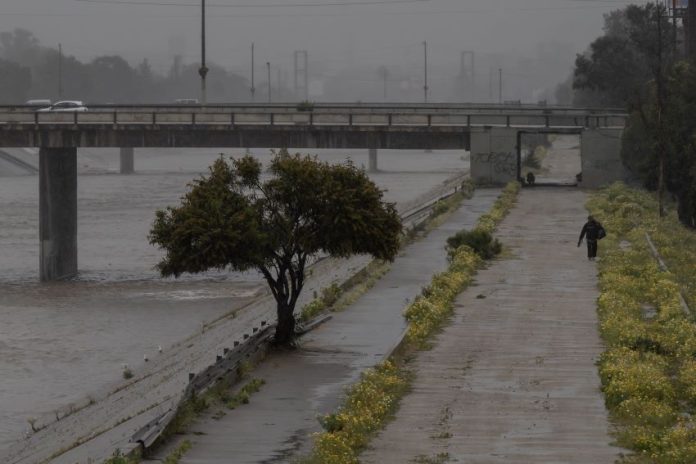
The cold front brought rain to Tijuana over the weekend. (Omar Martínez/Cuartoscuro)
Rain and cold weather are expected in northern Mexico, while central and southern Mexico will continue to experience hot weather, the National Meteorological Service (SMN) reported Monday.
Cold front 43 and the ninth winter storm of the season are expected to persistently advance over the northwest and north of the country this week, according to the SMN.
The forecast for Monday predicts cold to very cold weather in the mountainous regions of Baja California, Chihuahua, northern Durango, northern Sinaloa and Sonora. Minimum temperatures in these regions are expected to range from -10 to 0 degrees Celsius, with frost expected in the mountains of Sonora, Chihuahua and Durango.
Showers and heavy rain are also forecast for Baja California, Baja California Sur, Sinaloa, Chihuahua and Sonora.
The cold front could also bring gusts of wind ranging from 100 to 120 km/h in Chihuahua, Coahuila, and Durango; 80 to 100 km/h in Zacatecas, and 70 to 80 km/hin Sonora and Aguascalientes.
The western coast of the Baja California Peninsula may see waves of 2 to 3 meters high.
While the north cools off, the heat in central and southern Mexico will be intense this week. (File photo)
Hot weather to continue in the rest of the country
Meanwhile, the government of Mexico City has issued a yellow alert due to the forecast of high temperatures ranging between 29 to 31 degrees Celsius.
The yellow alert was issued for the boroughs of Álvaro Obregón, Azcapotzalco, Benito Juárez, Coyoacán, Cuauhtémoc, Gustavo A. Madero, Iztacalco, Iztapalapa, Miguel Hidalgo, Tláhuac, Venustiano Carranza and Xochimilco.
Scorching temperatures between 40 and 45 degrees Celsius are also expected in Nuevo León, Tamaulipas, San Luis Potosí, Nayarit, Jalisco, Colima, Michoacán, Guerrero, Morelos (south), Veracruz, Oaxaca, Chiapas, Tabasco, Campeche and Yucatán.
The states of Coahuila, Guanajuato, Querétaro, Hidalgo, State of Mexico (southwest), Puebla (southwest) and Quintana Roo will also see temperatures reach a maximum of 35 to 40 degrees Celsius.
Despite the heat, most of the country is expected to have cloudy to partly cloudy skies.
Due to the high temperatures, the population is advised to take preventive measures such as staying hydrated and closely monitoring chronically ill people, children, and older adults. Authorities also recommend avoiding eating street food as the heat will increase the risk of foodborne illness.
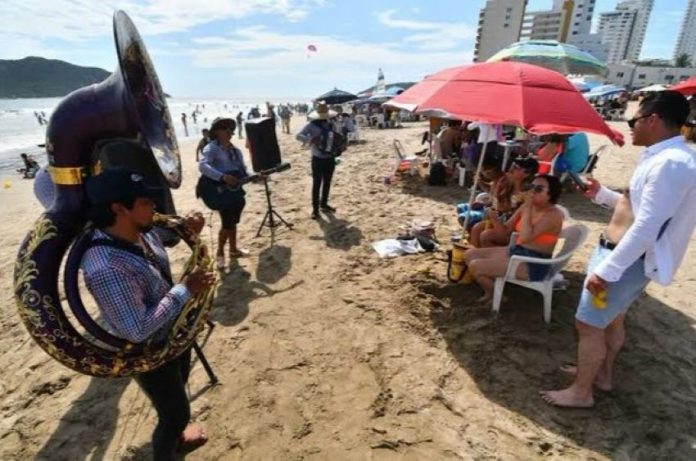
Banda musicians play for tourists on the beach in Mazatlán. (Máscara Roja/X)
President López Obrador on Monday expressed his support for musicians in Mazatlán who took to the streets last week to defend their right to play on the beaches in the Sinaloa resort city.
The banda sinaloense musicians have “every right” to protest, López Obrador told reporters at his morning press conference.
One hotel owner, Ernesto Coppel, said he had received hundreds of complaints from American tourists about excessive noise.
He asserted that loud music is causing “tremendous damage” to Mazatlán, but many locals pointed out that banda has been played in the city — and on its beaches — for generations. They also noted that the genre is an important part of local culture.
The Mazatlán mayor said late last week that local authorities had issued more than 50 permits authorizing bands to play on the beaches, and announced that musicians had agreed to not perform late at night or early in the morning.
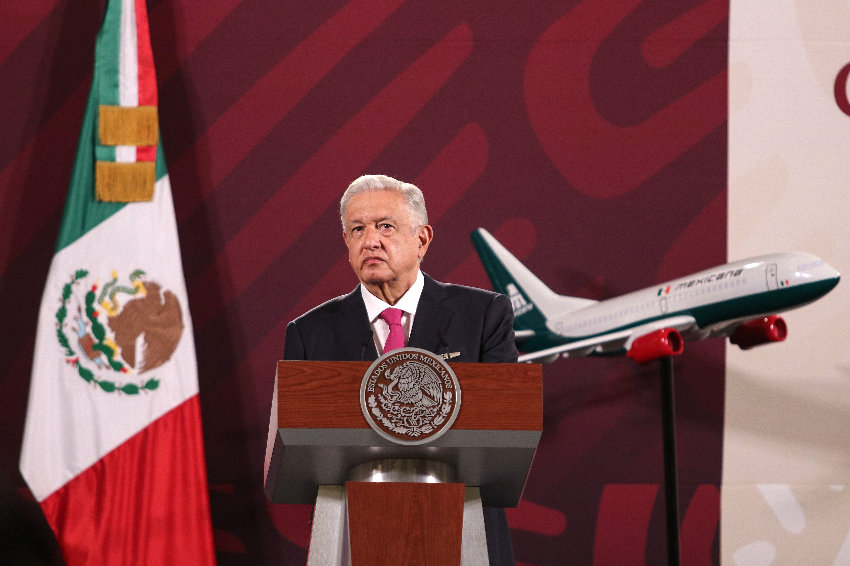
The president commented on the controversy at his Monday morning press conference. (Lopezobrador.org.mx)
Asked about the issue on Monday, López Obrador said that “the people are very aware and are defending their rights.”
“They wanted to ban … the bands and the musicians objected,” he said.
“I believe they objected because they live from … [their music] and also because it has been a tradition for a long time — centuries. That’s why they mobilized,” López Obrador said.
The president noted that a group of hoteliers — who banded together in an “anti-noise alliance” — called for live music to be prohibited on Mazatlán’s beaches. “Perhaps” municipal authorities didn’t respond quickly enough to their request to put the issue to bed, he said.
“And it became a very peculiar protest of bands. There was music for three or four days in Mazatlán. That’s the way people are — very aware. What’s not good is violence,” López Obrador said, apparently acknowledging that there were clashes between protesters and police.
“But the bands of Sinaloa or the musicians from the bands of Sinaloa protest have every right to protest,” he said.
Private companies made a total of 73 investment announcements in the period and their projects are expected to generate 39,192 jobs, the SE said.
Well over half of the total investment — 57% — will come from the United States, Mexico’s largest trade partner and source of FDI. Mexico’s next biggest investors based on announcements made so far this year are Germany (17% of the total), Argentina (14%) and China (6%).
The lion’s share of the money — 54% — will go to the manufacturing sector, while the mass media, commercial and transport sectors are set to get 16%, 15% and 14%, respectively.
The majority of the promised investment is destined for the manufacturing sector (Gob MX)
The SE highlighted that 18% of the new investment will go to Querétaro, 14% to México state, 10% to Nuevo León and 5% to Puebla. The other 53% will be divided between other states.
The ministry also highlighted five “main” investment announcements in early 2024. The companies that made them were:
Earlier this year, the SE said that investments announced by Coca-Cola bottler and convenience store owner FEMSA ($9.96 billion); Amazon Web Services ($4.96 billion); and DHL Supply Chain ($4 billion) were the three largest in 2024.
They remain the top three investment announcements of 2024, while Mercado Libre and Walmart occupy fourth and fifth place, respectively.
The FDI announced in the first 2 1/2 months of the year is only $4.55 billion less than the total investment recorded in 2023. FDI in Mexico was $36.06 billion last year, according to preliminary SE data, although investment announcements totaled well over $100 billion.
While Mexico is benefiting now from the growing nearshoring trend, it can expect to see more concrete benefits in coming years as the investment recently announced by foreign companies begins to flow into the country.
Scores of companies — including automakers Tesla and Kia, steelmaker Ternium and energy firms Mexico Pacific Limited and Woodside — made multi-billion-dollar investment announcements last year.
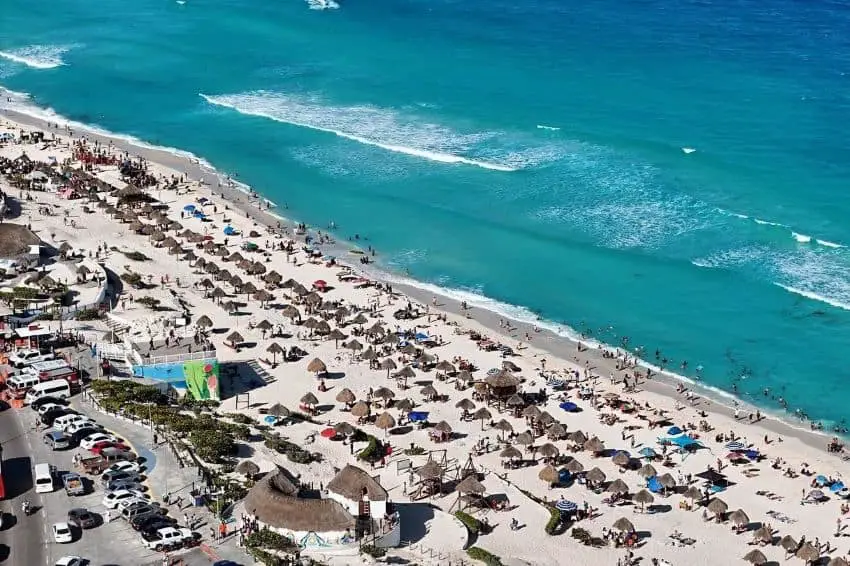
The record number of visitors was 4.2% more than the same week last year. (Mara Lezama/X)
Tourists came to the state of Quintana Roo in droves last week, setting a new Easter vacation record in the process.
Governor Mara Lezama on Sunday announced that an estimated 1.2 million visitors had arrived during Holy Week (Semana Santa), to sunbathe on the pristine beaches, explore the Maya ruins and take in the nightlife at the state’s 12 tourism destinations.
The spring break influx was facilitated by an increase in the number of international flights arriving daily to Cancún, Chetumal, Cozumel and the new international airport in Tulum. (Mara Lezama/X)
The spring break influx was facilitated by an increase in the number of international flights arriving daily to Cancún, Chetumal, Cozumel and the new international airport in Tulum.
On Saturday, more than 730 flights — domestic flights included — touched down in the state.
The record number of visitors was 4.2% more than the same week last year, Lezama said in a post on X. State Tourism Minister Bernardo Cueto Riestro estimated that the vacation period will generate nearly US $1.3 billion in revenue.
Quintana Roo carried out a massive security operation to ensure a safe experience for tourists, with 2,000 police and security agents as well as K-9 units patrolling the state across police units, quad bikes and a helicopter.
“We are very grateful to all those who helped enhance Quintana Roo’s tourism sector which is the livelihood of thousands of families here,” Lezama said. “We are also grateful to all the visitors who chose Quintana Roo as their vacation destination … solidifying our status as the jewel of the Mexican Caribbean.”
State officials reported that hotel occupancy hit 85%, with Lezama asserting that 110,500 of the state’s 130,000+ hotel rooms were booked during Holy Week.
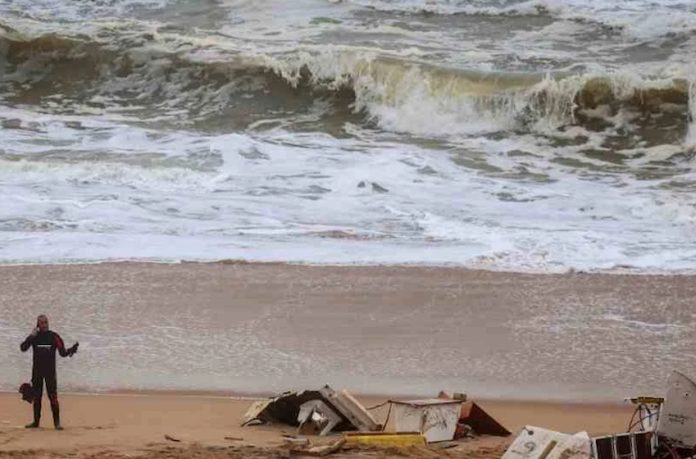
One migrant survived the accident at sea that killed eight. (@mexnewz/X)
The bodies of eight Chinese migrants were found on a beach in Oaxaca on Friday after the boat in which they were traveling capsized, state authorities said.
The Oaxaca Attorney General’s Office (FGE) reported that seven women and one man were found dead on Playa Vicente, a Pacific coast beach in the Isthmus of Tehuantepec region of Oaxaca.
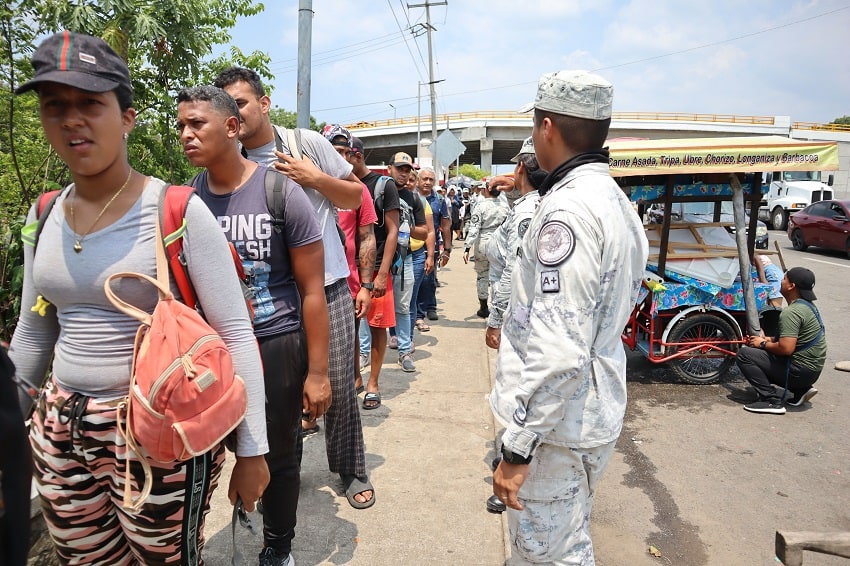
The Chinese migrants were traveling from Tapachula, Chiapas towards Oaxaca. (Damián Sánchez/Cuartoscuro)
The migrants had been traveling on a boat operated by a Mexican man that left Tapachula, Chiapas, last Thursday, according to a Chinese man who survived the accident.
The FGE didn’t say what happened to the Mexican captain. In a statement on Saturday, it said it was working with federal authorities and the Chinese Embassy in Mexico to identify the eight Chinese victims.
At a press conference on Monday, a spokesperson for China’s Ministry of Foreign Affairs said that China was “paying close attention” to the incident in Oaxaca last Friday.
“The Chinese Embassy in Mexico is in close touch with the Mexican side to further verify the information of the deceased and provide assistance to the surviving Chinese national. It has requested the Mexican side to speed up the investigation into the incident and sent a working group to the site of the incident,” said Wang Wenbin.
The intended final destination of the vessel is unclear, but it was possibly heading all the way to the United States.
“Treacherous boat rides up the coast of Mexico are often used by migrants hoping to cross into the U.S. in an attempt to bypass checkpoints on closely monitored land routes,” reported CNN, which described the sea route as “popular but perilous.”
The deceased Chinese migrants almost certainly entered Mexico from Guatemala before paying a migrant smuggler to transport them north by sea. The municipality of Tapachula is located just north of the border with the Central American nation.
The number of Chinese nationals entering Mexico en route to the United States has recently surged.
United States government data shows that more than 37,000 Chinese migrants were detained after entering the U.S. via its southern border without authorization in 2023, a figure almost 10 times higher than that recorded the previous year. An average of just 1,500 Chinese nations per year were detained by United States authorities at or near the U.S.-Mexico border during the decade before 2023.
The New York Times reported in December that “a growing number of Chinese” had entered the United States in 2023 “through the Darién Gap, exceeded only by Venezuelans, Ecuadoreans and Haitians, according to Panamanian immigration authorities.”
The Darién Gap is a jungle region amidst which the border between Colombia and Panama is located. If they are able to get through the treacherous jungle, migrants still face a long and dangerous journey via Central America and Mexico to get to the United States, whose government has recently pressured its Mexican counterpart to do more to stem northward migration.
The Times reported that Chinese migrants — both affluent people who seek to migrate legally to the U.S. and poorer folk who attempt to reach the country via the Darién Gap and Mexico — are escaping “bleak economic prospects and political oppression” in China.
Ian Johnson, senior fellow for China studies at the Council on Foreign Relations, said in February that “economic reasons” are the main driver of Chinese migration.
The wave of migration from China to the U.S. — via Mexico in a growing number of cases — is “likely to continue for the next several years,” he said.
The new flights will depart from AIFA in Mexico City and Miguel Hidalgo y Costilla International in Guadalajara. (Mara Lezama/X)
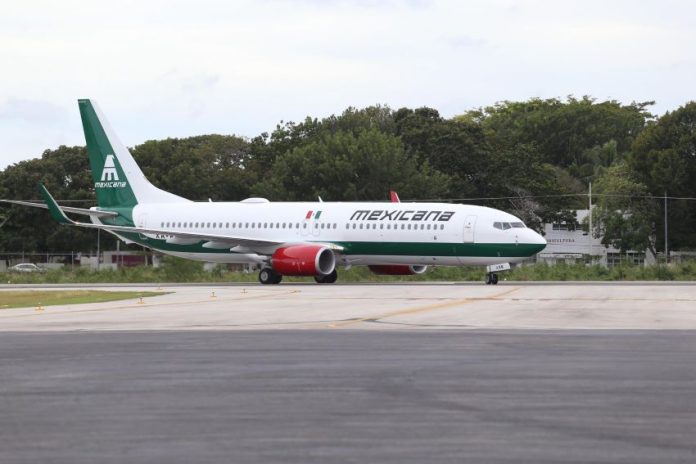
State-owned airline Mexicana de Aviación will now offer flights to Los Cabos, Baja California Sur. On Monday, April 1, the airline inaugurated Los Cabos-bound flights from Felipe Ángeles International Airport near Mexico City (AIFA) and the Miguel Hidalgo y Costilla International Airport in Guadalajara (GDL).
Los Cabos was initially to be included as one of Mexicana’s inaugural destinations. However, aircraft operation problems and administrative issues prevented its connection with AIFA.
Mexicana, only three months after launching, was slapped with a lawsuit on Wednesday for US $840 million. (Cuartoscuro)
Mexicana is supposed to offer the most affordable flights on the domestic market, with average prices 20% lower than those of its main competitors. According to its website, the round-trip flight between AIFA and Los Cabos starts at 1,149 pesos (US $68) while the flight between AIFA and GDL starts at 899 pesos (US $53). The first route from AIFA has a stopover in Guadalajara.
Flights from AIFA will operate on Mondays, Thursdays, and Sundays, while flights from GDL will also operate on Sundays.
Mexicana, once the country’s flagship airline, relaunched operations on Dec. 26 with an inaugural flight to Tulum, Quintana Roo, after the government acquired the brand. It is based at both AIFA and the new Tulum International Airport and run by the Olmeca-Mexica-Maya company, a military-run firm.
Since its acquisition, the airline has faced several challenges including obtaining sufficient planes for its fleet. On March 27, a Texas-based company hired by the Mexican government to provide a range of services to Mexicana de Aviación, including obtaining aircraft, sued the airline in a New York court for US $840 million, accusing it of various breaches of contract.
The airline currently services 17 other destinations in Mexico.
All 34 citizens had requested to leave the Caribbean nation. (Alicia Bárcena/X)
Due to the deteriorating political and security situation in Haiti, Mexico staged an operation early Sunday morning to evacuate 34 Mexican citizens aboard a military ship.
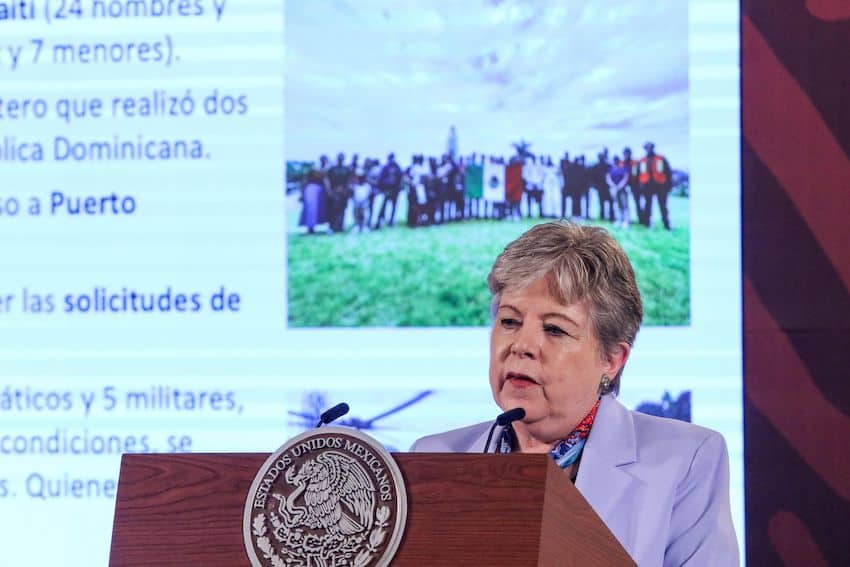
The group included 24 women and 10 men, of which seven are minors and four are diplomatic officials, according to statements from Foreign Minister Alicia Bárcena during President Andrés Manuel López Obrador’s Monday morning press conference.
Foreign Affairs Minister Alicia Bárcena revealed the details of the special operation during the president’s Monday morning press conference. (Moisés Pablo/Cuartoscuro)
The United Nations Human Rights Office stated on Thursday that Haiti, where violence has killed more than 1,500 people so far this year, is experiencing a “cataclysmic situation” that has brought the turmoil-stricken Caribbean nation “close to collapse.”
The New York Times cited “corruption, impunity and poor governance, together with increasing levels of gang violence” since late February, when several gangs joined forces to attack strategic locations in the capital.
A major factor behind the Mexican rescue operation was “the illicit control that armed groups have over the Toussaint Louverture International Airport” in Port-au-Prince, according to a statement from the Foreign Affairs Ministry (SRE), a situation that “prevents civilians from leaving.”
SRE cited other “violent acts” and “threats to keep the country paralyzed” as reasons behind what Bárcena called “a special operation” by the Mexican Navy.
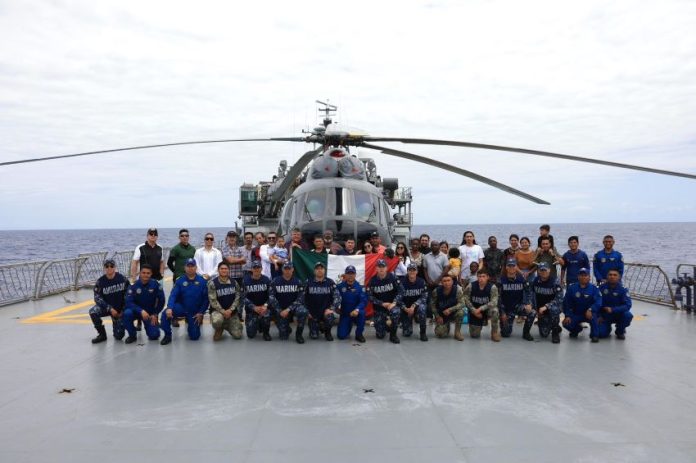
To rescue the 34 Mexican nationals who were in “a risky situation,” according to López Obrador, Mexico sent a Navy ship into waters near Haiti. The operation began at 4 a.m. on Easter Sunday, according to officials.
The Mexicans were taken by helicopter to the ship, and were due to arrive soon at Puerto Progreso, Yucatán, according to Mexican officials on Monday morning.
The operation was ordered by López Obrador, who noted, “We did a survey in Haiti to see who wanted to return, and everyone who returns does so voluntarily.”
SRE noted that the somewhat secret operation — it was not announced in advance — was conducted by personnel from SRE and the Navy (SEMAR). It was undertaken in response to a situation in Haiti that includes “shortages of food and basic products, economic paralysis and closure of public services.”
The Mexicans were transferred in two flights by a Navy MI-17 helicopter from the heliport of the Dominican Republic Embassy in Port-au-Prince. The Navy ship ARM Holbox Island was used in the operation (ARM stands for “Armada de México,” in much the same way USS is used to connote “United States Ship”).
The Mexican ambassador in Haiti, Daniel Cámara Ávalos, helped coordinate the operation with SRE and SEMAR.
The SRE statement noted that the Mexican Embassy in Port-au-Prince will remain open “with a minimum number of officials to protect the facilities and serve the compatriots who decided to remain in the Caribbean country.”
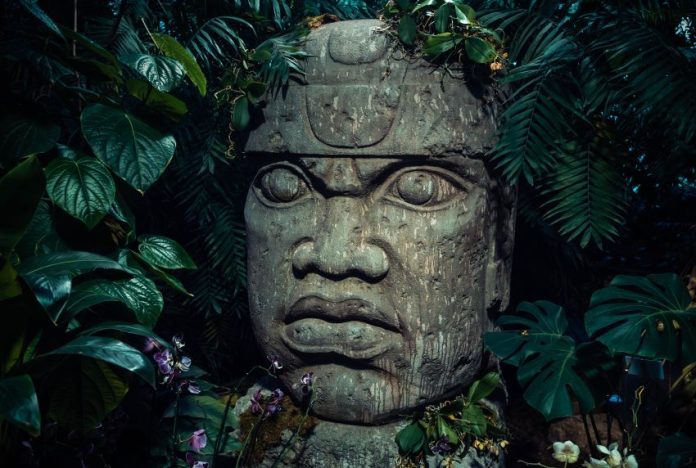
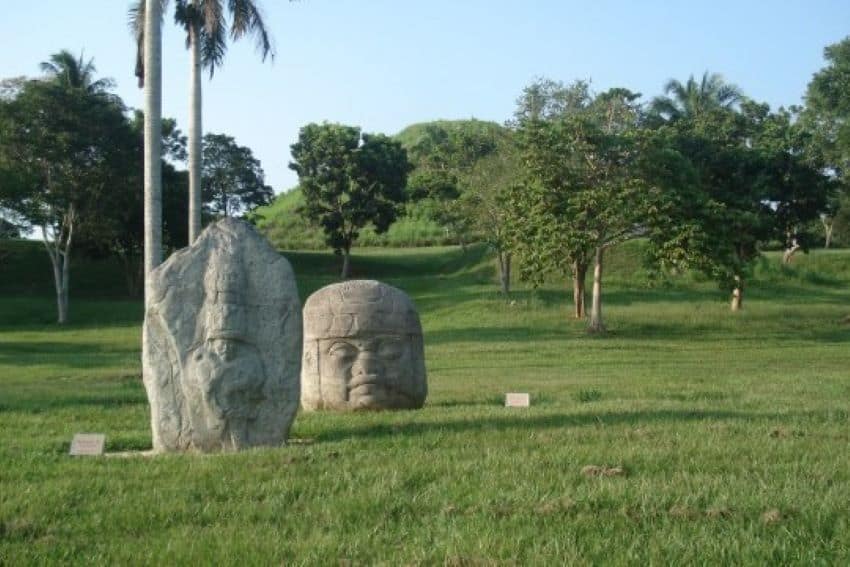
Mexico's Olmecs are considered the "mother culture" of the Americas, and their monuments still stand today. (Shutterstock)
Did you know that Mexico ranks among the oldest civilizations in the world as it was home to the Olmecs, dating back to 1200 B.C.?
The Olmecs influenced various Mesoamerican cultures in modern-day Mexico and Central America, defining everything from religious practices to urban settlement patterns, architectural styles, and trade routes.
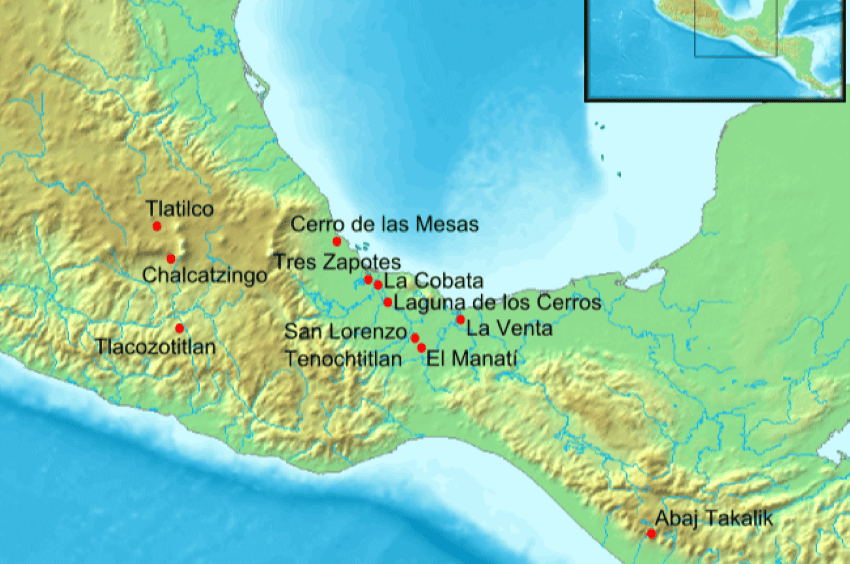
Major Olmec sites across central and southern Mexico. (Wikimedia Commons)
Artifacts found at Olmec sites place the culture among the earliest cradles of civilizations, alongside cultures in Iraq, Egypt, India, China, and Peru.
The Mother Culture of Mesoamerica
The Olmec culture, known as the “Mother Culture,” laid the early foundations that influenced the subsequent cultures of Mesoamerica. It emerged during the Preclassical Mesoamerican period (2500 BC to 200 AD) in what is today the southeast of Veracruz and western Tabasco in the Gulf of Mexico.
Because it is unknown how this civilization referred to themselves, the name “Olmec” was given by archaeologists based on the presence of rubber in the areas where this civilization thrived. It is derived from the Nahuatl (Aztec) word “Olmecatl,” which means “inhabitant of the rubber country.”
Both the cultural characteristics and artistic style of the Olmecs extended beyond the Gulf region, spreading from the Mexican states of Morelos to Guerrero and Chiapas to the Guatemalan Pacific coast and Costa Rica. This prevalent influence may be attributed to the extensive trade network established during that period.
Contributions of the Olmecs
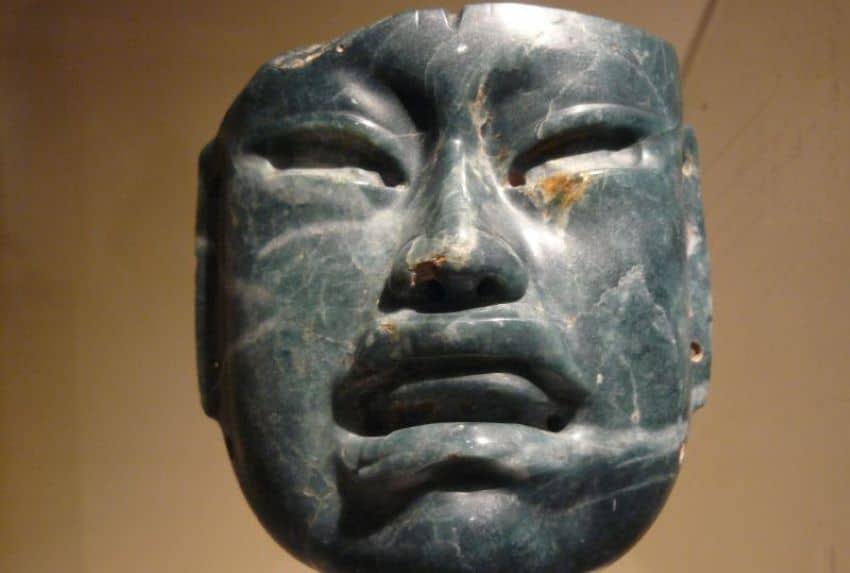
An Olmec mask made of jade. Like many European and Middle Eastern civilizations of the time, the Olmecs were skilled craftsmen. (Wikimedia Commons)
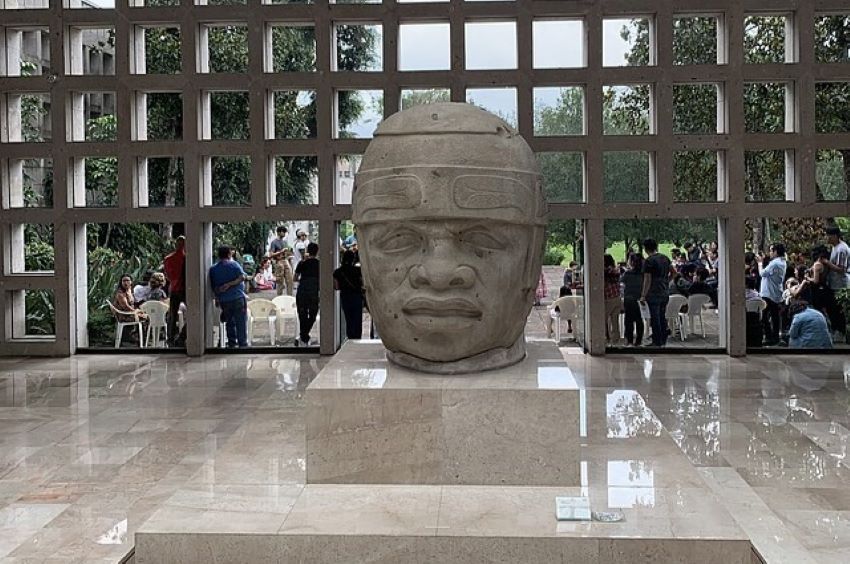
Art: The Olmecs are noted for their colossal basalt heads, raging between 8 to 9 feet tall and weighing 20-40 tons. These uniquely Olmec monoliths have striking facial features and appear to be wearing helmets.
Other colossal sculptures include altars, stelae (upright slabs), and statues.
Sports: As the oldest culture on record in the Americas, experts believe the Olmec invented the ball game or pok-ta-pok, a ceremonial team sport played by Mesoamerican civilizations, including the Maya and the Mexica.
Writing and science: The Olmecs are also credited with the creation of writing and epigraphy in the Americas, as well as the development of calendars, which later influenced cultures such as the Maya and Nahua. Scientists also believe that the Olmecs were the first Mesoamerican people to understand the concept of zero.
Religion: the Olmecs introduced the cult of the jaguar, which is present in all Mesoamerican cultures.
Urbanism: the Olmecs built what archaeologists consider the first planned city in pre-Hispanic Mexico: La Venta in Tabasco. Beyond its architectural achievements, the famous Olmec heads were unearthed in the city.
Additionally, they are credited with discovering the first conduit drainage system in the Americas.
La Venta’s monumental earthen architecture, great sculptural collection, jade artifacts, and massive offerings are unique in the pre-Hispanic world.
Other important Olmec archaeological sites include San Lorenzo (the oldest Olmec city) and Tres Zapotes (the last Olmec city) in Veracruz.
Complex B of the archaeological site of La Venta. The city is believed to have been a major stoneworking site, due to the carved heads and statues found in various states of completion. (INAH)
Pre-Columbian cultures influenced by the Olmecs
Despite the Olmecs’ intellectual and cultural achievements, their culture declined significantly between 400 and 350 B.C. for unknown reasons. However, other cultures rose after the Olmecs, further enriching Mexico’s historical wealth.
Next is a timeline of the most important pre-Columbian civilizations that followed the Olmec in today’s Mexico.
Zapotec (200 B.C. – 500 B.C.)
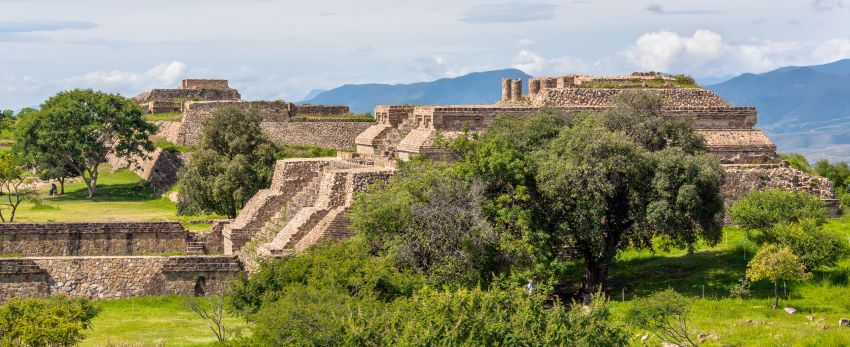
The Zapotecs, known as Ben Zaa in their language (“the people of the clouds,”) are the oldest group in the Oaxaca region. Their main city was Monte Albán, now one of Mexico’s most visited archaeological sites.
The Zapotec city of Monte Alban, in Oaxaca, is one of Mexico’s major tourist attractions. (Vadim Petrakov/Shutterstock)
Maya (350 B.C. – 1697 A.D)
This is one of the best-known cultures of Mesoamerica. It developed over an approximate area of 325,000 km2, covering parts of Chiapas, Tabasco, the Yucatan Peninsula, and part of Central America. They survived until contact with the Spanish, after which point their empire quickly declined.
One of the 7 New Wonders of the world is the Maya archaeological site of Chichen Itzá.
Teotihuacán (100 B.C. – 600 A.D.)
The Teotihuacán culture thrived in the Teotihuacán Valley, central Mexico. Their city, Teotihuacán, is considered one of the most intricate cities of the ancient world. This culture is recognized for controlling the deposits of obsidian, the most precious commodity of the time in Mesoamerica.
Toltecas (800 A.D. – 1200 A.D.)
An Olmec head in the Museum of Anthropology of Xalapa. (Wikimedia Commons)
Known as the “master builders” of Mesoamerica, the Toltecs capitalized on the decline of Teotihuacan to strengthen their power. Their influence spread throughout the central plateau in what is today Tlaxcala, Hidalgo, Ciudad de México, Mexico state Morelos and Puebla.
Mexica (1345 – 1521)
After a group of Mexica (also referred to as Aztecs) departed from the mythical Aztlan and settled in Tenochtitlán (present-day Mexico City), the Mexica empire was established. This civilization is the most extensively documented in all of Mesoamerica and was the largest empire of the time.
The fall of Tenochtitlán in 1521 resulted in the fall of all other pre-Columbian civilizations to the Spanish crown. From the ruins emerged the new capital of the colony of New Spain, marking the end of a long line of Mesoamerican civilizations that started with the mother culture of them all: the Olmecs.
Gabriela Solis is a Mexican lawyer turned full-time writer. She was born and raised in Guadalajara and covers business, culture, lifestyle and travel for Mexico News Daily. You can follow her lifestyle blog Dunas y Palmeras.
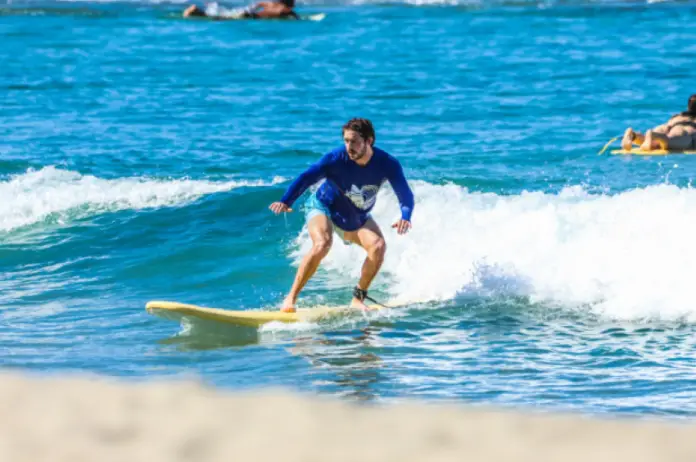
Fancy trying surfing for the first time? Oaxaca has some of the best waves in the world, and Puerto Escondido has no shortage of surf schools to help you learn. (All photos by Ian Ostroff)
Want to learn how to surf but have no idea where to begin? Maybe you’ve seen photos and videos of people catching monster waves on Mexican beaches in Los Cabos and questioned how they do it so effortlessly. That was me before I arrived in Puerto Escondido for my first lesson.
I can’t say I’m ready for the big waves at places like Zicatela Beach after one week of surf school. But there are enough beaches in this part of Oaxaca that perfect for beginners looking to learn how to surf for the very first time.
The beaches of Puerto Escondido are the perfect place for beginners to get to grips with an incredible sport.
In my experience, you’ll also have a great time while developing your new skills and confidence in this sport. That’s what counts the most at the end of the day, right?
Surfing isn’t easy. From basic techniques and safety rules to reading waves, and knowing which beaches to practice on, it can be overwhelming at first. But considering Puerto Escondido’s history, there’s no better place to learn in Mexico.
Where to take classes & potential costs
Puerto Escondido has been a popular surf town for decades, and that means there are endless surf schools and instructors to choose from when shopping for lessons.
There was a moment during my third class when I saw a young father and his newborn son going far out into the water of Playa Carrizalillo. Noticing how surprised I looked, my surf coach smiled and told me matter-of-factly: “In Puerto Escondido, you learn to surf before you can walk.”
Chingón Surf School is great with beginner surfers.
The company that helped me go from beginner to surfing small to medium-sized waves within five days was Chingon Surf Lessons. But if you walk along the path towards La Punta Beach, you’ll find a plethora of options that may be right for you.
Expect to pay anywhere between $800-900 pesos per lesson. Typically, they last about two hours, which includes the use of a surfboard and a certified instructor assigned to be your guide for the morning or afternoon.
How long does it take to learn the art of surfing?
From the way you position yourself on the board to knowing when to dive under the water to avoid getting injured by the rough waves you’ll find in Puerto Escondido, there’s a lot to understand.
Granted, the technical aspects of surfing and basic safety rules are things your coaches will go over with you before getting into the ocean. But there’s a difference between knowing in theory and real-world practice.
If your footwork isn’t fundamentally sound on the board, you’re going to fall off when trying to catch a wave. If you don’t position your hands in a push-up position or get up on the board too late or too early, you’ll also dive straight into the water. There are also unexpected things you need to know once you’re practicing this sport.
Preserving your energy between waves is a big one.
Swimming against the current for two hours or for however long your session is can be exhausting. Battling aggressive waves coming your way as you swim, shredding water, and handling your board, can result in increasing physical and mental fatigue.
I learned the hard way in my second lesson, in particular, when the waves at La Punta Beach weren’t giving me a break. Let’s just say, I took plenty of falls and hits that day.
Nothing is more satisfying than a successful day of surfing, especially when you’re still learning the ropes.
But once I took my time to swim back into the surf lineup, as well as resting on my board when the tide was calm, I found myself paddling less and having the strength to handle more waves and grow my confidence.
All-in-all, a week of consistent lessons is enough to learn the art of surfing. It’ll take more time to become a seasoned pro if those are your goals, but you’ll at least have a good foundation and be able to go out on small to medium-sized waves.
Beginner-friendly beaches to practice your new sport
Puerto Escondido is best known for its powerful waves at Playa Zicatela, but if you’ve done a week of intensive surf lessons like I have and feel confident to practice on your own, there are two solid options: La Punta Beach and Playa Carazalillo.
Even though it’s hard to predict how the waves will be on any given day, these beaches are welcoming to all levels. You see plenty of surf students like myself and their coaches there almost daily, which is reassuring.
Playa Carizalillo is a great place to get to grips with the waves in a relatively calm bay.
If I had to pick one, however, I’d say Playa Carazalillo is the most beginner-friendly beach to surf in Puerto Escondido. It’s also a beautiful place to hang out after your surf session is done.
There is a good balance of small to medium-sized waves that come your way here, and it’s easy to avoid falling on rocks since the water is so clear.
La Punta Beach is another good choice. The only difference is there are slightly more people in the surf lineup and sometimes big waves that appear out of nowhere. But if you’re aware of this beforehand, you’ll be more than okay.
Ready to start your surfing journey?
If anyone tells you surfing is easy, they’re lying — even if that person happens to be Laird Hamilton. But if you learn the technical aspects of the sport and practice enough, there’s no reason why you can’t enjoy days out on the waves sometime in the future.
My surf coach once told me there’s not much to do in Puerto Escondido other than to go surfing in the morning and relax in the evening. Even though I slightly disagree — it’s a popular checkpoint for young backpackers and spiritual types who have no interest in surfing — there is some truth to the coach’s words. Having spent over a week in this Oaxacan paradise, there’s no activity I’d recommend more.
Ian Ostroff is an indie author, journalist, and copywriter from Montreal, Canada. You can find his work in various outlets, including Map Happy and The Suburban. When he’s not writing, you can find Ian at the gym, a café, or anywhere within Mexico visiting family and friends.