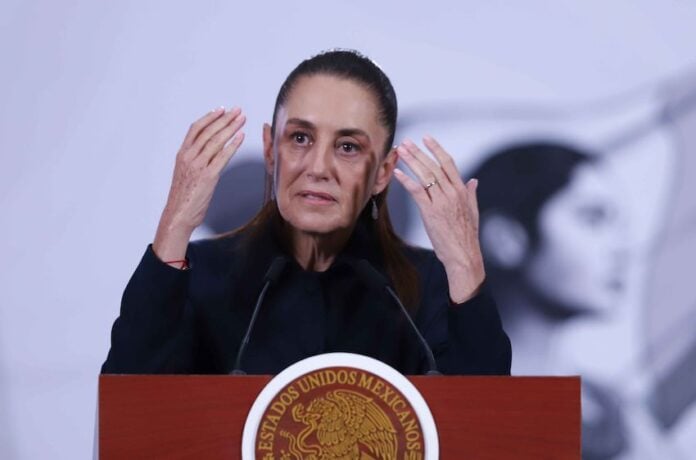
"Not agreeing with the government is one thing ... and another very different thing is to speak [badly] about Mexico," President Sheinbaum said on Wednesday. (Graciela López/Cuartoscuro)
Sheinbaum’s mañanera in 60 seconds
✈️ State airline hits 1 million tickets: Mexicana has sold 1.02 million tickets and carried 953,624 passengers since launching in December 2023, boasting a 95% passenger satisfaction rate. Seven new Embraer planes arrive this year, with new AIFA routes planned to Acapulco (June) and Hermosillo (July).
🎙️ Sheinbaum slams opposition’s U.S. media appearances: The president criticized Mexican politicians who appear on U.S. television to “speak badly of Mexico” and call for U.S. intervention, calling the behavior unpatriotic and a threat to national sovereignty.
🗳️ Right returning to power? Very unlikely, says Sheinbaum: Asked about the political opposition’s chances at upcoming elections, Sheinbaum cited polling and improvements in living standards as evidence that Morena’s grip on power remains firm.
Why today’s mañanera matters
The director of Mexicana got the opportunity to talk up the state-owned commercial airline at President Claudia Sheinbaum’s Wednesday morning press conference.
Also of note at today’s mañanera were Sheinbaum’s criticism of politicians who speak ill of Mexico, and her assessment of the future electoral prospects of Mexico’s political right.
Mexicana has sold more than 1 million tickets in 2 years
Two years and three months after the state-owned commercial airline Mexicana began operations, director Leobardo Ávila Bojórquez provided an update on the carrier’s “situation.”
State-owned Mexicana Airlines is reaching its millionth passenger after two years of operations. (Solojaynvm/Wikimedia Commons)
He said that since December 2023, the airline has sold 1.02 million tickets, transported 953,624 passengers and flown 14,473 flights. Data presented by Ávila showed that Mexicana has a 95% satisfaction rating among passengers. In 2025, Mexicana was Mexico’s fifth most popular airline for domestic flights with over 434,000 passengers.
Ávila noted that Mexicana flies to 14 destinations around Mexico, with the Felipe Ángeles International Airport (AIFA) in México state serving as the airline’s hub. Among the destinations the airline serves are Tulum, Puerto Vallarta, Los Cabos, Mérida, Campeche, Ciudad Victoria, Ixtepec, Monterrey, Guadalajara and Tijuana.
Ávila said that Mexicana will receive seven new Embraer planes this year, and add new routes from AIFA to Acapulco in June and AIFA to Hermosillo in July.
Later in the press conference, Sheinbaum said that Mexicana offers “more affordable prices” than other airlines and declared that “its vision is not about profit per se.”
“Obviously, all companies have to be profitable because it’s not about subsidizing state-owned companies,” she added.
Sheinbaum highlighted that Mexican flies to airports that other commercial airlines don’t fly to, and declared that traveling with the state-owned carrier is an “extraordinary experience.”
“I invite you to use Mexicana de Aviación,” she said, adding that the operations of the airline are going “very well.”
Sheinbaum takes aim at politicians who speak badly of Mexico on US television
Sheinbaum told reporters that Mexico is a “free and democratic” country and people can “freely” express their opinions.
However, “what we constantly say here is that not agreeing with the government is one thing … and another very different thing is to speak [badly] about Mexico,” she said.
“I’m very critical of the deputies and senators who go to the U.S. television stations to speak badly of Mexico and to request the intervention of the United States in Mexico,” Sheinbaum said.
Lilly Téllez responde a Sheinbaum y alega que ella ‘no habla mal de México’ en Fox News
Senator Lilly Téllez again took the opportunity to criticize the Sheinbaum administration in the context of the World Cup on Fox News.
“What is that?” she questioned with visible exasperation.
“When had this occurred before? The nerve of it,” Sheinbaum said before accusing politicians who speak badly of Mexico of being unpatriotic and failing to stand up for the country’s sovereignty.
Sheinbaum — who was backed by the leftist Morena party at the 2024 presidential election — is an extremely popular president, with many, but not all, polls consistently finding that she has an approval rating of around 70% or higher.
Since Andrés Manuel López Obrador was elected president in 2018, Morena has been Mexico’s predominant political party. It governs a majority of Mexico’s 32 federal entities and holds majorities in both houses of federal Congress.
By Mexico News Daily chief staff writer Peter Davies (peter.davies@mexiconewsdaily.com)
With the arrival of Holy Week, the Procession of Silence takes center stage in the religious life of parishioners in the Bajío region of Mexico, especially on Good Friday. (DavidTottto/Wikimedia Commons)
AsHoly Week celebrations begin in La Piedad, in the central state of Michoacán, the entire town enters a different, almost funereal, trance. Remembering the biblical passage of Jesus’ death and resurrection, the townspeople adorn the whole city in shades of purple, the preferred color in Catholic tradition for markingfarewell rituals.
Pili Ruiz, 26, was born and raised in La Piedad, one of the largest cities in thestate. Known primarily for its pork-based products, it has established itself as a “regional engine,” notes theMinistry of Economy, “due to its foreign direct investment, agricultural exports and significant international sales in sectors such as plastics and machinery.” Moreover, Michoacán remains one of the most conservative and Catholic states in the country, second only to Guanajuato.
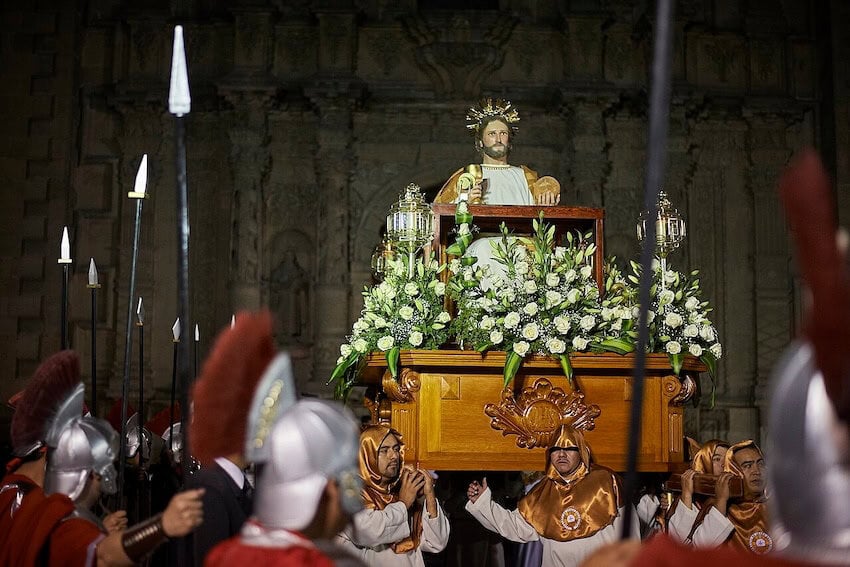
The Procesión del Silencio is a reenactment of the transfer of Jesus’ body to the Holy Sepulchre. (DavidTottto/Wikimedia Commons)
For as long as she can remember, the same ritual has marked her Easter holidays: the Procession of Silence. In an exclusive interview with Mexico News Daily, Ruiz explains the deep community ties that this religious tradition — often harsh in the eyes of foreigners — continues to have in her hometown, as well as throughout the Bajío region of Mexico.
What exactly is the Procesión del Silencio?
“On the day Jesus Christ died, Holy Thursday,” Pili explains, “his body is believed to have remained on the Cross. The Procession of Silence is a reenactment of the transfer of his body to the Holy Sepulchre.” During the reenactment, the woman from La Piedad details, “a statue of Jesus’s body lying down, wrapped in white sheets, is carried.”
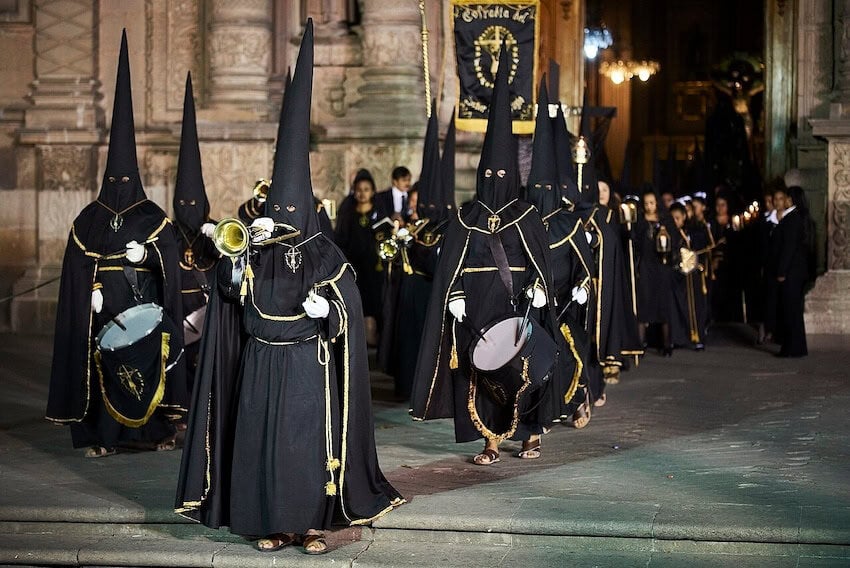
“At the front of the procession is a group of hooded figures carrying incense and a drum, which is the only sound made.” Ultimately, thisfuneral procession should be conducted in complete silence.
These drums are how the townspeople know the Procession of Silence is near and that it is necessary to leave their homes to show due respect to the body of Jesus.
Pili recalls that the Procession of Silence is something that has “existed all (her) life,” for as long as she can remember. On Good Friday, she tells MND, “We would all gather at my aunt’s house and watch from the sidewalk” as the Procession of Silence passed by. Some members of the community would join the procession at the back to accompany the body of Jesus Christ through the city, until they reached the church in the Zócalo.
A syncretic display of faith in Mexico
La Piedad is not the only place in Mexico where this ritual takes place. On the contrary, similar religious practices are found throughout the Bajío region. Specifically in the state of Michoacán, thisCatholic practice is thought to date back to the 16th century, following years of spiritual conquest by the Spanish.
Every few seconds, a hooded figure strikes a drum with a sharp beat to mark the rhythm of the funeral march. (DavidTottto/Wikimedia Commons)
These performances were intentionally somber: they were a way of teaching the new religion to the colonies in Latin America. Through fear and graphic narratives, the spiritual conquest of Latin America produced syncretic celebrations. Many of these traditions also incorporate Indigenous elements, such as the embroidery on the garments of the Virgin Mary and of Jesus himself.
The Procesión del Silencio gained strength in the 19th century, when it spread throughout the country. It is accompanied by antique religious images, most notably the Christ of Sugarcane Paste and Our Lady of Solitude.
Biblical reenactments
This tradition can be traced to Spain, where entire cities halt activities to reenact these biblical passages. Tradition dictates that, before the Procession of Silence, a special mass is held on Holy Thursday, where, Pili says, the Washing of the Feet takes place. This reenactment refers to the moment when, after the Last Supper, Jesus washes the feet of his disciples and friends. Major cities in the Bajío region reenact the Via Crucis, or the path Jesus took to Mount Golgotha, carrying the cross on his back.
After his sacrifice, as per the Catholic tradition in central Mexico, the faithful represent this funerary procession. Some of the most famous performances are in theSan Luis Potosí state, north of Michoacán. However, the version in Iztapalapa, Mexico City, has been recognized as intangible cultural heritage by UNESCO.
Besides being an act of respect and mourning for believers, thesetraditions unite the community under a single rhythm: that of the funeral drum and, sometimes, the cries of the professional mourners. “He died for our sins, he died for our sins, he died for our sins!”
Do people find solace in these impactful expressions of faith?
“For a child,” Ruiz admits, “seeing the figure of a dead person is somewhat frightening.” And it’s no wonder. In many ways, a legacy of the spiritual conquest perpetuated by European invaders, that was the intention of these religious manifestations: to instill fear and anguish among the new faithful. Pili acknowledges that the whole event can be “eerie,” especially during childhood, when kids don’t fully understand what it’s all about. “I feel it’s something very imposing.”
Major cities in the Bajío region reenact these biblical passages as a central part of the Holy Week activities. (DavidTottto/Wikimedia Commons)
Years after experiencing this as a child, Pili no longer identifies as Catholic. Even so, when she’s in her hometown on specific dates, “there are certain religious traditions that my family is very accustomed to participating in … and I feel I have to be a part of them.” Not only that: Pili considers that, because of the close relationship the people of Piedad have with these traditions, they are an “indispensable” part of community life — particularly those related to Holy Week.
This sense of duty prevails in Mexican Catholic communities, particularly in the Bajío region, where conservatism and the Church remain pillars of the social fabric. The weight of tradition compels people to participate “very actively,” says Pili, in these religious events. “It was as if my grandmother and aunts were at a wake. Like, ‘Híjole, there goes Jesus dead. We have to be silent and respectful.'”
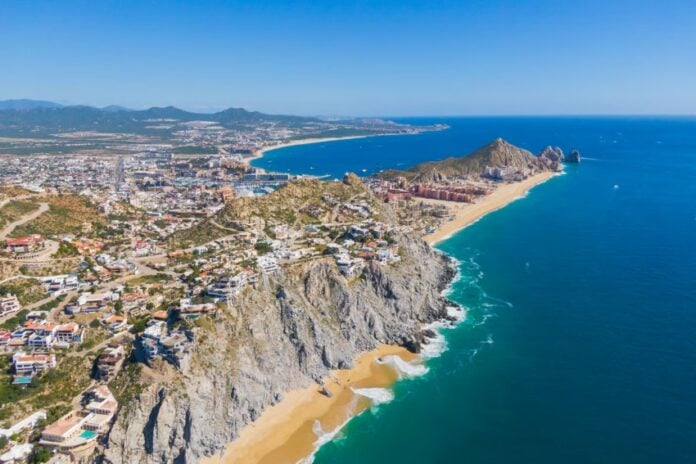
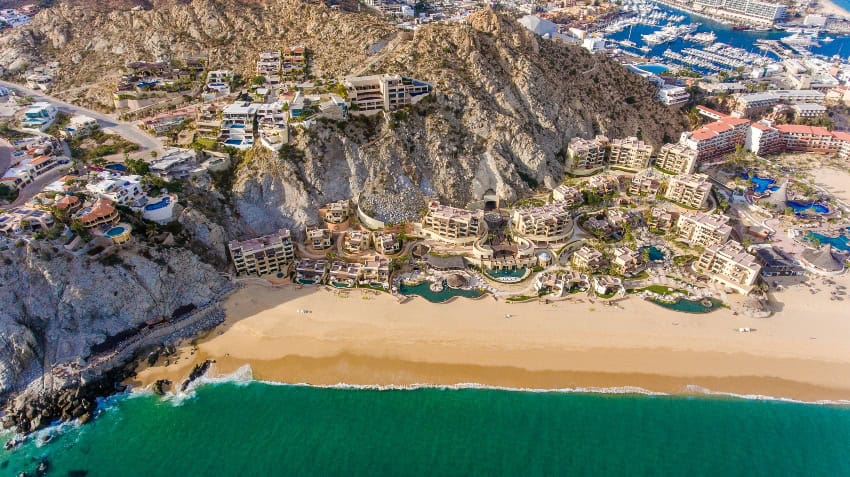
Los Cabos is one of many places vying to attract World Cup tourists, despite not hosting any games. (Coldwell Banker Riveras)
Across 39 days this summer (June 11 – July 19), billions of people around the world will tune in to watch the 2026 FIFA World Cup. Millions more will travel to watch games held around North America, as this year, for the first time, there will be three host countries: the U.S., Canada and Mexico.
Mexico alone is expecting an estimated 5.5 million tourists above average because of the World Cup, according to its Minister of Tourism, Josefina Rodríguez Zamora, and nearly US $3.2 billion in additional revenue. As a result of this influx of tourists and the money it represents, competition is as likely to be as fierce off the pitch as it is on.
Cities hosting games will see the biggest economic impacts from the 2026 FIFA World Cup. (X, formerly Twitter)
The three cities hosting games in Mexico — Mexico City, Guadalajara and Monterrey — are the most obvious destinations in the country to benefit from the World Cup bounty. Mexico City, for example, is expecting between 1.5 and 2 million World Cup tourists, per the city’s Hotel Association, but with an average length of stay of only 1.8 days.
These short, game-focused stays in host cities may be complemented with so-called “second stop” destinations, where tourists can unwind from the excitement of seeing their national teams succeed or fail on the world’s biggest sporting stage with more traditional vacation getaways.
Los Cabos makes its case
The “second stop” concept is not new. It has traditionally been associated with mega-events such as World’s Fairs, Olympic Games, and yes, World Cups. Iconic coastal destinations in Mexico, such as Cancún, Puerto Vallarta and Los Cabos, are all vying to attract “second stop” tourists and are competing to get them.
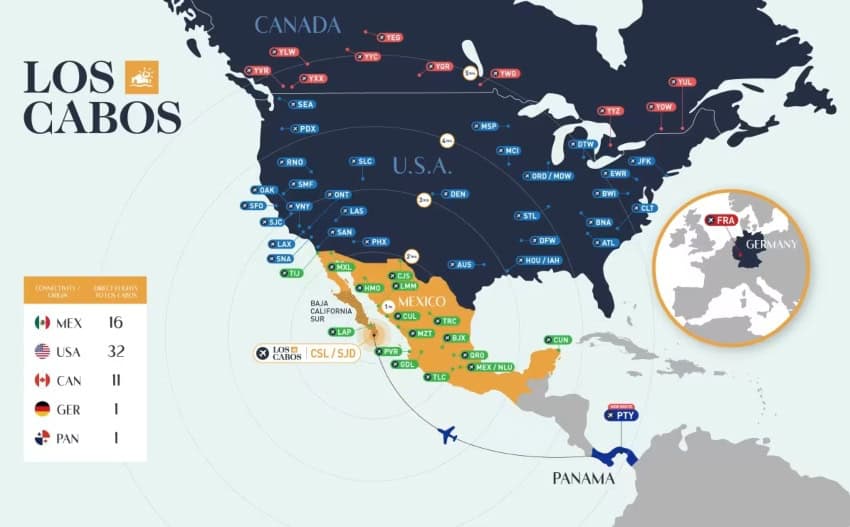
Rodrigo Esponda, managing director of the Los Cabos Tourism Board, has repeatedly stressed connectivity as one of the destination’s chief selling points, noting that Los Cabos has direct flights to all the host cities in the U.S., Canada and Mexico — except Miami and Philadelphia.
“Furthermore,” he told Reportur.co in November 2025, “Los Cabos’ business model is more focused on quality. Tourists coming to the World Cup who are looking for a high-quality, luxurious destination with distinctive natural beauty will prefer Los Cabos. During the World Cup, travel agents will be crucial, inviting their clients not only to enjoy the tournament but also to have a quality vacation in Los Cabos.”
The connectivity comparison
Esponda has been tireless in his efforts to expand Los Cabos connectivity around the world. In addition to flights to cities across Mexico, the U.S. and Canada, Los Cabos also has a connection to Europe via its direct flight from Frankfurt, Germany, and to the South American market — from which six national teams have already qualified — through its recent partnership with Copa Airlines in Panama. The destination is also in talks with Emirates and Turkish Airlines to gain a foothold in the Middle East.
Los Cabos’ connectivity to World Cup host cities across the U.S, Mexico and Canada makes it more attractive as a “second stop” destination. (Los Cabos Tourism Board)
But Los Cabos cannot match Cancún for connectivity — Cancún has direct flights to every World Cup host city and a far larger European imprint — and although Los Cabos does have an advantage over Puerto Vallarta in terms of increased connectivity, its best bets for separating itself from its competition in attracting World Cup tourists considering a “second stop” are likely to be its reputation for luxury and its ability to capitalize on relationships with key markets like Los Angeles.
How Los Cabos distinguishes itself
Puerto Vallarta and Cancún each boast some luxurious accommodations, but over the past decade, Los Cabos has increasingly established itself as Mexico’s luxury leader, with average daily hotel room rates of US $440 across 2025 that were by far the highest in the country. Those prices may put off some budget-minded World Cup tourists, but Esponda is banking that the destination’s commitment to quality will appeal to more upscale travelers.
In addition to capturing the upscale market, Los Cabos is also trying to maximize its historic connections to Los Angeles, a World Cup host city that will host eight games (only Dallas, with nine, will host more). The Los Cabos Tourism Board maintains an office in L.A. and will be working to set up some interesting “first stop–second stop” itineraries based on its strong relationships there.
“Tourists coming to Los Angeles can go to Disneyland and Hollywood, and combine it with a beach trip to Los Cabos,” Esponda points out. “Because we’re also very close, with 10 direct flights. We believe that these kinds of combinations will give us a boost, an additional number of travelers to the destination.”
The Trump factor
Los Cabos, Cancún and Puerto Vallarta could also benefit from anti-Trump sentiment among many World Cup tourists, which may encourage them to visit Canada or Mexico at the expense of the U.S. Bloomberg reported last summer that the U.S. tourism industry was on pace to lose out on over US $12.5 billion in 2025 due to safety concerns and a distaste for Trumpian economic policies (tariffs, notably) on the part of foreign tourists. Travel industry news site Skift noted in December that 46% of international travelers it polled were less likely to visit the U.S. because of its current president.
The slump in U.S.-bound international travel has continued in 2026, and this general trend, along with tougher U.S. immigration policies, will certainly affect World Cup travel plans. In fact, fans of two teams who have qualified for the event are currently banned from traveling to the U.S., those from Haiti and Iran.
What constitutes World Cup success for Los Cabos
Los Cabos is hoping its surfeit of luxurious hotels and resorts, like the Waldorf Astoria Los Cabos Pedregal, appeals to World Cup travelers and helps boost summer hotel occupancy. (Los Cabos Tourism Board)
Los Cabos’ World Cup ambitions aren’t extravagant. Esponda is expecting hotel occupancy in the destination to increase from 70% to 75% during the World Cup months of June and July and meeting or surpassing the latter percentage qualifies as success. The goal is essentially to turn two low-season months into what feels a bit more like high-season ones.
Chris Sands is a writer and editor for Mexico News Daily, and the former Cabo San Lucas local expert for the USA Today travel website 10 Best and writer of Fodor’s Los Cabos travel guidebook. He’s a contributor to numerous websites and publications, including The San Diego Union-Tribune, Marriott Bonvoy Traveler, Forbes Travel Guide, Porthole Cruise and Travel, and Cabo Living.
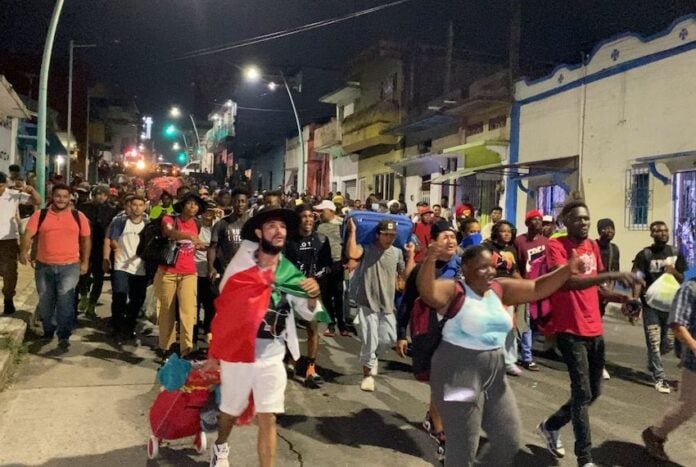
A caravan of foreign migrants left the southern border city of Tapachula en route to Mexico City, where they will seek visas so they can find work in Mexico. (Facebook)
A new migrant caravan started heading toward Mexico City last week, criticizing a lack of attention from federal officials as they departed Tapachula, Chiapas.
The participants are primarily foreigners from Haiti, Venezuela, Cuba and Central America who were assembled in Mexico’s southernmost state, where they felt trapped with no prospects for work.
Comprising approximately 800 people, the caravan had reached Pijijiapan — a distance of 133 kilometers (82 miles) — by Tuesday morning, traveling mostly at night to avoid the prevailing heat and humidity.
A group spokesman told Uno TV that the caravan’s goal remained that of reaching the capital to submit visa regularization applications, after which they would continue on to northern states in search of job opportunities.
The group insists it will not engage in intermediate negotiations en route, saying they prefer to talk to federal authorities in Mexico City.
Activists attending to the migrants have documented health problems among members of the caravan, including dehydration, foot injuries and stomach infections.
Uno TV reported that personnel from the National Migration Institute have intervened in a number of cases after travelers experienced health complications during the journey.
On Monday, hundreds of migrants who did not leave with the main caravan and remained in Tapachula were joined by activists and religious leaders, while highlighting the migratory phenomenon by re-enacting the Passion of Christ.
Luis Rey García, director of the Center for Human Dignity, criticized the Mexican Commission for Refugee Assistance (Comar) for failing to fulfill its responsibilities.
“No migrant wants to stay in Tapachula,” he said, adding that there are “tens of thousands of foreigners stranded” because of Comar’s indifference.
There was also vocal criticism of Donald Trump’s deportation policies. Participants who stayed in Tapachula, which included deportees from the U.S., burned an effigy of the U.S. president.
Conexión Indigo | Migrantes deportados junto con activistas religiosos, realizaron en Chiapas el llamado “Viacrucis migrante”. Toda la información con @JMRivaPalacio. pic.twitter.com/8bVWSkm3xL
Among those in Tapachula was Cuban Orlando Guillen Moro, who said he was separated from his family by Trump’s policies and sent to a third country where he and others “face adverse situations such as hatred and discrimination.”
“We are experiencing what Our Lord Jesus Christ went through,” he said, “and we need a light that will lead us to feel like human beings.”
Raúl, another Cuban migrant, said he hoped the Mexican authorities would become aware that many of the foreigners simply want a chance to stay in the country and find a job.
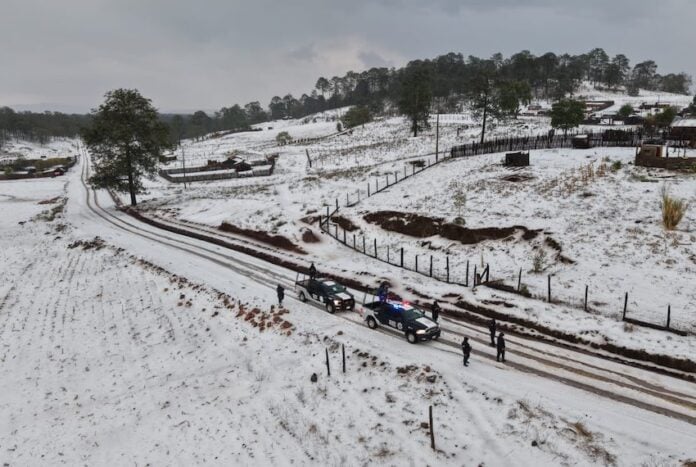
The rarely seen snow-covered roads, hills and houses of Nayarit, which is better known for its beaches. (SSPC Nayarit)
Spring brought an unusual surprise to the state of Nayarit: snow.
Nayarit, occupying Mexico’s Pacific Coast between Jalisco and Sinaloa, is usually associated with tropical weather. However, a variety of meteorological events led to snowfall in the community of Linda Vista, in the municipality of El Nayar, in the state’s highlands.
Similar conditions, including sleet and accumulated hail that looked like snow, were reported in other mountain municipalities such as Huajicori.
The rarely seen snow-covered roads, hills, and houses in white, prompting residents —typically unaccustomed to such conditions — to share images on social media that went viral.
The phenomenon, though rare, was not entirely surprising. While most of Nayarit has a warm and tropical climate, the Sierra Madre Occidental, which rises to altitudes between 2,000 and 2,500 meters above sea level, experiences cooler temperatures.
Snowfall in spring is certainly unusual, but its occurrence this time coincides with the late arrival of cold fronts or winter storms that interact with the environment’s springtime humidity.
These exceptional phenomena typically occur when masses of cold and warm air coincide during the transitional season, generating unstable weather conditions in higher altitude regions. Similar events have been reported in previous years, attributed to the influence of intense cold fronts on the mountainous region.
Ten years ago in March, Jalisco, which borders Nayarit to the south, experienced a sleet storm that covered in white at least 30 municipalities across the state. This storm was linked to a combination of very cold weather along with a late winter storm.
Local emergency services in Nayarit report that, while the scenery is aesthetically stunning, ice accumulation has made some sections of the mountain roads dangerous due to ice formation. Extreme caution is advised for those traveling on the routes connecting Jesús María with the rest of the state of Nayarit.
Iztapalapa has become world-famous for its accurate depiction of the Passion of Christ during the Easter festivities.
(Milton Martínez / Secretaría de Cultura CDMX)
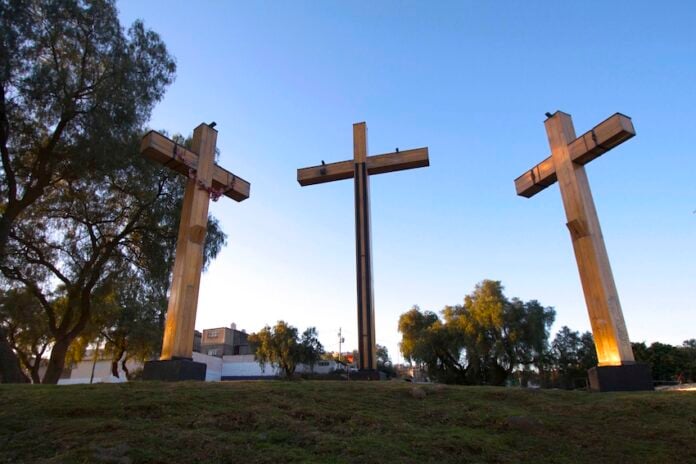
It’s a bit of a strange phenomenon. The tool conquerors used to impose their religion 500 years ago is now a deeply beloved tradition in Iztapalapa. It has even been designated as Intangible Cultural Heritage of Humanity. The Passion Play of Christ in the Mexico City boroughwas added to UNESCO’s list in December 2025, and this year’s reenactment will be the first to occur since the designation.
What is The Passion Play of Christ?
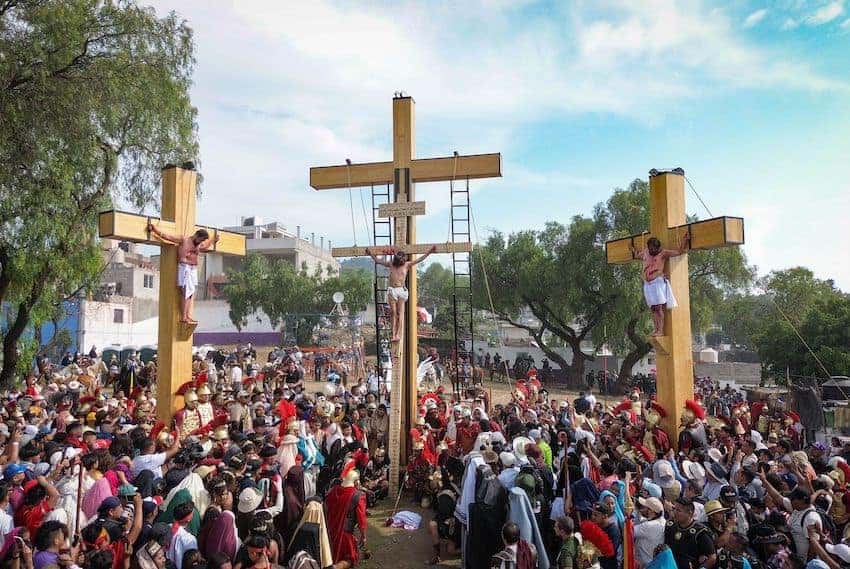
Celebrated since 1843, the Passion Play of Christ in Iztapalapa is more than just a theatrical representation. The tradition represents a communal moment for gathering and celebrating faith. It occurs every Good Friday on the streets of the borough. While the play is taking place, a market and a fair are held, attracting millions of visitors. According to local records, as many as 2 million spectators have attended.
Iztapalapa’s annual Passion Play involves over 5,000 people, with some 150 having speaking roles. (Rogelio Morales/Cuartoscuro)
The depiction follows the 14 stages of the Via Crucis of Jesus, from the moment he is condemned to the moment he is laid to rest in this tomb. Throughout the play, devotion mixes with performance: everyone who dresses up as Jesus becomes him, suffering just like him, walking barefoot on the road — sometimes even carrying a human-sized wooden cross — while the sun intensifies as the hours go by.
The Mesoamerican past of Iztapalapa
To understand how these traditions intersect, it’s helpful to consider Iztapalapa’s Mesoamerican heritage. Iztapalapa has never been a forgettable part of the Mexican Central Valley. Its urban past dates to pre-Hispanic times. This settlement was the southern neighbor of the Mesoamerican city of Tenochtitlán. Iztapalapa was the perfect boundary for an amphibious metropolis. It marked the divide between fresh water from Xochimilco and saltwater from Texcoco. Pre-Hispanic Itzapalapa also had the mountain of Huizachtitlan (now Cerro de la Estrella) at its heart. This mountain provided the city with the best of both worlds. On one side was a wet ecosystem, ideal for growing food on chinampas. On the other side was a dry, firm highland.
Iztapalapa was also the site of one of the most important pre-Hispanic ceremonies: El Fuego Nuevo. A new cycle began every 52 years. Huizachtitlan was the ideal spot to receive it.According to Nahuatl translator and researcher Rodrigo Ortega Acoltzi, the ceremony was elaborate, featuring music and processions.
“Time is renewed every 52 years in pre-Hispanic Anáhuac. Existence itself was renewed every 52 years. This comes from the coordination of the two Mexica Calendars. One is the agricultural calendar (360 days plus 5), and the other is the divinatory calendar (260 days). This renewal represents going back to the moment when the world was created,” says the specialist.
Ortega explains that priestesses and priests came from Tenochtitlán, bearing the regalia of various deities. They danced on top of Cerro de la Estrella and finally sacrificed a prisoner, whose chest the fire was lit on, for the new period of 52 years.
If we compare this tradition with the one we can appreciate today at the Passion Play of Christ, some similarities are impossible to miss. This connection comes to light when considering the role of sacrifice: Mexica ceremonies often required physical pain, just as the Passion Play reenacts — and in some cases embodies — suffering. Renewal is another shared element. In both traditions, something sacred is destined to die and be reborn in a new form. There is also a pilgrimage, as people now gather in Iztapalapa to follow the performance, recalling past processions. Finally, the significance of caves links both traditions.
El Señor de la Cuevita
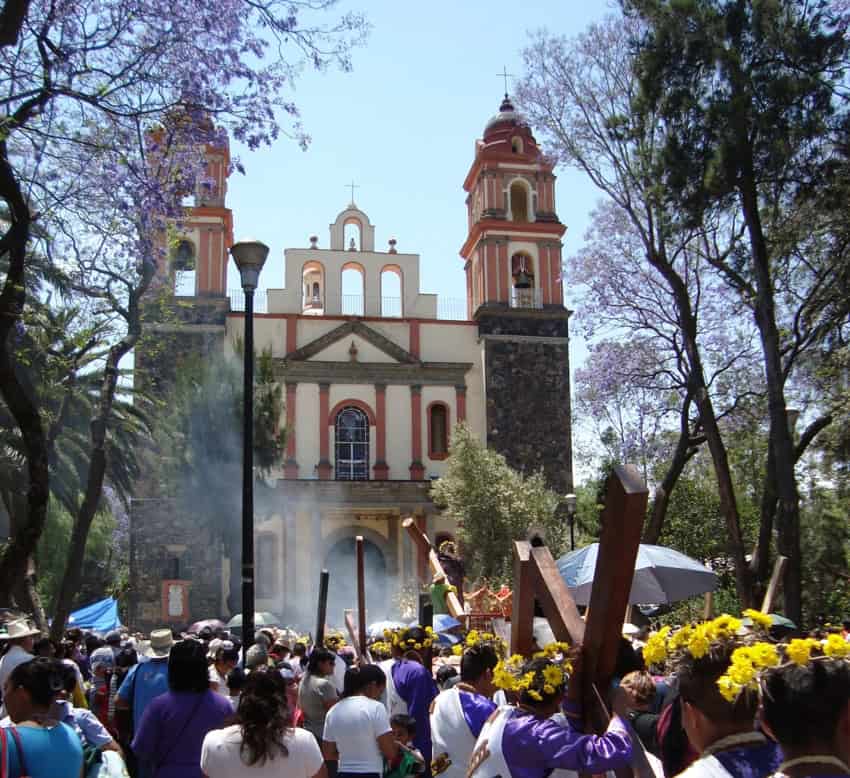
Good Friday procession to the Lord of the Cave sanctuary in Iztapalapa. (Yavidaxiu/Wikimedia Commons)
If there was something sacred in Mesoamerican culture, it was caves. These rocky, obscure formations represented not just the gate to the underworld but also the fertility that comes with their humid nature. That’s why it is not surprising that when a pilgrimage from Oaxaca arrived in Iztapalapa in 1687, a miracle happened inside a cave: El Señor de la Cuevita appeared.
The stewards who carried the images of Christ had to stop at Cerro de la Estrella to rest for a few hours. When they were ready to leave, the statue refused to go. The statue that had been easy to carry was now impossible to move. Instead of trying, a small sanctuary was built around the Lord of the Cave, El Señor de la Cuevita.
Almost 200 years later, an awful epidemic hit Iztapalapa. Locals went to El Señor de la Cuevita to ask for help. They promised to reenact the Passion of Christ every Holy Week in exchange for the tragedy to end. He completed his part of the deal, and the illness soon passed. Now, every year, locals keep the promise their ancestors made in 1833.
Since 1843, the Passion of Christ has been represented year after year in Iztapalapa. It has become a symbol of local identity. The plays and the market are always organized locally by those truly devoted to preserving the tradition. This devotion has continued for generations.
Lydia Leija is a linguist, journalist and visual storyteller. She has directed three feature films, and her audiovisual work has been featured in national and international media. She’s been part of National Geographic, Muy Interesante and Cosmopolitan.
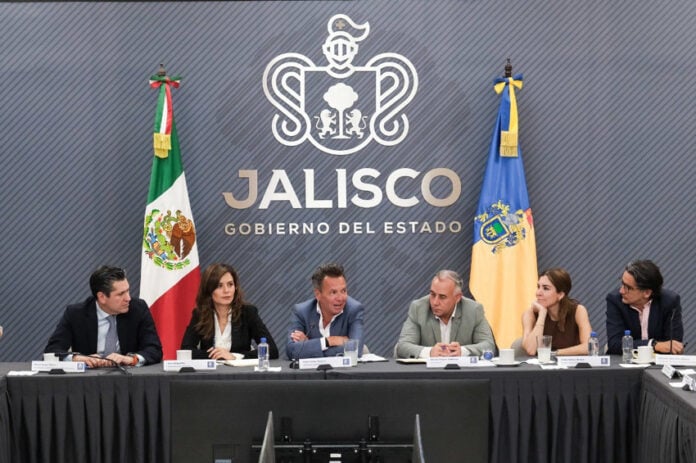
Jalisco Governor Pablo Lemus, center, in an unrelated recent photo, has asked the federal government for US $828.2M for Guadalajara's water infrastructure as a growing number of residents protest shortages and dirty water. (Pablo Lemus/X)
While work around the Guadalajara metro area continues at a feverish pace ahead of the 2026 FIFA World Cup — opening in the city on June 11 — Guadalajara’s water crisis has continued to deepen, with appeals to the federal government and Jalisco Governor Pablo Lemus firing the state’s water director.
Gov. Lemus requests GDL water infrastructure funds
Lake Chapala has long been Guadalajara’s main water source, but according to Guadalajara’s Metropolitan Planning Institute, 26 of every 100 liters of water consumed in the city’s metropolitan zone comes from underground aquifers. (Government of Jalisco)
The water situation across the Guadalajara Metropolitan Area (GMA) continues to deteriorate. Problems with water scarcity, dirty and foul-smelling water and low water pressure have become more widespread this past month, with approximately 400 neighborhoods now reporting issues.
On Friday, Jalisco’s Governor Pablo Lemus Navarro announced that he had requested $15 billion pesos (US $828.2 million) from President Sheinbaum to address urgent water infrastructure needs across the Guadalajara metro area.
If granted, these funds would be used to construct a replacement Chapala-Guadalajara aqueduct (estimated cost $10 billion pesos) and expand Water Treatment Plant No. 1 (estimated cost $4.8 billion pesos).
While the federal government has not yet approved the ask, President Sheinbaum confirmed that technical validation of the projects has begun with Conagua, Mexico’s National Water Commission.
Soon after taking office in October 2024, Sheinbaum promised to prioritize water infrastructure remediation projects nationwide, as part of her National Water Plan initiative.
Acute water challenges could not have surfaced at a worse time. The city is already hosting World Cup qualifying matches, with FIFA President Gianni Infantino in attendance.
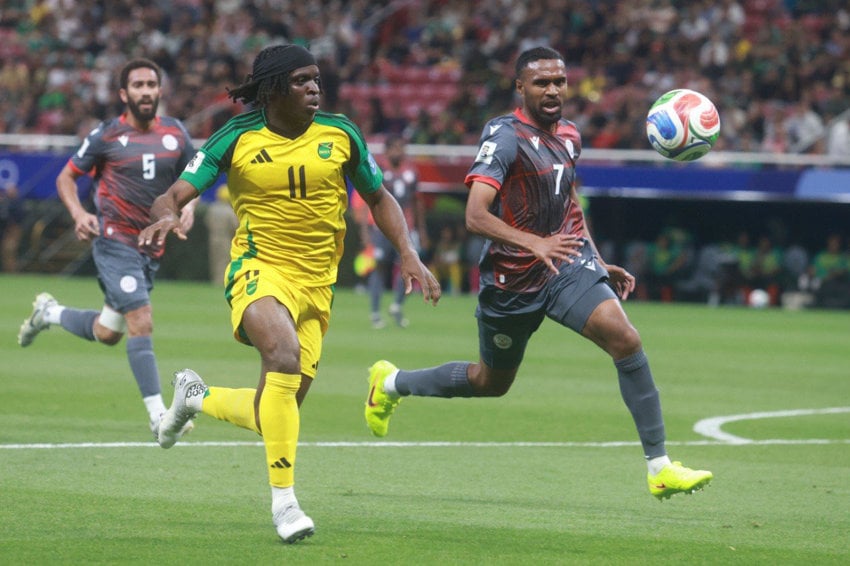
Guadalajara’s water problems are worsening as the city begins to host FIFA 2026 World Cup activities. This World Cup qualifying match between Jamaica and New Caledonia on March 26 is one example. (Pablo Lemus/X)
Last week, Gov. Lemus fired Antonio Juárez Trueba, the Director of SIAPA (as the state’s water agency is called). The agency will now be headed by Ismael Jáuregui Castañeda, who was previously the director of public works and infrastructure for the Guadalajara suburb of Zapopan.
Arturo Gleason, a professor and water management expert at the University of Guadalajara, had urged leaders to conduct a nationwide search for a candidate with a proven track record in water management projects, given the gravity of the water challenges SIAPA is facing right now. Castañeda notably lacks such credentials.
“The problem is serious, and we need the greatest expertise and the most advanced technical and scientific knowledge to solve it,”Gleason said.
Sergio Garibi, a member of the Comunidad Americana council representing the Colonia America neighborhood, popular with expats and tourists, estimates that 824,000 residents in some of the most densely populated urban areas of Guadalajara have been affected by bad water in recent months.
“We have many reports from neighbors with stomach illnesses… rashes, with skin irritation, and we have indications that suggest a connection with the water quality,”Garibi said.
The worsening situation has prompted one local advocacy group, as well as academics at the University of Guadalajara, to urge SIAPA to issue a health alert designating tap water unsafe in areas with known problems, so that residents can take precautions. Thus far, the state agency has declined to do so.
Rideshare apps granted legal status at GDL Airport
After ages of legal uncertainty, ride-hailing services like Uber and DiDi will have designated pickup-drop-off spots at Guadalajara International Airport, reportedly in time for the influx of tourists during the 2026 FIFA World Cup matches in Guadalajara in June. (Crisanta Espinoza Aguilar/Cuartoscuro)
After much uncertainty, Jalisco’s Governor Pablo Lemus confirmed earlier this month that ride-hailing apps like DiDi and Uber will be permitted to pick up passengers at the Guadalajara International Airport during the World Cup.
But there is a catch.
Ride-hailing apps will continue to be prohibited from pulling up to the terminal to collect their passengers. The reason is that these digital services lack the legal authority to operate at the airport terminals, as federal authorities grant this permission exclusively to authorized taxis and tourist services under the Federal Roads, Bridges and Motor Transport Law.
Instead, a dedicated site for DiDi and Uber drivers will be developed somewhere along the entry/exit road prior to ramps leading to the Chapala highway.
Given the distance from the terminal and the lack of safe sidewalks to reach the pickup and drop-off spot on foot, the airport will launch a new on-site shuttle to ferry riders from the terminal to the rideshare parking lot.
While this isn’t the most convenient solution, it will thankfully eliminate the ambiguity that plagued rideshare services in the past. This included rider uncertainty over the correct meeting location, and rideshare drivers being harassed at the terminal by Mexico’s National Guard patrols when attempting to connect with their riders there.
This new solution enabling rideshare services to operate at Guadalajara Airport has a price tag of 20 million pesos (US $1.1 million), with the work set to be completed before the 2026 World Cup matches in Guadalajara begin on June 11. As of now, no launch date has been shared by public officials.
Jalisco, Google partner on real-time public transit tracking
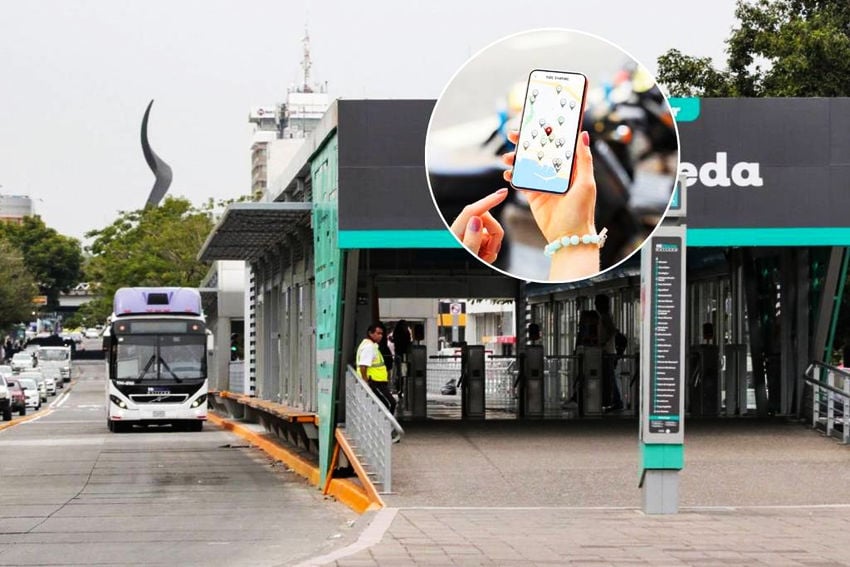
Now, thanks to Google, public transit riders in Guadalajara’s metro area will be able to see where their bus, light rail or metro car is in real time. (Jalisco Transportation Ministry)
It’s about to get a little easier to navigate the Guadalajara metro area on public transport, thanks to a little help from big tech.
With the goal of modernizing the public transportation system and keeping local riders better informed, the city government recently inked a new partnership with Google that will enable mobile apps like Google Maps and Waze to display bus and train locations in real time. The initiative will be executed in multiple phases.
During the first phase, expected to last nearly three months, roughly 100 vehicleswill be tracked. Over time, coverage will be expanded to include all 220 routes in the mass transit system provided by light rail and Mi Macro (bus rapid transit).
By year’s end, the program’s goal is to expand coverage to 4,500 vehicles.
Of the 594,288 jobs added in February, 54.9% were formal sector positions while the remainder were informal sector ones. (Cuartoscuro)
Mexico added almost 600,000 new jobs last month, according to official data, but year-to-date employment creation remained in negative territory at the end of February after more than 700,000 job losses in January.
Therefore, in the first two months of 2026, there was a total of 111,139 job losses in Mexico. Gabriela Siller, director of economic analysis at Banco Base, told the newspaper El Economista that the figure is derived from the loss of some 127,000 formal sector jobs and the addition of around 16,000 informal ones.
Siller said that the data for February shows that “there is a return of people to the labor market,” adding that higher inflation and a reduction in incoming remittances may have precipitated the need for “more family members to work.”
Self-employment drives job growth in February
Almost six in ten (57.8%) of the new jobs added in February were positions in which people work on their own — i.e., self-employment.
The number of self-employed people increased by 343,584 last month to reach 13.75 million, or 23% of all workers. The total number of self-employed people is the highest since INEGI began conducting its National Survey of Occupation and Employment (ENOE) in 2005.
In addition to self-employed people, INEGI publishes data on the number of people in “subordinate, remunerated” positions (i.e., employees) and unpaid positions. It also publishes data on employers. In February, the following changes occurred:
The number of people in unpaid positions increased by 153,673 to 1.91 million in February, representing 3% of the total active workforce. In February, the increase in the number of people in these positions was the second biggest driver of job growth.
The number of people in “subordinated, remunerated” positions increased by 66,904 to 41.42 million, representing 68.7% of the total active workforce. In February, the increase in the number of people in these positions was the third biggest driver of job growth.
The number of employers increased by 30,127 to 3.13 million, representing 5.2% of the total active workforce. In February, the increase in the number of employers was the fourth biggest driver of job growth.
Of the 594,288 jobs added in February, 54.9% were formal sector positions while the remainder were informal sector ones. Informal sector workers don’t pay income tax and generally don’t have access to benefits such as social security and paid vacations.
Almost 80% of the new jobs added in February were in the tertiary or services sector, while 14% were in the secondary sector, 3% in the primary sector and 2% in unspecified sectors.
Other ENOE results
Below is a summary of some of the other results of INEGI’s National Survey of Occupation and Employment in February.
The unemployment rate was 2.6%, down from 2.7% in January, but up from 2.5% in February 2025.
The underemployment rate was 7%, up from 6.1% in January, and 6.3% in February 2025.
The informality rate — the percentage of total workers employed in the informal sector — was 54.8%, down from 54.9% in January, but up from 54.5% in February 2025.
The number of people in jobs increased 1.8% compared to February 2025.
The number of unemployed people increased 5% annually to 1.6 million.
Annual job losses and gains
In the 12 months to the end of February, jobs were lost in the following sectors:
Agriculture, ranching, forestry, hunting and fishing: 113,229 job losses.
Mining and electricity: 60,579 job losses.
Restaurants and accommodation services: 58,611 job losses.
In the 12 months to the end of February, jobs were added in the following sectors:
Government and international organizations: 287,726 jobs added.
Transport, communications, mail and storage: 268,101 jobs added.
Manufacturing: 235,959 jobs added.
Services (various): 183,598 jobs added.
Commerce (including retail): 175,226 jobs added.
Social services: 84,279 jobs added.
Construction: 71,870 jobs added.
Profession, financial and corporate services: 15,215 jobs added.
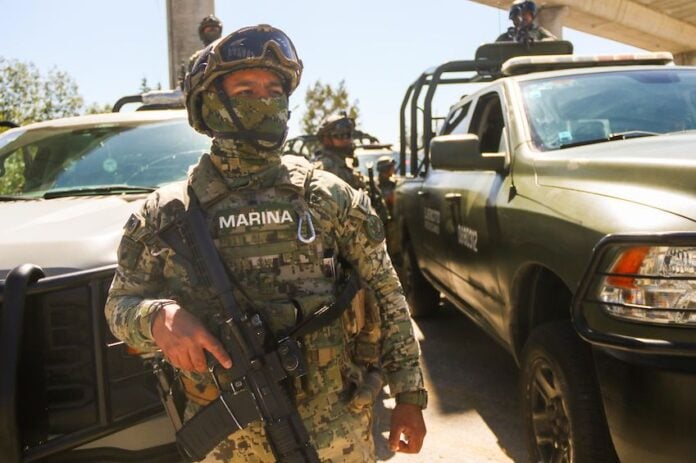
Between March 23 and 29, Semar carried out 147 operations, including 20 raids, as part of the ongoing Operation Sable, which seeks to deter illicit activities such as drug trafficking. (Victoria Valtierra/Cuartoscuro)
In the past week, the Mexican Navy (Semar) arrested 234 people in Puebla, Tlaxcala, Morelos, Mexico City and México state and seized 1,033 kg (one tonne) of methamphetamine, the agency reported on Tuesday.
Between March 23 and 29, Semar carried out 147 operations, including 20 raids, as part of the ongoing Operation Sable, which seeks to deter illicit activities such as drug trafficking.
In addition, Semar seized seven handguns, one rifle, eight magazines and 215 rounds of ammunition across the five states, as well as 38 vehicles and 12 properties.
Bilateral intelligence sharing leads to drug bust off coast of Michoacán
In a separate operation, Semar announced the arrest of six drug trafficking suspects on Monday, made possible by intelligence provided by the United States Northern Command and the Joint Interagency Task Force.
According to an official statement, Navy personnel used U.S. intelligence to identify a vessel located around 113 km southwest of the port of Lázaro Cárdenas, in Mexico’s western Michoacán state. On it, agents discovered 14 sack-like packages with 580 brick-shaped bundles of white powder.
Officials seized the packages, weighing 650 kg, alongside 350 liters of fuel. If the white powder is proven to be cocaine, the value of the goods could be as much as 150 million pesos (US $8.4 million), which would serve a significant blow to the criminal group involved.
U.S. Ambassador to Mexico Ronald Johnson, who has been complimentary of the bilateral security cooperation under Sheinbaum, took to X to congratulate the mission:
“The seizure of a speedboat by Mexican authorities — made possible thanks to the exchange of information between the United States and Mexico 🇺🇸🇲🇽 — led to the confiscation of 14 packages of cocaine and the arrest of six individuals, demonstrating that transnational criminal organizations cannot hide from justice when we work together.”
El aseguramiento de una embarcación rápida por parte de autoridades mexicanas – posible gracias al intercambio de información entre los Estados Unidos y México 🇺🇸🇲🇽 – llevó a incautar 14 paquetes de cocaína y detener a seis personas, lo que demuestra que las organizaciones… pic.twitter.com/KWHPxLlATn
“This action prevented more than 1.3 million doses from harming our communities. The historic cooperation driven by President Donald Trump and President Claudia Sheinbaum is yielding results. Stronger Together,” Johnson added.
The security strategy of the Sheinbaum administration has focused on making so-called “high-impact arrests” related to crimes such as homicide, extortion, kidnapping, robbery and trafficking. From Oct. 1, 2024, through Feb. 28, 2026, Mexico’s security ministry has reported 46,000 arrests of this type, or approximately 2,700 arrests per month.
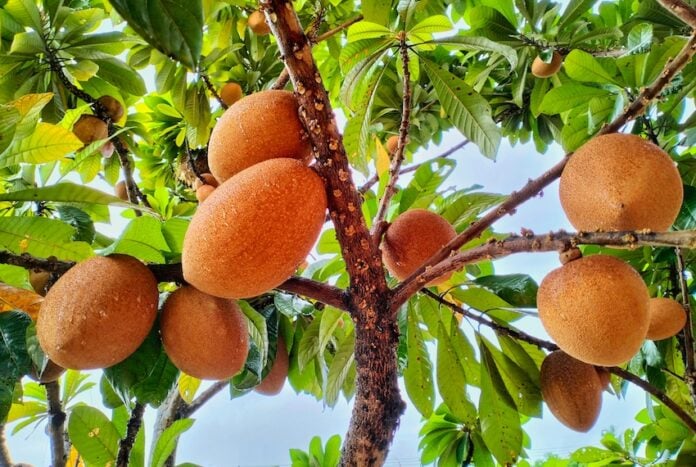
The sweet tropical fruit, native to Mesoamerica and cultivated in half of Mexico's states, has been exported to several countries across continental Europe in the past, but the United Kingdom has only now received its first shipment. (Shutterstock)
Mexico has exported mamey to the United Kingdom for the first time, opening a new European market for the sweet tropical fruit grown in southern Yucatán and elsewhere in Mexico.
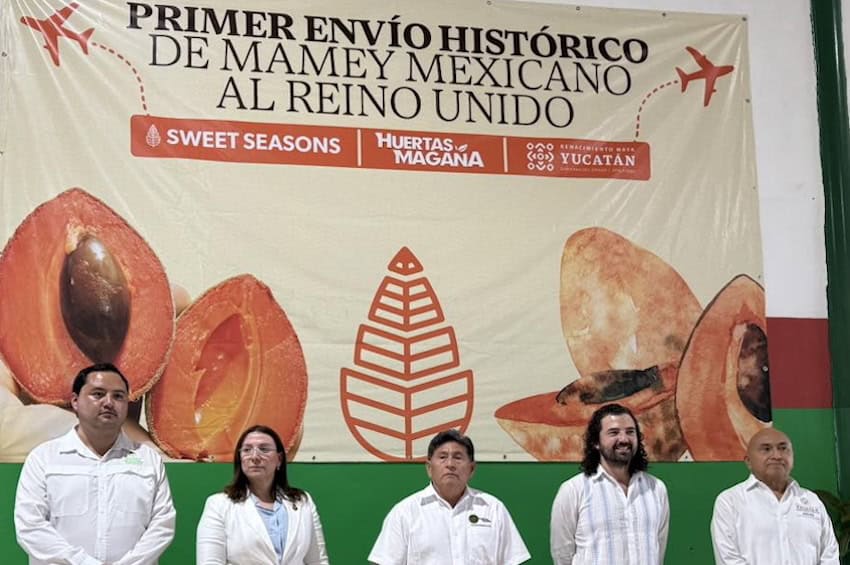
This week’s inaugural shipment — about two tonnes from Huertas Magaña, an orchard in the municipality of Akil, Yucatán — marks the culmination of more than two years of work to meet Britain’s strict phytosanitary requirements. “It’s quite a complicated job,” said Julio Magaña, marketing manager of Huertas Magaña. “Part of it is getting there, which is what has been achieved so far, but now we need to start positioning this product.”
It took a couple of years for the crew at Yucatán mamey producer Huertas Magaña to negotiate and organize the first exportation of Mexican mameys to the United Kingdom, but the historic shipment finally happened last week. (Huertas Magaña)
The achievement secures Yucatán’s position as Mexico’s leading mamey producer and adds the U.K. to a growing list of destinations that includes France, Spain, Germany, the Netherlands, Canada, Hong Kong and the United Arab Emirates.
“This shipment represents a historic step for Yucatecan agriculture,” said Roger Góngora García, the state’s deputy minister of investment, commerce and industry. “It is the result of years of work, meeting international standards, and demonstrating that the quality of our products can compete in the most demanding markets.”
Native to Mesoamerica, the mamey (or mamey sapote) thrives in Yucatán’s southern municipalities of Akil, Oxkutzcab, Tekax and Maní, where state officials say more than 5,000 producers cultivate roughly 3,000 hectares. The production season runs roughly from January to June, with peak output around January through March.
Exporters say packing houses have had to fine-tune temperatures, cushioning and box design so that each fruit can endure the journey, ripen on schedule and still arrive with unblemished pulp.
Studies describe Mexico as the world’s leading mamey producer, with about 15 states growing the fruit, and Yucatán ranks as the top-producing state by both planted area and yield, according to published data.
Huertas Magaña, a family-run orchard founded more than 50 years ago, markets its exports through an alliance with Sweet Seasons, which also distributes the fruit across Europe, Asia and the Middle East.
The U.K. shipment follows broader federal efforts, led by the Agriculture Ministry and its agrifood department, to expand export protocols for tropical fruits and strengthen the competitiveness of small producers in Mexico’s south.









Mexicana has sold more than 1 million tickets in 2 years
Two years and three months after the state-owned commercial airline Mexicana began operations, director Leobardo Ávila Bojórquez provided an update on the carrier’s “situation.”
He said that since December 2023, the airline has sold 1.02 million tickets, transported 953,624 passengers and flown 14,473 flights. Data presented by Ávila showed that Mexicana has a 95% satisfaction rating among passengers. In 2025, Mexicana was Mexico’s fifth most popular airline for domestic flights with over 434,000 passengers.
Ávila noted that Mexicana flies to 14 destinations around Mexico, with the Felipe Ángeles International Airport (AIFA) in México state serving as the airline’s hub. Among the destinations the airline serves are Tulum, Puerto Vallarta, Los Cabos, Mérida, Campeche, Ciudad Victoria, Ixtepec, Monterrey, Guadalajara and Tijuana.
Ávila said that Mexicana will receive seven new Embraer planes this year, and add new routes from AIFA to Acapulco in June and AIFA to Hermosillo in July.
Later in the press conference, Sheinbaum said that Mexicana offers “more affordable prices” than other airlines and declared that “its vision is not about profit per se.”
“Obviously, all companies have to be profitable because it’s not about subsidizing state-owned companies,” she added.
Sheinbaum highlighted that Mexican flies to airports that other commercial airlines don’t fly to, and declared that traveling with the state-owned carrier is an “extraordinary experience.”
“I invite you to use Mexicana de Aviación,” she said, adding that the operations of the airline are going “very well.”
Sheinbaum takes aim at politicians who speak badly of Mexico on US television
Sheinbaum told reporters that Mexico is a “free and democratic” country and people can “freely” express their opinions.
However, “what we constantly say here is that not agreeing with the government is one thing … and another very different thing is to speak [badly] about Mexico,” she said.
“I’m very critical of the deputies and senators who go to the U.S. television stations to speak badly of Mexico and to request the intervention of the United States in Mexico,” Sheinbaum said.
Senator Lilly Téllez again took the opportunity to criticize the Sheinbaum administration in the context of the World Cup on Fox News.
“What is that?” she questioned with visible exasperation.
“When had this occurred before? The nerve of it,” Sheinbaum said before accusing politicians who speak badly of Mexico of being unpatriotic and failing to stand up for the country’s sovereignty.
One Mexican politician who has appeared frequently on Fox News is National Action Party Senator Lilly Téllez, who has declared herself in favor of a U.S. military intervention in Mexico to combat drug cartels.
Sheinbaum: Low chance of the political right returning to power in Mexico
Asked whether there was a “risk” that the political right could return to power in Mexico, Sheinbaum said she saw the possibility as unlikely.
“From my perspective, the probability is very low,” she said.
“We see it in the polls, it’s not just a subjective perception — the polls show it,” Sheinbaum said.
“And people live better today than they lived before,” she added.
That — in part at least — was apparently a reference to the significant reduction in poverty that has been achieved in recent years, the increase in the minimum wage and the increase in government support for citizens via the provision of various welfare and social programs.
Sheinbaum — who was backed by the leftist Morena party at the 2024 presidential election — is an extremely popular president, with many, but not all, polls consistently finding that she has an approval rating of around 70% or higher.
Since Andrés Manuel López Obrador was elected president in 2018, Morena has been Mexico’s predominant political party. It governs a majority of Mexico’s 32 federal entities and holds majorities in both houses of federal Congress.