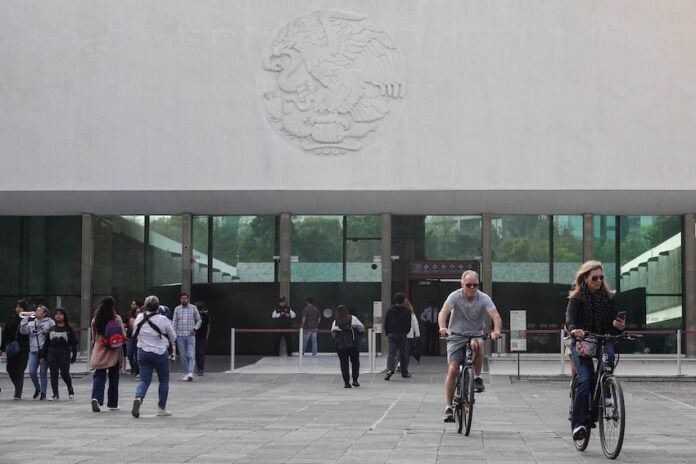
The National Museum of Anthropology in Mexico City is the first Latin American heritage site
to receive UNESCO's highest Blue Shield category, affording it special protection in the event of armed conflict. (Camila Ayala Benabib/Cuartoscuro.com)
Mexico City’s famed National Museum of Anthropology has received the highest level of protection afforded to a cultural heritage site, making it the first building in Latin America and the Caribbean to receive such a safeguard.
The Blue Shield, granted by UNESCO, serves to identify highly valued cultural property in the event of armed conflict, natural disaster or any other threat to its integrity. Displaying the shield on a cultural monument signals to military or civilian authorities that the site and its collections have enhanced immunity and must be safeguarded.
Develación de las placas de Escudo Azul UNESCO del Museo Nacional de Antropología
“Attacking cultural property during war not only violates the right to culture, but also undermines the identity and dignity of peoples,” Andrés Morales, the head of UNESCO México said at the unveiling ceremony.
The Blue Shield reads “Protected Cultural Property” and features a blue and white diamond with a bright red outline. It has been placed on the roof of the National Museum of Anthropology (MNA) to ensure visibility in satellite images, thereby helping prevent the safeguarded monument from becoming a military target. It has also been placed at the main entrance of the museum.
Francisco Vidargas, head of World Heritage at Mexico’s National Institute of Anthropology and History (INAH), noted that the MNA houses over 200,000 archaeological, artistic and ethnographic objects, many of which come from archaeological sites that have also been designated for protection under the Blue Shield emblem (such as Chichen Itzá and Monte Albán).
However, unlike the MNA, those sites bear the standard Blue Shield design, which indicates general cultural protection rather than the enhanced protection – distinguished by the red outline – that is reserved for assets of greater importance under international law.
Pablo Arrocha Olabuenaga, legal consultant at the Foreign Relations Ministry, said that this emblem highlights the “exceptional” value of the MNA, and underscores Mexico’s regional leadership in preserving memory and universal heritage.
“This symbol is not just an emblem. It is the visible manifestation of Mexico’s commitment to international law and its deep conviction that its cultural heritage is memory, identity and the legacy of its peoples, and therefore its protection is a shared responsibility of the international community,” Arrocha said.
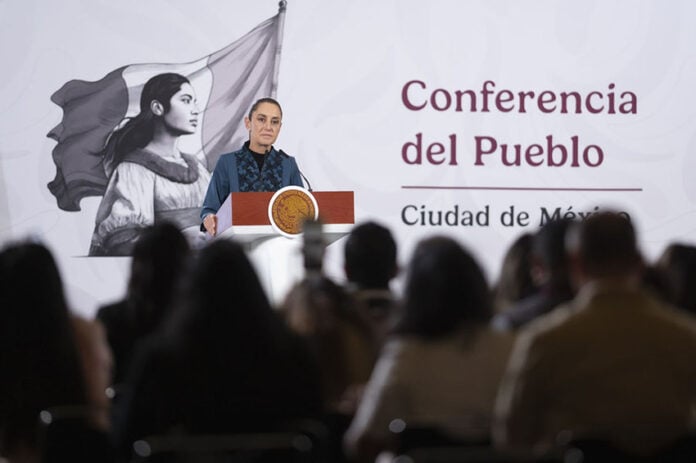
Friday's presser covered Mexico's search two missing sailboats carrying aid to Cuba, a border breach by U.S. soldiers and World Cup travel safety assurances. (Saúl López / Presidencia)
Sheinbaum’s mañanera in 60 seconds
🚢 Missing aid boats: Two small vessels carrying humanitarian aid to Cuba have gone missing after departing Isla Mujeres — 9 crew members of mixed nationalities are on board and the Mexican Navy is searching.
🪖 US soldiers crossed the border: US troops briefly entered Mexican territory in Nogales while installing barbed wire, but withdrew when asked. Sheinbaum called it unintentional and declared there was no “intervention” or “violation.”
⚽ World Cup tourism pitch: Sheinbaum assured tourists Mexico is safe to visit, pointing to an 8.6% jump in international arrivals in January and a dedicated security plan for the World Cup.
Why today’s mañanera matters
Just over a month after chaotic violence broke out across Mexico in response to a military operation targeting the now-deceased Jalisco New Generation Cartel leader Nemesio Rubén “El Mencho” Oseguera, President Claudia Sheinbaum declared that tourists have nothing to fear when visiting the country.
There is no doubt that the mayhem of Sunday, Feb. 22 — including the setting up of numerous fiery narco-blockades and armed clashes between cartel henchmen and security forces — damaged Mexico’s international reputation.
As she has done previously, Sheinbaum used her Friday press conference to attempt to dispel fears among foreigners planning to visit Mexico, including for the FIFA men’s World Cup, which Mexico will co-host with the United States and Canada in June and July.
Also of note at the final mañanera of the week were the president’s comments on two humanitarian aid vessels that are missing in the Caribbean Sea, and her remarks on an incident at Mexico’s northern border.
2 vessels carrying humanitarian aid to Cuba are still missing
Sheinbaum told reporters that authorities are still searching for two sailboats that went missing after departing Mexico to take humanitarian aid to Cuba.
The Mexican Navy said in a statement on Thursday that it had begun a search and rescue mission aimed at locating two sailboats that departed Isla Mujeres, Quintana Roo, for Havana, Cuba, last Friday. It said that the vessels were carrying “nine crew members of different nationalities.”
The navy also said that the vessels were expected to reach Cuba between Tuesday and Wednesday of this week.
Sheinbaum said that a Navy vessel was monitoring the two “small boats” that are missing, but lost contact with them.
Mexico’s navy has launched a search operation after two boats carrying nine crew members and humanitarian aid to Cuba went missing in the Caribbean. pic.twitter.com/WW2n9yvH3A
Mexican Navy vessels have also transported humanitarian aid to Cuba, where people are facing a situation of extreme hardship due to a U.S. oil blockade and other factors. Sheinbaum said that a Navy vessel carrying aid arrived in Cuba this morning.
US soldiers breach Mexico-US border
A reporter noted that she had seen reports that U.S. soldiers entered Mexico earlier this week, crossing the border between Nogales, Arizona, and Nogales, Sonora.
Asked what she knew about the incident, Sheinbaum said that the soldiers crossed the border by two meters and immediately returned to the United States when they were asked to do so.
According to an El Universal newspaper report, at least eight U.S. soldiers were putting up barbed wire along the border when they entered Mexico on Tuesday. Citing witnesses, the newspaper said that the soldiers came up to eight meters into the “national territory” of Mexico. National Guard personnel reportedly asked the U.S. soldiers to withdraw. The incident occurred where rail tracks cross the border.
Sheinbaum played down the incident, saying that there was no “intervention” or “violation” of any kind because the soldiers entered Mexico unintentionally.
Militares de Estados Unidos ingresan a México sin autorización para reforzar el cerco internacional
Sheinbaum: Tourists can visit Mexico ‘safely’
A reporter declared that Mexico has been “very stigmatized,” described as a country where “you run the risk” of being abducted.
Asked what her message was for Mexico-bound tourists ahead of the World Cup, Sheinbaum responded that “they can come to the country safely.”
She went on to highlight that tourism has increased despite the dissemination of anti-Mexico “propaganda.”
Sheinbaum specifically highlighted that international tourist numbers increased 8.6% in January compared to the same month of last year.
“In particular for the World Cup … we have a series of actions to protect tourists,” she added.
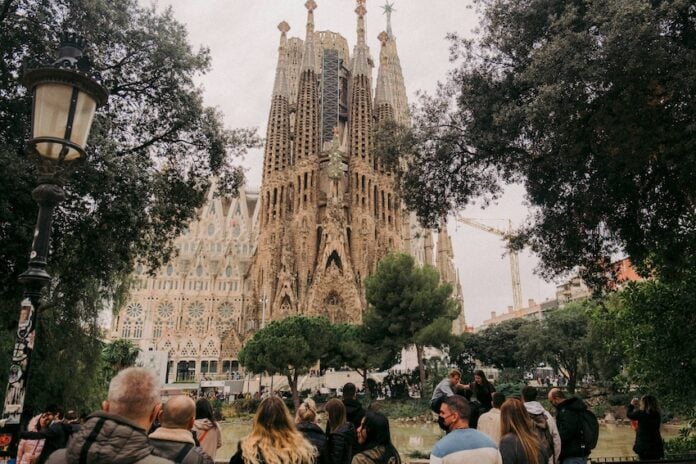
BARCELONA — Javier Marín, a 63-year-old sculptor from Uruapan, Michoacán, confirmed Monday that he is a finalist to complete the Glory Façade of the Sagrada Família — the main entrance to Gaudí’s 143-year-old basilica and the most theologically loaded piece of real estate in Spain.
If selected, the face greeting every visitor to Spain’s most beloved monument will have been designed by someone from Mexico. This is, historians note, almost exactly the opposite of what Spain spent three centuries doing, except in that case nobody sent an invitation.
The stones of Mexico’s greatest temple were stolen by the Spanish to build their new religious monuments. Marín has not forgotten this. (Shutterstock)
To understand why this is ironic, some context: beginning in 1521, Spanish colonisers systematically demolished the great monuments of indigenous Mexican civilisation and replaced them with Catholic churches, using the rubble of the originals as building material. The Metropolitan Cathedral on Mexico City’s main square was constructed directly on top of the Templo Mayor, the sacred heart of the Aztec empire, using its own stones. In Cholula, Puebla, Spanish priests built a church on the summit of the largest pyramid ever constructed by human hands. They did this across an entire continent for three hundred years and appear to have genuinely expected no one to bring it up again.
Marín has not brought it up. He doesn’t need to. A separate Mexican architect, Mauricio Cortés Sierra, has already installed Gaudí’s cross at the basilica’s highest point — 172.5 metres above Barcelona. Between them, Mexico now controls the top and the front of Spain’s most visited monument.
“It’s amazing that I might be able to do this,” Marín told reporters, which is also, more or less, what Spain said in 1521. The key difference is that Marín was formally invited by the board of trustees. He has a letter. The conquistadors did not have a letter.
The board votes in April. The Templo Mayor is still underneath the cathedral. Everyone is being very gracious about all of it.
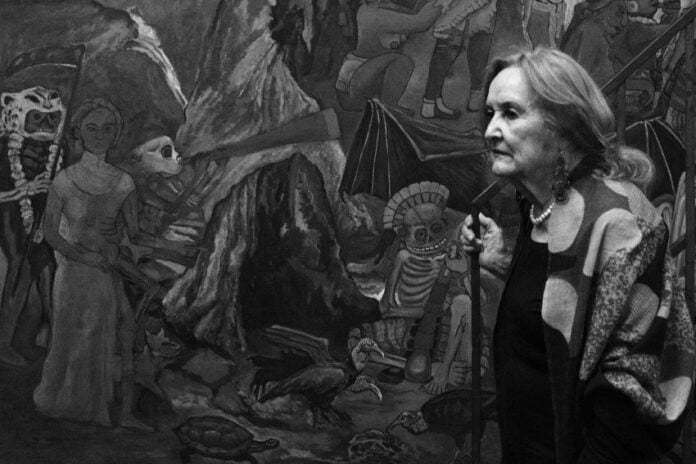
In her claim of Mesoamerican identity, Lazo, who studied under Mexican muralists Diego Rivera and Carlos Orozco Romero, was part of a 20th-century Latin American movement recognizing pre-Hispanic heritage as a vital source of artistic renewal and native pride. However, if you twisted the nationality question a bit and instead asked her about her birthplace, she would describe the Guatemalan landscape in loving terms.
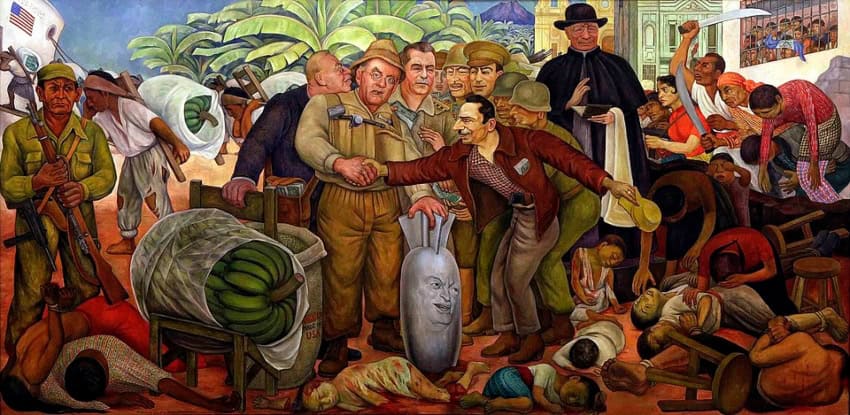
“Glorious Victory,” the Diego Rivera mural about the 1954 Guatemalan military coup, on which Lazo contributed and appears as a revolutionary. (TortugaHalo/Wikimedia Commons)
Her birth in Guatemala
“I was born in the most beautiful country in the world,” she once said. “Because I’ve seen many, but none as green and as full of volcanoes, lakes and marvelous weather.”
Although Lazo grew up in Guatemala City, her family spent time in the more rural Maya city of Cobán, which had a tight-knit German community of coffee plantation owners but was otherwise mainly populated by Mayas who spoke only the Indigenous Q’eqchi language.
Although Lazo never learned the language, her mother — the daughter of a German coffee producer — knew it and provided Rina with phrases to use at the market. She would never forget her encounters with the Maya in Cobán, and it would later influence her art.
Two things marked Lazo’s childhood: One was her grandfather’s interest in art, specifically painting; the other was the archaeological discoveries of ceramic pieces in Cobán. The images on those sherds would be forever present in Lazo’s paintings. She firmly believed that if you were meant to become someone, you would find a way to do it and that no school or teacher could determine your passion.
“That’s something you’re born with,” she said.
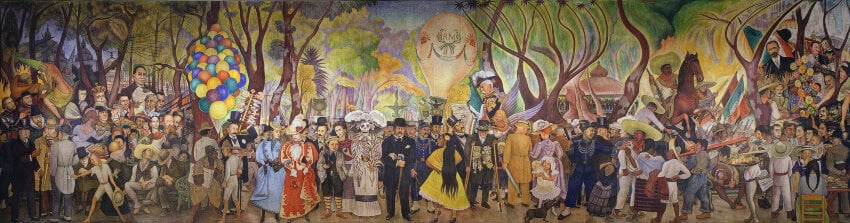
Lazo’s name appears next to Diego Rivera’s in the 50-foot mural “Dream of a Sunday Afternoon in the Alameda Central.” (Sotheby’s)
And when her professor Andrés Sánchez Flores invited her to work with Diego Rivera on what would become one of Rivera’s most famous murals, Sánchez said exactly the same thing: “It’s just a matter of will.”
Her arrival in Mexico
When Lazo was young, she wanted to be an astronomer, which is perhaps why many of her paintings feature astronomical phenomena. But she apparently changed her mind and began pursuing a career as a painter, earning a scholarship to study in Mexico. Since her financial resources were limited, she decided to enroll in the mural art class at La Esmeralda, Mexico’s National School of Art, where major Mexican artists like Diego Rivera, José Chávez Morado and Frida Kahlo were professors.
In her first mural class, her professor, and Diego Rivera’s mural technician, Andrés Sánchez Flores, presented her with a golden opportunity: the chance to work as an assistant to Diego Rivera on a project — the now iconic “Dream of a Sunday Afternoon in the Alameda Central” — a 50-foot mural for the Hotel del Prado in Mexico City. She started out doing minor tasks, such as grinding pigments, but after Rivera saw her work, he began assigning her to paint small details on the mural, decorative items on the clothing and the leaves on trees.
Her name now appears next to Rivera’s on the iconic work, which depicts Mexican history and was an instructive moment for Lazo.
From that moment on, she became Rivera’s apprentice for the next decade, until he died in 1957. She worked on a challenging underwater mural with him at the Cárcamo de Dolores hydraulic structure in Chapultepec Park. Even now that the structure no longer serves its original purpose, you can still visit the artwork in Chapultepec’s Second Section. And in the 1954 Rivera work, “Glorious Victory,” whose subject is the 1954 military coup that deposed Guatemalan president Jacobo Árbenz, Rivera asked Lazo to paint the prisoners in the painting. She also appears in the painting as one of the Guatemalan revolutionaries.
After Rivera
In 1966, Lazo competed for and won an assignment to create replicas of the ancient Maya murals at the Bonampak archeological site in Chiapas for the National Museum of Anthropology in Mexico City.
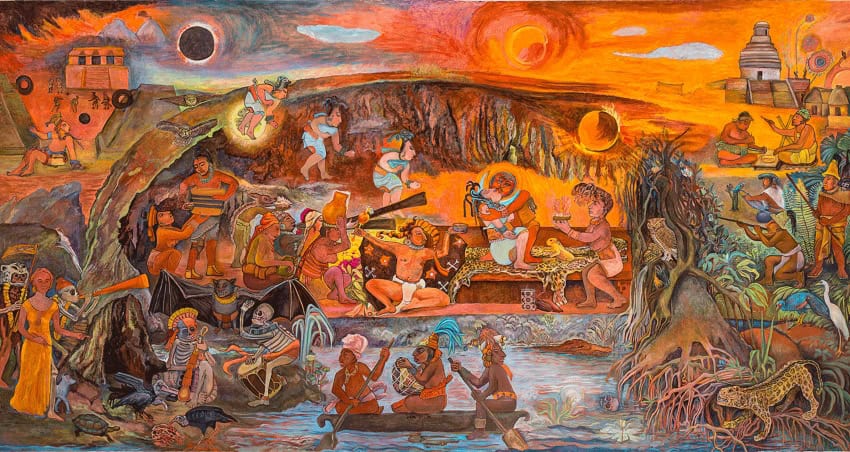
“Xibalbá, the Underworld of the Mayas” was Rina Lazo’s final mural and is now in the permanent collection at the Palacio de Bellas Artes in Mexico City. (INBAL)
The challenging commission — during which she spent three months isolated in Chiapas’ jungle, teaching herself about the originals — not only involved specific knowledge of materials and techniques but also a deeper connection with the people who had painted Bonampak. But its success launched her career. Years later, she would return to the museum with a piece of her own: “The Venerable Grandfather Corn,” a cosmogonic description of the creation of humanity according to Mayan tradition.
Lazo’s arrival at the Palacio de Bellas Artes
On Nov. 1, the Day of the Dead, Lazo celebrated her 96th birthday, finished her last mural, and then slipped into a deep sleep from which she never awoke. Those who knew her have said they like to think that her last mural, “Xibalbá, the Underworld of the Mayas,” was Lazo creating her own setting for her afterlife.
Xibalbá is the Maya place of the dead, a dark underworld full of all kinds of animals and trees. Thought by the Maya to be located in a cenote, Xibalbá is the home of deities associated with the dead.
For Lazo, it was not a place of suffering; it was a place of joy, where she believed all the elements of the Maya culture she had seen during her childhood would embrace her.
The portable mural would be displayed posthumously for a few months at a temporary exhibition. In 2024, it was incorporated into the permanent collection of the Palacio de Bellas Artes in Mexico City, making Lazo the first, and to-date only, female muralist to have a permanent space among the greats of Mexican Muralism like Siqueiros, Rivera, Orozco and Tamayo.
Lydia Leija is a linguist, journalist and visual storyteller. She has directed three feature films, and her audiovisual work has been featured in national and international media. She’s been part of National Geographic, Muy Interesante and Cosmopolitan.
The family-oriented team at Altos Norte are helping to change perceptions about wine from Jalisco. (Altos Norte)
Winemaking is an industry full of deep history and family traditions. In the growing winemaking region of Jalisco, one of those families is engineer José Miguel Vega, his wife Aida Karim Hernández and their children, who together created Altos Norte Vinícola.
Located in the municipality of Encarnación de Díaz in the Altos de Jalisco region, this vineyard is yet one more example of how winemaking is expanding throughout Mexico. Altos Norte Vinícola is also an example of how some of Mexico’s most promising vineyards are also among the nation’s youngest.
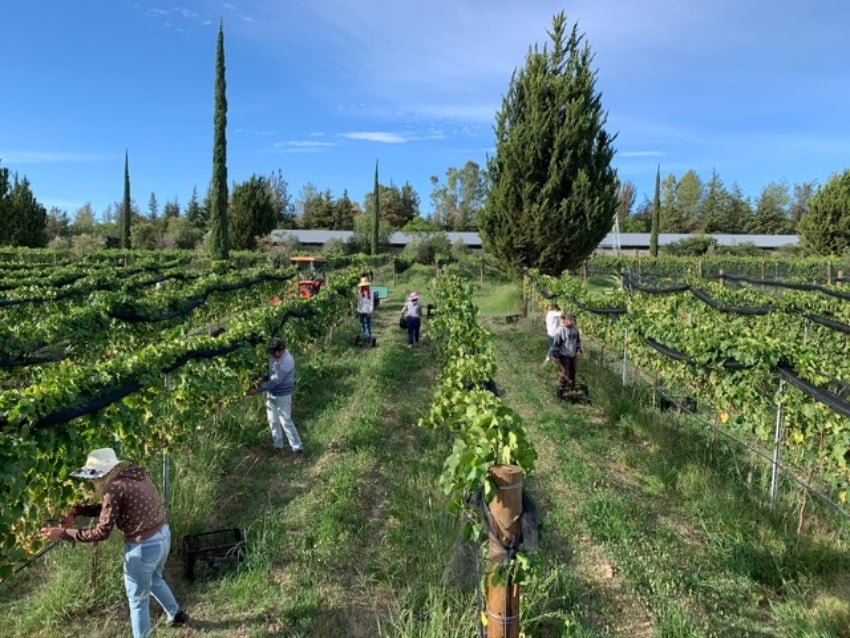
Workers harvest grapes in Jalisco for Altos Norte’s 2025 vintage wines (Altos Norte).
Not that the family was new to working the land. Originally, their farm — on land bought by their grandfather in 1922 — grew monoculture corn and raised livestock until 1990. Then, in 2016, after much preparation to convert the land to a vineyard, Vega and Hernández planted their first grapevines.
The switch was a challenge. But aiming high, the family sought out experts to help them achieve their vision, including viticulture specialist from Aguascalientes, Trini Jiménez, who had extensive industry experience and had studied abroad.
The first and most important step, however, came in 1994, when the family prepped the land for organic farming, using an agro-ecological model.
Altos Norte’s first harvest and first wines
At the same time, Vega began studying enology, which enabled him to serve as the winemaker in his own vineyard. The first vines were brought from France, a selection of Tempranillo and cabernet sauvignon plants. Later, Albariño and Malbec varieties were added, eventually covering an area that is a little less than 10 acres, creating a small but well-monitored vineyard.
By 2018, the vineyard celebrated its first harvest.
Even though Vega and Hernández knew that, ideally, they should wait between three and five years to make wine commercially, the high quality of their early harvests spoke for themselves, reflecting all the work that had been done over two decades to revitalize the land. So they bucked tradition and decided to bottle their first wine early.
In 2020, the vineyard produced three wines — a rosé, a red and a white — and the Altos Norte brand was officially born.
Evolving to a more natural winemaking process
The first sparkling wines at Altos Norte were made using traditional methods. For this winemaking process, they were advised by the Technological University of Northern Aguascalientes, where the selected yeasts were chosen and the wines were made.
However, as the family continued to plant more vines and the vineyard grew, Vega and Hernández began looking for new production methods, something that would better align with their philosophy of caring for the land, the crops, the environment and their workforce. They sought a process that involved less intervention.
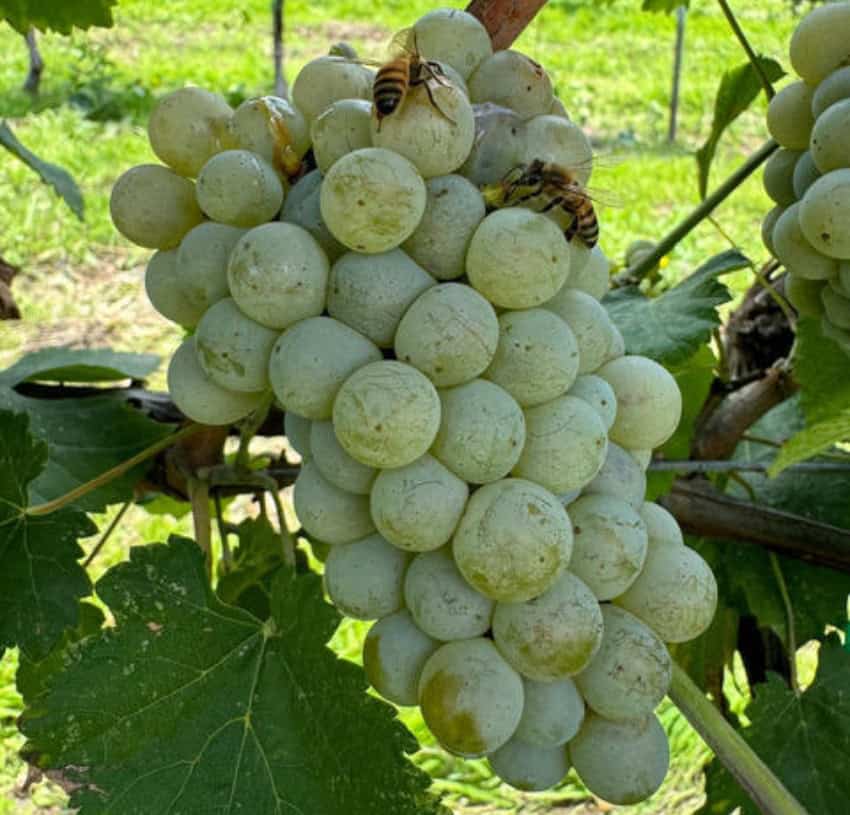
Albariño grapes are excellent for winemaking and are also appreciated by local bees. (Altos Norte)
The change came in 2021. With the winery now in a position to produce its own wines, the family opted to make Pét Nat (short for Pétillant Naturel), a slightly effervescent natural wine. They began aligning their winemaking process to be as low-intervention as possible, using wild, endemic yeasts and abstaining from adding sulfites, filtering their batches and stabilizing the wines.
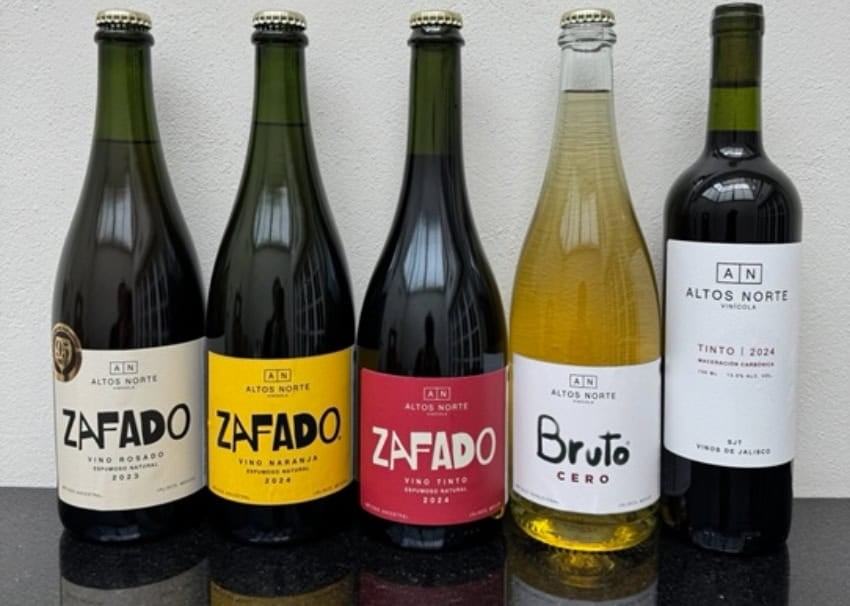
This is how their lines, Zafado and Bruto, were born. In Mexico, the Spanish word zafadomeans crazy, which was exactly what Vega’s uncle told him when he first shared that he, a man with no background in winemaking, would be making wine in Jalisco, a region not known for its viticulture.
There are three Zafado wines: a red, a rosé and an orange wine. In Mexico, few winemakers dare to make orange wine, but Altos Norte embraced the challenge using Spanish Albariño varietal grapes.
During the cultivation process, they were advised by Branko Pjanic, an expert winemaker who has been living in the country for years and consults on various projects.
Fermentation and food pairings
These include Altos Norte’s rosé, made from Tempranillo and Malbec grapes, and a red, made from cabernet sauvignon and Malbec. The process is 100% Pet Nat. The yeasts are wild or natural, meaning from indigenous microorganisms found in the grapes or in the environment. They ferment in stainless steel tanks, are monitored for 10–12 days, then continue their fermentation process in the bottle.
As sugars are consumed, sediments accumulate in the neck of the bottle. To prevent this, the bottles are constantly shaken. Additionally, there are no sulfites, no filtering and no stabilization. Once fermenting is done, it’s on to degorging, where sediments are removed from the bottles, and then the slightly effervescent wines are released onto the market.
The result is extraordinary: light, balanced wines that are easy to drink, with small bubbles that dance on the palate and open up the taste buds. A perfect pairing could include many things, but with their freshness and explosion of flavor, they perfectly accompany spicy Mexican cuisine — green enchiladas with cotija cheese, aguachiles (great with the orange wines), carnitas and tacos al pastor (a perfect pairing with the rosé). Try the red wines with roasted meat.
Et tu, Bruto?
The Altos Norte line of wines, including the Zafado and Bruto labels. (Altos Norte)
Altos Norte’s other line, Bruto, a dry sparkling brut, involves a first fermentation with wild yeasts, with the wine remaining in stainless steel tanks until it is finished. Afterward, technical tests are done to see if the fermentation is complete, and selected neutral yeasts (which do not add flavor) are added to generate bubbles for the sparkling wine. The second fermentation process then begins, and when it reaches a certain density, only then are the wines bottled. Those bottles are left for several months in cages, laid horizontally so that the wine remains in contact with its lees and yeast.
After several months, the bottles are shaken so that all the sediment goes to the top of the bottle. They remain like this for several weeks, with workers shaking the bottles two or three more times to break up the sediment until it turns to powder. After a while, the bottles are cooled, the neck is frozen, and the disgorging process is carried out to expel the lees, leaving a clean wine. No carbonated bubbles are added.
This wine is an excellent aperitif, ideal for seafood, shellfish, semi-mature cheeses and Iberian ham.
Good labor practices and environmental awareness
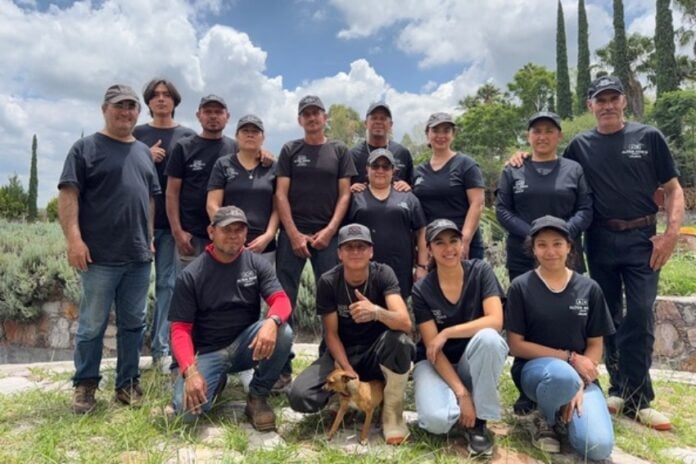
The philosophy that drives Altos Norte is one of care: for the land, for its wines and for its workers, whom the family recognizes make possible their vineyard’s incredible line of wines. The vineyard guarantees its workers consistent work throughout the year, and many live on the estate — a safe place to live that is just a few steps from where they work.
Work in the vineyard is also well distributed among the family members: Hernández is in charge of public relations and sales. The family’s two children, Catalina and José Manuel, manage social media. And, as mentioned above, José Miguel is a trained winemaker. Each year, as the harvest date approaches, Vega makes decisions about which wines he will produce based on the grapes, acidity, ripeness, Brix degrees, etc.
The vineyard also takes care to waste as little as possible: The residues from the winemaking process, the pomace and skins, are reused — some as compost and the best of the pomace made into a distillate known as Piqueta, or Piq Nat in French. The distillate is a fermented pomace made from cabernet sauvignon and Malbec grapes, with an alcohol content of 7%.
A growing future for Jalisco wines
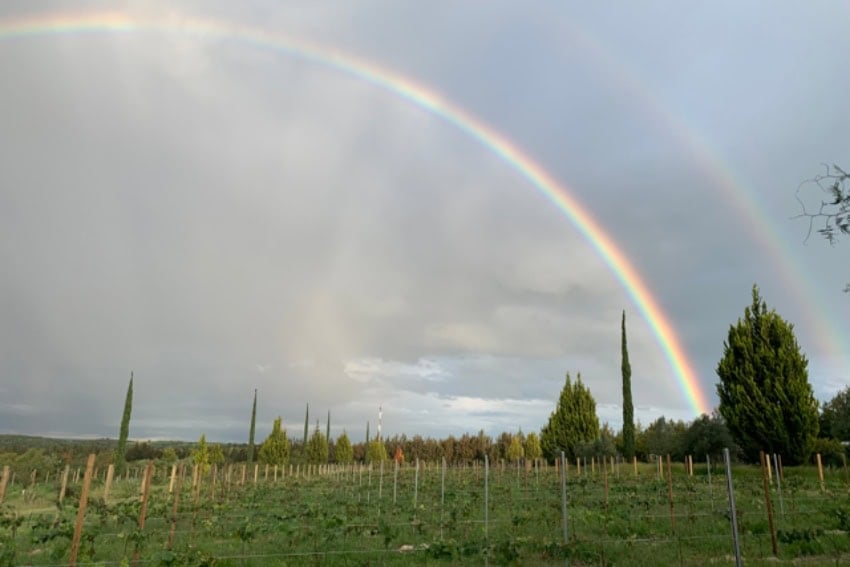
Altos Norte’s wines benefit from the winery’s non-interventionist approach, not to mention the occasional rainbow. (Altos Norte)
The winery has won some of the most wine industry’s most prestigious awards, including at the Concours Mondial de Bruxelles wine competition in Brussels. It’s always done well at competitions in Mexico. Nor is Altos Norte resting on its laurels. By 2025, the winery had produced its first cider, which we recently discussed in our special report on cider in Mexico.
And Altos Norte is by no means the only winemaker to check out in the state of Jalisco, where viticulture has become so successful that State Secretary of Tourism Michelle Fridman Hirsch recently published a call for tenders to initiate wine routes in the state.
So the next time you’re looking for something new, look westward to Altos Norte and to the growing number of Jalisco’s other great vineyards for your next great glass of wine.
¡Salud!
Diana Serratos studied at Universidad Nacional Autónoma de México (UNAM) and UNCUYO in Mendoza, Argentina, where she lived for over 15 years. She specializes in wines and beverages, teaching aspiring sommeliers at several universities. She conducts courses, tastings and specialized training.
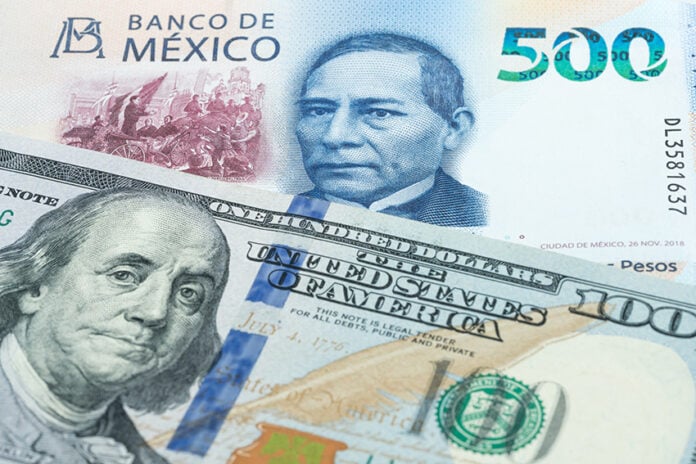
A convergence of factors weakened the peso this week, pushing it over 18 to the US dollar Friday morning. (Shutterstock)
The peso weakened past 18 per US dollar in early Friday trading, following the Bank of Mexico’s unexpected move to lower its benchmark rate to 6.75% and increased global risk aversion.
Mexico’s currency, which is weakening for a third consecutive trading day, is experiencing pressure from a stronger US dollar and concerns about inflation, as well as geopolitical risks impacting oil supplies in the Middle East.
The currency was trading at 18.0197 units to the US dollar in the early morning, down nearly 0.5% from Thursday’s close of 17.93.
The brokerage firm XTB said the depreciation of the peso reflects a profound adjustment in how the market is valuing Mexico, “primarily explained by internal factors … but amplified by signs of weakening external factors and an increasingly complex macroeconomic environment.”
Among the internal factors was the unexpected rate cut, which was primarily driven by perceived economic vulnerabilities including rising unemployment. Underemployment at 7.0% and high informal employment at 54.8% were also drivers of the bank’s decision and of equal concern to traders.
The bank’s move broke with the prevailing market expectation, which anticipated a more cautious stance due to the persistence of inflationary pressures.
Just days earlier, the national statistics institute INEGI reported that the annual headline inflation rate reached 4.63% through the first 15 days of March, up considerably from the 4.02% recorded at the end of February.
XTB also described the unanticipated trade deficit as a relevant data point. Mexico’s trade balance shifted to a US $0.46 billion deficit in February, reversing a previous surplus, as imports surged 20.8% annually to US $57.31 billion, outpacing a 15.8% rise in exports (US $56.85 billion).
Global sentiment has put further pressure on the peso: The dollar strengthened after reports that U.S. President Donald Trump had extended a deadline to attack Iranian energy infrastructure — even as the Pentagon considers sending 10,000 more troops to the Middle East.
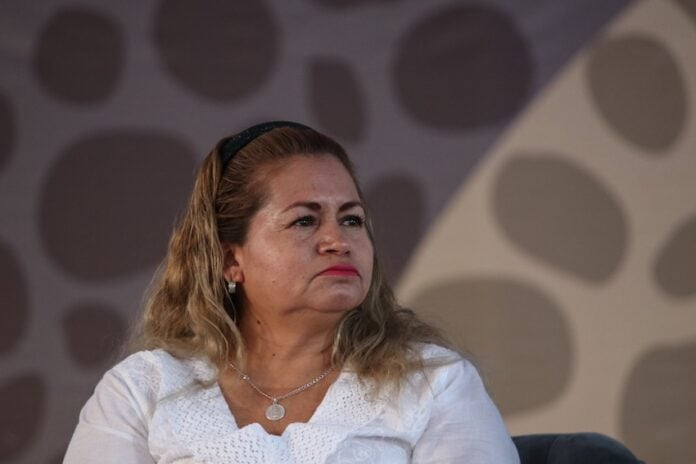
The citizens search collective founded seven years ago by Ceci Flores (pictured) has been involved with the recovery of more than 2,700 bodies. The latest is the most personal — Flores's own son.
(Andrea Murcia/Cuatroscuro.com)
The discovery of bones on Tuesday awaits DNA confirmation, but Ceci Flores is sure she has finally found one of her missing sons based on clothing found at the site.
“I’m convinced that I found my son,” she said. “I thank the authorities who made it possible and the people who never abandoned me.”
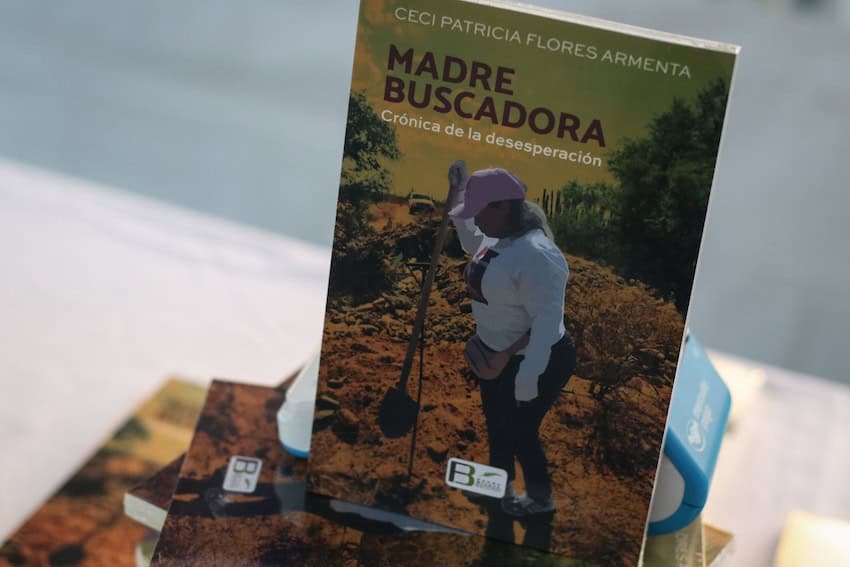
Ceci Flores published her book on being a searching mother in 2024, which she sub-titled “A chronicle of desperation.” (Andrea Murcia/Cuartoscuro.com)
She has been involved in the struggle since 2015 when her son, Alejandro Guadalupe, then 21, disappeared on his way to work in Los Mochis, Sinaloa.
Four years later, her sons Marco Antonio, 32 at the time, and Jesús Adrián, who was 15, went missing, abducted by an armed group in Sonora along with another brother. Soon thereafter, the kidnappers contacted Flores to indicate a meeting point where they released Jesús Adrián. Marco Antonio was never seen again.
The discovery of what are believed to be bone fragments belonging to Marco Antonio was made alongside Highway 26 near Hermosillo, Sonora, in an area where search collectives had reported the presence of clandestine graves.
The remains were scattered over a large area and did not comprise a complete body. The evidence was secured and transferred to laboratories for specialized analysis to determine the identity.
In a social media post, Flores expressed fatigue and gratitude that she found one of her sons:
“After fighting against everything, against oblivion, against apathy, against the hard, dry land scorched by the sun that was always there, leaving part of our blood and skin behind, crying to wipe away the dust that blinded us, because there was no time, because I believed that with every step I would find you alive, that I would arrive in time to protect you, to hold you and give you the most beautiful kisses that only a mother knows how to give.”
For the past seven years, Flores has led searches in clandestine graves, in remote desert spaces and rural areas across the state of Sonora as well as in other regions of the country.
Flores’ group has reported recovering more than 2,700 bodies and reuniting 2,400 living people with their families. This despite receiving threats from criminal groups (Flores has publicly accused organized crime gangs of being behind the disappearance of her sons) as well as violent attacks (in September 2023, the group was shot at while performing a search in Guaymas, Sonora).
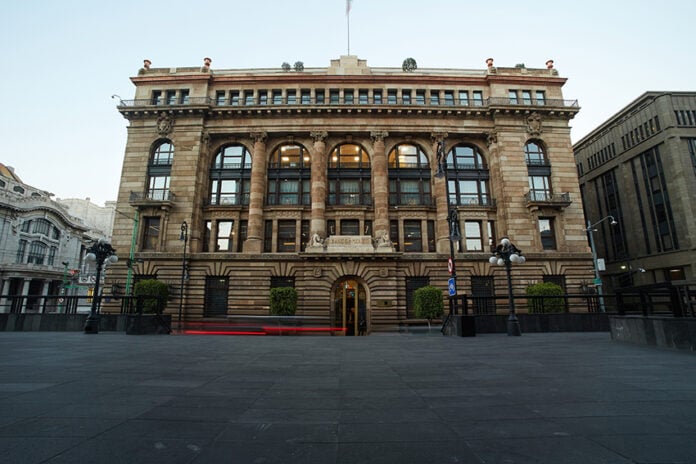
Mexico's central bank, also known as Banxico, surprised analysts with its Thursday decision to further cut Mexico's benchmark interest rate. (Shutterstock)
The Bank of Mexico (Banxico) board has voted to cut the central bank’s benchmark interest rate just two days after data showed that the annual inflation rate rose to 4.63% in the first half of March.
The 25-basis-point cut will take effect on Friday, reducing Banxico’s key rate to 6.75%.
Three of five board members including Banxico Governor Victoria Rodríguez voted in favor of reducing the rate to 6.75% while the other two supported maintaining the rate at 7%.
In a statement announcing the reduction, Banxico acknowledged that annual headline inflation increased to 4.63% in the first fortnight of March — its highest level since 2024 — but noted that core inflation “remained practically unchanged” between January and March, declining to 4.46% from 4.47%.
Despite inflation increasing every month so far this year, Banxico said that the headline rate is still expected to converge to the bank’s 3% target in the second quarter of 2027.
In making its latest monetary policy decision, Banxico said that its board “took into account the observed levels of the exchange rate, the weakness of economic activity, and the level of monetary restriction [already] implemented.”
It also said that the board “deemed that the monetary policy stance attained is adequate to face the challenges posed by an extension and escalation of the Middle Eastern conflict and its outcome.”
“… Looking ahead, depending on the evolution of macroeconomic and financial conditions, the Board will evaluate the appropriateness and timing for an additional reference rate cut,” Banxico said.
The decision to cut Banxico’s key rate by 25 basis points came after the central bank’s board last month voted to maintain borrowing costs at 7%.
Between August 2024 and December 2025, the Bank of Mexico cut its benchmark interest rate after 12 consecutive monetary policy meetings, shaving a total of four percentage points off borrowing costs in the period.
Banxico’s cut was not anticipated by most analysts
Of 37 banks, brokerages and research organizations consulted by Citi in its latest “Mexico Expectations Survey,” only 14 said they expected the Banxico board to vote in favor of an interest rate cut at its March monetary policy meeting. Seventeen respondents said they expected the next rate cut in May, while six believed that a reduction wouldn’t come until June.
On X, the director of economic analysis at Banco Base, Gabriela Siller, wrote that she was surprised by the Banxico board’s interest rate decision.
A mi sí me sorprendió el recorte de Banco de México.
Aunque en su comunicación estaba abierta la puerta a más recortes, con el repunte significativo de la inflación y los riesgos al alza pensé que serían más cautelosos.
Although Banxico’s “communication left the door open to more cuts, with the significant increase in inflation and the upside risks, I thought they would be more cautious,” she wrote.
Juan Pablo Spinetto, Latin America columnist for Bloomberg Opinion, also offered an opinion on Banxico’s latest rate cut. On X he wrote:
“Banxico must be the only central bank that says:
– That the risks to inflation remain ‘biased to the upside.’
– That geopolitical risks and risks in the U.S. ‘could imply pressures on inflation.’
– That raises its forecasts for inflation in Mexico in 2026.
And despite all this, [the bank] cuts its interest rate.”
The outlook for inflation in Mexico
Compared to the forecasts it made in February, Banxico raised its inflation outlook for three of four quarters of 2026.
The central bank anticipates average headline inflation of 4.1% in the first quarter of 2026, up from a previous prediction of 4%.
It increased its Q2 inflation forecast from 3.8% to 4% and lifted its Q3 outlook from 3.6% to 3.7%. Beyond that, Banxico made no changes to its February forecasts.
The bank anticipates inflation of 3.5% in the final quarter of this year, 3.2% in the first quarter of 2027 and 3% in subsequent quarters until the end of the forecast horizon in Q1 of 2028.
Banxico noted that its forecasts are subject to various upside and downside risks.
On the upside it identified:
Disruptions due to foreign trade policies or to an inflationary impact from geopolitical conflicts.
Cost-related pressures.
Persistence of core inflation.
A trend towards depreciation by the Mexican peso. (The peso depreciated on Thursday to close at 17.95 to the US dollar, according to Banxico).
Climate-related impacts.
The downside risks identified by Banxico were:
Lower-than-anticipated economic activity in Mexico and/or the United States.
A lower pass-through from increased costs.
Lower pressures stemming from the appreciation the national currency has been registering since last year.
Banxico said that “risks for the trajectory of inflation remain biased to the upside.”
“The changes in economic policy by the U.S. administration and the escalation of geopolitical conflicts add uncertainty to the forecasts,” the bank said in its monetary policy statement.
“Their effects could imply pressures on inflation,” it added.
Now, after a lengthy hiatus, we are resuming our “Mexico in Numbers” data journalism series with this article focusing on a range of information related to aviation in Mexico.
Without further ado, let’s delve into the numbers!
Top airlines for domestic flights
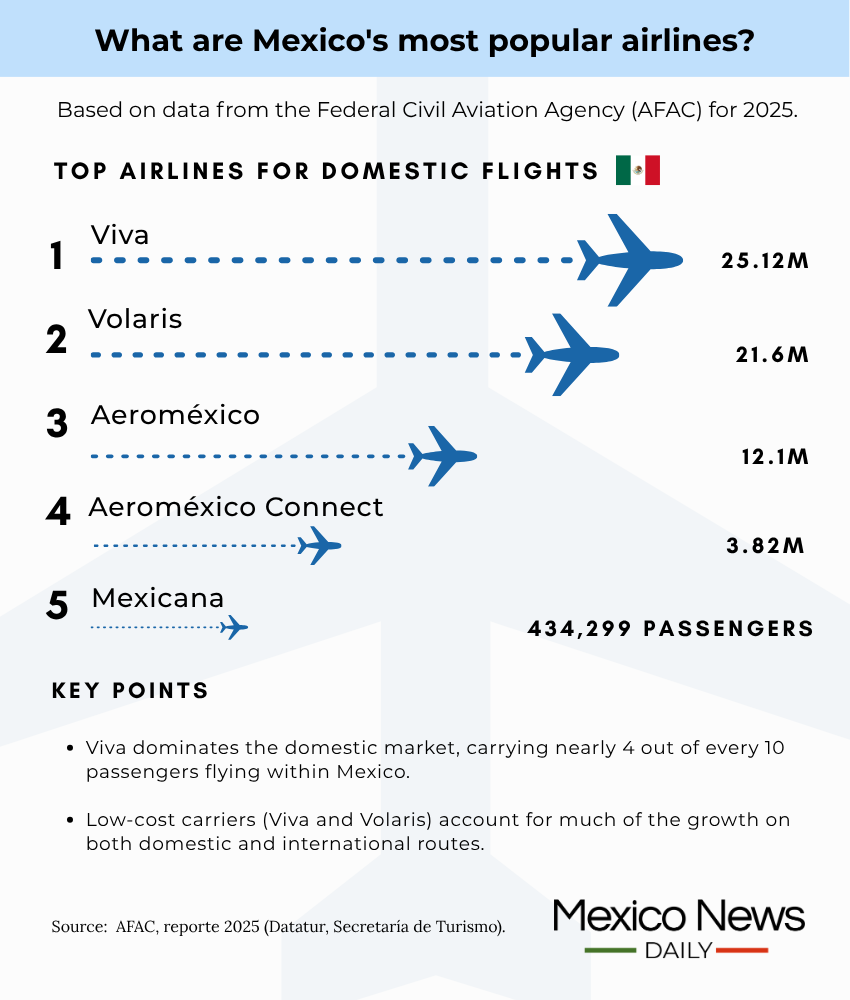
In terms of passenger numbers, the top airline for domestic flights in Mexico in 2025 was Viva, according to federal government data.
Viva transported 25.12 million passengers on domestic flights last year, an increase of 7.3% compared to 2024. The budget airline had a 39.5% share of the domestic air passenger market.
After Viva, the most popular airlines for domestic flights were:
(2) Volaris: 21.6 million passengers (+5.5%), 34% market share.
(3) Aeroméxico: 12.1 million passengers (-5.7%), 19.1% market share.
(4) Aeroméxico Connect: 3.82 million passengers (-7.2%), 6% market share.
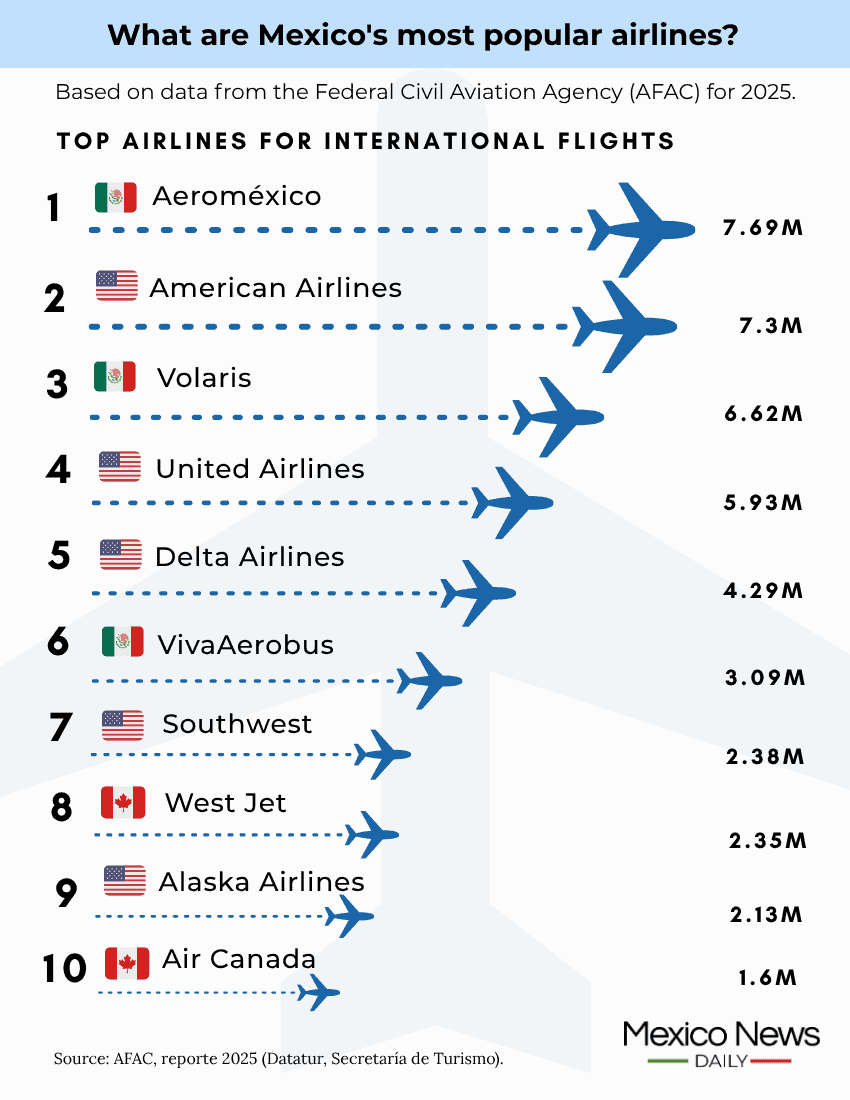
The top airline for international flights into and out of Mexico was Aeroméxico. The airline transported 7.69 million passengers on international routes in 2025, a 5.8% increase compared to the previous year. The airline had a 13.1% share of the market for passengers traveling internationally to and from Mexico.
After Aeroméxico, the most popular airlines for international flights to and from Mexico were:
(2) American Airlines: 7.3 million passengers (-4.1%), 12.4% market share.
(3) Volaris: 6.62 million passengers (+4.3%), 11.2% market share.
(4) United Airlines: 5.93 million passengers (-1.7%), 10.1% market share.
(5) Delta Airlines: 4.29 million passengers (+0.1%), 7.3% market share.
(6) Viva: 3.09 million passengers (+13.5%), 5.3% market share.
(7) Southwest Airlines: 2.38 million passengers (-6.5%), 4% market share.
(8) West Jet: 2.35 million passengers (+27.5%), 4% market share.
(9) Alaska Airlines: 2.13 million passengers (-1.6%), 3.6% market share.
(10) Air Canada: 1.6 million passengers (+84.2%)
How many airlines fly into and out of Mexico?
According to government data, 62 airlines flew routes into and out of Mexico in 2025.
Those airlines are based in countries in North America, Central America, South America, Europe and Asia.
Five of the airlines are Mexican, 13 are American, six are Canadian, 19 are European, 16 are South American or Central American and three are Asian.
Among the airlines that fly to Mexico from outside North America are Iberia, Air France, British Airways, Lufthansa, Turkish Airlines, Copa, Avianca, LATAM, Emirates, ANA and China Southern Airlines.
By Mexico News Daily chief staff writer Peter Davies (peter.davies@mexiconewsdaily.com)
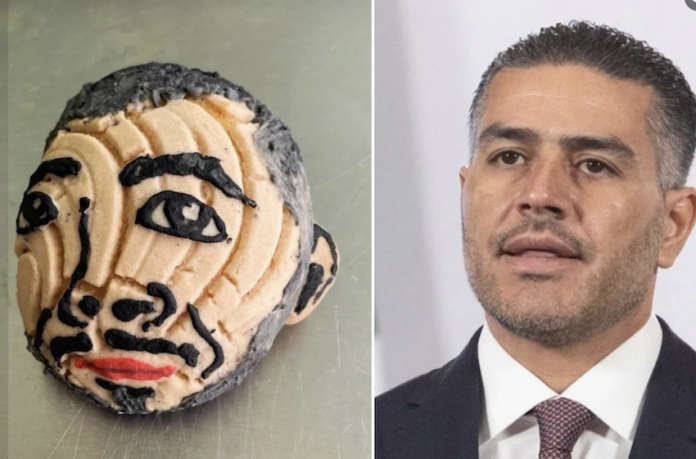
A Mexico City baker has taken Harfuch-mania to a new level by rendering the likeness of Security Minister Omar García Harfuch (right) on a concha (left) — or at least as close to his likeness as one can get on a dome-shaped piece of sweet bread. (Facebook)
Jonathan Barrera, who runs Bestcake CDMX in Mexico City, has turned García Harfuch’s face into a made-to-order concha, the iconic, dome-shaped Mexican sweet bread.
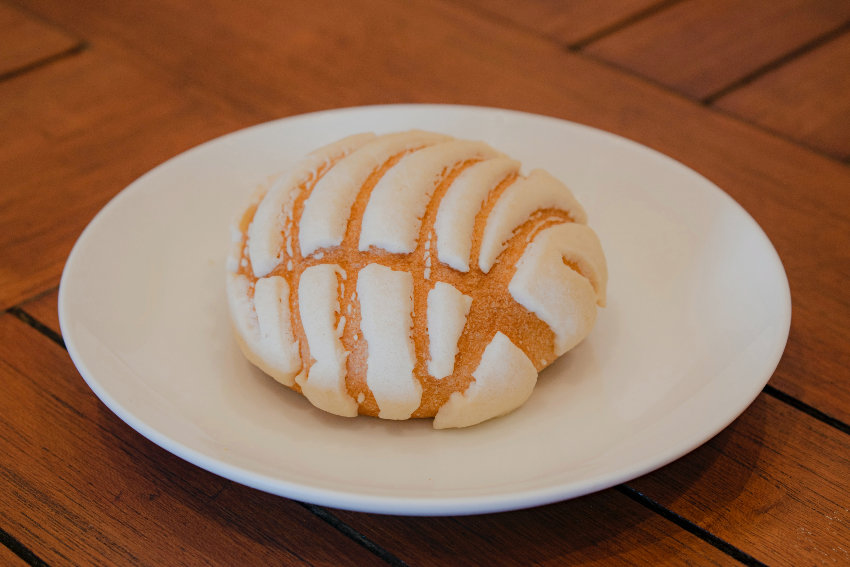
A concha is a traditional Mexican sweet bread, named for its seashell-like appearance. (Unsplash)
Nicknamed “Harfuchas,” the conchas keep their traditional buttery flavor, but their shape is slightly altered and the sugary crust on top is fashioned into the likeness of Mexico’s top cop.
Boxes of six reportedly sell for 350 pesos (US $19.64) while a more elaborate four-piece set has been going for 370 pesos (US $20.76).
However, the conchas are not being sold individually and are available only by advance order. And since Barrera handles pretty much everything at the shop, wait times have been long.
Barrera opened his small, independent bakery during the COVID pandemic. As its calling card, the shop in the capital’s Iztapalapa borough fuses conchas with meme-y and pop culture designs, such as Dr. Simi, the rain god Tlaloc and “Conchanguito.”
The latter — inspired by Punch, the Japanese baby monkey who went viral for clinging to a stuffed animal — is a portmanteau of “concha” and “changuito,” which literally means “little monkey.”
Earlier this month, this media outlet and others documented the boom in blankets, dolls and other items featuring the 44-year-old security chief, noting that some operators were turning out up to 150 blankets a day, with orders even flowing to the United States.
On TikTok, Instagram and Facebook, users have posted photos of the “Harfucha” conchas, sometimes alongside existing “Harfuchito” dolls and blankets (some featuring an image of a shirtless García Harfuch).
Some of García Harfuch’s celebrity was formed in 2022, when Green Party lawmaker Jesús Sesma referred to Mexico City’s then–citizen security chief as a “superhero” and crafted a Batman-modified action figure that went viral and sparked memes.
García Harfuch’s enduring image as a vigilante-style protector is part of what the current trend is seizing upon.
It also comes after a December 2025 poll cited him as the leading Morena contender for president in 2030, when President Claudia Sheinbaum’s term will end.