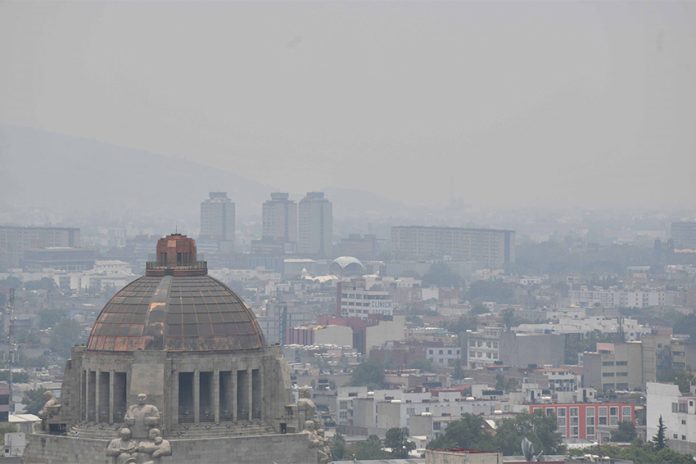
Mexico City's emergency pollution restrictions have been in effect since Monday. (Mario Jasso/Cuartoscuro)
Mexico City authorities declared a Phase 1 air quality emergency on Wednesday morning, restricting vehicular traffic, including taxis and cargo deliveries.
The Environmental Commission of the Megalopolis (CAMe) released a press bulletin at 3 p.m. confirming the measures will continue into Thursday for the fourth consecutive day, outlining the driving restrictions imposed when a Phase 1 air pollution emergency is declared.
During a Phase 1 emergency, automobiles with specific license plates and specific exhaust verification ratings are prohibited from driving, 50% of gas delivery trucks are kept off the road, and cargo trucks are only allowed to make deliveries between 6-10 a.m. Taxis can operate freely from 5 a.m. to 10 a.m. but thereafter they must adhere to restrictions linked to their license plates and exhaust verification ratings.
Authorities also urged residents to stay indoors and to avoid outdoor activities and exercise between 1 p.m. and 7 p.m. to prevent unnecessary exposure to high ozone levels. The CAMe also encouraged organizations to cancel civic, cultural and recreational activities that had been scheduled to take place outdoors.
According to the Mexico City Air Quality Monitoring System (SIMAT) a high-pressure system above the central and southern regions of the country has been creating conditions that make dispersion of pollutants difficult.
SIMAT also reported that only three of its 15 monitoring stations rated air quality in the Valley of Mexico as Good. Four others rated the air quality as Acceptable. The remaining eight rated it as Bad.
Conagua, however, is predicting that the Valley of Mexico, as well as the state of Querétaro and Morelos, could be seeing a bit of relief later on Wednesday, with intermittent rain squalls predicted thanks to humidity from the Pacific Ocean and the Gulf of Mexico.
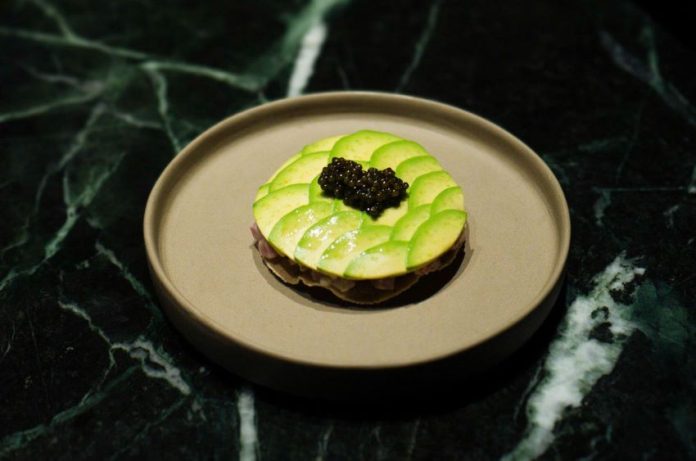
Em is one of the 16 Mexican restaurants to receive a one-star Michelin rating in 2024. (Michelin Guide)
Finally, what food aficionados had been waiting for — the Michelin Guide has arrived in Mexico!
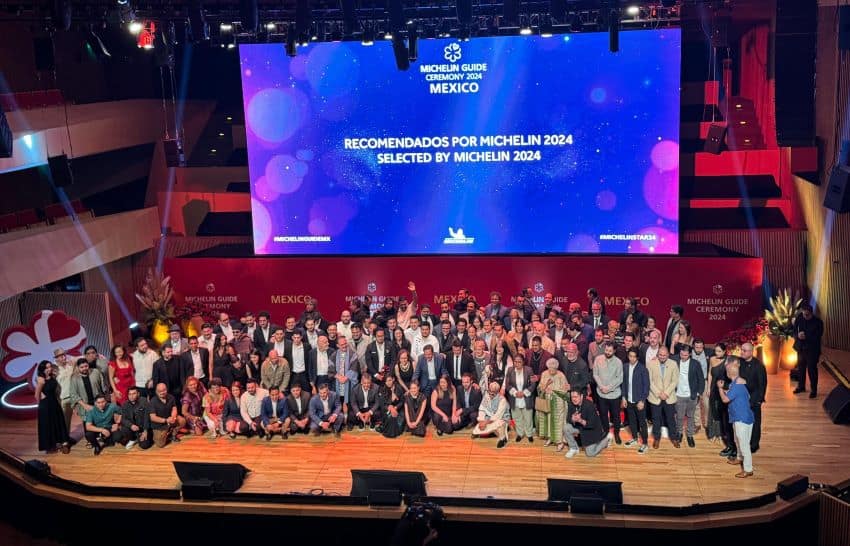
During a ceremony held in Mexico City on May 14, Michelin unveiled Stars for 18 restaurants across Mexico, including 2 two-star and 16 one-star ratings. The storied guide also awarded 6 Green Stars and 42 Bib Gourmands.
A ceremony for the long-awaited Michelin guide to Mexico was held in Mexico City on May 14. (X)
The restaurants in the Michelin Guide Mexico 2024 are located in Mexico City, Quintana Roo, Oaxaca, Baja California, Baja California Sur and Nuevo León.
First published in France in 1900 by the Michelin tire company to incentivize motorists to use their tires, the Michelin guide has become the most famous restaurant ranking in the world — and the most coveted recognition by restaurateurs.
From taquerías to family-run restaurants and high-end dining, here are the Mexican restaurants that hold one or two Michelin Stars in 2024.
Two Michelin Stars
According to the Michelin Guide, restaurants with two Michelin Stars reflect in their expertly crafted dishes the personality and talent of the chef; with food that is inspired and refined.
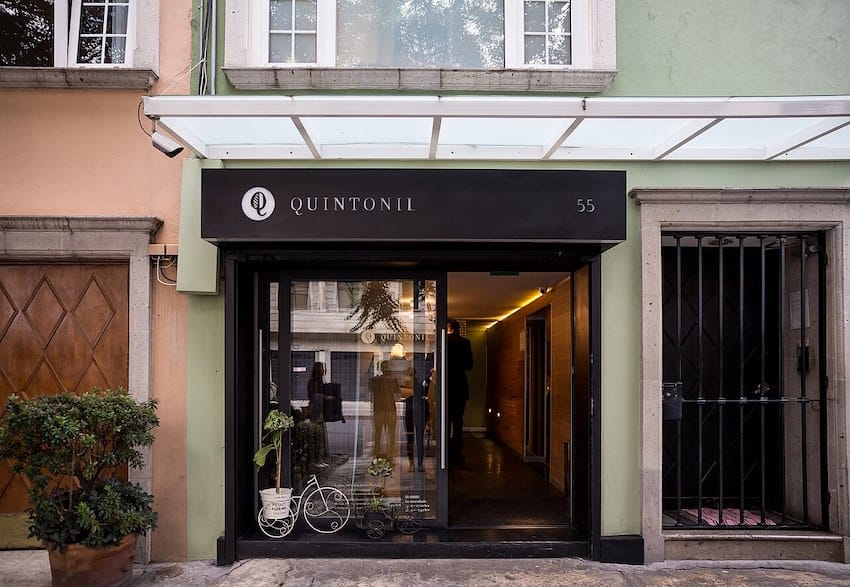
Mexico City’s Quintonil is one of just two Mexican restaurants to receive two Michelin stars. (Wikimedia Commons)
Quintonil
Newton 55, Polanco, Mexico City
Located in the heart of Polanco, Quintonil stood out to Michelin for its “enticing melding of excellent local product, impressive execution and great creativity to produce refined compositions,” the guide explains.
The restaurant is named after a native herb of the state of Oaxaca.
Owned by Chef Jorge Vallejo and his wife Alejandra Flores, the tasting menu is constantly evolving. The dishes praised by the guide include crab and shards of blue corn tostada with a vivid pipián verde, and a crème fraîche sorbet with caviar and Melipona honey.
Pujol
Tennyson 133, Polanco, Mexico City
Owned by Chef Enrique Olvera, Pujol has long stood as one of Mexico’s most acclaimed restaurants.
The restaurant is mostly famous for its mole madre (mother mole) dish, which consists of two circles of sauce placed in the middle of a circular plate. The small one, at the center, is a deep orange color. The large one, which surrounds the middle one, is almost black in color and has been cooked for years. Diners are informed of the exact number of days the mole has been cooking before tasting it.
The mole madre is the star dish of Pujol’s seven-course tasting menu. For the Michelin guide, the dish represents “an effort like no other that celebrates Mexican history and cuisine in the most profound way.”
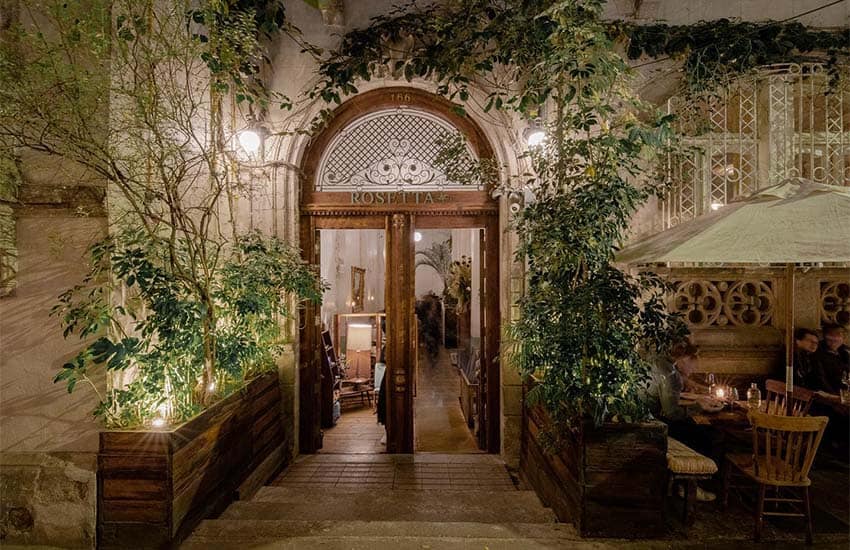
Elena Reygadas’s Rosetta in Roma Norte received one Michelin Star. (Rosetta)
One Michelin Star
The one-star distinction is awarded to restaurants where dishes are prepared to a consistently high standard with distinct flavors using top-quality ingredients, the guide explains.
Here is the complete list of restaurants with one Michelin Star in Mexico:
The accident killed eight seasonal laborers on their way to work in southern Florida on Tuesday morning. (Screenshot)
Eight Mexican migrant workers were killed and more than 40 others injured in a severe bus crash in Florida on Tuesday morning.
The workers were on their way to harvest watermelons when a 2001 Ford Ranger crossed over the centerline on a two-lane, rain-slicked country road about 130 kilometers north of Orlando, the local highway patrol said.
The pickup sideswiped a school bus headed in the opposite direction, causing it to veer off the road, after which it plowed through a fence, hit a tree and rolled over, officials noted.
The driver of the pickup, Bryan Maclean Howard, was arrested and charged with eight counts of driving under the influence/manslaughter, according to the state’s Department of Highway Safety and Motor Vehicles.
In a court hearing on Wednesday, a judge denied Howard bond, appointed him a public defender and set his next court appearance for June.
Mexico’s Foreign Affairs Ministry (SRE) confirmed the nationalities of the deceased, all of whom were men holding H-2A visas for temporary or seasonal agricultural work in the United States.
Florida farms employ about 50,000 H-2A workers each year, more than any other state, according to the Florida Fruit & Vegetable Association.
“With deep sorrow, I confirm the death of eight agricultural workers … Mexicans, men,” Foreign Minister Alicia Bárcena said on her X account late Tuesday night. “Seven of the 44 injured are hospitalized. Our consul [in Orlando, Florida] Juan Sabines Gutiérrez and the SRE will provide full support to our compatriots and their families.”
Local authorities reported that the bus was carrying 53 migrant workers when the collision occurred around 6:40 a.m. in Marion County, Florida. Over 30 ambulances were called to the scene, said Billy Woods, the county sheriff.
In his Wednesday morning press conference, Mexican President Andrés Manuel López Obrador said that 44 of the farmworkers on the bus were Mexican citizens.
The president did not release any more information out of consideration for the victims’ relatives, he said. Mexican consular officials are working with U.S. authorities to identify the victims and notify their next of kin.
No information was provided as to what substance had allegedly left Howard impaired, although Bárcena said in an interview for Milenio TV that Florida authorities told her he was under the influence of alcohol at the time of the crash.
State records show he had previous arrests, accused of driving with a suspended license, leaving the scene of an accident and marijuana possession.
Cannon Farms, where the workers were headed, noted in a Facebook post that it would remain closed through Wednesday, and in another it provided a link to a GoFundMe campaign organized by the Farmworker Association of Florida to support victims of the accident and their families.
As of Wednesday morning, the fund had raised more than US $40,000.
It was not known if the bus had seat belts or if the workers were using them. On June 28, a new seat belt requirement for employer vehicles carrying H-2A farmworkers will go into effect, the Labor Department previously announced. Florida law already requires seat belts for farmworker transport, but only in vehicles weighing less than 10,000 pounds.
Federal statistics show vehicle crashes were the leading cause of job-related deaths among farmworkers in 2022, the latest year available. They accounted for 81 of 171 fatalities.
The natural beauty of San Luis Potosí rivals anywhere else in Mexico, with almost limitless options for stunning walks across the state. (Guido/Unsplash)
If you love hiking and the great outdoors and you happen to find yourself in the city of San Luis Potosí, you’ll have to deal with a difficult problem: deciding which gloriously beautiful natural site you ought to visit first.
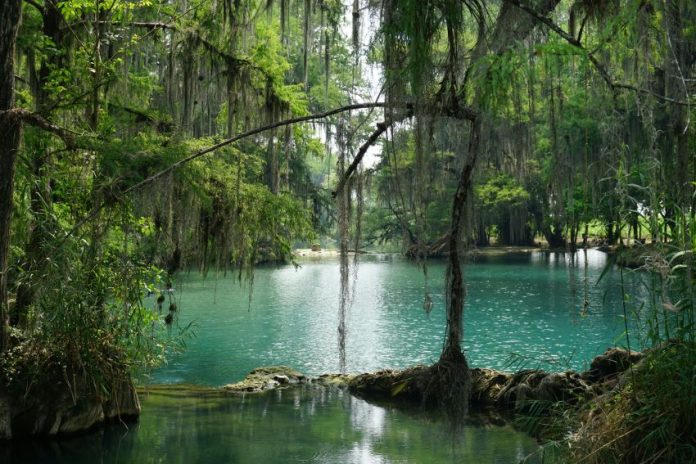
This is problematic because the whole state of San Luis Potosí is famed for its breathtaking landscapes, especially when it comes to fantastic waterfalls, rivers and cliffs — not to mention surrealist sculpture gardens.
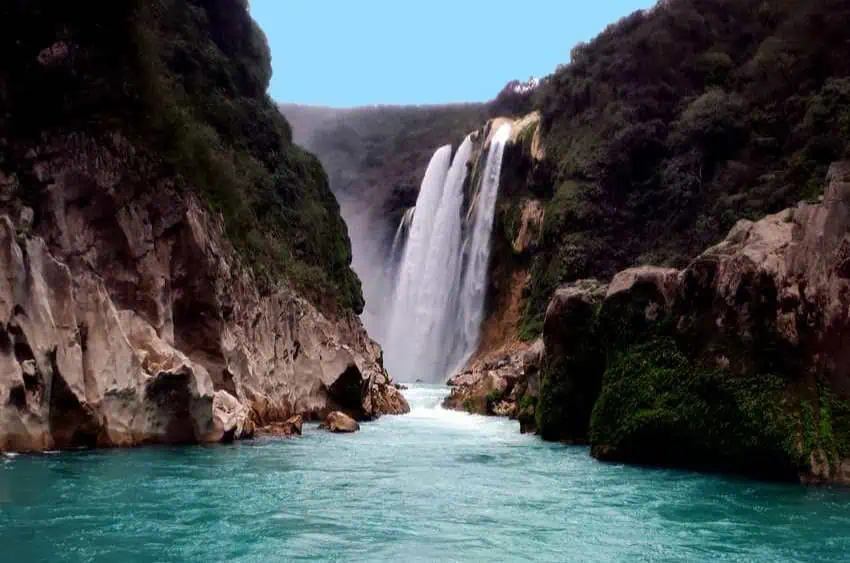
The majestic Tamul waterfall is just one of a trove of natural wonders in San Luis Potosí. (John Pint)
To assist you in making that choice, I have enlisted the help of Lori Jones, a native of San Luis who is also a highly experienced, certified tour guide.
Las Cascadas de Tamasopo: stunningly beautiful
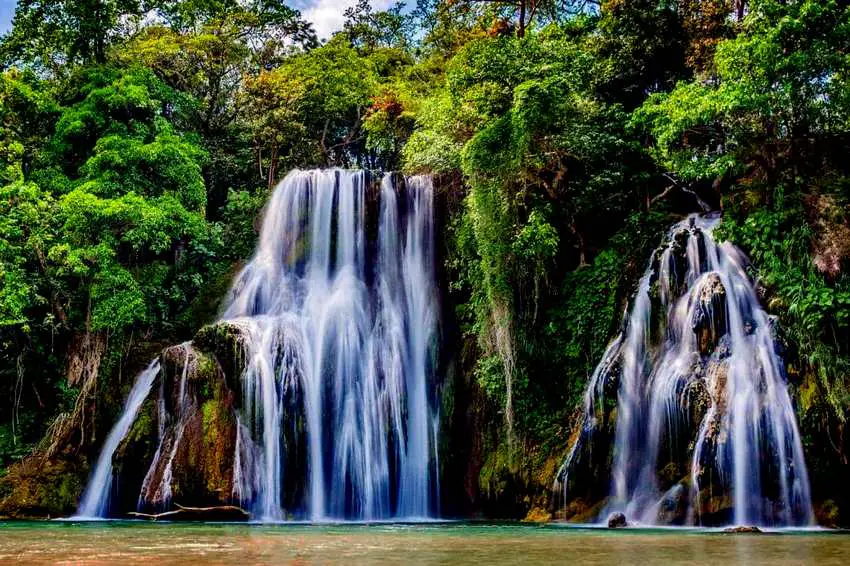
Tamasopo offers picturesque waterfalls and tranquil forest. It is worth the 300 steps to reach the bottom of the valley – though the less hiking inclined can take a more circuitous route. (Vive Huasteca)
“Of all the places we take people,” Jones told me, “this is my very favorite. The Tamasopo falls lie at the eastern end of the state of San Luis Potosí, in the great, untamed Huasteca Wilderness.”
At Tamasopo you’ll find three stunningly beautiful waterfalls to explore and swim under, along with other small pools and rivers. The place is almost like a water park, but the falls, pools and water slides are natural. In addition, there are jumping platforms and bridges at various heights, plus ropes to swing from.
Just a few kilometers from Tamasopo there is another swimming attraction called Puente de Diós (God’s Bridge), a pool of crystal-clear water that extends into a cave.
“To get to the Puente de Diós,” Jones told me, “you have to walk down 300 steps. The problem is not going down, but climbing back up! Not everyone is in shape for doing this, so I offer an alternative, a nearby place called Cascaditas where we can stroll alongside the river, which is full of lovely little waterfalls. It’s a leisurely walk where you can stop and go into the pools and falls, and the area is relatively flat, so you don’t have to negotiate any steps. About 50 percent of the people I take there prefer this option.”
The Tamasopo area is a three-hour drive from San Luis, making for a full day’s activity.
Hike to Wirikuta, the Wixárikas’ sacred mountain
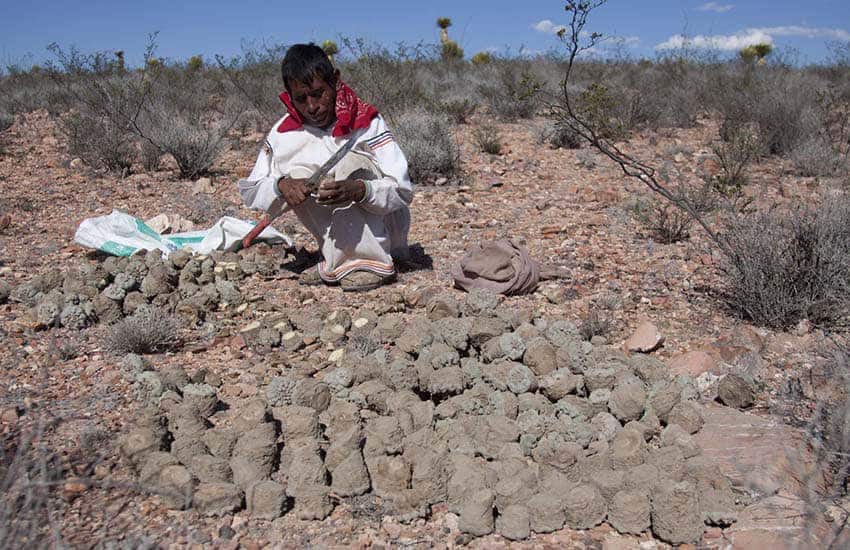
A member of the Indigenous people known as the Wikárika visits the sacred site of Wirikuta in San Luis Potosí. Here, they harvest peyote, used in rituals and in daily life. (Iván Stephens/Cuartoscuro)
This is a 15-kilometer hike from the unique old mining town of Real de Catorce to the Cerro del Quemado, also known as Wirikuta, one of the five sacred places of the Wixárika (Huichol) people. According to Wixárika cosmology, this is the place where the world was created. Today it is protected as a UNESCO Natural Sacred Area.
“This hike,” says Jones, “takes two and a half hours or three, depending on how fast you walk—because here you are hiking at an altitude of 2,700 meters (nearly 9000 feet) so most people have to walk very slowly. On top of the mountain you can see concentric circles of stone where the Wixárika do a cleansing, coming-of-age ceremony for their young men each year. This is a tough hike and you can choose to do it on your own two feet or on horseback. Personally, I do it on horseback.”
Other excursions from Real de Catorce include a hike or horseback ride to El Pueblo Fantásma. “It’s not really a ghost town,” says Jones, “but the picturesque ruins of an important silver mine. It’s at an altitude of 3000 meters, which is nearly 10,000 feet high.”
Row upriver to the Tamul Falls
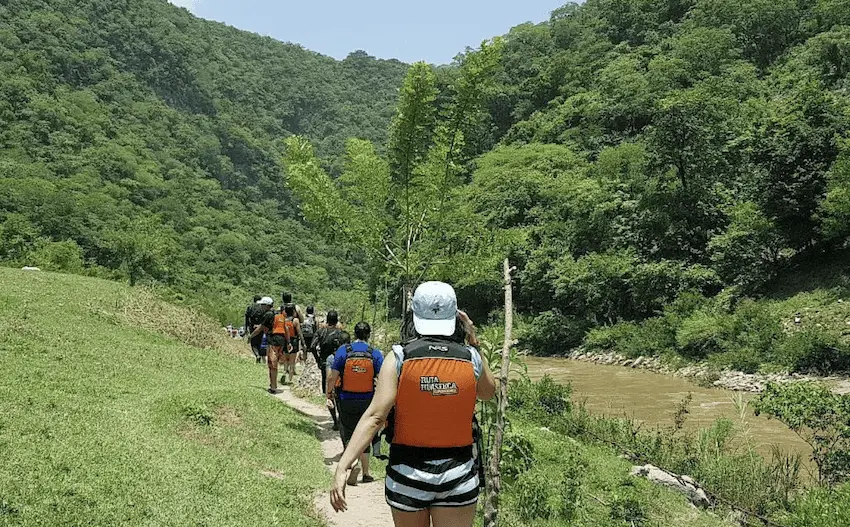
A hike and a paddle upstream bring visitors to the Tamul falls. (Tripadvisor)
“The Cascada de Tamul is a four-and-a-half-hour drive from town,” says Jones, “so we start out early. We stop for breakfast at 7:00 at a place in Río Verde famed for its gorditas. So we reach the river around 11 a.m. and we paddle up to the Tamul waterfall, which is an impressive 105 meters high and 300 wide. You have to row against the current for about maybe one hour or more—It’s not so easy. Everybody helps to paddle, otherwise we can’t make it all the way to the waterfall!”
Paddling gets you to within 50 meters of the waterfall. “From there,” says Jones, “you can take pictures and swim. The other day I took some people from Poland to this place and when we arrived there we found only some Germans, nobody else. So, going on a weekday has big advantages: we practically had the place to ourselves and everyone went swimming. Then, on the way back, we stopped and walked up a mountainside to a place they call La Cueva Del Agua and here you can swim inside the cave.”
The mezcal and pulque route
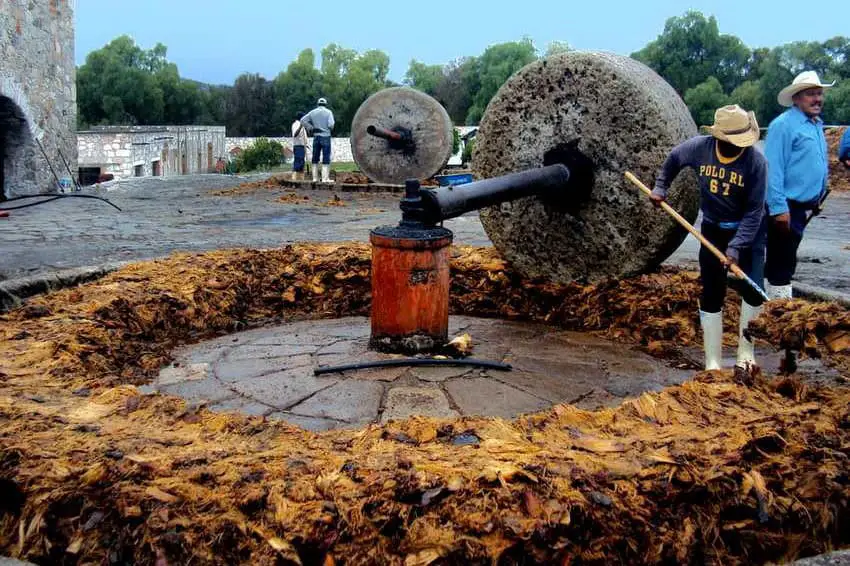
A mezcal distillery in Mexquitic. (Operatour Potosina)
“For a change of pace,” Jones told me, “I suggest a special visit we organize to give people a first-hand look at how mezcal and pulque are produced. For this we head for the municipality of Mexquitic, located just a half-hour drive from San Luis.”
Mexquitic is famed for its “high-desert mezcal,” made from the salmiana agave, said to suggest “the taste of fresh green chili, vibrant grapefruit peel and agave after a rainfall.” The process for making it has been a family secret going back 200 years.
“Beside touring this venerable distillery,” said Jones, “we also visit the family of Señora Flor and we join her in collecting aguamiel, which is very sweet and good to drink. The aguamiel is then fermented to produce pulque, which is — and has been for hundreds of years — a traditional drink for the people who work in the fields, who say it gives you lots of energy. At Señora Flor’s house we have an opportunity to taste fine pulque and to discover why it is so popular.”
The Garden of Surrealist Cultures
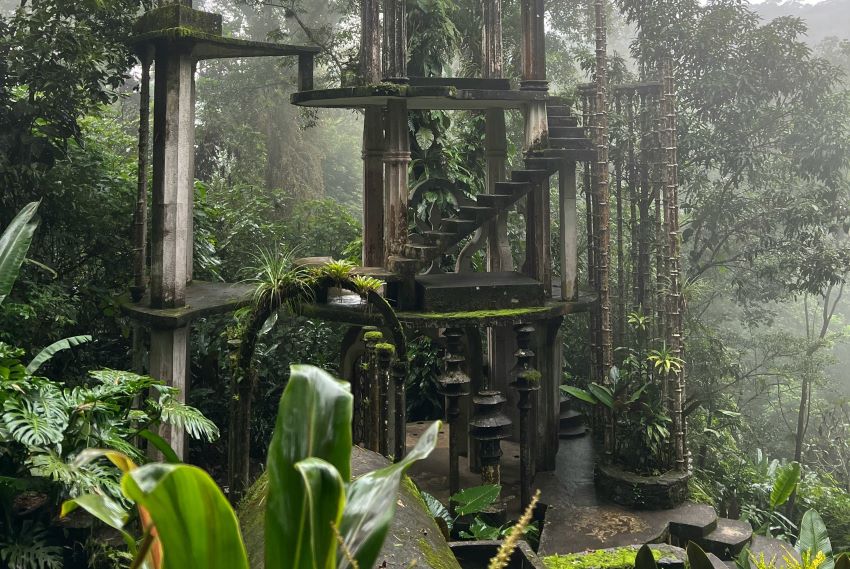
The brainchild of an eccentric Englishman, Xilitla has to be seen to be believed. (Fernando Rocha/Unsplash)
Las Pozas, Edward James’ unique “garden” in Xilitla might not seem to fit into a list of hikes, but, says Lori Jones, “Lots of walking is required to see it, because you have to go up and down many paths and staircases, spread around 37 hectares of subtropical rainforest.”
“Note that these are not sculptures, but structures,” Jones says. “There is one called ‘the house that looks like it has five floors but only has three.’ And then there is ‘the house that looks like it has three floors but actually has five.’ San Luis Potosí is filled with fascinating places to visit, but Xilitla is in a class all its own.”
John Pint has lived near Guadalajara, Jalisco, for more than 30 years and is the author of A Guide to West Mexico’s Guachimontones and Surrounding Area and co-author of Outdoors in Western Mexico. More of his writing can be found on his website.
As well as a talented actress, Nava Mau has become a leading voice for justice in the activist community. (All photos by Nava Mau/Instagram)
Exploding onto the scene in Netflix’s harrowing drama “Baby Reindeer,” Nava Mau is a Mexican filmmaker, actress and advocate making waves on and off the screen. Born in Mexico City in 1992, she was raised in San Antonio, Texas, and Oakland, California. Mau’s multicultural background and transgender identity has deeply influenced her work and drives her commitment to pushing boundaries.
Beyond being a star of the screen though, Mau has spent much of her career advocating for justice and supporting the victims of gender violence.
Activism and awards
Mau’s work has revolved around cultural issues and how to foster positive change. She received her BA in Linguistics & Cognitive Science from California’s Pomona College, after studying in Paris and conducting research in Guadalajara. She then worked with survivors of violence for three years; first with immigrant survivors as a legal assistant, and then as a peer counselor and advocate for LGBTQ+ survivors of violence.
In 2019, Mau starred in, directed and produced “Waking Hour.” In this poignant film, she portrays a young transgender woman navigating the desire for intimacy while grappling with safety concerns. Her impactful storytelling earned her the NewFest Audience Award and a YoSoy Award from the Hispanic Heritage Foundation for her advocacy work as a Latinx creator.
A trailblazer in the entertainment industry
Mau was a production fellow for the Netflix documentary “Disclosure,” delving into the representation of transgender people in the media. She then worked as a producer for the Sundance-premiered short film “Work,” along with producing the short films “Sam’s Town” and “Lovebites,” further solidifying her presence in the industry. As an actress, Mau shines with depth and authenticity in her role as a series regular in HBO Max’s “Generation.”
In “Baby Reindeer,” Donny is a struggling comedian and bartender. When he offers tea to a stranger who walks into his bar, his kind gesture sparks an obsessive fixation. Meanwhile, Donny is struggling to build a meaningful relationship with his girlfriend, a trans woman named Teri.
Baby Reindeer | Official Trailer | Netflix
Mau has received critical acclaim for her portrayal of Teri, who serves as a source of stability amidst the turmoil caused by Martha’s obsession. Her authentic portrayal highlights the importance of representing transgender characters in mainstream media. Gadd has confirmed that Teri is based on a real person he was dating at the time.
Soon, events take a dark turn as it explores topics including identity, trauma, shame and validation. In an interview for Vogue, Mau said that a huge part of daily life for a lot of trans people is having to contend with other people’s shame and judgment. Furthermore, she emphasizes that men can also be survivors of trauma and violence and it’s crucial to address these issues.
Nava Mau: leading the fight for social justice
Mau is a vocal advocate for LGBTQ+ rights and the empowerment and visibility of people of all genders. Mau’s work addresses topics ranging from gender identity to violence prevention. As her profile has risen, she has used her visibility to push for systemic change in the entertainment industry and beyond. Her dedication to breaking down barriers is an inspiration in the fight for equality and social justice.
Mau’s remarkable journey speaks volumes about her courage and talent. With each project, she reaffirms her dedication to amplifying marginalized voices and driving meaningful change. Her authentic storytelling and activism inspire embracing diversity as the new norm. As we continue to witness her impactful career, we are reminded of the transformative power of art for creating a more compassionate world.
Whatever she chooses to do next, Nava Mau looks set to continue her rise to stardom.
Sandra Gancz Kahan is a Mexican writer and translator based in San Miguel de Allende. who specializes in mental health and humanitarian aid. She believes in the power of language to foster compassion and understanding across cultures. She can be reached at: sandragancz@gmail.com
Hybrid and electric vehicle sales in Mexico are booming: February's figures showed a 58% increase compared to February 2023. (Saúl López/Cuartoscuro)
Electric and hybrid vehicle sales in Mexico increased 58% in February compared to last year, marking 17 months of consecutive growth, according to figures from the national statistics agency INEGI.
With 7,248 units sold, vehicles with some form of electrification (including hybrids, electric vehicles and PHEVs) accounted for 6.4% of total light vehicle sales in Mexico in February, which totaled 113,258 units. This figure was a record market share for electric vehicles for that month. However, it is lower than the 6.6% of sales recorded in January and the 7% of sales recorded in December.
Electric vehicle sales are still somewhat of a rarity in Mexico — likely due to their price points — but Mexicans have tax and other kinds of incentives to encourage them to make their auto purchases greener. (Saúl López/Cuartoscuro)
Plug-in hybrid (PHEV) vehicles saw the biggest sales growth in February, with a 58.4% increase (464 cars). Meanwhile, the hybrid segment recorded a 43.8% increase in sales volume, reaching 5,379 units.
It’s important to note that these figures do not include some cars sold by Chinese brands that have recently begun sales in Mexico and that sell a range of hybrid and electric vehicles. Some of these brands include BYD, Great Wall Motors (GWM), GAC, SEV and Geely, which have not reported their numbers to the government.
While INEGI report didn’t mention the number of cars sold by brand, Toyota has said that it is the market leader, due to its broad offer of hybrids.
The online Mexican car magazine Motorpasión has confirmed that the best-selling hybrid car in Mexico is a Toyota — the Toyota Prius, with 3,694 units. It is followed by the Chinese JAC E10X, with 1,862 cars sold; the Chevrolet Bolt EUV, with 146 units sold; and the Ford Mustang Mach-E, 325, with 66 cars sold.
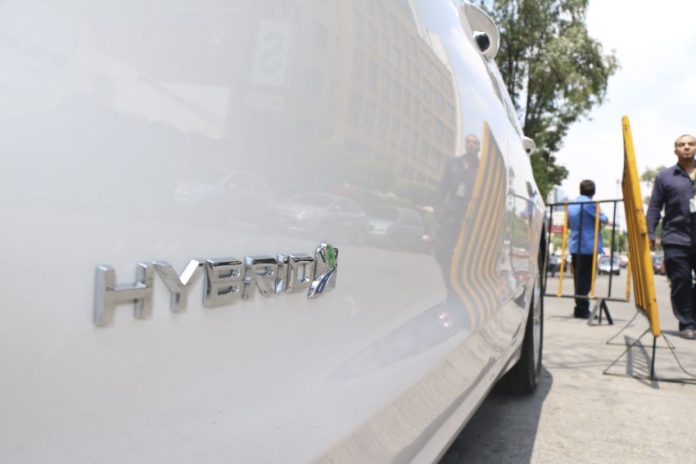
In Mexico, hybrid and electric vehicles qualify for certain tax benefits, such as exemption from vehicle ownership tax. In Mexico City, they’re also allowed to drive even when traffic restrictions are in place to mitigate poor air quality.
However, among the 10 top-selling cars in Mexico, none is an electric or hybrid vehicle.
Price is likely one of the reasons Mexicans still prefer gasoline-powered cars. According to the newspaper El País, there is a 200,000-peso (US $11,874) difference between the cheapest hybrid and the cheapest conventional car available in Mexico.
Another reason, distributors say, is lack of infrastructure for EVs. At the end of 2023, the National Auto Parts Industry (INA) and the Mexican Transport Institute (IMT) said that there were 1,189 electric charging stations in the country, with a total of 2,089 chargers.
As of last year, there were around 13,000 gas stations nationwide.
A new Mexican miniseries on Amazon Prime tells the story of the murder of much-loved, misbehaved Mexican TV presenter Paco Stanley, who was killed in 1999. (Germán Romero/Cuartoscuro)
A murder saga that captivated Mexico almost as much as the O.J. Simpson case gripped the United States is coming to Amazon Prime Video in “Who Killed Him?” on May 24.
The six-part miniseries will examine the unsolved murder of Paco Stanley, the Mexican TV presenter who was shot outside a popular Mexico City restaurant after enjoying a post-show lunch with his sidekicks on June 7, 1999 — nearly 25 years ago.
Mexican TV presenter Paco Stanley was shot dead in his car by three assailants. The case, which was in the media for over a year after his murder, captivated Mexicans. (Cuartoscuro)
Stanley, who was 56 at the time, hosted the show “Una tras otra” on TV Azteca, a rival to Televisa, the Mexican network where Stanley had been on air previously until 1998.
His personality, grace and humor fueled a career in radio and television that by the time of Stanley’s murder had made him one of the most beloved and recognizable celebrities in Mexico.
Each episode of “Quien lo Mató?” will be told through the point of view of one of the six people closest to Stanley at the time of his murder.
What gets revealed is a complex, behind-the-scenes story of fame, betrayal, excess and the dark side of the entertainment industry — at different moments pointing to different suspects. The miniseries also delves into potential motives behind Stanley’s murder.
There’s also a storyline about drug use and possible links to drug trafficking.
Upon his death, authorities found cocaine in Stanley’s blood, along with a small bag of the drug in his pocket, as well as a grinding kit. It was also discovered that he had legal clearance to carry firearms, a relative rarity in Mexico.
“The most interesting thing about the series is the representation of the comedy of errors of the Mexican justice system,” said actor Luis Gerardo Méndez, who plays Mario Bezares, an actor on Paco Stanley’s show “Una Tras Otra.” Bezares was jailed for over a year as a suspect in the TV host’s murder. (Amazon Prime)
Back in 1999, the murder of Paco Stanley was relentlessly covered by Mexican media, with news outlets exhausting every angle. Yet the public couldn’t seem to get enough of the story. Certain aspects of the media’s coverage — such as one of Stanley’s TV sidekicks being interviewed on live TV just seconds after attending Stanley’s funeral — even became hot debate points themselves.
Produced by Amazon Studios, the series falls into the realm of fiction; its online summary says it is “inspired” by real events.
The cast includes up-and-coming Mexican actor Roberto Duarte as Stanley in what could turn out to be a breakout role.
The more recognizable Luis Gerardo Méndez stars as Mario Bezares, the man who was Stanley’s sidekick first on Televisa and then followed him to TV Azteca and was initially arrested for his murder. Méndez is known for portraying soccer team co-owner Salvador “Chava” Iglesias in the hit Netflix comedy series “Club de Cuervos” and troubled police officer Victor Tapia in season 3 of the Netflix series, “Narcos: Mexico.”
“The most interesting thing about the series is the representation of the comedy of errors of the Mexican justice system,” Méndez said.
Though he was a friend of Stanley’s, Bezares was arrested as a suspect in the murder, along with another Stanley colleague, Paola Durante (played by the Mexican pop star and actress Belinda). Bezares was jailed for over a year.
Bezares was leaving the bathroom at the restaurant where he, Stanley and another TV sidekick, Jorge Gil, had eaten lunch when gunfire sounded outside.
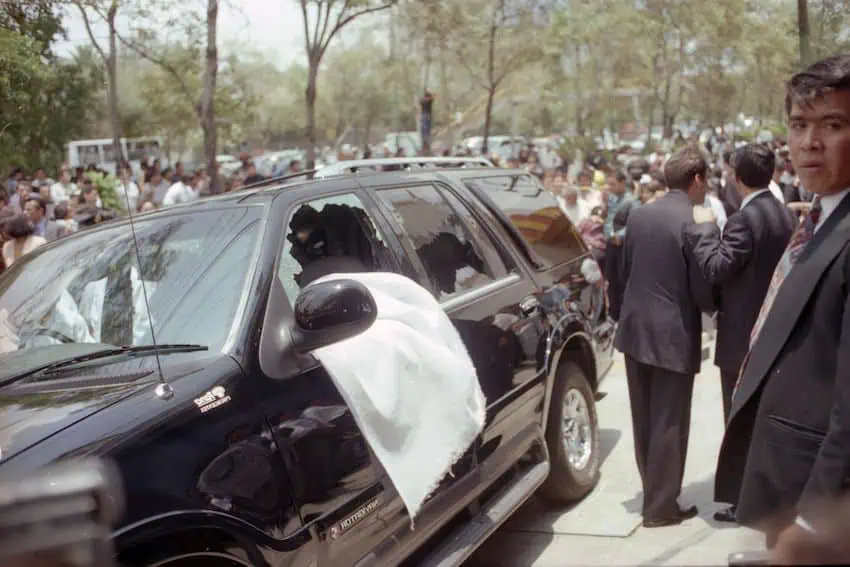
Three individuals approached Stanley in his Lincoln Navigator and fired more than 20 rounds, killing Stanley in the vehicle with four shots, including three to the head.
Gil was also wounded, and went on to publish a book about the murder, called “My Truth.”
Gil is portrayed by Diego Boneta, who starred as Luis Miguel in the 2018 Netflix bio-series “Luis Miguel: The Series.”
Una tras Otra con Paco Stanley | Fragmentos del último programa | 07/06/1999
A video showing clips of Paco Stanley during his last appearance on “Una Tras Otra,” which he filmed live, hours before his murder.
The producers say “Who Killed Him?” is based on information from direct sources and from the files of both the U.S. Drug Enforcement Administration (DEA) and Mexico’s federal Attorney General’s Office on Stanley’s murder.
A trailer for the series — in Spanish but with English subtitles available — can be seen on YouTube. Since the trailer’s release on April 17, it has logged more than 20 million views — attesting to the interest in the series.
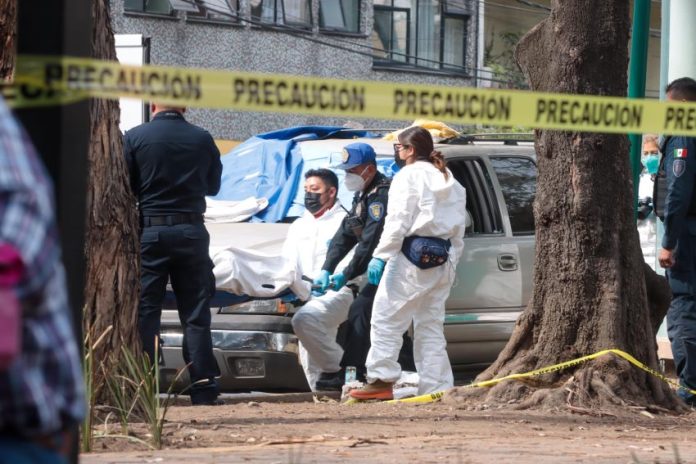
There were over 2,600 murders in Mexico in April, making it the worst month this year for homicides.(Rogelio Morales/Cuartoscuro)
April was the most violent month of the year to date with more than 2,600 homicides in Mexico, federal government data shows.
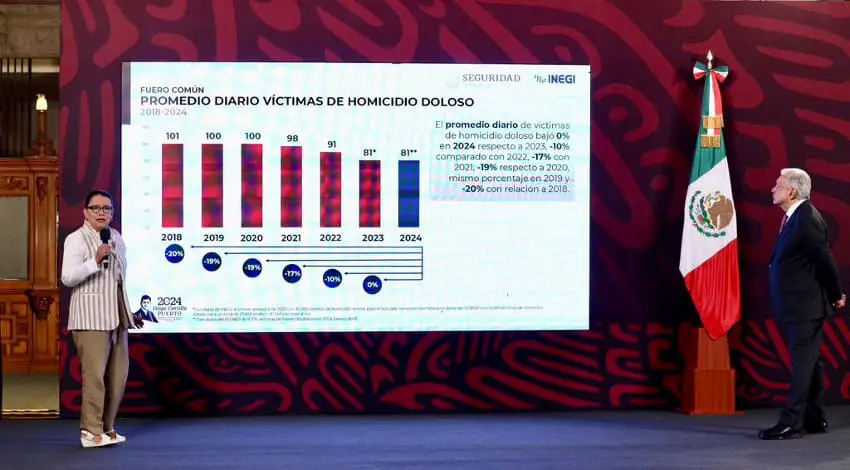
Homicides increased by 7.4% annually to 2,622 in April, according to data presented by Security Minister Rosa Icela Rodríguez at President Andrés Manuel López Obrador’s press conference on Tuesday morning.
The murder total was the highest monthly tally in Mexico since May 2023, when there were 2,664 victims.
Despite the increase in homicides last month, the total for the first four months of the year declined 1.5% annually to 9,776, or an average of just under 81 murders per day.
Rodríguez noted that the daily murder average in the first four months of the year was 20% lower than that for the entire year of 2018, during which former president Enrique Peña Nieto was in office for 11 months.
She presented data that showed that López Obrador is the first president since Ernesto Zedillo (1994-2000) to see a decline in homicides over the course of a six-year term.
Security Minister Rosa Icela Rodríguez presented a security report on Tuesday morning, and highlighted an overall decline in homicides over the course of President López Obrador’s term. However, April’s murder count was 7.4% higher than the same month in 2023. (Rosa Icela Rodríguez/X)
According to the graph she displayed, the two most recent ex-presidents, Peña Nieto (2012-18) and Felipe Calderón (2006-12), saw increases in murders of 192.8% and 59%, respectively, between their first full year in office and their final year.
For his part, López Obrador has overseen a 20% reduction in homicides, Rodríguez said.
Which states are the most and least violent in Mexico?
Data presented on Tuesday showed that Guanajuato was the most violent state in the first four months of the year in terms of total homicides. The Bajío region state recorded 1,002 homicides between January and April.
Several criminal organizations including the Jalisco New Generation Cartel and the Santa Rosa de Lima Cartel operate in Guanajuato, which has now been the country’s most violent state for several years.
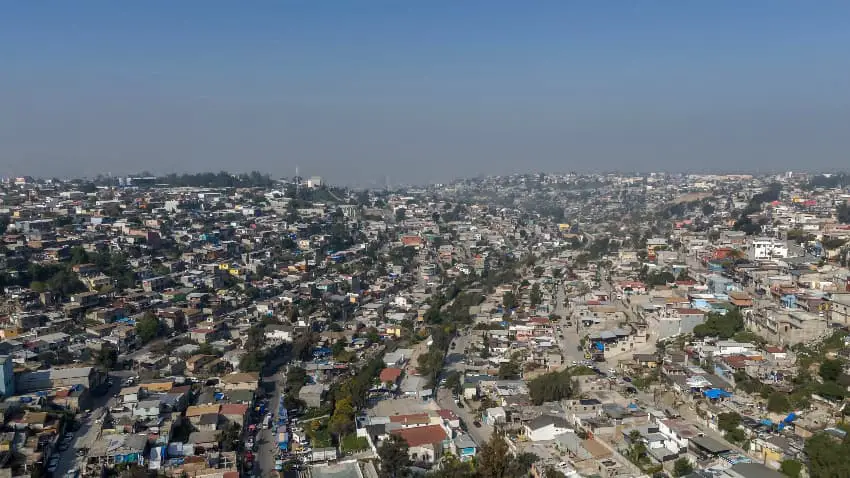
Baja California, home to the city of Tijuana (pictured) was the second-most violent state in the country in the first four months of the year. (Cuartoscuro)
Violence in the state — most of which is linked to organized crime — mainly occurs in a relatively small number of municipalities. There have been homicides this year in San Miguel de Allende and Guanajuato city, but murder numbers in the two tourism hotspots are well below those recorded in the state’s most violent municipalities.
Ranking third to sixth for total homicides between January and April were México state (813); Chihuahua (658); Jalisco (602); and Morelos (597).
Rodríguez highlighted that the six states with the highest number of murders so far this year accounted for 45.9% of all homicides across the country between January and April.
The six states with the lowest number of homicides in Mexico in the first four months of 2024 were Yucatán (15); Baja California Sur (17); Durango (20); Coahuila (25); Aguascalientes (32); and Campeche (33).
Mexico City ranked as the 12th most violent entity among 32, with 308 homicides in the first four months of the year.
Electoral violence
The think tank Laboratorio Electoral reported on May 10 that 63 people “linked to the [current] electoral process” have been murdered.
Of that number, 32 were registered candidates or aspired to contest the June 2 elections at which Mexicans will elect some 20,000 municipal, state and federal representatives.
That makes the thousands of people seeking to win an elected municipal position especially vulnerable to violence, as does the fact that influence over governments at that level is highly coveted by organized crime groups and seen as much more obtainable than holding sway at a state or federal level.
In addition to the shortages, many residents have been affected by contaminated water, possibly a result of aquifer overexploitation. (Shutterstock)
Water shortages will continue to affect residents in several areas of Guadalajara, Jalisco, until at least Wednesday night, according to a statement by the Intermunicipal Drinking Water and Sewage Services System (SIAPA).
According to news outlet ADN40, at least 20 neighborhoods were experiencing water shortages Tuesday morning.
Anoche en el sistema de bombeo de agua de Chapala a Guadalajara, tronó el cuarto transformador en tres días. Algo muy raro y muy grave está pasando con el sistema eléctrico nacional.
Nuestros equipos están trabajando día y noche para atender este problema y ya quedó reparado el… pic.twitter.com/tyqVFlu06d
On the social media platform X on Sunday, Jalisco Governor Enrique Alfaro explained Guadalajara’s lack of water on electrical failures in the system that pumps water from Lake Chapala to the city. He blamed them on problems last week with the national power grid.
On Monday, the SIAPA announced that water had been restored to over 80% of the Guadalajara metro area (ZMG) and that service in all locations would be gradually restored throughout Tuesday and Wednesday night.
According to authorities, the water shortages came after failures in the electrical system at the Chapala-Guadalajara pumping plant, caused by the nationwide power outages recorded during last week’s scorching heat wave.
SIAPA has warned residents of a fake image with the agency’s logo circulating on social media which claims that water supply will not be restored until May 17 and 18. SIAPA urged residents to consult only official social media accounts for updated and accurate information.
Water contamination blamed on aquifer overexploitation
In addition to water shortages, some residents have been affected by water contamination.
In Toluquilla, a neighborhood south of Guadalajara, the local newspaper El Informador reported that what little water is available to residents is contaminated. In March, residents of Tlaquepaque also reported “oily and brown” water.
Carlos Hernández Solís, member of the Jalisco Water Advisory Council (CEA), a local NGO, said that the poor water quality is due to the overexploitation of aquifers.
Lake Chapala has long been Guadalajara’s main water source, but these days, local aquifers have been increasingly picking up the slack. According to Guadalajara’s Metropolitan Planning Institute, 26 of every 100 liters of water consumed in the city’s metropolitan zone comes from underground aquifers. (Government of Jalisco)
“When the water levels drop, old water, which contains other types of substances, is taken for supply,” Hernández told El Informador. “For example, the Toluquilla Aquifer [contains] lead and may also have heavy metals and arsenic.”
The Toluquilla Aquifer extends through Zapopan, Tlaquepaque, El Salto, Tonalá and Tlajomulco, municipalities all located within 30 kilometers of Guadalajara.
According to the Metropolitan Planning Institute (Imeplan), which oversees municipal development in the ZMG, 26 of every 100 liters of water consumed in the area comes from underground aquifers such as the one in Toluquilla. The aquifers are overexploited by SIAPA, municipalities, private companies and the agroindustrial sector.
In a report published in November 2023, the National Water Commission (Conagua) said that the SIAPA-managed Toluquilla Aquifer is the most affected by overexploitation, with a deficit of 75.6 million cubic meters of water per year.
In 2022, an audit of Conagua by the Federal Auditor’s Office (ASF) reported that the Lerma Santiago Pacífico Hydrological-Administrative Region, which includes the state of Jalisco, has one of the highest proportions of overexploited aquifers in the entire country, with 24.2% of its aquifers overexploited.
Although Lake Chapala continues to be Guadalajara’s largest water source, accounting for 60%–65% of the city’s water supply, local aquifers have become increasingly important, as they provide 30%–35% of the water that reaches the city.
The ASF’s audit also revealed that out of 653 aquifers in the Lerma Santiago Pacifico region, 275 (42.1 percent) have a water availability deficit. Among the aquifers with a deficit, 111 (40.4 percent) are overexploited.
In addition, Lake Chapala itself appears to be struggling with its contamination problems. In Feburary, one of the European Space Agency’s Copernicus Sentinel-2 satellites caught images of the lake showing evidence of algal bloom along the coasts of San Juan Cosalá and Ajijic, which the agency says is due to lower water levels in Lake Chapala combined with high temperatures causing an excess of nutrients and a proliferation of microscopic algae
With the aim of addressing Guadalajara’s growing water shortage problems, President Andrés Manuel López Obrador inaugurated the El Salto-La Red-Calderón Aqueduct in February, the first of a network of aqueducts that will carry water from the El Zapotillo dam to the ZMG, and which will eventually supply Guadalajara with up to 3,000 liters of water per second, an additional 1,000 liters per second than currently, according to López Obrador.
According to authorities, the new aqueduct will serve 1 million residents.
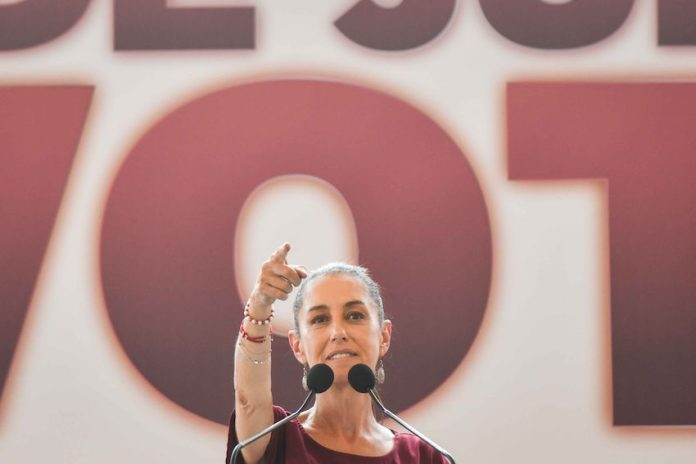
Morena candidate Claudia Sheinbaum is still well ahead of the two other presidential candidates in the latest poll published by El Economista newspaper.(Mario Jasso/Cuartoscuro)
Claudia Sheinbaum remains the clear frontrunner less than three weeks before Mexico’s presidential election, but Xóchitl Gálvez and Jorge Álvarez Máynez have both gained ground, according to the results of a new poll.
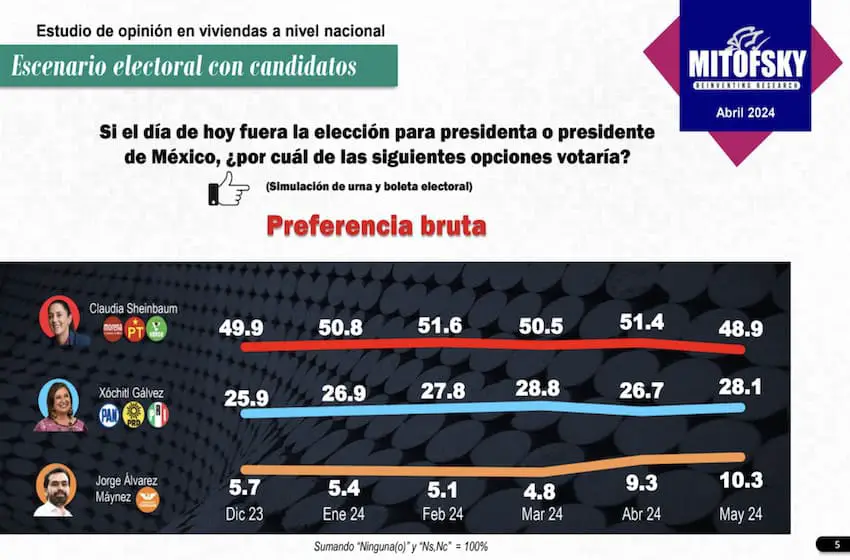
A poll conducted for the newspaper El Economista earlier this month found that 48.9% of 1,600 eligible voters intend to vote for Sheinbaum, the candidate for the ruling Morena party, the Labor Party (PT) and the Ecological Green Party of Mexico (PVEM).
The latest poll conducted by Mitofksy reveals that Claudia Sheinbaum remains the clear frontrunner less than three weeks before Mexico’s presidential election. (Mitofsky)
Support for the former Mexico City mayor declined 2.5 points compared to the poll conducted by the Mitofsky polling company for El Economista in April.
Support for Gálvez, candidate for a three-party opposition bloc made up of the National Action Party (PAN), the Institutional Revolutionary Party (PRI) and the Democratic Revolution Party (PRD), increased 1.4 points to 28.1%, while 10.3% of those polled indicated they would vote for Álvarez Máynez, the Citizens Movement (MC) Party aspirant.
Support for the MC candidate increased 1 point compared to a month earlier.
The remaining 12.7% of those polled — all of whom filled out mock ballots in their homes between May 3 and 6 — failed to indicate a preference for any of the three candidates vying to win the June 2 election and succeed President Andrés Manuel López Obrador on Oct. 1.
If they are stripped out of the results, support for the three candidates is as follows:
Sheinbaum: 56% – a decline of 2.8 points compared to April.
Gálvez: 32.2% – an increase of 1.7 points compared to April.
Álvarez Máynez: 11.8% – an increase of 1.2 points compared to April.
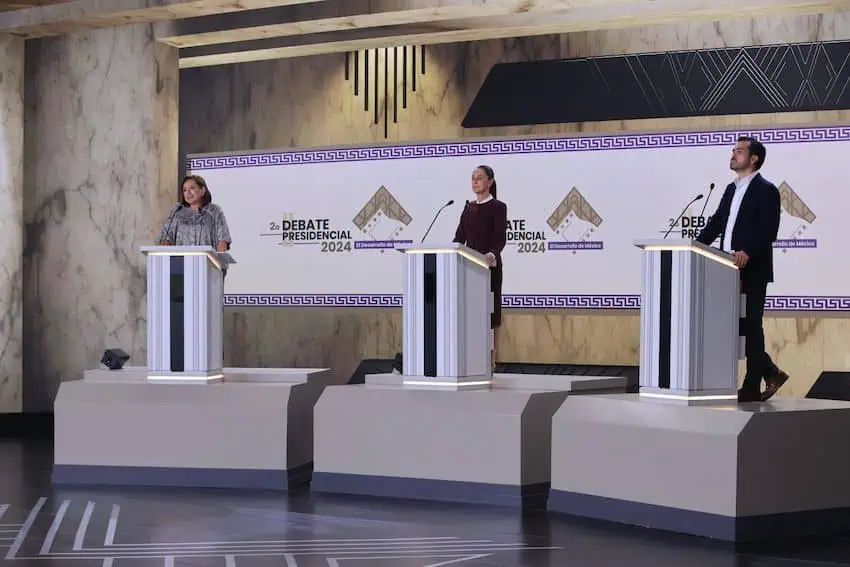
The candidates have faced off in two of three debates. The final one will take place on Sunday, May 19. (Cuartoscuro/INE)
The poll was conducted shortly after the three candidates faced off in the second of three televised debates. Gálvez was a more assured debater on April 28 than she was in the first debate on April 7. Her performance may help to explain the increase in her support as reflected in the latest El Economista poll.
The 1,600 respondents were also asked to compare the personal attributes of the three candidates.
More than 55% of respondents said that Sheinbaum — a physicist and environmental scientist who was environment minister in Mexico City when López Obrador was mayor in the early 2000s — is the most experienced.
The figures for Gálvez, a former senator and mayor of the Mexico City borough of Miguel Hidalgo, and Álvarez Máynez, a 38-year-old ex-federal deputy, were 19.7% and 8.5% respectively.
Sheinbaum also came out on top when respondents where asked which candidate is the most intelligent; who is closest to the people; who would make the best president; who would attract the most investment; and who would create the most jobs.
In addition, higher percentages of those polled said that the Morena candidate “represents more of a change” and is “the most honest” of the three candidates.
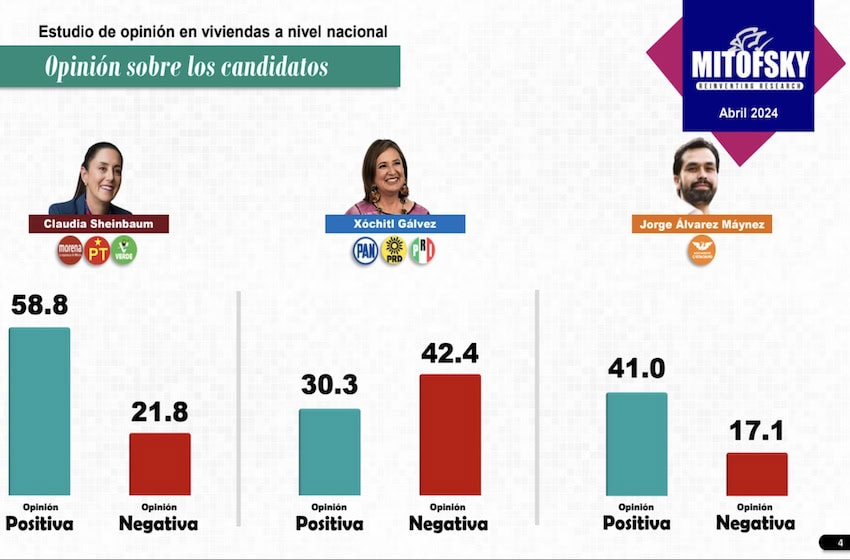
Just over 20% of the respondents said they don’t trust Sheinbaum, while 46.3% said the same about Gálvez.
Regarding how voters feel about the two leading presidential candidates, voters see Sheinbaum and Álvarez Máynez positively, whereas Gálvez is seen negatively. (Mitofsky)
One in ten of those polled nominated Álvarez Máynez as the candidate they don’t trust. Much of his campaign messaging is directed at young voters, and there is evidence that he is winning some members of that cohort over. He finished well ahead of Gálvez in a mock election held on university campuses last week, although Sheinbaum was the clear winner.
The Morena candidate is campaigning heavily on the fact that she is the only presidential aspirant that represents a continuation of the so-called fourth transformation of Mexico initiated by López Obrador. She has committed to continuing all the current social and welfare programs — as has Gálvez — and has expressed support for the constitutional reform proposals López Obrador sent to Congress in February.
Álvarez Máynez is in a distant third place with just 8% support.
Expansión Política says it collates poll results from more than 40 polling companies to come up with a “more exact” assessment of voters’ intentions. It last updated its “Poll of Polls” on Monday.
The three presidential candidates (left to right): Xóchitl Gálvez, Claudia Sheinbaum and Jorge Álvarez Máynez. (MND)
Expansión Política said that its latest numbers were derived from more than 600 polls.
“We don’t discount any public poll that discloses its methodology, although we do assign different weights to each polling company depending on their historic performance,” the news site said.
Expansión Política also reported Monday that the probability of Sheinbaum winning the presidential election on June 2 is 98%, while the probability of Gálvez prevailing is 2%.
The news source said that Sheinbaum’s probability of winning is “significantly high and suggests that … [she] will be the winner.”
However, Expansión Política added that a Sheinbaum victory is not a sure thing, remarking that “saying an election is defined” ahead of it being held “implies certainty that is rarely possible in the context of political dynamics.”