Juan Carlos Yerenas, left, accepts the World's Best Coffee Shops award for his Guadalajara café, El Terrible Juan. At right, espresso brews at Histórico Café Tostador in Chiapas. (El Terrible Juan; Histórico Café Tostador)
From a 19th-century hacienda in Chiapas to a Guadalajara bar that seeks to control every step from bean to cup, three Mexican coffee shops have just entered The World’s 100 Best Coffee Shops 2026 ranking.
The competitive ranking, which evaluates more than 15,000 projects worldwide, was announced during CoffeeFest Madrid 2026. It recognizes innovation, quality and passion for coffee in shops around the world.
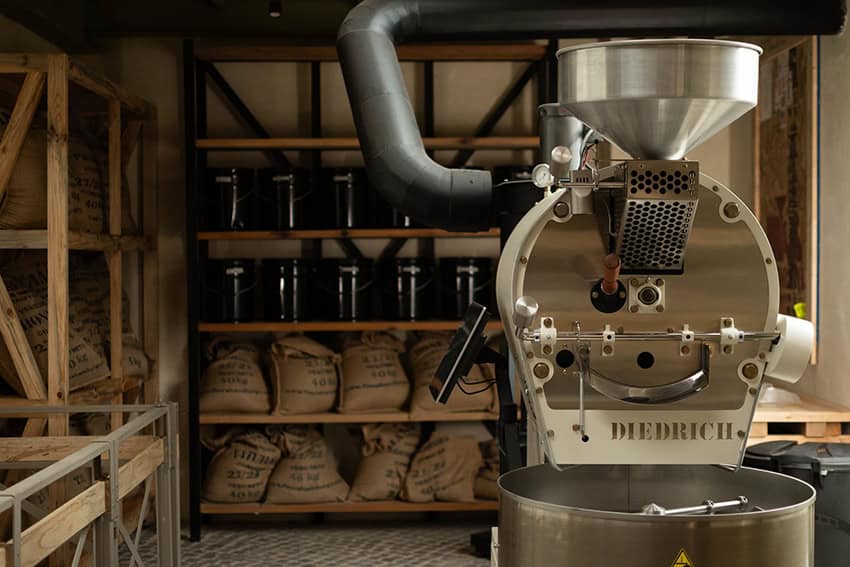
The facilities of San Cristobal’s Histórico Café Tostador, where coffee is grown on a legacy coffee farm then roasted and ground on-site. (Histórico Café Tostador)
And three of them are in Mexico.
Histórico Café Tostador – No. 35
Located in San Cristóbal de las Casas, in the southern state of Chiapas, Histórico Café Tostador “represents the urban continuity of its coffee legacy, connecting land, history, and cup in a single experience” the World’s 100 Best Coffee Shops said.
Set on the legacy coffee farm Finca Hamburgo (founded in 1888), this café grows and roasts its coffee on site. It also houses a coffee school offering courses, workshops and coffee experiences.
Exploradores de Café — No. 87
Born out of the desire to explore Mexico’s mountains in search of the best coffee, Exploradores de Café in Mexico City earned a place on the ranking thanks to their commitment to quality and sustainability of coffee production.
At Exploradores de Café, guests observe living coffee plants to understand varietals, genetics and ripening cycles. They can also watch coffee roasting firsthand and participate in cupping sessions.
El Terrible Juan Café — No. 96
Founded in 2015 in the western city of Guadalajara, Jalisco, El Terrible Juan Café focuses “on the quality of their products, flavors, and experiences,” according to the World’s 100 Best Coffee Shops. To achieve this, the café is involved in every step of the production chain, starting from the cherry harvest all the way to the preparation of their products and toppings.
El Terrible Juan started as a small coffee bar in the Americana neighborhood. Today, it has several locations in the city, establishing itself as one of the local benchmarks for specialty coffee.
According to the ranking, the top 3 coffee shops in the world are Onyx Coffee LAB in the United States, Tim Wendelboe in Norway and Alquimia Coffee in El Salvador.
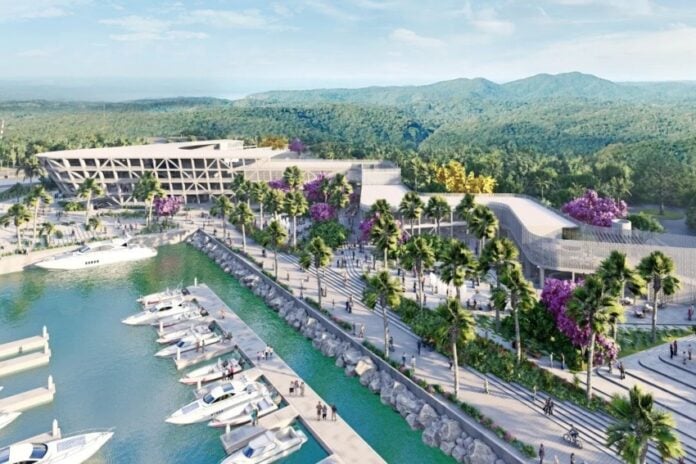
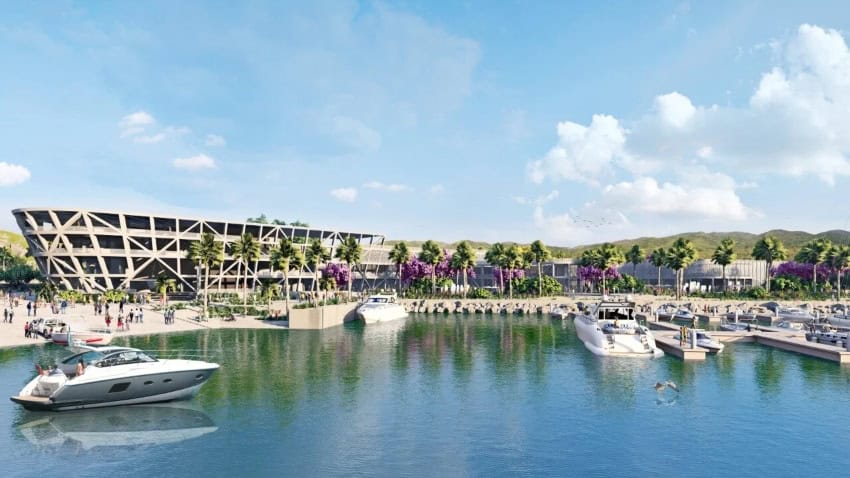
The Huatulco Convention Center was supposed to raise tourism in the Oaxaca destination to a new level. Now it's in a legal limbo. (TEN Arquitectos)
The contrast is stark. One site is defined by manicured green fairways; the other, a near-empty marina dominated by an architecturally striking but unfinished waterfront building. Both sit along the Gulf of Tehuantepec, where warm Pacific breezes move through overgrowth at the marina and across the groomed palms and fairways of the golf course. Yet at each, something is missing: activity, purpose, and the steady flow of people they were built to attract.
The cost of immobilizing large tourism assets is felt well beyond the offices where legal, political and administrative decisions are made. In Huatulco, two major tourism assets have been rendered inactive, leading to lost employment and tourism revenue, along with prolonged uncertainty for existing businesses and for investment decisions tied to facilities expected to be operating, not waiting.
Tourism in Huatulco would be better served if key tourism projects, like a convention center and golf course, were kept open. (Visit Mexico)
These impacts are rooted in two very different cases: one is an unfinished convention center; the other, a professionally maintained golf course placed in legal suspension.
The Huatulco Convention Center: From flagship project to legal standstill
On Dec. 11, 2025, formal seizure notices were posted across the unfinished structure of the Huatulco Convention Center overlooking the Chahué Marina. Issued by the Specialized Anti-Corruption Prosecutor’s Office of Oaxaca, the notices designated the building as evidence in an ongoing criminal investigation, legally halting any further work on the site. With that act, a project once promoted as a cornerstone of Huatulco’s future tourism economy entered a new phase, no longer merely incomplete, but legally immobilized.
The Huatulco Convention Center began as a relatively modest proposal, a single line item of 70 million pesos (US $3.7 million) within a package of 118 infrastructure projects announced by then-Gov. Alejandro Murat in 2019. The package was presented as a state effort to stimulate employment and reduce poverty across Oaxaca.
Only months after the infrastructure projects were announced, the COVID-19 pandemic upended construction schedules worldwide and delayed the start of work on the Huatulco Convention Center. Over roughly two years of inaction, the convention center’s role quietly expanded. State officials began to describe it not as a regional facility but as a “strategic trigger,” one capable of lifting Huatulco into the international convention market, alongside destinations such as Cancún and Los Cabos.
When vision and practical realities collide
To realize this expanded vision, the state of Oaxaca engaged Enrique Norten, founder of TEN Arquitectos, a Mexican firm internationally recognized for contemporary civic and cultural projects. The proposed design called for an approximately 11,000-square-meter facility integrated into the Chahué Marina, including a 1,285-seat auditorium with advanced acoustics capable of hosting concerts, theatrical productions, and academic conferences. Public plazas and landscaped green spaces were also incorporated. What emerged was no longer a modest, 70-million-peso infrastructure line item, but a highly visible, architecturally ambitious waterfront complex with regional and international aspirations.
Vision and aspiration soon collided with the practical realities of constructing a large-scale performance venue on reclaimed waterfront land, introducing significant technical challenges. Once the bidding process was completed based on the finalized architectural plans, the projected cost had risen to 323.7 million pesos (US $16.1 million), more than four times the original budget allocation. Construction formally broke ground in February 2022.
The vision of the Huatulco Convention Center, seen here in a rendering from TEN Arquitectos, collided with a sad reality. (TEN Arquitectos)
Forty-eight hours before his term ended in November 2022, Murat formally inaugurated the Huatulco Convention Center in its then-current state, largely complete but not yet operational. What was once framed as a catalyst for economic growth now sits silent on the waterfront. Sealed and unused, the striking structure awaits judicial resolution rather than further development, its fate emblematic of how large public assets can slip from promised engines of growth into prolonged limbo.
The Tangolunda golf course: From strategic asset to legal limbo
Central to each of the five master-planned tourist resorts developed by FONATUR (the National Fund for Tourism Promotion) was the inclusion of a golf course, conceived as a strategic anchor within Mexico’s planned resort model. In Huatulco, that role was filled by the Tangolunda golf course (Las Parotas Golf Club), which opened in 1991 and functioned for decades as a core component of the destination’s tourism infrastructure.
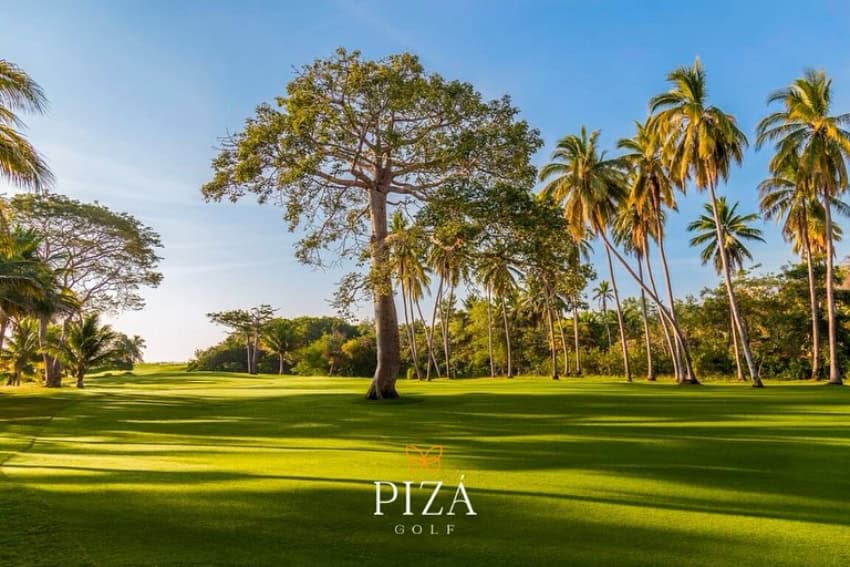
In 2012, following several years of operating losses, FONATUR opted to lease the Tangolunda golf course to a private operator under a 10-year concession. The decision was intended to stabilize finances, attract third-party investment, and upgrade the facility to professional-level standards. Those objectives were largely met. The course was extensively redesigned by Mexican golf architect Agustín Pizá and reopened in 2014 as a first-class, professionally maintained facility.
A period of uncertainty
With the expiration of the 10-year lease in 2022, the golf course entered a period of uncertainty. Federal authorities initially indicated the property would be sold, publicly referencing a proposed sale price of 600 million pesos and granting the existing leaseholder a first option to purchase. In October 2023, however, the federal government announced that no purchase offers had been received and that the Tangolunda golf course would instead be designated a national park, abruptly removing a core component of Huatulco’s planned resort model.
On March 14, 2024, National Guard personnel closed and secured the Tangolunda golf course to enforce the national park designation. Since then, the site has remained closed to the public while maintenance has continued, as legal challenges over its status proceed through the courts.
The designation of the Tangolunda golf course as a national park has effectively shuttered what had functioned as Oaxaca’s only championship-grade, 18-hole golf facility, leaving it closed despite continued maintenance. Without a resolution, or even a timeline for one, a functioning, attractive tourist asset remains in limbo.
Despite a redesign by famed Mexican golf course architect Agustín Pizá, Las Parotas Golf Club now seems destined to become a national park. (Instagram)
Shared pattern: Governance paralysis and stranded public assets
Neither of these stalled tourism assets failed for lack of a clear economic purpose, yet neither has a clear path forward. In both cases, uncertainty, not market failure, has become the defining condition, illustrating how governance paralysis can strand otherwise viable public assets.
For Huatulco, the cost of this uncertainty is not theoretical. Each year without resolution brings foregone employment, lost tourism activity, and an erosion of confidence among local businesses and potential investors. Public funds, meanwhile, remain tied up in assets that function neither as economic engines nor as public amenities. Private operators and municipal authorities cannot plan around facilities that remain unusable. In this kind of limbo, delay is a multifaceted, unnecessary loss that accumulates over time.
What ultimately distinguishes stranded assets from failed ones is not their economic logic, but the absence of timely resolution. As legal and administrative processes unfold, often over years, there is no parallel mechanism to determine interim use, conditional operation, or negotiated outcomes. In practice, inaction becomes the default decision, leaving viable public assets suspended indefinitely.
Randy Jackson is a seasonal resident of Huatulco and a regular contributor to the Huatulco Eye magazine. He writes on tourism, infrastructure and local governance. Email: box95jackson@gmail.com
President Sheinbaum thanked FIFA President Gianni Infantino for his continued support of Mexico as a World Cup host after violence erupted in multiple states following the death of the chief of the Jalisco New Generation Cartel. (Gabriel Monroy/Presidencia)
The operation against Jalisco New Generation Cartel (CJNG) leader Nemesio “El Mencho” Oseguera Cervantes and the violent cartel reaction that followed remains a central topic in the national conversation.
President Claudia Sheinbaum spoke about various issues related to the events on Sunday at her Thursday morning press conference.
Here is a recap of the president’s Feb. 26 mañanera.
Sheinbaum: Tribute to the armed forces at Mexico-Iceland match was ‘very moving’
Twenty-five members of the National Guard, which is under military patrol, were killed in clashes with cartel gunmen after the death of Oseguera, the founder and longtime leader of the CJNG.
Emotivo homenaje a las Fuerzas Armadas durante el México vs Islandia - AS México
Sheinbaum said that the tribute was “very moving” and thanked those who organized it.
“The truth is this tribute was very, very moving for everyone who is part of the armed forces, in particular the Army and National Guard, and for all of Mexico,” she said.
“Since Sunday, there have been a large number of very moving expressions of support. And yesterday was truly emotional,” Sheinbaum said.
Mexico defeated Iceland 4-0 in the friendly that followed the Wednesday night tribute.
Sheinbaum thanks FIFA after Infantino backs Mexico as World Cup host
A reporter noted that FIFA president Gianni Infantino expressed his support for Mexico continuing as a co-host of this year’s men’s World Cup, despite the outbreak of violence on Sunday.
Sheinbaum thanked FIFA and its president for their support, and noted that Infantino said that no changes would be made to the schedule of the World Cup, which will be held in the United States (78 matches), Canada (13 matches) and Mexico (13 matches).
In Miami on Wednesday, the FIFA chief told reporters that a World Cup qualifying tournament to be played in Guadalajara and Monterrey next month wouldn’t be moved.
“Nobody has to move anything. We are in constant contact with [the] presidency of Mexico, the authorities. We have full trust in the authorities in Mexico, [in] President Sheinbaum and her team, and we actually fully support them as well,” Infantino said.
“We live in a world where things happen, good things and bad things, situations happen, we don’t live in the moon,” he said.
“… We are monitoring of course the situation, but we have full confidence that everything will be great. Mexico is a football country, and the Mexicans, the authorities but also the people, will do everything they can to ensure that the World Cup and the playoffs … will be a celebration of football,” Infantino said.
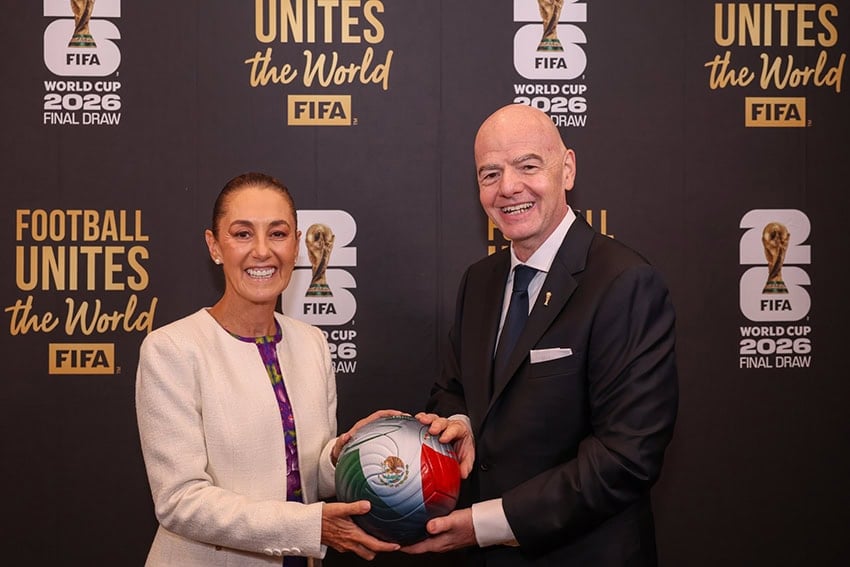
President Sheinbaum thanked FIFA President Gianni Infantino, seen here at the World Cup draw in December, for his continued support of Mexico after Sunday’s military operation. (Presidencia)
Sheinbaum said on Tuesday that security in Mexico during the World Cup is guaranteed, and asserted that there was “no risk” for tourists who come to the country to attend matches in Mexico City, Guadalajara and Monterrey.
On Thursday, she assured Mexican and international tourists alike that the World Cup “will be a great celebration, and we’ll be waiting for you with open arms.”
Sheinbaum: ‘Our objective is to protect life’
A reporter noted that a Labor Party deputy, José Luis Sánchez González, said that if the cost of achieving peace is the lives of “some Mexicans,” then “so be it.”
She asked the president what message she would send to politicians making such remarks.
“One cannot be a censor of what everyone says,” Sheinbaum said.
“Everyone is responsible for their own words and the people judge. In other words, I can’t know what a deputy or security minister is going to say,” she said.
Sheinbaum went on to say that in a situation such as that which occurred on Sunday, “no one would have wanted lives to be at stake.”
“… It’s not something that one seeks. Unfortunately, these events occur and what we have to do is support the families [of victims]. … What we want is to protect people’s lives, that is our objective — protect life, stability and people’s safety,” she said.
Sheinbaum rejected “this idea of ‘it doesn’t matter [if lives are lost because] there is always collateral damage.”
“That’s what [Felipe] Calderón said,” she remarked, referring to the ex-president who initiated a militarized war on cartels shortly after he took office in 2006.
“… Our objective is to protect life,” Sheinbaum said.
By Mexico News Daily chief staff writer Peter Davies (peter.davies@mexiconewsdaily.com)
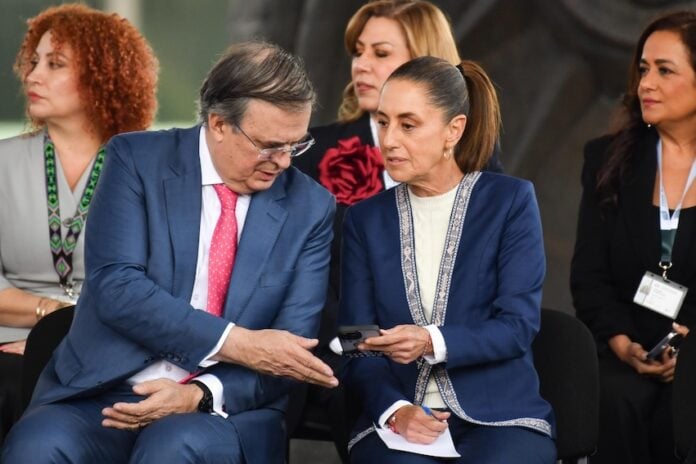
Economy Minister Marcelo Ebrard chats with President Claudia Shienbaum during a national meeting for the promotion of investment held earlier this month. As it turns out, year-end figures released this week showed a record year in 2025 for foreign direct investment in Mexico. (Mario Jasso/Cuartoscuro.com)
Mexico attracted a record US $40.87 billion in foreign direct investment (FDI) in 2025, a 10.8% year-on-year increase, the Economy Ministry (SE) reported on Wednesday.
In a press release, the SE said the growth — based on originally published figures — reflects a growth trend for the fifth consecutive year.
“Mexico is positioning itself as a strategic destination for global productive capital, in an environment in which FDI flows to developing economies showed a 2% drop in 2025,” it said.
The data indicates the United States remained Mexico’s principal investment partner, generating FDI flows of US $15.88 billion, 38.8% of the total.
Spain ranked second at US $4.4 billion (10.8%) with Canada (US $3.3 billion, 8.1% ), the Netherlands (US $2.4 billion, or 5.8%) and Japan (US $2.3 billion, or 5.6%) filling out the rest of the top 5.
The SE reported that reinvestment of profits registered the largest share of FDI flows entering Mexico in 2025 — nearly 68% — followed by new investments (18%), and intercompany accounts (14.3%).
New investments grew nearly 133%, to US $7.38 billion in 2025, providing the biggest bounce to the total FDI flow.
The SE described the performance of new investments last year as “entailing a greater capacity for Mexico to attract new capital that can promote the adoption of cutting-edge technologies and productivity growth in the national industry.”
The reinvestment of profits contracted slightly, falling 3.7% from US $28.7 billion to US $27.6 billion, which the SE attributed to a greater distribution of dividends.
As for intercompany accounts, they registered annualized growth of 17%, rising from US $4.99 billion in 2024 to US $5.8 billion in 2025. The SE said this is associated with the dynamics of capital reorganization in corporate groups.
Intercompany accounts are transactions originating from debts between Mexican companies that hold FDI in their share capital and associated companies abroad.
Once again, Mexico City was the top destination for FDI in 2025, receiving US $22.38 billion, roughly 55% of the total. This represented a 55% increase over 2024.
Second place went to Nuevo León, which received US $3.63 billion, or 8.9% of the total and a nearly 73% increase compared to last year.
México state ranked third, receiving US $3.28 billion, or 8%, a 24% year-on-year improvement.
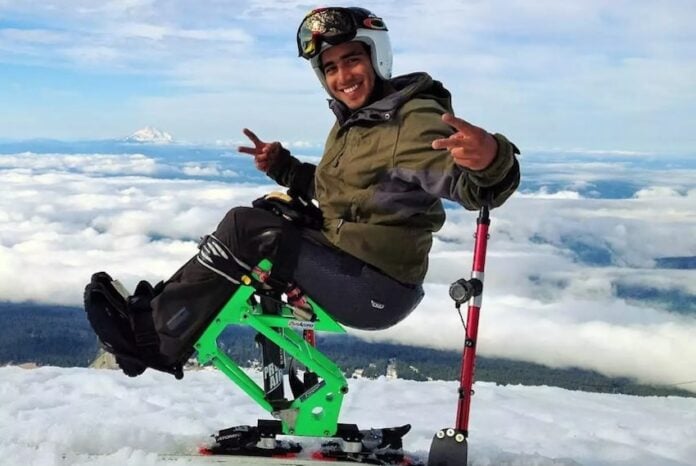
When Arly Velásquez suffered irreversible spinal damage at age 13, he had never tried on a ski. Now at age 37, he is representing Mexico at the Winter Paralympics for the fifth time. (Conade)
When the Winter Paralympics open next week in Italy, Mexico’s delegation will fit on a single monoski.
Arly Velásquez, a 37-year-old para alpine skier from Cancún, will be the country’s only athlete at the Milan-Cortina Games, the 50th anniversary of the Winter Paralympics. The opening ceremony is March 6.
Mexico’s presence at the Winter Paralympics has long been minimal, but this year they will have a one-man delegation thanks to para-skier Arly Velásquez. (Conade)
More than 600 athletes are expected to compete across six sports, with China favored to top the medals table again.
Moreover, its delegations have long been among the smallest in the field. Since making its Winter Games debut in 2006, Mexico has sent no more than two athletes to any edition.
This year, the entire Mexican presence will be Velásquez, who will race in downhill on March 7, super-G on March 9 and giant slalom on March 13 in the LW10-1 sitting category.
The opening ceremony will be held at Verona’s ancient Arena, a UNESCO World Heritage site retrofitted with wheelchair ramps and accessible restrooms.
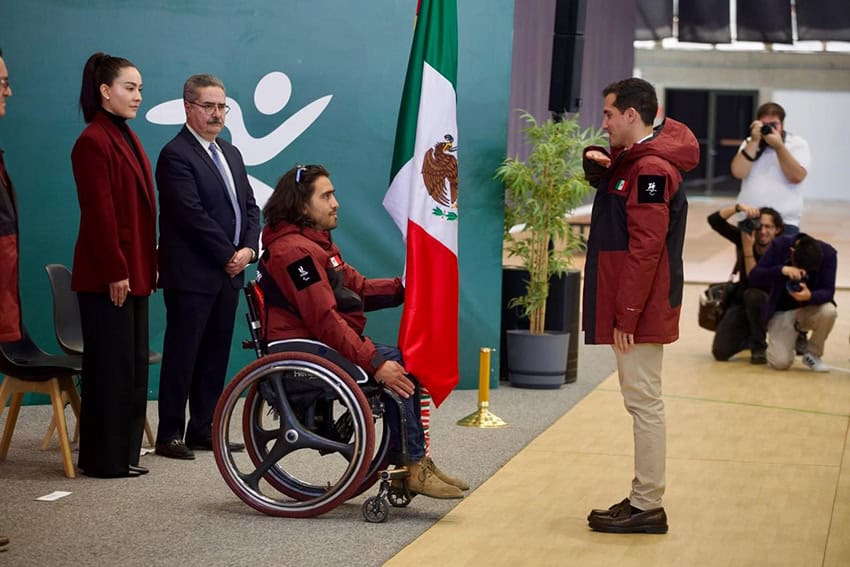
“Receiving the Mexican flag on my way to my fifth Paralympic Games is a profound honor,” Velásquez said at a flag ceremony this week in Mexico City. “Representing Mexico in five Games is not by chance. It is the result of discipline, resilience and reinventing myself physically and mentally time and time again.”
Velásquez is the Mexican athlete with the most appearances at the previous 13 Winter Paralympics, having debuted at Vancouver 2010 and also raced at Sochi 2014, Pyeongchang 2018 and Beijing 2022.
In Sochi, he posted his best Paralympics finish ever, 11th in super-G, before a crash in his next race left him in an induced coma for three days and forced a two-year break from competition.
After moving from Cancún to Mexico City as a youth following his parents’ divorce, Velásquez took up mountain biking and became a national champion at age 12.
At age 13, however, he suffered a major accident that left him with broken vertebrae and an irreversible spinal cord injury, according to the newspaper Milenio. He was told he would never walk again.
But around age 15, he began practicing wheelchair sports such as shot put, basketball, javelin and swimming.
On a trip to Canada a few years later, he happened to see Mexican Paralympic athlete Armando Ruiz competing in the slalom and giant slalom. That led him to seek out ski lessons.
Fourteen months later, he was competing in the 2010 Paralympic Games in Vancouver.
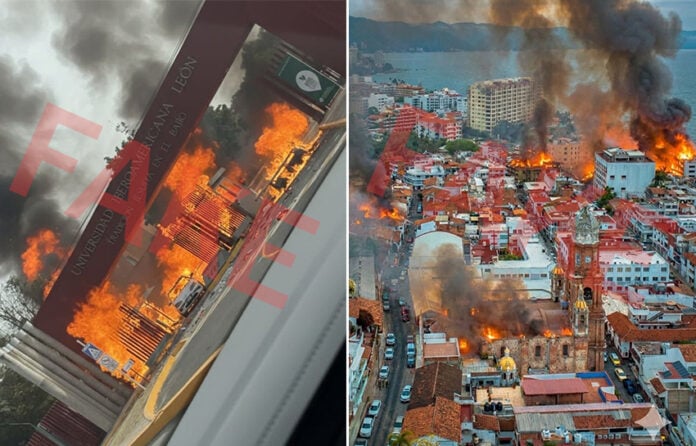
Fake, AI-generated photos showed Puerto Vallarta and the Iberoamerican University in León, Guanajuato, in flames. Neither happened. (Social media)
A plane in flames on the tarmac at Guadalajara Airport. Smoke billowing from a burning church in the resort city of Puerto Vallarta.
Images of these scenes appeared on social media on Sunday as members of the Jalisco New Generation Cartel (CJNG) reacted violently to the death of their leader, Nemesio “El Mencho” Oseguera Cervantes, who was shot by soldiers during an operation in Jalisco.
This fake image of a plane burning at the Guadalajara airport went viral on Sunday. (Social media)
They added to fear and panic in Mexico at a time when fiery narco-blockades were appearing in states across the country and cartel members were setting banks and OXXO stores on fire and engaging in gunfights with National Guard officers.
Both images, however, were fake, apparently created with the assistance of artificial intelligence, but nevertheless serving to make a very bad situation look even worse.
They were among a plethora of fake news that proliferated online on Sunday, and it wasn’t confined to social media.
Gunmen have taken over Guadalajara Airport, reported various major news outlets, a development seemingly supported by footage of passengers panicking and running, but which, in fact, was not true.
President Claudia Sheinbaum was taken by helicopter to a naval vessel off the Sonora coast to ensure her safety. Also false.
The Puerto Vallarta Costco burned to the ground. Didn’t happen.
Still, fake images and fake news went viral on social media on Sunday, shared not only by unsuspecting internet users but also by the CJNG itself, according to experts cited in media reports.
On Wednesday, the federal government ramped up its efforts to expose these fabrications, presenting a five-minute video during the regular “lie detector” segment of Sheinbaum’s morning press conference.
Ante los hechos registrados este día, es importante actuar con responsabilidad.
Se ha detectado la circulación de imágenes, audios y publicaciones falsas. Evita compartir contenido sin verificar su origen y confirma que provenga de fuentes oficiales. pic.twitter.com/NZbXxYsWlZ
No, a US agent didn’t strangle ‘El Mencho,’ says government
Before the aforesaid video was played, the government’s fake news debunker-in-chief Miguel Ángel Elorza Vásquez said that after Sunday’s operation targeting “El Mencho,” media outlets, commentators, politicians and social media users “promoted lies, disinformation and fake news about the operation, its origin and the events that occurred in different cities … of the country.”
Although some of the fake news went viral and fooled many people, Elorza — the head of Infodemia, a government initiative dedicated to debunking fake news — asserted that most Mexicans heeded the call to inform themselves about the prevailing situation via official channels of communication.
Citing a study by the Tec. de Monterrey university, the government’s “lie detector” video said that between 200 and 500 posts containing false information related to the operation against “El Mencho” appeared on social media.
Between 20 and 30 of those posts — which many social media users shared — were viewed more than 100,000 times, the video said.
The video labeled various social media posts and news stories as lies, including ones that claimed that cartel members were threatening to attack civilians and that armed men had entered the Guadalajara Airport.
It also highlighted that the two images described at the top of this article were false, and declared that posts asserting that U.S. tourists had been taken as hostages were untrue.
In addition, the video denounced as false claims that the U.S. was involved in the operation against “El Mencho,” including an assertion that a U.S. agent killed the CJNG leader by strangling him as he was being airlifted to a hospital for medical treatment.
The Tec. de Monterrey report cited in the video did not identify who produced the phony content related to that operation and the violent chaos that ensued.
🔴En la #MañaneraDelPueblo, el #DetectorDeMentiras mostró una campaña de desinformación tras la operación realizada en Jalisco para detener a Rubén “N”, alias ‘El Mencho’”:
❌Mentira que el crimen organizado amenazó con atacar a la población civil.
❌Mentira que miembros del… pic.twitter.com/K08deqo69z
‘They are trying to show that the Mexican government doesn’t have control over the country’
Citing experts, Reuters reported that fake news related to the death of “El Mencho” “spread at surprising speed,” with “unsuspecting” social media users — and the CJNG “in some cases — disseminating the phony images, posts and stories.
The objective of the cartel, Reuters wrote, was to “make its retaliatory wave of violence appear greater and more terrifying than it really was.”
Jane Esberg, an assistant professor of political science at the University of Pennsylvania, told the news agency that “they are trying to show that the Mexican government doesn’t have control over the country.”
Esberg, who has studied Mexican criminal groups’ use of social media, said that the dissemination of fake material on social media contributed to the creation of a narrative that the CJNG had a retaliatory presence all over Mexico on Sunday. While acts of violence occurred in 20 states, many municipalities of those states weren’t affected.
Federal Security Minister Omar García Harfuch said Monday that authorities had identified social media accounts sharing fake news and would conduct investigations to determine which ones have “direct relationships with an organized crime group” — i.e. the Jalisco Cartel.
While cartels have long used social media as a propaganda tool, the emergence of AI means that they — and others, including so-called “narco-influencers” — can create phony material that serves their agenda with nothing more than a laptop or a phone.
Pablo Calderón, an associate professor in politics and international relations at Northeastern University in London, told Reuters that cartels use social media to amplify their image and power and to influence public opinion, including by disseminating misinformation.
“Sunday was a good day for Mexican security forces,” he said, even though 25 National Guard officers were killed, and other troops sustained injuries in clashes with CJNG gunmen.
“But organized crime has been successful in shifting the narrative, away from the [military operation] to chaos,” Calderón said.
Vanda Felbab-Brown, an organized crime expert at the Brookings Institution in Washington D.C., told the Associated Press that it’s likely that people linked to the CJNG were responsible for some of the disinformation that circulated online on Sunday.
“The criminals are becoming very tech-savvy,” she said before describing the “level of misinformation” as “impressive.”
AI-generated images depicting scenes of violence “certainly added to the aura of chaos and meltdown in Mexico,” Felbab-Brown said.
‘We didn’t know what was true and what was false’
Victoria Elizabeth Peceril, a 31-year-old mother of three, told the Associated Press in Guadalajara on Wednesday that “we didn’t know what was true and what was false” amid the violent reaction to the death of “El Mencho.”
“We were really scared,” she said.
Given that the CJNG is known for extreme and spectacular acts of violence — including the downing of a military helicopter in 2015 and a brazen 2020 attack on García Harfuch when he was Mexico City police chief — deciphering whether an AI-generated image is real or false becomes even more difficult. Could the cartel have set a plane and a church ablaze? Conceivably, yes.
Yoni Pizer, a homeowner in Puerto Vallarta whose car was hijacked and firebombed on Sunday, noted in an interview with The New York Times that “there were images and videos that were not real.”
“People started posting that the gangs were just shooting randomly and killing people in town. That wasn’t true,” he said.
Fake news also distorted how people abroad perceived what was happening in Mexico on Sunday. One Mexico News Daily writer said that her grandmother in the United States believed that the CJNG was targeting Americans in Mexico due to U.S. involvement in the operation against “El Mencho,” which was limited to intelligence sharing, according to the Mexican and U.S. governments.
Back in Mexico, Nicolás Martín, a 28-year-old Mexico City resident who was in Puerto Vallarta when the violence began, told AP that “at first, we believed everything [we saw on social media].”
He said he was surprised by the high quality of the fake images that circulated on Sunday.
Sarai Olguín, a 22-year-old university student in Guadalajara, also said it was difficult to tell what was real and what was false. She found a silver lining in the dissemination of fake material, saying that it played a role in convincing people not to leave their homes.
“In a way it’s good, because all of this false news helped take care of people even though they sowed immense fear,” Olguín told AP.
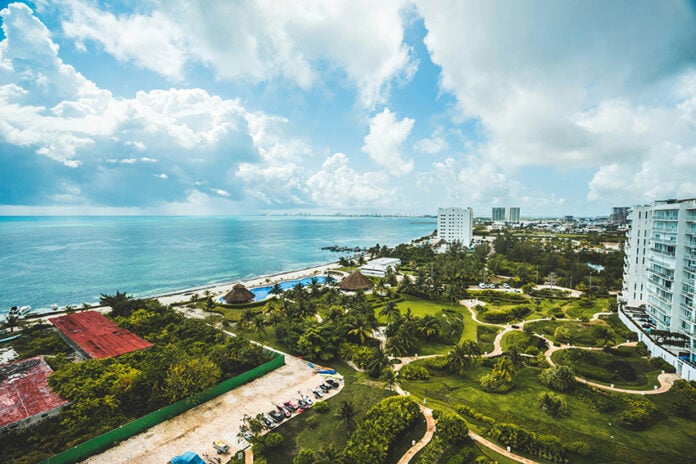
Nearly 20% of hotel bookings in Quintana Roo for the next holiday period have been canceled. (Joseph Barrientos/Unsplash)
The state of Quintana Roo and the Riviera Maya are paying the price for the violence that erupted last Sunday on the other side of the country.
Nearly 20% of hotel bookings for the next holiday period were canceled even as Quintana Roo Governor Mara Lezama oversaw the deployment of 10,000 troops to protect residents and tourists alike.
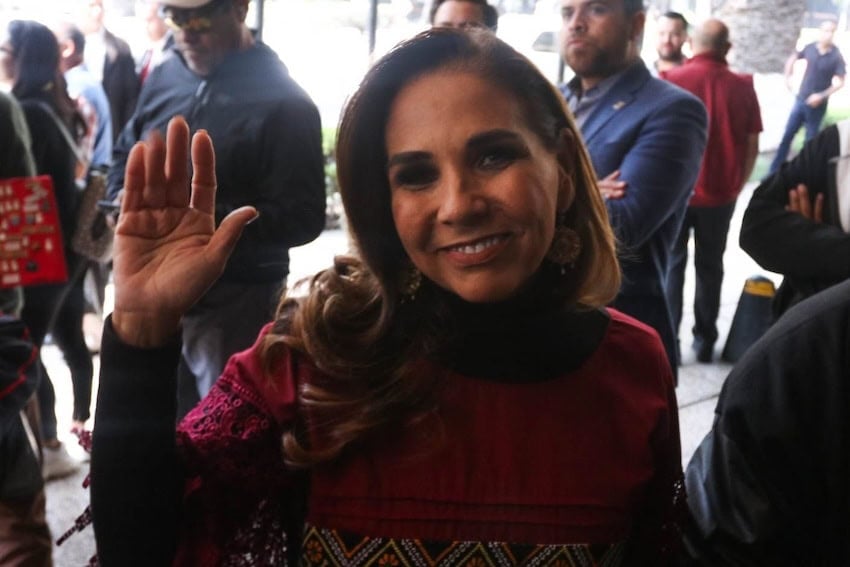
While cancellations of bookings made for upcoming holidays have been increasing, Quintana Roo Gov. Mara Lezama points out that there are right now hundreds of thousands of foreigners in her state and no lasting decrease in tourism is expected. (Graciela López/Cuartoscuro.com)
Valeria Rindertsma, president of the local chapter of the Mexican Association of Female Entrepreneurs, said the now-subdued violent reaction in 22 states by the CJNG cartel targeted in last Sunday’s military operation created a negative image that the hotel sector is working to address.
“We must change the perception,” she said, “and we can do that through the media, through our networks, so that people feel safe and come to visit us.”
At the same time, Gov. Lezama said her government reacted quickly to the disorder sparked by the CJNG and its associates, who were “trying to sow fear and cause conflict and uncertainty.” Her state government acknowledged 17 incidents in which vehicles were burned on Sunday.
The state security operation in place now comprises state and municipal police, the National Guard, the Army and the Navy. Civil Protection and fire fighting teams were also active and on heightened alert.
Rindertsma told reporters that the business sector had high expectations for the year, particularly since Mexico is co-hosting the FIFA World Cup, but admits that the violence “has shaken us up a bit.”
She pointed out that enhanced security strategies have eliminated the problem of extortion which had plagued the region in recent years, attributing the improvement to strong coordination between authorities and the business community.
Lezama warned about misinformation circulating on social media, including false reports about fires at schools, banks, convenience stores and restaurants, saying such fake news contributed to travel alerts being issued.
After reports of roadblocks and targeted attacks proved untrue, the U.S. Embassy removed Quintana Roo and its tourist destinations from the security alert it issued Sunday. The governor said there were more than 180,000 U.S. citizens in the state this week.
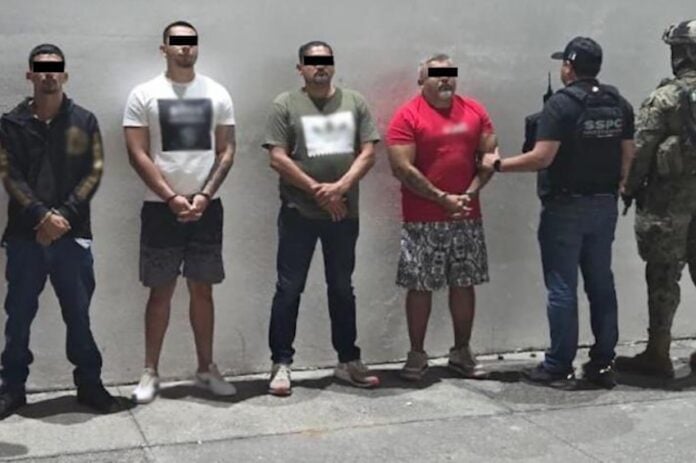
Even as vehicle fires were still breaking out across Jalisco, security personnel began invstigations and field operations to find and apprehend the 23 prisoners that escaped from the Puerto Vallarta prison. So far, their efforts have resulted in the recapture of four. (@OHarfuch/on X)
Four prisoners who broke out of the Puerto Vallarta State Penitentiary during last Sunday’s military operation against Jalisco New Generation Cartel (CJNG) leader “El Mencho” have been captured, the Security Ministry reported Thursday, while 19 other escapees remain at large.
On Sunday, amid the chaos that erupted across Jalisco state after El Mencho’s killing, 23 inmates escaped. Most had been imprisoned for serious crimes, including homicide, drug trafficking, aggravated robbery and possession of firearms and ammunition restricted to the Mexican Army. They hailed mainly from the states of Nayarit and Jalisco.
Autoridades federales encabezadas por SEMAR detuvieron a 4 de los 23 reos evadidos del Centro Penitenciario Estatal de Puerto Vallarta el 22 de febrero. Recaptura en El Colorado, Jalisco; investigaciones continúan para localizar a los 19 restantes tras fuga violenta. pic.twitter.com/RXFumOrbo9
Local reports attributed Sunday’s mass escape to outside help, with a group of armed assailants opening fire and ramming one or two vehicles into the prison walls, opening a breach for the breakout.
“Four people who escaped from the Puerto Vallarta State Penitentiary on February 22 were apprehended” following an operation led by the Mexican Navy, investigative personnel and the Security Cabinet, Security Minister Omar García Harfuch, wrote on the social media platform X on Thursday.
The Public Security Ministry (SSCP) began to gather intelligence and conduct field operations immediately on Sunday. It attained warrants and launched inter-institutional and immigration alerts, as well as strengthened coordination with state authorities to track routes, points of interest and possible hiding places for the escapees.
García Harfuch credited the quick actions for the capture of the four escapees in the town of El Colorado, within the Puerto Vallarta municipality.
Following Sunday’s violence, Puerto Vallarta is steadily moving toward normality (save for the presence in the vicinity of 19 violent escaped prisoners). An elevated number of police and military personnel are still deployed across the city.
Still, Jalisco state’s “Code Red” status was lifted on Tuesday, meaning that highways are now fully open, airport operations are increasing, businesses have reopened across the city and many tourist activities have resumed.
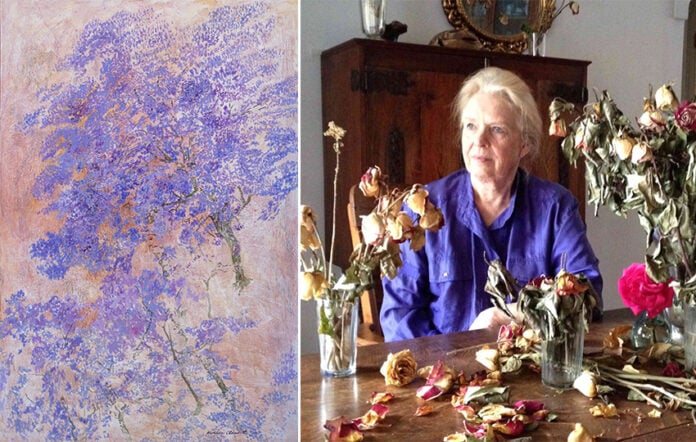
Kathleen Clement was a Mexico-City based American painter whose work documents and celebrates the natural world, particularly the flora of the Valley of Mexico. (Courtesy of Jennifer Clement)
Kathleen Clement — American-born painter, photographer, cultural documentarian and passionate advocate for the natural world — has passed away at the age of 97, her family reported earlier this month. For more than six decades, she made Mexico City her home, creating a body of work that bridged nations, artistic traditions and generations.
Born in 1928 in Ord, Nebraska, Clement grew up during the era of the Dust Bowl, a formative experience that shaped her lifelong sensitivity to landscape and environmental fragility. As a child she witnessed both hardship and wonder — famously recalling the awe of a whale that arrived by train in the plains of Nebraska, an image that stayed with her as a symbol of displacement and marvel. She graduated from Ord High School in 1946, studied at Milton College in Wisconsin, and earned her Bachelor of Fine Arts from the University of Nebraska–Lincoln in 1950. She later pursued studies in art criticism with Maestro T. Joysmith and studied museography in Paris.
Clement was known for incorporating textile elements into her work, including fabric, stitching and reflective elements. (Courtesy of Jennifer Clement)
In 1960, Clement emigrated to Mexico City, where she would live for the remainder of her life. Settling in San Ángel, she became part of a vibrant creative community that included artists such as Juan O’Gorman, Gunther Gerzo, José Luis Cuevas, Mathias Goeritz, Helen Escobedo, Leonora Carrington and Elizabeth Catlett. Among her early solo exhibitions, her 1969 presentation at the Museo Casa del Risco, Centro Cultural Isidro Fabela, marked an important milestone.
Clement’s art evolved from lyrical realism into impressionistic and ultimately abstract compositions, achieved through multiple layers of transparent paint. Her work was deeply rooted in the flora of the Valley of Mexico and carried an unmistakable ecological conscience. As Sylvia Navarrete Bouzard, the former director of Mexico City’s Museum of Modern Art, observed:
“Nature is triumphant in Kathleen Clement’s painting; leafy, nascent, free, but at the same time fragile and perishable … In the manner of the botanical drawing of past centuries … Kathleen Clement’s painting acquires the value of testimony — and warning — it makes us rediscover organic life and natural beauty that surround us and that we no longer notice and reminds us of the imperative of preserving them.”
Influenced by Japanese line, Mexican color, Chinese porcelain, and textiles from India and Africa, she created works inspired by fabric and stitching, sometimes incorporating glass and mirrors, and even sewn elements into her paintings. She was also an accomplished portraitist and photographer; her photographs of Mexico City graffiti appeared in Zapatista Graffiti: A Photographic Essay (2003) with a text by Jennifer Clement.
Over a career spanning more than seventy-five years, Clement mounted more than fifty solo exhibitions and participated in more than one hundred group shows across Mexico, the United States, Europe and beyond. Her work received international recognition. She was awarded prizes at the International Biennial of Humor and Satire in Gabrovo, Bulgaria (1989 and 1991), received the International Culture Prize of Parma, Italy, and participated in the 1994 Monterrey Museum Biennial. In recognition of her lifelong artistic achievement and cultural contribution, she was also honored with the 2025 Elizabeth Heywood Wyman Award.
Clement’s works are held in significant public and private collections, including the Museum of Nebraska Art; the National Museum of Women in the Arts in Washington, D.C.; the Museo de Arte Carrillo Gil; and the Library of Alexandria in Egypt; and in prominant private collections such as those of the Jordan Black family, Elena Poniatowska and Yusef Komunyaaka. She was included in numerous major publications and reference volumes, among them Who’s Who of American Art and 20th Century North American Women Artists.
Kathleen Clement is remembered for her luminous canvases, her devotion to Mexico’s endangered landscapes, and her unwavering belief in art as witness. She leaves behind family, friends, fellow artists, students and admirers in both the United States and Mexico, as well as generations of viewers moved by her layered, radiant meditations on nature’s endurance and fragility.
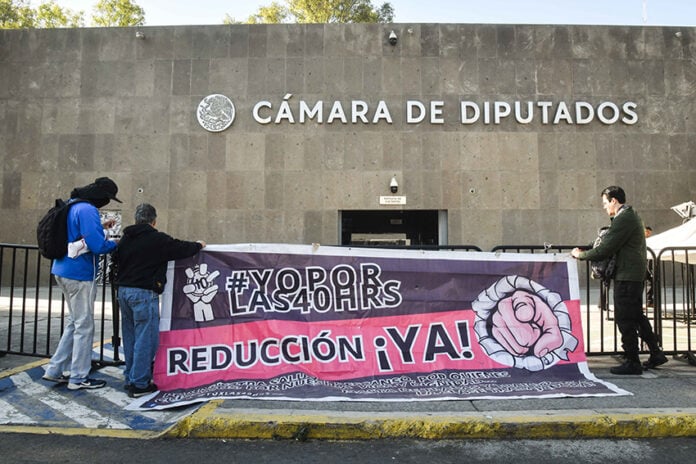
Members of the advocacy group "National Front for 40 Hours" protested against the six-day workweek on Tuesday, demanding two rest days per week. The reform passed by Congress reduces weekly hours to 40, but keeps the six-day workweek intact. (Mario Jasso / Cuarocscuro.com)
Mexico’s lower house of Congress approved on Wednesday a constitutional reform bill that will gradually reduce the standard workweek from 48 hours to 40.
All 469 lawmakers present in the Chamber of Deputies voted in favor of the bill when it was considered en lo general, or as a whole.
¡Felicidades trabajadoras y trabajadores de México! ¡La semana laboral de 40 horas será una realidad! Reconocemos el trabajo de las y los legisladores del Congreso de la Unión que ha permitido avanzar en el compromiso 60 de la Presidenta @Claudiashein. pic.twitter.com/G5NeGAg0WF
In a second vote held after consideration of the legislation’s individual articles, 411 deputies supported the bill while 58 opposed it.
The bill was first presented by the federal government in December and approved by the Senate earlier this month. It now needs to be ratified by at least 17 of Mexico’s 32 state legislatures in order to become law. That is expected to happen relatively quickly and the new law is slated to take effect on May 1 — International Workers’ Day.
In accordance with the legislation, Mexico’s standard workweek will be reduced by two hours annually starting next year in order to reach 40 hours in 2030, the final year of President Claudia Sheinbaum’s six-year term.
Despite the reduction in hours, the standard workweek will remain at six days, an aspect of the bill that was opposed by many opposition lawmakers.
Still, the federal Labor Ministry emphasized the significance of the legislation.
“After more than 100 years without modifications, Mexico will gradually leave behind the 48-hour work week and usher in a historic transformation,” it said on social media on Wednesday morning.
Labor Minister Marath Bolaños said in a video message that workers will have more time to rest, spend time with their families, play sports and enjoy cultural activities.
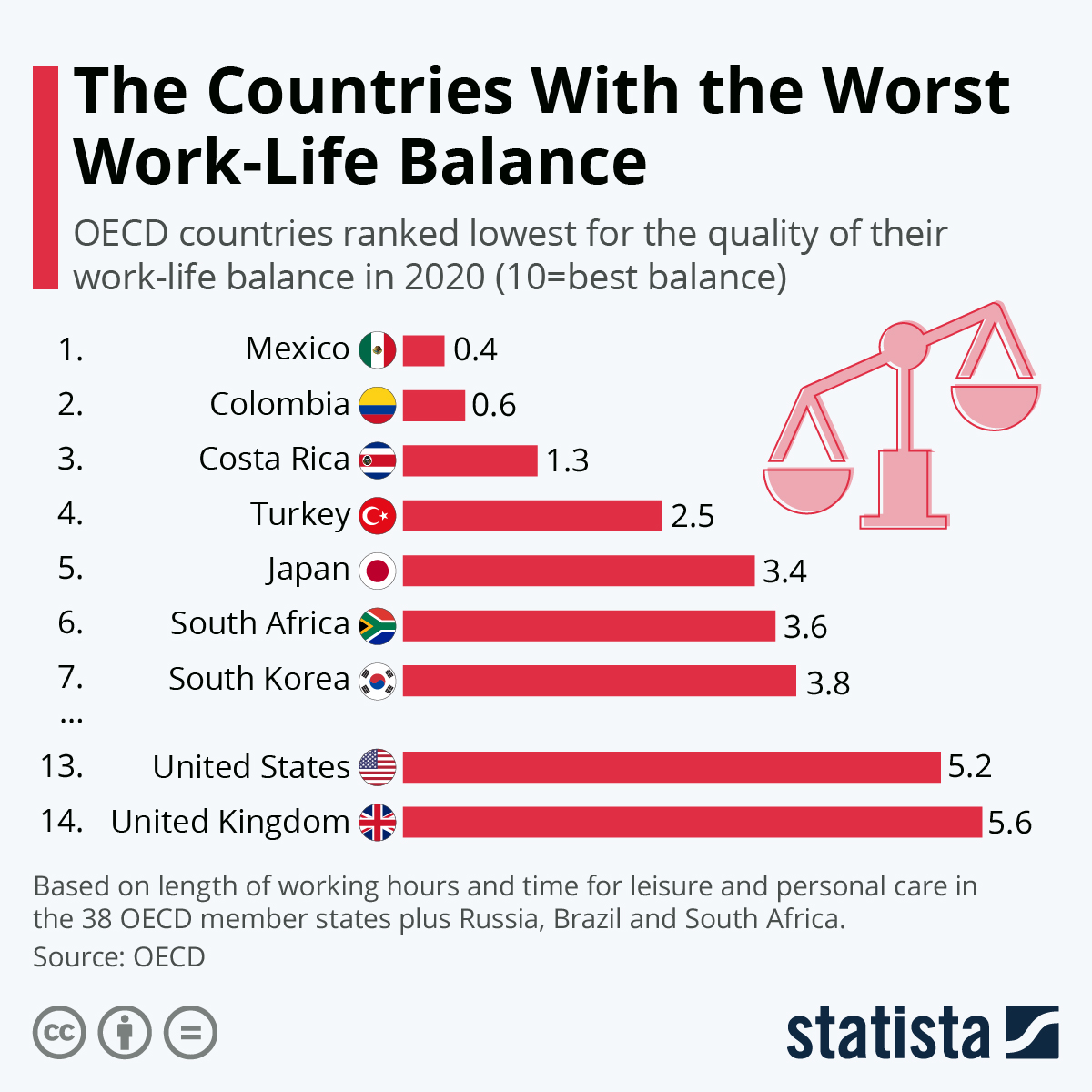
As things stand, Mexico has the worst work-life balance in the Organization for Economic Co-operation and Development, with more than 2,226 work hours per person per year, according to Reuters.
“The country, where around 55% of workers are employed in the informal sector, also has the lowest labor productivity and the lowest wages among the group’s 38 member states,” the news agency reported.
Among the other changes in the reform bill that has now been approved by both houses of Congress is an increase in the number of permitted double-time overtime hours from nine to 12. Workers will be limited to a maximum of four triple-time hours per week, meaning that a total of 16 overtime hours will be permitted. Workers aged below 18 will not be permitted to work overtime.
Employers will be prohibited from reducing workers’ salaries and benefits as the standard workweek is gradually shortened over the next four years.
Citizens Movement (MC) party Deputy Claudia Ruiz Massieu rejected Bernal’s “labor spring” claim.
“While it doesn’t include an additional day of rest, this reform will fall short,” said Ruiz Massieu, a former foreign affairs minister and ex-president of the Institutional Revolutionary Party.
“It promised more than it effectively guarantees … And it is working people who will pay the cost of that false promise,” Ruiz Massieu said, adding that without the introduction of a five-day workweek, “there is no labor spring.”
MC Deputy Patricia Flores Elizondo was also critical of the failure to guarantee workers two days of rest per week.
“In this chamber, they don’t want to talk about rest, they don’t even want to say the word,” she said, referring to deputies with the ruling Morena party and its allies, the PT and the Green Party.
“That is deeply hypocritical,” Flores claimed, “because many of those present here take six days of rest for every one they work.”
National Action Party Deputy Sarahí Gómez acknowledged that her party supported the reform bill, but nevertheless criticized it.
“What we don’t support is simulation — a pretty figure doesn’t change your life, 40 hours distributed across six days doesn’t change anything, increasing [overtime] hours cancels out the benefit,” she said.
The gradual reduction in the standard workweek “sends a very clear message — for the 4T [fourth transformation] there is no urgency,” said Gómez, referring to the government by its self-anointed nickname.
The bill was considered by Congress after consultation with workers, unions and private sector representatives.
Bolaños asserted in December that the reform “doesn’t imply greater costs for the business sector,” and claimed that some industries will see productivity gains from a shorter working week.
Some 13.4 million Mexicans who currently work more than forty hours per week will benefit from the gradual reduction in working hours.