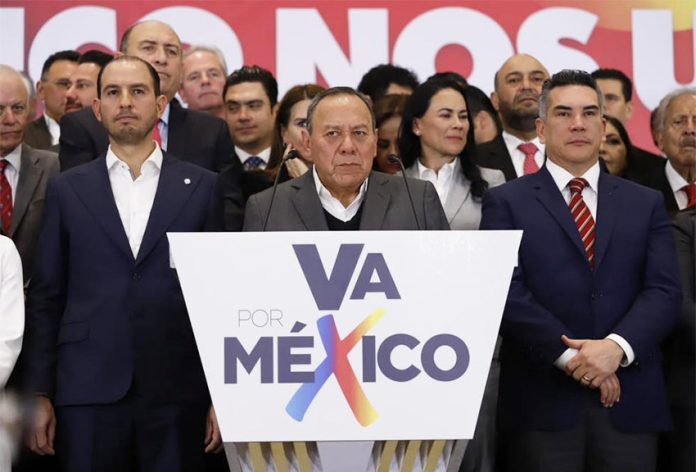
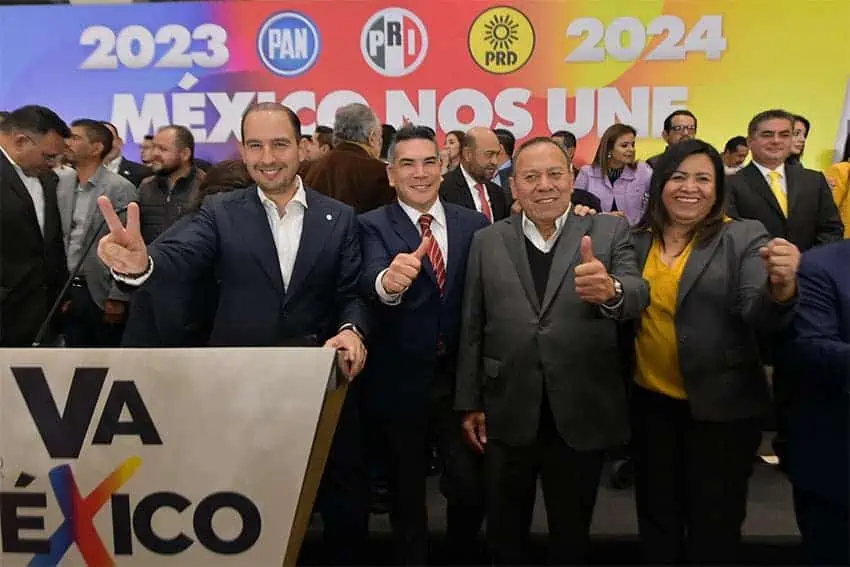
The coalition remains together, but PRD leader Jesús Zambrano (at center) said his party has been left out of some key candidate decisions. (Facebook / Partido de la Revolución Democrática PRD)
Mexico’s main opposition parties have announced they will field a common candidate at next year’s presidential election.
The Va por México alliance — made up of the National Action Party (PAN), the Institutional Revolutionary Party (PRI) and the Democratic Revolution Party (PRD) — was thought to be on the verge of breaking up in late 2022 after a PRI lawmaker presented a constitutional bill that sought to authorize the use of the military for public security tasks until 2028.
But the coalition survived the saga, and its leaders confirmed Thursday that the three parties will contest the 2024 presidential election, as well as the Mexico City mayoral race, on a joint ticket.
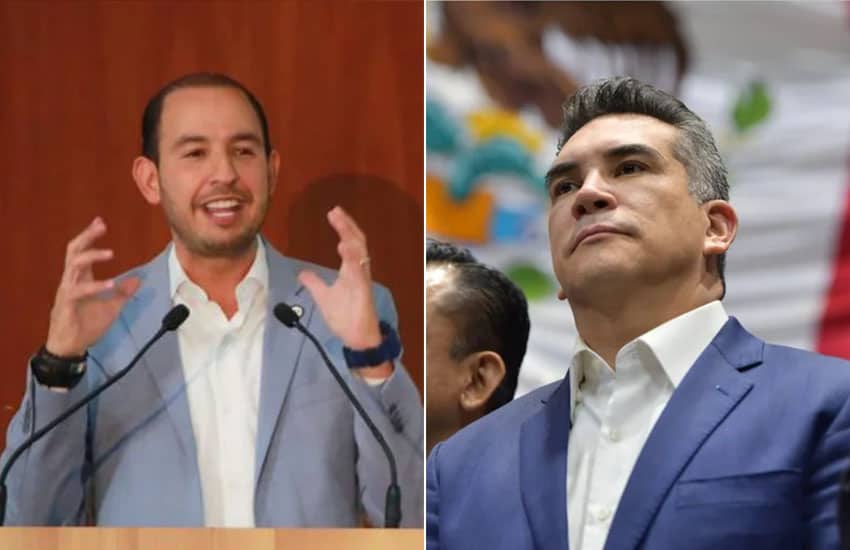
PAN leader Marko Cortés (left) and PRI leader Alejandro Moreno (right) fell out last fall over the PRI’s support for a constitutional bill allowing the military continuing performing domestic security functions, but their differences appear to have been smoothed over. Twitter
The PAN will be responsible for the selection process to find common candidates for those elections, said Marko Cortés, the party’s national leader. He told a press conference that the process will have “clear rules” and be open to all potential candidates that aspire to represent Va por México at the elections, including members of civil society.
Cortés also said that Va por México was open to having more parties join its alliance. There was speculation that the Citizens Movement party would join the coalition, but its national leader Dante Delgado said last month that wouldn’t be the case.
Moreno said that the coalition’s differences had been dealt with, and that it is now a solid opposition force.
However, a new internal rift has appeared. Zambrano said after Thursday’s press conference that the PAN and the PRI reached an agreement about the selection of candidates for next year’s presidential and mayoral elections without the involvement of the PRD. While the PAN will run the selection process to find candidates for those elections, the PRI was given responsibility for choosing Va por México candidates for gubernatorial elections in México state and Coahuila later this year.
The PAN-PRI agreement was struck bilaterally, and “we don’t agree with that,” Zambrano said.
From left, Marko Cortés (PAN), Alejandro Moreno (PRI) and Jesús Zambrano (PRD) represent their respective parties at the joint press conference. (Facebook / PRI Oficial México)
At the joint press conference, the PRD leader proposed the formation of a citizens’ committee to conduct the Va por México candidate selection processes in a transparent way.
“We’re a coalition of three political forces, but a coalition that must have the support of civil society,” he said later on Thursday.
“That’s the only way we will be able to win, if we don’t take that route we’ll be announcing a defeat.”
Mexico City Mayor Claudia Sheinbaum and Foreign Affairs Minister Marcelo Ebrard are seen as the top contenders to secure the ruling Morena party’s candidacy at the 2024 presidential election.
There is far less clarity about who will represent the PAN, PRI and PRD. In that context, President López Obrador offered his own (very) long-list of possible opposition candidates in October, saying that a total of 43 people have either expressed interest in vying for the presidency or have been mentioned as potential contenders.
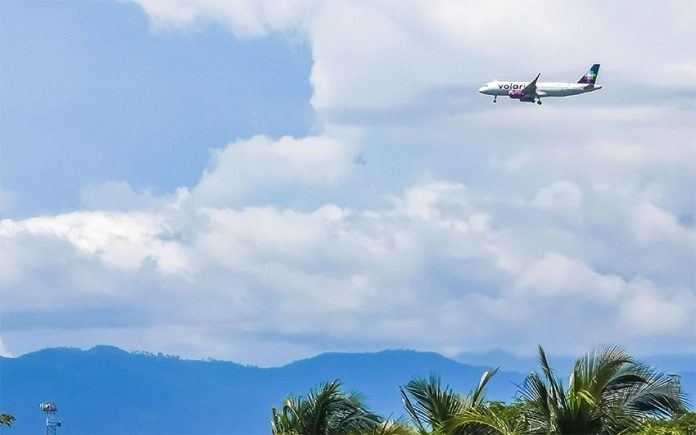
A Volaris airplane flies over Puerto Escondido, Oaxaca. (File photo)
A meeting originally scheduled for Thursday to assess the corrective action plan that could help Mexico regain its Category 1 of aviation safety rating was canceled last-minute by the United States Federal Aviation Administration (FAA).
Billy Noen, acting head of the FAA who was supposed to arrive in Mexico City on Thursday morning, canceled the trip due to an overnight system collapse on Tuesday that left pilots, airlines and airports in the United States without crucial safety information.
“The FAA requested to reschedule the meeting and make the visit to Mexico as soon as possible,” the Mexican aviation agency AFAC said in a statement.
The meeting had been scheduled as part of a plan to recover the coveted Category 1 air safety rating given by the FAA, which was downgraded for Category 2 (the lowest level) in May 2021. At that time, the FAA said that they demoted Mexico because its civil aviation authority didn’t meet the safety standards set by the United Nations International Civil Aviation Organization (ICAO).
Holding a Category 2 rating has prevented Mexican airlines from opening new routes to the U.S., increasing flight frequencies and adding new aircrafts that can enter the country. It also limits Mexican airlines to carry out marketing agreements with U.S. carriers.
According to Minister of Infrastructure, Communications and Transport Jorge Nuño Lara, who made an appearance before Congress in December 2022, a final audit is expected for February after which a decision on whether Mexico can recover Category 1 would be reached. The rating would be then granted by April.
However, it is yet to be seen if the cancellation of Thursday’s meeting would have any repercussions on the action plan or approval timeline.
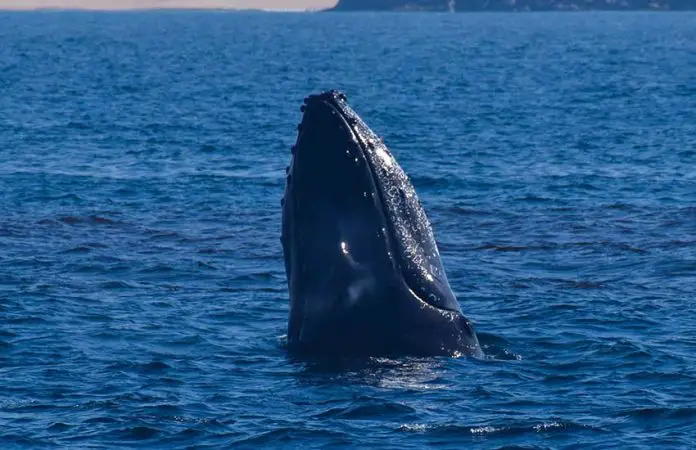
A humpback whale has a brief look around near Onca Explorations' whale watching boat off the Mazatlán coast. (Photo: Adair Cazares/Onca Explorations)
One of the most thrilling adventures on the Pacific coast of Mexico is whale watching — and thanks to the growth in ecotourism, these days, you can combine your trip with whale conservation education.
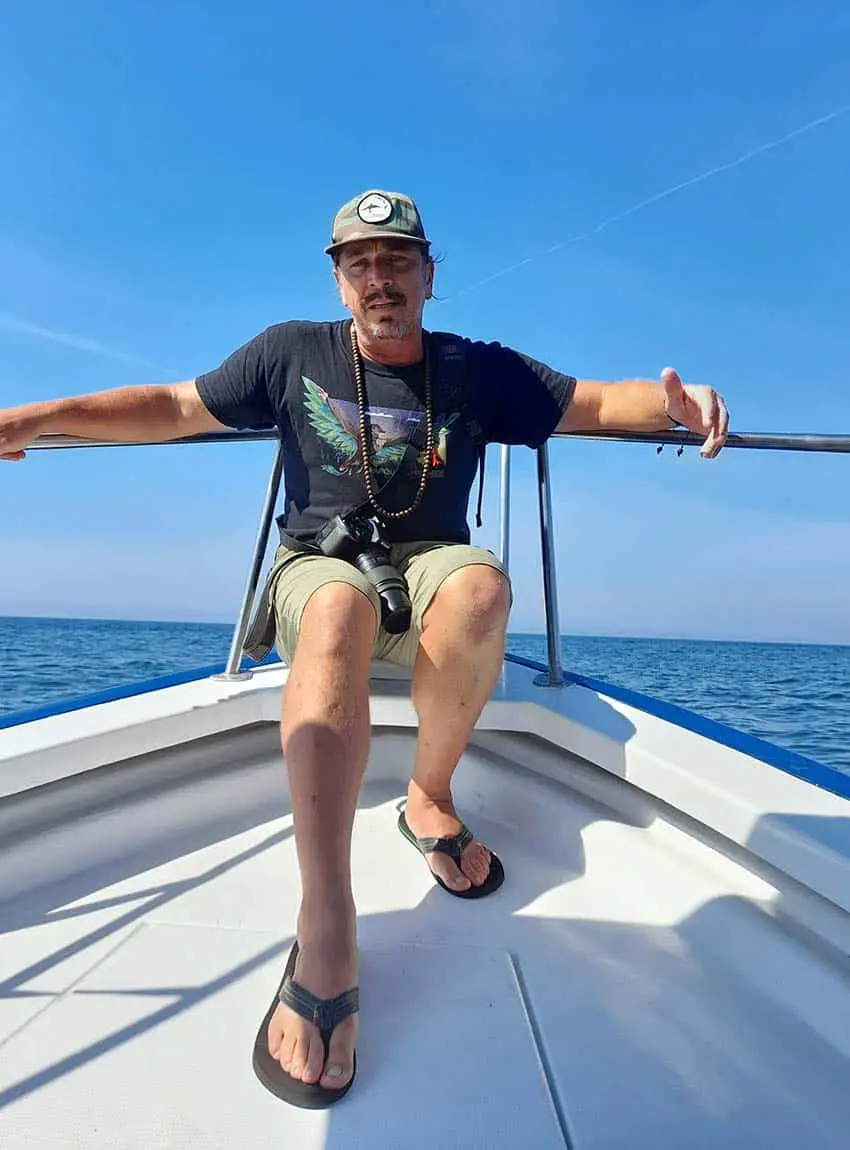
I recently took a whale watching expedition with a group of researchers from the ecotourism company Onca Explorations in Mazatlán. The founder of Onca, Oscar Guzon, is a marine biologist and lead researcher.
Humpback whales are fascinating to watch, and their behavior is constantly changing. At a length of 46 to 56 feet and weighing as much as 40 metric tons, these gentle giants are powerful but graceful. Their flamboyant acrobatics make them the entertainment superstars of the whale world.
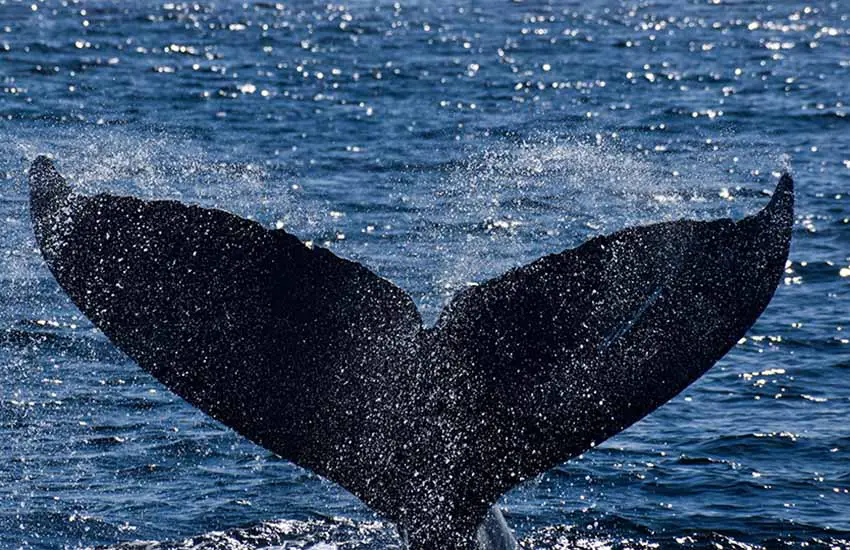
A whale shows off its flukes for researchers before fully re-entering the water. The slapping of the ocean water as it submerges may be a way for it to communicate. (Photo: Adair Cazares/Onca Explorations)
Our expedition wasn’t far from shore when we spotted our first whales frolicking in the water. We locate them by scanning the horizon for plumes of mist erupting from the surface, which occurs when a whale comes up to breathe.
Mazatlán is one of the breeding grounds for humpbacks along the west coast of Mexico.
“The larger whale is female; the smaller one is male,” Guzon tells me. “Whales are very playful, and this may be part of their mating ritual.”
We spot two bulls — male whales — rapidly approaching the happy couple from a distance. They are much larger than the smaller male.
“We may see some head-butting,” Guzon warns, “which the smaller one will certainly lose.”
The two bulls attempt to insert themselves between the couple. After several attempts, they finally give up as it becomes clear the female is not interested in either of them.
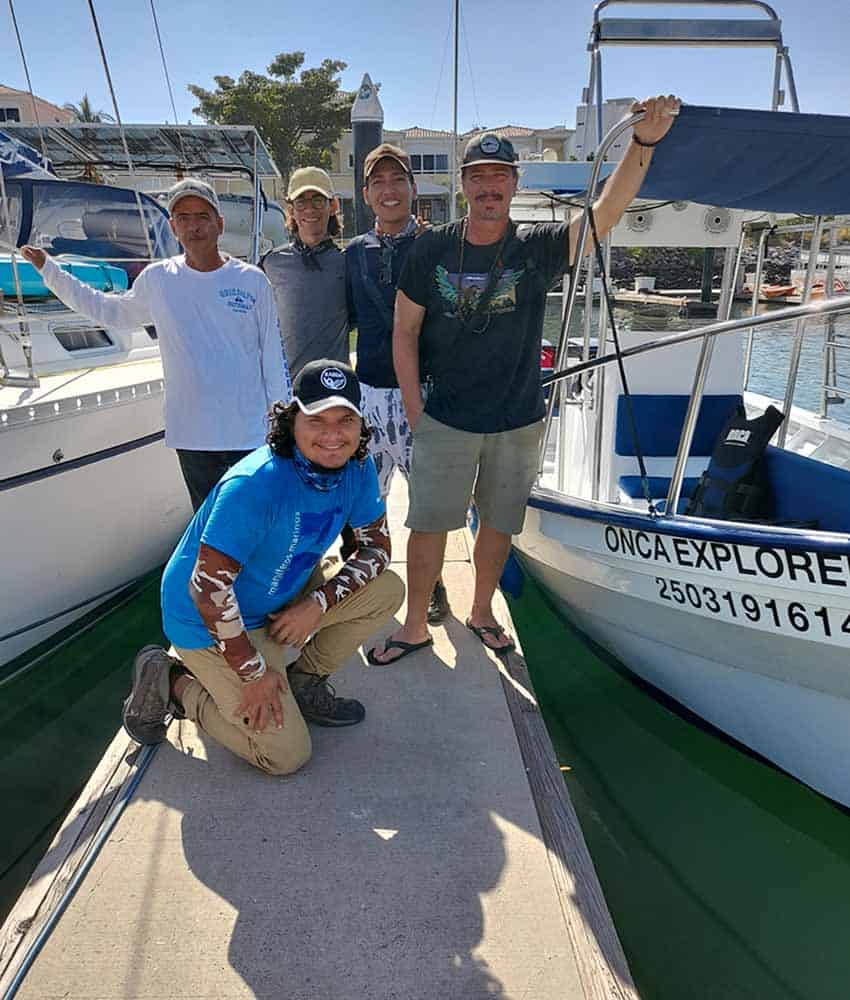
The staff of Onca Explorer. Oscar Guzon is standing on the right. (Photo: Sheryl Losser)
Soon afterward, we are surrounded by whales. The researchers are all busy gathering photographic evidence, using cameras fitted with telescopic lenses. One whale lifts its head vertically out of the water right next to the boat — known as spyhopping — to check out the surroundings. Guzon assures me there’s no threat.
“It’s just curious,” he says. “Whales are very curious creatures.”
During a break in the action, he explains to me that the photographic evidence is how they track the whales and monitor their behavior.
“We are trying to get good photos of the flukes [the right and left sides of the tail],” he says.
“Flukes have distinctive markings unique to each whale that are used to identify them. No two whales have the same markings,” he explains. “Through a process of capture-recapture with other researchers all along the west coast of Mexico, from Baja to southern Oaxaca, we share information on sightings.”
As we head back to shore, Guzon tells me that they photographed 16 distinct whales. “It was a very good whale day,” he says with a big smile. The excitement of the entire crew at seeing and capturing photos of so many whales in one day was infectious.
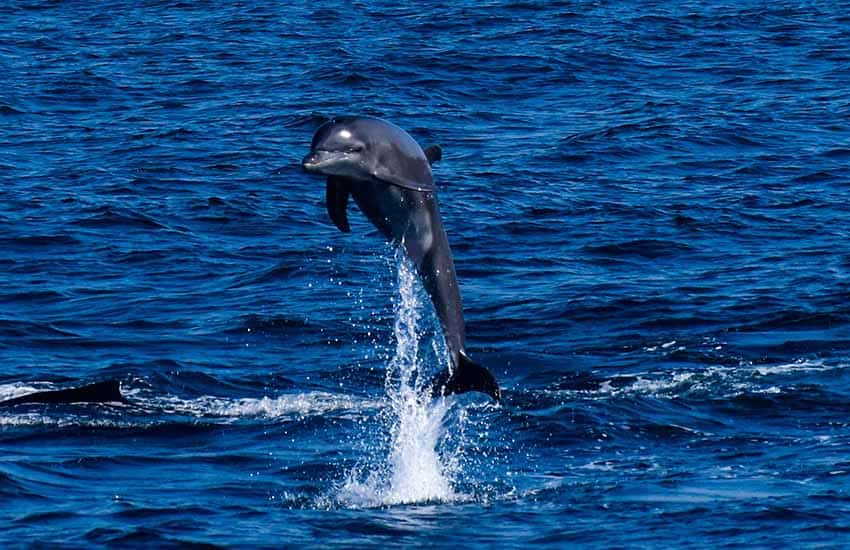
Sometimes dolphins also make a bonus surprise appearance on Onca Explorations’ whale watching tours. (Photo: Adair Cazares/Onca Explorations)
The researchers then take the photographic evidence they have collected and match it to photos that they and other researchers have compiled in large digital catalogs. In this way, they can track migratory patterns, frequency of the sightings and other behavioral patterns for each identified whale.
One of the larger catalogs on the Mexican Pacific coast — the FIBB catalog — has been compiled by Puerto Vallarta’s Ecologia y Conservación de Ballenas (Ecobac) through their Humpback Whale Photoidentification Project.
Ecobac marine biologist Astrid Frisch Jordan tells me that since its inception in 1996, FIBB has grown to include 3,183 photo IDs.
One of the things that her organization has discovered is that climate change has altered the migratory route and behavioral patterns of some humpbacks.
“Although their primary feeding grounds are off the coast of California, Oregon and Washington state, we are now seeing them feed in Banderas Bay [Puerto Vallarta] and staying longer to feed off the coast of California,” she says. “Now they are feeding wherever they can find food.”
Ironically, whales may play a critical role in efforts to reduce the effects of climate change. One whale can sequester up to 33 tons of carbon dioxide. These marine mammals also ensure a healthy abundance of phytoplankton; the microscopic plant captures CO2 from the atmosphere and produces oxygen.
During whale watching tours, Guzon and his crew also photograph the whales they spot to document them for marine mammal researchers from Baja California to Oaxaca. (Photo: Sheryl Losser)
The good news is that the humpback whale population is growing. During the 20th century, their numbers dropped almost 90%. But when the International Whaling Commission banned commercial humpback whaling in 1986, the population soared.
But these animals still face threats today — mostly man-made.
“Entanglement in nets, Jet Skis, boat collisions, noise pollution, throwing single-use plastic products into the ocean and in any way impeding their natural movement threatens their survival,” Frisch told me.
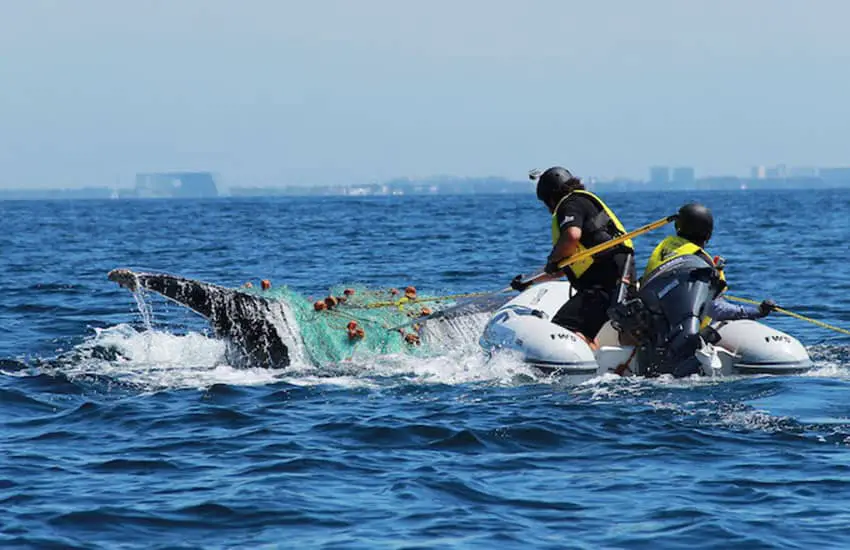
As coordinator of RABEN (The Attention Network for Entangled Whales), Frisch works with other inter-institutional teams trained to rescue whales entangled in fishing gear. She also works with Ecotours de Mexico and promotes ecotourism as one way to educate the public on humpbacks and conservation efforts.
Mexico’s Ministry of the Environment and Natural Resources (Semarnat) issued mandatory whale watching regulations in 2010, but “Many people aren’t aware of the regulations or don’t pay attention to them,” Frisch says.
The regulations are very detailed, including what activities are prohibited, distance at which whales can be observed, maximum boat speed allowable and the number of boats that can observe a group of whales at one time.
Members of the group RABEN saving a whale entangled in a fishing net. (Photo: Courtesy)
Semarnat also provides training and certification annually for whale watching companies which can be revoked if a company doesn’t follow the regulations.
Ecobac lists three basic commonsense rules for whale watching:
Cause the least possible impact on the whales
Be patient
Watch whales only with boats or companies with Semarnat certification
Frisch emphasizes the third rule as a way to be certain the tour leaders have received training and are properly following whale safety regulations.
To book a whale-watching expedition or explore other activities provided by Onca Explorations in Mazatlán, visit their website. In Puerto Vallarta, to find out about whale watching and other nature encounters with Ecotours de Mexico, visit their website.
Sheryl Losser is a former public relations executive and professional researcher. She spent 45 years in national politics in the United States. She moved to Mazatlán in 2021 and works part-time doing freelance research and writing.
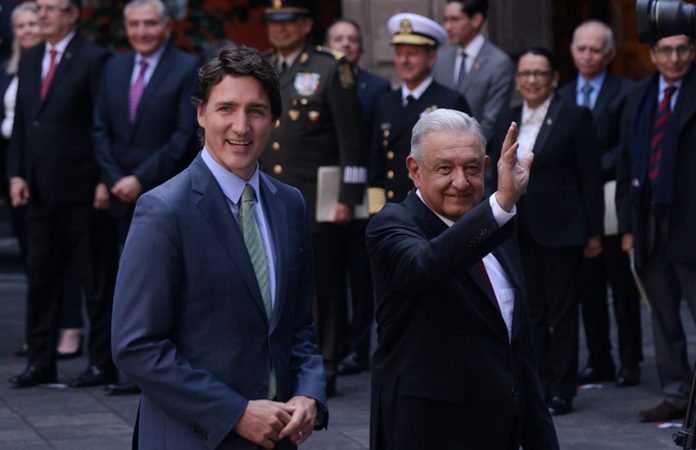
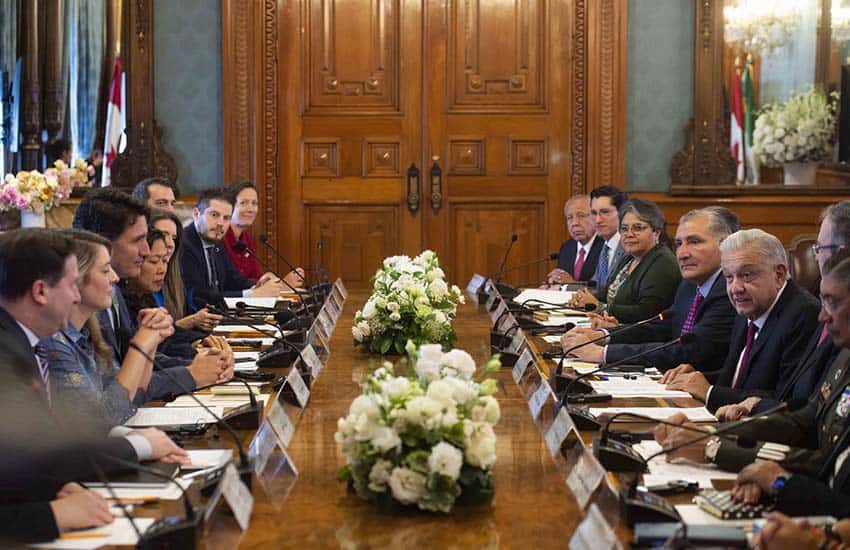
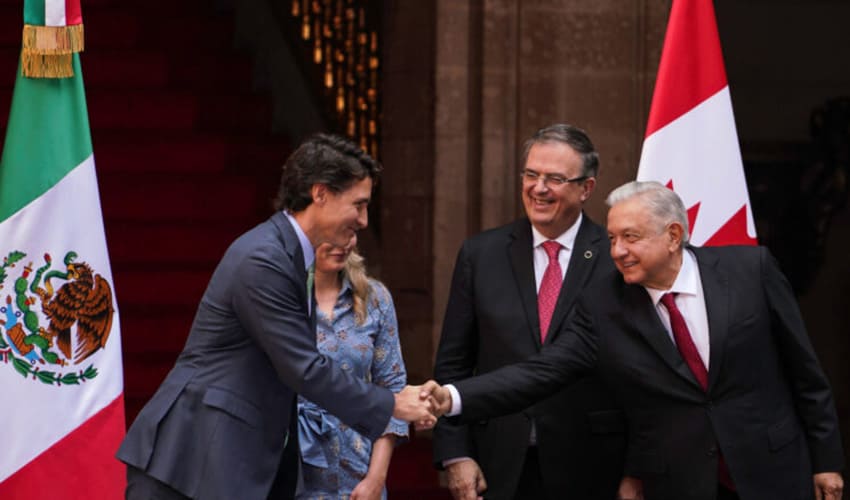
President López Obrador and Prime Minister Trudeau met to discuss strengthening ties between their countries after the North American Leaders' Summit. (Photo: Cuartoscuro)
The governments of Mexico and Canada announced the creation of a joint “action plan” following a meeting between President López Obrador and Canadian Prime Minister Justin Trudeau in Mexico City on Wednesday.
In a joint statement, the Mexican and Canadian governments said that López Obrador and Trudeau “have committed themselves to renew a relationship that draws on the diverse strengths of all citizens, putting their well-being and interests at the centre of our bilateral cooperation.”
In their joint statement, AMLO and Trudeau said they were focused on problem solving between their nations, including resolving trade issues related to Canadian firms operating in Mexico. They also pledged to advance a progressive agenda to improve the lives of indigenous people and women. (Photo: Cuartoscuro)
Their commitment “recognizes a shared vision to build more prosperous, sustainable, safe, and equitable societies for all as well as to contribute to the integrity and competitiveness of the North American region,” the statement said.
“The creation of the Canada-Mexico Action Plan establishes a strengthened partnership built on 9 pillars that outlines our citizens’ priorities and the initiatives that will advance them.”
The plan focuses on reconciliation with Indigenous peoples; gender equality and women’s empowerment; trade and investment; anti-racism; youth engagement; peace and security; tourism, migration and human mobility; environment and climate change; and cooperation in the face of future health crises.
“We’ve addressed economic issues related to investment of Canadian companies in Mexico, mining companies, important companies like TransCanada, which is investing to build a gas pipeline in the Gulf of Mexico. … We’ve also spoken about companies that are operating in the energy sector,” he said during public remarks at the bilateral meeting.
“We’re seeking to resolve problems, differences that naturally arise when dealing with these economic and trade relations. … Obviously there are some issues to deal with. I made the commitment to Prime Minister Trudeau to meet with [Canadian] companies that might have outstanding issues [or] disagree with the posture of our government. We are always open to dialogue,” López Obrador said.
In addition to signing the nine-point memorandum of understanding between their countries, Trudeau and Lopez Obrador also shepherded the signing of a memorandum of understanding between Mexico’s National Institute for Indigenous Peoples and its Canadian counterpart, Crown-Indigenous Relations and Northern Affairs Canada. (Photo: Cuartoscuro)
Trudeau subsequently told reporters that AMLO “was very open to meeting with different businesses, to working with our ministers and our civil servants to make sure the [energy] issues are resolved.”
In his public remarks, López Obrador also noted that he had spoken to the leader of Canada about a program in that country that has allowed Mexicans to work there while on temporary visas. AMLO said Tuesday that the program had benefited over 25,000 Mexicans.
Among the initiatives and commitments outlined in the statement on the Canada-Mexico Action Plan was a memorandum of understanding to modernize cooperation on indigenous issues.
The statement detailed a range of other bilateral commitments and initiatives, including that:
López Obrador and Trudeau are looking to organize a joint high-level summit on Reconciliation with Indigenous Peoples.
Canada and Mexico will continue to champion gender equality, and women and girls’ empowerment in regional and international forums.
Canada and Mexico maintain their commitment to work on inclusive trade and investment in building a sustainable economic recovery that places people, creation of good middle-class jobs, and well-being and quality of life of citizens at the center.
The two leaders will use the FIFA World Cup in 2026 as a key opportunity to support FIFA’s efforts to uphold human rights.
Canada agreed to provide technical assistance to help build Mexico’s forensics capacity. (The Mexican government conceded in late 2021 that the country was facing a “forensic crisis.” )
Both countries will work together to strengthen asylum and protection systems in Central America and Mexico.
Canada and Mexico will advance nature-based solutions to address climate change.
López Obrador said Wednesday that the Mexico-Canada relationship had been further strengthened as a result of the bilateral meeting.
“We’re neighbors, friends and we’re working together. And you will always be welcome in Mexico,” he told a delegation led by the Canadian prime minister.
For his part, Trudeau described Canada and Mexico as “progressive countries that put … equality, justice, opportunity for all, jobs for the middle class, and for people working hard to join it, protection of the environment, support for indigenous peoples, at the center of our vision for each of our countries.”
The meeting between the Mexican and Canadian leaders brought to an end three days of bilateral and trilateral talks in Mexico City. The next North American Leaders Summit – colloquially referred to as the “Three Amigos” summit – will be held in Canada in 2024.
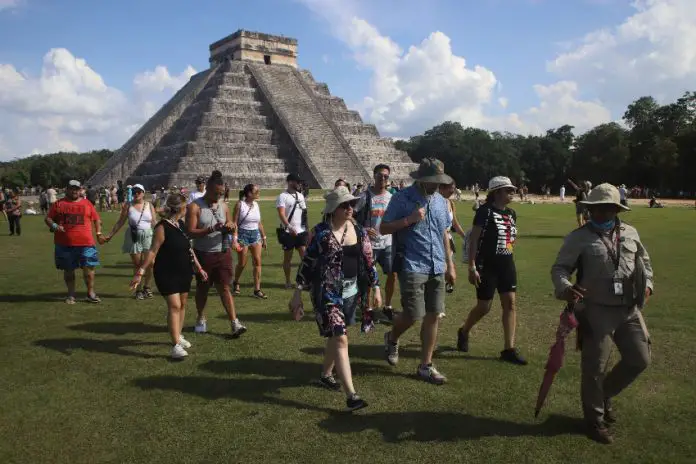
A guide leads tourists around Chichén Itzá, which received 2.5 million visitors in 2022. (Martín Zetina / Cuartoscuro.com)
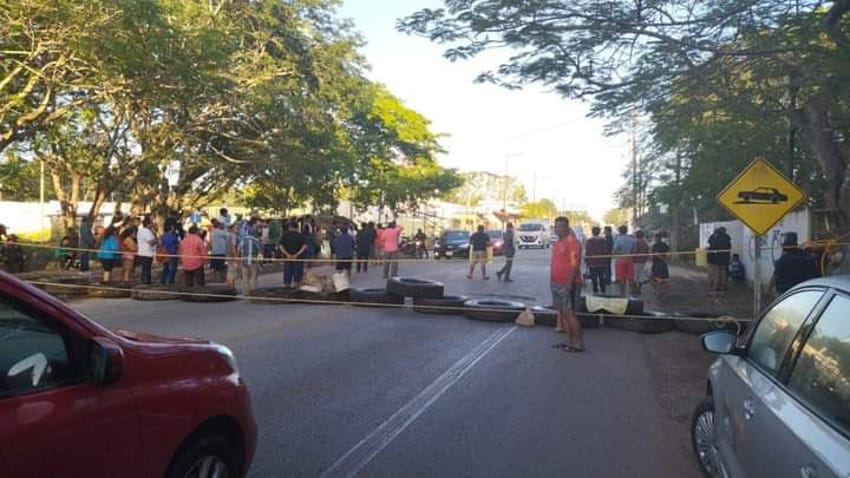
After what government officials deemed successful negotiations with leaders, protesters lifted a roadblock Wednesday that had prevented many tourists from reaching the Chichén Itzá archaeological site for 10 days.
The National Institute of Anthropology and History (INAH) issued a statement saying the portion of Highway 180 in Yucatán that leads from Mérida to Mexico’s most-visited archaeological site had been reopened after “necessary agreements and commitments” were achieved at a meeting between the two sides.
However, the groups of ejidatarios, merchants, artisans and activists warned that if their demands are not met in short order, they will resume their protest operations “with more force.”
Video showing protesters removing their blockades on Thursday
The highway to the ancient Maya site had been blocked at two checkpoints.
Though it wasn’t easy to get to, and though officials had begun urging tourists to visit smaller archaeological sites in the area, the Chichén Itzá site had remained open since the Jan. 2 start of the roadblock and protests, which had as many as 10,000 participants, community leaders said.
As recently as Monday, those leaders were saying that no one from INAH or the federal government had come forward to seek a solution.
That all changed “thanks to the efforts made by the national representation of the Ministry of the Interior,” said Arturo Chab Cárdenas, director of the INAH Yucatán Center.
“The government of Mexico has complied with many requests for clarifications from the communities,” he said.
The talks were held at the Municipal Palace in Kaua, Yucatán, a few days after vendors filed a complaint with the Human Rights Commission of Yucatán to air their grievances, which they characterize as violations of their rights as Indigenous peoples.
Protesters began blocking road access to the site on Jan. 2. (@PedroKanche Twitter)
Members of the Xcalakoop, Pisté and San Felipe communities — which are adjacent to the Chichén Itzá property — said they took to the streets after years of government officials not listening to their claims that INAH has been preventing them from setting up shop near the site’s major structures: the main pyramid, known as El Castillo, and by the popular Temple of Kukulcán.
Tour guides claim they aren’t given customers unless they hand over a percentage of their earnings.
Other protesters included farmers whose property abuts the archaeological zone. They want financial compensation due to not being allowed to plant crops. Others claim that those working on site, many who don’t speak Spanish, are prohibited from speaking Mayan.
Protesters are calling for the removal of INAH’s Chichén Itzá site director Marco Antonio Santos Ramírez. However, the agreement reached on Wednesday does not include the removal of Santos, who has blamed the protests on interest groups allegedly trying to “seize us as a political flag” for their own benefit.
The newspaper La Jornada Maya reported that a memorandum of understanding signed by Andrés Peraza, representative in Yucatán of the federal government, and the leaders of the protesters agrees to provide a solution to the demands of the protesters within a week. The signed document includes a list of those demands, including Santos’ dismissal. Representatives of the protesters also asked INAH “not to mess with the artisans” and to treat them with dignity.
The problems at Chichén Itzá are not new, said Eduardo Paniagua, national president of the Mexican Association of Travel Agencies.
“It’s a problem that’s been going on for many years, and it began when many vendors began to enter the archaeological zone, which is against the law,” he said.
A few years ago, he told La Jornada Maya, when he took a group of Japanese tourists to Chichén Itzá, “they ran into these vendors who yelled at them and did everything to attract their attention; and if they failed to make a sale, they insulted them.”
He said tourists often have more fun visiting other places and that if Chichén Itzá officials don’t get the message soon, travel agents will start promoting visits to nearby archaeological destinations such as Mayapán, Tulum and Cobá.
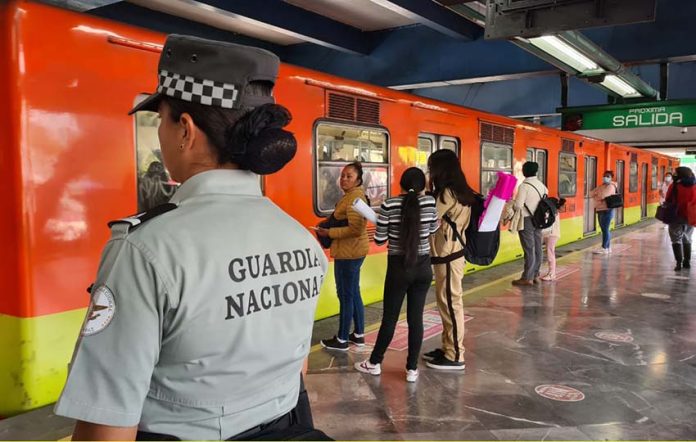
National Guardsmen patrolling the Mexico City Metro system on Thursday afternoon. City authorities said a number of "out of the ordinary" events had been happening at Metro facilities over the past few months that warranted the federal police force's patrols. (SCT/Twitter)
Over 6,000 National Guard officers will be deployed to provide security in Metro stations around Mexico City, after a series of unusual events sparked alarm among capital authorities.
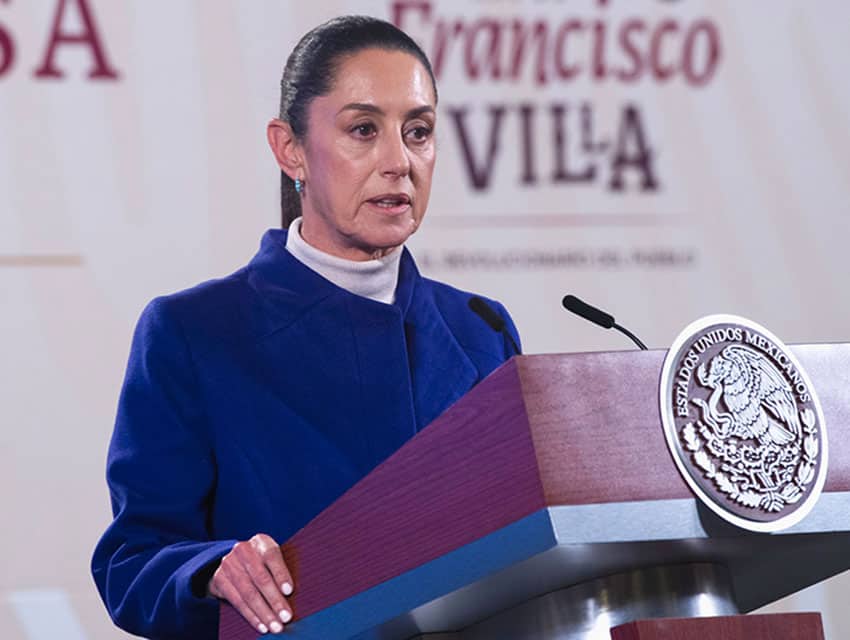
“Episodes have been occurring [in the Metro] in recent months that we classify as out of the ordinary,” Mayor Claudia Sheinbaum said in a press conference on Thursday. “So today, starting at 2 p.m., the National Guard will be present in Metro stations and in some other facilities with 6,060 elements.”
Sheinbaum explained that the heightened security presence would continue for a few months but did not confirm exactly what the National Guard’s role would be nor the specific reason for their deployment.
Addressing reporters on Thursday, Mayor Claudia Sheinbaum implied that elements leading to the crash appear suspicious. (Photo: Presidencia)
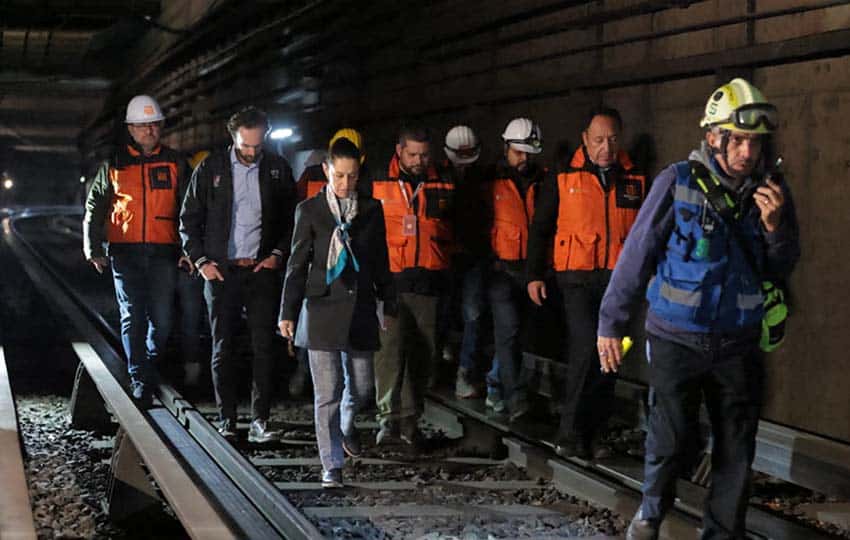
The announcement comes in the wake of an accident in whichtwo trains collided on Line 3 on Saturday, leaving one person dead and 106 injured.
Although Sheinbaum insisted she would wait for the results of the investigation before making detailed comments, she implied that elements of the incident appear suspicious.
In particular, she revealed that police had found a “black box” event data recorder belonging to the Metro located inside a van, suggesting that it had been removed before the accident.
One hypothesis currently under investigation by the Mexico City Attorney General’s Office is that the crash was due to missing sections of copper cable in the Metro tunnels, which caused communication failures and a drop in the trains’ circulation speed. The reason for the missing cable is unknown, although copper cables are frequently the target of theft to sell to recyclers.
“I don’t want to call it [sabotage], but they are actions, moments and atypical events that are happening in the Metro,” Sheinbaum said. “We are not going to get ahead of ourselves because we have to respect the workers; the workers are the ones who operate the Metro every day. But we have to protect [the public].”
During the same press conference, President López Obrador defended against criticisms by some human rights organizations that National Guard deployments are characterized by a lack of transparency and excessive use of force.
Mexico City Mayor Claudia Sheinbaum visiting the site of the Metro crash on Monday. (Photo: Government of Mexico City/Twitter)
“If they call it militarization, we assume responsibility, because it’s better to be safe than sorry,” AMLO said.
He also promised that more funding would be provided to the Metro if necessary. Capital government sources suggest that the Metro’s budget for 2022 was just under 20 billion pesos (US $1 billion), around 15% lower in real terms than it was in 2018.
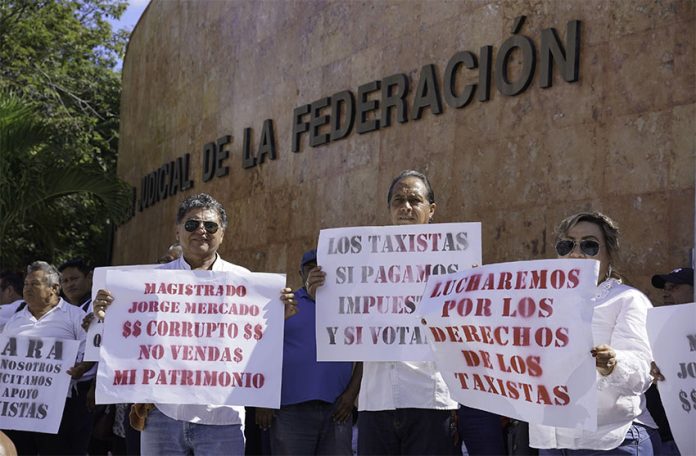
Taxi drivers protest outside the tribunal in Cancún on Wednesday. (Elizabeth Ruiz / Cuartoscuro.com)
A court in Quintana Roo has ruled that Uber can operate in the Caribbean coast state without a public transport license.
Two judges at a federal court in Cancún ruled Wednesday that the ride-hailing service provides private transport and therefore doesn’t require a public transit license.
Their decision complies with a 2021 Supreme Court ruling that Uber’s business model is different than those of public transport companies.
The ruling is a win for Uber, which has faced protests against its operation in Quintana Roo. Some 40,000 taxi drivers took to the streets of Cancún, Playa del Carmen, Tulum and Chetumal last month to protest against the possibility of the company operating in the state without a public transportation concession.
As a result of Wednesday’s ruling, Uber will now be able to operate freely in Quintana Roo without having to comply with regulations that apply to public transport operators including taxis.
“We’re very happy, … it’s a day of celebration. Finally, citizens and tourists will have a transport platform where they can feel safe,” Agueda Esperilla Soto, a spokesperson for Uber drivers, told the news organization Por Esto!
She said that Uber drivers now expect to be able to work without facing hostility.
Some 50 taxi drivers participated in a protest against Uber on the tourism-oriented island of Cozumel before and after the Cancún court delivered its ruling in favor of the ride-hailing service.
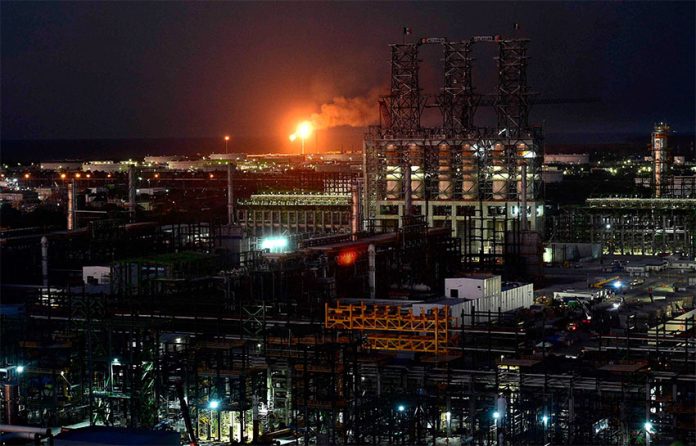
The president has cited the Pemex Dos Bocas refinery in Tabasco as another example of projects designed to boost economic development for future generations. (Presidencia / Cuartoscuro.com)
Pemex is searching for funds to make almost US $10 billion in bond payments this year, Bloomberg reported Monday.
Citing unnamed people with knowledge of the situation, the news agency reported last week that the Finance Ministry (SHCP) expects the state oil company to pay debt due this quarter without government help.
Pemex CEO Octavio Romero said last Wednesday that the state oil company needs to make debt payments of between $5.5 billion and $6 billion in the January-March quarter. He also said that he’s been in talks with the SHCP since the final quarter of 2022 to find a way for Pemex to pay the debt because the amortizations aren’t included in the federal budget.
Romero added that high oil prices could help Pemex — which with total debt of $105 billion is the world’s most indebted oil company — find alternatives to service its debt.
Bloomberg reported Monday that the federal government stopped paying Pemex’s debt amortizations in the second half of last year. Investors, it added, are questioning whether the state-owned firm will seek funding in international markets, attempt to sell unpaid oil-product invoices or seek other ways to get the funding it requires to meet its repayments.
The news agency noted that Pemex secured cash last year by selling unpaid oil and oil-product invoices to banks. Via that means — known as monetizing receivables with factoring — the company received at least $1 billion from HSBC and Goldman Sachs.
Bloomberg said that Pemex’s “most-recent debt maneuver in June — which paid oil suppliers with notes to be exchanged later — was deemed a flop due to weak demand.”
It added that the financing solutions Pemex has turned to may be insufficient as the company owes as much as $9.8 billion in 2023.
Patrik Kauffman, an investor at Aquila Asset Management in Zurich, said that Pemex could seek financing via a liability management exercise or a receivables-backed issuance.
“It depends very much on the rate they need to pay,” Kaufmann said.
“And if too high, the government is there and said it clearly. I believe the most viable way is the government.”
Although the SHCP expects Pemex to pay the required debt payments in the first quarter, President López Obrador “promises his government would step in to help the company if necessary,” Bloomberg said.
The news agency also said that “if forced, the beleaguered company may tap into its 2023 budget to pay down debts, a move that would further strain its struggling oil operations.”
Pemex — whose oil production has declined almost every year since 2004 — recorded a net loss of 52 billion pesos (US $2.7 billion) in the third quarter of 2023, while U.S. oil companies ExxonMobil and Chevron had a bumper three-month period due to a rally in international oil prices.
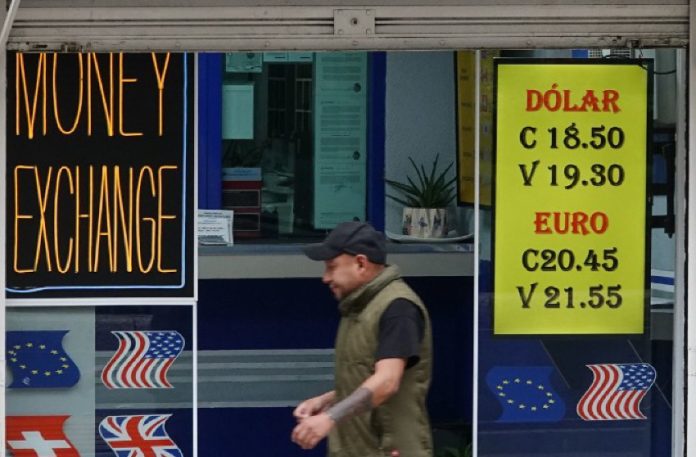
The value of a U.S. dollar hadn't dropped below 19 pesos since February 2020. (Graciela López Herrera / Cuartoscuro.com)
The Mexican peso closed at its strongest level against the U.S. dollar in almost three years on Wednesday, with one greenback buying fewer than 19 pesos for the first time since February 2020.
One U.S. dollar was worth 18.94 pesos at the close of trading, according to data from Mexico’s central bank.
The most recent previous time that the value of a greenback dropped below 19 pesos was February 21, 2020, when it bought 18.91 pesos at the close of that day’s trading.
The rise in the value of the peso on Wednesday came as the dollar weakened ahead of the release of U.S. inflation data on Thursday.
Gabriela Siller, director of economic analysis at Banco Base, said that the market is anticipating that the data will show inflation has cooled in the U.S., “which means the Federal Reserve won’t have to be so aggressive in the hikes [it makes to interest rates] this year.
Jesús Ramírez Cuevas, President López Obrador’s communications chief, noted on Twitter that the peso had strengthened to below 19 to the dollar.
“In that way the Mexican currency consolidates itself as one of the best [performing] currencies at an international level at the beginning of 2023,” he wrote.
The peso also performed well last year, being just one of four currencies that appreciated against the U.S. dollar, according to a report by the EFE news agency. The others were the Russian ruble, the Brazilian real and the Peruvian sol.
The peso closed at 19.5 to the U.S. dollar at the end of 2022, an improvement of 5% compared to the beginning of the year, Bank of México data showed.
Hay algunos que sufren con las buenas noticias para México, pero con @lopezobrador_ no solo la economía está mejor, también el peso es de las mejores monedas en el mundo. pic.twitter.com/glTY94uH4f
Mexico City Mayor Claudia Sheinbaum celebrated the peso on her Twitter feed as “one of the best currencies in the world.”
High inflation in Mexico last year led the central bank to lift its benchmark rate by 75 basis points on four consecutive occasions prior to a 50 bp hike in December. The rate is currently set at a record-high of 10.5%.
The Bank of México’s tightening of monetary policy and a record-high inflow of remittances were among the factors that propped up the value of the peso in 2022.
Hostal de la Luz, a spiritual and spa retreat built by meditation enthusiast Luis Oscoy, has been in Amatlán, Morelos, for 20 years. (Photo: courtesy)
Perhaps one of the best places I’ve ever found in Mexico to relax got its start 20 years ago with an invitation to breakfast.
One day in the early 2000s, Raul Velasco invited his good friend Luis Oscoy to have breakfast in Tepoztlan, Morelos. Before dining, however, Raul insisted on showing Oscoy around a tiny town next door, brimming with tropical plants and sweeping views of the mountains.
The town was quiet, except for birds chirping and an occasional dog barking in the distance. It seemed the perfect spot for the two men, both deeply entrenched in spiritual practices, to meditate. Oscoy had been meditating since he was just 5 years old and felt an instantaneous connection to the land.
The writer recommends Hostal de la Luz as a great place to escape the hustle and bustle of daily life and get in touch with your spiritual side. (Photo: courtesy)
After a lengthy meditation session, as the men drove a narrow, unpaved road toward Tepoztlan, Oscoy caught sight of a worn piece of paper attached to a tree. Scribbled in childlike handwriting were the words se vende (for sale) and a phone number. Upon arrival at the restaurant, made the call.
The rest, as they say, is history: Oscoy would go on to build Hostal de la Luz, a meditation and yoga retreat center located in the still-tiny town of Amatlán, Morelos (population: 1,312).
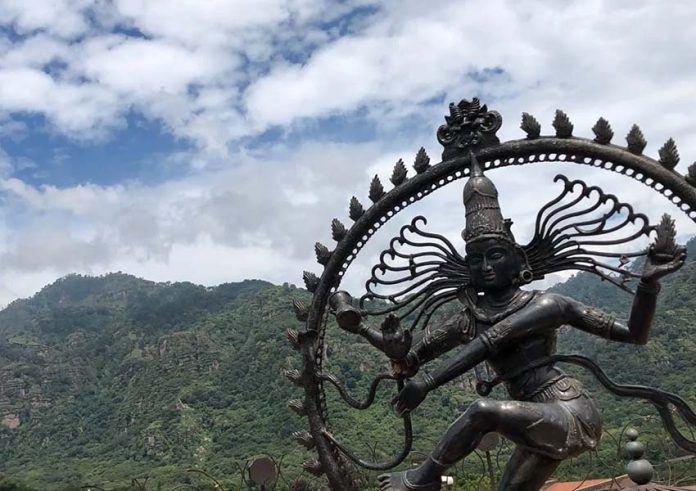
This town is said to be the birthplace of the pre-Hispanic god Quetzalcoatl. The landscape is still breathtaking, and the weather is temperate-to-warm all year. But its key attraction is Amatlán’s palpable energy, influencing droves of visitors each year to seek out its spiritual wonders.
Oscoy’s original intention was to build a simple ashram with 2 bare-bones dorms amid what is said to be one of the strongest energy centers on earth. A full-time plastic surgeon in Mexico City, Oscoy ventured to Amatlán on the weekends to lead New Age workshops in his newly minted ashram.
As more and more students came, more and more rooms had to be built to accommodate them. Oscoy soon realized that he needed to expand.
Thanks to several investors, what started as a small school quickly developed into a boutique hotel. He began traveling extensively to deepen his spiritual knowledge, taking regular trips to India, Tibet, parts of the Amazon and Native American reservations, immersing himself in master teachings.
Luis Ortiz, once an attorney, quit law to help his father run the center. (Photo: Courtesy)
He desperately wanted a reliable, trustworthy partner to assist with the expansion and so he asked his son, Luis Ortiz, if he’d be interested in the project.
“In the beginning, it was a complete mission impossible,” Ortiz laughs.
A trained lawyer and dedicated meditator himself since the age of 10, Ortiz quit law to study tourism when his father proposed this hotel partnership of sorts.
“Imagine, a plastic surgeon and a lawyer trying to run a hotel! There was a point where I almost quit.”
But business was exploding, and the father-son duo were determined to find their way. Oscoy was put in charge of the creative, holistic side so Ortiz could organize the business and operations elements.
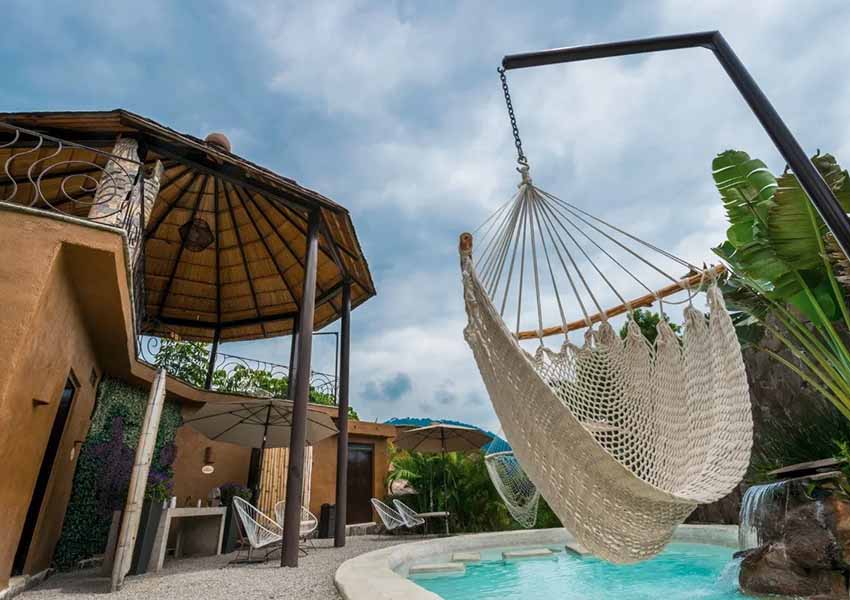
And thus, the small, modest ashram with two basic dorms has now become a luxury boutique hotel with 41 rooms, a holistic spa, a yoga studio, two temazcals and the only Chartres-style labyrinth in town. It has a human-sized healing gamma chamber and one of the biggest stupas (a Buddhist shrine) in the country.
Luis Oscoy, left, kneeling, during the blessing of the Hostal de la Luz as a Place of Peace by a representative of the Dalai Lama in 2006.
Does it all sound woo-woo? Well, each experience is vetted and approved by an in-house think tank of Western-trained medical doctors, Silicon Valley entrepreneurs and NASA employees to ensure some grounding in scientific research.
Needless to say, this hotel is unique. There are no sharp edges anywhere. Each brick used in its construction must measure 11×11 cm. About 90% of its staff are local to Amatlán, giving the experience a comfortable, familial feel.
The sacred, feng shui-inspired philosophy behind Hostal de la Luz is precisely what led the Dalai Lama himself to name it a World Peace Place in 2006.
There are so many curious healing modalities here that one could feasibly stay on the property for days and never feel the urge to leave.
Which is why I often find myself here. I love to escape the hustle and bustle of Mexico City in exchange for clear, starry nights and birdsong at sunrise.
Hostal de la Luz is a place where I recharge with morning yoga, an afternoon temazcal and an evening glass of wine with sweeping views of the mountains.
Hostal de la Luz’s ashram. (Photo: courtesy)
I’m guaranteed to return to the city feeling more creative and energized. If you’re looking for a nature break, consider gifting yourself a little getaway at Hostal de la Luz.
Bethany Platanella is a travel and lifestyle writer based in Mexico City. With her company, Active Escapes International, she plans and leads private and small-group active retreats. She loves Mexico’s local markets, Mexican slang, practicing yoga and fresh tortillas. Sign up for her (almost) weekly love letters or follow her Instagram account, @a.e.i.wellness.