Home Blog Page 95

Opinion: Could Mexico make America great again? An introduction

8
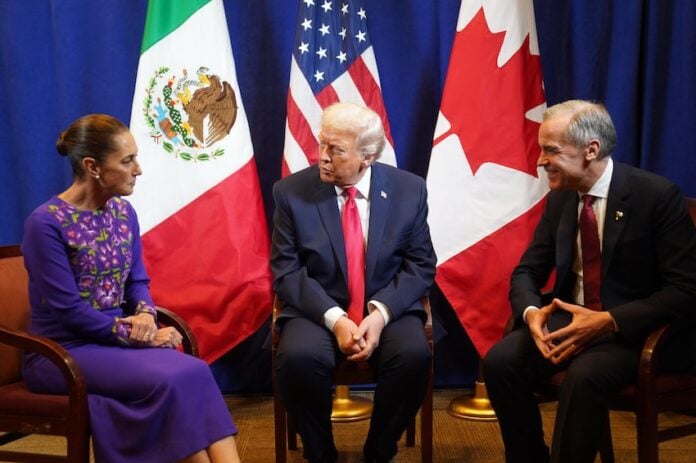
(Jessica Ramírez/Presidencia)

I’m often asked about the latest on tariffs or what’s going to happen next. Honestly? I don’t know. And if we’re all being honest: nobody knows — not even U.S. President Trump.

What we do have are some guardrails and foundations in U.S. policy that won’t change anytime soon. And those at least help us predict, in one way or another, the direction of economic and trade policy — and, more importantly, Mexico’s role in enabling the United States’ economic growth.

From where I stand, there are four big theoretical pillars shaping U.S. policy going forward.

First, the obvious one: the need to move away from China.

Twenty years ago, the U.S. share of global manufacturing value added was nearly triple China’s (26% vs. 9%). Fast forward to today, and China’s share is double that of the U.S. (31% vs. 15%). The global trading map flipped too: two decades ago, nearly 80% of the world traded more with the U.S. than with China. Today, 70% of the world trades more with China than with the U.S.! I won’t dig too deep into why this sets off every economic, political, and security alarm in Washington — I’ll let your imagination do the work.

Second, the re-industrialization of the American economy. This is a deep conversation about shifting the engine of growth from demand to supply — in other words, seeing Americans first as producers, not just consumers. For roughly four decades (think Reagan onward), success was measured by how much the average American could buy. That model required a trade-plus-geopolitics cocktail that pushed manufacturing to the cheapest locations possible while opening trade relationships around the globe. A.K.A. globalization.

The opportunity cost? Outsourced jobs, abandoned towns, and communities left behind — fertile ground for what economists politely call “deaths of despair.” Drugs of every kind filled the gap that good jobs used to occupy. And while buying a cheap T-shirt or a new refrigerator is nice, good jobs restore dignity, family stability and social fabric. Migration policy is part of this story too — but I’ll save that for another day.

Third, a shift toward fair trade rather than free trade.

Beyond the slogan, it means managed, controlled trade instead of an open-door model. The argument is straightforward: under the WTO framework, the U.S. has some of the lowest applied tariffs in the world — lower than Europe, Mexico, Canada, China, Brazil, you name it. Add to that the fact that the U.S. dollar can’t “adjust” trade deficits the way other currencies can, because it’s the world’s safe asset. In other words, classic trade theory simply doesn’t fit the United States. And when you throw in other countries’ industrial and tax policies — like VAT refunds for temporary imports — the feeling in Washington is that the playing field isn’t exactly level. Like it or not, the U.S. isn’t walking away from managed trade anytime soon.

Fourth and finally: national security. I won’t pretend to be a security expert (I know my limits), but everything above directly affects America’s ability to defend itself — from shipbuilding capacity, to critical minerals, to military readiness, to geopolitical leverage. It’s all connected.

So the next question becomes: What does the United States need to actually pull off these new policies — without collapsing under their weight?

The good news is that many of the answers lie with its closest allies and neighbors. Spoiler alert: Mexico plays a starring role.

I know most of us don’t have the time or attention span for long essays, so I’ll dive into Mexico’s opportunity in a separate text. For now, thanks for making it this far — see you soon.

Pedro Casas Alatriste is the Executive Vice President and CEO of the American Chamber of Commerce of Mexico (AmCham). Previously, he has been the Director of Research and Public Policy at the US-Mexico Foundation in Washington, D.C. and the Coordinator of International Affairs at the Business Coordinating Council (CCE). He has also served as a consultant to the Inter-American Development Bank. 
Mexico’s only Triple-Crown hiker launches 2,000-km Baja California Trail project

4
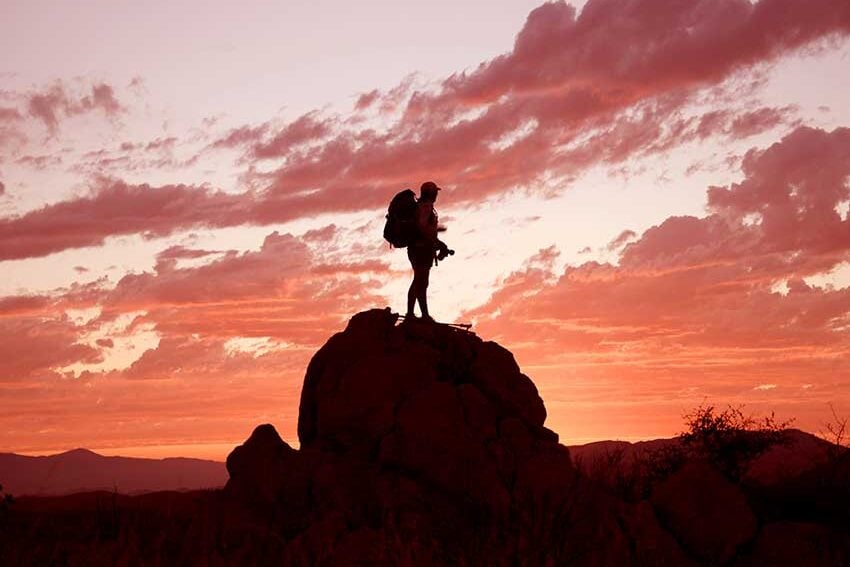
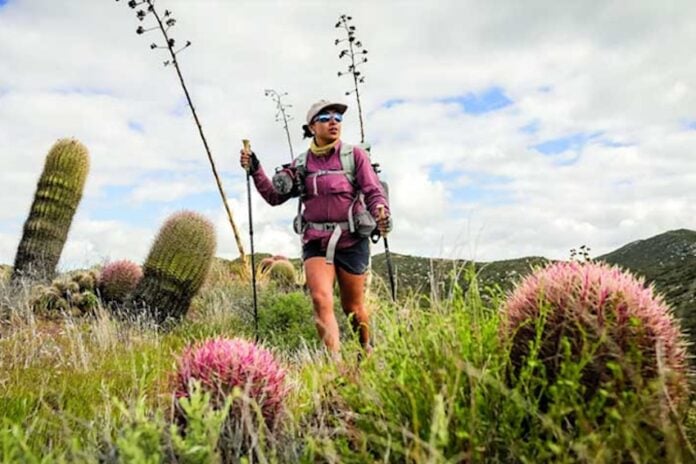
In October, Zelzín Aketzalli launched her 2,000-km hike down the Baja Peninsula from the Mexico-U.S. border at Tecate. She hopes to show off the very best of Northern Mexico on the trail. (Zelzín Aketzalli)

“I’ve been working on this project for seven years,” says Mexican long-distance thru-hiker Zelzín Aketzalli. “It will be a world-class trail running the entire length of Baja California: over 2,000 kilometers long. Those who walk it will discover that Baja is much more than beach, that it has snow-capped mountains, volcanoes, canyons, pine forests, salt flats and desert. In fact, it has plants, trees and animal life that exist nowhere else.”

The project Aketzalli is talking about will connect the Pacific Crest Trail with the new National Trail of Baja California, “empowering the region’s most iconic mountain ranges and its native communities,” she says.

En route through Baja California. Aketzalli hopes to produce a full-length documentary on her groundbreaking trek through Baja California. (Zelzín Aketzalli)

To create the trail, Aketzalli has been bushwhacking since October, starting from Tecate, visiting remote mountains, valleys, and canyons and plotting routes that will be interesting, challenging, and satisfying to future generations of long-distance hikers.

Although aligning the trail with Mexico’s historic Camino Real had been considered, Aketzalli’s chosen route follows mountain paths, avoiding highways while bringing hikers closer to Indigenous communities that can offer food, shelter and guidance.

Bushwhacking in BC

When she began her odyssey on October 19, she got a big send-off in Tecate by Baja California community leaders. Since then, she has been hard at work designing the trail.

“I spend a few days planning my strategy for the next section of the route, most nights camping in the mountains,” said Aketzalli. “And then I spend a few more days meeting and talking with the people in the nearby pueblitos and ranchos. This has become my new routine. It’s a different and deeply enriching way to experience thru-hiking.”

Simultaneously, Quetzal — her trail name — is recording footage for a feature-length documentary film on her creation of the Baja California trail.

“When people see what I’ve filmed,” she said, “they’re convinced I must have a camera operator marching along behind me, but I don’t. I’ve worked out techniques for getting the shot I need, which means I sometimes have to go up and down the same mountain five times.” 

Aketzalli is by profession an engineer and for years has applied her talents to the construction and maintenance of hiking trails, including the technically challenging Hanging Lake Trail in Glenwood Springs, Colorado.

Crisscrossing the US… on foot

Aketzalli hails from Mexico City, where she first took up long-distance mountain biking. In 2017, however, she decided to have a go as a hiker on the 4,270-kilometer U.S. Pacific Crest Trail. 

This, she realized immediately, was what she was meant to do. 

She went on to hike the Appalachian Trail (3,531 km) and the Continental Divide Trail (4,844 km), becoming the first — and so far only — Mexican to achieve the Triple Crown of U.S. hiking.

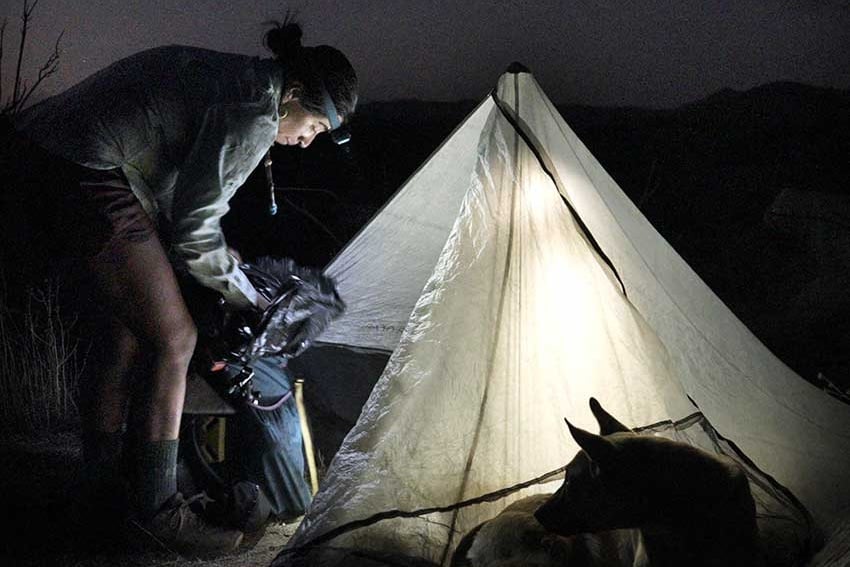
As her “helper” looks on, Zelzín sets up her tent in the mountains of Baja California. (Zelzín Aketzalli)

Today, Aketzalli offers courses in thru-hiking — meaning doing an entire trail in one go — and is fully committed to making long-distance trails a reality in Mexico. She estimates that her present trail reconnaissance will take at least another four months to complete.

Film festival winner

At the end of November, Aketzalli interrupted her Baja trek and flew to Guadalajara to attend a special short-film festival hosted by Cineforo UDG. Among the participants was the documentary “Zelzin, Huellas que Inspiran” (“Zelzin, Footprints that Inspire”). 

The film was shot on the Iztaccíhuatl volcano and its surrounding central Mexico landscapes. The documentary intertwines Aketzalli’s personal journey — growing up in a violent neighborhood in Mexico City — with her achievements in the natural world, to tell a story about resilience and empowerment.

“We won!” said Zelzin. “There were so many excellent entries in this festival… but we won! Making this cortometraje (short film) was difficult because at the same time, I was the protagonist, the producer and the director. For me, this film must be out there for all to see, just as the Baja Trail Project is getting underway.”

Aketzalli is now applying the experience she gained from producing her prize-winning short to filming her groundbreaking trek through the wilds of Baja California.

“It will be a full-length documentary on this most amazing peninsula,” she said, “but I’m definitely paying a heavy price for it. A thru-hiker’s backpack is usually very light, mostly containing food and water. Here in Baja, instead, I’m carrying all sorts of things you need to produce good cinema. I can’t believe I’m actually toting a tripod!”

What can future trekkers hope to see while following Aketzalli’s route through Baja California? For sure, they will be fascinated by the boojum tree, found almost exclusively in Baja’s Valle de los Cirios (Valley of the Candles).

Early 20th-century botanist Joseph Nelson Rose noted the boojum’s “grotesque, columnar form, rising improbably from the rocky soil,” and he compared its silhouette to a giant inverted carrot, highlighting its eccentricity among desert plants. For another botanist, Townsend Branegee, the boojum looks more like a candle (cirio), “unlike any other in the desert.”

According to the international nonprofit organization Wildcoast, Valle de los Cirios is globally unique. 

“There may be no other place that embodies the wild Pacific coastal landscapes of the Baja California peninsula,” it says on its website. “With some luck and a lot of patience, a visitor can catch glimpses of mule deer, kit foxes, bobcats, and stealthy mountain lions that wander among the giant cardon cactus and fantastical cirios, or boojum, trees.”

Gigantic rock-art murals

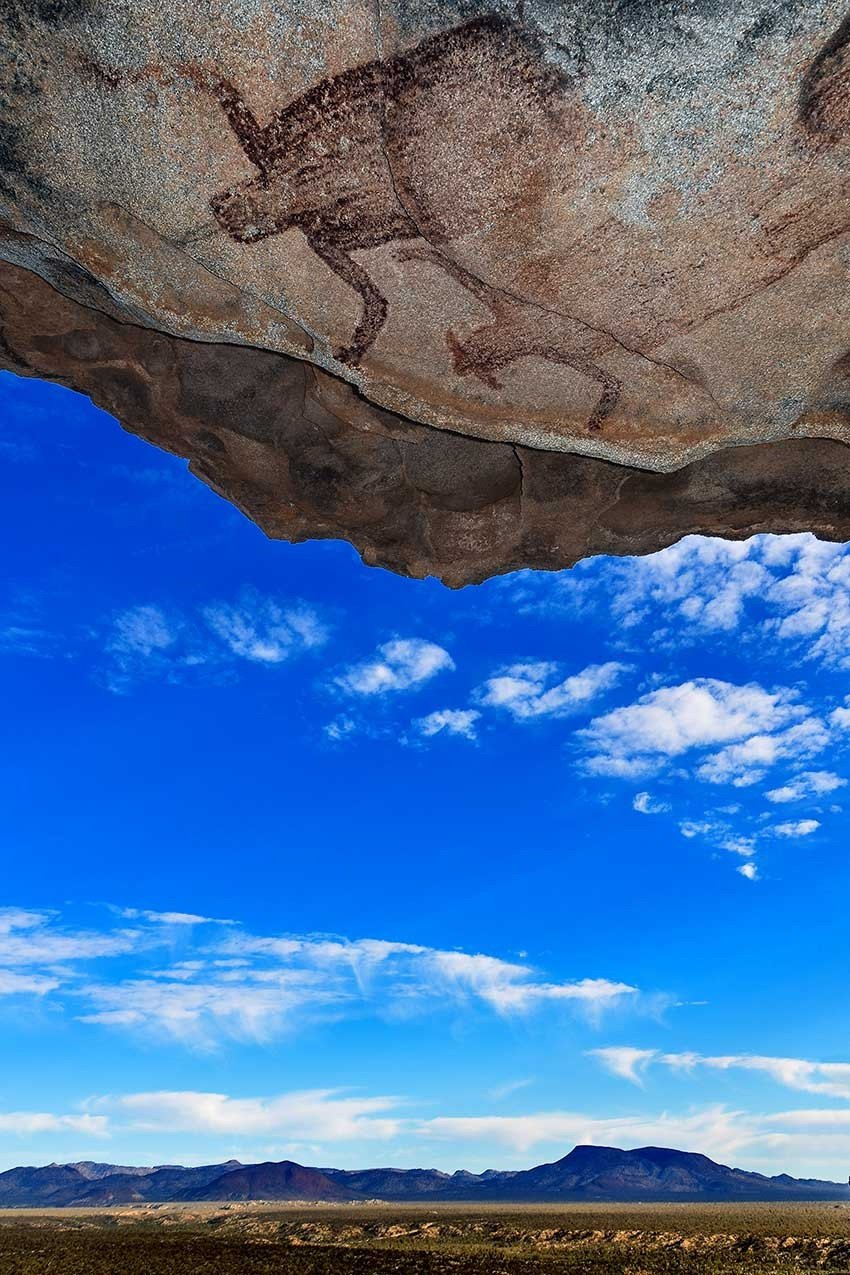
This pictograph on a cave ceiling in Sierra de San Francisco may be as many as 7,000 years old. (Carlos Lazcano)

For geologist Carlos Lazcano, the 120-kilometer stretch between the missions of San Ignacio and Santa Gertrudis is particularly impressive.  

“The canyons are spectacular, and the Sierra de San Francisco shelters ancient rock-art sites with gigantic murals, some over 10 meters wide.”

Another region on the planned trail recommended by Lazcano is Cataviña, a geological and ecological marvel which features “dramatic canyons of white granite hiding turquoise pools of water.”

Irresistible sands

And then there’s the Baja beach. It is so enticing that British schoolteacher Graham Mackintosh couldn’t stop following it. He stepped onto the beach in the 1980s, fell in love with it and then kept on walking — for 4,800 kilometers. To really appreciate those Baja sands, I suggest you read his book, “Into a Desert Place.”

To follow Zelzín Aketzalli’s progress down the Baja California peninsula, occasionally check her on Instagram at @zelzin_aketzalli.

John Pint has lived near Guadalajara, Jalisco, for more than 30 years and is the author of “A Guide to West Mexico’s Guachimontones and Surrounding Area” and co-author of “Outdoors in Western Mexico.” More of his writing can be found on his website.

New trail program to connect the Wixárika communities in Jalisco

0
Caminos Artesanales
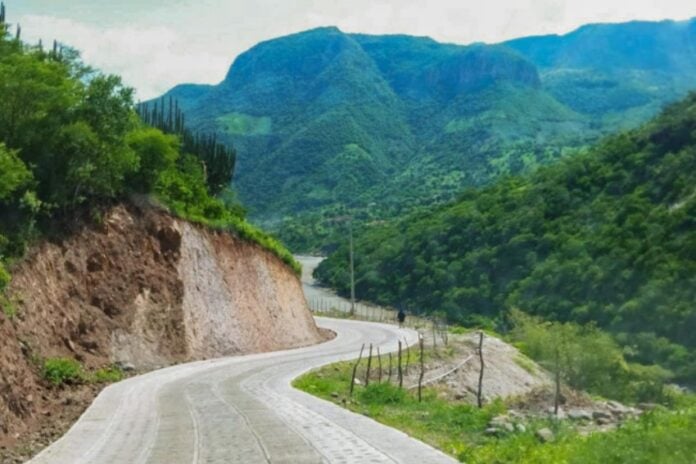
The new artisanal roads for Indigenous peoples are being built by the people who will use them. (Gobierno de Mexico)

The historically marginalized and isolated Indigenous Wixárika towns of Northern Jalisco,  will soon gain improved road connections, thanks to a program by Mexico’s Ministry of Infrastructure, Communications and Transportation (SICT). 

The program involves the construction of five roads to link 10 communities across the municipalities of Mezquitic and Tuxpan de Bolaños. It will require an investment of 159 million pesos (US $8.6 million).

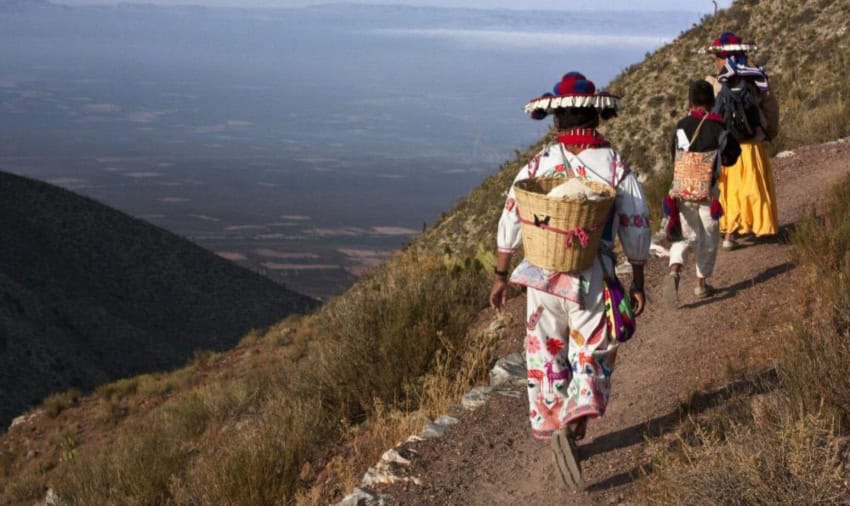
Wirárika peoples walking
Five new roads are being built in Northern Jalisco to connect Indigenous communities. (Ruta Wixárika).

Artisanal roads to connect Indigenous Wixárika

The agency explained that this initiative is part of a federal program dubbed the Artisanal Trails Program carried out by the National Institute of Indigenous Peoples (INPI), which seeks to connect Indigenous and highly marginalized communities through the rehabilitation of roads. 

The five rural roads in the northern part of the state will total 20.5 kilometers in length. The planned roads will be known as  Tezompa-Nueva Colonia, Cerro de la Puerta-Santa Catarina Cuescomatitlán, Cerro del Niño-San Miguel Huaixtita, Cerro del Pescado-Ocota de la Sierra and Bajío de las Gallinas-San Sebastián.

The federal government has named these roads “artisanal roads” as they connect rural and Indigenous communities and will be constructed primarily by the residents who benefit from them, with government resources provided to allow locals to manage the construction themselves. SICT will offer support of machinery for the more challenging sections.

As of August, the Artisanal Trails Program had rehabilitated 432 kilometers across 135 artisanal roads in 11 states. The program plan is to complete a total of 2,232 kilometers of artisanal trails across Mexico, representing an investment of 15.5 billion pesos (US $843 million) between 2025 and 2030.

Who are the Wixárika?

The Wixárika is an Indigenous community that lives in Northern Jalisco and in areas of the states of Nayarit, Durango, Zacatecas and San Luis Potosí. According to the Jalisco government, the highest density of the Wixárika community resides in its state, in the municipalities of Mezquitic, Bolaños and Huejuquilla. 

The Wixárika recently made headlines worldwide after a route through 20 sites that they consider sacred was recently added to UNESCO’s World Heritage List, becoming the first such recognition for a living Indigenous tradition in Latin America. The route, dubbed by UNESCO as The Wixárika Route through the Sacred Sites to Wirikuta, extends from west to northwest for more than 500 kilometers between the states of Jalisco, Nayarit, Durango, Zacatecas and San Luis Potosí.

Wixárika cosmology
Wixárika cosmology, as illustrated through traditional artwork. (Gobierno de Mexico)

The Wixárika people have managed to preserve their traditions largely due to the location of their communities: For centuries during Spanish colonization, they lived in inaccessible mountainous areas, which significantly contributed to the preservation of their culture.

With reports from Milenio, La Jornada, and El Informador

Gabriela Solis is a Mexican lawyer turned full-time writer. She was born and raised in Guadalajara and covers business, culture, lifestyle and travel for Mexico News Daily. You can follow her lifestyle blog Dunas y Palmeras.

Tariff package on Asian imports will protect 350,000 jobs: Monday’s mañanera recapped

1
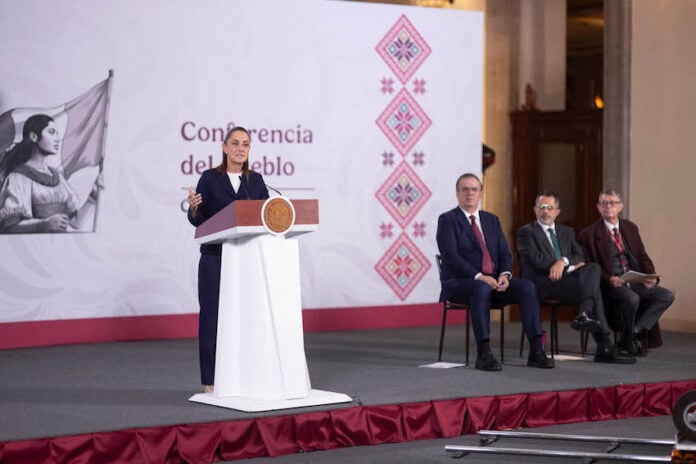
Cuauhtémoc, Ciudad de México. 15 de diciembre 2025. La presidenta constitucional de los Estados Unidos Mexicanos, la Doctora Claudia Sheinbaum Pardo en conferencia de prensa matutina en el salón de la Tesorería de Palacio Nacional. La acompañan: Marcelo Ebrard Casaubon, Secretario de Economía; Iván Escalante, Procurador Federal del Consumidor (Profeco) y Alfonso Suárez del Real, asesor político de la Coordinación de Comunicación Social.
The president also addressed the results of Chile's presidential election on Sunday, saying that she believes "it's a time of reflection for progressive movements in Latin America." (Gabriel Monroy/Presidencia)

The resurgence of the political right in Latin America and Mexico’s recently approved tariffs were among the issues spoken about at President Claudia Sheinbaum’s Monday morning press conference.

Here is a recap of the president’s Dec. 15 mañanera.

Sheinbaum: Shift to the right won’t happen in Mexico 

Citing the victory of José Antonio Kast in Chile’s presidential election on Sunday as well as the results of recent elections in Argentina and Bolivia, a reporter asked the president about the shift to the right of “some voters in Latin America.”

Sheinbaum responded that the situation in “each country” would need to be analyzed to determine why voters in some Latin American nations have recently supported right-wing candidates and parties in large numbers.

“Obviously, we want there to be more governments [that are] close to the people, but decisions must always be made democratically,” she added.

“In the case of Chile, it was a democratic vote. The people of Chile decided who they want to govern them,” said Sheinbaum, who congratulated Kast in a social media post.

She also said she believes that “it’s a time of reflection for progressive movements in Latin America,” a time to examine why “these circumstances” occur.

Sheinbaum subsequently said that she doesn’t believe there will be a shift to the right among Mexican voters, who supported both the current president and her predecessor in large numbers at the 2018 and 2024 presidential elections.

The reasons she cited for her belief were that “there is a lot of popular support for the government,” and the movement she leads is getting “results.”

Seeking to explain the high levels of support for her administration, Sheinbaum said that it is fulfilling its promises.

With regard to “results,” she cited the reduction in poverty and inequality that has been achieved in Mexico since former president Andrés Manuel López Obrador — the founder of the “fourth transformation” (4T) political movement — took office in late 2018.

“The majority of the Mexicans agree with the transformation that our country is going through,” said Sheinbaum, who now leads the 4T.

“And, in addition, there is unity here. Sometimes, when there isn’t unity in [political] movements, this reduction in support occurs. But not here. What we always seek here is unity in our movement and results,” she said.

“… And we’ll never abandon what we committed to or the vision that the government is there to serve the people. That’s why the government has a lot of popular support,” Sheinbaum said.

Ebrard talks new tariff package 

Economy Minister Marcelo Ebrard attended the mañanera to speak about the tariffs bill that was approved by Congress last week.

On Jan. 1, 2026, tariffs will be increased, or imposed for the first time, on more than 1,400 products from countries with which Mexico doesn’t have trade agreements, including China, South Korea and India. Products across more than a dozen sectors will be affected by the changes, including textiles, auto parts and cars.

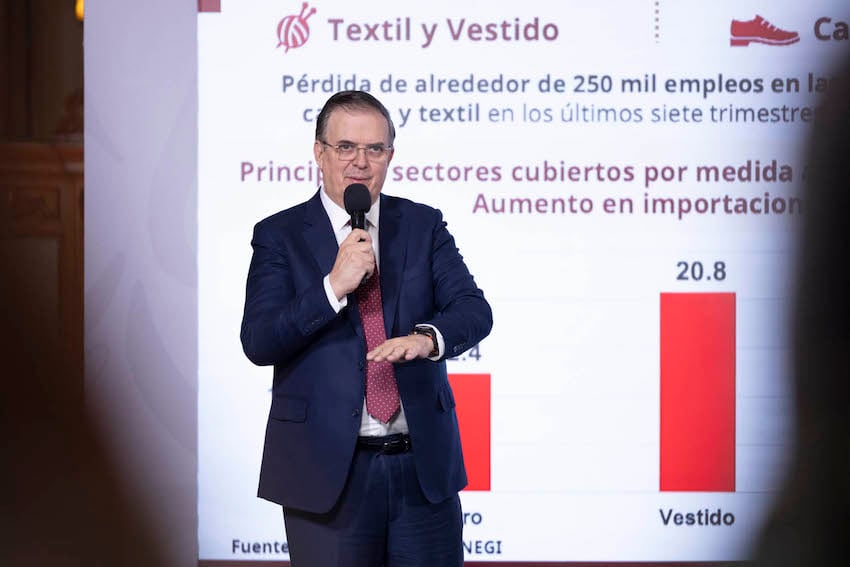
Ebrard said that the “objective” of the “tariff package” is, “in short,” to protect 350,000 jobs in Mexico. That number of jobs across sectors including textiles, clothing, footwear, steel and automotive are at risk of being lost within a year due to the influx of cheap exports, he said.

“When the playing field is uneven, you have to correct it, remedy that disadvantage or injustice,” Ebrard said on Monday. (Gabriel Monroy/Presidencia)

“We have the demand, the point of view, the insistence of the textile and clothing industry, the footwear industry, the steel industry, and now I’ll also mention the automotive industry [to increase tariffs] … not because they can’t compete, but because products are being brought in at prices below international reference levels,” Ebrard said.

“In other words, there isn’t a level playing field, because if there were, applying a tariff wouldn’t be justified. But when the playing field is uneven, you have to correct it, remedy that disadvantage or injustice,” he said.

Among other remarks, the economy minister said that:

  • Mexico is the world’s fifth-largest vehicle manufacturer and wants to maintain that position.
  • Mexico’s objective is to increase by 15% the “national content” in goods made in Mexico.
  • Mexico is not specifically targeting any one country with the tariffs, but rather imposing them on goods from all countries with which it doesn’t have trade agreements.
  • The tariffs will only add 0.2 percentage points to Mexico’s inflation rate.

Sheinbaum said last week that the tariffs weren’t specifically aimed at China, even though it seems they are. The East Asian economic powerhouse is easily the largest supplier to Mexico among the countries targeted and has a large trade surplus with Mexico. After the Mexican Congress’s approval of the tariffs, the Chinese government urged Mexico to “correct its wrong practices of unilateralism and protectionism” as soon as possible.

While the Mexican government says that the main purpose of the tariffs is to protect Mexican industry and jobs, the decision to impose them is widely seen as an effort to appease the United States ahead of next year’s UMSCA review.

Sheinbaum speaks to the pope 

Sheinbaum acknowledged that she spoke to Pope Leo XIV last Friday as the Day of the Virgin of Guadalupe was being celebrated in Mexico.

She said that the call was arranged through the Apostolic Nuncio to Mexico, Joseph Spiteri.

“He very kindly accepted the call, which we appreciate,” Sheinbaum said.

She said that Pope Leo — the first U.S.-born pope — is very interested in coming to Mexico, although she noted that no date has been set.

Sheinbaum said he is also interested in strengthening programs on which the Catholic Church collaborates with the federal government, such as the Sí al Desarme, Sí a la Paz (Yes to Disarmament, Yes to Peace) scheme.

“I spoke to him about this program and how important it is for the country,” she said.

“And he was very warm,” Sheinbaum said, adding that the pope sent his regards to the people of Mexico.

By Mexico News Daily chief staff writer Peter Davies (peter.davies@mexiconewsdaily.com)

Sheinbaum named PETA Latino’s person of the year for animal welfare agenda

2
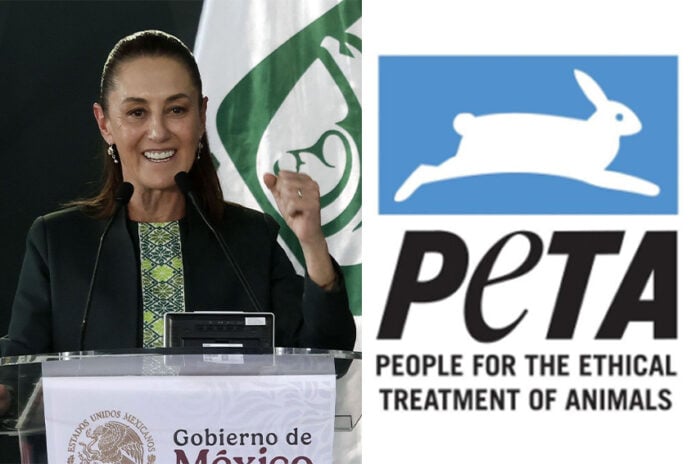
SHeinbaum adn PETA
People for the Ethical Treatment of Animals was enthusiastic in its praise for the Mexican president: “If more leaders followed President Sheinbaum’s compassionate steps and treated animal abuse as the serious threat to society that it is, the world would be a more humane place." (Cuartoscuro)

PETA Latino, the Latin American branch of the renowned animal rights organization People for the Ethical Treatment of Animals, has named President Claudia Sheinbaum as its first Person of the Year for her campaigns to support animal welfare, including her animal protection reforms in the Mexican Constitution. 

“If more leaders followed President Sheinbaum’s compassionate steps and treated animal abuse as the serious threat to society that it is, the world would be a more humane place,” said Alicia Aguayo, director of PETA Latino. “PETA Latino is grateful to have an ally like President Sheinbaum, and we look forward to celebrating many more victories for animals during her administration.”

dolphins
Sheinbaum’s leadership role in banning the exploitation of captive marine animals for entertainment was a major accomplishment cited by PETA. (Elizabeth Ruiz/Cuartoscuro)

During her first year in office, Sheinbaum shepherded through a law to prevent dolphins in Mexico from being forced to live in confined spaces and perform tricks for humans, as well as placed a ban on breeding dolphins in captivity for entertainment purposes. 

The Mexican Senate unanimously approved a nationwide ban on dolphin and other marine mammal shows in June, after a three-year legislative process that was sparked by public outrage over animal welfare violations. It resulted in the closure of Mexico’s dolphinariums.

A ban on bullfighting was also introduced in Mexico City in March, bringing an end to the torture and killing of bulls for the purpose of entertainment in bullrings. The legislation was approved by a 61-1 vote.

Michoacán followed suit by banning bullfighting across the state. The sport is now banned in six Mexican states.

Sheinbaum has also championed unprecedented constitutional reforms on animal welfare, which spurred a change in Mexico’s supreme law. Article 4 of the Constitution now states: “Animal abuse is prohibited. The Mexican State must guarantee the protection, proper treatment, conservation, and care of animals, as specified by the corresponding laws.”

“By prioritizing animal protection in the constitution, Sheinbaum has set a powerful example of a government that values ​​the lives and well-being of all individuals,” PETA said in a statement. “Her leadership shows that progress is not measured solely in human terms, because every animal is a being with its own life, feelings and relationships.” 

PETA, known for its aggressive activism, has taken credit for laying the groundwork for Sheinbaum’s reforms. “We have sparked waves of action, contributed to the closure of facilities that exploit animals, such as the Dolphinarium at the Barceló Hotel in Mexico, and mobilized tens of thousands of supporters against bullfighting,” it said in announcing the Person of the Year award.

With reports from Milenio

‘Checo’ Pérez is Tommy Hilfiger’s new global menswear ambassador

4
Cadillac driver Sergio Pérez with Tommy Hilfiger and wife Dee Hilfiger at the 2025 U.S. Open.
Cadillac driver Sergio "Checo" Pérez talks with Tommy Hilfiger and wife Dee Hilfiger at the 2025 U.S. Open. (@checofav11/X)

Tommy Hilfiger has named Sergio “Checo” Pérez as its new global menswear ambassador, reinforcing the brand’s commitment to Formula 1 and its connection to fashion, sport and pop culture.

The announcement, made in Amsterdam last week, marks a new stage in Tommy Hilfiger’s relationship with Formula 1, continuing a legacy that has included world-class sporting figures such as Lewis Hamilton, Rafael Nadal and Thierry Henry.

“We have long championed drivers’ freedom to express themselves through style and, as Formula 1 continues to embrace fashion and entertainment, its stars have become truly global figures,” Tommy Hilfiger said. 

The brand described Pérez as a global icon who embodies a relaxed, timeless and confident style, capable of inspiring new generations through his talent and authentic personality. 

Being a global menswear ambassador means that Checo becomes one of Tommy Hilfiger’s main male faces worldwide, starring in campaigns, public appearances and digital content associated with Tommy Hilfiger menswear. The collaboration includes sophisticated menswear collections, F1-inspired fanwear, refined designer watches, as well as the Mexican driver’s participation in global campaigns, digital content and exclusive brand events.

For Pérez, this new collaboration reinforces Tommy Hilfiger’s relevance beyond the track. 


View this post on Instagram


A post shared by Tommy Hilfiger (@tommyhilfiger)

“Tommy brought style to the paddock and gave drivers the confidence to show who they are away from the track. He has always been at the center of the action,” Pérez said.

Pérez returned to headlines after Cadillac’s Formula 1 Team announced the signing of Pérez and Valtteri Bottas to lead the team during its debut season in 2026, following his sudden firing from Red Bull Racing in 2024.

The Guadalajara-born driver said joining Cadillac is an “incredibly exciting new chapter” in his career. 

As a new Tommy Hilfiger ambassador, Pérez described his return to competition with the brand as an exciting new phase that he welcomes with enthusiasm and commitment, in line with his preparations for the upcoming sporting season.

Pérez, 35, started to kart competitively at age six. At just 21 years old, Pérez signed for the midfield Sauber team, making him the first Mexican to drive in F1 since Hector Rebaque, some 20 years earlier.

Organizers of the Mexican Grand Prix have pointed out that Checo is “very popular with Mexican fans,” with some 88% of Mexicans knowing who he is. He is also credited with reviving interest in Formula 1 among Mexicans.

With reports from Fashion Network and Carreras en Vivo

Peso dips below 18 to the dollar for the first time since July 2024

0
peso
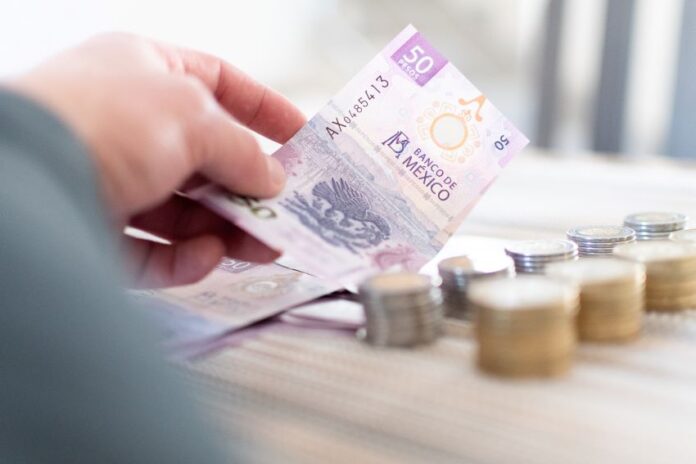
The peso has performed well compared to the greenback this year, remaining below 20 to the dollar since mid-April. (Shutterstock)

The Mexican peso traded at below 18 to the US dollar on Monday morning, its strongest position since July 2024.

After ending last week at just above 18 to the dollar, the peso appreciated slightly to reach 17.97 on Monday morning.

At 4:30 p.m. Mexico City time, the USD:MXN exchange rate was 17.99, according to Bloomberg.

The last time the peso traded at below 18 to the dollar was on July 23, 2024.

The peso has appreciated around 16% this year, after closing 2024 at 20.88 to the dollar, according to the Bank of Mexico.

Among the factors that have contributed to the significant appreciation of the peso in 2025 are the weakness of the US dollar, the Bank of Mexico’s still-high benchmark interest rate — even though it has declined by 275 basis points so far in 2025 — and strong foreign investment inflows.

The appreciation has occurred despite ongoing trade tensions with the United States, which in 2025 has imposed tariffs on a range of imports from Mexico, including steel, aluminum and light and heavy vehicles.

Analysts from the Monex financial group attributed the appreciation of the peso on Monday to the “continued decline” of the greenback.

Facade of Bank of Mexico building in Mexico City, done in a classical style of architecture with arches, pillars, and balconies at each upper floor window
The peso has appreciated around 16% this year, after closing 2024 at 20.88 to the dollar, according to the Bank of Mexico. (María Ruiz)

The value of the US dollar fell on Monday morning on the DXY index, which measures the greenback against a basket of foreign currencies, including the euro, the Japanese yen and the British pound.

Monex analysts also said that the peso benefited from the “resolution of tensions between Mexico and the United States thanks to the agreement that puts an end to a water dispute.”

The Mexican and U.S. governments announced on Friday that they had reached “an understanding on water management for the current cycle and the previous cycle’s water deficit under the 1944 Water Treaty.”

As part of the agreement, Mexico committed to begin transferring this week more than 200,000 acre-feet of water to the United States.

On Monday of last week, U.S. President Donald Trump threatened to impose an additional 5% tariff on imports from Mexico if the Mexican government didn’t immediately release a portion of the water it owes to the United States after failing to meet its treaty obligations in the 2020-25 cycle.

The appreciation of the peso on Monday morning comes ahead of the final monetary policy meeting of the Bank of Mexico (Banxico) board, which will convene this Thursday.

The Banxico board has cut its benchmark interest rate after each of its last 11 monetary policy meetings, including all seven held so far this year, and is widely expected to make a 12th successive cut this week. The key rate is currently set at 7.25%.

The United States Federal Reserve cut its key borrowing rate by 25 basis points last week, setting it at a 3.5%-3.75% range.

With reports from El Financiero and El Economista

1 year after becoming fully operational, the Maya Train is suffering major losses

18
maya train
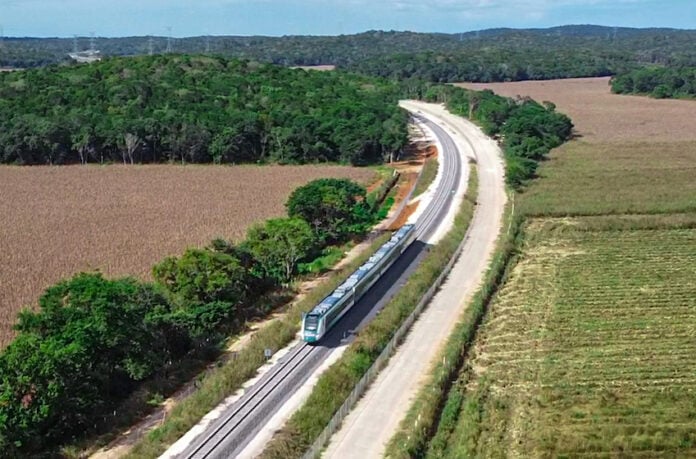
The Maya Train has been fully operational since last December and has been carrying passengers to a number of tourist destinations in southeastern Mexico for two years now. However, in the words of one analyst, it's "a losing project." (@TrenMayaMX/X)

One year after becoming fully operational, and two years after it was inaugurated, the Maya Train is hemorrhaging funds and is likely to require government support for up to 20 years before it becomes profitable.

During the first nine months of 2025, total Maya Train income covered a mere 12.6% of its operating expenses, with the remainder coming from government subsidies and resources from a public trust fund.

According to the company’s January-September financial statements, the Maya Train — with operating costs of 3.068 billion pesos (US $170.6 million) — received 3.345 billion pesos ($186 million) in public funding. During this time, it earned only 387 million pesos ($21.5 million) in ticket sales, souvenirs and other revenue streams.

“From a financial standpoint, this is a losing project,” Iberoamericana University professor Gerardo Herrera told the newspaper Reforma, adding that though passenger traffic is rising, it is not rising fast enough. 

“The government has no choice but to subsidize it since at the current rate it will take between 10 and 20 years to become profitable,” he said, pointing out that this could come at a cost of 25 billion pesos (nearly US $1.4 billion) over the next decade.

Railroad consultant Carlos Barreda told Reforma that the sustainability of the Maya Train subsidies is a concern, contrasting what he called “a high-cost, tourism-focused service” with the benefits of an urban transportation system that “generates real economic development in the community.” 

“Such economic benefits have not materialized,” he said.

Former President Andrés Manuel López Obrador inaugurated the Cancún-to-Campeche section of the Maya Train on Dec. 15, 2023, and the entire 1,554-kilometer-long railroad line was pronounced fully operational in December a year ago.

Four years and 1,554 kilometers later, the Maya Train is complete

Conceived as a mega-project that would benefit tourism, the railway was built at a cost of roughly 500 billion pesos (US $27.8 billion), nearly four times the original estimate. 

Also promoted as a project that would address the economic and social backwardness of southeastern Mexico, the train operated at a significant loss last year. Maya Train general director Óscar David Lozano reported that revenues in 2024 represented just 9.6% of operating costs, leaving the company US $133 million in the red.

Still, proponents urge patience, insisting that the financial success of the train hinges on freight operations that are set to begin either late next year or in 2027, even as critics continue to question the viability of the project and demand that the environmental damage be repaired

The train has experienced various mechanical failures, delays, air conditioning problems and unexpected stops due to insufficient operational testing.

Initial reviews have also highlighted the inconveniences. Most Maya Train stations are located far outside the main towns and tourist areas, requiring additional time and cost for a shuttle or taxi to reach the final destination.

Bus services have proven to be less costly, more reliable and more convenient, particularly since bus stations are located in city centers.

With reports from Reforma, El Imparcial and Serendipia

Is the Gulf of California actually Mexican? Naval study says it should be

6
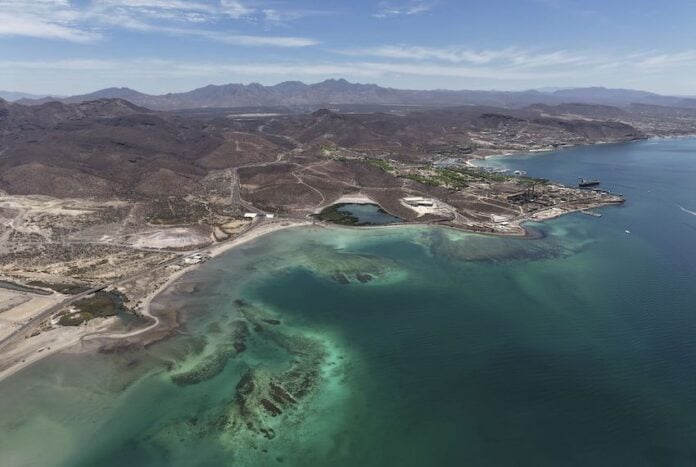
Aerial view of Mexico's rugged coastline with clear turquoise waters and arid mountain terrain in the background
Mexico only has internationally recognized control in the Gulf of California 12 nautical miles from either shore and the upper one-third of the body of water. (Presidencia/Cuartoscuro)

The map might lend the impression that the Gulf of California is Mexican territory, but that’s not the case.

A paper published by Mexico’s Center for Advanced Naval Studies (CESNAV) proposes rectifying the situation in order to exercise full sovereignty over “the world’s aquarium” in the name of national security.

fishers in alto golfo
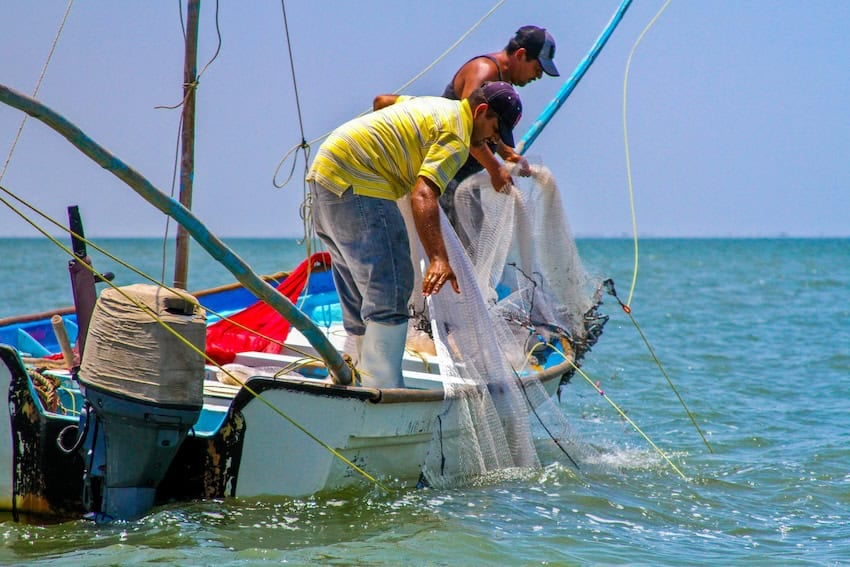
People may consider the Gulf of California to be as Mexican as mariachis and nopales, but legally, that mostly applies to the northern third of the Gulf, the “Alto Golfo,” where Indigenous fishermen have traditionally made a living. (Cuartoscuro)

In an essay titled “Geostrategic Importance of the Gulf of California: A Vision Towards the Historic Bay,” Naval Captain Carlos Alejandro Sans Aguilar suggests petitioning the International Maritime Organization to reclassify that area as a “historic bay,” a designation that would allow Mexico to treat it like land territory and enforce its own laws.

A “historic bay” is a body of water that a coastal nation claims as its internal waters, despite not meeting standard geographical criteria. The claim is based on the nation having traditionally and openly exercised continuous, long-term control with the implicit or explicit acquiescence of other nations.

The entire Gulf — an area of ​​approximately 50,000 square nautical miles — is considered a marginal sea of the Pacific Ocean and Mexico’s national waters only extend 12 nautical miles from its coastlines on either side of the 700-mile-long body of water.

The upper part of the Gulf — el Alto Golfo de California — is the only section designated as internal waters, meaning Mexico formally has control of only the northern third of the Gulf.

According to the U.N. Convention on the Law of the Sea (UNCLOS), the central and southern thirds are international waters. 

The rationale for the author’s request is to rid the Gulf of foreign powers as well as organized crime gangs that use the waters for illegal activities, such as piracy, poaching, human trafficking and drug trafficking.

The essay argues that the current condition “undermines Mexico’s sovereignty and national security due to the implicit freedom of navigation and overflight.” The legal status of the southern two-thirds of that part of the sea “allows various socioeconomic activities to be carried out, without the Mexican State being able to do anything about it.”

One recent incident cited by advocates for this change is a U.S. spy flight that took place on Feb. 2.

A U.S. Air Force plane entered the Gulf from the Pacific Ocean and flew north about 370 miles before turning around and flying south along the same track.

Pentagon’s 18 spy plane missions near US-Mexico border spark surveillance concerns

In March, Deputy Gustavo de Hoyos presented legislation to reform Mexico’s Federal Law of the Sea and to petition for the reclassification of the Gulf as “a historic bay or inland sea,” while saying “the lack of absolute control represents a strategic vulnerability for Mexico’s foreign policy.”

“Mexico meets the standards of international law to justify this reclassification, as it has exercised effective sovereignty over the region for centuries, without objection from the international community,” the bill states, “and consolidating sovereignty over the Gulf will strengthen national security, the protection of maritime resources, and geopolitical stability in the region.”

With reports from El Sol de México and Infobae

Mexico, US reach agreement on water deliveries

5
The outcome of the new bilateral agreement allows Mexico more time to make its required water deliveries, though President Sheinbaum emphasized on Monday that Mexico is not handing over water that "we don't have."
The outcome of the new bilateral agreement allows Mexico more time to make its required water deliveries, though President Sheinbaum emphasized on Monday that Mexico is not handing over water that "we don't have." (@conagua_mx/X)

Mexico has committed to releasing more than 200,000 acre-feet of water to the United States starting this week, averting the threatened imposition of an additional U.S. tariff on Mexican goods.

The Mexican and U.S. governments announced on Friday that they had “reached an understanding on water management for the current cycle and the previous cycle’s water deficit under the 1944 Water Treaty.”

The third of five points in a “Mexico-U.S. Joint Communiqué on Water Distribution” states that “Mexico intends to release 202,000 acre-feet of water to the United States with deliveries expected to commence the week of December 15, 2025.”

It was unclear when the delivery of the 202,000 acre-feet of water would be completed.

The 2020-25 cycle of the bilateral 1944 Water Treaty concluded in late October with Mexico still owing the U.S. just over 865,000 acre-feet of water, an amount equivalent to almost 50% of the 1.75 million acre-feet of water it is required to send across the northern border every five years from six tributaries of the Rio Grande.

Mexico will need to make up the shortfall in the 2025-30 cycle of the treaty. Its capacity to meet its treaty obligations in the past five-year cycle was hindered by drought conditions that were particularly severe in the north of the country.

The understanding the Mexican and U.S. governments reached on Friday came four days after U.S. President Donald Trump noted in a social media post that “Mexico still owes the U.S over 800,000 acre-feet of water for failing to comply with our Treaty over the past five years.”

US blames Texas crop losses on Mexico’s missed water deliveries

He wrote that “the U.S needs Mexico to release 200,000 acre-feet of water before December 31st,” before making one of his trademark tariff threats.

“As of now, Mexico is not responding, and it is very unfair to our U.S. Farmers who deserve this much needed water. That is why I have authorized documentation to impose a 5% Tariff on Mexico if this water isn’t released, IMMEDIATELY,” wrote Trump, whose administration has already imposed tariffs on a range of Mexican products.

After the tariff threat, Mexican officials engaged with Trump administration representatives in a series of meetings.

In a statement, Mexico’s Ministry of Foreign Affairs (SRE) said that “in recent weeks, both countries have worked intensively and in coordination to establish a technical roadmap that improves management of the current [treaty] cycle and addresses the deficit from the previous cycle.”

In the same statement, which includes the text of the Joint Communiqué, the SRE said that “Mexico reached an agreement with the United States to strengthen water management in the Rio Grande basin under the 1944 Water Treaty.”

“The Government of Mexico emphasizes that it has not violated any of its provisions,” the SRE said, adding that “during a period marked by an extraordinary and unprecedented drought that has affected users in both countries, Mexico has made additional deliveries, always in accordance with the Treaty, water availability, and the operational and infrastructure limitations of the region.”

“… The actions taken over the past year demonstrate that Mexico is meeting its obligations according to actual water availability, without affecting the human right to water and food production, and will continue to do so under the Treaty and through binational cooperation,” the ministry said.

For her part, U.S. Agriculture Secretary Brooke Rollins portrayed Mexico’s commitment to promptly begin transferring 202,000 acre-feet of water to the U.S. as a significant win for American farmers.

Secretary Brooke Rollins during a November agribusiness trade mission to Mexico
The 1944 Water Treaty was among Secretary Brooke Rollins’ priority issues during a November agribusiness trade mission to Mexico City and Chiapas. (@SecRollins/X)

“President Trump continues to put American farmers first and is finally holding our international partners accountable to their obligations and commitments. Once again, America is being treated fairly,” she said.

Farmers across South Texas have been reeling from the uncertainty caused by the lack of water. Now they can expect the resources promised to them, thanks to President Trump’s leadership,” Rollins said.

She thanked Mexico “for their willingness to abide by the treaty and return to good standing with their past obligations,” but added that:

“President Trump has been very clear: if Mexico continues to violate its commitments, the United States reserves the right and will impose 5% tariffs on Mexican products.”

Bilateral water negotiations are ongoing 

The Mexico-U.S. Joint Communiqué also states that “both countries acknowledge the critical importance of water sharing obligations under the 1944 Treaty and their impact on our citizens, and reaffirm the need to increase engagement to improve timely management of water.”

It says that “a series of actions to meet the treaty obligations have been reviewed, including timely repayment of the outstanding deficit from the previous water cycle, in accordance to the 1944 Water Treaty.”

“The two governments are in negotiations and intend to finalize the plan by January 31, 2026,” the communiqué adds.

The fifth and final point of the communiqué reads:

“Both countries concur on the importance of continuing to work cooperatively within the framework of the 1944 Water Treaty and the CILA/IBWC. In the event of noncompliance, each country can act sovereignly, in accordance to its national interests, subject to its international treaty obligations.”

The acronyms CILA (Spanish) and IBWC refer to the International Boundary and Water Commission, a 136-year-old body that is responsible for applying the boundary and water treaties between the United States and Mexico and settling differences that may arise in their application.

Sheinbaum: Water deliveries to US won’t adversely affect Mexico

At her morning press conference on Monday, President Claudia Sheinbaum told reporters that Mexico is not handing over water that “we don’t have” or whose delivery to the U.S. will affect availability for human consumption and agricultural purposes.

The president of Mexico’s National Agriculture Council, Jorge Esteve, has raised concerns about the risk water deliveries to the U.S. pose to water availability for human consumption and agriculture in Mexico.

Sheinbaum emphasized that Mexico is not delivering more water than is required under the terms of the 1944 treaty.

Sheinbaum indicated that the delivery of the 202,000 acre-feet of water to the U.S. won’t be completed until next year, as she said it wasn’t possible to transfer such a quantity of water by Dec. 31, the deadline set by Trump in his social media post.

“An agreement was reached to deliver it in more time,” she said.

Sheinbaum also said that Mexican officials had pointed out to their U.S. counterparts that Mexico’s failure to meet its treaty obligations during the previous five-year cycle wasn’t due to a lack of will but rather a lack of rain.

Mexico News Daily