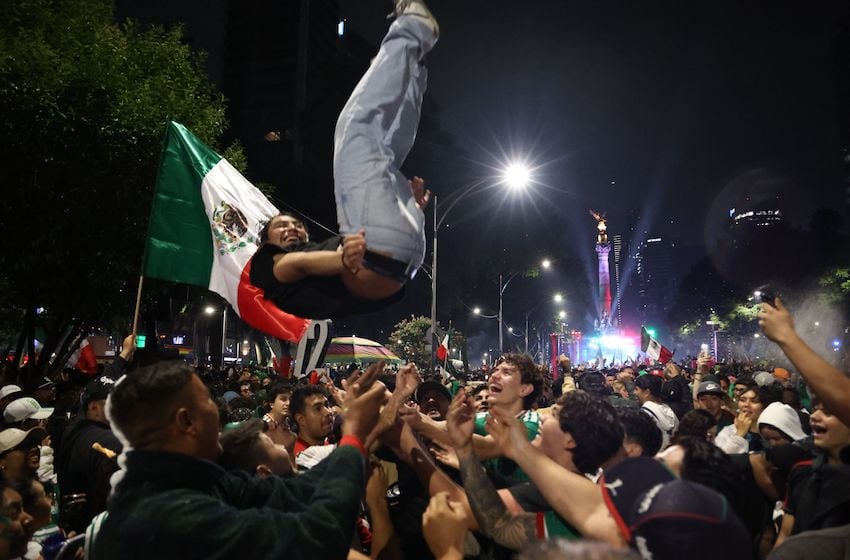
This week in Mexico, soccer euphoria and geopolitical tension shared the front pages in equal measure. On Wednesday, beloved Mexican rock band Maná drew tens of thousands to a free concert in Guadalajara, with proceeds channeled toward reforestation projects in western Jalisco. Less than 24 hours later, El Tri delivered an even bigger jolt of national joy, defeating South Korea to become the first team to punch its ticket to the knockout round of the 2026 FIFA World Cup.
The tournament now reaches a historic milestone: on Saturday, June 20, Tunisia and Japan face off in Monterrey in what FIFA has confirmed is the global showpiece’s 1,000th match played. Meanwhile, back in the corridors of power, U.S. Vice President JD Vance’s remarks about reserving the right to military action in Mexico kept diplomats and analysts on edge all week long.
Didn’t have time to catch this week’s top stories? Here’s what you missed.
Homicides in May were at their lowest in 11 years
On Tuesday, National Public Security System chief Marcela Figueroa presented preliminary data showing an average of 47.3 homicides per day across Mexico in May — a 27.6% drop compared to May 2025 and the lowest monthly figure recorded since President Sheinbaum took office in October 2024. Officials also noted it was the least violent May since 2015.
The picture across the full January-May 2026 period was similarly encouraging: an average of 50.4 homicides per day, down 29.8% year-on-year, with murders declining in 28 of Mexico’s 32 states. San Luis Potosí led the way with an 81% reduction. Guanajuato remained the most violent state with 668 homicides — 8.8% of the national total — followed by Baja California, Chihuahua and Sinaloa. Security Minister Omar García Harfuch added that authorities have arrested more than 56,000 people for high-impact crimes, dismantled 2,407 drug laboratories and seized 419 tonnes of narcotics since Sheinbaum took office, along with nearly 1,500 extortion-related arrests since last July.
Vance doubles down on military threat
The week’s most charged diplomatic moment came when a clip from U.S. Vice President JD Vance’s interview with N+ Univision’s Ilia Calderón was released Wednesday.
Asked directly whether the U.S. would respect President Sheinbaum’s “red line” against military operations on Mexican soil, Vance declined to commit: “We would take military action if we feel like we have to to protect our people. We don’t want to do that unless we’re working with the government of Mexico, but we have to reserve the right.” The remarks came the same day President Trump, speaking at the G7 Summit in France, declared that the U.S. would now shift its cartel focus from sea operations to land — and repeated his description of Mexico as a country where “the cartels run” things, though he called Sheinbaum “a very good woman.”

¿Qué tan posible es una invasión de Estados Unidos a México para atacar al crimen organizado? JD Vance le responde a Ilia Calderón en una entrevista especial.
Puedes ver la entrevista completa en ViX y nuestro canal de YouTube. Cada domingo estrenamos episodio de “Esta Semana”,… pic.twitter.com/cM4Ov3hh2Z
— N+ UNIVISION (@nmasunivision) June 17, 2026
Adding a further wrinkle, U.S. Ambassador Ronald Johnson posted on X that the United States has in fact transferred 313 wanted criminals to Mexico since Trump’s return to the White House — directly contradicting the Mexican Foreign Ministry’s May assertion that not a single one of Mexico’s 269 extradition requests had been honored. It remains unclear whether any of the 313 cases cited by Johnson overlap with Mexico’s formal extradition list, and the Foreign Affairs Ministry has not confirmed the figures. Sheinbaum, for her part, told Thursday’s press conference that Trump is “not well-informed” and reaffirmed her confidence that Mexico’s security results would forestall any unilateral U.S. action.
Sheinbaum to meet next week with the King of Spain
On a warmer diplomatic front, President Sheinbaum confirmed this week that she is expected to meet with Spain’s King Felipe VI on June 25 at the National Palace, when the Spanish monarch visits Mexico for the World Cup. The encounter marks another step in the gradual warming of Mexico-Spain relations after a prolonged diplomatic chill. It also arrives on the heels of a June 2 announcement in which both countries pledged to double bilateral trade and expand mutual investment by 50% before 2030, under the framework of the Modernized Global Agreement between Mexico and the European Union.
That investment ambition is being backed by concrete financial muscle. Spanish banking giant BBVA this week unveiled its “Smartshoring Mexico” initiative — a new service designed to help Spanish companies establish and scale operations in the Mexican market, with services ranging from preferential foreign-currency accounts to connections with local legal, tax and accounting firms. In 2025 alone, BBVA supported more than 3,400 Spanish companies expanding into Mexico, where the bank counts more than 30 million customers and holds a 25% share of the loan market.
Mexico slips in global competitiveness ranking
Switzerland’s Institute for Management Development (IMD) released its annual World Competitiveness Yearbook this week, and Mexico fell seven places to 62nd among 70 nations — a 12-spot decline since 2019.
The country posted declines across all four IMD pillars: economic performance (now 41st), business efficiency (57th), government efficiency (67th) and infrastructure (64th). The IMD attributed the slide primarily to institutional inefficiency, judicial uncertainty and a deterioration in public finances. Mexico’s strongest suit remains its labor market — ranked 12th globally — but that advantage is increasingly offset by governance deficiencies. Mexico now trails Chile (43rd), Argentina (58th), Colombia (59th) and Peru (60th) among Latin American nations.
World Cup numbers: Big on spirit, mixed on receipts
The tournament’s economic scorecard for Mexico is still to be determined. Hotel occupancy across Mexico’s three host cities is reportedly short of projections, with Mexico City hovering around 65%, Monterrey at roughly 60% and Guadalajara at barely 50% — far below the 80% benchmark the industry had targeted. The Mexican Employers’ Confederation cited structural problems including traffic congestion, transport saturation and overdependence on informal employment as factors dampening the anticipated windfall from 5.5 million expected visitors and a government-projected 60-billion-peso economic boost.
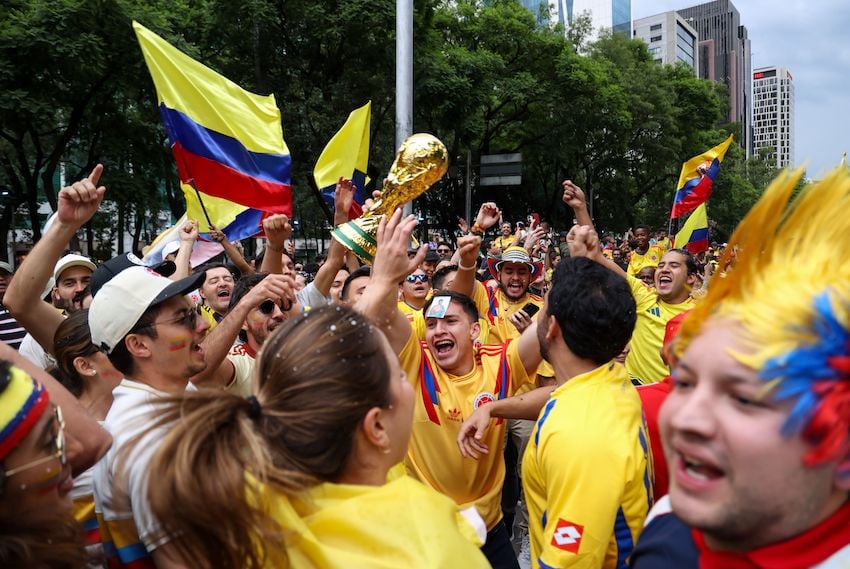
Mexico City did, however, bank an estimated $70 million boost during the first World Cup weekend, driven heavily by food, drink and entertainment spending. Indeed, the fan experience on the streets has been anything but muted. On Tuesday, thousands of Colombian fans descended on the Paseo de la Reforma and turned the Angel of Independence into a sea of yellow ahead of Colombia’s opener against Uzbekistan at the Azteca. ESPN estimated close to 10,000 fans gathered at El Ángel, with one Colombian visitor summing up the mood: “We’ve found ourselves in an incredible country. Wherever we go, we feel the love from Mexicans to Colombians.”
Mexico’s packed fan fests prove you don’t need a stadium seat to celebrate
One security incident cut through the festive atmosphere: Mexico’s military shot down a drone that was flying over the South Korean national soccer team, raising concerns about security protocols around visiting squads. Authorities confirmed the drone was neutralized without injury to any players or staff, and an investigation was opened.
Ancient Maya Calendar unearthed in Campeche
On the cultural front, archaeologists announced a remarkable discovery this week: an ancient monument in Campeche bearing the region’s oldest known Maya calendar date, pushing back the documented record of Maya calendrical inscription in the area and shedding new light on the civilization’s early astronomical and ritual practices.
Researchers said the find adds a significant piece to the ongoing effort to understand how the Classic Maya civilization developed across the Yucatán Peninsula.
MND’s inaugural healthcare survey: A resounding thumbs-up from foreign patients
Mexico News Daily this week published the results of its inaugural Mexico Healthcare Experience Survey, drawing on responses from 714 expat and foreign-resident patients.
The headline finding: 92.9% of respondents rated the quality of private healthcare they received in Mexico as “excellent” or “good,” with 63.1% saying it was superior to healthcare in their home country. More than 82% found it cheaper than back home, and 95.6% described access as “very easy” or “easy.” The most commonly used services were dental care (83.5% of respondents), blood work (82.5%) and general practitioner consultations (76.6%). The single most common answer to what would improve the experience? “Nothing — I am genuinely satisfied,” cited by 35.7% of respondents.
The results of our inaugural MND Mexico Healthcare Experience Survey™
Good news in brief
-
🦆 A duck named Merlin has become El Tri’s unofficial feathered mascot at the World Cup, delighting fans across Mexico.
-
⚡ The CFE announced its goal of powering 99.9% of Mexico by 2030.
-
🐢 A record 34 million olive ridley sea turtles hatched along the Oaxaca coast, marking an extraordinary conservation milestone.
-
🥐 Mexico City’s beloved Panadería Rosetta in Roma Norte won a coveted Paris-based pastry award, cementing its status as one of Latin America’s finest bakeries.
-
🚴 Mexican cycling star Isaac del Toro notched another win ahead of his Tour de France debut, raising hopes for a historic Mexican performance at cycling’s greatest race.
-
🌾 Bread giant Bimbo’s regenerative farmland now surpasses half a million hectares, as the company pushes toward 100% sustainability across its supply chain.
Mexico News Daily