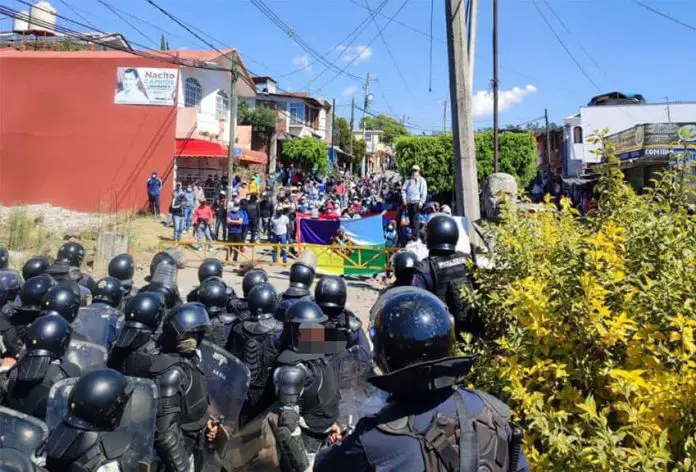
Teachers union members face off with police in Caltzontzin last Tuesday near the railroad tracks. Twitter @SSeguridad_Mich
National Guardsmen and state police are protecting train tracks in Michoacán after teachers belonging to the militant CNTE teachers union threatened to block the tracks near Uruapan on Monday.
The teachers, who are demanding that indigenous educator Joaquín Lázaro Márquez be appointed director of indigenous education, were urged to meet in Caltzontzin — on the outskirts of Uruapan — at 10 a.m. on Monday to burn vehicles and block the tracks, the newspaper Milenio reported.
They also planned to block the port of Lázaro Cárdenas and take over bus terminals in Zitácuaro and Morelia, the newspaper said.
Also on Monday, teacher college students staged their own protest by hijacking at least five buses on the Morelia-Pátzcuaro highway, using them as blockades to halt traffic for two hours.
Lázaro Márquez warned that the situation could deteriorate quickly. “If there is no favorable response, it’s going to get ugly … it’s going to get very ugly and I wouldn’t want that to happen,” he said, warning that if the government imposes its own choice for director Uruapan could turn into “a war zone.”
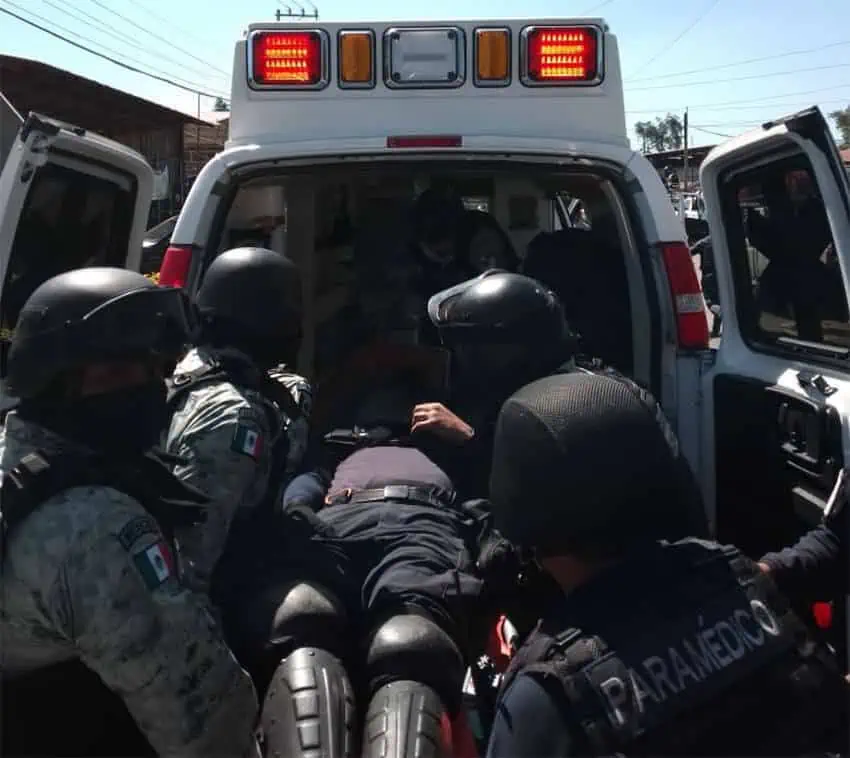
A state police officer is loaded into an ambulance after the confrontation on February 1. Twitter @SSeguridad_Mich
Lázaro said he had won the right to the post. “Since 1994 we’ve seen the amount of … corruption that existed when the directors of education were directly appointed. Then one day we decided that we would choose. Among several candidates we voted for the [one with the] best project, and in this case mine won,” he said.
Lázaro is held in high esteem in the indigenous community of Michoacán having dedicated 32 years to indigenous education, the newspaper reported. He is currently working on a project to translate the Bible from Spanish to Purépecha.
He said knowledge of Purépecha was a prerequisite for any director of indigenous education.
The teachers have also been demanding the payment of wages, consultation before any changes to pensions and jobs to be automatically awarded to teachers who have completed their training, a perennial demand by teaching students and the dissident CNTE union.
Governor Alfredo Ramírez Bedolla had appointed lawyer David Robles to be director of indigenous education, but he resigned after last week’s protests. Subsequent negotiations with the protesters broke down.
About 400 protesters from the radical wing of the CNTE union, Poder de Base (Power Base), attempted to block the tracks on February 1. At least 11 police and National Guardsmen were hurt, two of whom were seriously injured.
Blockades are a common tactic for dissatisfied teachers and teachers-to-be in Michoacán and other states: members of the CNTE blocked tracks for 91 days last year, costing businesses an estimated 50 million pesos per day (US $2.5 million at the exchange rate at the time).
The runaway truck was brought to a halt when it collided with a food stand.
The mayor of Acapulco has defended protesting students who pushed a semi-trailer toward National Guardsmen on Friday, but her defense is a novel one: there was nobody driving the vehicle and it was in neutral.
The students from the Ayotzinapa teacher training college — the school attended by the 43 young men who disappeared in Iguala, Guerrero, in 2014 — set the vehicle’s transmission in neutral and pushed it toward Guardsmen at the Palo Blanco toll plaza on the Autopista del Sol.
Traveling on a downhill slope, the truck steadily picked up speed, flew through a toll booth lane and crashed into a food stand. No one was injured.
At least 15 Guardsmen and 17 police were wounded in adjacent clashes at a toll plaza near Chilpancingo on the same highway, which runs between Mexico City and Acapulco.
Acapulco Mayor Abelina López said the defense of the students was legally sound.
“In strictly legal terms, the trailer was driving in neutral without a driver. There is no one to accuse because there is no evidence of who caused it … if an individual had been behind the wheel and that individual had been arrested, he could now be charged with attempted murder,” she said.
López added that the protesters should be shown leniency and justified their animosity toward authorities. “While various sectors and political actors call for … repression against the social movement, I believe in the right to protest and I ask for dialogue as the only solution … They are not criminals; there is a cause, there is pain … They must be listened to before being shouted at.”
She added that violence was part of the character of people from Guerrero. “We can not forget … our origins. To be from Guerrero is not to be just anyone,” she said.
The students have been occupying toll plazas at least twice a week for six years, the newspaper El Financiero reported. Security forces stopped them from doing so for the first time on Friday after the Senate passed a law that punishes the occupation of toll plazas with up to seven years’ imprisonment.
Ten bodies wrapped in blankets and tape were found on a street in Fresnillo on Saturday.
At least 18 homicides were recorded in Zacatecas on Saturday, the highest daily count for murders for any state so far this year.
Ten bodies were found on the street in Fresnillo, six more were discovered in a warehouse in General Pánfilo Natera and murders were perpetrated in at least two other municipalities.
Criminal groups are believed responsible for most if not all the homicides. The Jalisco New Generation Cartel and the Sinaloa Cartel are engaged in a turf war in Zacatecas, situated on a drug trafficking route between Pacific coast ports and Mexico’s northeastern border with the United States.
Residents of a community on the eastern side of Fresnillo – one of Mexico’s most violent cities – discovered 10 bodies wrapped in blankets and electrical tape early Saturday morning. The corpses were dumped on a road by armed men in pickup trucks, according to witnesses.
Federal and state security forces attended the crime scene and cordoned off the area. Some of the victims appeared to have been tortured before they were killed, authorities said. The bodies were taken to a morgue where forensic tests were to be undertaken to determine the cause of death and identity of the victims.
Zacatecas Governor David Monreal said that many of the bodies found Saturday could be members of criminal groups.
No arrests were reported in connection with the homicides and dumping of the bodies.
Later on Saturday, the cadavers of six men were found hanging in a warehouse located between the communities of San Pablo and Santa Elena in General Pánfilo Natera, a municipality about 50 kilometers east of Zacatecas city on the border with San Luis Potosí.
Zacatecas Attorney General Francisco Murillo Ruiseco said there could be a link between those murders and the arrest in the municipality of Ojocaliente last Friday of two people traveling in a vehicle with a person they had abducted.
Adding to the grim news out of Zacatecas was the murder of a man in Guadalupe, a municipality adjacent to Zacatecas city. The victim was shot dead in the center of the city.
In addition, a taxi driver was killed in an armed attack in the municipality of Calera on Saturday night.
The grisly discoveries and murders came after an upholsterer was shot and killed in his Guadalupe shop on Friday night. Saturday’s homicide count was two higher than the 16 people murdered in México state on January 24.
In November, Defense Minister Luis Cresencio Sandoval announced that hundreds of additional troops would be deployed to Zacatecas as part of a new security plan.
The bloody start to February comes after 220 homicides were recorded in Zacatecas in December and January, a 5.7% increase compared to the same months a year earlier. The uptick occurred despite the deployment of almost 500 additional federal troops to the state as part of a new security plan announced in late November following a spate of violence.
Homicides have also increased in Michoacán since a new security plan was announced last October, whereas Jalisco and Guanajuato – both of which border Zacatecas and Michoacán and neither of which received additional federal support in late 2021 – have recorded declines in murders in recent months.
Zacatecas Governor David Monreal said Saturday that the implementation of the support plan had “generated an escalation in violence … between criminal groups that unfortunately has caused human losses such as those … in the municipalities of Fresnillo and Pánfilo Natera.”
However, he expressed confidence that peace will be achieved “sooner or later” in Zacatecas, Mexico’s eighth most violent state in 2021 with over 1,600 homicides.
“I sincerely hope that it will be sooner rather than later,” said Monreal, who took office for the ruling Morena party last September.
The former federal senator said in a video message that he was aware of the challenges he would face as governor because he took over a state going through its worst ever security crisis. The dire situation is epitomized by any number of recent macabre incidents, such as the abandonment on Kings Day of a vehicle with 10 dead bodies beneath a giant Christmas tree in front of the state government palace or the discovery of another 10 cadavers on a Zacatecas highway last November.
Monreal called on residents to trust his government, declaring that it would never give up in the fight against organized crime and continue “acting with responsibility and a lot of strength.”
President López Obrador responded to the incident on Monday, calling it an “act of provocation” directed at the government by criminals.
“[Security] will be strengthened… and lots of intelligence. Sometimes intelligence is more important than the presence of troops,” the president said.
Writing in the newspaper El Universal, security analyst Alejandro Hope asserted that reducing deadly violence in Zacatecas in a sustained way will not be possible “if the federal presence is not accompanied by a strengthening of local police forces and the building of criminal investigation capacities.”
“For now, nothing indicates that they’re heading in that direction. Therefore, having more tragic days like Saturday in the near future shouldn’t come as a surprise,” he wrote.
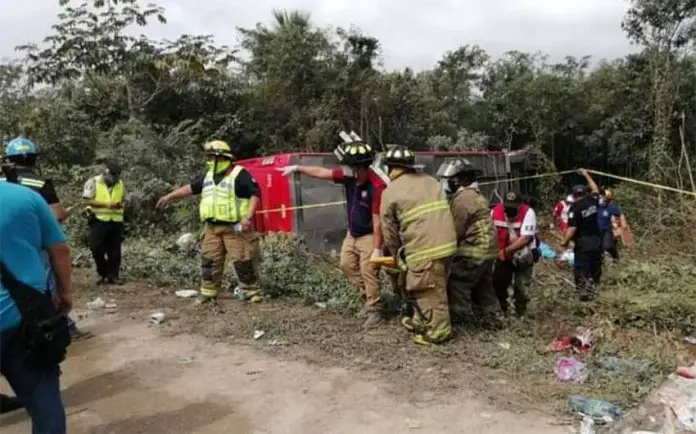
The accident occurred near the town of El Tintal, 73 kilometers west of Cancún.
Eight people died, including a foreign tourist, and 19 were injured after a bus collided with a dump truck on a highway near Cancún, Quintana Roo, on Sunday.
The bus, which was operated by the ADO bus line, was carrying 40 passengers on the Kantunilkin-Cancún highway from Mérida to Cancún at about 10:30 a.m. near the town of El Tintal, 73 kilometers west of Cancún, when the accident occurred.
The Quintana Roo Attorney General’s Office confirmed that five men and three women died. At least one of the fatalities was a foreign tourist, but the office didn’t reveal their nationality. Two children were injured — one seriously — and two French tourists, a German citizen and a Pakistani citizen were also hurt, the newspaper Reforma reported.
The accident occurred near section 4 of the Maya Train project that is under construction.
Authorities said Monday morning that the driver of the truck had been arrested. Witnesses say the truck drove on to the highway and into the path of the bus, whose driver didn’t have time to stop to avoid the collision.
The governor of Quintana Roo, Carlos Joaquín González, offered his condolences to those affected. “Attentive and following the accident that occurred on the Cancún-Mérida highway, where a passenger bus was involved … authorities are present and are helping the wounded. Our solidarity with the families of the victims,” he wrote on Twitter.
The Chapala axolotl/salamander (Ambystoma flavipiperatum) of Tecolotlán, Jalisco, proving that these creatures span far beyond the Mexico City area. Jesús Gordolomi Butterball RC/Creative Commons
Most Mexico City residents, as well as many tour guides and publications, will absolutely swear that the famed axolotl amphibian can only be found in what is left of the lake system now mostly destroyed by Mexico’s capital. But like so many things in Mexico, that statement is true and false.
The term “axolotl” in English is generally used for the Mexico City creature, Ambystoma mexicanum, which has lion mane-like protrusions and a wide face with a curious “smile.” It is the one endangered by the capital’s explosive growth and therefore has received the most attention by far — not to mention its very unusual ability to regenerate limbs and even vital organs to an extent.
But 16 members of Ambystoma are endemic to Mexico. Only one, Ambystoma mavortium, or the barred tiger salamander, has a range that extends into the United States and Canada.
All of them can be considered axolotls and/or salamanders but often aren’t because popular naming depends on their region and, frequently, whether the full-grown adult has the “lion’s mane” or not. If you live in one of several of Mexico’s states, you may have seen one and not even realized it because the one in your area looks little to nothing like the ones in Mexico City.
During at least some point in their development, all Ambystoma do have both lungs and gills (the lion’s mane), although depending on the species, the animal might favor one over the other. This depends on how much time the species spends on land.
The Lake Pátzcuaro species (Ambystoma_dumerilii), which is called “achoque” due to Purépecha influence. Pito22/Creative Commons
Other things all these salamanders have in common are a need to keep their skin wet, the fact that they do not shed their skin and the absence of metamorphosis seen in many other amphibians. Coloration varies even among the same species, and albinism is relatively common.
The Ambystoma with the widest range in Mexico is the plateau tiger salamander, found in México state, Puebla, Tlaxcala, Veracruz, Coahuila and Querétaro. But most, like A. mexicanum, are found only in very narrow ranges of area, often just in one small body of water.
In addition to A. mexicanum, there are other axolotls in the Valley of México and the mountains surrounding it. These include the mole axolotl (A. rivulare) in the valley proper. The granular axolotl (A. granulosum) is found only in the streams of the Iztacchihuatl, Popocatepatl and Monte Tlaloc volcanoes on the valley’s eastern edge.
Nearby is the range of A. leorai, the axolotl found only in the town of Río Frio in México state. In Puebla proper, there is the alchichica axolotl (A. taylori), named after the small volcanic lake in Tepehuayo, where it is found.
West of the Valley of México is the Sierra de las Cruces, the habitat of mountain stream axolotl (A. altamirani). Beyond these mountains is the Valley of Toluca, still in México state, where the main axolotl is the Lerma axolotl, (A. lermaense), which survives despite the wretched conditions of the Lerma River.
Also in the state is A. bombypellum, only in the municipality of Tenango del Valle. It is extremely rare.
Diagram of Ambystoma with and without gills from the Great Soviet Encyclopedia.
Over the next set of mountains, Michoacán has several species, but as this was the territory of the Purépecha, the common name for the animal here is “achoque,” rather than the Náhuatl-derived “axolotl.”
Of these Michoacán species, the achoques of Zacapu lake’s scientific name is A. andersoni; those of Lake Pátzcuaro are A. dumerilii and those of the Tancítaro municipality are A. amblycephalum.
To the west and northwest, you’ll find the habitats of the Chapala axolotl (A. flavipiperatum), found in the Sierra de Quila in Tecolotlán, Jalisco; the Tarahumara salamander (A. rosaceum) in the Sierra Madre Occidental; and the pine axolotl (A. silvense) in the Sierra Madre Occidental of Durango.
It is true that just about all Ambystoma are at least somewhat endangered — some so critically that they are all but extinct in the wild.
The main culprit is loss of habitat. The central highlands are by far the most populated and developed part of Mexico, so pressures on land and water are enormous. A. mexicanum not only gets attention because of the capital but also because its habitat was destroyed first, over a process of drainage going on since the colonial period.
But such habitat destruction has not stopped at the Valley of México’s edges. It now extends far beyond Mexico City due to the construction of housing and roads and the pumping of water to urban areas.
Images of pigmented and albino A. mexicanum, the best known axolotl. Creative Commons
Up to 10% of natural fresh surface water in these areas has been lost, and what is left is often a highly-toxic brew of feces, chemicals and garbage that includes introduced species like carp and tilapia that prey on axolotl larvae.
As much as humans have caused the near-extinction of the axolotl, conservation efforts are the only reasons axolotls still exist. The National University of Mexico is most concerned with A. mexicanum as its habitat is very close to its main campus. For the same reason, the México State Autonomous University works with the Lerma axolotl.
But perhaps the more interesting efforts have been private. In 2019, a small sanctuary dedicated to axolotls opened in Zacatelco, Tlaxcala state. It was followed by the Museo Mexicano del Axolote (MUMAX) in 2020 in the state of Puebla.
Even more curious is the work of the nuns at the Basilica of Nuestra Señora de la Salud in Pátzcuaro, Michoacán, who raise and care for over 300 of Pátzcuaro lake’s achoques. It began several decades ago because wild populations were rapidly decreasing, but their motivation was not ecological.
For over a century, the nuns have used a secretion from their skin to make a cough syrup, so a reliable supply was necessary. Today, the nuns have 300 captive animals that are the species’ best bet for survival.
Although axolotls are relatively easy to raise and can live for 10 years in captivity, releasing such populations back into the wild is not yet viable. Raised in pristine conditions, they cannot survive the shock of the polluted waters where they should be in the first place.
Two axolotl species on display at the Mexican Museum of the Axolotl in Chignahuapan, Puebla. Alejandro Linares García
Leigh Thelmadatter arrived in Mexico 18 years ago and fell in love with the land and the culture in particular its handcrafts and art. She is the author of Mexican Cartonería: Paper, Paste and Fiesta (Schiffer 2019). Her culture column appears regularly on Mexico News Daily.
Use your waffle iron to whip up these cheesy treats.
According to Wikipedia, the FIFA World Cup is the most-watched sports event in the world, with more than half the planet watching it live on TV in recent years. Statistics varied as to exact numbers, but they all were over 1 billion people for the 2019 event. The Olympics is the next most-watched event internationally.
Be that as it may, the Super Bowl is no slacker: in the United States alone, the 2021 broadcast had 96.4 million people watching, with another 30–50 million international viewers. And in Mexico, according to Statista.com, more than 12 million people watched the 2020 Super Bowl — about 10% of the total population!
Basically, wherever you are, you’ll find “American football” fans, and for them, Super Bowl Sunday is as close to an annual holiday as it gets.
Like a small country, throughout the 52 years the event has taken place, certain foods have become traditional: guacamole, chili, Buffalo wings, dips and chips, pizza, potato skins, hot dogs and fancy burgers, nachos, fried pickles, snack mixes.
Some of my past columns have included recipes that would be great for a Super Bowl party: flavorful sweet and savory nut mixes; jalapeno poppers; deviled eggs and tartar sauce; quick and easy homemade mayo for dipping; salsas, nachos and shrimp cocktail. Here are a few more new ones guaranteed to titillate your taste buds and maybe start some new traditions in your household.
Get your veggies with this creamy Green Goddess dip!
Waffle Iron Queso Frito
3 Tbsp. flour
½ tsp. paprika or pinch of cayenne pepper
½ lb. mozzarella, sliced ½-inch thick
2 eggs, whisked
½ cup breadcrumbs
Nonstick cooking spray
Preheat waffle iron or set to medium if it has temperature controls.
On a plate, mix flour with paprika or cayenne. Place eggs in a second plate or bowl and breadcrumbs in a third. One slice at a time, coat mozzarella in flour, then egg, then breadcrumbs.
Use nonstick spray on both sides of waffle iron. Place as many cheese slices as will fit in waffle iron and close the lid. Cook about 1 minute until breadcrumbs turn golden brown. Repeat with any remaining cheese.
Serve hot on its own or with salsa or tomato sauce for dipping.
Buffalo Cauliflower Dip
1 head cauliflower (1½ pounds), cut into small florets (about 4 cups)
1 Tbsp. olive oil
Salt and pepper
2 Tbsp. butter
½ cup Buffalo-style hot sauce
½ cup softened cream cheese, cut into pieces
¼ cup sour cream
½ cup freshly shredded Cheddar cheese
¼ cup crumbled blue cheese
1½ tsp. minced chives or scallions
Heat oven to 375 F (190 C). In medium-sized cast iron or ovenproof skillet, toss cauliflower with olive oil; season with salt and pepper. Cook covered on stovetop on high heat for 5 minutes.
Uncover and cook, stirring occasionally, until cauliflower is fork-tender and caramelized in spots, about 10 minutes. Add butter. Once melted, add hot sauce. Simmer until reduced by half, about 3 minutes.
Turn off heat; stir in cream cheese and sour cream. Sprinkle Cheddar on top. Bake until bubbling around edges and cheese melts, about 10 minutes. Sprinkle with blue cheese and chives or scallions.
Serve with vegetables, bread or chips for dipping. — nytcooking.com
You’ll score a touchdown with these bacon-wrapped baby potatoes.
Bacon-Wrapped Baby Potatoes
1 pepper from can of chipotle peppers in adobo, plus 1 Tbsp. adobo sauce
Preheat oven to 375 F (190 C). Line a baking sheet with aluminum foil. Mince chipotle pepper.
In large zip-lock bag, mix minced pepper and adobo sauce, garlic, oil, smoked paprika, brown sugar, dry mustard and salt. Add baby potatoes, seal bag, and shake, working seasoning mixture around the potatoes until they are fully coated. Pour potatoes onto baking sheet.
Wrap half a strip of bacon around each potato; secure with toothpick. Space potatoes evenly on baking sheet. Bake until potatoes are tender and bacon has crisped, 50–60 minutes. Remove toothpicks, sprinkle with herbs. Serve warm with mayo for dipping.
Green Goddess Dip
½ cup packed fresh dill
½ cup packed fresh mint
½ cup packed fresh parsley
⅓ cup packed fresh basil
2 garlic cloves, minced
2 scallions (use both white and green parts), sliced
1½ Tbsp. fresh lime/lemon juice
Salt to taste
½ cup olive oil
½ cup crumbled feta cheese
½ cup Greek yogurt
Optional: ¼ cup mayonnaise
Place dill, mint, parsley, basil, garlic, scallions, lemon juice and salt in food processor. Process until finely chopped. With motor running, drizzle in oil.
Add feta; process until smooth. Pulse in yogurt. Add more salt, if desired. For creamier dip, mix in mayonnaise.
Serve with chips or cut veggies for dipping, or store in refrigerator up to three days.
Hot Cheesy Olives
8 Tbsp. (1 stick) unsalted butter, softened
2 cups grated sharp Cheddar cheese
1½ cups flour
Pinch salt
¼ tsp. cayenne
Dash of Worcestershire sauce
1 egg
50 small pimento-stuffed cocktail olives, drained and patted dry
Heat oven to 350 F (177 C). Beat butter until creamy in large bowl, add cheese and mix well. Stir in flour, salt, cayenne and Worcestershire; mix until smooth.
Beat egg with 2 Tbsp. cold water. Add to dough; mix just until incorporated. Refrigerate 30 minutes.
Remove dough from fridge. Pinch off a walnut-sized piece and flatten into a thin round. Place an olive on top and shape it around it, pinching to seal. Place coated olive on an ungreased cookie sheet. Repeat with remaining dough and olives. Bake until about 15 minutes until browned. Serve hot.
Are you planning to watch the Super Bowl at home or at a party this year? What snacks are you planning? Share your favorite recipes with other readers in the comments!
The president at his Wednesday morning press conference. Presidencia de la República
Andrés Manuel López Obrador, the 65th president of Mexico, felt the airs of the Caribbean sea over the weekend, visiting the Maya Train project in Quintana Roo. The state’s economy depends on the tourist pull of Cancún, Playa del Carmen and Tulum. However, its attractiveness to foreign visitors is under threat after a recent uptick in gang related murders, some inside luxury hotels.
Monday
The president narrated the selling points of the Maya Train. He thanked construction workers and said the 1,500-kilometer train project was helping to restore ancient cities, before calling out businessman Claudio X. González, and “supposed environmental defenders” for creating legal obstructions to its progress.
On a tangent, AMLO mentioned a scandal about his 40-year-old son’s supposedly lavish lifestyle. He said his son’s wealth was nothing untoward and had some select words for the journalist who broke the story. “In this government my children have no influence, no contract is given to any suggested person … this Mr. Loret de Mola, is a mercenary … and is still at the service of the power mafia.”
On his own corruptibility, the Tabascan explained that power isn’t his priority.
“I am not interested in money, and I am not so attached to power. Power only makes sense and becomes virtuous when it is put at the service of others. Power is humility and power is being able to let go of it [the power] at the right time,” he said.
The president had some words of inspiration for viewers later in the conference.
“When we feel weak … or lack moral strength or are sad, when enthusiasm is lost, let us think of the heritage of those who have fought in other times for freedom, for justice, for democracy, for sovereignty,” the president proclaimed.
Tuesday
The president opened the conference on Tuesday by paying tribute to the former bishop of Ecatepec, Onésimo Cepeda, who died on Monday. The eccentric, wealthy Cepeda was a friend and one time business partner of Carlos Slim.
Deputy Health Minister Hugo López-Gatell said COVID-19 cases were down 31%. He added that Mexico had passed the peak of the fourth wave.
Deputy Health Minister Hugo López-Gatell reported that the fourth wave of the coronavirus is on its way out. Presidencia de la República
Ricardo Aldana won the election to lead the Pemex union, replacing Carlos Romero Deschamps who headed the union for 26 years, and lived lavishly. A journalist asked about the 20 billion pesos (almost US $1 billion) sent from union’s accounts to public servants while Aldana was treasurer.
“There was a very good turnout and a free and secret vote was guaranteed,” the president responded, refusing to be drawn into corruption allegations.
AMLO derided the negative press about the historian, who he considered to be “a first-rate historian, one of the best in the country.”
“There is no formal complaint [against him] … No more than a lynching campaign,” the president said, and added he’d try to find another position for Salmerón.
Wednesday
Elizabeth García refuted several stories that have appeared in Mexican media outlets over the past week. Presidencia de la República
Truth reviewer Elizabeth García Vilchis stood straight for her segment. She said claims the National Council of Science and Technology (Conacyt) would restrict scholarships for dissenters and pregnant people was misguided; flying from Felipe Ángeles airport won’t be more expensive and warned against fraudsters claiming to be workers from a state bank.
“There can’t be any recession if in the month of January more jobs were created than in the last 20 years. What recession?” he said.
However, whether economic growth was his aim came into question.
“It may be that because of COVID we have less growth, but there is more equality. Now [resources] are reaching the poor more than before, we are living in a less unequal country than when neoliberal politics were applied,” he said.
Thursday
The president was in Pachuca, Hidalgo, on Thursday. He said that 80% of households in the state were receiving at least one form of government welfare.
Governor Omar Fayad Meneses said homicides fell 19% in 2021, but lamented a recent gang related killing of six people. However, he pointed to the arrests of two high profile cartel members as evidence of progress.
Later in the conference, President López Obrador celebrated three of Mexico’s former leaders.
“I feel that there are three great presidents who still govern by their example: presidents Juárez, Madero and Cárdenas. President Juárez embodies patriotism, Cárdenas represents love of the people and Madero represents democracy, because even though he enjoyed power, he did not have too much attachment to power,” he said.
The example of Madero, he added, should be followed today.
“One of the mistakes of the last progressive left wing governments in Latin America was to think that they didn’t have enough time … time is short … but, no. No to re-election, that’s the most important lesson: no to re-election.”
Tlaxcala Governor Lorena Cuéllar presented at Friday’s presidential press conference, which was hosted in her state. Presidencia de la República
Friday
The president held the conference in Tlaxcala on Friday. He announced that a deal would be signed for health collaboration between the government of Tlaxcala and the federal government.
The governor, Lorena Cuéllar, said the state was getting safer after kidnappings fell 75%, femicides dropped 71% and human trafficking decreased 83%.
“We always chatted, we spent time together. He invited me to eat at his house. We talked about the situation in the country, we didn’t always agree, but through the whole time we maintained a relationship of respect,” he said.
The president also gave off some positive signals to the business community.
“We are talking about the loss of one of the most important businessmen in Mexico… we will always maintain support for Mexican businesses,” he said.
The Tabascan had more kind words to offer, this time for the U.S. ambassador to Mexico, Ken Salazar. A journalist quoted Salazar saying energy reform was necessary.
“I really appreciate Ambassador Ken Salazar’s words. President Biden’s administration has been very respectful … muy bien, Ken [very good, Ken],” AMLO replied.
In 2020, everyday heroine Jemima Peláez started "sidewalk classes" for poor children who work Queretaro's stoplights with their vendor parents.
Shortly after Christmas, my partner and I decided we’d go to the movie theater to see, at last, the new Spider-Man movie.
Superhero movies have never been my favorite. The whole Marvel franchise makes my inner nine-year-old roll her eyes at what she regards as “boy stuff.” But I’m also happy to hop over to the other side of our Venn diagram of shared interests for the sake of a nostalgia-filled childhood hero.
I’d had a vague sense that it was a popular choice, given how many screens on which it was scheduled, but was surprised to find that all the showings for the rest of the evening were sold out by the time we got there at 5 p.m.
If there’s one thing that Mexicans love, it’s superheroes.
Spider-Man seems to be an especially popular one, spotted frequently at birthday parties and painted on the outside of small local businesses. While I didn’t totally understand the movie, I did find it wholesome, its message clear: the bad guys aren’t really bad … not deep down.
A place like Mexico, which one might very well conclude is “lawless” in many respects, is the perfect breeding ground for heroes and villains alike. In fact, I’ve seen scenes from various iterations of Batman over the years and thought, “Gosh, Gotham City might as well be Mexico City.”
Think about it: most people are just trying to get by and not run into any trouble. A few people are very, very corrupt and sometimes, even worse, very powerful and very corrupt. Villains grow out of trauma-laced soil, as do heroes, the exact combination of ingredients needed to create either one unknowable. Also in Mexico, governmental power vacuums allow the bad guys — who conveniently keep us distracted from more mundane injustices like having to pay bribes or the dwindling of butterfly populations — free to roam.
It’s not that people are indifferent. There are just too many things to worry about at once, not least of all one’s own survival.
While President López Obrador likes to see himself as Mexico’s savior, I view him as someone who rather teeters on the line between trying hard to do good and also falling for his own exaggerations despite the evidence. After all, who’s ever heard of a superhero insisting that all the problems going on right in front of us are somehow figments of our imaginations?
Luckily, there are quite a few other heroes out there, both with and without capes. Look for them, and they might even make you believe that we’ll be all right after all.
One that made the news this past week actually brought tears to my eyes: Zadrigman, rescuer of street animals in Michoacán. According to this hero — who in true superhero fashion will not reveal his real identity — he’d made a pact with his dog that they’d do this work together. His dog died before they could start, but he continued on by himself, rescuing and finding homes for street animals.
A while ago, I also wrote about a pair that goes by the name the Supercívicos and focuses on pursuing small-scale justice by calling attention to minor infractions, infractions that most others would simply ignore. They don’t hide their faces, but they do have special outfits and “super” in their name, so I’m counting it!
Other examples of heroism and everyday acts of kindness abound and deserve, in my opinion, much more attention than the villains.
There’s the boy who in January set up a table in front of his house to give away toys so that other children could get presents on Kings Day. There’s the firefighter who carried a flaming tank of gas out of a restaurant and the police officer who returned a man’s 30,000 peso-filled backpack, in which he was carrying money he intended to use to buy an oxygen tank for his sick wife.
Batman appeared in Monterrey at the beginning of the pandemic to encourage people to stay home, and a transit officer just this week escorted a pack of stray dogs down the highway so they wouldn’t get hurt. An indigenous community in Sonora is working to protect hundreds of hectares of mangroves.
The villains may be flashier, but heroes abound. Keep your eyes peeled, and you’ll see plenty of them working quietly on everyday miracles.
Ayotzinapa teaching student faced off with police at the Palo Blanco toll plaza. Twitter
Students clashed with members of the National Guard and state police at a toll plaza near Chilpancingo, Guerrero, on Friday.
At least 14 guardsmen sustained burns from molotov cocktails and one fractured his ankle, the National Guard said.
Seventeen police were also injured, said Public Security Minister Evelio Méndez Gómez.
The confrontation occurred at the Palo Blanco toll plaza on the Autopista del Sol, the highway that runs between Mexico City and Acapulco.
Students from the Ayotzinapa teacher training college – the school attended by the 43 young men who disappeared in Iguala, Guerrero, in 2014 – arrived at the plaza, located about 60 kilometers south of the Guerrero capital, with the intention of occupying it, presumably to collect tolls from motorists.
The early afternoon clash, which reportedly lasted close to an hour, occurred after security forces tried to persuade the students to leave.
The newspaper Milenio reported that the students used stones, firecrackers and molotov cocktails against the security forces.
They also traded blows with the guardsmen and police, and pushed a driverless semi-trailer toward them with the aim of injuring or intimidating them. The truck crashed into a food stand but no one was injured, the newspaper El Financiero said.
The security forces deployed tear gas to repel the students.
Five students were detained, but they were subsequently released following mediation by National Human Rights Commission officials, Méndez said. The majority of the Ayotzinapa students left the toll plaza on the same buses on which they arrived.
El Financiero reported that the students have been occupying toll plazas at least twice a week for six years. Security forces stopped them from doing so for the first time last Friday, after the Senate passed a law that punishes the occupation of toll plazas with up to seven years’ imprisonment, the newspaper said.
Vidulfo Rosales Sierra, lawyer for the parents of the missing Ayotzinapa students, announced the new commission after meeting with President Sheinbaum.
There is friction between the parents of the 43 students who disappeared in Guerrero in 2014 and President López Obrador over the former’s request for the army to be investigated in connection with the crime, according to a lawyer for the victims’ families.
The lawyer, Vidulfo Rosales Sierra, also said that the federal government has begun intimidating the Ayotzinapa students’ parents, explaining that buses in which they were traveling on a Guerrero highway were stopped by the National Guard Tuesday and subsequently followed as they made their way to Acapulco.
He said that every time the parents advocate a thorough investigation into the army in connection with the events of September 26 and 27 of 2014, the government is annoyed at the prospect.
Leaked testimony from a protected witness that was obtained by the newspaper Reforma last year supported the belief that the army played a part in the crime that triggered mass protests and rattled the government led by former president Enrique Peña Nieto.
One theory is that the students’ bodies were burned in army incinerators after they were killed.
Rosales said that friction has been evident at meetings between the parents and López Obrador and other government officials over “the Mexican army issue.”
“When it’s placed on the table, they don’t like it, it causes disagreement so that’s caused friction,” he said.
The lawyer said the animosity between the two parties was regrettable and that no progress has been made on the case in recent months.
Upon taking office in late 2018, López Obrador vowed to establish the truth about what happened to the 43 students, but the remains of just three of the young men have been found and identified, and the current government, while disavowing its predecessor’s so-called “historical truth,” hasn’t provided its own definitive version of events.