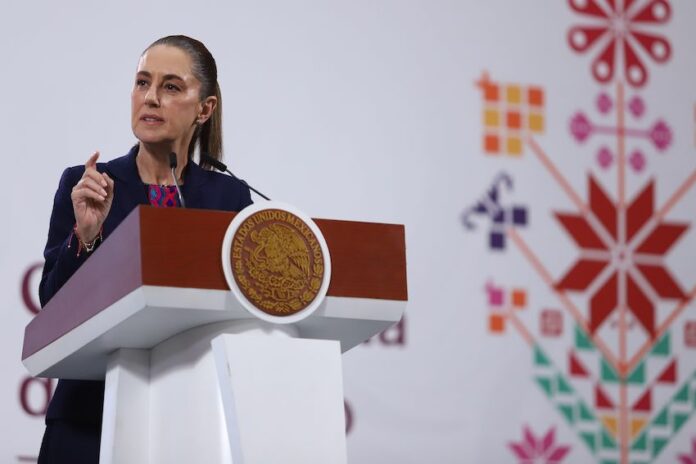
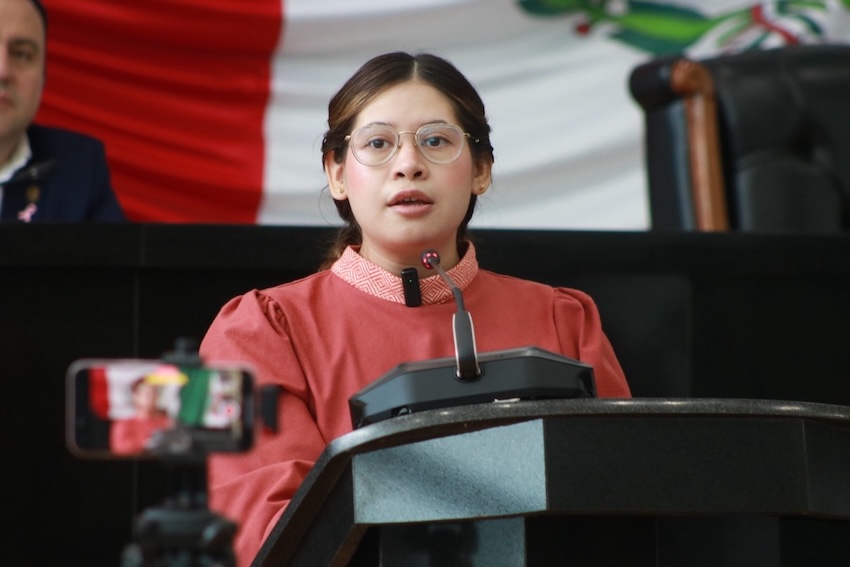
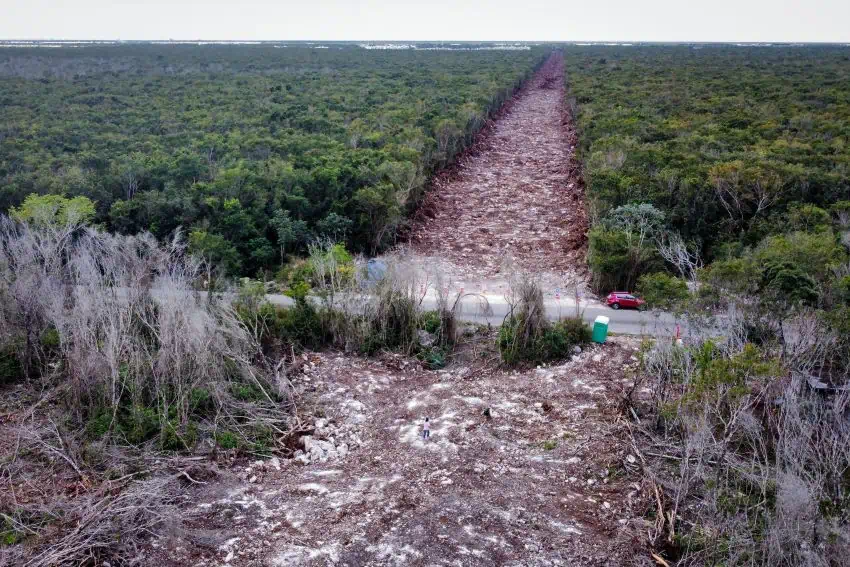
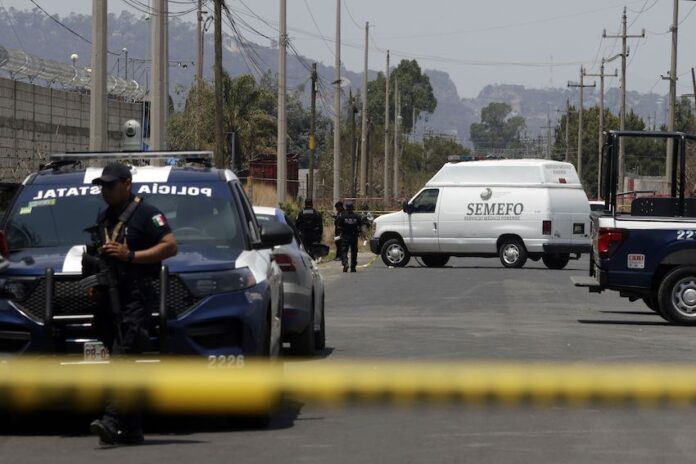
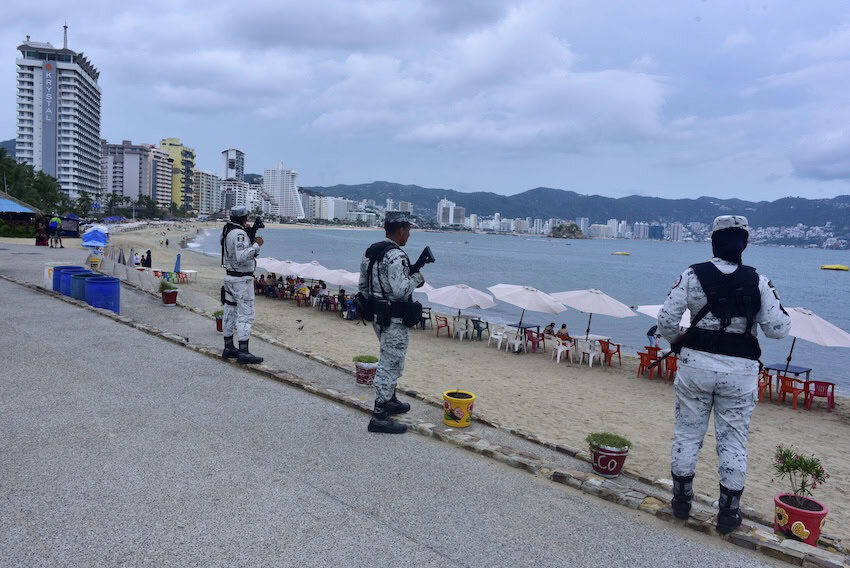
Homicides have sharply declined during Sheinbaum's presidency, but the percentage of people who feel unsafe in the city in which they live has risen. (Daniel Augusto/Cuartoscuro)
Citizens’ perceptions of insecurity and the United States’ allegations that Mexico is not fully complying with the USMCA free trade pact were among the issues President Claudia Sheinbaum spoke about at her Wednesday morning press conference.
Here is a recap of the president’s Oct. 8 mañanera.
Sheinbaum holds up a stop clock that she uses to keep track of the time during her morning press conferences. (Daniel Augusto/Cuartoscuro)
Homicides are down, but public fear of insecurity is up. Why?
Sheinbaum said that perceptions of insecurity “have to do with many aspects, many issues” beyond homicide numbers, which declined almost 25% annually in the first nine months of 2025. The ENSU considers things like whether people feel unsafe at the bank, on the streets they regularly use and on the highway, places where robberies are commonly committed.
Attempts at extortion over the phone “don’t necessarily” result in “fraud” or people paying money to extortioners, but do generate fear among the population, Sheinbaum said.
She said that another factor that causes people’s perception of insecurity to increase is that “a lot of media outlets” exaggerate “issues of violence,” which generates “an environment” in which people think “there is a lot of insecurity in the country.”
Therefore, the increase in the number of people who consider their city unsafe “also has to do with the kind of communication” employed by “traditional media outlets,” and by “some [television] channels in particular,” Sheinbaum said.
“… Now we [also] have social media and the fake news that is created on social media. So obviously we have to inform from here,” she said, referring to her mañanera lectern.
Sheinbaum: The new judiciary will aid the quest for peace
Sheinbaum said that her government will continue to work “every day” to improve public security in Mexico.
“Regardless of the [anti-government] campaigns, regardless of what appears on social media, we’ll work and listen to the people to continue providing peace and security,” she said.
“And I’m sure that the new judiciary will help us a lot,” Sheinbaum said.
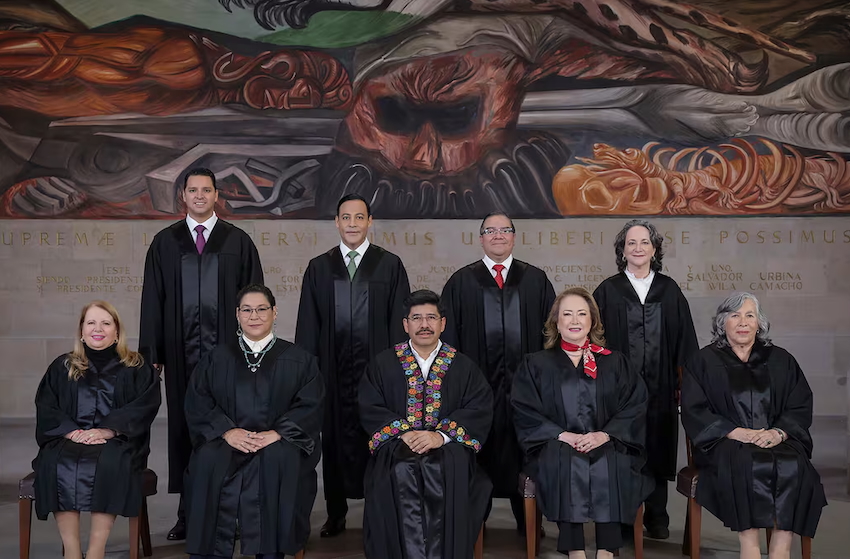
The newly reformed Supreme Court offers additional protections for the current government, while limiting opportunities for opposition candidates to win seats. (Supreme Court)
Sheinbaum argued that the elections were needed to renew the judiciary and thus rid it of corruption and other ills.
Mexico’s USMCA compliance ‘problems’
A week after United States Trade Representative Jamieson Greer accused Mexico of failing to comply with the USMCA free trade pact, Sheinbaum said there are “about 50 points raised by the United States regarding what they consider to be ‘Mexico’s problems’ with the trade agreement.”
She said that her government is “clarifying” the situation regarding the alleged compliance problems because reality doesn’t “necessarily” match “the view they have.”
“I’ll give you an example,” Sheinbaum continued.
“In the case of labor, they say that there aren’t enough resources for [Mexico’s] labor courts. They were only counting the budget that the federal government provides, but each state of the republic provides a budget to its own courts. If you put it all together, it’s more than 4 billion pesos [US $218.2 million],” she said.
“So issues like those are simply clarified and resolved,” Sheinbaum said.
She said that her government doesn’t agree with some of the United States’ other USMCA complaints, but is reviewing them nonetheless.
“At least from our point of view, the majority have already been resolved,” Sheinbaum said.
She noted that the “formal review” of the USMCA — scheduled for 2026 — hasn’t commenced, but acknowledged that Mexico and the United States have started public consultation processes.
Sheinbaum also noted that the United States has imposed tariffs on some imports from Mexico, such as vehicles and steel, but stressed that “the majority” of the USMCA is being respected by the U.S. government.
She expressed confidence that the outcome of the USMCA review will be positive for Mexico, even though U.S. President Donald Trump has indicated that he wants to renegotiate the pact that superseded NAFTA in 2020.
“We believe that we’ll do well. We’re optimistic,” Sheinbaum said.
By Mexico News Daily chief staff writer Peter Davies (peter.davies@mexiconewsdaily.com)
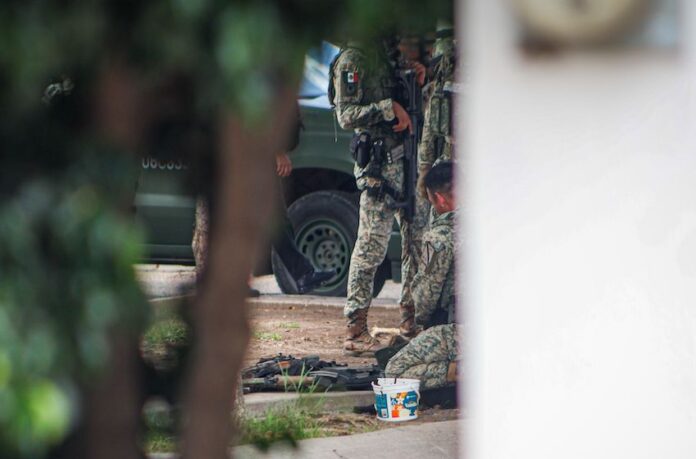
The soldiers involved in the incident on the Ciudad Mante-Tampico highway were relieved of their duties and presented to FGR offices in Tampico. (José Batanzos Zárate/Cuartoscuro)
Mexican soldiers opened fire on a vehicle in the northern border state of Tamaulipas on Monday night, killing six people and wounding two others.
The Ministry of National Defense (Defensa) announced the incident on Tuesday, saying in a statement that military personnel were traveling in three vehicles on the Ciudad Mante-Tampico highway when a white truck “attempted to ram” one of the army vehicles.
“Upon perceiving a risk to their physical safety and after some maneuvers, … [the soldiers] made use of their weapons and unfortunately five people lost their lives and three others were injured,” Defensa said.
The Defense Ministry said that the injured were given first aid and “expeditiously evacuated” to a hospital in Tampico, a city in southern Tamaulipas.
“During the transfer to the hospital, one of the wounded persons died,” Defensa said.
The Defense Ministry said that the Federal Attorney General’s Office (FGR) was “immediately” notified of the incident and began an investigation.
It said that military prosecutors also opened an investigation into the killing of the six people. The soldiers involved in the incident on the Ciudad Mante-Tampico highway were relieved of their duties and presented to FGR offices in Tampico, Defensa said.
The ministry didn’t say whether the victims were armed. Their identities have not been publicly disclosed.
At her Wednesday morning press conference, President Claudia Sheinbaum said that the actions of the soldiers involved in the “very regrettable” incident will be “completely” reviewed.
Asked whether the army still has instructions to not attack “the civilian population” and whether an army commander had made “a mistake” in ordering troops to open fire, Sheinbaum responded:
“We need to review what happened first, in order to have all the information about what occurred. … The use of a firearm has to be rational; there is a law that establishes under what conditions.”
Sheinbaum subsequently asserted that her government isn’t carrying out a “war” against drug cartels like that waged by the administration of former president Felipe Calderón.
During Calderón’s 2006-12 government, “the order was to shoot” at suspected criminals, she said, adding that federal security forces now only respond with force if there is an attack against them first.
Last month, the United States Ambassador to Mexico, Ronald Johnson, asserted that the Sheinbaum administration has made a “bold change” in security strategy in Mexico by ramping up operations against drug cartels. The president disagreed with his view.
An army ‘mistake’?
The newspaper El País reported on Wednesday that it was told by “official sources” that the army killed the six civilians in Tamaulipas “by mistake.”
El País noted that local media outlets have reported that the victims were jornaleros —day laborers who commonly work on farms.
El País reported that, as was the case in Tamaulipas on Monday, “the army didn’t point to any attack against it” before soldiers opened fire. (Facebook)
The newspaper said that military investigations in cases involving the army often become “the basis” of FGR investigations, allowing military prosecutors to “frame the event according to their vision.”
The Centro Prodh human rights organization said on social media on Tuesday that it was concerning that “parallel investigations in the military jurisdiction” continued to be opened in “cases of probable serious violations of human rights.”
Centro Prodh also said that the killing of the six people in Tamaulipas was an “undeniable consequence of the deepening of military power” in Mexico.
Sheinbaum-era precedents
In May, two girls were killed by soldiers in Badiraguato, Sinaloa.
“Family members of Alexa and Leidy, girls aged seven and 11, … reported that both were murdered by army officers in a direct attack on the vehicle in which they were traveling with their family,” the news outlet Animal Político reported.
El País reported that, as was the case in Tamaulipas on Monday, “the army didn’t point to any attack against it” before soldiers opened fire.
On Oct. 1, 2024 — the day Sheinbaum was sworn in as president — soldiers killed six migrants in Chiapas. According to the Defense Ministry, the soldiers opened fire on vehicles that attempted to evade military personnel carrying out patrols on a highway north of the city of Tapachula.
Ten other migrants were injured in the incident. Defensa indicated that soldiers mistook the migrants for criminals.
Two days after the incident, Sheinbaum said that “a situation like this can’t be repeated.”
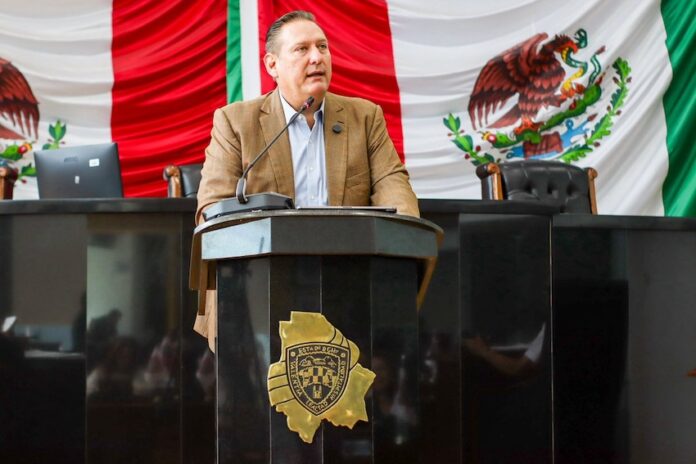
Carlos Olson San Vicente, a member of the Chihuahua State Congress from the National Action Party, authored and promoted the new law, which he says will eliminate from the schools "ideological language that indoctrinates our children and hinders learning.” (Carlos Olson/X)
The northern border state of Chihuahua has become the first state in Mexico to ban the use of inclusive language in public schools, passing a legislative reform that has ignited debate nationally over language and identity.
Pushed and promoted mainly by members of the Partido Acción Nacional (PAN), the reform was approved 17-14 by the Chihuahua State Congress on Tuesday.
Chihuahua State Congressmember Jael Argüelles criticized the law as regressive, noting, “Language is a living, evolving and ambiguous system that changes daily to name new realities, new identities and ways of existing.” (Jael Argüelles/X)
In amending Article 8 of the state’s education law, the legislation will prohibit inclusive language and promote the correct use of Spanish grammar and spelling rules in classrooms.
“We did it! No more ideologized language in the classrooms or woke confusions,” Carlos Olson San Vicente, a member of the Chihuahua State Congress, wrote on social media after the vote. “Only the biological truth that only boys and girls exist, not ‘niñes.’ Common sense over ideology!”
Olson is a deputy from PAN who authored and promoted the amendment. He is also a member of the state’s legislative committee for Education, Culture, Physical Education and Sports.
The reform makes Chihuahua — nicknamed “El Estado Grande” for its status as Mexico’s largest state by area — the first Mexican state to ban inclusive language in schools.
In other words, there will be no more classroom usage of gender-neutral terms such as “amigue,” “amigx” or “amix” in place of amigo or amiga; “todxs” “todes” or “tod@s” rather than todos or todas; “elle” instead of él or ella.
The common idea in those often awkward coinages is to provide options for avoiding gender-specific terms (usually male) in gender-neutral contexts.
For example, a Spanish noun ending in -os is generally masculine plural, as in todos (all men). But traditional standard Spanish also uses the masculine todos as a plural for a mixed group of men and women, which in recent years has rubbed many the wrong way. Hence the invention of “todxs” “todes” or “tod@s.”
On the legislative floor, Olson argued, “Let the new generations not lose command of their native language, nor should the teaching of Spanish be diluted by the influence of digital trends or linguistic formations that are foreign to the norm of the language.”
Opponents, including Jael Argüelles, a member of the Chihuahua State Congress representing the Morena party, criticized the law as regressive.
“Language fulfills a very specific function: to communicate,” she said. “Language is a living, evolving and ambiguous system that changes daily to name new realities, new identities and ways of existing.”
She said the reform makes invisible the struggles of women, children, Indigenous peoples and the LGBTTTIQ+ community “by imposing rigid criteria on language use.”
The vote occurred only months after the nation’s Senate approved a constitutional reform incorporating gender-inclusive language in national law.
Olson said the reform in his state follows similar decisions in countries such as France, Argentina and just days earlier in El Salvador. He asserted that “schools should teach grammar rules, not ideological language that indoctrinates our children and hinders learning.”
However, according to critics, the approved initiative does not clearly explain what constitutes inclusive language, or how its use distorts language and/or hinders learning.
Currently, there are no mainstream media reports of other Mexican states moving toward a similar legislative ban, though groups and authorities in other states have debated the use of inclusive language.
Since its creation in 1841, the amparo trial has been the balancing factor between citizens and the government. Here's what you need to know about amparo law in its current version. (Tingey Injury Law Firm/Unsplash)
After graduating from law school in Mexico – and before turning to writing full-time – I practiced amparo law for three years. Before that, I interned at a corporate law firm but left it because the job felt detached from what I thought the practice of law should be: creating legal arguments to seek justice for individuals before a court of law.
And there was no greater legal mechanism for defending individuals from abuses of power than an amparo trial.
In Mexican law, an amparo is a course of legal action that defends citizens who have had their rights infringed upon by the government. For instance, if a bright billboard has been installed in front of your house and it creates visual pollution, you could file an amparo trial against the authorities that approved its installation. If the municipality unjustifiably closes your coffee shop, you could claim legal protection against that decision through an amparo trial.
Since its creation in 1841, the amparo trial has been the balancing factor between citizens and the government. Its function within the legal system has helped reduce the asymmetry of power between the people and the state by submitting the authority’s actions to the scrutiny of a qualified judge.
Since I haven’t practiced amparo for a few years, I spoke with former colleagues to hear what they have to say about it.
Magistrate Julia María del Carmen García González, who recently retired after serving for 15 years as a federal judge in an administrative court in Naucalpan de Juárez, qualified the new terms of the reform as a “clear setback” and a “pro-authority reform.”
“I practiced my career through the most protective era of human rights, and now I’m worried, frustrated and sad for what lies ahead,” she said.
Magistrate Julia María del Carmen García González. In Mexico, a magistrate is a federal judge and is considered qualified to serve on the Supreme Court if they so choose. (Facebook)
Attorney at law and professor of amparo and constitutional procedural law at the Universidad Panamericana Guadalajara, Pablo Flores Guerrero, expressed concern that the new reform “sends a dangerous message to the new judges in the judicial system, treating the amparo figure as if it were an abusive tool that, with each favorable ruling, challenges the principles of good governance.”
Here are the most worrying proposed modifications.
The new law changes the definition of ‘legitimate interest,’ restricting access to amparo
Under the terms of the law approved by the Senate, access to amparo is restricted by changes in the definition of interés legítimo (legitimate interest), which “makes rigid a figure that should be dynamic,” Flores said.
To explain this, we need to take a quick look at how amparo works now.
According to the current amparo law, there are two channels through which a person can file an amparo lawsuit: through interés jurídico (legal interest) or interés legítimo (legitimate interest).
“Legal interest” means individuals can only go to court if a personal right is directly violated. For instance, if the government took away their property or fined them unfairly.
Meanwhile, “legitimate interest” (introduced in 2011) allows any person or group of people to go to court, even if the violation doesn’t affect them personally. For example, an environmental organization could file an amparo lawsuit against a project harming a protected natural area, even if the group doesn’t own the impacted plot of land.
See the article below to read more about a case of ‘legitimate interest’ amparo:
However, the new proposed definition (which can be found on page 9 here) can be interpreted to mean that general concern or indirect damage to the population are no longer sufficient cause to file an amparo lawsuit.
“For many years, until the 2011 reform, only people with a legal interest were able to access amparo. But with the introduction of the legitimate interest [amparo], civil society organizations had the opportunity to seek protection,” Magistrate Del Carmen said. “Restricting it is a clear step backwards.”
Flores added that if interés legítimo is dismantled by the proposed changes, lawsuits seeking the protection of community rights (known as “collective amparos”) will also be negatively impacted. In addition, he said, “There is a highly probable risk that the admissibility of amparo claims will become even more problematic.”
The new law limits the application of a provisional suspension
One of the key benefits of an amparo trial is that it halts the allegedly abusive act of the government while the case is being resolved as a way to protect the complainant. This measure is known as “provisional suspension.”Let’s say the municipality closed down your coffee shop. While the case is being studied (which could take months or years), a provisional suspension would allow you to keep your coffee shop open in the meantime.
However, the proposed changes introduce new grounds to restrict its application in some cases. In other words, it expands the scenarios in which a provisional suspension will not proceed.
“The fact that you do not have access to provisional suspensions in these scenarios will allow the authority to continue acting in total detriment of your rights,” Magistrate Del Carmen said.
She said the following changes are the ones that cause the most concern:
In cases of arrest warrants
The new amparo reform does not allow provisional suspension in cases of pretrial detention, meaning that individuals will remain detained at the discretion of the amparo judge without a real possibility of regaining their freedom before being found innocent or guilty.
In cases of blocked bank accounts
The proposed terms eliminate the provisional suspension in cases of bank accounts that have been blocked by the Financial Intelligence Unit (UIF), which typically happens due to suspicions of money laundering.
However, if an account is frozen by mistake (for instance, due to a name mix-up) the affected person could be left without access to their money for months, or even years, while the legal process unfolds.
Retroactive application of the law
The amparo reform approved by the Senate included a controversial clause that allows its provisions to be applied retroactively, affecting cases already initiated under the current law.
This retroactive application has been widely criticized as it violates the Mexican Constitution, which prohibits the retroactive application of laws to the detriment of any person.
Magistrate Del Carmen said that if the reform were approved in these terms, it would violate the principle of legal certainty. This principle is paramount in any legal system, as it allows all individuals to know what they should expect from the law.
Upon learning of this clause, Sheinbaum rejected its inclusion and clarified that her original initiative did not include such a provision, calling on the Chamber of Deputies to eliminate it.
Construction on the Maya Train was suspended on several occasions due to amparos submitted by complainants who asserted legitimate interest regarding the human right to a healthy environment and the right of Indigenous peoples to give their prior and informed consent, among other constitutional rights. (Cuartoscuro)
Are there any positive changes in the proposed reform?
Some experts have pointed out the benefit of introducing online trials in the proposed reform of Mexico’s amparo law. However, Magistrate Del Carmen considers this change to be irrelevant in the face of the other modifications.
“All else considered, the changes [to the law] are catastrophic,” Magistrate Del Carmen lamented.
For Flores, if the new amparo law is approved in the written terms, it will place even greater responsibility on lawyers, especially now that judges of the judicial branch have been selected by popular vote and have demonstrated “an evident lack of technical expertise in the issues on which they rule,” he said.
“The outlook is discouraging,” Flores acknowledged. “But this means that litigators carry a crucial duty to keep challenging cases with the technical rigor and quality standards that our country deserves.”
Gabriela Solis is a Mexican lawyer turned full-time writer. She was born and raised in Guadalajara and covers business, culture, lifestyle and travel for Mexico News Daily. You can follow her lifestyle blog Dunas y Palmeras.
It is rare for tourists and foreign residents to be affected by violence in Mexico, and homicides on the whole are declining. That said, Mexico News Daily believes it is important that visitors and locals are aware of the security situation in their town. (Mireya Novo/Cuartoscuro)
The popular tourism destinations of Tulum, Acapulco, Zihuatanejo and San Miguel de Allende are among Mexico’s 50 most violent municipalities based on their per capita homicide rates between September 2024 and August 2025.
Other municipalities that make the “50 most violent” list include Manzanillo, Culiacán, Colima, Tijuana and Ciudad Juárez.
The crime data website elcri.men compiles official data and uses it to rank municipalities and states based on their per capita homicide rates.
The latest “50 most violent municipalities” list shows that Huajicori, Nayarit, ranks first with a homicide rate of 278 per 100,000 people in the 12 months between September 2024 and August 2025.
Located in northern Nayarit on the border with both Sinaloa and Durango, Huajicori recorded 34 murders in the year to Aug. 30, according to elcri.men. The municipality has a population of just over 12,000.
Tulum, Acapulco, Zihuatanejo and San Miguel de Allende are popular tourism destinations for Mexican and international tourists, and foreigners live in each of the municipalities.
It is rare for tourists and foreign residents to be affected by violence in the four aforesaid destinations, as most of it is related to organized crime or among rival groups. That said, Mexico News Daily believes it is important that visitors and locals are aware of the security situation, as shown by the official homicide data compiled by elcri.men.
Tulum
The Caribbean coast municipality of Tulum, Quintana Roo, ranks as Mexico’s 20th most violent municipality with a homicide rate of 83.9 per 100,000 residents in the 12 months to Aug. 30.
Tulum, located about 130 kilometers south of Cancún, recorded 46 homicides in the period. The municipality has a population of just under 55,000, according to elcri.men.
The Pacific coast city of Acapulco, Guerrero, ranks as Mexico’s 34th most violent municipality with 71 homicides per 100,000 residents in the year to Aug. 30.
Acapulco, which was once a glamorous vacation destination for Hollywood royalty and “the rich and famous,” has traded its once-shiny reputation for one of crime and violence. (Carlos Alberto Carbajal/Cuartoscuro).
Also located on the Pacific coast of Guerrero, Zihuatanejo de Azueta ranks as Mexico’s 41st most violent municipality with 61.3 homicides per 100,000 people in the year to Aug. 30.
Zihuatanejo, which has an active expat community, recorded 79 murders between September 2024 and August 2025. The municipality has a population of just under 129,000, according to elcri.men.
Among the murder victims in the municipality of Zihuatanejo over the past year was the son of a business leader from Michoacán, who in late August was found dead in a vehicle that was abandoned near the community of El Posquelite.
San Miguel de Allende
Located in the Bajío region state of Guanajuato, San Miguel de Allende ranks as Mexico’s 50th most violent municipality with 49.3 homicides per 100,000 people in the 12 months to Aug. 30.
San Miguel, which has long been home to a sizable community of foreigners, recorded 88 homicides between September 2024 and August 2025. The population of the municipality is 178,576, according to elcri.men.
Among the homicide victims in San Miguel de Allende over the past year were three people who were shot during a religious event in August. Mayor Mauricio Trejo Pureco said that the attack was targeted at three people with significant criminal records. He said that 19 people were wounded in the attack and 16 of them were “good people.”
San Miguel de Allende is one of nine Guanajuato municipalities on the “50 most violent” list compiled by elcri.men.
Guanajuato has been Mexico’s most violent state in recent years based on total homicides.
The 10 most violent municipalities
Mexico’s 10 most violent municipalities based on their per capita homicide rates between September 2024 and August 2025 are as follows:
Huajicori, Nayarit: 278 homicides per 100,000 people.
Santiago Jamiltepec: 171.5 homicides per 100,000 people.
Manzanillo, Colima: 143.4 homicides per 100,000 people.
Huitzilac, Morelos: 132.3 homicides per 100,000 people.
Tarimoro, Guanajuato: 124.5 homicides per 100,000 people.
Salvatierra, Guanajuato: 121.4 homicides per 100,000 people.
Puente de Ixtla, Morelos: 117.9 homicides per 100,000 people.
San Luis Río Colorado, Sonora: 114 homicides per 100,000 people.
Elota, Sinaloa: 105.1 homicides per 100,000 people
Matías Romero Avedaño, Oaxaca: 103.7 homicides per 100,000 people.
Among the other municipalities on the “50 most violent” list are Culiacán, Sinaloa (17th); Colima, Colima (21st); Tecate, Baja California (23rd); Celaya, Guanajuato (35th); Tijuana, Baja California (46th); and Juárez, Chihuahua (49th).
Mexico’s most violent states
Based on homicides per capita, Colima was Mexico’s most violent state between September 2024 and August 2025. The small Pacific coast state recorded 89.2 homicides per 100,000 people, according to elcri.men.
Morelos ranked as the second most violent state with 60 homicides per 100,000 people, followed by Sinaloa (59), Chihuahua (47.8) and Guanajuato (47.6).
Based on total homicides, Guanajuato was the most violent state in the first nine months of 2025. Data presented by the federal government on Tuesday shows that the Bajío region state recorded 2,084 homicides between January and September, accounting for 11.3% of the national murder total.
Ranking second to fifth for total homicides in the period were Chihuahua, Baja California, Sinaloa and México state.
Carlos Fuentes' was a major voice not only in Mexican literature, but world literature. (Librerías Gandhi)
Mexican author Carlos Fuentes entered my life with the soft insistence of a truth you
recognize before you can name it. In a house where books functioned as liturgy and
political arguments were my family’s daily prayer, politics and fiction braided until
nationhood itself could only be discussed through story. Friends learned to avoid politics
and religion in polite conversation. But at our table, it was compulsory.
Encountering Fuentes
Between my mother’s journalistic and analytic perception and my father’s artistic view of the world, I first encountered Fuentes. It was an introduction that felt less like discovery than initiation. I first found “The Death of Artemio Cruz” rummaging through my parents’ bookshelves as a teenager, that furtive, holy act of taking what the house has to offer. The book is a slow, terrible confession. It follows a revolutionary soldier who becomes a wealthy
businessman and, on his deathbed, confronts the compromises that made his life
possible.
The son of a diplomat and later one himself, Fuentes often thought of himself as a “gypsy in a black tie.” (INBAL)
I asked my father if I might read it. He agreed with the tolerant risk of someone
who knows the power of literature. I was too young to understand everything —too
young for many of the dates and alliances and the dense historical scaffolding —but not
too young for the voices. The blunt honesty of Fuentes’s interlocutors cut into me. Their
phrases echoed family stories, private grievances and the way a father’s silence sometimes
explained more than his sermons. I went to sleep that night with the book heavy under
my pillow, feeling the first tremor of an allegiance.
Fuentes liked to say that the Latin American novel rescues what official history neglects.
It is an attractive aphorism: literature as a salvage operation, novels as lifeboats ferrying
the lives, rumors and embarrassments that governments prefer to let sink. But his claim
is more than rhetoric. Read Fuentes and you find not an inventory of facts but a map of
forces —the informal routines, petty calculations and generational betrayals —through which Mexican politics actually works. He is not interested in vindicating every detail of the
public record. He excavates the subterranean arithmetic of power. The small acts and
grand illusions that produce regimes.
A gypsy in a black tie
If Fuentes’s vantage feels panoramic, it is because it was cultivated that way. Born in
1928 in Panama to a cultured, liberal diplomatic family, he spent his early years amid
the humid expanses of Montevideo and Rio de Janeiro. Those tropical afternoons —book-lined, humid and full of foreign tongues —were where Fuentes first fell in love with literature. Alfonso Reyes, the Mexican humanist and a central pillar of the country’s intellectual life, became an early mentor who guided him through the literary world. The young Fuentes absorbed European and Latin American canons with equal appetite, continued his journey to Washington with his family. They stayed eight years in the American capital amid tense Mexico–U.S. relations following President Lázaro Cárdenas’s 1938 nationalizations.
Made in Mexico: Carlos Fuentes
Distance sharpened his sense of Mexico as a nation, and of his identity as Mexican in a
foreign country, as he turned into a schoolyard enemy thanks to the “Tata Lázaro” initiative. Watching his country from abroad, he did not simply miss home. He began to interrogate it. He traced a family history animated by wider European convulsions — ancestors who fled Germany and Spain and settled in Veracruz, establishing a coffee hacienda, and he learned how much a personal identity could be a palimpsest of political choices and historical happenstance. Then a pivotal evening at a New York cinema, where he watched “Citizen Kane” with his father, supplied a kind of formal revelation: narrative could reveal the way private lives braided into public histories. He decided then to write within those intersections.
The acquisition of a global perspective
Fuentes’s early reading list —Stevenson, Dumas, Miguel Zévaco, Jules Verne —reads
less like a curriculum than a confession. He wanted plot and spectacle, but with an eye
to the moral and historical sediment underneath. A teenage posting in Chile broadened
that sensibility further. Latin American politics did not respect borders. The authoritarian
and reformist rhythms he observed in Chile and Argentina taught him that patterns
reverberated across the continent, that the fate of one republic often presaged the
anxieties of another.
He returned to Mexico, weary of the peripatetic diplomat’s life — the “gypsy in a black tie as he called it —and enrolled at UNAM to study law at Alfonso Reyes’s encouragement.
The law sharpened him. Fuentes would later borrow Stendhal’s praise for the
Napoleonic civil code —“clear, concise and effective” —and insist that legal training gave
a novelist a discipline of clarity. Yet his impulse was to use that clarity to break forms with
novels that could capture the messy simultaneity of Latin American time.
Fuentes’ first book, “Los Días Enmascarados,” was published in 1954 when he was only 26 years old. (Librerías Gandhi)
At age 26, he published his first book, “Los Días Enmascarados” (1954), a collection
where myth and the fantastic meet a restless modernity. His true breakthrough came
with “La Región Más Transparente” (1958), a book that announced, with a kind of civic
thunder, a new way of seeing Mexico City. From that moment, he was no longer an
apprentice. He was a national habit.
A life stranger than fiction
Fuentes’s public life was as complicated as his fiction. His unique voice made him
central to Mexican culture to the point where presidents listened carefully to what Fuentes
and other Mexican intellectuals had to say about their regimes. Later, he accepted the ambassadorship to France (1975–1977), a decision tied to a friendship with President Luis Echeverría that earned both praise and censure. When the following president, Gustavo Díaz Ordáz, took office, he resigned from his role as ambassador in protest to the Tlatelolco massacre in 1968, an act that marked him among writers who believed conscience could not be compartmentalized.
He would reflect on this episode as a reminder that the line between cultural influence and political entanglement is rarely neat. Fuentes moved within the circles of power even as he remained a most acute critic.
The restless writer
He was, by any measure, prolific, writing more than seventy books — including novels, essays, short stories, scripts and plays —along with a steady stream of articles across the Americas. Critics who catalog his work point to recurring obsessions: the mestizo nature of
Mexican identity, the ways power shifts under pressure, and, when left to its own inertia, the precariousness of state narratives that tidy over contradictions.
But to reduce Fuentes to a set of themes is to miss his artistry, which is the ability to render political life in the language of human habit: betrayal as domestic pattern, corruption as genealogy, revolution as a choreography of broken promises. If a reader wants a beginning, here are five texts that make his method and moral
urgency plain.
1. ‘La Región Más Transparente’ (‘The Most Transparent Region’), 1958
A portrait of Mexico City through a chorus of characters —peasants, intellectuals,
opportunists, dreamers —this novel critiques a hopeful bourgeoisie who believes
concentrated wealth will somehow be redistributed by fate. The city is staged as
myth and machinery, a place where pre-Hispanic ghosts brush against neon and
where national identity is debated in salons and tenements alike. Fuentes
anticipates the rupture generation’s disillusionments, sketching a metropolis both
magnet and mirror.
“La Silla del Águila” or “The Eagle’s Throne” was one of Fuentes’ best later works, published in 2003. (Penguin Random House)
2. ‘La Silla del Águila’ (‘The Eagle’s Throne’), 2003
Set, proleptically, in 2020, told through letters after a communications collapse, it narrates a corrupt election, the corrosive compromises of those who seek higher office, and the blunt interventions of foreign powers —most pointedly the United States. It is less a
speculative thriller than a study in how institutions erode when informal networks
take precedence over civic duty.
3. ‘Tiempo Mexicano’ (‘Mexican Time’), 1971
An essayistic meditation on temporality and national memory. Fuentes argues that Mexican time is not linear but circular and overlapping. Epochs coexist and narrate one another. He examines who is given the right to remember and how state and culture conspire to shape
collective consciousness. Here, his faith in youth and his hope that new generations
could craft a more democratic nation glimmer most clearly.
4. ‘Nuevo Tiempo Mexicano’ (‘New Mexican Time’), 1994
Written in the wake of 1994’s ruptures —the Zapatista uprising in Chiapas and the peso’s collapse —this book is more sober. Where earlier essays were buoyed by the possibility of reform, “Nuevo Tiempo Mexicano” reflects on the hard limits of institution-building amid enduring inequality and the new economic realities shaped by NAFTA.
Perhaps my favorite, a sweeping cultural history that traces five centuries of Hispanic America. Fuentes is at once historian and storyteller. He narrates the persistence of colonial and Indigenous legacies as the subterranean currents of identity. The book is elegiac and
exuberant, a reminder that culture is not a surface polish but an accumulated
architecture.
Why read Fuentes?
Because he converts complexity into clearness without flattening it. He is not a historian
in the archival sense. Dates and citations are subordinated to moral geometry. But he
is remarkably precise in diagnosing how power, memory and myth conspire to produce
national life. His prose wants to unsettle complacency. He hoped readers would argue
with his books, not to annul them but to enlarge the conversation.
Fuentes belonged to an erudite generation that could look at Mexico from both inside
and outside. The diplomat’s gaze that knows protocol and the exile’s view that knows
perspective. He understood how the Mexican Revolution’s promise had been
domesticated: the postrevolutionary bourgeoisie reproducing pre-revolutionary
hierarchies, the PRI’s transformation from PRM into an apparatus that welded party to
state and how industrial growth often masked social exclusion.
Clarity and cultural insight
One of Fuentes’ greatest talents was the ability to distill cultural insights and political truths. (X, formerly Twitter)
But perhaps his clearest insight is cultural. The Revolution’s deepest achievement was not the redistribution of land or the construction of institutions alone, but the knitting together of a fragmented populace so disparate communities could finally perceive one another.
To read Fuentes is to feel history as a kind of weather: sudden, changeable and always
shaping the small gestures of private life. His novels let you listen to Mexico’s
interiors — the whispered bargains, the private prayers and public betrayals. They teach
patience. Political truths are rarely delivered in headlines. They arrive through
accumulations of habit and choice, through the intimate narratives that novels can, more
truthfully than manifestos, deliver.
If you find a copy of his work, take it. Fuentes will not hand you a neat syllabus of
reform. Instead, he will offer scenes and voices that make the stakes of politics
unavoidable. His writing insists upon engagement. Not mere consumption, but
conversation – argument, indignation, laughter and, sometimes, renewal. In that
stubborn insistence lies his lasting invitation: to read Mexico not as a place to be
explained, but as a country alive with stories that refine what we think we know.
María Meléndez is a Mexico City food blogger and influencer.
Sumilab, operated by the Favela López family, was first sanctioned by OFAC in 2023. (Google Maps)
The U.S. Department of the Treasury announced on Monday that its Office of Foreign Assets Control (OFAC) had sanctioned eight Mexicans and 12 Mexico-based companies that are allegedly affiliated with the Los Chapitos faction of the Sinaloa Cartel.
“This network supplies illicit fentanyl precursor chemicals to the Sinaloa Cartel, a terrorist organization responsible for a significant portion of the deadly drugs trafficked into the United States,” the Treasury Department said in a statement.
(U.S. Department of the Treasury)
The sanctioned individuals are six men and two women, four of whom are siblings.
The 12 sanctioned companies include chemical, laboratory equipment, agriculture-related, cleaning and real estate firms.
The eight individuals and 12 companies were “designated” by OFAC pursuant to Executive Order 14059 (an anti-narcotics order) and Executive Order 13224 (a counter-terrorism order).
The measures OFAC imposed on Monday freeze all assets in the U.S. affiliated with the sanctioned individuals and companies, and block U.S. transactions with them.
The Treasury Department said that Los Chapitos is a Sinaloa Cartel faction “run by the four sons of Joaquin ‘El Chapo’ Guzman Loera,” a former Sinaloa Cartel leader who was convicted on drug trafficking charges in the United States in 2019 and is now imprisoned in Colorado.
“With two of the four members of Los Chapitos now in U.S. federal custody, fugitive brothers Archivaldo Ivan and Jesus Alfredo Guzmán Salazar lead the faction and exert control over vast swaths of Sinaloa Cartel-controlled territories across Mexico,” the Treasury Department said.
It said that Los Chapitos are “heavily invested in the trafficking of illicit fentanyl and methamphetamine,” and “have consistently procured precursor chemicals, overseen illicit laboratories, and managed drug distribution.”
In the same statement, the Treasury Department’s under secretary for terrorism and financial intelligence said that “over 500,000 Americans have died of fentanyl poisoning.”
John K. Hurley also said that “President Trump has made clear that stopping the deadly flow of drugs into our country is a top national security priority.”
An alleged family-run criminal scheme
One of the companies sanctioned by OFAC on Monday is Sumilab, a Culiacán-based chemical and laboratory equipment firm that was founded in 2001, according to the Treasury Department.
An image submitted by a Google Maps user of a Sumilab store in Culiacán shows a display case containing laboratory and medical equipment. (Google Maps)
The company was “first sanctioned by OFAC pursuant to counternarcotics authorities” in 2023 and designated on Monday “for its involvement in providing and shipping precursor chemicals for and to Sinaloa Cartel members and associates,” Treasury said.
Treasury said that Sumilab is run by the Favela López family, including four siblings and two men who married into the family. Those six people, all of whom were sanctioned on Monday, are:
Víctor Andrés Favela López
Francisco Favela López
Jorge Luis Favela López
María Gabriela Favela López
Jairo Verdugo Araujo (María Gabriela’s spouse)
Gilberto Gallardo Garcia (married to another Favela López sibling, according to Treasury)
The other two people sanctioned by OFAC on Monday are:
César Elías López Araujo, who Treasury said is a “front person” for Víctor Andrés Favela López.
Martha Emilia Conde Uraga, who Treasury said is “a longtime Sinaloa Cartel-affiliated chemical broker operating out of multiple warehouses in and around Culiacán.”
Treasury said that after Sumilab was sanctioned in 2023, “the Favela López family removed signage from Sumilab storefronts and changed tactics, but remained heavily engaged in supplying precursor chemicals for the Sinaloa Cartel’s fentanyl production.”
It said that the three Favela López brothers “operate under the Los Chapitos faction of the Sinaloa Cartel and are responsible for supplying and distributing precursor chemicals and lab equipment to Sinaloa Cartel-affiliated chemical brokers and lab operators, who produce illicit fentanyl and methamphetamine.”
“Additionally, chemicals are sold to companies in the United States, where they are synthesized into illicit drugs and ultimately sold to U.S.-based customers,” Treasury said.
The department headed up by Treasury Secretary Scott Bessent said that the Favela López family “operates a network of chemical, laboratory equipment and agriculture-related companies” in addition to Sumilab, seven of which were sanctioned on Monday.
Those seven companies were sanctioned due to their links to the Favela López family.
The alleged ‘chemical broker’
The other four companies sanctioned by OFAC on Monday are run by Conde Uraga and her family, according to Treasury. Two are industrial cleaning companies, one is a mental health services provider and one is a real estate firm.
Treasury said that Conde Uraga is “also a utilizer of front persons,” but didn’t name any of them.
It said that the 63-year-old Culiacán native “supplies precursor chemicals to drug traffickers and lab operators working for the Los Chapitos faction of the Sinaloa Cartel.”
Treasury said that Conde Uraga uses “fraudulent invoicing and other concealment methods” to supply precursor chemicals, some of which are shipped illegally to Mexico from China, according to Mexican and U.S. authorities.
The United States’ ‘armed conflict’ against cartels
The Sinaloa Cartel is one of 10 Western Hemisphere criminal groups that the United States government designated as foreign terrorist organizations this year. Including the Sinaloa Cartel, six of them are based in Mexico.
According to a U.S. government memo obtained by The Associated Press last week, U.S. President Donald Trump has declared drug cartels to be unlawful combatants and says the United States is now in an “armed conflict” with them.
The U.S. military has recently carried out deadly strikes against boats the U.S. government said were transporting drugs and were linked to the Venezuelan crime group Tren de Aragua, one of the groups designated as a foreign terrorist organization by the U.S.
President Claudia Sheimbaum has ruled out the possibility that the United States military could target Mexican cartels on Mexican soil.
Maná frontman Fernando “Fher” Olvera has recently been gifted with a remarkable new instrument. (Maná México)
In a remarkable convergence of musical excellence and traditional Mexican artistry, renowned guitar manufacturer Paul Reed Smith recently presented Maná frontman Fernando “Fher” Olvera with an extraordinary custom instrument that transcends the boundaries between musical craftsmanship and cultural heritage. This unique guitar, painted by master artisan Hedilberto Méndez from the legendary woodcarving village of San Martín Tilcajete in Oaxaca, embodies the power of artistic collaboration to transcend cultural boundaries.
Everything started when Smith met Mendez, an alebrije artisan, at a market in the streets of Oaxaca City. Smith has long been recognized as one of the most innovative and respected guitar manufacturers in the world. Since founding PRS Guitars in 1985, Smith has consistently pushed the boundaries of instrument design, combining traditional luthier techniques with cutting-edge technology to create guitars that are as visually stunning as they are sonically superior.
A memorable collaboration
Smith unveiled the custom instrument on social media. (Maná/Instagram)
PRS instruments have found their way into the hands of countless legendary musicians, from Carlos Santana to Mark Tremonti, each guitar representing Smith’s unwavering commitment to excellence and his deep understanding of what musicians need from their instruments.
The collaboration between Smith, Olvera and Méndez represents a fascinating intersection of different artistic traditions. While guitars have long been canvases for artistic expression – from the intricate inlays of classical instruments to the bold graphics of modern electric guitars – this particular project takes the concept to an entirely new level by incorporating one of Mexico’s most cherished folk art traditions.
The process of transforming a PRS guitar into a work of art worthy of Méndez’s talents required careful consideration of both the instrument’s functional requirements and the artistic vision. Unlike a traditional alebrije sculpture, which exists purely as a visual art piece, this guitar needed to maintain its musical functionality while serving as a canvas for Méndez’s art. This meant that every brushstroke, every color choice and every design element had to be carefully planned to ensure that the instrument’s acoustic properties and playability would not be compromised.
Maná, Mexico’s rock ambassadors
Maná, a veteran Grammy and Latin Grammy-winning rock band from Guadalajara, has been one of Mexico’s most successful rock exports for over three decades, led by the charismatic Olvera, whose distinctive voice and passionate stage presence have captivated audiences worldwide. Olvera’s powerful vocals and dynamic stage presence have made him one of Latin America’s most recognizable rock stars since the band’s formation in 1986.
Fher has also been a passionate advocate for environmental causes and social justice, using his platform to raise awareness about issues affecting Latin America and the world. His appreciation for traditional Mexican arts and culture has been evident throughout his career, making him the perfect recipient for this unique artistic collaboration.
Hedilberto Méndez and his tradition
Nestled in the mountains of Oaxaca, approximately 23 kilometers from the state capital, lies the small village of Tilcajete, home to fewer than 1,500 residents but renowned worldwide for its extraordinary woodcarving tradition. The art of alebrije creation begins with the careful selection of copal wood, a soft, lightweight material that is ideal for carving.
San Martín Tilcajete in the state of Oaxaca is famed for alebrijes artisans such as Hedilberto Méndez. (Wikimedia Commons/Alejandro Linares Garcia)
According to Hedilberto, his work was inspired by the caracol – the sacred snail – that moves through time in perfect spirals, carrying within its shell the mathematics of creation itself. In Zapotec cosmology, this humble creature holds the secret of existence: that all things begin where they end and end where they begin. The spiral is not merely a shape. It is the very breath of the universe, the way energy moves through all living things, the path that souls take as they journey from the material world to the realm of the universe.
“I see this same spiral carved into its very essence”. The sound hole becomes the center of the cosmic spiral, the place where silence transforms into song, where the void gives birth to vibration.
The creation of a special instrument
Given Fher’s commitment to environmental causes. Méndez’s art on the guitar features the representations of a jaguar, the largest wild animal on the American continent and which inhabits the diverse ecosystem of the region’s cloud forests.
The musical instrument’s body retains the elegant curves of the guitar, says Hedilberto, while incorporating the muscular power of the iconic big cat. Strings of pure energy ran along its spine, each one attuned to different aspects of night’s domain—one for dreams, another for shadows. For the Zapotec, the Jaguar Deity is a guardian, a protector of all that dwells in darkness. The neck stretched and thickened, becoming a powerful throat from which would emerge roars that could shake the very foundations of reality.
This collaboration represents a significant moment in the careers of all three artists involved. For Smith, it demonstrates his company’s commitment to supporting artistic expression and cultural exchange while also showcasing the versatility of PRS instruments as canvases for artistic collaboration, aligning with PRS’s reputation for creating unique custom instruments that push the boundaries of what a guitar can be.
When Olvera takes the stage with this one-of-a-kind guitar, he carries with him not just a tool for making music but a piece of living cultural history that connects him to the rich artistic traditions of his homeland.
Social anthropologist and photojournalist Ena Aguilar Peláez writes on health, culture, rights, and the environment, with a strong interest in intercultural interactions and historical and cultural settings.
Plaza Amelia Wilkes is one of several areas in downtown Cabo San Lucas due for an extensive makeover. Our local news roundup takes a look at stories from across the peninsula. (Los Cabos Tourism Board)
There has been a spate of interesting news recently to catch up on for the 20 million or so visitors annually to destinations around the Baja California peninsula — from infrastructure projects to culinary announcements, and even an award-winning literary work set among Baja’s Spanish missions.
Let’s start in Los Cabos, the municipality that’s now home to 44% of the total population of Baja California Sur.
Los Cabos’ cities, Cabo San Lucas and San José del Cabo, will get downtown makeovers
Plaza Mijares and the historic downtown center of San José del Cabo will also see remodeling and renovations. (Chris Sands)
The central downtown areas of both Cabo San Lucas and San José del Cabo will benefit from a 120 million peso makeover, it was recently announced by Los Cabos’ Mayor Christian Agúndez Gómez. The urban beautification work on these areas is set to begin later in 2025 and is expected to be completed by early 2026.
The funding for the project comes courtesy of Fideicomiso de Turismo de Los Cabos (Fiturca, or the Los Cabos Tourism Board), which is administered through a 4% hotel tax. The expected changes are expected to be extensive and should include the renovation of public squares and plazas, building façades, and improved landscaping, sidewalks and lighting.
The result, if all goes well, will be a significant upgrade to the overall urban image of the two cape cities, and it’s definitely needed based on declining sales figures in these areas in recent years, with Cabo San Lucas’ traditionally party-hearty nightlife industry particularly hard hit. These losses can indeed be attributed to several factors, including declining alcohol sales among Gen Z and more travelers choosing all-inclusive properties where there is little reason to venture out for food or frolic. But a bad urban image, particularly in Cabo San Lucas, has definitely played a part.
No architectural illustrations have yet been released for the makeover, which is to be overseen by the Urban Development Department, with input from area business owners. So, to see the fruits of this latest in a long line of infrastructure improvements locally, you’ll have to come and visit in 2026.
Tacos know no borders, as a famed Tijuana taquería expands with new locations in the San Diego area
At the other end of the peninsula, one of Tijuana’s most famous taquerías — one recognized by the Michelin Guide — has recently opened two new locations across the border in the San Diego area. Such cross-border hopping is, of course, not uncommon in the CaliBaja Mega Region that sees a whopping US $70 billion annually in shared trade, with 200,000 daily border crossings. But at a time when the border is such a contentious, politicized issue, it’s always nice to see people uniting on an issue we can all agree on: namely, that tacos are delicious and deserve to be shared.
Baja California is justly famous for pioneering the modern fish taco. However, Tacos El Franc, which began as a street cart in 1974 and has since expanded to brick and mortar locations in Tijuana and, as of 2025, in San Diego, specializes in carne asada and marinated adobada. A Tijuana institution for more than 50 years, Tacos El Franc has seen its reputation spread far and wide in recent years, thanks to its recommended status from the Michelin Guide and its featured role on the popular Netflix series, “Las Crónicas del Taco (“The Taco Chronicles”).
Celebrated Tijuana taquería Tacos El Franc has recently opened two new locations in the San Diego area. (Tacos El Franc)
Originally founded by Javier Valadez and still owned in Tijuana by the Valadez family, U.S. expansion plans for Tacos El Franc have been undertaken in partnership with Roberto Kelly and Salvador Lombroso. The first new location premiered to acclaim in National City’s Westfield Plaza Bonita in June of this year, with the second opening its doors in San Diego’s Gaslamp Quarter on Oct. 8.
The expansion was a long time coming
The new locations represent the culmination of a 20-year odyssey for Kelly. “The reason why I pushed for the expansion is that I never tasted anything even close,” Kelly told the San Diego Business Journal. “The quality of the food and overall taste were extremely different from what people get on this side of the border. I strongly believe that people in the U.S. should have access to the same quality of food and taste.”
Or they could just drive over and try the original tacos on Blvd. Sánchez Taboada in Tijuana — although, unlike at the U.S. locations, there won’t be any beef tallow fries featuring a variety of proteins on the menu.
The Baja California peninsula’s Spanish Missions are the subject of a new award-winning literary work
The more than two dozen Spanish missions built on the Baja California peninsula by successive waves of Jesuit, Franciscan and Dominican missionaries between the 17th and 19th centuries were foundational to regional history and culture, and, as a consequence, have inspired some excellent guidebooks and accounts; a fact touched upon in a recent interview with author David Kier.
As of September 2025, they’ve also provided the backdrop for some award-winning new fiction, including “A Desert Between Two Seas,” a novel of linked stories written by author Amy Muia, which was recently published by the University of Georgia Press. “Though the stories span landscapes, villages, characters and decades, the heart of the novel is Baja California itself,” Muia notes. “A stark land of cactus and creosote, of russet canyons and splintered wastes of rock — where people living in the shadow of ruined missions seek redemption on an inhospitable peninsula forsaken even by its priests.”
Muia did her research well. The book reflects not only her understanding of the colonial culture and customs of the time, but also her decade-plus of study and exploration at mission sites around the peninsula. The book has already earned the prestigious Flannery O’Connor Award for Short Fiction, and based on its skillful interweaving of some of the mythic elements in 19th-century peninsular history — from pearl diving to legendary missions — should also find favor with Baja-loving readers.
Chris Sands is the former Cabo San Lucas local expert for the USA Today travel website 10 Best and writer of Fodor’s Los Cabos travel guidebook. He’s also a contributor to numerous websites and publications, including Tasting Table, Marriott Bonvoy Traveler, Forbes Travel Guide, Porthole Cruise, Cabo Living and Mexico News Daily.
Despite some high-profile rail projects, government spending on infrastructure is lower than expected. (Rogelio Morales/Cuartoscuro)
As Congress prepares to consider the 2026 budget package, infrastructure investment is becoming a point of contention.
When the government focused its attention on debt reduction earlier this year, the Finance Ministry (SHCP) responded by shrinking public investment in infrastructure.
Mariana Campos, an economist and managing director of the think tank México Evalúa, says she’s concerned that the proposed budget only seeks to “manage shortages” rather than move the country forward. (México Evalúa/X)
The SHCP reported that between January and August of this year, investment in public works such as roads, bridges, schools and hospitals shrank to 509.8 billion pesos (US $27.7 billion), a 33.7% reduction in real terms, the biggest reduction in 30 years.
The sector most impacted was water supply, specifically drinking water but also sewage treatment, as spending on public works in this sector in the first eight months of the year was 75% lower than during the same period last year.
Jorge Cano, director of the public spending and accountability program at the think tank México Evalúa, criticized the methodology adopted for debt reduction.
“Unfortunately, the main strategy [of the government] is not a reduction in spending [on welfare programs], but rather a reduction in public investment,” he told the newspaper El Sol de México.
Cano said the debt reduction plan lowered public investment to 2.3% of GDP in 2025, a 20% reduction from the year before and the lowest amount since 2019, the first full year of the previous administration.
“This limits the country’s potential for economic development and weakens social rights by reducing investment in streets, highways, ports, fiber optics, electricity grids, etc.,” he said.
The National Bank of Public Works and Services (Banobras) seemed to affirm Cano’s analysis in its 2025-2030 Institutional Program released last month.
Among the critical infrastructure gaps identified by Banobras are transportation (roads, railways and ports) and public utilities such as electricity, water and waste management.
“These resources are key to promoting intermodal connectivity, balanced regional development and sustainable urban growth,” Banobras stated. Its report identified the greatest challenge as road-building, which requires roughly 570 billion pesos (US $31 billion) to modernize highways, build bypasses and strengthen capacity at border crossings.
In a column for the newspaper El Universal, Mariana Campos, an economist and managing director of México Evalúa, voiced concern for what she called the lack of vision in the 2026 budget, which sets infrastructure investment at 2.5% of GDP. According to Campos, this is below the average of 3.1% recorded between 2013 and 2023.
Expansión magazine reported that the 2026 budget would have Mexico investing less in infrastructure than in paying interest on its debt. By the end of next year, the gap between physical investment and the financial cost of debt could reach record levels.
Without infrastructure investment, Mexico could have trouble meeting the budget’s gross domestic product (GDP) estimate, Campos said.
Total public debt could reach a record level of 54% of GDP if growth expectations are not met. And, she pointed out, in 13 of the past 17 years, official growth projections have proven overly optimistic.
Campos said the budget does not appear to be a plan to catapult Mexico into the 2030s, calling it “a roadmap for managing shortages without altering the status quo.”