It was 15 years ago in 2010 when Mexico joined France as the first two nations whose cuisine was honored by UNESCO. (Dassaev Téllez Adame/Cuartoscuro)
More than 100 chefs from around the world will converge in Cuernavaca, Morelos, next month for the 10th World Forum of Mexican Gastronomy, a milestone event celebrating the 15th anniversary of UNESCO having designated traditional Mexican cuisine as part of the Intangible Cultural Heritage of Humanity.
Mole is one of those only-in-Mexico works of gastronomic art that’s bringing hundreds of chefs from around the world to Cuernavaca next month to indulge themselves in Mexican cuisine. (Facebook)
The lineup of roundtable discussions, lectures, intercultural workshops and culinary showcases will spotlight Michoacán as the guest of honor.
In 2010, Mexico and France were the first two nations whose cuisine was honored by UNESCO.
The upcoming extravaganza was announced this week in Mexico City by Morelos Governor Margarita González Saravia and national Tourism Minister Josefina Rodríguez Zamora.
Participants will include traditional cooks, specialists and producers from Mexico, the United States, France, Italy, Spain and several regions in Asia. One of the main goals, organizers stated, is to have a dialogue between the ancestral and the contemporary aspects of Mexican gastronomy.
The forum will also seek to promote the international reach of Mexican cuisine and recognize its role as a driver of social cohesion, community development and tourism.
This is the first time Cuernavaca will host the event, which is usually held in Mexico, but has also been staged in Milan, Italy last year and in Long Beach, California in 2018. Downtown venues will include the Palace of Cortés, Borba Garden and Emiliano Zapata Square.
The event falls within Morelos’ broader “Xochicalco, Land of Encounters” program of eight festivals from October through December. Those events are expected to receive over 60,000 visitors and generate an estimated 100 million pesos (US $5.4 million) during the final quarter of 2025, said Morelos Tourism Minister Daniel Altafi Valladades.
Cuernavaca already achieved a measure of gastronomic fame earlier this year for constructing the world’s longest taco acorazado. The regional specialty, which translates to “armored taco,” was 80 meters long — equivalent to 88 yards on a U.S. football field or six standard school buses placed end to end.
President Sheinbaum said on Wednesday that there is "confidence that resources are being used transparently and honestly" and thanked Mexicans for paying their taxes. (Andrea Murcia/Cuartoscuro)
At her Thursday morning press conference, President Claudia Sheinbaum spoke about her meeting on Wednesday with business leaders from 17 different countries and responded to a question about the government’s proposed name for a new train that will run from Mexico City to the northern border.
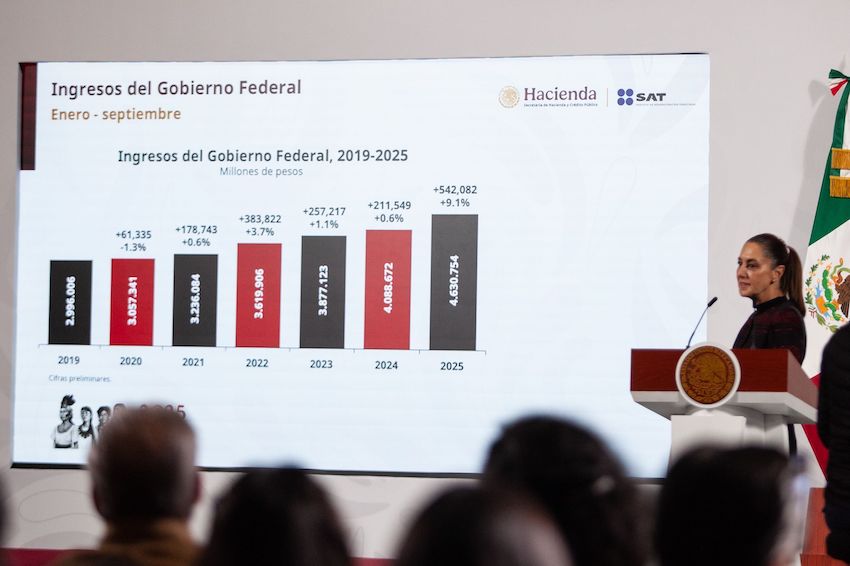
Early in the mañanera, Mexico’s finance minister provided an update on government revenue.
Sheinbaum presents Plan México to international business leaders
Sheinbaum acknowledged that she met on Wednesday with business leaders from various companies that are members of the World Economic Forum (WEF).
Among the people who attended the National Palace meeting were WEF president and CEO Børge Brende, BlackRock CEO Larry Fink and Salesforce CEO Marc Benioff.
Sheinbaum said that the businesspeople requested to meet with Mexican government officials in Mexico.
“They requested meetings in Mexico and for [government] ministers to speak about what Plan México is,” she said.
“And they asked me if I could give them a talk about Plan México,” Sheinbaum added.
In a meeting with representatives of WEF member companies on Wednesday, the president and her government colleagues spoke about the strengths of the Mexican economy and about Plan México. (SE/X)
The president said that she and her government colleagues spoke on Wednesday about “the main strengths” of the Mexican economy, and about Plan México, its objectives, the future outlook for Mexico and the country’s relationship with the United States, Canada and other nations around the world.
She said that there was no aim to reach any kind of agreement with the WEF-affiliated business leaders. They just wanted to come to Mexico to learn about “our proposals and how we see things” as well as investment opportunities “in our country,” Sheinbaum said.
In a video she shared to social media, the president speaks to the business leaders about the Plan México objective to “produce more in Mexico for the internal market and also for exports.”
Sheinbaum also speaks about increasing Mexico’s “food sovereignty” and “energy sovereignty” and strengthening public and private investment.
Government revenue up 9.1% in first 9 months of 2025
Speaking shortly after the commencement of the mañanera, Finance Minister Édgar Amador Zamora thanked Mexico’s taxpayers for their contribution to public resources.
He reported that the government’s tax and non-tax revenue increased 9.1% annually in real terms in the first nine months of 2025 to reach 4.63 trillion pesos (US $251.7 billion).
According to Mexico’s finance minister, approximately 200 billion pesos can be attributed to improved revenue collection in the area of foreign trade. (Andrea Murcia/Cuartoscuro)
Amador pointed out that the amount is 542 billion pesos higher than government revenue between January and September last year.
“Of those 542 billion [pesos], practically 200 billion corresponds to improved revenue collection in the area of foreign trade — all the taxes linked to foreign trade,” he said, adding that the “fight against corruption” at points of entry to, and exit from, the country has helped boost income.
“Thanks to that … it has been possible to have very, very solid growth of public income, amid an economic context in which [GDP] growth has been a little more moderate,” Amador said.
Sheinbaum highlighted that tax collection has reached its highest level on record, “without [the government] really having increased taxes or duties.”
She also thanked Mexicans for paying their taxes.
“A big applause for all the Mexican women and men,” Sheinbaum said.
She said that the latest tax revenue figures show that there is “confidence that resources are being used transparently and honestly.”
Sheinbaum also asserted that 99.9% of Mexicans are complying with their tax obligations, even though Mexico has a large cash-dependent informal sector.
A reporter asked the president why the government planned to name the train that will run on the Mexico City-Nuevo Laredo railroad the “Gulf of Mexico” train “when it doesn’t have a connection with the Gulf of Mexico.”
“But it’s in the west,” Sheinbaum said, using the word occidente (west) when she apparently meant to say oriente (east).
The reporter asked Sheinbaum why she hadn’t asked residents of Coahuila, Nuevo León and Tamaulipas their opinion on the matter when she delivered speeches in those states during her recent nationwide “accountability tour.”
“Do the citizens of the northeast have no voice or vote in this matter?” the reporter probed.
“Even you’re laughing at the question,” Sheinbaum noted before breaking into laughter herself.
“We can do a [public] consultation to determine what to call the trains,” said the president, whose administration is building a range of rail projects in Mexico.
By Mexico News Daily chief staff writer Peter Davies (peter.davies@mexiconewsdaily.com)
Navy ships carried out sargassum collection operations on the high seas throughout the summer as part of an all-out effort to keep Quintana Roo’s beaches clear of the noxious seaweed. (Elizabeth Ruiz/Cuartoscuro)
The 2025 sargassum season along Mexico’s Caribbean coastline has virtually concluded, as autumn’s cold fronts promise a drop in sea temperature and a resulting decrease in seaweed arrivals.
Esteban Amaro, director of the Quintana Roo Sargassum Monitoring System, said that although nearly 85,000 tonnes of the macroalgae were collected this year, the amount was not nearly as much as had been feared.
“The currents are changing … moving north, the southeasterly winds have decreased and there’s very little sargassum in the sea now,” he said. “Arrivals have dropped significantly in the past two weeks, suggesting the season is almost over.”
Of the 100 beaches Amaro’s organization monitors, only six saw sargassum last week, but the minimal quantities reaching the beaches were easily cleared.
Based on the latest monitoring data and satellite imagery, Amaro anticipates that Quintana Roo Governor Mara Lezama will be able to declare the end of the sargassum season sometime next week. In 2024, the sargassum season lingered until mid-November.
On Monday, Lezama expressed gratitude to federal, state and local authorities whose collaborative efforts in cleaning up the beaches helped make for a successful summer.
Although nearly 85,000 tonnes of the seaweed reached shore through last week — double the 40,000 tonnes that arrived in 2024 — the total fell far short of the more than 522,000 tonnes that invaded the region’s beaches in 2018.
Still, Amaro said sargassum seasons have been increasing in intensity since 2011, with cycles of heavy seasons every three years, adding that changing climatic conditions produce regional fluctuations from year to year.
This year also saw sargassum arrivals vary greatly from one week to the next.
In one week in early September, 663 tonnes of sargassum were collected from Cancún’s beaches, just over 5% of the 13,000 tonnes removed in Cancún throughout the eight-month sargassum season. Last year, only 3,700 tonnes of the seaweed arrived on Cancún’s beaches.
Through four matches, El Tri has scored nine goals against Argentina's 12. (AFA/FMF)
Mexico’s under-20 national squad faces a daunting task as it seeks to claim the country’s first FIFA World Cup title in this category.
El Tri faces tournament favorite Argentina in Saturday’s quarterfinal match-up with a chance to advance to the semifinals for just the third time in Mexico’s history.
In minute 26 of that match, Mora deftly redirected a long pass from Alexei Domínguez into the path of Tahiel Jiménez who one-timed a left-footer past the Chilean goalie to give a rampant El Tri the lead.
Although Mexico faltered early in the second half, Iker Fimbres (minute 67) and Hugo Camberos (80’, 86’) put the game out of reach before Chile tallied a late consolation goal.
Through four matches, El Tri has scored nine goals and given up five while showing resolve and resilience. Mora scored in minute 87 against Spain to earn a 2-2 draw, while defender Diego Ochoa nodded home the equalizer against Brazil in minute 86.
Argentina — the winningest nation in this biennial tournament with six titles — has won all four of its matches, scoring 12 goals and conceding just two. The Albiceleste humbled Nigeria — the team that eliminated Argentina in the previous U-20 World Cup — with a dominating performance in a 4-0 victory on Wednesday.
Guided by coach Diego Placente, the South Americans are chasing their first U-20 trophy since 2007. The club’s leading scorer is 19-year-old Alejo Sarco, who plays in Germany’s Bundesliga for Bayer Leverkusen.
Against the Argentines, coach Arce will hope for another star turn from teen sensation Mora, who plays for Tijuana in Mexico’s Liga MX. Mora — who is being scouted by European clubs, including Manchester United and Barcelona — leads El Tri with 3 goals.
If Mora is summoned to next month’s camp, he’ll miss out on playing in the Under-17 World Cup in Qatar, thus spoiling his dream of playing in three World Cups in a year (the U-20, the U-17 and next summer’s World Cup co-hosted by Mexico, the U.S. and Canada).
The staff of Green Space E-Mobility is ready to launch in November its
“Green Freight Transport Route” for carrying cargo between Monterrey and Nuevo Laredo (and eventually Dallas) using all-electric trucks. (Green Space E-Mobility)
The northern state of Nuevo León is going all in on its aim of taking full advantage of its expanding nearshoring opportunity. Governor Samuel García’s latest project is an “electro-route” cargo transport service that uses low-emission electric trucks to connect two industrial hubs — Monterrey, the state capital, and Dallas, Texas.
Developed by Green Space E-Mobility, the project uses Windrose brand electric tractor-trailers. According to a statement by the Nuevo León government, these state-of-the-art units offer long-range autonomy, an ultra-fast charging system, high performance and power, reduced operating costs and much lower emissions than heavy-duty trucks.
Nuevo León Governor Samuel García told attendees at the recent North Capital Forum that innovative transport projects, like the “Green Freight Transport Route” and Green Corridors, would not be possible without the contribution of his predecessors in helping the state achieve its standing as an industrial powerhouse. (Gobierno de Nuevo León)
The first phase of the project, which could start as soon as November, will run between Monterrey and Laredo, Texas, using existing roads, including the La Gloria-Colombia highway, and crossing the Nuevo León-Laredo Border Port. A later phase will extend the service to Dallas.
“This electromobility corridor is designed to be a competitive and sustainable alternative to traditional freight transport, aligning with global decarbonization trends,” Horacio de la Torre, general manager of Green Space E-Mobility USA, told the publication Border Now. “These features are not only good for the planet, but also an economically beneficial option for companies that choose to transport their goods using this green freight method.”
The “Green Freight Transport Route” is a private sector undertaking, but the Nuevo León state government is lending a hand by facilitating the installation of charging stations along the route.
“We seek to connect the two most important poles of economic development of Mexico and the United States, Monterrey and Dallas, consolidating the Nuevo León-Texas region as the best region to do business in the Americas,” said state Minister of Regional and Agricultural Development Marco González.
Green Corridors project greenlit for US $17B
Meanwhile, Nuevo León Governor Samuel García appeared at the recent North Capital Forum, where he extolled the virtues of an even more ambitious cross-border transportation project — the Green Corridors automated cargo shuttle.
The now-greenlit project will use autonomous container-vehicles to shuttle cargo between Monterrey and Laredo, Texas, along 250 kilometers of a dedicated elevated guideway free of other vehicles, cross-traffic, hijackers or blockages. It is a joint Mexico-U.S. investment requiring US $17 billion (of which US $11 billion have been put forward by Mexico).
García told Forum attendees that the viaduct will run parallel to the northern train route and the Monterrey-Laredo highway. Construction, he said, will start soon, with operations expected to begin by 2030.
During the North Capital Forum event, García said that one especially notable innovation of this shuttle is that cargo from across Mexico can arrive at a port in Monterrey, where cranes are used to “fish” the containers and load them onto the shuttle vehicles.
“The goal is to save money and deliver your product to Laredo in four hours,” García said.
On Thursday, Citi said in a statement that “after careful consideration of the proposal, including but not limited to financial considerations and transaction certainty, we have advised Grupo México that Citi rejects the offer.”
“We firmly believe that the transaction we announced on September 24, 2025 and the planned IPO will allow us to complete the divestiture of Banamex in a responsible manner and maximize value for our shareholders,” said Citi, a New York-based multinational investment bank that purchased Banamex for $12.5 billion in 2001.
On Sept. 24, Citi announced that “a company wholly-owned” by Mexican businessman Fernando Chico Pardo “and members of his immediate family” had agreed to purchase a 25% stake in Banamex for around $2.3 billion.
The U.S. bank announced last December that it had completed the separation of retail bank Banamex from its institutional banking business in Mexico as it prepared to list Banamex on the stock exchange.
On Monday, Citi said that it remained “committed to realizing the full value of Banamex for our shareholders, and the agreement we announced with Fernando Chico Pardo and the proposed IPO continues to be our preferred path to delivering that outcome.”
It said at the time that it hadn’t received Grupo México’s offer, but committed to review it in a “responsible manner.”
Ernesto Torres Cantú, director of Citi International, Mexican businessman Fernando Chico Pardo and Manuel Romo, CEO of Grupo Financiero Banamex. (Galo Cañas/Cuartoscuro)
Citi’s IPO, or initial public offering, of Banamex shares will occur on the Mexican Stock Exchange, probably sometime in 2026.
Reuters reported that shares in Grupo México climbed more than 4.5% on Thursday after Citi announced that it had rejected the conglomerate’s offer for Banamex.
The news agency reported that news of Grupo México’s $9.3 billion bid for the bank had “rocked local markets, wiping off billions in the firm’s market capitalization.”
Grupo México considered buying Banamex more than two years ago
Grupo México’s surprise bid last week to purchase Banamex came more than two years after it backed away from previous negotiations to buy the bank.
In February 2023, Reuters reported that the conglomerate had secured US $5 billion to buy Banamex. However, Citi said in May of that year that it would seek to sell Citibanamex on the stock market, ending conjecture that a sale to Grupo México was imminent.
Citi CEO Jane Fraser said at the time that the bank concluded that “the optimal path to maximizing the value of Banamex for our shareholders and advancing our goal to simplify our firm” was to “focus solely on an IPO of the business.”
There are fewer apprehensions "in an entire day now than in just two hours under the last administration," the government departments said. (Manuel Sánchez/Cuartoscuro)
The number of migrants detained by U.S. authorities after crossing the Mexico-U.S. border between official ports of entry declined to the lowest level in 55 years in Fiscal Year 2025, the U.S. government said Tuesday.
The U.S. Department of Homeland Security (DHS) and Customs and Border Protection (CBP) announced “preliminary enforcement numbers” on Tuesday that showed that there were 237,565 apprehensions at the Mexico-U.S. border in Fiscal Year 2025, which began on Oct. 1, 2024, and concluded on Sept. 30, 2025.
The number was “the lowest fiscal year total in 55 years, compared to 201,780 in Fiscal Year 1970,” DHS and CBP said in a statement.
They also said that the figure was 87% below the average of the last four fiscal years, which was 1.86 million.
CBP Commissioner Rodney Scott said that the data for Fiscal Year 2025 (FY25) “shows what happens when we enforce the law without compromise.”
“For too long, agents and officers were handcuffed by failed policies. Today they are empowered to do their jobs – and the result is the lowest apprehensions in more than five decades, and the most secure border in modern history,” he said.
DHS and CBP said that the reduction of border apprehensions to a 55-year low “is a testament to the Trump Administration’s success in restoring control at the border despite the handicap of more than three months of Biden’s open-border chaos at the start of the fiscal year.”
More than 70% of apprehensions in FY25 occurred in the final months of the Biden administration
DHS and CBP said that 72% of the apprehensions of migrants in FY25 occurred during the Biden administration.
Joe Biden was in office for the first 111 days of FY25, a period in which 172,026 migrants were detained at the border, according to the preliminary U.S. data.
During the first 254 days of the Trump administration — a period accounting for the remainder of FY25 — 65,539 migrants were detained after illegally crossing the Mexico-U.S. border. That figure represents 27.6% of the total apprehensions in FY25.
The preliminary data indicates that during the second Trump administration, an average of around 8,000 migrants per month have been apprehended after illegally crossing the Mexico-U.S. border.
CBS News, which obtained the preliminary DHS data before it was released, reported that as many as 9,000 migrants were detained at the border on some single days during the Biden administration.
In Fiscal Year 2022, U.S. Border Patrol detained a record high 2.2 million migrants at the Mexico-U.S. border, a figure more than 800% higher than that recorded in FY25.
Migrants can be counted more than once if they are detained again by U.S. authorities after having previously been turned back to Mexico.
Why have border apprehensions dropped so dramatically?
CBS News reported that soon after U.S. President Donald Trump began his second term, “his administration moved to seal and militarize the southern border, closing down the American asylum system using emergency powers, dispatching thousands of soldiers to repel illegal crossings and shutting down Biden-era programs that allowed some migrants to enter the U.S. legally.”
Migrants have thus been dissuaded from attempting to enter the United States since Trump began his second term on Jan. 20.
Trump said at the time that the Mexican “soldiers” would be “specifically designated to stop the flow of fentanyl, and illegal migrants into our Country.”
Migrant apprehensions in September 95% lower than Biden-era average
DHS and CBP said that an average of 279 migrants were apprehended per day in September.
There are fewer apprehensions “in an entire day now than in just two hours under the last administration,” the government departments said.
DHS and CBP also said that apprehensions in September were 95% lower than the Biden administration’s daily average of 5,110 from February 2021 through December 2024.
However, apprehensions in September — which numbered almost 8,400 — increased around 80% from the monthly low of 4,600 in July.
DHS and CBP also highlighted that “September marked the fifth consecutive month with ZERO releases [of migrants] by the Border Patrol along the southwest border, compared to 9,144 releases in September 2024.”
White House Deputy Press Secretary Abigail Jackson said that “President Trump has overwhelmingly delivered on his promise to secure our Southern Border.”
“As a result, Americans are safer — unvetted criminal illegal aliens and dangerous drugs are no longer pouring over our border unchecked,” she said in a statement.
The White House said in a separate statement that “after Biden-era chaos unleashed a record-shattering invasion, the seismic turnaround proves that strong leadership can, in fact, stop the flood of illegal crossings, deadly cartels, and security threats dead in their tracks.”
Salesforce has operated in Mexico since 2006, with a client list that includes Xcaret, Grupo Bafar and FEMSA. (Shutterstock)
Salesforce, a cloud-based software that helps companies manage their customer relationships (CRM), announced it would invest US $1 billion in Mexico over the next five years, aimed at expanding its operations, fostering digital transformation and accelerating the adoption of artificial intelligence (AI) in the country.
“This investment will not only create jobs and develop AI skills in Mexico, but will also position our country as a key consulting hub for markets throughout Latin America in the field of AI agents and much more,” Economy Minister Marcelo Ebrard said after announcing the news on Wednesday.
The investment will fund the opening of a new five-story office building in Mexico City and the creation of a Global Delivery Center (GDC), which will offer specialized AI consulting services to clients throughout Latin America. This involves hiring specialized talent to strengthen Salesforce’s presence in the country and providing multilingual support in Spanish, English and Portuguese.
“This $1-billion investment is a commitment to Mexico as a key market for AI-powered growth,” Salesforce CEO Marc Benioff said.
The company noted that it also plans to solidify its vision of the Agentic Enterprise, which combines human employees and AI agents to enhance customer service and other client-facing projects. Reuters reported Salesforce recently rolled out Agentforce, its AI agent platform designed to automate tasks, streamline operations and help lift margins.
“Salesforce’s commitment to expand its investment in Mexico underscores the strength of our economy and the exceptional talent we have,” Ebrard added.
According to the company, some of the funds will be allocated to training and development programs, including US $250,000 to the Friends of Philanthropy organization, which will train 100,000 Mexican students in AI.
Salesforce has operated in Mexico since 2006, with a client list that includes Xcaret, Grupo Bafar and FEMSA.
The removal of the fence on sacred Wixárika land sets a potentially valuable precedent in Mexican law for Indigenous rights activists, as it's the first time Article 59 of the Agrarian Law was used to reclaim communal ejido lands. (Photos by Tracy L. Barnett)
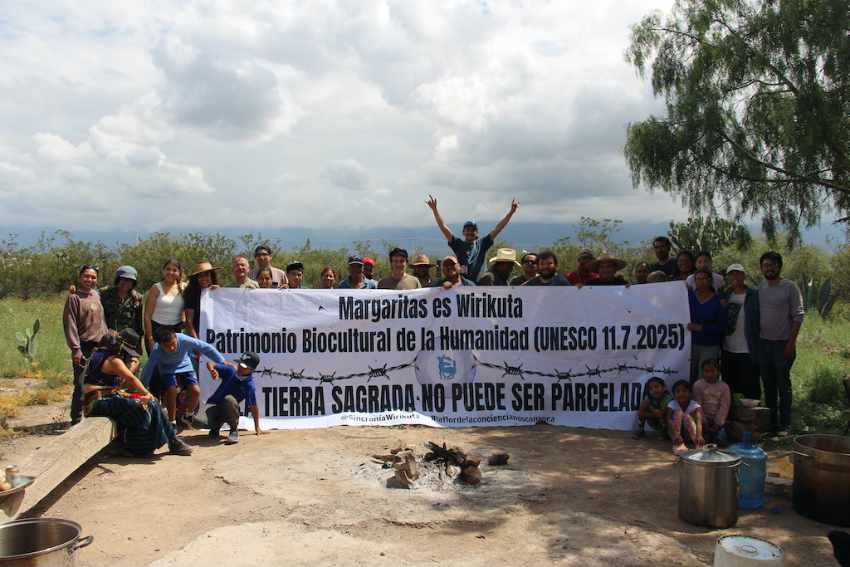
Thick clouds covered the unusually lush, green lands of San Luis Potosí as campesinos and their Wixárika guardians gathered at the edge of the barbed wire. Back home in their adobe kitchens, women prepared huge skillets of scrambled eggs, steaming pots of beans and warm, fresh tortillas. Those savory flavors of the Wirikuta region would be loaded onto the back of a pickup truck and carried down rocky roadsto feed about 200 who had come from near and far to stand in solidarity and witness history.
For three years, members of the Ejido Las Margaritas — located in the sacred desert known as Wirikuta — had resisted efforts to parcel and privatize their communal lands, known in Mexico as ejidos. In 2023, the government of former president Andrés Manuel López Obrador issued a decree that recognized and gave federal protection to all the sacred places and sites of the Wixárika, Náayeri, Odam or Audam and Mexikan peoples.
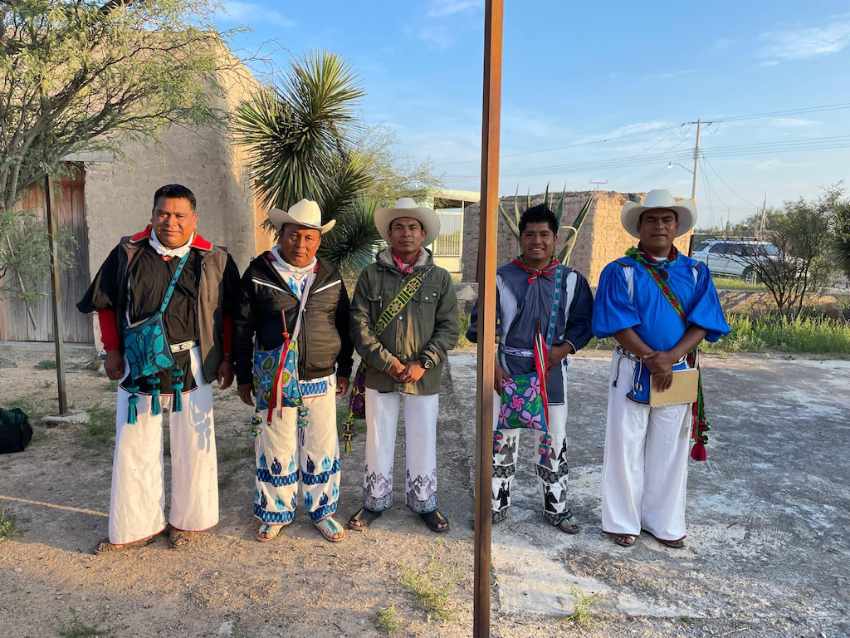
A delegation of Wixárika authorities from San Sebastián Teponahuaxtlán and Tuxpan de Bolaños, two sister communities in the Western Sierra Madre community of northern Jalisco.
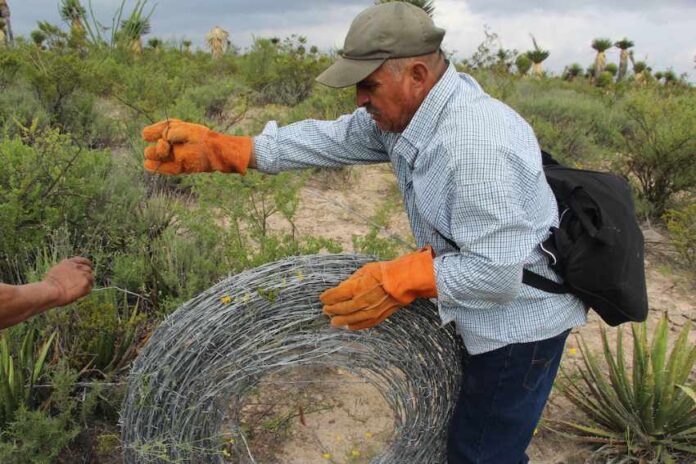
Recently, on Sept. 26, members of Ejido Las Margaritas took a decisive step: dismantling an illegally erected fence that threatened to fragment not only their territory but also a protected natural area and the Wixarika pilgrimage route through the desert, recognized just weeks ago by UNESCO as part of humanity’s world heritage. The fence had been put up by a group of ejido members who sought to subdivide and privatize part of the communal lands — a move others feared could open the door to agribusiness or mining interests rapidly expanding across the region.
With federal agrarian officials and human rights observers standing by, the men began loosening posts, rolling up the metal strands and carrying them off in measured bundles. But what unfolded that day was more than the removal of barbed wire. For the first time in Mexico, Article 59 of the Agrarian Law was invoked to defend ejido lands as a forest ecosystem, thanks to a scientific study recognizing desert plants like peyote, mezquites, nopales and creosote bush — known locally as gobernadora — as protected forest cover.
This unprecedented legal articulation — combining agrarian law, environmental law and Indigenous rights — set a national precedent.
As Jonathan Noyola, head of Mexico’s Agrarian Attorney’s Office, put it, “It is not an act of confrontation. It is the restoration of legality.”
The symbolism was potent.
“Taking down the fence is taking down the barbs that divide us,” said Marina Meza of Sincronía Wirikuta, a collective of activists from around the country working in defense of the sacred site. “So the deer can run, the rabbit can leap, the rattlesnake can pass — and so we can all walk in balance and peace.”
Locals young and old participated in removing posts and carefully dismantling the barbed wire fencing, which was turned over to local municipal officials.
The act of de-fencing
The people began to gather just after sunrise, in the golden light of the high desert, at the Casa Ejidal, a complex of adobe buildings in the center of the ejido. Coffee, pan dulce, gloves and wire cutters were shared, and gradually people gathered around the kiva-style amphitheater at the center.
Daniel Giménez Cacho, the award-winning Mexican actor who has advocated for the defense of Wirikuta for more than a decade, opened the circle, invoking God, the Sun and Kayumarie, the blue deer deity that guides the steps of the pilgrims who come to these lands in search of spiritual guidance. His presence underscored the gravity of what was to come. The round of introductions made clear the breadth of the gathering, which included:
Wixárika delegations from at least three communities in the high Sierra of Jalisco and Durango, for whom these desert plains are a sacred pilgrimage destination far from home.
Members of far-flung ejidos, some of whom had traveled for hours and slept on the bus to stand in solidarity, each with their own territorial struggles to share.
Land defenders from a collective called Guardians of the Sierra.
Officials from Mexico’s Agrarian Attorney’s Office — led by Noyola and accompanied by Dra. Beatriz Vera Castillo, who oversees the agency’s nationwide network of regional offices.
Representatives from the Interior Ministry (SEGOB), the National Institute of Indigenous Peoples (INPI), the Ministry of the Environment and Natural Resources (SEMARNAT), and the National Human Rights Commission (CNDH).
Delegates from the San Luis Potosí state government, the government of Catorce, a municipality that encompasses Las Magaritas and other ejidos in the area, and a pair of deputies from Mexico’s National Congress who had come to observe the proceedings.
Mauricio Guzmán, an environmental anthropologist from the Colegio de San Luis who brought his students, offering them a living lesson in Mexican democracy.
A team of diversely skilled organizers, documentarians and other professionals from Sincronía Wirikuta.
Then came the logistics. Tunuari Chávez, legal advisor for the ejidatarios (communal land owners) and Sincronía Wirikuta, laid out the action plan: The 5-kilometer fence, once dismantled, would be turned over to the municipal government. Roughly 60 ejidatarios and supporters would do the physical labor, while others would provide backup and document the process.
There was always the possibility of provocateurs showing up at the behest of those who had erected the barrier, but the plan was clear: De-escalate conflict and keep working. Such provocation had been made much less likely by the arrival of 11 Mexican National Guard units — about 66 soldiers in all — sent by the federal government to keep the peace.
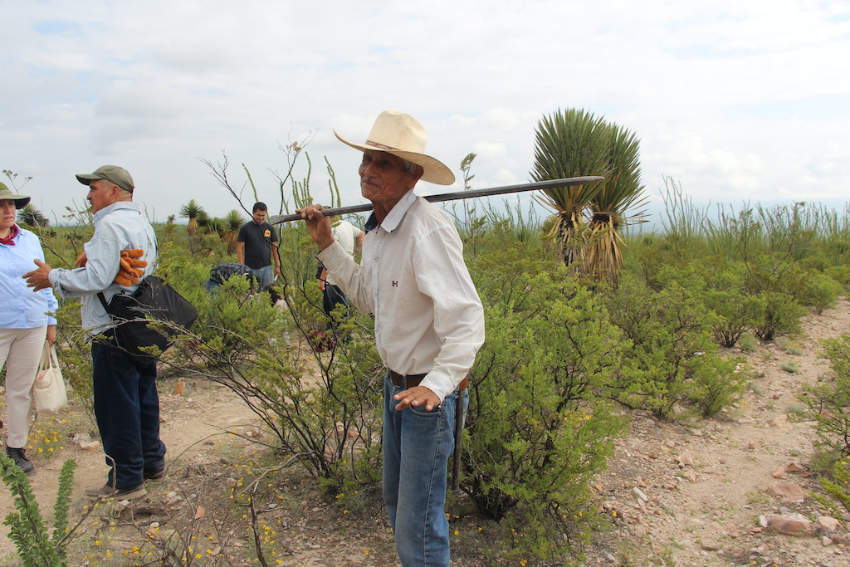
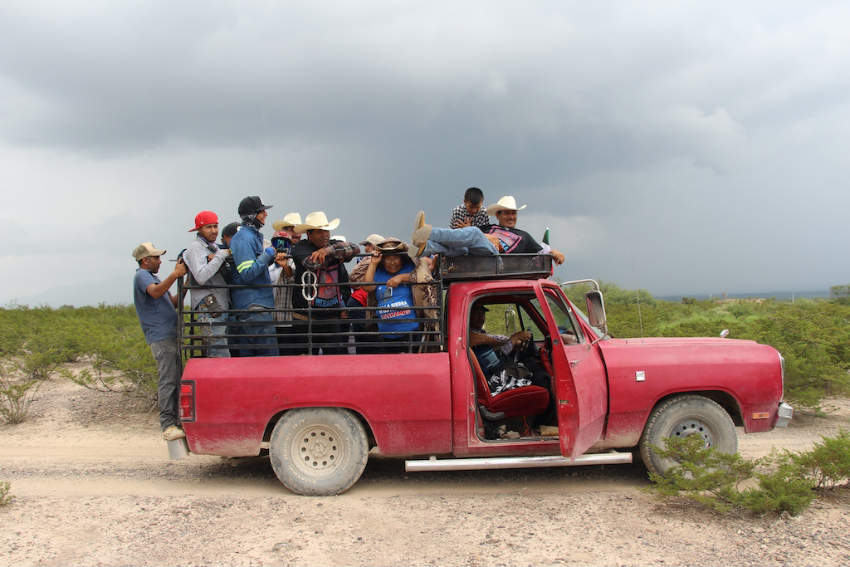
By the time the convoy of pickup trucks rolled out toward the disputed fields, the strategy was in place. A line of campesinos moved steadily along the wire, some prying posts from the rocky soil, others coiling the four rows of barbed strands, one by one, into neat bundles. It was the kind of work they had done all their lives — but this time, they weren’t just clearing land. They were reclaiming it.
By lunchtime, the wire and posts lay in orderly piles. Observers had seen no conflict. The work was carried out with discipline and restraint. As Chávez summed it up later: “We didn’t just take down a fence. We took down the walls between us.”
The legal breakthrough
The events in Las Margaritas represented far more than a local dispute resolved in the field. They signaled a new phase in Mexico’s approach to agrarian justice — one in which institutions, campesinos, and Indigenous peoples work side by side to restore legality to communal lands that have long been under pressure from privatization.
“Taking down the fence is taking down the barbs that divide us,” says Marina Meza of Sincronía Wirikuta, a collective of activists defending the sacred site.
“Most social movements,” Noyola explained, “are movements of resistance — they resist the economic forces that seek to take their land, their water, their environment. But here, the resistance itself went on the offensive. The Ejido Committee of Las Margaritas, supported by Wixárika communities, campesinos from other regions and environmental movements — and under the protection and accompaniment of the federal authorities — carried out an act of territorial reclamation. That happens very rarely, if ever.”
Beatriz Vera Castillo, who coordinates the agency’s national network of regional offices, described the action as a reaffirmation of Mexico’s communal property system.
“The ejidos and communal lands are the heart of the country,” she said. “More than half of Mexico’s territory is in their hands — that’s where our forests, biodiversity, and culture live. Preserving social property isn’t just important for those who live here, but for all Mexicans.”
For Chávez, who helped shape the legal strategy, the meaning was simpler.
“When the law and the heart walk on the same side, things change,” he said.
UNESCO, Indigenous rights, and an environmental siege
The victory at Las Margaritas resonated far beyond the ejido’s dusty boundaries. Just three months earlier, as UNESCO recognized the Wixárika pilgrimage route through Wirikuta as part of humanity’s world heritage — a symbolic safeguard for one of the most sacred and biodiverse deserts on Earth — threats were multiplying: industrial greenhouses, mining concessions, water extraction and fenced-off lands that cut through ceremonial and ecological corridors.
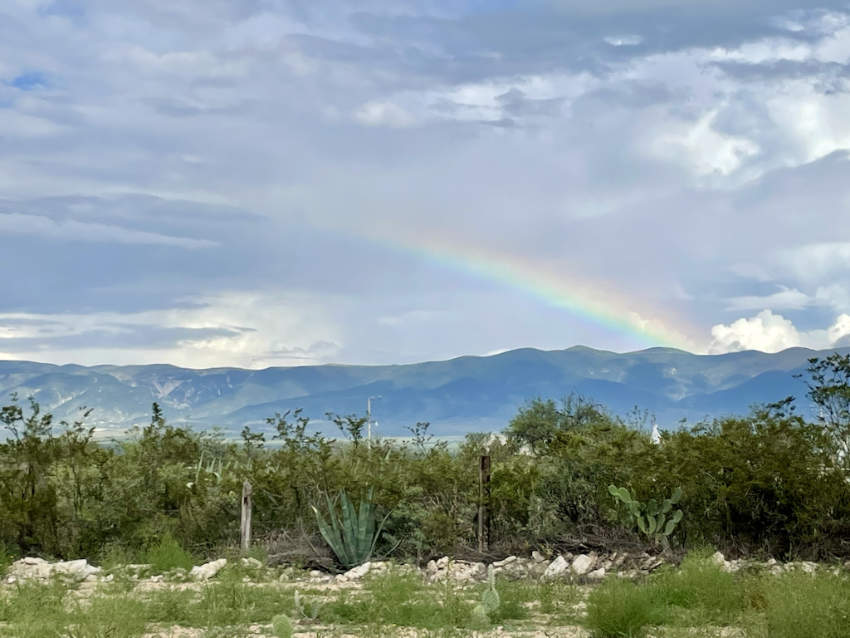
On the day after the de-fencing action, as volunteers washed the last dishes and cleared away the clutter, a rainbow appeared over the Sierra de Catorce, which many participants interpreted as a blessing for a job well done.
Guzmán said the struggle encapsulates a national dilemma between modernization and people’s right to exist.
“We could say that this case brings hope that the rights of both campesino and Indigenous communities will be respected and protected,” he said. “We’re not in an Indigenous community here, but the implications are broader — because modernization and development projects aren’t going to stop in this country. Quite the opposite: What we’re seeing are highways, railroads, all kinds of projects aimed at deeper territorial integration, and that will have an impact.
“The question is how to do this — what guarantees will there be? How can communities, even the smallest ranch or village, feel included in the decisions that affect them? Because that’s what’s at stake. I don’t think progress has to mean sacrificing these communities in the name of development.”
Giménez Cacho framed the day’s events as a glimpse of a different kind of civic and moral order — one in which public servants and citizens work together toward justice.
“I grew up in a culture where public officials were your adversaries,” he reflected. “… So today, to see public servants come here to uphold the law — it moved me deeply. A journalist asked me about utopias, and I told them, ‘In Mexico, for the law to be fulfilled — that’s the utopia.’”
The road ahead
A truckload of farmers from ejidos throughout the region came to stand in solidarity and lend a hand. Here, they had just finished with their assigned section of the first fence and were making their way to the second one.
By the closing circle on Sunday, tension had given way to quiet celebration. A core of allies and friends had stayed at the home of Eduardo “Lalo” Guzmán, ejidal treasurer, subsistence farmer and desert defender for decades, even though Guzmán was on a lecture tour in Europe, sharing the struggle of Wirikuta with more potential allies. Children played, women warmed the menudo and, finally, the group gathered as they had begun — around the fire in front of Lalo’s house.
All spoke with eloquence and passion, but Ricardo Peralta, the environmental educator and training coordinator who had been running the mobile kitchen with military precision, gave voice to the hopes of many.
“What we’ve witnessed these days — this synergy of people — is a clear message for all of Mexico. It’s proof of the beautiful things that can be achieved,” he said.
“For every Margaritas, may there be 10, 100, 1,000 more. May each one of them have that same strength, that same energy, that same love for the land — for life, for the people, for the animals, for the hills,” he added.
“What you achieved is historic,” Peralta said. “No one had ever managed to bring so many different actors together in one place — and you, the people of Margaritas, did it. Few have accomplished so much.”
Tracy L. Barnett is a freelance writer based in Guadalajara. She is the founder of The Esperanza Project, a bilingual magazine covering social change movements in the Americas.
A Mexico airport construction project took an unexpected turn when workers discovered a treasure trove of ice age fossils. (INAH)
The construction crews were in a hurry. López Obrador had just canceled the half-built Texcoco airport and entrusted the military to build what would become Felipe Ángeles International Airport (AIFA). However, there was one problem: Everywhere the crews dug, they turned up huge quantities of bones. Government archaeologists would have to be called in, slowing down an urgent infrastructure project. Little did they know, they had uncovered one of the richest Ice Age fossil sites in the world, an ancient treasure trove that would allow Mexican scientists to make remarkable discoveries about the country’s prehistoric past.
It started with a team of six archaeologists, but grew to more than 50 Instituto Nacional de Antropología e Historia (INAH) specialists overseeing a construction project that had turned into a massive archaeological dig. They eventually found over 70,000 fossils from ancient mammoths, camels, horses, giant ground sloths, dire wolves, deer and other ancient megafauna — including bits of at least 500 Columbian mammoths.
The mammoth discovery that was made in Mexico
Mexican scientists have sifted through more than 70,000 fossils from the Felipe Ángeles International Airport Discovery. (INAH)
When most people think of mammoths, they imagine a woolly mammoth. Furry and relatively compact, woolly mammoths were well-adapted to living in the icy northern reaches of the Americas. Columbian mammoths, on the other hand, could reach four meters (13 feet) at the shoulder and weighed up to 12 tons. They were the descendants of the first mammoths to reach the Americas over a million years ago, long before their woolly cousins arrived.
Occasional fossil finds confirmed that Columbian mammoths roamed as far south as modern-day Costa Rica. But since ancient DNA tends to degrade in warm climates, most of what is known about them comes from northern populations. Before the discovery of the AIFA fossils, the genetics and evolution of these tropical mammoths were largely a mystery.
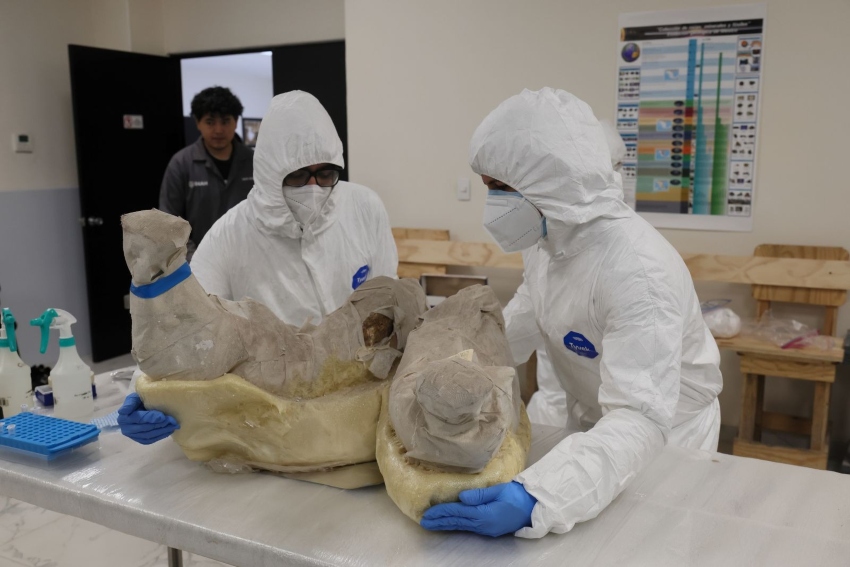
Access to the newly uncovered mammoth fossils was the opportunity of a lifetime for Mexican scientists, and they didn’t let it go to waste. A team of researchers from the National Autonomous University of Mexico (UNAM) began working to extract ancient DNA from the fossilized mammoth teeth found at AIFA and several more found nearby in Tultepec.
The difficulties of doing DNA analysis on fossils found in the tropics
Very little ancient DNA has been found in the tropics, and none has ever been recovered from tropical mammoths. The delicate strands of genetic material fall apart quickly in warm, moist settings. But the UNAM scientists had a couple of advantages on their side. The Basin of Mexico fossil sites were both over 2,000 meters above sea level, providing a cooler, drier climate than elsewhere in the tropics. Another plus: After being dug up and exposed to air, fossils naturally begin to degrade. But in this case, the scientists were able to access the fossils quickly while they were still relatively fresh.
Paleogeneticist Federico Sánchez, one of the researchers at UNAM, said the team confirmed that the fossilized teeth found at the sites belonged to Colombian mammoths based on their shape. After that, he told Mexico News Daily, the scientists began drilling out dental dust samples for DNA analysis. The first surprise was the amount of genetic material they found. Tens of thousands of years after the mammoths died, over 80% of the teeth still tested positive for DNA.
They worried the dental dust might have been contaminated. DNA fragments could have come from bacteria on a researcher’s hands or even a breath of air that touched the sample, so they compared it with known mammoth genetic material. Once again, the tests were positive. When Sánchez saw the results, he knew they had something very special on their hands.
A tagged fossil containing genetic material from the airport excavation site. (INAH)
How new information was unearthed about the Ice Age past of the Americas
“It took my breath away for a moment, because I hadn’t been sure that we were going to obtain endogenous mammoth DNA, and much less from so many individuals,” he said. “It was a very special moment.”
As they analyzed the DNA, the researchers found something unexpected. The Basin of Mexico mammoths were very different than their northern brethren. In fact, the northern Columbian mammoths appeared to be more closely related to woolly mammoths than to mammoths of their own species found in the Basin of Mexico. A likely explanation, Sánchez said, is that northern Columbian mammoths interbred with woolly mammoths. Colombian mammoths arrived in the Americas over 100,000 years before woolly mammoths, so some may have moved south before having a chance to get it on with their woolly northern cousins.
The scientists also found a high degree of genetic diversity within the Basin of Mexico mammoths, possible evidence of earlier hybridization between woolly mammoths, Columbian mammoths, and, even farther in the past, the ancient steppe mammoths of Eurasia.
New insights into the social lives of ancient mammoths
The analyses even provided hints about what the mammoths’ social lives might have looked like. In other areas, there are more male mammoth fossils than females, possibly due to males leaving behind matriarchal social groups to wander off on their own, then dying in natural traps like swamps or tar pits — typical behavior for elephants and related species. In Mexico, however, the genetic sex of the fossils showed an equal split between male and female. That suggests that the social groups stayed together, so males and females faced the same risk of dying and becoming fossils.
The results, now published in the prestigious scientific journal Science, are groundbreaking in more ways than one. It’s one of the first times scientists anywhere have extracted DNA from large animal fossils in the tropics, and the first genetic analysis of tropical mammoths. In total, the team found more Columbian mammoth DNA than every other previous study combined, a resource that scientists around the world can now use for their own studies.
It’s a relatively new field of study for Mexican scientists, who have long excelled in archeology but have less of a track record in ancient DNA studies … until now.
Mexican scientists were among the first to source genetic material from megafauna found in the tropics. (INAH)
Mexico’s first major megafauna genetics project
“It’s the first genetic study of megafauna in the country,” said María del Carmen Ávila, another UNAM senior researcher who worked on the study. “Having developed the technical capacity, human resources and infrastructure to do it here allows us to know more about our natural history.”
Another remarkable achievement was that much of the project was carried out by two ambitious undergraduate students. Ángeles Tavares Guzmán, who was studying biotech engineering, did most of the hands-on experimental work to extract the DNA. Eduardo Arrieta Donado, a genetics science student at the time the project started, did nearly all the evolutionary DNA analyses, Sánchez said. Together, Tavares and Arrieta are the lead authors on the article published in Science.
There’s still much to learn about the history of Columbian mammoths and the natural history of Mexico in general. However, thanks to this team of Mexican researchers, the country now has more tools than ever to tackle the problem.
Sánchez and other UNAM scientists are currently working to extract and analyze DNA from fossilized horses, camels, bison and deer uncovered during the construction of AIFA airport.
Studying the fossils of AIFA “has been a very thrilling and enriching experience from the start,” he said, “and we’re very excited for what’s coming next.”
Rose Egelhoff is a senior editor for Mexico News Daily.