Supporters of the bill celebrate in Oaxaca yesterday.
The Oaxaca Congress approved same-sex marriage after a heated debate on Wednesday.
The final vote was 25 in favor and 10 against, which came amid protests for and against by the LGBT community and evangelical Christians.
The bill removes the definition of marriage as a union exclusively between a man and a woman from the state’s Civil Code.
“Marriage is a civil contract celebrated between two people who unite in order to celebrate a life in common, and to provide each other with respect, equality and mutual help,” the Civil Code now reads.
Evangelical pastors and like-minded citizens gathered Wednesday morning to protest the amendment, showing their support for the “original design” of the family, composed of a man and a woman.
Opponents of same-sex marriage demonstrate in the Oaxaca capital.
The Brotherhood of Evangelical Pastors of the State of Oaxaca (Copaceo) accused the Chamber of Deputies of imposition for promoting and authorizing a law that was not put to public vote, in spite of the fact that they had requested such a vote as early as April 2.
Members of the LGBT community condemned the protest, considering it a type of hate speech. When the law was approved, however, they were jubilant, celebrating in the esplanade of the legislature in San Raymundo Jalpan, south of Oaxaca City.
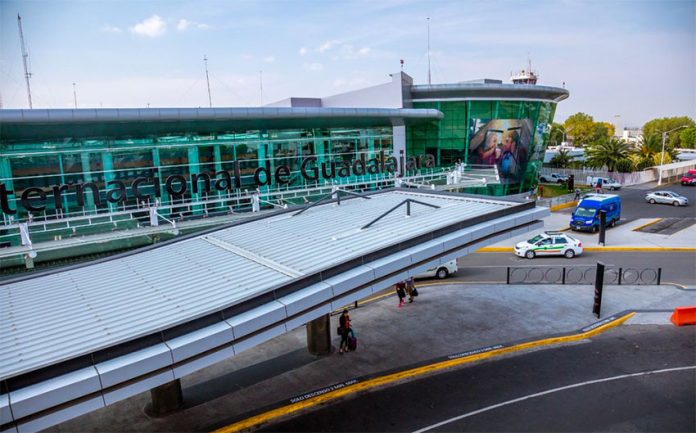
A long-running dispute over compensation for expropriated land will not prevent expansion at Guadalajara International Airport, the facility’s operator said, announcing that a second terminal and a new runway will go ahead.
Both will be built on land for which the airport operator already has a concession, circumventing the need to purchase it from community landowners engaged in the compensation dispute.
The Pacific Airport Group (GAP) presented a plan for the project to the federal Secretariat of Communications and Transportation (SCT) and pending approval, construction will begin in January. The project will be completed by 2025 at the latest.
Airport director Martín Pablo Zazueta Chávez said that the terminal and runway will be built on land included in a concession acquired by GAP 20 years ago.
“. . . We’re going to maximize the use of our lands and our concession,” he said.
“[The terminal] will have all the elements of modernity and cutting-edge technology. It will be a very functional building and will have the capacity to serve both national and international passengers,” Zazueta told the newspaper El Economista.
He explained that the second terminal will be accessed via a new, separate entrance. Having two terminals and a second runway will enable the airport to meet passenger demand for the next 25 years, Zazueta said.
He said construction will take place while the airport continues to operate but stressed that the builders and airport management will aim to minimize the impact of the work on passengers. However, Zazueta conceded that there are “complicated years” ahead.
The airport chief didn’t reveal how much the new terminal will cost, explaining that the price tag will be disclosed once the SCT gives the green light.
Construction of the new airport infrastructure was planned for a 137-hectare parcel of land owned by the community landowners of the El Zapote ejido (cooperative).
However, the landowners have refused to sell the land until they are paid compensation for 307 hectares of land that the federal government expropriated for the airport in 1951.
Their refusal to cede the land has held up plans to expand the airport in Mexico’s second largest city, where demand for airline services has more than tripled over the past two decades.
Zazueta said that when GAP began operating the airport 20 years ago, it handled about 4.3 million passengers annually.
Last year, 14.35 million people used the airport while in 2019 the number of passengers is expected to exceed 15 million for the first time.
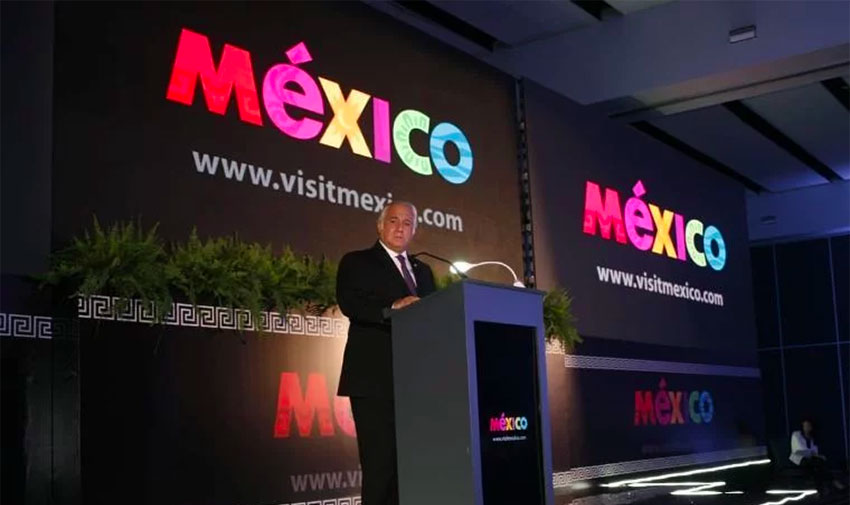
The Visit México tourism promotion platform has been relaunched with private sector funding.
Over the next five years, business will invest an estimated 1.8 billion pesos (US $90 million) in the website, which was previously administered by the now-defunct Tourism Promotion Council.
Tourism Secretary Miguel Torruco told a relaunch event yesterday that “not a peso” of public money will go to the site thanks to an agreement struck with the private sector.
The platform’s managers will seek additional investment from tourism service providers and a range of national and international partners, he said.
Google, Discovery Channel and hotel company Grupo Posadas have already committed to investing in the website, while the government’s Tourism Diplomacy Council will collaborate with the private sector on the digital marketing strategy for Mexico’s tourism sector.
Tourism Secretary Torruco announces new funding plan.
The strategy will be led by businessman Marcos Achar, who is the new chief of the platform.
In May, Achar and his business partners acquired the digital marketing company Braintivity, which previously had a contract with the Secretariat of Tourism (Sectur).
The updated Visit México site features pages for each of Mexico’s 31 states and the capital. Each page contains information about local destinations and attractions. Tourism companies will be able to offer their products and services to potential visitors.
Among the articles that are currently on the state-based pages are: Try the Lobster Tacos and other Rosarito Delights (Baja California); Breathe in the Fresh Air of the Chapultepec Forest (Mexico City); and Rejuvenate Yourself in the Ruins of Mitla (Oaxaca).
Information is available in 10 languages: Spanish, English, Russian, Portuguese, German, French, Italian, Japanese, Korean and Chinese.
Sectur said on Twitter that the new site has three main aims: digitalization and modernization of the tourism industry, promotion based on data and the attraction of more tourists through the provision of better information and more content.
Speaking at yesterday’s event, Achar stressed that the Visit México brand remains the property of the government but added that tourism companies, states and municipalities will now be able to make greater use of it.
He predicted that Mexico’s tourism industry will go from strength to strength as a result.
The tourism sector currently contributes about 9% of national GDP but to grow that figure, Achar contended that Mexico has to attract and receive visitors with offerings beyond tequila and mariachi.
Mexico managed to avoid international sanctions for not taking more significant action to protect the vaquita marina porpoise in the northern Gulf of California.
However, after negotiations with the United States, China and Liberia in Geneva, Switzerland, the Mexican government was able to ease the measures of an ultimatum set by the secretary-general of the Convention on International Trade in Endangered Species (CITES).
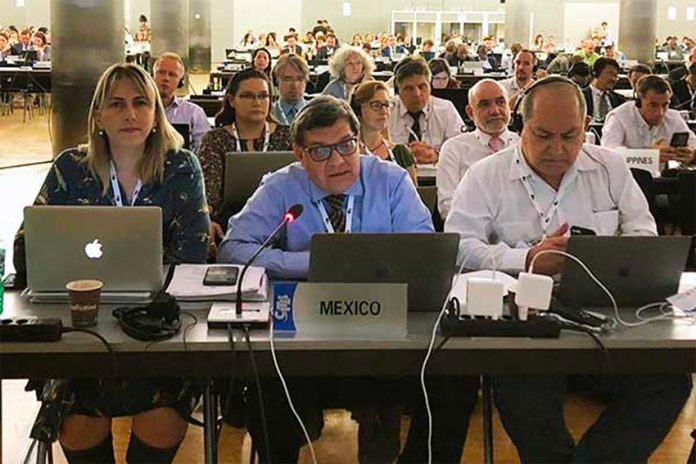
Head of the federal environmental protection agency (Profepa), Blanca Mendoza Vera, promised the 183 member countries that her office would turn in reports every six months detailing the efforts taken to protect the vaquita and the totoaba, which is also endangered.
In exchange, the document was modified to exclude the warning that the export of Mexican species on the CITES list will be suspended if it continues uncontrolled poaching in the vaquita’s habitat. Such products include shark fins, bighorn sheep hunting trophies and mahogany wood.
The change in the text, however, does not mean that Mexico no longer runs the risk of commercial sanctions from the international community. It will have to show improvement in its efforts by next year’s meeting.
Mendoza had previously offered the assembly a report of Mexico’s actions in the region which were primarily the results of actions carried out by the previous government.
Mendoza also lamented the difficulties in prosecuting totoaba poachers. She noted that from January until July, 249 people had been brought before the federal prosecutor’s office for poaching, but only 33 were punished.
The totoaba is highly prized in China for its swim bladder, making it pound-for-pound more expensive than cocaine.
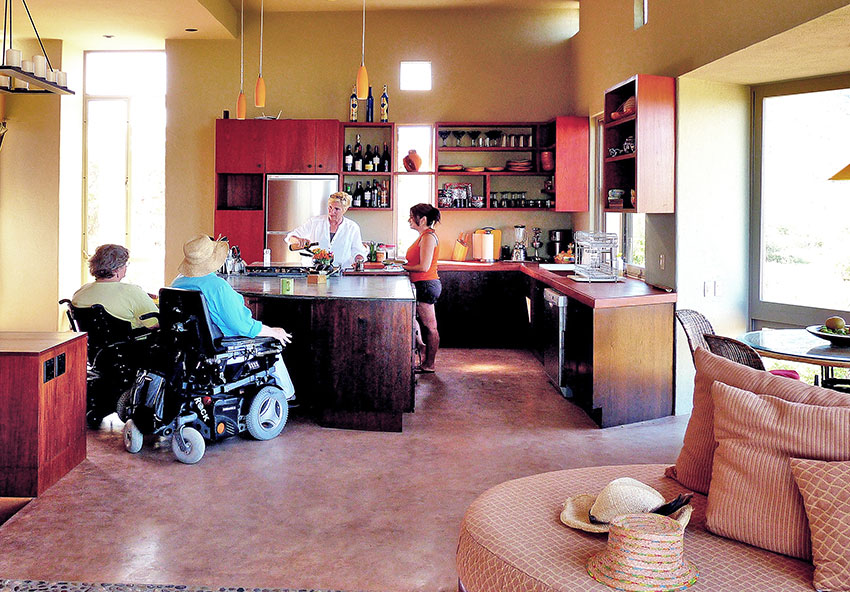
Casa Cabo Pulmo, a universally-designed home in Baja California Sur.
A house in Baja California Sur that incorporates accessibility without sacrificing aesthetics is an award winner in a competition for universal design.
As part of an initiative called “Accessibility is Beautiful,” the U.S.-based Cerebral Palsy Foundation, in collaboration with the American Institute of Architects New York chapter, put out a call in 2018 for universally designed homes.
From a series of entries, a steering committee looked for homes that would highlight how accessibility can be both functional and fashionable, and then created a Lookbook and mini-YouTube series to promote the selected designs to the public.
One of those entries was Casa Cabo Pulmo by Cathi and Steven House of San Francisco-based House + House architects, a home that incorporates universal design and accessibility in the far reaches of the Baja Peninsula — where land meets sea, and soulful meets utilitarian.
The Casa Cabo Pulmo story stretches back several years to San Francisco where fellow Californians Patricia Wright and Debra Zeyen had often admired the home of a friend designed by House + House. When they came across another House + House-designed home in Mexico, it felt like destiny.
Plenty of room for wheelchairs at Casa Cabo Pulmo.
The two asked the husband and wife team to build their dream home near Baja California’s most southern tip, but with a caveat — they wanted it 100% accessible.
Cathi and Steven House opened their architectural firm in San Francisco in 1982 and added an office in San Miguel de Allende 25 years ago. They have since designed more than 250 homes in four countries.
The two spend several months of the year traveling in Mexico and beyond investigating, in their own words, “what people build when there are no architects around.” Prioritizing indigenous architecture and local building materials gives House + House structures a sense of place that is integrated into their very fiber.
“Underneath all of our work is a very organic beginning,” says Cathi House. “We work very hard to make sure that everything we do comes from a complete understanding of the sun, the moon, stars, the breezes, the views, the shadows, and everything about a particular spot on Earth that could contribute in a positive or negative way to whatever you might design there.”
Casa Cabo Pulmo, with its bold desert hues, expansive cactus garden and sections of palapa roof, invokes that connection to the land. But the house is also deeply connected to the very real needs of its occupants.
Patricia Wright is a disability-rights activist who was instrumental in the passage of the Americans With Disabilities Act. Wright herself is visually impaired and both she and Zeyen could foresee a day when they might have mobility or other serious disabilities.
The ramp to the second floor.
So they wanted a 100% accessible house so they could, in Wright’s words, “age in place.”
House + House has been incorporating accessibility into its designs for decades. Casa Cabo Pulmo was a challenge the firm welcomed.
“Dividing people into those who are mobile and those who are not — or people who have abilities and others who have disabilities — that kind of division is part of what I think is wrong with our culture as a whole,” says Cathi House, “We’re not holistic enough to think about humanity and all of the needs of the people that might come in to this house or any house”
Plus, she adds, universal design isn’t just for the permanently disabled.
“Something can always happen in your life. You break a leg, you start to develop vision or hearing problems. It can even be as simple as . . . taking a shower and you’re all soapy and you hear a crash and a scream in the other room. You try to get through the door, but you have a round doorknob and can’t get a grip. So are you really disabled at that point? Well, yes, because of poor design.”
The Cabo Pulmo house has some logical elements one might expect in a universally-designed home — a 50-meter ramp leading to the second floor that sweeps up one side of the property, providing incredible ocean views as well an extension of the house’s gardens, kitchen spaces and hallways wide enough for a wheelchair, and lifts for getting in and out of the shower and bed.
Casa Cabo Pulmo is solar-powered and has a rainwater catchment system.
But there are also smaller, intimate details that, unless you have lived with a disability, you might not have considered – sinks are lower with space underneath for a wheelchair, light switches are lower, outlets are higher, doors have zero thresholds and toilets have 180-degree access.
And, in Casa Cabo Pulmo, each of these elements is incorporated so as not to detract from the natural flow of the living spaces.
The design doesn’t only consider the future of the owners, but also owners of the future. The house is completely off the grid with 12 solar panels and battery back-up as well as a rainwater catchment system, convection skylights, and a layout that moderates the extreme temperature highs and lows of the Mexican desert.
“Buildings will be around for a few hundred years,” says Cathi House. “You want to make sure what you create is worthy, not just for the clients of the moment, but for anyone who might ever come to be in these buildings.”
As U.S. baby-boomers arrive at an age when accessibility is vital for continued independence, the demand for universal design is slowly growing, and yet it often remains an afterthought in the design of public and private spaces.
Do the architects believe universal design is part of the architectural lexicon these days? The couple hosts groups of architecture students from around the world each year at their school in San Miguel de Allende — The Center for Architecture Sustainability + Art (CASA) — where universal design is part of the curriculum
Architects Steven and Cathi House.
“I don’t think it’s being taught in universities the way it should be; I don’t think it’s even a conversation that they’re having at any significant level,” says Cathi House.
“But we certainly talk to our students about it,” says Steven House. “The younger they are when they start thinking about it, the more hope we have for the future, that it will just become natural and integrated into everyone’s thought process.”
In the meantime, programs like the Accessibility is Beautiful initiative are shining a spotlight on integrated design that proves accessibility doesn’t have to mean giving up on aesthetics.
Casa Cabo Pulmo is a standing example of how a beautiful space in a stunning environment can be welcoming to any guest, regardless of ability.
The writer is a Mexico City freelancer and regular contributor to Mexico News Daily.
Mexico City’s overweight cops — and more than half are classified as such — will be able to earn a cash bonus if they shed some kilos.
Through the Healthy Police program, the Mexico City Citizen Security Secretariat (SSC) will offer economic incentives to officers who improve their physical health in different ways, including weight loss.
Over the past five weeks, 1,820 officers who were candidates for the program went through a series of physical and medical tests to see if they qualify for the bonus of 10,000 pesos (US $500). Once the beneficiaries are chosen, the bonuses will be paid out over five months.
Alejandra Ramírez, subdirector of police research and development for the SSC, said that being in top physical shape is important for police to be able to do their jobs.
“On the street, police officers face a lot of stress, which pushes them towards having bad dietary habits,” she told the newspaper El Universal. “Sometimes it’s easier to buy a quesadilla or a torta than to find a place where you can eat a sit-down meal.”
The program has funding to cover 1,200 officers, and it is likely that applications will be reopened in the future.
Of Mexico City’s 4,279 police officers, 2,453 are overweight and 1,826 are obese.
Ramírez said the goal of the program is to encourage officers to develop healthy habits over the period during which they receive the bonus, and to help them improve their diets with the extra money.
She added that many of the officers who signed up for the program believed that they were overweight, but after going through medical tests were found to have a healthy body weight and were removed from eligibility.
“Psychological health is also fundamental,” said Ramírez. “It has a lot to do with the state they’re in, what kind of stress they’re in, whether or not they’ll be able to start another diet. It might be complicated, but we’ll be holding their hands through the process.”
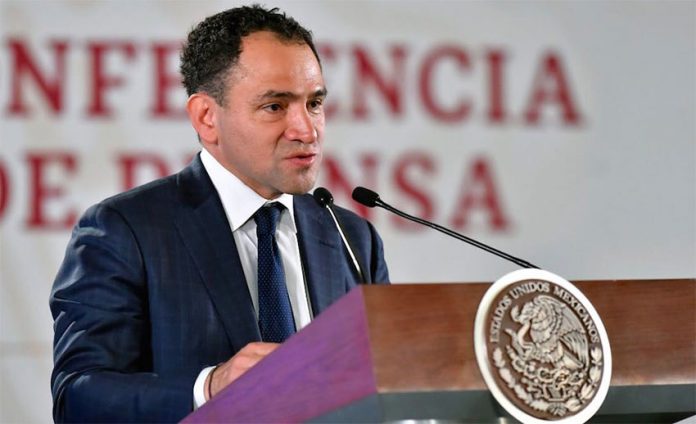
Finance Secretary Herrera announces new commission.
The federal government has reached an agreement with Mexico’s 10 pension funds that will reduce commissions and give a person entering the workforce today 10% more upon retirement.
The deal will see the commissions that workers pay reduced to 0.7% of their pension balance by the end of the government’s six-year term, Finance Secretary Arturo Herrera told reporters at the president’s Wednesday press conference.
“During the present administration, around 100 billion pesos [US $5 billion] will no longer remain with the pension funds but will go to workers’ accounts. This means that if a worker joins the workforce today, his pension will be 10% greater,” he said.
Herrera said that in 2008, pension funds were charging average commissions of 1.89% but that figure declined gradually over 10 years to 1.01% in 2018.
This year, during the administration of the new government, average commissions dipped below the 1% barrier for the first time to 0.98%, the finance secretary said.
“This decline of three basis points seems very little but it means almost 10 billion extra pesos in workers’ savings . . .” Herrera said.
He predicted that commissions could go as low as 0.63% in the coming years, which would be below the international standard of 0.7%.
Bernardo González, president of the Mexican Association of Pension Funds (Amafore), said that commissions have gone down by more than 90% since 1997, and that the funds have generated average annual returns for workers of 11% in nominal terms and 5% in real terms.
He said that the association supports the proposal to improve workers’ pensions.
“The pension funds join [the efforts] to achieve a pension system with international standards that benefits Mexican workers,” González said.
He added that Amafore is in favor of the implementation of a pension system reform to ensure that workers retire with pensions equivalent to 70% of their final salary.
According to data from the National Commission for the Pension System, the fund with the lowest commission rate in 2019 is the government-run Pensionissste, which charges state workers 0.82%.
Inbursa charges the next lowest commission rate – 0.95% – followed by Citibanamex and Banorte, both of which charge 0.96%. Azteca, Coppel, Invercap and Principal charge the joint highest commission rate of 1.04%.
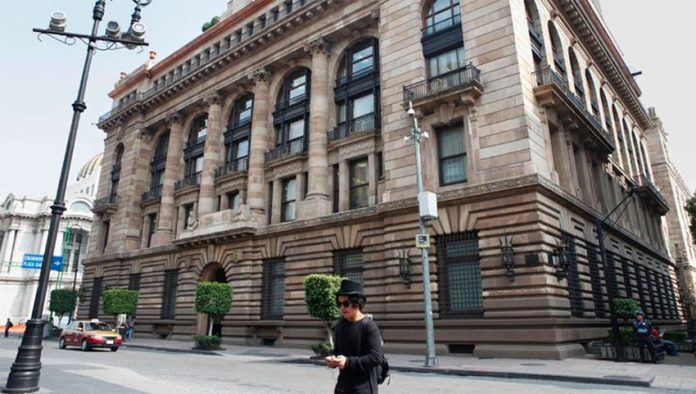
The Bank of México wielded a machete in its latest forecast.
The central bank has picked up a machete and lopped off a good part of its previous 2019 economic growth forecast.
The Bank of México (Banxico) on Wednesday cut its growth outlook to a range between 0.2% and 0.7% from the 0.8% to 1.8% GDP expansion it predicted in May.
Banxico said in its second-quarter report that its downward revision was the result of data released by the statistics agency Inegi last week that showed that growth was 0.0% between April and June – 0.1% less than previously reported – as well as more modest forecasts for industrial production in the United States and oil production in Mexico.
The Inegi data indicates a greater weakening of domestic demand than previously anticipated, the bank said.
It is the fifth time that Banxico has cut its outlook for 2019 since it predicted growth of between 2.2% and 3.2% in November 2017. Further downward revisions came in August and November of 2018 and February and May this year.
The central bank also cut its 2020 growth outlook on Wednesday to between 1.5% and 2.5% from a range of 1.7% to 2.7%.
Banxico predicted the creation of between 450,000 and 550,000 formal sector jobs this year, a reduction of 80,000 at both ends of the range compared to its previous report.
The bank cut its inflation rate outlook to 3.2% for the end of the year and predicted that price pressures will continue to decline during the next four quarters.
The downward revisions to both growth and inflation outlooks could lead to another reduction in interest rates, which the Bank of México cut for the first time in five years this month, citing slowing economic growth and lower inflation.
Many analysts said they expected the bank to make a further cut or cuts to the current rate of 8% before the end of the year.
A modified pickup becomes a 'narco-tank.' Sign on the back identifies the vehicle as belong to La Tropa del Infierno, or Hell's Army.
Security forces in Nuevo Laredo, Tamaulipas, were able to hold off two attacks by criminal groups on Tuesday night.
As many as 12 suspected criminals died after two separate attempted ambushes of police and soldiers in the border city.
In the first attack, gunmen aboard a pickup truck with Texas license plates attacked an elite unit of Tamaulipas state police near the Nuevo Laredo airport. Seven of the aggressors were killed in the ensuing confrontation.
Police suffered no casualties, but an innocent bystander was wounded by a gunshot.
The second attack took place at an army barracks which was followed by a car chase in which state police supported the military. Five of the attackers were killed.
The criminal organization presumed to be responsible for the attacks identified itself as the Tropa del Infierno (Hell’s Army), an armed wing of the Northeast Cartel, a Zetas splinter group.
Anonymous sources told reporters that the leader of the Northeast Cartel, Juan Gerardo Treviño Chávez, was among those killed but the information has not been confirmed by officials.
According to local media, the Tropa del Infierno sent a message to authorities claiming responsibility for an attack last week on a hotel in Nuevo Laredo in which a police officer was killed and two others were wounded.
“To all the tricky state police who have come to Nuevo Laredo, we made it clear with what we did to you yesterday,” the message read.
Later on Tuesday, families including women and children protested at a hotel where state police were staying to protest abuses by the officers. The protesters threatened to burn vehicles that were parked at the hotel.
A good friend of mine gave me a book for my birthday this year called Sapiens: A Brief History of Humankind (Harari, 2015). She added a kind and brilliant note on the first page: “I hope that in your darkest and strangest moments, you can understand that we are only apes.”
I only got the book a couple of days ago but haven’t been able to put it down. The gist of the first section is a reminder — and we humans do need to be reminded often — that we are animals, first and foremost — that share this planet with all other living things. For better or worse, we manipulate the world around us at our and all others’ peril.
Though we’re not sure why or how, our already-large brains very suddenly got smarter in what the author calls the Cognitive Revolution starting some 200,000 years ago, propelling us to become the rulers of the earth despite the physical disadvantages which should have kept us squarely in the middle of the food chain.
We rule now as a species — predictably, perhaps, inevitably — as any newly anointed 9-year-old boy-king would. Our intention is to be good, but our big brains are great at inventing things, not dealing with the consequences of those inventions.
During our 200,000-year reign, humans have rained disaster on the planet and all its creatures large and small. Most recently our big brains have brought us global warming. Despite our precociousness, we don’t seem to have the ability to make wise decisions.
For an excellent mediation on this, read Daniel Quinn’s novel, Ishmael (1992).
But this is a column of hope, not of shoulder-shrugging surrender. I believe in our ability to get better. After all, what’s the alternative? “Everything is awful, so let’s just keep on making it awful!” is no way to live.
So, hear me out, folks. Some societies have had worse problems than Mexico and solved them. Famine, environmental degradation, war, genocide, the rule of organized crime can be remedied. We can pull it off, too.
Hope keeps me mulling over solutions radical or silly. These are desperate times requiring desperate measures. Here are some thoughts on what is being or could be done to blunt the impact of our greed, apathy and poor decision making:
The environment must take priority. I’ve been heartened to see Mexico taking steps to make care and stewardship of the environment of preeminent importance. Single-use plastic and Styrofoam are on the way out, more efficient and cleaner water distribution systems are being tested, and students and innovators from all over are finding ways to reduce the hurt we inflict on our environment.
For these efforts, Mexico — indeed, all countries — must adopt an “all-hands-on-deck” approach, ensuring that funds and resources available to these endeavors are tantamount to their importance. To continue to live on this planet some key puzzle pieces need to fall into place to ensure our survival.
All politicians and public servants should take a vow of lifetime relative poverty. Look, being a politician is a job of service. We can’t move forward on our goals when the stewards of our institutions are corrupt.
I’m not against people earning and having money. But when politicians have million-dollar condos in the U.S. but there isn’t medicine, updated equipment, or even soap in the bathrooms at public hospitals and schools, something is deeply wrong. Perhaps a salary tied to the median wage would weed out those whose wish to benefit financially from a position of power that trumps the need to be of service to the citizens whose needs they represent.
All politicians and people in charge of the Public Education Secretariat (SEP) must send their own children to public schools. Imagine how much they’d improve if those in charge of this institution had a vested, personal interest in making sure they were of the highest possible quality?
Police and Civil Protection must be selected, trained and paid like professionals. Police are asked to put their lives on the line for everyone that might require protection.
My husband once went to Amsterdam, had a few too many bites of a “space cake,” and with his friend, wound up sleeping on a bench in the park when they couldn’t find a hotel room. A police officer approached them, not to tell them to scram, but to make sure they were all right. This is what police are supposed to do. Their No. 1 job is to protect average citizens.
People must be paid fair wages tied to the cost of living. Most criminals are not criminals because they’ve made a hobby of destabilizing society. People are naturally cooperative creatures, and we want to be of use to our families and our communities. When we can’t find an appropriate place for ourselves, we’ll usually find an inappropriate one. Let’s make it easier for people to find a dignified place in society.
I want my daughter’s teacher to be making 40,000 pesos a month, not 8,000 a month. I want garbage collectors to be making good money — where would we be without them? I want doctors, nurses, administrators and janitorial staff at hospitals to live solid middle-class lifestyles.
The jobs we do are important in different ways, but they’re all important and our ability to have decent lives should reflect that. Mexico does have the money to make this happen. It’s not a problem of quantity; it’s a matter of honesty — the opposite of corruption — and distribution of wealth.
To accomplish all of this, we might need to temporarily “outsource” oversight to an impartial international body. There’s no shame in asking for help. When a marriage is in trouble, counselors are sought. Getting help is the wise thing to do if solutions are to be found.
We humans can tell stories. We can be creative. We can set a structure in place and follow it. I believe in the possibility of wisdom and transcendence. We have made ourselves the gods of this world. Now it’s time to step up and save it and ourselves.
Sarah DeVries writes from her home in Xalapa, Veracruz.